Bird Songs and Sounds

Birds are famous for their beautiful plumage, but their songs and sounds are just as much a part of their identity and day-to-day life.

Video from Petersonfieldguides on YouTube


Back to the Peterson Field Guide Video Series

“Bird Songs and Sounds” Video is from petersonfieldguides at YouTubeBack to the Peterson Field Guide Video Series

Day Five at the Space Coast Birding Festival

We had another great day at the Space Coast Birding Festival which ends tomorrow, Jan 26th. We are home now, but they continue on without us.

Dawn, Jeff and Me

Dawn, Jeff and Me

Met up with Dawn and Jeff several times again today. She does Dawn’s Bloggy Blog. Then off to some more workshops. First off was Reinier Munguia’s, “Bird ID for Kids” to help with some upcoming lessons with kids. Reinier was still not up to normal, so he let his daughter do the presentation. She is a 9th grader and did a  fantastic job. She has been in the field with her dad since she was 3 months old, straped on her father’s back.

In the afternoon it was “Taking the Fear Out of Identifying Gulls” by Alvaro Jaramillo of Field Guides, Inc. He did another great presentation and again I picked up some great information.

By the time that ended, I was in “information overload.” With all the workshops and seminars, birding, plus walking around the exhibits and chatting for the past few days, I was ready for “home.” So was Dan. When we did get home, a 90 mile drive, we found that the cold weather we have been having did “a number” on a few of the plants in the yard. Checked the outdoor temperature and it had gotten down to 26 degrees. We weren’t here to cover the plants. The ones in pots were okay because we had set them in the carport before leaving. Would I go again, You Bet!!!

Birds of the Bible – The Bird Feeder I

While thinking about bird feeders and how birds approach them to eat, I started comparing that to how we approach the Word of God.

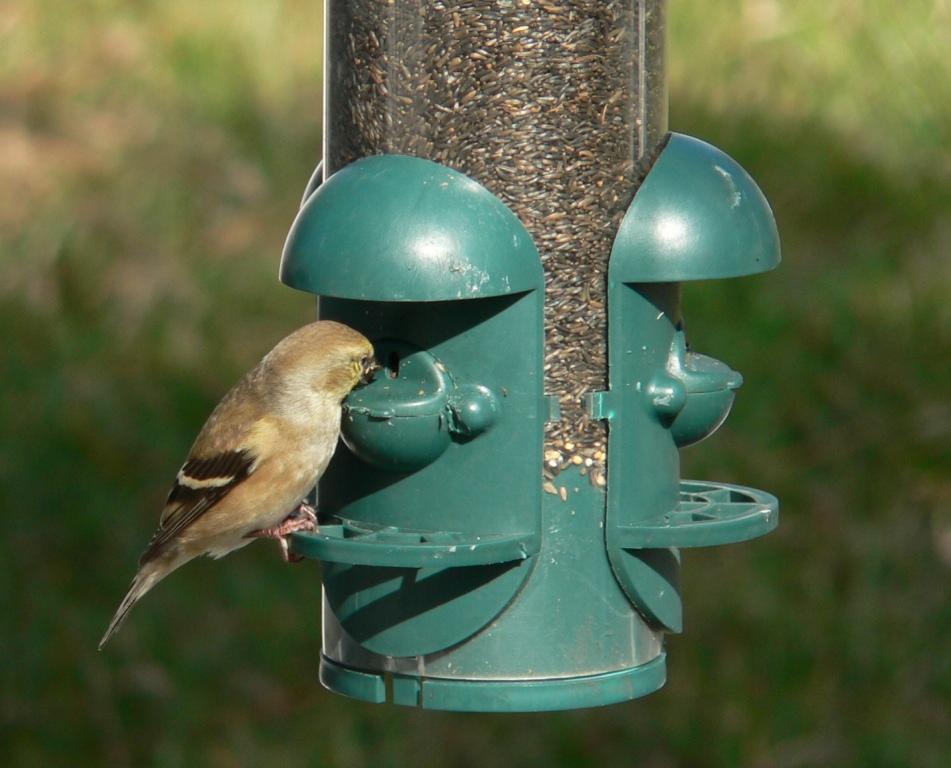
Goldfinch on Feeder

As newborn babes, desire the sincere milk of the word, that ye may grow thereby: (1Pe 2:2)
Thy word is very pure: therefore thy servant loveth it. (Psa 119:140)
I rejoice at thy word, as one that findeth great spoil. (Psa 119:162)
Thy word is a lamp unto my feet, and a light unto my path. (Psa 119:105)
How sweet are thy words unto my taste! yea, sweeter than honey to my mouth! (Psa 119:103)

Here are some of my thought about birds at my feeders:
Hummingbird Feeders (Hummingbirds and Orioles)

Hummer at Feeder, Camp Carlson, KY

Hummer at Feeder, Camp Carlson, KY

  • Defend It – could be protictive of the Word or keep chasing off others and become distracted.
  • Share It (sometimes) – Found nutrition and wants to share it
  • Drink on the Wing – In a hurry, made that way
  • Sit Sometimes – Enjoy it and reflect
  • Keep Returning Often – Can’t get enough, or realzes that it’s worth returning to often, needs it to live.
  • Deep Drink or Sip In-and-out – Long reading or get ‘N’ go)

Suet Feeders (Woodpeckers, Titmice, Nuthatches, etc

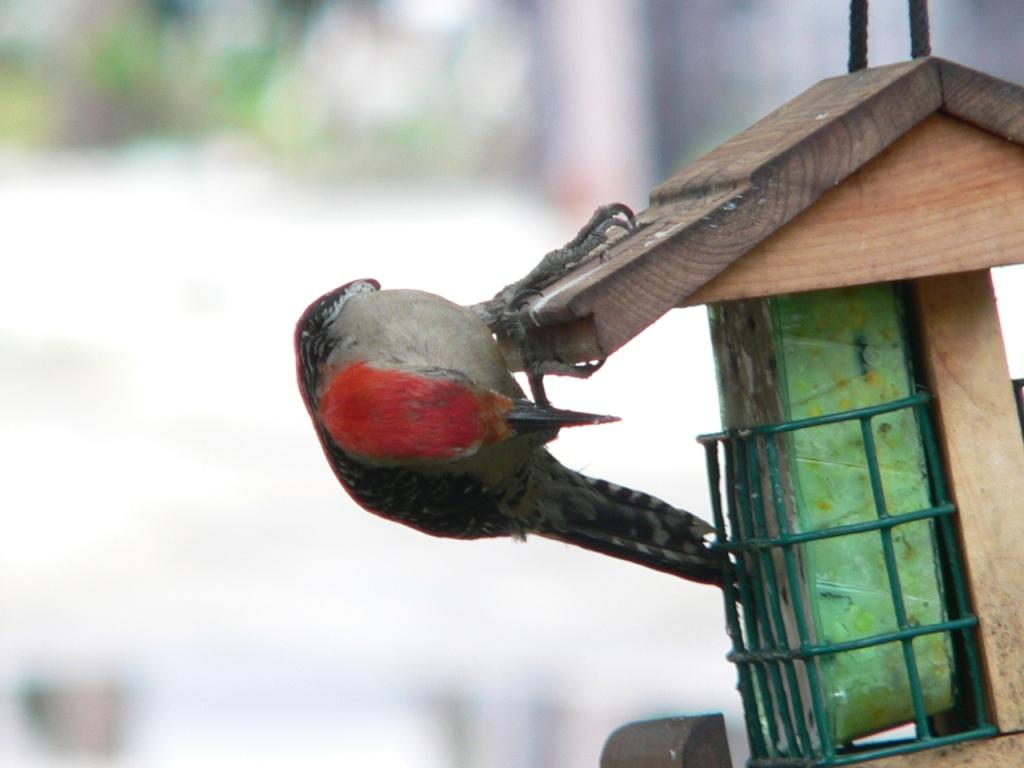
Red-bellied Woodpecker on Suet Feeder 

Red-bellied Woodpecker on Suet Feeder

  • Cling to it – (no landing perch) Hangs on to it
  • Hang On It – even upside down – From different angles, study word, checking all verses

Regular Feeders (Most birds)

  • Some eat until stuffed (Doves)
  • Some take one piece and fly off
  • Some stuff seed in crop and go feed others
  • Some chase others away – even if not eating themselves
  • Some crowd in and push others away
  • Some pick and choose – just want part of Word or sermons
  • Some throw seed to the ground in their search
  • Some wait underneath to get scraps (ground feeders) – Consider it “food from Above”

The law of the LORD is perfect, converting the soul: the testimony of the LORD is sure, making wise the simple. The statutes of the LORD are right, rejoicing the heart: the commandment of the LORD is pure, enlightening the eyes. The fear of the LORD is clean, enduring forever: the judgments of the LORD are true and righteous altogether. More to be desired are they than gold, yea, than much fine gold: sweeter also than honey and the honeycomb. Moreover by them is thy servant warned: and in keeping of them there is great reward. (Psa 19:7-11 KJV)

All pictures taken by Dan.


Birdwatching Tips – ID Body Parts

About.Com has some very good information on it about Birds. Today I received a newsletter giving help identifying the different parts of the bird. They were using the Passerines. The “passerines are mostly small land birds and include many familiar types of species such as flycatchers, thrushes, sparrows, and warblers. They are sometimes called songbirds because many passerine species display complex vocal behaviors, and they are sometimes called perching birds because their enlarged flexible hind toe (the hallux) allows for perching on top of vegetation and other structures.” (About.Com)
This article was worth passing on for you to view. Please check it out.
Passerine Identification

Birdwatching Tips #2

Making List of Your Birdwatching Adventures
Many people keep list of the things they see and hear while out birdwatching. There are several kinds of list you might want to consider starting.

Life List
This is a list of all the birds species you have seen or heard. The sound of a bird you heard is acceptable in lists (if you can figure out what you heard or recorded.) It is good to get a date and location of the first sighting of each new bird.

Trip Lists
I also keep a birding list when I go birdwatching. If we go to Lake Hollingsworth or Merritt Island NWR, I keep a list of that outing. I list all the birds I see or hear at that place. Like the other lists given here, I put the date, location, weather condition (sunny, overcast, windy, etc) time and whatever else is important. Sort of like a combined list and field note. It is my way of doing it. I then enter each trips list at ebird.com. (I’ll explain that in another blog post.)

Keeping Field Notes
These are your impressions of the bird as you observe it. You could describe it in words, sketches, colored pens, etc. to help identify the bird later. When you are at home with your reference guides, these notes will help to figure out which bird you saw and nail the ID.Your first impression of the bird’s size, proportions, colors and markings, bills, leg color, what the bird is doing, song or sounds, and the habitat, plus a sketch can all be helpful later.
Keeping a Bird-Watching Journal
The Journal differs from Field Notes in that it is less technical and more your impressions of the whole experience of watching the birds. Along with the date and location, you can detail the weather, the surroundings, what you think the bird is doing in more personal terms, how that makes you feel, etc.
Keeping a Birds of the Bible List or Journal

Study to show thyself approved unto God, a workman that needeth not to be ashamed, rightly dividing the word of truth. (2 Timothy 2:15 KJV)

Do your best to present yourself to God as one approved, a worker who has no need to be ashamed, rightly handling the word of truth. (2 Timothy 2:15 ESV)

So, why not have a list or journal of the birds you come across as you read the Bible. All of us come across the name of a bird or general reference to birds. Put the name down and the reference and come back later and dig a little deeper.
How to dig deeper?
Read the context of the verse. How is it being used?
  • Is it just in a list or is it the object of a lesson?
  • What is that lesson and how does it apply to me?
  • Is the bird mentioned elsewhere in scripture? Use a concordance or Bible software like e-Sword.
  • Use Naves Topical Bible or similar help to find out about birds.
  • Look up the bird online and in Bird guides.

More ideas could be mentioned, but you be creative and do what helps and motivates you to find out more about the Birds of the Bible. Later, drop a comment or email and we can share your ideas on this.

How To Identify A Bird

Try to decide the size of the bird being observed. When you start looking in the guide books, the approximate size will be very helpful.

Smaller than a Sparrow – 2 to 5 inches

Sparrow Size – 5 to 8 inches

Robin Size – 8 to 12 inches

Pigeon Size – 12 to 16 inches

Crow Size – 16 to 24 inches

Goose Size – 24 to 36 inches

Larger than a Goose

Below are links to helpful articles on the internet about spotting birds and then how to identify them. There are plenty of online resources that specialize in this. No sense re-inventing the wheel.

Parts of a Bird from About Birds

Bird Idenification Tips from About Birds

Birding for Beginners Ten Tips for New Birders – from Wildbirds.com

There are some good articles on the internet that will help you get started identifying birds. Some of the simpler ones are:

How to identify a Bird – from Birdwatcher’s Digest

Bird Identification – from Wildbirds.com

*

Birdwatching Tips #1

When we lived in Tamarac, FL, we had a park nearby in North Lauderdale whose naturalist encouraged me to become a birdwatcher. She was a good influence and shared her knowledge with me. I in turn now would like to share what I have learned with the readers of this blog. Though I doubt that I will ever have the level of “expertise” that she or others who have taught me have, I still desire to encourage others to start enjoying the wonderful and awesome birds around us that the Lord has created.

To become a birdwatcher:

  • Slow down and smell the roses. (I mean LOOK around you.) Observe!
  • Look at the birds that are common near you. Where? They are in fields, on poles, by ponds, in McDonald’s and Burger King’s parking lot. Don’t forget the trees at Wal-Mart or inside the Lowe’s and Home Depot garden spots.
  • Listen! The birds are pretty vocal. They are sometimes melodious (Song Sparrows); “off-key”(Grackles and Crows); mimicking others (Mockingbird and Gray Catbird), chattering (Swallow or Crane); or maybe “mourning” like a Mourning Dove.
  • After you find birds to watch, observe them.

How do you observe them? At first, just take note of their:

  • Colors
  • Size (Tiny, Small, Medium, Large, very Big)
  • Sounds
  • Their beak (Mouth-for you newbies) is it long, straight, curved, thick, thin, etc?
  • Their posture (upright, leaning forward, squatty)
  • Wings (long, short, pointed, rounded, etc.)
  • Tail (long, short, pointed, forked, fanned, etc.
  • What are they doing?

This is enough for now. I just wanted to encourage you to start watching birds and enjoying what is around us in our busy lives. In future postings, I will going into more details.