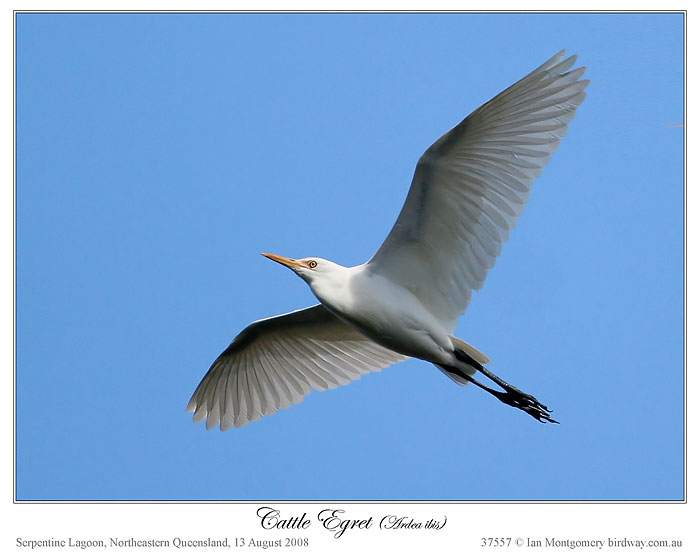
Ian’s Bird of the Week – Cattle Egret

Western Cattle Egret (Bubulcus ibis) by Ian Montgomery

Eastern Cattle Egret (Bubulcus coromandus) by Ian Montgomery

Ian’s Bird of the Week – Cattle Egret   by Ian Montgomery
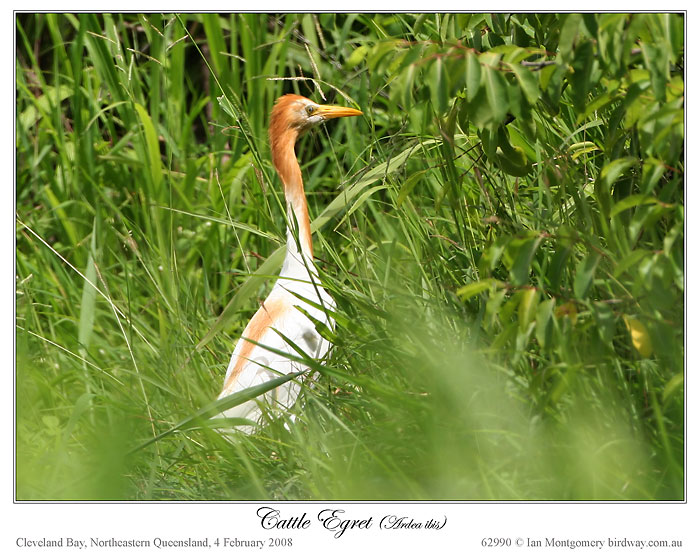
Eastern Cattle Egret (Bubulcus coromandus)2 by Ian Montgomery

Eastern Cattle Egret (Bubulcus coromandus)2 by Ian Montgomery

At a time when wildlife populations are generally under pressure, here is a success story about a species of bird, the Cattle Egret, that has undergone a spectacular world-wide expansion in range over the past century of or so.

In the 19th century, the Cattle Egret occurred only in tropical and subtropical Africa, southwestern Europe (the nominate race, Ardea ibis ibis) and in southern and southeastern Asia (the distinctive race Ardea ibis coromandus). Now, it breeds in every continent except Antarctica, though it turns up as a vagrant on sub-antarctic islands such as South Georgia and the South Orkney Island. Originally adapted to feeding with large herbivores, its expansion has followed the of spread humans with their livestock.

The expansion started in southern Africa with breeding first recorded in Cape Province in 1908. At about the same time, vagrants started crossing the Atlantic to eastern South America, where it probably became established in the 1930s but breeding was not proven until 1950 in Surinam and British Guiana. Some birds were reported in Florida in the 1940s and breeding was recorded in 1953. Since then, the species has spread all over South and Central America, much of the United States into Canada and has simultaneously expanded its range in southern Europe and the Middle East.
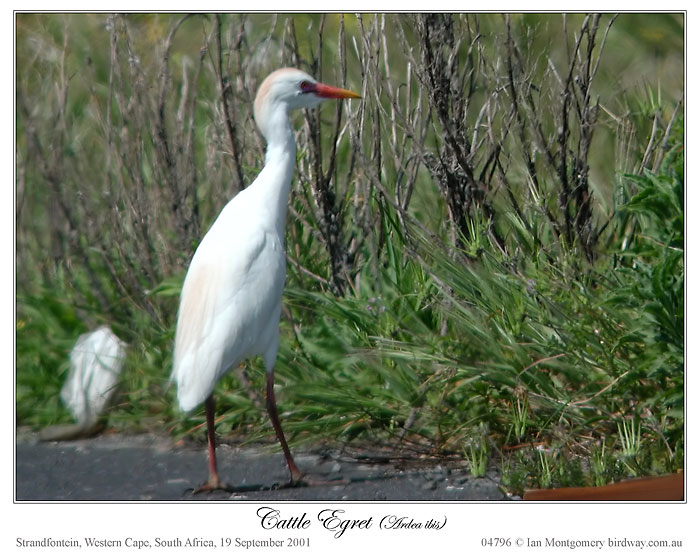
Eastern Cattle Egret (Bubulcus coromandus)3 by Ian Montgomery

Eastern Cattle Egret (Bubulcus coromandus)3 by Ian Montgomery

Concurrently, the Asian race was extending its range southeastwards and arrived in the Northern Territory in the 1940s. Cattle Egrets were first record in Victoria in 1949, southwestern Western Australia in 1959, South Australia in 1964, Tasmania in 1965 and started breeding in Queensland in 1963, the same year in which they were first recorded in New Zealand. Now, it is an abundant breeding bird in the warmer parts of Australia and mainly a winter and spring visitor to southern Australia, Tasmania and New Zealand.

In non-breeding plumage, the feathers are almost entirely white (first photo, bird in flight) apart from traces of buff on the crown and looks like a dumpy version of the Intermediate Egret. When breeding the Asian/Australian race has extensive gold on the head, back and breast (second photo) and looks quite different from the much paler eastern race (third photo). The bird in the latter photo is perhaps atypically pale for an eastern bird, but it has the reddish bill, legs and iris that are the courtship colours of both races.

Eastern Cattle Egret (Bubulcus coromandus)4 by Ian Montgomery

Eastern Cattle Egret (Bubulcus coromandus)4 by Ian Montgomery

The fourth photo shows several Cattle Egrets standing guard in a proprietary manner around some young Brahmins at the Orient Wetland north of Townsville last Friday. Although they are very gregarious, the dominant birds exclude other birds from the favoured feeding spots just behind grazing animals. They feed mainly on grasshopper and other invertebrates disturbed by herbivores but are flexible and will eat a wide variety of other food including young birds. So, the global expansion has a dark side and I recently read an article, thank you Jeri, expressing concern about predation by Cattle Egrets on the nesting colonies of the Red-winged Blackbird in California (http://tricolor.ice.ucdavis.edu/ ).

Meanwhile back at the website, following last week’s release of the revised home page, I’ve been working on redesigning the family pages and species galleries to make them neater and easier to use. It will take time before the revisions get generally applied but you might like to check out the Crane family thumbnails(http://www.birdway.com.au/gruidae/index.htm ), colour-coded by region, and the Brolga gallery with larger images (http://www.birdway.com.au/gruidae/brolga/index.htm ). I’ve also increased the size of the photos in this week’s bird of the week. This will mean that I’ll probably often exceed the intended limit of 200KB for the weekly posting. Let me know if this is going to be a problem, but I suppose most of us now have broadband internet.

Best wishes,
Ian

Ian Montgomery, Birdway Pty Ltd,
454 Forestry Road, Bluewater, Qld 4818
Phone: +61-7 4751 3115
Preferred Email: ian@birdway.com.au
Website: http://birdway.com.au


Lee’s Addition:

The Cattle Egret is now, according to the I.O.C., divided into 2 species. The Eastern Cattle Egret (Bubulcus coromandus) and the Western Cattle Egret (Bubulcus ibis). The Eastern breeds in Asia and Australasia, and the western nominate form occupies the rest of the species’s range. Here in the United States, we have the Western Cattle Egret. Those of us who live here in Florida see them all the time, just like in Ian’s forth picture. You will see one or more per cattle. They love to stand right by them and look for bugs or whatever as the cows pull up the grass to eat. They seem to get along and the cattle don’t seem to mind them standing there, almost in their face sometimes. Thanks, Ian, for more great photos and information.

The Cattle Egrets are part of the Ardeidae Family which has Herons, Egrets and Bitterns. They are in the Pelicaniformes Order.

Now behold, I Myself do establish My covenant with you, and with your descendants after you; and with every living creature that is with you, the birds, the cattle, and every beast of the earth with you; of all that comes out of the ark, even every beast of the earth. (Genesis 9:9-10 NASB)
Family#26 – Ardeidae
*

I Don’t Show Off – The Great Horned Owl

I Don’t Show Off – The Great Horned Owl – by a j mithra

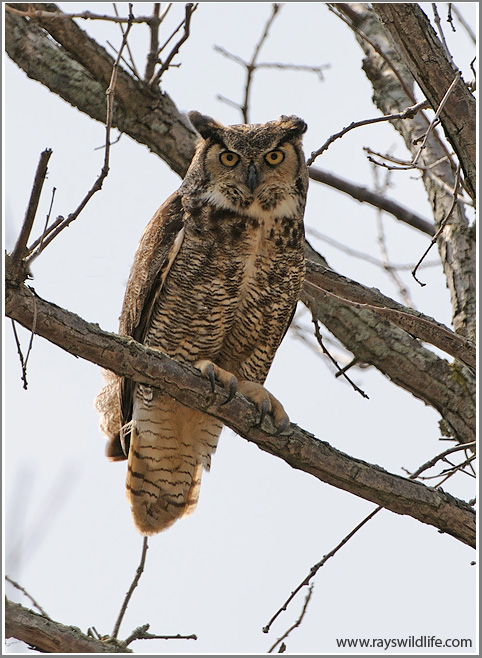
Great Horned Owl (Bubo virginianus) by Ray

Great Horned Owl (Bubo virginianus) by Ray

Great Horned owls can fly silently because the ends of their flight feathers don’t have barbules, those tiny hooks that most all other bird feathers have. When birds fly, the rubbing barbules is what makes the noise…

If GOD has not created these owls to fly silent, it would’ve turned into a prey instead of being a predator..

It doesn’t show-off its presence..

Please read through Isaiah chapter 39, you will see how King Hezekiah showed every treasure he had to the king of Babylon and how it brought curse over his family…

Talents and treasures from GOD
are not to show off but to glorify HIM…

On the faces of Great Horned owls and most other owls there are very short feather in a rounded pattern that form a facial disk. This facial dish acts like a satellite dish, receiving sounds and funneling them to the ears, which are hidden beneath feathers on the sides of the skull…

Its one ear is slightly higher and positioned at a slightly different angle on the head
than the other, it is able to use a kind of “sound triangulation” process to judge the location of its prey with amazing accuracy…

These owls can hear even the slightest movement of its prey within leaves or undergrowth or even in snow…
Such is its hearing ability..

Most of us tend to grumble about prayers unanswered..
We say that GOD doesn’t talk to us..
What sort of prayer time do we have?
Do we take time to be silent in HIS presence?

If these birds didn’t maintain silence, they may have to starve to death..

Most of us are spiritually starved cos, we go with a shopping list to the presence of GOD, instead of taking orders from the LORD..

Unless we learn to be still, we will never know our LORD..

Be still, and know that I am God: I will be exalted among the heathen, I will be exalted in the earth. (Psalm 46:10)

Note: Thank you, Ms Val, for the inspiration.. I’ve learnt loads from your article about THE GREAT HORNED OWL.. May GOD richly bless you in all that you do for HIS glory..

Have a blessed day!

Your’s in YESHUA,
a j mithra

Please visit us at: Crosstree

*

Reminiscing in South Florida

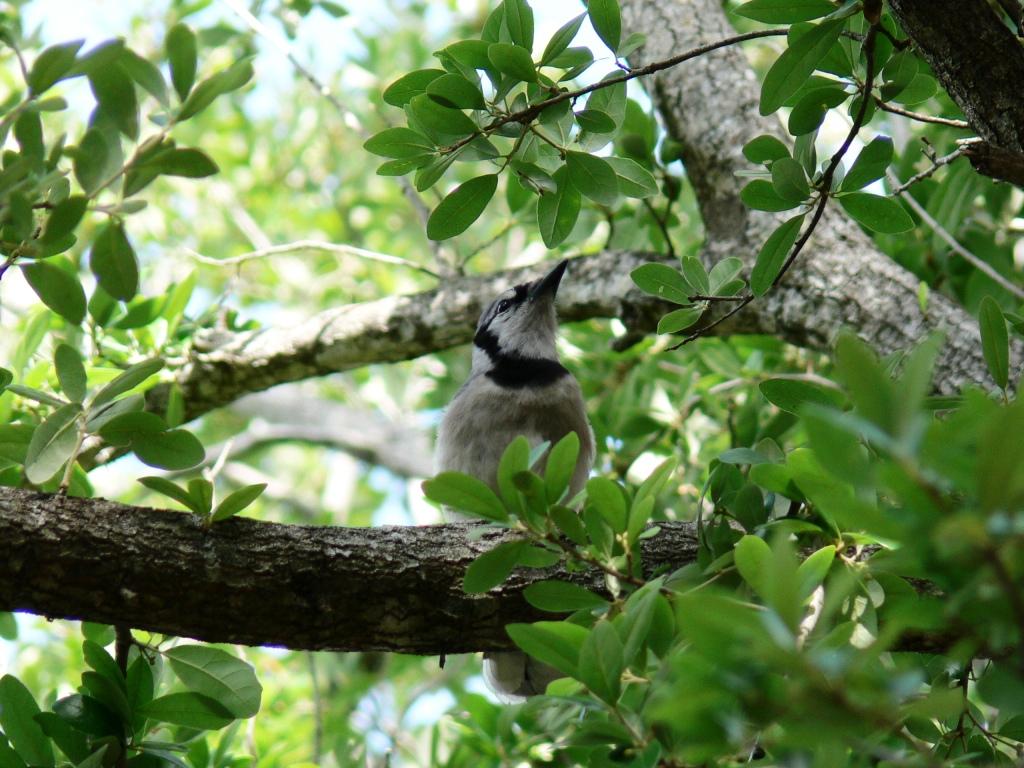
Blue Jay in tree at Hampton Pines

Blue Jay in tree at Hampton Pines

Reminiscing can be fun. We went to Miami this week to visit our friend after his surgery, but also took time to visit our old stomping grounds in the Fort Lauderdale area. We lived in Tamarac for 18 years, so had things to see and do.

We always enjoyed going to the beach to feed the Sea Gulls. Well, when we got to Lauderdale-by-the-Sea, there was not one gull in sight. We only saw Pigeons, a Boat-tailed Grackle and 2 Eurasian Collarded Doves. While driving, a 4 bird squadron of Brown Pelicans flew over. So much for the beach this time of the year.

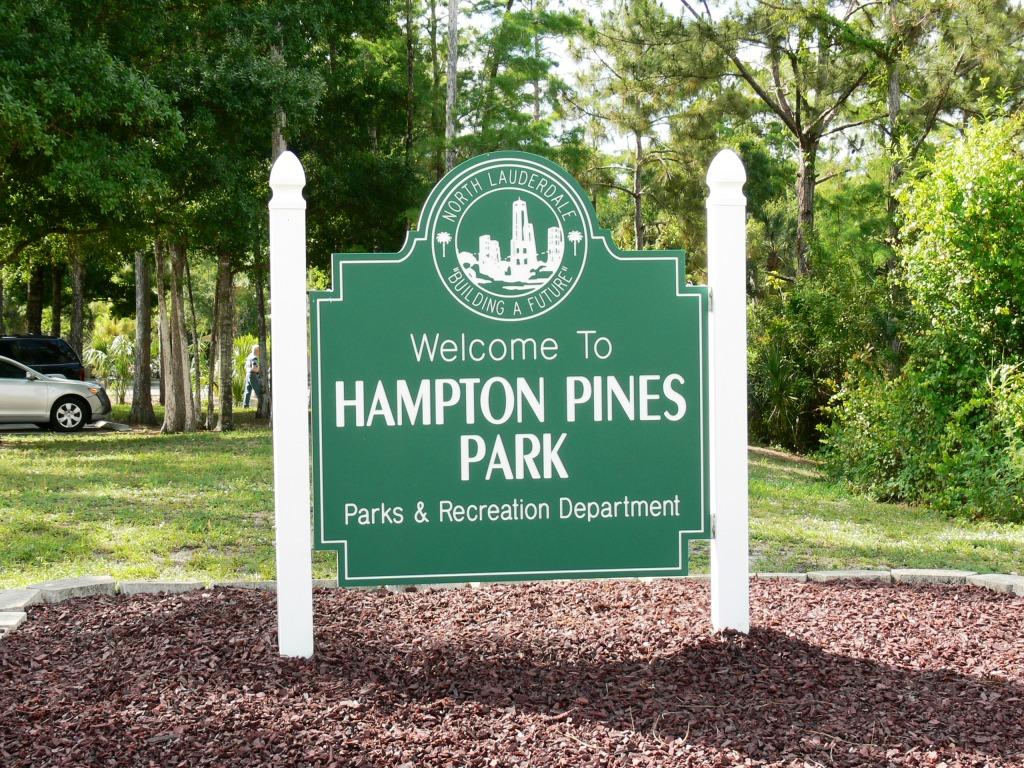
Hampton Pines Pk Sign

Hampton Pines Pk Sign

We then drove to the Hampton Pines Park in North Lauderdale. “It is a 32 acre natural woodland park containing native bald cypress and slash pines.” (It took a beating from Hurricane Wilma and many trees were blown down. This was according to a very nice grounds keeper we were talking with.) That is where I first became a real birdwatcher. There was a lady naturalist there who taught about the birds. We became friends (can’t remember her name now and the office was closed) and she sort of took me “under her wing.” I learned to have “soft eyes” (not stare at a certain spot, but softly watching the trees to catch movement), to listen for the birds (birding by ear), watch for evidences that a bird has been there (like droppings of fish bones and other things), and many other tips. Like many of our readers, I saw birds, but never really became aware of them until she revealed those and many other tips. I am sure she was the beginning of great hobby for me. I am thankful for the Lord bringing her into my life, for her and to Hampton Pines Park for having hired her.

Hampton Pines

Hampton Pines

While we were there we recorded only these birds: 7 Blue Jays carrying on with their alarm calls, Mourning Doves, Red-bellied Woodpeckers, Great Egret, Mockingbird, and 2 male Cardinals. We were only there about 20 minutes. Also saw 2 squirrels, which we fed before we saw the sign not to feed them. We also saw 2 lizards (I guess), one was about 18 inches and the other darker one was about 12 inches.

Since our house we lived in was only about a mile or so away, we went by it and took a few pictures of it and the pond across the street. There was a female Boat-tailed Grackle sitting at the top a bush (much taller than when we sold in 1995) in the yard. Used to have lots of feeders in the backyard. As my birding skills improved, I recorded many birds in our yard, around and in that pond.

Yes, it was fun to reminisce about when I learned to bird watch and to see the old homestead.

I remember the days of old; I meditate on all Your works; I muse on the work of Your hands. (Psalms 143:5 NKJV)

*

This slideshow requires JavaScript.

*

Best Local Playgrounds: Hampton Pines Park

City of North Lauderdale – Parks and Recreation

*

Birds of the Bible – Uniquely Created – Tools

Many birds have built in “tools” such as the way their beaks are designed or their feet, or wings, etc. Some use things as tools as shown below in the articles and the video.

How Nature Works: White-winged Crossbill Feeding Technique from CornellLab of Ornithology. (Last statement gives credit to evolution, but we believe they were uniquely created with this ability by the Lord.)

Rooks Reveal Remarkable Tool Use It appears that Rooks (Crow related) have been given intelligence by their Creator to figure out how to use things as tools.

Also, New Caledonian Crows themselves are able to use tools.

The list goes on and on of the uniquely created ways birds use their built in or external “tools.” “The Tool-Using Bird” (Vulture) and “Animals That Make and Use Tools” by Creation Moments.

What kind of tools (gifts) has the Lord given you to use. Are you using them in the way that He intended for you to use them.

Having then gifts differing according to the grace that is given to us, let us use them: if prophecy, let us prophesy in proportion to our faith; (Romans 12:6 NKJV)

As each one has received a gift, minister it to one another, as good stewards of the manifold grace of God. (1 Peter 4:10 NKJV)

Interesting Articles and Videos:
Adaptation and ecology: the marvelous fit of organisms to their environment” by Dr. Gary Parker

Woodpecker Finch using a stick as a tool. YouTube by firpeace

Animals Using Tools YouTube by ronesh (Bird Fishing)

*

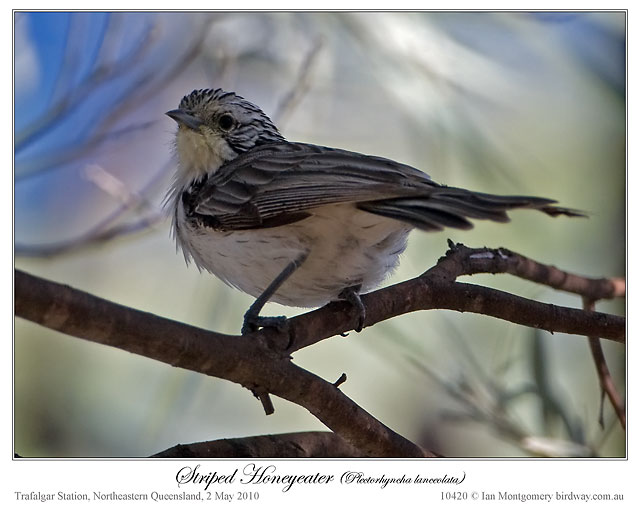
Ian’s Bird of the Week – Striped Honeyeater

Striped Honeyeater (Plectorhyncha lanceolata) by Ian

Striped Honeyeater (Plectorhyncha lanceolata) by Ian

Ian’s Bird of the Week – Striped Honeyeater – by Ian Montgomery

I’ve been slow to produce this week’s bird as I’ve been burning the midnight oil rewriting the home page of the website – more about that later.

Last week we had the Southern Bookbook from a rewarding evening of spotlighting at Trafalgar Station south of Charters Towers. Daytime birding there produced some interesting birds, notably a Pictorella Mannikin among some Plum-headed Finches and pair of Striped Honeyeaters. this is an uncommon Honeyeater with some unusual features and, being in its genus, is not closely related to other Honeyeaters.

Striped Honeyeater (Plectorhyncha lanceolata) by Ian

Striped Honeyeater (Plectorhyncha lanceolata) by Ian

One such feature is a very un-honeyeater-like call that first attracted our attention. The field guides agree that it is mellow, rollicking or rolling, and rising and falling. To me it sounded like a loud gerygone, the rusty bicycle wheel of a Mangrove or Large-billed maybe, but I’m a bit deaf and you mightn’t agree. In appearance it is rather dapper, and seems formally dressed for the drier, fairly casual areas of eastern Australia in which it occurs, from the Spencer Gulf in South Australia to Cooktown in NE Queensland.

It shows its affinity with honeyeaters by having a brush tongue for nectar, but the narrow, pointed bill, shown in the second photo is in fact adapted to supplementing a sugary diet by probing for insects and orther invertebrates as illustrated by the bird in the third photo, which has just found a spider in some mistletoe. The trees are mulga, a dry country acacia, and typical habitat for Striped Honeyeaters, I included the second photo, as it isn’t often one gets to photograph birds from above, a bird’s eye view so to speak, unless they are acrobatic like these in search of food.

Striped Honeyeater (Plectorhyncha lanceolata) by Ian

Striped Honeyeater (Plectorhyncha lanceolata) by Ian

I’ve redone the home page to make it easier to find photos of the more than 1,200 species in the 142 families now represented. The main change is the inclusion of a set of 142 family thumbnails – called Instant Links to Bird Families – in taxonomic sequence to take you directly to the species thumbnails for each family. The family thumbnails have been selected to show a typical member of the family, and each one has a list of the included species which will appear if you hold the cursor over the thumbnail. If you know or can guess in which family to look, you can find out, without leaving the home page, whether a particular species is present in the website.

Having clicked on a family thumbnail, the species thumbnails then allow you to go directly to view the first photo of a particular species and the thumbnails of other photos of that species. You can therefore find and view any of the now more than 5,000 photos in just three clicks. All the 5,000 photos have both family thumbnail button(s) for global and regional thumbnails and home page buttons, so you can then move back up to the family level or return directly to the home page to repeat the process for an unrelated species.

To make room for the new Instant Links, I’ve moved the ‘Recent Additions’ to a horizontal, scrollable row of (currently more than 70) thumbnails. The most recent additions are visible on the left, older ones are revealed by scrolling to the right. Future thumbnails will include a message – viewable in the same way as the family thumbnail list by holding the cursor over the thumbnail – about the date of the addition and the number of new photos; current ones just have a message to the effect ‘Click here to go to the gallery of  . . ‘.
Links:
Instant Links to Bird Families http://www.birdway.com.au/#families
Recent Additions http://www.birdway.com.au/#updates
Southern Boobook http://www.birdway.com.au/strigidae/southern_boobook/index.htm
Pictorella Mannikin http://www.birdway.com.au/estrildidae/pictorella_mannikin/index.htm
Plum-headed Finch http://www.birdway.com.au/estrildidae/plum_headed_finch/index.htm
Best wishes,
Ian

Ian Montgomery, Birdway Pty Ltd,
454 Forestry Road, Bluewater, Qld 4818
Phone: +61-7 4751 3115
Preferred Email: ian@birdway.com.au
Website: http://birdway.com.au


Lee’s Addition:

Striped Honeyeaters are in the Meliphagidae – Honeyeaters Family of the Passeriformes Order. There are 142 members in that family.
*

Long-wattled Umbrellabird – The Dawn Dancer..

Long-wattled Umbrellabird – The Dawn Dancer..  – by a j mithra

The Long-wattled Umbrellabird (Cephalopterus penduliger) is large bird that got its name because of its head feathers, which resemble an Elvis Presley hair-do that can be opened like an umbrella surrounding the bird’s head in all directions.

The first half of the name comes from another strange characteristic, the long wattle that hangs from the neck of the bird. This is a fleshy appendage covered in feathers that looks like a long, black tie and it is used for males during their exotic sexual courtship.

Long-wattled Umbrellabird (Cephalopterus penduliger) by Wikipedia

Long-wattled Umbrellabird (Cephalopterus penduliger) by Wikipedia

It is a large, charismatic, midnight-black bird, with a maximum wingspan of about two feet. Males have long crest feathers that, depending on their mood, they can retract like slicked-back pompadours (cool, relaxed) or expand to completely cover their heads (amorous, aroused). With his crest retracted, a male looks like Elvis on a bad hair day; with it expanded, he looks like Liberace on steroids…

During the August-to-February mating season, groups of between five and fifteen males gather every morning and afternoon at special sites called leks, each of which typically covers about 4.5 acres were most males stake out their own territories within a lek.

Beginning in the predawn darkness, the males sit on their favored perches and bellow their moo calls out into the forest around them. Ecuadorians call the bird the pajaro toro, meaning bull-bird, because the male’s song resembles nothing so much as a lost bovine mooing in the forest. The calls travel more than half a mile, to attract females. These males begin their calls at predawn darkness..

Have we ever realized that Jesus loves to talk to us in the predawn darkness?

The Manna would melt and that is the reason Manna collecting became a predawn exercise for the Israelites…
JESUS, the Word is our heavenly Manna…

How many of us have the habit of reading the Word of God as our predawn exercise? Just imagine, if our Bible had melted just like Manna after daybreak, most of us by now, would’ve starved to death isn’t it?

And they gathered it (Manna) every morning, every man according to his eating: and when the sun waxed hot, it melted. (Exodus 16:21)

As the day breaks, they begin to extend and retract their crests. They ruffle the feathers on their wattles and bob them up and down. They spread their wings out in a vulture-like pose and make a strange gurgling sound. They briskly beat their wings against their bodies. Sometimes they pull small branches off their perching trees and beat them against the limbs or trunk.

They spend hours each morning and afternoon in such elaborate displays, often nearly falling off their branches from the exertion. After they mate, the female is all by herself as she flies back to her home area in the forest, sometimes a few miles away and proceeds with the business of nesting.

These birds practice their mating ritual so hard for hours, that they even fall off their branches due to exertion..

JESUS is the copyright owner of the greatest and the most awesome mating ritual ever found on the face of the earth displayed at the Cross of Calvary..

It was not the nails which held Him to the cross but, it was the love that HE had for you and me that held HIM…

But God commendeth his love toward us, in that, while we were yet sinners, Christ died for us. (Romans 5:8)

These birds are endangered due to habitat loss, and their extinction would not only mean the loss of a very interesting-looking animal, but also a disruption for the forest dynamics. This is because Umbrellabirds are one of the few birds large enough to disperse big seeds that are typical of mature forests.

The long-wattled umbrellabird (Cephalopterus penduliger) lays claim to the title of best-dressed dinner guest at fruit-bearing Chapil palm trees..

The mating behavior of umbrellabirds might have important consequences for chapils and other plants whose fruits they disperse…

It takes an hour for these birds to digest the Chapil Palm fruits. So, the males, bring a high proportion of the seeds they eat back to their lek sites. That is where they spend most of their time. But, the females disperse the seeds after they fly back to their home areas, which maybe miles away from the lek…

JESUS, the bride sows HIS seed in the Church…
But, like these birds, it is the duty of the Church-the bride to spread the seeds among their home areas, their family and friends…
We call ourselves as the bride, but, do we carry the seed home to spread it in our home area? Or just leave back the seed in church every Sunday before we get back home?

For he that soweth to his flesh shall of the flesh reap corruption; but he that soweth to the Spirit shall of the Spirit reap life everlasting. (Galatians 6:8)

Your’s in YESHUA,
a j mithra

Please visit us at: Crosstree

The Umbrellabird is part of the Cotingidae – Cotingas Family of the Passeriformes Order

Birds in Hymns – Updated

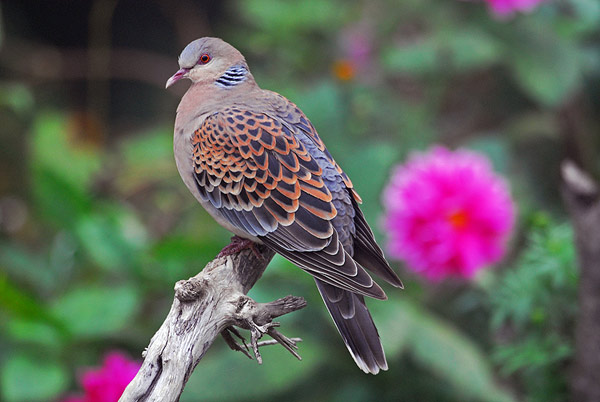
Oriental Turtle Dove (Streptopelia orientalis) by Nikhil

Oriental Turtle Dove (Streptopelia orientalis) by Nikhil

While updating the Birds in Hymns page, I had to read through the hymns to find the references to the birds. What struck me, is the depth of the writings of these hymn writers. Many of these were written in the 1,700 and 1,800s. These are not the shallow words of today, but are filled with great doctrinal truths, praise and worship for our Savior.

We here on the blog use the birds that God has created to teach you about them, but also to make applications that will help us with our lives. That is how many of the birds are used in Scripture, to learn from them by way of illustrations of truths to help make us better Christians or to become Christians.

I will sing of the mercies of the LORD forever; With my mouth will I make known Your faithfulness to all generations. (Psalms 89:1 NKJV)

Below are just some of the examples I pulled out. Time spent reading through the hymns, will be a blessing to you.

Jesus, Holy, Undefiled by Emily M. Shapcole wrote these words:

Now the little birds arise,
Chirping gaily in the skies;
Thee their tiny voices praise,
In the early songs they raise.

Thou, by Whom the birds are fed,
Give to me my daily bread;
And Thy holy Spirit give,
Without Whom I cannot live.

Speed For Thy Life by Fanny Crosby

Speed for thy life to the mountain,
Fly like a bird to its nest,
Fly to the arms of the Savior:
There is thy only rest.

There Seems A Voice In Every Gale by Amelia A. Opie

The birds, that rise on quivering wing,
Proclaim their Maker’s praise,
And all the mingling sounds of spring
To Thee an anthem raise.

This is My Father’s World by Maltbie B. Babcock

This is my Father’s world, the birds their carols raise,
The morning light, the lily white, declare their Maker’s praise.
This is my Father’s world: He shines in all that’s fair;
In the rustling grass I hear Him pass;
He speaks to me everywhere.

Yes, God is Good by John H. Gurney

The merry birds prolong the strain,
Their song with every spring renewed;
And balmy air, and falling rain,
Each softly whispers, “God is good.”

Jesus, I Come by William T. Sleeper

Out of unrest and arrogant pride,
Jesus, I come, Jesus, I come;
Into Thy blessèd will to abide,
Jesus, I come to Thee.
Out of myself to dwell in Thy love,
Out of despair into raptures above,
Upward for aye on wings like a dove,
Jesus, I come to Thee.

Let Him Come In by C. W. Ray

To thy barred and bolted door,
Gently as a wooing dove,
Jesus comes as oft before,
Pleading in His tender love.

Refrain

Let Him in; let Him in;
Sinner, why not make Him room?
Let Him in; let Him in;
Lest He never more may come.

See ~ Wordless Birds

More ~ Birds in Hymns

*

Birds, It’s Coffee-time

Birds, It’s Coffee-time – by a j mithra

Blue-crowned Motmot (Momotus momota) by Ian

Blue-crowned Motmot (Momotus momota) by Ian

You know?

Birds just love coffee..

Shade trees protect the understory coffee plants from rain and sun, help maintain soil quality, reduce the need for weeding, and aid in pest control. Organic matter from the shade trees also provides a natural mulch,which reduces the need for chemical fertilizers, reduces erosion, contributes important nutrients to the soil, and prevents metal toxicities…

That is the reason most birds to migrate to shaded coffee plantations..

Birds know that there is Life under the shadow of trees?

When life turns cruel and we face heat and storm we tend to forget that, we have an everlasting shade..
We forget to remember this verse,

And there shall be a pavilion for a shade in the day-time from the heat, and for a refuge and for a covert from storm and from rain. (Isaiah 4:6)

Why should you run away from your problems?
Don’t you remember that JESUS is your providence?

Jehovah is thy keeper: Jehovah is thy shade upon thy right hand. (Psalm 121:5)

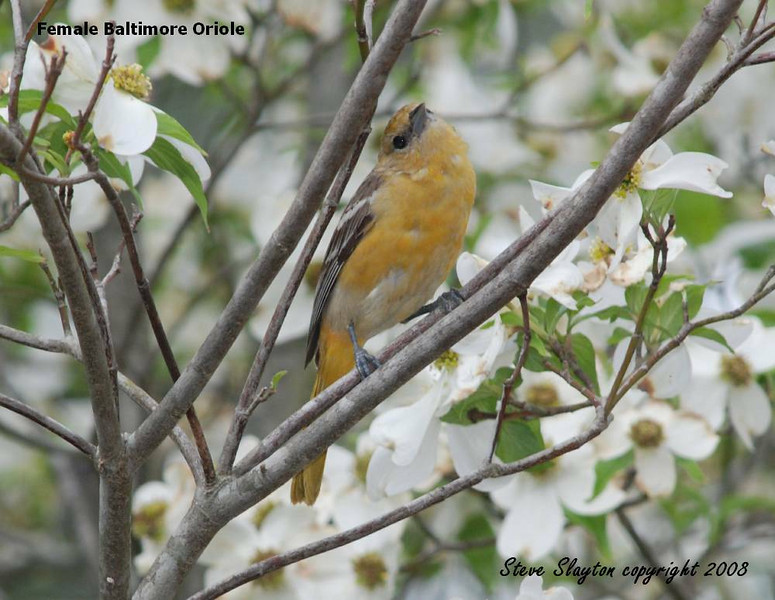
Baltimore Oriole (Icterus galbula) by S Slayton

Baltimore Oriole (Icterus galbula) by S Slayton

When you feel that tough seasons are approaching you, think of these birds and fly over to the everlasting shadow of JESUS, that is where you have perfect providence and protection…

Well, next time when you have coffee, just remember these birds and thank GOD for what HE has taught us through them..

Will you?

But ask now the beasts, and they shall teach thee; And the birds of the heavens, and they shall tell thee: (Job 12:7)

Yours in YESHUA,
a j mithra

Please visit us at: Crosstree


Lee’s Addition:

Here are some interesting articles:
Shade Grown Coffee

Birds of the Bible – Uniquely Created Sound

When the Lord created the birds, He gave each a unique design which includes not only their appearance, but also the sounds they make. Below is an interesting video about the sounds of the different birds. It is a little lengthy (9 min.) but well worth watching.

The Language of Birds by LabofOrnithology

The flowers appear on the earth; the time of the singing of birds is come, and the voice of the turtle is heard in our land; (Song of Solomon 2:12 KJV)

Each of the bird’s songs and sounds help them to communicate with one another, and with other species. Many times one bird, like a Blue Jay, will sound an alarm that warns all of the birds of an impending danger. Lots of birds singing is a sign that all is well in that area.

Just as the Lord uniquely gave each bird a separate song or sound, the Lord has given each of us in the church separate unique abilities and talents. One may be the preacher, one the song leader, teachers, choir or orchestra members, sound and video workers, baby sitters, ushers, etc. We all are different, but when all of those abilities are brought together, like all of those birds in the rain forest that make beautiful music together, we worship and serve the Lord jointly.

Thy hands have made me and fashioned me: give me understanding, that I may learn thy commandments. (Psalms 119:73 KJV)

Now therefore ye are no more strangers and foreigners, but fellowcitizens with the saints, and of the household of God; And are built upon the foundation of the apostles and prophets, Jesus Christ himself being the chief corner stone; In whom all the building fitly framed together groweth unto an holy temple in the Lord: In whom ye also are builded together for an habitation of God through the Spirit. (Ephesians 2:19-22 KJV)

*

Pigeons and Their Pecking Order

Hill Pigeon (Columba rupestris) by Nikhil Devasar

Hill Pigeon (Columba rupestris) by Nikhil Devasar

The April 7th issue of NatureNews has an interesting article called, “Airborne pigeons obey the pecking order.” According to the studies they did on flying pigeons that were strapped with tiny GPSs, they change directions by responding to the leaders, not just any member of the flock.

“”It is the first study demonstrating hierarchical decision-making in a group of free-flying birds,” says Tamás Vicsek, a biophysicist at Eötvös Loránd University in Budapest who led the study…”

Another interesting thing they found out was, “Although pigeons have an almost 340º field of view, the researchers found that the birds at the front of a flock tended to make the navigational decisions. Moreover, birds responded more readily to a leader’s movements if the leader was on their left side. These findings concur with previous work that indicated that social cues entering a bird’s left eye receive preferential processing in the brain2.”

The article is very interesting and worth reading. Of course, I don’t agree with the last sentence of the article because they give the credit to evolution. We believe that the Lord created the pigeons with this ability from the first day they were created.

Hast thou not known? hast thou not heard, that the everlasting God, the LORD, the Creator of the ends of the earth, fainteth not, neither is weary? there is no searching of his understanding. (Isaiah 40:28 KJV)

Who are these that fly as a cloud, and as the doves to their windows? Isa 60:8

Doth the hawk fly by thy wisdom… (Job 39:26a) God was asking Job about the hawk, but it could be any bird including the pigeon.

To read the complete article – Click Here

*

Kagu – The High Profile Endemic Emblem

The Kagu – The High Profile Endemic Emblem – by a j mithra

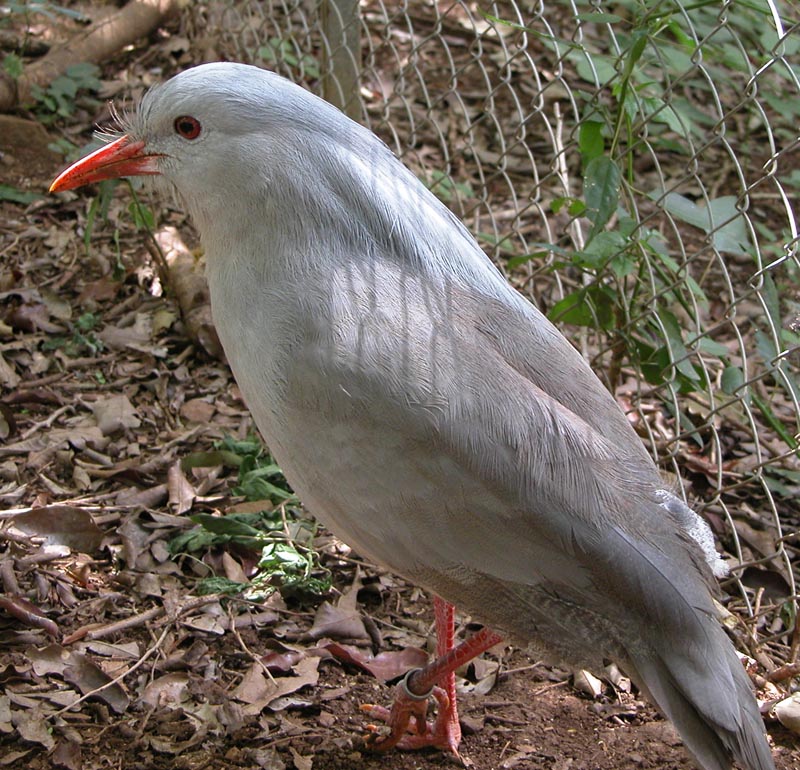
Kagu (Rhynochetos jubatus) Wikipedia

Kagu (Rhynochetos jubatus) Wikipedia

Kagus (Rhynochetos jubatus) are rather oddballs among birds because they are a mixed bag of physical characteristics, some of which are unique to Rhynochetidae, but most of which are shared with other bird families.

The name “Rhynochetos” refers to the unique rolled corns or nasal flaps that cover its nostrils.

Kagus look like rails (Rallidae) and occupy a niche similar to Rallidae; however, Kagus also exhibit light coloration and abundant, widely distributed powder-downs, much like herons (Ardeidae).

Kagus have a unique blood composition compared to other bird species, consisting of one-third the number of red blood cells and three times the hemoglobin content…

Our life is unique compared to the others, for we are not only brought by the blood of Jesus, but also protected by His precious blood..

Take heed therefore unto yourselves, and to all the flock, over the which the Holy Ghost hath made you overseers, to feed the church of God, which he hath purchased with his own blood. (Acts 20:28)

Although flightless, Kagus have large wings. They are medium-sized quite compact and agile birds that move surprisingly fast. Their dark-red eyes and orange-red, long legs and large bill contrast with their ash-gray and white plumage. A striking feature of the Kagu’s appearance, and usually concealed, is the patterning on the wings, which somewhat resembles that on the Sunbittern‘s wings. The patterning consists of a dominant design of black-and-white cross-bands with a smaller area of brown “overlay” also running across the primaries. Their long crest feathers extend to the lower back and are difficult to spot unless raised. The pattern on the wings of these birds resembles that of the Sunbittern’s wings…

Do we have the life pattern of The Sun of Righteousness in our lives? God has created us in His image; do we carry His image wherever we go?

So God created man in his own image, in the image of God created he him; (Genesis 1:27)

The Kagu is exclusively carnivorous, feeding on a variety of animals with annelid worms, snails and lizards being amongst the most important prey items…

Also taken are larvae, spiders, centipedes and insects such as grasshoppers, bugs, and beetles. The majority of the diet is obtained from the leaf litter or soil, with other prey items found in vegetation, old logs and rocks.

It possesses bright red legs and a similarly coloured bill, and has large eyes, positioned so that they give good binocular which is helpful in finding prey in the leaf litter and seeing in the gloom of the forest.

Their hunting technique is to stand still on the ground or from an elevated perch, and silently watch for moving prey. they must also use other means, like vibration and/or sound, to pinpoint out-of-sight prey in soil that they capture.

Sometimes Kagus will hunt small animals in shallow water. They may stand on one foot and move the leaf litter with the other foot in order to flush prey. Victory is not a guarantee, no matter how technically qualified we are.

Like the Kagu, our battle technique ought to stand still and watch God win the battle for us…

And all this assembly shall know that the LORD saveth not with sword and spear: for the battle is the Lord’s, and he will give you into our hands. (1 Samuel 17:47)

In addition to their song, Kagus are best known for their distinctive displays. For defense, the wings are opened to reveal their patterning and positioned forward-facing in an attention-grabbing display that might have acted to confuse past predators. This display is remarkably similar in form and function to the “frontal display” of the Sunbittern..

Kagus use a “strutting” display in courtship and in disputes with other birds. They take an upright pose with the crest raised and fanned and the wings held down and forward in the form of a cape. They then slowly circle around each other in a ballet-like dance.

A captured bird held by the feet will also instinctively open its wings to reveal the patterning and bring them together as “shields” to cover its head….

The Kagu played a part in some indigenous Kanak cultures; for example, Kagu feathers were worn by the chiefs and their song was used in war dances.

Kagus are considered very important in New Caledonia, it is a high profile endemic emblem for the Territory.

Its distinctive song used to be played to the nation every night as the island’s TV station signed off the air.

Kagus make a range of different sounds, most commonly duetting in the morning, each duet lasting about 15 minutes. Its survival is considered important for the nation’s economy and image…

Kagus seem to know the importance of corporate worship, is that why they sing duets every morning?

We may not be able to have corporate worship every morning, but, how many of us realize the importance of corporate worship at least on a Sunday morning?

Jesus said,

For where two or three are gathered together in my name, there am I in the midst of them. (Mathew 18:20)

This is what the Bible says about corporate worship…

Not forsaking the assembling of ourselves together, as the manner of some is; but exhorting one another: and so much the more, as ye see the day approaching. (Hebrew 10:25)

Our survival is important for the extension of God’s kingdom,so, let us live like JESUS and for JESUS…

Have a blessed day!

Your’s in YESHUA,
a j mithra

Please visit us at: Crosstree

Ian’s Bird of the Week – Southern Boobook

Southern Boobook (Ninox boobook) by Ian Montgomery

Southern Boobook ( Ninox boobook) by Ian Montgomery

Newsletter  5-4-2010

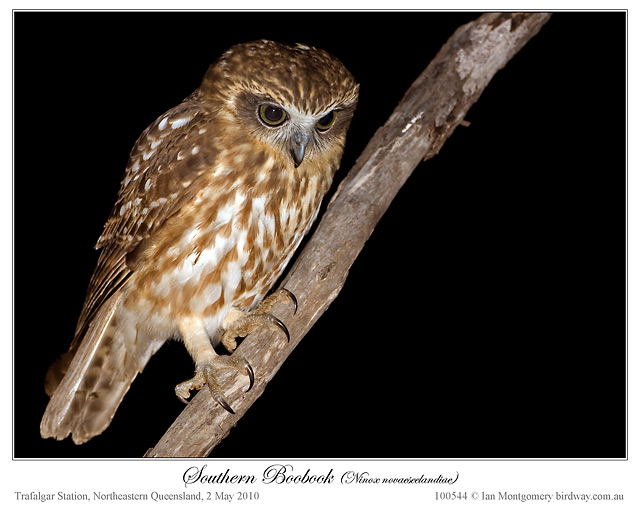
Here’s one for the lovers of owls – which, I imagine, includes almost everybody. This is the commonest and most widespread owl in Australia, and its plaintive ‘boobook’ or ‘morepork’ call is a familiar sound in a huge range of habitats from tropical rainforest, through leafy suburbs and city parks to almost treeless regions of the dry interior. Despite both its abundance and lots of effort on my part, it has eluded my camera since, as a graduate student, I took some slide photos of one through a window of the Zoology Department of Sydney University in the mid 1970s.

Southern Boobook (Ninox boobook) by Ian Montgomery

Southern Boobook (Ninox boobook) by Ian Montgomery

This weekend just past was the occasion of the AGM of Birds Australia North Queensland and it was held at a large cattle station (property) called Trafalgar about 50km southwest of Charters Towers outside Townsville. We went spotlighting in the station truck, ideally equipped for birding safari-style with two bench seats placed longitudinally back-to-back on the rear, on a clear Sunday night and after finding a rather flighty barn owl, we encountered a Boobook in a tree beside the road that was much more cooperative. Having photographed it from the truck, I eventually got down and set up the tripod much closer to the the owl. It stayed put, despite my flash and 3 spotlights and when we finally left, it was still there. The portrait in the first photo is in fact cropped from a photo that includes the whole bird, so you can appreciate that the conditions for photography were excellent.

Later we found a Tawny Frogmouth, also a willing subject, and on the road itself, a suicidal young Owlet-Nightjar – nearly got run over – which let me approach it so closely that I could no longer focus with my 500mm lens (minimum focusing distance 4.5m/15ft). The consensus seemed to be that it was the best night’s spotlighting ever. The clear sky with no light pollution meant that we could see both the Southern Cross and the Big Dipper/Plough simultaneously, and on the way back a just-past-full moon rose in the east.
The Boobook is a smallish owl ranging in size from 25-28cm/10-11in for males and 30-36cm/12-14in for females. This one seemed relatively large to me, so it was probably female. The current taxonomic treatment is to treat as a single species the various boobooks in Australia, New Zealand, southern New Guinea, Timor and some islands of eastern Indonesia. This leaves only the Sumba Boobook (Sumba is west of Timor) as a separate species, so there isn’t a ‘Northern’ Boobook as such.
Best wishes,
Ian
Links:

Barn Owl
Tawny Frogmouth
Australian Owlet-nightjar

Ian Montgomery, Birdway Pty Ltd,
454 Forestry Road, Bluewater, Qld 4818
Phone: +61-7 4751 3115
Preferred Email: ian@birdway.com.au
Website: http://birdway.com.au


Lee’s Addition:

Boobooks are in the Strigidae Family of the Strigiformes Order. I love that name. Not sure how it got it other than it’s sound.

Southern Boobook Audio from xeno-canto.org by Pakihi Okarito

But the cormorant and the bittern shall possess it; the owl also and the raven shall dwell in it: (Isa 34:11a)