Formed By Him – Sword-billed Hummingbird

Sword-billed Hummingbird (Ensifera ensifera) by Michael Woodruff

Sword-billed Hummingbird (Ensifera ensifera) by Michael Woodruff

He loves righteousness and justice; The earth is full of the goodness of the LORD. (Psalms 33:5 NKJV)

The Lord has graciously outfitted a small, but unique hummingbird. The Sword-billed Hummingbird has an unusually long bill.

I came across this bird today while checking out photographs of our newest Photographer to give permission to use his fantastic photos. Michael Woodruff’s Photostream has some shots that have just taken my breath away today. Thanks, Michael, for the permission to use the great images that you have captured through your lenses.

When I first saw the Sword-billed Hummingbird, my first thought was why did God make it like that. There has to be a reason for that beak being so long. After investigating some, here are a few facts about this bird:

What is so unique about the Sword-billed Hummer is that it is noted as the only species of bird to have a bill longer than the rest of its body. This beak is used to feed on flowers with long corollas such as Passiflora mixta. The tongue is therefore also unusually long. God had a long flower that needed pollination and so He created a long billed hummingbird to get in that long tube. The bird gets the nectar, carries away pollen and the bird and flower both have their needs provided.

Passiflora mixta galupa - Suncrest Nurseries

Passiflora mixta galupa – Suncrest Nurseries

(From Suncrest Nurserises) “Passiflora mixta – A cool growing species with long tubed flowers that face outward and upward at a 45 degree angle. The color is a vibrant pink with white highlights. It is a large and vigorous grower and puts on an amazing show. The variety ‘Galupa’ has flowers that face outward and downward at a 45 degree angle and are a bit larger in overall aspect. A very beautiful species”

Because it’s beak is so long, it has to groom itself with it’s feet. The Sword-billed Hummingbird was created by an Omniscient Creator that knew it needed the long bill for the flowers, but also had to have a way to keep well groomed.

Keith Blomerley, one of our videographers, captured a Sword-billed Hummingbird perched on a tree and looking around. Another bird flies by.
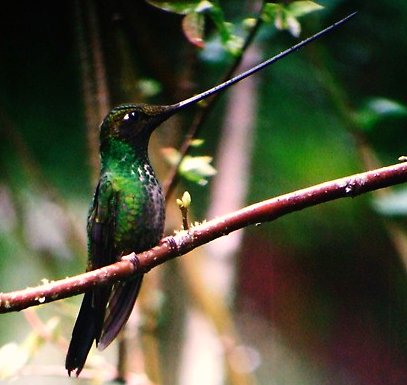
 

Sword-billed Hummingbird (Ensifera ensifera)©WikiC

Sword-billed Hummingbird (Ensifera ensifera) is a species of hummingbird from South America and the sole member of the genus Ensifera. It is found in Bolivia, Colombia, Ecuador, Peru and Venezuela.

The total length can be 15 cm (6 in) and the bird can weigh 12 grams, making it one of the largest hummingbirds.

What an amazing hummingbird. The Hummingbirds are in the Apodiformes Order which includes not only the hummers (Trochilidae), but also Owlet-nightjars (Aegothelidae), Treeswifts (Hemiprocnidae) and Swifts (Apodidae).

For by Him all things were created that are in heaven and that are on earth, visible and invisible, whether thrones or dominions or principalities or powers. All things were created through Him and for Him. (Colossians 1:16 NKJV)

Updated 11/30/10:

Just received this note from Michael Woodruff about this article and thought I would attach it.

The Sword-billed Hummingbird is quite a bird. We saw two or three of them at the Yanacocha Reserve in the Andes of Ecuador. They were crazy to watch as they knew right where the end of their beak was, feeding out of the hummingbird feeders. It looked like quite a feat to balance that bill, but they were good at it!

Glad you’re enjoying the photos and it would be cool to hear which ones you end up using at some point. I think it’s great how you’re incorporating scripture verses on the pages. Awesome stuff.

Have a great week and hope you’re getting to feeling better.

Michael

*
Ian’s Bird of the Week – Scintillant Hummingbird

Scintillant Hummingbird (Selasphorus scintilla) by Ian

Scintillant Hummingbird (Selasphorus scintilla) by Ian

Ian’s Bird of the Week – Scintillant Hummingbird ~ by Ian Montgomery

Newsletter – 11/25/10

At the Hotel Savegre (http://www.savegre.co.cr/) where I stayed in the highlands in Costa Rica in pursuit of the Resplendent Quetzal, a variety of Hummingbirds were regular visitors to the hummingbird feeders and the flowers in the garden. The largest of these was the Magnificent Hummingbird, up to 14cm/5.5in in length and 10g in weight – sparrow sized – as in the first photo.

Magnificent Hummingbird (Eugenes fulgens) by Ian

Magnificent Hummingbird (Eugenes fulgens) by Ian

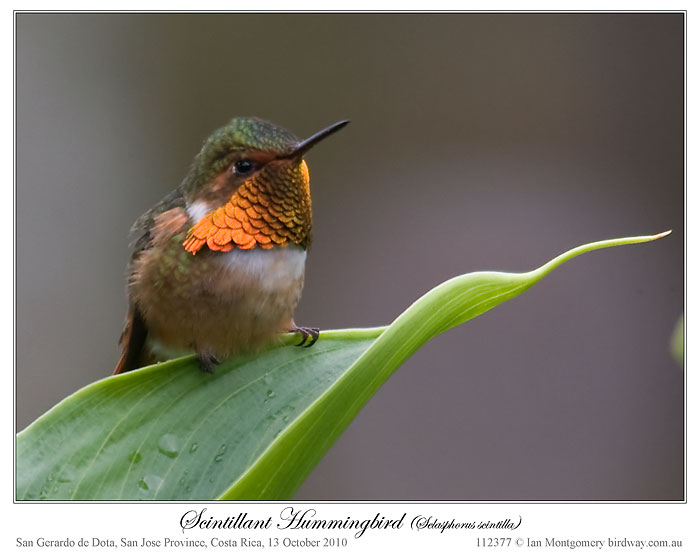
Size, however, isn’t everything particularly in hummingbirds and big ones risk looking like, dare I say it, mere ordinary birds. Much of the fascination in hummingbirds is how insect-like they are, so the smaller the better, and my favourite was the tiny Scintillant Hummingbird. The males, second and third photo, tip the scales at 2.1g with a length of 6.5cm/2.6in (the females average 2.3g and 7cm) and perched, seemingly weightless, on the tips and edges of the leaves of Zantedeschia plants. Their over-sized orange gorgets are very striking and this species is endemic to the mountain slopes of Costa Rica and Western Panama.

Scintillant Hummingbird (Selasphorus scintilla) by Ian

Scintillant Hummingbird (Selasphorus scintilla) by Ian

Incidentally, the smallest hummingbird of all, in fact the smallest bird of all, is the Bee Hummingbird of Cuba with the males, again smaller than the females, averaging 1.6g and 5cm/2in, not that much smaller the Scintillant Hummingbird. The largest is the Giant Hummingbird of the Andes, up to 23g in weight and 22cm/8.7in long and apparently swift-like in flight. Not surprisingly, the Bee Hummingbird is on my bucket list, the Giant isn’t.

Our premature wet season continues in North Queensland, so the website has received plenty of attention. I’ve revised the Thrush galleries with the addition of 6 Central American species, added a couple of swallows and the badly-named Long-tailed Silky-flycatcher – it may be silky but it’s not a flycatcher and it mostly eats fruit:

Ruddy-capped Nightingale-Thrush

Black-faced Solitaire

Mangrove Swallow

Long-tailed Silky-flycatcher

Best wishes,

Ian

Ian Montgomery, Birdway Pty Ltd,

454 Forestry Road, Bluewater, Qld 4818

Phone: +61-7 4751 3115

Preferred Email: ian@birdway.com.au

Website: http://birdway.com.au


Lee’s Addition:

Wow! What gorgeous Hummingbirds. Love that Scintillant’s colors, but the Magnificent is also magnificent. What a creative Hand the Lord used when they were created.

Who does great things, and unsearchable, Marvelous things without number. (Job 5:9 NKJV)

The Hummingbirds belong to the Trochilidae Family of the Apodiformes Order. That Order not only has Hummingbirds, but also Owlet-nightjars, Treeswifts and Swifts.

The colors of the Scintillant fit right in with today’s day of Thanksgiving here in America.

Happy Thanksgiving from all of us on this blog!

Oh that men would praise the LORD for his goodness, and for his wonderful works to the children of men! (Psalms 107:8 KJV)

*

Humming Birds – The Believing Believers… by a j mithra

a j mithra has produced another video using a hummingbird video with his thoughts and music.

We had previously done this as an article, then a j turned it in to a video. Absolutely amazing.

The Hummingbird – The Believing Believer…

The Bible says,”But ask now the beasts, and they shall teach thee; and the fowls of the air, and they shall tell thee: (Job12:7)

He says:

Here are some of the many things that we can learn from these small little wonderful Humming Birds…

Trust you enjoy watching this video.

*

YouTube’s  NATURE | Behind the Scenes of “Hummingbirds” | PBS is where the video came from (I think) and tells how the shots of the Hummingbirds were taken.

*

Ian’s Bird of the Week – Anna’s Hummingbird

Anna's Hummingbird (Calypte anna) by Ian

Anna's Hummingbird (Calypte anna) by Ian

Ian’s Bird of the Week – Anna’s Hummingbird ~ by Ian Montgomery

Newsletter – 09-01-10

As promised last week, here is Anna’s Hummingbird, the common Hummingbird of gardens and parks along the West coast of the United States. Many houses, including the one I am in, have hummingbird feeders to attract these delightful birds.

Anna's Hummingbird (Calypte anna) by Ian

Anna's Hummingbird (Calypte anna) by Ian

They can be quite inconspicuous, despite the striking colours of the male birds. They alternate between hovering and sudden bursts of very rapid flight which makes them appear and disappear with equal facility. The feathers have, in effect, lots of minute mirrors on them and the bright colour is only visible at exactly the right angle to the light. Otherwise, they look quite dark, dare I say drab, like the male in the first photo hovering at the feeder. The second and third photos, also males, show the claret-coloured head and breast quite well, even though the birds are perched in the shade. Young birds and females are mainly green and grey, though adult females have a small red patch on the throat.

At 12.5cm/4in in length Anna’s is quite large by hummingbird standards. Most of the North American hummingbirds are migrants and spend the winters in Mexico and/or Central America, but Anna’s is an exception and is resident in coastal areas of the western states. They are quite aggressive and males chase other males away from feeders. They also seem quite curious and will check you out by hovering quite closely.

Anna's Hummingbird (Calypte anna) by Ian

Anna's Hummingbird (Calypte anna) by Ian

Hummingbirds occur only in the Americas and there are more than 300 species. 27 of these, mostly photographed in Ecuador and Trinidad, are on the website: http://www.birdway.com.au/trochilidae/index.htm .

I went on a successful pelagic boat trip out of Monterey last Sunday, so next week’s bird will feature a wanderer that is also on the Australian list that I haven’t seen before. Sometimes, you have to travel quite far to track down local birds!

Best wishes,
Ian


Ian Montgomery, Birdway Pty Ltd,
454 Forestry Road, Bluewater, Qld 4818
Phone: +61-7 4751 3115
Preferred Email: ian@birdway.com.au
Website: http://birdway.com.au


Lee’s Addition:

I am glad Ian is getting to see the Hummingbirds up close here. Sure he is as thrilled to see them as we would be watching some of those beautiful birds that they have only in Australia. Welcome to America, Ian.

Where we live, there are very few hummers even in the winter. Other area of the state get some, but not this area. The description of the reflection the hummingbird gives when facing the light reminds me of several verses.

Make thy face to shine upon thy servant: save me for thy mercies’ sake. (Psalms 31:16 KJV)

Make thy face to shine upon thy servant; and teach me thy statutes. (Psalms 119:135 KJV)

And they that be wise shall shine as the brightness of the firmament; and they that turn many to righteousness as the stars for ever and ever. (Daniel 12:3 KJV)

Check out his Trochilidae Family pages and also the Trochilidae – Hummingbird Family page here.

*

Hovering Hummingbirds by Nature

Below is another amazing video of hummingbirds. This time they are showing their capability to hover.

What an amazing bird that the Lord has created.

The LORD by wisdom hath founded the earth; by understanding hath he established the heavens. (Proverbs 3:19 KJV)

*

Hummingbird Video Making from NATURE

Thought you might enjoy this video that a friend told me about. It is loaded with great shots of hummers. They belong to the Trochilidae Family of the Apodiformes Order. There are over 330 members in the family.

O LORD, how manifold are thy works! in wisdom hast thou made them all: the earth is full of thy riches. (Psalms 104:24 KJV)

*

The Hummingbird – The believing believer..

The Hummingbird – The believing believer.. – by a j mithra

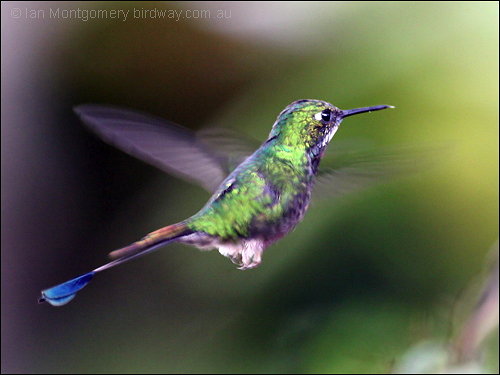
BootedRacket-tail(Ocreatus underwoodii)  by Ian

Booted Racket-tail (Ocreatus underwoodii) by Ian

Number 1500 is ‘PHOS’ which means LIGHT in Greek.. Number 1500 is YHVH (10x5x6x5), which means GOD in Hebrew…

Maybe the Hummingbird knew this, that’s why it visits about 1500 flowers everyday for nectar…..

What about us? Do we seek THE LIGHT at least once a day?

Then spake Jesus again unto them, saying, I am the light of the world: he that followeth me shall not walk in darkness, but shall have the light of life. (John 8:12)

The size of one of the curtains of the Tabernacle is 1260 square cubits…
The heartbeat of the Hummingbird is 1260 per minute..

This identical number of 1260 which is the area of one of the curtain of the Tabernacle and the heart beat of the hummingbird seems to convey a divine message.. Maybe the Hummingbird’s heart beats for the Lord?

For whom does our heart beat?

It has to feed every ten minutes, and would die if it starves for a few hours. But still, the Hummingbird has the energy to fly 500 miles nonstop to cross the Gulf of Mexico during migration….

If GOD can provide so much energy for a tiny little bird, will HE not strengthen us to cross every gulf in our lives?

After all, HE has created us in HIS own image…

With GOD our limited energy turns unlimited…

And he said unto me, My grace is sufficient for thee: for my strength is made perfect in weakness…….. (Psalm 2Corithians 12:9)

The more sugar we take, the more the chances of turning into a Diabetic… The Hummingbird feeds every ten minutes on nectar and drinks almost double its weight of nectar in a day.. Yet, it isn’t a Diabetic! Its cos, it burns its energy through its 53 per minute wing beat…

The word of the LORD is sweeter than honey… THE WORD is our LORD… Well, are we a Spiritual Diabetic? So much of GOD’S WORD enters our system but, we don’t seem to exercise… Do we?

How sweet are thy words unto my taste! yea, sweeter than honey to my mouth! (Psalm 119:103)

The Hummingbird gets attracted towards RED color.. Maybe it knows that its creator, the Rose of Sharon is RED….

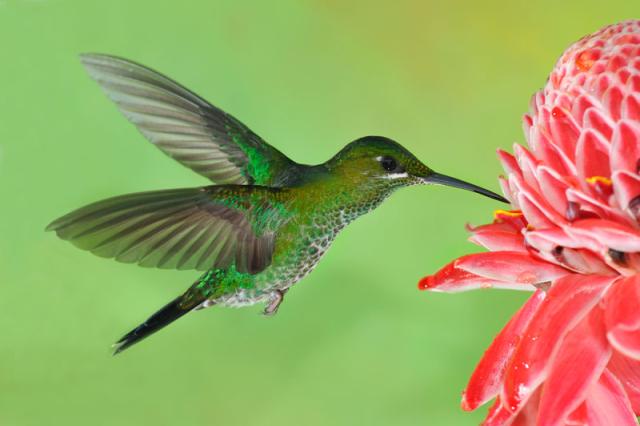
Green-crowned Brilliant (Heliodoxa jacula) Reinier Munguia

Green-crowned Brilliant (Heliodoxa jacula) Reinier Munguia

We all know that RED in a traffic signal means, Stop right away… RED color can also mean Danger..

For years together, we have been seeing Bloody RED on the cross. But, the question is, have we stopped sinning yet?

And I said unto him, Sir, thou knowest. And he said to me, These are they which came out of great tribulation, and have washed their robes, and made them white in the blood of the Lamb. (Revelation 7:14)

Moses used Hyssop’s stem for purification of sacrifices in the Tabernacle… David prayed to GOD to cleanse all his sins with Hyssop..

Did the Hummingbird choose Hyssop’s nectar to live holy? Cos, it gets its favorite nectar from the flowers of Hyssop.

What do we choose to live holy?

Purge me with hyssop, and I shall be clean: wash me, and I shall be whiter than snow. (Psalm 51:7)

With my whole heart have I sought thee: O let me not wander from thy commandments. (Psalm 119:10)

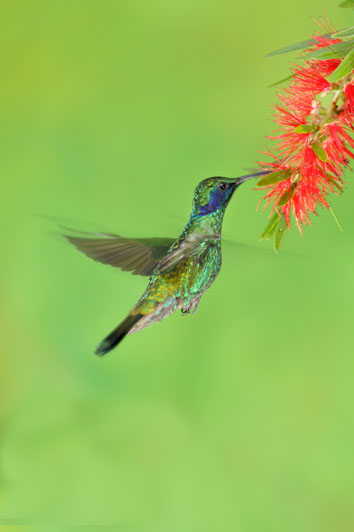
GreenVioletear (Colibri thalassinus) Reinier Munguia

GreenVioletear (Colibri thalassinus) Reinier Munguia

The tree of Life has twelve fruits in store for us. Hyssop-the Hummingbird’s favorite is a twelve inch spiked flower for which, the Hummingbird migrates 500 miles… The Bird seems to ask, “How far do you people run for those twelve wonderful fruits of the Tree of Life?”…

It made me think hard about it… What about you?

In the midst of the street of it, and on either side of the river, was there the tree of life, which bare twelve manner of fruits, and yielded her fruit every month: and the leaves of the tree were for the healing of the nations. (Revelation 22:2)

When it faces danger or if its frightened or if its confused, the Hummingbird immediately flies upward…..

In our dark times or in times of trouble, whom and where do we look for help? Do we look up to GOD instantly or do we look up to HIM when we find no other way?

My voice shalt thou hear in the morning, O LORD; in the morning will I direct my prayer unto thee, and will look up. (Psalm 5:3)

The eyes of Hummingbirds are attuned to wave lengths of light which is outside the visible range of human…

Tuning our spiritual eyes to the wave length of THE LIGHT unseen is FAITH…

Well, it is time for us to go for an eye check-up to check if we can see the unseen..

And he that doubteth is damned if he eat, because he eateth not of faith: for whatsoever is not of faith is sin. (Romans14:23)

Your’s in YESHUA,
a j mithra

Please visit us at: Crosstree


Lee’s Addition:

Hummingbirds are in the Trochilidae Family of the Apodiformes Order. There are 338 members of the family and not all are called hummingbirds.

Green-and-white Hummingbird (Leucippus viridicauda) by Keith

Interesting Things – Anna’s Hummingbird

SmileyCentral.com

New Avian Speed Champion Discovered

Which doeth great things past finding out; yea, and wonders without number. (Job 9:10)

“A peregrine falcon diving toward its prey reaches a relative speed of 200 body- lengths per second. This is close to the 207 body-lengths that the space shuttle travels as it enters our atmosphere. Thus, the peregrine falcon was thought to easily be the fastest dare-devil bird on Earth.

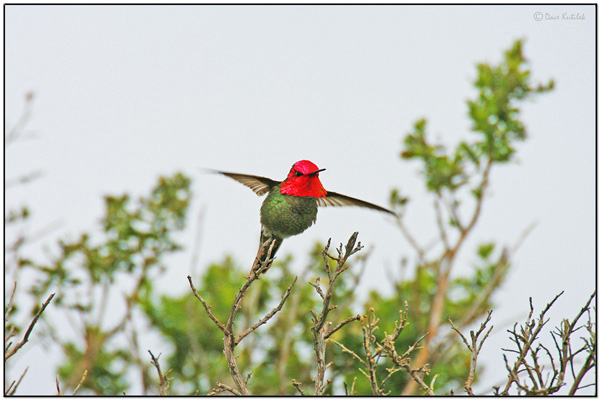
Anna's Hummingbird by Dave's BirdingPix

Anna's Hummingbird by Dave's BirdingPix

Scientists have now discovered that a little pink male hummingbird called Anna’s Hummingbird is the real Top Gun among the birds. As part of its mating ritual, a male hummingbird will try to impress a female with his speed and acrobatics. First, the male will fly up to about 90 feet above the ground. Then, he begins a power dive. As he nears the female, he pulls up, ascending again. During that near-miss pull-up he experiences more than nine times the force of gravity. His relative speed during descent is 385 body-lengths per second. That’s almost twice the peregrine falcon’s relative speed, it’s faster than the space shuttle entering the Earth’s atmosphere and is more than twice the relative speed of a jet fighter running with afterburners!

The wonders of God’s creation are still being discovered, and Creation Moments still loves to make them known to our listeners. But God’s greatest wonder is His love for us though His Son, Jesus Christ. We are thankful that this wonder is revealed to us in the Bible.

Prayer: Father, I give You thanks for the wonders You create, but I especially give You thanks for the wonder of salvation. Amen.

References: Science News, 7/4/09, p. 7, Susan Millius, “Hummingbird pulls Top Gun stunts.”

From Creation Moments ©March 24, 2010

Interesting Things – Ark, No Meat, Creator, Plus

SmileyCentral.com

While checking out Answers with Ken Ham, I found these interesting articles. Hope you find them informative.

Animals on the Ark–here Kitty, Kitty? (Jan 11, 2010)

Animals–no sin . . . no meat? (Mar 10, 2010)

Creator–where did He come from? (Jan 13, 2010)

Green-crowned Brilliant (Heliodoxa jacula) Reinier Munguia

The hummingbird-God’s Tiny Miracle! (Apr 5, 2007)

Bird brained-it could be a compliment! (Oct 9, 2009)

It’s a transition–NO, it’s a bird! (Aug 31, 2006)

The Secret Only God Knows About Hummingbirds – by April Lorier

HummingBirdSMAll of my neighbors have hummingbird feeders on their porches. Why? Well, everyone knows there’s something very special about these birds. Yes, they are birds, and there’s a secret only God knows about them.

Hummingbirds are birds in the family Trochilidae, and are native to the Americas. They can hover in mid-air by rapidly flapping their wings 12–90 times per second (depending on the species). They can fly backwards, and are the only group of birds able to do so.

Hummingbirds do not spend all day flying, though. They don’t have the energy for that! The majority of their activity consists simply of sitting or perching.

Hummingbirds feed in many small meals, consuming many small invertebrates and up to five times their own body weight in nectar each day. They spend an average of 10-15% of their time feeding and 75-80% sitting and digesting.

Hummingbirds feed on the nectar of plants and are important pollinators, especially of deep-throated, tubular flowers. Like bees, they are able to assess the amount of sugar in the nectar they eat; they reject flower types that produce nectar which is less than 10% sugar and prefer those whose sugar content is stronger. Nectar is a poor source of nutrients, so hummingbirds meet their needs for protein, amino acids, vitamins, minerals, etc. by preying on insects and spiders, especially when feeding young.

Their English name derives from the characteristic hum made by their rapid wing beats. They can fly at speeds exceeding 33 mph.

What is awesome about humming birds is that aerodynamically, these birds are not able to fly, and yet they do!

As scientists try to figure out how hummingbirds are flying, I think God is smiling. It’s just another thing only The Creator knows, and that’s fine with me. Life should have some mystery, don’t you think?

(c) 2009 April Lorier

For since the creation of the world God’s invisible qualities—his eternal power and divine nature—have been clearly seen, being understood from what has been made, so that men are without excuse. Romans 1:20

Supplied by and reprinted with permission of April Lorier


See:
More of April’s Articles here

When I Consider! – Hummingbirds

When I Consider!

When I Consider!

“One of the fascinating and unique creatures of all creation is the common hummingbird. What is the probability that all of the unique characteristics of the Ruby-throated Hummingbird, each of which are needed for its survival, developed by some step-by-step process? A few of the hummingbird’s incredible abilities are listed below:

  1. The unique ability to fly forward, backward, upside-down, and straight up like a helicopter as no other bird can.
  2. The use of a special fringed tongue to sweep insects out from the inside of flowers. It cannot survive on nectar alone, but also needs the protein from eating insects. Without its special tongue it could never catch the insects.
  3. The ability to fly 500 miles nonstop over the gulf waters to Mexico. The hummingbird can conserve its strength for long flights by taking a prolonged rest just  prior to the flight and making every motion count in flight.
  4. The ability to go into a “torpid” condition at night by almost shutting down its metabolism. Because of its incredibly high energy activity, gram for gram the hummingbird has the greatest energy output of any warm-blooded animal. Yet at night it uses only about one fifth of its normal energy.
Ruby-throated Hummingbird by Ray's Wildlife

Ruby-throated Hummingbird by Ray’s Wildlife

The hummingbird is truly a marvel of God’s creativity.

Character Sketches, Vol.II, p.42-48″

Seek the LORD and his strength; seek his presence continually! Remember the wondrous works that he has done, his miracles, and the judgments he uttered, (Psalms 105:4-5 ESV)

A Closer Look at the Evidence, July 13, by Richard and Tina Kleiss

Error
This video doesn’t exist

To see more about Hummingbirds See:

Birds of the Bible – Bird Feeder I

Hummingbirds – Peterson Field Guide Series

Hummingbird Videos