Ian’s Bird of the Week – Grey Goshawk

Grey Goshawk ( novaehollandiae) by Ian 1

Ian’s Bird of the Week – Grey Goshawk ~ by Ian Montgomery

Newsletter ~ 5-24-12

*
Here is an uncommon and beautiful raptor, the Grey or Variable Goshawk. It is usually called the Grey Goshawk in Australia but the moniker Variable is more accurate as it occurs in both grey and white morphs. The first photo shows a white morph bird perched in a dead tree near mangroves at Bushland Beach near Townsville, photographed in 2002.

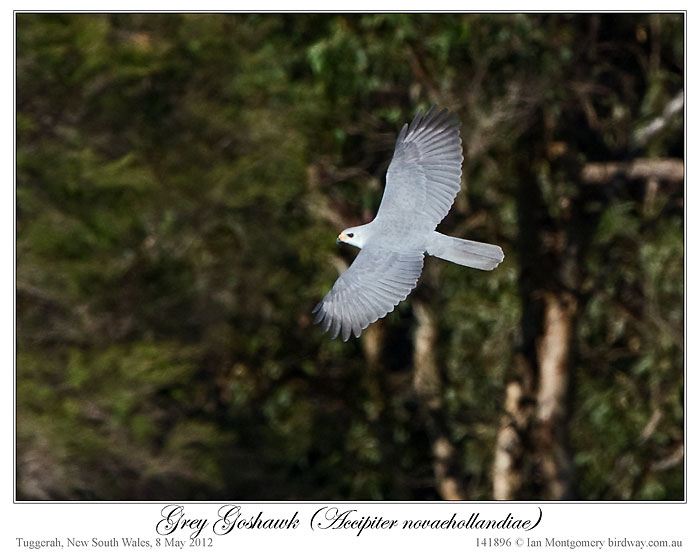
It is the only completely white raptor worldwide, though white morph birds may show some grey on the tail – as this one does – and on the head. These are large hawks, with the females being 50-55cm/20-22in in length with a wingspan to 1.1m/43in. The smaller males are 38-42/15-16.5in. By way of comparison – the choice is deliberate – the Sulphur-crested Cockatoo is 44-51cm with a comparable wingspan of about 1m. Despite their size, they are difficult to see (and to photograph) as they inhabit mainly dense forest, or forest edges and are shy, so it would be another ten years before I got an even vaguely respectable photo of a grey morph bird, second photo.
Grey Goshawk ( novaehollandiae) by Ian 2

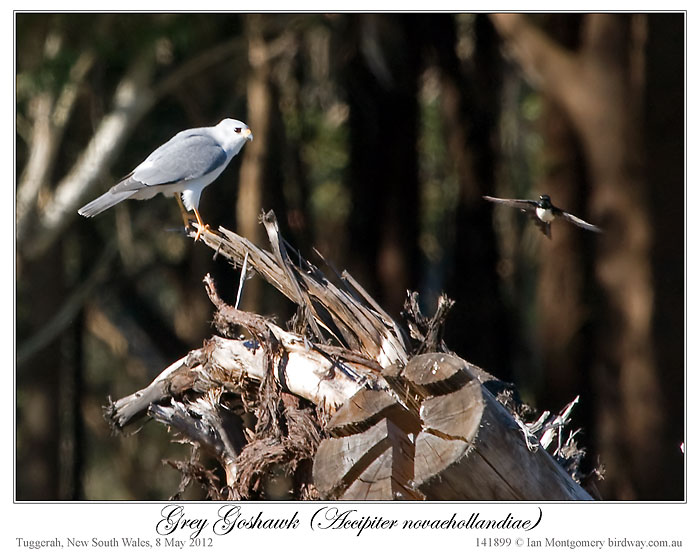
Here you can see how broad and rounded the wings are. This shape is ideal for short glides and rapid braking and is an adaptation for the preferred hunting strategy of this species, called ‘still hunting’ – perching on a well-hidden perch and making short, devastating swoops on unsuspecting prey feeding on the ground or in trees. Prey includes birds, mammals and reptiles and a female can take prey up to the size of herons, rabbits and possums. Goshawks are subject to mobbing by small birds, and the when the individual in the second photo landed on a tree stump several seconds later (12 to be exact) it immediately attracted the attention of a Willie-wagtail visible in flight near the goshawk in the third photo.
Grey Goshawk ( novaehollandiae) by Ian 3

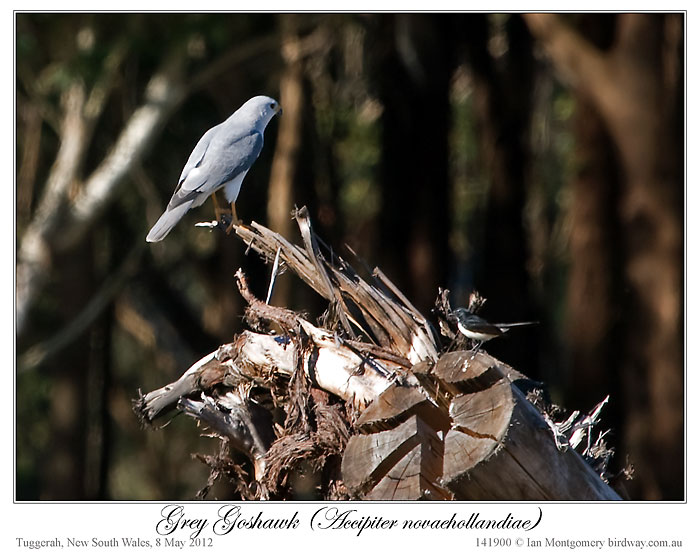
You might recall that pied plumage is often the hallmark of aggressiveness – the reverse of camouflage – and this Willie-wagtail actually landed on the tree stump as in the third photo. The Goshawk gives the appearance of having lost interest in the Willie-wagtail, but I suspect that it was more concerned with preparing to take flight as I approached it trying to get a closer shot, which it did very shortly afterwards.
Grey Goshawk ( novaehollandiae) by Ian 4

I mentioned Sulphur-crested Cockatoos before as it has been suggested that the white morph has evolved to mimic Cockatoos to escape detection, but this theory has never been proven. It is thought that genetically the white morph is simply a single recessive gene, like Mendel’s sweet peas, as white-white mating produces white offspring, while white-grey and grey-grey can produce either. There is supposed to be geographical variation in the proportion of the morphs, with the white one being predominant in northern Australia, Tasmania and western Victoria and the grey morph being predominant in eastern Australia. Despite the specific name novaehollandiae, it isn’t an Australian endemic and also occurs in New Guinea and neighbouring islands, though the island races are sometimes treated as separate species.

Best wishes

Ian

**************************************************
Ian Montgomery, Birdway Pty Ltd,
454 Forestry Road, Bluewater, Qld 4818
Tel 0411 602 737 ian@birdway.com.au
Check the latest website updates:
http://www.birdway.com.au/#updates
**************************************************

Lee’s Addition:

Wow! Another beautiful bird! I really enjoy Ian’s Newsletters. They tell about birds that many of us never see or even hear about. Then again, we tell about American birds and to others, those are probably just as fantastic to hear about. Ian has managed to travel around the world in search of birds to photograph. Check out his website, Birdway, to enjoy his photos.

The Goshawk is one of the Birds of the Bible and was not to be eaten, but this one is such a beauty, I wouldn’t dream of eating it or hurting it anyway.

the ostrich, the short-eared owl, the sea gull, and the hawk after its kind; (Leviticus 11:16 NKJV)

The Goshawks are part of the Accipitridae – Hawks & Allies Family. Check out Ian’s 47 members of the Hawks, Eagles & Allies and then the whole list of 255 species in the family listed here.

*

Ian’s Bird of the Week – Black-winged Petrel

Black-winged Petrel (Pterodroma nigripennis) by Ian Montgomery 1

Black-winged Petrel (Pterodroma nigripennis) by Ian Montgomery 1

Ian’s Bird of the Week – Black-winged Petrel ~ by Ian Montgomery

Newsletter – 5/14/12

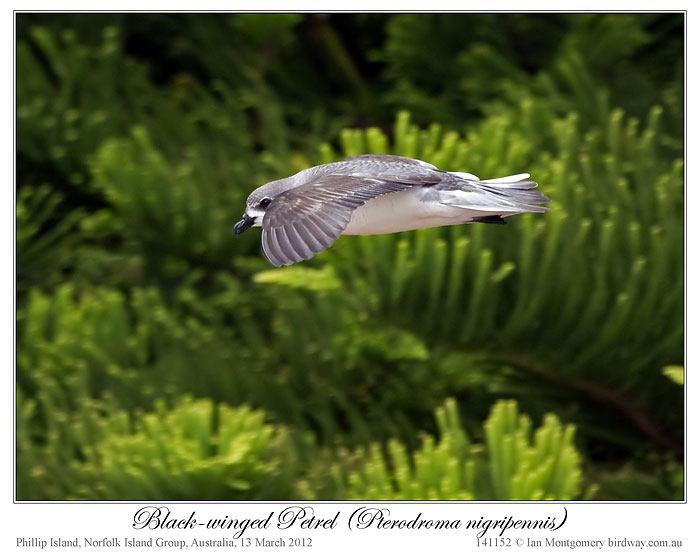
Three weeks ago we had the Cape Petrel. Here is the Black-winged Petrel, another species, like the White Tern and Grey Ternlet, that I had seen twenty years ago on Lord Howe Island and was keen to photograph on Norfolk Island. With a length of 28-30cm/11-12in and a wingspan of 67cm/26in, this is quite a small species with elegant black, grey and white markings and a stubby, hooked bill, visible in the first photo.

It nests on both the main island and Phillip Island – where it was quite abundant – and was easy to find as, unlike most petrels and shearwaters, it is active around the breeding colonies in daylight. Most petrels and shearwaters come ashore under cover of darkness to reduce the risk of avian predators such as raptors and gulls, but the Black-winged has historically nested on predator-free islands. ‘Historically’ here means before human settlers introduced predators such as feral cats.

Black-winged Petrel (Pterodroma nigripennis) by Ian Montgomery 2

Black-winged Petrel (Pterodroma nigripennis) by Ian Montgomery 2

Black-winged Petrels are accomplished fliers and spent much time in aerial acrobatics around and over cliffs. The generic name Pterodroma means ‘winged runner’ and refers to their aerial agility. The one in the second photo is coming in to land near its nesting burrow and passing some Norfolk Island Pines. All petrels and shearwater, except the Giant Petrels, have very weak legs and once on the ground are barely mobile using their wings to drag themselves along on their bellies.

Black-winged Petrel (Pterodroma nigripennis) by Ian Montgomery 3

Black-winged Petrel (Pterodroma nigripennis) by Ian Montgomery 3

Like many island birds, they seemed unafraid and didn’t appear agitated when approached closely to have their photos taken. The fourth photo shows the tubular nostrils characteristic of this family of birds and their close relatives the albatrosses and storm-petrels. All these ‘tube-nosed’ birds are thought to have a strong sense of smell – very unusual for birds – that helps them find both marine prey and their nesting burrows on dark nights, and the birds themselves apparently have a strong musty odour during the breeding season.

Black-winged Petrel (Pterodroma nigripennis) by Ian Montgomery 4

Black-winged Petrel (Pterodroma nigripennis) by Ian Montgomery 4

The hooked bill helps the birds grasp slippery prey – mainly squid and small fish – and the bills have sharp cutting edges. The Black-winged is one of about 36 global species of Pterodroma petrels collectively and, I think unfairly, called Gadfly Petrels, in reference to their erratic flight. As I’m sure you know, Gadflies are nasty blood-sucking insects such as Horse and March Flies, and there must be other more congenial erratic fliers after which they could been named. Anyway, Gadfly Petrels feed on the wing by snatching prey from the surface of the water and rarely alight on the water or dive.

The Black-winged Petrel breeds on islands in the south Pacific including Lord Howe, Norfolk, various islands around New Zealand and on several in French Polynesia. Helped by protection and the removal of predators such as feral cats, its population is increasing and it has bred on Lord Howe only since the 1960s. There are unproven recent reports of it breeding on some islands on the east coast of Australia, where it is generally rare. Outside the breeding season, it is highly pelagic and ranges widely over the Pacific as far as southern Japan and Mexico.

Best wishes
Ian
**************************************************

Ian Montgomery, Birdway Pty Ltd,
454 Forestry Road, Bluewater, Qld 4818
Tel 0411 602 737 ian@birdway.com.au
Check the latest website updates:
http://www.birdway.com.au/#updates
**************************************************


Lee’s Addition:

Thanks, Ian, for another interesting Newsletter. Trust you all are enjoying Ian’s Bird of the Week newsletters as well as I do. They are so informative and he introduces us to such a variety of birds. His photograph is outstanding.

The Black-winged Petrel is a member of the Procellariidae – Petrels, Shearwaters Family which has 87 species. They are in the Procellariiformes Order. The order has 3 other families, the Storm Petrels, Diving Petrels and the Albatrosses.

And God said, “…and let birds fly above the earth across the expanse of the heavens.” (Genesis 1:20 ESV)

See Bird of the Week for more articles by Ian.

*

Ian’s Bird of the Week – (Norfolk Island) Golden Whistler

Ian’s Bird of the Week – (Norfolk Island) Golden Whistler ~ by Ian Montgomery

Newsletter: 5-4-12

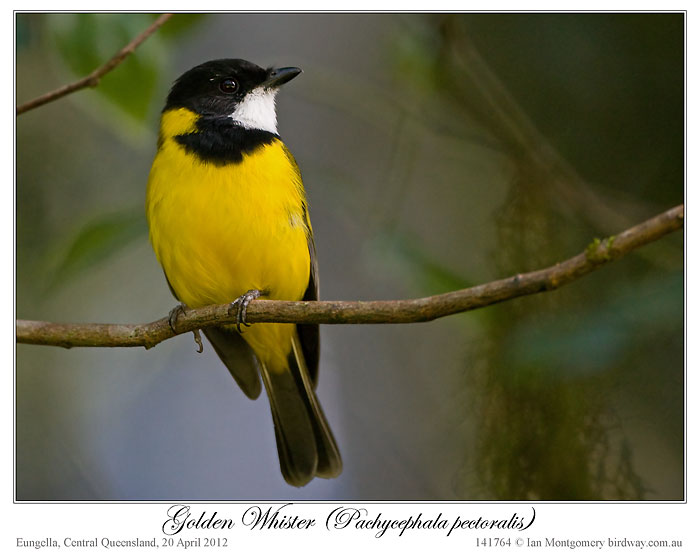
My apologies for a belated bird of the week. When I was in Eungella recently chasing the so-named Honeyeater, I encountered a very obliging male Golden Whistler, below, so I’ve chosen it to introduce this week’s subject.

Australian Golden Whistler (Pachycephala pectoralis) by Ian

It’s one of the most gorgeous of the woodland birds of eastern and southern Australia and one of those unusual birds that, unlike Rainbow Lorikeets for example, both look and sound strikingly beautiful. It featured as bird of the week in January 2005, but I don’t suppose you’ll mind me repeating it and I want to share with you the interestingly different Norfolk Island equivalent.

Australian Golden Whistler (Norfolk Island) (Pachycephala pectoralis xanthoprocta) by Ian

Australian Golden Whistler (Norfolk Island) (Pachycephala pectoralis xanthoprocta) by Ian

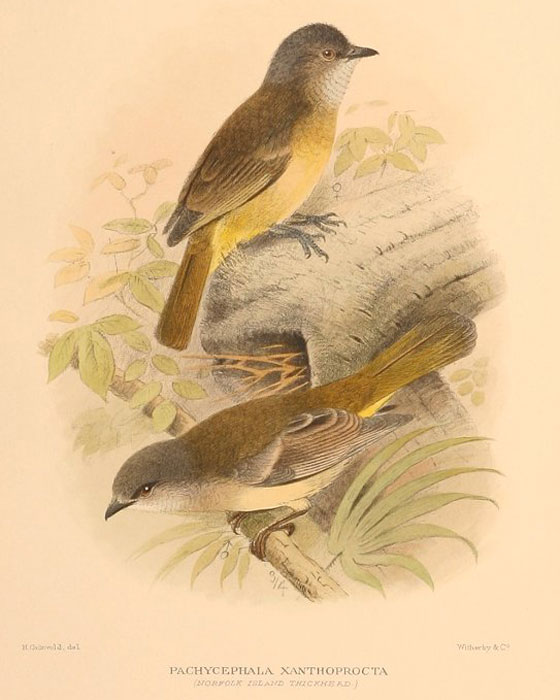
The bird in the second photo, one of a pair we encountered, is, or could be, an adult male Norfolk Island Golden Whistler. I say ‘could be’ because there, the adult males do not develop the striking yellow and black plumage of the mainland races and remain ‘hen-plumaged’, to quote Schodde and Mason. This was recognised early on in the settlement of the island and it was original described as a separate species, the Norfolk Island Thickhead (Pachycephala means ‘thick-head’) P. xanthoprocta, where xanthoprocta refers to the yellow vent. Here is a painting of a pair by John Gould.

Australian Golden Whistler (Norfolk Island) (Pachycephala pectoralis xanthoprocta) by Ian Drawing

Australian Golden Whistler (Norfolk Island) (Pachycephala pectoralis xanthoprocta) by Ian Drawing

He has labelled the bird in the foreground as a male, and the one in the background as a female. There are subtle differences in plumage, with the female being more lemon-yellow underneath and the male being more buffish yellow and. having darker dark lores. I haven’t been able to find whether these differences are consistent, but it seemed to me that the bird in photo above (141464) looks more like the Gouldian male than its partner below (141440).

 Australian Golden Whistler (Norfolk Island) (Pachycephala pectoralis xanthoprocta) by Ian

Australian Golden Whistler (Norfolk Island) (Pachycephala pectoralis xanthoprocta) by Ian

Mainland juvenile Golden Whistlers have rusty margins on the wing feathers and this is the case with the Norfolk Island birds, as shown in the next photo taken on a different occasion when we were hanging around waiting for the Norfolk Island Parakeets to show up.

Australian Golden Whistler (Norfolk Island) (Pachycephala pectoralis xanthoprocta) Juv by Ian

Australian Golden Whistler (Norfolk Island) (Pachycephala pectoralis xanthoprocta) Juv by Ian

To this day, the taxonomic status of the Golden Whistler ‘complex’ remains unresolved. There are different races on the mainland and in neighbouring locations such as New Guinea, New Britain and Fiji. The mangrove-inhabiting Golden Whistler of northern and western Australia has been elevated to specific status but the others have remained in the too-hard basket and are still lumped together as a single species. It seems to me unusual for avian taxonomists to be stumped by a problem like this, but maybe they’ve met their match.

Best wishes

Ian

**************************************************
Ian Montgomery, Birdway Pty Ltd,
454 Forestry Road, Bluewater, Qld 4818
Tel 0411 602 737 ian@birdway.com.au
Check the latest website updates:
http://www.birdway.com.au/#updates
**************************************************
*

Lee’s Addition:

Very interesting and a beautiful bird. I couldn’t resist finding out what this “whistler” sounds like. It is very pretty sounding. Take a listen.

Sound of Golden Whistler

In that day the LORD will whistle for the fly that is at the end of the streams of Egypt, and for the bee that is in the land of Assyria. (Isaiah 7:18 ESV)

The Whistlers are found in the Pachycephalidae – Whistlers and Allies. There are 58 members of the family. This Australian Golden Whistler (Pachycephala pectoralis xanthoprocta) is one of those subspecies; there are at least 7 subspecies. The “Norfolks” are found on the Norfolk Island, as Ian mentioned.

The Norfolk Golden Whistler (P. p. xanthoprocta) declined for many years due to habitat loss and fragmentation and possible due to introduced predators such as the Black Rat. Most of the population is now restricted to the Norfolk Island National Park. This has resulted in it being listed as vulnerable by the Australian Government.

Links:

Check out Ian’s other Whistlers

Australian Golden Whistler – Wikipedia

Pachycephalidae – Whistlers and Allies

*

Ian’s Bird of the Week – Eungella Honeyeater

Ian’s Bird of the Week – Eungella Honeyeater ~ by Ian Montgomery

Newsletter – 4/22/12

Well, team, many thanks, your moral and spiritual support have done it again: here is the Eungella Honeyeater, photographed last Friday after some diligent searching. The field guides say: ‘noisy, wary, elusive’ and that I would agree is a good description. I heard several at the first location (Chelmans Road, Upper Dalrymple) but got only a brief glimpse of one in the rather dense rainforest regrowth. The second location, Digging’s Road near Eungella, proved more productive and, as I walked back to the car, I eventually encountered a flock of ten or so crossing the road and got photos of a couple of them.

Were it not for its distinctive song, rather scratchy like a very loud gerygone I thought, it would be easy to overlook, given its rainforest habitat, and, dare one say, rather drab colours even if tastefully highlighted by blue eyes.

And overlooked it was until 1976. Or more accurately, any earlier records, such as one collected in 1959, of this bird from the little studied Eungella/Clarke Range area were mistakenly assumed to be the closely related wet-tropics endemic, the Bridled Honeyeater, see the third photo.
The Bridled Honeyeater is much larger – 20-22cm/8-8.7in versus 16-18cm/6.3-7.1in – has a yellow base to the bill and rather different head markings. Their songs are quite different, sufficiently so for someone rather deaf like me to distinguish them easily. Early field guides, such as the 1974 Slater’s, shows the range of the Bridled Honeyeater extending the 300km or so from the wet tropics down to the Clarke Range west of Mackay.
In 1975, during a survey by the Australian and Queensland Museums, another specimen was collected and labelled as a Bridled Honeyeater. The following year, Wayne Longmore was working on the Honeyeater collection at the Australian Museum and realised that not only was this bird not a Bridled Honeyeater – based on the colour of the bill – but that it didn’t correspond to any known species. He organised further field trips to the Clarke Range in 1978 and 1980 in search of the mystery bird and found that the species was relatively common in a restricted area of upland rainforest. It was described in 1983 by him and Walter Boles and named Meliphaga hindwoodi (now Lichenstomus hindwoodi) in honour of  Keith Hindwood, ornithologist and Wayne’s mentor. You can read the full story here. The fourth image shows the records from the BirdLife Australia Atlas Project.
So you don’t have to go to the wilds of Irian Jaya to discover new species of birds! What would you like next week?
Best wishes
Ian
**************************************************
Ian Montgomery, Birdway Pty Ltd,
454 Forestry Road, Bluewater, Qld 4818
Tel 0411 602 737 ian@birdway.com.au
Check the latest website updates:
http://www.birdway.com.au/#updates
**************************************************

Lee’s Addition:

I decided to produce this addition of Ian’s Bird of the Week in the exact format that I receive it. I am also happy that our collective prayers were answered for Ian’s latest adventure. The two Honeyeaters do look similar, but there is a difference. Thanks again, Ian, for letting us share in your birdwatching trips.

Then you will call upon Me and go and pray to Me, and I will listen to you. And you will seek Me and find Me, when you search for Me with all your heart. (Jeremiah 29:12-13 NKJV)

See Ian’s other Birds of the Week

*

Ian’s Bird of the Week – Cape Petrel

Cape Petrel (Daption capense) by Ian 1

Cape Petrel (Daption capense) by Ian 1

Ian’s Bird of the Week – Cape Petrel ~ by Ian Montgomery

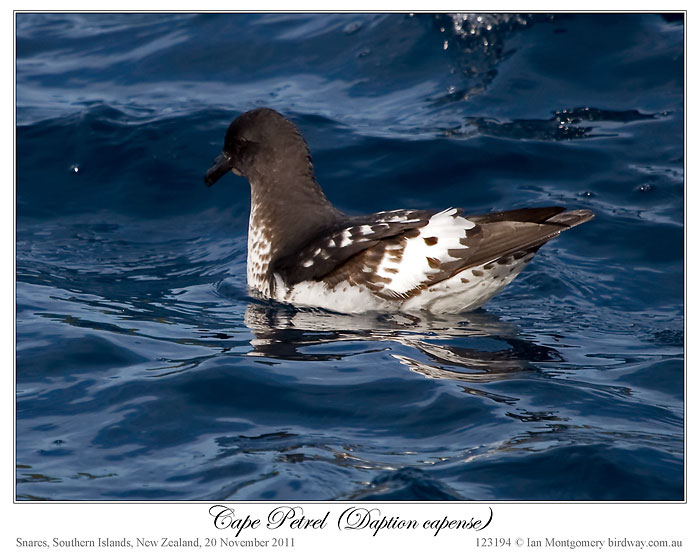
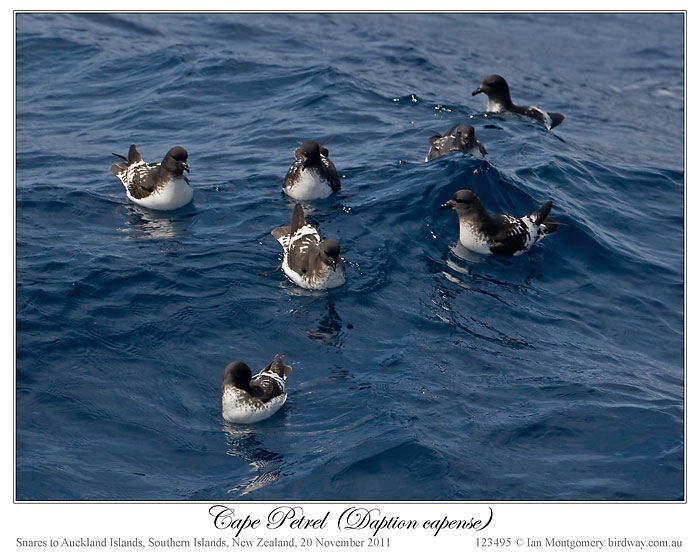
My records show that no Petrel and only one Shearwater (Buller’s) has ever featured as bird of the week. That’s partly because, until recently, I didn’t have many photos of members of this family of seabirds (Procellaridae) but that has been largely corrected by recent trips to the Sub-Antarctic and Norfolk Island. Petrels and Shearwaters are often challenging birds to identify, so I’m going to start with an easy and attractive one that featured prominently on the Sub-Antarctic Islands trip last November.

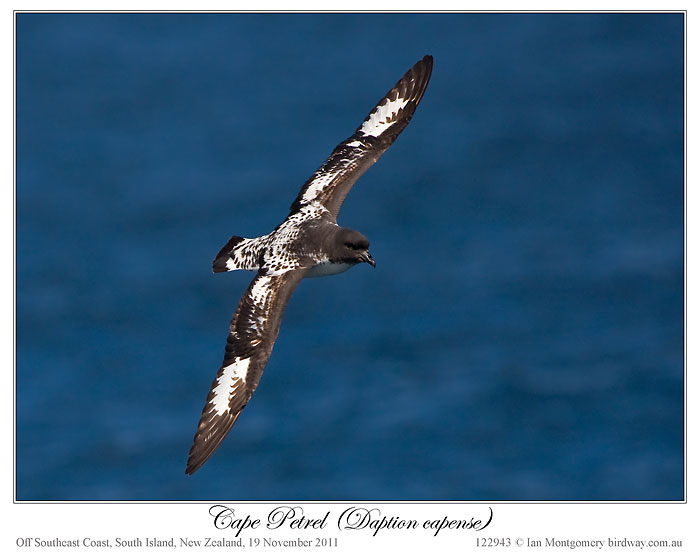
The striking chequered black and white pattern on the back and wings is unique. The white patches on the primary and secondary flight feathers are translucent and appears as ‘windows’ when seen from below in bright light, as in the second photo. We encountered Cape Petrels soon after leaving Dunedin, and as they follow ships, they were almost constant companions for most of the voyage.
Cape Petrel (Daption capense) by Ian 2

Cape Petrel (Daption capense) by Ian 2

With a length of 35-40cm/14-16in, they’re comparable in size to a domestic pigeon, though with much longer wings, and are often called Cape Pigeons. They feed on krill, small fish, etc., either by swimming buoyantly on the surface and pecking in a rather pigeon-like fashion or by snatching morsels in flight. They’ll readily feed on marine scraps left by others and often follow whales.
Cape Petrel (Daption capense) by Ian 3

Cape Petrel (Daption capense) by Ian 3

As you can guess from the name, the species was originally named from a specimen collected at the Cape of Good Hope and described by the father of taxonomy, Linnaeus, in 1758. Cape Petrels are very characteristic bird of the southern oceans right around the planet and range from the coast of Antarctica to the Tropic of Capricorn, and even reach the equator in the cold Humboldt current on the western side of South America. They occur around Australia in the southern winter but are mainly an offshore bird, unless beach-wrecked by storms. The global population is in the millions, and they can occur in large flocks, though we encountered them mainly in small numbers.
Cape Petrel (Daption capense) by Ian 4

Cape Petrel (Daption capense) by Ian 4

The nest on most of the sub-Antartic Islands around the world and on islands along the coast of Antarctica itself. There is a small colony on Macquarie Island and larger colonies on the Southern Islands of New Zealand (Snares, Auckland, Campbell, Bounty, Antipodes and Chatham). These belong to a separate race, australe, smaller than the nominate race.
Cape Petrel (Daption capense) by Ian 5

Cape Petrel (Daption capense) by Ian 5

I loved watching them soaring and wheeling around the ship, and they looked as if they enjoyed it too. I got very used to their attendance and found their familiar presence reassuring in the vast and sometimes alien and stormy remoteness of the Southern Ocean.
I have another request for moral and spiritual support (and so far you’ve never failed me :-})! I’m planning to go to Eungella National Park west of Mackay next weekend in search of the Eungella Honeyeater. I’ve never seen it before, and we need photos for the Pizzey and Knight digital project.
Best wishes
Ian

*************************************************
Ian Montgomery, Birdway Pty Ltd,
454 Forestry Road, Bluewater, Qld 4818B
Tel 0411 602 737 ian@birdway.com.au
Check the latest website updates:
http://www.birdway.com.au/#updates
**************************************************


Lee’s Addition:

And unto one he gave five talents, to another two, and to another one; to every man according to his several ability; and straightway took his journey. (Matthew 25:15 KJV)

Looks like the Petrel flew under some dropping white paint. I am sure that it helped in IDing it. Ian is correct about that unique pattern. I am amazed at how unique all the birds were created. Each has its own patterns, food requirements and places to live. Just like all of us. We each have a unique niche to find and enjoy. Thankfully, Ian has found one of his niches. He is an adventurous and fantastic photographer.

Yes, Ian, we will be praying for you as you take this next adventure to find the Eungella Honeyeater and whatever else pops up in front of your lens. Also for your safe journey.

Check out Ian’s Procellaridae family and the article about the Buller’s Shearwater.

The Procellariidae – Petrels, Shearwaters Family here.

Ian’s Bird of the Week

*

Ian’s Bird of the Week – Grey Ternlet (Noddy)

Bird of the Week – Grey Ternlet ~ by Ian Montgomery

Newsletter ~ 4/10/12
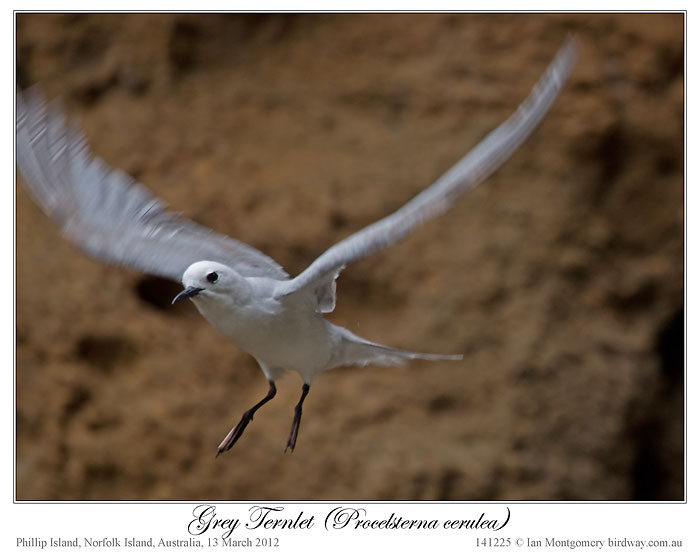
Last week we had the (Common) White Tern or White Noddy. Here is its counterpart the Grey Ternlet, often called the Grey Noddy. It is also an island species but is restricted in range to the Western and South Pacific. In the Australian regions it, like the White Tern, occurs on both Lord Howe and Norfolk Islands. Unlike the White Tern, it nests mainly on inaccessible rock cliffs and I had had only distant views of it on Lord Howe 20 years ago. The situation was similar on Norfolk Island, and the first photo, taken at Captain Cook’s Lookout, was our first view of any. This photo, I might add, was taken with a 500mm telephoto lens, so we were nowhere near them.
Grey Noddy (Procelsterna albivitta) by Ian 1

Grey Noddy (Procelsterna albivitta) by Ian 1

So we hoped that our planned boat trip to nearby Phillip Island would provide better views and photo opportunities. It was late in the nesting season, though, and when we returned to the rocky cove to be picked up by the boat, we still hadn’t seen any, even in the distance. Getting on and off the boat was an interesting exercise as there is no wharf, just a north-facing cove, sheltered in southerly winds and swell, with a slippery rock shelf, best negotiated in stockinged feet for better traction, second photo (that’s Norfolk Island in the background).
Grey Noddy (Procelsterna albivitta) by Ian 2

Grey Noddy (Procelsterna albivitta) by Ian 2

We were just getting ready to board the approaching boat, when two Grey Ternlets landed on a rocky cliff nearby, and the boat was forgotten while I dug the camera out of my backpack. The two birds were an adult and a juvenile, the adult standing over the juvenile, which has dark markings on the head, in the third photo.
Grey Noddy (Procelsterna albivitta) by Ian 3

Grey Noddy (Procelsterna albivitta) by Ian 3

I moved closer to them, but the adult flew off, leaving the youngster to its fate, fourth photo.
Grey Noddy (Procelsterna albivitta) by Ian 4

Grey Noddy (Procelsterna albivitta) by Ian 4

The adult had landed almost out of sight behind a rocky outcrop, but I got a photo of it when it took off a little later, fifth photo.
Grey Noddy (Procelsterna albivitta) by Ian 5

Grey Noddy (Procelsterna albivitta) by Ian 5

Anyway, it was time to leave the Ternlets to their own devices and get on the boat. We were to see more Grey Ternlets on the cliffs of Norfolk Island, including a flock of about 15, but we never got close to them again. It was a great ending to a very successful trip to Phillip Island and we didn’t mind too much getting rather wet from the spray on the way back to Norfolk Island, the cameras being safety stowed in a dry spot.
Best wishes
Ian
**************************************************
Ian Montgomery, Birdway Pty Ltd,
454 Forestry Road, Bluewater, Qld 4818
Tel 0411 602 737 ian@birdway.com.au
Check the latest website updates:
http://www.birdway.com.au/#updates
**************************************************

Lee’s Addition:

What scenery and what a beautiful Noddy. These Noddies or Ternlets like to nest on protected cliffs it appears.

The place where you live is safe. Your nest is on a high cliff. (Numbers 24:21a NIrV)

The Grey Noddy or Grey Ternlet (Procelsterna albivitta) is a seabird belonging to the tern family Laridae. It was once regarded as a pale morph of the Blue Noddy (Procelsterna cerulea) but is now often considered to be a separate species. It occurs in subtropical and warm temperate waters of the south Pacific Ocean.

It is 25–30 cm (9.8–12 in) long with a wingspan of 46–61 cm (18–24 in) and a weight of about 75 grams (2.6 oz). The tail is fairly long and notched. The plumage is pale grey, almost white on the head and underparts but darker on the back, tail and wings. The wings have dark tips and a white hind edge and are mainly white underneath. The eye is black and appears large due to the black patch in front of it. There is a white patch behind the eye. The thin, pointed bill is black and the legs and feet are also black apart from pale yellow webs.

It feeds in shallow water, not moving far from the breeding colonies. It gathers in large feeding flocks which can contain thousands of individuals. They feed by hovering over the water and dropping down to pick food from the surface. Plankton forms the bulk of the diet and small fish are also eaten.

Breeding takes place in colonies on rocky islands. The nest site is a sheltered rocky surface or underneath a boulder or clump of vegetation. A single egg is laid. Juvenile birds are browner than the adults and have darker, more contrasting flight feathers.

The Grey Noddy is usually silent but has a soft, purring call.

(The verse is out of context, but the nest on the cliff fit with these birds. Wikipedia cited.)

See Also:

Bird of the Week – by Ian

Birdway’s Laridae Family

Laridae – Gulls, Terns and Skimmers

Grey Noddy – Wikipedia

*

Ian’s Bird of the Week – Common White Tern

Ian’s Bird of the Week – Common White Tern ~ by Ian Montgomery

Newsletter – 4/2/12

Another species on my photo list on Norfolk Island was the (Common) White Tern. I’d admired on Lord Howe Island more than twenty years ago, before I got seriously into bird photography. They’re only Common if you’re on a remote coral or rocky island in the Pacific, Indian and Atlantic Oceans, but the label really means ‘standard’ and reflects a split of the species, not universally recognised, into ‘Standard’ and Little White Tern. It used to have the attractive name ‘White Noddy’, until some prosaic purist decided that only terns belong the genus Anous were real Noddies.

They are unusually looking terns, with a pointy, slightly upturned bill and very white, actually translucent, feathers, usually described as ‘ethereal’. Seen against the sunlight, the effect is something like looking at an X-ray as in the second photo. In this one, you can see the bill is very thin laterally so it is shaped more like a pair of scissors.

White Terns are numerous on Norfolk Island and as they nest on the branches of Norfolk Island Pines, you see them all over the island. If you’re used to seeing terns near water, it’s initially slightly disconcerting to see them flying around in forest. Many of these are parents feeding young, but do also see pairs or small groups of birds, as in the third photo, and very pretty they are too.

In March, the breeding season is nearly over, but there are still some hungry and very bored looking chicks in the pines waiting for a feed. The single egg is laid precariously in a concavity on a branch or palm frond. Norfolk Island pines, with their horizontal limbs, are ideal for this and the recent establishment of breeding White Terns on Lord Howe Island can probably be attributed to the introduction of Norfolk Island Pines.

The fourth photo shows a nearly fledged juvenile. At this age they look like furry toys, but the slightly younger ones, that were just losing the last traces of their down, often looked quite comical. The bird in the fifth photo shows one that looks for all the world like an aged goddess of the silver screen who doesn’t believe in growing old gracefully, with faux eye-lashes, smudged mascara, thinning hair, an ancient fur coat and a grumpy expression.

Hopefully, though, it has a bright future ahead.

Best wishes
Ian<

**************************************************
Ian Montgomery, Birdway Pty Ltd,
454 Forestry Road, Bluewater, Qld 4818
Tel 0411 602 737 ian@birdway.com.au
Check the latest website updates:
http://www.birdway.com.au/#updates
**************************************************


Lee’s Addition:

What a description of the that last photos. Puts a chuckle in you. What is so amazing is that it fits.

Anyway, Terns are in the Laridae – Gulls, Terns and Skimmers Family and see Ian’s Laridae Family of photos at his Birdway site. More of his photos of the Common White Tern can be Here.

“The White Tern (Gygis alba) is a small seabird found across the tropical oceans of the world. It is sometimes known as the Fairy Tern although this name is potentially confusing as it is the common name of the Fairy Tern Sternula nereis. Other names for the species include Angel Tern and White Noddy.

Wow! Look at this from ARKive:

http://www.arkive.org/common-white-tern/gygis-alba/image-G88261.html

The White Tern is a small, all white tern with a long black bill, related to the noddies. It ranges widely across the Pacific and Indian Oceans, and also nests in some Atlantic islands. It nests on coral islands, usually on trees with thin branches but also on rocky ledges and on man-made structures. The White Tern feeds on small fish which it catches by plunge diving.

…there are costs associated with tree nesting, as the eggs and chicks are vulnerable to becoming dislodged by heavy winds. For this reason the White Tern is also quick to relay should it lose the egg. The newly hatched chicks have well developed feet with which to hang on to their precarious nesting site. It is a long-lived bird, having been recorded living for 17 years.” (Wikipedia)

Looks like the Lord, in his creation of these chicks, provided feet that can help them hold on.

All the birds of the heavens made their nests in its boughs; under its branches all the beasts of the field gave birth to their young, and under its shadow lived all great nations. (Ezekiel 31:6 ESV)

Other Links:

Common white tern  (Gygis alba) – ARKive

White Tern – Wikipedia

*

Ian’s Bird of the Week – Pacific Robin

Pacific Robin (Petroica multicolor) by Ian 1

Pacific Robin (Petroica multicolor) by Ian 1

Ian’s Bird of the Week – Pacific Robin ~ by Ian Montgomery

Newsletter – 3/25/12

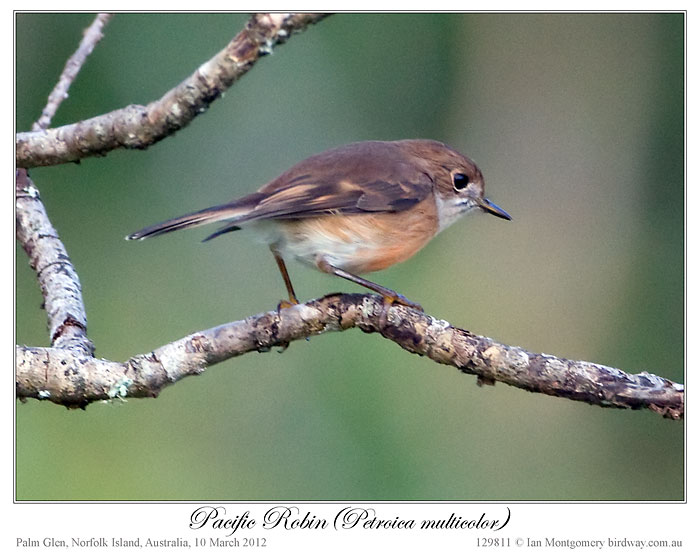
The Pacific Robin was another bird that I was keen to photograph on Norfolk Island. It has only recently been split from the mainland Scarlet Robin and, until that happened, it attracted little attention. As a consequence, I had trouble sourcing photos, particularly of adult males, and getting reliable material for the description of the species for the digital version of the Australian field guide by Pizzey and Knight.

It’s not common on Norfolk Island with an estimated population of 400-500 species and its distribution is restricted to areas of native forest. Happily, there was a resident family at the place, Palm Glen, where we did regular evening vigils for the Norfolk Island Parakeet and, being more confiding than Scarlet Robins, the members of the family proved to be good subjects for photography. The first photo shows the adult male. At first glance, it looks like a small Scarlet Robin, but closer examination reveals the diagnostic lack of white on the flight feathers of the wing and the outer tail feathers: the only white on the wing is the secondary wing coverts. Another supposed difference is a smaller area of white on the forehead, but this bird at least seemed to me to show much more white, extending back to a point above  the rear of the eyes. If you’re interested, compare with http://www.birdway.com.au/petroicidae/scarlet_robin/index.htm .
Pacific Robin (Petroica multicolor) by Ian 2

Pacific Robin (Petroica multicolor) by Ian 2 Fem L-Juv R

The second photo shows the adult female, left, and the juvenile, right, posing obligingly for comparison. Both lack the obvious white forehead spot characteristic of, in fact diagnostic of, their Scarlet Robin counterparts and also lack white in the outer tail feathers. The colours are also richer and the wing stripes are a deeper buff, almost blending with the buffish-brown of the rest of the wings and back. The third photos shows the same female face-on, and the lack of the white spot is more obvious: there is only slight white scalloping.

Pacific Robin (Petroica multicolor) by Ian 3 Fem

Pacific Robin (Petroica multicolor) by Ian 3 Fem

The fourth photo is another shot of the same juvenile, showing the lack of white on the outer tail feathers.
Pacific Robin (Petroica multicolor) by Ian 4 Juv

Pacific Robin (Petroica multicolor) by Ian 4 Juv

Having noticed the large amount of white on the forehead of the male, I kept an eye out for another individual and eventually photographed this one, fifth photo, on nearby Mount Pitt. This too had a large white spot.

Pacific Robin (Petroica multicolor) by Ian 5

Pacific Robin (Petroica multicolor) by Ian 5

The Pacific Robin, as now described, is quite widely distributed on islands in the South Pacific from the Solomons in the north via Vanuata and Fiji to Norfolk Island in the south. It is quite variable in plumage and 14 races have been described. It is closely related to the Tomtit of New Zealand, the males of which vary in colour from the white-breasted (North Island), through yellow-breasted (South Island) to the complete black race on the Snares: http://www.birdway.com.au/petroicidae/tomtit/index.htm. There is clearly enough material here to keep a South-sea-island-loving taxonomist busy for at least a lifetime and I won’t say anything further except to note an interesting historical twist in the story of the splitting of the Pacific and Scarlet Robins.

Norfolk Island was settled in the same year as Sydney, 1788, and one result of that was that the Scarlet Robin was described using a Norfolk Island specimen (the type specimen) by German Naturalist Johann Gmelin in 1789 and given the specific name multicolor. When the species was split 210 years later, the rules governing taxonomy insist that this name remains with the Norfolk Island bird, so the mainland species becomes the new one and was named boodang after the SE Australian race (up till thenPetroica multicolour boodang). To avoid confusion in Australia (at the risk maybe of increasing it in the Pacific Islands) the common name Scarlet was transferred to the new species and the new name Pacific was given to the old species.

I’m sure this family of birds at Palm Glen would be astounded to learn that their kind is the subject of such intense scrutiny!

Best wishes
Ian

*************************************************

Ian Montgomery, Birdway Pty Ltd,
454 Forestry Road, Bluewater, Qld 4818
Tel 0411 602 737 ian@birdway.com.au
>Check the latest website updates:
http://www.birdway.com.au/#updates


Lee’s Addition:

He answered and said to them, “When it is evening you say, ‘It will be fair weather, for the sky is red’; (Matthew 16:2 NKJV)

Those changes aught to keep the Bird Guide writers busy keeping up with the divisions and name changing. What a gorgeous bird and fantastic photography. Thanks again, Ian, for sharing all these great birds.

It seems small in the photos, so I checked to see its size. “The Pacific Robin is a small passerine, 4.5-5.3 in (11.5–13.5 cm) long and weighing .31-.38 oz (9–11 g.) Over much of its range it is the smallest species of bird. Pretty small.

The Pacific Robin is in the Petroicidae – Australasian Robins Family. Also see Ian’s Petroicidae  Family.

“The Pacific Robin is a seasonal breeder, although the timing of the breeding season varies across its range. Information on the timing of the season is patchy or absent in many islands. On Norfolk Island the breeding season is from September to December, and in Vanuatu the season is from October to January. Parents with young have been seen in mid August in the Solomon Islands and in June through to September in Samoa. The species builds a compact nest which is a cup of plant fibres and spider webs. The outside of the nest is decorated with moss and lichen, and is therefore easily overlooked. The nest is usually set into a fork or stump on a tree branch, or on a horizontal branch.

Around two to four eggs are laid in each clutch, with two being the typical clutch size in Norfolk Island, and two to three being typical in Fiji. The eggs are dull grey or greenish, and are incubated by the female. The nests of Pacific Robins are parastised by Fan-tailed Cuckoos where the two species co-occur.” (Wikipedia)

See – Pacific Robin (Wikipedia)

*

Ian’s Bird of the Week – Norfolk Island Parakeet

Norfolk Parakeet (Cyanoramphus cookii) by Ian 1

Norfolk Parakeet (Cyanoramphus cookii) by Ian 1

Ian’s Bird of the Week – Norfolk Island Parakeet ~ by Ian Montgomery

Newsletter ~ 3/15/12

Well, your unwavering moral and spiritual support has done it again: here is the Tasman or Norfolk Island Parakeet (better known here as the Green Parrot to distinguishing it from the introduced Red Parrot – the Crimson Rosella). Thank you very much!

We were met at the airport by Albury-Wodonga birder Dougald Frederick, excitedly carrying the news that there was a vagrant Ringed Plover at Slaughter Bay. So we picked up the hire cars, checked into our accommodation and went down to the Bay, whose name is a corruption of Slackwater Bay, rather than the site of a messy event in the generally nasty penal history of the island. Ringed Plovers are indeed rare in Australia, but I was brought up with them in Ireland and couldn’t conceal my impatience to get to Palm Glen near Mount Pitt, where Dougald had been regularly seeing the Parakeets in the evening.

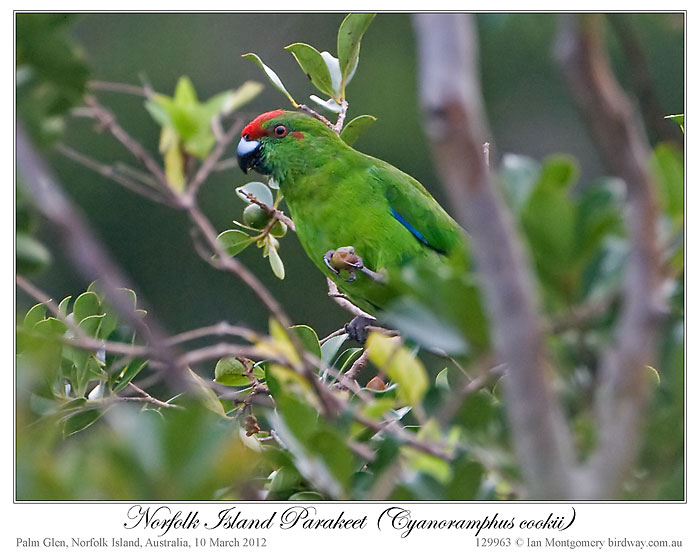
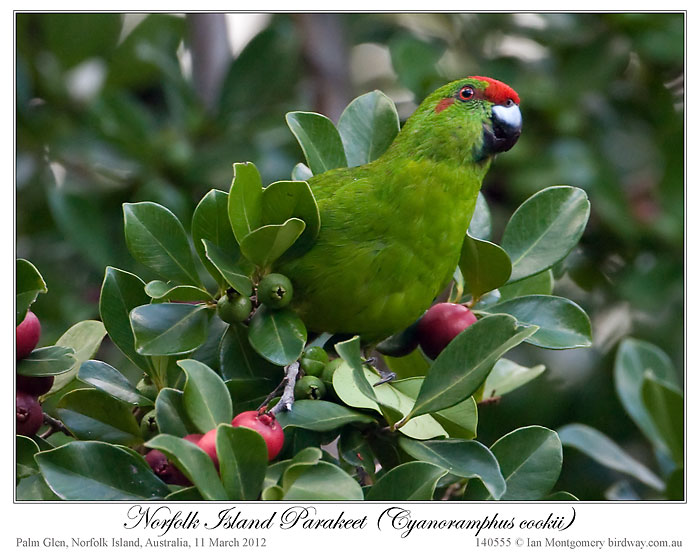
Eventually we went there and eventually, just before sunset and after my travelling companions had left to buy food for breakfast, the Parakeet in the first photo arrived and starting feeding on the feral guavas, fruiting prolifically around the picnic area. The guavas have dense foliage and the red fruit made the feeding Parakeets very hard to see. They were easier to see, but harder to photograph, when they used the top of the numerous tall Norfolk Island pines as vantage points, second photo. This less brightly coloured bird is a female or juvenile; the ones in the first and third photos are males.

Norfolk Parakeet (Cyanoramphus cookii) (fem or juv) by Ian 2

Norfolk Parakeet (Cyanoramphus cookii) (fem or juv) by Ian 2

After that, we visited Palm Glen regularly in the evenings and always saw at least one, distant Parakeet, with a flock of 6 on the second day when I took the third photo, the last occasion on which the birds were close enough to photograph. As well as being a pleasant spot to watch the sunset, it was also a good site for the other two remaining endemic species, the Norfolk Island Gerygone and the Slender- or Long-billed White-eye, and for the endemic races of the Golden Whistler and Grey Fantail.

Norfolk Parakeet (Cyanoramphus cookii) by Ian 3

Norfolk Parakeet (Cyanoramphus cookii) by Ian 3

The Norfolk Island Parakeet was originally regarded as a race of the Red-crowned Parakeet of New Zealand until genetic studies showed that it was sufficiently distinct to warrant the status of a full species. It came close to extinction in the 1980s when the population declined to an estimated 32 individuals with 4 breeding pairs (the sex ratio was heavily biased towards males). Since then, it has been the subject of an intense recovery program to control introduced predators and competitors, and the population is now estimated at perhaps 200 individuals, though our birding guide on Monday, Margaret Christian reckons that that is optimistic, given the frequency of sightings.

It’s a lovely island, friendly and historically interesting, so we have had an enjoyable week. If you intend to visit, we can highly recommend our accommodation, Poinciana Cottages – we all agreed that we could quite happily live in them permanently, and they gave me a free upgrade from an extra bed in one of our two cottages to solo occupancy of a third cottage. If you’re birding, then a morning spent with Margaret Christian is essential and she bakes delicious cake for morning tea. We also did a trip to Phillip Island for the seabirds. That too is highly recommended if the weather is suitable and David Bigg is the person to see about that.

Best wishes and much gratitude,

Ian

**************************************************
Ian Montgomery, Birdway Pty Ltd,
454 Forestry Road, Bluewater, Qld 4818
Tel 0411 602 737 ian@birdway.com.au
Check the latest website updates:
http://www.birdway.com.au/#updates


Lee’s Addition:

Glad we could assist with our prayers. What another neat creation to observe. I love the way they were designed to blend right in with the plants they like to eat. It protects them, but it does make for the challenge of birdwatching photographers and watchers. Thanks for your persistence, Ian.

Look at the birds of the air, for they neither sow nor reap nor gather into barns; yet your heavenly Father feeds them. Are you not of more value than they? (Matthew 6:26 NKJV)

The Norfolk Parakeet (Cyanoramphus cookii), also called Tasman Parakeet,[1] Norfolk Island Green Parrot or Norfolk Island Red-crowned Parakeet, is a species of parrot in the Psittacidae family. It is endemic to Norfolk Island (located between Australia, New Zealand and New Caledonia in the Tasman Sea).

Its natural habitats are subtropical or tropical moist lowland forests and plantations. It is threatened by habitat loss.

Check out Ian’s photos of others in the Psittacidae – Parrot Family.

*

Ian’s Bird of the Week – Yellow-crowned Parakeet

Yellow-crowned Parakeet (Cyanoramphus auriceps) by Ian 1

Yellow-crowned Parakeet (Cyanoramphus auriceps) by Ian 1

Ian’s Bird of the Week – Yellow-crowned Parakeet ~ by Ian Montgomery

Newsletter ~ 3/8/12

Last December, the Red-crowned Parakeet was the bird of the week http://www.birdway.com.au/psittacidae/red_crowned_parakeet/index.htm . That was photographed on Enderby Island in the Auckland Islands one of the New Zealand Sub-Antarctic islands. Here is a close relative the Yellow-crowned Parakeet photographed on the same trip in Fiordland on the South Island. I’ve chosen it for this week’s bird, as I’m going to Norfolk Island tomorrow and I need your moral and spiritual support to help me photograph the endangered Norfolk Island or Tasman Parakeet.

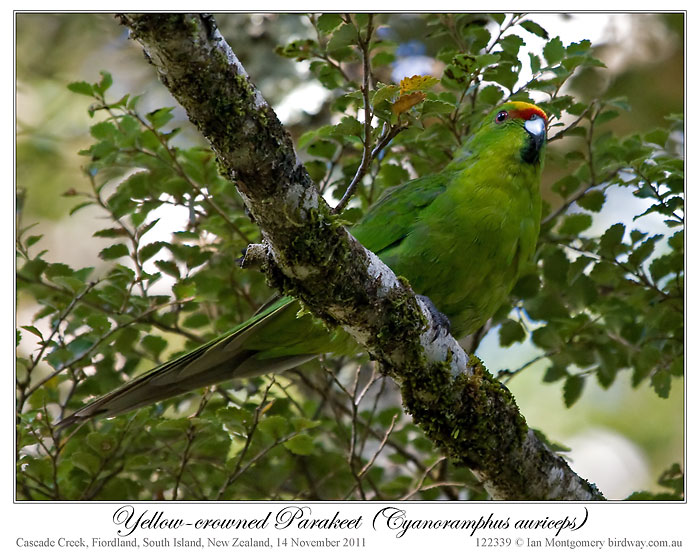
In Fiordland, I camped at Cascade Creek camping site because it’s within striking distance of Milford Sound for the Fiordland Penguin and also because it’s right beside a nature trail through Antarctic Beech forest to Lake Gunn. This particular trail had been recommended as a good site for various native birds including the Yellow-crowned Parakeet. I found the Parakeets with relative ease as they chatter away when feeding or in flight. In the first photo, the bird is perched in a beech tree, and you can see its lovely, serrated, spoon-shaped leaves.
Yellow-crowned Parakeet (Cyanoramphus auriceps) by Ian 2

Yellow-crowned Parakeet (Cyanoramphus auriceps) by Ian 2

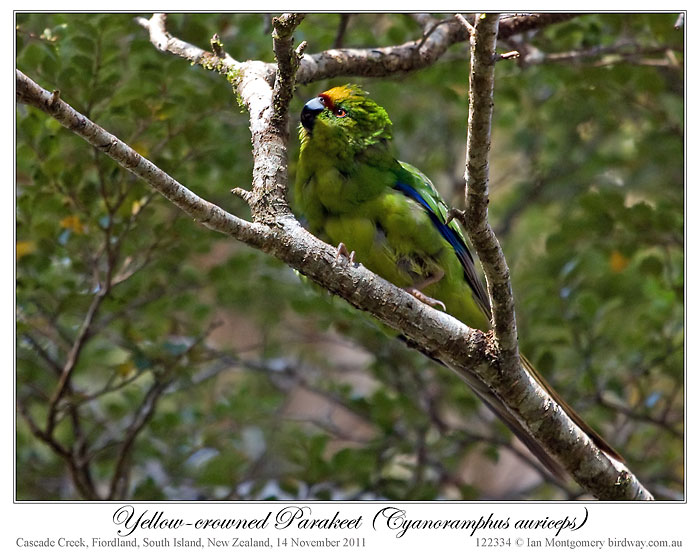
With a length of 23-25cm/9-10in, they’re smaller than the Red-crowned but otherwise very similar, apart from the colour of the crown and the lack of red behind the eye. In sunlight, the colours stand out well, as in the second photo, but in the shady areas of the forest they are well camouflaged and the presence of faded yellow leaves in both photos show well how the patches of colour in the plumage help to break up the outline of the bird.
Yellow-crowned Parakeet (Cyanoramphus auriceps) by Ian 3

Yellow-crowned Parakeet (Cyanoramphus auriceps) by Ian 3

The third photo shows another bird in a patch of sunlight on a very mossy tree stump. It’s a delightful forest, very Lord of the Rings, and it was easy to imagine encountering Treebeard along the way. It’s no wonder that the movie was filmed in New Zealand, and Tevora Lakes – not too far from here – was the location for Fangorn Forest, and you will, of course, remember that ‘Fangorn’ was the Sindarin for Treebeard http://en.wikipedia.org/wiki/Treebeard .
Yellow-crowned Parakeet (Cyanoramphus auriceps) by Ian Middle Earth

Yellow-crowned Parakeet (Cyanoramphus auriceps) by Ian Middle Earth

http://www.virtualoceania.net/newzealand/culture/lotr/Anyway, I’m wandering. The Norfolk Island trip is being organised by the same birders from Victoria that were my companions on the Sub-Antarctic trip. I’d originally turned down the invitation to join them on the grounds of extravagance so shortly after the other trip. We had such fun together, however, that I changed my mind, particular when their flights were re-routed through Brisbane, an easy, if horribly early, connection away from Townsville.

The Tasman/Norfolk Island Parakeet looks similar to the Red-crowned but yet smaller (21-26cm/8.3-10.2in). Like all the 10 members of this South Pacific genus (Cyanorhamphus – ‘blue bill’) it has suffered from the introduction of mammalian predators by Europeans, is classified as endangered and is restricted in distribution to the Norfolk Island National Park. Its numbers have increased recently from a dangerous low as a result of conservation efforts. There is talk of reintroducing it to Phillip Island, a small predator-freed island off Norfolk, and to Lord Howe, where a similar parakeet became extinct. It is thought to belong to the same species, hence the name Tasman Parakeet. So, wish me luck, keep your fingers crossed and transmit the same spiritual energy that is has been so successful before, and I’ll try to bring you the Tasman Parakeet as a future bird of the week.

Best wishes

Ian


Ian Montgomery, Birdway Pty Ltd,
454 Forestry Road, Bluewater, Qld 4818
Preferred Email: ian@birdway.com.au
Website: http://www.birdway.com.au/index.php


Lee’s Addition:

Our prayers will go with you for safety and that you might find your next “Bird of the Week.” We like following your adventures into the wilds. Must be nice to have so many parakeets and parrots around.

Check out Ian’s many members of the Parrots and Allies – Psittacidae Family photos. He has quite a collection of them. He has almost 50 species there. There are 350 total members in the Parrot family. Ian has a few more trips to take. When he mentioned “in the shady areas of the forest they are well camouflaged and the presence of faded yellow leaves,” it reminds me of how well their creator provided for their protection.

There will be a shelter to give shade from the heat by day, and refuge and protection from the storm and the rain. (Isaiah 4:6 NASB)

More – Bird of the Week articles

*

Ian’s Bird of the Week – New Zealand/Sub-Antarctic Snipe

Subantarctic Snipe (Coenocorypha aucklandica) by Ian 1

Subantarctic Snipe (Coenocorypha aucklandica) by Ian 1

Ian’s Bird of the Week – New Zealand/Sub-Antarctic Snipe ~ by Ian Montgomery

Newsletter ~ 2/29/12

My apologies for a late Bird of the Week. Lots of excuses are presenting themselves, as they do, but I won’t bore you with them. I’ve chosen another mostly good news conservation story from the Sub-Antarctic islands, the New Zealand or Sub-Antarctic Snipe. These are odd, dumpy, almost tail-less little snipe – length 23cm/9in – that occur now only on some of the islands south of New Zealand: Snares, Auckland Islands, Antipodes Islands and Campbell Island with a closely related species on Chatham Island.

We found them on Enderby Island, one of the Auckland Islands group, where the nominate subspecies (aucklandica) occurs. With their relatively short, curved bill they don’t look like your average snipe and they don’t behave like one either. Like the Auckland and Campbell Islands Teals they’re fairly confiding and allow close approach but, unlike the Teal, they can still fly, though are very reluctant to do so. When disturbed – and you have to nearly step on them to do that – they creep away mouse-like through the thick vegetation that they prefer and disappear with relative ease. Perhaps crake- or rail-like would be closer to the mark and the curved bill reminded me of the longer-billed rails such as the Virginia Rail http://www.birdway.com.au/rallidae/virginia_rail/source/virginia_rail_110552.htm .

Subantarctic Snipe (Coenocorypha aucklandica) by Ian 2

Subantarctic Snipe (Coenocorypha aucklandica) by Ian 2

By day they stay under cover, only venturing out onto more open areas at night. They feed on a wide variety of invertebrates that they the find by deeply probing the peaty island soil. The male, apparently, has a distinctive territorial call uttered at dawn and dusk and rendered as ‘queeyoo queeyoo’, and the extinct Stewart Island race is supposed to be responsible for the Maori legend of the hakawai or or hokioi, a frightening creature that called only at night (Heather & Robertson, Field Guide to the Birds of New Zealand). The males also perform a nocturnal display flight, making, like other snipe, a humming sound by vibrating the tail feathers, which, given the short tails of this species, one can imagine as being very high-pitched.

Subantarctic Snipe (Coenocorypha aucklandica) by Ian 3

Subantarctic Snipe (Coenocorypha aucklandica) by Ian 3

The third photo shows a pair of the snipe sneaking past the abundant yellow-flowered Bulbinella or Ross Lily, one of the characteristic, so-called ‘megaherbs’ of these islands http://en.wikipedia.org/wiki/Bulbinella_rossii.

The good part of the news is that although the New Zealand Snipe became extinct on the main islands following the arrival of the Pacific Rat with the Maoris a thousand years ago and the recent extinction of two races on Stewart Island and Little Barrier Island (the latter, ironically as a result of the introduction there of the Weka http://www.birdway.com.au/rallidae/weka/index.htm ), the remaining races seem to be doing quite well with a total population estimated at 34,000, of which two thirds occur on the smaller of the Auckland Islands, including Enderby.

Yet another race was thought to have become extinct on Campbell Island after the brig Perseverance, responsible for discovery of the island in 1810, was wrecked there in 1828 leaving the usual legacy of rats. This race remained undescribed and unseen until a small population was discovered on an almost inaccessible, nearby, little island called Jacquemart in 1997 during a search for the Campbell Island Teal. Rats were eliminated on the relatively huge – 11,000 hectare – main island in 2001 and the snipe have recolonised it from Jacquemart unaided. The race is now called, paradoxically, perseverence. Some of the more intrepid members of our party found some snipe on an arduous walk there in wet conditions on our last day. I’d had enough of boggy, wet walks through unrelenting waist-deep tussock grass by then and didn’t join them. Alas!

To make amends for the late BoftW, here is a non-bird of the week, Lumholtz’s Tree Kangaroo.

Lumholtz's Tree Kangaroo by Ian

Lumholtz's Tree Kangaroo by Ian

This obliging animal made a greatly-appreciated appearance in the middle of a Birds Australia North Queensland committee meeting 11 days ago when we were just about to debate a controversial agenda item. The meeting was being held at a member’s house in rainforest on the Atherton Tableland. A delightful interlude with this placid animal led to a very harmonious and well-mannered debate. There’s an obvious lesson there for choosing a suitable venue for meetings.

Best wishes
Ian


Ian Montgomery, Birdway Pty Ltd,
454 Forestry Road, Bluewater, Qld 4818
Phone: 0411 602 737 +61-411 602 737
Preferred Email: ian@birdway.com.au
Website: http://birdway.com.au


Lee’s Addition:

He causes the grass to grow for the cattle, And vegetation for the service of man, That he may bring forth food from the earth, (Psalms 104:14 NKJV)

Another neat bird and adventure by Ian. The Tree Kangaroo is also an adorable addition. We have the Wilson’s Snipe in this area, which is the only snipe seen by us. I am glad Ian let’s in on his adventures around the world. Better him having his “walks through unrelenting waist-deep tussock grass” than us. Thanks, Ian, for sparing us.

See all of Ian’s Birds of the Week – Click Here

*

Ian’s Bird of the Week – Auckland and Campbell Islands Teal

Auckland Teal (Anas aucklandica) Male by Ian 1

Auckland Teal (Anas aucklandica) Male by Ian 1

Ian’s Bird of the Week  – Auckland and Campbell Islands Teal

by Ian Montgomery

Newsletter ~ 2/16/12

The almost predator-free nature of the Sub-Antarctic Islands before the Europeans and their pests arrived is well illustrated by the existence of two closely-related flightless ducks on the Auckland and Campbell Islands. The first photo shows a male Auckland Islands Teal on Enderby Island – now their main stronghold – in the Auckland Islands group.

You can see how short the wings are, extending only two thirds of the way along the body instead of to the base of the tail as in their flying relatives the Chestnut Teal of Australia and the Brown Teal of New Zealand. This male is in breeding plumage and has greenish iridescence on the head and subtly beautiful barring on the flanks.

Auckland Teal (Anas aucklandica) Female by Ian 2

Auckland Teal (Anas aucklandica) Female by Ian 2

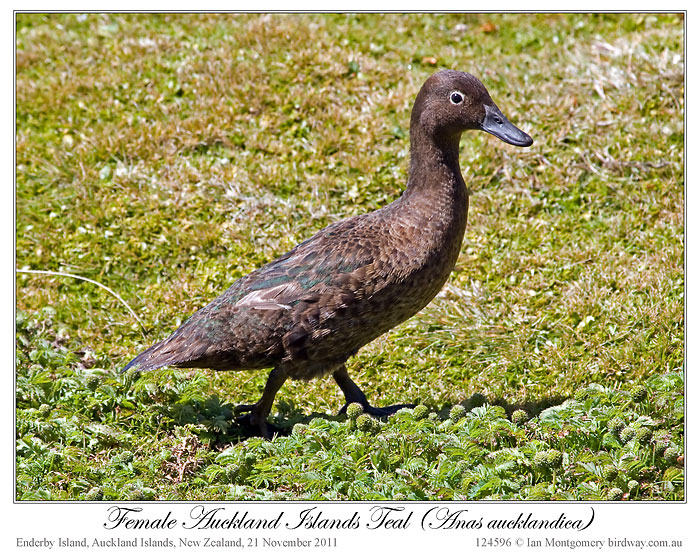
Females (and juveniles and eclipse-plumaged males) have more subdued colours and lack the green sheen on the head. The white eye-ring of both sexes is shared with the Brown Teal of New Zealand but not the Chestnut Teal of Australia. The third photo shows another female going for a stroll. Note the slightly drooping tail and upright stance, both characteristic of the two flightless species.

Auckland Teal (Anas aucklandica) Female by Ian 3

Auckland Teal (Anas aucklandica) Female by Ian 3

As you can probably judge from the photos, the teal were very confiding showing no alarm when closely approached. I had to retreat from the male to get it in focus – the lens I was using has a minimum focus distance of 1.8m/5.9ft, not usually an issue with wild birds! The first two photos were taken on one of the few bodies of freshwater on Enderby Island. Their more usual habitat is along the coast. We saw some in sheltered pools on a rock platform and they feed mainly on invertebrates and algae found in both attached and beach-stranded seaweed.

Campbell Teal (Anas nesiotis) by Ian 4

Campbell Teal (Anas nesiotis) by Ian 4

The fourth photo shows a vocal male Campbell Islands Teal on salt water near the landing wharf of that island. It’s very similar in appearance to the Auckland Islands Teal and both species were until recently treated as races of the flight-worthy Brown Teal of mainland New Zealand. Recent studies suggest that the the Brown Teal and Sub-Antarctic Teals were the product of separate colonisation events by the Australian Chestnut Teal, which occurs in New Zealand only as a rare vagrant.

The Sub-Antarctic Teals have suffered badly from the introduction of mammalian pests, particularly pigs, cats and rats (mice seem to affect them less). The Auckland Islands Teal is extinct on the main Auckland Island, but survives on six neighbouring island pig-less and cat-less island. The population is estimated at 600-2,000 individuals, appears stable, is classified as Vulnerable, and the New Zealand government is planning to eliminate pigs and cats from Auckland Island which will permit reintroduction of the Teal.

The Campbell Islands Teal was though to be extinct but a population of about 20 were rediscovered on nearby Dent Island in 1975, raising its status to Critically Endangered and the world’s rarest duck. A captive breeding program followed, leading to the establishment of a feral population on predator-free Codfish Island near Stewart Island in 1999 and 2000. Following the elimination of rats on Campbell Island, 50 birds were released there in 2005 and 55 in 2006. Successful breeding occurred in 2006. The total population, captive and wild, is now thought to be over 200 and its status has been downgraded to merely Endangered.

You can read the full story here http://terranature.org/tealcampbell_island.htm . It’s great to read a successful conservation story at a time of increasingly frequent bad news about wild populations.

Links to Ian’s Photos:

Aukland Islands Teal
Campbell Islands Teal
Chestnut Teal

Best wishes
Ian

Ian Montgomery, Birdway Pty Ltd,
454 Forestry Road, Bluewater, Qld 4818
Phone: 0411 602 737 +61-411 602 737
Preferred Email: ian@birdway.com.au
Website: http://birdway.com.au


Lee’s Addition:

That last Teal looks happy and “bushy eyed.” They must havee happy ducks and teals down there. Must be that lack of pigs and cats!

The Teals belong to the Anatidae – Ducks, Geese & Swans Family. There are 165 species in 48 genus including the Teals, Ducks, Shovelers, Wigeons, Pintails, Swans, Geese,  Pochards, Scaups, Eiders, Mergansers and all their allies. “Anatidae is the biological family of birds that includes ducksgeese and swans. The family has a cosmopolitan distribution, occurring on all the world’s continents except Antarctica and on most of the world’s islands and island groups. These are birds that can swim, float on the water surface, and in some cases dive in at least shallow water.” (Wikipedia)

And God blessed them, saying, “Be fruitful and multiply, and fill the waters in the seas, and let birds multiply on the earth.” (Genesis 1:22 NKJV)

*