Birds of the Bible – Feeding

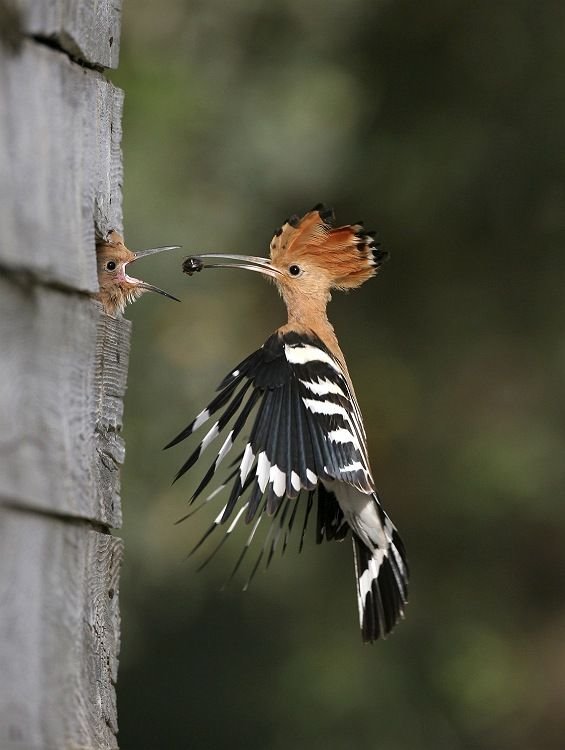
Hoopoe Feeding Young ©©Dvir Lotan from Israel

Hoopoe Feeding Young ©©Dvir Lotan from Israel


Also, to every beast of the earth, to every bird of the air, and to everything that creeps on the earth, in which there is life, I have given every green herb for food“; and it was so. Then God saw everything that He had made, and indeed it was very good. So the evening and the morning were the sixth day. (Genesis 1:30-31 NKJV)

Look at the birds of the air, for they neither sow nor reap nor gather into barns; yet your heavenly Father feeds them. Are you not of more value than they? (Mat 6:26 )

These verses have been shared before, but the quote below, that I received from an e-mail, provides another angle.

God Gives every bird its food,

but He does not throw it into its nest.

That quote cause a chuckle at first, but then you begin to really think about it.

Fan-tailed Raven (Corvus rhipidurus) ©WikiC

Fan-tailed Raven (Corvus rhipidurus) ©WikiC

 Who provides food for the raven, When its young ones cry to God, And wander about for lack of food? (Job 38:41 NKJV)

He gives to the beast its food, And to the young ravens that cry. (Psalms 147:9 NKJV)

Consider the ravens, for they neither sow nor reap, which have neither storehouse nor barn; and God feeds them. Of how much more value are you than the birds? (Luke 12:24 NKJV)

We know that the Lord provides for the birds, but they have to go out an gather it up. Some have it easy, other birds have to work at finding and then opening up the seeds, snails, nuts or what ever they have. The Lord, through His Creative Hand has given the various birds, the “tools” they need. Special beaks, feet, swift wings, keen eyes, etc.

And God said, “See, I have given you every herb that yields seed which is on the face of all the earth, and every tree whose fruit yields seed; to you it shall be for food. (Genesis 1:29 NKJV)

You cause the grass to grow for the livestock and plants for man to cultivate, that he may bring forth food from the earth (Psalms 104:14 ESV)

Those verse let us know that the Lord has also provided for us. Yet we have to gather it and again, the Lord has given us the skills and tools to feed ourselves. Can we not learn for the birds?

But now ask the beasts, and they will teach you; And the birds of the air, and they will tell you; (Job 12:7 NKJV)

Cedar Waxwing Eating by Steve Slayton

Cedar Waxwing Eating by Steve Slayton

She rises while it is yet night and provides food for her household and portions for her maidens. (Proverbs 31:15 ESV)

Give us this day our daily bread. (Matthew 6:11 NKJV)

Six days you shall labor and do all your work, (Exodus 20:9 NKJV)

Bearded Barbet (Lybius dubius) ©© Passing food

Bearded Barbet (Lybius dubius) ©© Passing food

I have shown you in every way, by laboring like this, that you must support the weak. And remember the words of the Lord Jesus, that He said, ‘It is more blessed to give than to receive.’ ” (Acts 20:35 NKJV)

Let him who stole steal no longer, but rather let him labor, working with his hands what is good, that he may have something to give him who has need. (Ephesians 4:28 NKJV)

The soul of a lazy man desires, and has nothing; But the soul of the diligent shall be made rich. (Proverbs 13:4 NKJV)
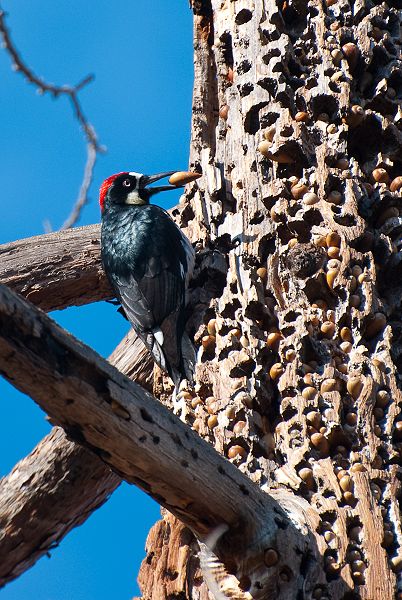
Acorn Woodpecker (Melanerpes formicivorus) with Hoard or Grainary WikiC

Acorn Woodpecker (Melanerpes formicivorus) with Hoard or Grainary WikiC

The lazy man will not plow because of winter; He will beg during harvest and have nothing. (Proverbs 20:4 NKJV)

The soul of a lazy man desires, and has nothing; But the soul of the diligent shall be made rich. (Proverbs 13:4 NKJV)

The lazy man will not plow because of winter; He will beg during harvest and have nothing. (Proverbs 20:4 NKJV)

Osprey with Fish by Jim Fenton

Osprey with Fish by Jim Fenton

For even when we were with you, we commanded you this: If anyone will not work, neither shall he eat. (2 Thessalonians 3:10 NKJV)

See:

Birds of the Bible

Gideon

*

Antbirds ~ An Interesting Family

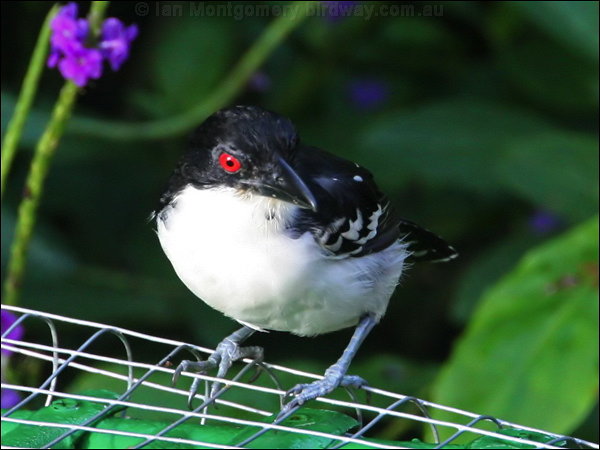
Great Antshrike (Taraba major) by Ian

Great Antshrike (Taraba major) by Ian

Just finished working on the Typical Antbird Family. (Thamnophilidae – Antbirds) Of the 228 species, there were only 21 links when I started a few day ago, after finishing the Tyrannidae – Tyrant Flycatchers Is Complete Minus One Bird family and article. Other than 4 species that are evading me, it is almost finished. I was side-lined Sunday evening and all day yesterday with some food poisoning. Perked up enough this evening to finish it up.

The little birds that are staying out of the camera lens are the:

If anyone knows where to find a photo of them, I would be obliged. Leave a comment if you know where they are hiding.

White-flanked Antwren (Myrmotherula axillaris) by Michael Woodruff

White-flanked Antwren (Myrmotherula axillaris) by Michael Woodruff

When you search the internet for photos, you have to be careful, I am finding out. Some searches show a picture on a page with the correct name, but the photo does not match the named bird. Won’t mention any names, but I will mention one of the more trusted sites that I use. IBC which is actually The Internet Bird Collection headed up, I believe by Josep del Hoyo. He and that group are quite experts in ornithology. They have been producing the Handbook of the Birds of the World. There are over 16 Volumes and counting. Their goal “has been to cover in detail and illustrate every species of bird in the world.” Now there is an undertaking, to say the least.

Ferruginous Antbird (Drymophila ferruginea) by Dario Sanches

Ferruginous Antbird (Drymophila ferruginea) by Dario Sanches

Back to the Antbirds. Wikipedia has this to say about them. ”

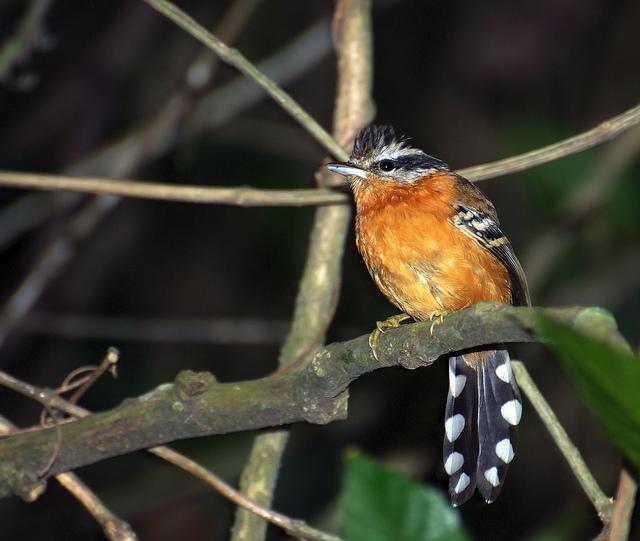
The antbirds are a large family, Thamnophilidae, of passerine birds found across subtropical and tropical Central and South America, from Mexico to Argentina. There are more than 200 species, known variously as antshrikes, antwrens, antvireos, fire-eyes, bare-eyes and bushbirds. They are related to the antthrushes and antpittas (family Formicariidae), the tapaculos, the gnateaters and the ovenbirds. Despite some species’ common names, this family is not closely related to the wrensvireos or shrikes.

Antbirds are generally small birds with rounded wings and strong legs. They have mostly sombre grey, white, brown and rufous plumage, which is sexually dimorphic in pattern and coloring.  Some species communicate warnings to rivals by exposing white feather patches on their backs or shoulders. Most have heavy bills, which in many species are hooked at the tip.

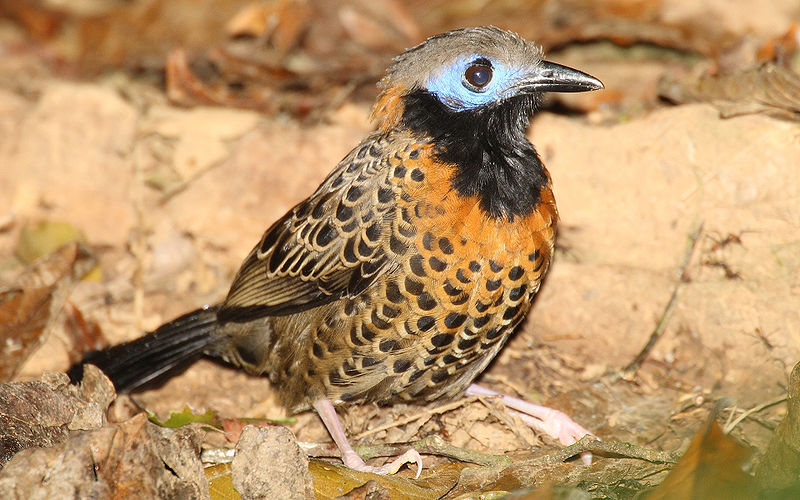
Ocellated Antbird (Phaenostictus mcleannani) ©WikiC

Ocellated Antbird (Phaenostictus mcleannani) ©WikiC

Members of this family have short rounded wings that provide good manoeuvrability when flying in dense undergrowth. The legs are large and strong, particularly in species that are obligate ant-followers. These species are well adapted to gripping vertical stems and saplings, which are more common than horizontal branches in the undergrowth, and thus the ability to grip them is an advantage for birds following swarms of army ants. The claws of these antbirds are longer than those of species that do not follow ants, and the soles of some species have projections that are tough and gripping when the foot is clenched. Tarsus length in antbirds is related to foraging strategy. Longer tarsi typically occur in genera such as the Thamnophilus antshrikes that forage by perch-gleaning (sitting and leaning forward to snatch insects from the branch), whereas shorter tarsi typically occur in those that catch prey on the wing, such as the Thamnomanes antshrikes.

Most antbirds have proportionately large, heavy bills. Several genera of antshrike have a strongly hooked tip to the bill, and all antbirds have a notch or ‘tooth’ at the tip of the bill which helps in holding and crushing insect prey. The two genera of bushbirds have upturned chisel-like bills.” (Wikipedia with editing)

Black-crested Antshrike (Sakesphorus canadensis) ©WikiC

Black-crested Antshrike (Sakesphorus canadensis) ©WikiC

It appears the Lord has created these birds with just what they need to survive in their environment. They may well be keeping the ant population in control, but some of the videos with the bird in the middle of an ant army swarm, makes you wonder who is winning.

But now ask the beasts, and they will teach you; And the birds of the air, and they will tell you; (Job 12:7 NKJV)

I know all the birds of the mountains, And the wild beasts of the field are Mine. (Psalms 50:11 NKJV)

The Bible has several things to say about the Ants:

The ants are a people not strong, Yet they prepare their food in the summer; (Proverbs 30:25 NKJV)

Go to the ant, you sluggard! Consider her ways and be wise, Which, having no captain, Overseer or ruler, Provides her supplies in the summer, And gathers her food in the harvest. How long will you slumber, O sluggard? When will you rise from your sleep? A little sleep, a little slumber, A little folding of the hands to sleep—So shall your poverty come on you like a prowler, And your need like an armed man. (Proverbs 6:6-11 NKJV)

Not being lazy and providing for yourself are two things one can learn. Also, He provides for the birds of this family by giving them an ample supply of ants and other insects, yet, they have to do the work of catching them. They are not fed directly by the Lord.

The Scripture tells us that “…my God shall supply all your need according to His riches in glory by Christ Jesus. (Philippians 4:19 NKJV). Are we suppose to sit back and just expect things to be provided for us? No, neither do the birds or animals. Yes, the Lord supplies our needs, for example, by having things grow, but they need to be picked and cooked or purchased and cooked. That is only one illustration from thousands.

White-plumed Antbird (Pithys albifrons) ©WikiC

White-plumed Antbird (Pithys albifrons) ©WikiC

Enjoy the ANTBIRD family. They are not the prettiest, but some are quite interesting.

Thamnophilidae – Antbirds

*