Making a Joyful Noise in Estonia’s Tallinn: A Quick Memoir of Common Swifts
James J. S. Johnson
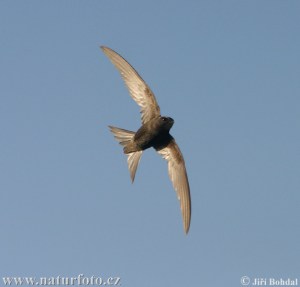
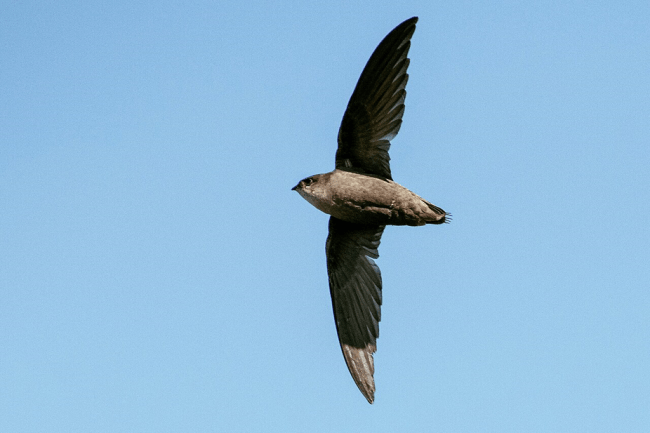
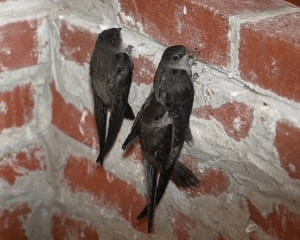
COMMON SWIFT (Apus apus) photo credit: Jiri Bohdal
Make a joyful noise unto the LORD, all ye lands. (Psalm 100:1)
What is making a “joyful noise”? It is commanded is Scripture, whatever it is – see Psalm 66:1; 81:1; 95:1-2; 98:4; 98:4; 100:1.
To many, the noise of circuitous swifts is just that, a screeching-like screaming noise — not the kind of “music” that King David would have included in his orchestra-supported choir (1st Chronicles 15:16). But to a bird-lover, the aerial call of this air-zooming insectivore is a “joyful noise”, installed and directed by the Composer and Giver of all birdsong (and other avian vocalizations).
Yes, as other ignore them, I enjoy hearing the energetic calls of Common Swifts (Apus apus), as they zip around, in hunting packs, de-bugging the lower airspace during the bug-filled days of summer.
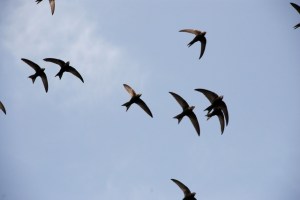
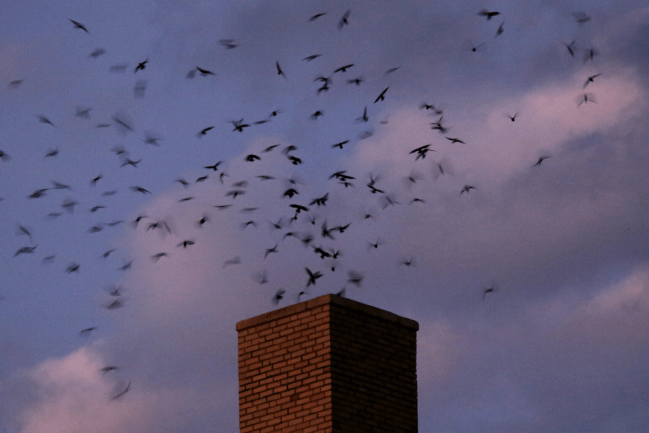
COMMON SWIFT flock in air (photo credit: Biopix; J C Schou)
On July 10th of AD2006 I was watching a flock of swifts circling above the rooftops in Old Town, Tallinn, Estonia. The flock’s high-speed-choreography included swerving, veering, soaring, turning, rolling, and circling maneuvers — always in graceful curves, yet nonetheless amazingly quick – in a word, “swift”. It was done so fluidly that it compares, though at a smaller-group level, with the carefully choreographed flock-flights of starling murmurations (which are described elsewhere at “Choreographed Choir on the Wing: Birds of a Feather Flock Together:).
It was a privilege to see such a lively and speedy display of God’s bioengineering, a fly-by performance, like a high-speed aerial parade. And the quaint old-town venue, Tallinn’s “Old Town”, still includes walls and towers from the Hanseatic League era (some 2 or 3 centuries older than the Protestant Reformation), providing an air of calm busyness that matched the swifts’ quick-turning air-dance.
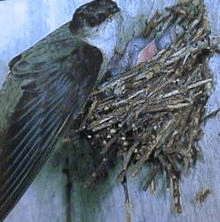
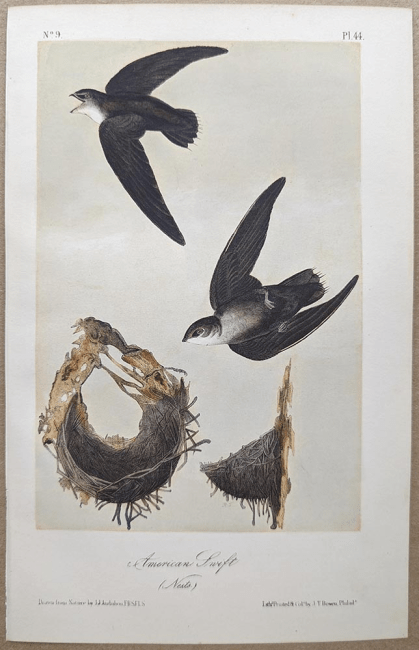
The COMMON SWIFT (Apus apus) is, as its name suggests, a bird that is both common and quick. As a true “swift”, having wings curved like a parenthesis (or boomerang, or crescent-sliver), it somewhat resembles a short-legged version of a Barn Swallow or Purple Martin, colored in black and grey, although its wings are narrower and more sickle-shaped in flight. When viewed from beneath, a swift’s silhouette (against the sky) almost looks like an anchor, as it glides. And swifts often glide, often circling above or near rooftops and other objects. When they want to accelerate, their wingbeats are thorough and (unsurprisingly) swift. The super-short legs are used for clinging to walls and other vertical surfaces, matching the German name for this bird, Mauersegler (“wall-glider”). Don’t expect to see this bird sitting on the ground – if it is “grounded” there is probably an involuntary explanation.
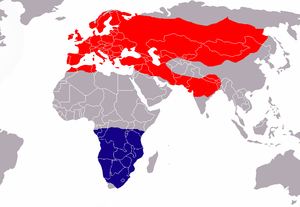
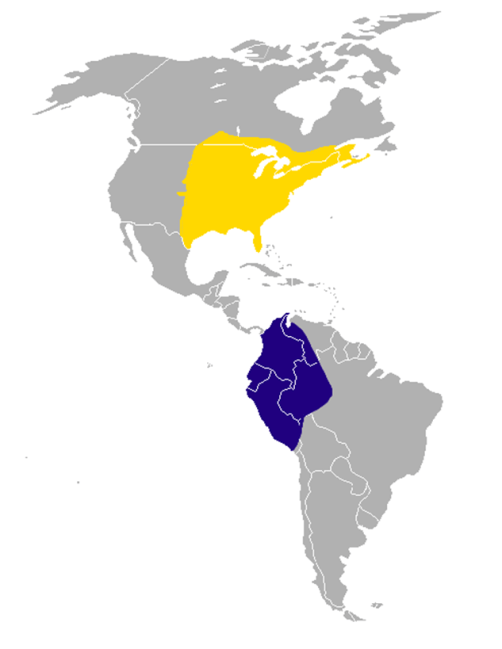
COMMON SWIFT range map (Wikipedia)
And “common” it is, in summer, all over Europe (and ranging from west to east across the middle band of Asia, as well as much of the Mideast and India). This insect-gobbling bird is a migrant, going where the bugs are plentiful — before the “bug famine” of Eurasia’s winter months the Common Swift migrates to the southern half of Africa, where bugs teem (during Africa’s summer months). Swifts and swiftlets are found all over the inhabited words, i.e., anywhere that flying insects are available for “eating on the fly”. Consider these illustrative examples: Black Swift (all over North America, from Canada to Costa Rica and Brazil), White-fronted Swift (forests in Mexico), Great Dusky Swift (many forests of South America), Sooty Swift (many forests of South America), White-chinned Swift (Central and South America), Cave Swiftlet (caves and woods of India, Indonesia, and Malaysia), Himalayan Swiftlet (common to the Himalayan range and Southeast Asia) — just to list a few. One of the rarest swifts is the Seychelles Swiftlet (a subspecies or cousin of the smaller Mascarene Swiftlet of Mauritius and Reunion (both being east-of-Madagascar islands in the Indian Ocean). The Seychelles Swift is found only on the Seychelles Islands east of Africa (and north of Madagascar), in the Indian Ocean. (See postage stamp – public domain image)

SEYCHELLES SWIFTLET [public domain]
An even rarer swiftlet is the
Atiu Swiftlet, endemic to the small island of Atiu (in the Cook Islands archipelago). That cave-loving swiftlet has been described in connection with appreciating
Gospel Days in the Cook Islands.
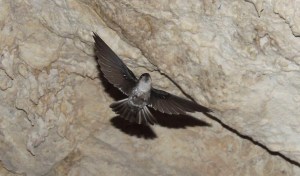
Atiu Swiftlet (photo credit: Wikipedia)
Now back to the COMMON SWIFT, such as those who circled the air near the rooftops of Old Town, Tallinn (Estonia), that summer afternoon in AD2006.
The Common Swift’s visible physical and behavioral traits have been aptly summarized by the co-authors whose bird-book I used on that summer afternoon in Tallinn:
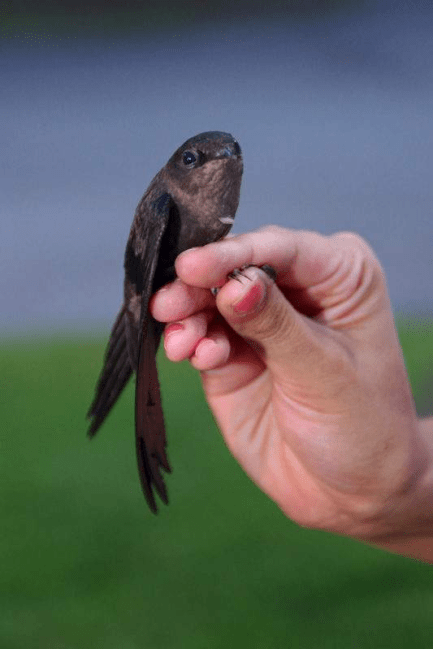
Dark, scythe-winged aerial feeder seen careening through sky in characteristic noisy, screaming parties. Flies in lower airspace early and late in day [when flying insects are out and about], and in wet weather. Spends virtually entire life … on the wing, coming to land only to nest. Larger than Barn Swallow, unlike which it never perches on wires or vegetation. Adult [has] uniform blackish-brown plumage relieved only by whitish chin. Very long, narrow, swept-back wings and [relatively] fat, cigar-shaped body give illusion that bird is bigger than it really is. Clearly forked tail lacks Swallow’s streamers and is often held tightly closed. Bill tiny. Sexes alike; similar juvenile has narrow pale feather edgings.
Nest colonially beneath eaves of buildings, less often in caves or hollow trees.
Enters site at breakneck speed and is only rarely seen perched below, clinging to walls with tiny legs and feet (unusually, all four toes face forwards). Breeds commonly in built-up areas, but travels huge distances to feed. Typically seen in parties of 10—100 birds, but congregates in massive swarms on spring and autumn migration, especially over wetlands and reservoirs. Flight action varied: either very fast with twinkling wingbeats or slower, with sudden flurries of wingbeats and glides on wings stiffly outstretched and slightly bowed down. Jinks, rises and falls with quick flick of wings and briefly spread tail as it gulps insect prey in [relatively] huge, gaping mouth.
Shrill, piercing screaming call, sree, is the essence of warm summer evenings.
[Quoting Chris Kightley, Steve Madge, & Dave Nurney, POCKET GUIDE TO THE BIRDS OF BRITAIN AND NORTH-WEST EUROPE (Yale University Press, 1998), page 174.]
And what kind of town is Estonia’s Tallinn? It is the main port and capital of Estonia, a land weary of foreign occupations.

Old Town, Tallinn, Estonia (photo credit: Wikipedia)
The native Estonians (who maybe felt like helpful bugs, trying to escape hungry predators), century after century, has been parasitized (and preyed upon) by many opportunists who — like busy Common Swifts — swiftly (or sometimes slowly) inserted themselves onto Estonia’s Baltic coastland, sometimes colonizing and sometimes content with controlling the flow of trade.
A quick [i.e., “swift”] summary of Estonia’s serial occupations by neighboring armies follows. Perhaps the reader can consider these back-and-forth conquests of the Estonian lands, and imagine how the “caught-in-the-middle” Estonians, of generation after generation after generation, lived, as their land changed from colony to battlefield to colony, etc.
Estonia’s sequence of political phases may be condensed to 24 episodes, namely: (1) the Viking era … (800s through 1200); (2) wars with Germany’s Bishop Albert of Livonia and the Sword Brethren (1208-1227); (3) Denmark intervenes and begins to rule Tallinn [from taani linn, meaning “Dane fort”, with the city continuing to be called by its German name, “Reval”], due to Danish King Valdemar II’s conquest … [resulting in] Estonia being occupied by a mix of Danes and Germans by 1220); (4) political decline of the ethnic-German “Sword Brethren” of Livonia, due to Lithuanian militarism … followed by merger of the Livonian Sword Brethren with Prussia’s Teutonic Knights [as Lithuania flourished]; (5) Danish-German domination of Estonia [with the Hanseatic League controlling Estonia’s economy] ; (6) decline of the militaristic Prussian Teutonic Knights, due to Russian militarism aided by Estonian and Latvian conscripted soldiers … [e.g., Alexandr Nevskii’s “Battle on the Ice” victory in AD1242]; (7) political association with, and domination by, the plutocratic “super-merchants” of Germany’s Hanseatic League (with Lübeck Law adopted for Tallinn in 1248, with Tallinn’s trade featuring Estonian rye [!], barley, oats, honey, bearskins and other furs, exchanged for imported herring, salt, precious metals, and clothing materials); (8) Danish relinquishment of troublesome Estonia (prompted by the bloody Jüriöö Mäss rebellion of 1343-1345 … resulting in Denmark’s “sale” of Estonia to the Prussian Teutonic Knights in 1346 … [so Estonia and Latvia were ruled by ethnic-Germans form the mid-AD1300s through the mid-AD1400s]; (9) Old Livonia declines, as Prussia’s Teutonic Knights decline, due to military defeats [e.g., Tannenberg, in AD1410] by the rising empire of Poland-Lithuania … {and Russia unsuccessfully tries, in AD1502, to grab Estonia from Poland-Lithuania]; (10) Estonia is touched by the Reformation, with Luther’s “use-of-the-language-of-the-common-people” policy beginning to change Estonia, planting the first seeds of Estonian cultural identity restoration (Reformation first arrives in Estonia during the 1520s; 1525 sees first book printed in Estonian language [and during that year Walter von Plettenburg, Rome’s “Master of the Livonian Order”, converts to Lutheran Christianity, heavily impacting the launching of the Protestant Reformation in Estonia]; first-Estonian-language church services in the 1530s); (11) the Livonian Wars (1558-1583) reveal Russia’s ambitions for the Baltic lands … followed by Estonia being “sold” to Denmark, who opposed the Russians (1560); (12) Old Livonia disintegrates, as the Swedes arrive to oppose Russia, and Tallinn becomes a Swedish land … (1561); (13) meanwhile, the Livonian lands south of Tallinn become Polish possessions (1561); (14) Livonian resistance to Russia, well into the mid-1500s, permitted the Germany-based Reformation to take root among the Estonian people (often aided by Swedish military action, combined with Lutheran education reforms led by Swedes, Germans, and Finns … for example, Tartu University [was founded] by Swedish King Gustav Adolphus, in 1632, to promote Lutheran education and culture); (15) Russia competed with Sweden for Estonia … complicated by Poland joining the fray (in 1579), resulting in Sweden successfully holding onto Estonia [AD1586]; (16) however, Sweden and Russia resumed war in the 1590s … as tension between Sweden and Poland, regarding who gets Estonia, continued to rise; (17) Sweden continued to dominate the Baltic lands … (from 1600-1629), somewhat resolved by the “Peace of Altmark” [AD1629]; (18) Denmark increased its ascendancy in the region … Denmark’s remaining portion of Estonia [i.e., Saaremaa] was transferred to Sweden (1645); (19) [Estonia suffers, due to war-ravaged agriculture] the Great Hunger of the 1690s (1695-1697); (20) Sweden’s domination in the Baltic [is lost in] the “Great Northern War” of 1700-1721 (with the last fighting of this war, on Estonian soil, occurring in 1710); (21) 300+ years of domination by Russia, with the last portion (from the mid-1800s onward) seeing a growth of national patriotism and a recovered sense of the Estonian language and cultural identity (1710-1918); (22) the first taste of Estonian independence (1918-1940); (23) interrupted by Soviet Russia’s re-conquest and cultural suppression of Estonia (1940-1991); and (24) Estonia’s post-Soviet experience of national independence [which was triggered by Estonia’s “Singing Revolution”], which is ongoing (1991 to present).
[Quoting James J. S. Johnson, “Heritage Highlights: Estonia”, BALTIC HERITAGE REVIEW (June AD2006), pages 2-4.] Surely you became weary (if not also wary), if you actually read all of that listing of 2-dozen political turnovers (flying over 12 centuries of political history), so imagine what native Estonians must feel like – having been occupied and re-occupied by foreigners, generation after generation.
Maybe the Estonians feel like little flying insects, the easy-prey targets for ever-hungry (and fleet-flying) Swifts, coming at them, from all directions, chasing what could have been tranquility from Tallinn’s lower airspace.
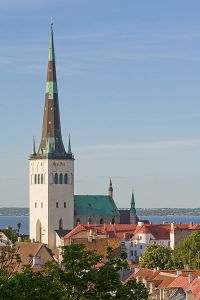
Olaf’s Church [Oleviste kirik] in Tallinn:
Roman Catholic, later Lutheran, now Baptist
(photo credit: Wikipedia)
And that description well fits the memory that I still retain, of the speedy, quick-turning, aerial acrobatics — of noisy Common Swifts — that I saw near the rooflines and rooftops of the ancient-looking building in Tallinn’s Old Town, likely displaying what those same birds’ ancestors did centuries before, when Tallinn (then called “Reval”) was an old Hanseatic League trading port city.
When it comes to bird behavior, some things don’t change all that much. Of course, European trade has now returned to the old Hanseatic port-city of Reval – or Tallinn (as it is called today, and has been for centuries) — and much of that trade comes today in the form of cruise ship passengers and European Union commerce.
If you are ever in the neighborhood (of Tallinn), check it out; there is a lot of history to see there, and to appreciate, as you think about what all has occurred there, century after century. So visit Tallinn at a relaxed pace – don’t just whizz by, like a Common Swift.
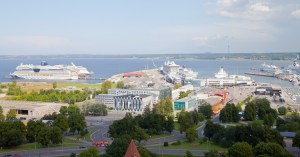
Tallinn port, where cruise ships visit Estonia (photo credit: Wikipedia)
But this nostalgic report began with a quote from Psalm 100, about singing. There is one habit that the Estonians are especially famous for, maybe moreso than any other habit – despite their long years (and centuries) of being suppressed as a Baltic people, they never gave up their songs.
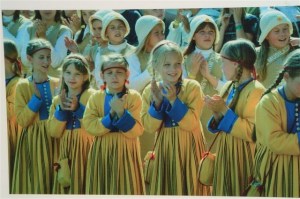
Estonian choir in Tallinn
(photo credit: JJSJ in AD2006, actually a photo of a large sign in Tallinn)
Estonians love to sing, especially in their own native Estonian language. And now, years after the tense days of Estonia’s “Singing Revolution”, they can sing with a freedom that is relatively new to their land. May God bless them – and may He keep their songs in their hearts, as they look up to Him — because He alone is the ultimate Giver of all good songs, even the diverse songs (and chirps, and other vocal noises) of the busy feathered creatures whom we call “songbirds”.
And may each of us, who has the Lord Jesus Christ as our personal Redeemer, live each day with a song in our hearts, singing with grace and gratitude (Colossians 3:16).
Make a joyful noise unto the Lord, all the earth: make a loud noise, and rejoice, and sing praise. (Psalm 98:4)
*
More From James J. S. Johnson
Apodidae – Swifts Family
Birds of the Bible – Swifts
*
 Lee's Birdwatching Adventures Plus