SEED-LOVING BOBOLINKS, GROUND-NESTING IN GRASSLANDS
Dr. James J. S. Johnson
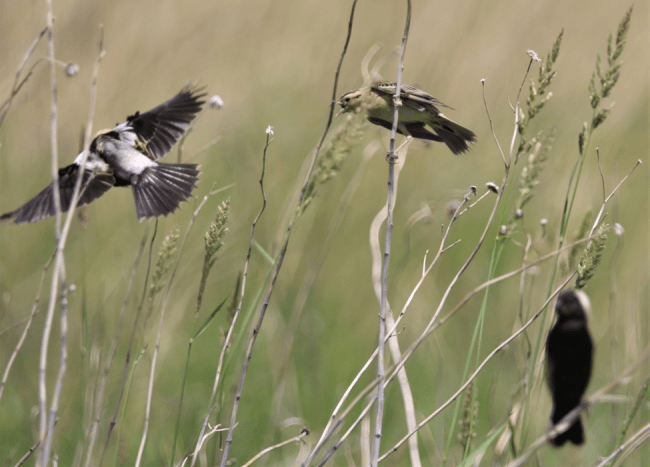
BOBOLINKS in grassland habitat, Minnesota (photo credit: Bryce Gaudian)
If a bird’snest chance to be before thee in the way in any tree, or on the ground, whether they be young ones, or eggs, and the mother sitting upon the young, or upon the eggs, thou shalt not take the mother with the young.
(Deuteronomy 22:6)
Moses noted that some wild birds build their nests upon the ground; Bobolinks do just that.
Years ago, I reported on the Black-capped Chickadee, noting that I first saw one at Gilsland Farm Sanctuary, while attending a wetland ecologists’ meeting: “Decades ago, I saw Black-capped Chickadees, for the first time, in Falmouth (near Portland), Maine – at the Gilsland Farm Sanctuary (now called “Gilsland Farm Audubon Center”), on May 31st of AD1995, while attending the annual national meeting of the Society of Wetlands Scientists.” [Quoting from “Tiny Yet Tough: Chickadees Hunker Down for Winter”, posted at https://leesbird.com/2016/11/18/tiny-yet-tough-chickadees-hunker-down-for-winter/ .]
Another “lifer” that I then observed that day, at Gilsland Farm Sanctuary, was the BOBOLINK. And what a striking plumage the male Bobolink has, during breeding season!
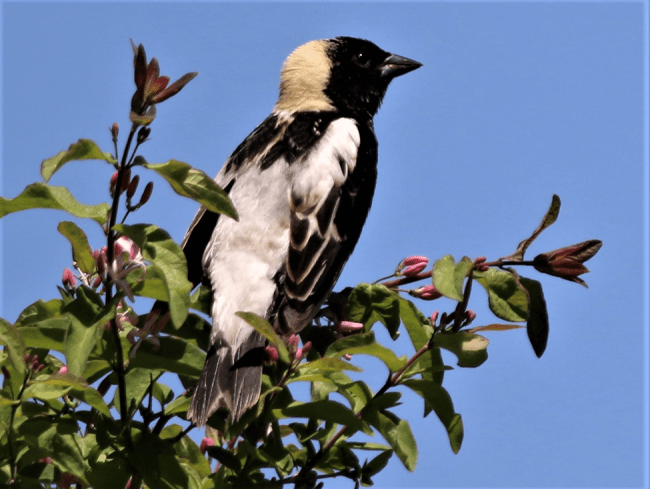
BOBOLINK MALE in breeding plumage, Minnesota (photo credit: Bryce Gaudian)
Bobolinks (Dolichonyx oryzivorus) are icterids (blackbirds of the Western Hemisphere), dwelling in America’s prairie and pasture grasslands and marshy wetlands during the warm months of the year. Bobolinks were nicknamed “rice birds” (which matches their species name, oryzivorus, meaning “rice-eating”), due to their dining habits, especially during autumn migrations.
The Bobolink genus name, Dolichonyx, means “long claw”, matching its prehensile perching “fingers”.
During such migrations Bobolinks frequently feed in farmed fields of rice and other grains (such as oats, sorghum, maize corn, and hayseed), at energy-packing refueling stopovers (e.g., in South Carolina and the Gulf states), on their aerial journeys southward, via Caribbean islands, en route to South American over-wintering range destinations.
Bobolinks feed on (or near) the ground, eating various seeds, insects, spiders, and even snails—especially during breeding seasons. Both larvae and adults of insects (especially armyworm moths) are protein-rich, much needed for growing Bobolink juveniles.
Also, during breeding seasons, Bobolinks depend upon available hay for nest-building, on the ground, in vegetated areas.
Bobolinks are quite specific in their breeding habitat needs. Open hay fields are a must, and so as farming is some regions of the country diminishes, so do populations of bobolinks. Where colonies of bobolinks have traditionally bred, it is important to preserve their habitat with regular mowing practices. Unfortunately, the right time to mow a field for hay is often just when the young are fledging[!]. Careful observation of the behavior of a [bobolink] colony and delaying of mowing until one or two weeks after fledging, a time when the young can fly fairly well, will keep a colony producing and ensure its [multi-generational] survival.
[Quoting Donald W. Stokes & Lillian Q. Stokes, A GUIDE TO BIRD BEHAVIOR, Volume III (Boston: Little, Brown & Company/Stokes Nature Guides, 1989), pages 351-352.]
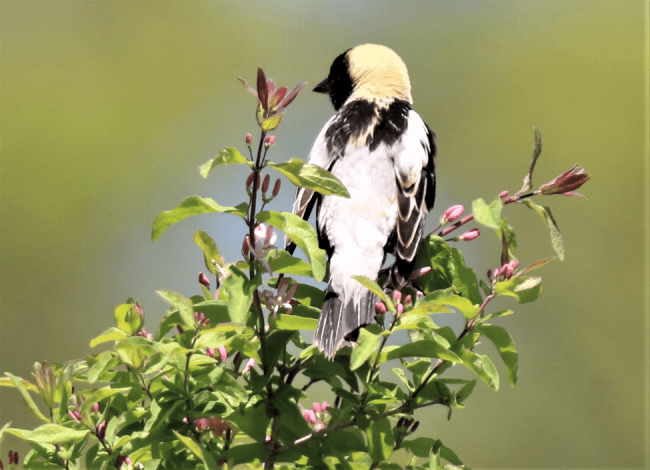
BOBOLINK MALE in grassland habitat, Minnesota (photo credit: Bryce Gaudian)
Consequently, Bobolinks are easier to find in habitats where their needs for food and nesting are plentiful.
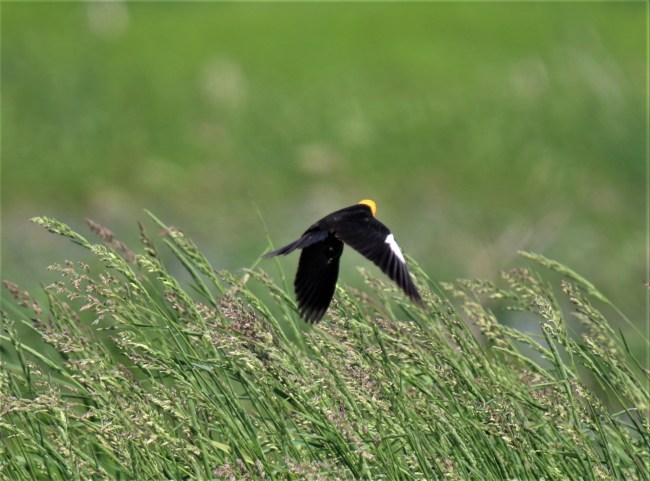
BOBOLINK male in flight, prairie habitat, Minnesota (photo credit: Bryce Gaudian)
The males have easily seen plumages—like reverse tuxedos (white upon black) in spring and summer, during breeding months.
Male and female bobolinks are easily distinguished during the breeding season. Males have a black head, belly, and wings, with a buff-gold nape and white patches on the back. The female is buff [and brown] colored all over with dark streaks on her back, wings, and sides.
[Quoting Donald W. Stokes & Lillian Q. Stokes, A GUIDE TO BIRD BEHAVIOR, Volume III (Boston: Little, Brown & Company/Stokes Nature Guides, 1989), pages 364.]
During non-breeding months, however, Bobolink males shift to duller hues of dark and light browns, similar to the year-round plumage of Bobolink females and juveniles.
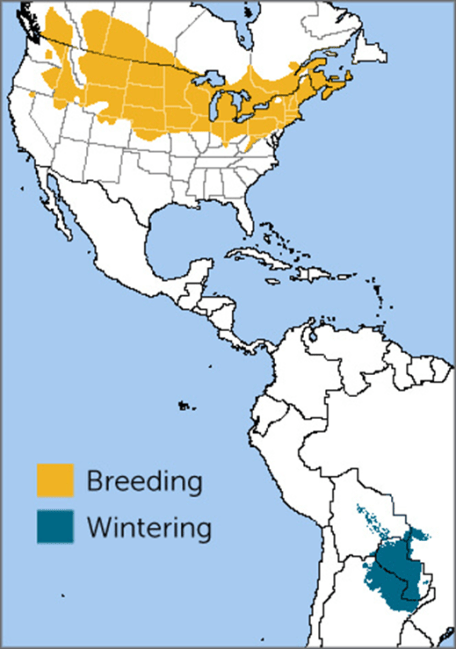
Of course, these tweety-chirpy icterids breed elsewhere in spring – in most of the upper half of America’s Lower 48, from the Northeast’s coastlines almost as far wet as the coasts of Washington and Oregon. Accordingly, the Bobolink migrates about 6,000 miles southward or northward, so it accrues about 12,000 miles per year, in air miles.
American Bird Conservancy range map
It was a privilege to see Bobolinks, back in AD1995, at the Gilsland Farm Sanctuary, as part of my time attending the Society of Wetlands Scientists’ meeting.
Likewise, it’s a privilege, now, to be permitted to share some of the wonderful Bobolink photographs taken in Minnesota, by Christian/creationist photographer BRYCE GAUDIAN — thanks, Bryce!
And now, it’s time for a limerick, about Bobolinks.
Black-capped Chickadee on snowy branch (BGSmith/Shutterstock photo)
And He [i.e., the Lord] said unto me, My grace is sufficient for thee: for My strength is made perfect in weakness. Most gladly therefore will I rather glory in my infirmities, that the power of Christ may rest upon me. (2nd Corinthians 12:9)
The Black-capped Chickadee (Parus atricapillus, a/k/a Poecile atricapillus) is the official state bird of both Maine and Massachusetts, and it resides in both of those states (and several others) throughout the year.
Black-capped Chickadee (Birdzilla.com)
These relatively plump titmouse-like birds are small – only about 4½ inches long. And, as this YouTube video clip shows, this wee bird is decidedly quick and cute!
Decades ago, I saw Black-capped Chickadees, for the first time, in Falmouth (near Portland), Maine – at the Gilsland Farm Sanctuary (now called “Gilsland Farm Audubon Center”), on May 31st of AD1995, while attending the annual national meeting of the Society of Wetlands Scientists.
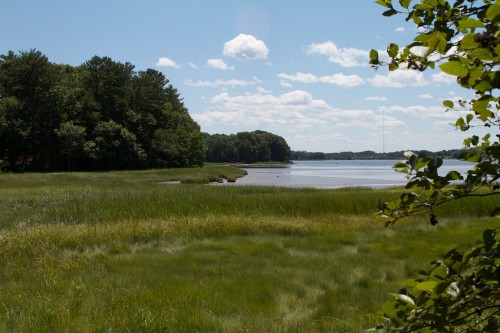
Gilsland Farm Audubon Center wetland habitat (photo: Real Family Camping)
The Black-capped Chickadee has a fairly large range, in most of the northern half of North America, as is shown on a Terry Sohl range map (which map is notshown below, because Mr. Sohl, as a self-described “hardcore atheist”, does not want his maps associated with a Christian blogsite).
The Black-capped Chickadee has some American “cousins”, including(but not limited to) the Chestnut-capped Chickadee (Parus rufescens) of the American West, the Mountain Chickadee (Parus gambeli) of the American West (and Canada’s southwest), the Carolina Chickadee (Parus carolinensis) of the USA’s Southeast, and the Boreal Chickadee (Parus hudsonicus) of Canada, Alaska, and New England.
[Regarding chickadee ranges, see Herbert S. Zim & Ira N. Gabrielson, “Black-capped Chickadee”, in A GUIDE TO FAMILIAR AMERICAN BIRDS(Golden Press, 1987; updated revision by Chandler S. Robbins), page 78; Roger Tory Peterson & Virginia Marie Peterson, EASTERN BIRDS: A FIELD GUIDE TO THE BIRDS OF EASTERN AND CENTRAL NORTH AMERICA (Boston: Houghton Mifflin, 1980), pages 210-211 & M246-M248; Roger Tory Peterson & Virginia Marie Peterson, WESTERN BIRDS: A FIELD GUIDE TO THE BIRDS OF WESTERN NORTH AMERICA(Boston: Houghton Mifflin, 1990), pages 258-259 & M279-M280.]
That year I was in the Portland area, primarily to present an ecology/conservation science research paper, regarding how U.S. government agencies (especially the U.S. Army Corps of Engineers) define and scientifically identify “wetland” properties, for federal regulatory jurisdiction purposes. [See James J. S. Johnson, “Delineating Wetlands: Hydrophilic Plants, Hydric Soils, and Wetland Hydrology”, in Proceedings of the Wetlands Scientists 16th Annual Meeting(Boston, Massachusetts, spring/summer 1995).]
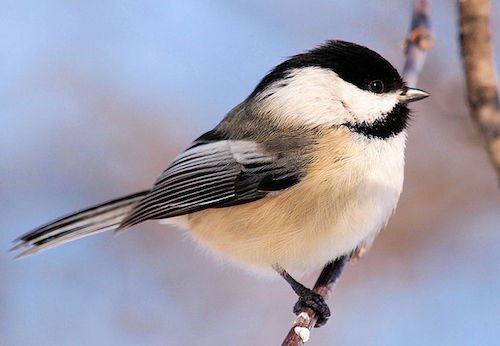
Black-capped Chickadee perching (Alain Wolf / Wikipedia)
For a birder, visiting the Gilsland Farm Sanctuary was an interactive treasure trove. The avian habitat sanctuary hosts various stands of white ash, red maple, spruce, quaking aspen, and white birch, as well as mature oaks and hemlocks. That day, in a variety to meadow-and-forest-edge habitat contexts (e.g., marshy meadows, apple orchard, wet woods and mixed forest edges, shrubland, pond water and shoreline, tidal mudflats of the Presumpscot River estuary), I viewed bobolinks, meadowlarks, herons, egrets, hawks, nuthatches, finches, etc.
For me, however, the 2 “lifers” were the marsh-loving icterid Bobolink and the tiny-yet-tough Black-capped Chickadee. The weather was warm enough, so thoughts of winter weather did not occur. However, many of the birds that my wife and I saw, that sunny day, would fly south, a few months later, to migrate away from the severe cold that Maine experiences when winter months arrive.
But not the Black-capped Chickadee! — it is tiny, yet it is tough — residing year-round in Maine, soldiering through the windchill and snowfall, annually illustrating how God has designed some passerine birds to display cold-climate-enduring resilience. Sometimes this wonderful design, and its operations in the real world, is noticed by ecology-analyzing naturalists – even if such naturalists (such as ecologist Kathie Fiveash, who is quoted hereinbelow) fail to accredit God with the providential design and construction of the winged wonders that they observe.
In the fall black-capped chickadees come together in small territorial flocks that will feed together all winter. If you walk in the woods or along the roads [in Maine, such as on Isle au Haut, in Acadia National Park – from where this quoted author writes], you are likely to find a flock feeding actively in the trees, calling to each other as they move about in search of food. These tiny, energetic creatures are preparing to face the frigid temperatures, daunting storms, and long nights of he Maine winter. The summer songbirds have left the coast of Maine, choosing the dangers [and potential blessings] of a migratory journey over the dangers of prolonged cold and darkness. The small songbirds that remain—juncos, kinglets, nuthatches and chickadees chief among them—must manage to stay warm and find sufficient food to survive an entire [winter] season in conditions that could extinguish a human life [if unprotected] in one night.
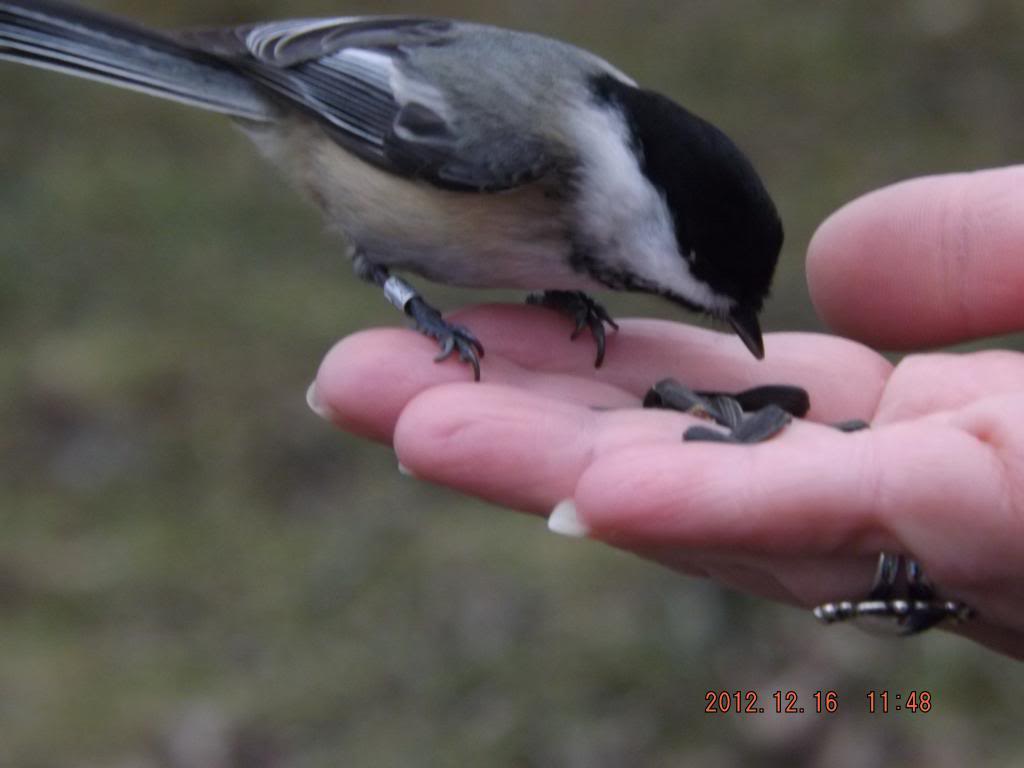
The black-capped chickadee, Maine’s state bird, is a common and cheerful presence [in Maine] all year. It lives throughout northern North America. With its black cap and bib, white cheeks, gray back, buffy sides, round head, and signature chickadee-dee-dee call, this little bird is unmistakable. Despite their small size [and relatively high metabolism], chickadees are long-lived; the oldest known wild chickadee was over twelve years old[!]. Chickadees are curious and sociable—you can, with a little patience, get a chickadee to land on your hand if you stand quietly with a palm full of sunflower seeds. But since a chickadee weighs less than half an ounce—about the same as four pennies—you will feel mainly the scratch of tiny claws.
Chickadees mate for life. Unmated birds find partners in the feeding flocks that form in autumn. In late winter, males begin to sing their sweet two-note song, and the winter flocks break up.
Chickadee pairs claim territories and, as spring arrives, excavate cavity nests [often made with moss, leaves, and grasses] in rotten snags [i.e., rotten yet standing timber, either dead or half-dead wood, such as tree stumps], often in birch [because its bark remains intact while the inner wood rots into softness]. The female lays about eight eggs and incubates them for two weeks while the male brings her food. When the naked chicks hatch, the mother broods them until they grow downy feathers. Then both parents feed the quickly maturing [i.e., growth-spurt-exhibiting] babies. The young leave the nest at about sixteen days but stay on the breeding territory for another month before heading off on their own. In the fall, chickadees gather again in small flocks that will stay together during the winter.
[Quoting Kathie Fiveash, “Black-capped Chickadees (Poecile atricapillus)”, in ISLAND NATURALIST(Stonington, ME: Penobscot Books, 2015), pages 171-172.] These habits (of chickadee family formation, nest-building, care of eggs and hatchlings, etc.) have been observed by other ornithologists, e.g., Donald Stokes, who similarly reports these behaviors in his chapter “Black-capped Chickadee”, within A GUIDE TO BIRD BEHAVIOR, VOLUME I(Boston: Little, Brown & Co., 1979), pages 161-173, — as well as Stan Tekiela, who likewise summarizes chickadee behaviors in his BIRDS OF MAINE FIELD GUIDE (Cambridge, MN: Adventure Publications, 2002), pages 188-189].
Of course, chickadees must eat – and they eat a lot! – because their energetic activities continuously demand food-fuel, to power their fast-paced lifestyles. Consequently, chickadees cannot afford to be too “picky” about what they eat; so, if it’s edible and nutritious, it’s like to be eaten by chickadees!
Chickadees eat insects [including insect eggs], spiders, berries, and seeds [of trees, weeds, or other plant-life]. The feed by gleaning the foliage and bark of trees, often hanging acrobatically upside down on twigs [and small branches]. They come readily to [artificial] feeders, and prefer nutritious black-oil sunflower seeds. As chickadees feed, they call to each other constantly. If you listen carefully you can hear many different vocalizations other than the familiar chickadee-dee-dee [call].
All fall, chickadees stash food in various places—bark, dead leaves, knotholes [in trees], etc. A chickadee can remember hundreds of different locations and retrieve stored food as needed.
Every year, in order to clear their brains for the new information they will need to remember, chickadees actually refresh their brains [according to research findings, apparently] by allowing neurons that held old knowledge to die, replacing them with new neurons. [This allows for some bird seeds to be “forgotten”, so those seeds can germinate, unretrieved, to produce a new generation of whatever kind of plant-life those seeds program for!] Chickadees feed constantly through the short winter days. A feeding flock of chickadees is often joined by other species like kinglets and nuthatches, which depend on the chickadees for food location and warnings of [predatory] danger.
[Quoting Kathie Fiveash, “Black-capped Chickadees (Poecile atricapillus)”, in ISLAND NATURALIST(Stonington, ME: Penobscot Books, 2015), page 172.]
But how do these miniscule marvels stay warm enough to tolerate the winter weather of Maine? God has equipped them for cold climate conditions!
Staying warm in winter is a huge challenge for a tiny creature like a chickadee. The smaller the animal, the greater the ratio of [heat-losing] body surface area to [heat-retaining] body mass, and the more heat is lost.
Chickadees are adapted [JJSJ note: as an evolutionists, she says “adapted” – but I would say “purposefully designed and bio-engineered”] to conserve heat and find enough food to fuel their tiny bodies.
Except on the coldest nights, chickadees roost alone, tucking themselves into small cavities or dense foliage with their heads under their wings. They puff up their feathers to maximize the insulation of their tiny down coats. They constrict the blood vessels directly under their skins to reduce heat loss. On the coldest nights, chickadees may roost communally, taking advantage of the warmth of other bodies. Amazingly [i.e., providentially], a chickadee can lower its body temperature by as much as fourteen degrees [Fahrenheit] from its normal temperature of 110 degrees [Fahrenheit], decreasing metabolic rate to conserve energy. This temporary lowering of body temperature, called torpor [which hummingbirds are also noted for], is rare among birds.
[Quoting Kathie Fiveash, “Black-capped Chickadees (Poecile atricapillus)”, in ISLAND NATURALIST (Stonington, ME: Penobscot Books, 2015), pages 172-173.]
So, how do Black-capped Chickadees “tough it out”, during the cold climate conditions of boreal winters, in the northern parts of America (and up into Canada)?
Quite simply they utilize what God has providentially bio-engineered into their physical traits and programmed behavior skills – which serves as a preparation-for-winter “package” that is “grace sufficient” for the challenges of life. By God’s providential grace, therefore, the Black-capped Chickadee is tiny yet tough – tough enough to make it through winter weather, so there is no need to fly south for the winter.
Black-capped Chickadee and berries (statesymbolsusa.org)
Thankfully, the Creator-God Who made these wee chickadees, with programming and provisions to succeed, generation after generation, also provides us with what we need to succeed, so long as we define our “success” in Biblical terms.
And He [i.e., the Lord] said unto me, My grace is sufficient for thee: for My strength is made perfect in weakness. Most gladly therefore will I rather glory in my infirmities, that the power of Christ may rest upon me. (2nd Corinthians 12:9)








 Lee's Birdwatching Adventures Plus