Wednesday’s When I Consider! – Survivability of the Ark

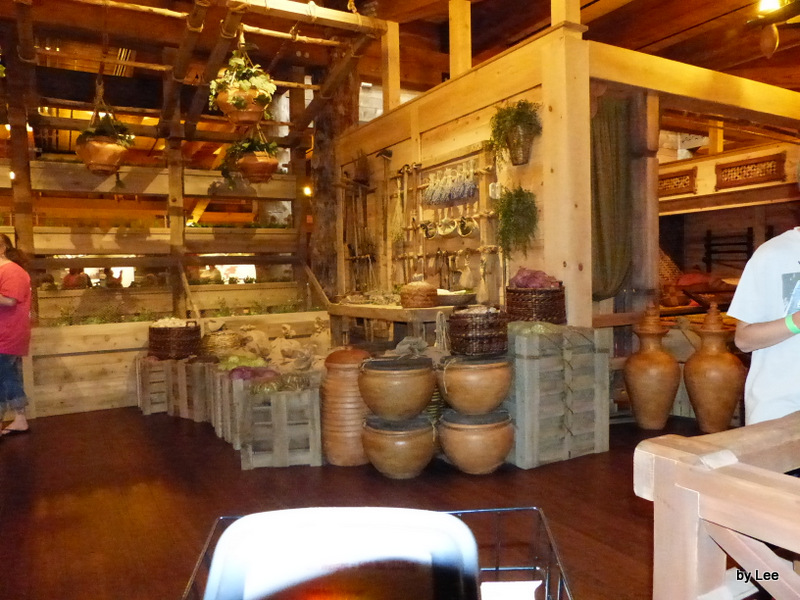
Food Preparation Area inside the Ark Encounter by Lee

“Evidence From The Worldwide Flood”

“How could the Ark have survived a year-long water catastrophe without sinking? The study of hydrodynamics (the branch of physics having to do with the motion and action of water) has demonstrated that a giant boxlike vessel the size and shape described in the Bible would be almost unsinkable. Even in a sea of gigantic waves, the Ark could be tilted to almost a 90° angle and would always tend to right itself again. A vessel of this shape also aligns itself with the waves so that it experiences the least amount of pitching.

In 1604, a Dutchman named Peter Jansz, built two smaller ships with the same proportions as the Ark. These small “arks” could carry one-third more cargo than regular ships without requiring any additional crew and quickly became a popular cargo carrier.

The perfect engineering of the Ark, with the exact characteristics necessary to survive the Flood, points to God as the ultimate Designer. Every detail of the Bible confirms its accuracy and supernatural origin.”

The Door of the Ark by Lee

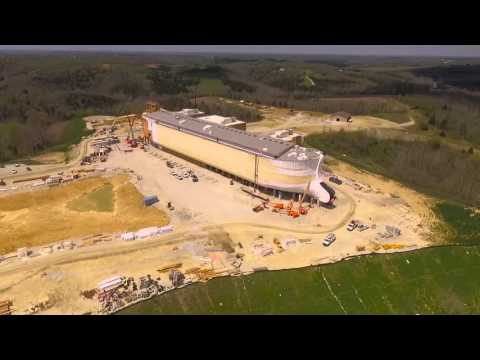
This image is a reproduction of the ark at Ark Encounter, USA. Answers in Genesis.

The Article is from:
The Creation, p. 150-151
The Genesis Record, p. 181

The above quote is from January 15), “”A Closer Look at the Evidence – Kleiss,” by Richard and Tina Kleiss

This is how you are to make it: The ark will be 450 feet long, 75 feet wide, and 45 feet high. (Genesis 6:15 HCSB)

“When I Consider!” is based on: (Psalms 8:3-9) (3) When I consider Your heavens, the work of Your fingers, The moon and the stars, which You have ordained…(9) O LORD, our Lord, How excellent is Your name in all the earth!

Ark Encounter During Construction

Interesting related articles:
WorldWideFlood.com
Noah’s Ark from Creation Wiki
The Resource for Answering the Critics of Noah’s Ark by John Woodmorappe, ICR
Caring for the Animals on the Ark by John Woodmorappe, AiG
Noah’s Ship: Like Nothing You’ve Seen Before by Catherine Myers, Answers

What is the Gospel?

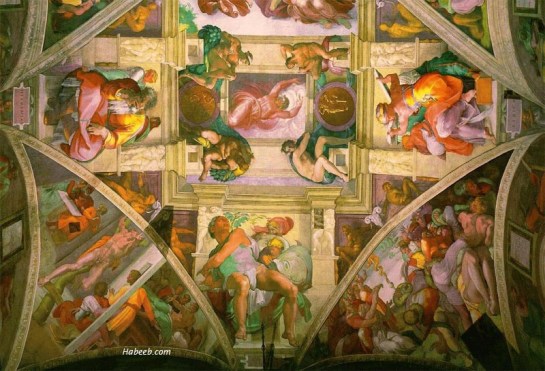
Wednesday’s When I Consider – Sistine Chapel Ceiling and God’s Creation

Sistine Chapel Ceiling

When I Consider – Wednesdays – Sistine Chapel Ceiling and God’s Creation

(Sistine Chapel Ceiling and God’s Creation – Reposted and Updated)

“Imagine that you are the child of the famous painter, Michelangelo. You grew up watching your father paint the ceiling of the Sistine Chapel. Each stroke of the brush revealed his love, creative genius, and masterful perfection.”

Later in life, you visit the Chapel and see a tour guide giving his talk about how the painting came about. They are standing there in “awe under the grandeur of the artistic work” and then hears the guide boldly say words to this effect. “The ceiling occurred by naturalistic processes over countless years as water leaked through the roof and stained the plaster. The people are told by their expert guide that what appears as an intentionally designed work of beauty is strictly a chance occurrence.”

“Would you not, as Michelangelo’s child, rise up in righteous indignation at the telling of such a flagrant lie? If the guide said that you father had used the random procedure of dripping water through the plaster to create the masterpiece, would that lie have been any more palatable?”

He telleth the number of the stars; He calleth them all by their names. (Psalm 26:7)

He telleth the number of the stars; He calleth them all by their names. (Psalm 26:7)

“The modern “tour guides” of our world are evolutionists who would have us believe that all of the purpose, eloquent design, and astronomical complexity of life just happened as chance naturalistic processes (such as mutations) formed life over billions of years. Liberal theologians would have us believe that God used such a process to make things.”

As Christians that believe the Word of God as truth, we should “boldly proclaim the truth so that more people may come to know the true Master Artist and come to trust His written revelation to mankind (the Bible)”

The LORD by wisdom hath founded the earth; by understanding hath he established the heavens. (Proverbs 3:19)

Who knoweth not in all these that the hand of the LORD hath wrought this? (Job 12:9)
Earth from NASA
By his spirit he hath garnished the heavens; (Job 26:13)

That I may publish with the voice of thanksgiving, and tell of all thy wondrous works. (Psalms 26:7)

That they might set their hope in God, and not forget the works of God, but keep his commandments: (Psalms 78:7)

*Quotes from “Evidence from Common Sense March 22,” in “A Closer Look at the Evidence,” by Richard & Tina Kleiss, (Bryce Gaudian, The Great Works Catalog, p22)

When I Consider – Wednesdays – Intro

Bald Eagle – San Diego Zoo

When I Consider – Wednesdays will be reposts/updates to a series of articles that were posted back in the early days of this blog.

A Closer Look at the Evidence by Richard & Tina Kleiss is a devotional book that has bite size information about incredible evidence about creation.

Here is a part of the review of the book written by the Richard & Tina Kleis.

We have never seen such a unique and fascinating devotional book. It is one of a very few that we have used that tempts us to read on ahead! A Closer Look at the Evidence presents straightforward evidence, primarily scientific, for the existence of our Creator.

This book is organized into twenty-six different subject areas and draws from over fifty expert sources. Each of the 400+ pages highlights knowledge from a Biblical perspective. Each day’s devotion is a full page of concise, well-researched, factual information with reference material noted if you desire more specifics.

The authors, Rich and Tina Kleiss, former public school science teachers, discovered that scientific evidence overwhelmingly supports creation. But evolution continues to be presented as fact in the media and textbooks, even as the evidence for creation is being systematically excluded.

By daily using and discussing A Closer Look at the Evidence, your family should not only learn the credible reasons for your belief in the Creator but also be equipped to share this truth with others. Each page ends with a related Bible verse…..

magnify_2748cDan and I used it daily after our regular devotions. I have been wanting to share these articles for some time and have decided to do so in a series called, “When I Consider!” A quote from the book’s Dedication has encouraged me decide to do this.

God’s desire is that the knowledge of what He has done through both the cross and creation is for everyone. We must not keep this knowledge to ourselves. The evidence that He is our Creator is so overwhelming and encouraging that it is desperately needs to be shared in the world today. A Closer Look at the Evidence is designed to be an affordable resource to both reinforce our individual faith and facilitate sharing the reasons for this faith. Consider praying about how God could use you to utilize the truths found in these pages.

The book is available at (Christianbook.com)

Here is the first in the “When I Consider!” Series:

This was the first in the series called, “When I Consider! Please see the above article, “A Closer Look at the Evidence – Kleiss“, by Richard and Tina Kleiss, for an explanation of this new series. Not only will I use information from the Kleiss’ book, but other articles also. Since our main blog is about Bird’s, this seems like a good starting place.

“Evidence From Biology”

The eagle’s diving speed can exceed 100 miles per hour. At this speed, the eagle’s eyesight must be perfect in order to know exactly when to pull out of a dive. Its eyes are designed to spot a rabbit or fish up to one mile away. The eagle also has remarkably designed wings, each covered by over 12,000 feathers. Aircraft designers are still trying to copy this engineering marvel.

Besides the ability to climb to 10,000 feet withing minutes, the parent eagle also assists its young in flight. As it flies alongside the eaglet, whirlpools of air formed by its primary feathers provide the eaglet with additional lift.

In speaking of His protective care over the nation of Israel, God states, ‘..I bare you on eagle’s wings…’ (Exodus 19:4 KJV). The Hebrew word for ‘bare’ is nacah, and its primary rood means ‘to lift.’ This is exactly what the parent eagle does to help its young in flight.

The precise selection and meaning of words used in the Bible is a testimony to the accuracy and precision of the remarkable book.

Character Sketches, Vol.III, p171-174″

The above quote is from January 28, “A Closer Look at the Evidence,” by Richard and Tina Kleiss

This series will be based on:

Psalms 8:3-9 NKJV
“When I consider Your heavens, the work of Your fingers, The moon and the stars, which You have ordained, What is man that You are mindful of him, And the son of man that You visit him? For You have made him a little lower than the angels, And You have crowned him with glory and honor. You have made him to have dominion over the works of Your hands; You have put all things under his feet, All sheep and oxen– Even the beasts of the field, The birds of the air, And the fish of the sea That pass through the paths of the seas. O LORD, our Lord, How excellent is Your name in all the earth!


When I Consider! – Fossils

When I Consider!

When I Consider!

“Evidence From The Fossil Record”

For over 200 years paleontologists and geologists have been digging in the hills, valleys, and plains of the earth. During this time they have uncovered and cataloged over a billion fossils. Thousands of fascinating plant and animal fossils from extinct organisms have been found. Fossils, like living organisms, are found fully formed and distinctly different in structure. Evolutionists claim to have found animal bones having features intermediate between similar creatures, proving that evolution has occurred (e.g., small horses to big horses). Yet there are no examples in the fossil record of one animal slowly changing into a different kind of animal. Diagrams have been made which show variations within the same type of animal in an effort to organize them into a supposed evolutionary order. Textbooks promote this type of evidence because no transitional evidence showing one animal slowly changing into another has been found.

It is astounding that over a billion fossils have been found, yet there is no undisputed transitional form between very different types of animals or even animal features (such as reptile’s scale turning into a bird’s feather). How can we say that evolution-the idea that man is the result of slow changes over time from earlier creatures-is a reasonable theory in light of evidence?

All flesh is not the same flesh; but there is one kind of flesh of men, another flesh of beasts, another of fishes, and another of birds. (I Corinthians 15:39 KJV)

Letting God Create Your Day, Vol 3, p 213

A Closer Look At The Evidence, by Richard and Tina Kleiss, January 20

Typed by Phyllis

See: Texas Fishapod fry!

When I Consider! – Petrified Tree Trunks

When I Consider!

When I Consider!

“Evidence From Geology”

Buried in an eroded hillside at Yellowstone National Park are petrified tree trunks protruding through multiple layers of earth. For many years a geological marker at this site (Specimen Ridge) stated that the trees were buried and petrified in place. The parallel layers were interpreted as successive forests buried by volcanic activity. It was claimed that after each volcanic eruption, the volcanic-ash layer slowly weathered into suitable topsoil and hundreds of years passed as subsequent forests grew to maturity. This pattern supposedly happened 27 times spanning 30,000 years. This interpretation seemed to present a problem to biblical accuracy, which indicates there has been less than 10,000 years of Earth history.

Polystrate lycopod in Tennessee showing VISS and crossbedding, both caused by flows from right to left in photo

Polystrate lycopod in Tennessee showing VISS and crossbedding, both caused by flows from right to left in photo

However, this interpretation ignores several important observations. The roots of the tree stumps are broken off with only the root balls left. The stump size, tree ring pattern, and number of tree rings throughout all 27 layers are remarkably similar. What the evidence really supports is the rapid burial of a single massive forest by a flood of worldwide proportions. Trees are buried at different levels because they sank into the sediment at different times. Apparently the majority opinion has moved toward this better interpretation because the “multiple-forest” interpretive sign has been removed. Unfortunately, the reality of a worldwide Flood is still not mentioned. It is because the Bible can be trusted when it speaks on physical matters (such as reality of a worldwide Flood) that we can trust what the Bible has to say about spiritual matters (such as morality and eternity).

It is the glory of God to conceal a matter; to search out a matter is the glory of kings. Proverbs 25:2

A Closer Look At The Evidence, by Richard and Tina Kleiss, January 17

Typed by Phyllis

When I Consider! – Uniformitarianism

When I Consider!

When I Consider!

“Evidence From Biblical Accuracy”

The belief in uniformitarianism (that the past history of our planet can be explained by slow processes over long periods of time) is not a new scientific revelation. Belief in evolution is built upon this foundation of uniformitarianism by denying that there have been major interventions by God in the past. God knew and forewarned mankind of this errant viewpoint thousands of years ago in 2 Peter 3.

1. Evolution denies the instantaneous creation of very different forms of life.
2. Evolution ignores that there was ever a curse on man and nature as a result of mankind’s rebellion.
3. Evolution suppresses the evidence for the worldwide Flood in spite of enormous geological evidence supporting the reality of this event. This global Flood explains the fossil record without the need for evolutionary concepts or time scales and must be denied in order to accept evolution.
4. Evolution undermines Christianity by assuming that death has always been around is the natural order of things. If this is true, then Christ did not die as a final payment for Adam’s (and our) sin because death is normal and not a specific penalty for our rebellion.

Once evolution is accepted as a fact, is it any surprise that Christianity rapidly becomes irrelevant? Is it any surprise that Europe became almost devoid of true Christian faith in the same time frame in which it totally embraced evolutionary theory as fact?

First of all, you must understand that in the last days scoffers will come, scuffing and following their own evil desires. They will say “Where is the ‘coming’ he promised? Ever since our fathers died, everything goes on as it has since the beginning of creation.” (2 Peter 3:3-4 KJV)

A Closer Look At The Evidence, by Richard and Tina Kleiss, January 12

Typed by Phyllis

When I Consider! – Mabbul (Flood)

Rainbow by Mike Bader

Rainbow by Mike Bader

Evidence From the Worldwide Flood

Mabbul

When I Consider!

When I Consider!

Many people claim that Noah’s Flood was just a relatively small local event. Yet God clearly stated in Genesis 6:17 that the coming judgment would be a mighty flood of waters (mabbul mayim). The word for flood (mabbul), used in Genesis 6:17 for the first time, is only used for Noah’s Flood; other floods are denoted by different words in the Bible. The Genesis Flood was the “mabbul,” unique in all history. God not only used a unique and exact word for the worldwide Flood, but also made it clear that the waters covered the highest mountains.

God promised to never send another flood upon the earth. Yet there have been countless local floods throughout history. Either the Genesis Flood was something different, unique, and worldwide–or God is a liar.

Enormous and widespread geologic features around the planet also testify to the global extent of the Flood. From the rapid formation of the Grand Canyon as backed-up waters rushed off the continents…to widespread coal deposits…to over-sized river valleys around the world-it is apparent that this planet was once covered with water.

(The Genesis Record, p 183) – From A Closer Look at the Evidence by Kleiss, November 8.

And the LORD smelled a sweet savour; and the LORD said in his heart, I will not again curse the ground any more for man’s sake; for the imagination of man’s heart is evil from his youth; neither will I again smite any more every thing living, as I have done. (Genesis 8:21 KJV)

When I Consider! – Amazing Stick Insects

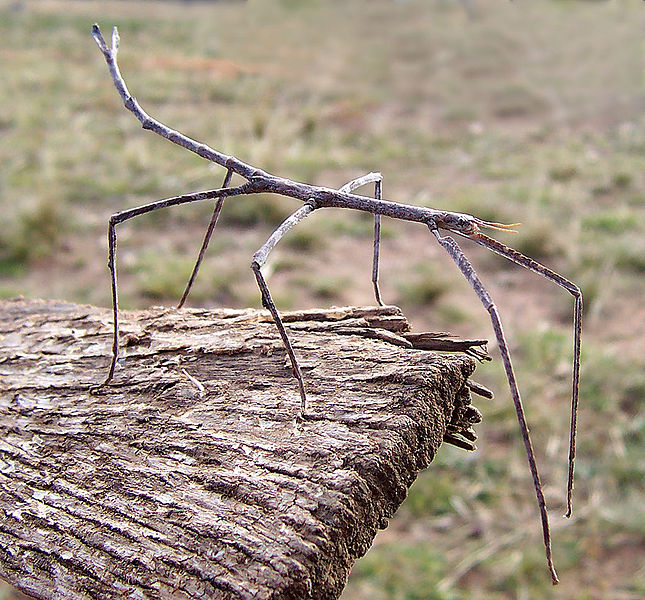
Stick Insect - Ctenomorpha chronus (by Wiki)

Stick Insect - Ctenomorpha chronus (by Wiki)

When I Consider!

When I Consider!

Evidence From Biology

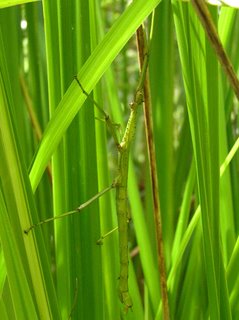
“One of nature’s masters of disguise is the stick insect. Stick insects are leaf eaters designed to look like little twigs. One tropical stick insect is as thick as a finger and the same color as the bamboo on which it is found. It even has swollen ridges just like bamboo! Other types have leafy flaps that match the leaves of the plants which they like to eat. Some stick insects even lay eggs that look exactly like the seeds of the plant on which they feed. A stick insect that’s found in New Mexico glues its eggs to grass stems. The position and shape of their pointed eggs exactly imitate the seeds of the grass!

New Zealand Stick Insect - (Landcare Research Manaaki Whenua)

New Zealand Stick Insect - (Landcare Research Manaaki Whenua)

Although stick insects don’t fly, some of them have brightly colored wings that can fold quickly to scare away nervous birds who want to investigate them for lunch. Some stick insects will often sway with the breeze to make their illusion even more effective. Others will sit motionless for hours as if they are just another piece of dead wood.

Stick insects are even geniuses at using their predator’s weakness for their own protection. Birds understand this and will closely examine non-moving twigs in search of a meal. Stick insects will not even move when being carried away by a bird, thus fooling many birds into dropping them. Although these defense mechanisms were likely designed after the Fall, stick insects are clearly not the result of random mutations, but the intelligent design of a Creator.”

(Letting God Create Your Day, Vol 3, p194) – From A Closer Look at the Evidence by Kleiss, February 17.

Give unto the LORD the glory due unto his name; worship the LORD in the beauty of holiness. (Psalms 29:2 KJV)

When I Consider! – Woodpecker

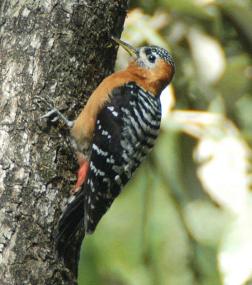
Rufous-bellied Woodpecker (Dendrocopos hyperythrus) by Nikhil Devasar

Rufous-bellied Woodpecker (Dendrocopos hyperythrus) by Nikhil Devasar

When I Consider!

When I Consider!

Evidence From Biology

Consider the probability of all of the following characteristics evolving simultaneously into an effectively functioning system in the woodpecker:

1. Its beak is connected to its skull with a resilient shock-absorbing tissue that is not found in any other bird.

2. The beak is much harder than the beaks of other birds, enabling it to bang away a hundred times a minute without hurting itself.

3. The tongue is barbed in most of the 200+ species and is about four times longer than the beak. In certain species the tongue wraps around the back of the bird’s skull, enabling it to reach deep into tree trunks and remove insects.

4. A sticky coating on some woodpecker tongues helps them grab insects.

5. Its tail feathers are constructed so that they are stiff enough to help brace against trees as it climbs.

6. Its keen senses of smell and hearing help detect insects crawling around under the bark of the trees.

7. It short legs and powerful claws are uniquely designed to help it climb tree trunks.

The engineering behind such a technological wonder as the woodpecker boggles our minds. Try to imagine the obstacles the first bird, which was trying to turn into a woodpecker, would have had to overcome!

The eyes of all wait upon thee; and thou givest them their meat in due season. Thou openest thine hand, and satisfiest the desire of every living thing. The LORD is righteous in all his ways, and holy in all his works. (Psalms 145:15-17 KJV)

From A Closer Look at the Evidence by Kleiss, November 6.


“The woodpeckers, piculets and wrynecks are a family, Picidae, of near-passerine birds. Members of this family are found worldwide, except for Australia and New Zealand, Madagascar, and the extreme polar regions. Most species live in forests or woodland habitats, although a few species are known to live in treeless areas such as rocky hillsides and deserts.

The Picidae are just one of the eight living families in the order Piciformes. Members of the order Piciformes, such as the jacamars, puffbirds, barbets, (also Asian and African barbets), toucans and honeyguides, have traditionally been thought to be very closely related to the woodpeckers, piculets and wrynecks. More recently, DNA sequence analyzes have confirmed this view.[1]”

“Members of the family Picidae have strong bills for drilling and drumming on trees and long sticky tongues for extracting food.[2] Woodpecker bills are typically longer, sharper and stronger than the bills of piculets and wrynecks; however their morphology is very similar. The bill’s chisel-like tip is kept sharp by the pecking action in birds that regularly use it on wood. Species of woodpecker and flicker that use their bills in soil or for probing as opposed to regular hammering tend to have longer and more decurved bills. Due to their smaller bill size, many piculets and wrynecks will forage in decaying wood more often than woodpeckers. The long sticky tongues, which possess bristles, aid these birds in grabbing and extracting insects deep within a hole of a tree. It had been reported that the tongue was used to spear grubs, but more detailed studies published in 2004 have shown that the tongue instead wraps around the prey before being pulled out.[3]

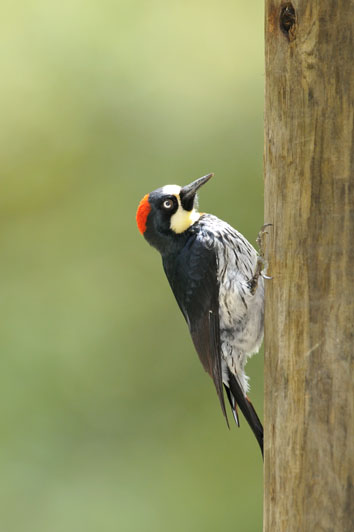
Acorn Woodpecker (Melanerpes formicivorus) by Reinier Munguia

Acorn Woodpecker (Melanerpes formicivorus) by Reinier Munguia

“The diet of woodpeckers consists mainly of insects and their grubs taken from living and dead trees, and other arthropods, along with fruit from live trees, nuts and sap both from live trees. Their role ecologically is thereby keeping trees healthy by keeping them from suffering mass infestations.The family is noted for its ability to acquire wood-boring grubs using their bills for hammering, but overall the family is characterized by its dietary flexibility, with many species being both highly omnivorous and opportunistic. The insect prey most commonly taken are insects found inside tree trunks, whether they are alive or rotten wood and in crevices in bark on trees. These include beetles and their grubs, ants, termites, spiders,and caterpillars. These may be obtained either by gleaning or more famously by excavating wood. Having hammered a hole into the wood the prey is excavated by a long barbed tongue. The ability to excavate allows woodpeckers to obtain tree sap, an important source of food for some species. Most famously the sapsuckers, (genus Sphyrapicus ) feed in this fashion, but the technique is not restricted to these and others such as the Acorn Woodpecker also feed in this way. It was once thought that the technique was restricted to the New World, but Old World species such as the Arabian Woodpecker and Great Spotted Woodpecker also feed in this way.[2]”Wikipedia

See Also:
When I Consider! – Woodpecker and Bones
When I Consider! – Salt Concentration

When I Consider!

When I Consider!

“Evidence From Geology”

Salt concentration in seawater can be used as a chronometer, because the oceans are getting saltier each year as rivers dump dissolved salts from the continents into the sea.  Traditionally, evolutionists have assumed that life evolved in a salty sea, some two to four billion years ago.  It is even taught that the mineral composition of our blood is similar to ancient seawater, because this is where the first living cell developed.  This belief is wrong, because the composition of our blood is not even remotely similar to the concentrations or types of the various salts in the oceans.   Furthermore, by measuring the rate at which salt is flowing from rivers into the ocean, scientists can estimate the maximum possible age of the current oceans.

Salt Fills The Sea Too Fast from AIG

Salt Fills The Sea Too Fast from AIG

Drs. Steven Austin and Russell Humphreys have done just that in a research paper called “The Sea’s Missing Salt:  A Dilemma For Evolutionists.”  In their research they systematically identified all known mechanisms and rates for the addition and removal of salt from the oceans.  This work has shown that there is nowhere near enough salt in the oceans if they are really thousands of millions of years old.  This is true even the oceans started as pure distilled water!  The oceans could not possibly be old enough for evolution to have taken place.

The Young Earth, p.85-87

Creation Magazine, Sept. 2000

In the beginning You  laid the foundations of the earth…   Psalm 102:25

(Typed by Phyllis)

Some more articles on this subject:
Reiterating: ok to use sea sodium as evidence for a young world
When I Hear… by Dr. Frank DeRemer
*
*


When I Consider! – Capillary flow, Osmosis and Vacuum pressure

When I Consider!

When I Consider!

Evidence From Botany – January 4

On a hot summer day, one large tree can pump over a thousand gallons—that’s four ton—of water from the ground to it leaves. The water is collected from the soil through the roots. But the real work of pumping four tons of water, often 100 feet in the air, occurs at the top of the tree. The water is suctioned toward the treetop by three remarkably efficient mechanisms—capillary flow, osmosis and vacuum pressure. Osmosis and capillary action act in concert to move the water partway to the top of the tree, but the real driving force is a pressure differential created by the leaves within the vessels of the tree. The pressure differential is a result of water evaporating from the leaves of the tree, creating a suction throughout the vessels. This suction (measured as low as 1/20 of atmospheric pressure) helps to draw water from the roots all the way to the top of the tree. If you were to cut one of these vessels, you could actually hear a hissing sound as air rushed back in.

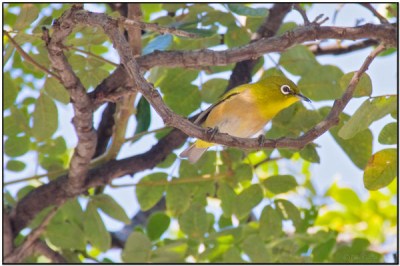
Japanese White-eye (Zosterops japonicus) by Daves BirdingPix

Japanese White-eye (Zosterops japonicus) by Daves BirdingPix up in a tree

The engineering excellence of this silent pumping system which efficiently delivers moisture to the very top of trees, is a not-so-silent witness against the idea that chance evolutionary processes (such as mutations) could have developed it.

Do you not know? Have you not heard? The LORD is the everlasting God, the Creator of the ends of the earth. He will not grow tired or weary, and His understanding no one can fathom. Isaiah 40:28

From A Closer Look at the Evidence, by the Kleiss’

(Typed by Phyllis)

When I Consider! – Couch’s Spadefoot Toad

When I Consider!

When I Consider!

Evidence From Biology – January 6

The Couch’s spadefoot toad of the Sonoran Desert is an example of how God takes care of creatures under extreme conditions. This toad lies dormant in the hot desert eleven out of twelve months each year. It has built-in sensors that tell it when a violent desert rainstorm occurs. The toad can detect vibrations of pounding rain miles away. It somehow knows to emerge from the sand when it rains so that the male toads can call for females as soon as pools of water form. Shortly afterwards the egg-laying is completed and the toads return to the sand, safe from the heat of the burning daytime sun. Most of the time the desert pools rapidly dry up, killing the eggs. Only under ideal conditions will some of the eggs hatch nine days later. The young toads have at most a few weeks to eat enough food to survive before burying themselves in the sand for the next eleven months while awaiting the another rainstorm.

Couch's Spadefoot Toad

Couch's Spadefoot Toad

Such survival instincts and mechanisms were probably not required before the Fall, when the world was designed as a paradise. In the current world, with its severe climates, such instincts and abilities seem to have been specifically designed for animals such as the spadefoot toad. How could this ability to adjust to such harsh weather conditions have evolved? Unless all of the abilities, instincts, and timing of the toads’ reproductive cycle were in place, the toads could never have survived the first severe season.

The wild animals honor me…because I provide water in the desert and streams in the wasteland… (Isaiah 43:20)

From A Closer Look at the Evidence, by the Kleiss’

(Typed by Phyllis)

From Wikipedia:
The Couch’s Spadefoot Toad, (Scaphiopus couchii) is a species of North American spadefoot toad native to the southwestern United States and the Baja region of Mexico. The epithet couchii is in honor of American naturalist Darius Nash Couch, who collected the first specimen while on a personal expedition to northern Mexico to collect plant, mineral and animal specimens for the Smithsonian Institution.[1]

These toads can be found throughout the Sonoran Desert, including Arizona. How can you tell the species? True toads have horizontal pupils but the spadefoots have vertical pupils (like cats). Look at the sole of a hind foot. There you’ll find the hard, dark “spade” that gives a spadefoot its name. There are only two spadefoot species in the Sonoran Desert of Arizona and California. If the space is sickleshaped, it’s Couch’s spadefoot, Scaphiopus couchi. If the spade is rounded, it’s the western spadefoot, Scaphiopus hammondii(called the southern spadefoot, Scaphiopus multiplicatus, in some field guides).

Spadefoot Foot by Thomas Eimermacher

Spadefoot Foot by Thomas Eimermacher

Incidentally, the spades really are digging tools–spadefoots use them to burrow backward into the soil.

Once you’ve finished checking the animal, gently put it down where you caught it–it has important things to do–then wash your hands thoroughly in the water. Amphibian skin secretions can be quite toxic; they probably won’t affect your hands, but you won’t want to get them in your eyes, nose, or mouth.

Spadefoots live for the monsoon. They spend the rest of the year underground awaiting their wake-up call: the drumming of raindrops on the soil during a summer thunderstorm. As soon as the males dig out they go looking for rain pools, and when they find them they broadcast the news loudly as they can. The chorus draws silent female spadefoots from far and wide.

Mating is an urgent matter for spadefoots. Their tadpoles must hatch, grow, and change into toadlets before the pool evaporates in the summer sun. That’s why they do most of their mating the first night the pool forms. Couch’s spadefoot toadlets sometimes leave the puddle only nine days after the eggs are laid! Western spadefoots take longer–at least three weeks.

The warmth of the water speeds up the tadpoles’ growth. Meanwhile they devour everything even remotely edible. They scrape algae off rocks. They filter microorganisms from the water as they pump it over their gills. They gather in wriggling masses, stir up the muck on the bottom of the pond, and filter that. And unlike most tadpoles, which are exclusively herbivores and filter-feeders, spadefoot tadpoles are omnivores. They also eat dead insects and tadpoles, and” more.

See Also:

Couch’s Spadefoot

Couch’s Spadefoot Toad by LA Zoo