Birds of the Bible – Mother and Her Chicks

Snow Goose (Chen caerulescens) at nest©USFWS

Snow Goose (Chen caerulescens) at nest©USFWS

If a bird’s nest happens to be before you along the way, in any tree or on the ground, with young ones or eggs, with the mother sitting on the young or on the eggs, you shall not take the mother with the young; you shall surely let the mother go, and take the young for yourself, that it may be well with you and that you may prolong your days. (Deuteronomy 22:6-7 NKJV)

Also in the with the animals, the Bible says,

Whether it is a cow or ewe, do not kill both her and her young on the same day. (Leviticus 22:28 NKJV)
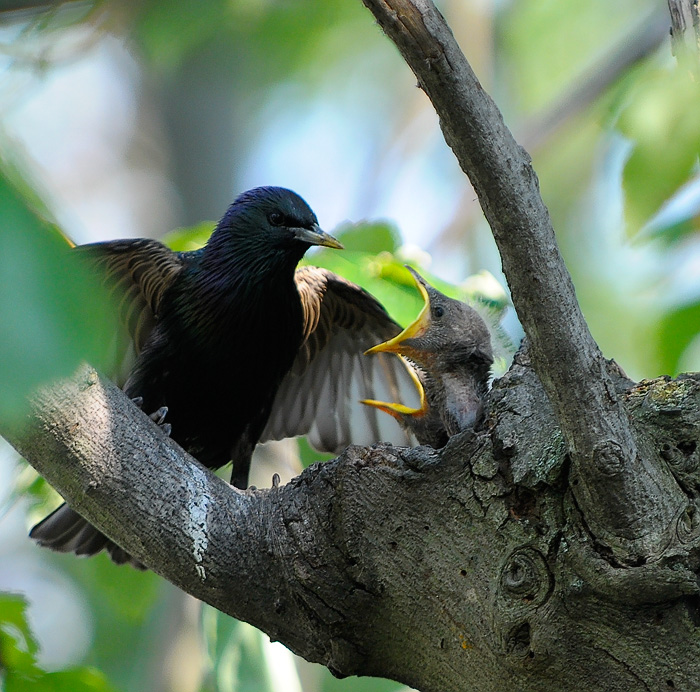
Common Starling (Sturnus vulgaris) at Nest by Anthony747

Common Starling (Sturnus vulgaris) at Nest by Anthony747

In Deuteronomy, the Israelites were being given some rules of things to do or not do. This passage about the mother bird and her chicks or eggs is among those commands. Notice that if they did this, it would be well with them and help prolong their days. There are many good characteristics for us to learn from this command. Below are some of the thoughts from the commentators.

Matthew Henry’s Commentary was the longest, but much insight. “II. In taking a bird’s-nest, the dam must be let go, Deu_22:6, Deu_22:7. The Jews say, “This is the least of all the commandments of the law of Moses,” and yet the same promise is here made to the observance of it that is made to the keeping of the fifth commandment, which is one of the greatest, that it may be well with thee, and that thou mayest prolong thy days; for, as disobedience in a small matter shows a very great contempt of the law, so obedience in a small matter shows a very great regard to it. He that let go a bird out of his hand (which was worth two in the bush) purely because God bade him, in that made it to appear that he esteemed all God’s precepts concerning all things to be right, and that he could deny himself rather than sin against God. But doth God take care for birds? 1Co_9:9. Yes, certainly; and perhaps to this law our Saviour alludes. Luk_12:6, Are not five sparrows sold for two farthings, and not one of them is forgotten before God? This law, 1. Forbids us to be cruel to the brute-creatures, or to take a pleasure in destroying them. Though God has made us wiser than the fowls of heaven, and given us dominion over them, yet we must not abuse them nor rule them with rigour. Let go the dam to breed again; destroy it not, for a blessing is in it, Isa_65:8. 2. It teaches us compassion to those of our own kind, and to abhor the thought of every thing that looks barbarous, and cruel, and ill-natured, especially towards those of the weaker and tender sex, which always ought to be treated with the utmost respect, in consideration of the sorrows wherein they bring forth children… It further intimates that we must not take advantage against any, from their natural affection and the tenderness of their disposition, to do them an injury. The dam could not have been taken if her concern for her eggs or young (unlike to the ostrich) had not detained her upon the next when otherwise she could easily have secured herself by flight. Now, since it is a thousand pities that she should fare the worse for that which is her praise, the law takes care that she shall be let go. The remembrance of this may perhaps, some time or other, keep us from doing a hard or unkind thing to those whom we have at our mercy.” (Matthew Henry’s Commentary)

Redwing Blackbird feeding young at Lake Hollingsworth

Redwing Blackbird feeding young at Lake Hollingsworth

“If a bird’s nest chance to be before thee — This is a beautiful instance of the humanizing spirit of the Mosaic law, in checking a tendency to wanton destructiveness and encouraging a spirit of kind and compassionate tenderness to the tiniest creatures. But there was wisdom as well as humanity in the precept; for, as birds are well known to serve important uses in the economy of nature, the extirpation of a species, whether of edible or ravenous birds, must in any country be productive of serious evils. But Palestine, in particular, was situated in a climate which produced poisonous snakes and scorpions; and the deserts and mountains would have been overrun with them as well as immense swarms of flies, locusts, mice, and vermin of various kinds if the birds which fed upon them were extirpated [Michaelis]. Accordingly, the counsel given in this passage was wise as well as humane, to leave the hen undisturbed for the propagation of the species, while the taking of the brood occasionally was permitted as a check to too rapid an increase.” (Jamieson, Faucett, and Brown Commentary)

If God detests cruelty done to little birds, how much more to man, made according to his image?” (Geneva Bible Translation Notes)

Redwing Blackbird young at Lake Hollingsworth

Redwing Blackbird young at Lake Hollingsworth

“..this law was made partly to preserve the species of birds, and prevent the decrease of them; for a dam let go might breed again, and to this purpose are the verses ascribed to Phocylides (y), which contain the substance of this law, and this reason of it: and partly, as Maimonides observes (z), that the dam might not be afflicted at the sight of the spoil of her young; for this law does not prohibit the taking of her in any other place but in her nest, nor after her young are taken, but not together; and, as the same writer remarks, if the law would have such care taken of beasts and birds, that they might be freed from sorrow and distress, how much more of man? Wherefore the intention of this law is to teach humanity, compassion, and pity in men to one another, and to forbid cruelty, covetousness, and such like vices; as also to instruct in the doctrine of Providence, which has a respect to birds; and our Lord may be thought to have this law in view, Luke 12:6.” (John Gill’s Exposition of the Whole Bible)

“The affectionate relation of parents to their young, which God had established even in the animal world, was also to be kept just as sacred. If any one found a bird’s nest by the road upon a tree, or upon the ground, with young ones or eggs, and the mother sitting upon them, he was not to take the mother with the young ones, but to let the mother fly, and only take the young. נִקְרָא for נִקְרָה, as in Exo_5:3. The command is related to the one in Lev_22:28 and Exo_23:19, and is placed upon a par with the commandment relating to parents, by the fact that obedience is urged upon the people by the same promise in both instances (vid., Deu_5:16; Exo_20:12).” (K & D Commentary on OT)

(Bolding is mine)

*

Interesting Video – Birds and Flight

White Pelicans in Flight - Circle B Bar by Dan

White Pelicans in Flight - Circle B Bar

And God said, Let the waters bring forth abundantly the moving creature that hath life, and fowl that may fly above the earth in the open firmament of heaven. (Genesis 1:20 KJV)

Just posted an Interesting Video called “Birds and Flight – Design or Mutations“, by Andy McIntosh at the following link in the Plus Pages.

Click Here to view the video.

See also: Birds: fliers from the beginning

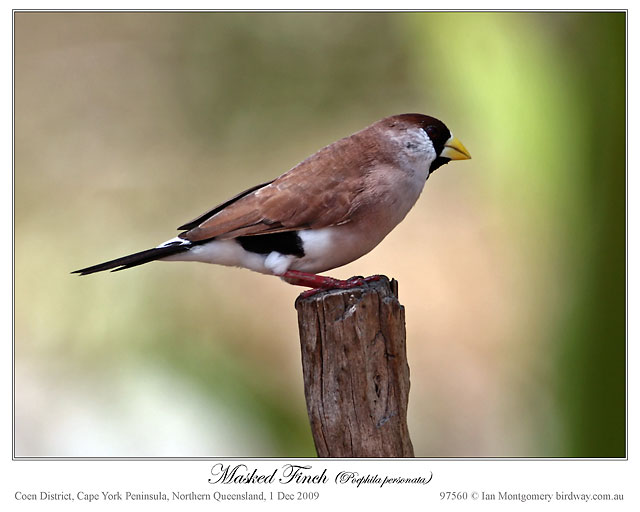
Ian’s Bird of the Week – Masked Finch

Masked Finch (Poephila personata) by Ian

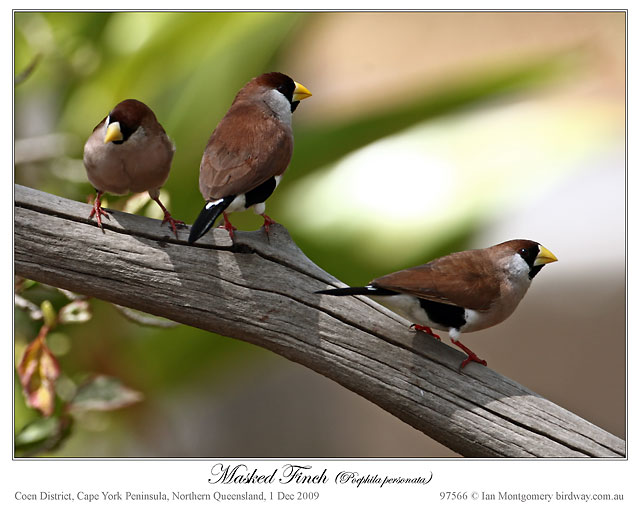
Masked Finch (Poephila personata) by Ian

Newsletter: 12/26/2009

Here is yet another beautiful finch from northern Australia, the Masked Finch, which we encountered on the recent trip to Cape York Peninsula. There are two races. This one, the ‘White-eared Finch’ (Poephila personata leucotis) occurs only on Cape York, while the nominate brown cheeked race (personata) occurs from northwestern Queensland through the top end of the Northern Territory to the Kimberley district of northern Western Australia. Both races are distinguishable from the closely related Black-throated and Long-tailed Finches (P. cincta and P. acuticauda respectively) by having large yellow bills, brown, rather than grey, crowns and only a small area of black on the chin.

Masked Finch (Poephila personata)2 by Ian

Masked Finch (Poephila personata)2 by Ian

We encountered these individuals at the fruit quarantine station near Coen in central Cape York Peninsula. The station provides a bird bath in the small park where we finished off some fruit and the bath was popular with both Masked Finches and the northern (black-rumped) race of the Black-throated Finch.

Masked Finches feed, like their, relatives mainly on grass seeds. So they feed mainly on the ground, but will retreat into bushes and trees when disturbed. The easiest way to find them is usually at waterholes in the dry season where they come in, often in large numbers, to drink and bathe. Masked Finches build globular nests in bushes and trees and will sometimes use the old burrows of kingfishers in termite mounds.

Links:
Black-throated Finch
Long-tailed Finch
Masked Finch (including the western brown-cheeked race)
Best wishes,
Ian

Ian Montgomery, Birdway Pty Ltd,
454 Forestry Road, Bluewater, Qld 4818
Phone: +61-7 4751 3115
Preferred Email: ian@birdway.com.au
Website: http://birdway.com.au


Black-throated Finch (Poephila cincta) by Ian

Black-throated Finch (Poephila cincta) by Ian

Long-tailed Finch (Poephila acuticauda) by Ian

Long-tailed Finch (Poephila acuticauda) by Ian

Lee’s Addition:

Are not five sparrows sold for two farthings, and not one of them is forgotten before God? (Luke 12:6 KJV)

These are in the Estrildidae – Waxbills, Munias & Allies family of the Passeriformes Order.

“The Masked Finch (Poephila personata) is a small passerine bird in the estrildid finch family, Estrildidae. The estrildid finches are small passerine birds of the Old World tropics and Australasia. They can be classified as the family Estrildidae (weaver-finch), or previously as a sub-group within the family Passeridae, which also includes the true sparrows.[It is a common resident of dry savanna across northern Australia, from the Kimberley, across the Top End, the Gulf country and the southern part of Cape York Peninsula, as far east as Chillagoe, but always near water.

It is 12.5-13.5 cm (4.9-5.3 in) long. The male is larger but the sexes are otherwise similar. It is cinnamon-brown above and paler below with a white rump, black mark on the flanks and black face mask. It has a heavy yellow bill and a pointed black tail. The eastern subspecies P. p. leucotis has whitish cheeks.

Pairs or small flocks forage through the day, mostly on the ground for fallen grass seeds. In the evenings and early mornings, large numbers—sometimes thousands— can gather around waterholes to drink, bathe, and preen, flicking their tails sideways and chattering incessantly.

Pairs build a domed nest from grasses, lined with fine grass, feathers, and charcoal, in the late wet season or early dry. The nest position varies: it can be as high as 20 metres or simply hidden in long grass. Five to six white eggs are laid.” -From Wikipedia

Birds of the Bible – At the Manger

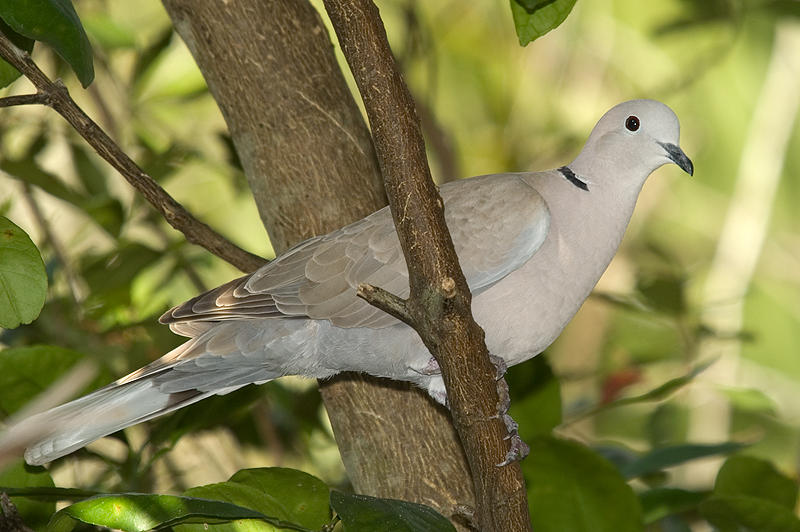
Eurasian Collared Dove (Streptopelia decaocto) by Reinier

Eurasian Collared Dove (Streptopelia decaocto) by Reinier

And it came to pass in those days that a decree went out from Caesar Augustus that all the world should be registered. This census first took place while Quirinius was governing Syria. So all went to be registered, everyone to his own city. Joseph also went up from Galilee, out of the city of Nazareth, into Judea, to the city of David, which is called Bethlehem, because he was of the house and lineage of David, to be registered with Mary, his betrothed wife, who was with child. So it was, that while they were there, the days were completed for her to be delivered. And she brought forth her firstborn Son, and wrapped Him in swaddling cloths, and laid Him in a manger, because there was no room for them in the inn. (Luke 2:1-7 NKJV)

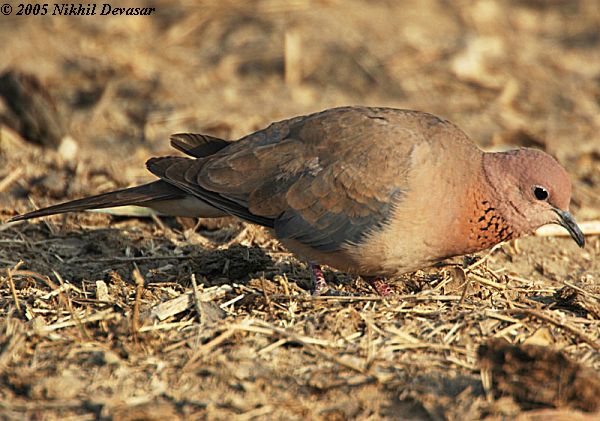
Laughing Dove (Stigmatopelia senegalensis) by Nikhil

Laughing Dove (Stigmatopelia senegalensis) by Nikhil

Most Christians know the passage in Luke 2 about the birth of our Savior, the Lord Jesus Christ. Many others have heard that passage read each Christmas. The birth of Jesus, who was born to die. “Although our first picture of Jesus is as a baby in a manger, it must not be our last. The Christ child in the manger is the subject of a beautiful Christmas scene, but we must not leave him there. This tiny, helpless baby lived an amazing life, died for us, ascended to heaven, and will return to earth as King of kings. Christ will rule the world and judge all people according to their decisions about him. Do you still picture Jesus as a baby in a manger—or is he your Lord? Make sure you don’t underestimate Jesus. Let him grow up in your life.” (Life Application Study Bible)

Joseph and Mary were not so poor that they could not afford a room at the end, but “there was no room for them in the inn.” Because of the registrations going on, each had to show up in their own city. According to the Jewish mode of registration the people would be enrolled by tribe, families or clans, and households. “But David occasionally went and returned from Saul to feed his father’s sheep at Bethlehem.” (1 Samuel 17:15 NKJV).

Micah prophesied in Micah 5:2:

But thou, Bethlehem Ephratah, though thou be little among the thousands of Judah, yet out of thee shall he come forth unto me that is to be ruler in Israel; whose goings forth have been from of old, from everlasting.

“This mention of the manger is the basis for the traditional belief that Jesus was born in a stable. Stables were often caves with feeding troughs (mangers) carved into the rock walls. Despite popular Christmas card pictures, the surroundings were dark and dirty. This was not the atmosphere the Jews expected as the birthplace of the Messiah-King. They thought their promised Messiah would be born in royal surroundings. We should not limit God by our expectations. He is at work wherever he is needed in our sin-darkened and dirty world.” (Life Application Study Bible)

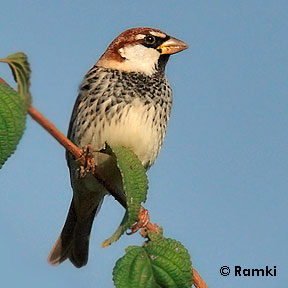
Spanish Sparrow (Passer hispaniolensis) by Nikhil Devasar

Spanish Sparrow (Passer hispaniolensis) by Nikhil Devasar

All of the above was to set the location for the manger and why in my imagination, I believe birds would have been around the manger. There are no verses in the Bible to show there were birds there, nor are there any to show that lambs, cows, or horse were there either, as depicted in our Christmas scenes. So, here is what birds I think may have been there at Jesus’ birth.

Doves – “You who dwell in Moab, Leave the cities and dwell in the rock, And be like the dove which makes her nest In the sides of the cave’s mouth.” (Jeremiah 48:28 NKJV)

Turtledoves – The flowers appear on the earth; The time of singing has come, And the voice of the turtledove Is heard in our land.” (Song of Solomon 2:12 NKJV)

Sparrows and Swallows- “How lovely is Your tabernacle, O LORD of hosts! My soul longs, yes, even faints For the courts of the LORD; My heart and my flesh cry out for the living God. Even the sparrow has found a home, And the swallow a nest for herself, Where she may lay her young— Even Your altars, O LORD of hosts, My King and my God.” (Psalms 84:1-3 NKJV) If they wanted to be at the altars or house of God, then surely, they wanted to be near their Creator.

Chickens and Roosters by Maji

Chickens and Roosters by Maji

Chickens and Roosters – “O Jerusalem, Jerusalem, the one who kills the prophets and stones those who are sent to her! How often I wanted to gather your children together, as a hen gathers her chicks under her wings, but you were not willing! (Matthew 23:37 NKJV) and Jesus said to him, “Assuredly, I say to you that this night, before the rooster crows, you will deny Me three times.” (Matthew 26:34 NKJV) Cave or Stable, there had to be Chickens, Hens, and Roosters.

Ravens – Who provides food for the raven, When its young ones cry to God, And wander about for lack of food? (Job 38:41 NKJV) They wanted to be near the One who has been feeding them.

Brown-necked Raven of Israel

Brown-necked Raven, Israel

I would think, in my “sanctified imagination,” that since the Lord created everything, birds included, that they might have been eager to see their Creator. Many humans failed to recognize Him while He was on earth, but I think the critters knew who He was. For example, the un-ridden donkey the Lord rode on. There is no report of it trying to buck or misbehave. It knew!

There are more kinds of birds that might have been there, but I will leave those to your imagination. Have a Merry Christmas as you consider the true meaning of the Lord’s birth.


Produced by Sean Fielder and our Pastor Nate Osborne.

*

Christmas Birds – Ornaments

Here are the last of the Christmas Birds. The colors and designs would be pretty in ornaments. But most of all, they are superb examples of the Lord’s omniscient creative designs.

He was in the world, and the world was made by him, and the world knew him not. He came unto his own, and his own received him not. But as many as received him, to them gave he power to become the sons of God, even to them that believe on his name:.. And the Word was made flesh, and dwelt among us, (and we beheld his glory, the glory as of the only begotten of the Father,) full of grace and truth. (John 1:10-12, 14 KJV)

*

This slideshow requires JavaScript.

*

Merry Christmas 2009

I’ve dusted off last years Christmas post and updated it some. But the message is still the same and I wanted to present our pastor’s illustration at the Cantata ’08. It has a very good message.

Christmas of 2009 is here and those of us at Lee’s Birdwatching Adventures; Lee, Dan, and Val, April, and Karen would like to wish you a very Merry Christmas. We are busy doing things for the special day when we celebrate the birth of the Lord Jesus Christ. Val has still been busy cooking and baking, not to mention shoveling snow out there in Idaho. We are enjoying the warmth of Florida, but are busy, none the less (but not shoveling snow!). We are off to Tampa to visit relatives again this year and try not to eat “too” much. We hope your Christmas Day is just as enjoyable as ours will be.

During all the festivities, pause to reflect on the true meaning of Christmas. We enjoy our birdwatching adventures throughout the year, and try to write and photograph our friends the birds, but our goal is to show God’s magnificent creation and point you to Him. We do not worship nature, but we do worship the Lord who created it all.

Please watch the video of my pastor, Nathan Osborne, III, as he gave an excellent illustration about birds out in the cold and snow. It helps to explain the true meaning of Christmas. (Part of our Christmas cantata, “From the Manger to the Cross”)

Christmas Birds – Red and Green

Here is the third Christmas Birds slideshow. While searching the photos for the Red Birds and the Green Birds, I kept coming across birds that were Red and Green. Here are some more of the neat birds that the Creator gave us to enjoy. Trust you are enjoying seeing the birds by their colors. It has been enjoyable for me to look through all the great photos the photographers we use here have provided. I have one more Christmas Birds to show you, but you will have to wait until tomorrow.

And suddenly there was with the angel a multitude of the heavenly host praising God, and saying, Glory to God in the highest, and on earth peace, good will toward men. (Luke 2:13-14 KJV)

*

This slideshow requires JavaScript.

*

Birdwatching in Polk County – December 2009

Wood Duck by Dan at Lake Hollingsworth

Wood Duck by Dan at Lake Hollingsworth by Dan

What an interesting list of birds have been seen and counted here in Polk County, FL the last few days. On Saturday, the 19th, the Christmas Bird count was done on a windy day. According to the Ledger (our local newspaper), the count was low for some birds like tree swallows. Only 3 were spotted, yet in Louisiana, a migrating flock of about 5 million was reported. The Annual Christmas Bird Count has been going on around the country for 110 years.

This years total bird count for our county was 123 species. Last year there were 132 species counted. Some of the missing species this year “included horned grebe, brown thrasher, Baltimore Oriole, Ovenbird, Northern Flicker and the Field and White-crowned Sparrows.” They did have some good finds, like 7,000 White Pelicans (mostly out at our favorite place, Circle B Bar Reserve), “111 Bald Eagles, 55 Brown Pelicans, 21 Wild Turkeys (Dan and I saw 10 along the road Sunday), 21 Roseate Spoonbills, and 167 Black-bellied Whistling Ducks.” They were surprised to find Buffleheads and Canvasbacks, 6 Ruby-throated Hummers, 4 Western Kingbirds and 8 Common Loons. As you can see, birding is great here this time of the year. Those of you up North get to have these birds in the summer, but we love it when they come down here for their “winter vacation.”

Yea, the stork in the heaven knoweth her appointed times; and the turtle and the crane and the swallow observe the time of their coming; but my people know not the judgment of the LORD. (Jeremiah 8:7 KJV)

Also, today, Cole Fredricks posted on the state listing service “BRDBRAIN” a list of birds he spotted yesterday (12/20) at the Circle B. He has 69 species that he saw there. Makes me want to grab the binoculars and the camera and head out there SOON! He even has photos of a possible White-faced Ibis, which is very rare here.  Here is what he listed:

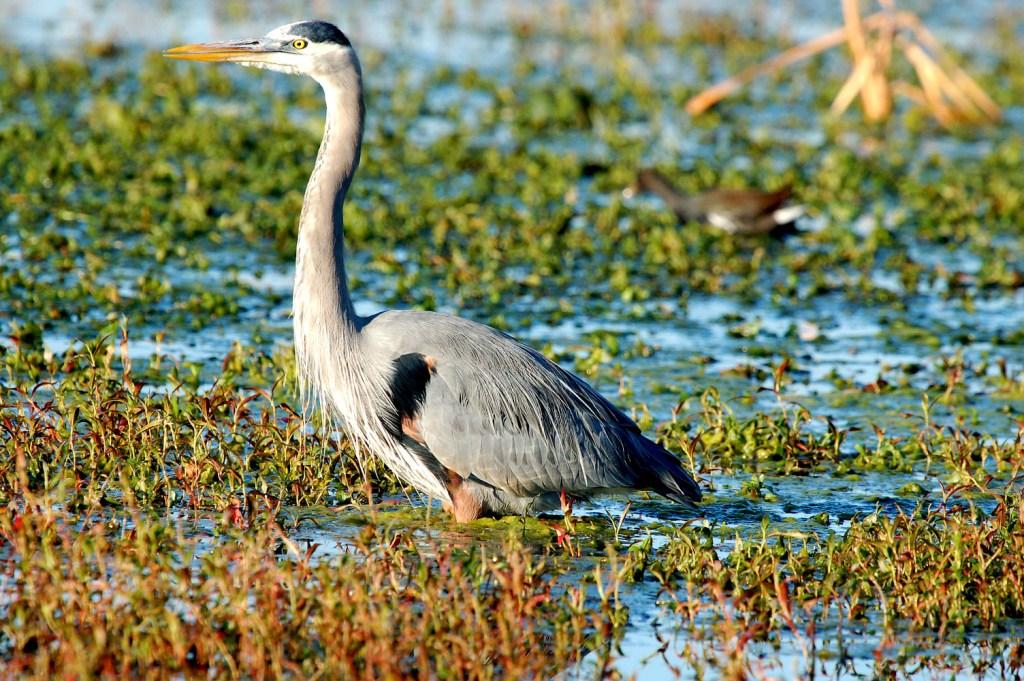
Great Blue Heron at Circle B Bar Reserve

Great Blue Heron at Circle B Bar Reserve

Location: Circle B Bar Ranch (Reserve)
Observation date: 12/20/09
Number of species: 69

Black-bellied Whistling-Duck – 80
Gadwall – 2
Mottled Duck – 8
Blue-winged Teal – 22
Northern Shoveler – 13
Ring-necked Duck – 20
Lesser Scaup – 1
Pied-billed Grebe – 20
American White Pelican – 700
Brown Pelican – 1

Wilson's Snipe at Circle B by Dan

Double-crested Cormorant – 110
Anhinga – 22
American Bittern – 1
Great Blue Heron – 25
Great Egret – 60
Snowy Egret – 1
Little Blue Heron – 8
Tricolored Heron – 7
Cattle Egret – 12
Green Heron – 1
Black-crowned Night-Heron – 4
White Ibis – 205
Glossy Ibis – 15
White-faced Ibis – 1
Roseate Spoonbill – 3

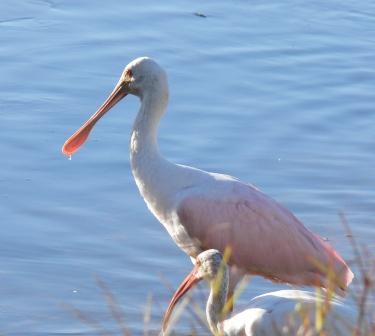
Roseate Spoonbill at Circle B

Roseate Spoonbill at Circle B

Wood Stork – 110
Black Vulture – 10
Turkey Vulture – 25
Osprey – 5
Bald Eagle – 4
Northern Harrier – 1
Red-shouldered Hawk – 4
American Kestrel – 1
Common Moorhen – 55
American Coot – 330
Limpkin – 6
Sandhill Crane – 10
Killdeer – 3
Wilson’s Snipe – 1
Laughing Gull – 25
Ring-billed Gull – 5
Caspian Tern – 21
Mourning Dove – 2

Sandhill Crane at Cirle B by Tommy Tompkins

Belted Kingfisher – 4
Red-headed Woodpecker – 1
Red-bellied Woodpecker – 7
Yellow-bellied Sapsucker – 1
Pileated Woodpecker – 1
Eastern Phoebe – 8
White-eyed Vireo – 1
Blue-headed Vireo – 1
Blue Jay – 2
Fish Crow –  2
Carolina Wren – 1
House Wren – 2
Ruby-crowned Kinglet – 1
Blue-gray Gnatcatcher – 35
American Robin – 2

White Pelicans in Flight - Circle B Bar by Dan

White Pelicans in Flight - Circle B Bar

Northern Mockingbird – 2
Yellow-rumped Warbler – 5
Pine Warbler – 3
Palm Warbler – 15
Black-and-white Warbler – 1
Common Yellowthroat – 2
Savannah Sparrow – 3
Swamp Sparrow – 2
Red-winged Blackbird – 50
Eastern Meadowlark – 4
Boat-tailed Grackle – 5

What surprised me out of the lists, no one mentioned all the 100+ Brown-headed Cowbirds in my yard everyday for the last week or so. Since we are only about 3 miles from the Circle B, as the “bird flies,” surely some of them must be there. Then again, the way they are eating up my seed, I may have the whole Polk County Cowbird population feeding here. Dan and I were birding last week at Lake Hollingsworth and Lake Morton. We saw (not on the above lists) 3 Wood Ducks, Mallards, 50+ Ring-necked Ducks, 80+ Ruddy Ducks, and Double-crested Cormorants swimming with the 15-20 White Pelicans.

Christmas Birds – Green

This is the second set of Christmas Birds. This time the Green Birds are featured. Hope you enjoyed the Christmas Birds – Red.

Again the Lord created these birds and colored them for their protection and to show off to their mates. There are many more that could be shown, but time is short this week.

Have you not known? Have you not heard? The everlasting God, the LORD, The Creator of the ends of the earth, Neither faints nor is weary. His understanding is unsearchable. (Isaiah 40:28 NKJV)

*

This slideshow requires JavaScript.

*

Ian’s Bird of the Week – Frill-necked Monarch

Frill-necked Monarch (Arses lorealis) by Ian

Frill-necked Monarch (Arses lorealis) by Ian

Newsletter – 12/16/2009

Frill-necked Monarch (Arses lorealis) by Ian

Frill-necked Monarch (Arses lorealis) by Ian

On our recent trip to Cape York Peninsula, we came across several Frill(-neck)ed Monarchs in the Lockhart River – Iron Range district. This is quite similar to the Pied Monarch of the wet tropics of northeastern Queensland, but lacks the black breast band and has a more extensive frill and broader blue eye-rings. I’ve qualified the name as the original Frilled Monarch of northern Cape York Peninsula, Torres Strait and Papua New Guinea (Arses telescopthalmus) has recently been split into the Frilled Monarch of Torres Strait and PNG and the new Frill-necked Monarch (Arses lorealis) of northern Cape York Peninsula.

The bird in the first photo is a male, distinguishable by having black lores and a black bib, or maybe goatee would be more appropriate. It’s doing something with either the white honeydew on the flower stalk or the insects (aphids or scale insects) responsible for the honeydew. More about the ‘something’ in a moment.

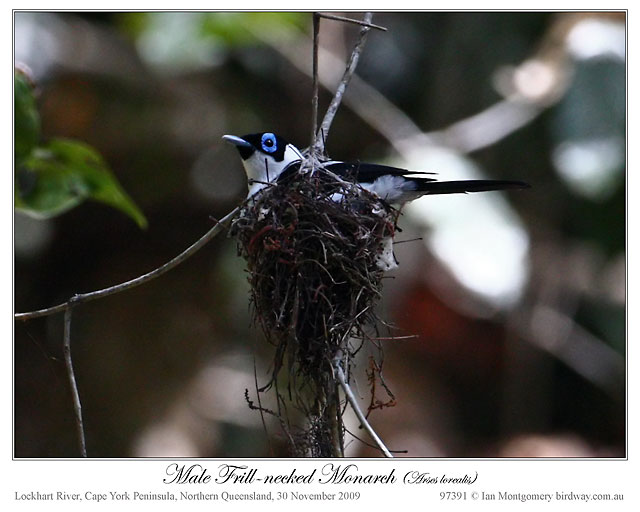
Earlier the same day, another Frill-necked Monarch carrying nesting material revealed the location of her nest, hanging, hammock- or swing-like, from a long vine over a creek, a typical location thought to discourage predation by animals such as arboreal snakes. This bird stayed in the nest for a few minutes, left and then, I thought, returned. It was only later, when examining the photos that it I realised that the second bird was her mate. If you look carefully, you can see the white chin (and maybe the pale lores) of the female in the second photo and the black goatee and lores of the male in the third photo.

Frill-necked Monarch

Frill-necked Monarch

The fourth photo was intended to show how precariously the nest was built at the end of at least 3 metres of vine, and, again, it was only later that I noticed that one branch of the vine was broken (in the centre of the photo). It’s still attached above the nest to the other strand of the vine and I wondered whether this attachment was serendipitous or had been done as a repair by the birds. Monarchs are supposed to use cobwebs to glue their nests together. I then wondered whether the bird in the first photograph was feeding on the aphids/scale insects, feeding on the honeydew (as some birds do such as the New Zealand Honeyeater the Tui) or collecting the honeydew as glue – it’s very sticky – for nest construction.

Back at the website, I’ve added photos of:
the Cape York race of the Masked Finch
the northern race of the Black-throated Finch
Wandering Whistling-Duck
White-bellied Sea-Eagle being fed on garfish by the Ferryman at Karumba
Golden-shouldered Parrot
White-faced Robin
Yellow-legged Flycatcher/Flyrobin
So it’s no wonder I’m late with my Christmas cards yet again!

I wish you all a safe and happy Christmas and best wishes for the New Year,
Ian

Ian Montgomery, Birdway Pty Ltd,
454 Forestry Road, Bluewater, Qld 4818
Phone: +61-7 4751 3115
Preferred Email: ian@birdway.com.au
Website: http://birdway.com.au


Lee’s Addition:

And God blessed them, saying, “Be fruitful and multiply, and fill the waters in the seas, and let birds multiply on the earth. (Genesis 1:22 NKJV)

The Frill-necked Monarch (Arses lorealis) is a species of songbird in the Monarchidae family. It is endemic to the rainforests of the northern Cape York Peninsula. It was considered a subspecies of the related Frilled Monarch (Arses telescophthalmus) for many years before being reclassified as a separate species in 1999.

The Frill-necked Monarch is a member of a group of birds termed monarch flycatchers. This group is considered either as a subfamily Monarchinae, together with the fantails as part of the drongo family Dicruridae, or as a family Monarchidae in its own right. Molecular research in the late 1980s and early 1990s revealed the monarchs belong to a large group of mainly Australasian birds known as the Corvida parvorder comprising many tropical and Australian passerines. More recently, the grouping has been refined somewhat as the monarchs have been classified in a ‘Core corvine’ group with the crows and ravens, shrikes, birds of paradise, fantails, drongos and mudnest builders.

Alternative common names include Australian Frilled Monarch, and White-lored Flycatcher.

The Frill-necked Monarch measures around 14 cm (5.5 in) in length, and the neck feathers can become erect into a small frill; the male is predominantly black and white, and can be distinguished from the similar and more common Pied Monarch by its all-white breast-the latter species having a broad black breast band. The throat, nape, shoulders, and rump are white while the wings and head are black. It has a eye-ring of bare skin, and a bright blue wattle. The bill is pale blue-grey and the eyes are dark. The female is similar but lacks the eye-ring and has white lores and a brownish tinged chest.

Breeding season is November to February with one brood raised. The nest is a shallow cup made of vines and sticks, woven together with spider webs and shredded plant material, and decorated with lichen. It is generally sited on a hanging loop of vine well away from the trunk or foliage of a sizeable tree about 2–10 metres (6.6–33 ft) above the ground. Two pink-tinged oval white eggs splotched with lavender and reddish-brown are laid measuring 19 mm x 14 mm.

Video of a Frilled Monarch (Arses telescopthalmus) by Keith.

Error
This video doesn’t exist

Christmas Birds – Red

Now that Christmas is less than a week away, it’s time to see some of the birds that have “traditional” Christmas colors. Today’s color will be birds that have some sort of red on them. Plans are for other colors to be shown during the week. When the Lord created the birds (fowls), He used many different colors, most for the protection of the bird (to blend in) or for display to attract a mate (to stand out).

We trust you enjoy the photos and that you are blessed as you consider the bird’s Creator, Who came to earth as a babe in a manger, so that He might redeem us from our sin. “All things were made through him, and without him was not any thing made that was made. (John 1:3)

But made himself of no reputation, and took upon him the form of a servant, and was made in the likeness of men: And being found in fashion as a man, he humbled himself, and became obedient unto death, even the death of the cross. (Philippians 2:7-8 KJV)

*

This slideshow requires JavaScript.

*