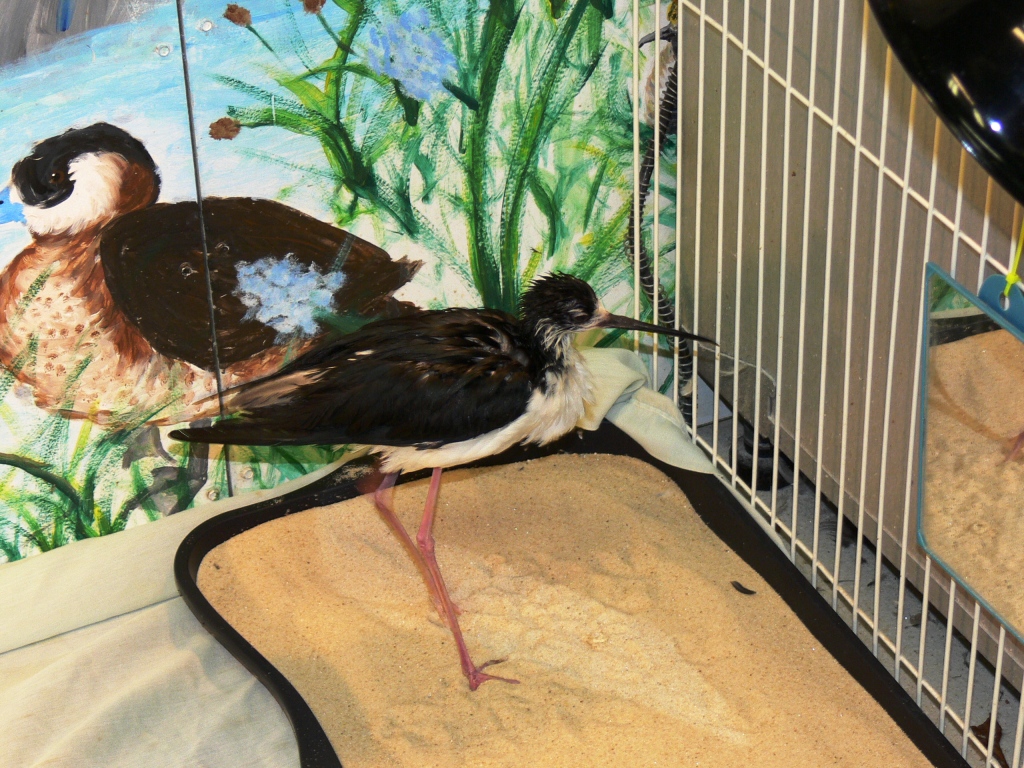
Happy Birthday – Skippy at National Aviary

Black-necked Stilt - Skippy

"Skippy" - Black-necked Stilt

Today is the 23rd birthday of “Skippy” the Black-necked Stilt. We met him on Friday at the National Aviary in Pittsburg, PA. Dan and I had the privilege of visiting  the National Aviary recently and thoroughly enjoyed our two days we spent there. “Skippy” is not on exhibit, but is behind the scenes and well taken care of by the hospital staff.

We were given some very special treatment at the Aviary and were allowed to see several of their “behind-the-scenes” operations. The hospital, breeding room, kitchen, an outdoor exhibit (closed right now) and other places were shown. I am thankful for meeting the “bird nurse” the day before our visit at a book store. I was looking at the bird books (of course) when I met Sarah. Long story short, she told us that she would show us around and did she ever. This is just the first of the articles to be written about the Aviary.

National Aviary Hospital Sign

National Aviary Hospital

We were in the Hospital section where the older birds are kept. These are ones who have been active in shows or have just been there a long time and are sort of in their “geriatric” stage of life. The birds there are kept comfortable and their health is maintained as well as can be. They are all very special and each had a story attached to them. I sort of felt right a home in there, since I have my fair share of aches and pains as I age.

We met “Skippy” who is kept in an area that has a fence (around it to create a pen). I may not get all the details right (I’m getting old, remember), but when his life long mate died, he wanted to give up and was very sad. That caused his health to deteriorate and he ended up in the “hospital.”  In memory of his sweetheart, they had painted a mural on the wall. One day he discovered the painting of his mate and parked right there beside it. His health started improving. They decided to put a fence around that area and that is where we found him the other day.

Today is Skippy’s birthday and he turns 23. HAPPY BIRTHDAY, SKIPPY! He is one of the longest known living Black-necked Stilts. The photo shows him beside the painting of his mate and a part of his pen. There is a mirror hanging there which he love to look in.
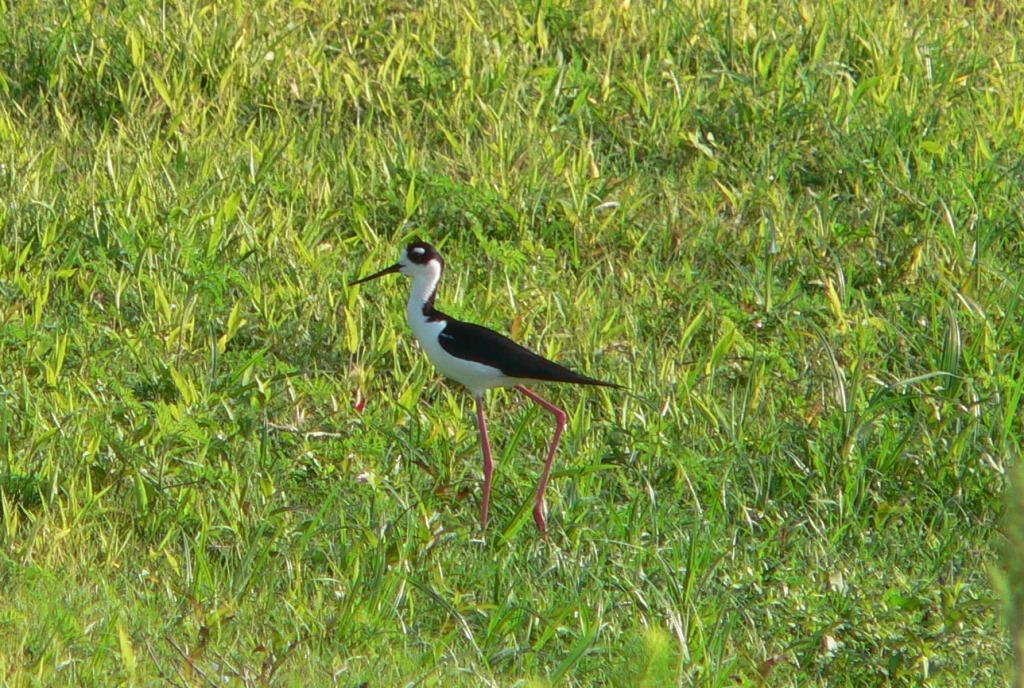
Black-necked Stilt at Circle B Bar Reserve

Black-necked Stilt at Circle B Bar Reserve by Lee

Black-necked Stilts (Himantopus mexicanus) are in Recurvirostridae Family which includes Avocets and Stilts. There are only 11 species in the family. They are in the Charadriiformes Order. This Stilt is a locally abundant shorebird of American wetlands and coastlines. We see them quite frequently around our area. I saw my first one in 2000 in the Rockport, TX.

“Adults have long pink legs and a long thin black bill. They are white below and have black wings and backs. The tail is white with some grey banding. A continuous area of black extends from the back along the hindneck to the head. There, it forms a cap covering the entire head from the top to just below eye-level, with the exception of the areas surrounding the bill and a small white spot above the eye. Males have a greenish gloss to the back and wings, particularly in the breeding season. This is less pronounced or absent in females, which have a brown tinge to these areas instead. Otherwise, the sexes look alike. (From Wikipedia)

They usually have 3-5 young and both of them take turn incubating the eggs for 22-26 days. The young can be swimming within 2 hours of birth. Check out the Aviary’s webpage on the Black-necked Stilt for more information about it.

Who teacheth us more than the beasts of the earth, and maketh us wiser than the fowls of heaven? (Job 35:11)

Is it wrong to be sad when someone dies? I think Skippy was only showing his love and concern for the bird he had spent so much time with.

When Jesus therefore saw her weeping, and the Jews also weeping which came with her, he groaned in the spirit, and was troubled, And said, Where have ye laid him (Lazarus)? They said unto him, Lord, come and see. Jesus wept. Then said the Jews, Behold how he loved him! (John11:33-36)
Birds in Hymns – Thou Sweet, Beloved Will Of God

And be not conformed to this world: but be ye transformed by the renewing of your mind, that ye may prove what is that good, and acceptable, and perfect, will of God. (Romans 12:2 KJV)

Words: Ger­hard Ter­steeg­en, Geist­lich­es Blum­en-Gärt­lein, first edi­tion, 1729, Book III, number 19 (Lieb­wer­ther, süss­er Gott­es-Wille); trans­lat­ed from Ger­man to Eng­lish by Em­ma Be­van, 1858.

Music: Holl­ey, George Hews, 1835 .
Al­ter­nate tune: •Abends, Her­bert S. Oak­e­ley, 1874

This is the Abends tune by Oakeley

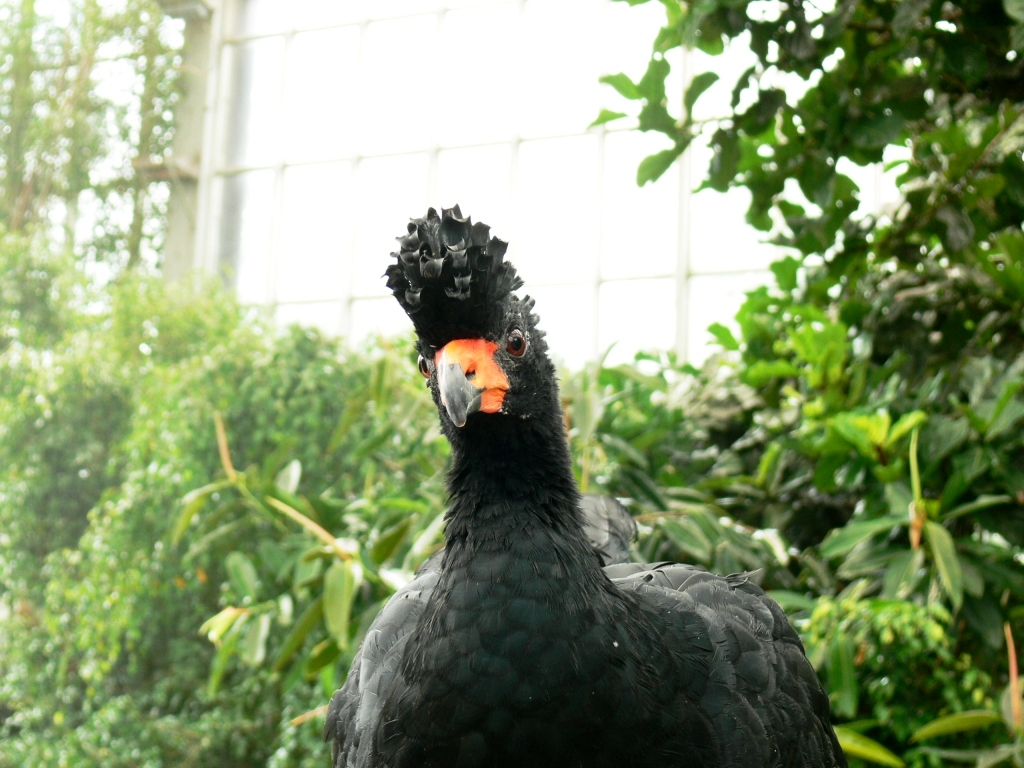
Wattled Curassow (Crax globulosa) at National Aviary by Lee

Wattled Curassow (Crax globulosa) at National Aviary by Lee

Thou sweet, belovèd will of God,
My anchor ground, my fortress hill,
My spirit’s silent, fair abode,
In thee I hide me and am still.

O Will, that willest good alone,
Lead thou the way, thou guidest best;
A little child, I follow on,
And, trusting, lean upon thy breast.

Thy beautiful, sweet will, my God,
Holds fast in its sublime embrace
My captive will, a gladsome bird,
Prisoned in such a realm of grace.

Within this place of certain good,
Love evermore expands her wings,
Or, nestling in thy perfect choice,
Abides content with what it brings.

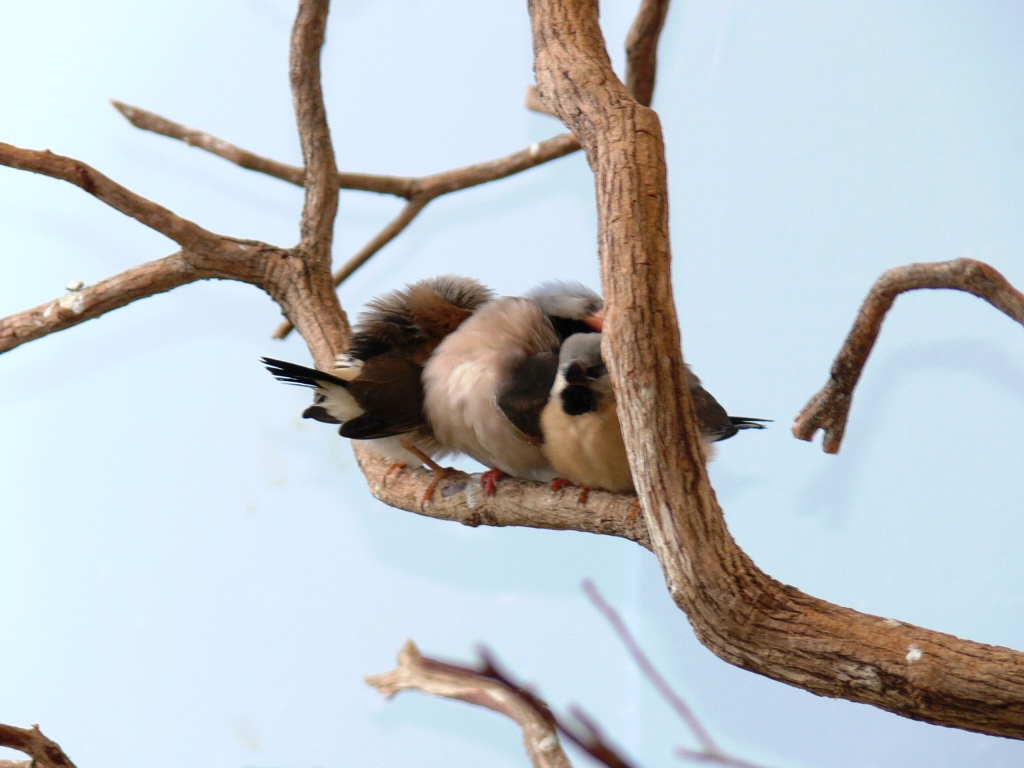
Long-tailed Finch (Poephila acuticauda) babies by Lee at National Aviary

Long-tailed Finch (Poephila acuticauda) (Spike-tailed) babies by Lee at National Aviary

O lightest burden, sweetest yoke!
It lifts, it bears my happy soul,
It giveth wings to this poor heart,
My freedom is thy grand control.

Upon God’s will I lay me down,
As child upon its mother’s breast;
No silken couch, nor softest bed,
Could ever give me such deep rest.

Thy wonderful grand will, my God,
With triumph now I make it mine;
And faith shall cry a joyous Yes!
To every dear command of thine.

Most information from The Cyber Hymnal

See ~ Wordless Birds

More ~ Birds in Hymns

I chose the Wattled Curassow because when we encountered the bird at the National Aviary, it seemed very glad, especially at feeding time. It practically got in my face. The Long-tailed (Spike-tailed) Finches are fairly young.

*

Birds of the Bible – Two Eagles in a Parable

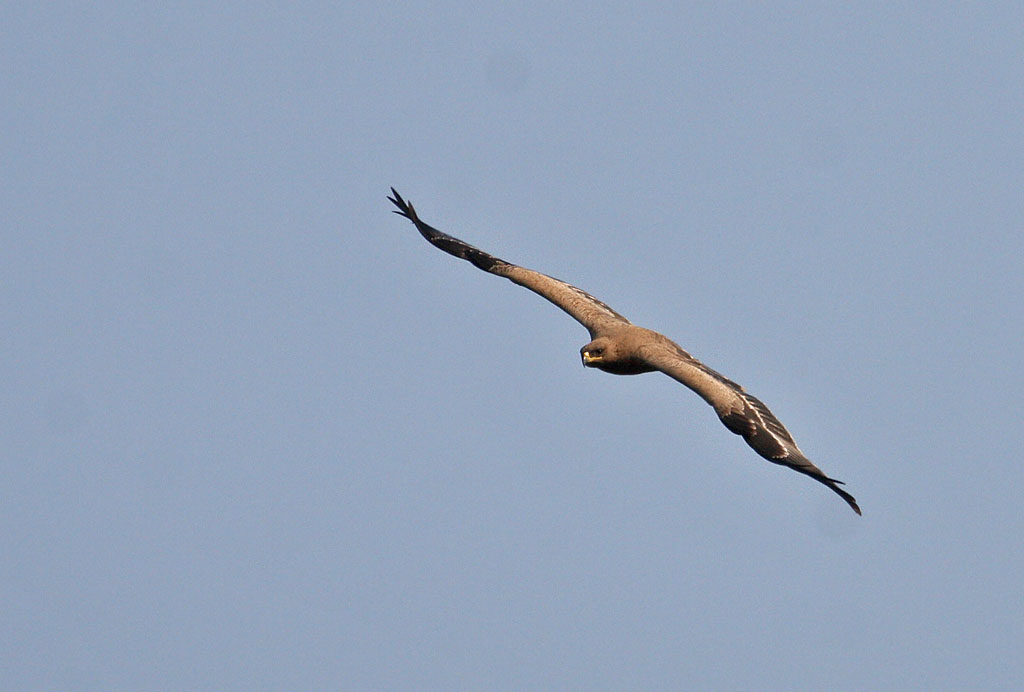
Steppe Eagle (Aquila nipalensis) by Peter Ericsson

Steppe Eagle (Aquila nipalensis) by Peter Ericsson

And the word of the LORD came unto me, saying, Son of man, put forth a riddle, and speak a parable unto the house of Israel; (Ezekiel 17:1-2 KJV)

The Lord God has given the prophet Ezekiel a parable to give to Israel. The parable is in Ezekiel 17:1-10 and it is in here that we find reference to two different eagles.

“The riddle is not the prophet’s, nor the parable his, but the Lord God’s; and exceeding beautiful and apt it is, to signify the things designed by it; the wisdom of God is greatly displayed in it:” (John Gill’s Exposition of the Entire Bible)

And say, Thus saith the Lord GOD; A great eagle with great wings, longwinged, full of feathers, which had divers colours, came unto Lebanon, and took the highest branch of the cedar: (Ezekiel 17:3 KJV)

John Gill says about this first Eagle:

a great eagle; which is Nebuchadnezzar king of Babylon, as it is explained, Eze_17:12; who is compared to an eagle for his power and authority, that being the king of birds, and for his swiftness and voracity in conquering and subduing kingdoms; see Jer_48:40;

with great wings
; so the Babylonish monarchy is signified by a lion with eagle’s wings, Dan_7:4; and the two parts of the Roman empire, into which it was divided at the death of Theodosius, are called two wings of a great eagle, Rev_12:14; and so here it may denote the large kingdoms and provinces which belonged to the Babylonian monarchy; see Est_1:1;

longwinged; or having a “long member” (m); meaning the body of the wing, which was long; and so, as the wings spread, may signify the breadth of his dominion, this the length of them, and both their extensiveness:

full of feathers
; of cities, towns, people, armies, wealth, and riches:

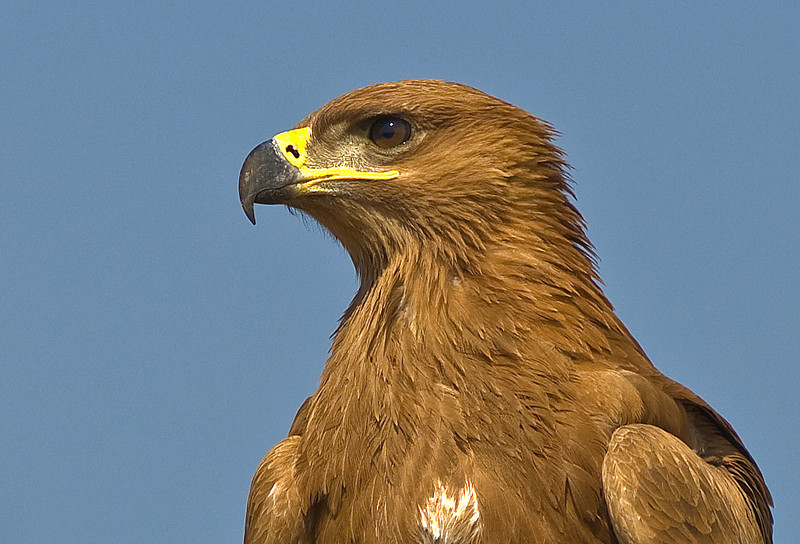
Steppe Eagle (Aquila nipalensis) by Nikhil Devasar

Steppe Eagle (Aquila nipalensis) by Nikhil Devasar

which had divers colours; or an “embroidery” (n); like that of the weaver, only needle work, consisting of various colours; and so it alludes to such eagles as are called the golden eagle, and “asterias”, from their golden colour, and their being spotted like stars, and which are said to be of the largest size, as Bochart, from Aelianus (o), observes; and may signify people of divers languages, customs, manners, and circumstances, subject to the government of the king of Babylon:

came unto Lebanon; the northern border of the land of Judea, and invaded it; where were the mountain and forest of Lebanon, famous for the cedars that grew there, from whence the whole land may here take its name, as being more apt for the allegory used: or the city of Jerusalem, where were the temple built of the cedars of Lebanon, as many of its palaces and houses also were; whither the king of Babylon came, and took it, and who came northward, as Babylon was:

and took the highest branch of the cedar; by the “cedar” is meant, either the nation in general, or the royal family in particular; and by the “highest branch” the then reigning king, Jeconiah with the princes and nobles of the land, who were taken and carried captive by Nebuchadnezzar; see 2Ki_24:14.

Adam Clarke’s Commentary on The Bible summarizes the first eagle:

  • A great eagle – Nebuchadnezzar. See Jer_48:40; Jer_49:22; Dan_7:4. And see here, Dan_7:12, where it is so applied.
  • Great wings – Extensive empire.
  • Long-winged – Rapid in his conquests.
  • Full of feathers – Having multitudes of subjects.
  • Divers colors – People of various nations.
  • Came unto Lebanon – Came against Judea.
  • The highest branch – King Jehoiachin he took captive to Babylon.
  • The cedar – The Jewish state and king.

There was also another great eagle with great wings and many feathers: and, behold, this vine did bend her roots toward him, and shot forth her branches toward him, that he might water it by the furrows of her plantation. (Ezekiel 17:7 KJV)

John Gill says of the second eagle:
Eze 17:7  There was also another great eagle,…. Hophra king of Egypt, a very powerful prince, whom Herodotus (u) calls Apries; and says he was the most happy and fortunate, after Psammitichus, of all the kings that were before; though not so mighty as the king of Babylon; therefore all the same things are not said of the one as of the other:

Tawny Eagle by Africaddict

Tawny Eagle by Africaddict

with great wings and many feathers: had large dominions, but not go extensive as the former, and therefore is not said to be “longwinged” as he; and had “many feathers”, but not “full” of them, nor had it such a variety; he had many people, and much wealth, and a large army, but not equal to the king of Babylon:

and, behold, this vine did bend her roots towards him; Zedekiah, and the people of the Jews under him; inclined to an alliance with the king of Egypt, and gave him some private intimations of it:

and shot forth her branches towards him; sent ambassadors to acquaint him with it, Eze_17:15;

that he might water it by the furrows of her plantation; Nebuchadnezzar had planted this vine, and made furrows for the watering of it, and by his means it was become prosperous and flourishing; but Zedekiah, not content with the greatness and glory he had raised him to, sought to the king of Egypt to help him with horses and people, in order to free himself from subjection to the king of Babylon, and to increase his lustre and glory: the allusion is thought to be to the trenches and canals of the river Nile, by which the land of Egypt was watered: the words may be rendered, “out of the rivulets of her plantation” (w) which best agrees with watering.

Adam Clarke’s Commentary on The Bible about the second eagle Ezekiel 17:7

  • Another great eagle – Pharaoh-hophra, or Apries, king of Egypt.
  • With great wings – Extensive dominion.
  • And many feathers – Numerous subjects.
  • Did bend her roots – Looked to him for support in her intended rebellion against Nebuchadnezzar.

This chapter in Ezekiel has a lot in it and I was mainly bringing out the two eagles presented in the parable. A short explanation of this chapter by John Gill follows:

INTRODUCTION TO EZEKIEL 17 – Under the simile of two eagles and a vine are represented the kings of Babylon and Egypt, and the condition of the Jews, who are threatened with ruin for their perfidy; and yet a promise is made of the raising up of the house of Judah, and family of David, in the Messiah. The prophet is bid to deliver a riddle or parable to the house of Israel, Eze_17:1. The riddle or parable is concerning two eagles and a vine, which is delivered, Eze_17:3; and the explanation of it is in Eze_17:11; and then the destruction of the Jews is threatened for their treachery to the king of Babylon, Eze_17:16; and the chapter is closed with a promise of the Messiah, and the prosperity of his kingdom, Eze_17:22.

Looking unto Jesus the author and finisher of our faith; who for the joy that was set before him endured the cross, despising the shame, and is set down at the right hand of the throne of God. (Hebrews 12:2 KJV)


See also:
Birds of the Bible – Eagles
Birds of the Bible – Eagles II
Birds of the Bible – Eagles III
Birds of the Bible – Hair Like Eagles
Eagles

*

Birds in Hymns – Let There Be Light!

And God said, Let there be light: and there was light. (Genesis 1:3 KJV)

Thou, Whose Almighty Word (or sometimes called – Let There Be Light!)
Author: John Marriott, 1780-1825
Musician: Joan J. Pinkston, b. 1947

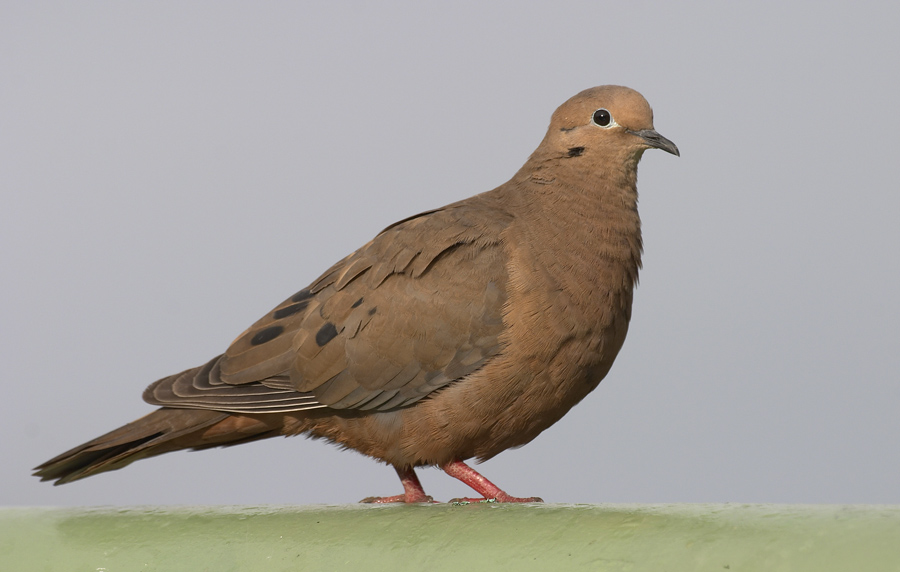
Eared Dove (Zenaida auriculata)  by Robert Scanlon

Eared Dove (Zenaida auriculata) by Robert Scanlon

The Rev. John Marriott was a clergyman of the English Church, a graduate of Rugby, and of Christ Church, Oxford. He took high honors in college, and was then engaged as private tutor by the Duke of Buccleuch, who after two years presented him with the living of Church Lawford, Warwickshire. This he kept to the end of his life. He wrote but three hymns, of which only one is in use. But this one belongs in the first rank, and entitles him to a place among the great hymn-writers:

‘Let there be light!'”

This hymn will richly repay careful study. It is founded on Genesis i. 3, but with a very fine and suggestive reference to the three persons of the Trinity. The Father uttered the original mandate “Let there be light”; the Son declared himself to be the “Light of the World”; the Spirit enlightens the soul. The poem is usually classed with the missionary hymns of the church, and very properly so. It is profoundly pervaded with the missionary spirit, not only in its separate expressions, but also in its majestic undertone. Its metaphors are striking—the “chaos” and “darkness” of creation and of heathenism; the “sick in mind”; the “lamp of grace”; the “ocean’s tide” of Wisdom, Love, and Might, and the like. The action is vigorous—”redeeming wing”; “speed forth thy flight”; “rolling in fullest pride.” The survey and sweep are most comprehensive. Above all, the hymn is a broad, beautiful, and blessed evangel.

Thou whose almighty word
Chaos and darkness heard,
And took their flight,
Hear us, we humbly pray,
And where the gospel day
Sheds not its glorious ray,
Let there be light!

Pied Imperial-pigeon (Ducula bicolor) by Kent Nickell

Pied Imperial-pigeon (Ducula bicolor) by Kent Nickell

Thou who didst come to bring
On Thy redeeming wing
Healing and sight,
Health to the sick in mind,
Sight to the inly blind,
Oh, now to all mankind
Let there be light!

Spirit of truth and love,
Lifegiving, holy Dove,
Speed forth Thy flight;

Move on the waters’ face,
Bearing the lamp of grace,
And in earth’s darkest place
Let there be light!

Blessed and Holy Three,
Glorious Trinity,
Wisdom and Might;
Where guilt and sin abound
Let gospel tidings sound,
Till Thy lost sheep be found,
Let there be light!

Information for various internet sources. CyberHymnal, Google Books and Online Hymnal

See ~ Wordless Birds

More ~ Birds in Hymns

*

Birds of the Bible – Turtle Doves

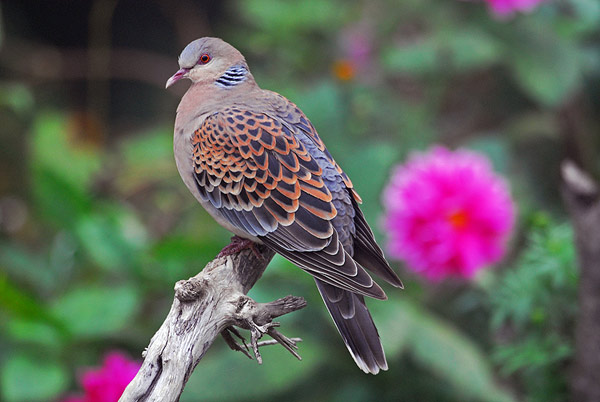
Oriental Turtle Dove (Streptopelia orientalis) by Nikhil

Oriental Turtle Dove (Streptopelia orientalis) by Nikhil

The flowers appear on the earth; the time of the singing of birds is come, and the voice of the turtle is heard in our land; (Song of Solomon 2:12 KJV)

According to the latest list of Turtle Doves by the I.O.C version 2.5 there are only six doves that bear the name “Turtle Dove.” They are in two genus (groups), the Nesoenas and the Streptopelia. That means that they are closely related, but the ornithologist have divided them that way.

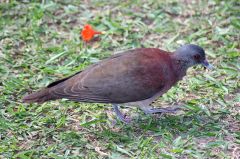
Malagasy Turtle Dove (Nesoenas picturata) ©WikiC

Malagasy Turtle Dove (Nesoenas picturata) ©WikiC

The Malagasy Turtle Dove (Nesoenas picturata) is the only one in the Nesoenas. The Malagasy Turtle-dove (Nesoenas picturata), is also known as the Madagascar Turtle-dove, is a bird species in the pigeon and dove family, Columbidae. It is found in British Indian Ocean Territory, Comoros, Madagascar, Mauritius, Mayotte, Réunion, and Seychelles. Its closest relative a Pink Pigeon together they form a lineage apart from both the typical pigeons (Columba) and the typical turtle-doves (Streptopelia).

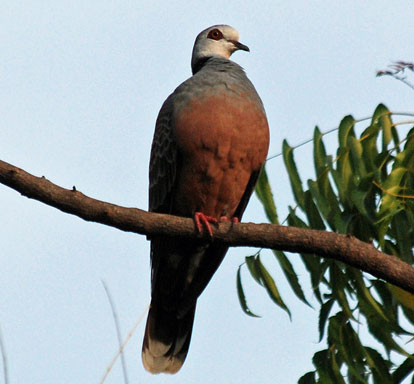
Adamawa Turtle Dove (Streptopelia hypopyrrha) ©WikiC

Adamawa Turtle Dove (Streptopelia hypopyrrha) ©WikiC

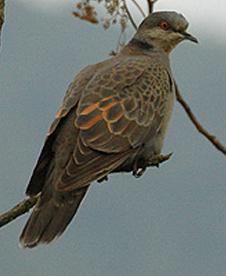
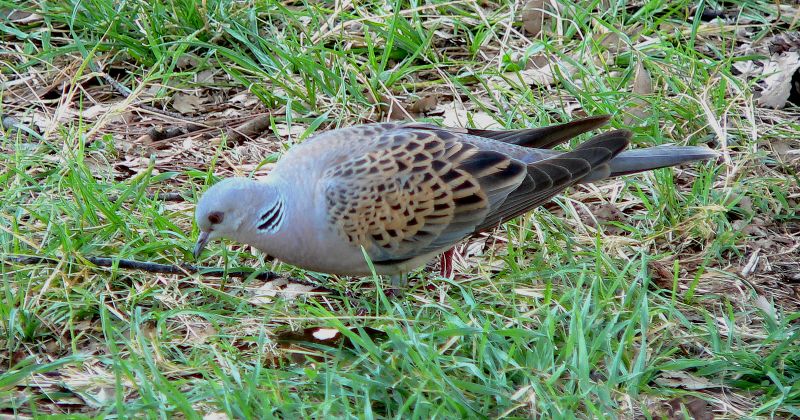
The other five Turtle Doves, the Euopean, Dusky, Adamawa, Oriental, and Red are in the Streptopelia genus. These are mainly slim, small to medium-sized species. The upperparts tend to be pale brown, and the underparts are often a shade of pink. Many have a characteristic black-and-white patch on the neck, and monotonous cooing songs. Mainly in Africa, but several species occur in tropical southern Asia. As a group, this genus is highly successful; many species are abundant in a range of habitats in the tropics, and two now have a much more extensive distribution.

Dusky Turtle Dove (Streptopelia lugens) ©WikiC

Dusky Turtle Dove (Streptopelia lugens) ©WikiC

In Scripture, the Turtle Dove or “turtledove” appears in fifteen verses. Most of those have to do with the turtledove being used as a sacrifice. In Genesis 15:9 the Lord GOD told Abraham to provide one and a pigeon as part of a sacrifice when Abraham was give the covenant of the promised land.

Then in Leviticus a turtledove was used in the burnt offering in Lev. 1:14, two turtledoves for the trespass offering of Lev. 5:7, two for a second burnt offering in Lev. 5:11, for purification after the birth of a child in Lev. 12:6, 8, a sin offering in Lev. 14:22, a sin and a burnt offering in Lev. 14:30, two more offered in Lev. 15:14 and 29.

In Deuteronomy 6:10, two turtledove or pigeons are used for a cleansing.

O deliver not the soul of thy turtledove unto the multitude of the wicked: forget not the congregation of thy poor for ever. (Psalms 74:19 KJV)

European Turtle Dove (Streptopelia turtur) ©WikiC

European Turtle Dove (Streptopelia turtur) ©WikiC

Here is what Albert Barnes Notes on the Bible says about the above verse in Psalms: “Psa 74:19 O deliver not the soul of thy turtle-dove – The “life” of thy turtle-dove; or, thy turtle-dove itself. The turtle-dove is a name of endearment for one beloved, in Son. 2:12, and is thus applied here to the people of Israel. The leading idea in such an application of the word is that of innocence, harmlessness, timidity, gentleness. The thought here is that of a people dear to God, now timid and alarmed. It is the prayer of a people beloved by God that he would not deliver them to their enemies. The prayer may be regarded as one which was used on the occasion referred to in the psalm; or, as a general prayer for the people of God, considered as exposed to ravening enemies.”

John Wesley’s Explanatory Notes says of Song of Son. 2:12 (quoted at top): “The flowers – The communications of God’s grace, the gifts, and graces, and comforts of the Holy Spirit, are vouchsafed unto, and appear in believers, as buds and blossoms do in the spring. The turtle – This seems particularly to be mentioned because it not only gives notice of the spring, but aptly represents the Spirit of God, which even the Chaldee paraphrast understands by this turtle, which appeared in the shape of a dove, and which worketh a dove – like meekness, and chastity, and faithfulness, in believers.”

Jeremiah speaks of the migration of the turtledove.

Yea, the stork in the heaven knoweth her appointed times; and the turtle and the crane and the swallow observe the time of their coming; but my people know not the judgment of the LORD. (Jeremiah 8:7 KJV)

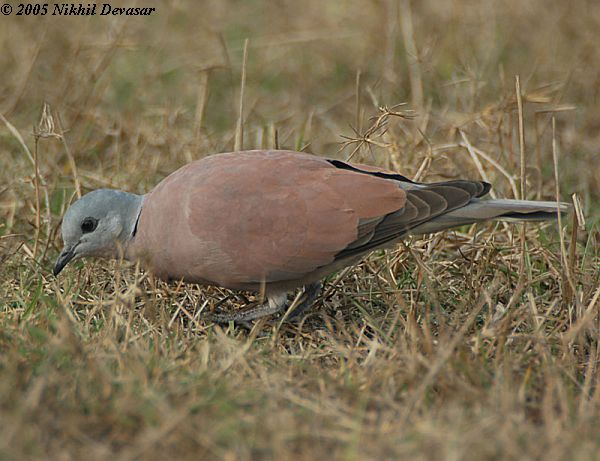
RedTurtle Dove (Streptopelia tranquebarica) by Nikhil Devasar

RedTurtle Dove (Streptopelia tranquebarica) by Nikhil Devasar

Last but not least, Mary offered a pair of turtledove at the end of her purification after Jesus was born. The turtledove are in Luke 2:24, but the whole passage from Luke 2:21-39 is worth reading.

Most of the times, not always, the turtledove or pigeons were use in the sacrifices by someone who could not afford an animal like a lamb or a bullock. I find this very comforting because God did not make salvation only for those who could afford it. In fact, none of us can afford the cost of what took for the purchase of our salvation.

Forasmuch as ye know that ye were not redeemed with corruptible things, as silver and gold, from your vain conversation received by tradition from your fathers; But with the precious blood of Christ, as of a lamb without blemish and without spot: Who verily was foreordained before the foundation of the world, but was manifest in these last times for you, Who by him do believe in God, that raised him up from the dead, and gave him glory; that your faith and hope might be in God. (1 Peter 1:18-21 KJV)

The Gospel Message

(All photos may be clicked on – WikiC = Wiki Commons. Hover mouse over underlined verses.)
*

Birds of the Bible – Honeyguide?

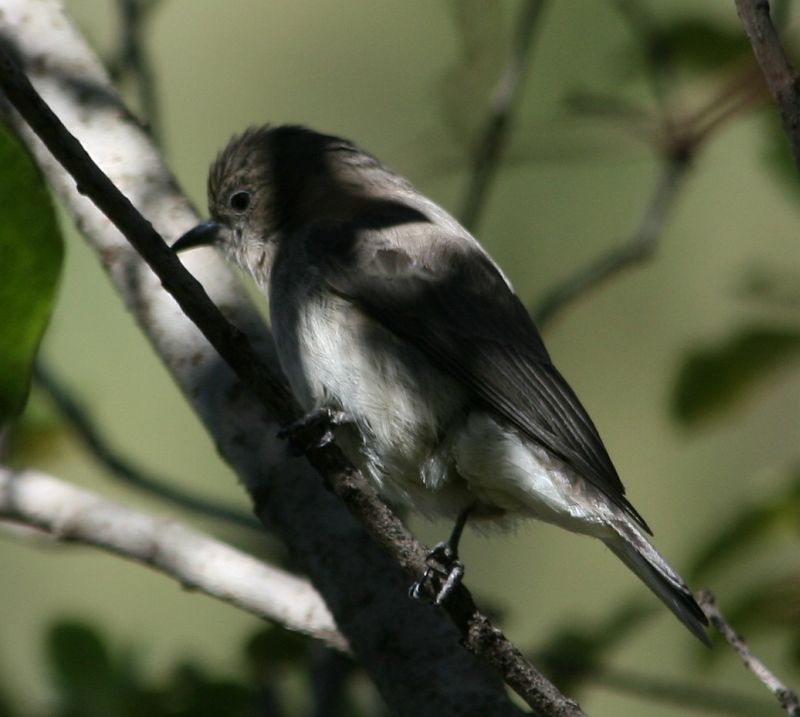
Brown-backed (Wahlberg's) Honeybird (Prodotiscus regulus) byWiki

Brown-backed (Wahlberg’s) Honeybird (Prodotiscus regulus) byWiki

The Honeyguide is an interesting bird. They are not mentioned specifically in the Bible by “name”, but all birds are mentioned whether named or not. The Lord God created all of them on the fifth day and declared them good.

And God created great whales, and every living creature that moveth, which the waters brought forth abundantly, after their kind, and every winged fowl after his kind: and God saw that it was good. And God blessed them, saying, Be fruitful, and multiply, and fill the waters in the seas, and let fowl multiply in the earth. And the evening and the morning were the fifth day. (Genesis 1:21-23 KJV)

Honeyguides love the honey, wax, larvae or whatever else is found in the honeycomb. In fact, it was created with such a cooperative instinct, that it helps others find the honey and in return, it gets fed also. The scientist today call it “mutualism” or “sembiotic relationship”. There is a Honey Badger (Ratal) that can’t see so well but loves the same things in the honeycomb and the Honeyguide “guides” it to the honey source. The bird first finds the bee’s nest, but since it is too weak to tear the comb apart, it finds the badger. Then by flitting its wings and making a fuss, it slowly leads the critter to the nest. He or she, does the hard work. The badger tears the bee’s nest apart with its paws and enjoys the meal. There is always enough left over that the bird gets its share of the meal also. Of course God has given the badger its instinct to let the bird lead it to honey also. They both need each other to make this work.

The bird has also been known to lead humans to a honey source. “One researcher found use of honeyguides by the Boran people of East Africa reduces the search time of people for honey by approximately two-thirds. Because of this benefit, the Boran use a specific loud whistle, known as the “Fuulido”, when a search for honey is about to begin. The “Fuulido” doubles the encounter rate with honeyguides” (Wikipedia)

Pleasant words are as an honeycomb, sweet to the soul, and health to the bones. (Proverbs 16:24 KJV)
My son, eat thou honey, because it is good; and the honeycomb, which is sweet to thy taste: (Proverbs 24:13 KJV)

The Lord Jesus even was served fish and a honeycomb after His resurrection.

And they gave him a piece of a broiled fish, and of an honeycomb. (Luke 24:42 KJV)

Yellow-rumped Honeyguide (Indicator xanthonotus) by A Grosset

Yellow-rumped Honeyguide (Indicator xanthonotus) by A Grosset

The Honeyguide is in the Indicatoridae Family which has 17 members and are in the Piciformes Order. Recently three of the birds were changed from Honeyguides to Honeybirds, but they all love honey. Most honeyguides are dull-colored, though a few have bright yellow in the plumage. All have light outer tail feathers, which are white in all the African species. The two honeyguides, the Greater Honeyguide and the Scaly-throated Honeyguide, are the most studied for this behavior.

The fear of the LORD is clean, enduring for ever: the judgments of the LORD are true and righteous altogether. More to be desired are they than gold, yea, than much fine gold: sweeter also than honey and the honeycomb. (Psalms 19:9-10 KJV)

See Also:

Birds of the Bible

Creation Moments – Helpful Honeyguide

Wikipedia – Honeyguides
Don Roberson’s Bird Families of the World – Honeyguides Indicatoridae

*

Birds in Hymns – How Pleasant, How Divinely Fair

My soul longs, yes, even faints For the courts of the LORD; My heart and my flesh cry out for the living God. (Psalms 84:2 NKJV)

Words: Isaac Watts, The Psalms of Da­vid, 1719.

Music: Ware­ham, Will­iam Knapp, 1738

Al­ter­nate tune: * Adisham, by Joseph Funk (Win­ches­ter, Vir­gin­ia: J. W. Holl­is, 1832)

How Pleasant, How Divinely Fair

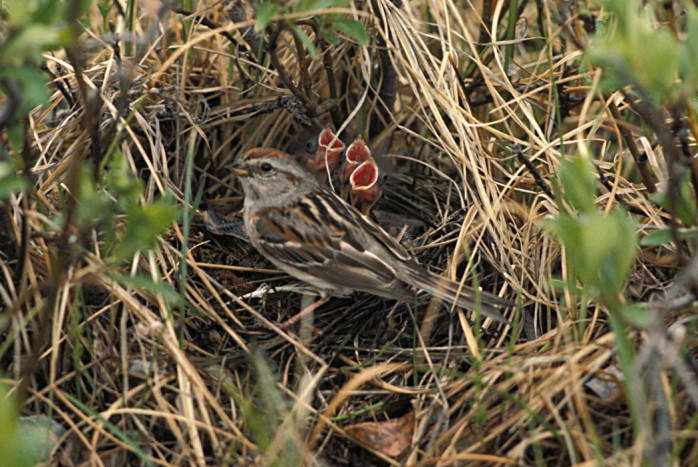
American Tree Sparrow (Spizella arborea) w chicks©USFWS

American Tree Sparrow (Spizella arborea) w chicks©USFWS

How pleasant, how divinely fair,
O Lord of hosts, Thy dwellings are!
With long desire my spirit faints
To meet th’assemblies of Thy saints.

My flesh would rest in Thine abode,
My panting heart cries out for God;
My God! my King! why should I be
So far from all my joys and Thee?

The sparrow chooses where to rest
And for her young provides her nest;
But will my God to sparrows grant
That pleasure which His children want?

Bless’d are the saints who sit on high
Around Thy throne of majesty;
Thy brightest glories shine above,
And all their work is praise and love.

Bless’d are the souls who find a place
Within the temple of Thy grace;
There they behold Thy gentler rays,
And seek Thy face, and learn Thy praise.

Bless’d are the men whose hearts are set
To find the way to Sion’s gate;
God is their strength, and through the road
They lean upon their helper God.

Cheerful they walk with growing strength,
Till all shall meet in Heav’n at length,
Till all before Thy face appear,
And join in a nobler worship there.


Words and music from CyberHymnal

See more – Birds in Hymns

*

Birds in Hymns – God Speaks To Us In Bird And Song

To him that rideth upon the heavens of heavens, which were of old; lo, he doth send out his voice, and that a mighty voice. (Psalms 68:33 KJV)

Words: Jo­seph John­son, Dibs: A Sto­ry of Young Lon­don Life (at the be­gin­ning of chap­ter 4: ‘Pro­mot­ed to the Choir’), 1888. The hymn was pub­lished in School Hymns in 1891.

Music: Child­hood – by Hen­ry W. Da­vies (1869-1941)

God Speaks to us in Bird and Song

Crested Bunting (Emberiza lathami) by Nikhil Devasar

Crested Bunting (Emberiza lathami) by Nikhi lDevasar

God speaks to us in bird and song,
In winds that drift the clouds along,
Above the din and toil of wrong,
A melody of love.

God speaks to us in far and near,
In peace of home and friends most dear,
From the dim past and present clear,
A melody of love.

God speaks to us in darkest night,
By quiet ways through mornings bright,
When shadows fall with evening light,
A melody of love.

O Voice divine, speak Thou to me,
Beyond the earth, beyond the sea,
First let me hear, then sing to Thee,
A melody of love.


Most information from The Cyber Hymnal

See ~ Wordless Birds

More ~ Birds in Hymns

*

Birds in Hymns – He Waters The Hills

He sendeth the springs into the valleys, which run among the hills. They give drink to every beast of the field: the wild asses quench their thirst. (Psalm 104:10-11)

Johann M. Haydn (1737-1806)

Words: From The Psal­ter (Pitts­burgh, Penn­syl­van­ia: The Unit­ed Pres­by­ter­i­an Board of Pub­li­ca­tion, 1912), num­ber 286.

Music: Ly­ons, at­trib­ut­ed to Jo­hann M. Hay­dn (1737-1806); ar­ranged by Wil­liam Gar­din­er, Sac­red Mel­odies (Lon­don: 1815)

HE WATERS THE HILLS

Pileated and Red-bellied on same tree - turkey point by Ray

Pileated and Red-bellied on same tree - turkey point by Ray

He waters the hills with rain from the skies,
And plentiful grass and herbs He supplies,
Supplying the cattle, and blessing man’s toil
With bread in abundance, with wine and with oil.

The trees which the Lord has planted are fed,
And over the earth their branches are spread;
They keep in their shelter the birds of the air,
The life of each creature the Lord makes His care.

The seasons are fixed by wisdom divine,
The slow changing moon show forth God’s design;
The sun in his circuit his Maker obeys,
And running his journey hastes not nor delays.

The Lord makes the night, when leaving their lair,
The lions creep forth, God’s bounty to share;
The Lord makes the morning, when beasts steal away
And men are beginning the work of the day.

How many and wise Thy works are, O Lord!
The earth with the wealth of wisdom is stored;
The sea bears in safety the ships to and fro,
And creatures unnumbered it shelters below.

The creatures all look to Thee for their food;
Thy hands open wide, they gather the good;
Thy face Thou concealest, in anguish they yearn;
Their breath Thou withholdest, to dust they return.


Another parable put he forth unto them, saying, The kingdom of heaven is like to a grain of mustard seed, which a man took, and sowed in his field: Which indeed is the least of all seeds: but when it is grown, it is the greatest among herbs, and becometh a tree, so that the birds of the air come and lodge in the branches thereof. (Matthew 13:31-32 KJV)

Sing to the LORD with thanksgiving; Sing praises on the harp to our God, Who covers the heavens with clouds, Who prepares rain for the earth, Who makes grass to grow on the mountains. He gives to the beast its food, And to the young ravens that cry. (Psalms 147:7-9 NKJV)

Most information from The Cyber Hymnal

See ~ Wordless Birds

More ~ Birds in Hymns

*

Birds in Hymns – Jesus, Lover Of My Soul

Blessed be God, even the Father of our Lord Jesus Christ, the Father of mercies, and the God of all comfort; Who comforteth us in all our tribulation, that we may be able to comfort them which are in any trouble, by the comfort wherewith we ourselves are comforted of God. For as the sufferings of Christ abound in us, so our consolation also aboundeth by Christ. (2 Corinthians 1:3-5 KJV)

Words: Charles Wes­ley, Hymns and Sac­red Po­ems, 1740. Some have called this the fin­est hymn in the Eng­lish lang­uage.

Music: Aberystwyth (Parry), Jo­seph Par­ry, in Ste­phens’ Ail Lyfr To­nau ac Emy­nau, 1879

Quotes below from Wholesome Words Christian Biography Resources

“The circumstance of the writing of this hymn is interesting. The story goes that Charles Wesley was roused from his sleep one night by a terrible storm. Being unable to rest he got up, put on his dressing-gown, and, opening his casement window stood looking out upon the stormy scene. Suddenly a bird, exhausted by the wind, and hotly pursued by a hawk, flew through the open window right into Charles Wesley’s breast for protection. Having saved the bird and placed it in security, he turned to his desk and wrote this immortal hymn, so realistic and descriptive of the fear and intense longing of the anxious soul to find safety and rest.

For our soul needs shelter; and the Only One Who can be a refuge for the soul is Jesus. He is our Hiding-place, our Haven of Rest. Listen to these words of the prophet Isaiah (32:2):

“A man shall be as an hiding place from the wind, and a covert from the tempest . . . as the shadow of a great rock in a weary land.”

We have no time to say anything about this wonderful hymn in detail, but I would have you notice one point about it. I have spoken of this in the case of other hymns, but the thought will bear repeating. Notice in it the personal and persistent use of me, and my, and I, in it:

“Let me to Thy bosom fly.”

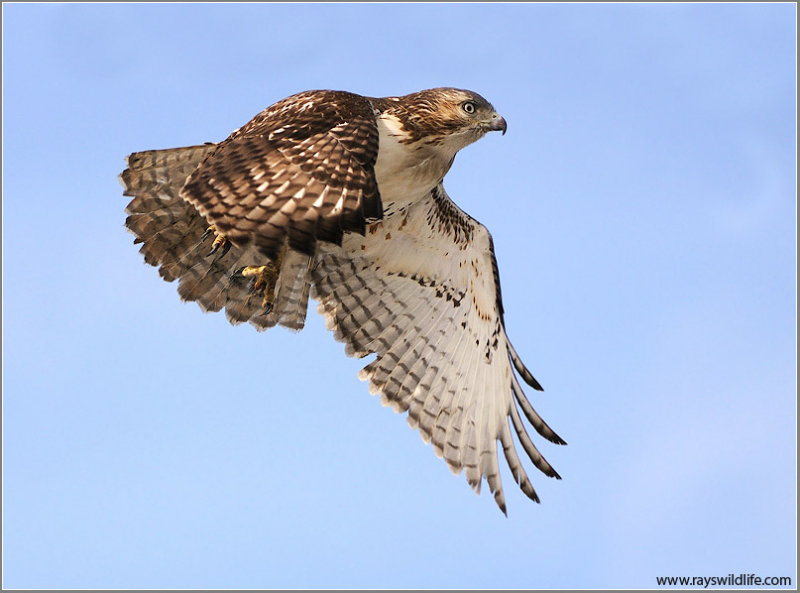
Red-Tailed Hawk by Ray

Red-Tailed Hawk by Ray

It is the prayer of the individual soul for succour, to the Saviour Himself; the call, as of a drowning man, that insists on being heard, and that can take no refusal; the cry of the terrified, and frail, and helpless bird, pursued by the cruel hawk, that is eager for its life.

Dear friends, are you “Safe in the arms of Jesus”? Have you “hidden” yourselves in Him?

Oh that these questions may go straight home to your hearts. If you are not in Christ, Oh, may God the Holy Spirit awaken you to see your danger. I will read the hymn to you, and then we will sing it together, on our knees, as our closing prayer.”

Jesus, Lover Of My Soul by Charles Wesley


Jesus, lover of my soul, let me to Thy bosom fly,
While the nearer waters roll, while the tempest still is high.
Hide me, O my Savior, hide, till the storm of life is past;
Safe into the haven guide; O receive my soul at last.

Other refuge have I none, hangs my helpless soul on Thee;
Leave, ah! leave me not alone, still support and comfort me.
All my trust on Thee is stayed, all my help from Thee I bring;
Cover my defenseless head with the shadow of Thy wing.

Wilt Thou not regard my call? Wilt Thou not accept my prayer?
Lo! I sink, I faint, I fall—Lo! on Thee I cast my care;
Reach me out Thy gracious hand! While I of Thy strength receive,
Hoping against hope I stand, dying, and behold, I live.

Thou, O Christ, art all I want, more than all in Thee I find;
Raise the fallen, cheer the faint, heal the sick, and lead the blind.
Just and holy is Thy Name, I am all unrighteousness;
False and full of sin I am; Thou art full of truth and grace.

Plenteous grace with Thee is found, grace to cover all my sin;
Let the healing streams abound; make and keep me pure within.
Thou of life the fountain art, freely let me take of Thee;
Spring Thou up within my heart; rise to all eternity.


Copyright ©2010 Wholesome Words and Info from Cyberhymnal

See ~ Wordless Birds

More ~ Birds in Hymns

*

Birds of the Bible – Barn Owls

Western Barn Owls (Family Tytonidae) by Bob-Nan

Western Barn Owl (Family Tytonidae) by Bob-Nan

the little owl, the cormorant, the short-eared owl, the barn owl, the tawny owl, the carrion vulture, (Leviticus 11:17-18 ESV)
and the little owl, and the cormorant, and the eared owl; and the barn owl, and the pelican, and the owl-vulture; (Leviticus 11:17-18 MKJV)

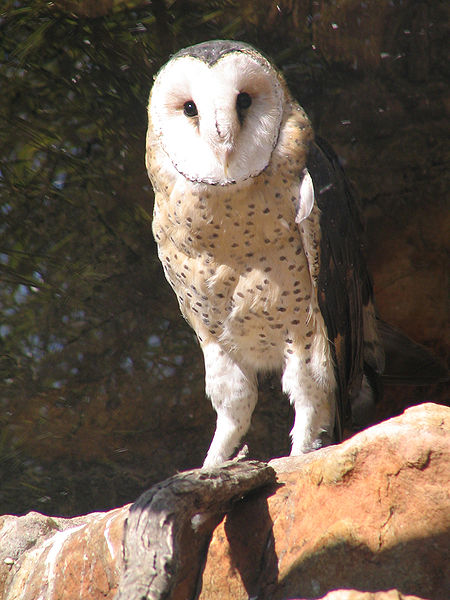
Australian Masked Owl (Tyto novaehollandiae) by Wiki

Australian Masked Owl (Tyto novaehollandiae) by Wiki

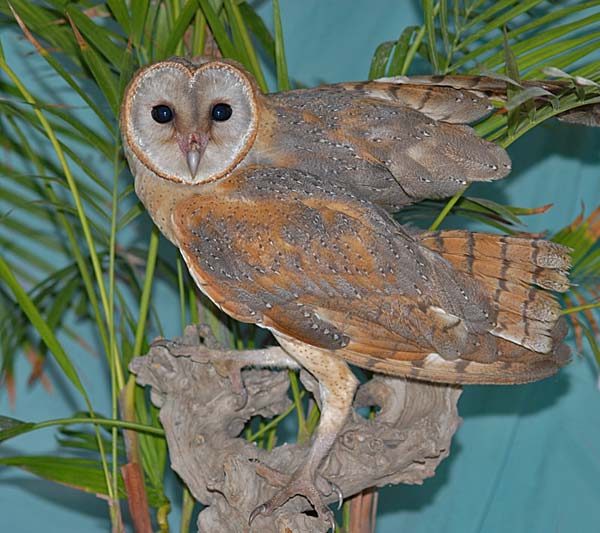
The Lord has created another interesting and fantastic bird, the Barn Owl. The Owls are mentioned in the list of unclean birds the Israelites were not to eat. The Bible mentions several different kinds of owls and that is possibly why the taxonomists today divide them at least into two different families. Within those families, especially the larger one, Strigidae, the are different groupings. The Barn Owl family, Tytonidae, all seem to have this heart-shaped face you will read about and see. Some of the other Bible versions call it the “white owl.” Most of the ones I found photos of do have a white face or almost white face.

Barn-owls (family Tytonidae) are one of the two families of owls, the other being the true owls, Strigidae. Barn Owls are medium to large sized owls with large heads and characteristic heart-shaped faces. They have long, strong legs with powerful talons. They also differ from Strigidae in structural details relating in particular to the sternum and feet.

Sulawesi Masked Owl (Tyto rosenbergii) by Wiki

Sulawesi Masked Owl (Tyto rosenbergii) by Wiki

The Barn Owl is a pale, long-winged, long-legged owl with a short squarish tail. Depending on subspecies, it measures about 25–45 cm (9.8–18 in) in overall length, with a wingspan of some 75–110 cm (30–43 in). Tail shape is a way of distinguishing the Barn Owl from true owls when seen in flight, as are the wavering motions and the open dangling feathered legs. The light face with its heart shape and the black eyes give the flying bird an odd and startling appearance, like a flat mask with oversized oblique black eyeslits, the ridge of feathers above the bill somewhat resembling a nose.[Wikipedia]

The barn-owls’ main characteristic is the heart-shaped facial disc, formed by stiff feathers which serve to amplify and locate the source of sounds when hunting. (See Calculating Owls below) Further adaptations in the wing feathers eliminate sound caused by flying, aiding both the hearing of the owl listening for hidden prey and keeping the prey unaware of the owl. Barn-owls overall are darker on the back than the front, usually an orange-brown colour, the front being a paler version of the back or mottled, although there is considerable variation even amongst species. The bay-owls closely resemble the Tyto owls but have a divided facial disc, ear tufts, and tend to be smaller.

On average, within any one population males tend to be less spotted on the underside than females. The latter are also larger, as is common for owls. A strong female Western Barn Owl of a large subspecies may weigh over 550 g (19.4 oz), while males are typically about 10% lighter. Nestlings are covered in white down all over, but the heart-shaped facial disk is visible soon after hatching.

the little owl and the short-eared owl, the barn owl (Deuteronomy 14:16 ESV)

Western Barn Owl (Tyto alba) by Nikhil Devassar

Western Barn Owl (Tyto alba) by Nikhil Devassar

Its head and upperparts are a mixture of buff and grey (especially on the forehead and back) feathers in most subspecies. Some are purer richer brown instead, and all have fine black-and-white speckles except on the remiges and rectrices, which are light brown with darker bands. The heart-shaped face is usually bright white, but in some subspecies it is browner. The underparts vary from white to reddish buff among the subspecies, and are either mostly unpatterned or bear a varying amount of tiny blackish-brown speckles. It was found that at least in the continental European populations, females with more spotting are healthier on average. This does not hold true for European males by contrast, where the spotting varies according to subspecies. The bill varies from pale horn to dark buff, corresponding to the general plumage hue. The iris is blackish brown. The toes, as the bill, vary in color; their color ranges from pinkish to dark pinkish-grey. The talons are black.

African Grass Owl (Tyto capensis) by Wiki

African Grass Owl (Tyto capensis) by Wiki

The barn owls are a wide ranging family, absent only from northern North America, Saharan Africa and large areas of Asia. They live in a wide range of habitats from deserts to forests, and from temperate latitudes to the tropics. The majority of the 16 living species of barn owls are poorly known. Some, like the (Madagascar) Red Owl, have barely been seen or studied since their discovery, in contrast to the Common Barn Owl, which is one of the best known owl species in the world. However, some sub-species of the Common Barn Owl possibly deserve to be a separate species, but are very poorly known.

Contrary to popular belief, it does not hoot (such calls are made by typical owls, like the Tawny Owl or other Strix). It instead produces the characteristic shree scream, ear-shattering at close range. Males in courtship give a shrill twitter. It can hiss like a snake to scare away intruders, and when captured or cornered, it throws itself on its back and flails with sharp-taloned feet, making for an effective defence. Also given in such situations is a rasp and a clicking snap, produced by the bill or possibly the tongue.

Barn Owl clicks and call from xeno.canto.org

Couldn’t pass up the opportunity for some verse of the “heart.”

I will praise thee, O LORD, with my whole heart; I will shew forth all thy marvellous works. (Psalms 9:1 KJV)
LORD, thou hast heard the desire of the humble: thou wilt prepare their heart, thou wilt cause thine ear to hear: (Psalms 10:17 KJV)
Let the words of my mouth, and the meditation of my heart, be acceptable in thy sight, O LORD, my strength, and my redeemer. (Psalms 19:14 KJV)
Wait on the LORD: be of good courage, and he shall strengthen thine heart: wait, I say, on the LORD.
(Psalms 27:14 KJV)

See Also:

Owls – Birds of the Bible
Calculating Owls – Find out how the Barn Owl finds things.

STRIGIFORMES (Owls) Order

Some information from Wikipedia

*

Birdwatching and Updated Indexes for I.O.C. 2.5 Version

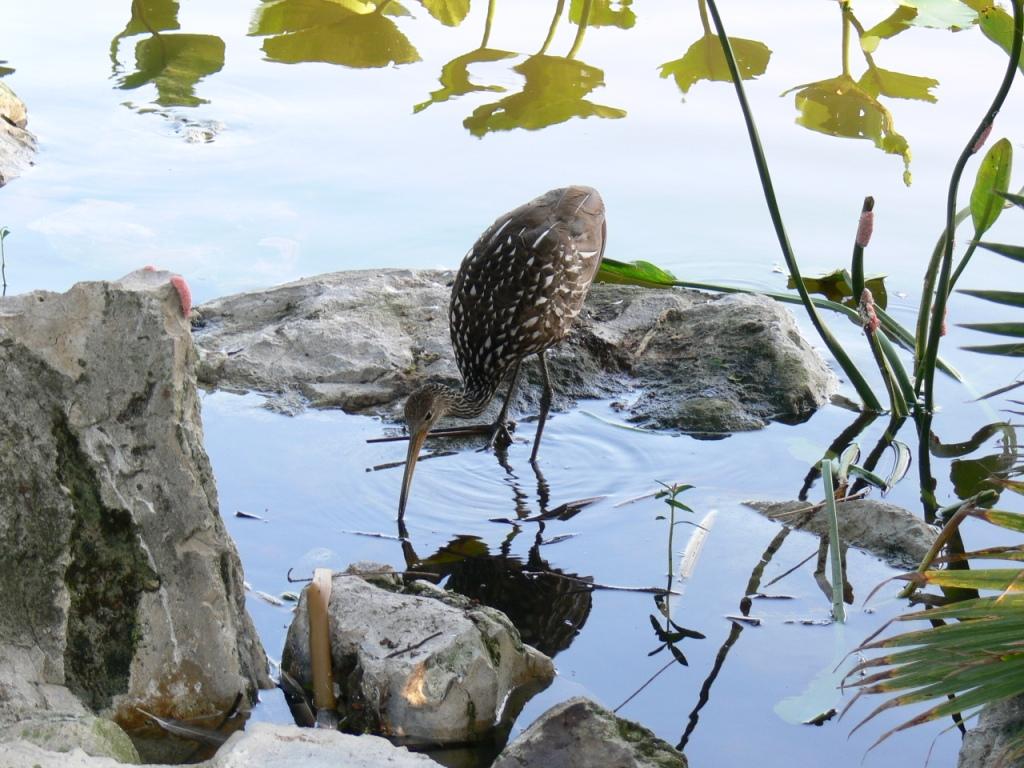
Limpkin at Lake Morton

Limpkin at Lake Morton

It took me awhile, but I finally got all the links up for the newest version (2.5) of the I.O.C. Now you should be able to find any bird on the lists.

Anhinga (Anhinga anhinga) scrawny by Lee

Anhinga (Anhinga anhinga) scrawny by Lee

Dan and I managed to get in a little birdwatching Friday at Lake Morton. We saw several weird things take place. At least I hadn’ t seen it before. Watched a Great Egret with what I thought was a fish, a scrawy Anhinga, and a one footed White Ibis.

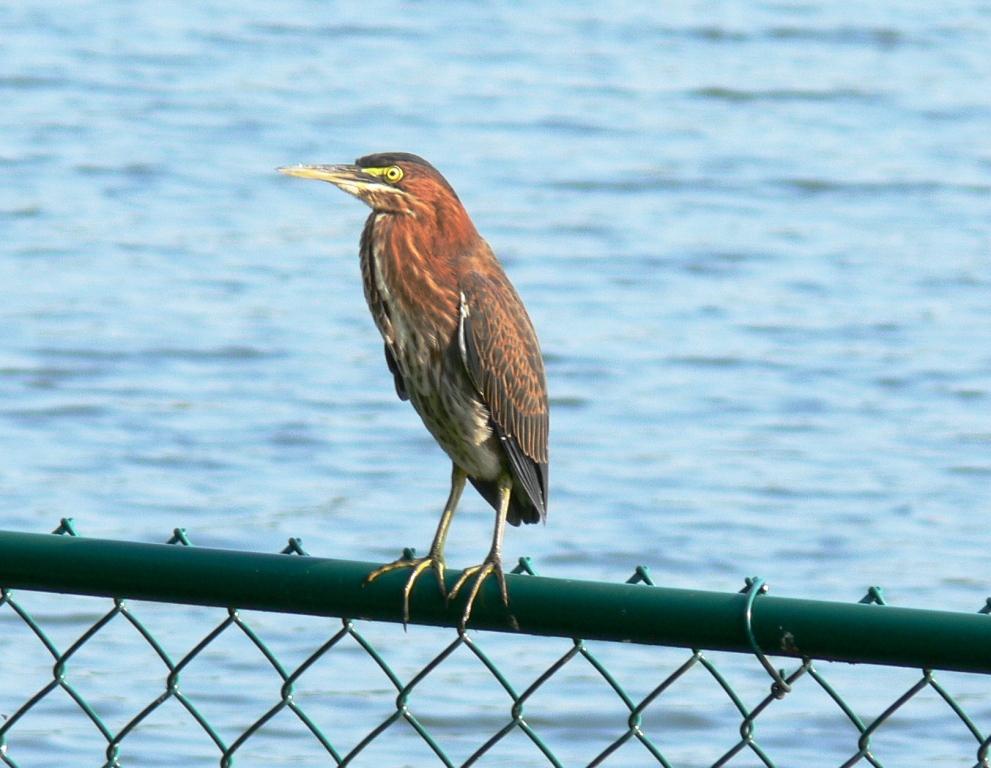
The Anhinga that we saw was “scrawny.” It must have been in a molting stage, because it sure didn’t have many complete feathers. Also fed a one-footed White Ibis. Did manage to get some nice photos of a Limpkin and a Green Heron. There were some gulls around and I think it is a Laughing Gull I photographed. Haven’t seen one there before, at least not with that black hood.

Great Egret at Lake Morton

Great Egret at Lake Morton

The Great Egret that was eating something, well, trying to, turned out to be a baby Mallard. I was photographing it from a distance and didn’t realize what it had until we got home and viewed the photos. Never did see it swallow it. The Egret flew off with it and when I spotted it later, there was no baby Mallard around. Hope he dropped it when he flew off. I was sad when I realized what had been going on.

Sunday, at church, our pastor was preaching on the death of Christ on the cross. He gave the following quote by Dorothy Sayers and it reminded me of what I had seen on Friday.

It is a curious fact that people who are filled with horror when a cat kills a sparrow can hear the true story of how people killed the Lord Jesus Christ told Sunday after Sunday and not experience any Shock whatsoever! Dorothy L. Sayers

The Lord loved us so much He was willing to lay His life down and pay for our sins. He has “finished” the payment and has raised Himself up and is in heaven with the Father. Do we hear that week after week and not acknowledge the truth? I trust you know the Savior.

For God so loved the world, that he gave his only begotten Son, that whosoever believeth in him should not perish, but have everlasting life. For God sent not his Son into the world to condemn the world; but that the world through him might be saved. (John 3:16-17 KJV)

Wordless Birds and Gospel Message

Laughing Gull (Leucophaeus atricilla) by Lee

Laughing Gull (Leucophaeus atricilla) by Lee

Green Heron (Butorides virescens) by Lee

Green Heron (Butorides virescens) by Lee