Cowbird Mothers: Worse than Infidels?

Dr. James J. S. Johnson

But if any provide not for his own, and specially for those of his own house, he hath denied the faith, and is worse than an infidel. (1st Timothy 5:8)

There she was, that shameful sneak!  An unmotherly and irresponsible female Brown-headed Cowbird! 

Cowbird egg deposited into “foster home” nest
(National Audubon Society photo credit)

Why do I say “sneak”?  Because the female Brown-headed Cowbird is the most prominent example of a “brood parasite” in North America.  Cowbird mothers refuse to raise their own young; they use deceit to “dump” their kids on other mothers (and fathers) to raise. Shame on them! In fact, about half of America’s Lower 48 states are year-round residence range for these brood-parasitic icterids.

RANGE of Brown-headed Cowbird, with green = year-round resident (Wikipedia image credit)

In other words, the mother cowbirds sneakily deposit their eggs into the nests of other bird mothers – so that the involuntary “foster mothers” are left with the responsibility of raising the cowbird hatchlings.  The ornithologists at Cornell University describe the cowbird mother’s habits:

The Brown-headed Cowbird is North America’s most common “brood parasite.” A female cowbird makes no nest of her own, but instead lays her eggs in the nests of other bird species, who then raise the young cowbirds. …

Brown-headed Cowbird lay eggs in the nests of more than 220 species of birds. Recent genetic analyses have shown that most individual females specialize on one particular host species. …

Cowbird eggs hatch faster than other species eggs, giving cowbird nestlings a head start in getting food from the parents. Young cowbirds also develop at a faster pace than their nest mates, and they sometimes toss out eggs and young nestlings or smother them in the bottom of the nest.  [Quoting “Brown-headed Cowbird: overview”, posted on Cornell Lab’s AllAboutBirds.org website]

1 Cowbird egg inserted into a Phoebe nest
(Wikipedia photo credit)

In other words, unlike the noble stepparent, who intentionally and unselfishly accepts the child-rearing responsibility for a (typically ungrateful) child who was procreated by someone else, avian “foster parents” who raise undocumented alien offspring (of Brown-headed Cowbirds) do so unawares.

Finch nest with 5 finch eggs + 1 cowbird “home invader” hatchling
(Everyday Cinematic Birds / YouTube photo credit)

Of course, not all nest-managing birds are fooled by brood parasite birds — regarding Australia’s Superb Fairywren, who uses a parental “password” to vet her nestlings for legitimacy, see “Pushy Parasites and Parental Passwords“, posted at http://www.icr.org/article/pushy-parasites-parental-passwords .

Also, the statistical prospects for cowbird babies is unimpressive: out of about 40 eggs laid/abandoned per year, by cowbird mothers, only about 2 or 3 survive to adult maturity. [See Donald Stokes & Lillian Stokes, “Brown-headed Cowbird”, A GUIDE TO BIRD BEHAVIOR, Volume II (Boston, MA: Little, Brown, & Company), page 213.)

Earlier this month, enjoying fair weather, I went birdwatching with my son, in some suburban parks of Dayton (Ohio). 

COX ARBORETUM park in Dayton, Ohio
(TripAdvisor photo credit)

One of the best birdwatching venues is Cox Arboretum MetroPark, a 174-acre botanical preserve with many forested hiking trails [see https://en.wikipedia.org/wiki/Cox_Arboretum_and_Gardens_MetroPark ].

The above-noted birdwatching experience was enhanced by my son’s smart-phone’s usage of an “app” called MERLIN (Merlin Bird ID, by Cornell Lab: https://merlin.allaboutbirds.org  ) which identifies (by name) bird calls, plus provides a color photograph, when a bird’s calls are recognized by the app.  Most of the recognized birdsongs were from American Robins or various sparrows (e.g., Chipping Sparrow, English Sparrow, etc.), but more than once the songbird was a female Brown-headed Cowbird. 

Of course, male Brown-headed Cowbirds are easy to recognize, as shown below. 

Brown-headed Cowbird MALE
(Wikipedia photo credit)

However, female Brown-headed Cowbirds are much less conspicuous in plumage, because the soft-brown-hued females do not have shiny iridescent plumage that make males so easily recognizable. 

Brown-headed Cowbird FEMALE
(Wikipedia photo credit)

The Cornell Lab’s Merlin app also identifies birds visually – you just “zoom [in] until your bird fills the box” (on your smart-phone), then the Merlin app identifies the bird, plus it supplies some basic information about the bird that you are photographing on your smart-phone.  Nice! 

Brown-headed Cowbird: female (L) & male (R) Wikipedia photo credit

There’s even more features to the Merlin app – but this is enough to suggest its usage. In other words, the main point (of this blogpost) is simple enough:  get out there, and appreciate God’s Creatorship as you do some birding!

So, what are they wading for, in South Florida?

Dr. James J. S. Johnson

“To everything there is a season, and a time to every purpose under the heaven … Everything He [i.e., God] has made beautiful, in its time: also He hath set eternity in their heart, so that no man can find [i.e., fully find/discover] the work that God has done from the beginning to the end.” (Ecclesiastes 3:1 & 3:11)

Lately I’ve been investigating birds of South Florida, especially those of the Everglades and the Florida Keys. God willing, I expect to be part of a scientific/educational tour of those parts of Florida, later this year (more on that later, D.v., if that trip becomes a reality!). Meanwhile, a few of those Florida birds are on my mind, so it’s timely to post a bit on some of these beauties. For starters, let’s consider some heron-like wading birds, the kinds that have long skinny legs, perfect for hunting food in shallow waters.

Interestingly, there is an “albino” version (endemic subspecies) of the Great Blue Heron, called the “Great White Heron”. In other words, this version of the Great Blue Heron is white, but it’s not a Great White Egret. It’s seen in the Florida Keys. In fact, there is a national wildlife refuge named for it: Great White Heron National Wildlife Refuge, just west of national Key Deer Refuge.

The face of a “Great White Heron” looks a lot like that of a regular Great Blue Heron — to compare, consider this mugshot of a Great Blue Heron.

Of course, South Florida has lots of inland and coastal waters, so the opportunities for hunting and eating aquatic prey seems boundless, as a practical matter (to a hungry heron). Consider this Great Blue Heron, eating what looks like a catfish. Of course, there are many other heron-like birds in South Florida. For another example, consider the Little Blue Heron, which is often found in the Everglades. The Little Blue Heron has bluish-grey plumage, ivory white legs and feet, and a whitish dagger-like bill.

For another wading bird of South Florida, consider the Roseate Spoonbill. Well-named, this rose-feathered wader has a distinctively spoon-shaped bill, used for capturing prey (and securing it as the bill-shaking bird drains out excess water before swallowing.

For another example, consider the American Flamingo (a/k/a Pink Flamingo), an icon of South Florida’s colorful wildlife. If the flamingo gets the right diet, and thus gets lots of carotenoid pigment, the red-to-pink color is vivid!

And we should not forget the Wood Stork, which Buddy Davis calls “the only stork of North America” (see SWAMP MAN, Buddy’s classic wildlife DVD produced by Answers in Genesis ministry).

WOOD STORK (“Iron-head”): Nat’l Park Service photo

The clunky-looking Wood Stork is nicknamed “Iron-hHead” (and “Flint-head”) due to its grey scaly neck and head.

Of course, the Snowy Egret is a Florida favorite — especially to LEESBIRD.COM visitors. Snowy legs are black, but look at those yellow feet! Some call them “golden slippers”, since they walk, strut, and amble upon their feet; others say “golden gloves” since snowies use them as prehensile fingers, grasping things.

One of my (this is JJSJ talking) all-time favorite wading birds, of Florida, is the White Ibis. Some become accustomed to eating bread crumbs provided by birdwatchers, e.g., in the Webels’ pondside backyard (St. Petersburg). And, in some public parks, white ibises might even eat bread crumbs out of your hand!

That’s it for now . . . please appreciate that God has providentially equipped the habitats of Florida to be bird’s havens, so those habitats are likewise birder’s havens! Yes, the Lord has made all of these birds “beautiful in their times”–and in ours too!

“To everything there is a season, and a time to every purpose under the heaven … Everything He [i.e., God] has made beautiful, in its time: also He hath set eternity in their heart, so that no man can find [i.e., fully find/discover] the work that God has done from the beginning to the end.” (Ecclesiastes 3:1 & 3:11)

Hey! Is that an egret standing atop my head? (Photo by Marcia Webel)

GO, FLY — A KITE !

GO, FLY — A KITE!

Dr. James J. S. Johnson

And the vulture, and the kite after his kind…. (Leviticus 11:14)

And the glede, and the kite, and the vulture after his kind …. (Deuteronomy 14:13)

Flies (and other flying insects) better flee, whenever a hungry Mississippi Kite flies by!

MISSISSIPPI KITE (Dick Daniels / Wikipedia photo credit)

Perhaps the term “kite”, translating the Hebrew noun אַיָּה [’ayyâh] in Leviticus 11:14, and in Deuteronomy 14:13, refers to the Black Kite (Milvus migrans) that currently dwells in the Holy Land – as well as in several parts of Eurasia, Australia, and Africa.

Once, recently, while I was gazing at tree-perching cardinals and mockingbirds, a Mississippi Kite (Ictinia mississippiensis) landed on a tree-branch near my house, recently (Wednesday, May 7th, A.D.2025), letting me to see its magnificent movements and eye-catching plumage. 

During springtime, here in North Texas, local insect populations are booming – and this busy bonanza is an insectivore’s smörgåsbord for Mississippi Kites, who love to eat flying and crawling insects (bees, cicadas, dragonflies, grasshoppers, and more!). 

MISSISSIPPI KITE hunting dragonfly (Matthew B. Furst image credit)

Also, these diurnal raptors (i.e., daytime hunters) employ their short hooked beaks to eat other small animals, e.g., small snakes, lizards, frogs, mice, bats, and even small birds.  If cicadas are abundant, as they periodically are, kites may feast on them beyond other foods.  [See Stan Tekiela, “Mississippi Kite”, BIRDS OF TEXAS FIELD GUIDE (Adventure Publications, 2020), pages 326-327.]

This mostly grey-colored maneuvering marvel has a black tail, dark-red eyes (surrounded by black “blackeye-like eyepatches), red-to-yellow legs, charcoal-grey (with some russet-brown) plumage on the wings, and whitish-grey “ashy” underside and head; the kite’s head is such a pale grey that it is almost white, similar to a Scissor-tailed Flycatcher’s head. It is easy to remember a Mississippi Kite when you see one – what a beautifully bioengineered and impeccably constructed bird it is! 

Mississippi Kite parent, feeding a dragonfly to its young chick
(Ozark Bill Duncan photo credit)

In fact, the Mississippi Ornithological Society (which, as its name indicates, is an ornithological society that focuses on Mississippi birds) has named its semiannual journal for this marvelous bird (see https://missbird.org/kite/ ).

Smaller than eagles, vultures, and most hawks, these aerial acrobats are migratory accipiters, i.e., smaller hawks with short, broad wings, plus relatively long legs (with precision-designed talons!), often found flying fastly in wooded habitats that include riparian edges.  Since my neighborhood has several ponds and drainage ditches, it’s no surprise that kites visit occasionally – this is not the first time that I’ve seen a kite on my homeplace.

MISSISSIPPI KITE (Cornell Lab of Ornithology photo credit)

Unsurprisingly, this Mississippi Kite visited my Texas homestead in springtime. These kites routinely winter in Central or South America, yet sometimes they winter within the Rio Grande Valley of South Texas.  During spring they migrate northward, to their summer nesting-and-breeding grounds; besides Mississippi (where they are famous for dwelling near the Mississippi River), they migrate to breeding ranges north of Mexico, including Arizona, New Mexico, Oklahoma, Louisiana, Colorado, Kansas, Missouri, and much of northern Texas.  Some are even known to have migrated as far north as South Dakota, or as far east as Florida!  [See, accord, David E. Fantina, “Mississippi Kite”, THE TEXAS BREEDING BIRD ATLAS (posted at Texas A&M AgriLife Research, at https://txtbba.tamu.edu/species-accounts/mississippi-kite/ .]

MISSISSIPPI KITE (J. J. Audubon image credit / public domain)

According to Texas Parks & Wildlife Department, kites are social creatures:

Mississippi kites are very social in all activities. They do not maintain territories and they congregate at roosts in late summer. . . . . Kites have been known to fly about cattle and horsemen in order to catch insects that are stirred up from the grass [acting as the airborne equivalent to pasture-strolling Cattle Egrets!].. . . .

Paired kites generally begin nesting soon after their arrival in their old nests or in newly constructed ones. In late May or early June, kites breed and both sexes will incubate usually two bluish-white eggs until they hatch 31 to 32 days later.

Mississippi kites, at times, cause problems for unsuspecting individuals. Kites, like many other birds, will dive at animals and people that venture too closely to their nests. This diving behavior is simply an attempt to ward off potential threats to the nest and young. Once the young leave the nest some 30 to 34 days after hatching, kites will stop their protective behavior. Kites normally may live to seven years of age in the wild.

[Quoting TP&WD,  https://tpwd.texas.gov/huntwild/wild/species/kites/ .]

Mississippi Kite perching
(Jeff Tibbits / Oklahoma Dep’t of Wildlife Conservation photo credit)

Kites are a lot like falcons, they are small birds of prey with streamlined and quick-darting maneuverability in flight.  They prefer to nest in habitats of tall trees – “near water, in open woodlands, savannahs, and rangelands  … [and sometimes] in urban settings” – according to Texas Parks & Wildlife Department (see  https://tpwd.texas.gov/huntwild/wild/species/kites/ ). 

What an unexpected privilege it was, a few days ago, when I spotted that Mississippi Kite landing upon that tree-branch – perhaps that tree had some insects that the kite spotted, and quickly consumed.  In any case, it’s a beautiful bird to which God gave admirable mobility.

Mississippi Kite parent, feeding cicada to its young chick
(Vincent Fouchi, Jr. photo credit)

So, here is a limerick to remind us of how the Mississippi Kite is an aerial hunter of insects:

MISSISSIPPI KITE, AERIAL HUNTER OF INSECTS

Eyes dark red, and head greyish-white,

Pointed wings, for quick-turning flight —

Its curled beak grabs a bee;

Insects, you better flee!

Beware the Mississippi Kite!

:)

Pileated Woodpecker, in Denton County, Texas?

Dr. James J. S. Johnson

And the same John [i.e., John the Baptist] had his raiment of camel’s hair, and a leathern girdle about his loins; and his meat was locusts and wild honey. (Matthew 3:4)

Sometimes you see a bird that “should” be somewhere else: “Hey, bird, you’re not supposed to be here!”

PILEATED WOODPECKERS
(3 males below; 1 female above)
John James Audubon painting

Earlier this month, to my surprise, I saw a red-crested black-and-white woodpecker in one of my trees. The woodpecker’s mostly-black-with-white plumage, plus the characteristic red crest, proved it to be a Pileated Woodpecker (Dryocopus pileatus). Unable to see if its “mustache/neck stripes were red or black, I’m not sure if it was a male or a female. Regardless of that, what is a Pileated Woodpecker doing in Denton County, Texas? Pileated woodpeckers are well-known as year-round residents within the Piney Woods of East Texas, but how did one end up in the Cross Timbers suburbs of Denton County?

PILEATED WOODPECKER female, eating insects
Andrew Brownsword (Wikipedia/public domain)

Yet, I am not the only one claiming to have seen a Pileated Woodpecker inside Denton County, recently. Today, online, I found a report of 2 Pileated Woodpeckers observed on April 13th (A.D.2025) by “Hannah U.”, at Clear Creek Natural Heritage Center (in Denton, Texas — https://ebird.org/region/US-TX-121/bird-list?yr=cur ). Of course, wooded riparian habitats are known to attract insectivorous woodpeckers. If your trees have ants, these woodpeckers would love to feast on those ants! Other bug-plucking woodpeckers recently reported (on that same ebird.org website), inside Denton County (Texas), include Red-bellied Woodpecker, Downy Woodpecker, Hairy Woodpecker, Ladder-backed Woodpecker, and Red-headed Woodpecker. But Pileated Woodpeckers are easily recognized by their scarlet-red crests, plus they are conspicuously large — crow-sized (sometimes longer than 16″)!

WOODPECKERS (AvianReport.com image credit)

In fact, Pileated Woodpeckers are known to casually frequent Texas as far west as Fort Worth, according to Keith A. Arnold, of the Department of Wildlife and Fisheries Sciences, at Texas A&M University (College Station, Texas — https://txtbba.tamu.edu/species-accounts/pileated-woodpecker/ ), saying: “DISTRIBUTION:  This species is fairly common locally to uncommon in wooded portions of eastern third of Texas, west casually to Gainesville and Fort Worth [emphasis added], rarely to Bastrop and Palmetto State Park, south irregularly to Victoria (Oberholser and Kincaid 1974).” [Quoting Keith A. Arnold, “Pileated Woodpecker”, The Texas Breeding Bird Atlas, Texas A&M AgriLife Research (viewed 4-15-AD2025).]

Woodpeckers, unsurprisingly, seek to eat insects found on and in trees.

“The Pileated Woodpecker’s primary food is carpenter ants, supplemented by other ants, woodboring beetle larvae, termites, and other insects such as flies, spruce budworm, caterpillars, cockroaches, and grasshoppers [notice: “locusts” are a type of grasshopper, so these woodpeckers have part of their diet in common with that of John the Baptist!]. They also eat wild fruits and nuts, including greenbrier, hackberry, sassafras, blackberries, sumac berries, poison ivy, holly, dogwood, persimmon, and elderberry. In some diet studies, ants constituted 40 percent of the diet, and up to 97 percent in some individuals. Occasionally, Pileated Woodpeckers visit backyard bird feeders for seeds or suet.” [Quoting “Pileated Woodpecker”, ALL ABOUT BIRDS, CORNELL LAB OF ORNITHOLOGY, posted at http://www.allaboutbirds.org/guide/Pileated_Woodpecker/lifehistory .]

PILEATED WOODPECKERS
Mass Audubon (Massachusetts Audubon) image credit

What beautiful birds — and, considering their large size, imagine how many carpenter ants (and other insects) that a Pileated Woodpecker eats, over its lifespan of perhaps more than 10 years. That a lot of insects!

Yes, some insects are eaten by humans — such as the locusts that John the Baptist was famous for eating — but I still think that I’d rather have eggs, bacon, and some buttered rye toast, with coffee.

GREAT WHITE & CATTLE EGRETS, OBSERVED IN POND & PASTURE

Dr. James J. S. Johnson

 “And the stork, the heron after her kind, and the lapwing, and the bat.” (Leviticus 11:19)

This is just a quick note, from my part of Texas, to report seeing some white egrets lately.

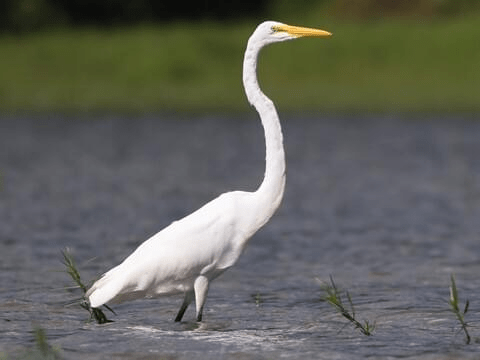
GREAT WHITE EGRET, wading in pond-water
(Cornell Lab of Ornithology photo credit)

So much of (our part of) Texas is urbanizing–and suburbanizing. So, frequenting a rural area, where birdwatching is convenient, is like hunting for an endangered species.

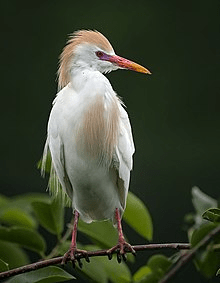
Last Sunday, in a journey that included driving through parts of Denton County and Tarrant County (Texas), my wife drove our car, as I looked out my car window–for birds in pastures and ponds. Ponds attract heron-like birds, such as foraging Great White Egrets (a/k/a “Great White Heron”). Likewise, pastures (with bovine cattle grazing), attract foraging Cattle Egrets.

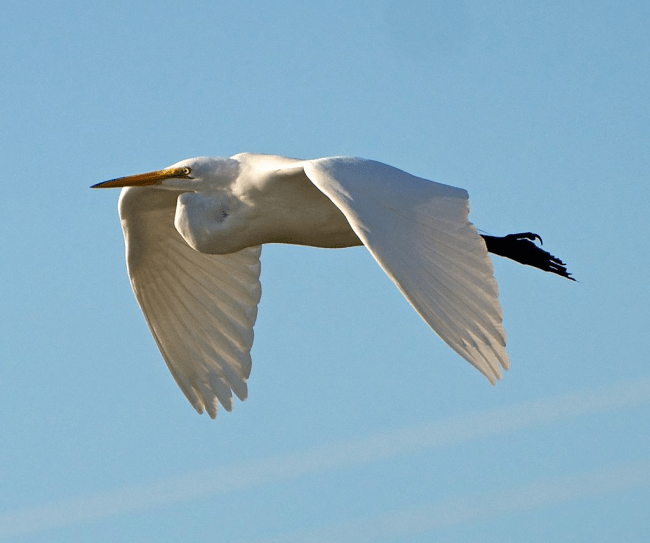
GREAT WHITE EGRET in flight
(Wikipedia photo credit)

Thankfully, I saw several kinds of birds, from place to place, in field and trees, and besides ponds and drainage ditches. Among those birds, observed that day, were two kinds of heron-like wading birds–Great White Egret and Cattle Egret. Which led to composing this limerick:

GREAT WHITE & CATTLE EGRETS, OBSERVED WHILE TRAVELLING

Cute critters—some are wild, some are pets;

Yesterday, I observed white egrets!

Standing, beside a pond;

Others, in grass beyond …

Go birding—you’ll have no regrets!

It’s good to know that, so far, there are still some pastures and ponds, where we can still view egrets.

Yes, we can all thank the Lord for making and sustaining these oft-ignored (yet magnificent) wild white wonders (Job 9:10).

CATTLE EGRET
(Wikipedia image credit)

(Regarding Cattle Egrets, see JJSJ’s “Cabin Fever, Cattle Egrets, and Pasture-land Partnerships” http://www.icr.org/article/cabin-fever-cattle-egrets-pasture-land-partnership/ .)

MALLARDS ARE DABBLING PUDDLE DUCKS

Dr. James J. S. Johnson

For as the rain comes down, and the snow from heaven, and returns not there, but waters the earth, and makes it bring forth and bud, that it may give seed to the sower, and bread to the eater, so shall My Word be, that goes forth out of My mouth; it shall not return unto Me void, but it shall accomplish that which I please, and it shall prosper in the thing to which I sent it.   (Isaiah 55:10-11)

MALLARDS in rain-filled drainage ditch
(Ian Sullens / U.S. Air Force photo credit)

Mallards like to float about in rainwater-runoff puddles and pools—in fact, a group of Mallards is sometimes called a “puddle” of Mallards.  Mostly unnoticed by humans (even though Mallards are the world’s most ubiquitous duck), these delightful ducks serenely enjoy their own small part of God’s great global water cycle. 

At my home, our front yard is bounded by roadside drainage ditches—so, when it rains a lot, those drainage ditches become brook-like pools of flooded rainwater. 

Just think, even mud puddles and rain runoff are parts of God’s global water cycle (Isaiah 55:101-11). Amazing! Imagine the uncountable details of biogeochemical dynamics that God keeps track of, worldwide and all-the-time, as He masterminds and maintains the orchestra of Earth’s water cycle. [Regarding Earth’s wondrous water cycle, see Job 26:8 & 36:27-28; Isaiah 55:10-11Deuteronomy 8:7 & 32:2; Ecclesiastes 1:7, 11:3; Amos 5:8 & 9:6; Psalm 104:10-13Jeremiah 10:13 & 14:22 & 51:16; Zechariah 10:1Luke 12:54. See also “Water Drops and Human Value”, posted at http://www.icr.org/article/water-drops-and-human-value .]
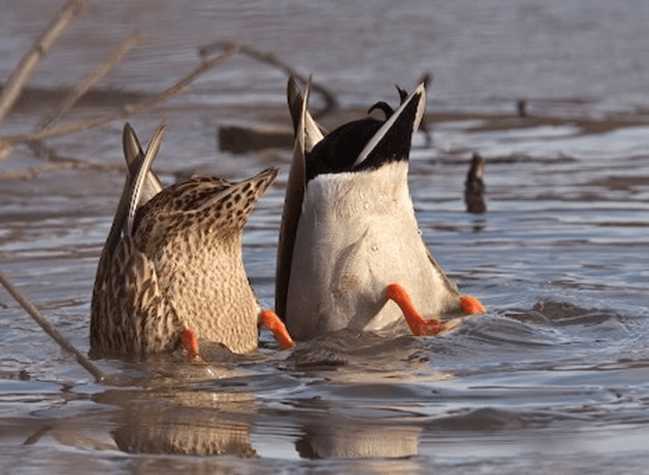
Year after year after year, during the colder months (such as December), migratory Mallards (Anas platyrhynchos) seasonally seek out southern ponds and lakes, for over-wintering, yet they also frequent shallow rainwater-filled drainage ditches and rain-pooled puddles. 

DABBLER DUCKS “UPENDING”
(Camo Trading photo credit)

As dabbling ducks (a/k/a “puddle ducks”), they often “upend” in water, thus grazing on water-covered plants that they easily reach by flipping upside-down at the pooled water’s surface. 

Dabbling ducks feed by straining food from the water’s surface or by submerging their heads while their tails remain out of the water. Male dabblers are usually brightly colored while females are drab. Plants make up most dabblers’ diets. Their method of taking flight is a sort of leap from the water’s surface. Look for them on rivers and close to shorelines.  The most widely known dabbler duck is the mallard. The male has a dark green head while the female is dusky brown. Another dabbler species is the American black duck. Both male and female American black ducks look similar to mallard hens, only darker. Other dabblers include the American wigeon, green-winged teal, northern pintail (the male has long black tail feathers), and northern shoveler (named for its large, spatula-like bill). [Quoting CHESAPEAKE BAY JOURNAL, 33(9):40 (December 2023), posted at www.BayJournal.com ]

Since dabblers don’t dive into deep water, they don’t need large paddle-like feet for underwater propulsion mobility.  So, it makes sense that God did not design dabbling ducks to have the larger paddle-shaped feet that diving ducks have.  Also, it makes sense that dabbling ducks have legs (and feet) positioned near the middle of their bellies, for balancing themselves as they tread water, upside-down in shallow puddle-water, while the dabblers are grasping water-covered (and water-softened) acorns, nuts, seeds, and underwater plants.  

God, in His providential care for the ducks He created, fitted His ducks with appropriate anatomies for the places they “fill” on Earth. Likewise, their behaviors fit their family life roles and territorial needs. 

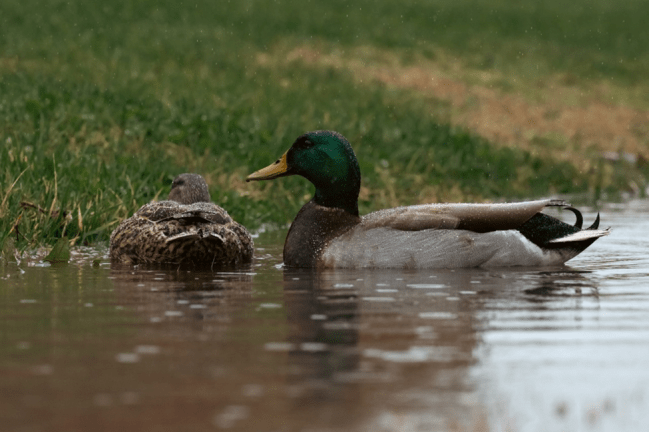
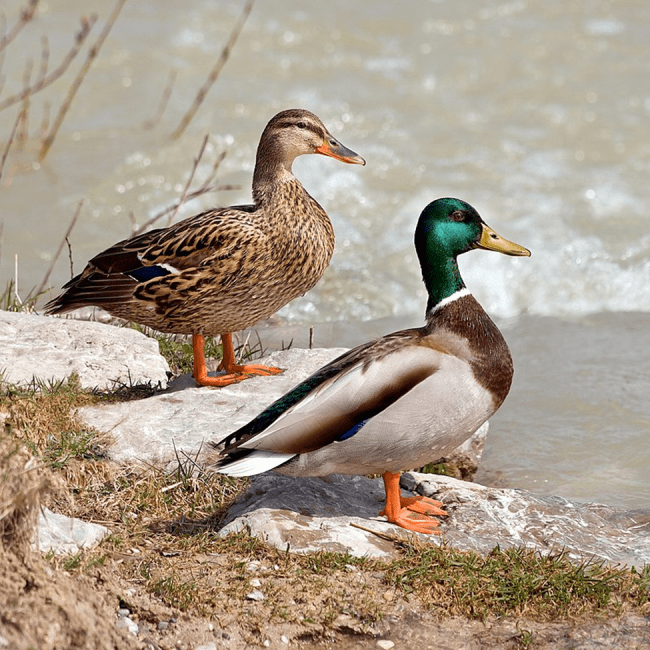
MALLARD male (R) & female (L)
(Richard Bartz / Wikipedia photo credit)

Ornithologist Donald Stokes informs us that Mallards not only display sexual dimorphism (i.e., the 2 sexes have very different plumage, with the male being the distinctive “greenhead”), their vocalizations differ based upon sex:

When I first started studying Mallards I was surprised to find that the males and females make entirely different sounds.  The quacking sound, which I had assumed all Ducks make, can be made only by the female.  The male has two other calls of his own—a nasal rhaeb sound and a short Whistle-call.  . . .  An added advantage to knowing Mallard displays is that closely related species of Ducks such as Black Ducks, Gadwalls, Pintails, Widgeons and Teals have similar displays.  Therefore, once you learn some of the patterns of Mallard behavior you will have a good start on being able to understand the behavior of these other Ducks as well. The Black Duck is particularly close in this respect, having nearly the same display repertoire as the Mallard.  [Quoting Donald Stokes, GUIDE TO BIRD BEHAVIOR: VOLUME ONE (Boston, MA: Little, Brown & Company, 1979), pages 31-32]

Of course, hybrid ducks are common, proving that such hybridizing ducks really belong to the same created kind.  For example, ornithologist Eugene McCarthy has documented that the Common Pintail (Anas acuata) is known to hybridize with the Mallard, as well as with American Black Duck (Anas rubripes), various pochards, various widgeons, various teals, Gadwall (Anas strepera), Northern Shoveler (Anas clypeata), and more.   [See Eugene M. McCarthy, HANDBOOK OF AVIAN HYBRIDS OF THE WORLD (Oxford, UK: Oxford Univ. Press, 2006), pages 71-73.]

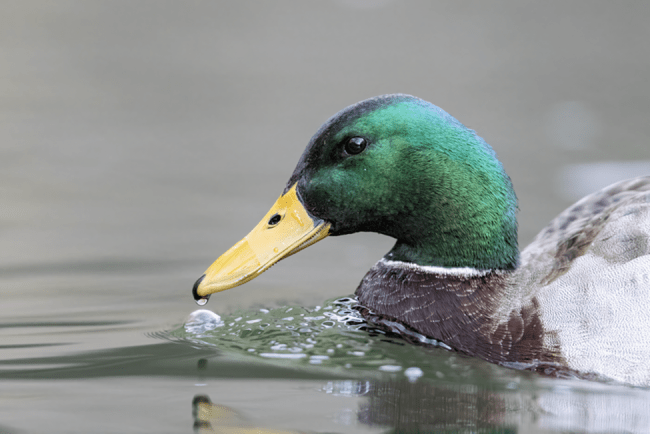
MALLARD MALE close-up
(Chuck Homler / Wikipedia photo credit)

Interestingly, Mallards can be permanent (i.e., “year-round”) residents or migrants.

One of the reasons why mallard ducks are so plentiful is because they’re highly adaptable to climate, geography, temperature and diet. Particularly, they love shallow ponds, marshes and wetlands, as those calmer waters tend to produce the most aquatic bugs and plants—more so than fast moving rivers or deeper lakes. Mallards mate in pairs, and while some migrate to warmer temperatures, many are permanent residents in their nested homes throughout the United States. [Quoting Camo Trading, at www.camotrading.com/resources/the-upside-down-life-of-dabbling-ducks/ ]

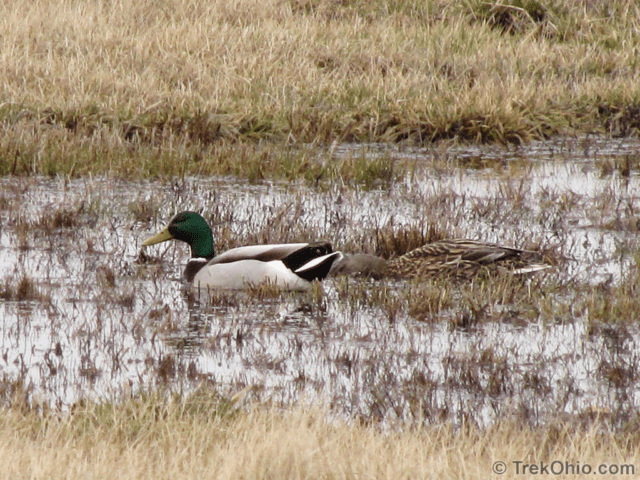
MALLARD male & female, in shallow wetland pool
(TrekOhio.com photo credit)

In other words, God gave ducks what they need, anatomically and genetically (and even behaviorally)—for building families where they live—so that God’s ducks can be fruitful, multiply, and “fill” parts of Earth that God providentially prepared for their homes.

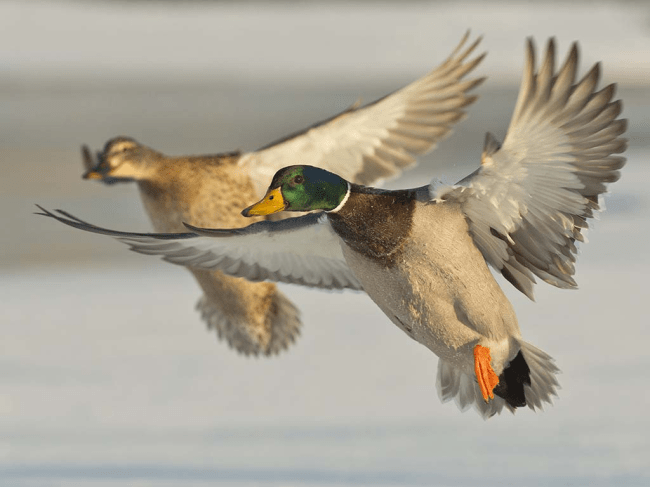
MALLARDS in flight (Fin & Field photo credit)

CARDINALS ARE RED BIRDS

Dr. James J. S. Johnson

And they shall take gold, and blue, and purple, and scarlet, and fine linen.

EXODUS 28:5

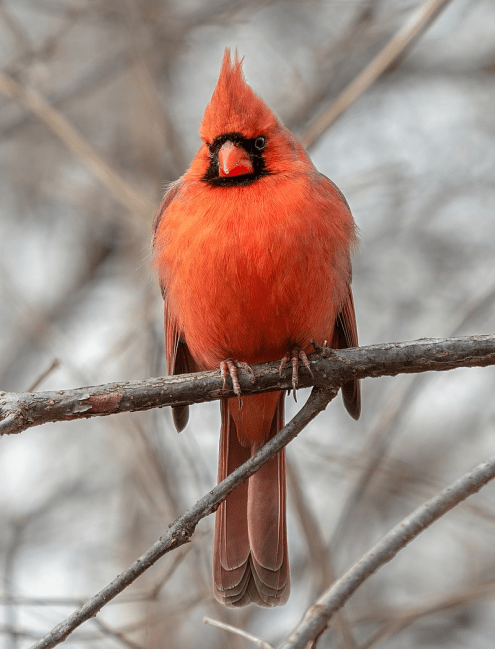
Cardinal males are red birds, easy to see. Yet cardinal females have a softer-hued beauty of their own.

male Cardinal (Wikipedia / Rhododendrites photo credit)

Just as the Old Testament Tabernacle blended theological meaning with aesthetically attractive colors—as exemplified by Exodus 28:5 (quoted above), some birds are gold (e.g., Goldfinch, Yellow Warbler, Evening Grosbeak), or blue (e.g., Mountain Bluebird, Indigo Bunting), or purple (e.g., Purple Starling, Purple Honeycreeper), or scarlet (e.g., Scarlet Tanager, Northern Cardinal), or white as fine linen (e.g., Snowy Egret, White Ibis, Trumpeter Swan). 

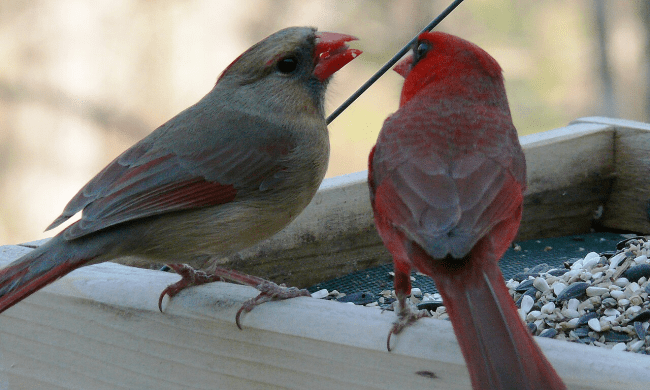
male Cardinal feeding female Cardinal (Wikipedia / Ken Thomas photo credit)

In fact, the Northern Cardinal (Cardinalis cardinalis) is often nicknamed the Redbird, because the male cardinal is almost all-covered in bright red plumage. Male cardinals, being bright red, are conspicuous—so conspicuous that they get noticed! Cardinals are so popular, in fact, that 7 states have officially adopted the Northern Cardinal as their official state bird:  Illinois, Indiana, Kentucky, North Carolina, Ohio, Virginia, and West Virginia. (That’s more states than any other bird represents!)
Recently (i.e., during December of A.D.2024), it has been my prized privilege to hear Northern Cardinals chirping happily in and around trees, where I live and also in places that I visit.  Perhaps the cardinals are extra talkative at this time of year. Or maybe I am paying better attention to the cardinals’ movements and vocalizations. Sometimes I see a cardinal flitting about, or hopping among leaf litter at the bottom of bushes, shrubs, or tree-trunks.  Sometimes I see cardinals perching on tree branches. Then, suddenly, a cardinal might fly off to a nearly spot on the ground–or to a branch of another tree. Also, cardinal chirping–which can be a somewhat squeaky whistle–is often easy to recognize.

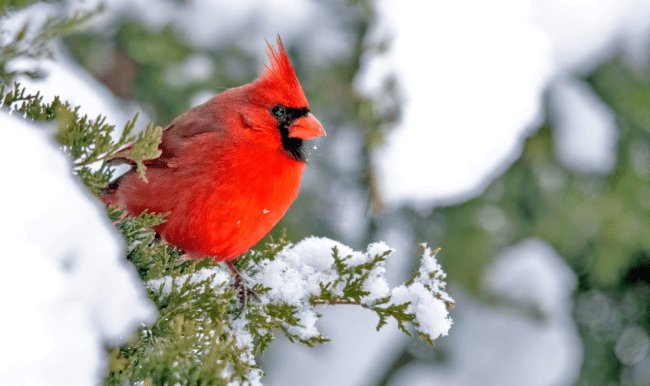
CARDINAL IN WINTER SNOW (All About Birds / Brad Imhoff photo credit)

What wonderful birds! What beauty the Lord built into these winged wonders!

The Cardinal is a favorite bird of many people and it’s easy to see why. The brilliant scarlet plumage of the male and the subtle shades of the female, combined with their clear melodic song, make them enjoyable to watch in any season.  Male and female Cardinals sing equally well, a fact not generally known by those used to the widespread [yet erroneous] assumption that only male birds sing. Song is an important coordinating behavior in the life of a Cardinal. . . . In countersinging, one bird will sing one phrase several times and then the other [cardinal] will match it. Then the leader will sing a new phrase and the other will again match it. This type of countersinging that involves copying [musical] phrases functions to synchronize and unify members fo a pair; and when given between males, helps settle territorial disputes. [Quoting Donald Stokes & Lillian Stokes, “Northern Cardinal”, A GUIDE TO BIRD BEHAVIOR, volume II (Boston, MA: Little, Brown & Company), page 247]

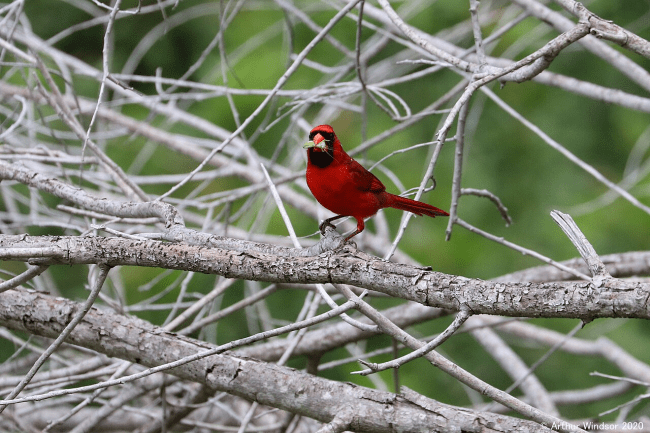
CARDINAL with grasshopper (Wikipedia / Arthur Windsor image credit)

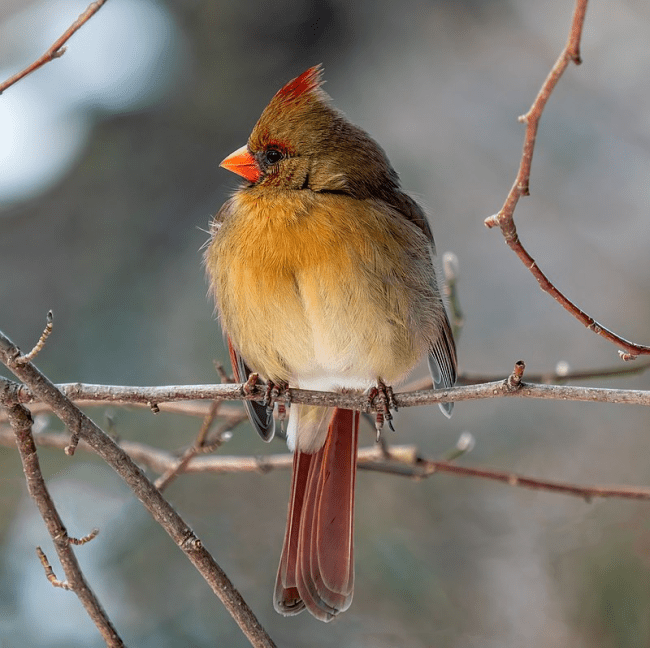
The Cardinal males are so brightly colored, with crimson-red wings and scarlet-red bellies, contrasting with black face-masks that showcase their red beaks. Female cardinals also have bright scarlet-red beaks, yet they are more camouflaged in their plumage hues—soft beige-cream bellies with russet-brown wings and head feathers, accented by reddish crests.

female Cardinal (Wikipedia / Rhododendrites photo credit)

Cardinals are year-round residents—they don’t migrate to avoid cold winters. Rather, cardinals tough out winter weather—hence many scenic photographs display bright-red cardinals perched in tree branches against backdrops of snow-drifts. What beautiful pairs they are, to see in December, braving cold winds and chilly rains or snowfall. 

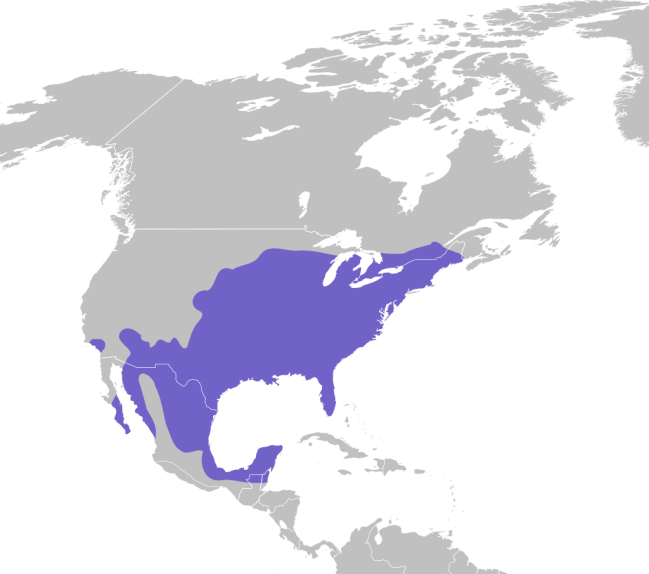
NORTHERN CARDINAL RANGE MAP (Wikipedia image credit)

So, as you journey through winter months, remember that there are times when you should stop being so busy, just long enough to gaze upon busy cardinals that flit about, outside, sharing with us overlapping bits of space and winter weather. 

Thank You, God, for the cardinals.

Thankful for Turkeys (and Turkey Vultures)

Dr. James J. S. Johnson

 For the invisible things of Him [i.e., the God of the Bible] from the creation of the world are clearly seen, being understood by the things that are made, even His eternal power and deity; so that they are without excuse [αναπολογητους]; because that, when they knew God, they glorified Him not as God, neither were thankful; but they became vain in their imaginations, and their foolish heart was darkened. (Romans 1:20-21)

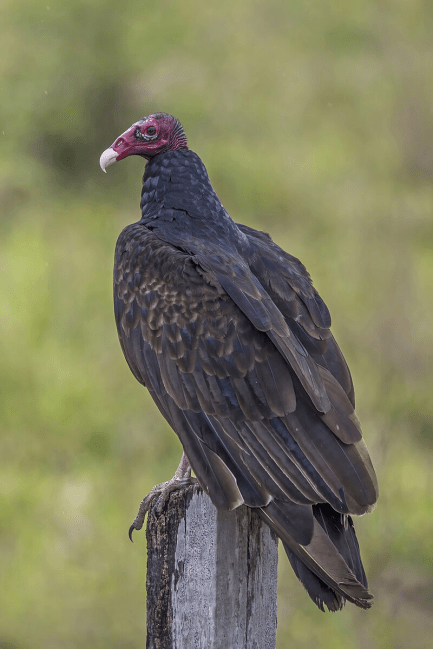
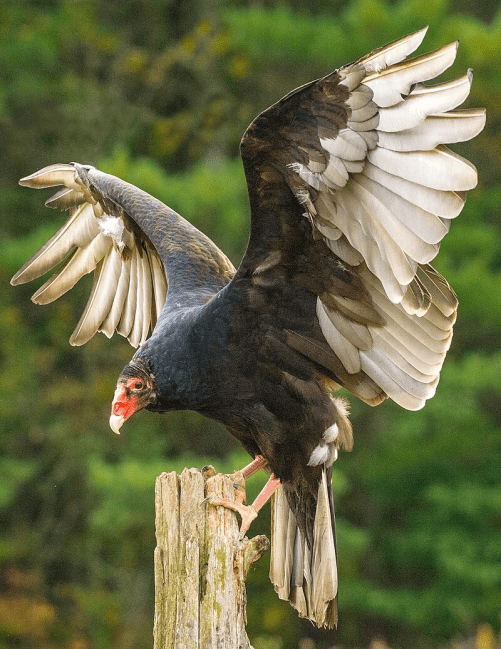
TURKEY VULTURE perching
Wikipedia / Charles J. Sharp photo credit

The two inexcusable sins, routinely committed by evolutionist fools [and notice that the term “fools” is factually appropriate, because Romans 1:21 says that “their foolish heart was darkened”], are the inexcusable failure to glorify God as the Creator He ubiquitously proves Himself to be — plus the inexcusable failure to give thanks unto Him for the uncountable blessings that He caringly and providentially provides to us all (Romans 1:18-25; Acts 14:17; Daniel 5:23; Psalm 14:1).

Meanwhile, speaking of giving thanks, Thanksgiving is fast approaching; many folks are thinking about the American Turkey. See “Strangers and Pilgrims (and the American Turkey)”, posted at https://leesbird.com/2014/11/25/strangers-and-pilgrims/ .

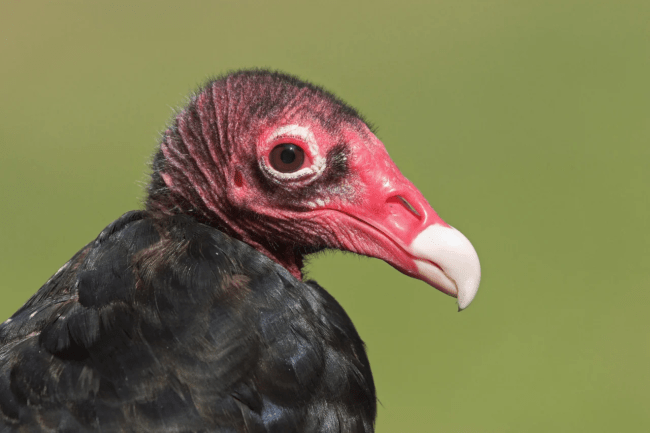
TURKEY VULTURE “beauty contest” mugshot
HighlansCenter.org / Felipe Guerrero photo credit

But what about another large bird that we often see, the Turkey Vulture? This scavenger, known scientifically as Cathartes aura, is actually a very valuable neighbor in whatever habitat they inhabit.

Turkey vultures are most interesting creatures.  One can tell, just by looking at them, that they are well-suited to their task as disposers of dead things.   Their beaks and feet lack the power and the design for killing living things, though their hooked beaks allow them to free the last shred of meat clinging to a carcass.  Their heads are completely featherless, which makes it easier to clean them of bacteria and parasites encountered while rooting around in dead carcasses.  Turkey vultures nest on crags, caves and clefts in rock piles.  They don’t bother to build a nest.  The female lays her two brown, mottled eggs on the bare ground and incubates them for forty-one days.   When the babies hatch, they are fed exclusively on a diet of regurgitated carrion.   (Yumm!??) These birds sound totally disgusting, right?  Actually, they are quite impressive.  They are a very large bird—males and females are quite similar in appearance, with shiny black feathers.  They have a wingspan of up to six feet, and the underside tips of their flying feathers are greyish white.  When they are observed soaring aloft on the thermals, they are quite beautiful indeed, and beauty is in the eye of the beholder. [Quoting Sandy Stoecker, Highlands Center for Natural History naturalist]

But, how did the Turkey Vulture get its valuable role in the so-called “circle of life” neighborhood (i.e., within the dynamic life-and-death ecosystem of this fallen (i.e., good-yet-“groaning”-with-sin and-death) world? The fallenness of our world is thanks to Adam (Romans 5:12-21); however, the gift of life–from the beginning–plus the providential and redemptive sustaining of life in this fallen world–is thanks to our Lord Jesus Christ, Who is both the life-giving Creator (John 1; Colossians 1; Hebrews 1) and the life-restoring Redeemer (Romans chapter 8, especially Romans 8:21-23).

 Because the creature itself also shall be delivered from the bondage of corruption into the glorious liberty of the children of God. For we know that the whole creation groaneth and travails in pain together until now. And not only they, but ourselves also, which have the firstfruits of the Spirit, even we ourselves groan within ourselves, waiting for the adoption, to wit, the redemption of our body. (Romans 8:21-23)

TURKEY VULTURE in Canada
Wikipedia / Peter Burian photo credit

It’s not by good luck that turkey vultures can find rotten carrion, gobble it down, and not die of food poisoning. Vultures have powerful senses of sight and smell; they detect dead animals from afar. Equipped by God for scavenging in this fallen world, they serve as garbage collectors/processors, picking apart and eating roadkill and other carcasses.

Why don’t they get sick or die of botulism? The acidity of vultures’ digestive tracts is astounding. The digestive juices in their stomachs can reach a pH between 1.5 and 1.0, more corrosive than car battery acid and caustic enough to instantly denature to death almost any bacterial or viral pathogen! [Chen, Y. et al. 2023. Vultures as a Model for Testing Molecular Adaptations of Dietary Specialization in BirdsAvian Research. 14: 100128; Buechley, E. R. and C. H. Sekercioglu. 2016. VulturesCurrent Biology. 26 (13): R560–R561. Genesis 15:11 reports on carrion-seeking birds whose behavior resembles that of vultures.]

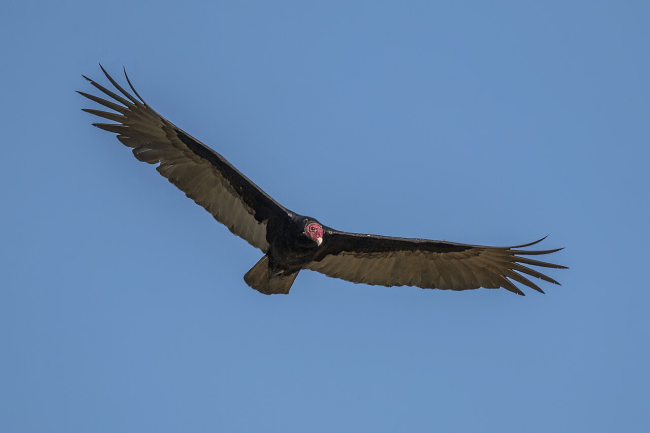
TURKEY VULTURE soaring
Wikipedia / Charles J. Sharp photo credit

In other words, if the vultures’ Creator had not constructed their stomachs with such germ-destroying acidity, the vultures themselves would quickly become dead meat. These built-in (and interactively dynamic) habitat-fitting traits utilize what Dr. Randy Guliuzza calls “continuous environmental tracking”, linked to providentially installed equipment that adjust to the outside world that the vultures live in. God’s providence is thus obvious to — and logically recognized by — honest observers, because God’s glorious craftsmanship is what the apostle Paul calls “clearly seen” (Romans 1:20).

For in-depth analysis of these providential bioengineering wonders (illustrated by God’s amazing creatures), see Dr. Randy Guliuzza’s series on Exploring Adaptation from an Engineering Perspective, posted (e.g.) at http://www.icr.org/article/exploring-adaptation-from-engineering-perspective//1000 — which introduces the truth-seeking reader to Dr. Guliuzza’s series, posted at http://www.icr.org/home?f_search_type=icr&f_keyword_all=&f_keyword_exact=Engineered+Adaptability&f_keyword_any=&f_keyword_without=&f_search_type=articles&f_articles_date_begin=5%2F1%2F2017&f_articles_date_end=12%2F31%2F2019&f_authorID=203&f_typeID=11&section=0&f_constraint=both&f_context_all=any&f_context_exact=any&f_context_any=any&f_context_without=any&module=home&action=submitsearch .

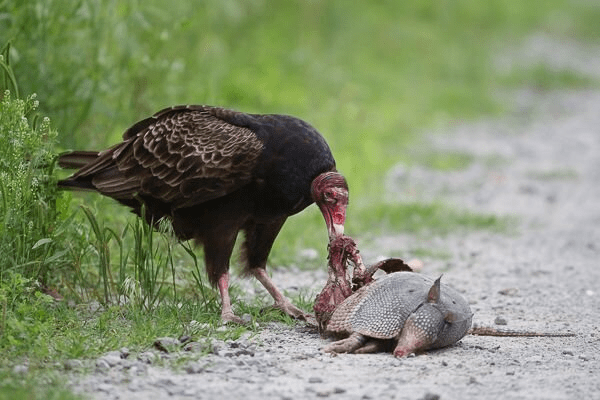
TURKEY VULTURE scavenging dead armadillo
Sound View Camp photo credit

Meanwhile, it’s sad that arrogant evolutionists, like Joel Duff, are self-blinded to these clearly seen Christ-honoring wildlife ecology facts, but they show themselves as self-blinded, habitually, “without excuse” [αναπολογητους] — see Romans 1:18-25 (especially Romans 1:20.)

But, for those with eyes to see it, we can enjoy God’s brilliant bioengineering displayed in Turkey Vultures — and also in the American Turkey — as we approach Thanksgiving with an attitude of gratitude.

Tundra Swans Return, in November, to Chesapeake Bay

Swans Return, in November, for Chesapeake Bay Over-wintering

Dr. James J. S. Johnson

To every thing there is a season, and a time to every purpose under the heaven . . . .  He hath made every thing beautiful in his time; also He has set the world in their heart, so that no man can find out the work that God makes from the beginning to the end. (Ecclesiastes 3:1 & 3:11)

TUNDRA SWANS as “Winter Marylanders”
(Will Parson/Chesapeake Bay Program photo credit)

Seasons come and seasons go, demonstrating the faithfulness of God’s post-Flood promise to Noah and Noah’s Ark passengers:

While the earth remains, seedtime and harvest, and cold and heat, and summer and winter, and day and night shall not cease. (Genesis 8:22)

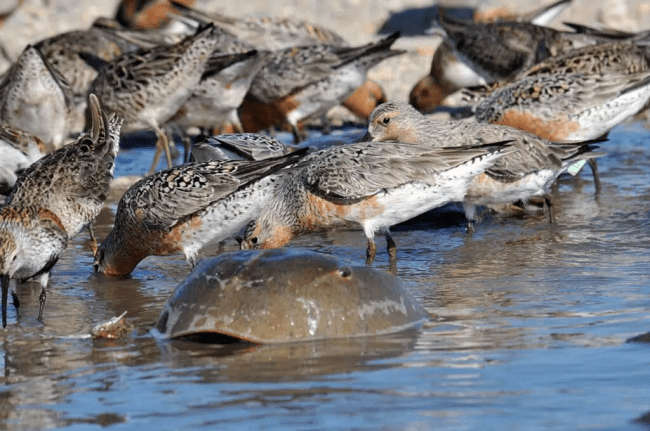
RED KNOTS eating horseshoe crab eggs
(USF&WS / Gregory Breese photo credit)

Only a half-year ago the May migrants were blanketing shorelands of the Delmarva [Delaware-Maryland-Virginia] Peninsula, and other parts of the the Chesapeake Bay’s watershed shorelands, here and there:

In May we were tramping the saltmarshes and beaches of the lower Delmarva Peninsula with biologists from the Nature Conservancy, collecting vital data on a variety of shorebirds, from willets to whimbrels, plovers to dunlins, red knots to ruddy turnstones. Some, like the curved-beaked whimbrels, may be airborne without stopping for up to five days, arriving at the lush marshes and mudflats of our region famished from their winter haunts in South America. For several weeks they will refuel here, nonstop, chowing down on fiddler crabs. Then, one spring evening, something in them stirs, and they are aloft by the thousands, not to alight before reaching breeding grounds that stretch from Hudson Bay to far northwest Canada’s Mackenzie River Delta. [Quoting Tom Horton, CHESAPEAKE BAY JOURNAL, 34(5):30 (July -August 2024).]

But now, in November, the phenological reverse occurs — because, during May (and earlier), migrant birds fly northward, to seek out their summer breeding grounds; whereas, during November (and earlier), migrant birds are flying southbound, leaving their breeding grounds behind, as they emigrate by air to their over-wintering grounds.

Come this autumn we’ll be on Deer Creek on the Susquehanna River . . . [including] days in the wet and snow over the winter, filming tundra swans, one of the largest long-distance migrators of the bird world. They [i.e., tundra swans] spend a good portion of their lives on the wing, moving from breeding grounds across Alaska’s North Slope and the Yukon each fall into the Chesapeake and North Carolina — a 9,000-mile round trip. . . . . In November, not long after the last monarch [butterfly, emigrating southward to Mexico] has passed through, and as the silver eels [migrating snake-shaped ray-finned fish] stream from the Chesapeake’s mouth toward Sargasso depths, there will come the lovely, wild hallooing of “swanfall” — the descent of the tundra swans from on high to grace our winter. [Quoting Tom Horton, CHESAPEAKE BAY JOURNAL, 34(5):30 (July -August 2024).]

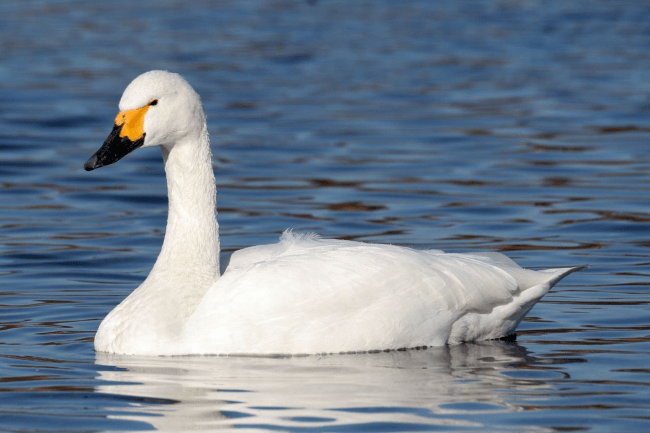
TUNDRA SWAN (Wikipedia / Maga-chan photo credit)

Tundra swans — they are huge [some would say “yooge”] geese-like birds.

So, what kinds of waterfowl are phenologically (and providentially) programmed, by the Lord Jesus Christ, to winter in ice-free estuaries like the Chesapeake Bay? 

“Duck, duck, goose!”—and swans (such as Tundra Swans), just to name the most obvious.  For example, Tundra Swans—being “yooge” birds—are easy to observe, especially if they are afloat in waters of an estuarial (or lacustrine) habitat that you may be visiting.

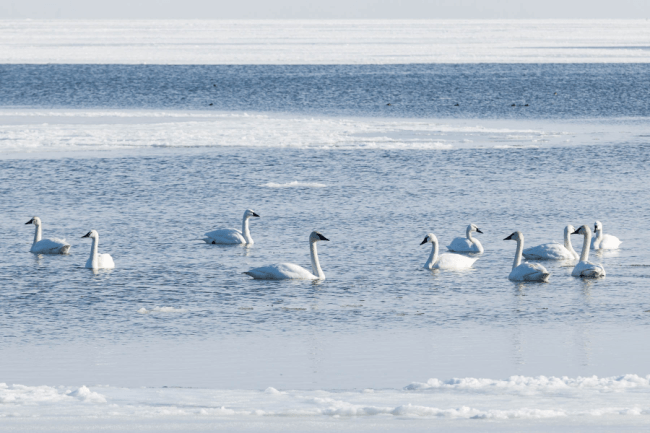
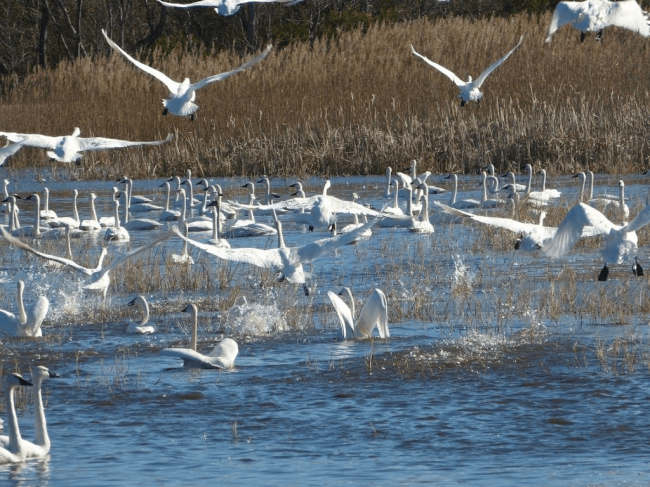
TUNDRA SWANS in North Carolina
(USF&WS photo / public domain)

Swans are the largest waterfowl, and the tundra swans travel the farthest, more than 4,000 miles in some cases. They winter primarily on the Delmarva [Delaware-Maryland-Virginia] Peninsula and the estuarine edges of North Carolina. These large white birds are easily recognized by their black bills and straight or nearly straight necks. Tundra swans often form flocks on shallow ponds. [Quoting Kathy Reshetiloff, “Chesapeake’s Abundance Lures Wintering Waterfowl”, CHESAPEAKE BAY JOURNAL, 33(9):40 (December 2023), posted at http://www.bayjournal.com/columns/bay_naturalist/chesapeake-s-abundance-lures-wintering-waterfowl/article_4463317a-887f-11ee-a208-8768dc34c5a7.html .]

Wow! — what a wonder these wintering waterfowl are!

Or, more appropriately said, Hallelujah! — what a treasure of phenological providence these wonderful waterbirds are, showing God’s handiwork and caring kindness for His own creatures. May God bless them all, as they faithfully do their respective parts to “be fruitful, and multiply upon the earth” (Genesis 8:17).

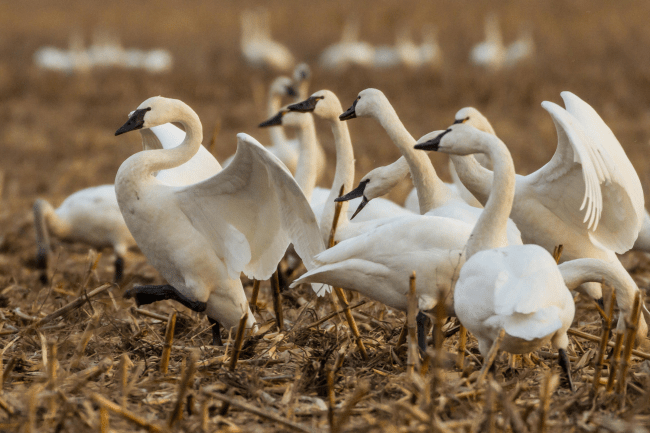
TUNDRA SWANS
(Audubon Field Guide photo credit)

CROWS SOMETIMES EAT ROADKILL

Dr. James J. S. Johnson

Consider the ravens [κορακας], for they neither sow nor reap; which neither have storehouse nor barn; and God feedeth them: how much more are ye better than the fowls?  (Luke 12:24)

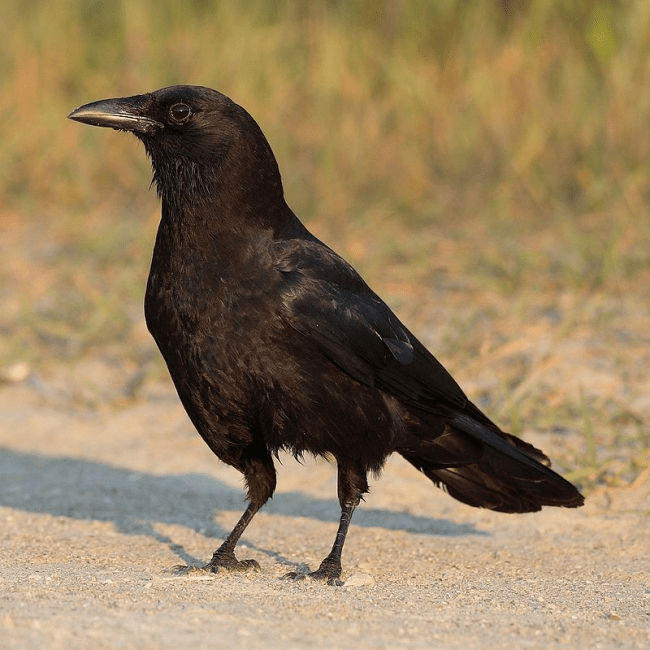
AMERICAN CROW (Wikipedia photo credit)

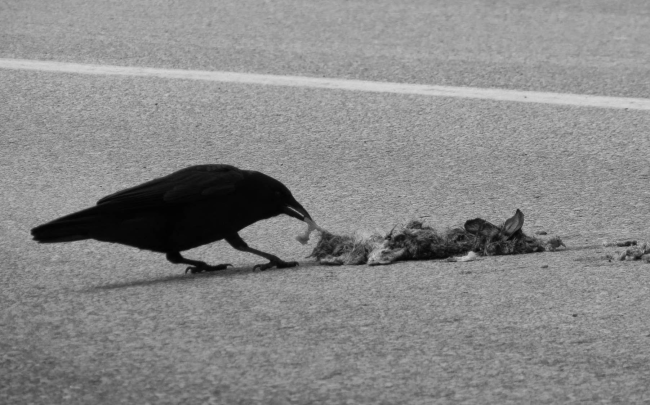
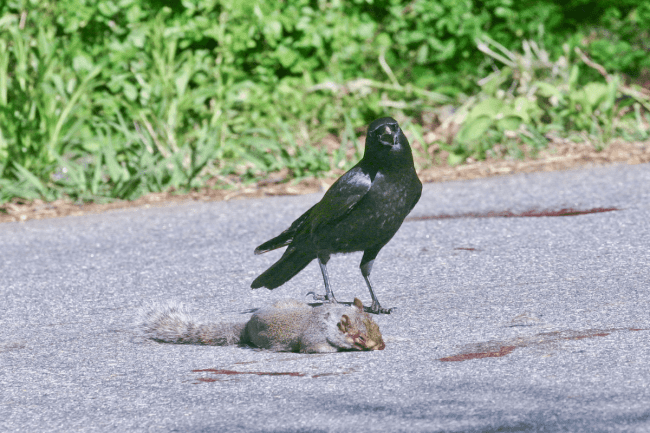
Ever seen a crow [Corvus brachyrhynchos] on a road, struggling to consume roadkill?  Yesterday I approached a crow in the road, as I was commuting—the crow was struggling to pull edible portions of meat from roadkill—it looked like a squirrel. 

CROW EATING SQUIRREL ROADKILL
r/crowbro / reddit.com photo credit

Like the Holy Land’s ravens [Corvus corax] who are mentioned by the Lord Jesus Christ Himself (in Luke 12:24), crows are famously opportunistic eaters – and their potential food sources include the cadavers of dead rodents, such as squirrels who (sadly) become roadkill in tree-populated suburban streets. 

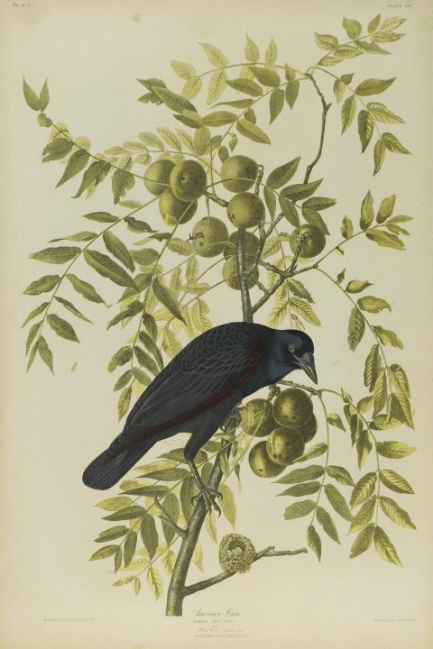
AMERICAN CROW
(J. J. Audubon painting / public domain)

The crow that I saw, yesterday morning, was struggling so, to get some edible parts of the roadkill, that he (or she) did not see my car approaching—which could result in the roadkill-eating crow himself (or herself) soon becoming another example of roadkill! 

So, of course, I tooted my car’s horn, with the jolting noise scaring the crow – so the crow quickly (and safely) flew away, thus escaping a roadkill fate. After my car passed through that part of the boulevard, happily, the hungry (and still living) crow returned to its roadkill meal. 

Sometimes a little “beep, beep” is all that is needed to “save the day” (for a crow)!

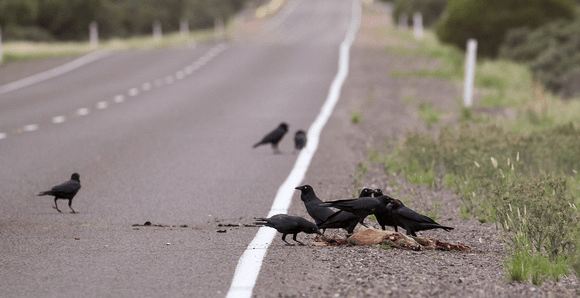
CROWS EATING ROADKILL
WarangaUnitingChurches.net.au photo credit

So, with that incident in mind, here is a limerick:

WHEN EATING ROADKILL, DON’T BECOME ROADKILL YOURSELF

While I drove, one day, on a street

I neared a crow, trying to eat

Tugging at roadkill

But I had goodwill

So I braked, with warning: beep, beep!

><> JJSJ profjjsj@aol.com

Beware, frisky squirrels, else you become roadkill. 

Beware, too, ye crows – because it could happen to you, too!

CROW WITH ROADKILL SQUIRREL
Nature-Blog-Network photo credit

Bufflehead Ducks’ Dependable Migration Timing

BUFFLEHEAD DUCKS’ DEPENDABLE MIGRATION TIMING

Dr. James J. S. Johnson

Seest thou a man diligent in his business? he shall stand before kings; he shall not stand before mean men.  (Proverbs 22:29)

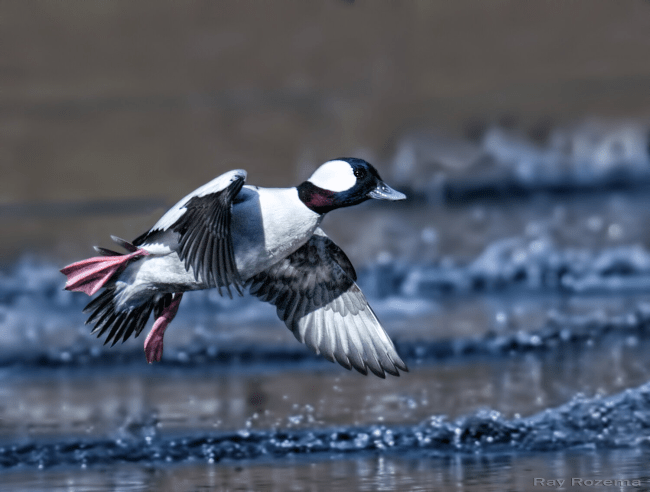
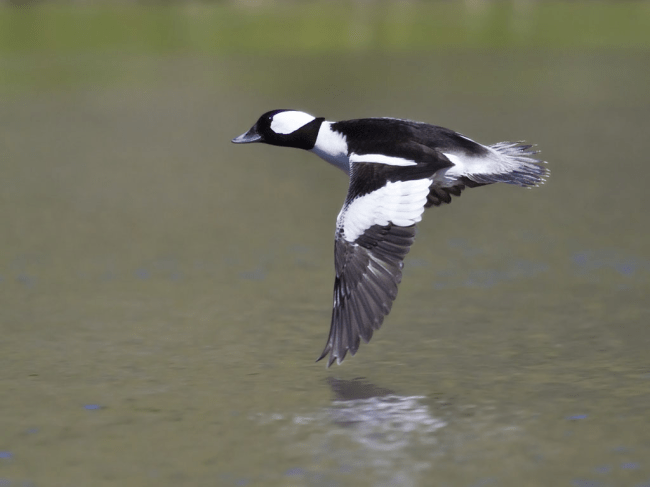
BUFFLEHEAD IN FLIGHT
Sacramento Audubon Society / Ray Rozema photo credit

When I think of Bufflehead ducks (Bucephala albeola), I am reminded of the authoritative advice (“words of the wise”) of Proverbs 22:29, regarding reputations for dependable “diligence”.  Why?

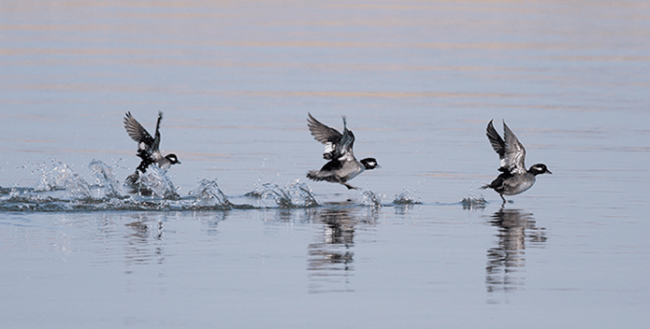
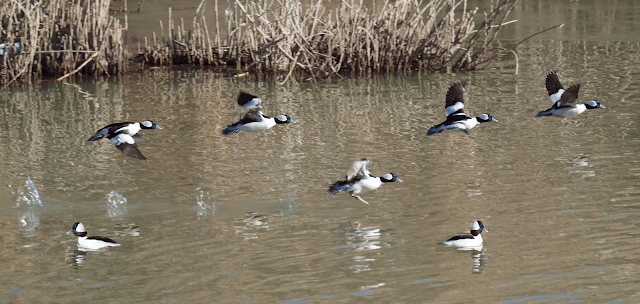
BUFFLEHEADS in migration
Jonathan Maher Kresge / Chesapeake bay Foundation photo credit

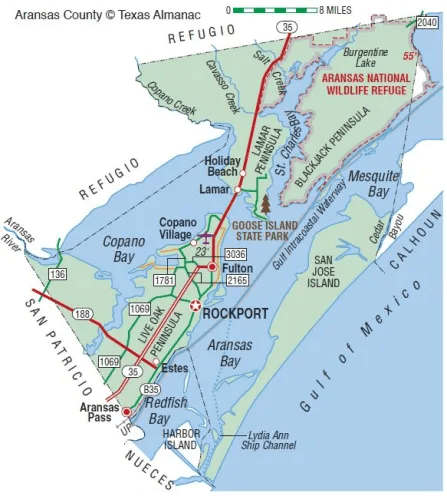
The first time that this author observed a Bufflehead, in the wild, was on March 11th of A.D.1996, while visiting the Texas Gulf Coast’s Aransas Bay (which is protected as Aransas Bay National Wildlife Refuge), as part of ornithological research (eventually) leading to a doctoral degree in creation science (applied to wildlife ecology). [See “Bufflehead Duck, One of Diverse Divers at Aransas Bay” (posted at https://leesbird.com/2018/01/26/bufflehead-duck-one-of-diverse-divers-at-aransas-bay/ .]

ARANSAS BAY MAP
Aransas County in TEXAS ALMANAC image credit

What conspicuously beautiful ducks those Buffleheads were (and are)!

BUFFLEHEAD DUCK in flight
Bill Bouton photo credit

Consider the reputation that the Bufflehead duck has, for dependability punctuality, as was recently observed by Alonso Abugattas, the Chesapeake Bay area’s “Capital Naturalist”:

The bufflehead is nothing if not punctual.  Few other ducks are known to arrive in our neighborhood every winter within a few delays of the date they arrived the previous year.  The smallest of North America’s diving ducks, the bufflehead … [can] nest in the tree cavities of woodpeckers, most commonly northern flickers, according to Canadian zoologist Gilles Gauthier. . . . .

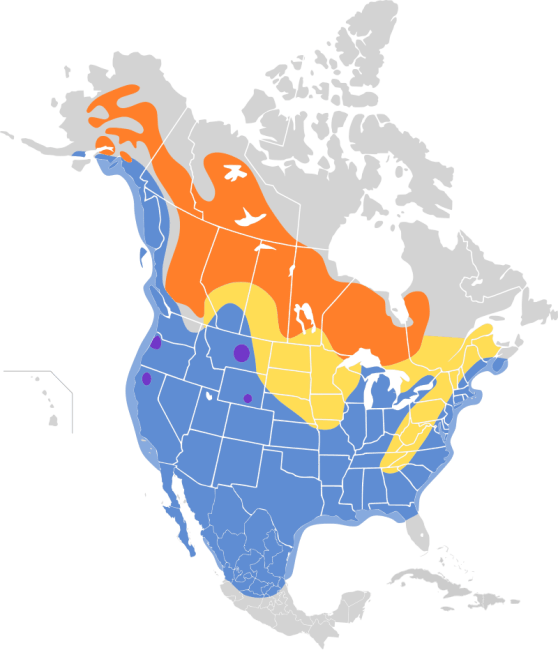
After forming their pair bonds over the winter, the birds head back to their breeding grounds in early April and early May, migrating at night. They’re among the last ducks to leave their winter territory.  The greatest concentration of breeding grounds, according to abundance maps maintained by the Cornell Lab of Ornithology, are in northwestern Canada, in a wide swath crossing through Saskatchewan, Alberta and Northwest Territory… petering out in Alaska. . . .

Buffleheads start leaving [their breeding grounds] for the wintering grounds in October, settling mostly across [the U.S.A.’s Lower 48] but sometimes going as far [south] as Central America.

[Quoting CHESAPEAKE BAY JOURNAL, 34(8): 39 (November 2024).]

BUFFLEHEAD RANGE MAP
(Cephas / BirdLife Internat’l / Wikipedia image credit)

So much for the Bufflehead’s predictable-because-dependable migration movements. 

Yet is there a lesson for us humans, as we consider the Bufflehead’s phenological reliability?  Yes, there is – especially if we look at the details of Proverbs 22:29.

BUFFLEHEADS in wetland habitat
Robert Mortensen / BirdingIsFun.com composite photo credit

Of course, it is good to earn a reputation for dependable punctuality. In fact, that is similar to having a reputation for quickly fulfilling one’s responsibility — as opposed to having a reputation for dilatory procrastination.  Some folks can be expected to do sloppy work – who needs that kind of “help”?

Yet other folks are famous for delivering extremely careful (almost perfectionist) work, but only in an all-too-often impractically slow response time, so slow that the perfectionist work is of diminished practical value (because the need for timely results was compromised and disappointed).

How is all that relevant to understanding Proverbs 22:29?  That proverb is translated into English as follows:

Seest thou a man diligent in his business? he shall stand before kings; he shall not stand before mean men.  (Proverbs 22:29)

In that sentence the phrase “man diligent” is a translation of ’îš mâhîr, with ’îš being a generic word for “man”—but what does the Hebrew word mâhîr (translated as “diligent” in the KJV) mean?

Consider that the masculine singular adjective mâhîr is translated by several English words in our English Bible.  For example, mâhîr is translated “ready” in Ezra 7:6 and also in Psalm 45:1 (which is Psalm 45:2 in Hebrew verse numbering]). Also, mâhîr is translated “hasting” in Isaiah 16:5.  But there is more to consider, because Hebrew adjectives are routinely related in meaning to similarly spelled nouns, verbs, and/or adverbs. 

Therefore, to better understand what the Hebrew adjective mâhîr means, in Proverbs 22:29, consider also the following (non-exhaustive) listing of illustrative (etymologically related) verbs and adverbs:

ROOT VERB mâhar

“hasten”, “haste”, “make haste”, etc. (Genesis 18:6-7 & 19:22 & 24:18,20,46 & 41:32 & 43:30 & 45:9,13; Exodus 34:8; Joshua 4:10 & 8:14,19; Judges 9:48 & 13:10; 1st Samuel 9:12 & 17:48 & 23:27 & 25:18,23,34,42 & 28:24; 1st Kings 20:41 & 22:9;  2nd Kings 9:13; 2nd Chronicles 24:5; Esther 5:5 & 6:10; Psalm 16:4; Proverbs 1:16 & 7:23; Isaiah 49:17 & 51:14 & 59:7)

“make ready quickly” (Genesis 18:6)

“make speed” (2nd Samuel 15:14)

“fetch quickly” (2nd Chronicles 18:8)

RELATED MASCULINE ADVERB mahêr

“quickly” (Exodus 32:8; Deuteronomy 9:3,12[twice],16 & 26:20; Joshua 2:5; Judges 2:17,23)

“speedily” (Psalm 69:17 [69:81 in Hebrew verse numbering] & 79:8 & 102:2 [102:3 in Hebrew verse numbering]; 143:7)

“hastily” (Judges 2:23; Proverbs 25:8)

“suddenly” (Deuteronomy 7:4)

RELATED FEMININE ADVERB mehêrâh

“quickly” (Numbers 16:46 [17:11 in Hebrew verse numbering]; Deuteronomy 11:17; Joshua 8:19 & 10:6 & 23:16; 2nd Samuel 17:16,18,21; 2nd Kings 1:11; Ecclesiastes 4:12)

“hastily” (Judges 9:54)

“speedily” (Psalm 31:2 [31:3 in Hebrew verse numbering]; Ecclesiastes 8:11; Isaiah 58:8)

“swiftly” (Psalm 147:15)

[See generally George V. Wigram’s ENGLISHMAN’S HEBREW CONCORDANCE OF THE OLD TESTAMENT (Hendrickson’s 2001 reprint of the 1874 London-published 3rd edition), page 669.]

The listing above is incomplete—but the pattern is already clear—the adjective mâhîr denotes the trait of being speedy, swift, quick!  

RAPIDLY RUNNING A RACE!
Scottish Gov’t / Parent Club photo credit

In other words, a person who consistently and dependably does his or her work fastly is appreciated—and (eventually) will “stand before kings” (i.e., not be limited to serving before low-ranking individuals).

So, just as the phenological punctuality of the returning-from-winter Bufflehead duck is dependably predictable (as is also the migratory return of Israel’s faithful stork—see www.icr.org/article/lesson-from-stork — which is noted in Jeremiah 8:7), a truly diligent human will be prompt (i.e., give quick turnaround) in his or her work responsibilities. 

Careful work is appreciated, yes, but only if it is contextually timely. Promptness is really appreciated! 

><> JJSJ  profjjsj@aol.com  😊

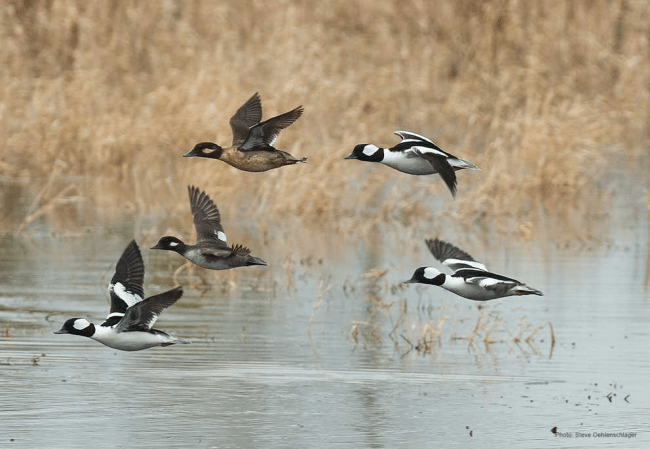
BUFFLEHEADS in flight
Ducks Unlimited photo credit

MIGRATORY STOPOVER FOR CANADA GEESE

Dr. James J. S. Johnson

Yea, the stork in the heaven knows her appointed times; and the turtledove and the crane and the swallow observe the time of their return; but My people know not the judgment of the LORD. (Jeremiah 8:7)

The Bible mentions migratory birds – for examples, storks, turtledoves, cranes, and swallows are mentioned as faithfully migratory birds in Jeremiah 8:7.  (See JJSJ’s “A Lesson from the Stork”, at http://www.icr.org/article/lesson-from-stork .)

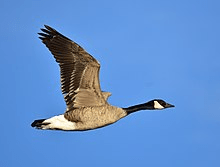
CANADA GOOSE in flight (Wikipedia photo credit)

Avian migrations are truly a wonderful recurrence in God’s phenological providences. 

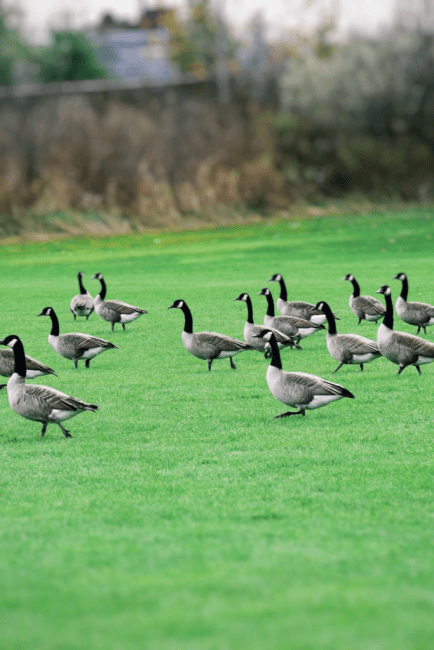
With that in mind, I observed a flock of Canada geese (Branta canadensis) in my neighborhood, not far from my mailbox—they were grazing among the grasses by my rain-runoff drainage ditch. 

CANADA GEESE IN GRASS
(HumaneActionPittsburgh.org photo credit)

But not long afterwards they were off again, in the air, southbound, toward wherever they go for winter.  Today’s limerick follows.

OBSERVING 18 CANADA GEESE: MIGRATORY STOPOVER VISITORS

A migrant flock came by today

The flock intact, none gone astray;

Slowly grazing geese,

Dawdling and obese;

Then they returned to their flyway.

(JJSJ, November 4th A.D.2024, near Flower Mound, Texas.)

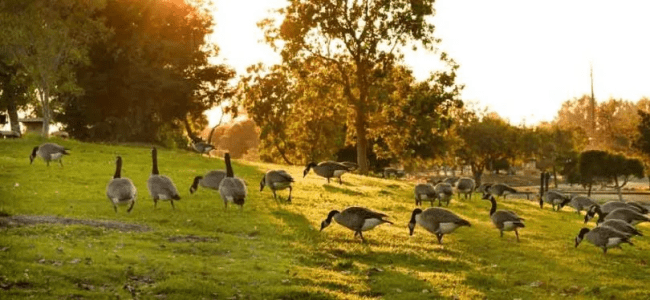
CANADA GEESE IN YARD
(TriangleGardener.com photo credit)