Ian’s Bird of the Week – Red-necked Phalarope

Red-necked Phalarope (Phalaropus lobatus) by Ian

Red-necked Phalarope (Phalaropus lobatus) by Ian

Ian’s Bird of the Week – Red-necked Phalarope ~ by Ian Montgomery

Newsletter – 01-13-11

I had an inquiry from my sister, Colette, in Ireland recently about Red-necked Phalarope (some appeared in breeding plumage at a potential breeding site there last northern summer), so it was floating around in my mind yesterday when I considered what to share with you this week. It’s a dainty and interesting wader, like its cousin the Red/Grey Phalarope which featured as bird of the week after my trip to Alaska in 2008.
Red-necked Phalarope (Phalaropus lobatus) by Ian

Red-necked Phalarope (Phalaropus lobatus) by Ian

The three species of Phalarope (Wilson’s is the third) breed in high latitudes in the northern hemisphere so Ireland is at the southern edge of its potential range (there was a colony of up to 50 pairs there in the early part of the 20th century). Despite their delicate appearance and toy-like behaviour when bobbing around picking up plankton from the surface of water, these are tough little birds and the Red-necked, 19cm/7.75in in length with a wing-span of 38cm/15in is the smallest of the three. Their favourite nesting sites are on small ponds in the northern tundra and outside the breeding season they are normally pelagic wandering far and wide over the oceans of the world in search of food.
Red-necked Phalarope (Phalaropus lobatus) by Ian

Red-necked Phalarope (Phalaropus lobatus) by Ian

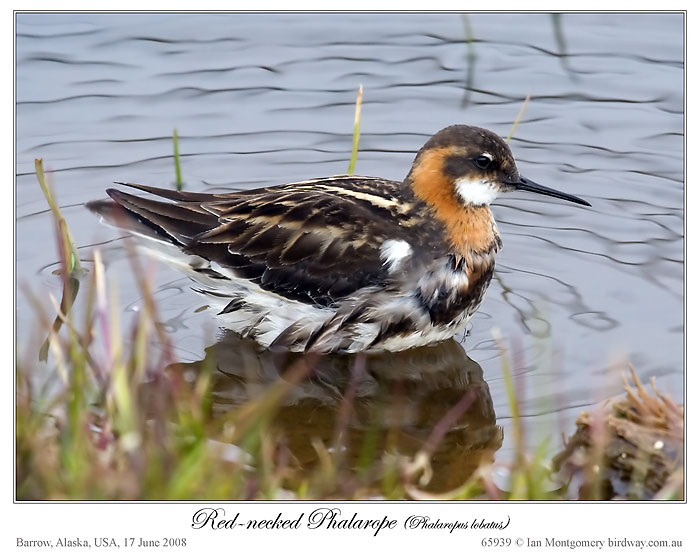
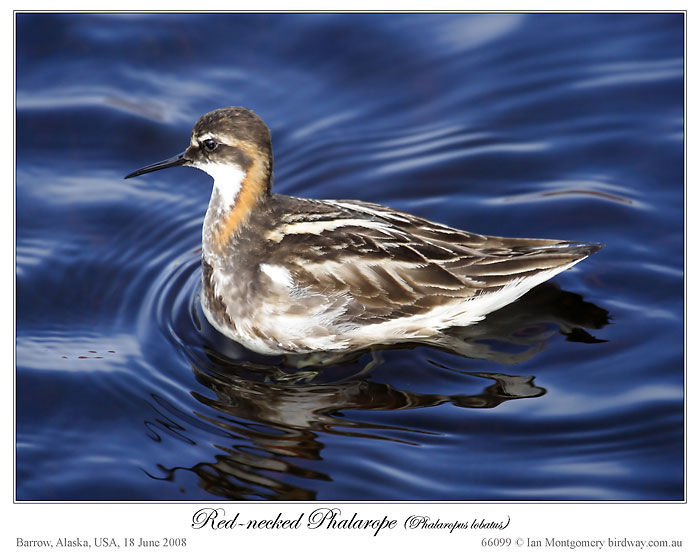
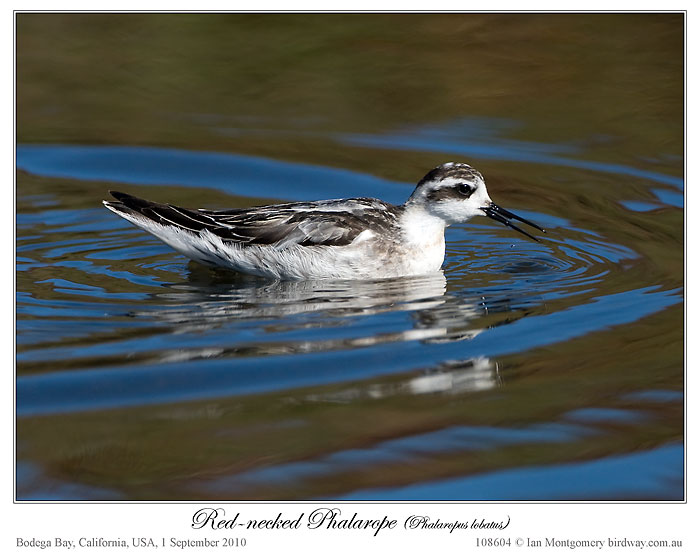
Like the Red/Grey (summer/winter) Phalarope, the Red-necked shows a reversal in sex roles, with the brighter females courting the males, having multiple partners and leaving the males to incubate the eggs and look after the young. There is though to be a selective advantage in the females being able to lay as many eggs as possible in the brief breeding season of high latitudes. The first photo shows the brighter female, the second the smaller and more subdued – in more ways than one – male.
Red-necked Phalarope (Phalaropus lobatus) by Ian

Red-necked Phalarope (Phalaropus lobatus) by Ian

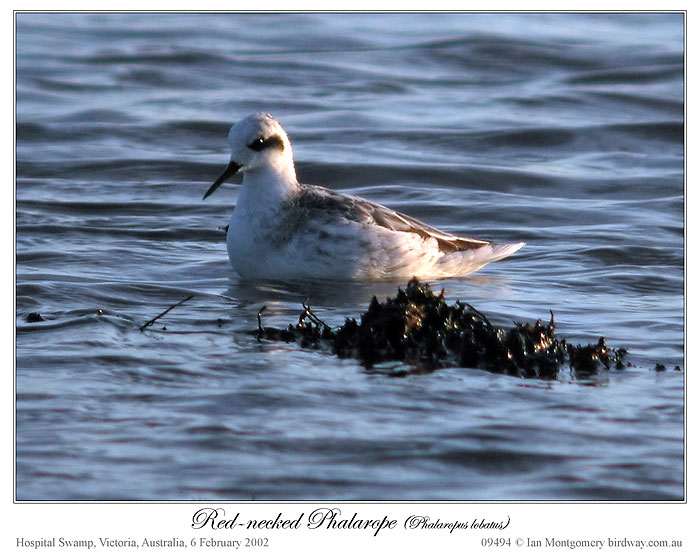
In non-breeding plumage all three species have mainly grey and white plumage. The Red-necked has a black, downturned eye-patch – see the third photos – and, visible in flight, wing bars (lacking in Wilson’s) and dark underwing marking. All three species turn up rarely in Australia in the non-breeding season, particular following storms when drive them into bays for shelter or inland. The Red-necked is the least rare of the three and the fourth photo shows one that turned up on the Bellarine Peninsula south-west of Geelong, Victoria in 2002.

On the website, I’ve started altering the sequence of the next and previous family pointers of the Australian family thumbnail pages so that they follow the sequence of Christidis and Boles (2008) – rather than that of Birdlife International – and only include families that occur in Australia. The intention is to create a ‘green’ Australian zone for visitors who are interested only in Australia birds. A green background already distinguishes the Australian thumbnails and I’m adding background colours to pointer arrows and alphbetical index pages to highlight the distinction. You might like to visit the news section of the home page http://www.birdway.com.au/#news and the Australian index http://www.birdway.com.au/australianbirds.htm to see the difference and to find links to examples.
So far I’ve changed the families from Cassowaries http://www.birdway.com.au/casuariidae/index_aus.htm (the first) as far as Plovers and Lapwings http://www.birdway.com.au/charadriidae/index_aus.htm and will progressively work through the rest. That will be delayed for a week as I’m now in northern NSW en route to Armidale, flooded roads permitting, for a recorder course. Fortunately, given the floods, I had already shelved plans to drive down and flew to the Gold Coast yesterday.
Other website additions include a few more snakes and a couple of photos of Greater Frigatebirds .
Best wishes,
Ian

Ian Montgomery, Birdway Pty Ltd,
454 Forestry Road, Bluewater, Qld 4818
Phone: +61-7 4751 3115
Preferred Email: ian@birdway.com.au
Website: http://birdway.com.au

Lee’s Addition:

Ian has introduced another neat bird. As Ian mentioned, there are three Phalaropes and all of them are here in the United States, though I have not had the privilege of seeing them.

“A phalarope is any of three living species of slender-necked shorebirds in the genus Phalaropus of the bird family Scolopacidae. They are close relatives of the shanks and tattlers, the Actitis and Terek Sandpipers, and also of the turnstones and calidrids. They are especially notable for two things: their unusual nesting behavior, and their unique feeding technique.” (These are in the Charadriiformes Order)

Two species, the Red Phalarope (Phalaropus fulicarius, called Grey Phalarope in Europe) and Red-necked Phalarope (P. lobatus) breed around the Arctic Circle and winter on tropical oceans. Wilson’s Phalarope (P. tricolor) breeds in western North America and migrates to South America. All are 6–10 in (15–25 cm) in length, with lobed toes and a straight, slender bill. Predominantly grey and white in winter, their plumage develops reddish markings in summer.”

“Red and Red-necked Phalaropes are unusual amongst shorebirds in that they are considered pelagic, that is, they spend a great deal of their lives outside the breeding season well out to sea. Phalaropes are unusually halophilic (salt-loving) and feed in great numbers in saline lakes such as Mono Lake in California and the Great Salt Lake of Utah. (from Wikipedia)

You are the salt of the earth; but if the salt loses its flavor, how shall it be seasoned? It is then good for nothing but to be thrown out and trampled underfoot by men. (Matthew 5:13 NKJV)
Salt is good, but if the salt loses its flavor, how will you season it? Have salt in yourselves, and have peace with one another. (Mark 9:50 NKJV)

*
Ian’s Bird of the Week – White-tailed Kite

White-tailed Kite (Elanus leucurus) by Ian

White-tailed Kite (Elanus leucurus) by Ian

Ian’s Bird of the Week – White-tailed Kite ~ by Ian Montgomery

Newsletter ~ 1-06-11

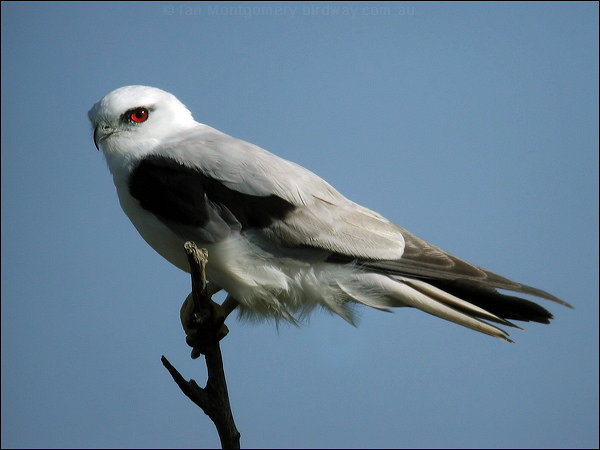
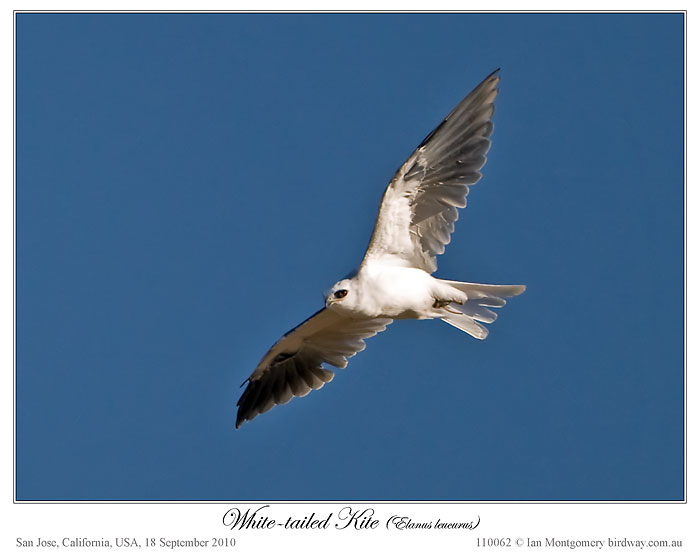
It was only when I was recently preparing this photo for the website, that I noticed that this White-tailed Kite was carrying a small mammal, probably a mouse given the location and the length of the tail, so I thought I would share it with you.

If you are an Australian birder and this bird looked very familiar – ah, a Black-shouldered Kite – you actually be very nearly right. The endemic Australian Black-shouldered (Elanus axillaris), the American White-tailed (E. leucurus) and the Old World Black-winged (E. caeruleus) Kites have been regarded as a single species in the past. Although they are now treated as separate ones, they are referred to collectively as a ‘super-species’, which, if you’re cynical, you might see as a case of taxonomists hedging their bets. The only other member of the genus Elanus worldwide is the Letterwinged Kite (E. scriptus), also an Australian endemic and a rarely seen, largely nocturnal inhabitant of the dry centre.
Black-shouldered Kite (Elanus axillaris) by Ian

Black-shouldered Kite (Elanus axillaris) by Ian

The three species differ slightly in size – the White-tailed at 15in/38cm in length is by a small margin the largest – but mainly in the pattern of the underwing. If you look carefully at this bird you can see a blackish spot on a white background near the wrist joint (the primary underwing coverts). This is longer in the Australian version and missing completely in the otherwise very similar Eurasian one. The Black-winged occurs quite widely through southeastern and southern Asia, central and southern Africa and, in small numbers in Iberia and north Africa. The White-tailed occurs in the southern USA and Central and South America.

These are elegant little kites, hover like kestrels and all feed mainly on small mammals. The Letter-winged is particularly partial to the long-haired rat, despite its scientific name Rattus villosissimus, and its population cycles follow the rat’s with the birds dispersing widely when the rat population crashes. I once saw a pair at dusk in a street in inner Sydney (Surry Hills) and you can’t get much farther from the dry interior than that.
Anyway, I’m getting off the track. Back at the website, I’ve added new photos of Australian, American White and Brown Pelicans and starting adding some snakes to the Other Wildlife section.
Links:
Best wishes,
Ian

Ian Montgomery, Birdway Pty Ltd,
454 Forestry Road, Bluewater, Qld 4818
Phone: +61-7 4751 3115
Preferred Email: ian@birdway.com.au
Website: http://birdway.com.au

Lee’s Addition:
Another neat bird from Ian. Glad to see him post because I wasn’t sure if he was being affected by the flooding in Australia.

The Kites are in the Accipitridae Family with the Hawks, Kites and Eagles. The Accipitridae are in the Accipitriformes Order which not only includes them but also the New World Vultures, Secretarybird and Ospreys.

But these are they of which ye shall not eat: the eagle, and the ossifrage, and the ospray, And the glede, and the kite, and the vulture after his kind, (Deuteronomy 14:12-13 KJV)

*

Ian’s Bird of the Week – Metallic Starling

Metallic Starling (Aplonis metallica) by Ian

Metallic Starling (Aplonis metallica) by Ian

Ian’s Bird of the Week – Metallic Starling ~ by Ian Montgomery

Newsletter: 1-2-2011

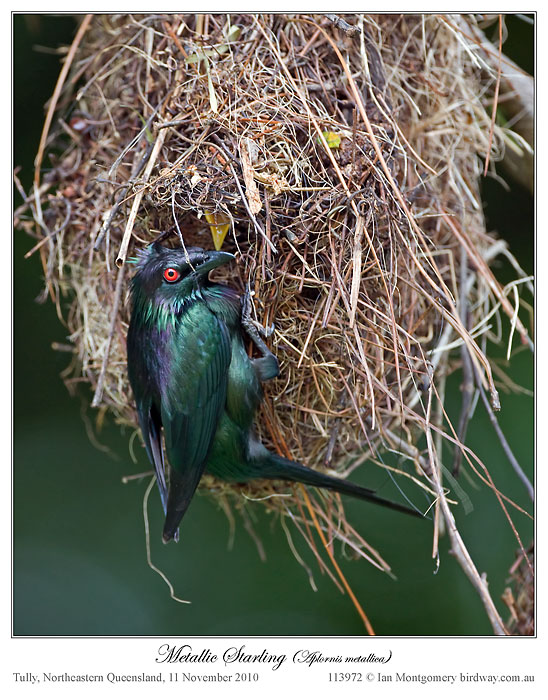
Here’s a local bird to welcome in the New Year: the Metallic Starling. The Common Starling has given starlings a bad name by being feral (introduced) in many parts of the world including Australia, South Africa and North America and feral (in behaviour) in its native Europe and Asia. Here’s an exotic tropical one to infuse a bit of balance. With strikingly iridescent green and violet plumage worthy of a bird of a paradise, a piercing red eye to make the devil envious, a long pointed tail and dashing flight, there’s nothing merely feral about this starling: see the first photo.

Metallic Starling (Aplonis metallica) by Ian

Metallic Starling (Aplonis metallica) by Ian

Like the Common Starling, however, they are highly social both in and out of the breeding season. They build large globular nests suspended in dense colonies in large rainforest trees. In Northeastern Australia they often nests in the introduced South American Rain Tree, like this one in Tully, halfway between Cairns and Townsville, where all of these photos except the last were taken (thank you, John Barkla). The second photo shows an adult visiting a nest and the yellow gape of a hungry chick begging for food.

Metallic Starling (Aplonis metallica) by Ian

Metallic Starling (Aplonis metallica) by Ian

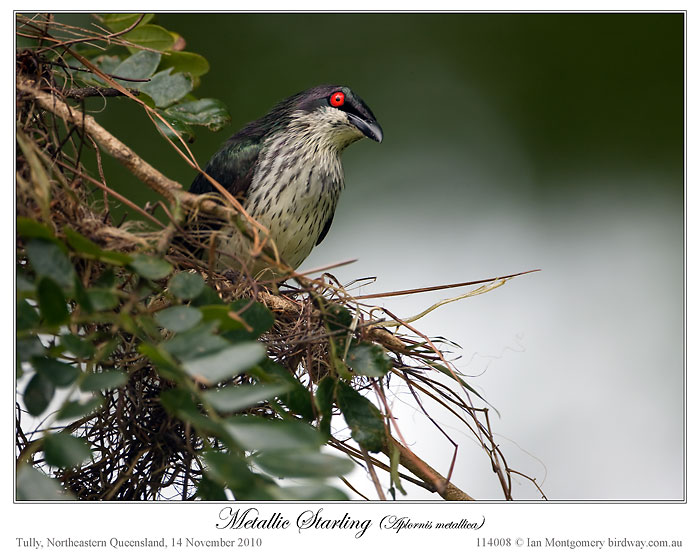
Many fledged juveniles are often present in these colonies and these are strikingly different in appearance from the adults with their white underparts with bold streaks, as in the third photo, and could easily be mistaken for a different species.

Metallic Starling (Aplonis metallica) by Ian

Metallic Starling (Aplonis metallica) by Ian

In Australia, the Metallic Starling has a limited range along the north east coast of Queensland from the tip of Cape York to Mackay, but common only north of Ingham, where there is a colony in the middle of the main street. In Australia it is mainly a summer migrant, arriving in August/September and most have left by April, though some overwinter. The fourth photo shows a big flock of Metallic Starlings preparing to roost at sunset at Chilli Beach near Lockhart River on Cape York Peninsula.

If, like me, you are into symbols, I offer you the sunset as a farewell to 2010 and the new-born chick as a token of the New Year: I wish you a happy and healthy one!
Ian


Ian Montgomery, Birdway Pty Ltd,
454 Forestry Road, Bluewater, Qld 4818
Phone: +61-7 4751 3115
Preferred Email: ian@birdway.com.au
Website: http://birdway.com.au


Lee’s Addition:

Wow! What a gorgeous bird. I venture to say, that in person, it would be even shinier. Like Ian said, we only have the Common Starling here.

When I look at how the feathers shine it reminds me of these verses:

Make thy face to shine upon thy servant; and teach me thy statutes. (Psalms 119:135 KJV)
But the path of the just is as the shining light, that shineth more and more unto the perfect day. (Proverbs 4:18 KJV)
The people that walked in darkness have seen a great light: they that dwell in the land of the shadow of death, upon them hath the light shined. (Isaiah 9:2 KJV)

Starlings are in the Sturnidae – Starling Family of the Passeriformes (Perching Birds) Order.  The Sturnidae family has 118 members and the only members here in the U.S. are Common Starling and the Common Myna. The family is made up of mostly Starlings, 24 Mynas, 1 Coleto, and 3 Rhabdomis (at this time).

To see all of Ian’s photos of the Sturnidae Family – Click Here

He has photos of the Metallic, Common, Spotless, Asian-Pied and Red-winged Starlings and the Common, Bank and Jungle Myna.

To see other Bird of the Week articles by Ian – Click Here

*

Ian’s Bird of the Week – Scarlet Robin

Scarlet Robin (Petroica boodang) by Ian

Scarlet Robin (Petroica boodang) by Ian

Ian’s Bird of the Week – Scarlet Robin ~ by Ian Montgomery

Newsletter and holiday wish – 12-24-10

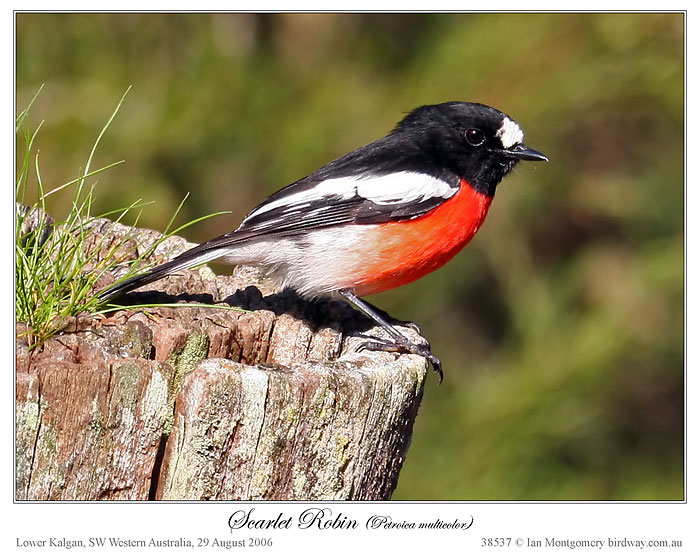
Christmas and New Year is a time for tradition not (egregious) originality so here, without apology, is a Scarlet Robin to wish you season’s greeting. Okay, it’s not the classical European Robin – which featured as Bird of the Week on Christmas 2005 – but perhaps the closest we can get to in Australia. In fact, as a member of the Australo-Papuan Robins – the Petroicidae – rather than the Old World Flycatchers – the Muscicapidae – it’s not even closely related, but I don’t think science is very important when it comes to symbolism.

Anyway, whatever your creed or beliefs, I wish you a safe and peaceful holiday season and a fulfilling and happy 2011.

I also offer you an apology. I’ve just noticed that I sent an email, intended for the committee members of Birds Australia North Queenland, to the bird of the week list on the 14 December. I’m sorry if I mystified you but fortunately the email contained nothing controversial!

Links:
Australo-Papuan Robins
Old World Flycatchers
Eurasian Robin

Best wishes,
Ian


Ian Montgomery, Birdway Pty Ltd,
454 Forestry Road, Bluewater, Qld 4818
Phone: +61-7 4751 3115
Preferred Email: ian@birdway.com.au
Website: http://birdway.com.au


Lee’s Addition:

Merry Christmas and Happy New Year to you also, Ian. Trust you enjoy the holidays and that in 2011 you find lots of more neat birds to introduce us to in your Bird of the Week articles. Always enjoy reading about your birdwatching adventures where ever you roam. You do seem to get around quite a bit.

My son, do not forget my teaching, but let your heart keep my commandments, for length of days and years of life and peace they will add to you. (Proverbs 3:1-2 ESV)

What a neat little bird. The Scarlet Robin is in the Petroicidae Family as Ian said and that family is in the Passeriformes Order.

See all of Ian’s Birds of the Week.

*

Ian’s Bird of the Week – Spectacled Antpitta

Streak-chested (Spectacled) Antpitta (Hylopezus perspicillatus) by Ian

Streak-chested (Spectacled) Antpitta (Hylopezus perspicillatus) by Ian

Ian’s Bird of the Week – Spectacled Antpitta ~ by Ian Montgomery

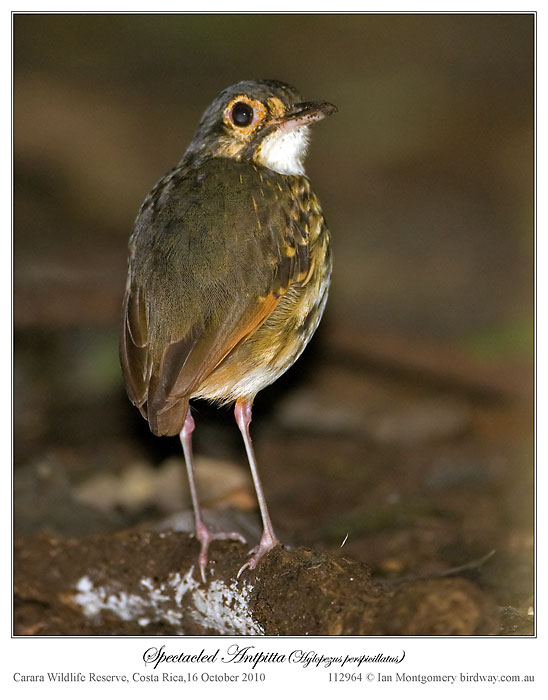
A friend of mine pointed out once that birds that stand upright and have short tails (long ones get in the way) look like little people and are consequently attractive. Penguins are the classic example, but there are plenty others, including the Pittas of Australia and Eurasia. Pittas don’t occur in the Americas but instead there are the unrelated but similar-looking Antpittas, members of the New World family Formicariidae, which occur from Mexico southwards.

Antpittas have similar habits to true Pittas and rummage around in leaf-litter in tropical and sub-tropical forest looking for invertebrate prey such as snails and worms. They are also easier to hear than see, so it was a pleasant surprise when we stumbled on this Spectacled Antpitta in Carara Wildlife Reserve in Costa Rica. It moved off through the undergrowth,but I struggled after it encumbered by a large lens and flash and managed to get a few photos of it peering suspiciously at me over its shoulder before disappearing. Incidentally, there are various groups of Central and South American birds, collectively called Antbirds, so named because some of them are found in association with army ants and feed on prey disturbed by the flow of ants across the landscape.

Streak-chested (Spectacled) Antpitta (Hylopezus perspicillatus) by Ian

Streak-chested (Spectacled) Antpitta (Hylopezus perspicillatus) by Ian

The Spectacled Antpitta ranges form Honduras in the north to Columbia in the south. There are about 50 species of Antpitta and there are photos of another species, the Moustached Antpitta, from Ecuador on the website. This is, I think, the last of the Costa Rican birds of the week as I’ve put most of the Costa Rican species on the website.

Recent additions to the website include the odd Yellow-thighed Finch – not a finch but a member of the Emberizidae – from Costa Rica and additional photos of a couple of terns from closer to home: the Little Tern and the Caspian Tern.

Links:
Other Antbirds:
True Pittas:

Last week, the link to the Black-necked Stilt mistakenly pointed to the American Avocet; it should have been: http://www.birdway.com.au/recurvirostridae/black_necked_stilt/source/black_necked_stilt_109873.htm . My apologies.

Best wishes,
Ian

Ian Montgomery, Birdway Pty Ltd,
454 Forestry Road, Bluewater, Qld 4818
Phone: +61-7 4751 3115
Preferred Email: ian@birdway.com.au
Website: http://birdway.com.au


Lee’s Addition:

Thanks Ian, for another great bird to find out about. Ian uses the Bird International list and we use the I.O.C.’s list of birds. The Spectacled Antpitta and the Streak-chested Antpitta are one in the same bird. That is where knowing the scientific name, “Hylopezus perspicillatus,” comes in handy. By either name, it does have a neat voice and below is a video link to one singing that I located.

The Antpittas are in the Grallariidae Family (IOC) of the Passeriformes Order.

Video of Streak-chested Antipitta singing by Dave Jackson

*

Ian’s Bird Of The Week – Chestnut-mandibled Toucan

Chestnut-mandibled Toucan (Ramphastos swainsonii) by Ian

Chestnut-mandibled Toucan (Ramphastos swainsonii) by Ian

Ian’s Bird of the Week – Chestnut-mandibled Toucan ~ by Ian Montgomery

Newsletter – 12/09/10

Guinness Toucan Poster from Ian

Guinness Toucan Poster from Ian

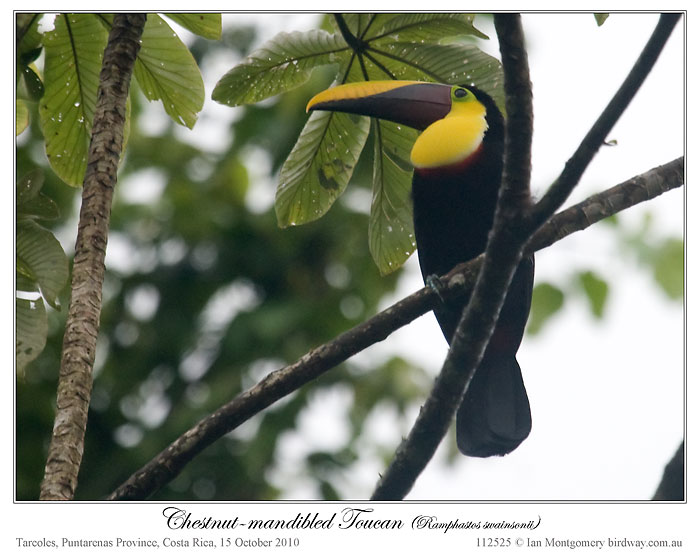
I think everybody, birders and non-birders, likes Toucans. They’re one of the iconic, almost cartoonish, animals that were introduced to as young children and I remember Toucans (and Gnus) featuring in posters for Guinness stout in Ireland in the 1950s. Their unbelievably large and colourful bills are so outlandish that it is a delightful shock to come across them in the flesh, particularly in the wild.

The Villa Lapas hotel where I stayed in the Pacific lowlands of Costa Rica had a rainforest canopy trail in its grounds and I checked it out one thundery and gloomy afternoon. The rain held off for most of the trek but, for the most part, the birds didn’t like the weather any more than I did and the light and the dense foliage made it hard to see much less photograph anything. However, repeated raucous calls led me to a pair of Chestnut-mandibled Toucans perched high in an unusually open tree. They proved to be very shy, fell silent as soon as I appeared and flew off into the forest giving me time to take only a few photos. With a length to 61cm/24in, the Chestnut-mandibled is the largest Toucan in Costa Rica. Its range includes most of Central America and Northern South America from Honduras to Ecuador.

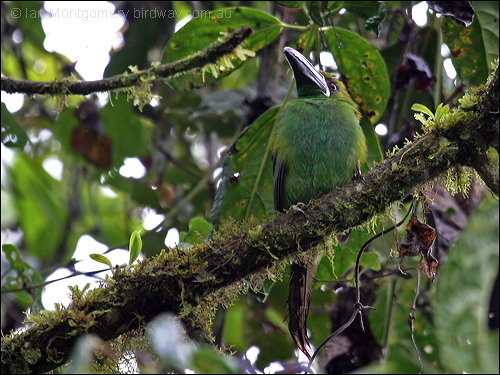
Crimson-rumped Toucanet (Aulacorhynchus haematopygus) by Ian

Crimson-rumped Toucanet (Aulacorhynchus haematopygus) by Ian

Toucans use their large bills to collect fruit, but will also feed on nestlings. The structure of the bill is a honeycomb, so it quite light and not particularly strong. Its function has attracted a lot of speculation from reaching fruit, signalling and defence and the latest theory is that it is used as heat exchanger for cooling. The colours vary widely from species to species, supporting its use for species identification but they don’t vary either between the sexes or seasonally. There are about a dozen species of large toucan (genus Ramphastos) and the toucan family (Ramphastidae) includes smaller ones such as Mountain-Toucans (Andigena), Toucanets (Selenidera) and Araçaris (Peteroglossus). All of these are restricted to Central and South America but the related Barbets occur also in Africa and Eurasia. If you are interested in examples of these, have a look at: http://www.birdway.com.au/ramphastidae/index.htm.

Recent milestone on the website are totals of 5,600 photos and 1,300 species. Additions to the website since last week include more photos of American waders such as:

American Avocet

Black-necked Stilt

Willet

and Least Sandpiper

Best wishes,

Ian

Ian Montgomery, Birdway Pty Ltd,

454 Forestry Road, Bluewater, Qld 4818

Phone: +61-7 4751 3115

Preferred Email: ian@birdway.com.au

Website: http://birdway.com.au


Lee’s Addition:

Wow! What a milestone. Way to go Ian. Hope he doesn’t mind, but I inserted one of his photos of a toucanet. Check out Ian’s link above of the Ramphastidae Family.

Gracie the retired Chestnut-mandibled Toucan (Ramphastos swainsonii)

Gracie the retired Chestnut-mandibled Toucan (Ramphastos swainsonii)

We were able to meet and pet “Gracie” at the National Aviary in Pittsburgh, PA this summer. She is also a Chestnut-mandibled Toucan. Her beak as you can see is showing her age. She is retired now and is well cared for. Like Ian said, “I think everybody, birders and non-birders, likes Toucans.” I definitely think they are very neat.

Its leaves were beautiful and its fruit abundant, and in it was food for all. The beasts of the field found shade under it, and the birds of the heavens lived in its branches, and all flesh was fed from it. (Daniel 4:12 ESV)

The Toucans, as Ian said, are found in the Ramphastidae Family. At present, there are 47 species in the family. They are part of the Piciformes Order which contains the Woodpeckers and their allies.

(Editor’s note – not advocating or advertising Guinnes) *

Ian’s Bird of the Week – Slaty Flowerpiercers (and Hummingbirds)

Slaty Flowerpiercer (Diglossa plumbea) by Ian

Slaty Flowerpiercer (Diglossa plumbea) by Ian

Ian’s Bird of the Week – Slaty Flowerpiercers (and Hummingbirds) ~ by Ian Montgomery

Newsletter ~ 12/02/10

Last week’s hummingbirds were popular so here, in a roundabout way, are some more. Flowers often have complex relationships with the animals (eg birds, moths) with which they interact and use them for pollination and distribution of seeds. Mutually beneficial (symbiotic) relationships may develop, such as exchange of nectar for pollination, that result in structural correspondences between species of flowers and animals, in particular the length of flower tubes and the length of the bills of hummingbirds and the probosces of months.

Slaty Flowerpiercer (Diglossa plumbea) by Ian

Slaty Flowerpiercer (Diglossa plumbea) by Ian

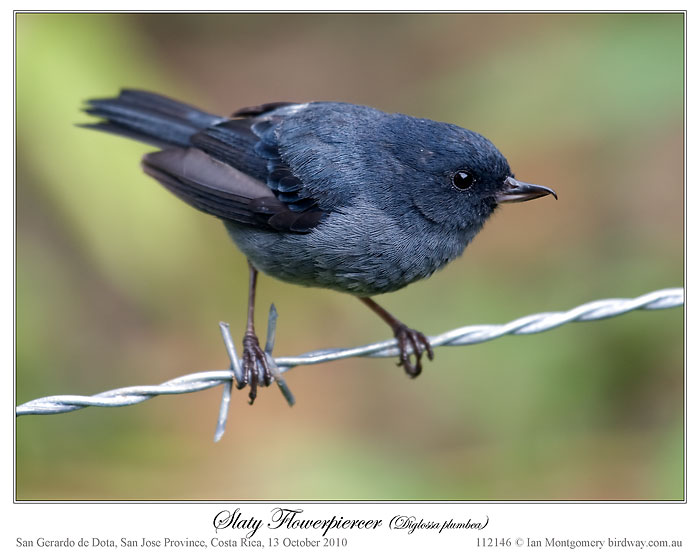
These relationships may exclude other species and this leads to cheating in various ways, either directly or indirectly. Flowerpiercers, such as the Slaty Flowerpiercer found in Costa Rica and named after the male of the species, first photo, cheat by using their specially adapted bills to bite through the flower tube to get at the nectar without helping with pollination. The female in the second photo shows how its done with the flower of a ginger plant.

Volcano Hummingbird (Selasphorus flammula) by Ian

Volcano Hummingbird (Selasphorus flammula) by Ian

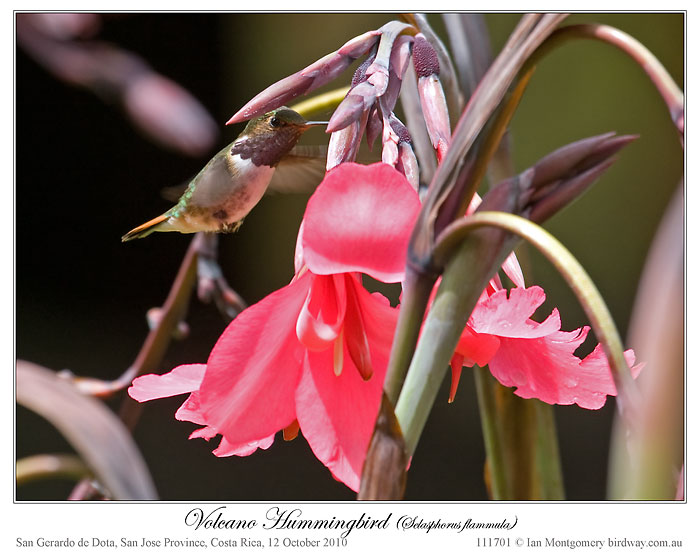
Some short-billed Hummingbirds do the same thing and stab the flower tube. Others, however, cheat indirectly and take advantage of the holes left by the flowerpiercers to sip the nectar. The tiny male Volcano Hummingbird (8cm/3.1in 2.5g) in the third photo is doing just that. Totally dwarfed by the ginger flower, it is hovering nearby and hasn’t had to land on the flower to stab it. The Volcano Hummingbird, incidentally, is a very close relative of the Scintillant Hummingbird of last week but has a violet rather than an orange gorget and is found, as its name suggests, at much higher altitudes. The vertical ranges of the two species just overlap at the 2,200m/7,200ft altitude of San Gerardo de Dota, the valley of the Quetzals.

White-throated Mountaingem (Lampornis castaneoventris) by Ian

White-throated Mountaingem (Lampornis castaneoventris) by Ian

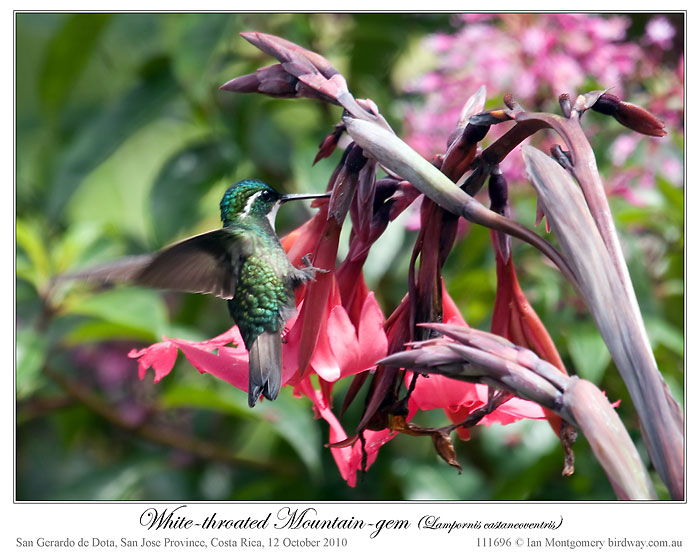
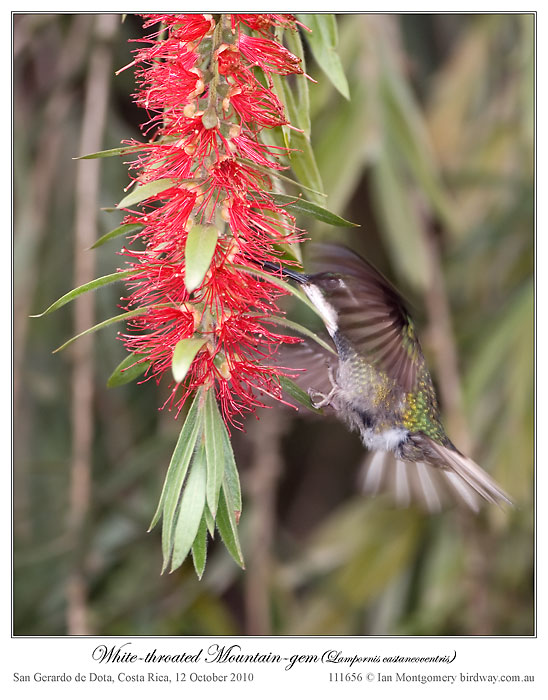
The much larger male White-throated Mountain-gem (11cm/4in 6.2g) in the fourth photo has actually landed on the ginger flower, so whether it has stabbed the flower or is also taking advantage of the Flowerpiercers isn’t obvious. They’re clearly versatile: the fifth photo shows another male feeding on an alien, almost petal-less, Bottlebrush in San Gerardo de Dota, the closest one is likely to get to an Australian Hummingbird!

White-throated Mountaingem (Lampornis castaneoventris) by Ian

White-throated Mountaingem (Lampornis castaneoventris) by Ian

Links:
Flowerpiercers (members of the Tanager family)
Volcano Hummingbird
White-throated Mountain-gem

On the website, I’m getting towards the end of adding Costa Rican birds and have added quite a variety. You might like to check out Recent Additions: http://www.birdway.com.au/index.htm#updates .

Best wishes,
Ian


Ian Montgomery, Birdway Pty Ltd,
454 Forestry Road, Bluewater, Qld 4818
Phone: +61-7 4751 3115
Preferred Email: ian@birdway.com.au
Website: http://birdway.com.au


Lee’s Addition:

Now, Ian, how did you know I was just reading about the Flowerpiercers this week? Thanks for the beautiful photos and article about these birds.

Could it be that the flowerpiercers are not cheating, but just doing as they were designed to do. By poking those holes they are not only getting a drink but allowing the little guys to have access also to a meal of nectar. Such forethought!

All things were made by him; and without him was not any thing made that was made. (John 1:3 KJV)

While working on the Hummingbird and the Tanager pages, the Flowerpiercer again caught my eye like the Sword-billed Hummingbird had from Michael Woodruff photos. If too many of the hummers had those long beaks, there would be a lot of sore necks. So by having the flowerpiercers pierce a hole nearer to the nectar, there are many hummers that get to have shorter beaks and less neck aches!

The common name refers to their habit of piercing the base of flowers to access nectar that otherwise would be out of reach. This is done with their highly modified bills, although this is greatly reduced in the Bluish Flowerpiercer, which has an almost “normal” bill. Most flowerpiercers are restricted to highlands, especially the Andes, in South America, but two species occur in Central America.

There are 18 flowerpiercers in the Diglossa genus in the Tanagers & Allies – Thraupidae Family of the Passeriformes Order.

*

Ian’s Bird of the Week – Scintillant Hummingbird

Scintillant Hummingbird (Selasphorus scintilla) by Ian

Scintillant Hummingbird (Selasphorus scintilla) by Ian

Ian’s Bird of the Week – Scintillant Hummingbird ~ by Ian Montgomery

Newsletter – 11/25/10

At the Hotel Savegre (http://www.savegre.co.cr/) where I stayed in the highlands in Costa Rica in pursuit of the Resplendent Quetzal, a variety of Hummingbirds were regular visitors to the hummingbird feeders and the flowers in the garden. The largest of these was the Magnificent Hummingbird, up to 14cm/5.5in in length and 10g in weight – sparrow sized – as in the first photo.

Magnificent Hummingbird (Eugenes fulgens) by Ian

Magnificent Hummingbird (Eugenes fulgens) by Ian

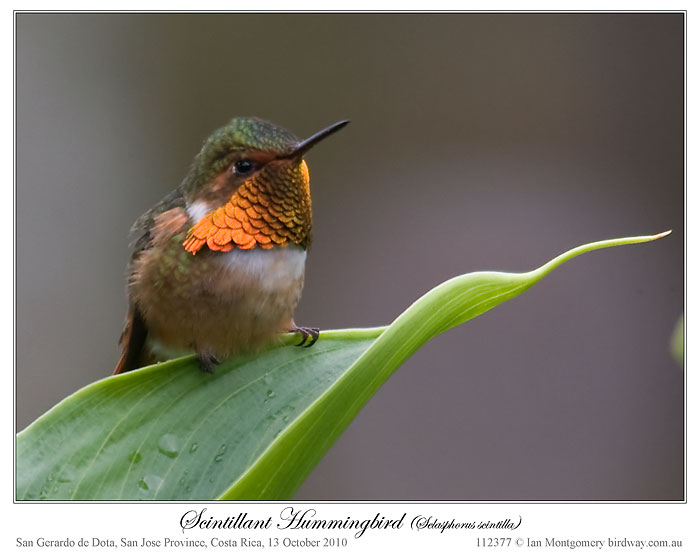
Size, however, isn’t everything particularly in hummingbirds and big ones risk looking like, dare I say it, mere ordinary birds. Much of the fascination in hummingbirds is how insect-like they are, so the smaller the better, and my favourite was the tiny Scintillant Hummingbird. The males, second and third photo, tip the scales at 2.1g with a length of 6.5cm/2.6in (the females average 2.3g and 7cm) and perched, seemingly weightless, on the tips and edges of the leaves of Zantedeschia plants. Their over-sized orange gorgets are very striking and this species is endemic to the mountain slopes of Costa Rica and Western Panama.

Scintillant Hummingbird (Selasphorus scintilla) by Ian

Scintillant Hummingbird (Selasphorus scintilla) by Ian

Incidentally, the smallest hummingbird of all, in fact the smallest bird of all, is the Bee Hummingbird of Cuba with the males, again smaller than the females, averaging 1.6g and 5cm/2in, not that much smaller the Scintillant Hummingbird. The largest is the Giant Hummingbird of the Andes, up to 23g in weight and 22cm/8.7in long and apparently swift-like in flight. Not surprisingly, the Bee Hummingbird is on my bucket list, the Giant isn’t.

Our premature wet season continues in North Queensland, so the website has received plenty of attention. I’ve revised the Thrush galleries with the addition of 6 Central American species, added a couple of swallows and the badly-named Long-tailed Silky-flycatcher – it may be silky but it’s not a flycatcher and it mostly eats fruit:

Ruddy-capped Nightingale-Thrush

Black-faced Solitaire

Mangrove Swallow

Long-tailed Silky-flycatcher

Best wishes,

Ian

Ian Montgomery, Birdway Pty Ltd,

454 Forestry Road, Bluewater, Qld 4818

Phone: +61-7 4751 3115

Preferred Email: ian@birdway.com.au

Website: http://birdway.com.au


Lee’s Addition:

Wow! What gorgeous Hummingbirds. Love that Scintillant’s colors, but the Magnificent is also magnificent. What a creative Hand the Lord used when they were created.

Who does great things, and unsearchable, Marvelous things without number. (Job 5:9 NKJV)

The Hummingbirds belong to the Trochilidae Family of the Apodiformes Order. That Order not only has Hummingbirds, but also Owlet-nightjars, Treeswifts and Swifts.

The colors of the Scintillant fit right in with today’s day of Thanksgiving here in America.

Happy Thanksgiving from all of us on this blog!

Oh that men would praise the LORD for his goodness, and for his wonderful works to the children of men! (Psalms 107:8 KJV)

*

Ian’s Bird of the Week – Violaceous Trogon

Violaceous Trogon (Trogon violaceus) by Ian

Violaceous Trogon (Trogon violaceus) by Ian

Ian’s Bird of the Week – Violaceous Trogon ~ by Ian Montgomery

Newsletter – 11/17/10

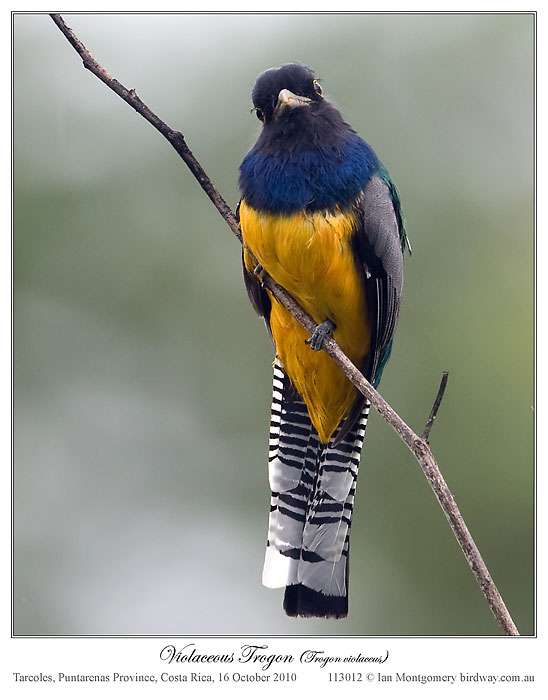
When the Resplendent Quetzal featured as bird of the week in October, I mentioned that Quetzals are members of the Trogon family, the Trogonidae. So they belong to a splendid lineage as typical Trogons are quite gorgeous in their own right and among my favourite birds. Here is the Violaceous Trogon, also from the Costa Rican trip, though it has a wide range in Central and South America (I have also photographed it in Trinidad).

Violaceous Trogon (Trogon violaceus) by Ian

Violaceous Trogon (Trogon violaceus) by Ian

Trogons, the males in particular, are very colourful and the different species come in an extraordinary variety of colours, invariably in aesthetically pleasing and frequently complementary combinations, i.e. red-green, blue-yellow, purple-orange. Male Trogons with red and green breasts include the Slaty-tailed, Black-tailed, Collared and Masked, while both the Violaceous and the White-tailed are somewhere between blue-yellow and purple-orange, perhaps violet-chrome yellow, first photo. Non-complementary but still lovely are the red-brown male Crimson-rumped  and female Masked. (I’ve chosen these examples as all seven are on the Birdway website.)
Their backs are green, bluish or brown, as in the second photo, and if all this is not enough, the upper wing coverts often have subtle and intricate scroll patterns and beautifully barred black and white tails, as in the third photo. If you wanted to design a fantastically beautiful bird yourself, it would be hard to come up with something better: female Trogons clearly have impeccable taste.
Violaceous Trogon (Trogon violaceus) by Ian

Violaceous Trogon (Trogon violaceus) by Ian

Despite their rich colours, Trogons can be hard to spot as they tend to sit fairly motionless in leafy trees in tropical rainforest, occurring in both the New and the Old Worlds. They have distinctive repeated calls that reveal their presence, but hearing one in thick forest is no guarantee of being able to see it. They sit tight, so if you do find them they are fairly approachable but you have to be lucky to find one in clear view.

Related link:
Recent additions to the website include:
and additional photos of
(and a couple of other Costa Rican species that I’m keeping up my sleeve as future birds of the week!).
Best wishes,
Ian

Ian Montgomery, Birdway Pty Ltd,
454 Forestry Road, Bluewater, Qld 4818
Phone: +61-7 4751 3115
Preferred Email: ian@birdway.com.au
Website: http://birdway.com.au

Lee’s Addition:
Thanks again for another informative article and photos, Ian. Dan and I were able to see a White-tailed Trogon at the National Aviary. They are very colorful like Ian said. They belong to the Trogonidae Family of the Trogoniformes Order.     There are 42 species in the family.

Now Israel loved Joseph more than any other of his sons, because he was the son of his old age. And he made him a robe of many colors.
(Genesis 37:3 ESV)

Ian’s Bird of the Week – White-whiskered Puffbird

White-necked Puffbird (Notharchus hyperrhynchus) by Ian

White-necked Puffbird (Notharchus hyperrhynchus) by Ian

Ian’s Bird of the Week – White-whiskered Puffbird ~ by Ian Montgomery

Newsletter – 11/11/10

Last week’s Asian Dowitcher prompted an amusing comment about bird names (‘Dowitcher Princess’) from a friend of mine on the list, thank you Peter, so how about the White-whiskered Puffbird, encountered in Carara Reserve on the Pacific Coast of Costa Rica? Puffbirds get their name from their fluffy plumage and along with Nunbirds (black), Monklets (smaller and brown) and Nunlets (oddly, also small and brown) comprise a small Central and South America family of 22 species, all with slightly hooked bills, called the Bucconidae, related to the iridescent Jacamars (Galbulidae).

White-necked Puffbird (Notharchus hyperrhynchus) by Ian

White-necked Puffbird (Notharchus hyperrhynchus) by Ian

All these bird sit around quietly in forests, and are easily overlooked, waiting for their invertebrate prey to appear, which they then pounce on. The White-whiskered Puffbird, 20cm/8in in length, usually perches close to the understory at a height of 1 to 6m/3 – 30ft and have the reputation of being tame. It nests in holes in the ground, either on a slope or in a bank, and supposedly blocks the entrance to the nest hollow at night with green leaves. It prefers the lowlands and ranges from southern Mexico to the western side of the Andes in Colombia and Ecuador.

Related links:
Black-fronted Nunbird
White-fronted Nunbird
Rufous-tailed Jacamar

Other Costa Rican additions to the website include:
Scarlet Macaw
Double-striped thick-knee
Magnificent Hummingbird

And, for the wader-lovers, more photos of:
Terek Sandpiper
Curlew Sandpiper
Short-billed Dowitcher
Marbled Godwit

Best wishes,
Ian

Ian Montgomery, Birdway Pty Ltd,
454 Forestry Road, Bluewater, Qld 4818
Phone: +61-7 4751 3115
Preferred Email: ian@birdway.com.au
Website: http://birdway.com.au


Lee’s Addition:
Bucconidae – Puffbirds are in the Piciformes Order which includes not only the Puffbirds, but also Jacamars, 3 families of Barbets, Honeyguides and Woodpeckers.

With all those new birds added from Costa Rica, you can discern that Ian had a great time on his visit. Now we have some more great photos for us armchair birdwatchers to view.

… we know that “all of us possess knowledge.” This “knowledge” puffs up, but love builds up. If anyone imagines that he knows something, he does not yet know as he ought to know. But if anyone loves God, he is known by God. (1 Corinthians 8:1-3 ESV)

*

Ian’s Bird of the Week – Asian Dowitcher

Asian Dowitcher (Limnodromus semipalmatus) by Ian

Asian Dowitcher (Limnodromus semipalmatus) by Ian

Ian’s Bird of the Week – Asian Dowitcher ~ by Ian Montgomery

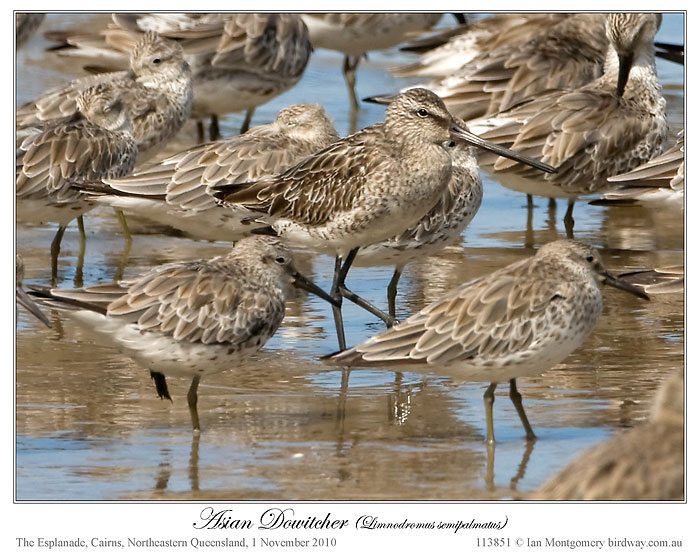
This is something of a postscript to a presentation on wader identification that I gave last Saturday to a workshop organized by the Townsville Region Bird Observers Club as part of the Shorebirds 2020 Project ( http://www.shorebirds.org.au/ ). Of the 45 species that we considered, I lacked photos of just one: the Asian Dowitcher. So you’ll understand why I and a friend jumped into the car after the practical session at Bushland Beach, near Townsville, on Sunday and drove to Cairns, where an Asian Dowitcher had recently been reported, for an overnight visit. They are regular visitors in small numbers to northwestern Australia (e.g. Broome in Western Australia) but occur only as irregular vagrants on the east coast.

Asian Dowitcher (Limnodromus semipalmatus) by Ian

Asian Dowitcher (Limnodromus semipalmatus) by Ian

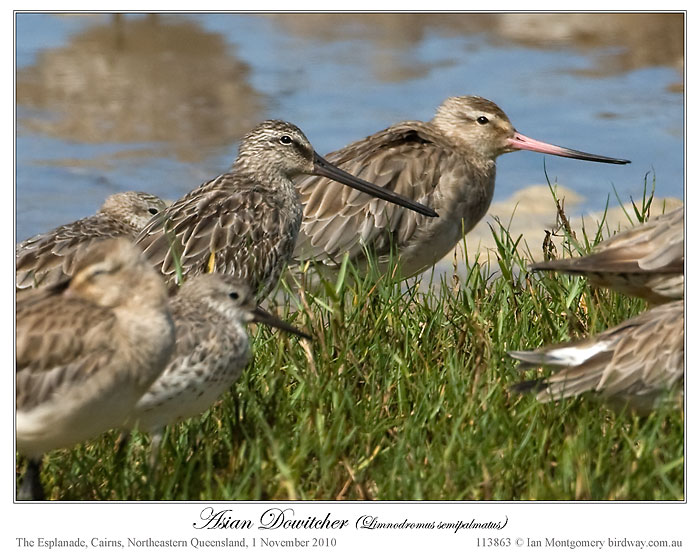
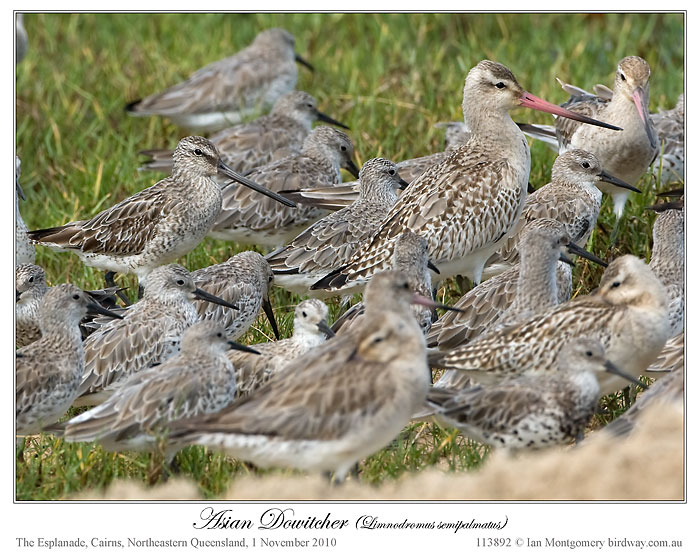
The mudflats on the Esplanade are very flat, so the window of opportunity provided by an incoming tide is very short and it wasn’t until Monday afternoon that that happened. Even so, I would probably have missed it if Guy Dutson hadn’t alerted me to its location. It’s a bird that’s easy to overlook among the Great Knots and Bar-tailed Godwits when they’re all in non-breeding plumage, thank you, Guy! The first photo shows it among Great Knots. The body size is similar, so the key Asian Dowitcher features are the very long, straight, dark bill with a bulbous tip rather like that of a snipe, long dark legs and dark loral stripe (between the bill and the eye). Body length in waders is confounded by bill and leg length, so weight and wing-span are more useful. These are – Asian Dowitcher: 127-245g and 59cm/23.2in; Great Knot: 115-248g and 58cm/22.8in.

The second photo shows the Asian Dowitcher on the left with a smallish – probably male – Bar-tailed Godwit on the right (Bar-tailed Godwit male 190-400g female 262-630g, span 70-80cm/28-32in) and the third photo shows the Dowitcher with a larger Bar-tailed Godwit and lots of Great Knots and in this photo you can see the barred flanks of the Dowitcher compared with the plain flanks of the Godwit. The bill of the Dowitcher was always the most obvious distinguishing feature, but the bird would often have a snooze, tucking its bill under a wing, and magically disappear. What’s more, the mud on the Cairns Esplanade is very gluggy, so the pink bases of Godwit bills are often covered, but the different shape is usually still apparent.

Asian Dowitcher (Limnodromus semipalmatus) by Ian

Asian Dowitcher (Limnodromus semipalmatus) by Ian

When I was preparing the presentation and checking carefully on distinguishing features, I found that a wader that I’d photographed in India in 2003 and posted to the website as a Wood Sandpiper was actually a Green Sandpiper. This a bird, rare in Australia, that I had long wanted to photograph, so I was pleased to find and correct the error: http://www.birdway.com.au/scolopacidae/green_sandpiper/index.htm .

Best wishes,
Ian

Ian Montgomery, Birdway Pty Ltd,
454 Forestry Road, Bluewater, Qld 4818
Phone: +61-7 4751 3115
Preferred Email: ian@birdway.com.au
Website: http://birdway.com.au


Lee’s Addition:

The Asian Dowitcher is part of the Scolopacidae Family which is in the Charadriiformes Order that consists of Shorebirds and their allies. To see Ian’s Birdway website of the Scolopacidae – Click Here.

He answered, “The man called Jesus made mud and anointed my eyes and said to me, ‘Go to Siloam and wash.’ So I went and washed and received my sight.” (John 9:11 ESV)

*

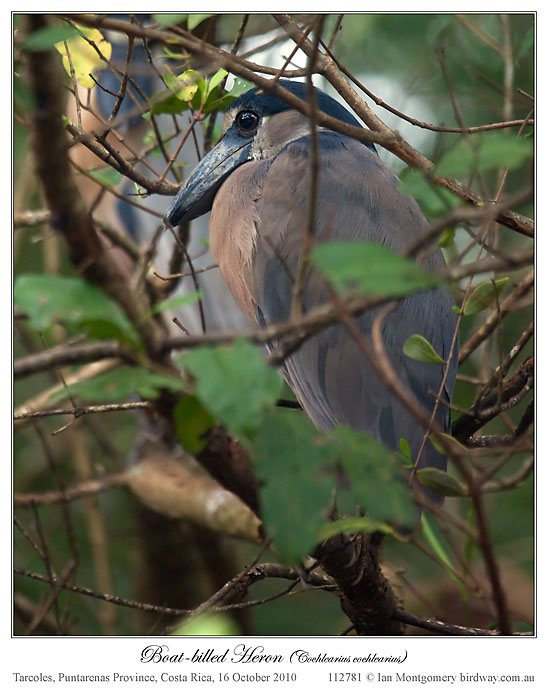
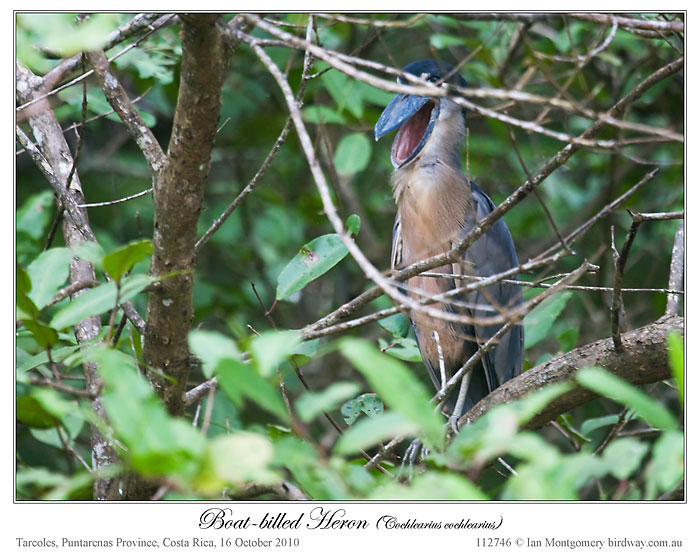
Ian’s Bird of the Week – Boat-billed Heron

Boat-billed Heron (Cochlearius cochlearius) by Ian

Boat-billed Heron (Cochlearius cochlearius) by Ian

Ian’s Bird of the Week – Boat-billed Heron 

After I’d photographed the Resplendent Quetzal, my immediate reaction was one of relief: ‘Now I can just relax and enjoy the rest of my time in Costa Rica!’. Needless to say, that didn’t last long and I decided to chase a couple of other species on my bucket list including Scarlet Macaw and Boat-billed Heron. If you’re not familiar with bucket lists, have a look here http://www.imdb.com/title/tt0825232/ – and I hasten to add that I’m not terminally ill!. I enquired at the Hotel Savegre, where I was staying, and they booked me into the Villa Lapas, another eco-lodge-style hotel, but in the lowlands on Puntarenas Province on the Pacific Coast.

Boat-billed Heron (Cochlearius cochlearius) by Ian

Boat-billed Heron (Cochlearius cochlearius) by Ian

‘Lapas’ is the Spanish for Macaw, and that seemed like a good omen, particularly as the hotel is adjacent to the Carara Biological Reserve, supposedly one of the best places in Costa Rica for Scarlet Macaws. Anyway, I checked into the hotel and booked myself on an early morning wildlife boat trip on the Tarcoles River. I was the only passenger, so the crew of two were only too happy to try to satisfying my wishes. Sure enough, within minutes of starting, we got distant views of a pair of Scarlet Macaws feeding on Beach Almonds and after a trip up the river we went down to the mangroves for the climax of the trip, three Boat-billed Herons roosting in the mangroves.

Boat-billed Heron (Cochlearius cochlearius) by Ian

Boat-billed Heron (Cochlearius cochlearius) by Ian

There have got to be the strangest looking herons, with their huge bills, though otherwise they show some resemblance to Night-Herons and are also nocturnal – hence the large eyes. The bill looks it’s designed a heavy duty task like crushing crabs, but in fact it is used rather passively as a scoop and Boat-bills eat a variety of invertebrates and small vertebrates unlucky enough to get in the way. In the past they have been given their own mono-typic family, but DNA research has shown that they are related to both the Tiger-Herons and the Night-Herons.

I first got interested them when reading about them in Trinidad in 2005 where they are rare. Elsewhere in South America they are reasonably common with a range extending from Mexico to northern Argentina. There are five sub-species, sometimes treated as two species, Northern and Southern, but the Costa Rican race (panamensis) is intermediate between the two extremes and it is usual now to treat them as a single species.

I’m enjoying being back home in North Queensland, though the first week here has been a busy one as I’ve been preparing material for a workshop on wader identification tomorrow. When that is out of the way, I can get back to the website and the rest of my domestic routine in earnest.

Best wishes,
Ian

Ian Montgomery, Birdway Pty Ltd,
454 Forestry Road, Bluewater, Qld 4818
Phone: +61-7 4751 3115
Preferred Email: ian@birdway.com.au
Website: http://birdway.com.au


Lee’s Addition:

the stork, the heron after its kind, and the hoopoe and the bat. (Deuteronomy 14:18 NKJV)

Boat-billed Herons belong to the Ardeidae Family of the Pelecaniformes Order. I am glad Ian managed to get photos of it. We were able to get photos at the National Aviary in Pittsburgh and a Lowry Park Zoo in Tampa, FL. It is really an interesting beak that the Boat-billed has. The Heron is one of the Birds of the Bible.

*