SEED-LOVING BOBOLINKS, GROUND-NESTING IN GRASSLANDS
Dr. James J. S. Johnson
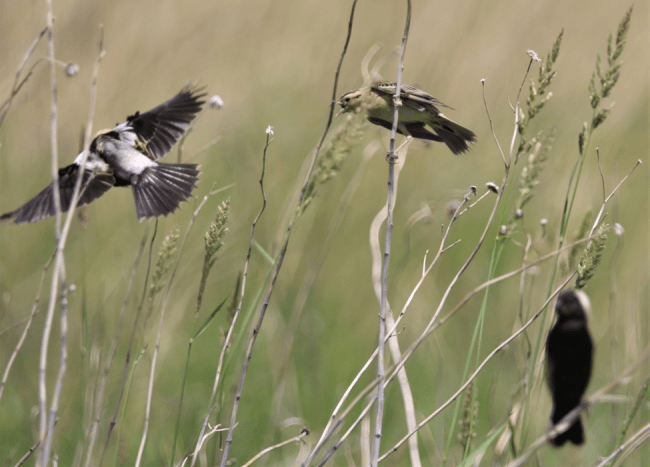
BOBOLINKS in grassland habitat, Minnesota (photo credit: Bryce Gaudian)
If a bird’snest chance to be before thee in the way in any tree, or on the ground, whether they be young ones, or eggs, and the mother sitting upon the young, or upon the eggs, thou shalt not take the mother with the young.
(Deuteronomy 22:6)
Moses noted that some wild birds build their nests upon the ground; Bobolinks do just that.
Years ago, I reported on the Black-capped Chickadee, noting that I first saw one at Gilsland Farm Sanctuary, while attending a wetland ecologists’ meeting: “Decades ago, I saw Black-capped Chickadees, for the first time, in Falmouth (near Portland), Maine – at the Gilsland Farm Sanctuary (now called “Gilsland Farm Audubon Center”), on May 31st of AD1995, while attending the annual national meeting of the Society of Wetlands Scientists.” [Quoting from “Tiny Yet Tough: Chickadees Hunker Down for Winter”, posted at https://leesbird.com/2016/11/18/tiny-yet-tough-chickadees-hunker-down-for-winter/ .]
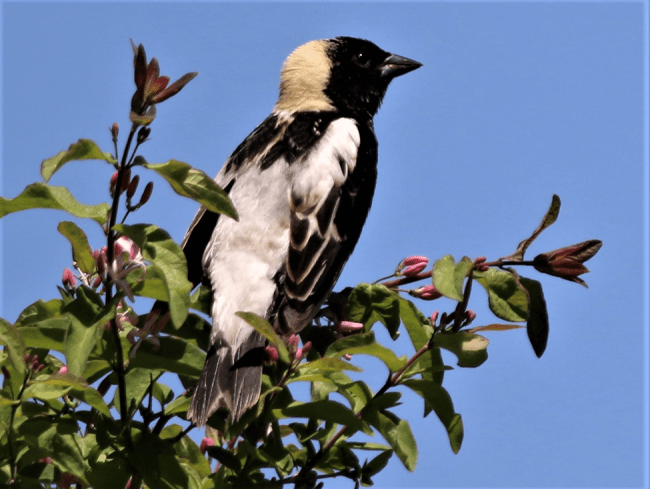
Another “lifer” that I then observed that day, at Gilsland Farm Sanctuary, was the BOBOLINK. And what a striking plumage the male Bobolink has, during breeding season!
BOBOLINK MALE in breeding plumage, Minnesota (photo credit: Bryce Gaudian)
Bobolinks (Dolichonyx oryzivorus) are icterids (blackbirds of the Western Hemisphere), dwelling in America’s prairie and pasture grasslands and marshy wetlands during the warm months of the year. Bobolinks were nicknamed “rice birds” (which matches their species name, oryzivorus, meaning “rice-eating”), due to their dining habits, especially during autumn migrations.
The Bobolink genus name, Dolichonyx, means “long claw”, matching its prehensile perching “fingers”.
During such migrations Bobolinks frequently feed in farmed fields of rice and other grains (such as oats, sorghum, maize corn, and hayseed), at energy-packing refueling stopovers (e.g., in South Carolina and the Gulf states), on their aerial journeys southward, via Caribbean islands, en route to South American over-wintering range destinations.
Bobolinks feed on (or near) the ground, eating various seeds, insects, spiders, and even snails—especially during breeding seasons. Both larvae and adults of insects (especially armyworm moths) are protein-rich, much needed for growing Bobolink juveniles.
Also, during breeding seasons, Bobolinks depend upon available hay for nest-building, on the ground, in vegetated areas.
Bobolinks are quite specific in their breeding habitat needs. Open hay fields are a must, and so as farming is some regions of the country diminishes, so do populations of bobolinks. Where colonies of bobolinks have traditionally bred, it is important to preserve their habitat with regular mowing practices. Unfortunately, the right time to mow a field for hay is often just when the young are fledging[!]. Careful observation of the behavior of a [bobolink] colony and delaying of mowing until one or two weeks after fledging, a time when the young can fly fairly well, will keep a colony producing and ensure its [multi-generational] survival.
[Quoting Donald W. Stokes & Lillian Q. Stokes, A GUIDE TO BIRD BEHAVIOR, Volume III (Boston: Little, Brown & Company/Stokes Nature Guides, 1989), pages 351-352.]
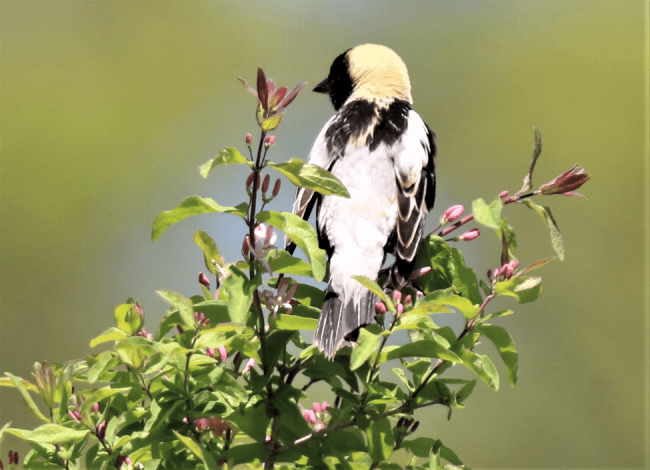
BOBOLINK MALE in grassland habitat, Minnesota (photo credit: Bryce Gaudian)
Consequently, Bobolinks are easier to find in habitats where their needs for food and nesting are plentiful.
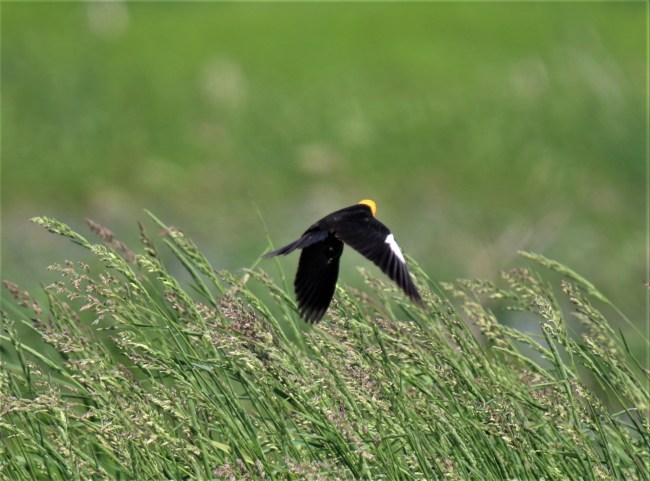
BOBOLINK male in flight, prairie habitat, Minnesota (photo credit: Bryce Gaudian)
The males have easily seen plumages—like reverse tuxedos (white upon black) in spring and summer, during breeding months.
Male and female bobolinks are easily distinguished during the breeding season. Males have a black head, belly, and wings, with a buff-gold nape and white patches on the back. The female is buff [and brown] colored all over with dark streaks on her back, wings, and sides.
[Quoting Donald W. Stokes & Lillian Q. Stokes, A GUIDE TO BIRD BEHAVIOR, Volume III (Boston: Little, Brown & Company/Stokes Nature Guides, 1989), pages 364.]
During non-breeding months, however, Bobolink males shift to duller hues of dark and light browns, similar to the year-round plumage of Bobolink females and juveniles.
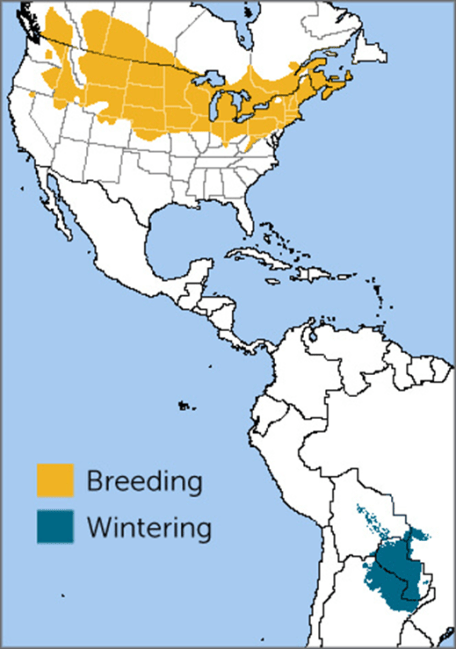
Of course, these tweety-chirpy icterids breed elsewhere in spring – in most of the upper half of America’s Lower 48, from the Northeast’s coastlines almost as far wet as the coasts of Washington and Oregon. Accordingly, the Bobolink migrates about 6,000 miles southward or northward, so it accrues about 12,000 miles per year, in air miles.
American Bird Conservancy range map
It was a privilege to see Bobolinks, back in AD1995, at the Gilsland Farm Sanctuary, as part of my time attending the Society of Wetlands Scientists’ meeting.
Likewise, it’s a privilege, now, to be permitted to share some of the wonderful Bobolink photographs taken in Minnesota, by Christian/creationist photographer BRYCE GAUDIAN — thanks, Bryce!
And now, it’s time for a limerick, about Bobolinks.
After Being Buried for 350 Years, Nottingham Sheriff’s Two Swans Reappear
Dr. James J. S. Johnson
And the swan [הַתִּנְשֶׁ֥מֶת], and the pelican, ….
(Leviticus 11:18)
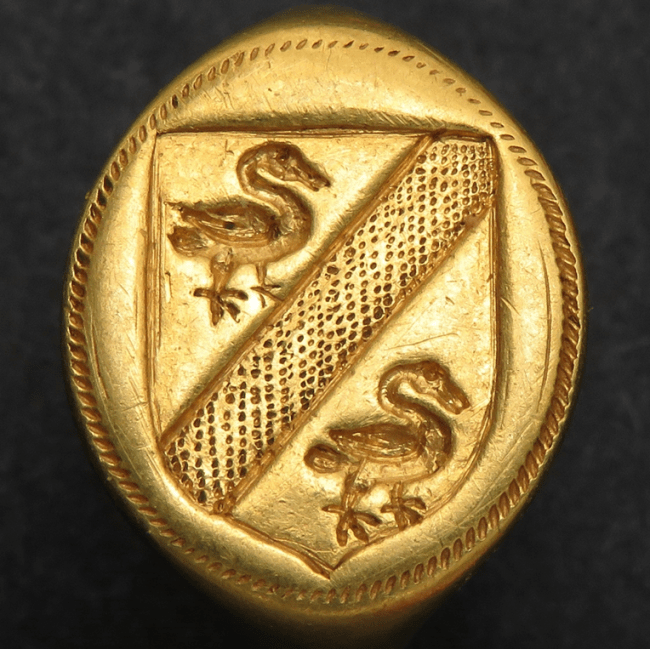
Recently (today being June 26th of AD2023), an ancient (about 350 years old!) gold signet ring of interest to birdwatchers –– was found by a man in Nottingham (England), using a metal detector.
But why would this ancient ring be of interest to birdwatchers? Because the signet ring displayed an armorial coat of arms that features 2 birds that look like swans or geese. In fact, the 2 birds are swans.
Nottingham sheriff’s old signet ring (public domain image)
It was found by Graham Harrison, a retired British Merchant Navy engineer, according to a news report (that was recently brought to my attention by my good wife):
“Graham Harrison spends his time searching the hills in his town with a metal detector, in hopes of finding something special. The former merchant navy engineer struck gold, quite literally, in the form of a 350-year-old gold signet ring that was owned by Nottingham’s most famous sheriff. The ring belonged to Sir Matthew Jenison who was the Sheriff of Nottingham from 1683 and 1684, looking after the famous Sherwood Forest. Harrison found the ring on farmland about 26 miles from the forest. After finding the ring, he sent it to the British Museum’s Portable Antiquities Scheme where it was authenticated. ….
[An auctioneer’s expert] consultant valuer Adam Staples said, ‘The ring has survived in near perfect condition and the front face bears a detailed engraving of the Jenison family arms, two swans separated by a diagonal bend. This would have been pressed into melted wax in order to seal the family crest on important letters and documents’. … Jennison [who served as Nottingham’s Sheriff, guarding England’s Sherwood Forest, once home to the original Robin Hood] was born in 1654 and became a knight in 1683. As sheriff, his job was to keep watch on the trees in the Sherwood Forest. Despite starting his life defending the law, and being elected to British parliament, Jenison got himself jailed for refusing to pay legal costs from a lawsuit he was involved in … [eventually dying] in prison in 1734.”
Quoting Christina Williams, “Retiree Unearths 350-year-old Ring”, THE DAILY ACORN (May 23rd AD2023)
Whooper Swans of Great Britain (photo image credits: from The Royal Society for the Protection of Birds)
The Hebrew word translated “swan” in Leviticus 11:18 (and also in Deuteronomy 14:16) is tinšemeh, meaning breath/wind-blower, derived from the Hebrew root verb nâšam, denoting the noise of wind blowing or someone breathing. Swans are like avian woodwind instruments, famous for their vocalized nasal-sounding noises—honking, trumpeting, whooping, etc.
Since the typical swan having winter range in England is the Whooper Swan (Cygnus cygnus), it’s most likely that the signet ring displays a pair of Whooper Swans. In fact, even today there are whooper swans in England, according to Nottinghamshire Wildlife Trust ( www.nottinghamshirewildlife.org/wildlife-explorer/birds/waterfowl/whooper-swan ); these huge (and noisy) waterfowl have been protected in England since AD1981, pursuant to the Wildlife and Countryside Act.
And, thanks to conservation efforts, the United Kingdom is now seeing more swans–especially whooper swans–in places like Northern Ireland, Scotland, and England (especially East Anglia and northern England, not far from the Sherwood Forest that Nottingham’s Sheriff was famous for guarding).
Flag of Nottinghamshire, England (public domain image)
One may wonder, looking at the ring’s engraved impression, how many times those 2 swan molds were used to squish and shape melted wax into a 3-dimensional seal, leaving a wax-hardened bas-relief image of 2 swans upon the wax seal of some legal document that recorded official business of England’s Sheriff of Nottingham.
Of course, signet rings have been around–being used by government officials to solemnify and authenticate legal documents for many centuries. For example, the Persian king’s signet ring played an important role in the political drama recorded in the Old Testament’s book of ESTHER.
And the king took his ring from his hand, and he gave it unto Haman the son of Hammedatha the Agagite, the Jews’ enemy.
(Esther 3:10)
Notice that the Persian king’s ring was a signet ring that was used to seal official documents.
Then were the king’s scribes called on the thirteenth day of the first month, and there was written according to all that Haman had commanded unto the king’s lieutenants, and to the governors that were over every province, and to the rulers of every people of every province according to the writing thereof, and to every people after their language; in the name of king Ahasuerus was it written, and sealed with the king’s ring.
(Esther 3:12)
In the above-quoted verses the king’s signet ring was used by a wicked government official, Haman.
Esther 8:2 (public domain image)
However, later–thanks to God’s providence (in answer to fervent prayers of God’s people)–the king’s signet ring was used by Haman’s adversary, Mordecai, to secure a work-around solution that overcame the evils done by Haman.
And the king took off his ring, which he had taken from Haman, and gave it unto Mordecai. And Esther set Mordecai over the house of Haman. … Write ye also for the Jews, as it liketh you, in the king’s name, and seal it with the king’s ring: for the writing which is written in the king’s name, and sealed with the king’s ring, may no man reverse. … And he [i.e., Mordecai] wrote in the king Ahasuerus’ name, and sealed it with the king’s ring, and sent letters by posts on horseback, and riders on mules, camels, and young dromedaries ….
(Esther 8:2 & 8: & 8:10)
Thank God for His kind and caring providences! Without God’s providential care we have no hope!
Meanwhile, most signet rings–although important–are not used for such Earth-shaking intrigues. And, in the case of the Nottingham Sheriff’s signet ring, obscurity lasted 350 years, buried underground.
So, there you have it—a gold signet rings bearing 2 swans, within the sheriff’s armorial coat of arms. Those 2 engraved swans had to wait 350 years to see the life of day (so to speak), again, after being buried. Wow! That almost makes me want to buy a metal detector!—who knows what I might find?
WHOOPER SWAN in Great Britain (BBC photo credit)
ABOUT THE AUTHOR: Dr. James J. S. Johnson has been a birdwatcher since 2nd grade, thanks to Mrs. Thelma Bumgardner, who gave him his 1st bird-book (which he still has). Jim has taught ornithology and ecology at Dallas Christian College, for ACSI, for ICR-SOBA, and has served as a naturalist-historian guest lecturer aboard 9 different international cruise ships, for a half-century observing many birds in many places, including in Great Britain. profjjsj@aol.com ><> JJSJ
But they that wait upon the LORD shall renew their strength; they shall mount up with wings as eagles; they shall run, and not be weary; and they shall walk, and not faint.
( Isaiah 40:31)
Therefore, seeing we also are compassed about with so great a cloud of testifying-witnesses [μαρτυρων ], let us lay aside every weight, and the sin which doth so easily beset us, and let us run with patience the race that is set before us.
Seeing a Greater Roadrunner (Geococcyx californianus, a/k/a Chaparral Bird) scampering about in the grass, near the east side of my lawn, last Friday (12 May, A.D.2023), reminded me of the hidden-in-plain-view miracle of running. Roadrunners are cuckoo-like birds, capable of flight yet more famous for on-the-ground running (including chasing and catching insects and reptilian prey), easily recognizable by their skinny-chicken-looking bodies, sporting long tails, scissors-like beak, and prominent crest feathers.
GREATER ROADRUNNER in Mojave Desert, California ( photo credit: Wikipedia / Jessie Eastland )
Running is an astounding activity, although we rarely think of running that way. (And chasing is even more amazing, because it involves 2 creatures running at the same time, with one trying to catch while the other tries to escape!). However, if we only saw an animal–or a human–running once in a lifetime we might recognize the physiology of running as the God-given miracle that is. But, because we see creatures run about, frequently, we lose sight of how astonishing the action of running really is.
Running requires coordinated and energetic movement, integrating purpose, distance, and body parts and systems working together with teamwork (see 1st Corinthians chapter 12), so the bioengineering needed to enable running is an energetic and ongoing exhibit of the Lord Jesus Christ’s empowering genius and wisdom. (See, accord, Randy J. Guliuzza, “Made in His Image: Beauty in Motion”, posted at http://www.icr.org/article/beauty-motion# .)
Children assume that running is normal; grandparents watch runners with nostalgia, remembering when sprinting felt effortless. Running, if and when it is accomplished with ease, is a blessing–the ability to run is a marvelous gift from our God Who invented the ability to run. In fact, the Lord gave the gift of running to more than just human children, and athletes who are older than children–He gave the gift of running to many of the animal He created.
CHEETAH running (Answers in Genesis photo credit)
Among mammal s, notable runners include feline family (such as cheetah, jaguar, and cougar, sprinting at speeds near 70 mph!), antelope-like beasts (such as pronghorn, springbok antelope, and Indian blackbuck antelope, reaching speeds of 50 to 60 mph), wildebeest (running at 50 mph), and even bats (such as free-tailed bat, flying at 60 mph!). Other fast-footed mammals include the African lion and the hare (both climaxing at almost 50 mph, and running longer distances at lesser speeds), as well as the African wild dog and Australia’s kangaroo (both climaxing at almost 45 mph).
But, what about birds? Many birds move at speeds that are mind-boggling, such as the figure-eight wing-beating of hummingbirds, which appear as blurs to the watching eyes of human spectators–some capable of speeds above 40 mph!)..
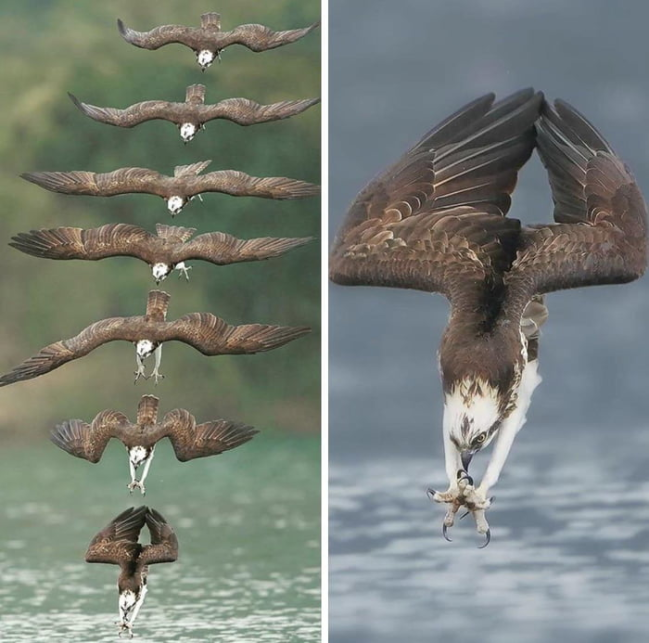
Likewise, birds can fly at high speeds, both horizontally and especially when “dive-bombing” (a/k/a stoop diving) downward—think of falcons (e.g., Peregrine Falcon, with horizontal speeds up to almost 70 mph, and diving speed above 240 mph!). Likewise, eagles are famous for their speed (e.g., Golden eagle, with horizontal speed near 30 mph, and diving speed near 200 mph).
EAGLE diving down! ( photo credit: 9gag.com )
Indeed, the Holy Bible refers to the eagle’s speedy flight more than once.
Saul and Jonathan were lovely and pleasant in their lives, and in their death they were not divided: they were swifter than eagles, they were stronger than lions.
( 2nd Samuel 1:23 )
Our persecutors are swifter than the eagles of the heaven: they pursued us upon the mountains, they laid wait for us in the wilderness.
( Lamentations 4:19 )
Yet birds can be rapid runners on ground, too–with the Roadrunner being the classic example of a bird famous for running.
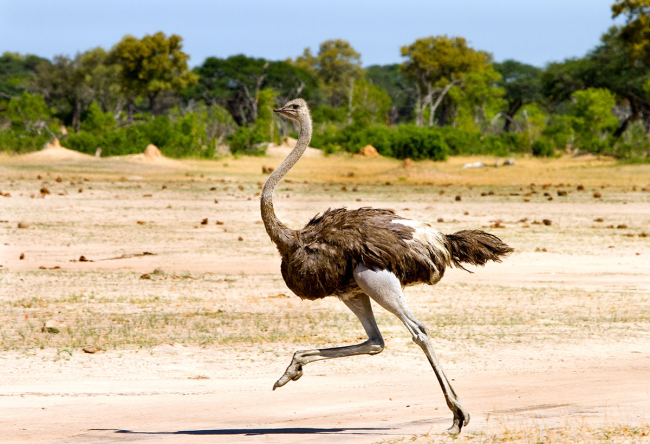
OSTRICH running ( photo credit: Thomson Safaris )
Actually, Africa’s Ostrich runs faster, achieving speeds up to 43 mph (with some reports of quick sprint-bursts up to 60 mph!), qualifying the Ostrich as the fleetest terrestrial runner among birds! Ostriches have stamina, too, so they can sustain speeds above 30 mph for a half-hour or even longer–no human can do that! Behind the Ostrich, Australia’s Emu (a smaller ratite) zooms by, racing at speeds above 30 mph.
ROADRUNNER with prey (photo credit: Nature Picture Library)
Yet the Greater Roadrunner, a much smaller bird, can dart about at speeds above 25 mph–faster than even fleet-footed children.
So, you get the picture–running is a big deal! On that note I’ll quit–i.e., rest–because I ‘got tired” just thinking about all of those creatures running to and fro. Actually, to be frank, I NEVER GET TIRED! Why? I don’t “get tired” because I stay tired.
:)
GREATER ROADRUNNER at Caprock Canyons State Park in West Texas ( photo credit: Wikipedia / drumguy8800 xvisionx.com )
Having arrived at this blogpost’s “finish line”, I’ll contribute this limerick:
STARTLED BY A ROADRUNNER ZIGZAGGING IN THE GRASS
After filling my mower with gas,
I was cutting my east lawn’s grass;
Whoa! — it gave me a start!
‘Twas a bird that did dart!
Wow! Texas roadrunners run fast!
ROADRUNNER, on the run! (photo credit: Wikipedia / El Brujo+ )
County Caithness Can Now Rave about their Raven Flag
Dr. James J. S. Johnson
CAITHNESS flag by roadside (BBC photo credit)
Who provides for the raven his food? — when its young ones cry unto God, they wander for lack of meat.
( Job 38:41 )
Having a bird featured upon an official flag is nothing new, so the above flag of Scotland’s County Caithness, which became official (ceremonially celebrated January 26th of A.D.2016) is not a novel concept.
Flag Institute unveiling of County Caithness flag (BBC photo credit)
However, that vexillological event was and is worth noticing, especially to all of us who appreciate ravens — including Mrs. Lee Dusing, and the rest of us who appreciate her world-class bird-blog! (E.g., see one of Lee’s several blogposts, on ravens (and other corvids), at https://leesbird.com/2013/07/03/birds-of-the-bible-raven-iii/ .)
In fact, the first bird to be named (by its kind) within the Holy Bible was a raven. WOW! That’s quite an incomparable honor!
And he [i.e., Noah] sent forth the raven [‘ōrēb], which went forth to and fro, until the waters were dried up from off the earth.
( Genesis 8:7 )
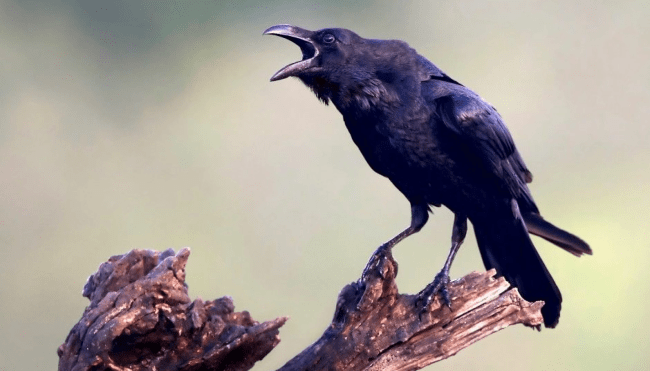
COMMON RAVEN of North America (Wikipedia photo credit)
Likewise, the godly Bible translator and leading Reformer, Dr. Martin Luther, carefully observed and appreciated flocks of ravens (and jackdaws, their corvid cousins), during the adventurous times of the Protestant Reformation’s first generation in Germany. (See “A Diet of Jackdaws and Ravens”, posted at https://leesbird.com/2015/09/16/a-diet-of-jackdaws-and-ravens/ .)
Obviously, ravens are special birds, because God providentially cares for their kind — and tells us so in the Scriptures!
For example, in the Old Testament, within God’s creation sermon to the patriarch Job, Job was questioned about how God takes spare of ravens.
Who provides for the raven his food? — when its young ones cry unto God, they wander for lack of meat.
( Job 38:41 )
Likewise, in the New Testament, the Lord Jesus Christ refers to God’s provision for the physical needs of ravens.
Consider the ravens: for they neither sow nor reap; which neither have storehouse nor barn; and God feeds them; how much more are ye better than the fowls?
( Luke 12:24 )
Ravens are something to rave about!
RAVEN in Norway ( ScienceNorway.NO Dennis Jacobsen, Colourbox photo credit )
ISLE OF MAN’s Coat of Arms, with Peregrine and Raven (public domain)
In fact, this Christian birdwatching blog has previously blended ornithology (i.e., systematic study of birds) with vexillology (i.e., systematic study of flags). Specifically, years ago (during A.D.2015), this bird-blog features a mini-series captioned “FLAG THAT BIRD!” — about flags of the world that feature a bird.
So, this blogpost, celebrating the Caithness Raven, now succinctly supplements that ornithological-vexillological series.
Official flag of Scotland’s County CAITHNESS (public domain image)
Caithness thus celebrates its Viking heritage, with a flag that contains a Nordic cross, plus the raven of antiquity, well known to Viking literature, along with a galley ship, reminiscent of ocean-faring adventures of northeastern Scotland’s Viking forebears, some who came as visitors, yet many who settled as immigrants, blending in with native Celts, providentially producing future generations of Count Caithness natives (Psalm 102:18).
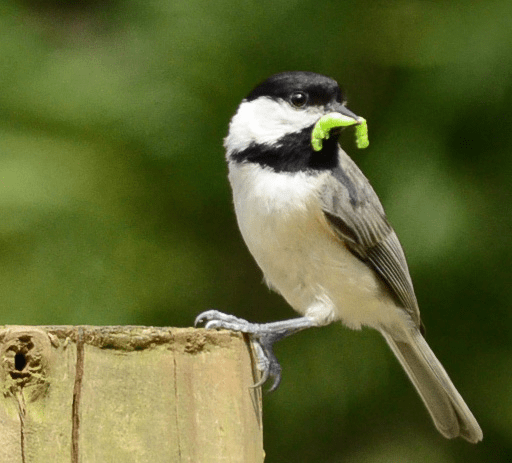
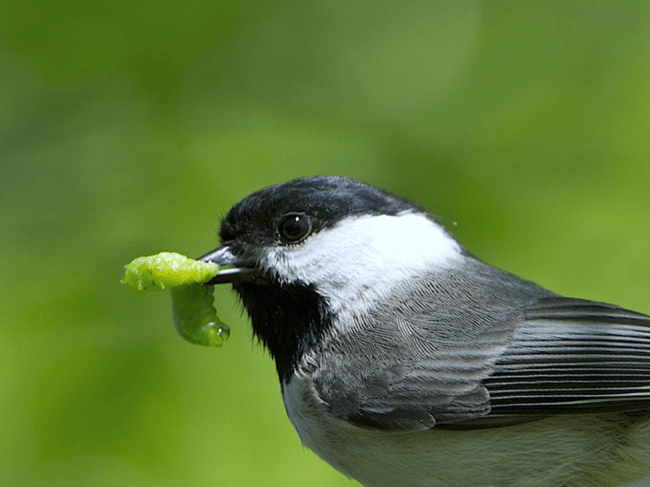
CHICKADEE WITH CATERPILLAR (photo credit: Deb Breton / Portland State University)
Lay not up for yourselves treasures upon earth, where moth and rust doth corrupt, and where thieves break through and steal; but lay up for yourselves treasures in heaven, where neither moth nor rust doth corrupt, and where thieves do not break through nor steal.
(Matthew 6:19-20)
Although moths are famous as pests, to humans (since Biblical times, as the above quote shows), moth caterpillars are desired and delectable food for hungry chickadees—and chickadees need lots of food energy for fuel, to live out their brave and busy lives.
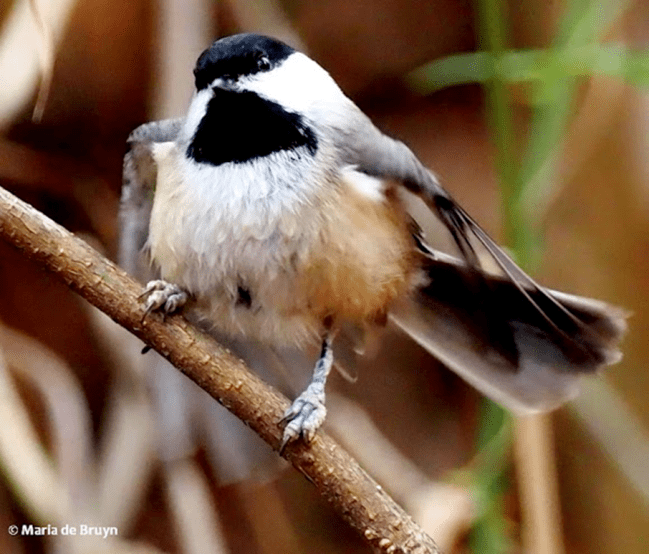
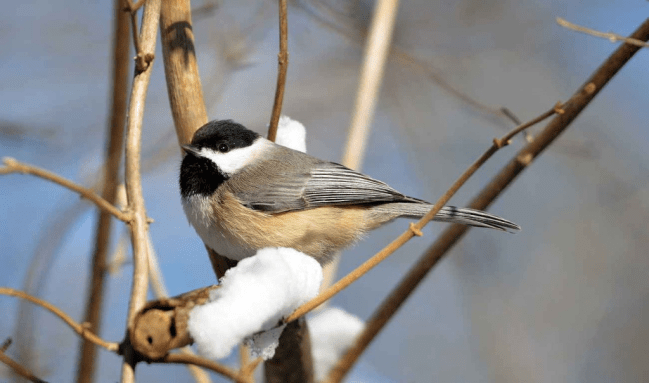
CAROLINA CHICKADEE ( photo credit: Maria de Bruyn / ProjectNoah.org )
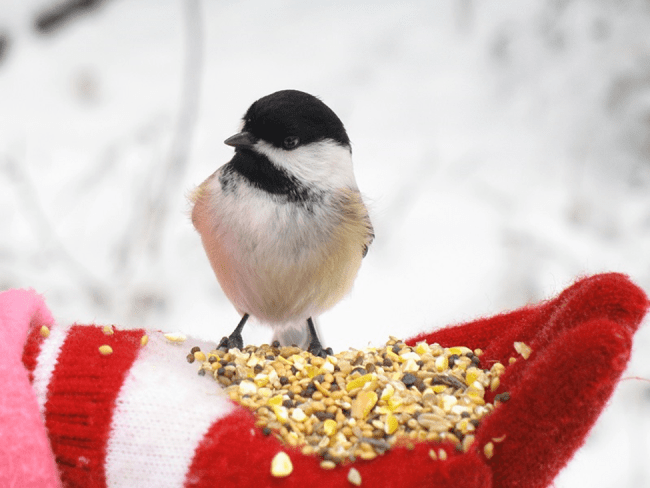
Chickadees are brave little birds, resilient enough to tough out winter weather, while less resilient birds migrate south for milder climes.
CHICKADEE, eating seeds during winter in Canada (photo credit: DiscoverSouthernOntario.com)
The resilience of these petite yet robust little passerines was recently appreciated by Alonso Abugattas (a/k/a “Capital Naturalist”*), in the May (A.D.2023) issue of CHESAPEAKE BAY JOURNAL. (*This is the same Alonso Abugattas, longtime natural resources manager for Arlington in Virginia, who was recognized as a “Regional Environmental Champion” by the Washington metro area’s Audubon Naturalist Society.)
One of my favorite birds is the chickadee. The Carolina chickadee (Poecile carolinensis) is the one we usually see around the Washington, D.C. area. The nearly identical black-capped chickadee (Poecile atricapillus) usually lives farther north, though the species overlap a bit in central and south Pennsylvania. The black caps are known to venture farther south during irruption years, when there is severe cold weather or food shortage. The energy and resourcefulness of chickadees, along with biological adaptations, allow them to live in our yards year-round. In winter, when most other insect-eating birds migrate [south], they augment their diet with seeds. People who feed birds are likely to find chickadees, which are particularly fond of black oil sunflower seeds, to be among their best customers. …
Chickadees have several ways of conserving energy [i.e., body heat when it is cold outside]. They fluff their feathers and grow up to 30% more feathers in winter to trap body-warmed air. They can also enter torpor [i.e., overnight semi-hibernation metabolic slowdown], reducing their body temperatures by as much as 20 degrees on winter nights to conserve fat reserves.
[Quoting Alonso Abugattas, “Meet the Carolina Chickadee, Resourceful ‘Bringer of News’”, CHESAPEAKE BAY JOURNAL, 33(3):39 (May 2023).]
CHICKADEE IN WINTER (photo credit: Howard Eskin / Backyards for Nature)
In Texas the Carolina Chickadee is a year-round resident in the north (even as far as the northeast corner of the Panhandle), east, and central (including much of the Edwards Plateau) parts. [See Roger Tory Peterson, A FIELD GUIDE TO THE BIRDS OF TEXAS AND ADJACENT STATES (Boston: Houghton Mifflin, 1988), a/k/a BIRDS OF TEXAS, at pages 141, plate 38, & 172.]
Chickadees are easy to identify: “Chickadees are the only small birds with the combination of black cap, black bib, white cheeks. … [noticeably] smaller than sparrows.” [Quoting Peterson’s BIRDS OF TEXAS, cited above, at page 172.]
However, distinguishing between Carolina Chickadees and Black-capped Chickadees is not so easy. In fact, these chickadees belong to the same created (on Day 5 of Creation Week) created “kind” of bird, because they successfully interbreed. (In fact, other chickadee hybrids are known, such as hybrids of Mountain Chickadees with Black-capped Chickadees.)
CHICKADEE HYBRID: BLACK-CAPPED X MOUNTAIN (photo credit: Steve Mlodinow / Bird Hybrids Blog)
Unsurprisingly, hybridization occurs where Black-capped Chickadees share ranges with Carolina Chickadees, such as in Colorado. [See Kelsey Simpkins, “The Chickadee You See Sitting on a Tree? It Might Be a Hybrid”, CU BOULDER TODAY (Oct. 22, 2022), posted by University of Colorado Boulder, at http://www.colorado.edu/today/2022/10/28/chickadee-you-see-sitting-tree-it-might-be-hybrid .] In fact, hybridization also occurs with the Black-capped Chickadee and its range-sharing cousin, the white eye-browed (but otherwise similar-looking) Mountain Chickadee.
Black-capped chickadee is by far the most common of the two i.e., of Black-capped Chickadees and Carolina Chickadees] and has a much wider range spanning pretty much the entirety of the USA and southern Canada, though they’re also found in Alaska. Conversely, the Carolina chickadee is relatively confined to the southeastern USA. The two birds converge [i.e., overlap in ranges] along a wide strip spanning from New Jersey to Kansas. In terms of looks, the Black-capped chickadee is slightly larger than the Carolina chickadee [which is an advantage for preserving body heat in cold winters]. The Black-capped chickadee also has more strongly contrasting plumage, including a paler breast and underside of the body. To confuse these birds further, they often hybridize (frequently!) across the strip where they meet, particularly when the Black-capped chickadees push further south during [winter] than they would usually do. Hybrid Black-capped and Carolina chickadees are pretty much impossible to identify [apart from DNA studies]. . . .
However, where Black-capped and Carolina chickadees meet, they can learn each other’s songs which renders this form of identification quite useless! For example, most Carolina chickadees sing Black-capped songs in Pennsylvania, and about 60% sing both Black-capped and Carolina songs. This intermixing of songs causes chickadees to sing strange mixes of each other’s songs, leading to increased hybridization.
The observed behaviors of chickadees are a study in themselves—they have special habits of communication (including vocalized “talking” and visual display “body language”), courting, breeding and nest life (including nest-building, egg laying, incubation, nurturing hatchlings, etc.), territory defense, and more.
BLACK-CAPPED CHICKADEE in Ontario, Canada (photo credit: DiscoverSouthernOntario.com)
One such behavior is territory defense, a behavioral habit that is unusual among North American passerine songbirds. In particular this has been observed of Black-capped Chickadees, though there is not reason to suspect this habit is absent among its southern Carolina cousins.
Black-capped Chickadees are unusual in terms of territory [stewardship]. Like some other birds, they hold both breeding and nonbreeding territories, but unlike any of our other common birds, their nonbreeding territory is occupied and defended by a flock and not by an individual bird or mated pair. These flocks are highly structured [i.e., organized] and have predictable patterns of movement. …
In late summer after the young [fledglings] have dispersed, Chickadees gather into small flocks that remain together until the start of the next breeding season. … A flock usually forms around a dominant pair that has just finished a successful brood. The flock contain six to ten birds, some juveniles, some paired adults, and some single adults. It establishes a feeding territory which it defends against other neighboring flocks. …
Once the breeding phase starts [in spring], winter flocks break up and you will have fewer Chickadees at your feeder. If one or two pairs remain in the area to breed, you may see the female do Wing-quiver [visual display] as she is fed by the male in courtship, and later you may see the young [hatchlings] do Wing-quiver as they are fed by the parents.
[Quoting Donald W. Stokes, A GUIDE TO BIRD BEHAVIOR, VOLUME I (Little, Brown, 1979), at pages 166, 171, 173]
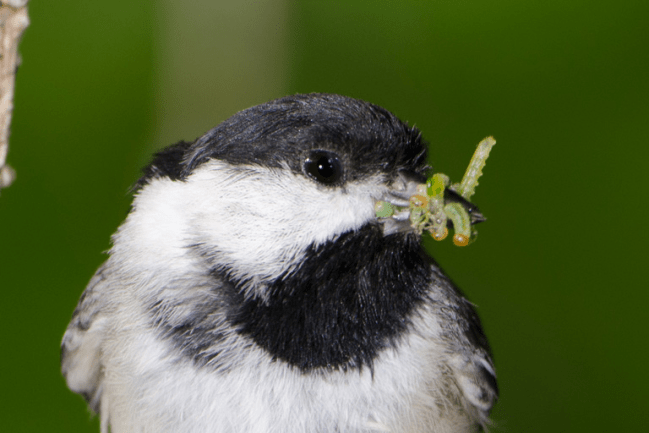
Chickadees are also famous for another habit: gobbling up caterpillars!
CHICKADEE EATING CATERPILLAR (photo credit: Doug Tallamy of Univ. of Delaware / News.Mongabay.com)
So, if you dislike swarms of insects (such as flies) during summertime, or if you fear moths marring your beautiful clothing (see Matthew 6:19-20), you should appreciate the moth-munching insectivorous diets of chickadees:
Chickadee parents feed their young almost exclusively on insects. Caterpillars [i.e., crawling insect larvae of butterflies and moths] are their favorite. It takes about 9,000 caterpillars to raise one brood. Studies have shown that when insects aren’t available, the young [chickadee hatchlings] can die if fed only seed. This is why chickadees prefer to nest near native trees (and, in turn, native insects) as opposed to yards with nonnative plants [that are less “hospitable” to the insect populations that chickadees prefer to eat]. Their reproductive success is at stake.
[Quoting Alonso Abugattas, “Meet the Carolina Chickadee, Resourceful ‘Bringer of News’”, CHESAPEAKE BAY JOURNAL, 33(3):39 (May 2023).]
CAROLINA CHICKADEE EATING CATERPILLAR (photo credit: Doug Tallamy, University of Delaware / Popular Science)
Caterpillars provide more metabolic value than just nutritious protein; because caterpillars contain carotenoids, eating caterpillars helps chickadee feathers to be colorful, bright, and shiny.
So, as moths (including their caterpillar larvae) remind us to store up incorruptible treasures in Heaven (Matthew 6:21), we can also appreciate how God has purposed many of those lepidopteran caterpillars to fuel the brave and busy lifestyles of chickadees.
CHICKADEE EATING CATERPILLAR (photo credit: Deb Breton / Portland State University)
“Praise the LORD from the earth … fruitful trees and all cedars … and flying fowl.” (from Psalm 148:7-10)
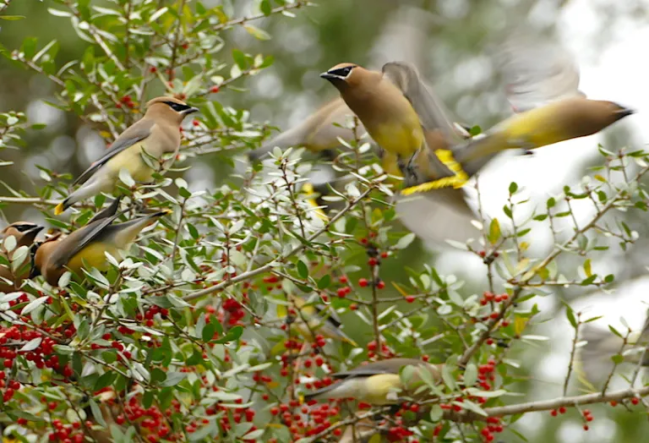
CEDAR WAXWINGS EATING BERRIES [photo credit: Wild Birds Unlimited]
Each spring gregarious flocks of Cedar Waxwings pass through my part of Texas, as they migrate northward toward their breeding grounds. No “lone rangers” here! Cedar Waxwings travel in flocks of many dozens–sometimes even hundreds–synchronizing their fast-food stopovers along the way, to refuel for the next aerial leg of their migratory trek. And trees or bushes with red berries are a particular favorite of Cedar Waxwings. Although the nutritional details are a bit technical — as noted below* — waxwings need to balance their sour berry intake with protein-rich pollen, both of which are available during mid-April in my part of Texas, as the flocks of Cedar Waxwings pass through in their flights northward.
So, when these large flocks of colorful waxwings make a “pit stop” for fast-food they often fill the branches of trees as they hastily consume red berries (and other edible nutrients), just before resuming their northbound flights to their spring-through-summer breeding ranges.
On April 7th A.D.2023, a Friday morning, as I observed this hastily convened arboreal assembly of avian migrants, I thought of the traditional assemblies (“things”) of the Vikings — such as those Nordic congregants convened annually in Iceland (Thingvellir’s “Althing”) and on the Isle of Man (at the Manx “Tynwald”), to conduct the serious business of life. Could it be that these Cedar Waxwings were having their own version of an Althing assembly, as they refueled (and rested briefly) during their stopover in the branches of my trees and bushes? Since I cannot understand the language of Cedar Waxwings I cannot know what they conversed about — but I knew that they would vacate northward soon enough, so I would not see them again until the next seasonal migratory pass-through, as they live out the providential phenology of their migratory lifestyle.
What a privilege it was to see God’s Cedar Waxwings–scores of them (perhaps more than a hundred!) as a flock in transit–quickly visiting the trees and bushes on the south side of my home. Surely God’s birds will remind us of His care for us, if we take the time to think about it–and have eyes to see (Matthew 6:26; Luke 12:24).
In fact, that faith lesson (which is was taught, in ancient times, to the patriarch Job, by God Himself (in Job 38:41), as is noted in the first of the 3 apologetics lectures (shown below) that I gave recently, to a Swedish theology school (Skandinavisk Teologisk Högskola):
CEDAR WAXWINGS [photo credit: Museum of Life & Science, Durham, N.C.]
So, now for a limerick, that memorializes my observations of the flock of Cedar Waxwings that briefly visited my frontyard earlier this month:
FAST-FOOD/FLY-THRU ALTHING OF MIGRATORY CEDAR WAXWINGS
A flock-full of birds, in my trees,
Gulped down every berry they’d seize;
This arboreal Althing
of the Cedar Waxwing
Soon adjourned—dispersed with the breeze!
CEDAR WAXWINGS photo credit: Mary Anne Borge / The Natural Web
[*For technical information, befitting Cornell University, about the diet of Cedar Waxwings, see Mark C. Witmer’s “Nutritional Interactions and Fruit Removal: Cedar Waxwing Consumption of Viburnum opulus Fruits in Spring”, ECOLOGY, 82(11):3120-3130 (November 2001).]
God … is wise in heart, and mighty in strength: … [and He] doeth great things past finding out; yea, and wonders without number.
[Job 9:2 & 9:4 & 9:10]
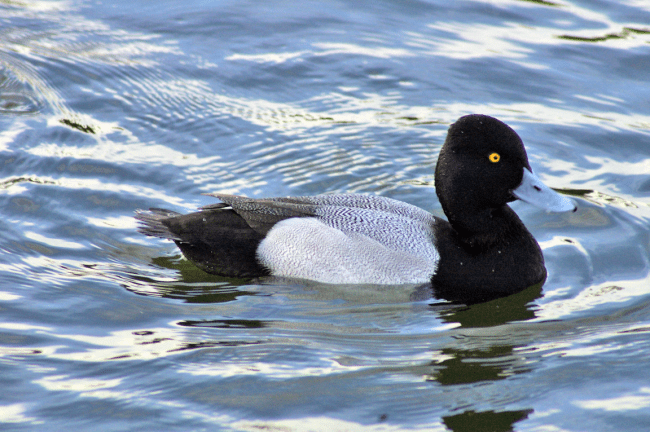
LESSER SCAUP male (photo credit: National Audubon Society)
Last Saturday (February 18th of A.D.2023), as I was birdwatching inside my wife’s car — while she was driving, so it’s okay that I was birdwatching! — I saw a lone Lesser Scaup (Aythya affinis, a/k/a “Little Bluebill”) floating in the middle of a favorite pond (where I have often seen grackles in the past — see http://www.icr.org/article/grackles-gratitude/ — and appreciated that God could have made me a grackle!).
As I thought about this Lesser Scaup, and how I’ve often seen such scaups (and other ducks) on Texas ponds during winter, it seems that the occasion deserves a poetic memorial of some kind, such as a limerick.
Now, a few days later, here is that limerick, although admittedly the limerick calls the pond a “lake” (which some ponds are called, anyway, by Floridians), because it’s easier to rhyme “lake” than “pond” when composing limericks.
Apparently, the anatid name “scaup” derives from a European word referring to shellfish (e.g., Noah Webster’s 1828 AMERICAN DICTIONARY OF THE ENGLISH LANGUAGE notes that “scalp” comes from the Dutch schelp meaning “shell”), alluding to coastal bivalves (such as clams, mussels, and oysters), which are often eaten by these diving ducks. These wetland-frequenting ducks also eat shoreline vegetation, such as pondweeds, widgeon-grass, sedges, bulrushes, wild rice, wild celery, and other hydrophilic plants.
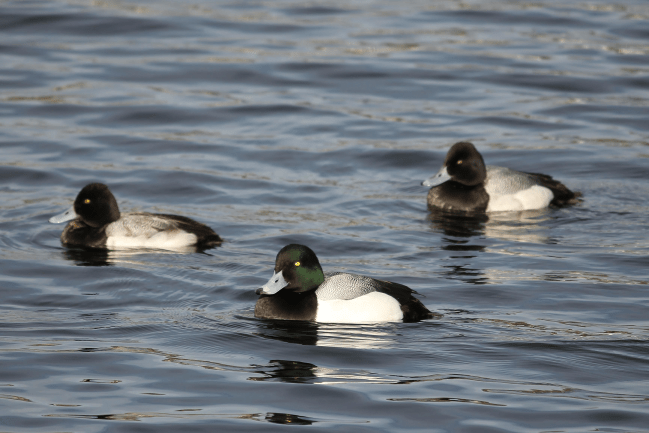
Generally speaking, scaups are migratory birds, so we Texans see them during the cold months of the year — however, there are some parts of North America where Lesser Scaups are seen year-round. Sometimes it’s hard to distinguish a Lesser Scaup from a Greater Scaup (Aythya marila, a/k/a “Common Scaup” or “Bluebill”), from a distance — plus, to confuse identifications further, these scaups can hybridize with each other, as well as with the American Redhead (Aythya americana), Ring-necked Duck (Aythya collaris), European Pochard (Aythya ferina), and Canvasback (Aythya valisineria). [See Eugene M. McCarthy, HANDBOOK OF AVIAN HYBRIDS OF THE WORLD (Oxford, UK: Oxford Univ. Press, 2006), page 90.] But they are all diving ducks!
Greater Scaup between Lesseer Scaups (photo credit: reddit.com / birdpics)
So, as noted above (in the above limerick that is just “ducky”), I’m glad that, such ducks, God did make!
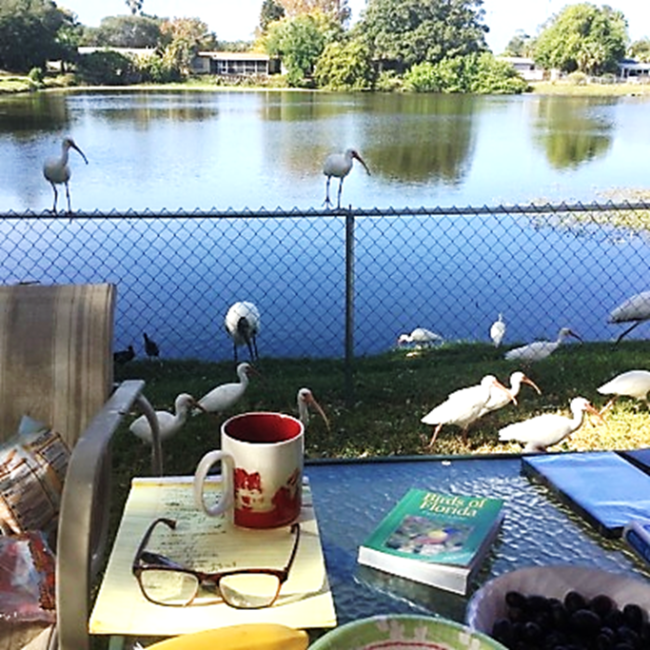
As reported in 2 recent blogposts — ( see https://leesbird.com/2023/01/20/florida-pond-shore-report-part-1/ and https://leesbird.com/2023/01/23/florida-pond-shore-report-part-2/ ) — the pond-shore birds were plentiful (except not ducks, for some odd reasons) in St. Petersburg, Florida, at the home of Chaplain Bob and Marcia Webel, on the morning of Monday, January 16th (A.D.2023, as Chaplain Bob and I sat in lawn chairs in the Webels’ backyard that adjoins the pond-shore (of what Floridians call a “lake”), drinking our coffee (and eating toasted rye bread).
In that prior-reported blogposts I described reported (in Part 1) seeing Bald Eagle, White Ibis, and Common Grackle, as well as seeing (in Part 2) Great Blue Heron, Great White Egret, and Double-crested Cormorant.
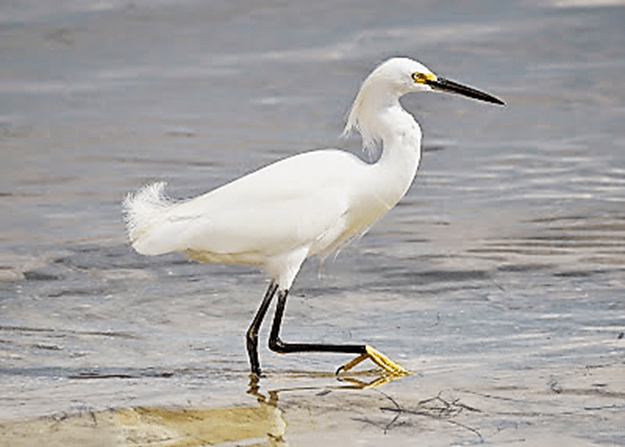
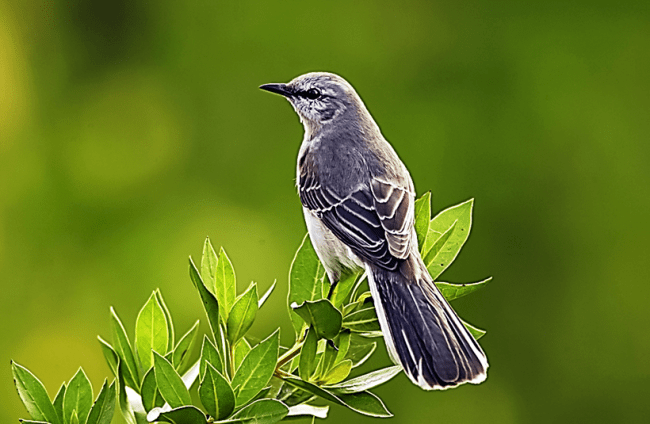
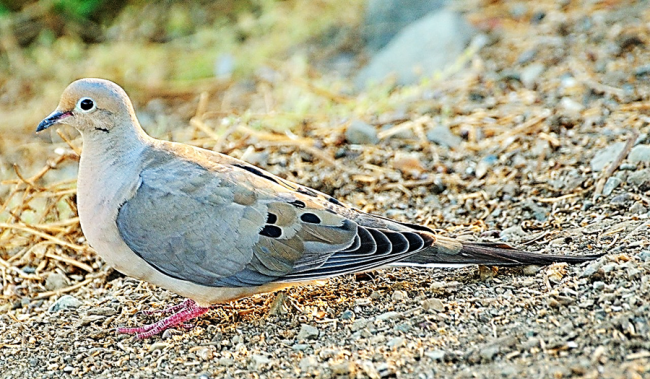
In this report (Part 3) the birds to be featured are Snowy Egret,Mockingbird, Mourning Dove, and Blue Jay.
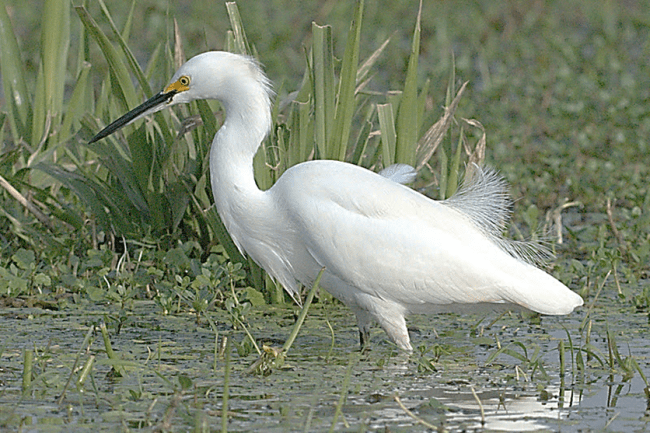
SNOWY EGRET in St. Petersburg (Joan and Dan’s Birding Blog image, q.v.)
SNOWY EGRET. The Snowy Egret has previously been described on this blog by ornithologist Lee Dusing, documenting this splendidly plumed wader (seen in St. Petersburg), in her blogpost “Walking Snowy Egret Showing Off Yellow Feet”, posted at https://leesbird.com/2019/01/04/walking-snowy-egret-showing-off-yellow-feet/ , on January 4th of A.D.2019, — as well as in “’E’ is for Egrets and Emus: ‘E Birds’, Part 2” (posted at https://leesbird.com/2016/11/08/eis-for-egrets-and-emus-e-birds-part-2/ , on November 11th of AD2018). Snowy Egrets (Egretta thula) are reported to hybridize with Little Egret (Egretta garzetta) and Cattle Egret (Bubulcus ibis), according to Eugene M. McCarthy, HANDBOOK OF AVIAN HYBRIDS FO THE WORLD (Oxford, UK: Oxford University Press, 2006), pages 189-191. The Snowy Egret, as a member of the “heron-egret” subfamily Ardeinae, is a distant “cousin” to the Great White Egret that is described in “Egret Feathers, Worth More than Gold!” (posted at https://leesbird.com/2018/08/17/egret-feathers-worth-more-than-gold/ , dated August 17th of AD2018).
NORTHERN MOCKINGBIRD ( U.S. Fish & Wildlife Service image / Wikipedia, q.v.)
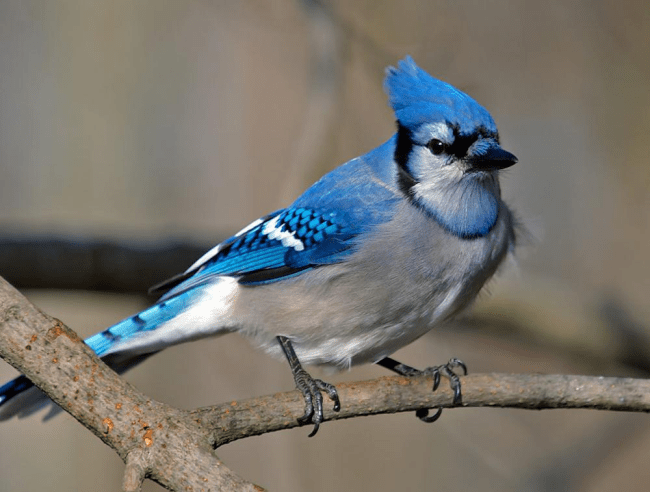
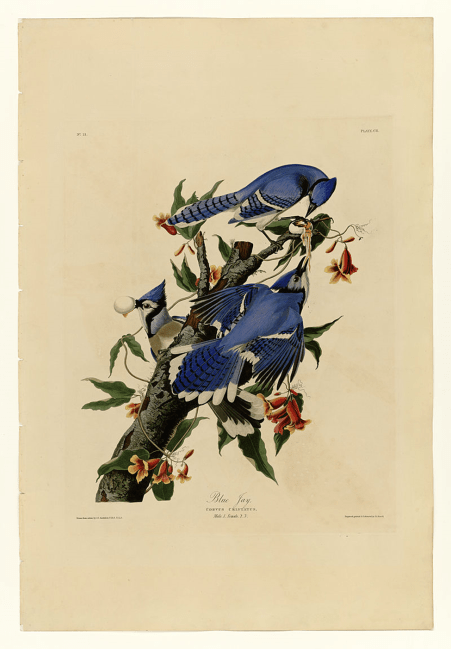
BLUE JAY (John James Audubon painting, ~AD1830s / public domain)
BLUE JAY. The Blue Jay, which can be a neighborhood bully, has been described on this birding blog – see “Bird Brains, Amazing Evidence of God’s Genius”, posted on March 7th of AD2013 (at https://leesbird.com/2013/03/07/48484/ ). When ranges overlap, such as in Rocky Mountain states, Blue Jays sometimes hybridize with Steller’s Jays — see “Jaybirds Mix It Up in Colorado”, posted on November 12th of AD2018 (at https://leesbird.com/2018/11/12/jaybirds-mix-it-up-in-colorado/ ). The behavioral habits of Blue Jays, which include eating sunflower seeds, are noted within the poetic blogpost titled “Here’s Seed for Thought”, posted on July 4th of AD2015 (at https://leesbird.com/2015/07/04/heres-seed-for-thought/ ). Another jaybird adventure that comes to mind is the birdwatching joy (on July 7th of AD2006, with my wife, while approaching a rural restaurant) of seeing a Eurasian Jay in a wooded field outside of Porvoo, Finland – see “Eurasian Jay: ‘Jay of the Oaks’ Admired in Finland”, posted on October 10th of AD2016 (at https://leesbird.com/2016/10/10/eurasian-jay-jay-of-the-oaks-admired-in-finland/ ). Truly amazing!
Meanwhile, the other pond-shore visiting birds — i.e., Florida Gallinule (a/k/a Common Moorhen), Anhinga (a/k/a Snakebird), Tufted Titmouse, Limpkin, Red-bellied Woodpecker, and Muscovy Duck (the last being seen on grass of neighbor’s front-yard) — on the morning of Monday, January 16th of A.D.2023), must wait for another day to be reported here, Deo volente. Thank the Lord for such good memories!
Also, thanks be unto the LORD for His creative and artistic bioengineering as our great Creator, including His Creatorship as exhibited in His making of Snowy Egrets (like the one below shown) and of all of Earth’s other magnificent birds!
><> JJSJ profjjsj@aol.com
SNOWY EGRET (Rich Vial / Clearly Confused Blog photo credit)
And the stork, theheron [הָאֲנָפָ֖ה] after her kind, and the lapwing, and the bat.
Leviticus 11:19
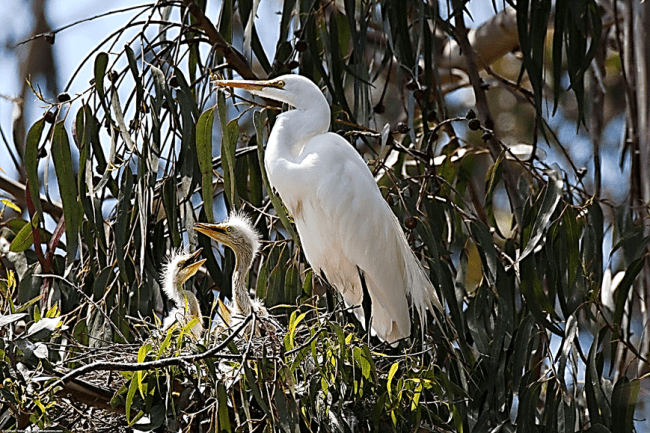
As reported last Friday — ( see https://leesbird.com/2023/01/20/florida-pond-shore-report-part-1/ ) — the pond-shore birds were plentiful (except not ducks, for some odd reasons) in St. Petersburg, Florida, at the home of Chaplain Bob and Marcia Webel, on the morning of Monday, January 16th (A.D.2023, as Chaplain Bob and I sat in lawn chairs in the Webels’ backyard that adjoins the pond-shore (of what Floridians call a “lake”), drinking our coffee (and eating toasted rye bread). In that prior-reported blogpost I described the Bald Eagle, White Ibis, and Common Grackle. This report (“Part 2” in this series) will feature the Great Blue Heron, Great White Egret, andDouble-crested Cormorant.
GREAT BLUE HERON in Florida (Terry Foote image / Wikipedia image, q.v.)
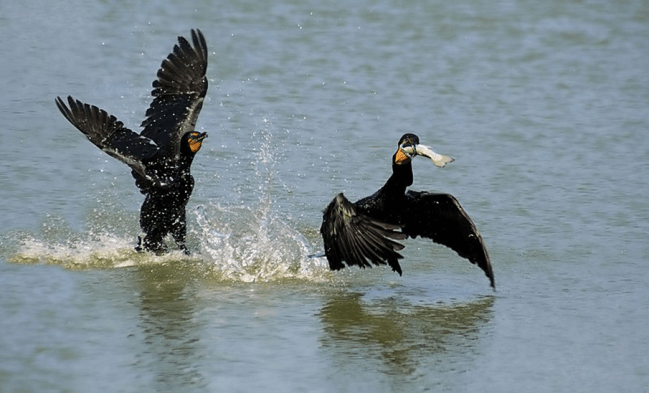
DOUBLE-CRESTED CORMORANT, 1 with a fish (Brocken Inaglory image / Wikipedia, q.v.)
DOUBLE-CRESTED CORMORANT. The Double-crested Cormorant has previously been described on this birdwatching blog – see “Of Cormorants and Anhingas” (posted on June 13th of A.D.2019, at https://leesbird.com/2019/06/13/of-cormorants-and-anhingas/ ). See also Lee Dusing’s interesting report on cormorants, “Birds of the Bible – Cormorant”, posted June 26th of A.D.2008, at https://leesbird.com/2008/06/26/birds-of-the-bible-cormorant/ — which includes video footage of domesticated cormorant fishing in China. Amazing!
Meanwhile, the other pond-shore visiting birds — i.e., Mockingbird, Mourning Dove, Blue Jay, Snowy Egret, Common Moorhen (a/k/a “Florida Gallinule”, Anhinga, Tufted Titmouse, Limpkin, Red-bellied Woodpecker, and Muscovy Duck (the last being seen on grass of neighbor’s front-yard) — on the morning of Monday, January 16th of A.D.2023), must wait for another day to be reported here, Deo volente. Thank the Lord for ssuch good memories!
I would seek unto God, and unto God would I commit my cause, Who doeth great things and unsearchable, marvelous things without number … Who doeth great things past finding out; yea, and wonders without number.
“I will open rivers in high places, and fountains in the midst of the valleys: I will make the wilderness a pond of water, and the dry land springs of water.”
(Isaiah 41:18)
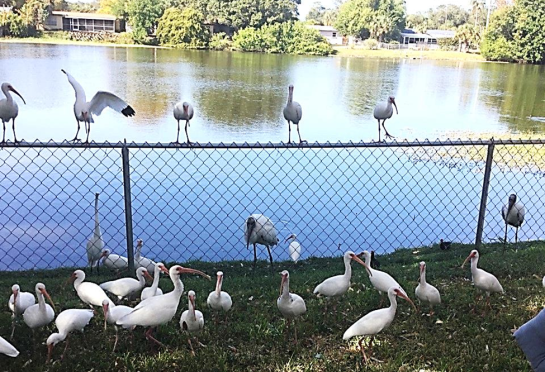
Wow! What a morning birdwatching in St. Petersburg, Florida, at the home of Chaplain Bob and Marcia Webel, good Christian friends (of mine) since the early A.D.1970s (and good friends of my wife, years later). On the morning of Monday, January 16th (A.D.2023) we sat in lawn chairs inside the backyard that borders a near-the-bay pond (i.e., what Floridians call a “lake”), drinking our coffee (and eating toasted rye bread), enjoying the privilege of observing the following birds:
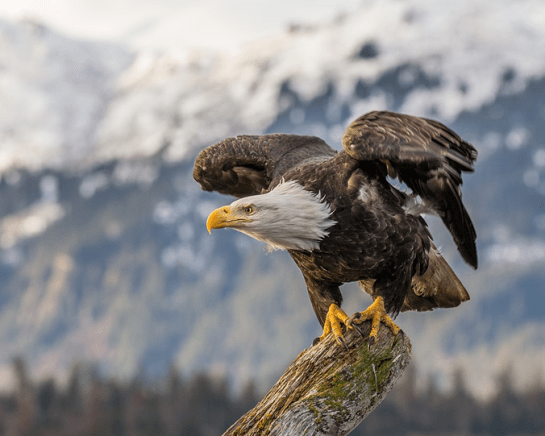
BALD EAGLE (Wikipedia image)
Bald Eagle. When a Bald Eagle fly to the top branches of a pond-shore tree the smaller birds fled, yielding to the eagle’s raptor reputation. All American patriots know the Bald Eagle, our national bird. The heads and necks (of both male adults and female adults) are covered with bright white feathers, giving it the appearance of being “bald” (from a distance). [See John Bull & John Farrand, Jr., NATIONAL AUDUBON SOCIETY FIELD GUIDE TO NORTH AMERICAN BIRDS: EASTERN REGION, revised edition (New York, NY: Alfred A. Knopf, 1994), pages 321-322 & 423-424.] These heavy hawk-like raptors love to eat fish, so it is not surprising to see them at and near seashores, lakeshores, estuarial bays and riverbanks, and similar shorelines where fish are readily available. [See Roger Tory Peterson, PETERSON FIELD GUIDE TO BIRDS OF WESTERN NORTH AMERICA, 5th edition (Boston, MA: HarperCollins, 2020), page 178.]
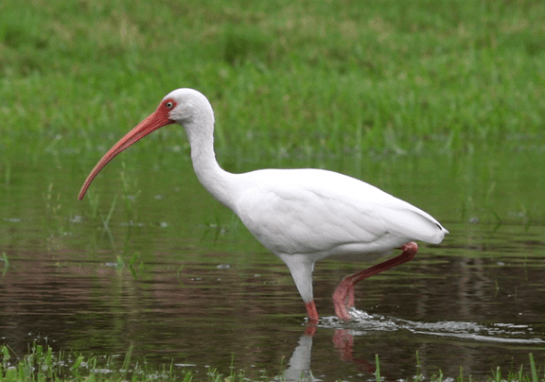
WHITE IBIS (Wikipedia image)
White Ibis. Although wild, these happy-to-eat-bread birds are noticeably bold in their willingness to approach humans who feed them bread crumbs. (In some Florida pond-shore park contexts they will literally eat bread morsels from human hands.) White Ibises are a long-legged chicken-sized waterfowl, almost all white (yet has black under-edging on its wings), with a long decurved (i.e., downward-curved) bill that is reddish (vermillion-orange/coral-red) in color. These wading birds enjoy eating critters that inhabit pond-shore waters, such as crayfish, small fishes, and aquatic insects. [See John Bull & John Farrand, Jr., NATIONAL AUDUBON SOCIETY FIELD GUIDE TO NORTH AMERICAN BIRDS: EASTERN REGION, revised edition (New York, NY: Alfred A. Knopf, 1994), pages 12 & 376.] These white waterfowl are known to hybridize with Scarlet Ibis. [See Eugene M. McCarthy, HANDBOOK OF AVIAN HYBRIDS OF THE WORLD (Oxford, UK: Oxford University Press, 2006), page 192.]
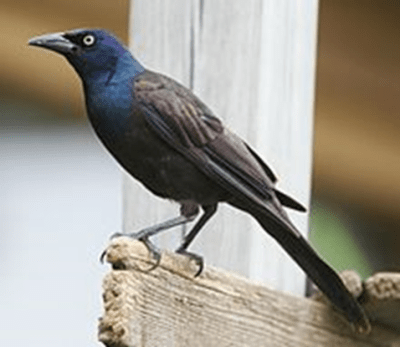
COMMON GRACKLE (Wikipedia image)
Common Grackle. Although I was originally inspired by a Great-tailed Grackle (at a pond-shore in Denton County, Texas) to write “Of Grackles and Gratitude”, in the July AD2012 issue of ACTS & FACTS ( posted at www.icr.org/article/grackles-gratitude ), the grackles that I saw in St. Petersburg, in the backyard by the pond-shore, were Common Grackles (varieties of which include “Purple Grackle” and “Florida Grackle”). Their glossy-black iridescent plumage shimmers in the sunlight, like a kaleidoscope of gleaning flickers of indigo, deep purple, peacock blue, midnight blue, dark bronze-brown, and emerald green. [See John Bull & John Farrand, Jr., NATIONAL AUDUBON SOCIETY FIELD GUIDE TO NORTH AMERICAN BIRDS: EASTERN REGION, revised edition (New York, NY: Alfred A. Knopf, 1994), pages 479 & 735.]
Other birds that we (i.e., Chaplain Bob Webel and I, while our wives chatted inside the Webels’ house) observed that morning, at or near the pond-shore, included Great White Egret, Great Blue Heron, Double-crested Cormorant, Mockingbird, Mourning Dove, Blue Jay, Snowy Egret, Common Moorhen, Anhinga, Tufted Titmouse (on a tree near the pond-shore), Limpkin (foraging near a group of ibises), Red-bellied Woodpecker (on oak branches by the pond-shore), plus later 3 Muscovy Ducks were seen waddling about on the grass of a neighbor’s front-yard. Besides birds, a playful (and very large) River Otter relaxed on the opposite shore of the pond, while several Eastern Grey Squirrels darted here and there on the ground and on the trunk and branches of nearby trees.
But the details of those other shoreline-visiting birds must await future blogposts (D.v.), because this one is almost finished.
Meanwhile, what a privilege it is to observe—close-up—God’s winged wonders, including those seen last Monday.
“Praise the Lord from the earth, … beasts, and all cattle; creeping things, and flying fowl.”
To everything there is a season, and a time to every purpose under the heaven. (Ecclesiastes 3:1)
KONICA MINOLTA DIGITAL CAMERA
RED-COCKADED WOODPECKER (Carolina Bird Club photo)
Woodpeckers are famous for eating insects—beetles, caterpillars, “grubs” (insect larvae), spiders, ants, etc.—as well as occasionally eating berries and other fruits. But what about vitamins and minerals, how do woodpeckers get what they need?
Consider this: when you eat eggs—boiled, poached, or as omelets—do you discard the eggshells? Likewise, if you eat trout or turkey, do you recycle your fish or fowl bones?
Some birds and mammals eat broken eggshells or snail shells to get nutritionally valuable calcium.[1] Also, some birds—such as Red-cockaded woodpeckers[2] and Alaskan sandpipers[3]—munch on bones, to get calcium, especially during breeding season.
Getting calcium (usually from calcium carbonate: CaCO3) is needful, of course, but how do birds know they need calcium, especially during the breeding season?
A related question: how do expectant human mothers, who suddenly crave finfish or shellfish (or pickles, or Buffalo hot wings, or whatever) know that they need a nutritional change, while their physiologically transformed womb-factories busily build beautiful babies?
God somehow provides an urge to eat certain foods that we need, when we need those foods—this is something we gained by so-called evolutionary “luck” or random “chance”! In fact, successful reproduction of populations, whether they be human or animal, is something that is unfixable if reproduction is ever broken. (In other words, true extinction is forever—there are no second chances!)
Actually, calcium nutrition-satisfying behavior makes sense, biblically, because it helps Christ’s creatures to reproduce successfully, i.e., to “be fruitful and multiply”, so their kinds can “fill” (populate) Earth’s habitats. Thus, learning how creatures fulfill the Genesis Mandate helps us to “cast down” haughty imaginations (2nd Corinthians 10:4-5), such as the imaginations of Darwinists, who try to replace Christ with animistic “nature-creating-itself” mythology, masquerading falsely as “science” (1st Timothy 6:20)–as if inanimate “nature” could somehow “select” helpful results for promoting life on Earth!
During Creation Week (on Day #5, to be exact), the Lord Jesus Christ (as Creator[4]) commanded birds to reproduce (and “fill” environments); He also equipped them with what they need, to do so. Many of the intricate details we are just now learning.
Further complicating matters, successful reproduction requires a harmony of physical traits (biochemically regulated by genetics/epigenetics) with decision-based behaviors (which rely upon learning, by the non-physical “soul” of a bird). The details of successfully blending physical body systems, with non-physical learned behaviors, is one of the “wonders without number” (Job 9:10) that we can admire God for, as we reverently study how God’s creatures live.[5]
Of course, when creatures purposefully search local habitats for needed nutrients—including vital minerals like calcium—they exhibit continuous environmental tracking (CET), as they hunt and select what they need from their territory. Thus, Christ equipped animals to actively select what they need, from their habitats—it is not true that habitats “select” or “shape” passive animals.[6]
So, what can we learn from our Lord Jesus Christ’s red-cockaded woodpeckers (Picoides borealis), that recycle calcium from collected bone fragments, consuming bone flakes just before and when they are laying eggs?
The females took bone fragments from raptor pellets located on the ground. … Small bone fragments were consumed at the pellets whereas larger pieces were taken to a tree trunk (by flight) where they were pecked and mandibulated. … Pieces of bone were cached by placing them between scales of [tree-trunk] bark and then hammering them with the bill until they were wedged. We confirmed that bones were cached by recovering two pieces of bone from trees and by observing birds recover cached bones, handle them and cache them elsewhere.2
Repasky, Blue, & Doerr article cited in endnote 2 (below)
Selecting and ingesting bone-pecked calcium is targeted and purposeful—not random—because mother woodpeckers seek and extract calcium from bone fragments during breeding seasons (hiding bone fragments for later “snacks”), mostly ignoring those bones when they cease producing eggs2,4,5—amazing!
Darwinian trial-and-error “luck” cannot explain how these wise woodpeckers know to hunt and ingest calcium-rich bone flakes, timed to egg-producing seasons.4,5 However, the Lord Jesus Christ is the Mastermind of purposeful timing for all of His creation (Ecclesiastes 3:1), including female red-cockaded woodpeckers.
RED-COCKADED WOODPECKERS (James Audubon watercolor — public domain)
REFERENCES
[1] E.g., Mary Straus, “Calcium in Homemade Dog Food”, WHOLE DOG JOURNAL (May 28, 2019), at http://www.whole-dog-journal.com/food/calcium-in-homemade-dog-food/ (calcium from eggshells). See also Samuel L. Beasom & Oliver H. Pattee, “Utilization of Snails by Rio Grande Turkey Hens”, JOURNAL OF WILDLIFE MANAGEMENT, 42:916-919 (1978).
[2] Richard R. Repasky, Roberta J. Blue, & Philip D. Doerr, “Laying Red-cockaded Woodpeckers Cache Bone Fragments”, THE CONDOR, 93(2):458-461 (1991). Red-cockaded woodpeckers resemble 4 other American woodpeckers, the Ladder-backed Woodpecker, Downy Woodpecker, Hairy Woodpecker, and Nuttall’s Woodpecker. It appears that Red-cockaded Woodpeckers can hybridize with Hairy Woodpeckers (Picoides villosus), which in turn hybridize with Ladder-backed Woodpeckers (Picoides scalaris), which hybridize with Downy Woodpeckers (Picoides pubescens) and with Nuttall’s Woodpecker (Picoides nuttallii). See Eugene M. McCarty, HANDBOOK OF AVIAN HYBRIDS OF THE WORLD (New York, NY: Oxford University Press, 2006), pages 107-108.
[3] Stephen F. MacLean, Jr., “Lemming Bones as a Source of Calcium for Arctic Sandpipers (Calidris spp.)”, IBIS (INTERNATIONAL JOURNAL OF AVIAN SCIENCE), 116:552-557 (1974).
[4] See John 1:1-10 & Colossians 1:16-17 & Hebrews 1:1-2, etc.
[5] “Although qualitatively distinct from humans—who are made in God’s image (Genesis 1:27)—animals have what Scripture calls a “soul” (Hebrew nephesh). … But the resourcefulness of animals should not surprise us. Proverbs [30:24-28] informs us that God wisely installed wisdom into animals—even small creatures like ants, conies, locusts, and lizards. Literally, these animals are “wise from receiving [God’s] wisdom.”7 Fascinating!” Quoting James J. S. Johnson, “Clever Creatures: ‘Wise from Receiving Wisdom’”, ACTS & FACTS, 46(3):21 (March 2017).
[6] Randy J. Guliuzza, “A New Commitment to Deep Research”, ACTS & FACTS, 50(9):4-5 (September 2021).
RED-COCKADED WOODPECKER (Carolina Bird Club photo)
Bar-Tailed Godwit’s Migration Sets Nonstop Mileage Marathon Record, for Aerial Flapping Flight Over the Pacific Ocean
And God said, Let the waters bring forth abundantly the moving creature that hath life, and fowl that may fly above the earth in the open firmament of heaven.
(Genesis 1:20)
It seems that nonstop flying, over thousands of miles of ocean, is not limited to Boeing 747s — just ask an over-the-ocean-flying migratory Bar-tailed Godwit, a long-hauling tough-traveling sandpiper known to scientists as Limosa lapponica.
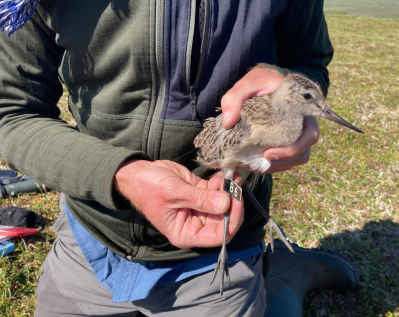
Tagging juvenile BAR-TAILED GODWIT “B6” on July 15th AD2022, near Nome, Alaska
(Photo credit: Dan Ruthrauff / U.S. Geological Survey)
Yet some scientists have recently documented the ecological advantages to such seasonal migratory flights, even when those aerial migrations include staggeringly long nonstop over-the-ocean wing-flapping flights:
Mountain ranges, deserts, ice fields and oceans generally act as barriers to the movement of land-dependent animals, often profoundly shaping migration routes. [This study] used satellite telemetry to track the southward flights of bar-tailed godwits (Limosa lapponica baueri), shorebirds whose breeding and nonbreeding areas are separated by the vast central Pacific Ocean. Seven females with surgically implanted transmitters flew non-stop 8117–11680 km … directly across the Pacific Ocean; two males with external transmitters flew non-stop along the same corridor for 7008–7390 km. Flight duration ranged from 6.0 to 9.4 days … for birds with implants and 5.0 to 6.6 days for birds with externally attached transmitters…. [It seems] that this transoceanic route may function as an ecological corridor rather than a barrier, providing a wind-assisted passage relatively free of pathogens and predators.
(quoting Gill et al., cited below)
[Quoting from Robert E. Gill, Jr., T. Lee Tibbitts, et al., “Extreme Endurance Flights by Landbirds Crossing the Pacific Ocean: Ecological Corridor Rather than Barrier?” PROCEEDINGS OF THE ROYAL SOCIETY B, 276:447-457 (posted online October 29th AD2008.]
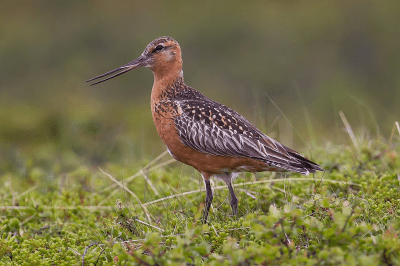
BAR-TAILED GODWIT in breeding plumage (photo credit: Wikipedia/Andreas Trepte)
This is not the first time that ornithologist Robert E. Gill, Jr. has reported on the tremendous treks of Bar-tailed Godwits migrating southwardly from Alaska to New Zealand and Eastern Australia. [See Robert E. Gill, Jr., Theunis Piersma, et al., “Crossing the Ultimate Ecological Barrier: Evidence for an 11000-km-Long Nonstop Flight from Alaska to New Zealand and Eastern Australia by Bar-tailed Godwits”, THE CONDOR, 107(1):1-20 (February 2005), noting that observations indicate that the Alaska-based Bar-tailed Godwits “migrate directly across the Pacific, a distance of 11 000 km” and that they do so “in a single flight without stopping to rest or refuel”.]
In short, these birds know how to use wind currents to their advantage—which is not news to Bible readers, especially to those who have considered the thermal air currents referred to in Job 39:26-29, which says:
Doth the hawk fly by thy wisdom, and stretch her wings toward the south? Doth the eagle mount up at thy command, and make her nest on high? She dwelleth and abideth on the rock, upon the crag of the rock, and the strong place. From thence she seeketh the prey, and her eyes behold afar off.
(Job 39:26-29,)
[For analysis of this Bible passage, from a creation ornithology perspective, see also JJSJ, “Hawks and Eagles Launching Skyward”, ACTS & FACTS, 47(4):21 (April 2018), posted at www.icr.org/article/hawks-eagles-launching-skyward .]
God designed and made bird wings. Bird wings, almost without exception, were designed for winds. (Penguins, of course, are exceptions—their wings were designed for underwater “flying”.) For a technical study that documents how important winds are for wings—of Bar-tailed Godwits—see Jesse R. Conklin & Phil F. Battley, “Impacts of Wind on Individual Migration Schedules of New Zealand Bar-tailed Godwits”, BEHAVIORAL ECOLOGY, 22(4):854-861 (June 2011), documenting how some Bar-tailed Godwits time their departure dates to maximize harnessing helpful wind currents for nonstop flying migrations.
On the Pacific Ocean side of the globe, these phenological patterns are conspicuously exhibited in the migrations of wading shorebirds, such as skinny-legged sandpipers, who flap their wings in flight (as opposed to relying mostly on gliding). But one such migratory sandpiper—the Bar-tailed Godwit, takes wing-flapping flight to the maximum!
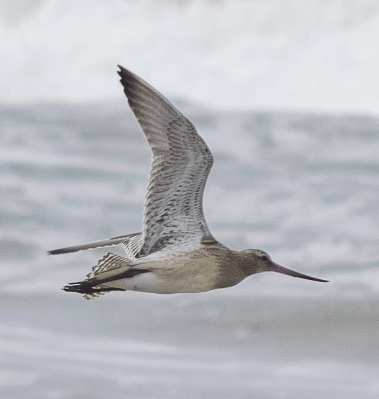
BAR-TAILED GODWIT, in flight over the ocean
(photo credit: Wikipedia/Paul van de Velde)
In particular, the New Zealand-breeding subspecies of that marathon-migrating wading bird (Limosa lapponica baueri), has been making ornithology news, again, this year. But before considering this year’s news, consider news about Bar-tailed Gotwits from last year:
On September 28, one small bird completed a very long flight. An adult, male Bar-tailed Godwit, known by its tag number 4BBRW, touched down in New South Wales, Australia, after more than 8,100 miles in transit from Alaska —flapping its wings for 239 hours without rest, and setting the world record for the longest continual flight by any land bird by distance. And 4BBRW isn’t even done yet. In the next few days, the Godwit is expected to end its southbound migration in New Zealand after its well-earned island stopover, says Adrian Riegen, a builder from West Auckland [New Zealand] and a passionate birdwatcher.
From his home office, usually reserved for managing building projects, Riegen keeps tabs on 4BBRW and 19 other Bar-tailed Godwits fitted with solar-powered location trackers. During migration season, he spends at least an hour each morning going through the most recent location data and writes a daily report for the ongoing project, run by the Pūkorokoro Miranda Shorebird Center, an education and research nonprofit in Miranda, New Zealand, where many Godwits spend non-breeding months. All of the best tidbits he compiles are disseminated to the center’s followers on Facebook and Twitter, so that people can follow along with the birds’ cross-hemisphere, trans-oceanic journeys—speed bumps and all. “It’s such an amazing story,” Riegen says. “We want to share it as widely as we can.”
Although 4BBRW’s feat is astounding, it may not be particularly surprising. Bar-tailed Godwits are incredible migrants: Individuals have broken the “longest, non-stop, migration” record more than once since satellite tracking began in 2007 and regularly make continuous flights of more than 7,000 miles.
In fact, 4BBRW previously held the world record for his 2020 flight of 7,580 miles. And just three days before 4BBRW’s 2021 touch-down, a female godwit, tagged 4BYWW, completed a trip of a similar distance that was briefly considered the record. While multiple subspecies of Bar-tailed Godwit make long distance journeys around the world, the New Zealand-Alaska population travels the farthest in its migration loop. “It’s this thing of imagination and magic that we have in this world, to think this tiny little bird traveled thousands of miles,” says Audubon Alaska executive director Natalie Dawson.
Unlike albatross or other long-flying seabirds, godwits are active flyers [a/k/a “flappers”], not gliders—their wings are moving the whole time. “It just beggars belief, really,” Riegen says. “I mean, though I’ve known that for decades now, I still find it hard to imagine how anything can keep up that sort of effort 24-hours a day, without taking a break.”
“4BBRW has outdone itself two years in a row. Project researchers are hoping the location trackers last for many more years, so they can continue to keep tabs on how birds’ paths change over time.”
With that impressive background we can appreciate the latest news about the long-distance nonstop migration of this tough-travelling shorebird:
This [October] is the time of year when Alaska’s migratory birds uproot and move to warmer places. But one shorebird in particular made history this past week after it was tracked flying thousands of miles nonstop [calculated as 8,425 or perhaps 8,435 aerial miles!] to the southern hemisphere, drawing international attention and potentially giving scientists new insight into the future of a declining population of shorebirds.
Earlier this week [at the end of October AD2022], a bar-tailed godwit, tagged as “B6″, completed its migration from the Western Alaska coast to Southern Australia, a non-stop journey of nearly 8,500 miles completed in 11 days. …
The center of attention: a four-month-old shorebird weighing just 600 grams — a little more than a pound, or slightly heavier than a can of beans. The journey, tracked for the first time using a real-time solar-powered transmitter, is being described as a world record.
Lee Tibbitts, a wildlife biologist with the U.S. Geological Survey’s Alaska Science Center, has been researching these birds for decades and was part of the team that began observational studies about 40 years ago, before technology enabled satellite tracking.
Prior to this work, nobody really believed that nonstop migration across the Pacific Ocean was possible, said Dan Ruthrauff, a USGS research wildlife biologist who helped tag B6.
B6 is the first tagged Alaska-breeding bar-tailed godwit chick whose migration was successfully tracked. Not only did it complete its migration, but it flew nearly 1,600 miles farther than its species’typical migration route from Alaska to New Zealand –– something Ruthrauff hypothesizes could have been a result of strong easterly winds.
“They don’t land on the water. They don’t glide. This is flapping flight for a week and a half,” he said.
The chick [Bar-tailed Godwit identified as “B6”] was just one of three that was fitted with a transmitter this summer. The other two transmitters are still sending signals from the tundra on the Seward Peninsula. Ruthrauff guesses that they were too loose and fell off the birds before their migration.
The transmitter, attached using surgical-grade silicon tubing, weighs just five grams and fits like a fanny pack, Ruthrauff said. The antenna trails off from the bird’s tail and is fitted with a solar panel. Once fitted with the transmitter, all that was left for Ruthrauff and his team to do was to wait.
During that time, B6 moved to its staging area on the Kuskokwim Delta and stayed there for about six weeks, fattening up on clams, worms and berries for the trip –– much like a bear getting ready for hibernation. “It’s pretty crazy how much bigger they get,” Ruthrauff said. “It’s mostly just fat –– little butter balls.”
In preparation for the trip, these birds increase the size of their gizzard, stomach, kidney, liver and length of their intestine in order to metabolize the foods that they’re eating, Ruthrauff said. As they approach time to migrate, the digestive tract begins to atrophy while their heart and pectoral muscles increase in size.
Bar-tailed godwit chicks migrate without their adult counterparts and are known to take advantage of weather systems along their route.
Set up with a “smokin’” tailwind, B6 departed Alaska on Oct. 12. (quoting Mesner, cited below)
[Quoting Emily Mesner, ANCHORAGE DAILY NEWS, posted October 31st AD2022, at news.yahoo.com/juvenile-shorebird-tagged-alaska…]
A map showing the migration route of bar-tailed godwit, B6.
(Image credit: courtesy of Jesse Conklin/Max Planck Institute of Ornithology)
Providentially, Godwit B6 arrived safely on October 23rd of AD2022, in Eastern Australia. What an exhausting nonstop trip!
The obvious take-away lesson, from this astounding journey, is that the southward migration of Alaska’s Bar-tailed Godwits cannot be the product of random trail-and-error experiments by birds trying to “evolve” in a supposedly “survival-of-the-fittest” world, as imagined by evolutionists.
Rather, these brave birds can only survive and thrive in this world, the real world that the Holy Bible perfectly describes, because God has carefully and caringly provided these wing-flapping migrants with whatever they need to succeed—and they do, thanks to their (and our) Creator, the Lord Jesus Christ!
And God said, Let the waters bring forth abundantly the moving creature that hath life, and fowl that may fly above the earth in the open firmament of heaven.
(Genesis 1:20)
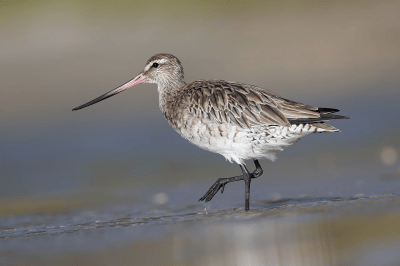
BAR-TAILED GODWIT over-wintering plumage, Australia

























 Lee's Birdwatching Adventures Plus