Ian’s Bird of the Week – Magnificent Riflebird

Magnificent Riflebird (Ptiloris magnificus) by Ian

Magnificent Riflebird (Ptiloris magnificus) by Ian

Ian’s Bird of the Week – Magnificent Riflebird ~ by Ian Montgomery

Newsletter – 9/12/11

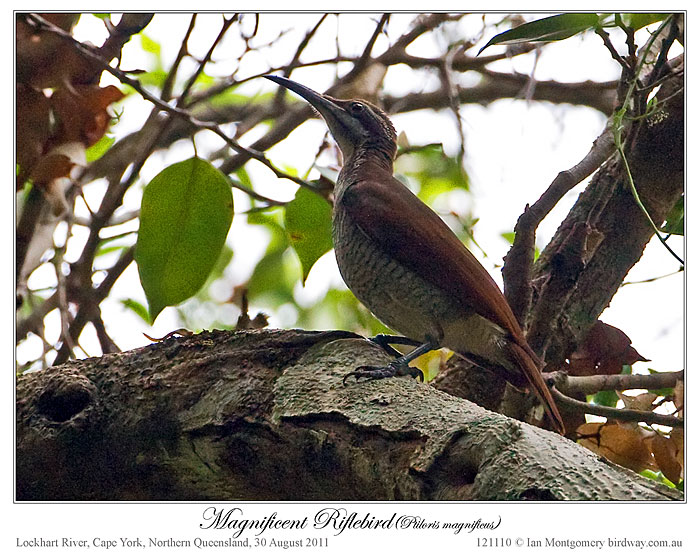
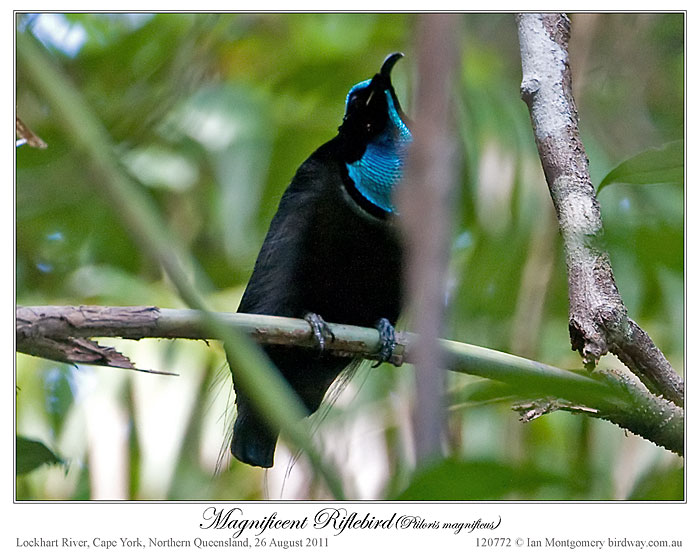
We’ve been dealing with Birds of Paradise for the last couple of birds of the week, so here’s another one from Iron Range, the Magnificent Riflebird. This, like the Trumpet Manucode is easier to hear than see as it spends most of its time in the tall trees of the rainforest and on my previous two visits to this part of Cape York I’d seen only a few females. This time, the males were very vocal and actively courting females and I had more success, as in the first photo.

The ‘magnificent’ is appropriate as, with a length of 28-33cm/11-13in, it is the largest of the three Australian Riflebirds. (There is a fourth species of Riflebird, the Eastern or Growling Riflebird, in eastern PNG – recently split from the Magnificent Riflebird and distinguishable mainly by its call.) As you can see from the first photo, the blue shield on the throat and upper breast of the male is much larger than that of the other two Australian ones. It is also the only one of the three to have plumes along the flanks. These are hard to see on the first photo (except as a fuzzy area below the right wing) but are visible in the second photo both as a fuzzy line along the right side and as longer wiry plumes on either side of the tail.

Magnificent Riflebird (Ptiloris magnificus) by Ian

Magnificent Riflebird (Ptiloris magnificus) by Ian

Like Victoria’s Riflebird the heavy plumage of the males make a swishing noise in flight as they sweep regally around in the canopy of the forest. Their usual call is like a wolf whistle and carries a long way, though I found that locating a male in this way was no guarantee of being able to see it. The male in the first photo was actively wooing an unimpressed or ambivalent female who flew away from him and landed on a branch in the open directly above me. She quickly realised that she was attracting my interest too, as in the third photo, and flew off again in renewed search of peace.

Magnificent Riflebird (Ptiloris magnificus) by Ian

Magnificent Riflebird (Ptiloris magnificus) by Ian

The females are fairly different in appearance from the females of Victoria’s Riflebird with rufous upperparts and heavily barred underparts. (You may remember that the female Victoria’s has much greyer upper parts with less marked buff underparts). The fourth photo shows a female in a more typical pose, looking for grubs, Woodpecker-like, along the limbs and trunks of trees, though Riflebirds also eat fruit.

Magnificent Riflebird (Ptiloris magnificus) by Ian

Magnificent Riflebird (Ptiloris magnificus) by Ian

Another spectacular bird in Iron Range was the Yellow-billed Kingfisher. It has featured as bird of the week before, so here is the link to the new Yellow-billed Kingfisher and on the Daintree we encountered plenty of Azure Kingfishers and Little Kingfishers .

The website, incidentally, had a record month in August with more than 9,300 visits, substantially up from previous records in July of 7,700 and in June of 7,200, with total downloads of about 4.5GB, also a record.

Best wishes
Ian

Ian Montgomery, Birdway Pty Ltd,
454 Forestry Road, Bluewater, Qld 4818
Phone: 0411 602 737 +61-411 602 737
Preferred Email: ian@birdway.com.au
Website: http://birdway.com.au


Lee’s Addition:

The Paradisaeidae Family is again presented by Ian. If you missed Ian’s other birds from this family, see:
Ian’s Bird of the Week – Trumpet Manucode
Ian’s Bird of the Week – Victoria’s Riflebird

Oh, magnify the LORD with me, and let us exalt his name together! (Psalms 34:3 ESV)

*

Some Very Unusual Birds

The following photos are from an e-mail I received. It has arrived many times from various friends. I don’t know who the photographers are and trust that they do not mind them being presented here.

What I do know is that these very unusual birds have a very Imaginative Creator. For His pleasure He created these kinds of birds and for our enjoyment also. The titles are from the e-mail and maybe #12 is some sort of Bird of Paradise or in that family (I think). Enjoy the photos and God’s Creative Hand at work.

Praise ye the LORD. I will praise the LORD with my whole heart, in the assembly of the upright, and in the congregation. The works of the LORD are great, sought out of all them that have pleasure therein. His work is honourable and glorious: and his righteousness endureth for ever. He hath made his wonderful works to be remembered: the LORD is gracious and full of compassion. (Psalms 111:1-4 KJV)

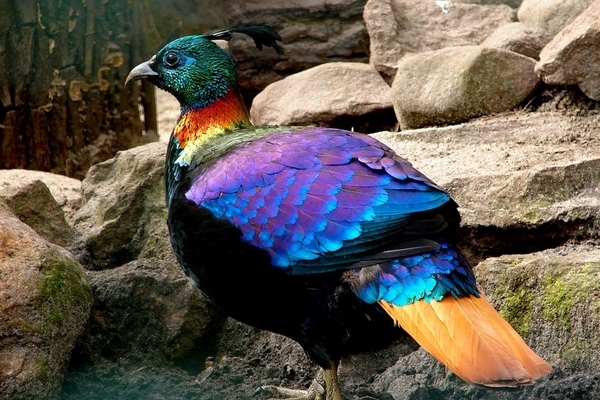
1. Himalayan Monal

1. Himalayan Monal

************

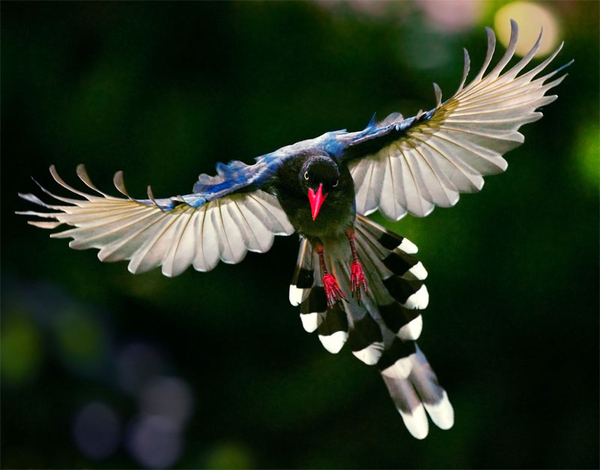
2. Formosan Magpie

2. Formosan Magpie

************

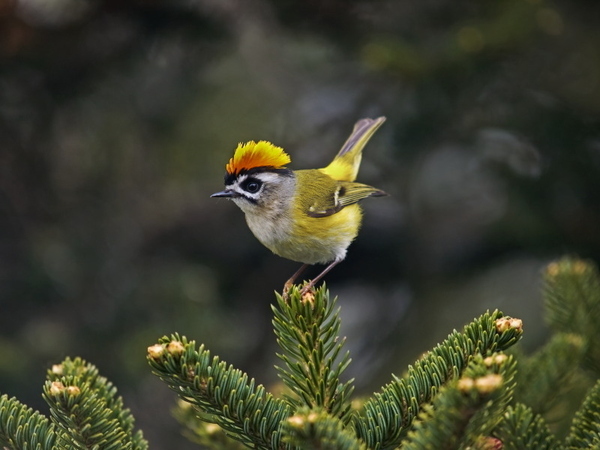
3. Flamecrest

3. Flamecrest

************

4. Golden Pheasant

4. Golden Pheasant

************

5. Green Jay

5. Green Jay

************

6. Kingfisher

6. Kingfisher

************

7. Lady Amherst's Pheasant

7. Lady Amherst's Pheasant

************

8. Bleeding Heart Pigeons

8. Bleeding Heart Pigeons

************

9. Nicobar Pigeon

9. Nicobar Pigeon

************

10. Quetzal

10. Quetzal

************

11. Winson's Bird Of Paradise

11. Winson's Bird Of Paradise

************

12. No Idea What Bird This Is, But It's Totally Rad

12. No Idea What Bird This Is, But It's Totally Rad

************

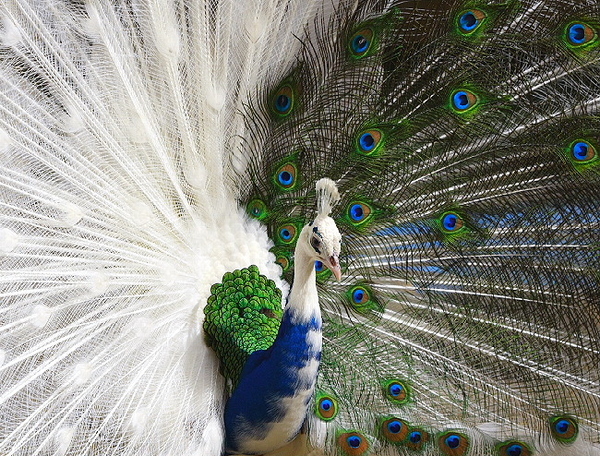
13. Peacock

13. Peacock

************

14. Sup, Polish Chicken

14. Sup, Polish Chicken

************

When I have time, I will update the names, if I can find them. My time is short and these names will have to suffice for now. If you know the exact names or who the photographers might be so they get proper credit, please leave a comment. Thanks, Lee
*

Birds of the Bible – Created Kinds

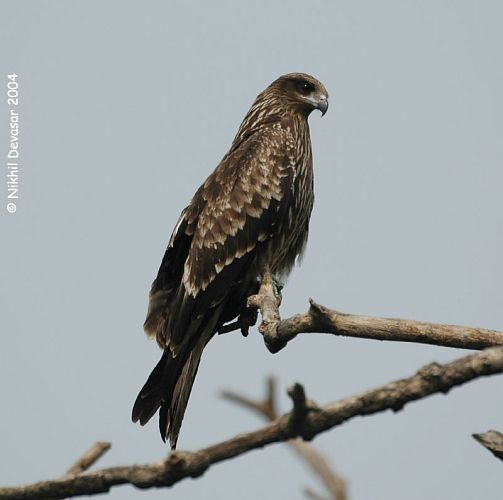
Black Kite (Milvus migrans) by Nikhil Devasar

Black Kite (Milvus migrans) by Nikhil Devasar

An interesting “News To Note” from Answers in Genesis reported on an article from BBC: “Species count put at 8.7 million” The following paragraphs are what prompted this blog.

Created kinds are organisms representing or descended from those originally created by God about 6,000 years ago. Organisms within a created kind generally interbreed and produce only more organisms of their own kind “within the limits of preprogrammed information, but with great variation.”15 Organisms that can interbreed are of the same created kind, since God designed organisms to reproduce “after their kind.” Due to loss of information and other factors, however, some organisms lose the ability to interbreed. Created kinds correspond roughly to the family level of the current classification taxons but may vary from order to genus level.
Although evolutionists imbue taxonomic classification with evolutionary implications—believing that the taxonomic groupings roughly depict common ancestry— taxonomy is really nothing more than a useful bookkeeping system to sort and group organisms according to their shared characteristics.

I know there is research going on by the Creationist to try to find out what were the original “kinds”, but I am just going to show the different passages in Scripture that talk about “kinds” and specifically those that refer to the “birds or fowls

The first mention of the “Kinds” is in Genesis, of course. We start of with Genesis 1:21:

And God created great whales, and every living creature that moveth, which the waters brought forth abundantly, after their kind, and every winged fowl after his kind: and God saw that it was good. (Genesis 1:21 KJV)

This  took place on the fifth day of creation. Believer’s Bible Commentary says this:
“1:20-23 The fifth day saw the waters stocked with fish and the earth stocked with bird-life and insects. The word translated birds means “flying ones” and includes bats and probably flying insects.”

The kinds are again mentioned when Noah was told to keep alive the birds after their kind during the global flood, they board in Genesis 7:14, and then again these kinds are mentioned as they come off the Ark.

Of the birds after their kind, of animals after their kind, and of every creeping thing of the earth after its kind, two of every kind will come to you to keep them alive. And you shall take for yourself of all food that is eaten, and you shall gather it to yourself; and it shall be food for you and for them.” Thus Noah did; according to all that God commanded him, so he did. (Genesis 6:20-22 NKJV)

they and every beast after its kind, all cattle after their kind, every creeping thing that creeps on the earth after its kind, and every bird after its kind, every bird of every sort. And they went into the ark to Noah, two by two, of all flesh in which is the breath of life. (Genesis 7:14-15 NKJV)

So Noah went out, and his sons and his wife and his sons’ wives with him. Every animal, every creeping thing, every bird, and whatever creeps on the earth, according to their families, went out of the ark. (Genesis 8:18-19 NKJV)

Most of the versions use “kind or families” and “birds or fowls.” As we continue through Scripture we arrive at the “eat or do not eat” list of birds in Leviticus 11 and Deuteronomy 14. Let’s see what is here:

Leviticus 11:14 has the Kite and Falcon after its kind (ACV) and these are in two different Orders and two different Families today:  Accipitriformes (order) – Accipitridae (family) and Falconiiformes (order) – Falconidae (family). Other versions have the Vulture which is in the Accipitriformes, but the Catharidae family. The Buzzard is mentioned in the GW version, but again, it is Accipitridae family. These are today’s divisions, but yet they are all placed next to each other and could have come from the same original kind. Leviticus 11:16 does the same with the terms for “kind”, but this time with the Hawk. It again is in the Accipitriformes (order) – Accipitridae (family).

The different versions use the terms; after its or his kind, likened to it, the like to it, of that sort, all types.

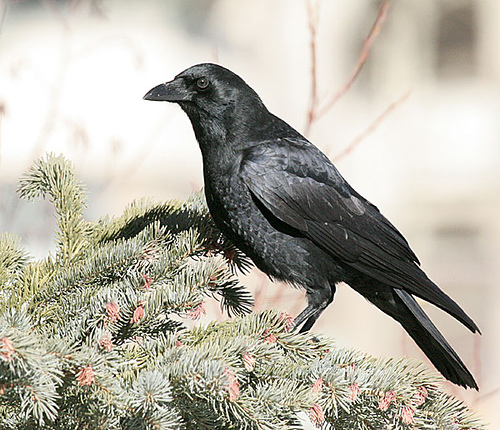
Chihuahuan Raven (Corvus cryptoleucus)Raven (Corvus corax) by Kent Nickell

Chihuahuan Raven (Corvus cryptoleucus)Raven (Corvus corax) by Kent Nickell

Levitcus 11:15 mentions the Raven after its kind. These are the Corvidae Family of birds which are in the Passeriformes (Songbirds) Order. This family includes the Crows, Jays, Treepies, etc., and the Ravens way down at the bottom of the list. (Which has nothing to do with importance)

Leviticus 11:19 does the same, but has the “Heron after his, her  or its kind” (depending on the version) Egrets, Herons, and Bitterns make up the Ardeidae Family of the Pelicaniformes Order.

The list in Deuteronomy 14:13-18, covers the same birds and basically says the same things.

There is one interesting reference in the DRB (1899 Douay-Rheims) in Leviticus 11:19 and Deut. 14:18. Look at the verse:

The heron, and the charadroin according to its kind, the houp also, and the bat. (Leviticus 11:19 DRB)
The bittern, and the charadrion, every one in their kind: the houp also and the bat. (Deuteronomy 14:18 DRB)

Northern Lapwing (Vanellus vanellus) by Nik

Northern Lapwing (Vanellus vanellus) by Nikhil Devasar

Some of the other versions mention the Lapwing and the Hoopoe, but not with “their kinds.” What caught my interest here is that there is an Order and a Family with a name similar to “charadrion.” The Charadriiformes Order has a Family called Charadriidae and guess what bird is in that family? The Lapwing! I loaded the Vulgate into my e-Sword, not because I know Latin, but all the birds are given a Common Name and a Scientific Name, which most times is Latin or similar. For instant the – Northern Lapwing (Vanellus vanellus) or a Black-headed Lapwing (Vanellus tectus). Here is Lev 11:19 and Deut 14:18:

erodionem et charadrion iuxta genus suum opupam quoque et vespertilionem
(Leviticus 11:19 Vulgate)
onocrotalum et charadrium singula in genere suo upupam quoque et vespertilionem (Deuteronomy 14:18 Vulgate)

I also see the word “genus” and “genere” which could refer to what we call today a genus or genera. (Told you I don’t know Latin.)

James is the only New Testament place where “every kind of” birds is again listed. In this reference all birds no matter what Family or Order are included. See Birds of the World.

For every kind of beasts, and of birds, and of serpents, and of things in the sea, is tamed, and hath been tamed of mankind: (James 3:7 KJV)

I know parts of this blog has been somewhat technical as far as the Taxonomy of birds, but the birds are mentioned in the Bible and I enjoy trying to find out about them. The Bible also says:

All scripture is given by inspiration of God, and is profitable for doctrine, for reproof, for correction, for instruction in righteousness: (2 Timothy 3:16 KJV)

Previous articles here include:
Birds of Bible – Foundation #2
Birds of Bible – Foundation #3
Birds of Bible – Foundation #5

*

Ian’s Bird of the Week – Trumpet Manucode

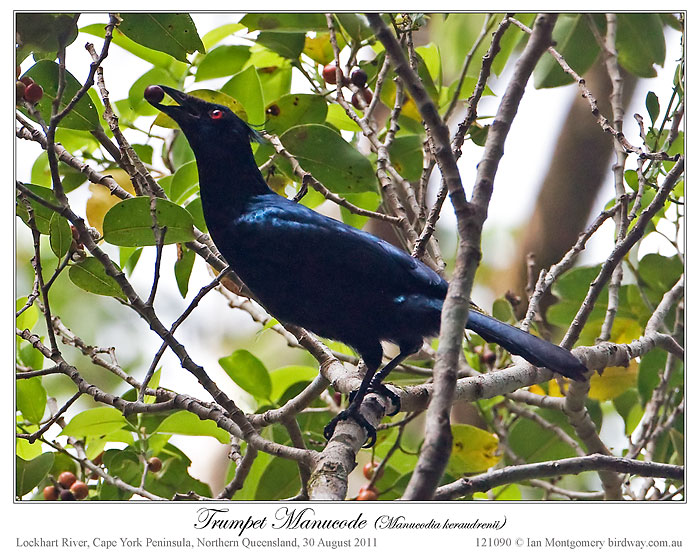
Trumpet Manucode (Phonygammus keraudrenii) by Ian

Trumpet Manucode (Phonygammus keraudrenii) by Ian

Ian’s Bird of the Week – Trumpet Manucode ~ by Ian Montgomery

Newsletter ~ 9/6/11

I’m back home now after the 2 week trip to Cape York and happy to be able to provide the hoped-for Bird of Paradise, the Trumpet Manucode, as bird of the week. Your collective moral/spiritual support clearly worked again, as it did with Snowy Owl in Alaska 3 years ago and Resplendent Quetzal in Costa Rica last year, so thank you very much. A bit of persistence probably helped too as Trumpet Manucodes are easy to hear but notoriously difficult to see, and this was my third visit to Iron Range/Lockhart River without getting more than distance glimpses in the thick foliage of the rainforest.

The first photo shows the crest and neck plumes that are erected in an apparently spectacular display. Although the males were calling, the breeding season doesn’t start until October so I didn’t see any display, though in the second photo the crest plumes are erect as the bird reaches for a fig.

Trumpet Manucode (Phonygammus keraudrenii) by Ian

Trumpet Manucode (Phonygammus keraudrenii) by Ian

Manucodes are 28-32cm/11-13in in length and the sexes are similar, though the females have duller plumage and orange rather than red eyes. This very tall tree, one of few that I found in fruit, was popular with other fruit-eaters such as Yellow Orioles, Barred Cuckoo-shrikes and Metallic Starlings. The Manucode seemed to have a rather proprietorial attitude to it and would sweep in majestically, making the other birds scatter.

Trumpet Manucodes have a long curved windpipe under the skin of the breast, which gives a wonderfully resonant quality to its trumpet call, rendered as ‘growng’ which carries a long way and can be attributed a mocking quality when you can’t find the bird! Their other main call is a gurgling ‘owwgk’ made when inhaling through the windpipe.

The Trumpet Manucode also occurs in New Guinea, where there are 4 other species of Manucode, most of which are illustrated here: http://australianmuseum.net.au/William-T-Coopers-Birds-of-Paradise?page=2&assetID= . The name Manucode is derived from the Malay ‘manuk dewata’ meaning “bird of the gods” so a parallel with the divine nature of the Resplendent Quetzal is easy to draw.

The rest of the trip went smoothly and I also got photos of the other species on my short list – Tropical Scrubwren, Green-backed and White-streaked Honeyeaters – and a few others besides, which I’ll be sharing with you in the coming weeks.

Links:
Resplendent Quetzal 
Snowy Owl
Green/Yellow Oriole
Barred Cuckoo-shrike
Metallic Starling

Best wishes
Ian


Ian Montgomery, Birdway Pty Ltd,
454 Forestry Road, Bluewater, Qld 4818
Phone: 0411 602 737 +61-411 602 737
Preferred Email: ian@birdway.com.au
Website: http://birdway.com.au


Lee’s Addition:

I am glad our thoughts and prayers worked and helped you stay persistent. Those of us that remember you also have selfish motives. We thoroughly enjoy getting to see your great finds. Sounds like a “win-win” situation.

The Manucode, as Ian mentioned is in the Bird-of-Paradise family. That Family, the Paradisaeidae, has 41 species in 16 genera. There are 5 Manucodes; the Trumpet (Ian’s), Glossy-mantled, Jobi, Crinkle-collard and the Curl-crested Manucode. Riflebirds are also part of the family and Ian has photos of the Magnificent, Victoria’s and Paradise Riflebirds on his site.


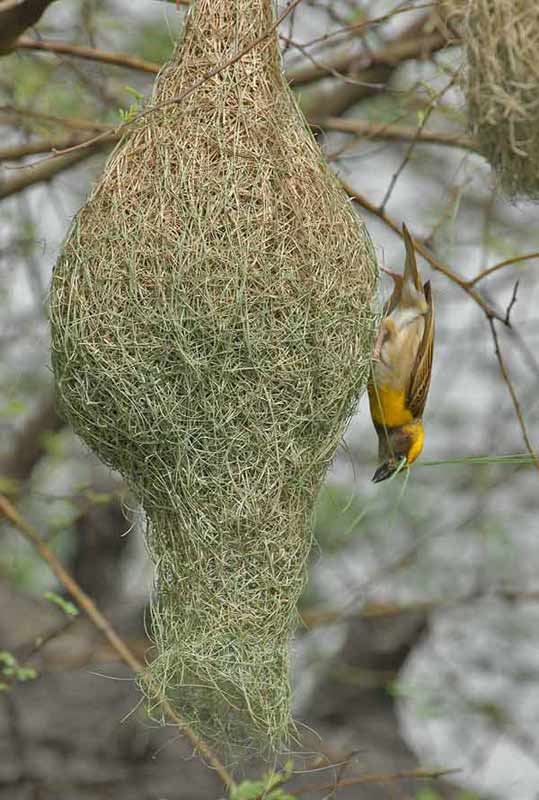
Baya Weaver – The Model Church

Baya Weaver (Ploceus philippinus) by Nikhil Devasar

Baya Weaver (Ploceus philippinus) by Nikhil Devasar

Baya Weaver – The Model Church ~ by a j mithra

The Baya Weaver (Ploceus philippinus) is a weaverbird found across South and Southeast Asia. These are sparrow-sized (15 cm) and in their non-breeding plumage, both males and females resemble female house sparrows. They have a stout conical bill and a short square tail.

Non-breeding males and females look alike, dark brown streaked fulvous buff above, plain (unstreaked) whitish fulvous below, eyebrow long and buff coloured, bill is horn coloured and no mask. Breeding males have a bright yellow crown, dark brown mask, blackish brown bill, upper parts are dark brown streaked with yellow, with a yellow breast and cream buff below.

Baya Weaver (Ploceus philippinus) by MAMuin

Baya Weaver (Ploceus philippinus) by MAMuin

Baya Weavers are social and gregarious birds. They forage in flocks for seeds, both on the plants and on the ground. Flocks fly in close formations, often performing complicated maneuvers. Their calls are a continuous chit-chit-… sometimes ending in a wheezy cheee-eee-ee that is produced by males in a chorus. A lower intensity call is produced in the non-breeding season.

Feeding together and flying together and singing together?
The church needs to take a leaf out from the lifestyle of these birds..
Is it not important, to be together as a one? We say that Christ is the head of the church. But how can Christ be the head of disintegrated choirs in disintegrated churches and indifferent individuals who make disoriented families?

These birds feed together…

  • How many Christian families spend time together in reading and meditating the Bible?
  • How many Christian families live together?

These birds even fly together performing complicated maneuvers…

  • How are our maneuvers as a team?
  • We are supposed to be the army of Jesus, but sadly each one facing different directions…

These birds sing together in chorus..

  • How do our family and church worship the Lord?
  • Do we sing in unity as one?

Its time for us to check ourselves and try learn to live like these birds…

Behold, how good and how pleasant it is for brethren to dwell together in unity!

It is like the precious ointment upon the head, that ran down upon the beard, even Aaron’s beard: that went down to the skirts of his garments; As the dew of Hermon, and as the dew that descended upon the mountains of Zion: for there the LORD commanded the blessing, even life for evermore. (Psalm 133:1-3 KJV)

Baya Weaver (Ploceus philippinus) by Nikhil Devasar

Baya Weaver (Ploceus philippinus) by Nikhil Devasar

Flocks of these birds are found in grasslands, cultivated areas, scrub and secondary growth and they are best known for their hanging retort shaped nests woven from leaves. These nest colonies are usually found on thorny trees or palm fronds and the nests are often built near water or hanging over water where predators cannot reach easily.

They are widespread and common within their range but are prone to local, seasonal movements mainly in response to rain and food availability.
Christ is mindful of us even unto death..
He did think of you and me even as He wore the crown of thorns…

These birds remind me of Psalm 23:2

He maketh me to lie down in green pastures: he leadeth me beside the still waters.

These birds choose to live in the grasslands and build their nests with green leaves over fresh water bodies…
The Lord is our Shepherd and the Living Water..
No doubt about it…
But, the question is, do we let Him makes us lie down in green pastures and lead us beside still waters?
If the answer is yes, then how come our soul is weak, weary and thirsty?
Lets seek His presence, for He is the God of abundance…

Thou wilt shew me the path of life: in thy presence is fulness of joy; at thy right hand there are pleasures for evermore. (Psalm 16:11)

Baya Weaver (Ploceus philippinus) 3 Male building by Nikhil Devasar

Baya Weaver (Ploceus philippinus) 3 Male building by Nikhil Devasar

The nest of the Baya Weaver bird is an engineering marvel…
These dull looking birds have a most interesting breeding season…
The breeding season of the Baya Weavers is during the monsoon..
The breeding condition is initiated by environmental characters such as day length and comes to an end after summer although this termination is not influenced by short day length as in temperate birds…

They nest in colonies typically of up to 20-30, close to the source of food, nesting material and water. Baya Weavers are best known for the elaborately woven nests constructed by the males. These pendulous nests are retort shaped, with a central nesting chamber and a long vertical tube that leads to a side entrance to the chamber. The nests are woven with long strips of paddy leaves, rough grasses and long strips torn from palm fronds. Each strip can be between 20–60cm in length. A male bird is known to make up to 500 trips to complete a nest.

Our Lord Jesus Christ made just one trip to the earth and is now building a mansion for us…

In my Father’s house are many mansions: if it were not so, I would have told you. I go to prepare a place for you. (John 14:2)

The birds use their strong beaks to strip and collect the strands, and to weave and knot them while building their nests. The nests are often built hanging over water from palm trees and often suspended from thorny Acacias and in some cases from telephone wires. Although thorny trees are preferred, they may sometimes use avenue trees in urban areas. Nests are often located on the eastern side of the tree where they are believed to provide shelter from the Southwest Monsoon, however late breeders are more likely to build their nests in other orientations relative to the trunk of the nest tree..

  • How do these birds know where and when to build their nests?
  • How do these birds know the direction where the nest has to be placed?

Is it cos they look up to God the directions in life?

  • A Meteorological expert knows about the weather…
  • A Botanist knows about the plants and trees…
  • A Hydrologist knows about water…

But how do these birds know about the season, the tree and the water?
Want to know everything under the sky? Just follow the following verses…

Evil men understand not judgment: but they that seek the LORD understand all things. (Proverbs 28:5)
The young lions do lack, and suffer hunger: but they that seek the LORD shall not want any good thing. (Psalm 34:10)

This male Baya Weaver is working on his nest. This is by Wondersf, which is one of the videographers who has given us permission to use his videos. Khong Tuck Khoon lives in Malaysia.

The males take about 18 days to construct the complete nest with the intermediate “helmet stage” taking about 8 days. The nests are partially built before the males begin to display to passing females by flapping their wings and calling while hanging from their nests.

When I read the above passage I was reminded of the famous picture of the cross where I read the following quote..

I asked Jesus how much He loved me
He answered “this much”
Then He stretched out His arms and died for me

The females inspect the nest and signal their acceptance of a male. Once a male and a female are paired, the male goes on to complete the nest by adding the entrance tunnel. Males are almost solely in charge of nest building, though their female partners may join in giving the finishing touches, particularly on the interiors. So much so, that even a snake would never be able to enter its nest. Females may modify the interiors or add blobs of mud.

Studies have shown that nest location is more important than nest structure for the female, when it selects the nest and mate…

When we build our lives above the Living Water, the serpent would never be able to enter our homes…

Instead we would walk over them..

Behold, I have given you authority to tread on serpents and scorpions, and over all the power of the enemy, and nothing will injure you. “Nevertheless do not rejoice in this, that the spirits are subject to you, but rejoice that your names are recorded in heaven. (Luke 10:19,20)

Have a blessed day!

Your’s in YESHUA,
a j mithra

Please visit us at:
Crosstree

ajmithra21


Lee’s Addition:

The Baya Weaver is in the Ploceidae – Weavers, Widowbirds Family of the Passeriformes (Songbirds) Order.

Here’s an amazing video to watch. It’s about 3 minutes long, but shows the weaving going on by the bird. By 

See also:
Birds the Engineers… by ajmithra
Master Builder’s Master Builders by ajmithra
*

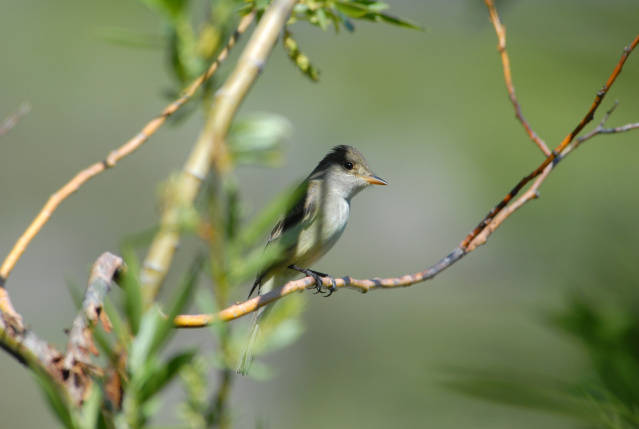
Willow Flycatcher – The Solitary Singer

Willow Flycatcher (Empidonax traillii) ©USFWS

Willow Flycatcher (Empidonax traillii) ©USFWS

Willow Flycatcher songs are innate, not learned like those of most songbirds. Young Willow Flycatchers reared in captivity with Alder Flycatcher tutors sang typical Willow Flycatcher songs.

Daniel was put to test, But, he chose not to defile himself with the portion of king’s meat or the wine..

  • No matter where God places you, never try to be like others…
  • Though God has created each one of us In His image, there still isn’t anyone like you…
  • You are God’s unique creation…

Please read Daniel Chapter one…

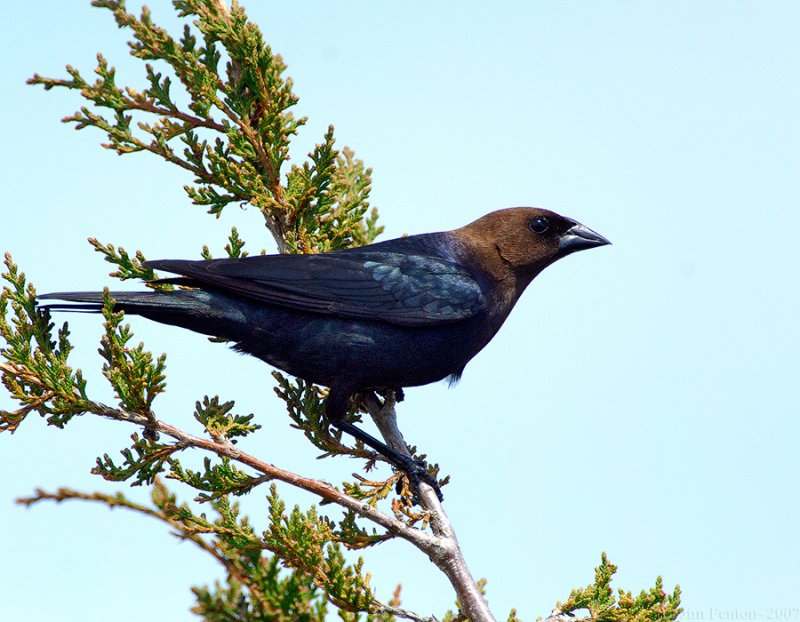
Brown-headed Cowbird (Molothrus ater) by J Fenton

Brown-headed Cowbird (Molothrus ater) by J Fenton

If a Brown-headed Cowbird lays its eggs in the nest of a Willow Flycatcher, the flycatcher may bury the Cowbird eggs in the nest lining, or even build a completely new nest over the top of the first one…

How do you respond when satan tries to hatch his ideas in your life?

  • Do you receive them or reject them like these birds?
  • Remember, his place is not beside you, but, under the sole of your feet…
  • Don’t let satan sit in your life..
  • Just bury him under your feet…
“And the God of peace shall bruise Satan under your feet shortly. The grace of our Lord Jesus Christ be with you. Amen.”Romans 16:20

Have a blessed day!

Your’s in YESHUA,
a j mithra

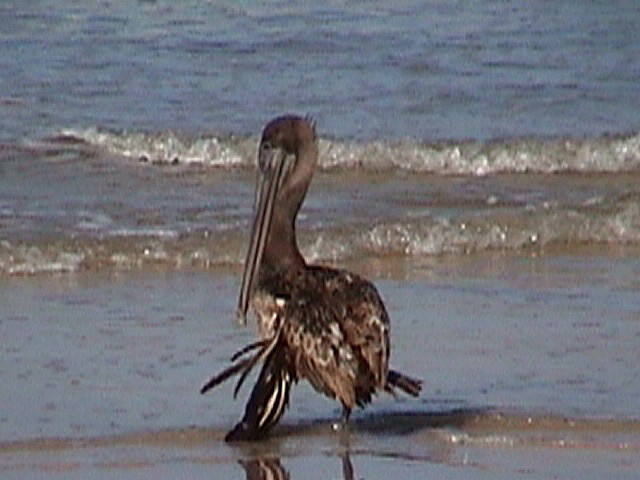
Birds Versus Hurricanes

Brown Pelican with broken wing from a hurricane CC

Brown Pelican with broken wing from a hurricane ©©

Here is a link to a very interesting blog from eNature about hurricanes and birds. With Hurricane Irene coming along the coast many will be wondering about the welfare of the birds.

What Happens To Birds When Hurricanes Hit? | Blog | eNature.

While searching for other articles about birds in the storm or hurricane, I found this YouTube produced by Pastor Mark L Johnson of Liberty Hill Baptist Church. It has a great message.

Also, remember:

…Be merciful to me, O God, be merciful to me, for in you my soul takes refuge; in the shadow of your wings I will take refuge, till the storms of destruction pass by. (Psalms 57:1 ESV)
Consider the ravens: for they neither sow nor reap; which neither have storehouse nor barn; and God feedeth them: how much more are ye better than the fowls?
(Luke 12:24 KJV)

Birds in Hymns – His Eye Is On The Sparrow

Why should I feel discouraged, why should the shadows come,
Why should my heart be lonely, and long for heaven and home,
When Jesus is my portion? My constant friend is He:
His eye is on the sparrow, and I know He watches me;
His eye is on the sparrow, and I know He watches me.

For the whole hymn – Click Here

Other articles about this include:

How Birds Stay Safe During Hurricanes by Birding.com

The Secret Relationship Between Birds and Hurricanes by NPR

Where do birds go in a hurricane?

Hurricane Birds

*

Birds of the Bible – Birds For Nehemiah

Chickens and Roosters by Maji

Chickens and Roosters by Maji

Now what was prepared at my expense for each day was one ox and six choice sheep and birds, and every ten days all kinds of wine in abundance. Yet for all this I did not demand the food allowance of the governor, because the service was too heavy on this people. (Nehemiah 5:18 ESV)

As I have continued reading through the Old Testament, I came across another mention of birds. This time in Nehemiah.

In Nehemiah 5:18, Nehemiah is providing for around 150 people daily. The cost is one ox, six choice sheep and fowls or birds and wine. He is personally providing for them from his own wealth. As Governor, he could have required these provision be provided for by the people, but Nehemiah knows that the people are over-burdened already.

This is the only mention of birds in the book and this time they are being eaten. That means several things.

1) These would have been “clean” birds and on the “do eat” list. This will be speculation on my part, but most likely they were birds like chickens, turkeys, ducks, quinea fowl, pheasants, quail or something along that line.

After hunting for traditions, searching for birds, and clearing the legal hurdles, the dinner eventually included: chicken, turkey, duck, goose, muscovy duck, mallard, pigeon, dove, pheasant, partridge, quail, guinea fowl, sparrow… (from an article about finding kosher birds in Israel today)

2) They were being prepared for at least 150 people daily – (5:17)

The different versions give these clues:
Various – “Fowls”, “fowls were prepared for me”, “birds”
Brenton – “a goat”
CEV – “lots of chickens were prepared.”
GNB – “many chickens”
ERV – “different kinds of birds”
ISV – “various kinds of poultry was prepared for me” or

Not sure where that “goat” came from. This seems like a simple verse telling about eating birds, that is true, but it is in the Bible, and this is the Birds of the Bible series. So when verses are found with them, they are written about.

All scripture is given by inspiration of God, and is profitable for doctrine, for reproof, for correction, for instruction in righteousness: That the man of God may be perfect, throughly furnished unto all good works. (2 Timothy 3:16-17 KJV)
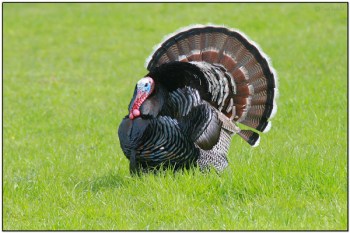
Wild Turkey (Meleagris gallopavo) by Daves BirdingPix

Wild Turkey (Meleagris gallopavo) by Daves BirdingPix

Nehemiah, an exile, was the Cupbearer for King Artaxerxes. He tells the king about the problems of the broken wall, and ruins in Jerusalem. After praying, he ask permission to go and rebuild the walls. The King gives permission and even provides some supplies. Nehemiah then goes to Jerusalem for around 12 years. God uses him to encourage the returned exiles and rebuild the city. The people are poor and Nehemiah not only meets his own needs, but also feeds others from his own wealth. This relieves the burden of feeding him as is the custom for those in power.

Here are some of the comments from some of the commentaries. Nehemiah had many good qualities and is a good example.

(Matthew Henry’s Commentary on the Whole Bible)2. More particularly, observe here, (1.) How little Nehemiah received of what he might have required. He did the work of the governor, but he did not eat the bread of the governor (Neh_5:14), did not require it, Neh_5:18. So far was he from extorting more than his due that he never demanded that, but lived upon what he had got in the king of Persia’s court and his own estate in Judea: the reason he gives for this piece of self-denial is, Because the bondage was heavy upon the people. He might have used the common excuse for rigour in such cases, that it would be a wrong to his successors not to demand his dues; but let them look to themselves: he considered the afflicted state of the Jews, and, while they groaned under so much hardship, he could not find it in his heart to add to their burden, but would rather lessen his own estate than ruin them. note, In our demands we must consider not only the justice of them, but the ability of those on whom we make them; where there is nothing to be had we know who loses his right. (2.) How much he gave which he might have withheld. [1.] His servants’ work, Neh_5:16. The servants of princes think themselves excused from labour; but Nehemiah’s servants, by his order no doubt, were all gathered to the work. Those that have many servants should contrive how they may do good with them and keep them well employed. [2.] His own meat, Neh_5:17, Neh_5:18. He kept a very good table, not on certain days, but constantly; he had many honourable guests, at least 150 of his own countrymen, persons of the first rank, besides strangers that came to him upon business; and he had plentiful provisions for his guests, beef, and mutton, and fowl, and all sorts of wine. Let those in public places remember that they were preferred to do good, not to enrich themselves; and let people in humbler stations learn to use hospitality one to another without grudging, 1Pe_4:9.
III. He concludes with a prayer (Neh_5:19): Think upon me, my God, for good. 1. Nehemiah here mentions what he had done for this people, not in pride, as boasting of himself, nor in passion, as upbraiding them, nor does it appear that he had occasion to do it in his own vindication, as Paul had to relate his like self-denying tenderness towards the Corinthians, but to shame the rulers out of their oppressions; let them learn of him to be neither greedy in their demands nor paltry in their expenses, and then they would have the credit and comfort of their liberality, as he had. 2. He mentions it to God in prayer, not as if he thought he had hereby merited any favour from God, as a debt, but to show that he looked not for any recompence of his generosity from men, but depended upon God only to make up to him what he had lost and laid out for his honour; and he reckoned the favour of God reward enough. “If God do but think upon me for good, I have enough.” His thoughts to us-ward are our happiness, Psa_40:5. He refers it to God to recompense him in such a manner as he pleased. “If men forget me, let my God think on me, and I desire no more.”

Chukar Partridge (Alectoris chukar) by Ian

Chukar Partridge (Alectoris chukar) by Ian

(Chuck Smith) “Now Nehemiah was a beautiful example unto the people in that he did not take a salary from the people. He did not take of their taxes, but he supported himself completely all the while that he was there. Not exacting taxes upon the people in order that he might live a luxurious kind of life. The governors that had been there before him all lived off of the people, but Nehemiah lived off of his own resources, showing really that his heart was in his office. It was not just a job; it was a real calling of his heart. And he even fed his guests, and he had 150 people eating at his table everyday. So it took one oxen, a half a dozen sheep and all to feed all of these people that came. But he took all of that out of his own pocket.”

(Believer’s Bible Commentary) “5:14-19 A short account of Nehemiah’s twelve-year tenure as governor closes chapter 5. He supported himself rather than charge the people with his maintenance. He did not take advantage of his position to acquire land or feather his nest for the future. His time was devoted to making Jerusalem safe for his brothers, not to building his own personal fortune. He supplied his own table and welcomed strangers to share his hospitality. He did all this because he feared God. If God kept track of his sacrifices, that was sufficient for Nehemiah.”

Crested Guineafowl (Guttera pucherani) by Lee at LPZoo

Crested Guineafowl (Guttera pucherani) by Lee at LPZoo from Kenya

(Treasury of Scriptural Knowledge)
“Nehemiah 5:18
one ox: This was food sufficient for more than two hundred men. Bp. Pococke says that the bey of Tunis had daily twelve sheep, with fish and fowls, soups, oranges, eggs, onions, boiled rice, etc., etc. His nobles dined with him; after they had done, the servants sat down; and when they had finished, the poor took what was left. Here the bey’s twelve sheep are equal to Nehemiah’s one ox and six choice sheep; and probably the mode of living between the two was nearly alike. It is still the practice in the East to calculate the expenses of the table, not by the money paid, but by the provisions consumed by the guests.
required: Neh_5:14-15
because the bondage: Psa_37:21, Psa_37:26″

(Wesley) “Nehemiah 5:18 Required not – But bore it out of my own estate: which was very considerable, his office in the Persian court being a place of great profit.”

(K & D) “Neh_5:18
“And that which was prepared for one (i.e., a single) day was one ox, six choice (therefore fat) sheep, and fowls; they were prepared for me, i.e., at my expense, and once in ten days a quantity of wine of all kinds.” The meaning of the last clause seems to be, that the wine was furnished every ten days; no certain quantity, however, is mentioned, but it is only designated in general terms as very great, לְהַרְבֵּה. זֶה וְעִם, and with this, i.e., notwithstanding this, great expenditure, I did not require the bread of the Pechah (the allowance for the governor, comp. Neh_5:14), for the service was heavy upon the people. הָעֲבֹדָה is the service of building the walls of Jerusalem. Thus Nehemiah, from compassion for his heavily burdened countrymen, resigned the allowance to which as governor he was entitled.”

(John Gill’s Exposition) “Nehemiah 5:18 Now that which was prepared for me daily was one ox and six choice sheep,…. Or fat ones; of beef and mutton a considerable quantity, abundantly sufficient for his guests and servants, and shows what a good table he kept:

also fowls were prepared for me; what number is not said:

..yet for all this required not I the bread of the governor; the salary that used to be given him, but did this at his own expense, out of his own estate in Judea; or what he had got by his office as cupbearer to the king of Persia, the salary of which perhaps was continued:

because the bondage was heavy upon the people; the tribute of the king of Persia, and their labour and expense in building the walls of the city.”
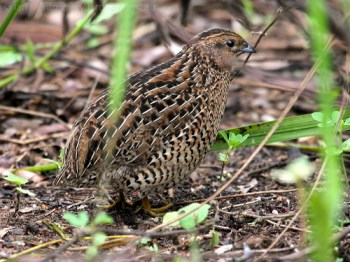
Brown Quail (Coturnix ypsilophora) by Ian

Brown Quail (Coturnix ypsilophora) by Ian

(Guzik Commentary) “2. (17-18) Nehemiah’s example of generosity.

And at my table were one hundred and fifty Jews and rulers, besides those who came to us from the nations around us. Now that which was prepared daily was one ox and six choice sheep. Also fowl were prepared for me, and once every ten days an abundance of all kinds of wine. Yet in spite of this I did not demand the governor’s provisions, because the bondage was heavy on this people.

a. And at my table were one hundred and fifty Jews and rulers: Nehemiah not only did not take when he could have; he also gave when he didn’t have to. He received a lot of food from the king’s provisions, which he could have sold for his own profit. Instead, he gave them away to be the example of generosity – feeding as many as 150 people regularly.

b. Yet in spite of this I did not demand the governor’s provisions: Nehemiah could have taken more (the governor’s provisions), but he didn’t. Therefore, Nehemiah was an example for what he did not take and for what he did not keep.

c. Because the bondage was heavy on this people: Nehemiah, in his own life, lived the way he told the nobles and rulers to live – to not take personal advantage of another’s need. He did what every godly leader must do: he never expected more of his followers than he expected of himself.”

Most of these birds come from the Galliformes Order
See also Birds of the Bible:
Chickens/Hens/Roosters
Doves and Pigeons
Partridge
Peacocks
Quails
Sparrows
*

Ian’s Bird of the Week – Victoria’s Riflebird

Victoria's Riflebird (Ptiloris victoriae) by Ian

Victoria's Riflebird (Ptiloris victoriae) by Ian

Ian’s Bird of the Week – Victoria’s Riflebird ~ by Ian Montgomery

Newsletter ~ 8/21/11

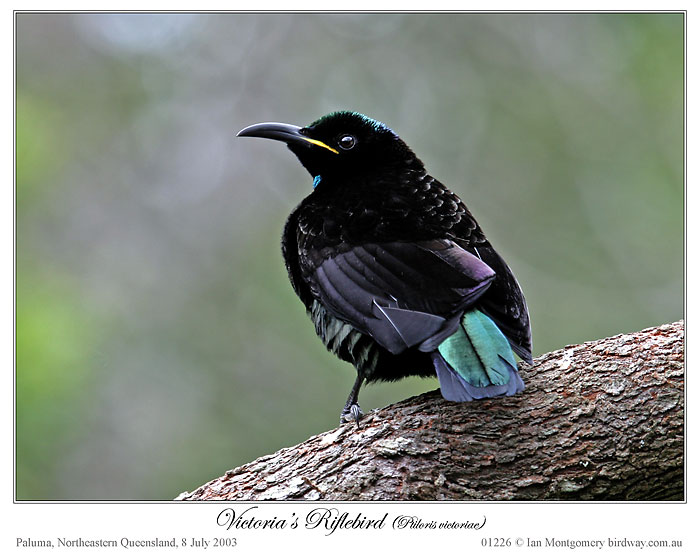
I’m on my way to Iron Range and this may be my last internet connection, so here is a hasty posting which I’ll keep brief. In keeping with the spirit of the search for the Trumpet Manucode, here is one of the other 3 Australian Birds of Paradise, the Victoria’s Riflebird, which is found in the Wet Tropics between Cooktown and Townsville. The males, as in photo 1, are quite spectacular with iridescent purplish black plumage highlighted with blue and a yellow gape as the final touch. The feathers have a satiny texture which rustles audibly in flight like an elaborate ball gown.

The females look quite different, and are beautiful in a more sober style as in the second photo.
Victoria's Riflebird (Ptiloris victoriae) by Ian - female

Victoria's Riflebird (Ptiloris victoriae) by Ian - female

The bird in the third photo is a young male, like the female but just beginning to acquire the hummingbird-like reflective plumage on the head.
Victoria's Riflebird (Ptiloris victoriae) by Ian - young male

Victoria's Riflebird (Ptiloris victoriae) by Ian - young male

As you’d expect from a bird of paradise, the promiscuous male has a spectacular display in which curves the wings in a circle around the head and moves them back and forward like a fan. Unfortunately, I haven’t photographed this yet. Conforming to the inverse avian correlation between beauty in appearance and voice, the Riflebird, as suggested by its name, has a harsh call that would shatter crystal at a hundred yards and is often the first indication that these birds are present.
Like many fruit-eating birds, they are hard to spot in the foliage of trees but they come readily to houses if fruit is left out for them. All these photos were taken in such circumstances around Paluma north of Townsville and the birds are quite common in suitable habitat.
Unlike the Riflebirds, and again as indicated by the name, the Trumpet Manucode has a spectacular and strange call, which I’ll be listening for carefully if I get to Iron Range in a day or two.
Best wishes
Ian


Ian Montgomery, Birdway Pty Ltd,
454 Forestry Road, Bluewater, Qld 4818
Phone: 0411 602 737 +61-411 602 737
Preferred Email: ian@birdway.com.au
Website: http://birdway.com.au


Lee’s Addition:

This fantastic bird is in the Bird of Paradise – Paradisaeidae Family of the Passeriformes Order. Ian has a Magnificent Riflebird, the Victoria’s and the Paradise Riflebird on his website.

Thought you might enjoy seeing a Victoria’s Riflebird displaying. YouTube by vanityvehicle.

And he said unto Jesus, Lord, remember me when thou comest into thy kingdom. And Jesus said unto him, Verily I say unto thee, To day shalt thou be with me in paradise. (Luke 23:42-43 KJV)

*

Birds in Hymns – Hark, My Soul, How Everything

Song Sparrow (Melospiza melodia) by J Fenton

Song Sparrow (Melospiza melodia) by J Fenton

Let the field be joyful, and all that is therein: then shall all the trees of the wood rejoice (Psalms 96:12 KJV)

Words: John Aus­tin (1613-1669)

Music: Lyne, Mag­da­len Cha­pel Hymns, cir­ca 1760

Hark, My Soul, How Everything

Hark, my soul, how everything
Strives to serve our bounteous King;
Each a double tribute pays,
Sings its parts, and then obeys.

Nature’s chief and sweetest choir
Him with cheerful notes admire;
Chanting every day their lauds,
While the grove their song applauds.

Though their voices lower be,
Streams have too their melody;
Night and day they warbling run,
Never pause, but still sing on.

All the flowers that gild the spring
Hither their still music bring;
If heaven bless them, thankful, they
Smell more sweet, and look more gay.

Only we can scarce afford
This short office to our Lord;
We, on whom His bounty flows,
All things gives, and nothing owes.

Wake! for shame, my sluggish heart,
Wake! and gladly sing thy part;
Learn of birds, and springs, and flowers,
How to use thy nobler powers.

Call whole nature to thy aid;
Since ’twas He whole nature made;
Join in one eternal song,
Who to one God all belong.

Live forever, glorious Lord!
Live by all Thy works adored,
One in Three, and Three in One,
Thrice we bow to Thee alone.

Most information from The Cyber Hymnal

See ~ Wordless Birds

More ~ Birds in Hymns

*

Ian’s Bird of the Week – Campbell/Black-browed Albatross

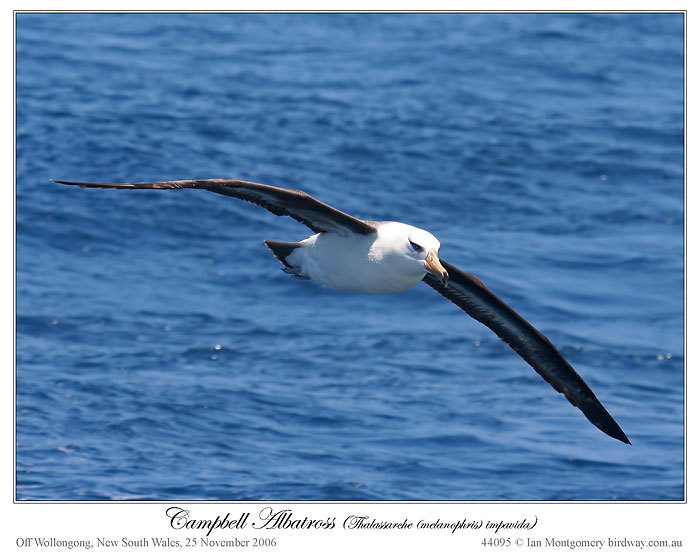
Campbell Albatross (Thalassarche impavida) by Ian

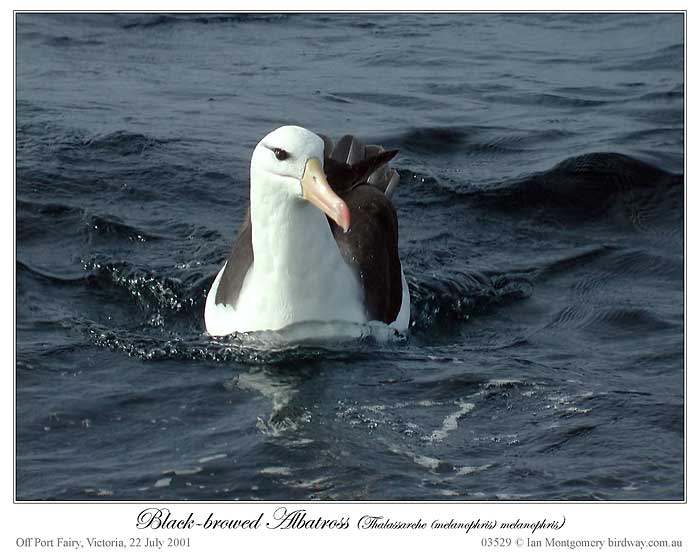
Campbell Albatross (Thalassarche (melanophris impavida) by Ian 1

Another belated bird of the week, so this time you get two species, or maybe only one as we’ll see shortly. Welcome, in a nutshell, to the glory of Albatrosses and the nightmare of bird taxonomy, where I’ve been lately trying to help sort out the final bird list for the digital Pizzey and Knight.

Let’s start by comparing the bird in photo #1 with the one in #2, taken within 6 minutes of each another on a pelagic bird-watching trip from Port Fairy in southern Victoria on 22 July 2001. In those days, when life was simple, we called them both Black-browed Albatrosses. I mention the date as only 5 days later a paper was accepted for publication by the Journal of Molecular Biology which supported the splitting of this species into at least two, the Black-browed Albatross (Thalassarche melanophris) which nests in the South Atlantic and Indian Oceans and the Campbell Albatross (Thalassarche impavida), endemic to Campbell Island south of New Zealand.

Black-browed Albatross (Thalassarche melanophris) by Ian 2

Black-browed Albatross (Thalassarche melanophris) by Ian 2

Definitely a spot the difference puzzle and by now you have found the two features visible in birds not in flight: the adult Campbell Island Albatross has a more strongly marked brow, which makes it look crosser, and a pale iris, which, I think, makes it look slightly manic like the Blue-winged Kookaburra. The underwing patterns are different too. The Campbell is much darker with only a faint central band of white as in photo #3, taken off Wollongong in New South Wales.

Campbell Albatross  (Thalassarche (melanophris impavida) by Ian 3

Campbell Albatross (Thalassarche (melanophris impavida) by Ian 3

At even a short distance, the colour of the iris is hard to see, so the underwing pattern is a better field mark for birds in flight, as in the sub-adult Campbell Albatross in photo #4.

Campbell Albatross (Thalassarche (melanophris impavida) by Ian 4

Campbell Albatross (Thalassarche (melanophris impavida) by Ian 4

Campbell T. impavida if you follow Birdlife International. The different spellings melanophris and melanophrys aren’t typos. Temminck originally spelt it with an ‘i’ but the taxonomists Jouanin and Mougin, Latin scholars obviously, though Temminck couldn’t spell and it should be a ‘y’ and that has been adopted by Birdlife International. C&B uphold the rule that says the original spelling should stand, and stick to the ‘i’.

Welcome to the nit-picking world of bird taxonomy. Does it matter? It does if you want to know how many birds are on your list and it matters if you are a conservationist. Governments are much more willing to provide funds and resources to protect threatened species that they are for sub-species and many of the Albatross types, or taxons, are threatened by long-line fishing. Linnaeus set out in the 18th Century to impose order on a chaotic scientific world with his binomial naming scheme, long before Darwin’s Origin of Species. It’s probably just as well he’s not around to see the result.

Back at the website, I’ve recently finished reformatting the galleries with improved layout, easier navigation and larger photos. I started the process in May 2010 and said then that it would take a long time (over 1,300 galleries) and it’s good to put it behind me. To celebrate, I’m joining the local Birds Australia (BANQ) in Daintree next weekend and then going to Cape York to chase a few species missing from the wanted list for the digital Pizzey and Knight (Trumpet Manucode, Tropical Scrubwren, White-lined and Green-backed Honeyeater). Wish me luck as I’d love to produce the Manucode, one of the 4 species of bird of paradise found in Australia, as a bird of the week. The Daintree weekend includes one or two boat trips on the Daintree River and birding walks, so join us if you can. All are welcome, so check out the details on the BANQ website http://www.birdsaustralianq.org/#Coming .

Best wishes
Ian


Ian Montgomery, Birdway Pty Ltd,
454 Forestry Road, Bluewater, Qld 4818
Phone: 0411 602 737 +61-411 602 737
Preferred Email: ian@birdway.com.au
Website: http://birdway.com.au


Lee’s Addition:

Whew! Okay, Ian, I think I followed all of that! As I have been saying, this naming and re-naming, splitting and glumping can get confusing. I still contend that Adam had it a whole lot easier. I have been going through those changes when the IOC World Bird List comes about about every 3 months. Keep up the good work, Ian. No matter what you call them, those are fantastic photos of the Albatrosses.

After checking out Ian’s Albatrosses, the look up the whole family, Diomedeidae-Albatrosses, here.

And God said, “Let the waters swarm with swarms of living creatures, and let birds fly above the earth across the expanse of the heavens.”
(Genesis 1:20 ESV)

*

Birds of the Bible – Singing in the Trees


Rockrunner (Achaetops pycnopygius) by Keith Blomerley

By them shall the fowls of the heaven have their habitation, which sing among the branches. (Psalms 104:12 KJV)

From the verses below, you will see that the birds will be either:

  • in the trees
  • among the branches or foliage
  • between or in the midst of the rocks

Now that we have them placed, lets see how they are producing sound:

  • sing or singing
  • giving out a sound
  • utter or give forth a voice
  • chirp a song
  • lift up their voices

Psalms 104:12

(ABP+) by them the winged creatures of the heaven shall encamp; from between the rocks they shall give out a sound;
(ASV) By them the birds of the heavens have their habitation; They sing among the branches.
(BBE) The birds of the air have their resting-places by them, and make their song among the branches.
(Brenton) By them shall the birds of the sky lodge: they shall utter a voice out of the midst of the rocks.
(CEV) Birds build their nests nearby and sing in the trees.
(Darby) The birds of heaven dwell by them; they give forth their voice from among the branches.
(DRB) Over them the birds of the air shall dwell: from the midst of the rocks they shall give forth their voices.
(ERV) Wild birds come to live by the pools; they sing in the branches of nearby trees.
(ESV) Beside them the birds of the heavens dwell; they sing among the branches.
(GNB) In the trees near by, the birds make their nests and sing.
(GW) The birds live by the streams. They sing among the branches.
(ISV) Birds of the sky live beside them and chirp a song among the foliage.
(JPS) Beside them dwell the fowl of the heaven, from among the branches they sing.
(KJV) By them shall the fowls of the heaven have their habitation, which sing among the branches.
(KJV-1611) By them shall the foules of the heauen haue their habitation: which sing among the branches.
(LITV) over them the birds of the heavens dwell; they give voice from between the branches.
(MKJV) By them the birds of the heavens will have their place of rest; they sing among the branches.
(NAS77) Beside them the birds of the heavens dwell; They lift up their voices among the branches.
(NASB) Beside them the birds of the heavens dwell; They lift up their voices among the branches.
(NKJV) By them the birds of the heavens have their home; They sing among the branches.
(RV) By them the fowl of the heaven have their habitation, they sing among the branches.
(Webster) By them shall the fowls of the heaven have their habitation, which sing among the branches.
(YLT) By them the fowl of the heavens doth dwell, From between the branches They give forth the voice.

How do birds produce a song? Why are they singing?

“The distinction between songs and calls is based upon complexity, length, and context. Songs are longer and more complex and are associated with courtship and mating, while calls tend to serve such functions as alarms or keeping members of a flock in contact. Other authorities such as Howell and Webb (1995) make the distinction based on function, so that short vocalizations such as those of pigeons and even non-vocal sounds such as the drumming of woodpeckers and the “winnowing” of snipes’ wings in display flight are considered songs. Still others require song to have syllabic diversity and temporal regularity akin to the repetitive and transformative patterns which define music. It is generally agreed upon in birding and ornithology which sounds are songs and which are calls, and a good field guide will differentiate between the two.

Bird song is best developed in the order Passeriformes. Most song is emitted by male rather than female birds. Song is usually delivered from prominent perches although some species may sing when flying. Some groups are nearly voiceless, producing only percussive and rhythmic sounds, such as the storks, which clatter their bills. In some manakins (Pipridae), the males have several mechanisms for mechanical sound production, including mechanisms for stridulation not unlike those found in some insects.”

Anatomy – The avian vocal organ is called the syrinx; it is a bony structure at the bottom of the trachea (unlike the larynx at the top of the mammalian trachea). The syrinx and sometimes a surrounding air sac resonate to sound waves that are made by membranes past which the bird forces air. The bird controls the pitch by changing the tension on the membranes and controls both pitch and volume by changing the force of exhalation. It can control the two sides of the trachea independently, which is how some species can produce two notes at once.” (Wikipedia)

Why are they singing in the verse?

Psalm 104 is about blessing the Lord for all the things He has created and it describes different aspects of that creation. Light, water, clouds, foundations, the deep, mountains, springs, trees, grass, etc. The birds are singing after the springs are described in verse 10 and it gives drink to all. The trees are producing fruit, and the birds are making nest or resting in the trees. Then in verse 12 they are content and are singing. If your read the whole 104th Psalm, you just might find great cause to do your own singing and praising.

For more details see:

Bird Communication (Very detailed but good)

Bird vocalization (Wikipedia)

More Birds of the Bible articles – Click Here
*