On Good Friday we were at Bok Sanctuary in Lake Wales, FL enjoying a beautiful cloudless day. The orange grove there was in full bloom and the aroma drifted over the whole place. We were birding, taking pictures, and appreciating God’s goodness. The birds were full of songs and they came out for us to see them. Could that have been because I asked the Lord to do just that? If He can make a donkey talk and and cause it to stop before an angel, and bring ravens to feed a prophet, surely He could answer my prayer. He did!
Here is a list of what we saw and heard: Cardinals, Blue Jays, Mourning Doves, Mockingbirds, Brown Trashers, Red-bellied Woodpecker, a pair of American Kestrels sitting close, Fish Crows, Gray Catbird, Great Blue Heron, Black and Turkey Vultures, Osprey, and my two prize catches – a Black and White Warbler and a Ruby-crowned Kinglet.
We also saw a cactus in bloom.
Of course there were plenty of squirrels to put up with.
Today was a great day, with both morning and evening services being a blessing. I trust your day was also blessed as you reflected on the Resurrection of Christ and what it means to our lives.
Observing the Northern Mockingbird must have some lessons we can learn. I can think of two off hand. Well, actually one of them comes from my husband. The song of the mockingbird uses a “vocal mimicry or appropriation” to make “sounds of other species (as well as non-avian sounds such as the barking of dogs, screeching of machinery, or human whistling) sometimes incorporated into a bird’s repertoire.” (“Vocal Copying,” The Birder’s Handbook) They listen, incorporate, and assimilate those songs and produce sounds into a very melodious song. Their song is usually a phrase repeated three times or so, and then a new phrase is sung. This can go on for hours.
Lesson #1: He could be like a person, who hears things and then repeats it three or more time. Sort of like a gossiper.
Lesson #2: (My preference) He could be like a Christian who listens to sermons, Sunday School lessons, other Biblical lessons, songs, has personal devotions, etc. then meditates and incorporates what they have heard into their life. Their life then produces a “song,” or way of life that is pleasing to others and especially to the Lord.
And besides they learn to be idle, wandering about from house to house, and not only idle but also gossips and busybodies, saying things which they ought not. (1Ti 5:13)
Also
Charge them that are rich in this world, that they be not high-minded; nor trust in uncertain riches, but in the living God, who giveth us richly all things to enjoy; That they do good, that they be rich in good works, ready to distribute, willing to communicate; Laying up in store for themselves a good foundation against the time to come, that they may lay hold on eternal life. (1Ti 6:17-19)
Till I come, give attendance to reading, to exhortation, to doctrine. Neglect not the gift that is in thee, …. Meditate upon these things; give thyself wholly to them; that thy profiting may appear to all. (1Ti 4:13-15)
Many people think of babies being delivered when a Stork is mentioned. I am amazed when I watch the Wood Storks here in Florida. When they are on the ground, they are very unbecoming (aka-ugly), but when they are flying, it is so awesome to see the gracefulness of their flight and how beautiful their wings are.
The Wood Stork is a large bird (35”) that has huge long legs and a wing span of five and a half feet. It is the only stork that breeds here in the U.S. There are 19 species of storks worldwide. It has a long, thick, down-curved bill, and its head is black and un-feathered. The Stork is a wadder and raises its young in late winter in Florida during the dryer season. When the water is lower, the fish concentrate, and the Wood Stork and other birds can find an ample supply to feed their young. When they fly, they hold the neck extended. Pictures by my friend Reineir Munguia, (Professional Photographer) The stork is found in the list of unclean birds in Lev 11:19 and in Deu. 14:18
In Psalms the list is repeated with a comment here about the stork.
Where the birds make their nests; The stork has her home in the fir trees. Psa(104:17)
My picture of a Wood Stork in tree and Reinier’s much better one.
Jeremiah refers to the migration of birds and how they know when it’s time to leave. Here is an interesting quote from an article from Israel: The Bird’s Eye View By Sherri Mandell
Israel may be a small country, but thousands of birds annually take advantage of its passage-friendly flyway and the welcoming sanctuaries that dot the country.
The ancients considered Israel the center of the world, and it certainly feels that way if you look up at the sky in the spring and autumn. Half a billion migrating birds, more than 230 species, fly in Israeli air space on annual migrations between Europe, western Asia and Africa.
These journeys were noted long ago: “The stork in the heaven also knows her appointed times; and the turtledove, swift and the crane observe their time of coming” (Jeremiah 8:7).
“Tourists are sometimes afraid to visit here,” observes Alen Kasel, education director of the Jerusalem Bird Observatory, “but [the birds] never abandon us.”
Zechariah alludes to the “wings of a stork”.
Then I raised my eyes and looked, and there were two women, coming with the wind in their wings; for they had wings like the wings of a stork, and they lifted up the basket between earth and heaven. (Zec 5:9)
This Reddish Egret was stirring up food by running around and trying to scare up some food. Overcast day and very windy. Not a good birding day. I did enjooy watching the Egret though.
California Quail sometimes called California Partridge
Chukar Partridge (Alectoris chukar) by Ian
Partridges, which number 39, are part of the Phasiaidae family which has 155 species worldwide (only 16 in North America) that includes Chukar, Francolin, Quail, Pheasants, Junglefowl, Peafowl, and Peacocks. The Grouse and Wild Turkey are also related to them.
The Phasaidae family has a “chicken-like” appearance. These are medium-sized birds intermediate between the larger pheasants and the smaller quails.
The Partridges are native to Europe, Asia, North Africa, and the Middle East. They are ground-nesting seed-eaters. Their diet consists of mostly grains, fruits and some insects.
Many species are hunted for sport or game.
Eggs: from 5-20 in nests. “…20 or more often represents laying of more than one gray partridge hen in same nest; ring-necked pheasant also known to lay eggs in nest of gray partridge.” (The Audubon Encyclopedia of North American Birds, pg. 690) It appears some lay eggs, but get others to do the hatching.
The partridge is a “clean” bird.
The Partridge is only mentioned twice in Scripture. In Jeremiah, the fact is that other birds put their eggs in the nest of a partridge and then expect the nesting bird to do all the work, sitting, feeding, and fledging the chicks.
I, the LORD, search the heart, I test the mind, Even to give every man according to his ways, According to the fruit of his doings. “As a partridge that broods but does not hatch, So is he who gets riches, but not by right; It will leave him in the midst of his days, And at his end he will be a fool.” (Jer 17:10-11)
We find the second reference to a partridge in I Samuel. David is being hunted by Saul.
So now, do not let my blood fall to the earth before the face of the LORD. For the king of Israel has come out to seek a flea, as when one hunts a partridge in the mountains.” (1Sa 26:20)
I promised to present the birds, not explain all the verses. I’ll leave that for our pastors.
Last week was not conducive for birdwatching trips. Between windy overcast days, stormy rainy evenings, and doctor visits we didn’t get out and about, nor was I on the computer much. So, I have decided to share our visits to Santa Ana National Wildlife Refuge in Alamo, Texas. That is way “down in the valley” and sits on the Rio Grande River. We spent two winters in our RV in that area and were able to visit the refuge.
The first time we visited (Nov 01’) with our friend Betty, who is an experienced birder. It is nice to have someone along who can help ID the birds. They have a welcome center that has some feeders right by the entry way. Within about 5-10 minutes, I was able to see my first Green Jay, Buff-bellied Hummingbird, Golden-fronted Woodpecker, Great Kiskadee, Inca Dove, Red-billed Pigeon and the Plain Chachalaca,. Some of the birds only come over the Rio Grande a few miles, so I was thrilled to see them. I am including pictures of them. These were taken with an older digital camera, so they are so so.
The House Sparrow is the first bird in a new series (Eye of the Beholder) of how I or others see birds . In last week’s Birds of the Bible – Sparrow I blog, attention was drawn to how it is many times mentioned as a “pest.” The reason for this reference is the House Sparrow has taken over many other bird’s nests, houses, cavities, etc. They hog food from the “prettier and more desirable” birds.
Let’s look at the other side of the coin. The House Sparrow has learned to adapt to whatever is given it. They make do with whatever living space they can find (Did you ever notice how many letters of signs have nests in them?), and are able to eat what’s available (even at McDonald’s and Burger King). Many birds are so specialized in their diets and where they live, that as man or birds encroach in their area, they cannot adapt to the new situation. Many birds have become extinct over the years, not being able to cope. You have to give Sparrows credit for surviving after having been uprooted from their homeland. God has allowed this little brown bird, the House Sparrow, to be content and make do with what is provided.
To me, the sparrow reminds us of what the Bible says about being able to adapt and accept what the Lord allows to come into our lives. The Bible says,
“Not that I speak in regard to need, for I have learned in whatever state I am, to be content: I know how to be abased, and I know how to abound. Everywhere and in all things I have learned both to be full and to be hungry, both to abound and to suffer need. I can do all things through Christ who strengthens me.” (Php 4:11-13)
Sparrows are mentioned in at least seven verses in the Bible, but because of other applications associated with them, this is only Part I.
I am amazed at the articles that mention Sparrows as “Trash birds” or brushed off in articles about birds. Some examples:
“..he refers to common birds of no interest to him as ‘trash birds.’ With the possible exception of pigeons and House (English) Sparrows, there is no such thing as a trash bird” The Complete Idiot’s Guide to Birdwatching, p. 25.
“…until the problem species disperse.”
They can distract you from the less common birds, resulting in lost viewing opportunities – those other birds slip away while you’re trying to determine whether that brownish bird is “just” a song sparrow or something more exciting.
“…blackbirds, cowbirds, grackles, and house sparrows. If you’re inundated by these less desirable birds, you may want stop offering corn.”
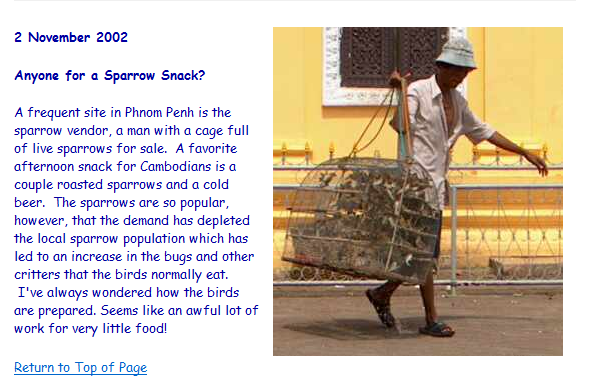
Anyone for a Sparrow Snack?
Click Picture to Enlarge
Can you believe this? A Sparrow Snack?
“The large North American (House Sparrow) population is descended from birds deliberately imported from Britain in the late 19th century. They were introduced independently in a number of American cities in the years between 1850 and 1875 as a means of pest control. The mistake was realized after they were well established and by 1883 they were already considered pests and their introduction a disaster.
While declining somewhat in their adopted homeland, House Sparrows are one of the most abundant birds in North America, with a population estimated at approximately 150 million. …In the United States and Canada, the House Sparrow is one of only three birds (the other two being the European Starling and the Rock Pigeon) not protected by law. As an invasive non-indigenous species, it is legal to kill House Sparrows and destroy their eggs at any time in most places in the United States. These three introduced species are now each more widespread and common on the continent than are any other birds.” (Wikipedia)
The sparrow is just trying to live and take care of it’s family.
Are not two sparrows sold for a copper coin? And not one of them falls to the ground apart from your Father’s will. But the very hairs of your head are all numbered Do not fear therefore; you are of more value than many sparrows. (Mat 10:29-31)
“Are not five sparrows sold for two copper coins? And not one of them is forgotten before God. But the very hairs of your head are all numbered. Do not fear therefore; you are of more value than many sparrows. (Luk 12:6-7)
“The next time that you see a sparrow, remember God is interested in that sparrow. An eloquent preacher said one time that there is never a sparrow dies but that God goes to its funeral. I am not that eloquent, so I don’t usually talk like that, but it impressed me—not a sparrow dies, but that God goes to its funeral.
God is interested in you. The next time you see a sparrow, remember God cares about you so much more than about that sparrow.
“Do not fear therefore; you are of more value than many sparrows.” (Birds of the Bible Study, Dr Joe Temple)
Hymns: He the pearly gates will open
Like a sparrow hunted, frightened,
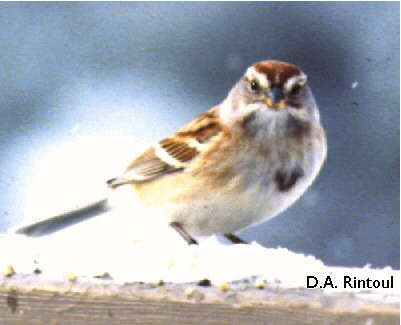
American Tree Sparrow
Weak and helpless— such was I;
Wounded, fallen, yet He healed me—
He will heed the sinner’s cry.
Refrain:
He the pearly gates will open,
So that I may enter in;
For He purchased my redemption
And forgave me all my sin.
His eye is on the sparrow
Why should I feel discouraged?
Why should the shadows come?
Why should my heart feel lonely?
And long for heaven and home
When Jesus is my portion
A constant friend is He
His eye is on the sparrow
And I know He watches over me
His eye is on the sparrow and I know He watches me
I sing because I’m happy
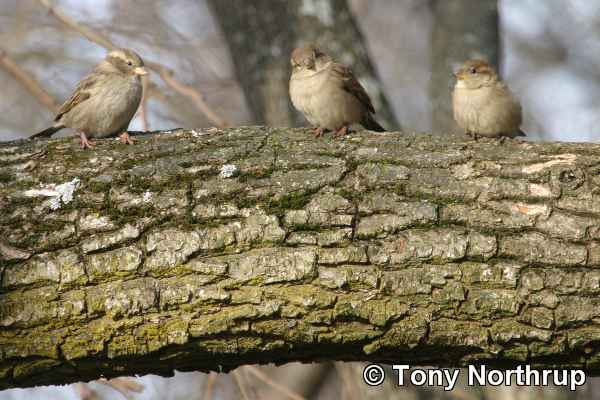
Three Sparrows
I sing because I’m free
His eye is on the sparrow
And I know He watches me
His eye is on the sparrow
And I know He watches me
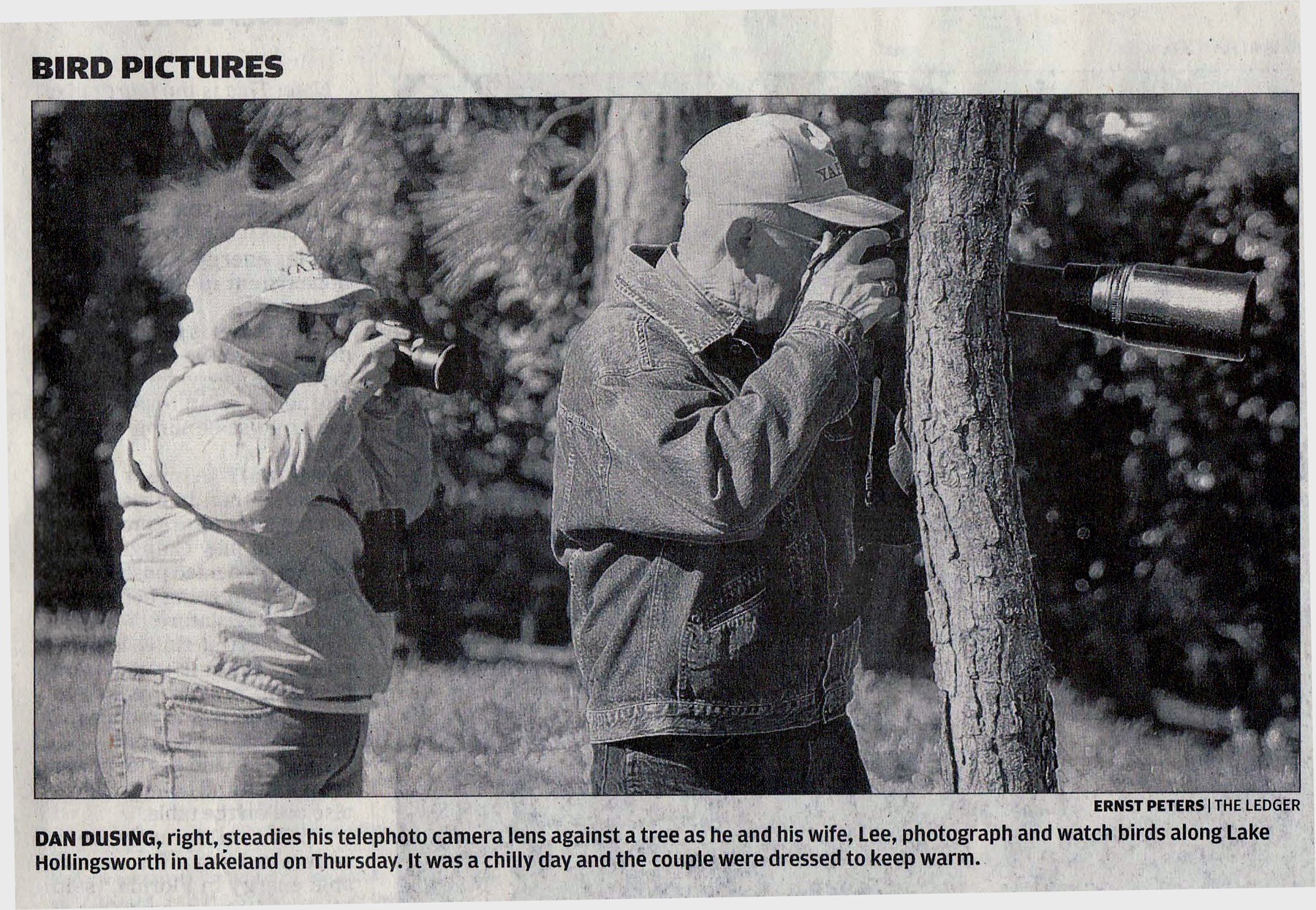
Our latest bird watching trip was last Thursday, the 28th, to Lake Hollingsworth in Lakeland. It turned out to be an interesting time. The true birder came out in us, because it was COLD. It was 45 degrees when we got there around 10:00 am and the wind was whipping off of the lake. I mean, this is Florida, you know! We were bundled-up, while there were some visitors walking around the lake in SHORTS (You know, the ones from Canada and Wisconsin, etc.); some of the “Floridarized” residents even had gloves on. Well, anyway, while we were taking pictures of a group of White Pelicans, a photographer was taking a picture of us. We ended up in Saturday’s “The Ledger,”our local newspaper. You never know what will happen when you go birding.
Article from the Lakeland, FL Ledger
In between shivers, we watched the White Pelicans and got some good pictures. One of my favorite finds was to see a Black-crowned Night-Heron. It was the closest I have ever gotten to one. The rest of the birds seen were: Great Blue Herons, Little Blue Heron, Coots, Common Moorhens, Purple Gallinules, Mallards, Pied-billed Grebe, Tree Swallows, Redwings, Ospreys, and the normal bunch of Grackles and Vultures. Not a bad day, considering how Cold it was.
According to Thayer’s Birding Software, the Common Raven in the U.S. is 24 inches long (from beak to tail), with about a four foot wingspan, has “entirely black plumage, a large, heavy bill, wedge-shaped tail, long shaggy feathers on chin and throat, larger than crows and has relatively short legs.” It resides more out west than here in the east, though they show up in some areas in the east. You might find them in the desert, forest, canyons, foothills, mountains, and other places. “They are “often seen along highways eating road kill.” They are in the same family as Crows, Jays and Magpies.
Two Ravens mentioned in Israel: are the Brown-necked Raven
Brown-necked Raven, Israel
Raven Master
and Common Raven.
Bible Facts about the Raven
They were on the ark and the first to leave. (Gen 8:7)
Noah opened the window of the ark and let a raven fly out, for the purpose of ascertaining the drying up of the waters. The raven went out and returned until the earth was dry, but without being taken back into the ark” (Keil & Delitzsch Commentary on the Old Testament)
Two thoughts I have. The raven was the first bird to see the new world after the flood and if the raven had re-entered the ark, he would have corrupted it, since he was “unclean.”
Ravens are considered an unclean bird. They eat mostly carrion. (Lev 11:13-15)
Ravens fed Elijah. (I Kings 17:4-6)
“Elijah was commanded to hide himself. If Providence calls us to solitude and retirement, it becomes us to go: when we cannot be useful, we must be patient; and when we cannot work for God, we must sit still quietly for him. The ravens were appointed to bring him meat, and did so. Let those who have but from hand to mouth, learn to live upon Providence, and trust it for the bread of the day, in the day. God could have sent angels to minister to him; but he chose to show that he can serve his own purposes by the meanest creatures, as effectually as by the mightiest.” (Matthew Henry’s Commentary)
“and these provisions were ready prepared, the bread made and baked, and the flesh boiled, broiled, or roasted;” (John Gill’s Exposition of the OT)
The hair was “black as a raven.” (Song of Solomon 5:11)
Who provides food for the raven, When its young ones cry to God, And wander about for lack of food?” (Job 38:41)
“Sing to the LORD with thanksgiving; Sing praises on the harp to our God, Who covers the heavens with clouds, Who prepares rain for the earth, Who makes grass to grow on the mountains. He gives to the beast its food, And to the young ravens that cry.” (Psa 147:7-9)
They are mentioned in Luke 12:24 as not sowing or reaping, nor gathering and that God feeds them.
“Consider the ravens, for they neither sow nor reap, which have neither storehouse nor barn; and God feeds them. Of how much more value are you than the birds?”
A hymn that mentions Ravens:
Sometimes a Light Surprises It can bring with it nothing,
But He will bear us through;
Who gives the lilies clothing
Will clothe His people too:
Beneath the spreading heavens
No creature but is fed;
And He who feeds the ravens
Will give His children bread.
World List of Ravens:
Little Raven, Relict Raven, Forest Raven, Chihuahuan Raven, Brown-necked Raven, Common Raven, Fan-tailed Raven, White-necked Raven, Thick-billed Raven
Other interesting facts:
Ravens are considered one of the most intelligent birds.
They have a Raven Master. “It’s said that when the ravens leave the Tower, the Tower will crumble and the kingdom will crumble with it.” To see the article: Tower of London
I have been thinking about the Birds of the Bible Series I am working on. Yesterday, we finished our Missions Conference at Faith and was motivated even more to do this blog. Today, while searching the internet for information for my next article, I realized again how many others have done similar blogs. Shades of doubt began to form. So, why am I doing this?
The Lord has helped me to REMEMBER why.
1. The Lord wants us to praise Him and declare His mighty and wondrous works. Great is the LORD, and greatly to be praised; And His greatness is unsearchable. One generation shall praise Your works to another, And shall declare Your mighty acts. I will meditate on the glorious splendor of Your majesty, And on Your wondrous works. (Psa 145:3-5) 2. I love bird watching and am amazed and awed at the how God created the birds. Their beauty, structure, song and habits are amazing. To know that they are under the “curse” along with us, and still they are inspiring.
3. As we sang yesterday, “Little Is Much When God Is In It”. My efforts may be small, and this won’t be a famous blog, but to share with others my love for birds and the Lord is strong.
4. My husband also greatly reassured me.
There are a lot of great websites that teach about the Birds of the Bible and others that are all about birds. I will try to share those sites for your information and try not to “re-invent the wheel.”
+compressed.jpg) On Good Friday we were at Bok Sanctuary in Lake Wales, FL enjoying a beautiful cloudless day. The orange grove there was in full bloom and the aroma drifted over the whole place. We were birding, taking pictures, and appreciating God’s goodness. The birds were full of songs and they came out for us to see them. Could that have been because I asked the Lord to do just that? If He can make a donkey talk and and cause it to stop before an angel, and bring ravens to feed a prophet, surely He could answer my prayer. He did!
On Good Friday we were at Bok Sanctuary in Lake Wales, FL enjoying a beautiful cloudless day. The orange grove there was in full bloom and the aroma drifted over the whole place. We were birding, taking pictures, and appreciating God’s goodness. The birds were full of songs and they came out for us to see them. Could that have been because I asked the Lord to do just that? If He can make a donkey talk and and cause it to stop before an angel, and bring ravens to feed a prophet, surely He could answer my prayer. He did!
+compressed.jpg)


+Wood+Stork+in+a+tree.jpg)





 Lee's Birdwatching Adventures Plus
