Heard, But Not Seen

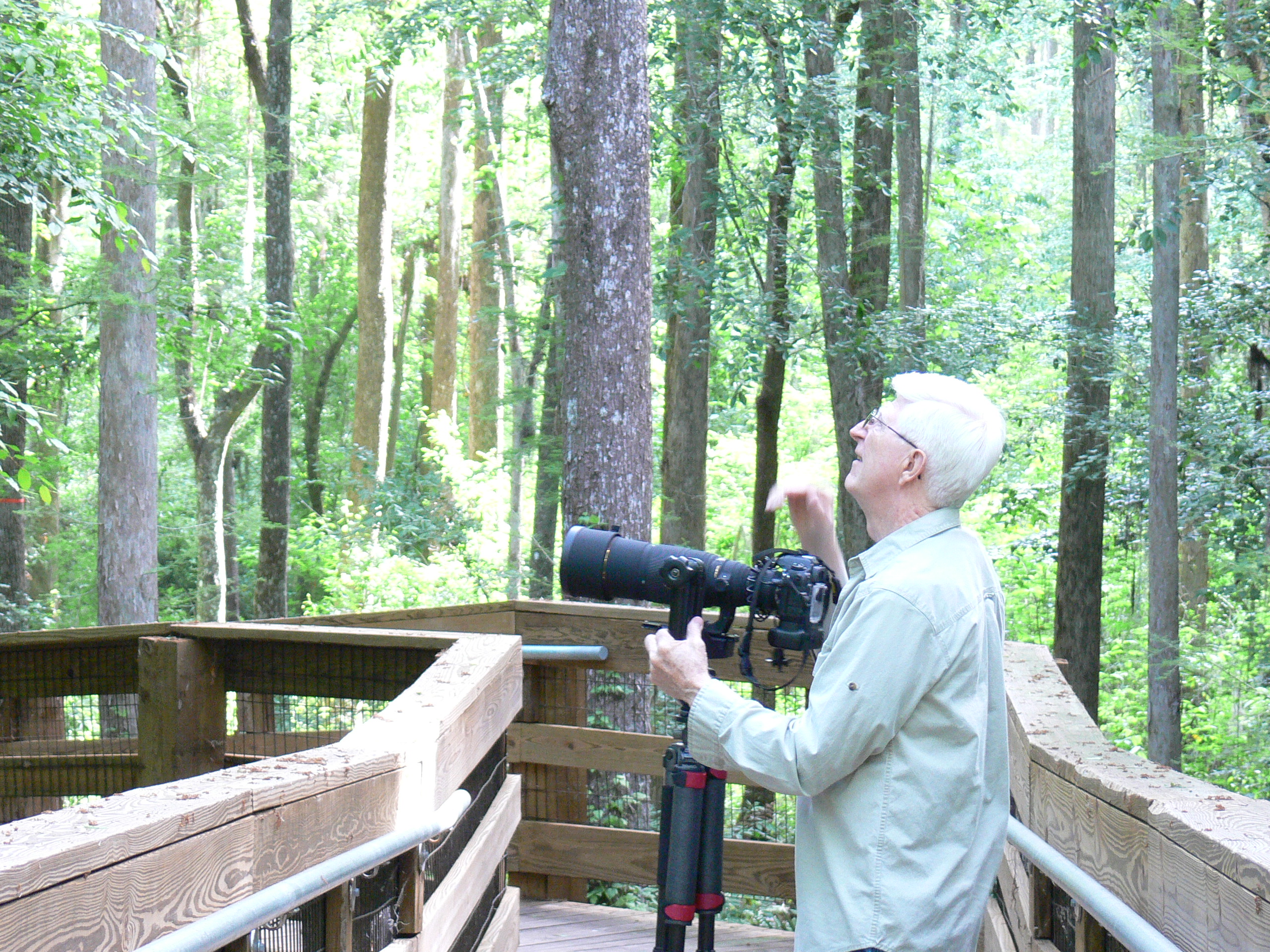
Caught Dan on the Boardwalk trying to find a bird

Caught Dan on the Boardwalk trying to find a bird

Yesterday Dan and I went birdwatching at the Mosaic Peace River Park in Homeland, FL. It was a gorgeous morning and the temperature was around 73° when we got there around 10 am. While we were getting our gear out a Northern Cardinal landed nearby. I aimed my camera and realized I had not taken the lens cap off yet. By the time I did remove it, you guessed it, he flew away into the trees. That was the story of our trip. The birds were “heard, but not seen.”

For those that may be new to birdwatching, when a bird is heard even though not seen, it can be counted on your list. Some are not aware of that fact. The problem is, knowing what the birds sound like. I was sorry yesterday that I had not spent enough time practicing hearing sounds. My list would have been much longer. Where we were has a boardwalk winding between the trees and ends up at the Peace River. Other than that Cardinal and the ones flying way overhead, no birds were seen. Yet, our list included 16 species.

I have decided to test you some and help you learn. Below are the sounds of some of the birds we heard, but I won’t  ID until later in the article.

Sound #1

Sound #2

Sound #3

Sound #4

Sound #5

So, have you figured them all out. They are fairly common to this area of the US. To help you out, here is a link to their photos:
Bird #1 ~ ~ Bird #2 ~ ~ Bird #3 ~ ~ Bird #4 ~ ~ Bird #5

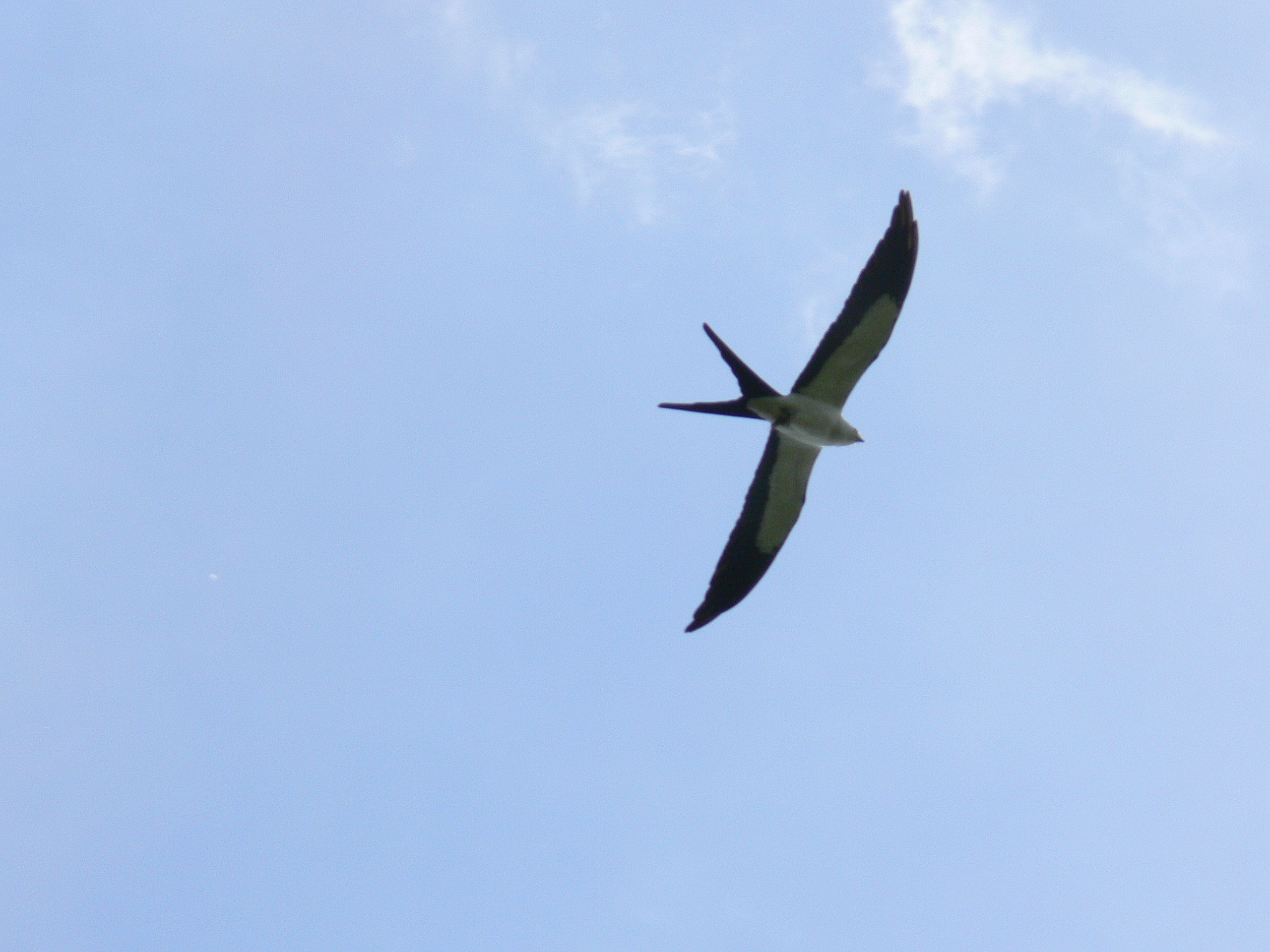
Swallow-tailed Kite - the one bird I got a photo of as it flew overhead

Swallow-tailed Kite – the one bird I got a photo of as it flew overhead

That Bird #5 had given me a test of my memory. I wrote down on my list “squeeky wheel bird.” I knew I had heard it before and planned to look it up when we got home. Luckily, on the way back to the car, we met a group of birdwatchers from Martin county Audubon. We compared lists, which is normal for birdwatchers, and then I asked about the “squeeky wheel bird” and they gave me it’s name right off. (I should have been birding with them) I checked out my recordings at home and sure enough, that is what it was.

All the sound recording came from xeno-canto.org and there are numerous other places to find the sounds of birds. Birding by Ear Basics from About.com/Birds has good tips. Cornell Lab of Ornithology is one of the best for seeing and hearing the birds.

We hear the birds and know they are there even though we do not see them. In the Christian realm, we do not see the Lord in person today, but we know He is alive and speaks to us through the things He has created and most of all by His Word.

He who is of God hears God’s words; …” (John 8:47a NKJV)

Now to the King eternal, immortal, invisible, to God who alone is wise, be honor and glory forever and ever. Amen. (1 Timothy 1:17 NKJV)

For since the creation of the world His invisible attributes are clearly seen, being understood by the things that are made, even His eternal power and Godhead, so that they are without excuse, (Romans 1:20 NKJV)

*

Ian’s Bird of the Week – Christmas Imperial Pigeon

Christmas Imperial Pigeon (Ducula whartoni) by Ian Montgomery

Christmas Imperial Pigeon (Ducula whartoni) by Ian Montgomery

Bird of the Week: Christmas Imperial Pigeon by Ian Montgomery
Newsletter: 04/13/10

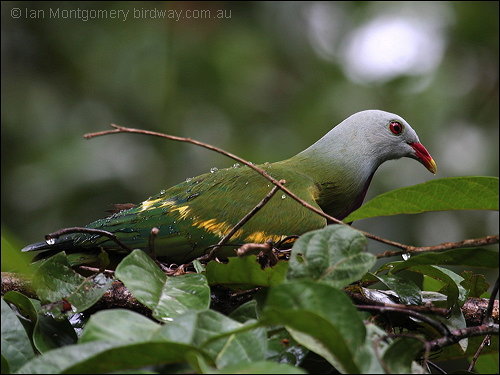
We are, we hope, near the end of a persistent wet season, during which I haven’t taken many photos. So, here is an attractive bird from the archives, photographed on a trip to Christmas Island in 2006, the Christmas Island Imperial Pigeon. It’s comparable in size (length 38-40cm/15-16in) to the Pied Imperial-Pigeon of northern Australia, but quite different in colour, much darker with strikingly iridescent plumage. In the first photo, the sunlight highlights the green iridescence of the back and wing feathers, while the second photo shows the purplish-grey and rufous-brown plumage of the underside.

Christmas Imperial Pigeon (Ducula whartoni) by Ian Montgomery

Christmas Imperial Pigeon (Ducula whartoni) by Ian Montgomery

It’s endemic to Christmas Island, a mere speck – area 140 sq km – in the Indian Ocean 500 km south of Java. Because of its small range and therefore limited population, it is classified as Vulnerable on the IUCN Red List. It seemed to be quite common on the island and the population is thought to be stable, though there are concerns that it could be affected by an infestation of yellow crazy ants on Christmas Island. Control measures have reduced the ant infestation, but eliminating them has proved difficult and the baits used also affect other invertebrates such as the famous terrestrial red crabs.

It’s closest relative is the Pink-headed Imperial-Pigeon (Ducula rosacea) which is widespread but rather rare in the islands of Indonesia and East Timor. It has suffered from both habitat destruction and hunting. Some authorities consider that the Christmas Island Imperial-Pigeon may be a race of the Pink-headed.

I’ve added photos of three more Australian mammals to the website: the Euro (a blackish kangaroo), Bush Rat and Fawn-footed Melomys (also a rodent). The latter two obliged us with good view coming into feed on grain at Kingfisher Park over Easter, undeterred by the rain.

Best wishes,
Ian

Links:
Christmas Imperial Pigeon
Pied Imperial-Pigeon
Euro
Bush Rat
Fawn-footed Melomys

Ian Montgomery, Birdway Pty Ltd,
454 Forestry Road, Bluewater, Qld 4818
Phone: +61-7 4751 3115
Preferred

Email: ian@birdway.com.au
Website: http://birdway.com.au


Lee’s Addition:
The Christmas Island Imperial-Pigeon has recently been changed to the Christmas Imperial Pigeon. It is in the Columbidae Family of the Columbiformes Order. There are 321 birds in the family of various Doves and Pigeons, plus Bronzewings and Bleeding Hearts.

Check out the Doves and Pigeon page. Doves and Pigeons are mentioned many times in the Bible.

So I said, “Oh, that I had wings like a dove! I would fly away and be at rest. (Psalms 55:6 NKJV)

Birds of the Bible – Little Brown Jobs

An interesting video from YouTube by SmellLikeDirt caught my interest. Take a look and then I’ll comment on it.

*

The Sparrow has been written about before, but it is always nice to find out something else new about them. We know that the Lord created all the birds, but it seems as though the Sparrow just doesn’t get the attention like the more colorful birds. After watching the video, I trust you saw how God has provided for them to keep their species alive.

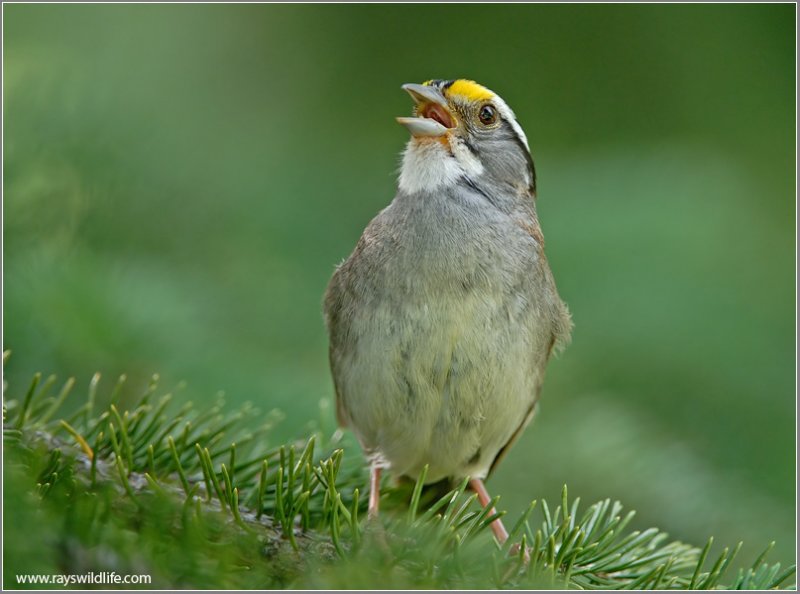
White-throated Sparrow by Ray

It is interesting about the behavior patterns of the different patterns of coloration. The White-throated Sparrow is a passerine bird of the American sparrow family Emberizidae. The White-throated Sparrow is 17 cm (6.75 inches) in length with a wingspan of 23 cm (9 inches) Typical weight is 26 grams (0.91 oz).

There are two adult plumage variations known as the tan-striped and white-striped forms. On the white-striped form the crown is black with a white central stripe. The supercilium is white as well. The auriculars are gray with the upper edge forming a black eye line.

On the tan form, the crown is dark brown with a tan central stripe. The supercilium is tan as well. The auriculars are gray/light brown with the upper edge forming a brown eye line. Both variations feature dark eyes, a white throat, yellow lores and gray bill. There is variation and some individuals may show dark lateral stripes of each side of the throat.

Most of us are just average people and sometimes may feel like you are not that important to others. But God loves us, even more than the sparrows and He hasn’t forgotten them.

Are not five sparrows sold for two copper coins? And not one of them is forgotten before God. (Luke 12:6 NKJV)

It’s true that the Sparrows are looked down on and sometimes just called, “Little Brown Jobs,” but they are created the way God wanted them in His plan for them. As Christians, not everyone can be the leader or the one in the “lime-light.” If that were true, then where would the followers be?

For in fact the body is not one member but many. If the foot should say, “Because I am not a hand, I am not of the body,” is it therefore not of the body? And if the ear should say, “Because I am not an eye, I am not of the body,” is it therefore not of the body? If the whole body were an eye, where would be the hearing? If the whole were hearing, where would be the smelling? But now God has set the members, each one of them, in the body just as He pleased. (1 Corinthians 12:14-18 NKJV)

See also:

Sparrows

*

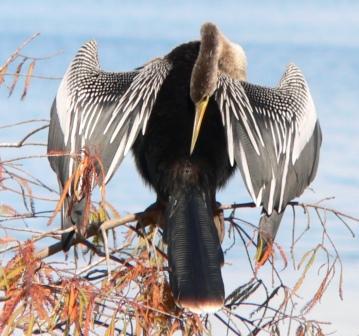
The Surrendered Anhinga

The Surrendered Anhinga – by A J Mithra

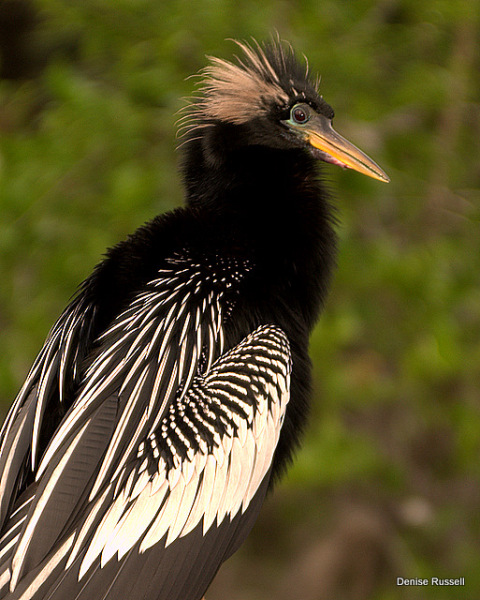
 Anhinga (Anhinga anhinga) By Densie Russell

Anhinga (Anhinga anhinga) By Denise Russell

The Indians who live near the Amazon River in South America call it “Anhinga.” In North America it is called “water turkey,” “snake darter,” or “darter.” This strange bird goes by several names. It has a long tail that accounts for its nickname, “water turkey.”

The Anhinga swims with only its head above the water While swimming, the long neck and the head may be above the surface with its body below and this has resulted in another nickname, “snake bird.”

Some Anhingas live in Asia, in Africa and in Australia and in America, from southern Arkansas to Argentina and they are quite common in Florida.

People may call you by your first name, last name, surname or even nicknames, but,JESUS not only calls you by your name but gives you a new name too…

As long as Jacob was Jacob, he was a wanderer, but, GOD gave him a new name, Israel, only after Jacob accepted that he is a fraud..

After which, Israel was no more a wanderer, but the most powerful nation on the face of the earth…
GOD gives us a new name only when we repent…

He that hath an ear, let him hear what the Spirit saith unto the churches; To him that overcometh will I give to eat of the hidden manna, and will give him a white stone, and in the stone a new name written, which no man knoweth saving he that receiveth it. (Revelation 2:17)

 Anhinga (Anhinga anhinga) By Densie Russell

Anhinga (Anhinga anhinga) By Denise Russell

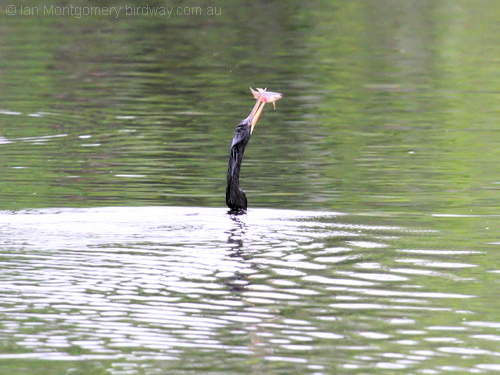
It finds its food in the water. It eats insects, frog eggs, fish and even small alligators. It spears fish with its long beak, so, sometimes it has to swim to shore and pry the fish off its beak by rubbing on a rock or tree limb.

Mating pairs are monogamous. Anhingas have been seen performing rituals when changing egg incubation duties they intertwine necks and pass nesting material when changing positions.

The Anhinga is frequently seen soaring high in the sky overhead. It is a graceful flier and can travel long distances without flapping its wings, much in the manner of a Turkey Vulture.

Among birds, the Anhinga is the best fresh-water diver. It goes down quietly and hardly makes a ripple. Unlike like other birds who spend most of their days in water (like a duck), an Anhinga’s feathers are not waterproof. But, this weakness allows the Anhinga to dive deeper than birds with waterproof feathers. But, it also has it downfalls.

When an Anhinga swoops down into a body of water to capture its food, its feathers quickly become water-logged. When an Anhinga is water-logged, it is unable to fly. Thus the Anhinga must dry itself off by holding its wings outstretched, allowing the sun to dry the feathers….

This bird is a good example of “I CAN DO ALL THINGS WITH GOD”

Anhinga Dryed at Lake Hollingsworth by Dan

They are not water proof , yet they dive very deep..
They cannot fly when they are water-logged, but, they look up to the sun, to dry themselves, so that they may soar high and fly long distances…

You may not be quality proof, but still, you can fly high and dive deep…
People may consider you as useless but GOD sees you as “USED LESS”

Whom are you looking for help?

If you are one among those who try to do things with their own strength, its time to look at these birds for awhile before you proceed further in life…

When they spread their wings to dry them, these birds seem to say, LORD I have nothing and I need You, to go down deep into the Living Waters and to lift me high, so that I may fly like an Eagle…

Take away all that is unwanted in me Lord and make me dry, so that,I may say,

I am crucified with Christ: nevertheless I live; yet not I, but Christ liveth in me: and the life which I now live in the flesh I live by the faith of the Son of God, who loved me, and gave himself for me. (Galatians 2:20)

I surrender all, I surrender all,
All to thee my blessed Savior,
I surrender all…

Have a Crucified day with GOD!

Your’s in YESHUA,
A J Mithra

Please visit us at: Crosstree


Anhinga (Anhinga anhinga) with a speared fish by Ian

Anhinga (Anhinga anhinga) with a speared fish by Ian

Lee’s Addition:

Anhingas are in the Anhingidae Family of the Pelecaniformes Order.

A J, nice article and, yes, the Anhingas are a daily occurance here in Florida, by the water.

*

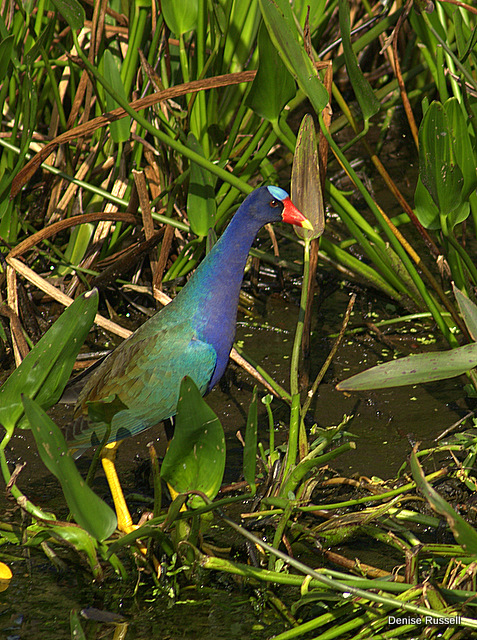
The Purple Gallinule – The Awkward Beauty!

The Purple Gallinule – The Awkward Beauty! ~ by A J Mithra

Purple Gallinule (Porphyrio martinica) by Densie Russell

Purple Gallinule (Porphyrio martinica) by Denise Russell

The beautifully colored Purple Gallinule is often known as a ‘swamp hen’. The scientific name is Porphyrio martinica. The Purple Gallinule belongs to the rail (Rallidae) family of birds.

Almost without exception, rails frequent freshwater wetlands such as swamps and marshes. Preferred habitats include lakes, pools, waterways, and wet marshes.

These birds look so beautiful…
Is it because, they prefer to live by the waters?
When we live by the Living Waters we too shall turn beautiful like the Rose of Sharon and the Lilly of the Valley…
After all, GOD created us in HIS own image… Isn’t it?
Remember how Moses’ face shone after his forty day communion with GOD?

Awake, awake; put on thy strength, O Zion; put on thy beautiful garments, O Jerusalem, the holy city: for henceforth there shall no more come into thee the uncircumcised and the unclean. (Isaiah 52: 1)

These birds are omnivorous and eat a wide variety of seeds, leaves and fruits. Insects, frogs, small fish, snails are earthworms are all eaten with relish. It will also steal eggs and eat young ducklings if it gets the opportunity.

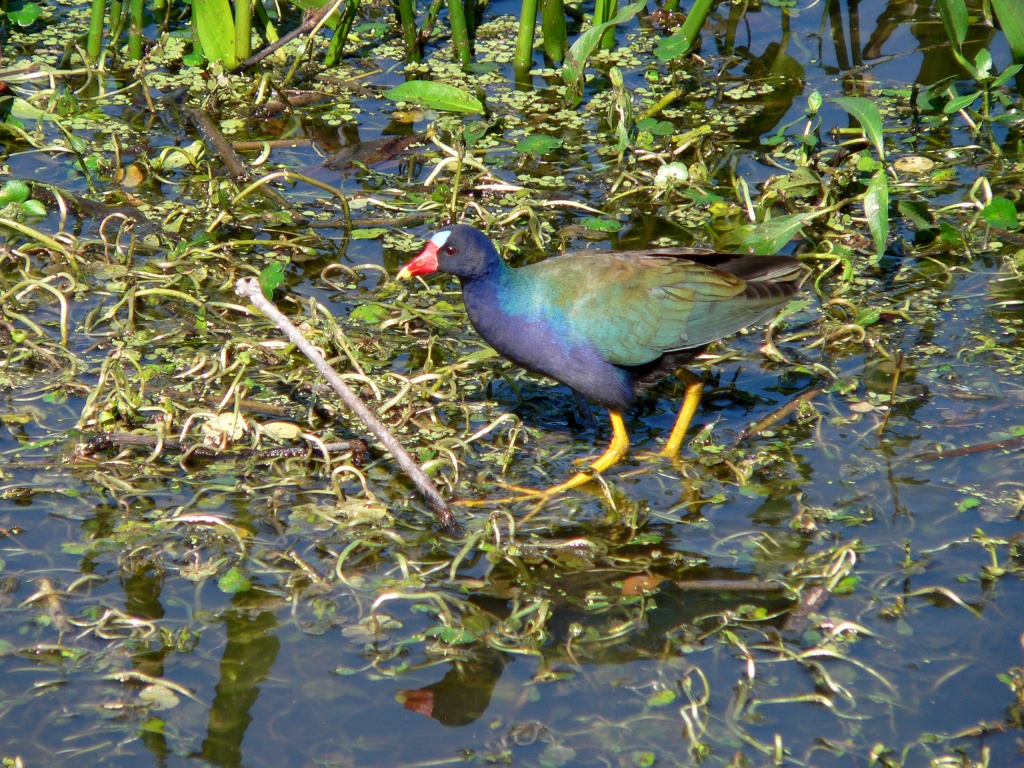
The long toes prevent the bird from sinking when walking on floating vegetation or on water-lilies. The toes can also be used to grasp food and it may then use its feet to carry food to the mouth.
The legs are strong and the gallinule can run well on land….

What kind of feet did GOD give us?

He maketh my feet like hinds’ feet: and setteth me upon my high places. (2 Samuel22:34)
Thou shalt tread upon the lion and adder: the young lion and the dragon shalt thou trample under feet.” (Psalm 91:13)

Not only that,

Then shall the lame man leap as an hart,……..” (Isaiah 35:6)

Purple Gallinule by Lee at Lake Hollingsworth

Purple Gallinule by Lee at Lake Hollingsworth

The eggs are laid in a platform or pad constructed of trampled reeds, leaves and grasses. The pad is often situated on a floating ‘island’ of debris in a clump of saw grass or in a secluded thicket. Both parents share the incubation and care of the chicks.

The parents have a ritual which is performed whenever one takes over incubation duties from the other. The incoming bird brings the gift of a leaf to its partner. The bird on the nest takes the leaf and adds it to the nest. It then relinquishes duties to its mate.

GOD has chosen us to finish the good work which HE started when HE was in this earth…

The incoming bird brings the gift of a leaf to its mate…
Fresh Leaf denotes new life..
JESUS gave us a fresh lease of life by giving HIS life on the cross…

Now it is our turn to take up HS duty to reach the unreached till HE returns as KING of kings..

For the wages of sin is death; but the gift of God is eternal life through Jesus Christ our Lord. Romans(6:23)

The Purple Gallinule is essentially a tropical marsh bird that just makes its way into the United States. But some go even farther afield. It has even been found numerous times in Europe and South Africa.
There has even been the occasional American Purple Gallinule turn up in Western Europe.

Framed Purple Gallinule by Dan

Framed Purple Gallinule by Dan

Although it looks quite clumsy in the air, flying as it does with the legs dangling, it nonetheless can cover quite long distances. The Purple Gallinule, despite appearing to be an awkward flier, regularly turns up in northern states and southern Canada. It has even been found numerous times in Europe and South Africa…

People may call us by nicknames but GOD had called us by name…

You may be called clumsy or awkward, but, GOD calls you as HIS crown and a royal diadem…
If JESUS becomes your strength, you will never be weak..
If JESUS becomes your wisdom, you will never be a fool..

These birds may be awkward fliers, but still GOD is able to take them to far off places..

GOD doesn’t judge you by your quality but by your availability…
Are you available for JESUS? 24 x 7?

My beloved is mine, and I am his: he feedeth among the lilies” (Song of Solomon 2:16)

Note: Photograph by Denise Russell

Have a blessed day!

Your’s in YESHUA,
A J Mithra

Please visit us at: Crosstree


Lee’s Addition:
The Purple Gallinule is one of our favorites here in Florida. We see them quite frequently. They can be little beggars when we are feeding the birds at Lake Hollingsworth. They are in the Rails, Crakes, and Coots – Rallidae Family of the Gruiformes Order which also includes Cranes, Flufftails, Finfoots, Trumpeters and Limpkins.

Purple Gallinule walking around on vegetation at Lake Hollingsworth by Lee

Background Sounds

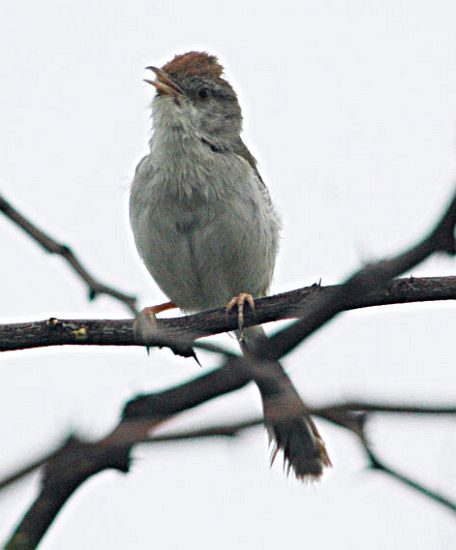
Rufous-fronted Prinia (Prinia buchanani) by Nikhil D

Rufous-fronted Prinia (Prinia buchanani) by Nikhil D

We are trying something new. At the top of the sidebar there is now a place to click to listen to background sounds of birds as you view this blog. It can be turned on and off as you desire. If you were to watch a video or recording, the background sound can be stopped. Our goal is to change the recording periodically and as we can get permission for recordings.

As always, this is a work in progress. We would like your comments on this. Yes, No, or whatever. Let us know by leaving a comment.

Out of the Mouth of Babes…

Out of the Mouth of Babes…  –  by A J Mithra

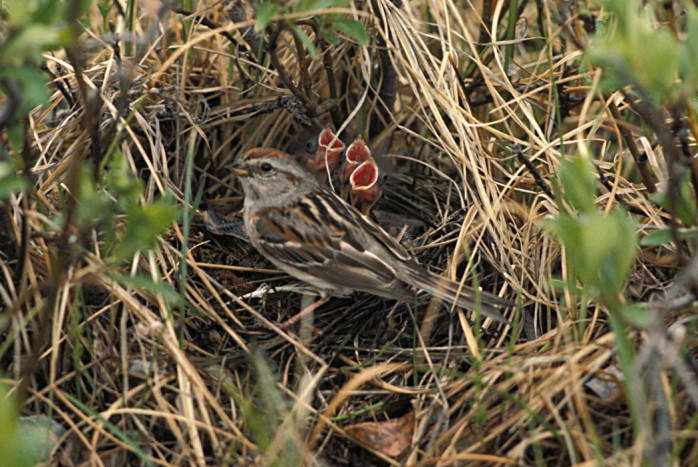
American Tree Sparrow (Spizella arborea) w chicks©USFWS

American Tree Sparrow (Spizella arborea) w chicks©USFWS

A research team from the University of Bristol discovered recently that when a songbird chick opens wide, its parents see ultraviolet areas of the mouth that are invisible to humans. The researchers speculate that the ultraviolet highlights around the edges of the mouth make a more conspicuous target in a dark nest…

Paul and Silas opened their mouth wide in their dark prison cells, and GOD delivered them…
When you are in the dark, just open your mouth wide, and worship JESUS, so that, THE LIGHT may shine on you…

For thou wilt light my lamp: Jehovah my God will lighten my darkness. (Psalms 18:28)

Previous research on begging focused mostly on the colors that humans can see, such as red and yellow. But now, researchers believe that some species can assess their chicks’ hunger based on the color of their gapes. The hungrier a canary chick is, the redder its gape. This is true of some other finches that, like canaries, eat seeds regurgitated by their parents, but it isn’t true of insect-eaters….

Common Waxbill (Estrilda astrild) by Daves BirdingPix

Common Waxbill (Estrilda astrild) by Daves BirdingPix

The reasons for the vivid colors of nestlings’ mouths aren’t fully understood. Estrildid finches, such as these Zebra Waxbill chicks from Africa, have boldly decorated mouth markings whose purpose is still a mystery. The color of the gapes shows the level of chick’s hunger…

GOD knows the hunger of our inner man…
What are we hungry for? Fame or fortune?
Are we hungry for JESUS, the Living Bread?

Blessed are they that hunger and thirst after righteousness: for they shall be filled. (Matthews 5:6)

It’s also a mystery why the insides of the mouths of some nestlings have crazy designs. The nestlings of various species of Estrildid finches in Africa, Australia, and Asia,have bizarre black-and-white patterns inside their mouths, including dots, horseshoe shapes, and blobs.

In Africa, Whydah and Indigo bird species lay their eggs in the nests of Estrildid finches, and their nestlings’ mouths match those of their hosts…

What kind of a design do we have in our mouth?
Do we have an arrogant mouth? (1 Samuel 2:3)
Or a lying mouth? (1Kings 22:22)
Or a deceiving mouth like that of the Whydah and Indigo species?

Let us pray for a GOD taught mouth… (Exodus4:13)
And a mouth which sings the song of witness… (Deuteronomy 31:21)
Let us ask GOD to give us a mouth of a child,
which is the most powerful weapon on earth….

Out of the mouth of babes and sucklings hast thou established strength, Because of thine adversaries, That thou mightest still the enemy and the avenger. (Psalms 8:2)

Have a mouth filling day!

Your’s in YESHUA,
A J Mithra

Please visit us at: Crosstree

*

Birds of the Bible – Leaving the Ark

Wompoo Fruit-Dove (Ptilinopus magnificus) by Ian

Wompoo Fruit-Dove (Ptilinopus magnificus) by Ian

In my reading this week, I read something that I had overlooked before. We know that the animals, birds and all critters came to Noah two by two to be placed in the safety of the Ark.

And of every living thing of all flesh, two of every sort shalt thou bring into the ark, to keep them alive with thee; they shall be male and female. Of fowls after their kind, and of cattle after their kind, of every creeping thing of the earth after his kind, two of every sort shall come unto thee, to keep them alive. (Genesis 6:19-20 KJV)

We have written about that before in Birds of the Bible – Foundation #3 when the critters went in and Foundation #4 when they came off. What I discovered is that the attitudes or instincts of them changed when they came off.

Noah let the Raven out and it didn’t come back, but the dove did because it didn’t find a resting place for it’s feet.

But the dove found no place to set her foot, and she returned to him to the ark, for the waters were still on the face of the whole earth. So he put out his hand and took her and brought her into the ark with him. (Genesis 8:9 ESV)

Then 7 days later Noah let the dove out again and this time returned with an olive leaf.

He waited another seven days, and again he sent forth the dove out of the ark. And the dove came back to him in the evening, and behold, in her mouth was a freshly plucked olive leaf. So Noah knew that the waters had subsided from the earth. (Genesis 8:10-11 ESV)

Some commentators had this to say:

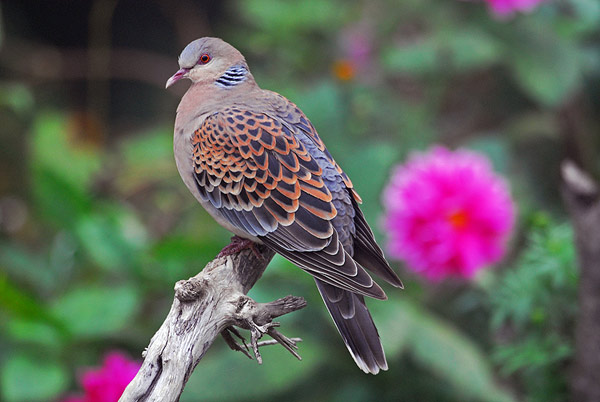
Oriental Turtle Dove (Streptopelia orientalis) by Nikhil

Oriental Turtle Dove (Streptopelia orientalis) by Nikhil

then he put forth his hand and took her, and pulled her in unto him into the ark: she hovered about it, and got near the window, which Noah opened and took her in; which may represent the gracious reception sensible souls meet with from Christ, who apply to him; he kindly embraces them, and they find room in his heart and affections, fullness of everything they want, and security from all danger.” (Gill)

“And as Noah put forth his hand, and took the dove, and pulled her in to him, into the ark, so Christ will graciously preserve, and help, and welcome, those that fly to him for rest.” (Matthew Henry)

What I noticed and believe is that the Dove did not fear Noah and allowed itself to be brought back in twice. The dove returned needing shelter, but also not wary of the humans on board. This lack of fear demonstrated by the dove may help explain why the animals, birds and other critters had no problem coming to Noah to be loaded on board the Ark in the first place. Of course, God brought them there, as we know, but the lack of fear may have made it easier for them to get them in.

Now, watch what happens in Genesis 9:1-3:

And God blessed Noah and his sons and said to them, “Be fruitful and multiply and fill the earth. The fear of you and the dread of you shall be upon every beast of the earth and upon every bird of the heavens, upon everything that creeps on the ground and all the fish of the sea. Into your hand they are delivered. Every moving thing that lives shall be food for you. And as I gave you the green plants, I give you everything. (Genesis 9:1-3 ESV)

Right there that lack of fear ended.

Today, those of us who love to go bird or critter watching know about that fear they have of us. Because of that fear, they are able to steer clear of being trapped, caged, or eaten. Do we fear satan enough that we steer clear of his traps, cages, and falling prey to him?

To me it is amazing that no matter how many times we read over a passage of Scripture, the Lord allows us see new things to help us grow and appreciate our Creator and Savior even more. Never tire of re-reading a passage of God’s Word. His Word is alive just as He is.

Thick-billed Murre – Did GOD Create Us To Fall?

Thick-billed Murre – Did GOD create us to fall? – by A J Mithra

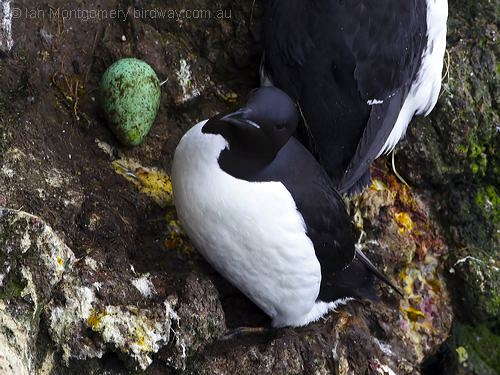
Thick-billed Murre (Uria lomvia) by Ian

Thick-billed Murre (Uria lomvia) by Ian

Thick-billed Murres are unique birds..
They are flightless but their swimming migration may span enormous distances when these birds probably swim 1600 km (1000 miles) and they can dive as deep as 100 meters…

The deepest recorded dive of a Thick-billed Murre reached a depth of 210 metres (690 feet). The birds can move at a speed of 2 metres per second (6.5 feet) under water. Diving birds can stay under water for up to three minutes.

Read more at Suite101: The Thick-billed Murre, Arctic Auk: Northern Penguin-like Bird of Sea Cliffs and Continental Shelves

Most of their life is spent on water…

It is only for breeding that they come return to the shore where they lay their eggs on a rock or on the edge of a cliff, without building a nest. The interesting part is their eggs are designed not to roll when disturbed…

Thick-billed Murre (Uria lomvia) with egg by Ian

Thick-billed Murre (Uria lomvia) with egg by Ian

GOD not only takes care of the birds, but,
HE also takes care of its eggs….

HE knows that these birds spend all their lives on water, and so HE designed its eggs to stay still even at the edge of a cliff…

If GOD can care so much for little birds, will HE not care for you?

Did HE not created you in HIS image?
GOD did not create us to fall but, to stand high above the others..

HE not only cares for you but,HE also cares for your future…

HE wants to see the world through you that’s why HE calls you as
THE APPLE OF HIS EYE..
HE wants to work through you, that’s why HE has

CARVED YOU IN HIS PALM..

CHEER UP FOR YOU ARE UNIQUE…

Are not two sparrows sold for a farthing? and one of them shall not fall on the ground without your Father. (Matthew 10:29)

Have a blessed day!

Yours in YESHUA,
A J Mithra

Please visit us at: Crosstree


Lee’s Addition:

The Thick-billed Murre is in the Alcidae – Auks Family of the Charadriiformes Order
See Also:
When I Consider! – Guillemot (In the same family as Murres)

*

Yellow-bellied Sapsucker – Chief Corner Stone’s Keystone

Yellow-bellied Sapsucker – Chief Corner Stone’s Keystone – By A J Mithra

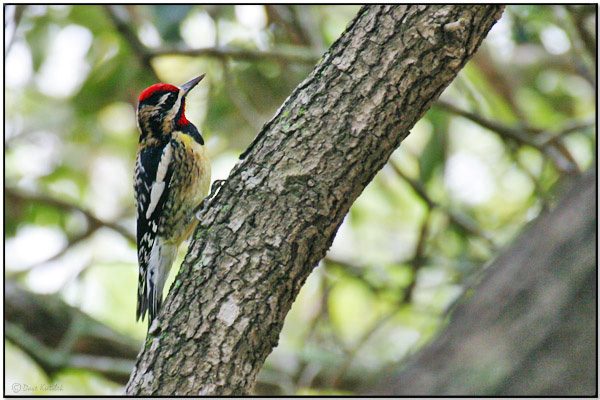
Yellow-bellied Sapsucker (Sphyrapicus varius) by Daves BirdingPix

Yellow-bellied Sapsucker (Sphyrapicus varius) by Daves BirdingPix

Although most non-birders believe that the Yellow-bellied Sapsucker is a fictitious bird created just for the humorous name, in fact it is a widespread species of small woodpecker.
Its habit of making shallow holes in trees to get sap is exploited by other bird species, and the sapsucker can be considered a “keystone” species, one whose existence is vital for the maintenance of a community.
The Yellow-bellied Sapsucker frequently uses human-produced materials to help
in its territorial drumming. Street signs and metal chimney flashing amplify the irregular tapping of a territorial sapsucker.
The sapsucker seems to suffer no ill effects of whacking its bill on metal,
and a bird will return to a favorite sign day after day to pound out
its Morse code-like message.

How much effort do we take to share the message of hope to the hopeless?
How many souls do we touch each day?
These birds don’t seem to bother if, others are listening to its message or not…
It still returns each day to pound out its Morse code-like message…
Are we really taking any effort to pound out the message of Love which
JESUS showed on the Cross of Calvary?

For the preaching of the cross is to them that perish foolishness;
but unto us which are saved it is the power of God. (1 Corinthians 1:18)

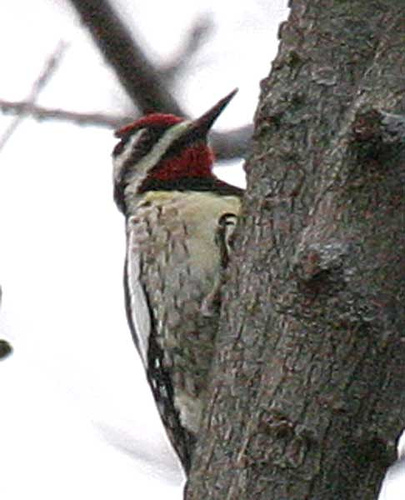
Yellow-bellied Sapsucker (Sphyrapicus varius) by Kent Nickell

Yellow-bellied Sapsucker (Sphyrapicus varius) by Kent Nickell

The Yellow-bellied Sapsucker is the only woodpecker in eastern North America that is completely migratory. Although a few individuals remain throughout much of the winter in the southern part of the breeding range, most head farther south, going as far south as Panama. Females tend to migrate farther south than do males. These birds migrate to the Southeastern United States, West Indies and Central America, leaving their summer range. This species has occurred as a very rare vagrant to Ireland and Great Britain.

As the name implies, Sapsuckers drill a series of wells in trees and drink the sap that oozes forth. Forages for insects by gleaning, probing, prying, tapping, and fly catching. Drills series of shallow holes in bark of tree, licks up sap.
They breed in young forests and along streams, especially in aspen and birch.
Winters in variety of forests, especially semi open woods…
They are often quite important ecologically for a given habitat, as several other animal species use sapsucker wells for feeding.

Isaac dug well after well, and the herdsmen of Gerar took it from him…
This incident is found in the book of Genesis 26 : 15 to 22 …
Did someone take possession of your blessings?
Just leave it for GOD to intervene and start digging another well..

And all this assembly shall know that the LORD saveth not with sword and spear: for the battle is the Lord’s, and he will give you into our hands (1 Samuel 17:47)

Early in the spring the sapsucker tests many trees around its selected nesting site by making sample drillings before selecting ones it prefers. These trees, because of quantity or sugar content of the sap, are visited several times a day for the rest of the season and sometimes are used as a food source for several years.

O taste and see that the LORD is good: blessed is the man that trusteth in him (Psalms 34:8)
How sweet are thy words unto my taste! yea, sweeter than honey to my mouth! (Psalm 119:103)

In commercial forests or orchards, favorite feeding trees of the sapsucker are left untreated, so that the birds will concentrate their feeding activities on these favorite trees, which in turn often protects nearby trees from serious injury…

JESUS, the Tree of Life, knew that satan is after us to drill holes of sorrow and holes of hurt, holes of poverty and holes of doubts and suck the life out of us so that we would die of sin than live life eternal..
That is the reason that, JESUS planted HIMSELF beside us on the cross to save us from destruction…

And that he died for all, that they which live should not henceforth live unto themselves, but unto him which died for them, and rose again. ( 2 Corinthians 5:15)

LORD JESUS….
How great thou art, how great thou art….

Have a blessed day!

Your’s in YESHUA,
A J Mithra

Please visit us at:  Crosstree


Sapsuckers are part of the Picidae – Woodpeckers Family of the Piciformes Order.

*

Ian’s Bird of the Week – Welcome Swallow

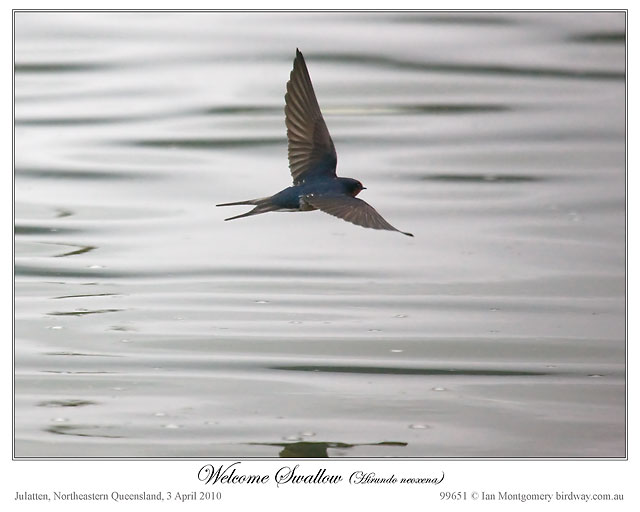
Welcome Swallow (Hirundo neoxena) by Ian

Welcome Swallow (Hirundo neoxena) by Ian

Newsletter: 4-6-10

Birds Australia North Queensland had planned to visit Cooktown for Easter, which turned out to be very wet throughout northeastern Queensland. A few intrepid souls, presumably not camping, made it there, but a friend and I spent a few days at Kingfisher Park in Julatten near Mossman before returning home. We did manage to get out birding a few times between showers and one afternoon I spent an hour or two trying to photograph birds hawking for insects over the fish ponds of a nearby Barramundi farm. As is often the case, the poor weather brought both the insects and their avian predators down to low levels – poor light but good practice.

Welcome Swallow (Hirundo neoxena) by Ian

Welcome Swallow (Hirundo neoxena) by Ian

The birds consisted of a mixture of Welcome Swallows, Tree Martins and White-rumped Swiftlets, and I’ve posted images of all three to the website, though I’ve chosen the Welcome Swallow here as being the most photogenic. This is a familiar and widespread bird in Australia, though it is absent from the the arid centre and northern Western Australia and much of the Northern Territory. It is similar in appearance and habits to the Barn Swallow of the northern hemisphere, and like it builds a cup-shaped nest in sheltered sites, particularly buildings.

Welcome Swallow (Hirundo noexena) by Ian

Welcome Swallow (Hirundo noexena) by Ian

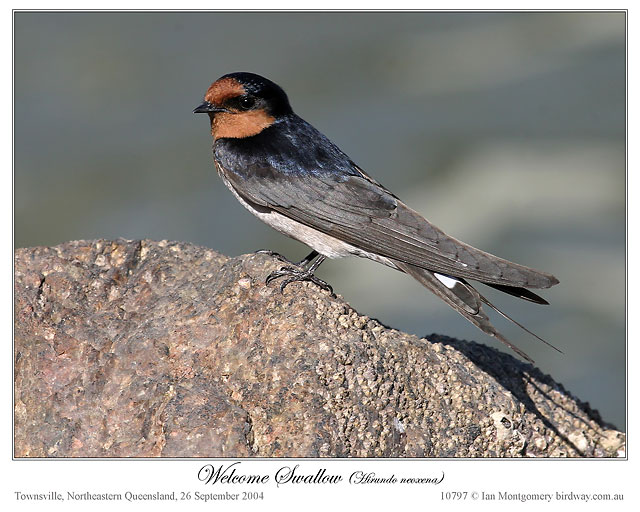
The first photo shows a bird hawking low over grass and obligingly spreading all its tail feathers to brake or turn. The second one is flying over the fish pond and the third is a photo taken some time ago of a bird perched beside Ross River in Townsville.

The name ‘Welcome’ emphasizes its familiarity, but it also suggests to me migration and a harbinger of Spring. In fact, unlike the Barn Swallow, it is resident over much of its range and only in Tasmania and southeastern Australia does it migrate for the southern winter but only as far as Queensland and Torres Strait. The Barn Swallow is a famous migrant traveling from Europe to Africa, North to South America and Northern to Southern Asia. Some even get as far as Australia and turn up annually in small numbers in northern coastal areas.

Best wishes,
Ian

Links:
Welcome Swallow
Barn Swallow
Tree Martin
White-rumped Swiftlet

Kingfisher Park
Birds Australia North Queensland

Ian Montgomery, Birdway Pty Ltd,
454 Forestry Road, Bluewater, Qld 4818
Phone: +61-7 4751 3115
Preferred Email: ian@birdway.com.au
Website: http://birdway.com.au


Lee’s Addition:

The Welcome Swallow is in the Hirundinidae Family of the Passeriformes Order. What a shot, Ian, of that Swallow flying with wings and tail out. I hardly get to see our swallows, they fly so fast.

The Welcome Swallow is metallic blue-black above, light grey below on the breast and belly, and rusty on the forehead, throat and upper breast. It has a long forked tail, with a row of white spots on the individual feathers. These birds are about 15 cm long, including the outer tail feathers which are slightly shorter in the female. The call is a mixture of twittering and soft warbling notes, and a sharp whistle in alarm.

Young Welcome Swallows are buffy white, instead of rufous, on the forehead and throat, and have shorter tail streamers.

The winter range in northern Australia overlaps with that of wintering Barn Swallow (Hirundo rustica), but the latter is readily separable by its blue breast band.[5] Welcome Swallows readily breed close to human habitation. The nest is an open cup of mud and grass, made by both sexes, and is attached to a suitable structure, such as a vertical rock wall or building. It is lined with feathers and fur, and three to five eggs are laid. Two broods are often raised in a season.

The female alone incubates the eggs, which hatch after two to three weeks. The young are fed by both parents, and leave the nest after a further two to three weeks.

These birds are extremely agile fliers, which feed on insects while in flight. They often fly fast and low to the ground on open fields in large circles or figure 8 patterns. They will often swoop around animals or people in the open.

An immature Welcome Swallow preening by Nick Talbot

(Info from Wikipedia)

Atlantic Puffin – The Deep Sea-Diver

Atlantic Puffin – The Deep Sea-Diver – by A J Mithra

Dubbed “sea parrots” as well as “clowns of the sea,”
Atlantic puffins sport large, brightly-colored beaks on their substantially-sized heads.

Atlantic Puffin (Fratercula arctica) by Bob-Nan

Atlantic Puffin (Fratercula arctica) by Bob-Nan

Crisp black and white markings on their plumage, as well as superior diving capabilities, have led people to compare the northern seabirds to penguins. It is brilliant in coloration during the summer months, but tends to fade to a deep or olive colored gray during the winter, and bloom like a flower to the same bright colors in the spring. Scientists believe that it might be part of the mating attraction, and helps them to get a mate, since it changes with the seasons.

The bright beaked Atlantic Puffin stay at sea most of their life, and when they are not swimming they ride the waves like a surfboard. They are excellent swimmers, using their wings to stroke the water with a flying motion to propel them along. They have large feet that they use to steer, rather like the rudders on a boat

GOD had created these Birds to surf over the waves…
But, GOD has called us to walk over storm and walk through fire…
We have a GOD who can steer us troubled waters….

When thou passest through the waters, I will be with thee; and through the rivers, they shall not overflow thee: when thou walkest through the fire, thou shalt not be burned; neither shall the flame kindle upon thee. (Isaiah 43:2)

They can dive down to depths of 200 feet or more usually stay underwater for only 20 or 30 seconds to get a meal of small fishes like herring or sand eels. Puffins primarily eat fish, particularly female Capelin, but will also eat crustaceans and squid.

These birds have to dive deep; else they may have starve, because, their favorite food is deep below the sea… Most of us love to pick up shells rather than go deep into the sea and collect pearls,

Is that the reason why, we always prefer to stand by the Living Water, instead of diving deep down?
The treasures lie deep down the sea and not by the beach…. Isn’t it?

He gathereth the waters of the sea together as an heap: he layeth up the depth in storehouses. (Psalm 33:7)

Puffins, although they prefer to ride the waves are incredibly fast fliers, and can flap their wings up to 400 times a minute and reach speeds of about 55-60 miles per hours in the air.

Puffins land on the coasts of North America, and in islands to breed every spring and summer.

Iceland is the place where about 60% of all Puffins breed. They choose rocky cliffs or tops of rocky hills to build the nests which are lined with soft feathers and grass. Puffin burrows are 1 to 2 meters deep, often turning at sharp angles to the right, left, up, and down.

How deep have we burrowed to lay the foundation of lives?

He is like a man which built an house, and digged deep, and laid the foundation on a rock: and when the flood arose, the stream beat vehemently upon that house, and could not shake it: for it was founded upon a rock. (Luke 6:48)
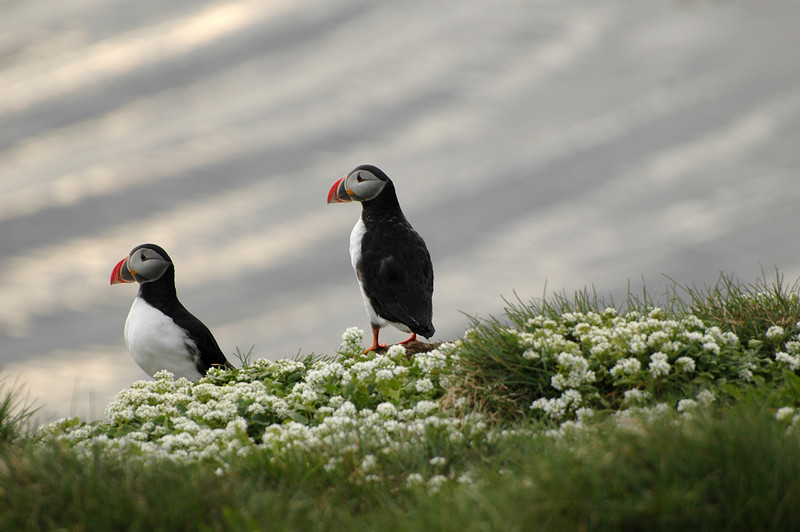
Atlantic Puffin (Fratercula arctica) by Ian

Atlantic Puffin (Fratercula arctica) by Ian

Puffins lay a single egg and rear a single chick each year. The parents take turns sitting on the egg for about 40 days before it hatches. When a chick hatches, its parents take turns feeding it by carrying small fish back to the nest in their bills. Once the chick hatches, the mother and father will take turns bringing it fish to eat several times a day.  To wean their chicks, puffins simply scale back the amount of food they bring them. Once hunger wins out, the chick will journey to the ocean during the night to avoid predators.

Sometimes, GOD will just not answer our prayers, you know why?
HE wants us to conquer new horizons.
GOD could have saved Daniel before he entered the lion’s den.
But, GOD preferred something different and taught the whole mankind, what perseverance is all about…

When you feel that, GOD is not answering your prayers, just know, that you’re going to do what you haven’t done before like Daniel..
When the going gets tough, the tough gets going…

I can do all things through Christ which strengtheneth me. (Philippians 4: 13)

Puffin couples often reunite at the same burrow site each year and mate again although it is unknown how they know where to go. Some believe they use visual reference points, others the moon or stars for navigation.
Broken marriages, broken relationships and broken families, where are we heading to?
Who navigates out lives? Whom do we consider as our guiding star?

NO JESUS NO PEACE…. KNOW JESUS KNOW PEACE….

For unto us a child is born, unto us a son is given: and the government shall be upon his shoulder: and his name shall be called Wonderful, Counsellor, The mighty God, The everlasting Father, The Prince of Peace. (Isaiah 9:6)

Atlantic puffins have the ability to carry several fish in their beaks at one time. They push the fish to the back of their mouth with their tongue, where ridges at the top of their bill secure the fish in place. This allows puffins to keep their mouth open to catch more fish without losing any in the process. In general, they can hold around ten fishes in their beak at once by holding them in an alternating end to end pattern.

GOD has given us Ten Commandments; how many can be seen in our lives?
Though we don’t carry all those Ten Commandments, are we carrying at least the one that JESUS gave us?

And the second is like unto it, Thou shalt love thy neighbour as thyself. (Matthew 22:39)

Some pairs exhibit a special behavior known as “billing” where the two birds rub their beaks together.
This often draws an excited crowd of other puffins to watch..
What sort of testimony do we have among our friends and family?
Does our life attract people towards CHRIST?

Then they that feared the LORD spake often one to another: and the LORD hearkened, and heard it, and a book of remembrance was written before him for them that feared the LORD, and that thought upon his name. (Malachi 3:16)

Atlantic Puffin (Fratercula arctica) by Bob-Nan

Atlantic Puffin (Fratercula arctica) by Bob-Nan

The chick stays in the burrow until it is able to fly. The young puffin uses a toilet area towards the front of the burrow away from the nest to stay clean. It cannot risk getting its feathers soiled and ruining the waterproof protection they provide.

How clean are we in spirit? What sort of life do we lead on week days?
Most of us come for a spiritual bath to church on Sundays.
Do we consider Church as a spiritual bathroom?

7 DAYS without JESUS makes 1 WEAK…

And Joshua said unto the people, Sanctify yourselves: for tomorrow the LORD will do wonders among you. (Joshua 3:5)

After 45 days, the chick leaves the burrow and spends 3-5 years at sea learning about feeding places and choosing a mate. In the wild, puffins can live around 20 years. Their main predator is the great black-backed gull, which can capture a puffin mid-flight  or swoop in on a puffin on the ground. Herring gulls are also a threat because they steal puffins’ fish…

Puffins spend their first three years of life out at sea.  They return to land once they reach maturity. Puffins are insulated from the cold by an oily coating on their feathers. Without this coating, they would never survive Atlantic winters..

Are we insulated by the blood of JESUS?
How to get insulated by the blood of JESUS?
Unless one dies for sins and lives with CHRIST and for CHRIST…

Nicodemus saith unto him, How can a man be born when he is old? can he enter the second time into his mother’s womb, and be born? Jesus answered, Verily, verily, I say unto thee, Except a man be born of water and of the Spirit, he cannot enter into the kingdom of God.(John3:4,5)

Your’s in YESHUA,

A J Mithra

Please visit us at: Crosstree

Puffins are in the Alcidae – Auks Family of the Charadriiformes Order