Eye of the Beholder – Ibises and Crane

Sandhill Crane at Cirle B by Tommy Tompkins

Sandhill Crane at Cirle B by Tommy Tompkins

Last week while reading by the window that overlooks our small backyard, my eye caught movement. When I looked out, under the tree in the shade stood a Sandhill Crane surrounded by 8 or 9 White Ibises. The Ibises walked toward my way and were digging and checking out our lawn. The group kept moving and digging around as Ibises will do. They exited left of my view and the Sandhill was still standing in the same spot. Soon, from the left of view the Ibises came back and this time there were 11 of them. They walked back toward the crane and exited right. Crane still standing. Then a few minutes later, back they came right to left and this time there were 13 of them. The Crane was still standing there. Off they went to the left of my view. You got it, the crane was still standing there. Then, here they came the last time, left to right, and there were 14 of them this time. My stately Sandhill Crane was still standing there. All of this took place in about a 30 minute time span.
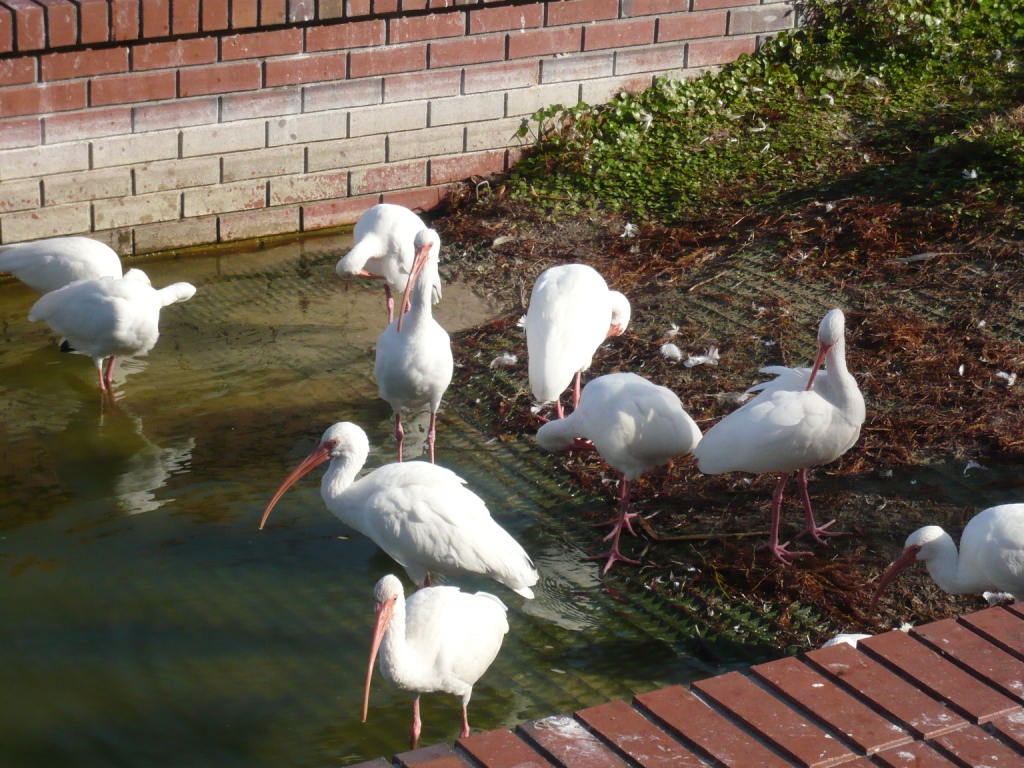
White Ibises at Lake Morton by Dan

White Ibises at Lake Morton by Dan

Needless to say, my reading was slowed down by all this activity. The ibises were digging around and yet they kept on the move. They put their beaks in the ground and pound up and down about 5 or 6 times and then move on and repeat the process over again. One or two of them will find something good to eat and will stay in the same spot to continue to dig. When they look up and see that the group has moved on, they immediately scurry off to catch up with the others. They have a funny little way of walking. This was repeated many times as they looked up and then followed the crowd.

I can come up with several applications for what was going on, but I will only choose one of them, for now.

God has given us His Word, the Bible, and in it we learn the truths about God the Father, Jesus Christ the Son, and the Holy Spirit who are one and are the great I AM.  The Word reveals truths about creation, salvation, sin, God’s attributes such as love, mercy, grace, judgment, justice, long-suffering, etc. As the Sandhill Crane stood, so should we stand firm in the truths taught in the Bible. We should not waver or try to change what has been written. Jesus has provided salvation, through His death on the cross, and invites us to accept His gift of salvation.

Jesus said to him, “I am the way, the truth, and the life. No one comes to the Father except through Me. (John 14:6)

Many people know the truth about Jesus, the Cross, God, creation, heaven, hell, etc., but do not apply it to their heart or soul. They either think, there is some other way and are always searching for some new “angle” of belief. Be it different religions, non-religion, atheism, or what ever.

Off on another search - American White Ibis by Bob-Nan

Off on another search - American White Ibis by Bob-Nan

Others who do accept the Lord Jesus Christ as their Savior, want to find some new “angle” to what the Bible teaches, by perverting it, or trying to twist it to where their “sin” is justified. Maybe are just not really “walking with the Lord” and want to live in sin or they become false teachers.

Both groups, unbelievers or believers, are like the Ibises who go away from the truth (crane), and try new things, then almost come back, sort of, and then scurry off to find something different. Even those who settle down, look up and see the crowd going a certain way, and run after that new thing.

Enter by the narrow gate; for wide is the gate and broad is the way that leads to destruction, and there are many who go in by it. Because narrow is the gate and difficult is the way which leads to life, and there are few who find it. (Matthew 7:13-14)

May we all seek the truth of God, accept the Lord’s salvation, and then live our lives according to God’s Word.

See:
The Gospel Message
Wordless Birds

Birds in Hymns – How Great Thou Art

Great is the LORD, and greatly to be praised; And His greatness is unsearchable. (Psalms 145:3)

Author: Carl Boberg, 1859-1940
Tr. By Stuart K. Hine, 1899-
Musician: Swedish Melody
Arr. By Stuart K. Hine, 1899-

(by Sean Fielder)

How Great Thou Art

American Yellow Warbler (Dendroica aestiva) by J Fenton

American Yellow Warbler (Dendroica aestiva) by J Fenton

O Lord my God! When I in awesome wonder
Consider all the worlds Thy hands have made,
I see the stars, I hear the rolling thunder,
Thy power throughout the universe displayed,

Refrain:
Then sings my soul, my Saviour God to Thee;
How great Thou art, how great Thou art!
Then sings my soul, my Saviour God to Thee;
How great Thou art, how great Thou art!

When through the woods and forest glades I wander
And hear the birds sing sweetly in the trees;
When I look down from lofty mountain grandeur
And hear the brook and feel the gentle breeze;

And when I think that God, His Son not sparing
Sent Him to die, I scarce can take it in;
That on the cross, my burden gladly bearing,
He bled and died to take away my sin;

When Christ shall come with shout of acclamation
And take me home, what joy shall fill my heart!
Then I shall bow in humble adoration
And there proclaim, my God, how great Thou art!

——————————————————————————–

HYMN HISTORY:

Northern Parula (Parula americana) by Reinier Munguia

Northern Parula (Parula americana) by Reinier Munguia

Boberg wrote the poem “O Store Gud” (O Great God) in 1885 with nine verses.

The inspiration for the poem came when Boberg was walking home from church near Kronobäck, Sweden, and listening to church bells. A sudden awe-inspiring storm gripped Boberg’s attention, and then just as suddenly as it had made its violent entrance, it subsided to a peaceful calm which Boberg observed over Mönsterås Bay. According to J. Irving Erickson:

Carl Boberg and some friends were returning home to Mönsterås from Kronobäck, where they had participated in an afternoon service. Nature was at its peak that radiant afternoon. Presently a thundercloud appeared on the horizon, and soon sharp lightning flashed across the sky. Strong winds swept over the meadows and billowing fields of grain. The thunder pealed in loud claps. Then rain came in cool fresh showers. In a little while the storm was over, and a rainbow appeared.

When Boberg arrived home, he opened the window and saw the bay of Mönsterås like a mirror before him… From the woods on the other side of the bay, he heard the song of a thrush…the church bells were tolling in the quiet evening. It was this series of sights, sounds, and experiences that inspired the writing of the song.[7]

According to Boberg’s great-nephew, Bud Boberg, “My dad’s story of its origin was that it was a paraphrase of Psalm 8 and was used in the ‘underground church’ in Sweden in the late 1800s when the Baptists and Mission Friends were persecuted.”  The author, Carl Boberg himself gave the following information about the inspiration behind his poem:

“It was that time of year when everything seemed to be in its richest colouring; the birds were singing in trees and everywhere. It was very warm; a thunderstorm appeared on the horizon and soon thunder and lightning. We had to hurry to shelter. But the storm was soon over and the clear sky appeared.

“When I came home I opened my window toward the sea. There evidently had been a funeral and the bells were playing the tune of ‘When eternity’s clock calling my saved soul to its Sabbath rest.’ That evening, I wrote the song, ‘O Store Gud.'”

[edit] Publication

Boberg first published “O Store Gud” in the Mönsterås Tidningen (Mönsterås News) on 1886 March 13.

The poem became matched to an old Swedish folk tune. and sung in public for the first known occasion in a church in the Swedish province of Värmland in 1888. Eight verses appeared with the music in the 1890 Sions Harpan.

In 1890 Boberg became the editor of Sanningsvittnet (The Witness for the Truth). The words and music were published for the first time in the 16 April 1891 edition of Sanningsvittnet. Instrumentation for both piano and guitar was provided by Adolph Edgren (born 1858; died 1921 in Washington D.C.), a music teacher and organist, who later migrated to the United States.

Boberg later sold the rights to the Svenska Missionsförbundet (Mission Covenant Church of Sweden). In 1891 all nine verses were published in the 1891 Covenant songbook, Sanningsvittnet.  These versions were all in 3/4 time. In 1894 the Svenska Missionsförbundet sångbok  published “O Store Gud” in 4/4 time as it has been sung ever since (cf. Time signature).
——————————————————————————–
Wikipedia – How Great Thou Art – History
SermonAudio – How Great Thou Art – Audio

See ~ Wordless Birds

More ~ Birds in Hymns

*

The Gospel Message

The Gospel Message is that Jesus Christ, the Creator, came to earth and died for us. It is up to us to accept, by faith, what He has done for us. He loves us, and wants to be our Savior, Lord, and King.

Please read the basic message of the whole gospel below and seriously consider that your eternal soul is very important to God, the Lord Jesus Christ, the Holy Spirit.

A.  God

  • He exists  (Hebrews 11:6)
  • He is holy  (1 Peter 1:15)
  • Man must be perfect to reach God  ( Matthew 5:48)
  • The measure of God’s holiness is the law  ( Romans 2:12, 13, 14, 15, 16)
  • He has judged sin  (Romans 6:23)

B.  Man

  • He is a sinner  (Romans 3:23)
  • He cannot save himself  (Ephesians 2:8,9)

C.  Jesus Christ

  • He died because of our sins  (1 Corinthians 15:3)
  • He rose again  (1 Corinthians 15:14)
  • He is the only Messiah (Savior)  (John 14:6), (1 Timothy 2:5)
  • He paid the price for our sins  (1 Corinthians 6:1920), (Hebrews 7:27)
  • That He is Lord, that is the right ruler of all, including us  (Romans 10:9, 10)

D.  Grace

  • Salvation is a free gift.  (Ephesians 2:8,9)
  • We can’t earn it  (Ephesians 2:8,9)

E.  Faith

  • We must totally yield ourselves to Christ  (Acts 16:31)
  • We accept what God has done  (John 13:20)
  • We trust in Christ alone for salvation  (John 14:6), (Ephesians 2:8,9, 10)
  • Repentance is inherent in Biblical Faith  (Acts 2:36)

F.  Commitment

  • We must be willing to turn from our sins and follow Christ  (2 Corinthians 5:15)

(The verses will pop up when mouse is placed over them)

If you have any further questions or would like assistance accepting Christ as your personal Savior, please contact me at Lee@Leesbird.com or contact my pastor, Rev. Nathan Osborne III.

wsbirdsbirdhouse(Pastor Osborne provided the above outline)

As much as we enjoy bird watching and enjoy seeing how many we can see or how many we can count on a list, remember the following verses:

For what will it profit a man if he gains the whole world, and loses his own soul? Or what will a man give in exchange for his soul? (Mark 8:36-37)

When I Consider! – Turkey Vulture

Turkey Vulture Tree at Saddle Creek by Lee

Turkey Vulture Tree at Saddle Creek by Lee

We get to see lots of Turkey Vultures in this area. I have seen trees just loaded with them. They are ugly to look at, but are very useful.

The following is the October 6th’s “Evidence from Biology” article from A Closer Look at the Evidence, by Richard and Tina Kleis:

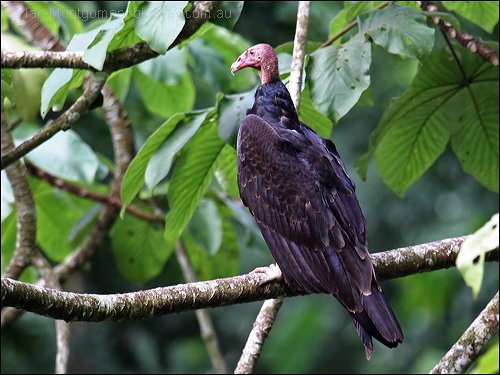
“The Turkey Vulture has incredible farsighted vision capable of seeing dead or dying objects several miles beyond what the human eye can detect. Yet it is designed with dull, weak, talons and a thin beak, forcing it to eek out an existence eating rotting flesh or decaying vegetables. Since the vulture eats the remains of animals that have died of disease, it has a digestive tract designed to destroy deadly bacteria (including anthrax!). The Turkey Vulture also has the ability to sanitize itself and its surroundings using a special disinfectant found in its own excrement. The same chemicals which kill the deadly bacteria in its stomach continue to kill the germs outside its body!

Turkey Vulture by Ian Montgomery

Turkey Vulture by Ian Montgomery

Because the vulture’s head is usually covered in blood, pieces of rotten flesh, and bacteria, it is especially vulnerable to disease. Therefore, this particular bird was created without feathers from the neck up. As the turkey vulture stands in the sun, the ultraviolet radiation kills any remaining bacteria.

By removing the carcasses of decaying animals, the turkey vulture serves an important purpose of limiting the spread of disease and preventing potential epidemics among both man and beast. One wonders how the turkey vulture could have evolved all of the specialized characteristics. The creation solution is that they were created with the original vulture-type bird. The survival characteristics needed for our fallen world were either given after the Fall or developed from originally created abilities.”

Character Sketches, Vol. III, p. 121-124

The LORD is righteous in all his ways, and holy in all his works. (Psalms 145:17 KJV)


Lee’s Extras:
We have mentioned the Vulture many times on the blog and especially in the places below. After all, they are one of the unclean birds that the Jewish people were not allowed to eat. After reading the above article, you can understand why they were off the “menu.”

There is a path which no fowl knoweth, and which the vulture’s eye hath not seen: (Job 28:7 KJV)

Birds of the Bible – Vulture
Vulture
Vulture Photos
Vulture Videos
Accipitridae – Kites, Hawks & Eagles

More When I Consider! articles

Ian Juby’s Newsletter – Oct 2009

Ian Juby just sent out his latest newsletter and it is also available at his blog. The article features the new “Ardi” that is suppose to prove our ancestors were related to this fossil. Personally, I believe it will become another hoax like “Luci,” but time will tell.

So God created man in his own image, in the image of God created he him; male and female created he them. (Genesis 1:27 KJV)

1) Ardi ar arrr…


Artist’s best guess as to what Ardipithecus ramidus may have looked like.
Okay, so maybe it didn’t stand upright like that, and maybe it didn’t have human eyes like that, and maybe it was a male and not a female, and maybe it….well, it’s close at least!
Drawing by J.H. Matternes

The propaganda machine goes into overdrive:
Got a barrage of emails this week from my honourable news watch team regarding a supposed “Missing link” found this week which “proves” our ancestral relationship to the apes.
In fact, Science magazine even ran a special issue just on this fossil, CBC’s “Quirks and Quarks” devoted a segment of their program to it (downloadable as a 22 meg MP3), National Geographic had a spread on it as well.
Seeing as how there’s been so much fuss over this fossil, I thought I’d devote a newsletter in response.

As is typical, this “missing link” is presented with impressive pomp and circumstance before the emporer comes out wearing no clothes. We’ve seen this before time and again with Ida, Puijila, and even Archaeoraptor – the fraudulent fossil that was brazenly heralded with many bold claims as “proof of evolution” before it was quietly sidelined after it was discovered to be a fake.  I still, to this day, occasionally have people bring up Archaeoraptor as proof of evolution.  This is the power of propaganda.

Same old, same old.
Before proceeding, it’s probably a good idea to point you to my previous response to the SciAm write up on our supposed “hominid” fossil lineage.  In this article, I dealt with dozens of these supposed “half-ape/half-human” fossils that evolutionists often hurl at us:  “The Human Pedigree”

As you can see, the whole “science” behind these “hominid” fossils is so speculative and subjective it isn’t funny!
1) Start with the assumption that evolution is true.
2) Interpret the fossil within an evolutionary paradigm
3) Use the interpretation as proof that evolution is true.
4) Return to step #1.

The New Old Find
The “new” find (actually found back in ‘92) is attributed to Ardipithecus ramidus.  The famous ‘flintstone fossil’ “Ardipithecus ramidus kadaba-daba-doooooo!” (thanks Teno Groppi), Ardipithecus has now been divided into two fossils, Ardipithecus ramidus, and Ardipithecus kadaba.  Good grief – there was barely enough fossil fragments for one fossil reconstruction, let alone two!  See my response to SciAm for more details.

So with the unveiling of  more of the fossils this week, once again … To see the rest of the article –  CLICK HERE

To see more here by Ian Juby – CLICK HERE

The Flight of Migratory Birds by Werner Gitt

Pectoral Sandpiper (Calidris melanotos) by J Fenton

Pectoral Sandpiper (Calidris melanotos) by J Fenton

The Flight of Migratory Birds by Werner Gitt is a fairly technical, but very interesting article about the migration of birds. While thinking about yesterday’s Birds of the Bible – Migration September 2009, I came across this article. He mentions the Pacific Golden Plover in detail and some other long fliers, like:

“The following equally incredible flight performances are recorded for:

  • the Japanese snipe (Capella hardtwickii): 5,000 km flight from Japan to Tasmania
  • the needle-tailed swift of Eastern Siberia (Chaetura caudacuta): flight from Siberia to Tasmania
  • the American sandpipers (e.g. Calidris melanotos = pectoral sandpiper): 16,000 km flight from Alaska to Tierra del Fuego.”

Another excerpt from the article:

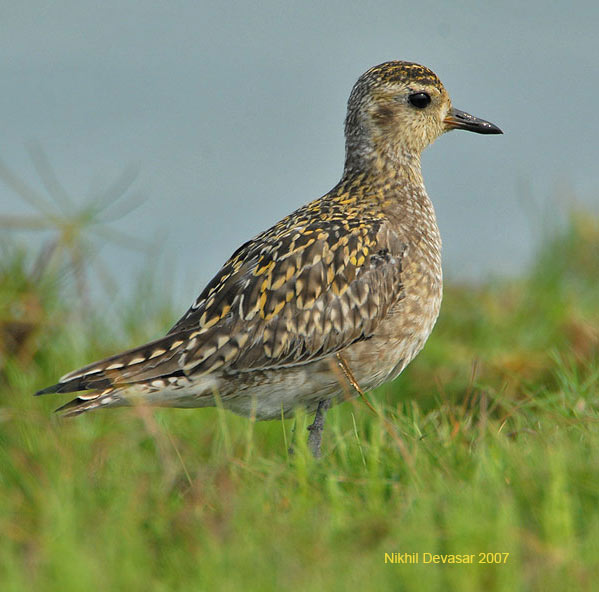
Pacific Golden Plover (Pluvialis fulva) by Nikhil Devasar

Pacific Golden Plover (Pluvialis fulva) by Nikhil Devasar

“The birds’ capabilities extend beyond the bounds of our imagination. They can determine their homeward course over long distances, even when all possible aids to orientation have been removed during the disorientation journey. They possess the extraordinary faculty of being able, wherever they are, to determine their position relative to their home territory from their immediate surroundings. And this method of determining location, itself not understood even today, is only the beginning; then comes the real problem, namely flight navigation: mere sense of direction is not enough for this.

During flight over wide, windswept stretches of ocean, a tendency to drift off course cannot be avoided. Such drift must be continually compensated for, as in a feedback system in control technology, in order to avoid losing energy by flying a longer route. The Creator equipped the birds with a precise ‘autopilot,’ which apparently is constantly measuring its geographical position and comparing the data with its individually “programmed” destination. In this way an economical, energy-saving and direct flight is guaranteed. Just where this vital system is to be found and how this operating information is coded is known by no one today except the Creator, who made it.”
To see the whole article – CLICK HERE


Birds of the Bible – Migration September 2009

Radar 9-30-09 image at 12:30 AM Eastern Daylight savings time.

Radar 9-30-09 image at 12:30 AM Eastern Daylight savings time.

I know that I have written about the migration of the birds before, but this is really interesting. They have been posting radar images of the Florida peninsula on BRDBRAIN, a bird-listing service. Here are the images for September 28th and 30th. The dark spots are the birds in migration being picked up on radar. It is amazing. I have been reading the updates for about a week and the birds are ON THE MOVE!

Even the stork in the sky Knows her seasons; And the turtledove and the swift and the thrush Observe the time of their migration; But My people do not know The ordinance of the LORD. (Jeremiah 8:7 NASB)

9-28-2009 Bird Radar

9-28-2009 Bird Radar

When the Lord created the birds, he put within them the instinct to migrate. They go for various reasons, but that desire is there and off they go. Some do not make it across the open waters, but most do. As you can see by the radar, they know to fly around the bad weather and go where it is clear. I know here in Polk county, Florida, that the Bald Eagles have been arriving back. I have seen a Bald Eagle on 7 of the last 9 days. I was in different places in the county when they were spotted. Prior to that, I had not spotted any eagles since they left on their spring northern migration other than the few resident ones.

Does the hawk fly by your wisdom, And spread its wings toward the south? (Job 39:26 NKJV)

“Stretch her wings toward the south? – Most of the falcon tribe pass their spring and summer in cold climates; and wing their way toward warmer regions on the approach of winter. This is what is here meant by stretching her wings toward the south. Is it through thy teaching that this or any other bird of passage knows the precise time for taking flight, and the direction in which she is to go in order to come to a warmer climate? There is much of the wisdom and providence of God to be seen in the migration of birds of passage. This has been remarked before. There is a beautiful passage in Jeremiah, Jer_8:7, on the same subject:” From the Adam Clarke’s Commentary.

A few links to check out are:

http://badbirdz2.wordpress.com/
http://badbirdz2.wordpress.com/2009/09/30/more-migration-over-florida-2/
http://badbirdz2.wordpress.com/2009/09/30/more-migrants-on-their-way/
http://badbirdz2.wordpress.com/2009/09/29/major-migrant-movement-last-night/

See Also:
Birds of the Bible – Migration
Bird Migration Mistakes
Interesting – Migration and Mechanics of Flight
Interesting Things – Amazing Bird Migration
Birds of the Bible – Hawk Migration
Interesting Thing – Lesson from the Stork

Birds of the Bible – Eagle’s Renewal

Bless the LORD, O my soul, And forget not all His benefits: Who forgives all your iniquities, Who heals all your diseases, Who redeems your life from destruction, Who crowns you with lovingkindness and tender mercies, Who satisfies your mouth with good things, So that your youth is renewed like the eagle’s. (Psalms 103:2-5 NKJV)

Bald Eagle (Haliaeetus leucocephalus)  by AestheticPhotos

Bald Eagle (Haliaeetus leucocephalus) by AestheticPhotos

The Eagle is an interesting bird and I have written about them before. In the King James Version of the Bible, an eagle is mentioned in 34 verses. So, there will be future articles about the eagle also.

The interest of this article is the renewing of the eagle. In Psalms 103:5 (quoted above), your youth is renewed like the eagle’s. What exactly does that mean? Also, in Isaiah 40:31, strength is renewed and “shall mount up with wings as eagles.”

But they that wait upon the LORD shall renew their strength; they shall mount up with wings as eagles; they shall run, and not be weary; and they shall walk, and not faint. (Isaiah 40:31 KJV)

Many articles can be found on the internet about an eagle going off and plucking its feathers and not being able to fly for about five months. The image has even been added that the beak and claws are knocked off and then grow back during that time, giving them another 10 or so more years to their life. I have been trying to find proof of that, and am not finding it. Most Eagle authorities state that that would not happen, because the bird would die during that time with no flight feathers or beak or claws.

Bald Eagle (Haliaeetus leucocephalus)Grandfather Eagle by PastorBBC

Golden or Juvenile Bald Eagle (Haliaeetus leucocephalus) by PastorBBC in NC

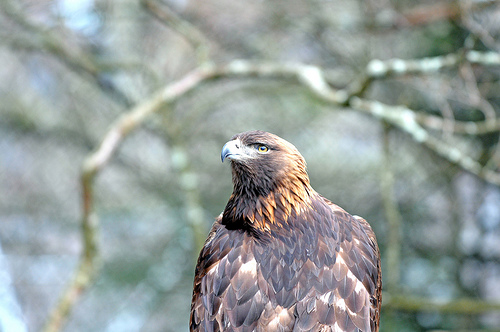
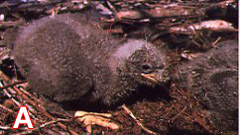
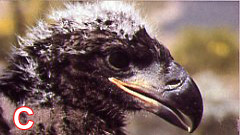
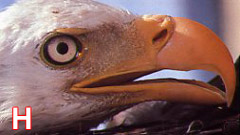
If those facts are true, then what is meant by God’s Word about the eagle? I believe God’s Word is true, so there has to be an explanation of it. From the Southwestern Bald Eagle Management I found an interesting chart that shows the different stages of plumage (feathers) as an eagle ages.  They said, “In their five year development to adulthood, bald eagles go through one of the most varied plumage changes of any North American bird. During its first four weeks of life, an eaglet’s fluffy white down changes to a gray wooly down. At about five weeks, brown and black feathers begin to grow. It becomes fully feathered at 10 weeks of age. In its first year, the mostly dark-colored juvenile can often be mistaken as a golden eagle. However, the bald eagle progressively changes until it reaches adult plumage at five years. Notice in the pictures how its dark eye lightens throughout its first four years of life until it becomes yellow. Also, see how its beak changes form gray-black to a vibrant yellow.

ald Eagle (Haliaeetus leucocephalus)  by AestheticPhotos

Bald Eagle (Haliaeetus leucocephalus) by AestheticPhotos

It is believed that the darker, more mottled plumage of a young eagle serves as camouflage, while the white head and tail announce that it is of breeding age.”

That to me sounds a lot like, “So that your youth is renewed like the eagle’s.” As the eagle goes through the different stages of its life, the new feathers are graciously provided by a Creator that sees to the needs of His creation by having designed those features to renew as it matures.

The Lord provides for renewal for His children as they mature. The following verses tell of a renewed right spirit, mind, spirit of your mind, and knowledge:

Create in me a clean heart, O God; and renew a right spirit within me. (Psalms 51:10 KJV)
And be not conformed to this world: but be ye transformed by the renewing of your mind, that ye may prove what is that good, and acceptable, and perfect, will of God. (Romans 12:2 KJV)
And be renewed in the spirit of your mind; (Ephesians 4:23 KJV)
And have put on the new man, which is renewed in knowledge after the image of him that created him: (Colossians 3:10 KJV)

(Update 11/2/11) Here is another possible explaination about this topic. It might be a vulture instead of an eagle. See: http://www.thewonderofbirds.com/griffon-vulture/bible.htm)
*

Birds in Hymns – Praise to the Lord, the Almighty

I will praise thee; for I am fearfully and wonderfully made: marvellous are thy works; and that my soul knoweth right well. (Psalms 139:14 KJV)

Writer: Joachim Neander (1650-1680)
Music: From Praxis Pieatis Melica (1668)

1. Praise to the Lord, the Almighty,
the King of creation!
O my soul, praise Him, for He is thy
health and salvation!
All ye who hear,
Now to His temple draw near;
Sing now in glad adoration!

Bald Eagle Flying by Aesthetic Photos

Bald Eagle Flying by Aesthetic Photos

2. Praise to the Lord, who o’er all
things so wondrously reigneth,
Who, as on wings of an eagle,
uplifteth, sustaineth.

Hast thou not seen
How thy desires all have been
Granted in what He ordaineth?

3. Praise to the Lord, who hath fearfully,
wondrously, made thee!
Health hath vouchsafed and, when
heedlessly falling, hath stayed thee.
What need or grief
Ever hath failed of relief?
Wings of His mercy did shade thee.

4. Praise to the Lord, who doth prosper
thy work and defend thee,
Who from the heavens the streams of
His mercy doth send thee.
Ponder anew
What the Almighty can do,
Who with His love doth befriend thee.

5. Praise to the Lord! Oh, let all that
is in me adore Him!
All that hath life and breath, come
now with praises before Him!
Let the Amen
Sound from His people again;
Gladly for aye we adore Him.

Most information from The Cyber Hymnal

See ~ Wordless Birds

More ~ Birds in Hymns

*

When I Consider! – Loon

When I Consider!

When I Consider!

“Evidence From Biology”

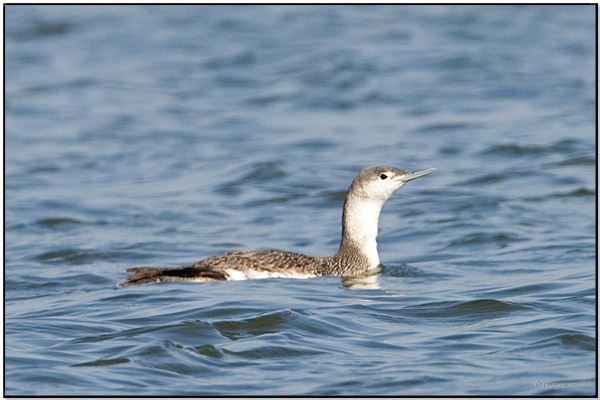
The loon is designed quite differently than almost all other birds. While the bodies of most birds are designed as light and aerodynamic as possible, the loon’s body is heavier, allowing it to sink until only its head is above water. It controls its ability to float by inflating or deflating tiny air sacs under its skin. When flying at high altitude, where the air is thin, the loon can conserve oxygen by limiting the flow of blood to its massive leg muscles.

Red-throated Loon (Gavia stellata) by Daves BirdingPix

Red-throated Loon (Gavia stellata) by Daves BirdingPix

The loon also has a perfectly developed reflex which limits the flow of blood to its wings and digestive tract during underwater dives. This allows the loon to hold its breath for long periods of time. Although an average dive lasts about 40 seconds, three-minute dives that cover 300-400 yards are quite common. Astounding dives have been documented where loons have held their breath for as long as 15 minutes while swimming underwater for over 2 miles.

Both common sense and the laws of probability tell us that these many unique abilities could not have evolved by chance processes such as random mutations. The loon could not have developed its unique diving ability in some step-at-a-time manner. It would have starved to death long before it caught its first fish. The system had to work perfectly from the beginning.”

Great Northern Loon (Gavia immer) by J Fenton

Great Northern Loon (Gavia immer) by J Fenton

Character Sketches, Vol III. p.49

For thou art great, and doest wondrous things: thou art God alone. (Psalms 86:10 KJV)

From September 18, A Closer Look at the Evidence, by Richard and Tina Kleiss
More – “When I Consider!


Lee’s Additions:

“any of five species of diving birds constituting the genus Gavia, family Gaviidae. Loons were formerly included, along with the grebes, to which they bear a superficial resemblance, in the order Colymbiformes, but they are considered to constitute their own separate order. Loons range in length from 60 to 90 cm (2 to 3 feet). Characteristics include a strong tapered bill, small pointed wings, webs between the front three toes, and legs placed far back on the body, which makes walking awkward. Loons have thick plumage that is mainly black or gray above and white below. During the breeding season the dorsal plumage is patterned with white markings, except in the red-throated loon (Gavia stellata), which during the summer is distinguished by a reddish brown throat patch. In winter the red-throated loon develops white speckling on the back, while the other species lose these markings.” (Britannica Online)
“Loons are excellent swimmers, using their feet to propel themselves above and under water and their wings for assistance. Because their feet are far back on the body, loons are poorly adapted to moving on land. They usually avoid going onto land, except when nesting.

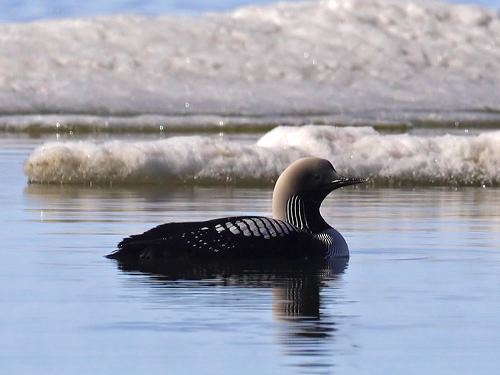
Pacific Loon (Gavia pacifica) by Ian

Pacific Loon (Gavia pacifica) by Ian

All loons are decent fliers, though the larger species have some difficulty taking off and thus must swim into the wind to pick up enough velocity to become airborne. Only the Red-throated Diver (G. stellata) can take off from land. Once airborne, their considerable stamina allows them to migrate long distances southwards in winter, where they reside in coastal waters. Loons can live as long as 30 years.”

“The loons are the size of a large duck or small goose, which they somewhat resemble in shape when swimming. Like in these but unlike in coots (which are Rallidae) and grebes (Colymbiformes), their toes are connected by webbing. They may be confused even more readily with cormorants (Phalacrocoracidae), which are not too distant relatives of divers and like them are heaviset birds whose bellies – unlike those of ducks and geese – are submerged when swimming. Flying loons resemble a plump goose with a seagull’s wings, which seem quite small in proportion to the bulky body. They hold their head slightly pointing upwards during swimming, less so than cormorants do, and in flight they let the head decidedly droop down compared to all other aquatic birds of comparable habitus.

Males and females do not differ in plumage. Males are a bit larger on average, but usually this is only conspicuous when directly comparing the two parents. Their plumage is largely patterned black-and-white in summer, with grey on the head and neck in some species, and a white belly in all of them. This resembles many sea-ducks (Merginae) a lot – notably the smaller goldeneyes (Bucephala) – but is distinct from most cormorants which rarely have white feathers, and if so usually as large rounded patches rather than delicate patterns. All species of divers have a spear-shaped bill.”(Wikipedia)

See Also:
Peterson’s Field Guide Video Series on the Common Loon (Now the Great Northern Loon)
Gaviidae – Loons
Loon from Wikipedia
An interesting article in The Wilson Bulletin dated September 1947 – “The Deep Diving of the Loon and Old-Squaw and its Mechanism

Birds in Hymns – O Bless the Lord, My Soul

Birds in Hymns – O Bless the Lord, My Soul by James Montgomery

Based on Psalms 103

A Psalm of David. Bless the LORD, O my soul: and all that is within me, bless his holy name. Bless the LORD, O my soul, and forget not all his benefits: (Psalms 103:1-2 KJV)

Words: James Montgomery, in Se­lect­ion of Psalms and Hymns, by Thom­as Cot­ter­ill, 1819.
Music: St. Thom­as (Will­iams), Aar­on Will­iams, The New Un­i­vers­al Psalm­o­dist, 1770

O Bless the Lord, My Soul

Bald Eagle (Haliaeetus leucocephalus)  by Quy Tran

Bald Eagle (Haliaeetus leucocephalus) by Quy Tran

O bless the Lord, my soul!
His grace to thee proclaim!
And all that is within me join
To bless His holy Name!

O bless the Lord, my soul!
His mercies bear in mind!
Forget not all His benefits!
The Lord to thee is kind.

He will not always chide;
He will with patience wait;
His wrath is ever slow to rise,
And ready to abate.

He pardons all thy sins;
Prolongs thy feeble breath;
He healeth thine infirmities,
And ransoms thee from death.

He clothes thee with His love;
Upholds thee with His truth;
And like the eagle He renews
The vigor of thy youth.

Then bless His holy Name,
Whose grace hath made thee whole,
Whose loving kindness crowns thy days!
O bless the Lord, my soul!


Who satisfieth thy mouth with good things; so that thy youth is renewed like the eagle’s. (Psalms 103:5 KJV)

See:
Eagles by Linda Ozirney

Most information from The Cyber Hymnal

See ~ Wordless Birds

More ~ Birds in Hymns

*

Birds of the Bible – Birds of Every Sort

American Flamingo (Phoenicopterus ruber) by Africaddict

American Flamingo (Phoenicopterus ruber) by Africaddict

When I came across this verse about “every kind of bird” and “birds of every sort,” I decided it would be great to show some of the really fantastic birds that I have seen recently in the photos I am sorting for the Birds of the World blog. This will be done, but also the verses themselves are very interesting.

Thus says the Lord GOD: “I myself will take a sprig from the lofty top of the cedar and will set it out. I will break off from the topmost of its young twigs a tender one, and I myself will plant it on a high and lofty mountain. On the mountain height of Israel will I plant it, that it may bear branches and produce fruit and become a noble cedar. And under it will dwell every kind of bird; in the shade of its branches birds of every sort will nest. And all the trees of the field shall know that I am the LORD; I bring low the high tree, and make high the low tree, dry up the green tree, and make the dry tree flourish. I am the LORD; I have spoken, and I will do it. (Ezekiel 17:22-24 ESV)

Tufted Puffin by Dave's BirdingPix

Tufted Puffin by Dave's BirdingPix

Nebuchadnezzar had placed one of the family of David on the throne in Judah. This signified taking the seed of the land and planting it, but it did not succeed. But as these verses tell of a future time when there will be a “tender one” from the topmost twigs, referring to the Messiah, the tender one, and the tribe of Judah, main tribe. The Messiah is often referred to as a branch in prophecy.

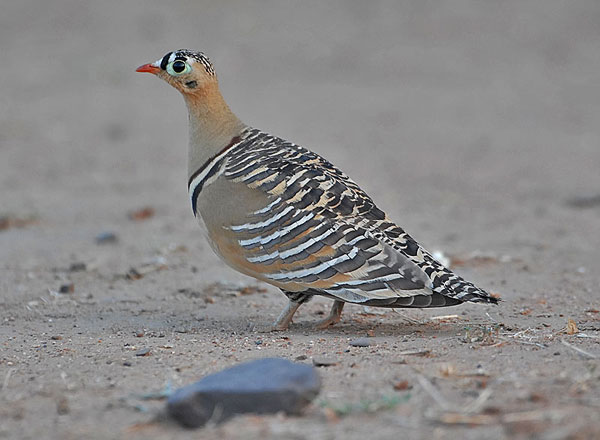
Painted Sandgrouse (Pterocles indicus) by Nikhil

Painted Sandgrouse (Pterocles indicus) by Nikhil

“Nebuchadnezzar and Zedekiah was made on this ground, and the name of Jehovah was brought in to confirm it. It was not the Gentile who broke the covenant. Zedekiah added to his other sins that of rendering impossible the existence of a people and a kingdom that belonged to God. The name of Jehovah was more despised and trampled under foot by him than by the Gentile king. He intrigues with Egypt to escape from the dominion of Nebuchadnezzar, whom God Himself, in judgment, had set up as supreme. This filled up the measure of iniquity, and brought on the final judgment. But it left room for the sovereignty of God, who would bring down the high tree and exalt the low tree, who would dry up the green tree and make the dry tree to flourish. His grace would take the little forgotten branch of the house of David and raise it up in Israel upon the mountain of His power, where He would cause it to become a goodly cedar, bearing fruit, and sheltering all that would seek the protection of its shadow. All the powers of the earth should know the word and the works of Jehovah.” From John Darby’s Synopsis.

Cedar Waxwing (Bombycilla cedrorum) by J Fenton

Cedar Waxwing (Bombycilla cedrorum) by J Fenton

“The twig planted by the Lord will grow there into a glorious cedar, under which all birds will dwell. The Messiah grows into a cedar in the kingdom founded by Him, in which all the inhabitants of the earth will find both food (from the fruits of the tree) and protection (under its shadow). For this figure, compare Daniel 4:8-9. צִפֹּור כָּל־כָּנָף, birds of every kind of plumage (cf. Ezekiel 39:4, Ezekiel 39:17), is derived from Genesis 7:14, where birds of every kind find shelter in Noah’s ark. The allusion is to men from every kind of people and tribe. By this will all the trees of the field learn that God lowers the lofty and lifts up the lowly.” From Keil & Delitzsch Commentary on Old Testament

Salvation is open to all people no matter what background, nationality, or tongue you speak. As the birds of every sort enjoy the shade and provisions of the tree, may you enjoy the Salvation of Lord and all His blessings He provides.

See: Wordless Birds

This is Birds of Every Sort – Part 1 (Non-Passerines)
*

This slideshow requires JavaScript.

*