Tasty household…

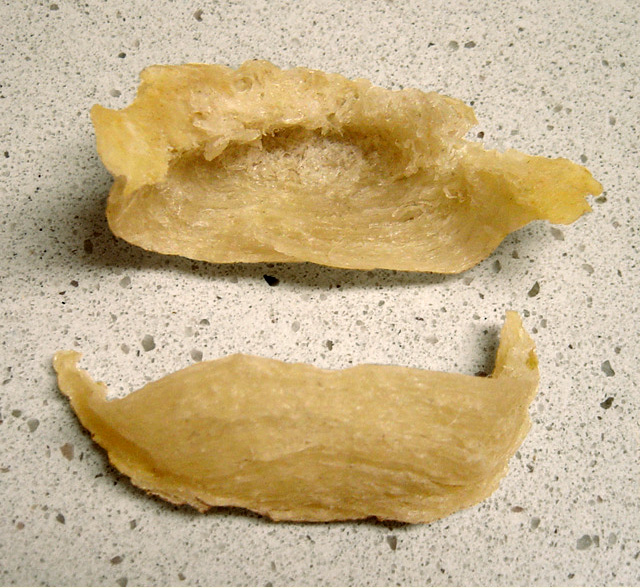
Edible-nest Swiftlet (Aerodramus fuciphagus) ©WikiC

Edible-nest Swiftlet (Aerodramus fuciphagus) ©WikiC

Tasty household… ~ by a j mithra

Edible-nests Swiftlets
build their nests
with their saliva..

Edible-nest Swiftlets - Swiftlet Bird Nests©WikiC

Edible-nest Swiftlets - Swiftlet Bird Nests©WikiC

Its nests are considered
as the costliest delicacy
in the world..
The nests are known
for its nutrients…
How do we build our nests?
Do people find
that our household
nutrient and tasty?
Does our household
reflect the Love of JESUS?

‘We are fearfully
and
wonderfully made by GOD…”
But,
the question is,
how wonderful is our household,
our Nest for people around us?

…:but as for me and my house, we will serve the LORD. (Joshua 24:15)

Have a blessed day!

Thoughts from a j mithra


The Edible-Nest Swiftlet is in the Apodidae Family of the Apodiformes Order.


*

Birds of the Bible – Spain

Eurasian Hoopoe (Upupa epops) by Ian

Eurasian Hoopoe (Upupa epops) by Ian

I have enjoyed getting to know the Tim and Pam Darling, our missionaries, while they have been in transition from the field of Venezuela to Spain. We have all been praying for them to get their Resident Visas so they can get on over to Spain to start their new ministry. They now have the Visas in hand, which is a great answer to prayer. They are busy getting packed up and will go to Spain around the 10th of November.

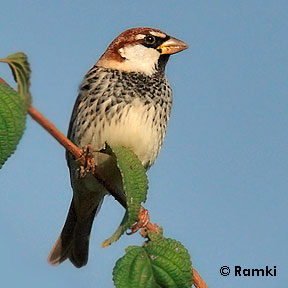
Spanish Sparrow (Passer hispaniolensis) by Nikhil Devasar

Spanish Sparrow (Passer hispaniolensis) by Nikhil Devasar

This blog is in honor of their friendship and to help them get to know the birds they may encounter in Spain. Thanks, Tim and Pam, for your friendship and our prayers will follow you as you travel and reach those in Spain for our Lord Jesus Christ.

Of course the Sparrows will be over there. The House Sparrow, Spanish Sparrow, Eurasian Tree Sparrow, Rock Sparrow and the White-throated Sparrows will help you to remember

Even the sparrow finds a home, and the swallow a nest for herself, where she may lay her young, at your altars, O LORD of hosts, my King and my God. Blessed are those who dwell in your house, ever singing your praise! Selah (Psalms 84:3-4 ESV)

Along with them you will get to meet the Eurasian Hoopoe. A favorite of mine. There will be Swifts – Common, White-rumped, Little, Pallid and Plain Swifts. Also the Swallows – Red-rumped and the Barn.

Yea, the stork in the heaven knoweth her appointed times; and the turtle(dove) and the crane and the swallow observe the time of their coming; but my people know not the judgment of the LORD. (Jeremiah 8:7 KJV)

Lots of Doves and Pigeons to be on the lookout for – Rock Dove (pigeon), Eurasian Collared-Dove, Oriental Turtle-Dove, Laughing Dove, European Turtle-Dove, Bolle’s Pigeon, Laurel Pigeon and a Stock Pigeon. Only found the Common Crane listed there.

There are 9 kinds of Owls, 10 in Falcon family, 3 Kites, 3 Bitterns, 2 Cormorants, 4 Herons, 3 Storks, 2 Hawks, 2 Lapwings, the Osprey, 3 Partridges, 2 Quails and the Bobwhite, and 4 Swans.

There is the Common Raven and you know what the Word says about the Ravens.

Consider the ravens: for they neither sow nor reap; which neither have storehouse nor barn; and God feedeth them: how much more are ye better than the fowls? (Luke 12:24 KJV)

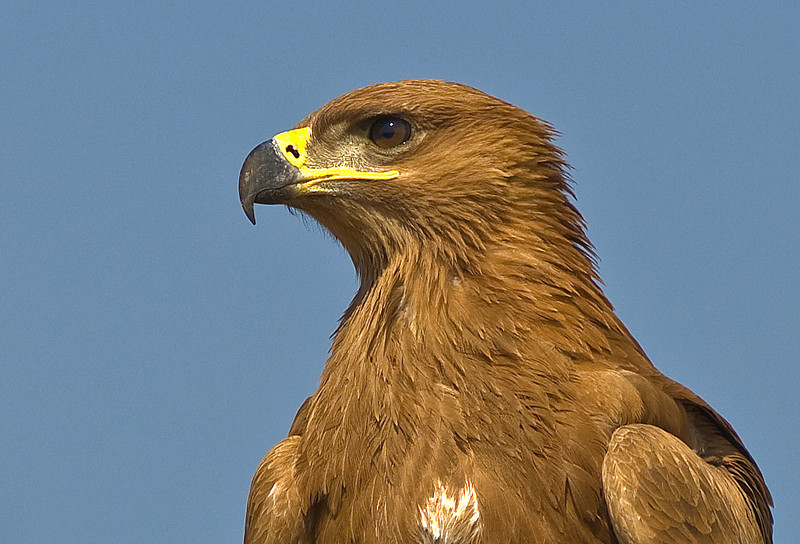
Tawny Eagle by Africaddict

Tawny Eagle by Africaddict

Saved the Eagles for last, not because they are bad, but because of the promises that use them as examples. In Spain they have the Adalbert’s, Golden, Greater Spotted, Imperial, Lesser Spotted, Tawny, Short-toed Snake-Eagle, White-tailed Eagle, Bonelli’s Eagle and the Booted Eagles.

Wilt thou set thine eyes upon that which is not? for riches certainly make themselves wings; they fly away as an eagle toward heaven. (Proverbs 23:5 KJV)

The Darling’s are definitely not going to Spain to obtain earthly gains, but to gain heavenly rewards.

But they that wait upon the LORD shall renew their strength; they shall mount up with wings as eagles; they shall run, and not be weary; and they shall walk, and not faint. (Isaiah 40:31 KJV)

Tim and Pam, our collective prayers will go with you.

(Updated 8-04-12) We have had the privilege of spending some time with Tim and Pam for the last few weeks while they have been on a short furlough. Her parents belong to our church and live in the area. I have tried to encourage them to send me some photos of the birds in Spain. Stay tuned, maybe we can have another update.)

*

This slideshow requires JavaScript.

*

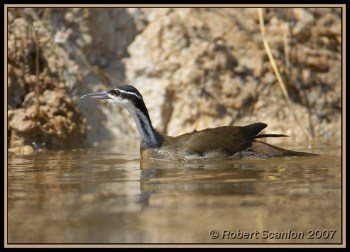
Mysterious Sungrebe…

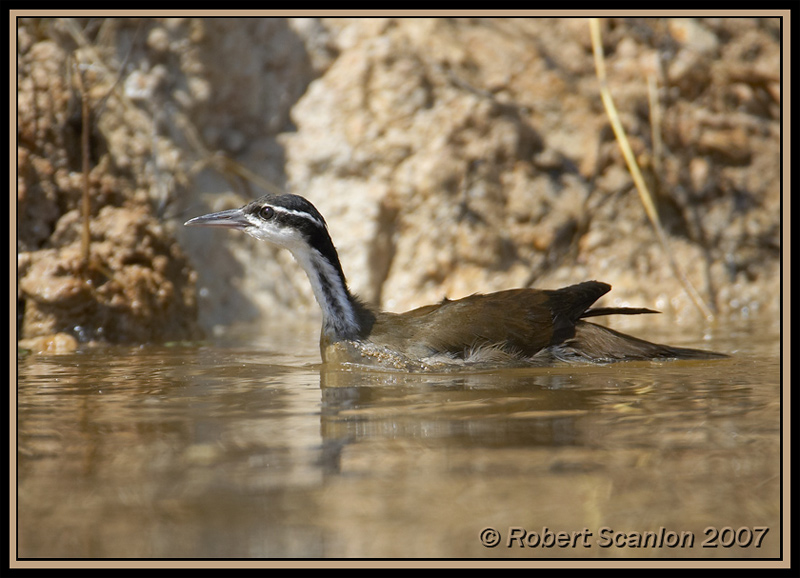
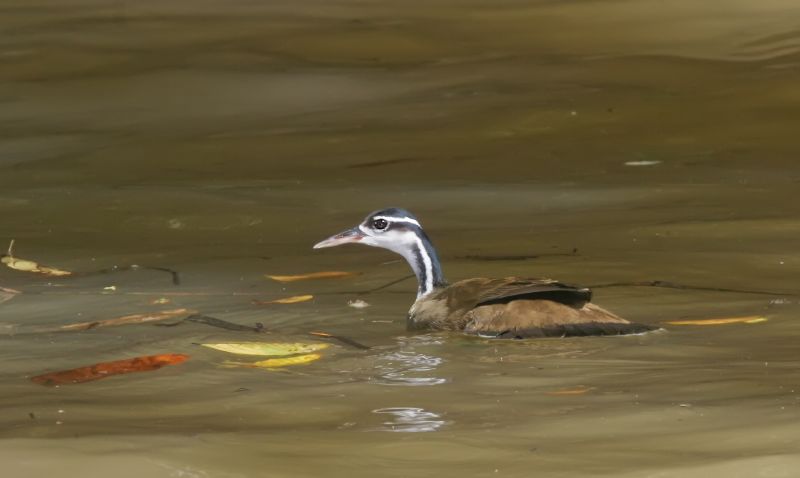
Sungrebe (Heliornis fulica) by Robert Scanlan

Sungrebe (Heliornis fulica) by Robert Scanlan

Mysterious Sungrebe… ~ by a j mithra

Sungrebe, common name for a tropical, mainly aquatic bird of the family Heliornithidae. Sungrebes, also called finfoots, are remarkable for their colorful, puffy-toed, webbed feet, which may serve as lures for fish and other aquatic animals.

The Sungrebe is a small slim-bodied water bird, typically 28-31 cm long and weighing 130 g.
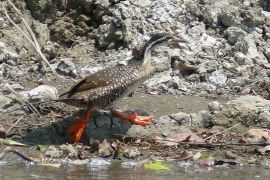
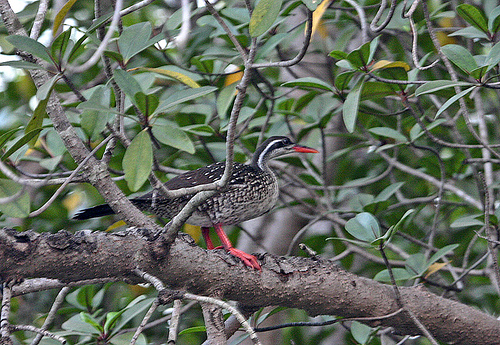
African Finfoot with puffy feet ©WikiC

African Finfoot with puffy feet ©WikiC

Once widely distributed, they (Heliornithidae) are now limited to three species.

The largest of these is the Masked Finfoot (Heliopais personata) measuring up to 20 in. (51 cm) in length, and found from Bengal to Malaya and Sumatra. Its body is olive-brown above, with a black head and throat, a yellow bill, and bright green legs with white stripes.

At 16 in. (41 cm), the African Finfoot (Podica senegalis) is dark brown with black and white spots above, a white belly, and bright red feet and legs. It is thought to be more of a climber than the other species.

Only a third to a quarter as bulky as the Asian Sungrebe and measuring less than 12 in. (30 cm) in length is the Sungrebe (Heliornis fulica) of South and Central America. its plumage is colored similarly to that of the Asian sun grebe, but it is scarlet-billed with yellow, black-striped legs.

All three species are marked by a white band running from eye to neck. Sun grebes are classified in the phylum Chordata subphylum Vertebrata, class Aves, order Gruiformes, family Heliornithidae. It is mainly brown, with a long neck and blackish tail, and a long red bill. The crown and neck are strikingly patterned with black and white stripe, and the feet are black and yellow.

The sexes differ in the colour of the cheeks, buff in the female and white for the male. Sungrebes are shy birds rarely seen by people. They usually swim close to cover and may hide either in vegetation or in the water, with their bodies underwater and their heads lowered, when they are disturbed.

What do we do when we are disturbed in life?

  • Look up towards mortal men or the immortal God?
  • These birds teach us the best way to turn our focus from a mess to a message…
  • Instead of facing the problem, it would be better to get immersed in to the Living water…
  • As long as Peter’s focus was on the Lord, he was able to walk over the water…
  • Once he shifted his focus from the Lord to the water, he sunk…
  • Let our focus be on the One whose focus is always on us…

The name of the LORD is a strong tower: the righteous runneth into it, and is safe. (Psalm 18:10)

They are not just good swimmers but capable walkers and climbers too. Sungrebes tend to roost, or spend the night, in trees or bushes. This bird is unique that it is able to do everything; fly, swim, walk and climb..

We are unique too, for, God has created us in His image..

So, lets stop talking low of ourselves and start praising God for His purpose in our lives..

I can do all things through Christ which strengtheneth me. (Philippians 4:13)

Masked Finfoot (Heliopais personatus) Wikipedia

Masked Finfoot (Heliopais personatus) ©Wikipedia

Sungrebes may be solitary, that is, may live by themselves, or are found in pairs, generally male and female breeding partners, or family groups. Sungrebes are permanently territorial, meaning they defend their territories from other individuals of the same species during the breeding season as well as the nonbreeding season.

Although all three sungrebe species have distinctive calls, these are not often heard. The African Finfoot makes a loud booming sound during breeding. The Masked Finfoot has a bubbling call. The Sungrebe has a “eeyoo” call that it makes to warn other sungrebes away from its territory.

Though these birds have distinctive calls, they are not often heard..

Our grumbling and complaining is heard ever so often, which makes it easier for satan to locate us easily..

The Bible says,

I am the LORD thy God, which brought thee out of the land of Egypt: open thy mouth wide, and I will fill it. (Psalm 81:10)

God did not ask us to open our mouth to complain and grumble, but, to sing praises…

  • The next time you feel like a looser and want to grumble or complain, just remember that, you are giving away your location to satan…
  • Our praises has the power to vacate God from heaven, to dwell with us..
  • At the same time grumble and complaints has the power to bring satan among us…
  • Remember, Israelites grumbled and fell dead in the wilderness…
  • But, Joshua and Caleb worshiped their way into the land of milk and honey…

Death and life are in the power of the tongue: and they that love it shall eat the fruit thereof. (Proverbs 18:21)

African Finfoot (Podica senegalensis) Wikipedia

African Finfoot (Podica senegalensis) Wikipedia

Sungrebes feed primarily on insects, particularly midgets, mayflies, and dragonflies. They may also eat beetles, grasshoppers, and flies, as well as some mollusks, crustaceans, worms, millipedes, and spiders. Occasionally they can eat larger animals such as frogs, tadpoles, or small fish. Sungrebes are also known to eat a small amount of plant material, such as seeds and leaves. Most of their food is found on the water surface, but Sungrebes also forage in overhanging vegetation or along banks.

It nests from August to April building a bowl shaped nest from reeds, course grass and shiny leaves which it places on a sloping branch overhanging the water often in driftwood caught in branches. The eggs are pale buffy green streaked with brown and purple and 1 to 2 are laid and incubated for about eleven days. The chicks hatch naked, blind, and defenseless.

When our dwelling place is near the Living waters, we have providence in abundance and protection and deliverance..

Where are we planted?

Blessed is the man that walketh not in the counsel of the ungodly, nor standeth in the way of sinners, nor sitteth in the seat of the scornful.

But his delight is in the law of the LORD; and in his law doth he meditate day and night.

And he shall be like a tree planted by the rivers of water, that bringeth forth his fruit in his season; his leaf also shall not wither; and whatsoever he doeth shall prosper. (Psalm 1:1-3)

The Sungrebe is already very strange in having a very short incubation period (10-11 days, matching some small passerines) but has an astonishing behavior entirely unique in the bird world: the male Sungrebe is able to transport these helpless offspring, even in flight! The male has a shallow pocket under each wing into which the two young can fit. The pocket is formed by a pleat of skin, and made more secure by the feathers on the side of the body just below. The heads of the chicks could be seen from below as the bird flew. This adaptation is unique among birds: in no other species is there any mechanism whereby altricial young can be transported.

Our God not only carries us under His mighty wings but has carved us in His palms too…

  • But, most of us seem to find the temporary comforts of the world better suited for us…
  • Maybe that is the reason we are unable to be successful in life…
  • As long as Eve was with Adam, the serpent couldn’t be near her..
  • The day she went alone around the garden of Eden, she was deceived by satan..
  • Where are we right now?
  • It’s time for us to get back to our basics, our first love…

As an eagle stirreth up her nest, fluttereth over her young, spreadeth abroad her wings, taketh them, beareth them on her wings: (Deuteronomy 32:11)
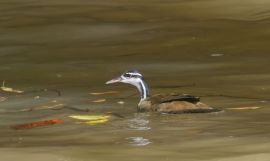
Sungrebe (Heliornis fulica) ©Wikipedia

Sungrebe (Heliornis fulica) ©Wikipedia

Of course, the precocial young of some swans and grebes may hitch rides on their swimming parents’ backs, and a male jaçana can transport his chicks about holding them between his wings and body, but neither of these cases applies when the adults are in flight….

The transport system of the Sungrebe raises numerous further questions. How do the chicks get into the pocket? Are they put in by the male? Does he feed them in there? Do they stay inside, or get in and out? Why does the female not have similar pockets? …

Yes, the Sungrebe and the Finfoots are mystery birds indeed…

Our God is not mysterious but His ways are…

  • He makes ways only where there seems to be no way….
  • He makes ways over the waters and over the sky…
  • He brings waters in the wilderness and rivers into the desert…
  • You may not see rain or wind yet, He is capable of bring rain….
  • He can win a battle with a pebble..
  • He can even win a war without a fight…
  • He can make the waters stand up tall and mighty walls to lie flat..

Our God is able…

Great in counsel, and mighty in work: for thine eyes are open upon all the ways of the sons of men: to give every one according to his ways, and according to the fruit of his doings: (Jeremiah 32:19)

Have a blessed day!

Your’s in YESHUA,
a j mithra

Please visit us at: Crosstree


Heliornithidae Family

Gruiformes Order
Light Rain…

Nicobar Pigeon sunbathing at Lowry Park Zoo by Lee

Nicobar Pigeon sunbathing at Lowry Park Zoo by Lee

Light Rain… by a j mithra

Numerous Bird species
know that

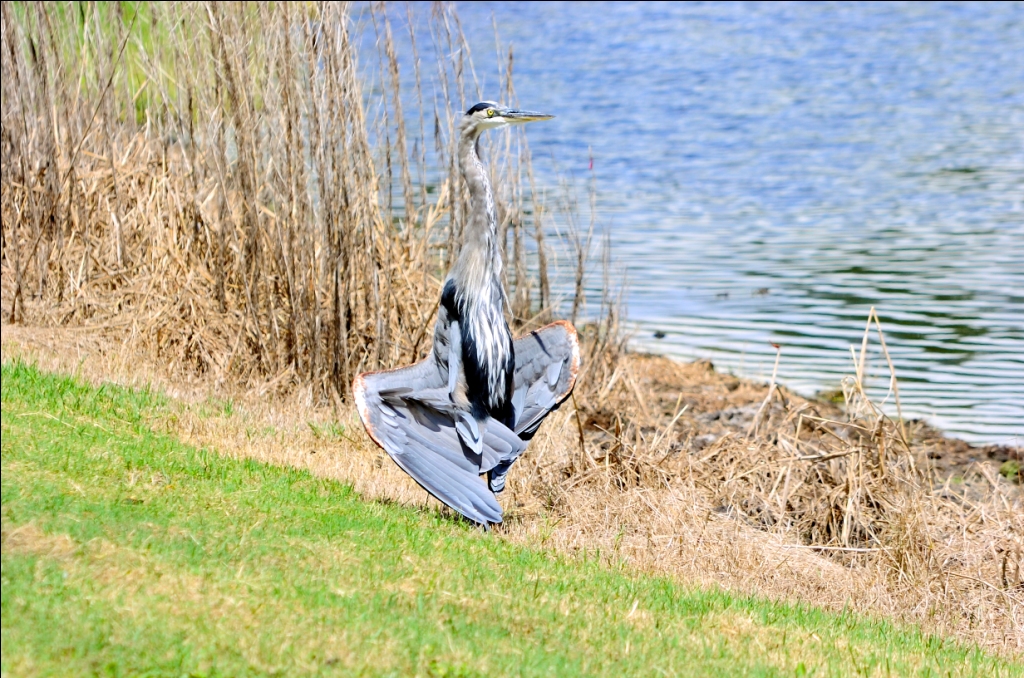
Great Blue Heron sunning by Dan

Great Blue Heron sunning by Dan

Sun light and heavy rains
would support
a tremendous food source
for all of them…
That’s the reason
we can see lots of birds
having sunbath
just after rains….
Most of us
have failed to realize that,
it is impossible
to survive
without THE LIGHT
of the SUN OF RIGHTEOUSNESS
and
the rain of THE HOLY SPIRIT…
JESUS had told that
HE will pour the latter rain
on all flesh..
Thank GOD we are made of flesh
so,
lets get soaked in the rain
and walk in THE LIGHT…

Ask ye of the LORD rain in the time of the latter rain; so the LORD shall make bright clouds, and give them showers of rain, to every one grass in the field. (Zechariah 10:1)

Have a blessed day!

Thoughts from a j mithra

Wordless Birds

*

Launching pad…

Brant Goose (Branta bernicla) by Ian

Brant Goose (Branta bernicla) by Ian

Launching pad… ~ a j mithra

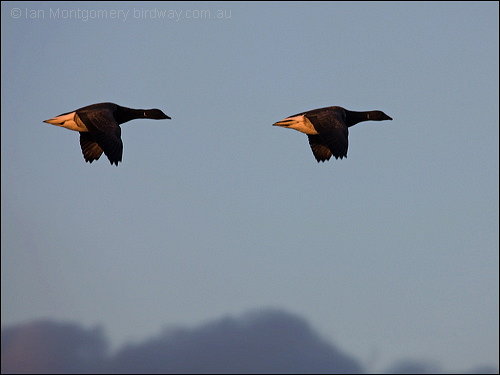
Brant Geese (Branta bernicla) by Ian

Brant Geese (Branta bernicla) by Ian

The small Arctic Goose
called Brant Goose,
would wait
for the storm system
to come,
so that,
it would catch
the storm’s tail wind
and
migrate during winter…
GOD doesn’t give
the storm to destroy you,
but,
to take you
to a better place…
Remember,
storm is surely
a launching pad…

The LORD is slow to anger, and great in power, and will not at all acquit the wicked: the LORD hath his way in the whirlwind and in the storm, and the clouds are the dust of his feet. (Nahum 1:3)

Have a blessed day!

A thought from ~ a j mithra

*

Birds of the Bible – Ostrich II

Common Ostrich (Struthio camelus) Memphis Zoo by Lee

Common Ostrich (Struthio camelus) Memphis Zoo by Lee

Even a mother wolf will nurse her cubs, but my people are like ostriches, cruel to their young. (Lamentations 4:3 GNB)
Even jackals nurse their young, but my people are like ostriches that abandon their own. (Lamentations 4:3 CEV)

The two versions of Lamentations 4:3 are interesting. In Birds of the Bible – Ostrich, the facts about the Ostriches behavior toward their young were mentioned. Her lack of interest in raising her young by putting them in a communal nest, her “big feet”, and her lack of knowledge.

This verse in Lamentations 4, again mentions how the ostriches are cruel to their young. This time the context is referring to the punishment of Israel and how they have gone from having much and now suffering with little or nothing. Verse 2 says,

These are Zion’s people, worth more than purest gold; yet they are counted worthless like dishes of clay.

May we serve the Lord with a clean heart and keep a “short list” of things that need to be confessed. May we never get so far away from the Lord that we have to have judgment come into our lives to “wake us up.”

Luckily, those of us who know the Lord as our personal Saviour, know:

Let your conversation be without covetousness; and be content with such things as ye have: for he hath said, I will never leave thee, nor forsake thee. (Hebrews 13:5 KJV)

Somali Ostrich (Struthio molybdophanes) by P Kwong

Somali Ostrich (Struthio molybdophanes) by P Kwong

The Ostrich, Struthio camelus, is actually an interesting bird that is flightless and native to Africa. It is the only living species of its family, Struthionidae and its genus, Struthio. Ostriches share the order Struthioniformes with the kiwis, emus, and other ratites. It is distinctive in its appearance, with a long neck and legs and the ability to run at maximum speeds of about 45 mph, the top land speed of any bird. The Ostrich is the largest living species of bird and lays the largest egg of any living bird (extinct elephant birds of Madagascar and the giant moa of New Zealand laid larger eggs).

Ostriches usually weigh from 63 to 130 kilograms (140–290 lb), with exceptional male Ostriches weighing up to 155 kilograms (340 lb). The feathers of adult males are mostly black, with white primaries and a white tail. However, the tail of one subspecies is buff. Females and young males are greyish-brown and white. The head and neck of both male and female Ostriches is nearly bare, with a thin layer of down.[4][6] The skin of the females neck and thighs is pinkish gray, while the male’s is blue-gray, gray or pink dependent on subspecies.
Claws on the wings

The long neck and legs keep their head 6 to 9 ft above the ground, and their eyes are said to be the largest of any land vertebrate – 50 millimetres (2.0 in) in diameter; they can therefore perceive predators at a great distance. The eyes are shaded from sun light falling from above.

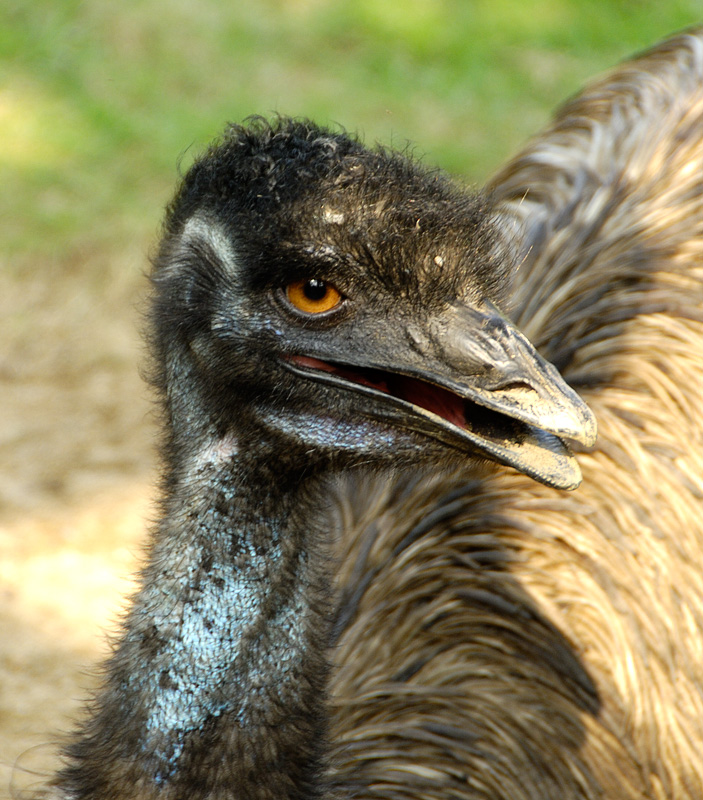
Emu Foot Lowry Pk Zoo

Emu Foot Lowry Pk Zoo

At sexual maturity (two to four years), male Ostriches can be from 5 ft 11 in to 9 ft 2 in in height, while female Ostriches range from 5 ft 7 in to 6 ft 7 in. During the first year of life, chicks grow 10 in per month. At one year of age, Ostriches weigh around 100 lb. Their lifespan is up to 40–45 years.

Yesterday, Dan and I were at the Lowry Park Zoo and were watching the Emu pair they have there. Took pictures of their feet and though smaller than the Ostrich, they have “big feet” also.

See Also:

Birds of the Bible – Ostrich

Ostrich

Struthionidae – Ostriches

Struthioniformes – Ostriches

*

Mrs. Mom…

Northern Wren by Peter Ericsson

Northern Wren by Peter Ericsson

Mrs. Mom… ~ by a j mithra

Scientists have found
that mother Wrens

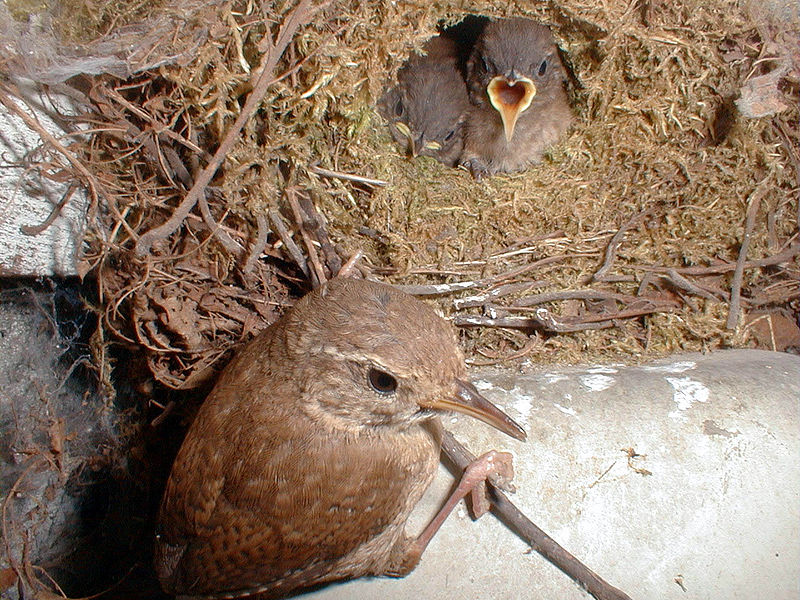
Winter Wren Female and chick ©Wikipedia

Winter Wren Female and chick ©Wikipedia

make at least 1200 visits
to its nest
to feed its chicks…
Amazing isn’t it?
If a small little bird
could take
so much care
of its chicks,
how much would
our LORD,
who gave HIS life
care for you and me?
If the creation is
so amazing,
what would you say
about the CREATOR?

When my father and my mother forsake me, then the LORD will take me up. (Psalm 27:10)

Have a Blessed day!

Thoughts from a j mithra

*

Seeker…

Blackpoll Warbler (Setophaga striata) ©Flickr Scott Heron

Seeker… ~ by a j mithra

A small
North American bird,
the size of a sparrow
called the Blackpoll Warbler,
flies about 2,500 miles
on a nonstop 90 hr.
journey during migration
every year..

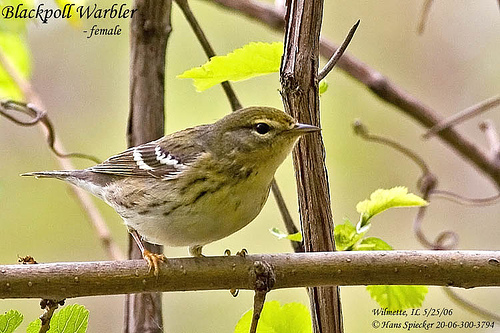
Blackpoll Warbler (Dendroica striata) female by Kent Nickell

Blackpoll Warbler (Dendroica striata) female by Kent Nickell

If such a small little bird
could fly that long
and that far,
How far
and how long
should we seek the presence
of the LORD?

But seek ye first the kingdom of God, and his righteousness; and all these things shall be added unto you. (Mathew 6:33)

Have a blessed day!

Thoughts from a j mithra

Those Ugly Shirts

I don’t know if you were glued to your TV when the miners in Chile were taken up from their 69 day entrapment, but I was. I prayed for them that nothing would go wrong as they brought each one up and for them personally to know the Lord.

Today I received an email with a YouTube about the shirts that many were wearing. I too was curious as to what they said. Here is a great video that tells about those “ugly shirts.”

Video by iranmojdeh.

Wordless Birds

Today’s Birds of the Bible

Updated at 8:10 pm

They are all finished. Hope you enjoy reading them.

********

Today, instead of doing my regular Birds of the Bible article, I am going to try to finish the Scripture Alphabet of Animals series. I have all the birds finished and am working hard to finish the rest of the animals today. All throughout the day, new articles will be posted as they are completed. I will be updating the index to the article (below) as I finish each one.

I trust you have enjoyed reading them as much as I have as the articles are being “modernized.” Harriet N Cook was a very good writer and trust she would have approved of the way that they are being handled here.

Lee

Learning from the Birds – Overwhelmed

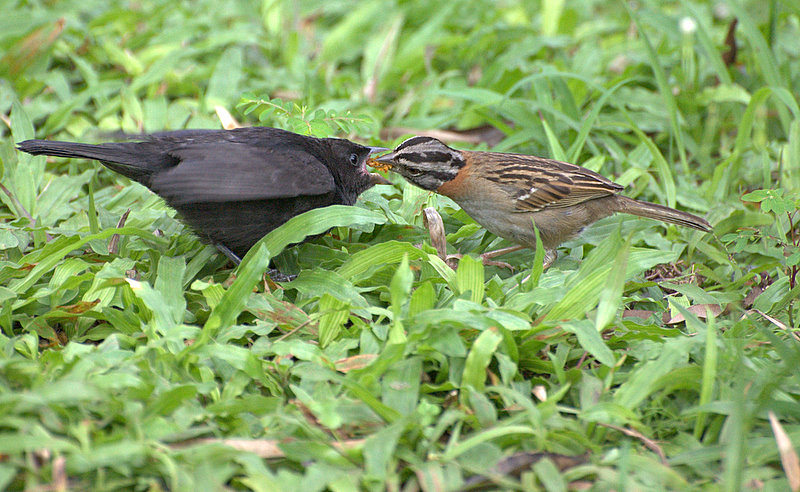
A Shiny Cowbird (Molothrus bonariensis) chick being fed by a Rufous-collared Sparrow (Zonotrichia Capensis)

A Shiny Cowbird (Molothrus bonariensis) chick being fed by a Rufous-collared Sparrow (Zonotrichia Capensis)

But now ask the beasts, and they will teach you; And the birds of the air, and they will tell you; (Job 12:7 NKJV)

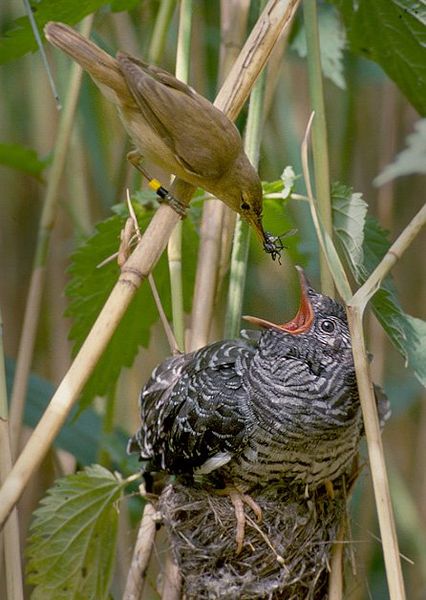
Brood parasites are organisms that use the strategy of brood parasitism, found among birds, fish or insects, involving the manipulation and use of host individuals either of the same or different species to raise the young of the brood-parasite. This relieves the parasitic parent from the investment of rearing young or building nests, enabling them to spend more time foraging, producing offspring etc. Additionally, the risk of egg loss to raiders such as raccoons is mitigated, by having distributed the eggs amongst a number of different nests. As this behavior is damaging to the host, it will often result conflict between parasite and host.

Common Cuckoo (Cuculus canorus) being raised by a Reed Warbler©WikiC

Common Cuckoo (Cuculus canorus) being raised by a Reed Warbler©WikiC

Interspecific brood-parasites include the Old World Cuckoos in Eurasia and Australia, Cowbirds and Black-headed Ducks in the Americas, and Indigobirds, Whydahs, and the Honeyguides in Africa.

Among specialist avian brood parasites, mimetic eggs are a nearly universal adaptation. There is even some evidence that the generalist Brown-headed Cowbird may have developed an egg coloration mimicking a number of their hosts.

Most avian brood parasites will remove a host egg when they lay one of their own in a nest. Depending upon the species, this can happen either in the same visit to the host nest or in a separate visit before or after the parasitism. This both prevents the host species from realizing their nest has been parasitized and reduces competition for the parasitic nestling once it hatches.

Most avian brood parasites have very short egg incubation periods and rapid nestling growth. This gives the parasitic nestling a head start on growth over its nestmates, allowing it to outcompete them. In cases where the host nestlings are significantly smaller than the parasite nestling, the host nestlings will often starve to death. Some brood parasites will eliminate all their nestmates shortly after hatching, either by ejecting them from the nest or killing them with sharp mandible hooks which fall off after a few days.

Whoa! This is NOT NICE! What is so amazing is that if not detected in time, many times the birds do find the intruding egg and toss it out, but most times, the unsuspecting parents raise this young bird as if it were it’s own.

What can we, as observers of this behavior, learn from the birds? I want to consider the host birds who have quite a challenge to face. They either fix the problem or they could be very “overwhelmed” with situation at hand.

My first thoughts were from a physical need. When faced with a health problem, we pray and visit the doctors and try to remedy the situation. Sometimes the ailment is not cured and we may be faced with an “overwhelming” need. Do we accept whatever the outcome and:

Not that I speak in regard to need, for I have learned in whatever state I am, to be content: (Philippians 4:11 NKJV)

Another lesson that could by learned by observing this “overwhelming” task might be in sharing the load. Often in churches, the ones who are willing to serve the Lord become very involved because of others not volunteering or helping. They keep taking on more responsibilities, not complaining, but in time they could become “overwhelmed.” We should find a way to:

Bear one another’s burdens, and so fulfill the law of Christ. (Galatians 6:2 NKJV)

Though one may be overpowered by another, two can withstand him. And a threefold cord is not quickly broken. (Ecclesiastes 4:12 NKJV)

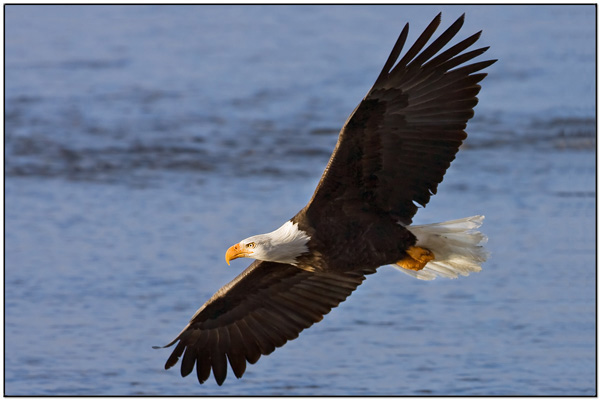
Bald Eagle flying by Dave's BirdingPix

Bald Eagle flying by Dave's BirdingPix

The host birds accept the situation and do the best they can to raise the young bird. How do they do that? One worm at a time! When we become “overwhelmed,” that is just what we need do. No! Not by catching worms, but by taking one step at a time and harkening to the following promises:

But ye, brethren, be not weary in well doing. (2 Thessalonians 3:13 KJV)

And let us not be weary in well doing: for in due season we shall reap, if we faint not. (Galatians 6:9 KJV)

I can do all things through Christ which strengtheneth me.
(Philippians 4:13 KJV)

But they that wait upon the LORD shall renew their strength; they shall mount up with wings as eagles; they shall run, and not be weary; and they shall walk, and not faint. (Isaiah 40:31 KJV)

(Some information from Wikipedia)
*

Bobolink – Extraordinary Migrant…

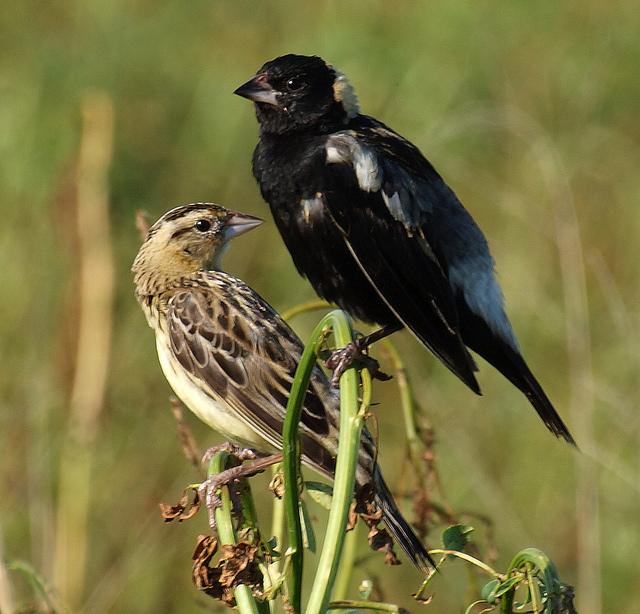
Bobolink (Dolichonyx oryzivorus) Pair ©©ramendan

Bobolink (Dolichonyx oryzivorus) Pair ©©ramendan

Bobolink – Extraordinary Migrant… ~ by a j mithra

Rice bird, meadow-wink, skunk blackbird, reed bird, butter bird—these various names for the member of the blackbird family most commonly known as the Bobolink reflect the diversity of ways in which humans have looked upon this gregarious songbird.

Nesting in the prairies and cultivated land of south Canada and the northern United States and wintering in the grasslands and marshes of Argentina, the Bobolink migrates at least 5,000 miles each way.

Bobolink Migration Route©WikiC

Bobolink Migration Route©WikiC

The Bobolink is an extraordinary migrant, traveling to south of the equator each autumn and making a round-trip of approximately 20,000 kilometers (12,500 mi). One female, known to be at least 9 years old, presumably made this trip annually, a total distance equal to traveling 4.5 times around the earth at the equator! These birds migrate to Argentina, Bolivia and Paraguay. One bird was tracked flying 12,000 miles (19,000 km) over the course of the year, and up to 1,100 miles (1,800 km) in one day. The vast distance is more impressive in relation to the Bobolink’s diminutive size, averaging 7 inches in length, 11.5 inches in wingspan, and 1.5 ounces. in weight.

  • Feeling small?
  • Get ready to do greater things for God…
  • You know, God does not use boulders to stop the waves of the sea from entering the land..
  • But, He uses tiny grains of sand to do it..

God has designed this bird to travel long distances to encourage us that we too can do great and mighty things for God..

A little one shall become a thousand, and a small one a strong nation: I the LORD will hasten it in his time. (Isaiah 6:21)

God seems to have a liking to use small things to fulfill great missions..

  • He chose the small Miriam to find a way to take care of Moses..
  • He chose a small slave girl to bring healing to a Commander of an army..
  • He chose a little shepherd boy David to bring down a mighty giant..
  • He chose a small boy to feed the multitudes…

Here again, this small bird He uses to inspire us to do great things for God..

If this small bird can travel 4.5 times around the world at the equator in its life time, how much more God will expect from us? Most of rely on our strength that is the reason we find it so difficult to travel next door to share the gospel isn’t it?

What sense does it make to say, I can do all things through Christ who strengthens me when we find it so difficult to stand for God?

But be ye doers of the word, and not hearers only, deceiving your own selves. For if any be a hearer of the word, and not a doer, he is like unto a man beholding his natural face in a glass: For he beholdeth himself, and goeth his way, and straightway forgetteth what manner of man he was. But whoso looketh into the perfect law of liberty, and continueth therein, he being not a forgetful hearer, but a doer of the work, this man shall be blessed in his deed. (James 1:22-25)

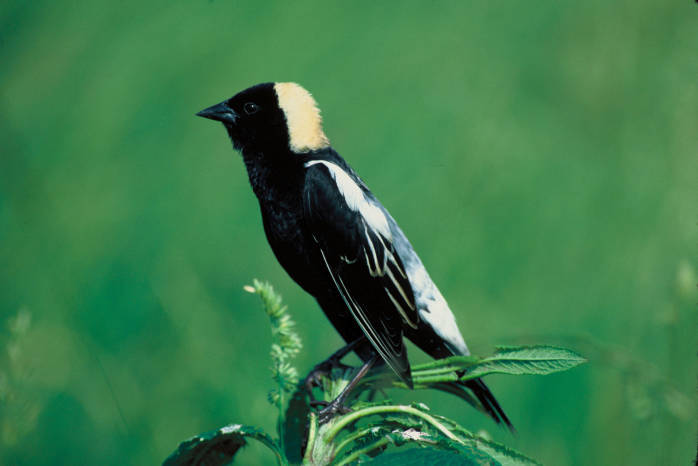
Bobolink (Dolichonyx oryzivorus) ©USFWS

Bobolink (Dolichonyx oryzivorus) ©USFWS

Bobolinks begin their journey northward in South America in early March, reaching Colombia and Venezuela in late April. From there, most take a route over the Caribbean Sea to the Florida peninsula, although some will cross the Gulf of Mexico from the Yucatan Peninsula to Louisiana and Texas. From there they fan northward and westward, arriving on the breeding grounds in May. These Birds breed in open grasslands and hay fields.

Bobolinks migrate at night. The distinctive “clink” notes of these nocturnal travelers can be heard as they pass overhead in large flocks, apparently using the earth’s magnetic field as a compass and the locations of the stars as a map.

  • Human race boasts about technology, innovation and inventions…
  • We feel great pride in finding unknown routes with the help of satellites and compass…

But, these birds use the earth’s magnetic field as compass and locations of the stars as a map…

  • How difficult it is for us to tread on unknown path?
  • When we worship in church we feel so good to call Jesus as the Brightest Morning Star…
  • Do we really turn towards this Morning Star to seek direction in life?
  • Who is our inspiration in life?

If God be with us who can be against us? But the million dollar question is, are we with God?

Great in counsel, and mighty in work: for thine eyes are open upon all the ways of the sons of men: to give every one according to his ways, and according to the fruit of his doings: (Jeremiah 32:19)

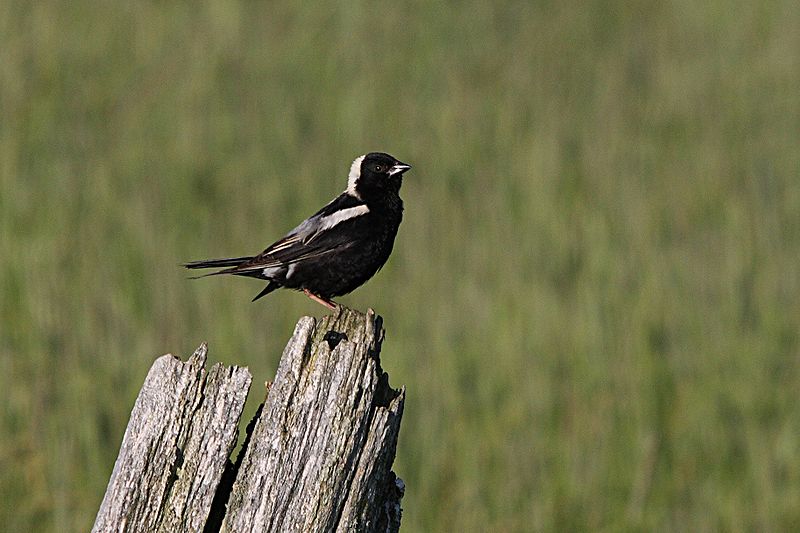
Bobolink (Dolichonyx oryzivorus) ©WikiC

Bobolink (Dolichonyx oryzivorus) ©WikiC

In summer, Bobolinks feed primarily on insects switching to grain crops as they migrate south. In migration and in winter uses freshwater marshes, grasslands, rice and sorghum fields.

Although the Bobolink typically feeds during the day, in migration, while building fat reserves for its long over water flight, it has been observed feeding in rice fields after dark on bright nights.

We all know that we are on the verge of migrating once and for all to heaven..

  • Have we stored reserves to migrate that long?
  • His words has the power to heal the broken and strengthen the weak…
  • His words shall never return empty…

My son, forget not my law; but let thine heart keep my commandments: For length of days, and long life, and peace, shall they add to thee. Let not mercy and truth forsake thee: bind them about thy neck; write them upon the table of thine heart: So shalt thou find favour and good understanding in the sight of God and man.

Trust in the LORD with all thine heart; and lean not unto thine own understanding. In all thy ways acknowledge him, and he shall direct thy paths. Be not wise in thine own eyes: fear the LORD, and depart from evil. It shall be health to thy navel, and marrow to thy bones. (Proverbs 3:1-8)

Bobolink (Dolichonyx oryzivorus) by J Fenton

Bobolink (Dolichonyx oryzivorus) by J Fenton

How many times do we read His words in a day? Maybe we should learn from these birds to eat His words even during our dark hours.

Thy word is a lamp unto my feet, and a light unto my path. (Psalm 119:105)

Judging by sight or sound, the Bobolink is a bird of distinction. Their song has been vividly described as

  • “a bubbling delirium of ecstatic music that flows from the gifted throat of the bird like sparkling champagne,”
  • “a mad, reckless song-fantasia, and outbreak of pent-up, irrepressible glee,” and as
  • “a tinkle of fairy music, like the strains of an old Greek harp.”

We may not be a good singer, yet, God loves to hear us sing. The reason for creating us is to sing, glorify and thank Him.  But, we seem to do every other thing except thanking Him…  Many of our prayers are unanswered, because, we have failed to thank when we pray..

Be careful for nothing; but in every thing by prayer and supplication with thanksgiving let your requests be made known unto God. (Philippians 4:6)

Have a blessed day!

Your’s in YESHUA,
a j mithra

Please visit us at: Crosstree


The Bobolink is in the Icteridae Family of the Passeriformes Order
*