Please read the article about this – Some Birds Were Created to Boogie
Posted using ShareThis
Posted using ShareThis
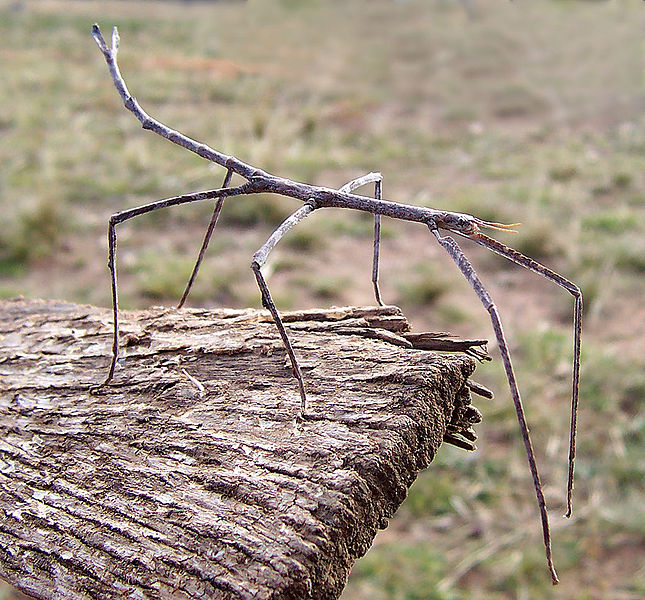
Stick Insect - Ctenomorpha chronus (by Wiki)

When I Consider!
Evidence From Biology
“One of nature’s masters of disguise is the stick insect. Stick insects are leaf eaters designed to look like little twigs. One tropical stick insect is as thick as a finger and the same color as the bamboo on which it is found. It even has swollen ridges just like bamboo! Other types have leafy flaps that match the leaves of the plants which they like to eat. Some stick insects even lay eggs that look exactly like the seeds of the plant on which they feed. A stick insect that’s found in New Mexico glues its eggs to grass stems. The position and shape of their pointed eggs exactly imitate the seeds of the grass!
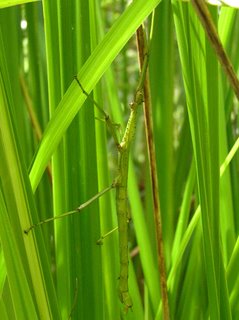
New Zealand Stick Insect - (Landcare Research Manaaki Whenua)
Although stick insects don’t fly, some of them have brightly colored wings that can fold quickly to scare away nervous birds who want to investigate them for lunch. Some stick insects will often sway with the breeze to make their illusion even more effective. Others will sit motionless for hours as if they are just another piece of dead wood.
Stick insects are even geniuses at using their predator’s weakness for their own protection. Birds understand this and will closely examine non-moving twigs in search of a meal. Stick insects will not even move when being carried away by a bird, thus fooling many birds into dropping them. Although these defense mechanisms were likely designed after the Fall, stick insects are clearly not the result of random mutations, but the intelligent design of a Creator.”
(Letting God Create Your Day, Vol 3, p194) – From A Closer Look at the Evidence by Kleiss, February 17.
Give unto the LORD the glory due unto his name; worship the LORD in the beauty of holiness. (Psalms 29:2 KJV)

Rufous-bellied Woodpecker (Dendrocopos hyperythrus) by Nikhil Devasar
When I Consider!
Evidence From Biology
Consider the probability of all of the following characteristics evolving simultaneously into an effectively functioning system in the woodpecker:
1. Its beak is connected to its skull with a resilient shock-absorbing tissue that is not found in any other bird.
2. The beak is much harder than the beaks of other birds, enabling it to bang away a hundred times a minute without hurting itself.
3. The tongue is barbed in most of the 200+ species and is about four times longer than the beak. In certain species the tongue wraps around the back of the bird’s skull, enabling it to reach deep into tree trunks and remove insects.
4. A sticky coating on some woodpecker tongues helps them grab insects.
5. Its tail feathers are constructed so that they are stiff enough to help brace against trees as it climbs.
6. Its keen senses of smell and hearing help detect insects crawling around under the bark of the trees.
7. It short legs and powerful claws are uniquely designed to help it climb tree trunks.
The engineering behind such a technological wonder as the woodpecker boggles our minds. Try to imagine the obstacles the first bird, which was trying to turn into a woodpecker, would have had to overcome!
The eyes of all wait upon thee; and thou givest them their meat in due season. Thou openest thine hand, and satisfiest the desire of every living thing. The LORD is righteous in all his ways, and holy in all his works. (Psalms 145:15-17 KJV)
From A Closer Look at the Evidence by Kleiss, November 6.
“The woodpeckers, piculets and wrynecks are a family, Picidae, of near-passerine birds. Members of this family are found worldwide, except for Australia and New Zealand, Madagascar, and the extreme polar regions. Most species live in forests or woodland habitats, although a few species are known to live in treeless areas such as rocky hillsides and deserts.
The Picidae are just one of the eight living families in the order Piciformes. Members of the order Piciformes, such as the jacamars, puffbirds, barbets, (also Asian and African barbets), toucans and honeyguides, have traditionally been thought to be very closely related to the woodpeckers, piculets and wrynecks. More recently, DNA sequence analyzes have confirmed this view.[1]”
“Members of the family Picidae have strong bills for drilling and drumming on trees and long sticky tongues for extracting food.[2] Woodpecker bills are typically longer, sharper and stronger than the bills of piculets and wrynecks; however their morphology is very similar. The bill’s chisel-like tip is kept sharp by the pecking action in birds that regularly use it on wood. Species of woodpecker and flicker that use their bills in soil or for probing as opposed to regular hammering tend to have longer and more decurved bills. Due to their smaller bill size, many piculets and wrynecks will forage in decaying wood more often than woodpeckers. The long sticky tongues, which possess bristles, aid these birds in grabbing and extracting insects deep within a hole of a tree. It had been reported that the tongue was used to spear grubs, but more detailed studies published in 2004 have shown that the tongue instead wraps around the prey before being pulled out.[3]
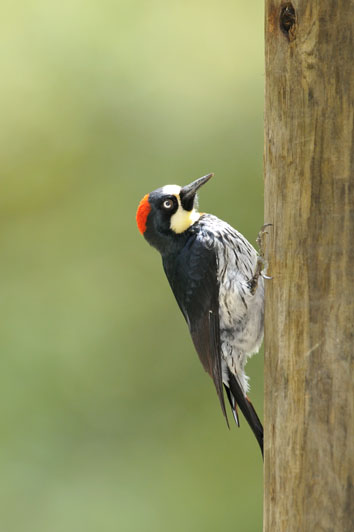
Acorn Woodpecker (Melanerpes formicivorus) by Reinier Munguia
“The diet of woodpeckers consists mainly of insects and their grubs taken from living and dead trees, and other arthropods, along with fruit from live trees, nuts and sap both from live trees. Their role ecologically is thereby keeping trees healthy by keeping them from suffering mass infestations.The family is noted for its ability to acquire wood-boring grubs using their bills for hammering, but overall the family is characterized by its dietary flexibility, with many species being both highly omnivorous and opportunistic. The insect prey most commonly taken are insects found inside tree trunks, whether they are alive or rotten wood and in crevices in bark on trees. These include beetles and their grubs, ants, termites, spiders,and caterpillars. These may be obtained either by gleaning or more famously by excavating wood. Having hammered a hole into the wood the prey is excavated by a long barbed tongue. The ability to excavate allows woodpeckers to obtain tree sap, an important source of food for some species. Most famously the sapsuckers, (genus Sphyrapicus ) feed in this fashion, but the technique is not restricted to these and others such as the Acorn Woodpecker also feed in this way. It was once thought that the technique was restricted to the New World, but Old World species such as the Arabian Woodpecker and Great Spotted Woodpecker also feed in this way.[2]”Wikipedia”
See Also:
When I Consider! – Woodpecker and Bones

Sunbittern (Eurypyga helias) by Lee at Lowry Park Zoo 2-4-10
Let them praise the name of the LORD: for his name alone is excellent; his glory is above the earth and heaven. (Psalms 148:13 KJV)
Today, Dan and I went to the Lowry Park Zoo in Tampa, Florida. I was thrilled to see some of the birds in person that I have been entering into the Birds of the World section. This Sunbittern caught my attention when he spread its wings out into the beautiful display shown below. I could not but think of the Lord’s magnificent creative power, details, and love that He gave His creatures. No, this bird is not specifically named in the Bible, but God’s Glory sure is.
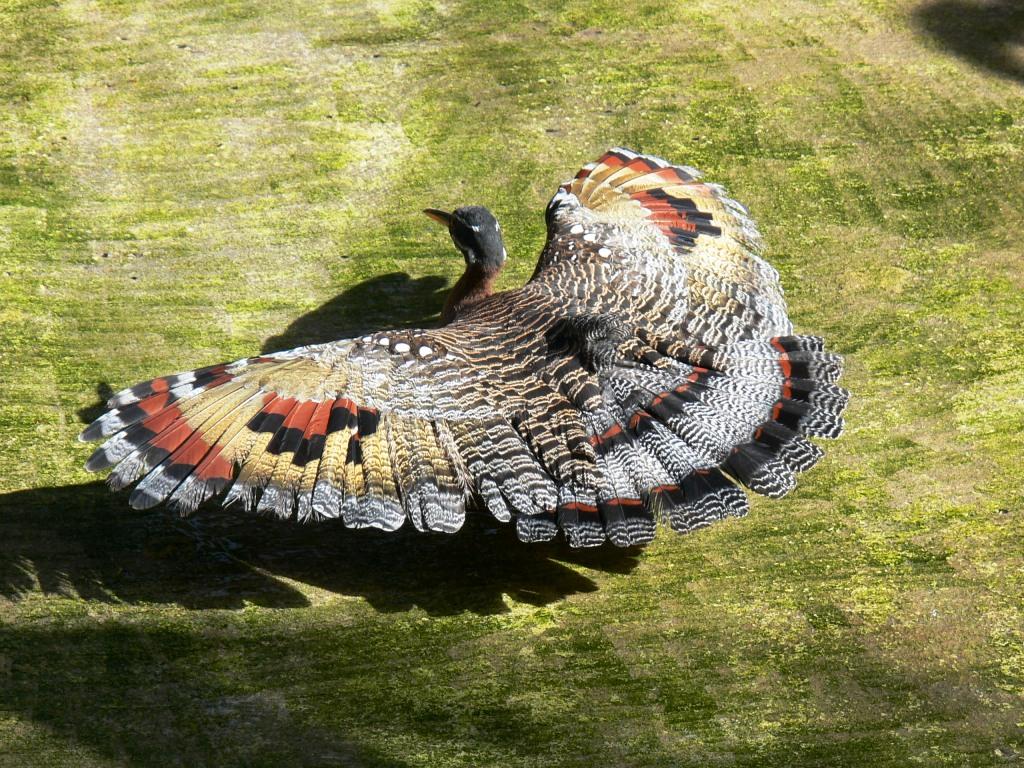
Sunbittern (Eurypyga helias) by Lee at Lowry Park Zoo
The Sunbittern is similar to a heron or bittern because it has a long straight pointed bill, long legs and a thin neck, but it is in the Eurypygidae family of the Eurypygiformes Order. Most likely they are of the same “kind”, but they like to separate them and then declare “convergent evolution” caused them to develop the “same but different.” They totally deny creation by our Creator God.
They are 17-19 inches (43-48 cm) and have “soft, lax flight feathers, which account for the species being almost silent in flight.” (Bird the Definitive Guide, p.208) They make their nests with leaves, grass, mud and she usually lays 2 eggs. Both parents feed the chicks. “Remarkably, the young molt directly into adult plumage, while still in the nest, which is extremely unusual…” They leave in 3-4 weeks. The wings are spread for displaying (to win their sweetheart’s attention) or for defense (to make them look larger), but the Lord also lets them spread their wings so we can enjoy them and behold His Creative designs.
O LORD, how manifold are thy works! in wisdom hast thou made them all: the earth is full of thy riches. (Psalms 104:24 KJV)
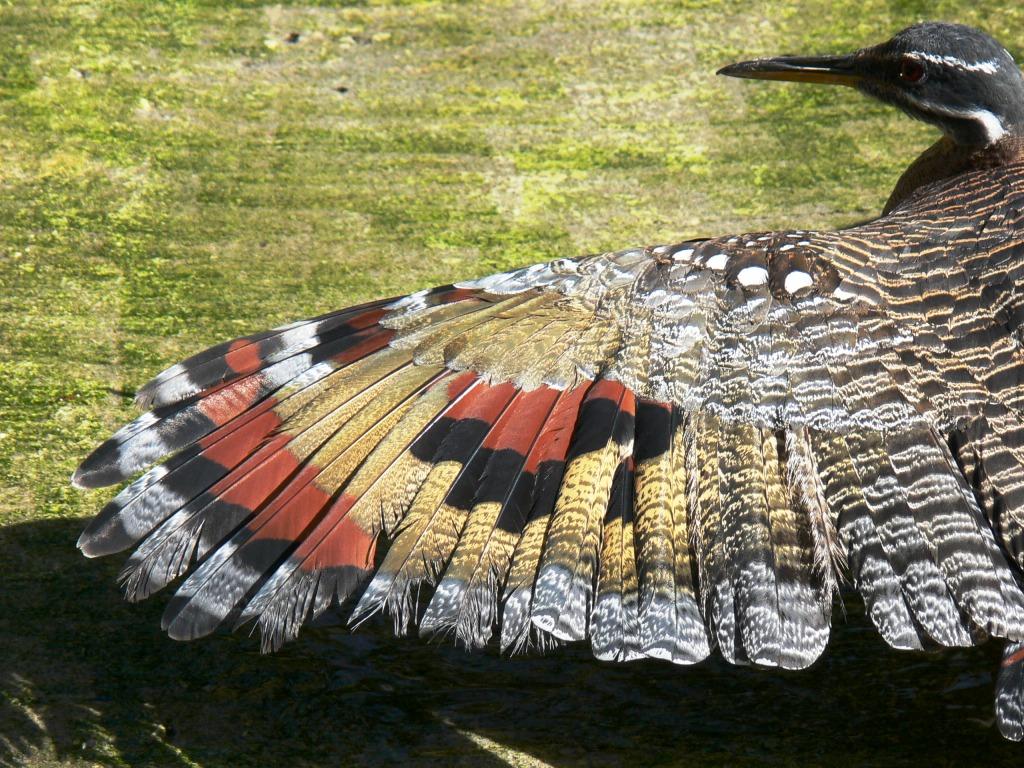
Sunbittern (Eurypyga helias) Left Wing by Lee at Lowry Park Zoo
All photos can be clicked-on to enlarge.

For as in Adam all die, even so in Christ all shall be made alive. (1 Corinthians 15:22 NKJV)
Today’s Creation Moments:
Some people think that they can believe in Jesus Christ as their Savior and at the same time believe God created through evolution. These people are called theistic evolutionists or progressive creationists. What kind of nature would a god have who creates through the death that is essential to evolution?
First, death would have to have begun from the very moment of creation. Death, disease, pain and suffering would have had to originate with this god. Long before man, according to evolution, dinosaurs were eating other dinosaurs, and entire species were dying out. Rather than loving us, such a god would be indifferent and capricious. The god that would use evolution to make living things would have no right to punish sin. He would have had no right to bring a worldwide Flood to punish sinful man. This kind of god would be nothing more than a bully. Such a god would not be likely to have given us his word. And nothing the Bible says about him could be true. If the Bible really is from him, it is full of untrue claims. Any god who created using evolution is not the God of the Bible. If you think about it, the god of evolution sounds surprisingly like the devil.
What’s wrong with believing that God created through evolution over millions of years? Any god that uses evolution and death to make us is extremely cruel. More importantly, if there was no first Adam to bring sin and death into the world, there was no need for Christ, Whom the Bible calls the last Adam, to die and save us from sin and death.
Prayer: I rejoice, dear Father, because you are gracious and merciful to me. Amen.
References: Creation, 9-11/99. pp. 42-45, “The god of an old Earth.”

And the earth brought forth grass, and herb yielding seed after his kind, and the tree yielding fruit, whose seed was in itself, after his kind: and God saw that it was good. (Genesis 1:12 KJV)
And God created great whales, and every living creature that moveth, which the waters brought forth abundantly, after their kind, and every winged fowl after his kind: and God saw that it was good. And God blessed them, saying, Be fruitful, and multiply, and fill the waters in the seas, and let fowl multiply in the earth. (Genesis 1:21-22 KJV)
“How wonderful! Your dog has just had puppies! But do you now have to sort through the litter and make sure there are no baby giraffes or kangaroos?

Painted Spurfowl (Galloperdix lunulata) by Nikhil Devasar
In God’s account of creation in Genesis 1, we repeatedly read that both plants and animals were created to reproduce “after their kind.” Genesis 1, in speaking about the creation of plants, repeats three times in just two verses that they are to reproduce “after their kind.” We see the same phrase repeated later in the chapter when animals are created. This is not just empty repetition. God is stressing a fundamental principle that all things reproduce “after their kind.” Mother dogs have puppies and mother cats have kittens. You can count on it.
Why does God stress this principle? Even before creation, God knew that humans would eventually sin and then seek to hide their responsibility by trying to explain things without a Creator. God knew that this idea of evolution would capture the faith of millions over the history of the world.
God stresses what our experience shows so that He might be harder for us to hide from. All things do reproduce after their kind. And despite evolutionists’ strong faith in evolution, they cannot offer one established scientific fact to explain how one kind of creature might eventually make a completely different kind!

Egyptian Goose (Alopochen aegyptiaca) by Daves BirdingPix
Prayer: I thank You, Lord, that You have made it hard for men to deny You. Yet men still deny You, seeking explanations and excuses outside of Your Word. I know that I, too, can do this, for I am both saint and sinner. I ask that You would correct me when I seek outside of Your Word what is already so richly provided to me in Your Word. Amen.”
© 2010 Creation Moments • All Rights Reserved
Updated 12/17/09
I just updated the Hoatzin’s article “Interesting Birds – Hoatzin”. Two videos were added to show this amazing bird. One is repeated here and both are on the Hoatzin page. To find out more aboat this strange bird that the Lord created – Click Here.
When I Consider!
Evidence From Biology – January 6
The Couch’s spadefoot toad of the Sonoran Desert is an example of how God takes care of creatures under extreme conditions. This toad lies dormant in the hot desert eleven out of twelve months each year. It has built-in sensors that tell it when a violent desert rainstorm occurs. The toad can detect vibrations of pounding rain miles away. It somehow knows to emerge from the sand when it rains so that the male toads can call for females as soon as pools of water form. Shortly afterwards the egg-laying is completed and the toads return to the sand, safe from the heat of the burning daytime sun. Most of the time the desert pools rapidly dry up, killing the eggs. Only under ideal conditions will some of the eggs hatch nine days later. The young toads have at most a few weeks to eat enough food to survive before burying themselves in the sand for the next eleven months while awaiting the another rainstorm.

Couch's Spadefoot Toad
Such survival instincts and mechanisms were probably not required before the Fall, when the world was designed as a paradise. In the current world, with its severe climates, such instincts and abilities seem to have been specifically designed for animals such as the spadefoot toad. How could this ability to adjust to such harsh weather conditions have evolved? Unless all of the abilities, instincts, and timing of the toads’ reproductive cycle were in place, the toads could never have survived the first severe season.
The wild animals honor me…because I provide water in the desert and streams in the wasteland… (Isaiah 43:20)
From A Closer Look at the Evidence, by the Kleiss’
From Wikipedia:
The Couch’s Spadefoot Toad, (Scaphiopus couchii) is a species of North American spadefoot toad native to the southwestern United States and the Baja region of Mexico. The epithet couchii is in honor of American naturalist Darius Nash Couch, who collected the first specimen while on a personal expedition to northern Mexico to collect plant, mineral and animal specimens for the Smithsonian Institution.[1]
These toads can be found throughout the Sonoran Desert, including Arizona. How can you tell the species? True toads have horizontal pupils but the spadefoots have vertical pupils (like cats). Look at the sole of a hind foot. There you’ll find the hard, dark “spade” that gives a spadefoot its name. There are only two spadefoot species in the Sonoran Desert of Arizona and California. If the space is sickleshaped, it’s Couch’s spadefoot, Scaphiopus couchi. If the spade is rounded, it’s the western spadefoot, Scaphiopus hammondii(called the southern spadefoot, Scaphiopus multiplicatus, in some field guides).

Spadefoot Foot by Thomas Eimermacher
Incidentally, the spades really are digging tools–spadefoots use them to burrow backward into the soil.
Once you’ve finished checking the animal, gently put it down where you caught it–it has important things to do–then wash your hands thoroughly in the water. Amphibian skin secretions can be quite toxic; they probably won’t affect your hands, but you won’t want to get them in your eyes, nose, or mouth.
Spadefoots live for the monsoon. They spend the rest of the year underground awaiting their wake-up call: the drumming of raindrops on the soil during a summer thunderstorm. As soon as the males dig out they go looking for rain pools, and when they find them they broadcast the news loudly as they can. The chorus draws silent female spadefoots from far and wide.
Mating is an urgent matter for spadefoots. Their tadpoles must hatch, grow, and change into toadlets before the pool evaporates in the summer sun. That’s why they do most of their mating the first night the pool forms. Couch’s spadefoot toadlets sometimes leave the puddle only nine days after the eggs are laid! Western spadefoots take longer–at least three weeks.
The warmth of the water speeds up the tadpoles’ growth. Meanwhile they devour everything even remotely edible. They scrape algae off rocks. They filter microorganisms from the water as they pump it over their gills. They gather in wriggling masses, stir up the muck on the bottom of the pond, and filter that. And unlike most tadpoles, which are exclusively herbivores and filter-feeders, spadefoot tadpoles are omnivores. They also eat dead insects and tadpoles, and” more.
See Also:
Couch’s Spadefoot Toad by LA Zoo
When I Consider!
Evidence From Biology – January 2
Although the original world was created perfect and without death, our fallen world requires creatures to adapt to difficult situations in order to survive. Even in the current world full of death and competition, the smallest of creatures exhibit amazing capabilities for survival in harsh environments. The female snowshoe rabbit is one such creature. During extreme drought or harsh winters, the stress of finding food triggers a chemical process in the pregnant female that stops and embryo’s growth. Her body then responds to this condition of physical weakness with a process called resorption. In this process, the mother completely reabsorbs the growing embryo. This mechanism allows the rabbit to survive by replenishing her own strength. She can later become pregnant during more favorable conditions.
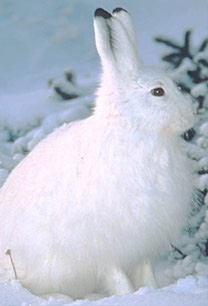
Snowshoe Hare or Rabbit
The number of chemical and physical changes required for a rabbit to reverse a pregnancy is mind-boggling. There is no scientific evidence which explains how this remarkable resorption process could have evolved. The creativity of God to have provided for the common rabbit in this way is truly amazing!
The LORD is gracious and righteous; our God is full of compassion. Psalm 116:5
From A Closer Look at the Evidence, by the Kleiss’
When I Consider!
Evidence From Botany – August 16
The skunk cabbage is a uniquely designed plant. It generates enough heat to melt the snow around itself so that it can begin to grow and flower. Even if the air temperature drops as low as 10oF, the skunk cabbage produces the heat it needs to maintain a temperature of between 72°F and 74°F. However, if the temperature stays extremely low for more than 24 hours, the hooded blower exhausts its heating ability and the flower dies. The skunk cabbage then prepares more flowers and repeats the process.

Western Skunk Cabbage from Wikipedia
This amazing plant also has a built-in thermostat. If the flower becomes too cold more heat is summoned. If the flower becomes too warm, the heat is withdrawn. Because of its amazing abilities, the skunk cabbage is one of the first plants to break through the snow in early spring. Normally, honeybees are unable to fly in temperatures below 65°F. However, when the skunk cabbages are in bloom, honeybees can fly when temperatures drop as low as 45°F. Inside the flower’s hood, the bees warm up enough to travel to the next cabbage flower. In cold weather the bees fly from one skunk cabbage to another, warming themselves as they travel back to their hive. Could this intricately designed flower be the result of random-chance mutational changes?
Character Sketches, Vol.III, P.209-212
I will ponder all your work, and meditate on your mighty deeds. Your way, O God, is holy. What god is great like our God? (Psalms 77:12-13 ESV)
Very interesting article from The Nature Institute, Skunk Cabbage (Symplocarpus foetidus)
Skunk Cabbage by Fairfax County Public Schools

Turkey Vulture Tree at Saddle Creek by Lee
We get to see lots of Turkey Vultures in this area. I have seen trees just loaded with them. They are ugly to look at, but are very useful.
The following is the October 6th’s “Evidence from Biology” article from A Closer Look at the Evidence, by Richard and Tina Kleis:
“The Turkey Vulture has incredible farsighted vision capable of seeing dead or dying objects several miles beyond what the human eye can detect. Yet it is designed with dull, weak, talons and a thin beak, forcing it to eek out an existence eating rotting flesh or decaying vegetables. Since the vulture eats the remains of animals that have died of disease, it has a digestive tract designed to destroy deadly bacteria (including anthrax!). The Turkey Vulture also has the ability to sanitize itself and its surroundings using a special disinfectant found in its own excrement. The same chemicals which kill the deadly bacteria in its stomach continue to kill the germs outside its body!
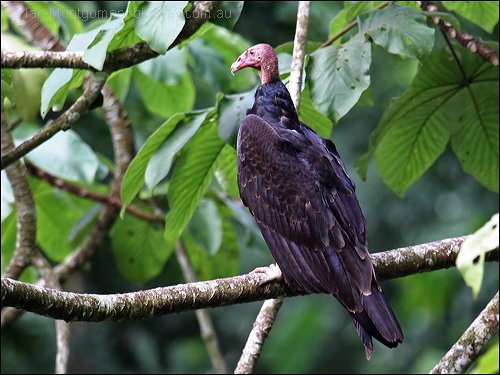
Turkey Vulture by Ian Montgomery
Because the vulture’s head is usually covered in blood, pieces of rotten flesh, and bacteria, it is especially vulnerable to disease. Therefore, this particular bird was created without feathers from the neck up. As the turkey vulture stands in the sun, the ultraviolet radiation kills any remaining bacteria.
By removing the carcasses of decaying animals, the turkey vulture serves an important purpose of limiting the spread of disease and preventing potential epidemics among both man and beast. One wonders how the turkey vulture could have evolved all of the specialized characteristics. The creation solution is that they were created with the original vulture-type bird. The survival characteristics needed for our fallen world were either given after the Fall or developed from originally created abilities.”
Character Sketches, Vol. III, p. 121-124
The LORD is righteous in all his ways, and holy in all his works. (Psalms 145:17 KJV)
Lee’s Extras:
We have mentioned the Vulture many times on the blog and especially in the places below. After all, they are one of the unclean birds that the Jewish people were not allowed to eat. After reading the above article, you can understand why they were off the “menu.”
There is a path which no fowl knoweth, and which the vulture’s eye hath not seen: (Job 28:7 KJV)
Birds of the Bible – Vulture
Vulture
Vulture Photos
Vulture Videos
Accipitridae – Kites, Hawks & Eagles

