For as the rain comes down, and the snow from heaven, and returns not there, but waters the earth, and makes it bring forth and bud, that it may give seed to the sower, and bread to the eater, so shall My Word be, that goes forth out of My mouth; it shall not return unto Me void, but it shall accomplish that which I please, and it shall prosper in the thing to which I sent it. (Isaiah 55:10-11)
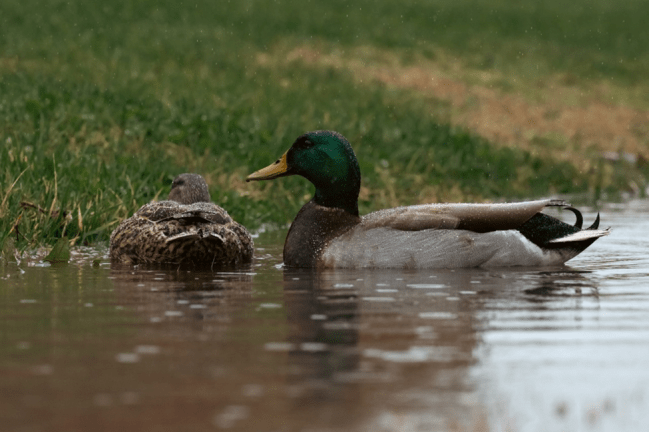
MALLARDS in rain-filled drainage ditch (Ian Sullens / U.S. Air Force photo credit)
Mallards like to float about in rainwater-runoff puddles and pools—in fact, a group of Mallards is sometimes called a “puddle” of Mallards. Mostly unnoticed by humans (even though Mallards are the world’s most ubiquitous duck), these delightful ducks serenely enjoy their own small part of God’s great global water cycle.
At my home, our front yard is bounded by roadside drainage ditches—so, when it rains a lot, those drainage ditches become brook-like pools of flooded rainwater.
Year after year after year, during the colder months (such as December), migratory Mallards (Anas platyrhynchos) seasonally seek out southern ponds and lakes, for over-wintering, yet they also frequent shallow rainwater-filled drainage ditches and rain-pooled puddles.
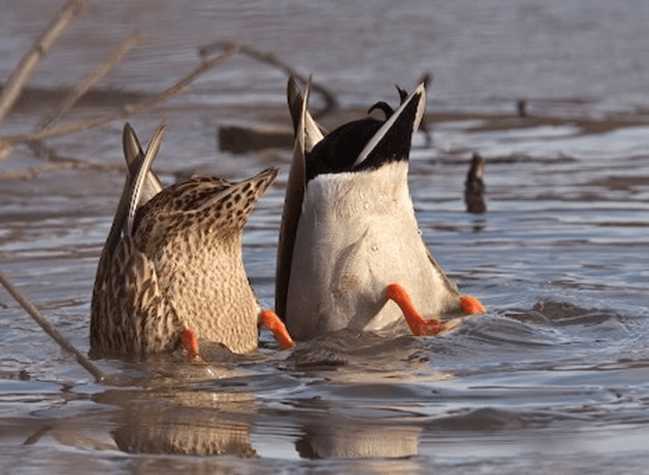
As dabbling ducks (a/k/a “puddle ducks”), they often “upend” in water, thus grazing on water-covered plants that they easily reach by flipping upside-down at the pooled water’s surface.
Dabbling ducks feed by straining food from the water’s surface or by submerging their heads while their tails remain out of the water. Male dabblers are usually brightly colored while females are drab. Plants make up most dabblers’ diets. Their method of taking flight is a sort of leap from the water’s surface. Look for them on rivers and close to shorelines. The most widely known dabbler duck is the mallard. The male has a dark green head while the female is dusky brown. Another dabbler species is the American black duck. Both male and female American black ducks look similar to mallard hens, only darker. Other dabblers include the American wigeon, green-winged teal, northern pintail (the male has long black tail feathers), and northern shoveler (named for its large, spatula-like bill). [Quoting CHESAPEAKE BAY JOURNAL, 33(9):40 (December 2023), posted at www.BayJournal.com ]
Since dabblers don’t dive into deep water, they don’t need large paddle-like feet for underwater propulsion mobility. So, it makes sense that God did not design dabbling ducks to have the larger paddle-shaped feet that diving ducks have. Also, it makes sense that dabbling ducks have legs (and feet) positioned near the middle of their bellies, for balancing themselves as they tread water, upside-down in shallow puddle-water, while the dabblers are grasping water-covered (and water-softened) acorns, nuts, seeds, and underwater plants.
God, in His providential care for the ducks He created, fitted His ducks with appropriate anatomies for the places they “fill” on Earth. Likewise, their behaviors fit their family life roles and territorial needs.
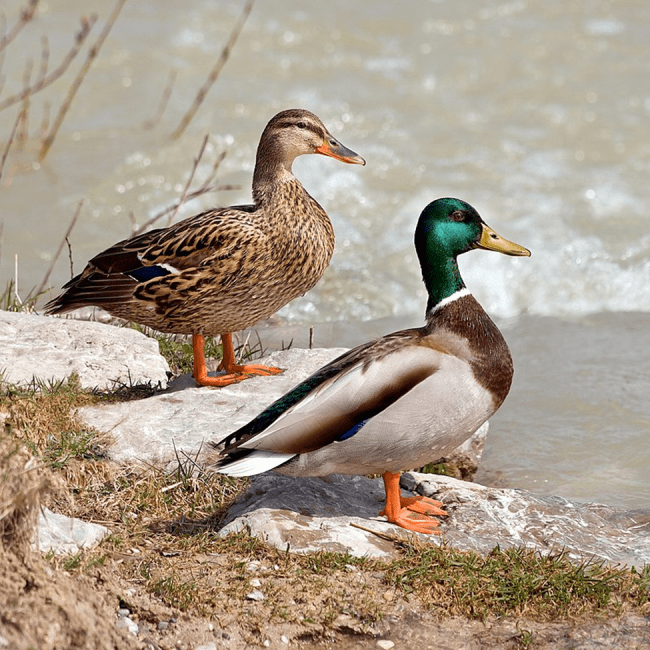
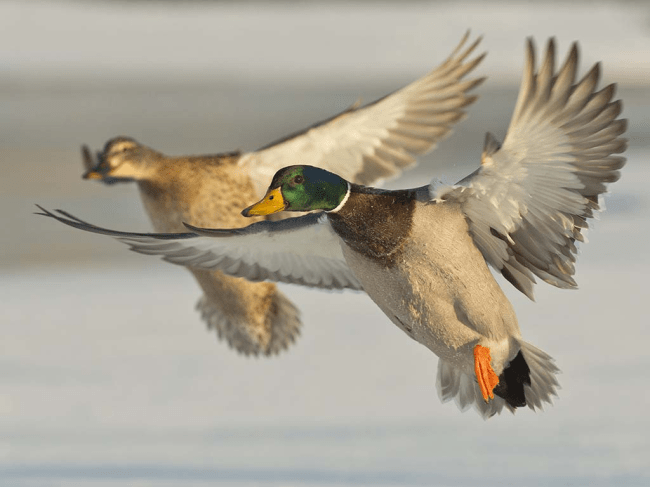
MALLARD male (R) & female (L) (Richard Bartz / Wikipedia photo credit)
Ornithologist Donald Stokes informs us that Mallards not only display sexual dimorphism (i.e., the 2 sexes have very different plumage, with the male being the distinctive “greenhead”), their vocalizations differ based upon sex:
When I first started studying Mallards I was surprised to find that the males and females make entirely different sounds. The quacking sound, which I had assumed all Ducks make, can be made only by the female. The male has two other calls of his own—a nasal rhaeb sound and a short Whistle-call. . . . An added advantage to knowing Mallard displays is that closely related species of Ducks such as Black Ducks, Gadwalls, Pintails, Widgeons and Teals have similar displays. Therefore, once you learn some of the patterns of Mallard behavior you will have a good start on being able to understand the behavior of these other Ducks as well. The Black Duck is particularly close in this respect, having nearly the same display repertoire as the Mallard. [Quoting Donald Stokes, GUIDE TO BIRD BEHAVIOR: VOLUME ONE (Boston, MA: Little, Brown & Company, 1979), pages 31-32]
Of course, hybrid ducks are common, proving that such hybridizing ducks really belong to the same created kind. For example, ornithologist Eugene McCarthy has documented that the Common Pintail (Anas acuata) is known to hybridize with the Mallard, as well as with American Black Duck (Anas rubripes), various pochards, various widgeons, various teals, Gadwall (Anas strepera), Northern Shoveler (Anas clypeata), and more. [See Eugene M. McCarthy, HANDBOOK OF AVIAN HYBRIDS OF THE WORLD (Oxford, UK: Oxford Univ. Press, 2006), pages 71-73.]
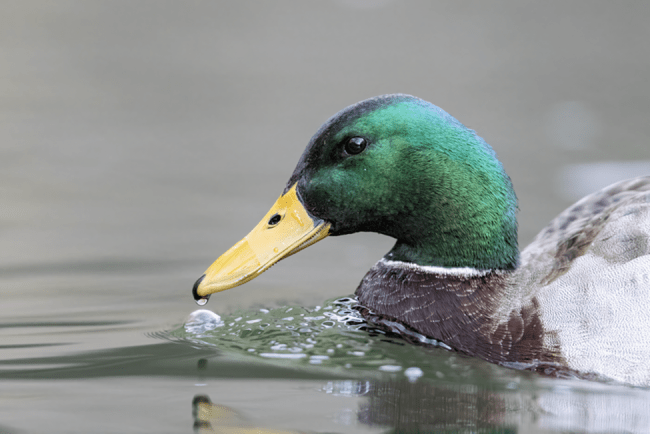
MALLARD MALE close-up (Chuck Homler / Wikipedia photo credit)
Interestingly, Mallards can be permanent (i.e., “year-round”) residents or migrants.
One of the reasons why mallard ducks are so plentiful is because they’re highly adaptable to climate, geography, temperature and diet. Particularly, they love shallow ponds, marshes and wetlands, as those calmer waters tend to produce the most aquatic bugs and plants—more so than fast moving rivers or deeper lakes. Mallards mate in pairs, and while some migrate to warmer temperatures, many are permanent residents in their nested homes throughout the United States. [Quoting Camo Trading, at www.camotrading.com/resources/the-upside-down-life-of-dabbling-ducks/ ]
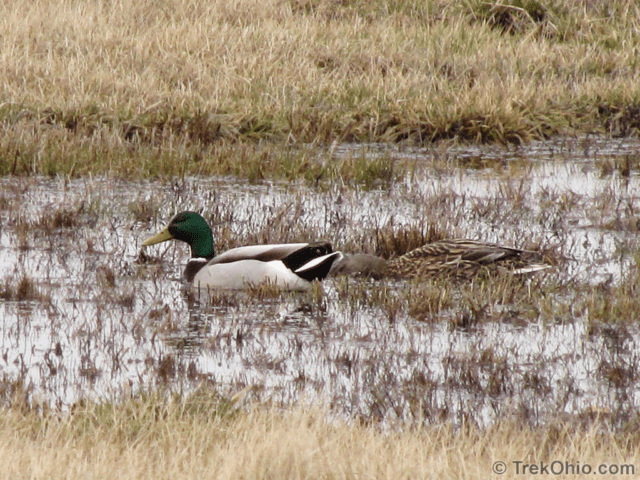
MALLARD male & female, in shallow wetland pool (TrekOhio.com photo credit)
In other words, God gave ducks what they need, anatomically and genetically (and even behaviorally)—for building families where they live—so that God’s ducks can be fruitful, multiply, and “fill” parts of Earth that God providentially prepared for their homes.
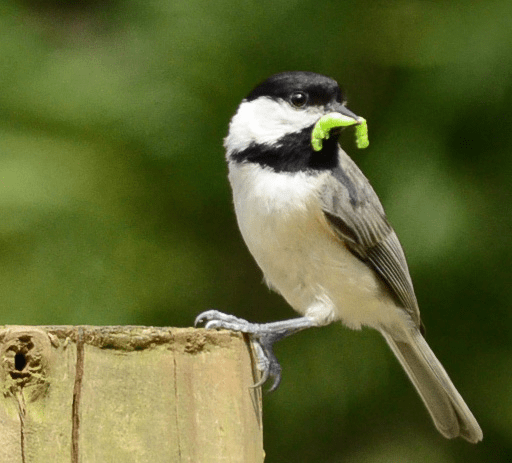
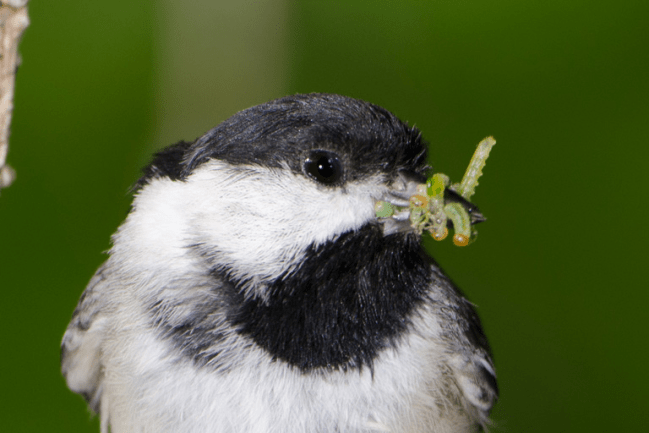
CHICKADEE WITH CATERPILLAR (photo credit: Deb Breton / Portland State University)
Lay not up for yourselves treasures upon earth, where moth and rust doth corrupt, and where thieves break through and steal; but lay up for yourselves treasures in heaven, where neither moth nor rust doth corrupt, and where thieves do not break through nor steal.
(Matthew 6:19-20)
Although moths are famous as pests, to humans (since Biblical times, as the above quote shows), moth caterpillars are desired and delectable food for hungry chickadees—and chickadees need lots of food energy for fuel, to live out their brave and busy lives.
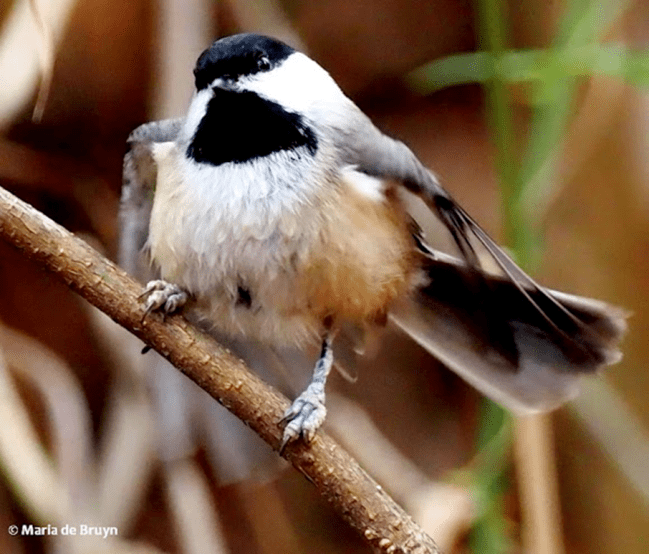
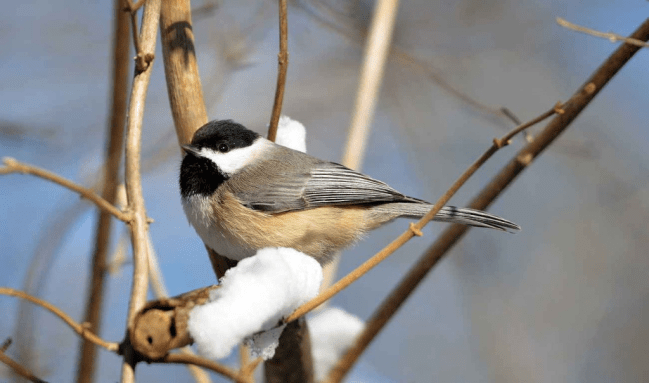
CAROLINA CHICKADEE ( photo credit: Maria de Bruyn / ProjectNoah.org )
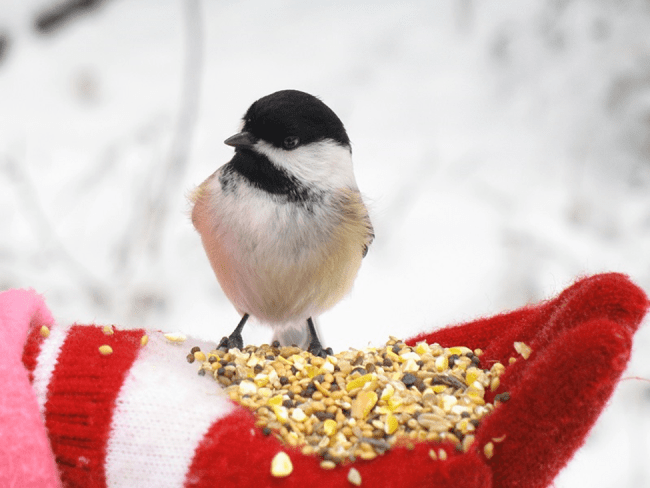
Chickadees are brave little birds, resilient enough to tough out winter weather, while less resilient birds migrate south for milder climes.
CHICKADEE, eating seeds during winter in Canada (photo credit: DiscoverSouthernOntario.com)
The resilience of these petite yet robust little passerines was recently appreciated by Alonso Abugattas (a/k/a “Capital Naturalist”*), in the May (A.D.2023) issue of CHESAPEAKE BAY JOURNAL. (*This is the same Alonso Abugattas, longtime natural resources manager for Arlington in Virginia, who was recognized as a “Regional Environmental Champion” by the Washington metro area’s Audubon Naturalist Society.)
One of my favorite birds is the chickadee. The Carolina chickadee (Poecile carolinensis) is the one we usually see around the Washington, D.C. area. The nearly identical black-capped chickadee (Poecile atricapillus) usually lives farther north, though the species overlap a bit in central and south Pennsylvania. The black caps are known to venture farther south during irruption years, when there is severe cold weather or food shortage. The energy and resourcefulness of chickadees, along with biological adaptations, allow them to live in our yards year-round. In winter, when most other insect-eating birds migrate [south], they augment their diet with seeds. People who feed birds are likely to find chickadees, which are particularly fond of black oil sunflower seeds, to be among their best customers. …
Chickadees have several ways of conserving energy [i.e., body heat when it is cold outside]. They fluff their feathers and grow up to 30% more feathers in winter to trap body-warmed air. They can also enter torpor [i.e., overnight semi-hibernation metabolic slowdown], reducing their body temperatures by as much as 20 degrees on winter nights to conserve fat reserves.
[Quoting Alonso Abugattas, “Meet the Carolina Chickadee, Resourceful ‘Bringer of News’”, CHESAPEAKE BAY JOURNAL, 33(3):39 (May 2023).]
CHICKADEE IN WINTER (photo credit: Howard Eskin / Backyards for Nature)
In Texas the Carolina Chickadee is a year-round resident in the north (even as far as the northeast corner of the Panhandle), east, and central (including much of the Edwards Plateau) parts. [See Roger Tory Peterson, A FIELD GUIDE TO THE BIRDS OF TEXAS AND ADJACENT STATES (Boston: Houghton Mifflin, 1988), a/k/a BIRDS OF TEXAS, at pages 141, plate 38, & 172.]
Chickadees are easy to identify: “Chickadees are the only small birds with the combination of black cap, black bib, white cheeks. … [noticeably] smaller than sparrows.” [Quoting Peterson’s BIRDS OF TEXAS, cited above, at page 172.]
However, distinguishing between Carolina Chickadees and Black-capped Chickadees is not so easy. In fact, these chickadees belong to the same created (on Day 5 of Creation Week) created “kind” of bird, because they successfully interbreed. (In fact, other chickadee hybrids are known, such as hybrids of Mountain Chickadees with Black-capped Chickadees.)
CHICKADEE HYBRID: BLACK-CAPPED X MOUNTAIN (photo credit: Steve Mlodinow / Bird Hybrids Blog)
Unsurprisingly, hybridization occurs where Black-capped Chickadees share ranges with Carolina Chickadees, such as in Colorado. [See Kelsey Simpkins, “The Chickadee You See Sitting on a Tree? It Might Be a Hybrid”, CU BOULDER TODAY (Oct. 22, 2022), posted by University of Colorado Boulder, at http://www.colorado.edu/today/2022/10/28/chickadee-you-see-sitting-tree-it-might-be-hybrid .] In fact, hybridization also occurs with the Black-capped Chickadee and its range-sharing cousin, the white eye-browed (but otherwise similar-looking) Mountain Chickadee.
Black-capped chickadee is by far the most common of the two i.e., of Black-capped Chickadees and Carolina Chickadees] and has a much wider range spanning pretty much the entirety of the USA and southern Canada, though they’re also found in Alaska. Conversely, the Carolina chickadee is relatively confined to the southeastern USA. The two birds converge [i.e., overlap in ranges] along a wide strip spanning from New Jersey to Kansas. In terms of looks, the Black-capped chickadee is slightly larger than the Carolina chickadee [which is an advantage for preserving body heat in cold winters]. The Black-capped chickadee also has more strongly contrasting plumage, including a paler breast and underside of the body. To confuse these birds further, they often hybridize (frequently!) across the strip where they meet, particularly when the Black-capped chickadees push further south during [winter] than they would usually do. Hybrid Black-capped and Carolina chickadees are pretty much impossible to identify [apart from DNA studies]. . . .
However, where Black-capped and Carolina chickadees meet, they can learn each other’s songs which renders this form of identification quite useless! For example, most Carolina chickadees sing Black-capped songs in Pennsylvania, and about 60% sing both Black-capped and Carolina songs. This intermixing of songs causes chickadees to sing strange mixes of each other’s songs, leading to increased hybridization.
The observed behaviors of chickadees are a study in themselves—they have special habits of communication (including vocalized “talking” and visual display “body language”), courting, breeding and nest life (including nest-building, egg laying, incubation, nurturing hatchlings, etc.), territory defense, and more.
BLACK-CAPPED CHICKADEE in Ontario, Canada (photo credit: DiscoverSouthernOntario.com)
One such behavior is territory defense, a behavioral habit that is unusual among North American passerine songbirds. In particular this has been observed of Black-capped Chickadees, though there is not reason to suspect this habit is absent among its southern Carolina cousins.
Black-capped Chickadees are unusual in terms of territory [stewardship]. Like some other birds, they hold both breeding and nonbreeding territories, but unlike any of our other common birds, their nonbreeding territory is occupied and defended by a flock and not by an individual bird or mated pair. These flocks are highly structured [i.e., organized] and have predictable patterns of movement. …
In late summer after the young [fledglings] have dispersed, Chickadees gather into small flocks that remain together until the start of the next breeding season. … A flock usually forms around a dominant pair that has just finished a successful brood. The flock contain six to ten birds, some juveniles, some paired adults, and some single adults. It establishes a feeding territory which it defends against other neighboring flocks. …
Once the breeding phase starts [in spring], winter flocks break up and you will have fewer Chickadees at your feeder. If one or two pairs remain in the area to breed, you may see the female do Wing-quiver [visual display] as she is fed by the male in courtship, and later you may see the young [hatchlings] do Wing-quiver as they are fed by the parents.
[Quoting Donald W. Stokes, A GUIDE TO BIRD BEHAVIOR, VOLUME I (Little, Brown, 1979), at pages 166, 171, 173]
Chickadees are also famous for another habit: gobbling up caterpillars!
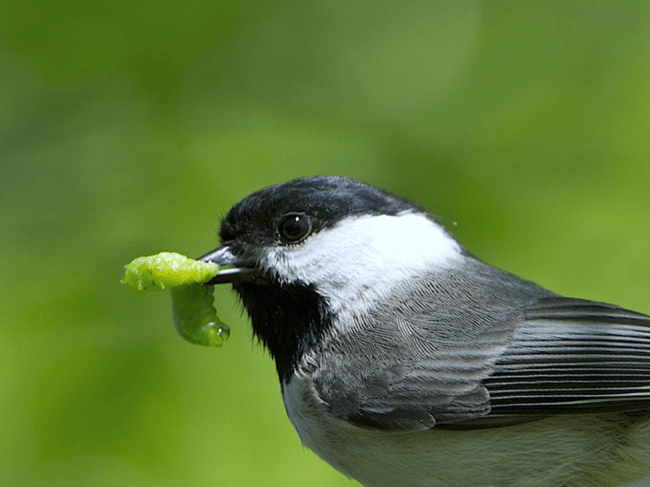
CHICKADEE EATING CATERPILLAR (photo credit: Doug Tallamy of Univ. of Delaware / News.Mongabay.com)
So, if you dislike swarms of insects (such as flies) during summertime, or if you fear moths marring your beautiful clothing (see Matthew 6:19-20), you should appreciate the moth-munching insectivorous diets of chickadees:
Chickadee parents feed their young almost exclusively on insects. Caterpillars [i.e., crawling insect larvae of butterflies and moths] are their favorite. It takes about 9,000 caterpillars to raise one brood. Studies have shown that when insects aren’t available, the young [chickadee hatchlings] can die if fed only seed. This is why chickadees prefer to nest near native trees (and, in turn, native insects) as opposed to yards with nonnative plants [that are less “hospitable” to the insect populations that chickadees prefer to eat]. Their reproductive success is at stake.
[Quoting Alonso Abugattas, “Meet the Carolina Chickadee, Resourceful ‘Bringer of News’”, CHESAPEAKE BAY JOURNAL, 33(3):39 (May 2023).]
CAROLINA CHICKADEE EATING CATERPILLAR (photo credit: Doug Tallamy, University of Delaware / Popular Science)
Caterpillars provide more metabolic value than just nutritious protein; because caterpillars contain carotenoids, eating caterpillars helps chickadee feathers to be colorful, bright, and shiny.
So, as moths (including their caterpillar larvae) remind us to store up incorruptible treasures in Heaven (Matthew 6:21), we can also appreciate how God has purposed many of those lepidopteran caterpillars to fuel the brave and busy lifestyles of chickadees.
CHICKADEE EATING CATERPILLAR (photo credit: Deb Breton / Portland State University)
FOREST RAVEN (Corvus tasmanicus): eBird.org / David Irving photo credit
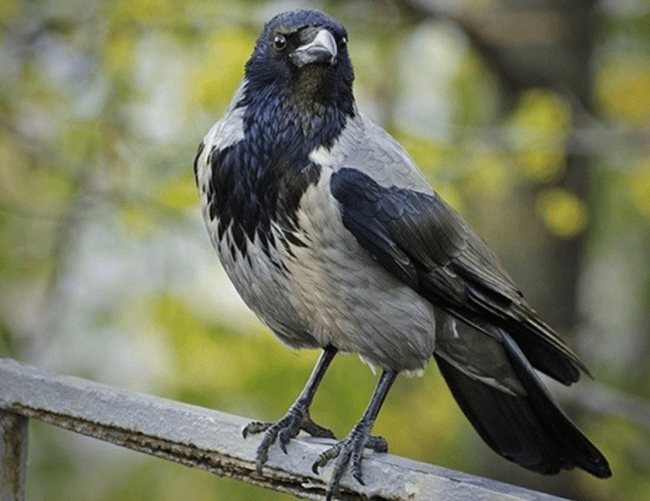
HOODED CROW (World Life Expectancy photo)
“Every raven after his kind” (Leviticus 11:15)
Who provides for the raven his food? When his young ones cry unto God, they wander for lack of food. (Job 38:41)
Consider the ravens: for they neither sow nor reap; they neither have storehouse nor barn, yet God feeds them; how much more are ye better than birds? (Luke 12:24)
[quoting from the HOLY BIBLE]
There is, as Moses noted, a “kind” (i.e., genetically related family) of birds that we call “corvids”, crow-like birds, including ravens. [In the English Bible (KJV), these birds are always called “ravens”.]
These black (or mostly black – see Song of Solomon 5:11) omnivores are known to “crow”, often calling out a harsh KAWWWW! Also famous for their “ravenous”appetites and eating habits, it is no wonder that the English labeled many varieties of these corvid birds as “ravens”.
The HOODED CROW (Corvus cornix) lives and thrives in the Great North – including Sweden, Finland, and Russia. This I learned firsthand, on July 6th of AD2006, while visiting a grassy park near the Vasa Museum of Stockholm, Sweden. The next day (July 7th of AD2006), it was my privilege to see another Hooded Crow in a heavily treed park in Helsinki, Finland. Again, two days later (i.e., the 9th of July, AD2006), while visiting Pushkin (near St. Petersburg, Russia), I saw a Hooded Crow, in one of the “garden” parks of Catherine’s Palace. Obviously, Hooded Crows appreciate high-quality parks of northern Europe!
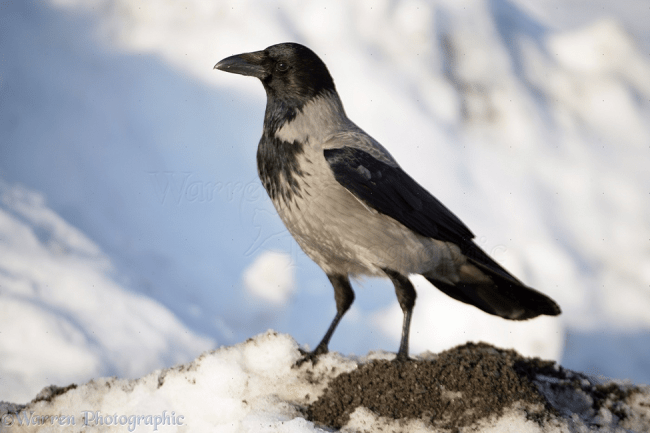
HOODED CROW (Warren Photographic photo credit)
The physical appearance of a Hooded Crow is, as one bird-book describes, “unmistakable”.
Unmistakable. Head, wings and tail black, but body grey (can show pinkish cast in fresh plumage).
[Quoting Chris Kightley, Steve Madge, & Dave Nurney, POCKET GUIDE TO THE BIRDS OF BRITAIN AND NORTH-WEST EUROPE (Yale University Press / British Trust for Ornithology, 1998), page 271.]
Like most large corvids, the Hood Crow is quite versatile in filling various habitats.
Wary, aggressive scavenger found in all habitats from city centre to tideline, forest to mountain top. Generally seen in ones and twos, but the adage ‘crows alone, rooks in a flock’ unreliable; often accompanies other crows, and hundreds may gather at favoured feeding spots and roosts. Watch for crow’s frequent nervy wing flicks whenever on ground or perched. Calls varied. Typically a loud, angry kraa, usually given in series of 2—6 calls. Unlike Rook, pairs nest alone (usually in tree).
[Again quoting Kightley, et al., POCKET GUIDE TO THE BIRDS OF BRITAIN AND NORTH-WEST EUROPE, page 271.]
CARRION CROW (Ouiseaux-Birds photo)
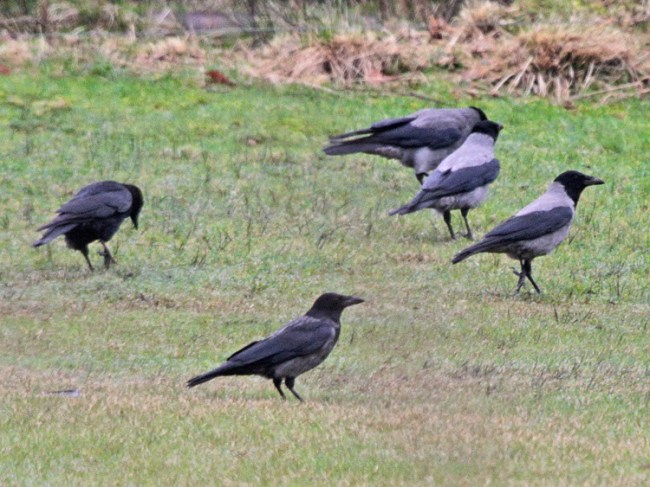
Yet the HOODED CROW is not a genetically self-contained “species”, regardless of what taxonomists might wish about them. They happily hybridize with other crows, especially the CARRION CROW [Corvus corone], whose international range the Hooded Crow overlaps.
CARRION AND HOODED CROWS. The familiar crow. Two distinct races occur … [In the]British Isles and western Europe, Carrion Crow (Corvus corone) is common everywhere except north and west Scotland, Ireland, Isle of Man and Europe east of Denmark, where it is replaced by Hooded (Corvus cornix). Where breeding ranges overlap hybrids are frequent [emphasis added by JJSJ].
[Again quoting Kightley et al., page 271.]
The Carrion-Hooded Crow hybrids are also noted within a larger discussion (i.e., pages 224-228) of Corvid family hybrids, in Eugene M. McCarthy, HANDBOOK OF AVIAN HYBRIDS OF THE WORLD (Oxford University Press, 2006), at page 227.
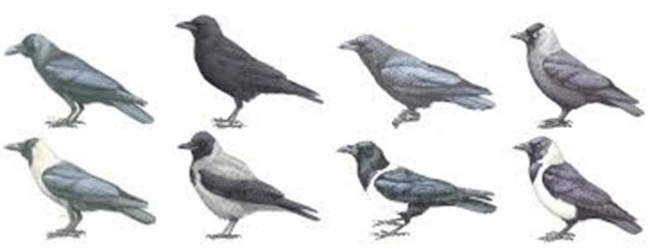
CORVIDS (Jelmer Poelstra / Uppsala University image credit)
Dr. McCarthy, an avian geneticist, has accumulated and summarized genetic research on Carrion-Hooded hybrids, especially examples observed in Eurasia:
Because the Carrion Crow has a split range … with the Hooded Crow intervening … there are two long contact zones, one extending from N. Ireland, through N. Scotland, to N.W. Germany, then S to N Italy, and another stretching from the Gulf of Ob (N Russia) to the Aral Sea. … Even in the center of the [overlap] zone, only 30% of [these corvid] birds are obviously intermediate. Due to hybridization these [corvid] birds are now sometimes lumped, but Parkin et al. (2003) recommend against this treatment since the two have obvious differences in plumage, as well as in vocalizations and ecology, and because hybrids have lower reproductive success than either parental type. Hybrid young are less viable, too, than young produced from unmixed mating (Saino and Villa 1992). Genetic variability increases within the hybrid zone (as has been observed in many other types of crossings). Occasional mixed pairs occur well outside [the overlap range] zones (e.g., Schlyter reports one from Sweden).
[Quoting Eugene M. McCarthy, HANDBOOK OF AVIAN HYBRIDS OF THE WORLD (Oxford Univ. Press, 2006), at page 227.]
Dr. McCarthy, on pages 224-228, lists several other examples of documented corvid hybridizations, including: Corvus capellanus [Mesopotamian Crow] X Corvus corone [Carrion Crow]; Corvus cornix [Hooded Crow] X Pica pica [Black-billed Magpie]; Corvus albus [Pied Crow] X Corvus albicollis [White-necked Raven]; Corvus albus [Pied Crow] X Corvus ruficollis [Brown-necked Raven]; Corvus albus [Pied Crow] X Corvus splendens [House Crow]; Corvus brachyrhynchos [American Crow] X Corvus caurinus [Northwestern Crow]; Corvus corax [Common Raven] X Corvus brachyrhynchos [American Crow]; Corvus corax [Common Raven] X Corvus corone [Carrion Crow]; Corvus corax [Common Raven] X Corvus cryptoleucus [Chihuahuan Raven]; Corvus corax [Common Raven] X Corvus levaillantii [Jungle Crow]; Corvus corax [Common Raven] X Corvus macrorhynchos [Large-billed Crow]; Corvus corax [Common Raven] X Corvus ruficollis [Brown-necked Raven]; Corvus corone [Carrion Crow] X Corvus macrorhynchos [Large-billed Crow]; Corvus daururicus [Jackdaw, a/k/a “Coloeus dauuricus”] X Corvus monedula [Jackdaw, a/k/a “Coloeus mondela”]; Corvus levaillantii [Jungle Crow] X Corvus macrorhynchos [Large-billed Crow]; Pica nuttalli [Yellow-billed Magpie] X Pica pica [Black-billed Magpie]; plus it looks like an occasional Rook [Corvus frugilegus] joins the “mixer”, etc. Looks like a good mix or corvids!
Avian hybrids, of course, often surprise and puzzle evolutionist taxonomists, due to their faulty assumptions and speculations about so-called “speciation” – as was illustrated, during AD2013, in the discovery of Norway’s “Redchat” — see “Whinchat, Redstart, & Redchat: Debunking the ‘Speciation’ Myth Again”, posted at https://leesbird.com/2017/12/12/whinchat-redstart-redchat-debunking-the-speciation-myth-again/ .
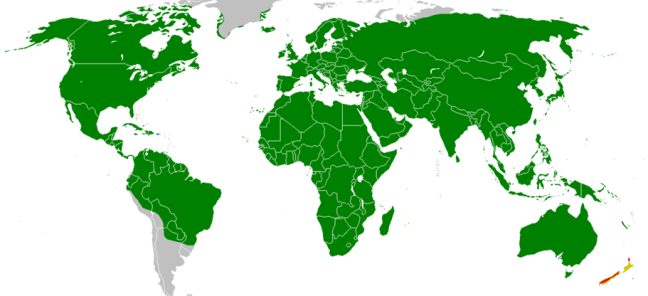
CORVID RANGES of the world (Wikipedia image credit)
Meanwhile, as the listed examples (of corvid hybridizations) above show, corvid hybrids are doing their part to “fill the earth”, includingHooded-Carrion Crows.
Now that is are something to crow about! ><> JJSJ profjjsj@aol.com
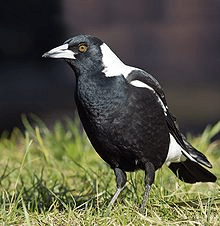
AUSTRALIAN MAGPIE (Gymnorhina tibicen) swooping to attack / CSIROscope photo credit
APPENDIX: CROWS & OTHER CORVIDS ARE REALLY SMART BIRDS!
Crows, as well as other corvid birds (i.e., members of the Crow-Raven family), fascinate children. They should amaze adults, too, yet often we are too busy to take time to ponder and appreciate the God-given traits of the creatures who share our world. Why should these birds capture our attention? They are alive!
Unlike plants, which are like biological machines (having no self-consciousness), higher-order animals like mammals and birds are truly alive, often displaying what might be called personalities. Although qualitatively distinct from humans—who are made in God’s image (Genesis 1:27)—animals have what Scripture calls a “soul” (the Biblical Hebrew noun is nephesh—see Genesis 1:20-21; 1:24; 2:19; 9:10; 9:12; 9:15-16 & Leviticus 11:46. ) This “soul” (nephesh)—is something more than the bird’s (or other animal’s) physical body. A bird’s nephesh-lifedeparts at death, yet its physical body remains. Thus, there is a difference between a bird’s immaterial life and its material body, just as we humans have physical bodies distinct from our own immaterial selves. The bird’s “soul” is revealed by how he or she intelligently thinks, communicates, learns, and makes decisions—including problem-solving choices.
Although many avian (and other animal) behaviors exhibit preprogrammed responses to outside world conditions, not all such behaviors are instinctive. Some such behaviors reveal that God chose to give these creatures real intelligence, real cleverness—demonstrated by abilities to learn new ideas, to fit new situations, and to solve practical problems of daily living.
As [Benjamin] Beck tells us in his book Animal Tool Behavior, [a crow] was fed partly on dried mash, which its keepers were supposed to moisten. But sometimes (being merely human) they forgot. The crow, undaunted, would then pick up a small plastic cup that had been provided as a toy, dip it into a water trough, carry the filled cup across the room to the food, and empty the water onto the mash. “If the water was spilled accidently,” Beck writes, “the crow would return to the trough for a refill rather than proceed to the food pan with an empty cup.” The bird was not taught to do this. “The [problem-solving] behavior appeared spontaneously,” Beck reports
[Quoting from Candace Savage, Bird Brains: The Intelligence of Crows, Ravens, Magpies, and Jays (San Francisco: Sierra Club, 1997), pages 2-4.]
Australian Magpie (Wikipedia photo)
For another example of a corvid bird—in this case a magpie—demonstrating problem-solving intelligence, consider how Australian magpies deal with the unforeseeable problem of a human-imposed GPS “backpack”, which hinders its avian wearer similar to the inconvenience of a human wearing an “ankle bracelet”:
Here, we describe one such study trialling [i.e., trial-experimenting] a novel harness design for GPS tracking devices on Australian Magpies Gymnorhina tibicen. Despite previous testing demonstrating the strength and durability of the harness, devices were removed within minutes to hours of initial fitting. Notably, removal was observed to involve one bird snapping another bird’s harness at the only weak point, such that the tracker was released.
[Quoting from Joel Crampton, Celine H. Frère, & Dominique A. Potvin, “Australian Magpies Gymnorhina tibicen Cooperate to Remove Tracking Devices”, Australian Field Ornithology, 39:7-11 (2022).]
Likewise, some corvid birds (such as scrub jays)—acting like helpful “first responders”—are known to rescue distressed “birds of [the same] feather”, when a predator is threatening one of their own kind.
What if a large predatory bird attacks a small bird (or its nest of hatchlings)? Oftentimes, in such situations, the imperiled bird’s alarm-cry is followed by a “mob” attack. In effect, a vigilante-like “posse” of small birds chase and peck the predator, so the predator quickly flees to avoid the group counter-attack. This has often been observed in corvid birds—the family of crows—such as Eurasia’s Siberian jay.
Jays sometimes gang up on owls and hawks, their primary predators, in an activity called “mobbing.” Uppsala University research [in Sweden] on Siberian jays, slated to appear in the Proceedings of the Royal Society Biological Sciences, investigated the specifics of how jays communicate when mobbing predators. The study found that these birds have “over 25 different vocalisations” which combine to form “over a dozen different calls [while mobbing], some of which are specific for owls and other [sic] for hawks.”
[Quoting from Brian Thomas, “Jay Talking”, Creation Science Update (June 29, 2009), posted at www.icr.org/article/jay-talking — quoting from a Uppsala University press release, “Siberian Jays Use Complex Communication to Mob Predators”, dated June 8, 2009]
Many other examples of problem solving by resourceful animals could be given. Domesticated livestock, family pets, wildlife, and laboratory-tested animals come up with clever solutions to the challenges of daily living to secure food, water, air, shelter, rest, information, and reproductive success. But the resourcefulness of animals should not surprise us.
Proverbs informs us that God wisely installed wisdom into the minds of corvid birds, as well as many other animals—even small creatures like ants, conies, locusts, and lizards. To literally translate what Proverbs 30:24 [chakâmîm mechukkâmîm] says about such animals, they are “wise from receiving [God’s] wisdom.” Truly amazing display — of God’s creativity and love for life !
><> JJSJ profjjsj@aol.com
father Australian Magpie (Corvus tibicen) feeding juvenile magpie (Wikipedia / Toby Hudson photo credit)
[P.S.: this blogpost updates and expands upon an earlier post on November 7th A.D.2018.]
Of fowls after their kind, and of cattle after their kind, of every creeping thing of the earth after his kind, two of every sort shall come unto thee, to keep them alive. (Genesis 6:20)
As my recent blogpost on Corvid hybrids illustrates [see blogpost reference below], birds feel no obligation to conform to taxonomist classifications of “genus” and/or “species” — because they limit their gene pool activities to the created “kind” categories that God gave to them, from the beginning, on Day # 5 of Creation Week (see Genesis 1:21), when God made different kinds of “winged fowl”. And, it follows likewise, that real-world corvids likely reject modern speculations (by “natural selection” advocates) that appear in public wearing the term “speciation”.
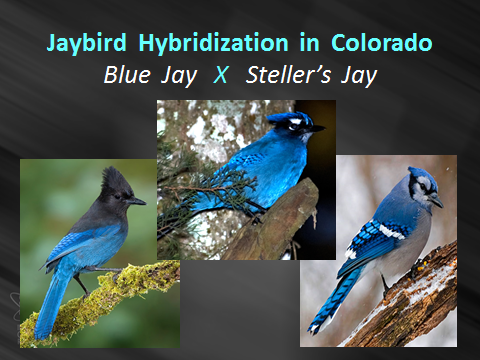
Accordingly, it should not shock us to learn that hybrids are observed where the Blue Jay and Steller’s Jay ranges overlap, in America’s Great West.
Hence, this limerick:
Caveat, Taxonomists: Jaybirds Mix It Up in Colorado!
In Western pines, before my eyes
A jaybird perched, to my surprise
Yet its front, wings, head, and back
Were feathered blue, not much black
Wow! Western jaybirds hybridize!
(Birder’s take-away lesson: don’t take terms like “species” and “speciation” too seriously.)
Whinchat, Redstart, and Redchat: Debunking the “Speciation” Myth Again
Dr. James J. S. Johnson
Are not two sparrows [στρουθια] sold for a farthing? and one of them shall not fall on the ground without your Father. But the very hairs of your head are all numbered. Fear ye not therefore, ye are of more value than many sparrows [στρουθιων]. (Matthew 10:29-31)
Are not five sparrows [στρουθια] sold for two farthings, and not one of them is forgotten before God? But even the very hairs of your head are all numbered. Fear not therefore: ye are of more value than many sparrows [στρουθιων]. (Luke 12:6-7)
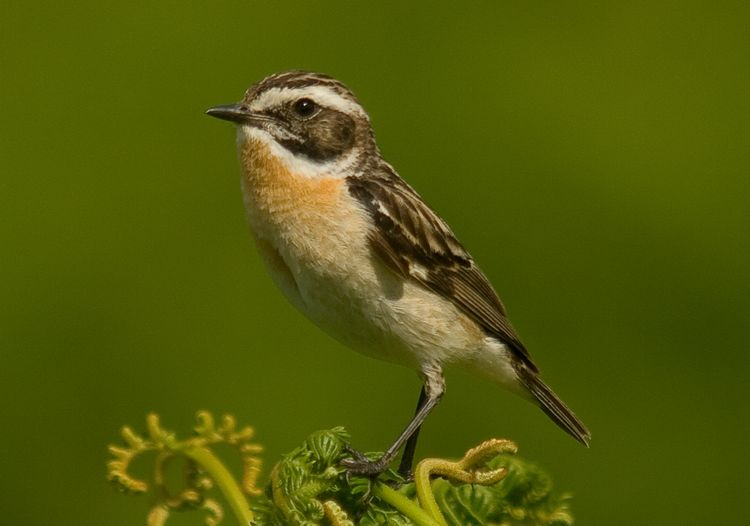
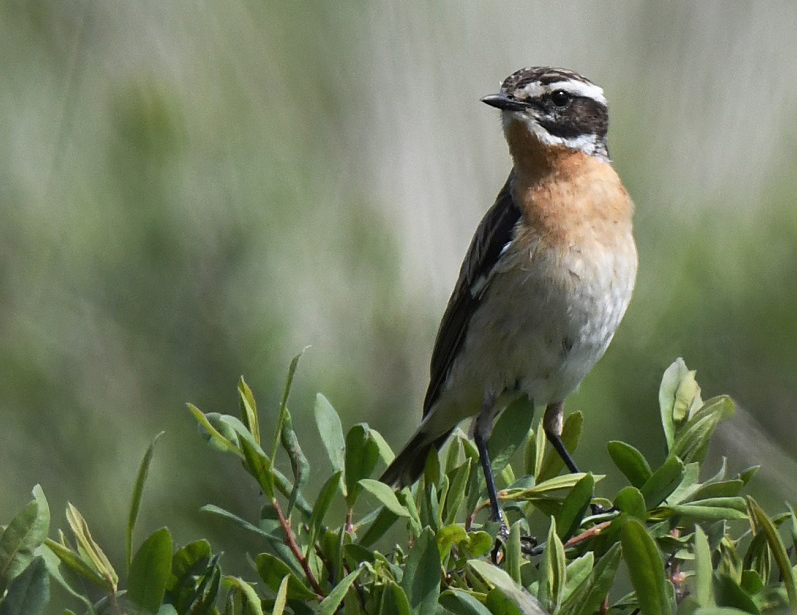
It’s good to know that we are worth far more, to God Himself, than many “sparrows”. However, the term “sparrows” (as quoted above) is an English translation of the New Testament Greek noun strouthion, a fairly general word for “small bird’ that can include many varieties of perching songbirds, in general, including yet not limited to the birds we label “sparrows”(1) — including the Whinchat, a sometimes inconspicuous little songbird that resembles a thrush, wheatear, or a flycatcher. (Or maybe a redstart?)
WHINCHAT Scottish Ornithologists’ Club
It was my privilege, on July 13th of AD2006, to view a Whinchat (Saxicola rubetra) among some roadside weeds, while in the fine company of my wonderful wife (Sherry) and Dr. Bill Cooper, England’s top-tier gentleman and scholar.
The bird-book that I was using, that day (as Laird Bill drove us along a motorway between Harwich and London), described the common Whinchat as follows:
Restless, short-tailed chat that perches openly on bush-tops, tall weeds and fences, flicking its wings and tail. Males in summer distinctive. Females and autumn birds can be confused with the female Stonechat, but Whinchat’s conspicuous creamy eyebrows, boldly streaked rump and white wedges at base of tail (often noticed as birds flick tail to balance in the wind) are reliable fieldmarks.
[Quoting Chris Knightley & Steve Madge, POCKET GUIDE TO THE BIRDS OF BRITAIN AND NORTH-WEST EUROPE (Yale Univ. Press, 1998), page 212.] The Whinchat is a summer migrant, visiting (and nesting in) Great Britain and much of western Europe during the spring and summer months, migrating south to northwestern Africa for the winter months. Its habits are typical of many other insect-eating passerines:
Nests on heaths, grassy moors, rough fields, damp rushy meadows and young coniferous plantations. Like Stonechat, pounces to the ground for insects, returning to same slightly elevated perch or flying quickly to another sprig nearby. Broken song mixes short musical phrases with dry churrs and distinct pauses. Call an agitated tu-tek, tu-tek-tek. Widespread on migration, often in some numbers in coastal bushes and fields.
[Again quoting Chris Knightley & Steve Madge, POCKET GUIDE TO THE BIRDS OF BRITAIN AND NORTH-WEST EUROPE (Yale Univ. Press, 1998), page 212.]
The Whinchat has other names, including Paapje (Dutch), Braunkehlchen (German), Traquet tarier (French), and Buskskvätta (Swedish: “bush chat”). [See Roger Tory Peterson, Guy Mountfort, & P.A.D. Hollom, BIRDS OF BRITAIN AND EUROPE (Houghton Mifflin / Peterson Field Guides, 5th rev. ed., 1993), pages 175-176.] Moreover, to the chagrin of taxonomic “splitters”, the Whinchat is known to hybridize with the Siberian Stonechat and the Common (European) Stonechat of western (and southern) Europe. [See Eugene McCarthy, HANDBOOK OF AVIAN HYBRIDS OF HE WORLD (Oxford, 2006), page 238.] – proving that those 3 chats descend form a common ancestor pair that survived the worldwide Flood aboard Noah’s Ark.
More surprising, to the birding community, is the capture and DNA verification (by the Lista Bird Observatory in Vest-Agder, Norway, during September AD2013) of a hybrid parented by male Common Redstart (Phoenicurus phoenicurus) and a female Whinchat (Saxicola rubetra), published in the Journal of Ornithology.(2)
Common Redstart x Whinchat HYBRID
Photograph by Jonas Langbråten
(18 Sept. AD2013, Lista Bird Observatory, Vest-Agder, Norway)
The male Redstart-Whinchat hybrid was captured by bird-banding volunteers, near the southern tip of Norway’s peninsula.
“We have a standardized bird banding project where we mark migratory birds in the spring and autumn. We have volunteer bird watchers going every hour to catch birds in mist nets to band them,” says Jan Erik Røer from the Norwegian Ornithological Society.
The hybrid’s unofficial name is rødskvett (“redchat”), blending parts of the Norwegian words (Buskskvett and Rødstjert) for its two parents.
Needless to say, this little “redchat” has caused a lot of confusion and controversy among evolutionists at the Natural History Museum in Oslo, where the “speciation” mythology (of supposed biogenetic divergence, “13.3 million years” ago) is popularly taught, as ifthere was real “science” (empirical or forensic) to support that imaginary scenario.(3)
Once again the “speciation” myth of “natural selection”-advocating evolutionists, both theistic and atheistic, is debunked by the real-world evidence.
References
When the Lord Jesus referred to God’s watchcare over “sparrows” (English translation for Greek strouthion], He used a Greek word that is more general in its categorical coverage than is our English term “sparrow”. The Greek noun strouthion denotes a bird in the wild, possibly any small perching songbird, including but not limited to what we call “sparrows”. (In fact, the Septuagint translators used strouthion to translate the Hebrew noun tsippôr, in Psalm 84:3a [84:4a BH], which is usually translated simply as “bird” (e.g., Genesis 7:14; Deuteronomy 14:11 & 22:6; Psalm 104:1; Ezekiel 39:4) or “fowl” (e.g., Deuteronomy 4:17; Nehemiah 5:18; Ezekiel 17:23 & 39:17). The Septuagint translators also used strouthion to translate the Hebrew double-noun qe’ath-midbâr in Psalm 102:7b, a construct phrase that refers to some bird or birds that habituate open desert or semi-desert areas.)
See Silje Hogner, Albert Burgas Riera, Margrethe Wold, Jan T. Lifjeld, & Arild Johnsen, “Intergeneric Hybridization Between Common Redstart Phoenicurus phoenicurus and Whinchat Saxicola rubetra Revealed by Molecular Analyses”, JOURNAL OF ORNITHOLOGY, 156(3):829-836 (2015), cited in Dave Appleton’s “Common Redstart x Whinchat”, BIRD HYBRIDS (1-13-AD2016), posted at http://birdhybrids.blogspot.com/2016/01/common-redstart-x-whinchat.html . This unexpected hybrid is discussed in Ingrid Spilde’s “Mysterious Bird was Unique Cross of Two Unrelated [sic] Species”, Science Nordic (3-11-AD2015), posted at http://sciencenordic.com/mysterious-bird-was-unique-cross-two-unrelated-species .
See 1st Timothy 6:20, regarding the folly of “’science’ falsely so-called”. See also, accord, John 3:12.








 Lee's Birdwatching Adventures Plus