Birds – The Engineers..

Birds – The Engineers.. ~ by a j mithra

Birds are capable of grand engineering feats. But are they engineers?  Not in the way you might think. Just as birds know how to fly, they know how to build a nest without instructions or apprenticeship. It’s a matter of instinct. Birds craft their nests without consciously thinking about it. How then did some species of birds develop such well-engineered, elaborate nests?

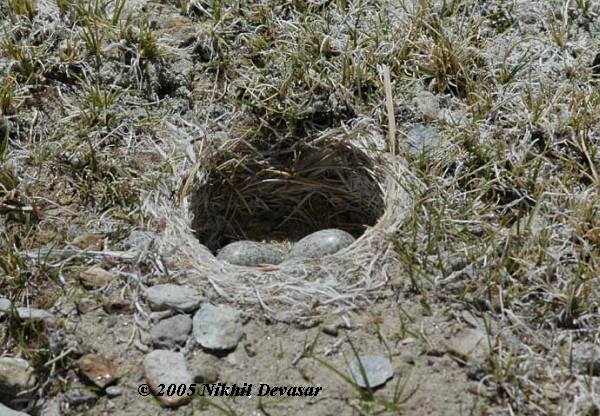
Horned Lark (Eremophila alpestris) Nest w/eggs by Nikhil Devasar

Horned Lark (Eremophila alpestris) Nest w/eggs by Nikhil Devasar

Horned Larks nests showed a significant northern bias in orientation angle and were 49% shaded in the early afternoon, the hottest part of the day. A northern nest orientation ensures maximal shading by the grass tuft to the south, may protect nests from cool evening winds, and provides increased daytime ventilation of the nest through exposure to prevailing winds. In addition, shade may also help conceal nests from predators.

  • From where did these birds learn to choose the location to build their nests?
  • Have we ever thought about the direction in which we need to have the front door of our house?
  • Is our choice based on location or direction of the house?

When JESUS becomes our direction, HE gives the best location..

I am the door: by me if any man enter in, he shall be saved, and shall go in and out, and find pasture. (John 10:9)

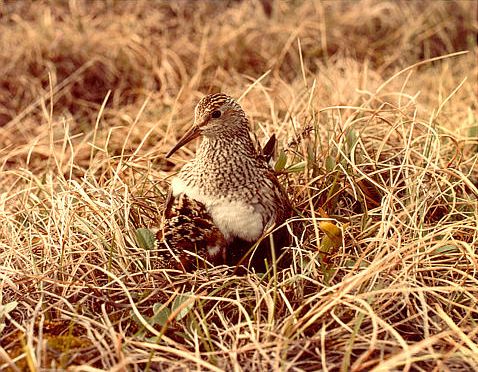
Pectoral Sandpiper (Calidris melanotos) ©WikiC

Pectoral Sandpiper (Calidris melanotos) ©WikiC

Pectoral Sandpipers nest on the arctic tundra, often near water. The nest is lined with grass, moss and lichens. They do not use lining materials according to local availability. Instead, relative use was correlated with a material’s insulative quality when wet and they therefore use lining materials appropriate to minimizing heat loss given their damp breeding environment.

And he shall be like a tree planted by the rivers of water, that bringeth forth his fruit in his season; his leaf also shall not wither; and whatsoever he doeth shall prosper. (Psalm 1:3)

Blue Tit (Parus caeruleus) by Robert Scanlon

Blue Tit (Parus caeruleus) by Robert Scanlon

Female Blue Tits gather lavender, yarrow, curry, mint and other scented plants for their nests shortly after laying eggs, and continue to do so until the chicks leave home. They are real botanists and do a great job exploiting their environment to protect their chicks. The birds make a pot-pourri of 10 aromatic plants from the 250 species in their habitat. Many of the chemicals in these plants ward off bacteria,
viruses, parasites, fungi and insects.

Our nest is covered by the blood of JESUS and no harm shall enter…

And the blood shall be to you for a token upon the houses where ye are: and when I see the blood, I will pass over you, and the plague shall not be upon you to destroy you, when I smite the land of Egypt. (Exodus 12:13)

Common Waxbill (Estrilda astrild) by Daves BirdingPix

Common Waxbill (Estrilda astrild) by Daves BirdingPix

Common Waxbills are small African finches select carnivore scat as a material to include in, on, and around their nests to reduce predation risk…

A South American Ovenbird may take months to fashion one nest from clay or mud mixed with bits of straw, hair, and fibers. The tropical sun bakes the walls brick-hard.

Bald Eagles, which use sticks, some two inches thick and several feet long, to make nests sturdy enough to support a human adult.

Chimney Swift using saliva as glue to help support its nest.


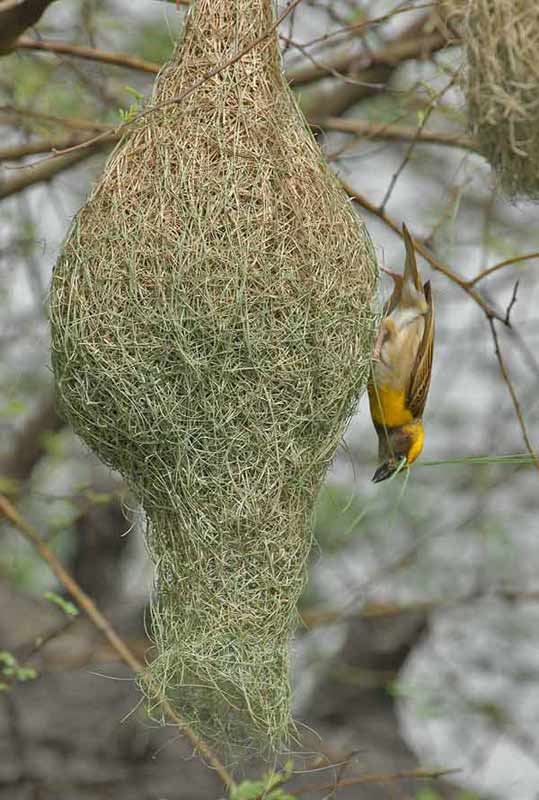
Baya Weaver (Ploceus philippinus) by Nikhil Devasar

Baya Weaver (Ploceus philippinus) by Nikhil Devasar

Baya Weaver nests in colonies of up to 20-30 pairs, usually in trees near freshwater and open ground. Their nests hang from a branch and look like an upside-down flask. A long tube leads to a side entrance,  making it difficult even for snakes to enter the nest. Nests are made entirely out of strips of grass
that the birds collect by cutting a notch in some tall grass, then stripping off a 30-60 cm long piece. A newly-made nest is green with fresh grass and turns brown as the grass dries. A bird may make up to 500 trips to complete a nest.

  • GOD has given us a home and a family with a purpose….
  • Most of us are trying hard to be like others and to live like others…
  • HE loves us as we are so; let us live the way HE wants us to live…

Sparrows never try to live like Eagles. Do they? If we are a sparrow, so be it and if we are an Eagle, so be it. After all, a sparrow cannot live like an Eagle and an Eagle cannot live like a Sparrow…

I will make a man more precious than fine gold; even a man than the golden wedge of Ophir. (Isaiah 13:12)

Bird nests vary from a simple accumulation of materials on the ground to elaborate refuges in or on secluded and elevated substrates. Nest construction and placement are correlated with flight ability. Some birds create a simple depression in the ground to harbor their incubating eggs. The progression of nest complexity moves from cryptic ground nests to simple elevated nests. Birds which construct elevated nests in a bush or tree or on a cliff or rock ledge tend to be better fliers than simple ground nesters.

  • You may be wondering why GOD has placed you as a ground nester while you desire to be an elevated nester…
  • You may be wondering why you have not got a place you feel that you deserve…
  • May be GOD feels that you would get hurt if you are an elevated nester..
  • Or maybe HE feels that you are not best equipped to be in a higher place…

Humble yourselves therefore under the mighty hand of God, that he may exalt you in due time: (1Peter 5:6)

  • GOD had HIS nest in heaven and because HE loved us so much,
  • HE stirred up HIS nest and wandered without a nest to be crucified for our sins…
  • So that HE may nest in us…
  • HE needs a nest that is why HE is knocking at the door of your heart….
  • Do you have a place for HIM to nest?

Please do not forget that HE is building an eternal nest for us live with HIM forever and ever.

Behold, I stand at the door, and knock: if any man hear my voice, and open the door, I will come in to him, and will sup with him, and he with me. (Revelation 3:2)

Have a blessed day!

Your’s in YESHUA,
a j mithra

Please visit us at: Crosstree


See:
Gospel Message

Wordless Birds

Birds of the Bible – Nests

*

Humming Birds – The Believing Believers… by a j mithra

a j mithra has produced another video using a hummingbird video with his thoughts and music.

We had previously done this as an article, then a j turned it in to a video. Absolutely amazing.

The Hummingbird – The Believing Believer…

The Bible says,”But ask now the beasts, and they shall teach thee; and the fowls of the air, and they shall tell thee: (Job12:7)

He says:

Here are some of the many things that we can learn from these small little wonderful Humming Birds…

Trust you enjoy watching this video.

*

YouTube’s  NATURE | Behind the Scenes of “Hummingbirds” | PBS is where the video came from (I think) and tells how the shots of the Hummingbirds were taken.

*

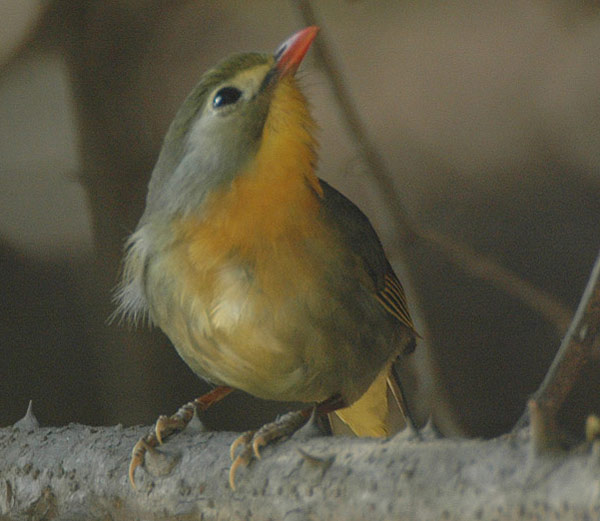
Red-billed Leiothrix – The Rain Seeker…

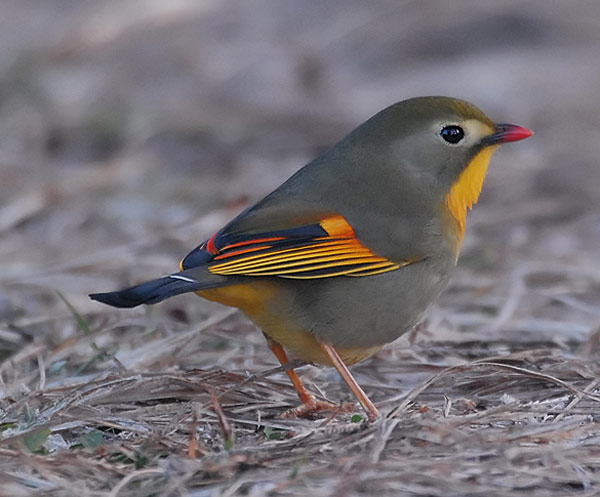
Red-billed Leiothrix (Leiothrix lutea) by Dan's Pix. at National Aviary

Red-billed Leiothrix – The Rain Seeker… ~ by a j mithra

Red-billed Leiothrix are native to Southern Asia ranging from central Himalayas in India and Nepal, eastwards to Burma and Vietnam. Leiothrix prefer to inhabit underbrush at all elevations with a cover of dense vegetation near the ground. These birds are found at elevations 700 m to 2000 m in winters and 1500 m to 2700 m in summers. Flocks of Leiothrix’s have been known to fly up to elevations of 4500 m for a short period of time.

These birds favor areas with at least 40 inches of rain.

  • We go to church, pray and give offering, but still, many of us are dry in spirit.. Why?
  • These birds have a thirst to stay in places where there is abundant rain…
  • God pours out His spirit according to our thirst…

He has promised to pour His spirit on all flesh…

For I will pour water upon him that is thirsty, and floods upon the dry ground: I will pour my spirit upon thy seed, and my blessing upon thine offspring: (Isaiah 44:3)

Red-billed Leiothrix (Leiothrix lutea) by Nikhil Devasar

Red-billed Leiothrix (Leiothrix lutea) by Nikhil Devasar

The leiothrix can usually be found in a group of about ten to thirty birds during the non-breeding season; however, during the breeding season the birds break off into pairs and become territorial.

  • We as believers, do we congregate often or just on Sundays?
  • The word of God encourages us to have corporate worship…
  • Jericho came down through corporate worship..
  • Battle was won through corporate worship…
  • Jesus too had promised to be in the midst of those who unite in His name in twos and threes…

The presence of the Lord flows like a river during corporate worship..

A Song of degrees of David. Behold, how good and how pleasant it is for brethren to dwell together in unity! It is like the precious ointment upon the head, that ran down upon the beard, even Aaron’s beard: that went down to the skirts of his garments; As the dew of Hermon, and as the dew that descended upon the mountains of Zion: for  there the LORD commanded the blessing, even life for evermore. (Psalm 133)

Though we need to dwell together in unity, at times, like these birds who break off into pairs, we need to have an intimate and personal relationship with our Saviour..

  • Jesus set Himself as an example by spending time alone in prayer..
  • How much time do we spend on our knees?

But thou, when thou prayest, enter into thy closet, and when thou hast shut thy door, pray to thy Father which is in secret; and thy Father which seeth in secret shall reward thee openly. (Mathew 6:6)

Red-billed Leiothrix (Leiothrix lutea) by Nikhil Devasar

Red-billed Leiothrix (Leiothrix lutea) by Nikhil Devasar

These birds seem to teach us about the importance of Praise and Prayer isn’t it? These birds have a song which consists of short powerful notes that are repeated continuously throughout the year but it is more persistent during the breeding season… This period usually lasts from early April until September and they are usually found around well watered areas.

Above it stood the seraphims: each one had six wings; with twain he covered his face, and with twain he covered his feet, and with twain he did fly.

And one cried unto another, and said, Holy, holy, holy, is the LORD of hosts: the whole earth is full of his glory. (Isaiah 6:2,30)

  • The Seraphins has been singing the same phrase since creation…
  • But, they don’t seem to feel bored at all…
  • But, most of us feel bored when the church sings the same song over and over again. Why?

The males also sing long complex songs with a wide array of syllables to attempt to attract the female…

  • Do you know how the power of worship?
  • Our worship will not let the Creator of the Universe sit in His throne..
  • It is that powerful..
  • So, sing and don’t let the King sit in His throne forever….

All the ends of the world shall remember and turn unto the LORD: and all the kindreds of the nations shall worship before thee. (Psalm 22:27)

Have a blessed day!

Your’s in YESHUA,
a j mithra

Please visit us at: Crosstree


Lee’s Addition:

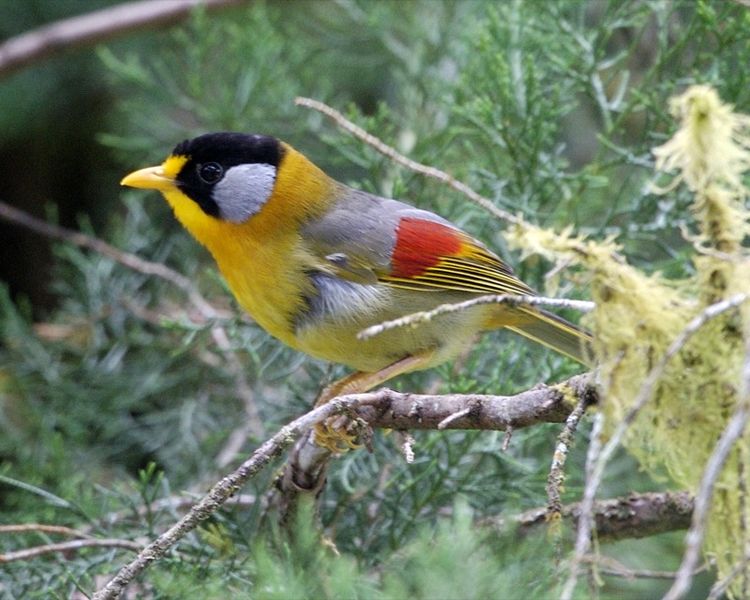
The Leiothrix is in the Timaliidae Family of Babblers and Parrotbills which are in Passeriformes Order. There are two Leiothrix in the family, the other being a Silver-eared Leiothrix. Both are very colorful birds. Maybe because they seek rain, the Lord gave them colors that are bright like the rainbow.

*

Yellow-rumped Cacique – The trusted Watchman

Yellow-rumped Cacique (Cacicus cela) by Ian

Yellow-rumped Cacique – The trusted Watchman ~ by a j mithra

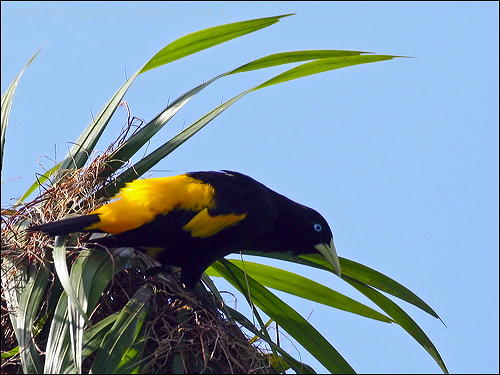
The caciques are Passerine birds in the New World Blackbird family. Members of the family are resident breeders in tropical South America and north to Mexico. The caciques are birds associated with woodland or forest. The Yellow-rumped Cacique is found in tropical South America from Panama to central Brazil.

Yellow-rumped Cacique (Cacicus cela) by Daves BirdingPix

Yellow-rumped Cacique (Cacicus cela) by Daves BirdingPix

It prefers Varzea forest edges, woodland and some semi-open habitats. The areas flooded in the annual cycle are extensive lowland and forested areas bordering the main river and its tributaries and are known by the Portuguese word várzea which means flooded plains are subject to annual flooding, with consequent soil enrichment; Trees in this zone survive flooding for several weeks annually and provide the basis of a food web that includes fish adapted…

They are very gregarious and large, noisy flocks can be seen flying over Amazon Rivers particularly at dawn and dusk as the flocks move from their overnight roost to their feeding grounds and back again. These birds prefer a place which is abundant in food and water…

There is abundance in the presence of Jesus, our Good Shepherd..

King David had experienced God’s abundance and that’s why he says,

The LORD is my shepherd; I shall not want. He maketh me to lie down in green pastures: he leadeth me beside the still waters.” Psalm 23:1,2

These birds seem to know that flood brings in soil enrichment which in turn provides the basis of food web…

Are you in the midst of a flood?

Just remember this verse,

So shall they fear the name of the LORD from the west, and his glory from the rising of the sun. When the enemy shall come in like a flood, the Spirit of the LORD shall lift up a standard against him. Isaiah 59:19

Where there is flood, there the Spirit of the Lord lifts a banner..

Glory be to Jesus name!!!!!!!!!

Yellow-rumped Cacique (Cacicus cela) by Ian

Yellow-rumped Cacique (Cacicus cela) by Ian

Most are colonial breeders, with several long, hanging, bag-shaped nests in a tree, each suspended from the end of a branch and have their entrance at the upper side. The nests are occupied in the short dry season.

The birds don’t like bad weather; they leave the colony when it rains too much. Nests can be washed out of a tree by heavy rain. For more protection, a couple of males are always on watch and if a bird of prey comes in sight, they sound the alarm and the colony tree will be empty in no time.

God has set us as watchmen over His people to warm them to walk in The WAY..

If when he seeth the sword come upon the land, he blow the trumpet, and warn the people; Then whosoever heareth the sound of the trumpet, and taketh not warning; if the sword come, and take him away, his blood shall be upon his own head.

He heard the sound of the trumpet, and took not warning; his blood shall be upon him. But he that taketh warning shall deliver his soul.

But if the watchman see the sword come, and blow not the trumpet, and the people be not warned; if the sword come, and take any person from among them, he is taken away in his iniquity; but his blood will I require at the watchman’s hand.

So thou, O son of man, I have set thee a watchman unto the house of Israel; therefore thou shalt hear the word at my mouth, and warn them from me.” Ezekiel33:3-7

Yellow-rumped Cacique (Cacicus cela) by Kent Nickell

Yellow-rumped Cacique (Cacicus cela) by Kent Nickell

Some species choose a tree that also contains an active wasp nest as a deterrent to predators (e.g. toucans), and females compete for the best sites near the protection of the wasp nest. The wasps also repel Philornis flies which are attracted in enormous numbers by the birds’ smell. These flies are paratisized by a mite which then move on to the nestlings, many of whom die from the infestation.

The females make the nests, brood en raise the young and are more abundant than the males. These birds are not afraid of building their nests near a tree that contains wasp’s nest..

Is it because they know that,

And we know that all things work together for good to them that love God, to them who are the called according to his purpose. Romans 8:28?

If Naaman had not turned into a leper, he wouldn’t have known God…

If Lazarus didn’t die, he wouldn’t have known the power of God…

After a nasty fall, if I had not dislocated my shoulder, I would surely have dislocated my hip..

Thank You Lord for Your saving grace and I also thank You for Sister Lee and the readers of this site who had prayed for my healing…

Bless them abundantly Lord in Jesus name …Amen

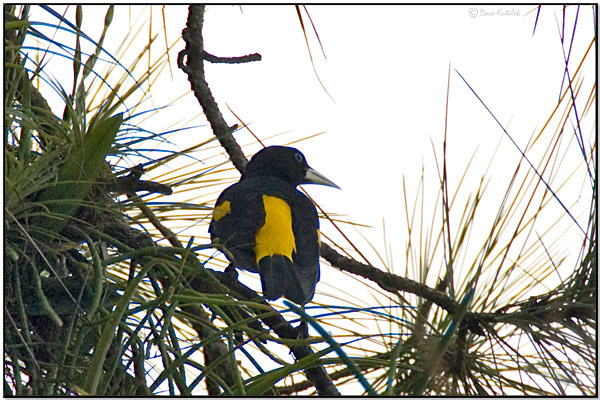
These are slim birds with long tails and a predominantly black plumage The relatively long pointed bill is pale greenish, yellowish or bluish, depending on species, and most caciques have blue eyes (at least when adult).

  • The female is typically smaller than the male.
  • Caciques eat large insects and fruit.
  • Most are gregarious and typically seen in small groups.
  • They are very vocal, producing a wide range of songs, sometimes including mimicry.
  • Males try to make an indelible impression on the females by showing their yellow feathers and flapping their wings.
Yellow-rumped Cacique (Cacicus cela) by Kent Nickell

Yellow-rumped Cacique (Cacicus cela) by Kent Nickell

Gold is called the Yellow metal and Gold denotes God’s glory…

God had been showing His glory and spreading His wings time and again to show how much He cares for us and longs for us to come under His wings..

But, there are still scores of them out there who are yet to know Him…

Are we doing something to reach the unreached?

The LORD recompense thy work, and a full reward be given thee of the LORD God of Israel, under whose wings thou art come to trust. Ruth 2:12

Have a blessed day!

Your’s in YESHUA,
a j mithra

Please visit us at:  Crosstree


Lee’s Addition:

We are continuing to pray for you, a j. Praying for your speedy recovery.

There are 12 Caciques are in the Icteridae – Oropendolas, Orioles & Blackbirds Family of the Passeriformes Order.

*

Interesting Things – Ron DiCianni’s Painting of the Resurrection

And said unto them, Thus it is written, and thus it behoved Christ to suffer, and to rise from the dead the third day: (Luke 24:46 KJV)

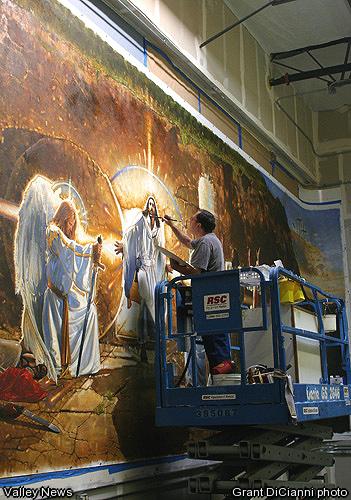
Resurrection Painting

Resurrection Painting

The following link tells about a great painting that is being done by Ron DiCianni about the Ressurection. I know it is not bird related, but I have had several emails about it and decided to share it here. It is worth watching the video.

The mural will be 12 feet by 40 feet wide. It is to be placed in the Museum of Biblical Arts in Dallas.

Ron DiCianni: Painting the Resurrection.

*

Birds of the Bible – Eye Hath Seen

For since the beginning of the world men have not heard, nor perceived by the ear, neither hath the eye seen, O God, beside thee, what he hath prepared for him that waiteth for him. Thou meetest him that rejoiceth and worketh righteousness, those that remember thee in thy ways: behold, thou art wroth; for we have sinned: in those is continuance, and we shall be saved. (Isaiah 64:4-5 KJV)

Wood Duck by Dan at Lake Hollingsworth

Wood Duck by Dan at Lake Hollingsworth

When I think of the verses above and the next verse, I think of the neat birds that the Lord has created. Even though they are under the curse, some of them have fantastic colors and markings. Their sounds are so sweet (well, most of them). I imagine the Lord with the most beautiful paintbrush. What must heaven look like when many of the things we experience here are so awesome? Once the curse is removed, what will things look like then?

But as it is written, Eye hath not seen, nor ear heard, neither have entered into the heart of man, the things which God hath prepared for them that love him. (1 Corinthians 2:9 KJV)

The photos below are just of birds and it was difficult to narrow the selection, but what of all the beautiful flowers, sunsets, sunrises, scenery, and on and on. What must heaven be like? Like many of you, I am looking forward to arriving and seeing things that I can’t even imagine as the verses say.

It is not automatic to go there. A person needs to accept the Lord Jesus Christ as their personal Saviour. Please see either or all of the following:

The Gospel Message, or the Wordless Birds

(A little short this week as we are just arriving home after a two week vacation – blogs about the trip to follow later. )

I will let the Lord’s Creative Hand reveal what we see here and it is fantastic.

*

This slideshow requires JavaScript.

*

Thanks to all the great photographers who have given permission to use their photos.

*

Arctic Terns – The Light Seekers

Arctic Terns – The Light Seekers

Arctic Tern (Sterna paradisaea) by J Fenton

Arctic Tern (Sterna paradisaea) by J Fenton

The Arctic Terns
see more daylight
than the other birds,
cos,
it flies about 19,000 kilometers
from the Arctic to the Antarctic
and back every year
during migration….
Which means,
in its life time
it would travel a distance
equal to going to the moon
and back…
We too can do,
what others can’t
when we see more of
JESUS , THE LIGHT….

But if we walk in the light, as he is in the light, we have fellowship one with another, and the blood of Jesus Christ his Son cleanseth us from all sin. (1John1:7)

A thought from a j mithra

*

The Artic Tern is in the Laridae Family.

*

Love and Sorrow

Many of my friends have sent me the photos of the Swallow that was hit by a car and then how her mate reacted. I found this YouTube by kirchiman1000 of that email and decided to post it. It shows the feelings and concern that birds have for each other.

The post of Skippy’s birthday a few days ago also shows how the death of their mate affects them. When the Lord created the creatures, he put the ability to love in them. We should learn from them.

But ask the beasts, and they will teach you; the birds of the heavens, and they will tell you; (Job 12:7 ESV)

As the Father hath loved me, so have I loved you: continue ye in my love. If ye keep my commandments, ye shall abide in my love; even as I have kept my Father’s commandments, and abide in his love. These things have I spoken unto you, that my joy might remain in you, and that your joy might be full. This is my commandment, That ye love one another, as I have loved you. Greater love hath no man than this, that a man lay down his life for his friends… These things I command you, that ye love one another. (John 15:9-13, 17  KJV)

He that loveth not knoweth not God; for God is love. (1 John 4:8 KJV)

Worship – Our Mating Song

Worship – Our Mating Song  ~ by a j mithra

Indian Scops Owl (Otus bakkamoena) pairby Nikhil Devasar

Indian Scops Owl (Otus bakkamoena) pairby Nikhil Devasar

If birds
don’t sing,
they wouldn’t find
a mate
and
if they don’t find a mate,
there would be
no reproduction…
If there is no reproduction,
there would a major
Ecological disaster…
If we don’t worship,
the presence of the LORD
wouldn’t be there,
if the presence of the LORD
is missing,
the church would be empty,
if the churches are empty
there would be a
Spiritual catastrophe…

But thou art holy, O thou that inhabitest the praises of Israel. (Psalm 22:3)

A thought from a j mithra

*

The Indian Scops Owl is in the Strigidae Family.

*

Disciplined Avian

Disciplined Avian ~ by a j mithra

Orange-bellied Leafbird (Chloropsis hardwickii) by W Kwong

Orange-bellied Leafbird (Chloropsis hardwickii) by W Kwong

Birds are
very disciplined
in every area
of their lives..
Be it,
food selection,
preening their feathers,
their songs,
their courtship,
their nesting,
their migration
and all that they do,
they are so well organized
and disciplined…
We human,
preach about discipline,
but,
never are we disciplined
in practicing what
we preach…

To every thing there is a season, and a time to every purpose under the heaven: (Ecclesiastes 3:1)

A thought from a j mithra

*

The Orange-bellied Leafbird is part of the Chloropseidae Family.

*

Scare Scarer

Scare Scarer ~ by a j mithra

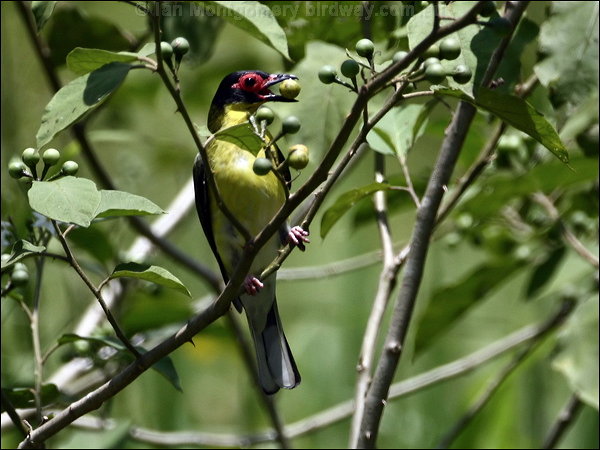
Australasian Figbird (Sphecotheres vieilloti) by Ian

Australasian Figbird (Sphecotheres vieilloti) by Ian

Birds get scared
only when the scarecrow
has human smell on it…
But,
after the rain,
the smell vanishes
and
the birds are not
scared anymore…
Come all ye people,
get wet and let
the Holy Spirit rain
and scare the scare away…

My beloved spake, and said unto me, Rise up, my love, my fair one, and come away.
For, lo, the winter is past, the rain is over and gone;
The flowers appear on the earth; the time of the singing of birds is come, and the voice of the turtle is heard in our land;
The fig tree putteth forth her green figs, and the vines with the tender grape give a good smell. Arise, my love, my fair one, and come away. (Psalm 2:10-13)

A thought from a j mithra

*

The Australian Figbird is in the Oriolidae Family

*

Birds – Watchers of Light

Birds – Watchers of Light ~ by a j mithra

American Golden Plover (Pluvialis dominica) at National Aviary by Lee

American Golden Plover (Pluvialis dominica) at National Aviary by Lee

Changes in the
level of sunlight,
causes migratory birds
to migrate…
Are you ready
to migrate
to heaven?
Cos,
the darkness
is fast approaching
and
THE LIGHT
is on the way
to trigger the migration
for the last time…

Watch therefore, for ye know neither the day nor the hour wherein the Son of man cometh. Mathew (25:13)

A thought from a j mithra

*

The Pacific Golden Plover is in the Charadriidae Family and a long distance migration bird.

*