Red-eyed Vireo (Vireo olivaceus) ©WikiC in nest
Twenty-Five Village Sermons, 1 – God’s World – By Charles Kingsley
(Guest Writer from the Past)
O Lord, how manifold are Thy works! in wisdom hast Thou made them all: the earth is full of Thy riches. Psalm 104:24
When we read such psalms as the one from which this verse is taken, we cannot help, if we consider, feeling at once a great difference between them and any hymns or religious poetry which is commonly written or read in these days. The hymns which are most liked now, and the psalms which people most willingly choose out of the Bible, are those which speak, or seem to speak, about God’s dealings with people’s own souls, while such psalms as this are overlooked. People do not care really about psalms of this kind when they find them in the Bible, and they do not expect or wish nowadays any one to write poetry like them. For these psalms of which I speak praise and honour God, not for what He has done to our souls, but for what He has done and is doing in the world around us. This very 104th psalm, for instance, speaks entirely about things which we hardly care or even think proper to mention in church now. It speaks of this earth entirely, and the things on it. Of the light, the clouds, and wind–of hills and valleys, and the springs on the hill- sides–of wild beasts and birds–of grass and corn, and wine and oil–of the sun and moon, night and day–the great sea, the ships, and the fishes, and all the wonderful and nameless creatures which people the waters–the very birds’ nests in the high trees, and the rabbits burrowing among the rocks,–nothing on the earth but this psalm thinks it worth mentioning. And all this, which one would expect to find only in a book of natural history, is in the Bible, in one of the psalms, written to be sung in the temple at Jerusalem, before the throne of the living God and His glory which used to be seen in that temple,–inspired, as we all believe, by God’s Spirit,– God’s own word, in short: that is worth thinking of. Surely the man who wrote this must have thought very differently about this world, with its fields and woods, and beasts and birds, from what we think. Suppose, now, that we had been old Jews in the temple, standing before the holy house, and that we believed, as the Jews believed, that there was only one thin wall and one curtain of linen between us and the glory of the living God, that unspeakable brightness and majesty which no one could look at for fear of instant death, except the high-priest in fear and trembling once a- year–that inside that small holy house, He, God Almighty, appeared visibly–God who made heaven and earth. Suppose we had been there in the temple, and known all this, should we have liked to be singing about beasts and birds, with God Himself close to us? We should not have liked it–we should have been terrified, thinking perhaps about our own sinfulness, perhaps about that wonderful majesty which dwelt inside. We should have wished to say or sing something spiritual, as we call it; at all events, something very different from the 104th psalm about woods, and rivers, and dumb beasts. We do not like the thought of such a thing: it seems almost irreverent, almost impertinent to God to be talking of such things in His presence. Now does this shew us that we think about this earth, and the things in it, in a very different way from those old Jews? They thought it a fit and proper thing to talk about corn and wine and oil, and cattle and fishes, in the presence of Almighty God, and we do not think it fit and proper. We read this psalm when it comes in the Church-service as a matter of course, mainly because we do not believe that God is here among us. We should not be so ready to read it if we thought that Almighty God was so near us.
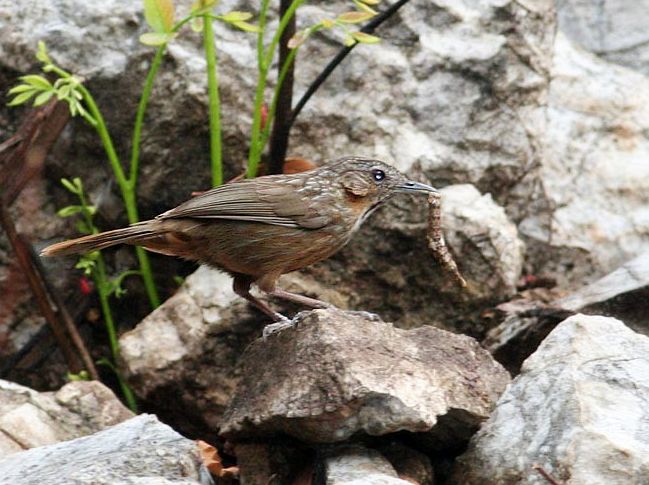
Limestone Wren-Babbler (Napothera crispifrons) by Peter Ericsson
That is a great difference between us and the old Jews. Whether it shews that we are better or not than they were in the main, I cannot tell; perhaps some of them had such thoughts too, and said, ‘It is not respectful to God to talk about such commonplace earthly things in His presence;’ perhaps some of them thought themselves spiritual and pure-minded for looking down on this psalm, and on David for writing it. Very likely, for men have had such thoughts in all ages, and will have them. But the man who wrote this psalm had no such thoughts. He said himself, in this same psalm, that his words would please God. Nay, he is not speaking and preaching ABOUT God in this psalm, as I am now in my sermon, but he is doing more; he is speaking TO God–a much more solemn thing if you will think of it. He says, “O Lord my God, THOU art become exceeding glorious. Thou deckest Thyself with light as with a garment. All the beasts wait on Thee; when Thou givest them meat they gather it. Thou renewest the face of the earth.” When he turns and speaks of God as “He,” saying, “He appointed the moon,” and so on, he cannot help going back to God, and pouring out his wonder, and delight, and awe, to God Himself, as we would sooner speak TO any one we love and honour than merely speak ABOUT them. He cannot take his mind off God. And just at the last, when he does turn and speak to himself, it is to say, “Praise thou the Lord, O my soul, praise the Lord,” as if rebuking and stirring up himself for being too cold-hearted and slow, for not admiring and honouring enough the infinite wisdom, and power, and love, and glorious majesty of God, which to him shines out in every hedge-side bird and every blade of grass. Truly I said that man had a very different way of looking at God’s earth from what we have!

Banded Broadbill (Eurylaimus javanicus) by Peter Ericsson
Now, in what did that difference lie? What was it? We need not look far to see. It was this,–David looked on the earth as God’s earth; we look on it as man’s earth, or nobody’s earth. We know that we are here, with trees and grass, and beasts and birds, round us. And we know that we did not put them here; and that, after we are dead and gone, they will go on just as they went on before we were born,–each tree, and flower, and animal, after its kind, but we know nothing more. The earth is here, and we on it; but who put it there, and why it is there, and why we are on it, instead of being anywhere else, few ever think. But to David the earth looked very different; it had quite another meaning; it spoke to him of God who made it. By seeing what this earth is like, he saw what God who made it is like: and we see no such thing. The earth?–we can eat the corn and cattle on it, we can earn money by farming it, and ploughing and digging it; and that is all most men know about it. But David knew something more–something which made him feel himself very weak, and yet very safe; very ignorant and stupid, and yet honoured with glorious knowledge from God,–something which made him feel that he belonged to this world, and must not forget it or neglect it, that this earth was his lesson-book–this earth was his work-field; and yet those same thoughts which shewed him how he was made for the land round him, and the land round him was made for him, shewed him also that he belonged to another world–a spirit- world; shewed him that when this world passed away, he should live for ever; shewed him that while he had a mortal body, he had an immortal soul too; shewed him that though his home and business were here on earth, yet that, for that very reason, his home and business were in heaven, with God who made the earth, with that blessed One of whom he said, “Thou, Lord, in the beginning hast laid the foundation of the earth, and the heavens are the work of thy hands. They shall perish, but Thou shalt endure; they all shall fade as a garment, and like a vesture shalt Thou change them, and they shall be changed; but Thou art the same, and THY years shall not fail. The children of Thy servants shall continue, and their seed shall stand fast in Thy sight.” “As a garment shalt Thou change them,”– ay, there was David’s secret! He saw that this earth and skies are God’s garment–the garment by which we see God; and that is what our forefathers saw too, and just what we have forgotten; but David had not forgotten it.
Look at this very 104th psalm again, how he refers every thing to God. We say, ‘The light shines:’ David says something more; he says, “Thou, O God, adornest Thyself with light as with a curtain.” Light is a picture of God. “God,” says St. John, “is light, and in Him is no darkness at all.” We say, ‘The clouds fly and the wind blows,’ as if they went of themselves; David says, “God makes the clouds His chariot, and walks upon the wings of the wind.” We talk of the rich airs of spring, of the flashing lightning of summer, as dead things; and men who call themselves wise say, that lightning is only matter,–‘We can grind the like of it out of glass and silk, and make lightning for ourselves in a small way;’ and so they can in a small way, and in a very small one: David does not deny that, but he puts us in mind of something in that lightning and those breezes which we cannot make. He says, God makes the winds His angels, and flaming fire his ministers; and St. Paul takes the same text, and turns it round to suit his purpose, when he is talking of the blessed angels, saying, ‘That text in the 104th Psalm means something more; it means that God makes His angels spirits, (that is winds) and His ministers a flaming fire.’ So shewing us that in those breezes there are living spirits, that God’s angels guide those thunder-clouds; that the roaring thunderclap is a shock in the air truly, but that it is something more–that it is the voice of God, which shakes the cedar-trees of Lebanon, and tears down the thick bushes, and makes the wild deer slip their young. So we read in the psalms in church; that is David’s account of the thunder. I take it for a true account; you may or not as you like. See again. Those springs in the hill- sides, how do they come there? ‘Rain-water soaking and flowing out,’ we say. True, but David says something more; he says, God sends the springs, and He sends them into the rivers too. You may say, ‘Why, water must run down-hill, what need of God?’ But suppose God had chosen that water should run UP-hill and not down, how would it have been then?–Very different, I think. No; He sends them; He sends all things. Wherever there is any thing useful, His Spirit has settled it. The help that is done on earth He doeth it all Himself.–Loving and merciful,–caring for the poor dumb beasts!–He sends the springs, and David says, “All the beasts of the field drink thereof.”

Swift Fox ©WikiC
The wild animals in the night, He cares for them too,–He, the Almighty God. We hear the foxes bark by night, and we think the fox is hungry, and there it ends with us; but not with David: he says, “The lions roaring after their prey do seek their meat from God,”–God, who feedeth the young ravens who call upon Him. He is a God! “He did not make the world,” says a wise man, “and then let it spin round His finger,” as we wind up a watch, and then leave it to go of itself. No; “His mercy is over all His works.” Loving and merciful, the God of nature is the God of grace. The same love which chose us and our forefathers for His people while we were yet dead in trespasses and sins; the same only- begotten Son, who came down on earth to die for us poor wretches on the cross,–that same love, that same power, that same Word of God, who made heaven and earth, looks after the poor gnats in the winter time, that they may have a chance of coming out of the ground when the day stirs the little life in them, and dance in the sunbeam for a short hour of gay life, before they return to the dust whence they were made, to feed creatures nobler and more precious than themselves. That is all God’s doing, all the doing of Christ, the King of the earth. “They wait on Him,” says David. The beasts, and birds, and insects, the strange fish, and shells, and the nameless corals too, in the deep, deep sea, who build and build below the water for years and thousands of years, every little, tiny creature bringing his atom of lime to add to the great heap, till their heap stands out of the water and becomes dry land; and seeds float thither over the wide waste sea, and trees grow up, and birds are driven thither by storms; and men come by accident in stray ships, and build, and sow, and multiply, and raise churches, and worship the God of heaven, and Christ, the blessed One,–on that new land which the little coral worms have built up from the deep. Consider that. Who sent them there? Who contrived that those particular men should light on that new island at that especial time? Who guided thither those seeds–those birds? Who gave those insects that strange longing and power to build and build on continually?– Christ, by whom all things are made, to whom all power is given in heaven and earth; He and His Spirit, and none else. It is when HE opens His hand, they are filled with good. It is when HE takes away their breath, they die, and turn again to their dust. HE lets His breath, His spirit, go forth, and out of that dead dust grow plants and herbs afresh for man and beast, and He renews the face of the earth. For, says the wise man, “all things are God’s garment”– outward and visible signs of His unseen and unapproachable glory; and when they are worn out, He changes them, says the Psalmist, as a garment, and they shall be changed.
The old order changes, giving place to the new,
And God fulfils Himself in many ways.
But He is the same. He is there all the time. All things are His work. In all things we may see Him, if our souls have eyes. All things, be they what they may, which live and grow on this earth, or happen on land or in the sky, will tell us a tale of God,–shew forth some one feature, at least, of our blessed Saviour’s countenance and character,–either His foresight, or His wisdom, or His order, or His power, or His love, or His condescension, or His long-suffering, or His slow, sure vengeance on those who break His laws. It is all written there outside in the great green book, which God has given to labouring men, and which neither taxes nor tyrants can take from them. The man who is no scholar in letters may read of God as he follows the plough, for the earth he ploughs is his Father’s: there is God’s mark and seal on it,–His name, which though it is written on the dust, yet neither man nor fiend can wipe it out!
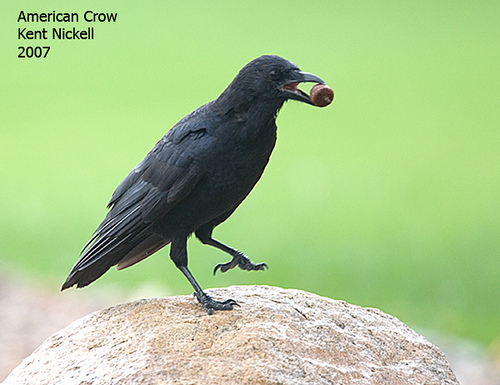
American Crow (Corvus brachyrhynchos) by Kent Nickell
The poor, solitary, untaught boy, who keeps the sheep, or minds the birds, long lonely days, far from his mother and his playmates, may keep alive in him all purifying thoughts, if he will but open his eyes and look at the green earth around him.
Think now, my boys, when you are at your work, how all things may put you in mind of God, if you do but choose. The trees which shelter you from the wind, God planted them there for your sakes, in His love.–There is a lesson about God. The birds which you drive off the corn, who gave them the sense to keep together and profit by each other’s wit and keen eyesight? Who but God, who feeds the young birds when they call on Him?–There is another lesson about God. The sheep whom you follow, who ordered the warm wool to grow on them, from which your clothes are made? Who but the Spirit of God above, who clothes the grass of the field, the silly sheep, and who clothes you, too, and thinks of you when you don’t think of yourselves?–There is another lesson about God. The feeble lambs in spring, they ought to remind you surely of your blessed Saviour, the Lamb of God, who died for you upon the cruel cross, who was led as a lamb to the slaughter; and like a sheep that lies dumb and patient under the shearer’s hand, so he opened not his mouth. Are not these lambs, then, a lesson from God? And these are but one or two examples out of thousands and thousands. Oh, that I could make you, young and old, all feel these things! Oh, that I could make you see God in every thing, and every thing in God! Oh, that I could make you look on this earth, not as a mere dull, dreary prison, and workhouse for your mortal bodies, but as a living book, to speak to you at every time of the living God, Father, Son, and Holy Ghost! Sure I am that that would be a heavenly life for you,–sure I am that it would keep you from many a sin, and stir you up to many a holy thought and deed, if you could learn to find in every thing around you, however small or mean, the work of God’s hand, the likeness of God’s countenance, the shadow of God’s glory.
See Charles Kingsley index.
Charles Kingsley – 1819 – 1875
Charles Kingsley was born in Holne (Devon), the son of a vicar. His brother, Henry Kingsley, also became a novelist. He spent his childhood in Clovelly, Devon and was educated at Magdalene College, Cambridge, before choosing to pursue a ministry in the church. From 1844, he was rector of Eversley in Hampshire, and in 1860, he was appointed Regius Professor of Modern History at the University of Cambridge.
Kingsley’s interest in history spilled over into his writings, which include The Heroes (1856), a children’s book about Greek mythology, and several historical novels, of which the best known are Hypatia (1853), Hereward the Wake (1865), and Westward Ho! (1855).
In 1872 Kingsley accepted the Presidency of the Birmingham and Midland Institute and became its 19th President.
Kingsley died in 1875 and was buried in St Mary’s Churchyard in Eversley.
*