“And the stork, the heron after her kind, and the lapwing, and the bat.” (Leviticus 11:19)
This is just a quick note, from my part of Texas, to report seeing some white egrets lately.
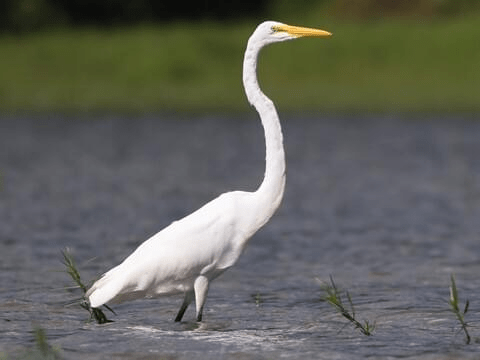
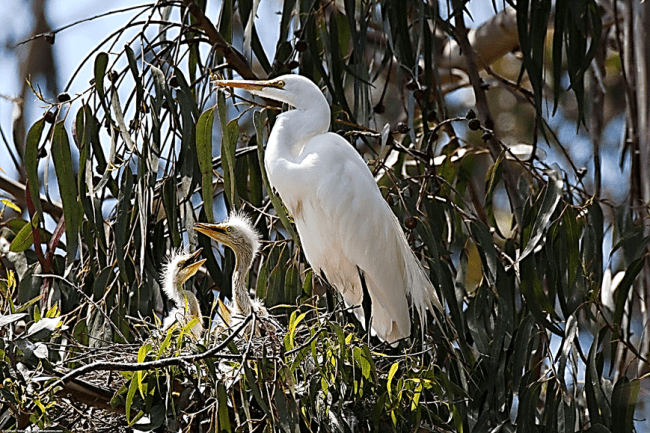
GREAT WHITE EGRET, wading in pond-water (Cornell Lab of Ornithology photo credit)
So much of (our part of) Texas is urbanizing–and suburbanizing. So, frequenting a rural area, where birdwatching is convenient, is like hunting for an endangered species.
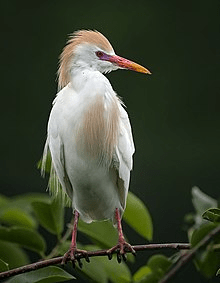
Last Sunday, in a journey that included driving through parts of Denton County and Tarrant County (Texas), my wife drove our car, as I looked out my car window–for birds in pastures and ponds. Ponds attract heron-like birds, such as foraging Great White Egrets (a/k/a “Great White Heron”). Likewise, pastures (with bovine cattle grazing), attract foraging Cattle Egrets.
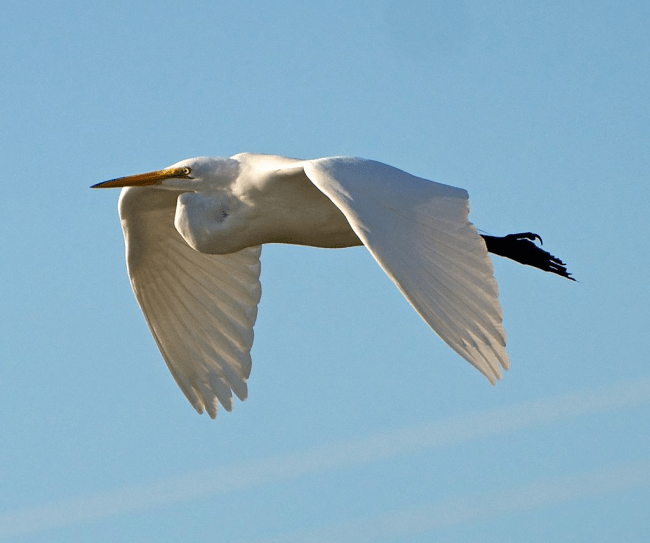
GREAT WHITE EGRET in flight (Wikipedia photo credit)
Thankfully, I saw several kinds of birds, from place to place, in field and trees, and besides ponds and drainage ditches. Among those birds, observed that day, were two kinds of heron-like wading birds–Great White Egret and Cattle Egret. Which led to composing this limerick:
GREAT WHITE & CATTLE EGRETS, OBSERVED WHILE TRAVELLING
Cute critters—some are wild, some are pets;
Yesterday, I observed white egrets!
Standing, beside a pond;
Others, in grass beyond …
Go birding—you’ll have no regrets!
It’s good to know that, so far, there are still some pastures and ponds, where we can still view egrets.
Yes, we can all thank the Lord for making and sustaining these oft-ignored (yet magnificent) wild white wonders (Job 9:10).
Cormorants are Great; Great Cormorants are Really Great!
Dr. James J. S. Johnson
“But the cormorant [shalak] and the bittern shall possess it [i.e., the land of Idumea, a/k/a Edom]; the owl also and the raven shall dwell in it; and He [i.e., the LORD, in judgment] shall stretch out upon it the line of confusion, and the stones of emptiness.“
Isaiah 34:11
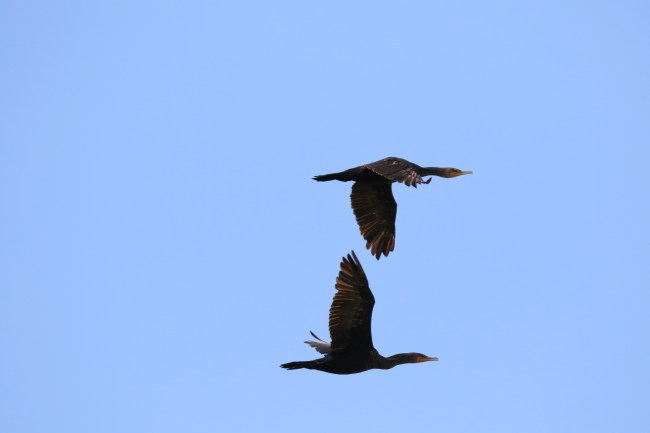
GREAT CORMORANTS in flight (Minnesota) photo credit: Bryce Gaudian
In some contexts, CORMORANTS are not deemed as indicators of blessing — as in Isaiah 34;11, where it is prophetically mentioned as an indicator that the land of Edom is catastrophically destroyed. However, in many other contexts, these magnificent birds are recognized as wonderful creatures whom God has equipped to live by bodies of water, both freshwater and seawater.
GREAT CORMORANT aloft (Minnesota) photo credit: Bryce Gaudian
Cormorants love to live by bodies of water. Cormorants are found busy hunting — darting (befitting the Hebrew noun shalak, in Leviticus 11:17 & Deuteronomy 14:17, translated “cormorant”, which matches the darting-like targeting movements) for food over and near coastlines, including the coasts of islands, such as the Hebridean isle of Staffa, which was reported earlier (on this Christian birdwatching blog), in the report titled “Birdwatching at Staffa: Puffins, Shags, and more”, posted at https://leesbird.com/2019/07/22/birdwatching-at-staffa-puffins-shags-more/ (July 22nd A.D.2019), citing Isaiah 42:12. [Regarding “cormorants” in the Holy Bible, see George S. Cansdale, ALL THE ANIMALS OF THE BIBLE LANDS (Zondervan, 1976), at page 175.]
Cormorants constitute a large “family” of birds; the mix of “cousins” include Crowned Cormorant (Phalacrocorax coronatus), Brandt’s Cormorant (Phalacrocorax penicillatus), Galapagos Cormorant (Phalacrocorax harrisi), Bank Cormorant (Phalacrocorax neglectus), Neo-tropic Cormorant (Phalacrocorax brasilianus), Double-crested Cormorant (Phalacrocorax auritus), Indian Cormorant Phalacrocorax fuscicollis), Socotra Cormorant (Phalacrocorax nigrogularis), Cape Cormorant (Phalacrocorax capensis), Guanay Cormorant (Phalacrocorax bougainvillii, a/k/a Guanay Shag), Kerguelen Shag (Phalacrocorax verrucosus), Imperial Shag (Phalacrocorax atriceps), Antarctic Shag (Phalacrocorax bransfieldensis). South Georgia Shag (Phalacrocorax georgianus), Campbell Island Shag (Phalacrocorax campbelli), New Zealand King Shag (Phalacrocorax carunculatus), Bronze Shag (Phalacrocorax chalconous), Chatham Island Shag (Phalacrocorax onslowi), Auckland Island Shag (Phalacrocorax colensoi), Rock Shag (Phalacrocorax magellanicus), Bounty Island Shag (Phalacrocorax ranfurlyi), Red-faced Cormorant (Phalacrocorax urile, a/k/a Red-faced Shag), European Shag (Phalacrocorax aristotelis), Pelagic Cormorant (Phalacrocorax pelagicus, a/k/a Pelagic Shag), Red-legged Cormorant (Phalacrocorax gaimardi), Spotted Shag (Phalacrocorax punctatus), Pied Cormorant (Phalacrocorax varius), Great Cormorant (Phalacrocorax carbo), Japanese Cormorant (Phalacrocorax capillatus), Olivaceous Cormorant (Phalacrocoraxolivaceus, a/k/a Mexican Cormorant), and Pitt Island Shag (Phalacrocorax featherstoni).
That’s a lot of cormorant “cousins”, worldwide! [For details on each of these “cousins”, see pages 116-136 of Jim Enticott & David Tipling, SEABIRDS OF THE WORLD: THE COMPLETE REFERENCE (Stackpole Books, 1997).]
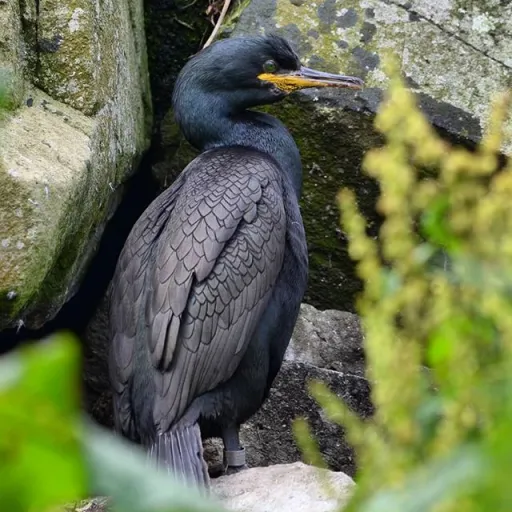
SHAG (a type of Cormorant), at Staffa, Hebrides (Scotland) photo credit: Public Insta
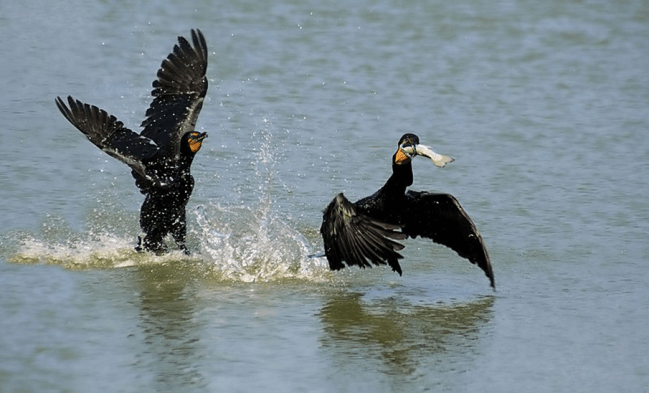
Cormorants are famous “fishermen” along ocean coastlines, yet cormorants also thrive in inland freshwater habitats, such as over and near ponds and lakes, such as the Double-crested Cormorants that frequent inland ponds in Denton County, Texas, where they catch “fish of the day”.
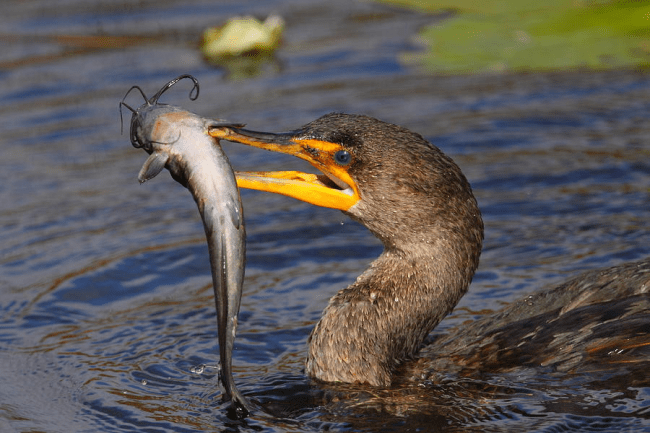
DOUBLE-CRESTED CORMORANT with fish photo credit: Bruce J. Robinson
Cormorants are generally described, by ornithologist Roger Tory Peterson, as follows:
Large, blackish, slender-billed water birds. Often confused with loons, but tail longer, bill hook-tipped. In flight, wing action is more rapid and axis of body and neck is tilted upward slightly (loon’s neck droops). Young birds are browner, with a pale or whitish breast. Flocks [of cormorants] fly in line or wedge formation very much like geese but they are silent. Cormorants often perch in uprightpositions on buoys or posts with neck in an S [posture]; sometimes strike a “spread eagle” pose. Swimming, they lie low like loons, but with necks more erect and snakelike, and bills tilted upward at an angle. Food: Fish (chiefly non-game). Nearly cosmopolitan [in range].
[Quoting Roger Tory Peterson, cited below]
[See Roger Tory Peterson, A FIELD GUIDE TO THE BIRDS OF TEXAS AND ADJACENT STATES (Houghton Mifflin, 1988), page 10.]
Specifically, the Double-crested Cormorant (Phalacrocorax auritis) is perhaps the most common winter migrant of the cormorants; also, the Double-crested Cormorant is often seen in the coastline areas of Texas’ Gulf of Mexico shores.
GREAT CORMORANTS descending (Minnesota) photo credit: Bryce Gaudian
Have you ever watching a silhouetted cormorant — or two — or three — winging their way across the late afternoon sky? It is a wonder to behold!
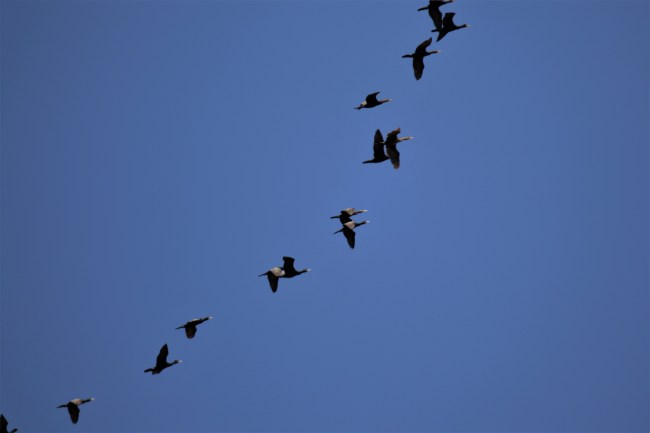
GREAT CORMORANTS silhouetted against the sky photo credit: Bryce Gaudian
Now, try to imagine a dozen, or more, cormorants, flying in series. That’s a wondrous wonder to behold! That constitutes one of the “wonders without number” that Scripture refers to (in Job 9:10).
serial “line” of GREAT CORMORANTS in flight (Texas) photo credit: Bryce Gaudian
And now here is my closing limerick, about cormorants:
APPRECIATING HUMBLE CORMORANTS (AND SHAGS)
Cormorants are not known to brag,
If they’re so-called, or called “shag”;
They oft fly, in a line,
And on fish, they oft dine —
But cormorants aren’t known to brag.
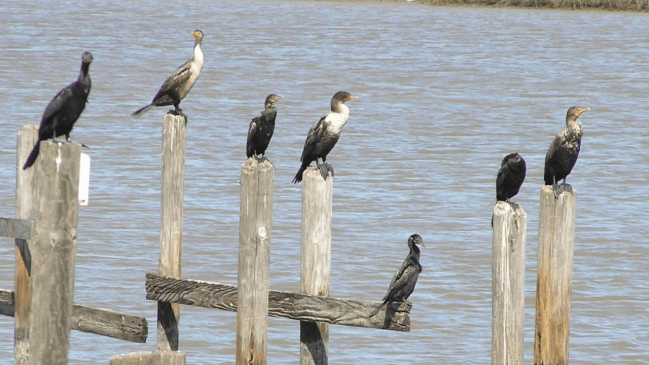
DOUBLE-CRESTED CORMORANTS perching on posts photo credit: Mark Eising Birding
(Dr. Jim Johnson formerly taught ornithology and avian conservation at Dallas Christian College, among other subjects, and he has served as a naturalist-historian guest lecturer aboard 9 international cruise ships, some of which sailed in seawaters frequented by cormorants and shags. Jim was introduced to Christian birdwatching as an 8-year-old, by his godly 2nd grade teacher, Mrs. Thelma Bumgardner.)
And the stork, theheron [הָאֲנָפָ֖ה] after her kind, and the lapwing, and the bat.
Leviticus 11:19
As reported last Friday — ( see https://leesbird.com/2023/01/20/florida-pond-shore-report-part-1/ ) — the pond-shore birds were plentiful (except not ducks, for some odd reasons) in St. Petersburg, Florida, at the home of Chaplain Bob and Marcia Webel, on the morning of Monday, January 16th (A.D.2023, as Chaplain Bob and I sat in lawn chairs in the Webels’ backyard that adjoins the pond-shore (of what Floridians call a “lake”), drinking our coffee (and eating toasted rye bread). In that prior-reported blogpost I described the Bald Eagle, White Ibis, and Common Grackle. This report (“Part 2” in this series) will feature the Great Blue Heron, Great White Egret, andDouble-crested Cormorant.
GREAT BLUE HERON in Florida (Terry Foote image / Wikipedia image, q.v.)
DOUBLE-CRESTED CORMORANT, 1 with a fish (Brocken Inaglory image / Wikipedia, q.v.)
DOUBLE-CRESTED CORMORANT. The Double-crested Cormorant has previously been described on this birdwatching blog – see “Of Cormorants and Anhingas” (posted on June 13th of A.D.2019, at https://leesbird.com/2019/06/13/of-cormorants-and-anhingas/ ). See also Lee Dusing’s interesting report on cormorants, “Birds of the Bible – Cormorant”, posted June 26th of A.D.2008, at https://leesbird.com/2008/06/26/birds-of-the-bible-cormorant/ — which includes video footage of domesticated cormorant fishing in China. Amazing!
Meanwhile, the other pond-shore visiting birds — i.e., Mockingbird, Mourning Dove, Blue Jay, Snowy Egret, Common Moorhen (a/k/a “Florida Gallinule”, Anhinga, Tufted Titmouse, Limpkin, Red-bellied Woodpecker, and Muscovy Duck (the last being seen on grass of neighbor’s front-yard) — on the morning of Monday, January 16th of A.D.2023), must wait for another day to be reported here, Deo volente. Thank the Lord for ssuch good memories!
I would seek unto God, and unto God would I commit my cause, Who doeth great things and unsearchable, marvelous things without number … Who doeth great things past finding out; yea, and wonders without number.
Black-headed Gulls and Great Black-backed Gulls: Birdwatching in the Scottish Hebrides, Part 4
Dr. James J. S. Johnson
For the earth shall be filled with the knowledge of the glory of the LORD, as the waters cover the sea.
(Habakkuk 2:14)
Black-headed Gull (BirdGuides.com photo credit)
Great Black-backed Gull (National Audubon Society photo credit)
The islands of Scotland’s Outer Hebrides are a familiar territory for various seagulls, including two in particular: (1) the largest seagull, the low-sounding “laughing” Great Black-backed Gull (Larus marinus); and (2) a much smaller yet loud-“laughing” Black-headed Gull (Larus ridibundus, a/k/a Chroicocephalus ridibundus).
Great Black-backed Gulls are large (more than 2’ long, with wingspan about 5’ wide; often males weigh up to 4 or 5 pounds, while females weigh slightly less), deserving their nickname “King of Gulls”. Thanks to God-given toughness these gulls can survive and thrive in coastlands of the North, breeding in parts of Russia, Scandinavia, along Baltic coasts, the British Isles, Iceland, Greenland, the Faroe Islands, plus the Atlantic seacoasts of Canada and America’s New England shorelines. In winter many of these gulls migrate south.
In Nornian, the ancient Old Norse-derived language of the Shetland Islands, the Great Black-backed Gull was once called swaabie, from swartbak, meaning “black back”—whereas in AD1758 Karl (“Linnaeus”) von Linné taxonomically designated theseseagulls as Larus marinus, denoting a marine seagull/seabird (from Greekλάῥος). In a previous study (titled “Birdwatching at Staffa, near Iona: Puffins, Shags, and Herring Gulls”), the Great Black-backed Gull was noted as a prominent predator of Atlantic puffins, yet this gull avoids puffins who nest near humans.
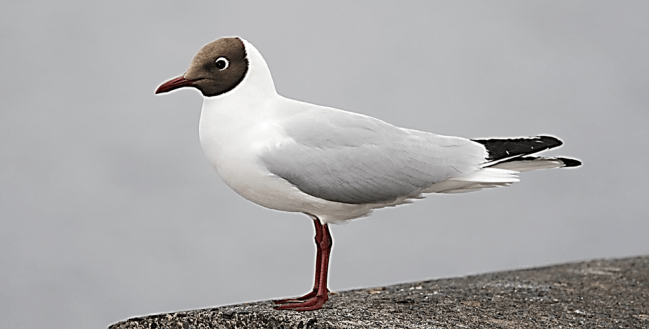
BLACK-HEADED GULL perching (Nat’l Audubon Society photo credit)
However, it is not just the Atlantic puffins that must beware the apex-predatory pursuits of Black-backed Gulls, because these gulls also prey on terns and many other birds, as well as almost any other organic food smaller than themselves, living or nonliving, if they can swallow it. Accordingly, these scavenging gulls are attracted to garbage dumps filled with human wastes, as well as to egg-filled nests of smaller birds, plus available rodents (e.g., rats) and lagomorphs (e.g., rabbits). Likewise, these bullies practice “klepto-parasitism”, i.e., aerial bullying-based robberies of food from other birds—when accosted by Great Black-backed Gull, the smaller birds drop their food—as the Great Black-backed Gull chases the dropping food, to capture it in the air, the robbery victim flies away to safety.
During the winter months these gulls spend less time over land, because the sea itself then offers better opportunities for food—especially lots of fish! Any fish who are close to the ocean’s surface are at risk when these gulls scout for catchable food. In fact, quantitative studies of their stomachs show that marine fish (such as herring) are the primary diet of Great Black-backed Gulls, although they also eat other birds (like herring gulls, murres, puffins, terns, Manx shearwaters, grebes, ducks, and migrant songbirds), plus small mollusks (like young squid), crustaceans (like crabs), marine worms, coastline insects and rodents, as well as inland berries, and lots of garbage and carrion (found in places as diverse as saltmarshes, landfills, parking lots, airport runways, piers, fishing docks, surface ocean-waters, etc.).
[See William Threlfall, “The Food of Three Species of Gull in Newfoundland”, Canadian Field-Naturalist, 82:176-180 (1968). See also, accord, Kirk Zufelt, “Seven Species of Gulls Simultaneously at the Landfill”, Larusology (http://Larusology.blogspot.com/2009/11/7-species-of-gulls-simultaneously-at.html ), posted Nov. 15, 2009.]
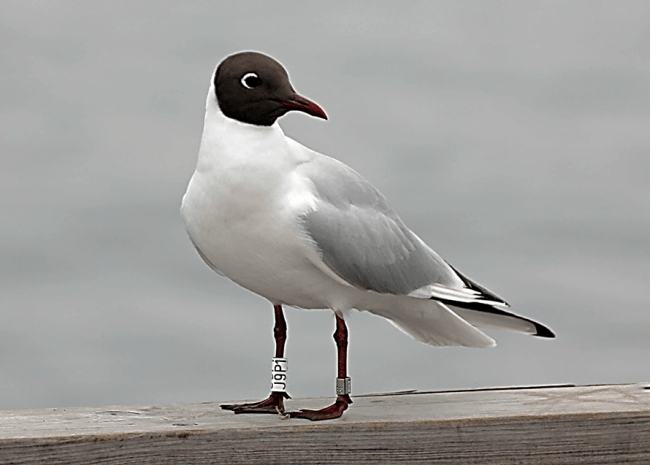
BLACK-HEADED GULL with “ankle bracelet” (Oslo Birder photo credit)
Like the above-described Great Black-backed Gull, the gregarious (i.e., colony-dwelling) Black-headed Gull is notorious for its omnivorous scavenging and often-predatory habits, opportunistically frequenting oceans, intertidal beaches and estuarial coastlands, marshlands and other inland wetlands, lakes, rivers, and even agricultural fields. These gulls, as breeding adults, sport dark-chocolate (almost black) heads.
Black-headed Gulls can soar high in the air, swim in the ocean, and walk along a sandy beach—they are equally comfortable moving to wherever they want to go to. These noisy seagulls sometimes appear to “laugh” when they call. Like other seagulls, they enjoy eating fish—sometimes they dip their heads under the tidewater surface, while swimming. When scouting along a coastal beach, these gulls probe for coastline critters (which they probe for and snatch). Also, they are fast enough to capture flying insects, which they catch “on the wing”.
BLACK-HEADED GULL (Shells of Florida’s Gulf Coast photo credit)
Gulls come in many varieties, plus some of these varieties are known to hybridize. For example, Great Black-backed Gulls (Larus marinus) hybridize with Herring Gulls (Larus argentatus). Black-headed Gulls (Larus ridibundus) often hybridize with Mediterranean Gulls (Larus melanocephalus), and also with Laughing Gull (Larus atricilla) and Common Gull (Larus canus). Other hybrids exist, too, and many of these gull hybrids have been verified by genetics (i.e., DNA parentage verification).
[ As a boy this author watched seagulls, both inland and at seacoasts, with wonder. God made them all! A half-century later, I still watch seagulls (and many other birds) with wonder. “He (God) does great things beyond searching out … and wonders without number.” (Job 9:10) — God shows how wonderful He is! ]







.jpeg.aspx?width=762)
 Lee's Birdwatching Adventures Plus