GO, FLY — A KITE !

GO, FLY — A KITE!

Dr. James J. S. Johnson

And the vulture, and the kite after his kind…. (Leviticus 11:14)

And the glede, and the kite, and the vulture after his kind …. (Deuteronomy 14:13)

Flies (and other flying insects) better flee, whenever a hungry Mississippi Kite flies by!

MISSISSIPPI KITE (Dick Daniels / Wikipedia photo credit)

Perhaps the term “kite”, translating the Hebrew noun אַיָּה [’ayyâh] in Leviticus 11:14, and in Deuteronomy 14:13, refers to the Black Kite (Milvus migrans) that currently dwells in the Holy Land – as well as in several parts of Eurasia, Australia, and Africa.

Once, recently, while I was gazing at tree-perching cardinals and mockingbirds, a Mississippi Kite (Ictinia mississippiensis) landed on a tree-branch near my house, recently (Wednesday, May 7th, A.D.2025), letting me to see its magnificent movements and eye-catching plumage. 

During springtime, here in North Texas, local insect populations are booming – and this busy bonanza is an insectivore’s smörgåsbord for Mississippi Kites, who love to eat flying and crawling insects (bees, cicadas, dragonflies, grasshoppers, and more!). 

MISSISSIPPI KITE hunting dragonfly (Matthew B. Furst image credit)

Also, these diurnal raptors (i.e., daytime hunters) employ their short hooked beaks to eat other small animals, e.g., small snakes, lizards, frogs, mice, bats, and even small birds.  If cicadas are abundant, as they periodically are, kites may feast on them beyond other foods.  [See Stan Tekiela, “Mississippi Kite”, BIRDS OF TEXAS FIELD GUIDE (Adventure Publications, 2020), pages 326-327.]

This mostly grey-colored maneuvering marvel has a black tail, dark-red eyes (surrounded by black “blackeye-like eyepatches), red-to-yellow legs, charcoal-grey (with some russet-brown) plumage on the wings, and whitish-grey “ashy” underside and head; the kite’s head is such a pale grey that it is almost white, similar to a Scissor-tailed Flycatcher’s head. It is easy to remember a Mississippi Kite when you see one – what a beautifully bioengineered and impeccably constructed bird it is! 

Mississippi Kite parent, feeding a dragonfly to its young chick
(Ozark Bill Duncan photo credit)

In fact, the Mississippi Ornithological Society (which, as its name indicates, is an ornithological society that focuses on Mississippi birds) has named its semiannual journal for this marvelous bird (see https://missbird.org/kite/ ).

Smaller than eagles, vultures, and most hawks, these aerial acrobats are migratory accipiters, i.e., smaller hawks with short, broad wings, plus relatively long legs (with precision-designed talons!), often found flying fastly in wooded habitats that include riparian edges.  Since my neighborhood has several ponds and drainage ditches, it’s no surprise that kites visit occasionally – this is not the first time that I’ve seen a kite on my homeplace.

MISSISSIPPI KITE (Cornell Lab of Ornithology photo credit)

Unsurprisingly, this Mississippi Kite visited my Texas homestead in springtime. These kites routinely winter in Central or South America, yet sometimes they winter within the Rio Grande Valley of South Texas.  During spring they migrate northward, to their summer nesting-and-breeding grounds; besides Mississippi (where they are famous for dwelling near the Mississippi River), they migrate to breeding ranges north of Mexico, including Arizona, New Mexico, Oklahoma, Louisiana, Colorado, Kansas, Missouri, and much of northern Texas.  Some are even known to have migrated as far north as South Dakota, or as far east as Florida!  [See, accord, David E. Fantina, “Mississippi Kite”, THE TEXAS BREEDING BIRD ATLAS (posted at Texas A&M AgriLife Research, at https://txtbba.tamu.edu/species-accounts/mississippi-kite/ .]

MISSISSIPPI KITE (J. J. Audubon image credit / public domain)

According to Texas Parks & Wildlife Department, kites are social creatures:

Mississippi kites are very social in all activities. They do not maintain territories and they congregate at roosts in late summer. . . . . Kites have been known to fly about cattle and horsemen in order to catch insects that are stirred up from the grass [acting as the airborne equivalent to pasture-strolling Cattle Egrets!].. . . .

Paired kites generally begin nesting soon after their arrival in their old nests or in newly constructed ones. In late May or early June, kites breed and both sexes will incubate usually two bluish-white eggs until they hatch 31 to 32 days later.

Mississippi kites, at times, cause problems for unsuspecting individuals. Kites, like many other birds, will dive at animals and people that venture too closely to their nests. This diving behavior is simply an attempt to ward off potential threats to the nest and young. Once the young leave the nest some 30 to 34 days after hatching, kites will stop their protective behavior. Kites normally may live to seven years of age in the wild.

[Quoting TP&WD,  https://tpwd.texas.gov/huntwild/wild/species/kites/ .]

Mississippi Kite perching
(Jeff Tibbits / Oklahoma Dep’t of Wildlife Conservation photo credit)

Kites are a lot like falcons, they are small birds of prey with streamlined and quick-darting maneuverability in flight.  They prefer to nest in habitats of tall trees – “near water, in open woodlands, savannahs, and rangelands  … [and sometimes] in urban settings” – according to Texas Parks & Wildlife Department (see  https://tpwd.texas.gov/huntwild/wild/species/kites/ ). 

What an unexpected privilege it was, a few days ago, when I spotted that Mississippi Kite landing upon that tree-branch – perhaps that tree had some insects that the kite spotted, and quickly consumed.  In any case, it’s a beautiful bird to which God gave admirable mobility.

Mississippi Kite parent, feeding cicada to its young chick
(Vincent Fouchi, Jr. photo credit)

So, here is a limerick to remind us of how the Mississippi Kite is an aerial hunter of insects:

MISSISSIPPI KITE, AERIAL HUNTER OF INSECTS

Eyes dark red, and head greyish-white,

Pointed wings, for quick-turning flight —

Its curled beak grabs a bee;

Insects, you better flee!

Beware the Mississippi Kite!

:)
GREAT WHITE & CATTLE EGRETS, OBSERVED IN POND & PASTURE

Dr. James J. S. Johnson

 “And the stork, the heron after her kind, and the lapwing, and the bat.” (Leviticus 11:19)

This is just a quick note, from my part of Texas, to report seeing some white egrets lately.

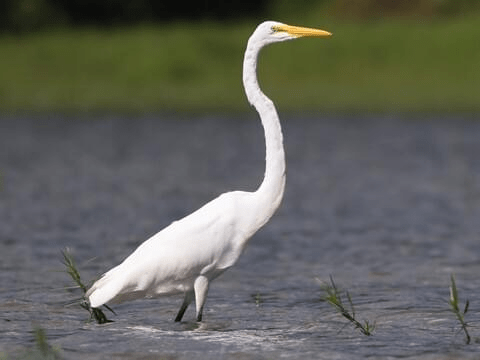
GREAT WHITE EGRET, wading in pond-water
(Cornell Lab of Ornithology photo credit)

So much of (our part of) Texas is urbanizing–and suburbanizing. So, frequenting a rural area, where birdwatching is convenient, is like hunting for an endangered species.

Last Sunday, in a journey that included driving through parts of Denton County and Tarrant County (Texas), my wife drove our car, as I looked out my car window–for birds in pastures and ponds. Ponds attract heron-like birds, such as foraging Great White Egrets (a/k/a “Great White Heron”). Likewise, pastures (with bovine cattle grazing), attract foraging Cattle Egrets.

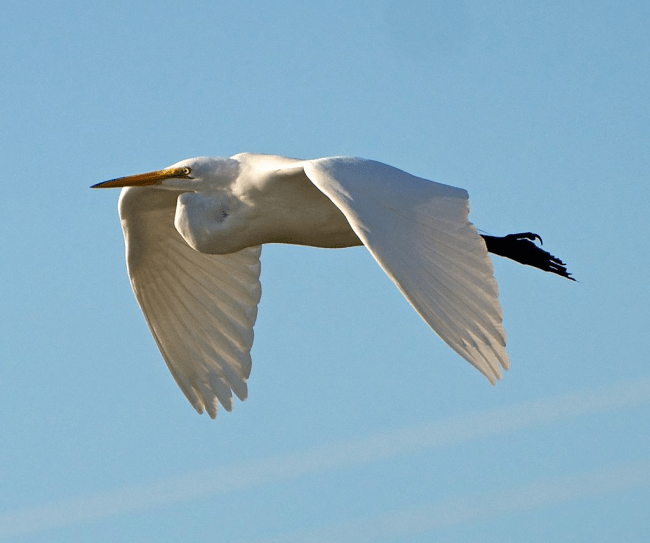
GREAT WHITE EGRET in flight
(Wikipedia photo credit)

Thankfully, I saw several kinds of birds, from place to place, in field and trees, and besides ponds and drainage ditches. Among those birds, observed that day, were two kinds of heron-like wading birds–Great White Egret and Cattle Egret. Which led to composing this limerick:

GREAT WHITE & CATTLE EGRETS, OBSERVED WHILE TRAVELLING

Cute critters—some are wild, some are pets;

Yesterday, I observed white egrets!

Standing, beside a pond;

Others, in grass beyond …

Go birding—you’ll have no regrets!

It’s good to know that, so far, there are still some pastures and ponds, where we can still view egrets.

Yes, we can all thank the Lord for making and sustaining these oft-ignored (yet magnificent) wild white wonders (Job 9:10).

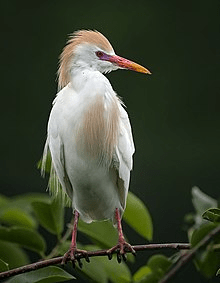
CATTLE EGRET
(Wikipedia image credit)

(Regarding Cattle Egrets, see JJSJ’s “Cabin Fever, Cattle Egrets, and Pasture-land Partnerships” http://www.icr.org/article/cabin-fever-cattle-egrets-pasture-land-partnership/ .)

CROWS SOMETIMES EAT ROADKILL

Dr. James J. S. Johnson

Consider the ravens [κορακας], for they neither sow nor reap; which neither have storehouse nor barn; and God feedeth them: how much more are ye better than the fowls?  (Luke 12:24)

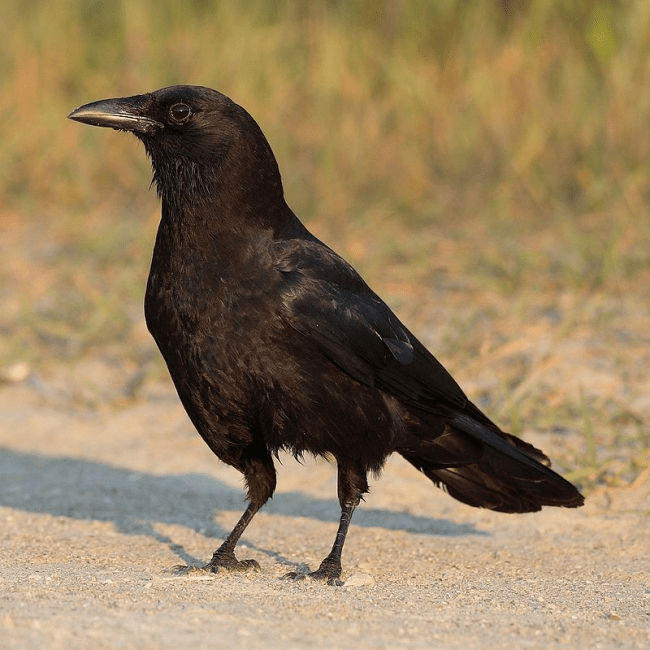
AMERICAN CROW (Wikipedia photo credit)

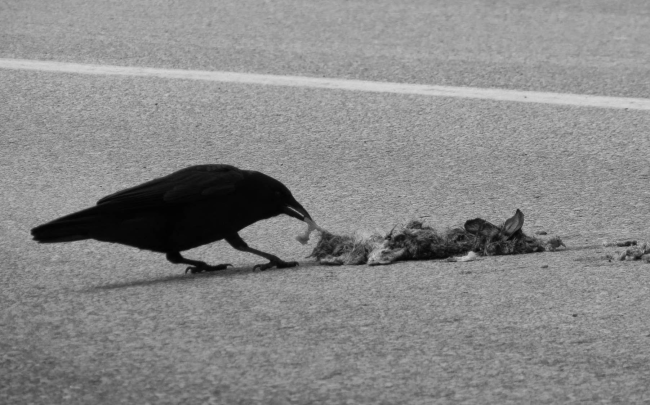
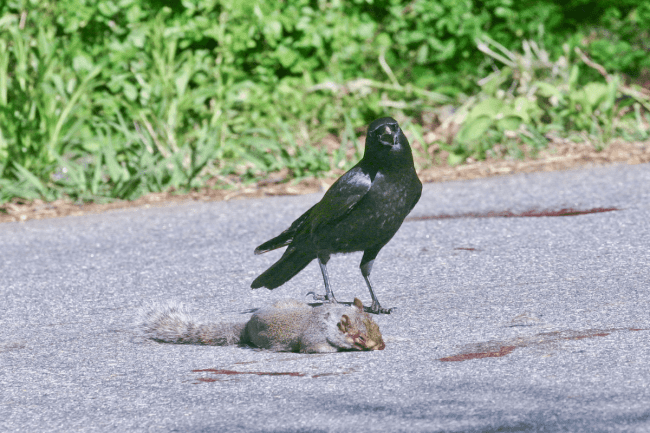
Ever seen a crow [Corvus brachyrhynchos] on a road, struggling to consume roadkill?  Yesterday I approached a crow in the road, as I was commuting—the crow was struggling to pull edible portions of meat from roadkill—it looked like a squirrel. 

CROW EATING SQUIRREL ROADKILL
r/crowbro / reddit.com photo credit

Like the Holy Land’s ravens [Corvus corax] who are mentioned by the Lord Jesus Christ Himself (in Luke 12:24), crows are famously opportunistic eaters – and their potential food sources include the cadavers of dead rodents, such as squirrels who (sadly) become roadkill in tree-populated suburban streets. 

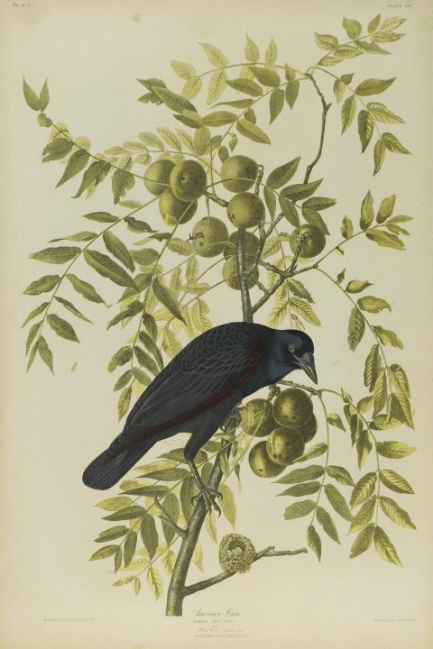
AMERICAN CROW
(J. J. Audubon painting / public domain)

The crow that I saw, yesterday morning, was struggling so, to get some edible parts of the roadkill, that he (or she) did not see my car approaching—which could result in the roadkill-eating crow himself (or herself) soon becoming another example of roadkill! 

So, of course, I tooted my car’s horn, with the jolting noise scaring the crow – so the crow quickly (and safely) flew away, thus escaping a roadkill fate. After my car passed through that part of the boulevard, happily, the hungry (and still living) crow returned to its roadkill meal. 

Sometimes a little “beep, beep” is all that is needed to “save the day” (for a crow)!

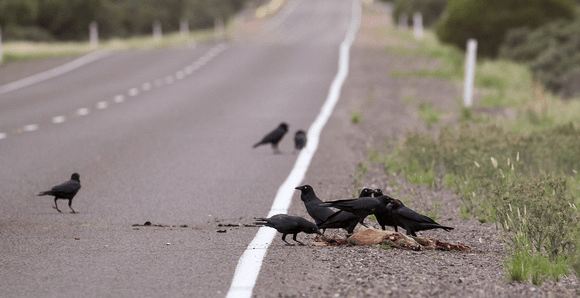
CROWS EATING ROADKILL
WarangaUnitingChurches.net.au photo credit

So, with that incident in mind, here is a limerick:

WHEN EATING ROADKILL, DON’T BECOME ROADKILL YOURSELF

While I drove, one day, on a street

I neared a crow, trying to eat

Tugging at roadkill

But I had goodwill

So I braked, with warning: beep, beep!

><> JJSJ profjjsj@aol.com

Beware, frisky squirrels, else you become roadkill. 

Beware, too, ye crows – because it could happen to you, too!

CROW WITH ROADKILL SQUIRREL
Nature-Blog-Network photo credit

MIGRATORY STOPOVER FOR CANADA GEESE

Dr. James J. S. Johnson

Yea, the stork in the heaven knows her appointed times; and the turtledove and the crane and the swallow observe the time of their return; but My people know not the judgment of the LORD. (Jeremiah 8:7)

The Bible mentions migratory birds – for examples, storks, turtledoves, cranes, and swallows are mentioned as faithfully migratory birds in Jeremiah 8:7.  (See JJSJ’s “A Lesson from the Stork”, at http://www.icr.org/article/lesson-from-stork .)

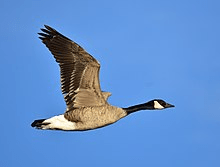
CANADA GOOSE in flight (Wikipedia photo credit)

Avian migrations are truly a wonderful recurrence in God’s phenological providences. 

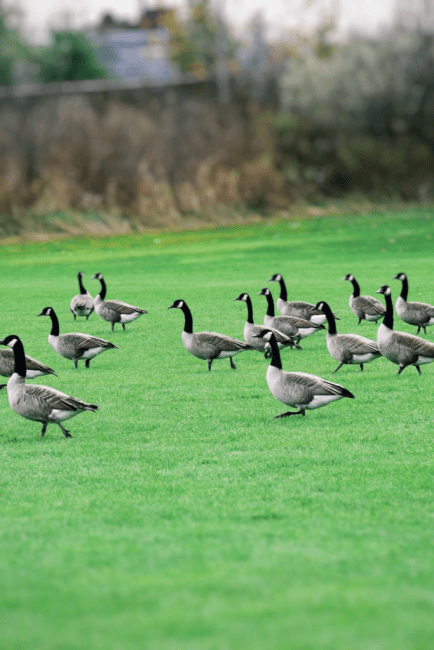
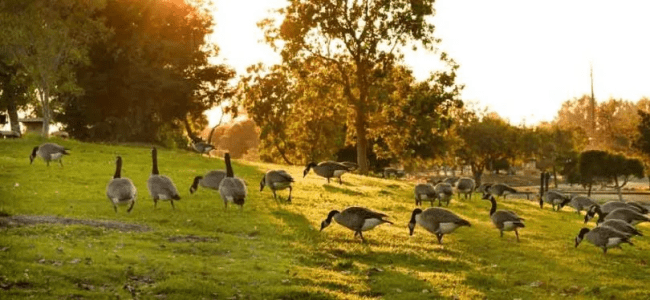
With that in mind, I observed a flock of Canada geese (Branta canadensis) in my neighborhood, not far from my mailbox—they were grazing among the grasses by my rain-runoff drainage ditch. 

CANADA GEESE IN GRASS
(HumaneActionPittsburgh.org photo credit)

But not long afterwards they were off again, in the air, southbound, toward wherever they go for winter.  Today’s limerick follows.

OBSERVING 18 CANADA GEESE: MIGRATORY STOPOVER VISITORS

A migrant flock came by today

The flock intact, none gone astray;

Slowly grazing geese,

Dawdling and obese;

Then they returned to their flyway.

(JJSJ, November 4th A.D.2024, near Flower Mound, Texas.)

CANADA GEESE IN YARD
(TriangleGardener.com photo credit)

Cormorants are Great; Great Cormorants are Really Great!

Cormorants are Great; Great Cormorants are Really Great!

Dr. James J. S. Johnson

But the cormorant [shalak] and the bittern shall possess it [i.e., the land of Idumea, a/k/a Edom]; the owl also and the raven shall dwell in it; and He [i.e., the LORD, in judgment] shall stretch out upon it the line of confusion, and the stones of emptiness.

Isaiah 34:11
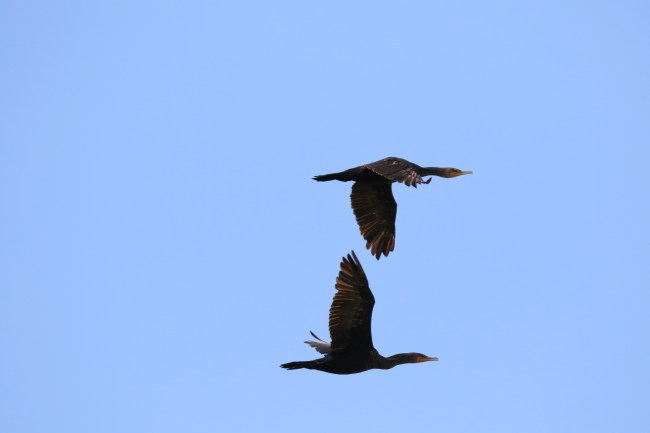
GREAT CORMORANTS in flight (Minnesota)
photo credit: Bryce Gaudian

In some contexts, CORMORANTS are not deemed as indicators of blessing — as in Isaiah 34;11, where it is prophetically mentioned as an indicator that the land of Edom is catastrophically destroyed. However, in many other contexts, these magnificent birds are recognized as wonderful creatures whom God has equipped to live by bodies of water, both freshwater and seawater.

GREAT CORMORANT aloft (Minnesota)
photo credit: Bryce Gaudian

Cormorants love to live by bodies of water. Cormorants are found busy hunting — darting (befitting the Hebrew noun shalak, in Leviticus 11:17 & Deuteronomy 14:17, translated “cormorant”, which matches the darting-like targeting movements) for food over and near coastlines, including the coasts of islands, such as the Hebridean isle of Staffa, which was reported earlier (on this Christian birdwatching blog), in the report titled “Birdwatching at Staffa: Puffins, Shags, and more”, posted at https://leesbird.com/2019/07/22/birdwatching-at-staffa-puffins-shags-more/ (July 22nd A.D.2019), citing Isaiah 42:12. [Regarding “cormorants” in the Holy Bible, see George S. Cansdale, ALL THE ANIMALS OF THE BIBLE LANDS (Zondervan, 1976), at page 175.]

Cormorants constitute a large “family” of birds; the mix of “cousins” include Crowned Cormorant (Phalacrocorax coronatus), Brandt’s Cormorant (Phalacrocorax penicillatus), Galapagos Cormorant (Phalacrocorax harrisi), Bank Cormorant (Phalacrocorax neglectus), Neo-tropic Cormorant (Phalacrocorax brasilianus), Double-crested Cormorant (Phalacrocorax auritus), Indian Cormorant Phalacrocorax fuscicollis), Socotra Cormorant (Phalacrocorax nigrogularis), Cape Cormorant (Phalacrocorax capensis), Guanay Cormorant (Phalacrocorax bougainvillii, a/k/a Guanay Shag), Kerguelen Shag (Phalacrocorax verrucosus), Imperial Shag (Phalacrocorax atriceps), Antarctic Shag (Phalacrocorax bransfieldensis). South Georgia Shag (Phalacrocorax georgianus), Campbell Island Shag (Phalacrocorax campbelli), New Zealand King Shag (Phalacrocorax carunculatus), Bronze Shag (Phalacrocorax chalconous), Chatham Island Shag (Phalacrocorax onslowi), Auckland Island Shag (Phalacrocorax colensoi), Rock Shag (Phalacrocorax magellanicus), Bounty Island Shag (Phalacrocorax ranfurlyi), Red-faced Cormorant (Phalacrocorax urile, a/k/a Red-faced Shag), European Shag (Phalacrocorax aristotelis), Pelagic Cormorant (Phalacrocorax pelagicus, a/k/a Pelagic Shag), Red-legged Cormorant (Phalacrocorax gaimardi), Spotted Shag (Phalacrocorax punctatus), Pied Cormorant (Phalacrocorax varius), Great Cormorant (Phalacrocorax carbo), Japanese Cormorant (Phalacrocorax capillatus), Olivaceous Cormorant (Phalacrocorax olivaceus, a/k/a Mexican Cormorant), and Pitt Island Shag (Phalacrocorax featherstoni).

That’s a lot of cormorant “cousins”, worldwide! [For details on each of these “cousins”, see pages 116-136 of Jim Enticott & David Tipling, SEABIRDS OF THE WORLD: THE COMPLETE REFERENCE (Stackpole Books, 1997).]

Notice: Cormorants are not anhingas!

To distinguish these 2 large black fish-loving birds, see “Of Cormorants and Anhingas” (June 13th A.D.2019), posted at https://leesbird.com/2019/06/13/of-cormorants-and-anhingas/ .

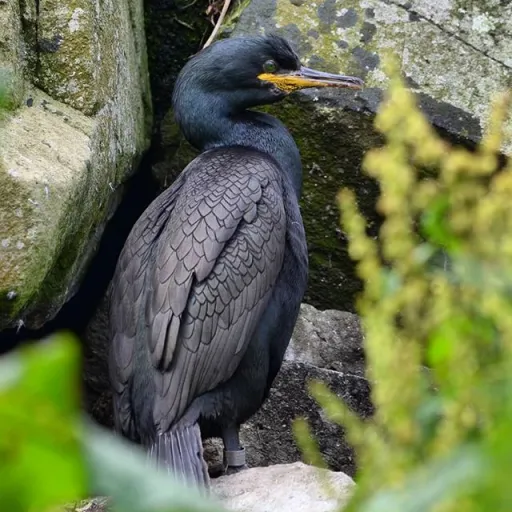
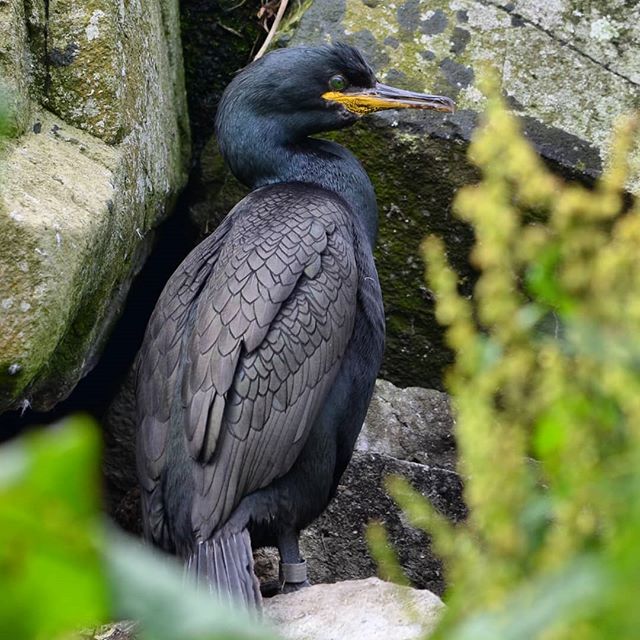
SHAG (a type of Cormorant), at Staffa, Hebrides (Scotland)
photo credit: Public Insta

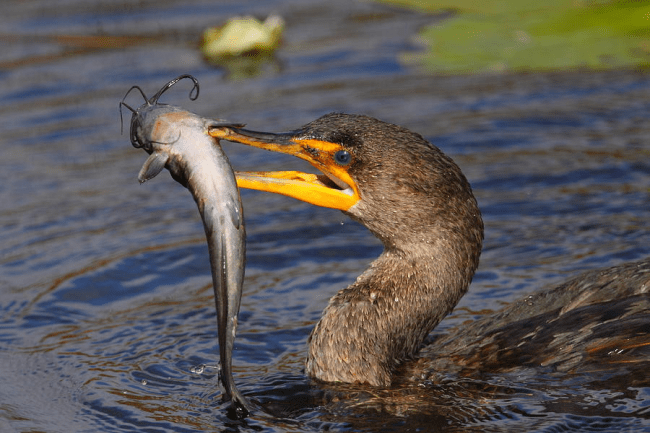
Cormorants are famous “fishermen” along ocean coastlines, yet cormorants also thrive in inland freshwater habitats, such as over and near ponds and lakes, such as the Double-crested Cormorants that frequent inland ponds in Denton County, Texas, where they catch “fish of the day”.

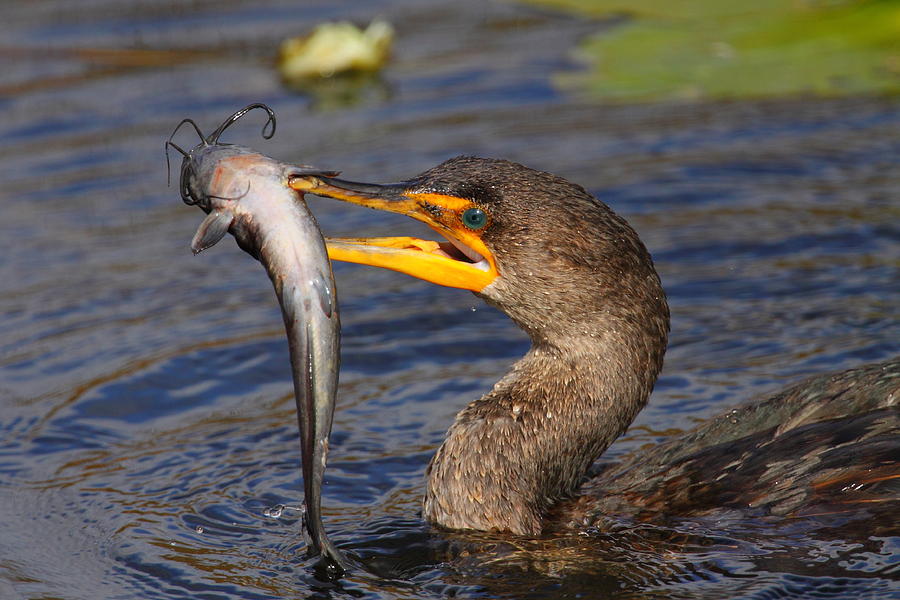
DOUBLE-CRESTED CORMORANT with fish
photo credit: Bruce J. Robinson

Cormorants are generally described, by ornithologist Roger Tory Peterson, as follows:

Large, blackish, slender-billed water birds. Often confused with loons, but tail longer, bill hook-tipped. In flight, wing action is more rapid and axis of body and neck is tilted upward slightly (loon’s neck droops). Young birds are browner, with a pale or whitish breast. Flocks [of cormorants] fly in line or wedge formation very much like geese but they are silent. Cormorants often perch in upright positions on buoys or posts with neck in an S [posture]; sometimes strike a “spread eagle” pose. Swimming, they lie low like loons, but with necks more erect and snakelike, and bills tilted upward at an angle. Food: Fish (chiefly non-game). Nearly cosmopolitan [in range].

[Quoting Roger Tory Peterson, cited below]

[See Roger Tory Peterson, A FIELD GUIDE TO THE BIRDS OF TEXAS AND ADJACENT STATES (Houghton Mifflin, 1988), page 10.]

Specifically, the Double-crested Cormorant (Phalacrocorax auritis) is perhaps the most common winter migrant of the cormorants; also, the Double-crested Cormorant is often seen in the coastline areas of Texas’ Gulf of Mexico shores.

GREAT CORMORANTS descending (Minnesota)
photo credit: Bryce Gaudian

Have you ever watching a silhouetted cormorant — or two — or three — winging their way across the late afternoon sky? It is a wonder to behold!

GREAT CORMORANTS silhouetted against the sky
photo credit: Bryce Gaudian

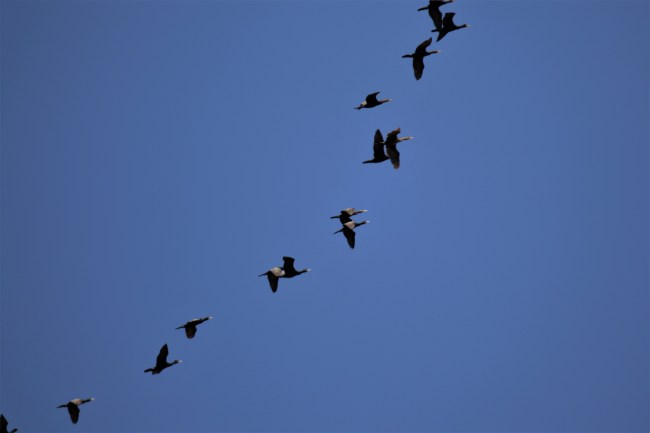
Now, try to imagine a dozen, or more, cormorants, flying in series. That’s a wondrous wonder to behold! That constitutes one of the “wonders without number” that Scripture refers to (in Job 9:10).

serial “line” of GREAT CORMORANTS in flight (Texas)
photo credit: Bryce Gaudian

And now here is my closing limerick, about cormorants:

APPRECIATING HUMBLE CORMORANTS (AND SHAGS)

Cormorants are not known to brag,

If they’re so-called, or called “shag”;

They oft fly, in a line,

And on fish, they oft dine

But cormorants aren’t known to brag.

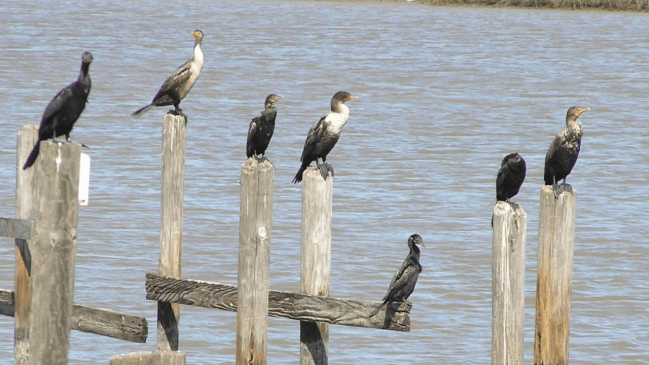
DOUBLE-CRESTED CORMORANTS perching on posts
photo credit: Mark Eising Birding

(Dr. Jim Johnson formerly taught ornithology and avian conservation at Dallas Christian College, among other subjects, and he has served as a naturalist-historian guest lecturer aboard 9 international cruise ships, some of which sailed in seawaters frequented by cormorants and shags. Jim was introduced to Christian birdwatching as an 8-year-old, by his godly 2nd grade teacher, Mrs. Thelma Bumgardner.)

BOBOLINKS: GRAIN-LOVING GRASSLANDERS

SEED-LOVING BOBOLINKS, GROUND-NESTING IN GRASSLANDS

Dr. James J. S. Johnson

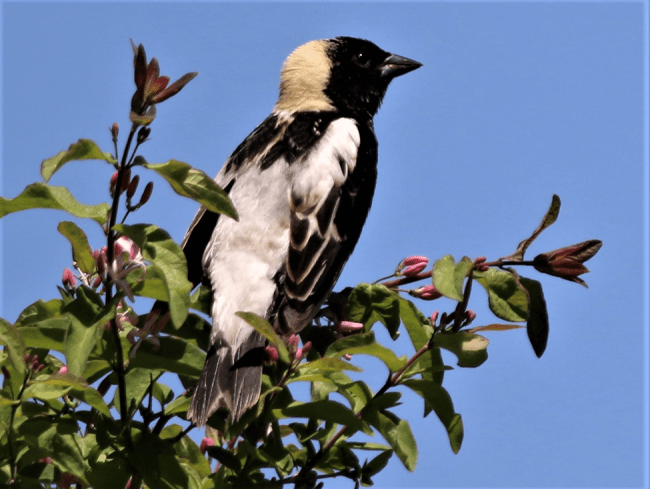
BOBOLINKS in grassland habitat, Minnesota 
(photo credit: Bryce Gaudian)

If a bird’s nest chance to be before thee in the way in any tree, or on the ground, whether they be young ones, or eggs, and the mother sitting upon the young, or upon the eggs, thou shalt not take the mother with the young. 

(Deuteronomy 22:6)

Moses noted that some wild birds build their nests upon the ground; Bobolinks do just that.

Years ago, I reported on the Black-capped Chickadee, noting that I first saw one at Gilsland Farm Sanctuary, while attending a wetland ecologists’ meeting: “Decades ago, I saw Black-capped Chickadees, for the first time, in Falmouth (near Portland), Maine – at the Gilsland Farm Sanctuary (now called “Gilsland Farm Audubon Center”), on May 31st of AD1995, while attending the annual national meeting of the Society of Wetlands Scientists.” [Quoting from “Tiny Yet Tough: Chickadees Hunker Down for Winter”, posted at https://leesbird.com/2016/11/18/tiny-yet-tough-chickadees-hunker-down-for-winter/ .]

Another “lifer” that I then observed that day, at Gilsland Farm Sanctuary, was the BOBOLINK.  And what a striking plumage the male Bobolink has, during breeding season! 

BOBOLINK MALE in breeding plumage, Minnesota 
(photo credit: Bryce Gaudian)

Bobolinks (Dolichonyx oryzivorus) are icterids (blackbirds of the Western Hemisphere), dwelling in America’s prairie and pasture grasslands and marshy wetlands during the warm months of the year.  Bobolinks were nicknamed “rice birds” (which matches their species name, oryzivorus, meaning “rice-eating”), due to their dining habits, especially during autumn migrations.  

The Bobolink genus name, Dolichonyx, means “long claw”, matching its prehensile perching “fingers”.

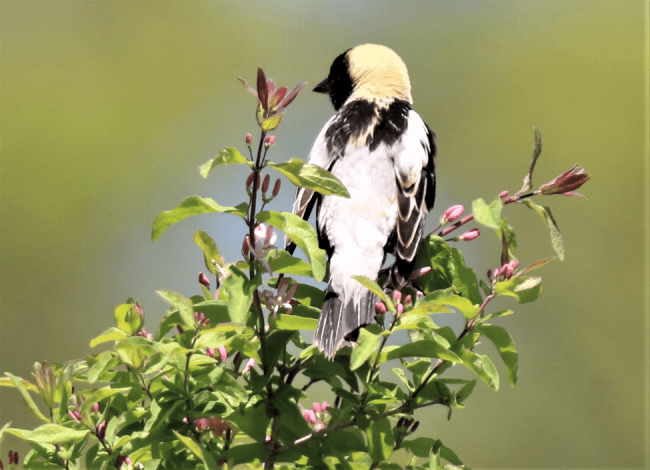
BOBOLINK MALE, perching with “long claws”, Minnesota 
(photo credit: Bryce Gaudian)

During such migrations Bobolinks frequently feed in farmed fields of rice and other grains (such as oats, sorghum, maize corn, and hayseed), at energy-packing refueling stopovers (e.g., in South Carolina and the Gulf states), on their aerial journeys southward, via Caribbean islands, en route to South American over-wintering range destinations.

Bobolinks feed on (or near) the ground, eating various seeds, insects, spiders, and even snails—especially during breeding seasons.  Both larvae and adults of insects (especially armyworm moths) are protein-rich, much needed for growing Bobolink juveniles.

Also, during breeding seasons, Bobolinks depend upon available hay for nest-building, on the ground, in vegetated areas. 

Bobolinks are quite specific in their breeding habitat needs.  Open hay fields are a must, and so as farming is some regions of the country diminishes, so do populations of bobolinks.  Where colonies of bobolinks have traditionally bred, it is important to preserve their habitat with regular mowing practices.  Unfortunately, the right time to mow a field for hay is often just when the young are fledging[!].  Careful observation of the behavior of a [bobolink] colony and delaying of mowing until one or two weeks after fledging, a time when the young can fly fairly well, will keep a colony producing and ensure its [multi-generational] survival. 

[Quoting Donald W. Stokes & Lillian Q. Stokes, A GUIDE TO BIRD BEHAVIOR, Volume III (Boston: Little, Brown & Company/Stokes Nature Guides, 1989), pages 351-352.]
BOBOLINK MALE in grassland habitat, Minnesota 
(photo credit: Bryce Gaudian)

Consequently, Bobolinks are easier to find in habitats where their needs for food and nesting are plentiful.

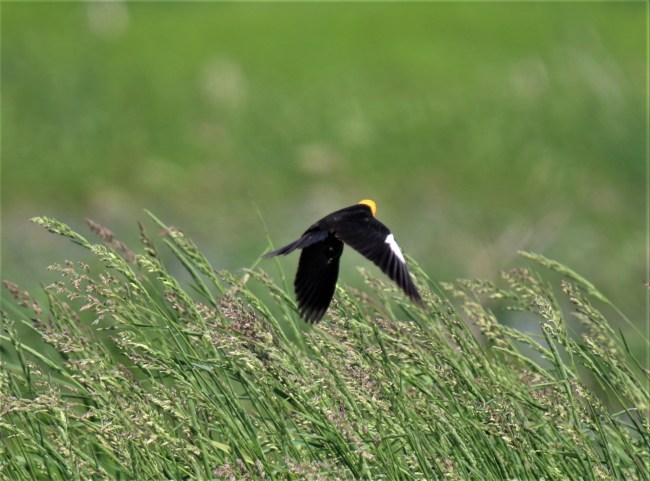
BOBOLINK male in flight, prairie habitat, Minnesota
(photo credit: Bryce Gaudian)

The males have easily seen plumages—like reverse tuxedos (white upon black) in spring and summer, during breeding months.

BOBOLINK male, displaying yellow nape-hood, Minnesota
(photo credit: Bryce Gaudian)

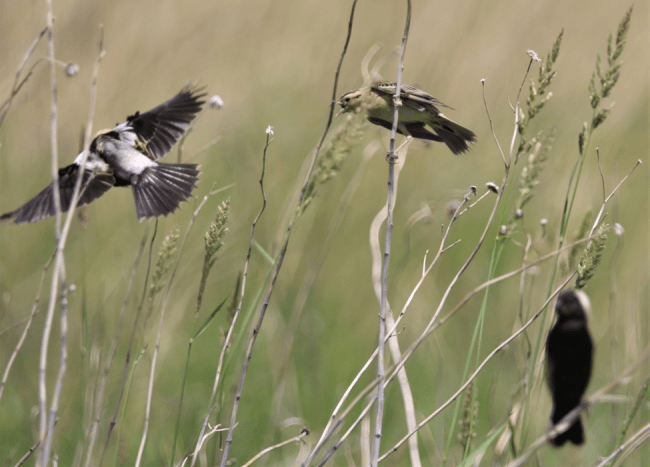
Male and female bobolinks are easily distinguished during the breeding season.  Males have a black head, belly, and wings, with a buff-gold nape and white patches on the back.  The female is buff [and brown] colored all over with dark streaks on her back, wings, and sides.

[Quoting Donald W. Stokes & Lillian Q. Stokes, A GUIDE TO BIRD BEHAVIOR, Volume III (Boston: Little, Brown & Company/Stokes Nature Guides, 1989), pages 364.]

During non-breeding months, however, Bobolink males shift to duller hues of dark and light browns, similar to the year-round plumage of Bobolink females and juveniles.

BOBOLINK female perching near prairie flower
(Mircea Costina / Shutterstock / ABCbirds.org photo credit)

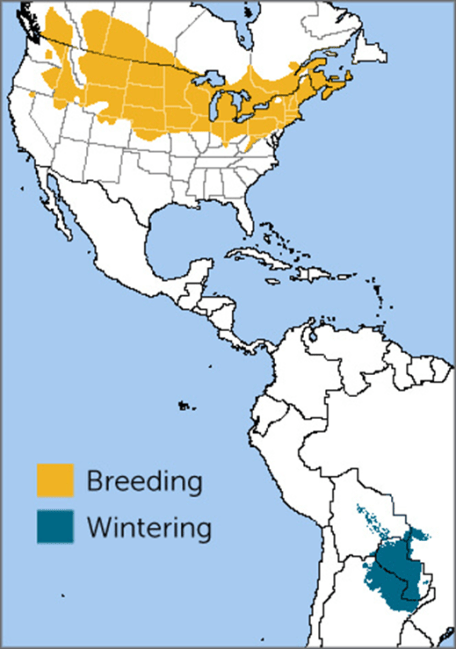
Of course, these tweety-chirpy icterids breed elsewhere in spring – in most of the upper half of America’s Lower 48, from the Northeast’s coastlines almost as far wet as the coasts of Washington and Oregon. Accordingly, the Bobolink migrates about 6,000 miles southward or northward, so it accrues about 12,000 miles per year, in air miles.

American Bird Conservancy range map

It was a privilege to see Bobolinks, back in AD1995, at the Gilsland Farm Sanctuary, as part of my time attending the Society of Wetlands Scientists’ meeting.

Likewise, it’s a privilege, now, to be permitted to share some of the wonderful Bobolink photographs taken in Minnesota, by Christian/creationist photographer BRYCE GAUDIAN — thanks, Bryce!

And now, it’s time for a limerick, about Bobolinks.

In Appreciation of the Bobolink, a/k/a Rice Bird

There’s an icterid feathered quite nice,

Whose fast-food oft includes rice;

It makes a chirp-sound,

As it nests on the ground,

And it’s photo’d quite well, by Bryce!


ON SEEING A GRACKLE IN THE POND-SHORE CATTAILS

On Seeing a Grackle in the Pond-shore Cattails

Dr. James J. S. Johnson

This shall be written for the generation to come; and the people who shall be created shall praise the LORD.

(Psalm 102:18)
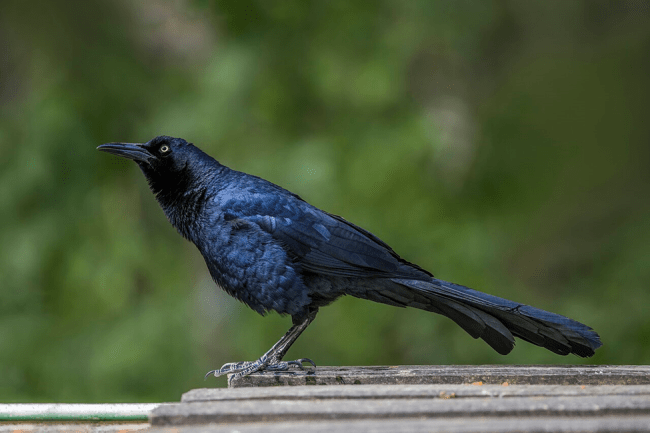
GREAT-TAILED GRACKLE (male)
Charles J. Sharp / Wikipedia photo credit

Last weekend, I drove past a familiar Texas pond, where 11 years ago I saw a “common” black-feathered bird (i.e., Quiscalus mexicanus = Great-tailed Grackle, to be exact), and was then jolted by an “uncommon” (and somewhat-scary) realization – God could have made me a grackle! 

Days later, during the summer of AD2012, I reported this important thought (and attitude fo gratitude) within an article [“Grackles and Gratitude”, ACTS & FACTS, 41(7):8-10 July 2012), posted at www.icr.org/article/grackles-gratitude ] about how uniquely and personally each one of us is, created by the Lord Jesus Christ, as exactly the specific individual that each one of us is. 

When was the last time that you saw a bird—perhaps a grackle or a pigeon—and shuddered with the scary realization: That could have been me! Maybe you have never thought about a grackle that way. Yet it is true—God did not need to make us just as we are. He had many other options. God could have created each of us as a bird, a butterfly, or a basalt rock. God could have made you or me a uranium-bearing rock, a nudibranch, an ice worm, a quince fruit, an ultraviolet ray, or an egret. [Notice the acrostic in the previous sentence: U.N.I.Q.U.E.!]

Yet, He deliberately chose otherwise. He chose to make us one-of-a-kind humans. What a fearful and wonderful reality!…

Surely we should thank Christ for being our very personal Creator. So the next time you see a grackle, think thankfully for a moment, “That could have been me!” And be grateful to your Creator, who made you a unique, one-of-a-kind creation.

[Quoting JJSJ’s “Of Grackles and Gratitude”)
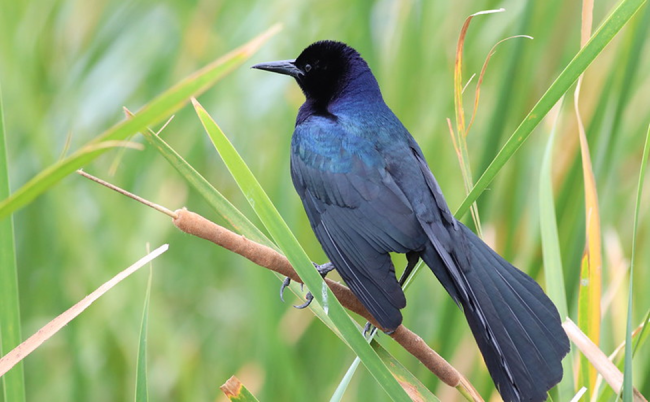
GRACKLE ON CATTAILS (BirdNote / Gary Leavens photo credit)

So, what an echo from yesteryear it was, last weekend, when I spied another “common” grackle (actually a Great-tailed Grackle, which is common in Denton County, Texas), ambling about the littoral cattails of that same pond that I drove by more than a decade ago. 

Whew!  What a journey the past 11 years have been, as I quickly recall and reconsider (and gratefully appreciate) God’s many personal and providential blessings unto me – including His kind and caring blessings that continue to make me the individual man I am – along with the many other blessings of His redemptive and always-sufficient grace, over those 11 years since that important icterid-aided insight. 

Plus, the best is yet to come (Luke 10:20)! So, thinking of Psalm 102:18, I close this nostalgic memoir with a limerick:

AN ATTITUDE OF GRATITUDE, ON SEEING A GRACKLE IN THE CATTAILS

Some troubles, in life, we must tackle,

Threatening us, with harm, like a jackal;

     Yet life, itself, we can face,

     Since life, itself, is God’s grace

Each of us, God could’ve made, a grackle!

COMMON GRACKLE on Cattail
(National Park Service photo credit)

ROADRUNNERS: Made for Running!

Roadrunners: Made for Running!

Dr. James J. S. Johnson

But they that wait upon the LORD shall renew their strength; they shall mount up with wings as eagles; they shall run, and not be weary; and they shall walk, and not faint.

( Isaiah 40:31)

Therefore, seeing we also are compassed about with so great a cloud of testifying-witnesses [μαρτυρων ], let us lay aside every weight, and the sin which doth so easily beset us, and let us run with patience the race that is set before us.

( Hebrews 12:1 )
GREATER ROADRUNNER (Wikipedia / PhreddieH3 photo credit)

Seeing a Greater Roadrunner (Geococcyx californianus, a/k/a Chaparral Bird) scampering about in the grass, near the east side of my lawn, last Friday (12 May, A.D.2023), reminded me of the hidden-in-plain-view miracle of running. Roadrunners are cuckoo-like birds, capable of flight yet more famous for on-the-ground running (including chasing and catching insects and reptilian prey), easily recognizable by their skinny-chicken-looking bodies, sporting long tails, scissors-like beak, and prominent crest feathers.

ROADRUNNER EATING SNAKE
( photo credit: MSN.com News / Bonnie Blink )

And Roadrunners are quick! (See, e.g., “Sneaky Roadrunner”, posted at https://leesbird.com/2014/07/09/sneaky-roadrunner/ — and also see “Dueling with a Diamondback i the Desert: ROADRUNNER vs. RATTLESNAKE!”, posted at https://leesbird.com/2017/05/23/dueling-with-a-diamondback-in-the-desert-roadrunner-vs-rattlesnake/ .)

For a recent news report on a snake-eating roadrunner, see Robyn White’s “Hungry Bird Takes on Venomous Snake—and Wins””, posted at http://www.msn.com/en-us/news/us/hungry-bird-takes-on-venomous-snake-and-wins/ar-AA1bcKQQ?ocid=msedgntp&cvid=e9fb24f6a0bc45f8b2e00754820428c0&ei=14 .

GREATER ROADRUNNER in Mojave Desert, California
( photo credit: Wikipedia / Jessie Eastland )

Running is an astounding activity, although we rarely think of running that way. (And chasing is even more amazing, because it involves 2 creatures running at the same time, with one trying to catch while the other tries to escape!). However, if we only saw an animal–or a human–running once in a lifetime we might recognize the physiology of running as the God-given miracle that is. But, because we see creatures run about, frequently, we lose sight of how astonishing the action of running really is.

Running requires coordinated and energetic movement, integrating purpose, distance, and body parts and systems working together with teamwork (see 1st Corinthians chapter 12), so the bioengineering needed to enable running is an energetic and ongoing exhibit of the Lord Jesus Christ’s empowering genius and wisdom. (See, accord, Randy J. Guliuzza, “Made in His Image: Beauty in Motion”, posted at http://www.icr.org/article/beauty-motion# .)

Children assume that running is normal; grandparents watch runners with nostalgia, remembering when sprinting felt effortless. Running, if and when it is accomplished with ease, is a blessing–the ability to run is a marvelous gift from our God Who invented the ability to run. In fact, the Lord gave the gift of running to more than just human children, and athletes who are older than children–He gave the gift of running to many of the animal He created.

CHEETAH running (Answers in Genesis photo credit)

Among mammal s, notable runners include feline family (such as cheetah, jaguar, and cougar, sprinting at speeds near 70 mph!), antelope-like beasts (such as pronghorn, springbok antelope, and Indian blackbuck antelope, reaching speeds of 50 to 60 mph), wildebeest (running at 50 mph), and even bats (such as free-tailed bat, flying at 60 mph!). Other fast-footed mammals include the African lion and the hare (both climaxing at almost 50 mph, and running longer distances at lesser speeds), as well as the African wild dog and Australia’s kangaroo (both climaxing at almost 45 mph).

But, what about birds? Many birds move at speeds that are mind-boggling, such as the figure-eight wing-beating of hummingbirds, which appear as blurs to the watching eyes of human spectators–some capable of speeds above 40 mph!)..

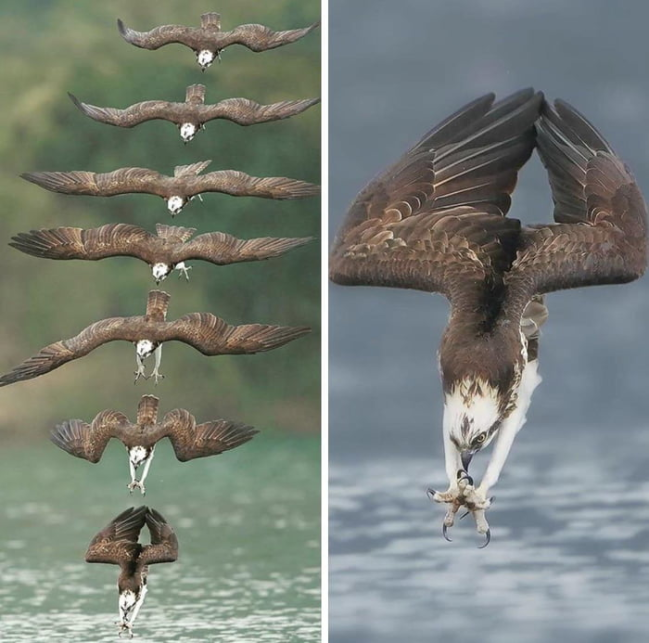
Likewise, birds can fly at high speeds, both horizontally and especially when “dive-bombing” (a/k/a stoop diving) downward—think of falcons (e.g., Peregrine Falcon, with horizontal speeds up to almost 70 mph, and diving speed above 240 mph!). Likewise, eagles are famous for their speed (e.g., Golden eagle, with horizontal speed near 30 mph, and diving speed near 200 mph).

EAGLE diving down! ( photo credit: 9gag.com )

Indeed, the Holy Bible refers to the eagle’s speedy flight more than once.

Saul and Jonathan were lovely and pleasant in their lives, and in their death they were not divided: they were swifter than eagles, they were stronger than lions.

( 2nd Samuel 1:23 )

Our persecutors are swifter than the eagles of the heaven: they pursued us upon the mountains, they laid wait for us in the wilderness.

( Lamentations 4:19 )

Yet birds can be rapid runners on ground, too–with the Roadrunner being the classic example of a bird famous for running.

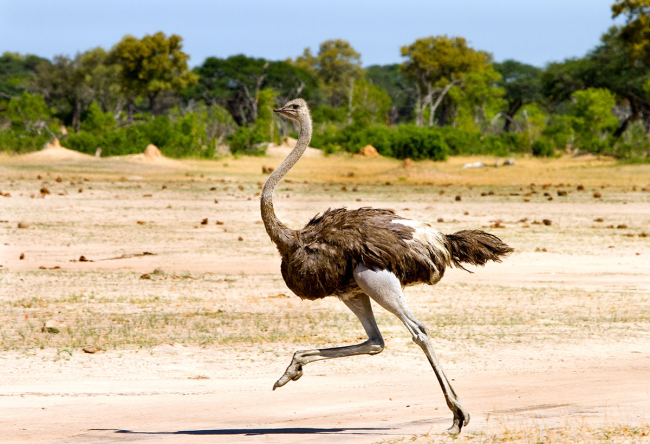
OSTRICH running ( photo credit: Thomson Safaris )

Actually, Africa’s Ostrich runs faster, achieving speeds up to 43 mph (with some reports of quick sprint-bursts up to 60 mph!), qualifying the Ostrich as the fleetest terrestrial runner among birds! Ostriches have stamina, too, so they can sustain speeds above 30 mph for a half-hour or even longer–no human can do that! Behind the Ostrich, Australia’s Emu (a smaller ratite) zooms by, racing at speeds above 30 mph.

ROADRUNNER with prey (photo credit: Nature Picture Library)

Yet the Greater Roadrunner, a much smaller bird, can dart about at speeds above 25 mph–faster than even fleet-footed children.

So, you get the picture–running is a big deal! On that note I’ll quit–i.e., rest–because I ‘got tired” just thinking about all of those creatures running to and fro. Actually, to be frank, I NEVER GET TIRED! Why? I don’t “get tired” because I stay tired.

:)

GREATER ROADRUNNER at Caprock Canyons State Park in West Texas
( photo credit: Wikipedia / drumguy8800 xvisionx.com )

Having arrived at this blogpost’s “finish line”, I’ll contribute this limerick:

STARTLED BY A ROADRUNNER ZIGZAGGING IN THE GRASS

After filling my mower with gas,

I was cutting my east lawn’s grass;

Whoa! — it gave me a start!

‘Twas a bird that did dart!

Wow! Texas roadrunners run fast!

ROADRUNNER, on the run!
(photo credit: Wikipedia / El Brujo+ )

Fly-thru “Althing” of Migratory Cedar Waxwings

Dr. James J. S. Johnson

“Praise the LORD from the earth … fruitful trees and all cedars … and flying fowl.” (from Psalm 148:7-10)

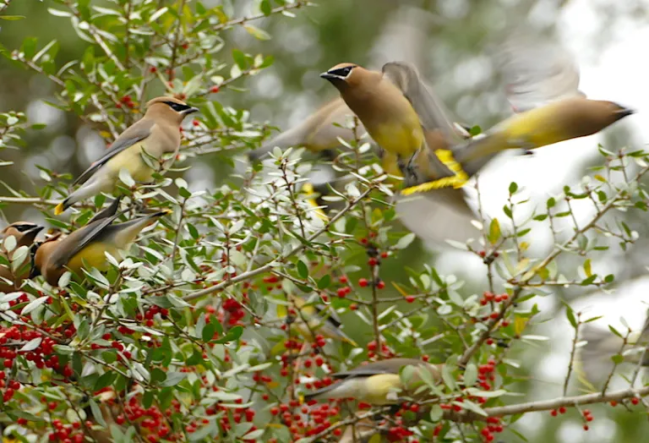
CEDAR WAXWINGS EATING BERRIES [photo credit: Wild Birds Unlimited]

Each spring gregarious flocks of Cedar Waxwings pass through my part of Texas, as they migrate northward toward their breeding grounds. No “lone rangers” here! Cedar Waxwings travel in flocks of many dozens–sometimes even hundreds–synchronizing their fast-food stopovers along the way, to refuel for the next aerial leg of their migratory trek. And trees or bushes with red berries are a particular favorite of Cedar Waxwings. Although the nutritional details are a bit technical — as noted below* — waxwings need to balance their sour berry intake with protein-rich pollen, both of which are available during mid-April in my part of Texas, as the flocks of Cedar Waxwings pass through in their flights northward.

So, when these large flocks of colorful waxwings make a “pit stop” for fast-food they often fill the branches of trees as they hastily consume red berries (and other edible nutrients), just before resuming their northbound flights to their spring-through-summer breeding ranges.

On April 7th A.D.2023, a Friday morning, as I observed this hastily convened arboreal assembly of avian migrants, I thought of the traditional assemblies (“things”) of the Vikings — such as those Nordic congregants convened annually in Iceland (Thingvellir’s “Althing”) and on the Isle of Man (at the Manx “Tynwald”), to conduct the serious business of life. Could it be that these Cedar Waxwings were having their own version of an Althing assembly, as they refueled (and rested briefly) during their stopover in the branches of my trees and bushes? Since I cannot understand the language of Cedar Waxwings I cannot know what they conversed about — but I knew that they would vacate northward soon enough, so I would not see them again until the next seasonal migratory pass-through, as they live out the providential phenology of their migratory lifestyle.

What a privilege it was to see God’s Cedar Waxwings–scores of them (perhaps more than a hundred!) as a flock in transit–quickly visiting the trees and bushes on the south side of my home. Surely God’s birds will remind us of His care for us, if we take the time to think about it–and have eyes to see (Matthew 6:26; Luke 12:24).

In fact, that faith lesson (which is was taught, in ancient times, to the patriarch Job, by God Himself (in Job 38:41), as is noted in the first of the 3 apologetics lectures (shown below) that I gave recently, to a Swedish theology school (Skandinavisk Teologisk Högskola):

God’s Creation Sermon in Job 39: Learning from God’s Animals: https://youtu.be/_ydP8vCTBAY

Viking Skeletons Embarrass Carbon 14 Radiometric Dating: https://youtu.be/Bx40cjdodRM

Why Study Grass and Flowers? Learning from God’s Plants: https://youtu.be/-4SMgqq2waU

CEDAR WAXWINGS [photo credit: Museum of Life & Science, Durham, N.C.]

So, now for a limerick, that memorializes my observations of the flock of Cedar Waxwings that briefly visited my frontyard earlier this month:

FAST-FOOD/FLY-THRU ALTHING OF MIGRATORY CEDAR WAXWINGS

A flock-full of birds, in my trees,

Gulped down every berry they’d seize;

This arboreal Althing

of the Cedar Waxwing

Soon adjourned—dispersed with the breeze!

CEDAR WAXWINGS photo credit: Mary Anne Borge / The Natural Web

[*For technical information, befitting Cornell University, about the diet of Cedar Waxwings, see Mark C. Witmer’s “Nutritional Interactions and Fruit Removal: Cedar Waxwing Consumption of Viburnum opulus Fruits in Spring”, ECOLOGY, 82(11):3120-3130 (November 2001).]

Looking at a Lone Lesser Scaup

LOOKING AT A LONE LESSER SCAUP

Dr. James J. S. Johnson

God … is wise in heart, and mighty in strength: … [and He] doeth great things past finding out; yea, and wonders without number.

[Job 9:2 & 9:4 & 9:10]

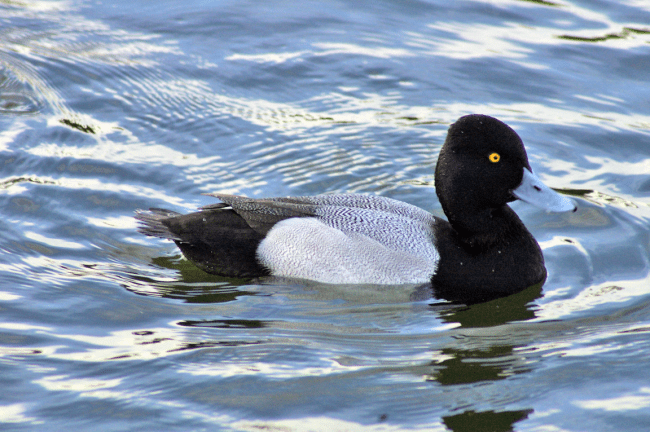
LESSER SCAUP male (photo credit: National Audubon Society)

Last Saturday (February 18th of A.D.2023), as I was birdwatching inside my wife’s car — while she was driving, so it’s okay that I was birdwatching! — I saw a lone Lesser Scaup (Aythya affinis, a/k/a “Little Bluebill”) floating in the middle of a favorite pond (where I have often seen grackles in the past — see http://www.icr.org/article/grackles-gratitude/ — and appreciated that God could have made me a grackle!).

As I thought about this Lesser Scaup, and how I’ve often seen such scaups (and other ducks) on Texas ponds during winter, it seems that the occasion deserves a poetic memorial of some kind, such as a limerick.

Now, a few days later, here is that limerick, although admittedly the limerick calls the pond a “lake” (which some ponds are called, anyway, by Floridians), because it’s easier to rhyme “lake” than “pond” when composing limericks.

LESSER SCAUP (photo credit: swartzentrover.com / BirdPages)

LOOKING AT A LONE LESSER SCAUP ON A WINTER DAY

One cold wintry day, on a lake,

A scaup floated by — ’twas a drake;

Little bluebills eat seeds,

Clams, mussels, pondweeds;

I’m glad that, such ducks, God did make!

LESSER SCAUP female (L) & male (R)

photo credit: BirdwatchingDaily.com / David Mundy

Apparently, the anatid name “scaup” derives from a European word referring to shellfish (e.g., Noah Webster’s 1828 AMERICAN DICTIONARY OF THE ENGLISH LANGUAGE notes that “scalp” comes from the Dutch schelp meaning “shell”), alluding to coastal bivalves (such as clams, mussels, and oysters), which are often eaten by these diving ducks. These wetland-frequenting ducks also eat shoreline vegetation, such as pondweeds, widgeon-grass, sedges, bulrushes, wild rice, wild celery, and other hydrophilic plants.

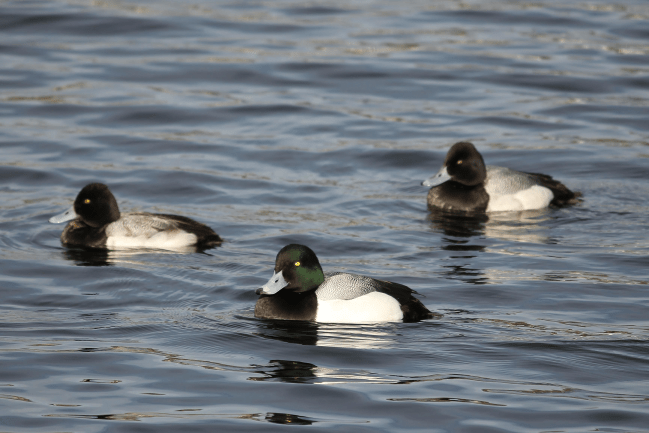
Generally speaking, scaups are migratory birds, so we Texans see them during the cold months of the year — however, there are some parts of North America where Lesser Scaups are seen year-round. Sometimes it’s hard to distinguish a Lesser Scaup from a Greater Scaup (Aythya marila, a/k/a “Common Scaup” or “Bluebill”), from a distance — plus, to confuse identifications further, these scaups can hybridize with each other, as well as with the American Redhead (Aythya americana), Ring-necked Duck (Aythya collaris), European Pochard (Aythya ferina), and Canvasback (Aythya valisineria). [See Eugene M. McCarthy, HANDBOOK OF AVIAN HYBRIDS OF THE WORLD (Oxford, UK: Oxford Univ. Press, 2006), page 90.] But they are all diving ducks!

Greater Scaup between Lesseer Scaups (photo credit: reddit.com / birdpics)

So, as noted above (in the above limerick that is just “ducky”), I’m glad that, such ducks, God did make!

Birdwatching at Staffa: Puffins, Shags, & more

Birdwatching at Staffa, near Iona: Puffins, Shags, and Herring Gulls

Dr. James J. S. Johnson

Let them give glory unto the Lord, and declare his praise in the islands.  (Isaiah 42:12)

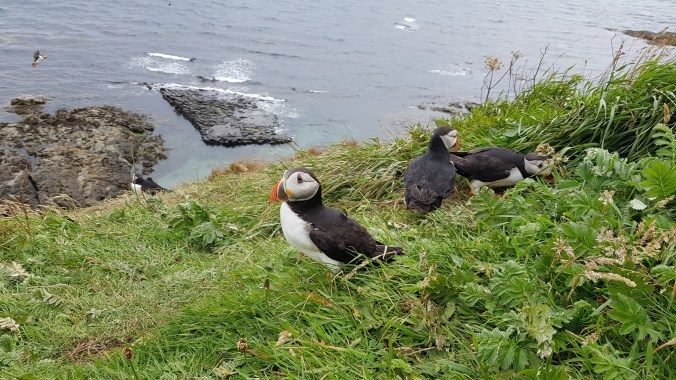
The three birds that I recall most, from visiting the island of Staffa (Inner Hebrides, just north of Iona) were Herring Gulls (a very common seagull),  Shags (a yellow-mouthed but otherwise all-black cormorant), and those cute and colorful (and comically clown-like) Atlantic Puffins, a couple of which settled (after some aerial arcing) not much more than a yard (i.e., meter) form where I was standing, upon the grassy cliff-side of the pasture-topped island.

Shag-Staffa.PublicInsta-[hoto

SHAG  at  STAFFA   (Public Insta photo credit)

Below is a limerick I wrote to recall my observations at the Isle of Staffa (same island that has Fingal’s Cave, made famous by Felix Mendelssohn’s overture written in AD1829), a small uninhabited island north of Iona (where I ate some of the best sea scallops, after soaking my feet in the cold Sound of Iona tidewaters!), in the Inner Hebrides archipelago on the western side of Scotland (July 19th AD2019).  Norse Vikings were reminded of staves (plural of “staff”) when they saw the upright timber/log-like columns (contiguous pillars) of basalt there  —  hence the name “Staffa“.

BIRDWATCHING  FROM  CLIFF-EDGE  ATOP  STAFFA  ISLAND,  NORTH  OF  IONA  (INNER  HEBRIDES)

Herring gulls, puffins, and shags,

Launch from cliff-edge grass and crags;

Flying low — then a splish!

Success!  Caught a fish!

Herring gulls, puffins, and shags.

Herring gulls, of course, I first observed during my boyhood days (in elementary school).  But shags and puffins are not seen in the parts of America where I have lived, so seeing them at Staffa was quite a privilege!

Puffins-Staffa.Mull-n-IonaRangerService

PUFFINS at STAFFA   (Mull & Iona Ranger Service)


POST-SCRIPT:   Puffins, gulls, and shags  —  as noted (in the limerick, above)  —   enjoy eating fish, from the sea-waters that wash ashore coastal rocks and beaches of the Hebrides.   Meanwhile, to consider what humans enjoy eating, when visiting Scotland’s Highlands and Hebrides,  check out “When in Scotland, Eat Well!”  —  posted at https://rockdoveblog.wordpress.com/2019/07/29/when-in-scotland-eat-well/  .


Of Cormorants and Anhingas

Of Cormorants and Anhingas

Dr. James J. S. Johnson

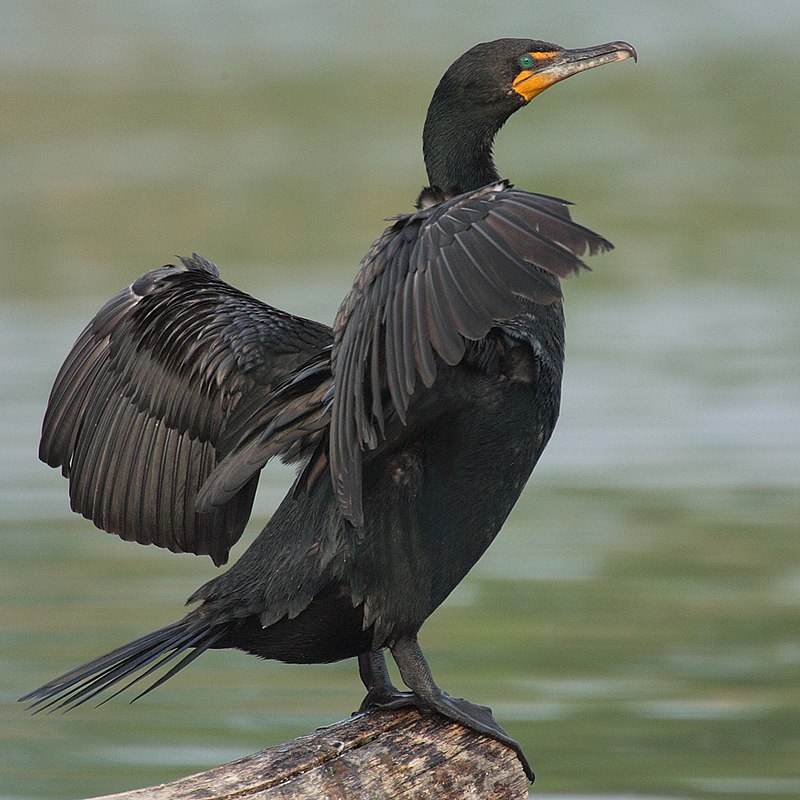
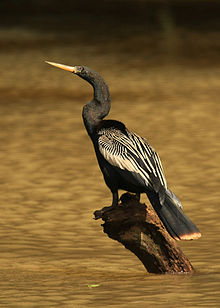
Cormorant-Doublecrested.WikipediaAnhinga-perching.Wikipedia

Double-crested Cormorant (L) & Anhinga (R)  / both Wikipedia images­

­But the cormorant and the bittern shall possess it; the owl also and the raven shall dwell in it . . . . (Isaiah 34:11a)

Cormorants and bitterns (the latter being a type of heron) are famous to frequently waterways, preying on fish and other aquatic critters. Yet there is another large waterbird that resembles a cormorant, the anhinga.

CORMORANT VERSUS ANHINGA

Cormorants and Anhingas are frequently confused. They are both [fairly big, i.e., bigger than a crow, almost as large as a goose] black birds that dive under the water to fish.  Both must dry their feathers in the sun [because their feathers are not 100% waterproofed].

The differences are easy to see. The Anhinga’s beak is pointed for spearing [i.e., stabbing] fish, while the Cormorant’s beak is hooked for grasping its prey.  The Cormorants’ body remains above the surface when swimming [unlike the “snake-bird” appearance of a swimming Anhinga, which swims mostly underwater, with only its head and neck emergent].  It [i.e., the Cormorant] lacks the Anhinga’s slender [snake-like] neck, long tail, and white wing feathers.

[Quoting Winston Williams, FLORIDA’S FABULOUS WATERBIRDS: THEIR STORIES (Hawaiian Gardens, Calif.: World Publications, 2015), page 4.]

By the way, this photography-filled waterbird book [i.e., Winston Williams’ FLORIDA’S FABULOUS WATERBIRDS: THEIR STORIES] was recently given to me by Chaplain Bob & Marcia Webel, of Florida, precious Christian friends (of 45+ years) who are also serious birdwatchers.

Cormorant-Doublecrested-fishing.Bruce-J-Robinson-photo

Double-crested Cormorant fishing (Bruce J. Robinson photograph)

Of course, there are different varieties of cormorants [e.g., Neotropic Cormorant, Brandt’s Cormorant, Pelagic Cormorant, Great Cormorant, etc.], as Winston Williams observes [ibid., page 4], but the cormorant that you can expect to see in Florida is the Double-crested Cormorant (Phalacrocorax auritus), so called due to white tufted feather “crests” during breeding season.  Mostly piscivorous [i.e., fish-eating], cormorants will also eat small crustaceans [e.g., shellfish like crayfish] and amphibians [e.g., frogs], often about one pound of prey daily. These cormorants range over America’s Lower 48 states, especially in the Great Lakes region.

It is the American Anhinga (Anhinga anhinga), however, that is properly nicknamed “Snake-bird” (and a/k/a “American Darter” or “Water Turkey”), due to its mostly-submerged-underwater hunting habit.  It eats fish almost exclusively, though it can and sometimes does eat crustaceans (e.g., crabs, shrimp, crayfish) or small aquatic vertebrates (e.g., frogs, newts, salamanders, turtles, snakes, and even baby crocodiles).

Anhinga-piscivore.PhilLanoue-photo

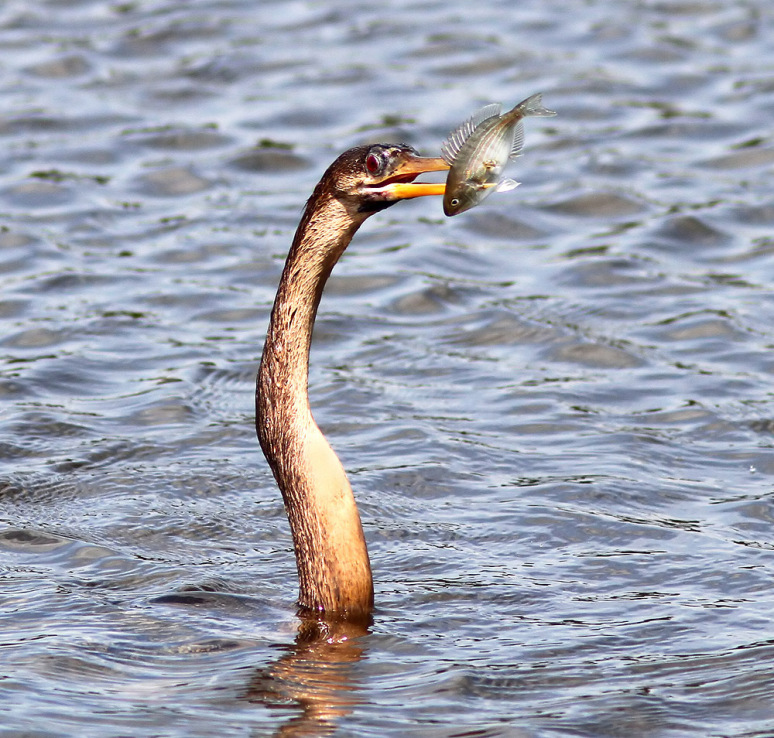
ANHINGA with fish (Phil Lanoue photo)

America’s Anhinga is a cousin to other darters (a/k/a “snake-birds”) of other continents, such as the Indian Darter, African Darter, and Australian Darter. The term “darter” refers to the piercing dart-like impalement technique that these birds use, for acquiring and securing their prey, just before ingestion.   Worldwide, darters like in tropical climes or in regions with almost-tropical weather.

In the Orient, for many generations, cormorants have been harnessed to catch fish for human masters. [See “’C’ Is for Cardinal and Cormorant:  ‘C’ Birds, Part 1”, posted at https://leesbird.com/2016/05/18/c-is-for-cardinal-and-cormorant-c-birds-part-1/ .]

Also, cormorant feathers have been used, historically, for stuffing Viking pillows. [See “Viking Pillows were Stuffed for Comfort:  Thanks to Ducks, Geese, Eagle-Owls, Cormorants, Seagulls, and Crows!”, posted at https://leesbird.com/2018/04/30/viking-pillows-were-stuffed-for-comfort-thanks-to-ducks-geese-eagle-owls-cormorants-seagulls-and-crows/ .]

Now it is time for a limerick, about an Anhinga:

TABLE  MANNERS  &  TECHNIQUE  (ANHINGA  STYLE)

Wings spread out, the bird had one wish:

To dive, stab, flip up, and eat fish;

Without cream of tartar,

Fish entered the darter!

‘Twas stab, gulp!  —  no need for a dish!

><> JJSJ