Ian’s Bird of the Week – Black-faced Monarch

Ian’s Bird of the Week – Black-faced Monarch ~ by Ian Montgomery

Newsletter ~ 4/15/15

On the way to Orbost in East Gippsland in March on the great owl hunt, we stopped for a break at Fairy Dell Nature Reserve between Bairnsdale and Lakes Entrance. This has a lovely walk through temperate rainforest along a creek with plenty of interesting birds – we saw our first Lyrebird of the weekend here. We also found this Black-faced Monarch showing its black face to great advantage through the fronds of a tree fern.
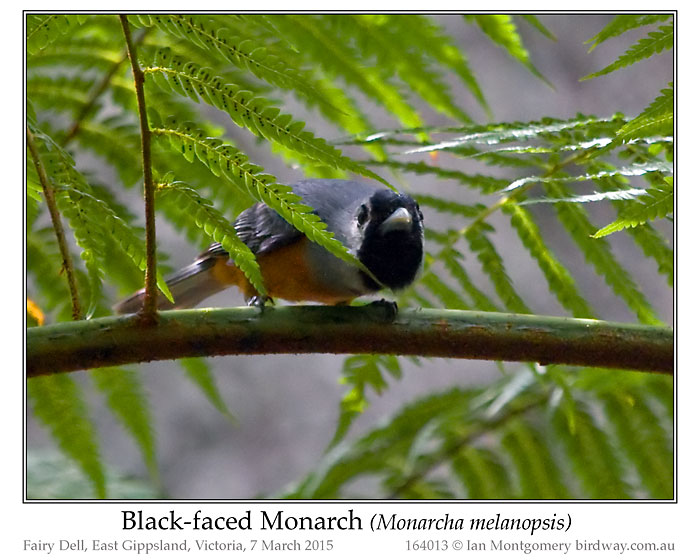
Black-faced Monarch (Monarcha melanopsis) by Ian

Black-faced Monarchs are usually inconspicuous solitary inhabitants of dense forest and are best located by their calls, the most distinctive of which is a vibrant fluty call, rendered by Pizzey and Knight as ‘Why-you, which-you’. Here they search for insects, sometimes making sallies after flying insects when they are easier to spot. The combination of grey back and wings, black face and rich, rufous underparts is striking, though the rufous breast is best seen in the gloom of the forest using a flash, as in the second photo taken in the highlands of Northeastern Queensland. These two photos encompass most of the breeding range of this species along the east coast of Australia from Melbourne to Cape York.

Black-faced Monarch (Monarcha melanopsis) by Ian

These birds are resident in the highlands of Northeastern Queensland but breeding summer visitors to areas farther south. In winter many migrate to southern and eastern New Guinea, and some immature birds spend their first summer there. In the lowlands of Northeastern Queensland, around Townsville for example, we see them only as passage migrants in March-April and September-October and I saw one last week along Bluewater Creek near the house, reminding me that autumn is here. The bird in the third photo is an immature one photographed on the creek ten years ago. Juvenile lack the black face, have brownish wings and dark bills with a pinkish edge to the base of the lower mandible – which you can just see in this photo.
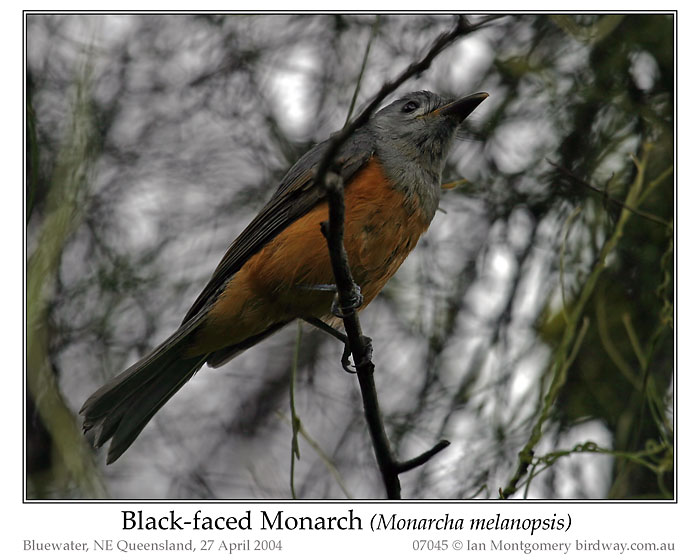
Black-faced Monarch (Monarcha melanopsis) juvenile by Ian

Black-faced Monarch build beautiful, conical nests wedged into the fork of a shrub or sapling in moist gullies. This is constructed of fibrous plant material, including ferns and moss, glued together using gossamer from spiders’ webs as in the fourth photo.

Black-faced Monarch (Monarcha melanopsis) Nest by Ian

Autumn here means warm, clear sunny days and (relatively) cool nights with low humidity, very welcome after the wet season and my favourite time of the year. The wet usually leaves a legacy of lush green grassland and forest, though this year it has been fairly dry with good rain only in January. The Dollarbirds have left for the winter and the forests and gardens are rather silent without the loud calls of the Koels and Channel-billed Cuckoos, leaving just the Blue-winged Kookaburras and Bar-shouldered Doves to fill the gap.

Greetings
Ian

**************************************************
Ian Montgomery, Birdway Pty Ltd,
454 Forestry Road, Bluewater, Qld 4818
Tel 0411 602 737 ian@birdway.com.au
Bird Photos http://www.birdway.com.au/
Where to Find Birds in Northern Queensland:  iTunesGoogle Play Kobo Books
Recorder Society http://www.nqrs.org.au


Lee’s Addition:

“If a bird’s nest happens to be before you along the way, in any tree or on the ground, with young ones or eggs, with the mother sitting on the young or on the eggs, you shall not take the mother with the young; you shall surely let the mother go, and take the young for yourself, that it may be well with you and that you may prolong your days”. (Deuteronomy 22:6-7 NKJV)

What a nice looking bird, Ian. That breast color reminds me of our American Robin’s outfit. Thanks again for sharing so many birds with us over the weeks. With over 10,000 of the Lord’s avian creations flying around, you nor I will ever cover them all.

Here is the Black-faced Monarch’s call from xeno-canto:

You can see Ian’s Monarch family photos at Monarch Flycatchers & Allies [Family: Monarchidae]
Monarchidae – Monarchs Family

Black-faced Monarch –  Wikipedia
Black-faced Monarch – Birds in Backyards
Black-faced Monarch – New Zealand Birds Online

*

Ian’s Bird of the Week – Frill-necked Monarch

Frill-necked Monarch (Arses lorealis) by Ian

Frill-necked Monarch (Arses lorealis) by Ian

Newsletter – 12/16/2009

Frill-necked Monarch (Arses lorealis) by Ian

Frill-necked Monarch (Arses lorealis) by Ian

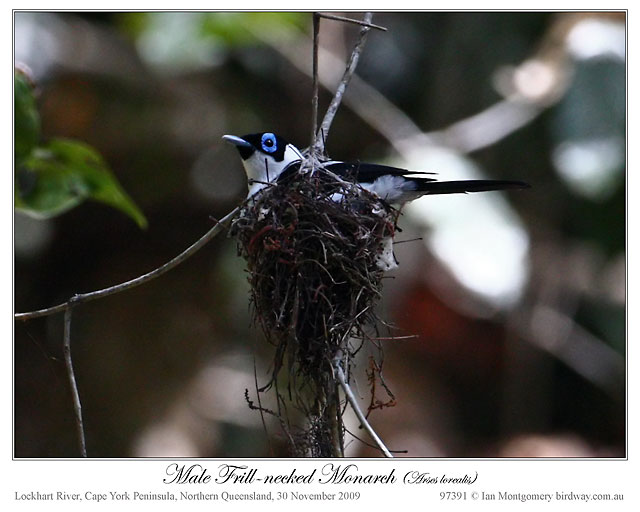
On our recent trip to Cape York Peninsula, we came across several Frill(-neck)ed Monarchs in the Lockhart River – Iron Range district. This is quite similar to the Pied Monarch of the wet tropics of northeastern Queensland, but lacks the black breast band and has a more extensive frill and broader blue eye-rings. I’ve qualified the name as the original Frilled Monarch of northern Cape York Peninsula, Torres Strait and Papua New Guinea (Arses telescopthalmus) has recently been split into the Frilled Monarch of Torres Strait and PNG and the new Frill-necked Monarch (Arses lorealis) of northern Cape York Peninsula.

The bird in the first photo is a male, distinguishable by having black lores and a black bib, or maybe goatee would be more appropriate. It’s doing something with either the white honeydew on the flower stalk or the insects (aphids or scale insects) responsible for the honeydew. More about the ‘something’ in a moment.

Earlier the same day, another Frill-necked Monarch carrying nesting material revealed the location of her nest, hanging, hammock- or swing-like, from a long vine over a creek, a typical location thought to discourage predation by animals such as arboreal snakes. This bird stayed in the nest for a few minutes, left and then, I thought, returned. It was only later, when examining the photos that it I realised that the second bird was her mate. If you look carefully, you can see the white chin (and maybe the pale lores) of the female in the second photo and the black goatee and lores of the male in the third photo.

Frill-necked Monarch

Frill-necked Monarch

The fourth photo was intended to show how precariously the nest was built at the end of at least 3 metres of vine, and, again, it was only later that I noticed that one branch of the vine was broken (in the centre of the photo). It’s still attached above the nest to the other strand of the vine and I wondered whether this attachment was serendipitous or had been done as a repair by the birds. Monarchs are supposed to use cobwebs to glue their nests together. I then wondered whether the bird in the first photograph was feeding on the aphids/scale insects, feeding on the honeydew (as some birds do such as the New Zealand Honeyeater the Tui) or collecting the honeydew as glue – it’s very sticky – for nest construction.

Back at the website, I’ve added photos of:
the Cape York race of the Masked Finch
the northern race of the Black-throated Finch
Wandering Whistling-Duck
White-bellied Sea-Eagle being fed on garfish by the Ferryman at Karumba
Golden-shouldered Parrot
White-faced Robin
Yellow-legged Flycatcher/Flyrobin
So it’s no wonder I’m late with my Christmas cards yet again!

I wish you all a safe and happy Christmas and best wishes for the New Year,
Ian

Ian Montgomery, Birdway Pty Ltd,
454 Forestry Road, Bluewater, Qld 4818
Phone: +61-7 4751 3115
Preferred Email: ian@birdway.com.au
Website: http://birdway.com.au


Lee’s Addition:

And God blessed them, saying, “Be fruitful and multiply, and fill the waters in the seas, and let birds multiply on the earth. (Genesis 1:22 NKJV)

The Frill-necked Monarch (Arses lorealis) is a species of songbird in the Monarchidae family. It is endemic to the rainforests of the northern Cape York Peninsula. It was considered a subspecies of the related Frilled Monarch (Arses telescophthalmus) for many years before being reclassified as a separate species in 1999.

The Frill-necked Monarch is a member of a group of birds termed monarch flycatchers. This group is considered either as a subfamily Monarchinae, together with the fantails as part of the drongo family Dicruridae, or as a family Monarchidae in its own right. Molecular research in the late 1980s and early 1990s revealed the monarchs belong to a large group of mainly Australasian birds known as the Corvida parvorder comprising many tropical and Australian passerines. More recently, the grouping has been refined somewhat as the monarchs have been classified in a ‘Core corvine’ group with the crows and ravens, shrikes, birds of paradise, fantails, drongos and mudnest builders.

Alternative common names include Australian Frilled Monarch, and White-lored Flycatcher.

The Frill-necked Monarch measures around 14 cm (5.5 in) in length, and the neck feathers can become erect into a small frill; the male is predominantly black and white, and can be distinguished from the similar and more common Pied Monarch by its all-white breast-the latter species having a broad black breast band. The throat, nape, shoulders, and rump are white while the wings and head are black. It has a eye-ring of bare skin, and a bright blue wattle. The bill is pale blue-grey and the eyes are dark. The female is similar but lacks the eye-ring and has white lores and a brownish tinged chest.

Breeding season is November to February with one brood raised. The nest is a shallow cup made of vines and sticks, woven together with spider webs and shredded plant material, and decorated with lichen. It is generally sited on a hanging loop of vine well away from the trunk or foliage of a sizeable tree about 2–10 metres (6.6–33 ft) above the ground. Two pink-tinged oval white eggs splotched with lavender and reddish-brown are laid measuring 19 mm x 14 mm.

Video of a Frilled Monarch (Arses telescopthalmus) by Keith.

Error
This video doesn’t exist

Ian’s Bird of the Week – Black-winged Monarch

Black-winged Monarch (Monarcha frater) by Ian

Black-winged Monarch (Monarcha frater) by Ian

From: Ian Montgomery
Newsletter 12/7/2009

Subject: Bird of the Week: Black-winged Monarch

Black-winged Monarch (Monarcha frater) by Ian

Black-winged Monarch (Monarcha frater) by Ian

If you live on the east coast of Australia, you may be familiar with the very similar Black-faced Monarch. The Black-winged Monarch, distinguishable by paler grey upper parts and contrasting black wings, is, however, a Cape York specialty migrating from PNG in the southern summer to breed along the northeast coast of the Peninsula south to about the McIlwraith Ranges north of Coen.

It’s not a well-known species, and until fairly recently hadn’t been photographed. That, I’m sure, has all changed now with a steady stream of digitally armed birders making the pilgrimage to Lockhart River, where these photos were taken, and the nearby Iron Range National Park. Anyway, I was glad of the opportunity last week to improve on the two mediocre shots on the Birdway website taken on my first visit there almost 6 years ago.

Links:
Black-winged Monarch (the original photos)
Black-faced Monarch

Best wishes,
Ian

Ian Montgomery, Birdway Pty Ltd,
454 Forestry Road, Bluewater, Qld 4818
Phone: +61-7 4751 3115
Preferred Email: ian@birdway.com.au
Website: http://birdway.com.au


Lee’s Addition:

When I think of the Monarch, my first thoughts are of a Monarch Butterfly, but the Monarch birds are very interesting. There are 47 Monarchs in Monarchidae Family of the Passeriformes Order. Also included in the family are Paradise and Crested Flycatchers, an Elepaio, Shrikebills, a Silktail, Magpielark, Torrentlark, and the Myiagra genus of Flycatchers. (Total of 93)
Here are some more of Ian’s Photos from the Monarchidae Family:
Broad-billed Flycatcher
Leaden Flycatcher
Shining Flycatcher
Restless Flycatcher
White-eared Monarch
Spectacled Monarch
Magpielark
Frilled Monarch
Pied Monarch

Another parable He put forth to them, saying: “The kingdom of heaven is like a mustard seed, which a man took and sowed in his field, which indeed is the least of all the seeds; but when it is grown it is greater than the herbs and becomes a tree, so that the birds of the air come and nest in its branches. (Matthew 13:31-32 NKJV)

Black-faced Monarch by Nick Talbot

Also see:

Monarch Flycatchers – Wikipedia