Ian’s Bird of the Week – Violaceous Trogon

Violaceous Trogon (Trogon violaceus) by Ian

Violaceous Trogon (Trogon violaceus) by Ian

Ian’s Bird of the Week – Violaceous Trogon ~ by Ian Montgomery

Newsletter – 11/17/10

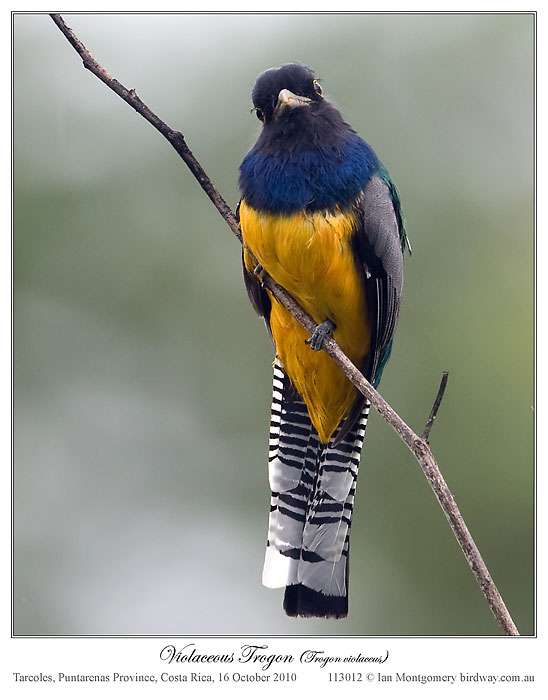
When the Resplendent Quetzal featured as bird of the week in October, I mentioned that Quetzals are members of the Trogon family, the Trogonidae. So they belong to a splendid lineage as typical Trogons are quite gorgeous in their own right and among my favourite birds. Here is the Violaceous Trogon, also from the Costa Rican trip, though it has a wide range in Central and South America (I have also photographed it in Trinidad).

Violaceous Trogon (Trogon violaceus) by Ian

Violaceous Trogon (Trogon violaceus) by Ian

Trogons, the males in particular, are very colourful and the different species come in an extraordinary variety of colours, invariably in aesthetically pleasing and frequently complementary combinations, i.e. red-green, blue-yellow, purple-orange. Male Trogons with red and green breasts include the Slaty-tailed, Black-tailed, Collared and Masked, while both the Violaceous and the White-tailed are somewhere between blue-yellow and purple-orange, perhaps violet-chrome yellow, first photo. Non-complementary but still lovely are the red-brown male Crimson-rumped  and female Masked. (I’ve chosen these examples as all seven are on the Birdway website.)
Their backs are green, bluish or brown, as in the second photo, and if all this is not enough, the upper wing coverts often have subtle and intricate scroll patterns and beautifully barred black and white tails, as in the third photo. If you wanted to design a fantastically beautiful bird yourself, it would be hard to come up with something better: female Trogons clearly have impeccable taste.
Violaceous Trogon (Trogon violaceus) by Ian

Violaceous Trogon (Trogon violaceus) by Ian

Despite their rich colours, Trogons can be hard to spot as they tend to sit fairly motionless in leafy trees in tropical rainforest, occurring in both the New and the Old Worlds. They have distinctive repeated calls that reveal their presence, but hearing one in thick forest is no guarantee of being able to see it. They sit tight, so if you do find them they are fairly approachable but you have to be lucky to find one in clear view.

Related link:
Recent additions to the website include:
and additional photos of
(and a couple of other Costa Rican species that I’m keeping up my sleeve as future birds of the week!).
Best wishes,
Ian

Ian Montgomery, Birdway Pty Ltd,
454 Forestry Road, Bluewater, Qld 4818
Phone: +61-7 4751 3115
Preferred Email: ian@birdway.com.au
Website: http://birdway.com.au

Lee’s Addition:
Thanks again for another informative article and photos, Ian. Dan and I were able to see a White-tailed Trogon at the National Aviary. They are very colorful like Ian said. They belong to the Trogonidae Family of the Trogoniformes Order.     There are 42 species in the family.

Now Israel loved Joseph more than any other of his sons, because he was the son of his old age. And he made him a robe of many colors.
(Genesis 37:3 ESV)

Birds of the Bible – A Gull?

Common Gull (Larus canus) by Robert Scanlon

Common Gull (Larus canus) by Robert Scanlon

The following two verses have been used several times in the Birds of the Bible articles. It is interesting in how one of the birds is translated in the various versions.

the ostrich, the nighthawk, the sea gull, the hawk of any kind, (Leviticus 11:16 ESV)
the ostrich, the nighthawk, the sea gull, the hawk of any kind; (Deuteronomy 14:15 ESV)

I have been reading through the English Standard Version and found the “sea gull” listed in those verses. Those verses are in the list of the birds the Israelites were not to eat. Previously, I had used the KJV which translates  “שׁחף” as “the cuckoo: Shachpaph, probably the sea-gull or mew”(H7828).

See Birds of the Bible – Cuckoo and Cuckoo II where the Cuckoo is considered as the bird mentioned. But, what if it is one of the other options? Those options would be the sea-hawk, seamew, seagull or gull. Only one mentions the sea-hawk, so for now that will be ignored until another time.

Mew Gull (Larus canus) by Ian

Mew Gull (Larus canus) by Ian

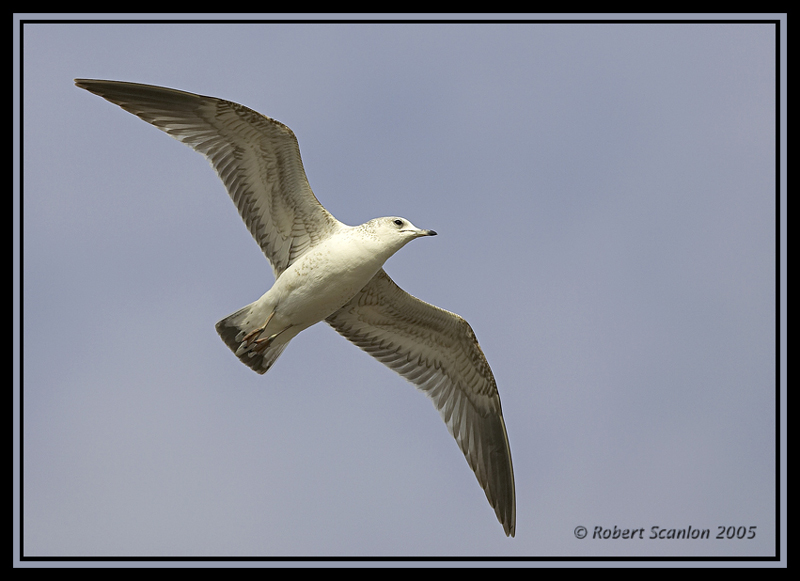
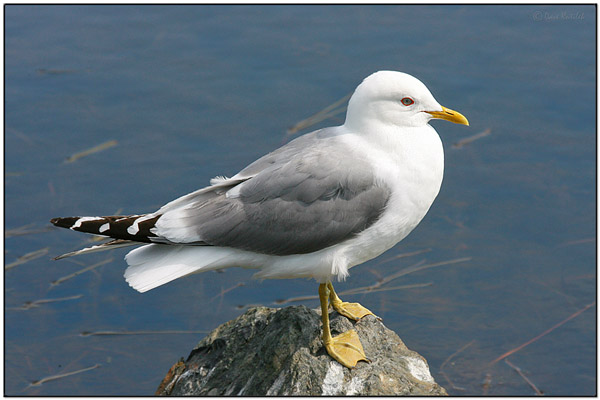
A Seamew according to Wikipedia is the Common Gull (European and Asian subspecies; see below) or Mew Gull (North American subspecies) Larus canus which is a medium-sized gull which breeds in northern Asia, northern Europe and northwestern North America. It migrates further south in winter. Its name does not indicate that it is an abundant species, but that during the winter it feeds on common land, short pasture used for grazing.

Mew Gull (Larus canus) by Daves BirdingPix

Mew Gull (Larus canus) by Daves BirdingPix

Adults are 15.7-18.1 in (40-46 cm) long, obviously smaller than the Herring Gull, and slightly smaller than the Ring-billed Gull, also differing from this in its shorter, more tapered bill with a more greenish shade of yellow, as well as being unmarked during the breeding season. The body is grey above and white below. The legs are greenish-yellow. In winter, the head is streaked grey, and the bill often has a poorly-defined blackish band near the tip (sometimes sufficiently obvious to cause confusion with Ring-billed Gull). They have black wingtips with large white “mirrors”. Young birds have scaly black-brown upperparts and a neat wing pattern, and grey legs. They take two to three years to reach maturity. The call is a high-pitched “laughing” cry.
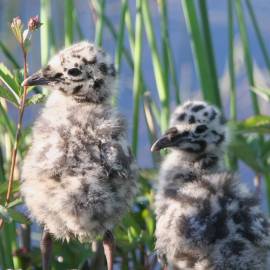
Mew Gull (Larus canus) chicks ©USFWS

Mew Gull (Larus canus) chicks ©USFWS

Both Common and Mew Gulls breed colonially near water or in marshes, making a lined nest on the ground or in a small tree; colony size varies from 2 to 320 or even more pairs. Usually three eggs are laid (sometimes just one or two); they hatch after 24–26 days, with the chicks fledging after a further 30–35 days. Like most gulls, they are omnivores and will scavenge as well as hunt small prey. The global population is estimated to be about one million pairs; they are most numerous in Europe, with over half (possibly as much as 80-90%) of the world population. By contrast, the Alaskan population is only about 10,000 pairs.

Some of the commentaries have this to say about the bird:
Jamieson, Faussett, and Brown – “the cuckoo — Evidently some other bird is meant by the original term, from its being ranged among rapacious birds. Dr. Shaw thinks it is the safsaf; but that, being a graminivorous and gregarious bird, is equally objectionable. Others think that the sea mew, or some of the small sea fowl, is intended.”
K & D – “slender gull
Barnes – “Lev_11:16 – And the owl … – Rather, “and the ostrich, and the owl, and the gull, and the hawk,” etc.
John Gill’s – “and the cuckoo; a bird well known by its voice at least: some have thought it to be the same with the hawk, changing its figure and voice; but this has been refuted by naturalists (a): but though it is here forbidden to be eaten, yet its young, when fat, are said to be of a grateful savour by Aristotle: and Pliny (b) says, no bird is to be compared to it for the sweetness of its flesh, though perhaps it may not be here intended: the word is by the Septuagint rendered asea gull”, and so it is by Ainsworth, and which is approved of by Bochart (c):”

Laughing Gull (Leucophaeus atricilla) by Lee

Laughing Gull (Leucophaeus atricilla) by Lee

Will the mystery be solved? Not by me. I still find it amazing that the different versions use the different meaning for words, but then again, that is just like today. Our language is constantly changing the definitions of words or making other things mean the same.

Just keeping up with the names of birds today is a challenge. Every 3-4 months the I.O.C. make changes. Names of birds come and go. One bird can have many names and the different countries name them different. That is the reason they use the scientific names so they can talk about the same bird. Problem to that is that they even change the scientific name occasionally. The birds mentioned in Scripture were named in those verses several thousand years ago.

One thing is certain, there is one thing that remains the same:

Jesus Christ the same yesterday, and to day, and for ever. (Hebrews 13:8 KJV)
Jesus Christ is the same yesterday and today and forever. (Hebrews 13:8 ESV)
Jesus Christ is the same yesterday and to-day, yea and for ever. (Hebrews 13:8 ASV)
Jesus Christ yesterday and to-day the same, and to the ages; (Hebrews 13:8 YLT)

See:

Birds of the Bible – Sea Gulls

*

Ian’s Bird of the Week – White-whiskered Puffbird

White-necked Puffbird (Notharchus hyperrhynchus) by Ian

White-necked Puffbird (Notharchus hyperrhynchus) by Ian

Ian’s Bird of the Week – White-whiskered Puffbird ~ by Ian Montgomery

Newsletter – 11/11/10

Last week’s Asian Dowitcher prompted an amusing comment about bird names (‘Dowitcher Princess’) from a friend of mine on the list, thank you Peter, so how about the White-whiskered Puffbird, encountered in Carara Reserve on the Pacific Coast of Costa Rica? Puffbirds get their name from their fluffy plumage and along with Nunbirds (black), Monklets (smaller and brown) and Nunlets (oddly, also small and brown) comprise a small Central and South America family of 22 species, all with slightly hooked bills, called the Bucconidae, related to the iridescent Jacamars (Galbulidae).

White-necked Puffbird (Notharchus hyperrhynchus) by Ian

White-necked Puffbird (Notharchus hyperrhynchus) by Ian

All these bird sit around quietly in forests, and are easily overlooked, waiting for their invertebrate prey to appear, which they then pounce on. The White-whiskered Puffbird, 20cm/8in in length, usually perches close to the understory at a height of 1 to 6m/3 – 30ft and have the reputation of being tame. It nests in holes in the ground, either on a slope or in a bank, and supposedly blocks the entrance to the nest hollow at night with green leaves. It prefers the lowlands and ranges from southern Mexico to the western side of the Andes in Colombia and Ecuador.

Related links:
Black-fronted Nunbird
White-fronted Nunbird
Rufous-tailed Jacamar

Other Costa Rican additions to the website include:
Scarlet Macaw
Double-striped thick-knee
Magnificent Hummingbird

And, for the wader-lovers, more photos of:
Terek Sandpiper
Curlew Sandpiper
Short-billed Dowitcher
Marbled Godwit

Best wishes,
Ian

Ian Montgomery, Birdway Pty Ltd,
454 Forestry Road, Bluewater, Qld 4818
Phone: +61-7 4751 3115
Preferred Email: ian@birdway.com.au
Website: http://birdway.com.au


Lee’s Addition:
Bucconidae – Puffbirds are in the Piciformes Order which includes not only the Puffbirds, but also Jacamars, 3 families of Barbets, Honeyguides and Woodpeckers.

With all those new birds added from Costa Rica, you can discern that Ian had a great time on his visit. Now we have some more great photos for us armchair birdwatchers to view.

… we know that “all of us possess knowledge.” This “knowledge” puffs up, but love builds up. If anyone imagines that he knows something, he does not yet know as he ought to know. But if anyone loves God, he is known by God. (1 Corinthians 8:1-3 ESV)

*

The Cat and the Crow

Just received an email from a friend today with this YouTube Video. Thought I would share it. It is really amazing.

From ozricus

The wolf also shall dwell with the lamb, and the leopard shall lie down with the kid; and the calf and the young lion and the fatling together; and a little child shall lead them. And the cow and the bear shall feed; their young ones shall lie down together: and the lion shall eat straw like the ox. … They shall not hurt nor destroy in all my holy mountain: for the earth shall be full of the knowledge of the LORD, as the waters cover the sea. (Isaiah 11:6-9 KJV)

Ian’s Bird of the Week – Asian Dowitcher

Asian Dowitcher (Limnodromus semipalmatus) by Ian

Asian Dowitcher (Limnodromus semipalmatus) by Ian

Ian’s Bird of the Week – Asian Dowitcher ~ by Ian Montgomery

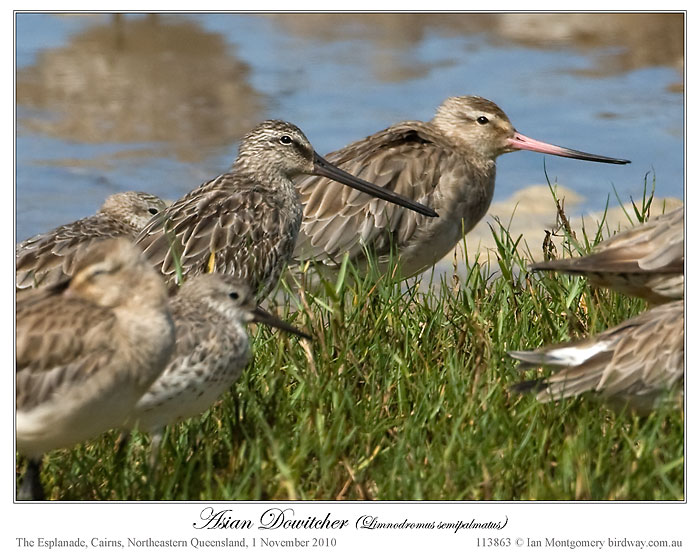
This is something of a postscript to a presentation on wader identification that I gave last Saturday to a workshop organized by the Townsville Region Bird Observers Club as part of the Shorebirds 2020 Project ( http://www.shorebirds.org.au/ ). Of the 45 species that we considered, I lacked photos of just one: the Asian Dowitcher. So you’ll understand why I and a friend jumped into the car after the practical session at Bushland Beach, near Townsville, on Sunday and drove to Cairns, where an Asian Dowitcher had recently been reported, for an overnight visit. They are regular visitors in small numbers to northwestern Australia (e.g. Broome in Western Australia) but occur only as irregular vagrants on the east coast.

Asian Dowitcher (Limnodromus semipalmatus) by Ian

Asian Dowitcher (Limnodromus semipalmatus) by Ian

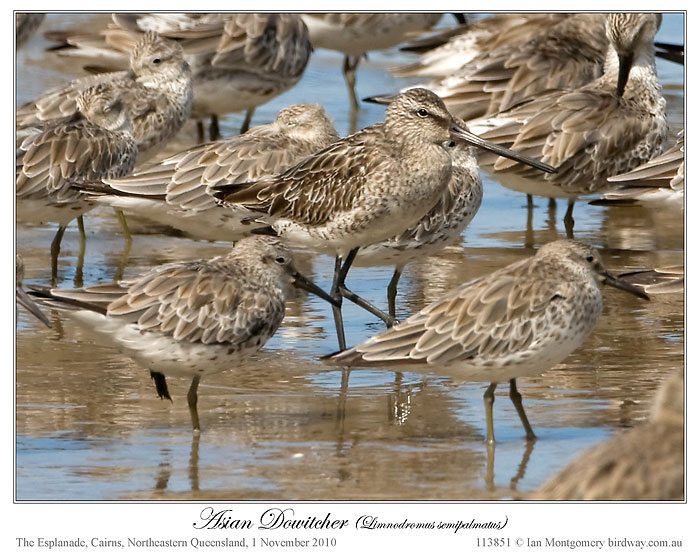
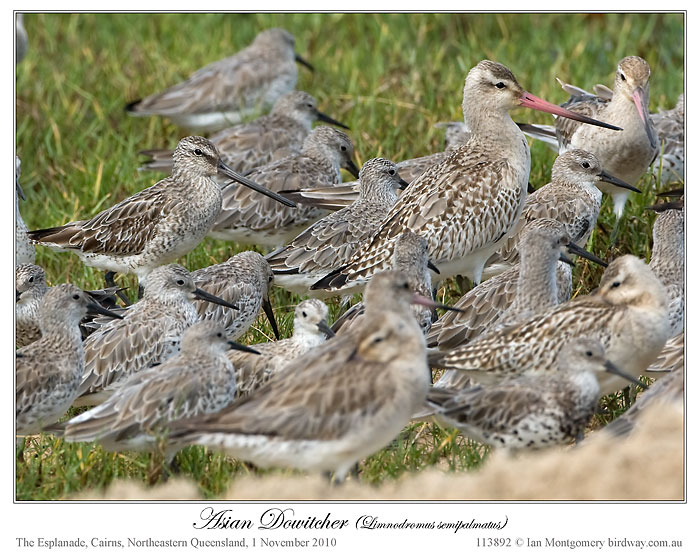
The mudflats on the Esplanade are very flat, so the window of opportunity provided by an incoming tide is very short and it wasn’t until Monday afternoon that that happened. Even so, I would probably have missed it if Guy Dutson hadn’t alerted me to its location. It’s a bird that’s easy to overlook among the Great Knots and Bar-tailed Godwits when they’re all in non-breeding plumage, thank you, Guy! The first photo shows it among Great Knots. The body size is similar, so the key Asian Dowitcher features are the very long, straight, dark bill with a bulbous tip rather like that of a snipe, long dark legs and dark loral stripe (between the bill and the eye). Body length in waders is confounded by bill and leg length, so weight and wing-span are more useful. These are – Asian Dowitcher: 127-245g and 59cm/23.2in; Great Knot: 115-248g and 58cm/22.8in.

The second photo shows the Asian Dowitcher on the left with a smallish – probably male – Bar-tailed Godwit on the right (Bar-tailed Godwit male 190-400g female 262-630g, span 70-80cm/28-32in) and the third photo shows the Dowitcher with a larger Bar-tailed Godwit and lots of Great Knots and in this photo you can see the barred flanks of the Dowitcher compared with the plain flanks of the Godwit. The bill of the Dowitcher was always the most obvious distinguishing feature, but the bird would often have a snooze, tucking its bill under a wing, and magically disappear. What’s more, the mud on the Cairns Esplanade is very gluggy, so the pink bases of Godwit bills are often covered, but the different shape is usually still apparent.

Asian Dowitcher (Limnodromus semipalmatus) by Ian

Asian Dowitcher (Limnodromus semipalmatus) by Ian

When I was preparing the presentation and checking carefully on distinguishing features, I found that a wader that I’d photographed in India in 2003 and posted to the website as a Wood Sandpiper was actually a Green Sandpiper. This a bird, rare in Australia, that I had long wanted to photograph, so I was pleased to find and correct the error: http://www.birdway.com.au/scolopacidae/green_sandpiper/index.htm .

Best wishes,
Ian

Ian Montgomery, Birdway Pty Ltd,
454 Forestry Road, Bluewater, Qld 4818
Phone: +61-7 4751 3115
Preferred Email: ian@birdway.com.au
Website: http://birdway.com.au


Lee’s Addition:

The Asian Dowitcher is part of the Scolopacidae Family which is in the Charadriiformes Order that consists of Shorebirds and their allies. To see Ian’s Birdway website of the Scolopacidae – Click Here.

He answered, “The man called Jesus made mud and anointed my eyes and said to me, ‘Go to Siloam and wash.’ So I went and washed and received my sight.” (John 9:11 ESV)

*

Ian’s Bird of the Week – Boat-billed Heron

Boat-billed Heron (Cochlearius cochlearius) by Ian

Boat-billed Heron (Cochlearius cochlearius) by Ian

Ian’s Bird of the Week – Boat-billed Heron 

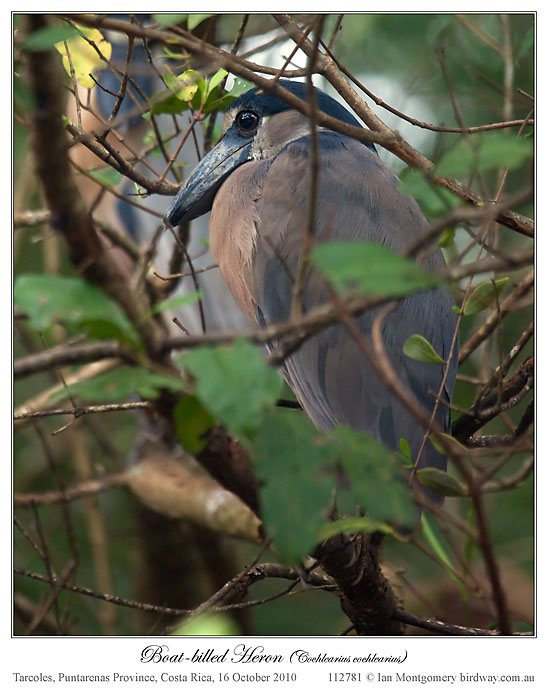
After I’d photographed the Resplendent Quetzal, my immediate reaction was one of relief: ‘Now I can just relax and enjoy the rest of my time in Costa Rica!’. Needless to say, that didn’t last long and I decided to chase a couple of other species on my bucket list including Scarlet Macaw and Boat-billed Heron. If you’re not familiar with bucket lists, have a look here http://www.imdb.com/title/tt0825232/ – and I hasten to add that I’m not terminally ill!. I enquired at the Hotel Savegre, where I was staying, and they booked me into the Villa Lapas, another eco-lodge-style hotel, but in the lowlands on Puntarenas Province on the Pacific Coast.

Boat-billed Heron (Cochlearius cochlearius) by Ian

Boat-billed Heron (Cochlearius cochlearius) by Ian

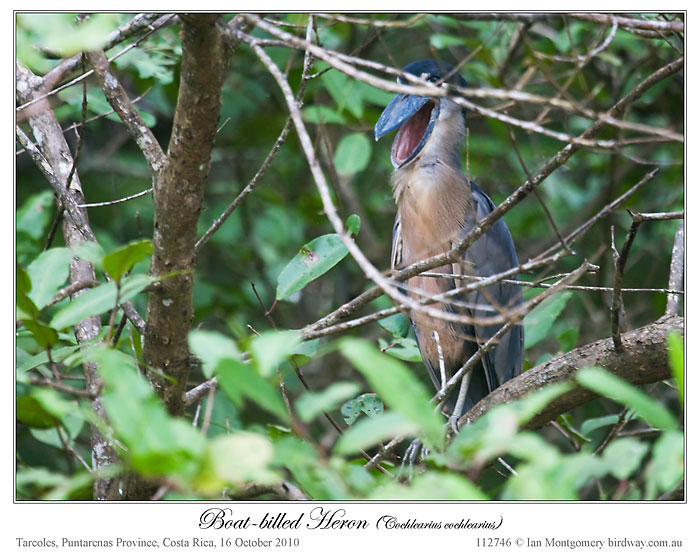
‘Lapas’ is the Spanish for Macaw, and that seemed like a good omen, particularly as the hotel is adjacent to the Carara Biological Reserve, supposedly one of the best places in Costa Rica for Scarlet Macaws. Anyway, I checked into the hotel and booked myself on an early morning wildlife boat trip on the Tarcoles River. I was the only passenger, so the crew of two were only too happy to try to satisfying my wishes. Sure enough, within minutes of starting, we got distant views of a pair of Scarlet Macaws feeding on Beach Almonds and after a trip up the river we went down to the mangroves for the climax of the trip, three Boat-billed Herons roosting in the mangroves.

Boat-billed Heron (Cochlearius cochlearius) by Ian

Boat-billed Heron (Cochlearius cochlearius) by Ian

There have got to be the strangest looking herons, with their huge bills, though otherwise they show some resemblance to Night-Herons and are also nocturnal – hence the large eyes. The bill looks it’s designed a heavy duty task like crushing crabs, but in fact it is used rather passively as a scoop and Boat-bills eat a variety of invertebrates and small vertebrates unlucky enough to get in the way. In the past they have been given their own mono-typic family, but DNA research has shown that they are related to both the Tiger-Herons and the Night-Herons.

I first got interested them when reading about them in Trinidad in 2005 where they are rare. Elsewhere in South America they are reasonably common with a range extending from Mexico to northern Argentina. There are five sub-species, sometimes treated as two species, Northern and Southern, but the Costa Rican race (panamensis) is intermediate between the two extremes and it is usual now to treat them as a single species.

I’m enjoying being back home in North Queensland, though the first week here has been a busy one as I’ve been preparing material for a workshop on wader identification tomorrow. When that is out of the way, I can get back to the website and the rest of my domestic routine in earnest.

Best wishes,
Ian

Ian Montgomery, Birdway Pty Ltd,
454 Forestry Road, Bluewater, Qld 4818
Phone: +61-7 4751 3115
Preferred Email: ian@birdway.com.au
Website: http://birdway.com.au


Lee’s Addition:

the stork, the heron after its kind, and the hoopoe and the bat. (Deuteronomy 14:18 NKJV)

Boat-billed Herons belong to the Ardeidae Family of the Pelecaniformes Order. I am glad Ian managed to get photos of it. We were able to get photos at the National Aviary in Pittsburgh and a Lowry Park Zoo in Tampa, FL. It is really an interesting beak that the Boat-billed has. The Heron is one of the Birds of the Bible.

*

New I.O.C. 2.6 Version is Out

Large Grey Babbler (Turdoides malcolmi) by Ian

Large Grey Babbler (Turdoides malcolmi) by Ian

The newest version of the I.O.C list of birds has been released. Version 2.6 has made quite a few changes. It was released on October 23rd and I have started making the changes to the Birds of the World pages. (One reason I haven’t posted much.) Also making “Kindle-friendly” changes (see below).

When I started with version 2.1 there were 10,340 birds and now they have 10,417 (up from 10,396-ver. 2.5) The families have been increasing also from 224 to 222 to now 233. The ornithologist love to change things around and split and lump the species. Now they have added a new Order (from 39 to 40).

They have already start planning for the 2.7 version. Talk about change. For every change they make every 3 months or so, I have to update this website. This new version is going to call for new pages to be made for that new Order and the new Families, plus the spelling changes. Not complaining, just explaining why the guest writers may be posting more than me.

As for the birds, they are for the most part, the same. It is just how the ornithologist look at them. Some grew a new colored feather and they gave it a new name, and some lost a feather and now it is put back into another group. (Just kidding.) They do work very hard in trying to figure what bird belongs where. The DNA studies that are ongoing are letting them see that the birds are related in different ways than they thought.

So God created … every winged bird according to its kind. And God saw that it was good. And God blessed them, saying, “Be fruitful and let birds multiply on the earth.” And there was evening and there was morning, the fifth day. (Genesis 1:21-23 ESV)

We do know that God told the birds to multiply and fill the earth and they are doing that within their kinds. Luckily, they don’t have to keep up with charts and list and web pages. They just keep looking for the next meal and raising their families.

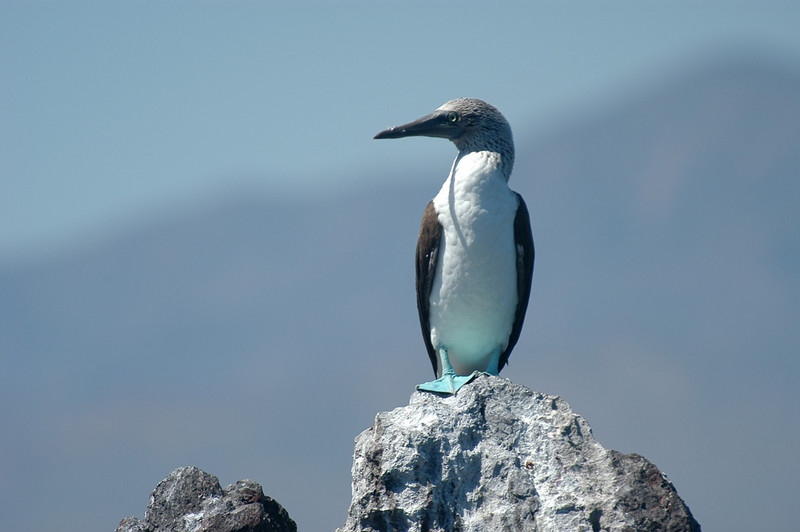
Blue-footed Booby (Sula nebouxii) by Bob-Nan

Blue-footed Booby (Sula nebouxii) by Bob-Nan

The new Order is Suliformes which includes the Frigatebirds-Fregatidae; Gannets, Boobies-Sulidae; Cormorants, Shags-Phalacrocoracidae; and the Anhingas, Darters-Anhingidae Families. (As I make the pages, a link will be provided here)

Another major change is they divided the Babblers into 5 Families -(Timaliidae, Pellorneidae, Leiothrichidae, Sylviidae, Zosteropidae). So I will be busy making and changing pages for awhile. All together the IOC: added 22 species, deleted 1; made 19 English Name changes; changed 16 Ranges; and made 180 Taxonomy changes including the new Order and the new Families mentioned.

Also, as I am making changes, I am making the pages “Kindle-friendly.” I recently got a Kindle that has 3G on it and found out that it will not let you open links, photos, or articles in a New Tab or New Window. As the pages are reworked, I am fixing those links, photos, and articles that link (internal) to this site so that they will Open in the Same Window. All the new articles in the last week or so have also been made “Kindle-friendly.” There are over 1,000 blogs and pages here, so don’t expect it to be changed over night.

Birds of the World (Internal link)

I.O.C Worldbirdnames.org (Not internal link)

*

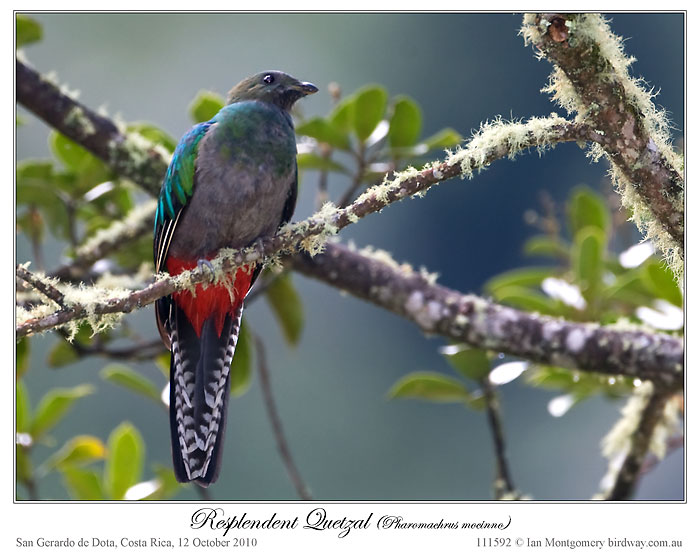
Ian’s Bird of the Week – Resplendent Quetzal

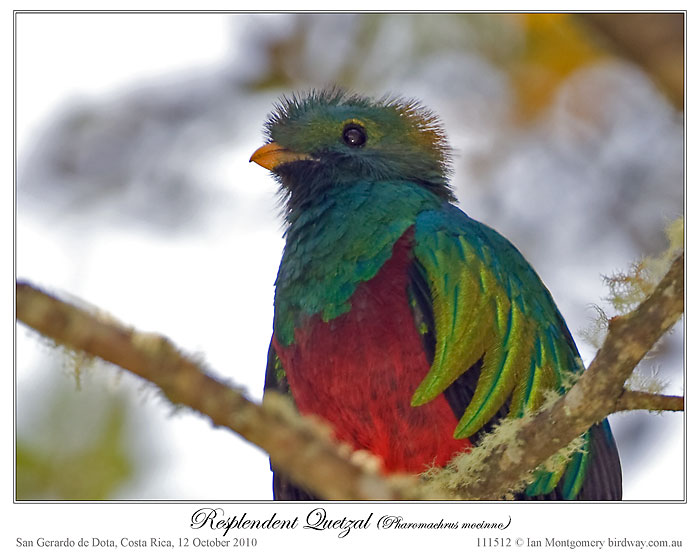
Resplendent Quetzal (Pharomachrus mocinno) by Ian

Resplendent Quetzal (Pharomachrus mocinno) by Ian

Ian’s Bird of the Week – Resplendent Quetzal ~ Ian Montgomery

Newsletter 10-18-10

It looks like your collective prayers worked, thank you very much, so here is the legendary Resplendent Quetzal, the main goal of my visit to Costa Rica.

Resplendent Quetzal (Pharomachrus mocinno) by Ian2

Resplendent Quetzal (Pharomachrus mocinno) by Ian2

After a post-flight night in a hotel in the capital, San Jose, I drove to hotel called the Hotel Savegre ( http://www.savegre.co.cr/ ) in a town called San Gerardo de Dota in a valley in the mountains often now called Quetzal valley. On the following morning, I went out with an excellent guide called Melvin Fernandez who is attached to the hotel ( birdwatchersavegre@hotmail.com ) and within two hours he had taken me to a Quetzal-favoured avocado tree containing two pairs of Quetzals and I had taken photos to my hearts content.

Resplendent Quetzal (Pharomachrus mocinno) by Ian3

Resplendent Quetzal (Pharomachrus mocinno) by Ian3

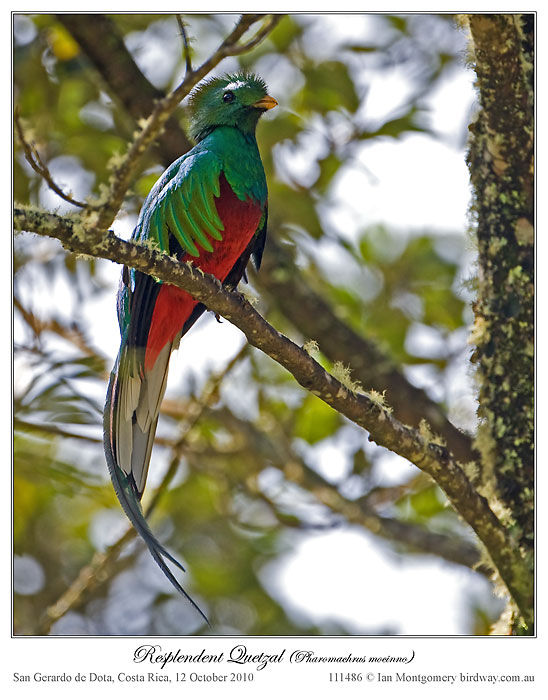
The Resplendent Quetzal is regarded as the most spectacular bird in the Americas, and it would be easy to agree. The males are just sensational as you can see in the first three photos. At this time of the year the tail streamers are short, which actually makes photographing them easier as you can fit the whole bird in more easily. They shed the streamers in July and they gradually grow back month by month to their maximum extent of up to 64cm/25in in time for the breeding season.

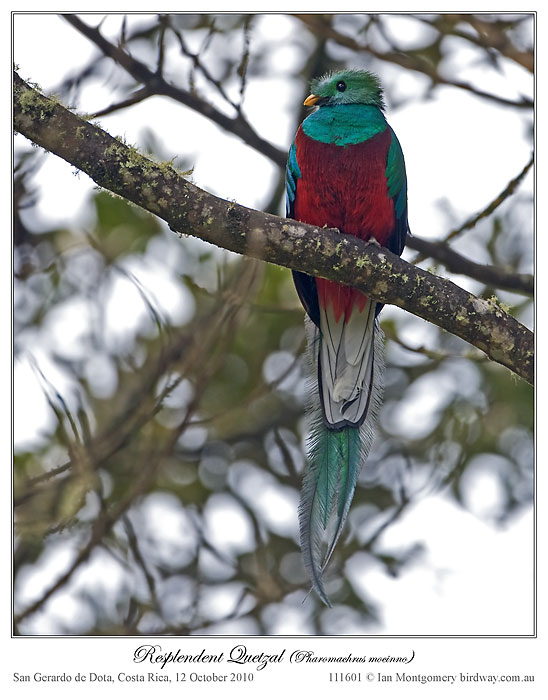
Resplendent Quetzal (Pharomachrus mocinno) by Ian Female

Resplendent Quetzal (Pharomachrus mocinno) by Ian Female

The female, fourth photo, shows the birds Trogon affinities – they are members of the Trogon family, Trogonidae – and she is quite gorgeous in her own right, though completely eclipsed by her amazing partner.

The adjective legendary is literally the case and the legends and myths focus on three aspects: the divine nature of the bird, the the defeat of the Mayans by the Spanish and its symbolic representation of liberty. You can read all about it here http://en.wikipedia.org/wiki/Resplendent_Quetzal and here http://blog.guatemalangenes.com/2009/03/legend-of-quetzal.html so I won’t repeat the details but just say that they add to the magic of the bird.

Resplendent Quetzal (Pharomachrus mocinno) by Ian5

Resplendent Quetzal (Pharomachrus mocinno) by Ian5

The tail streamers are not tail feathers – the tail is quite trogon-like – but erectible extensions of four of the feathers of the tail coverts, as you can see in the fifth photo. Similarly, the cloak-like feathers across the breast are the wing coverts.

Having photographed these amazing birds, mision completa as they say in Spanish, I was then free to relax and enjoy the rest of my stay in Costa Rica. The adventure, however, had just started and I have plenty of other interesting material for future birds of the week.

If you want to see the Quetzal, I highly recommend the Savegre Hotel. It’s family owned, has delightful gardens and its own primary cloud forest (the hotel is at 2,200m 7,200ft) and lots of trails, is on the Savegre River and Melvin tells me the best months for the Quetzal are February and March – I was there in the wet season and it rained heavily every afternoon.

I’m now back in California, due, flights permitting, to return to Australia tonight and looking forward to getting home.

Best wishes,
Ian

Ian Montgomery, Birdway Pty Ltd,
454 Forestry Road, Bluewater, Qld 4818
Phone: +61-7 4751 3115
Preferred Email: ian@birdway.com.au
Website: http://birdway.com.au


Lee’s Addition:

I am glad our prayers for your Quetzal were so speedily answered as were the ones for traveling mercies. That bird is a prize catch for most birdwatchers heading to Costa Rica.

Delight thyself also in the LORD; and he shall give thee the desires of thine heart. Commit thy way unto the LORD; trust also in him; and he shall bring it to pass. (Psalms 37:4-5 KJV)

To see Ian’s Trogonidae photos – Click Here

The Quetzals are part of the Trogonidae Family in the Trogoniformes Order.

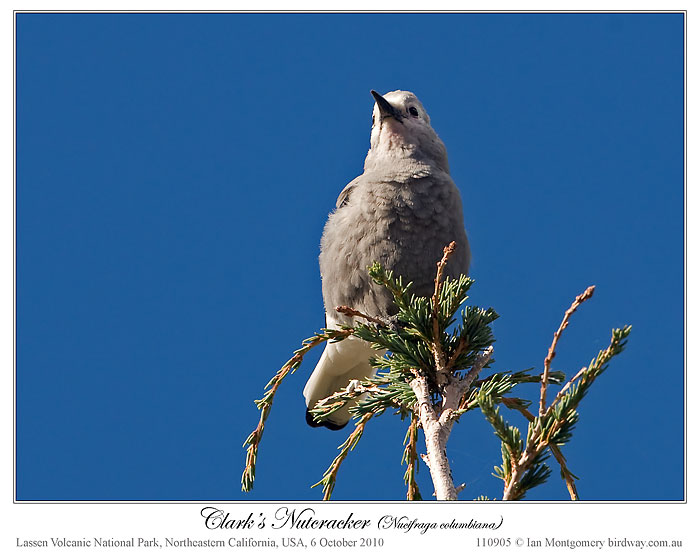
Ian’s Bird of the Week: Clark’s Nutcracker

Clark's Nutcracker (Nucifraga columbiana) by Ian

Clark's Nutcracker (Nucifraga columbiana) by Ian

Ian’s Bird of the Week: Clark’s Nutcracker ~ by Ian Montgomery

Newsletter – 10-14-10

My apologies for the very late bird of the week. My last week in California was very full, so the flight to Costa Rica last Sunday was the first opportunity to prepare the photos and, owing to internet problems at my first two hotels, I haven’t been able to send this email until now (Thursday) although I wrote it on Monday morning.

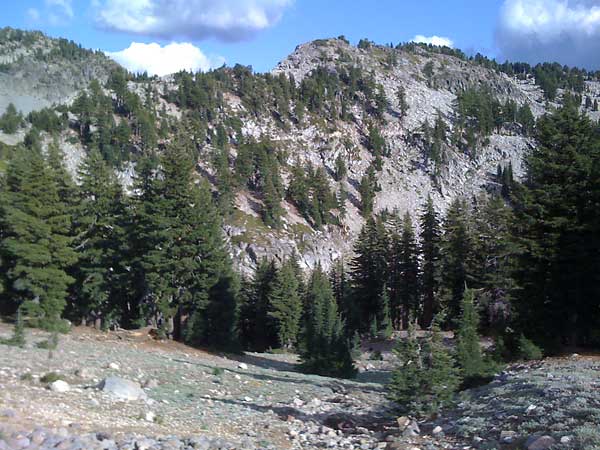
Craggy Trail-Lassen Volcanic National Park

Craggy Trail-Lassen Volcanic National Park

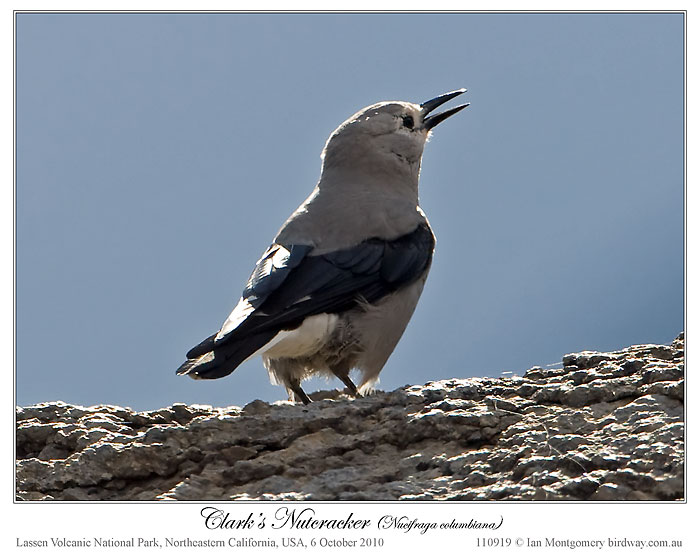
This is one of the birds of the week that gets chosen because there’s a good story to go with it. Clark’s Nutcracker is a mountain species, found near the tree-line in coniferous forest or rocky areas, that I’d only seen once before, in Colorado in September 1970 and and last week’s visit to Lassen Volcanic National Park in NE California was my third since 2008 to look for it. The first photo shows the craggy trail recommended by a ranger to Bumpass Hell (I kid you not) my sister, Gillian, and I took to look for it.

Clark's Nutcracker (Nucifraga columbiana) by Ian

Clark's Nutcracker (Nucifraga columbiana) by Ian

Clark's Nutcracker (Nucifraga columbiana) by Ian

Clark's Nutcracker (Nucifraga columbiana) by Ian

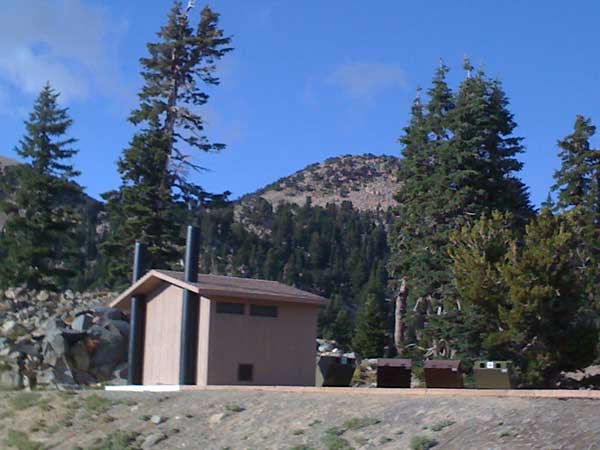
Eventually, we returned to the car park empty-handed and went to the rest-rooms shown in the second photo. After I’d emerged, I heard the call we had been listening for, and turned round the find Gillian looking for the source – a Clark’s Nutcracker calling mockingly at us perched the very top of the small pine tree right behind the building, third photo.

Restroom area-Lassen Volcanic National Park

Restroom area-Lassen Volcanic National Park

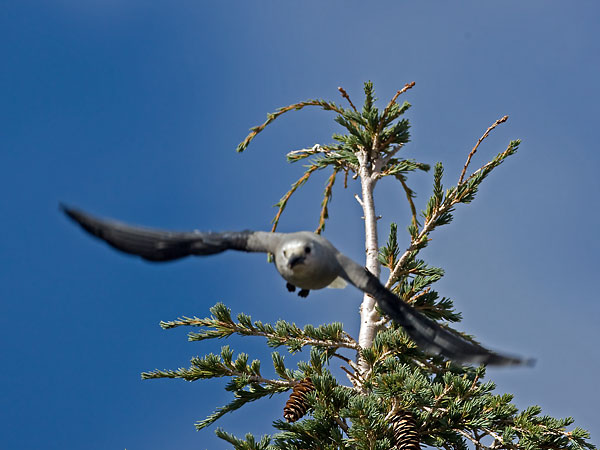
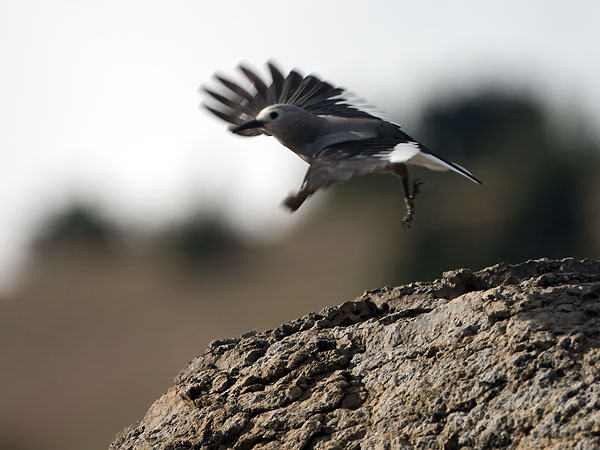
After a few seconds, it then flight right over my head and almost into the camera, fourth photo, to perch on a rock beside the car park, directly in front of the sun, thank you very much, fifth photo. I dodges the inevitable questions from a couple of tourists about the size of my 500mm lens to get in a better position before the bird flew, sixth photo, with its mate down into the very steep valley, never to be seen again.

Clark's Nutcracker (Nucifraga columbiana) by Ian

Clark's Nutcracker (Nucifraga columbiana) by Ian

Many birders will be familiar with the car park list, the ones you find waiting for you when you get back after a long and arduous hike and the rest-room list is a variation on this. And familiar with the advice to take your camera everywhere. EVERYWHERE! And with the settings ready to take photos of the unexpected.

My main target here is the elusive Resplendent Quetzal, so a collective world-wide prayer that I can serve it up to you as the next bird of the week would be greatly appreciated!

Best wishes,
Ian,

Ian Montgomery, Birdway Pty Ltd,
454 Forestry Road, Bluewater, Qld 4818
Phone: +61-7 4751 3115
Preferred Email: ian@birdway.com.au
Website: http://birdway.com.au


Lee’s Addition:
I couldn’t help but chuckle about his being ready at all times episode. It reminded me of a verse in Daniel that says,

Now if ye be ready that at what time ye hear the sound of the cornet, flute, harp, sackbut, psaltery, and dulcimer, and all kinds of musick, … (Daniel 3:15 KJV)

I didn’t read where it mentioned the “Clark’s Nutcracker calling mockingly.”

As usual, Ian had another interesting birdwatching experience.

The Clark’s Nutcracker (Nucifraga columbiana) are in the Corvidae – Crows, Jays family of the Passeriformes order.

See also:

a j mithra’s – Clark’s Nutcracker

Ian’s Bird of the Week – Sora

Sora (Porzana carolina) by Ian

Sora (Porzana carolina) by Ian

Ian’s Bird of the Week – Sora (#382) ~ By Ian Montgomery

Newsletter (#382)  – 09-29-10

Any birds that are a challenge to see exert a particular fascination. This includes all the night birds – owls, nightjars, etc – and all the skulkers and lurkers. We had a classic skulker, the American Bittern, a couple of weeks ago, and the crakes and rails belong in the same category and the same habitat. In Australia, I’ve never seen a Lewin’s Rail and I’ve never photographed a Spotless Crake. Here in the US, the Clapper Rails at the Baylands Park at Palo Alto are giving me a hard time too, but the Sora, a crake, and the Virginia Rail have been more obliging.

The Sora (Porzana carolina) is very close related to the Australian Spotted Crake (Porzana fluminea) and looks very similar, but lacks the Moorhen-like red spot on the bill. They both live in reedbeds but will sometimes come out into the open to feed, particularly in the evening and when water levels are low, as they are here now in California at the end of a dry summer.

Sora (Porzana carolina) by Ian

Sora (Porzana carolina) by Ian

I’ve recently visited a park in the hills above San Jose three times looking without success for Golden Eagles, but each time I’ve seen a Sora and twice a Virginia Rail as well. In fact, the bird in the first photo came out into the sunshine to feed on the edge of the reed when we – my sister is here now – were watching for a less cooperative Virginia Rail, that was making a lot of noise. All the crakes and rails have very distinctive, loud calls, so presumably they, like the bittern, have trouble seeing each other too.

Both species are widespread throughout the United Sates and southern Canada, so there’s probably a cautionary tale here about naming species after places, such as Virginia or carolina, though I’m presuming that they weren’t named after people. Both migrate, so crakes and rails will fly quite long distances if they have to – usually at night – and turn up in odd places. Some, like the Buff-banded Rail, widespread in Australia also occurs on coral islands on the Barrier Reef and in the South Pacific, where, with nowhere to hide, it can become quite tame. Others like the Lord Howe Island Woodhen, have gone to the skulking extreme and lost the ability to fly.

Links:

Sora
Australian Spotted Crake
Virginia Rail
Buff-banded Rail

Best wishes,
Ian

Ian Montgomery, Birdway Pty Ltd,
454 Forestry Road, Bluewater, Qld 4818
Phone: +61-7 4751 3115
Preferred Email: ian@birdway.com.au
Website: http://birdway.com.au


Lee’s Addition:

Well, Ian does it again! I saw a Sora once years ago and still haven’t been able to spot one again here in Central Florida. Ours hide a little more than the one he found. :)

I am glad that he is being successful out there in California. If I was envious, I would be upset, but I am not. I’ll just keep looking.

At any rate, the Sora is part of the Rallidae Family of Rails, Crakes & Coots. There are 131 species in the family. The Rallidaes keep company with the Flufftails, Finfoots, Trumpeters, Cranes and Limpkins who are also in the Gruiformes Order.

The Sora’s breeding habitat is marshes throughout much of North America. They nest in a well-concealed location in dense vegetation. The female usually lays 10 to 12 eggs, sometimes as many as 18, in a cup built from marsh vegetation. The eggs do not all hatch together. Both parents incubate and feed the young, who leave the nest soon after they hatch and are able to fly within a month. (Wikipedia)

Can the papyrus grow up without a marsh? Can the reeds flourish without water? While it is yet green and not cut down, It withers before any other plant. So are the paths of all who forget God; … (Job 8:11-13a NKJV)

Ian’s Bird of the Week – Wilson’s Warbler

Wilson's Warbler (Wilsonia pusilla) by Ian

Wilson's Warbler (Wilsonia pusilla) by Ian

Ian’s Bird of the Week – Wilson’s Warbler ~ by Ian Montgomery

Newsletter – 09-21-10

Here is the attractive Wlson’s Warbler one of the New World Wood-Warblers (family Parulidae) that is quite common in Canada and the western United States. We encountered this one at Point Reyes, an pleasant coastal area and good birding spot just north of San Francisco. With a length of only 12cm/4.75in, the specific name pusilla (small) given to it by Alexander Wilson in 1811 is appropriate.

The Wood-Warblers, so named to distinguish them from the unrelated Old World Warblers, are justifiably popular with American birders, particular during the spring and fall migrations. They come in a wide variety of shapes and colours, with over 50 species (out of a family total of near 120) occurring in North America. Most species spend the winter in Central and South America, a few in the warmer southern states such as California and Florida and during the migration, many birders are on the lookout for Warblers occurring outside their breeding range.

Wilson's Warbler (Wilsonia pusilla) by Ian

Wilson's Warbler (Wilsonia pusilla) by Ian

Alexander Wilson moved from Scotland to Pennsylvania in 1794 at the age of 28, became interested in ornithology in 1801 and decided in 1802 to publish a book illustrating all the North America birds. This appeared as the nine volume American Ornithology between 1808 and 1814, though Wilson died in 1813 and the ninth volume was completed by his friend George Ord. He met John James Audubon in 1810 and probably inspired him to publish his own book of illustrations, even though Audubon’s reaction to Wilson is described as ‘decidedly ambiguous’. (He declined to subscribe to American Ornithology, felt his own illustrations were much better and, in 1820, decided to publish the ‘greatest bird book ever’.) Seven species of birds are name after Wilson, including two on the Australian list, Wilson’s Phalarope and Wilson’s Storm-Petrel.

I have had a report of a list member having trouble accessing the Birdway website. If you have encountered any such difficulties recently, I’d like to hear from you. Recent additions to the website include:

Black Turnstone
Cassin’s Auklet
Rhinoceros Auklet
Sora
Virginia Rail

Best wishes,
Ian

Ian Montgomery, Birdway Pty Ltd,
454 Forestry Road, Bluewater, Qld 4818
Phone: +61-7 4751 3115
Preferred Email: ian@birdway.com.au
Website: http://birdway.com.au


Lee’s Addition:

Another winner for Ian. What a pretty little warbler. I like that black cap it is wearing. As he said, they are in the Parulidae Family. You can see his photos of the Parulidaes and then check out the whole family here at the Parulidae Family. There are 120 members in the family at this time.

By them the birds of the heavens have their home; They sing among the branches. (Psalms 104:12 NKJV)

Ian’s Bird of the Week – American Bittern

American Bittern (Botaurus lentiginosus) by Ian Montgomery

American Bittern (Botaurus lentiginosus) by Ian Montgomery

Ian’s Bird of the Week – American Bittern ~ by Ian Montgomery

Newsletter – 9/14/2010

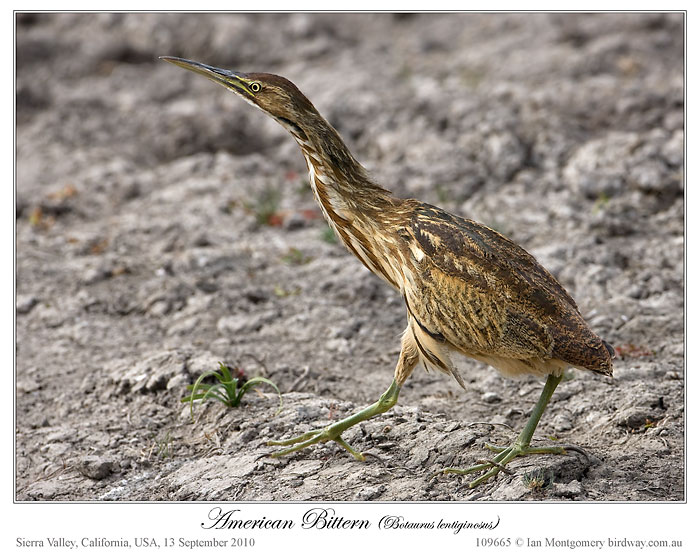
Lightning, they say, doesn’t strike the same place twice. Luck, in bird photography, is rather similar: a missed opportunity usually remains just that. High on my list of American targets was the American Bittern, a cryptic and elusive bird of inaccessible reed beds that had successfully eluded me since I first did some serious birding in the USA exactly forty years ago. Imagine my delight and disappointment when I finally flushed one from reeds on the Feather River at Lake Almanor in NE California last Sunday but wasn’t quick enough to get a photo of it as if flew off. I found it in the viewfinder okay, but the autofocus didn’t as often happens when it gets distracted by a complex background.

American Bittern (Botaurus lentiginosus) by Ian Montgomery

American Bittern (Botaurus lentiginosus) by Ian Montgomery

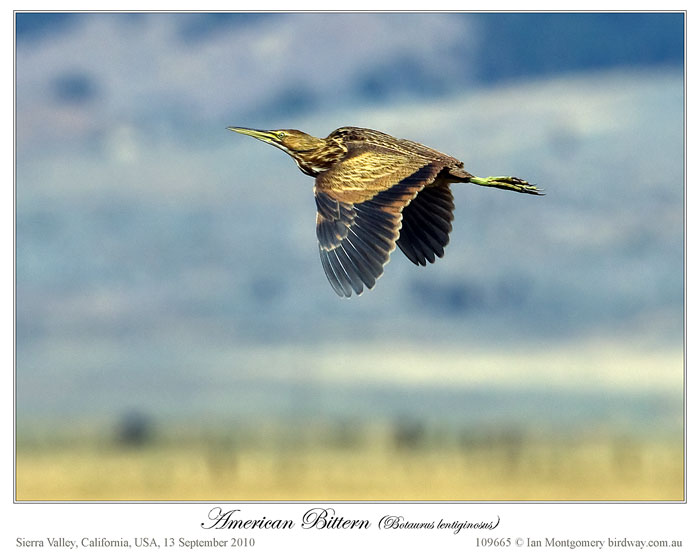
Yesterday, two days later, at Sierra Valley in the Sierra Nevada (‘Snowy Mountains’) I saw a large bird flying towards and past me across more reeds and decided to photograph it even before I realized that it was another Bittern, see the first photo. Shortly later, another more distant one flew past and then I found a couple more lurking in the dwindling area of wetland remaining at the end of a dry summer. Eventually, I startled one in a ditch beside the road which froze in indecision (if in doubt, freeze, is a Bittern maxim) frustratingly close but on the other side of an unpicturesque barbed wire fence.

American Bittern (Botaurus lentiginosus) by Ian Montgomery

American Bittern (Botaurus lentiginosus) by Ian Montgomery

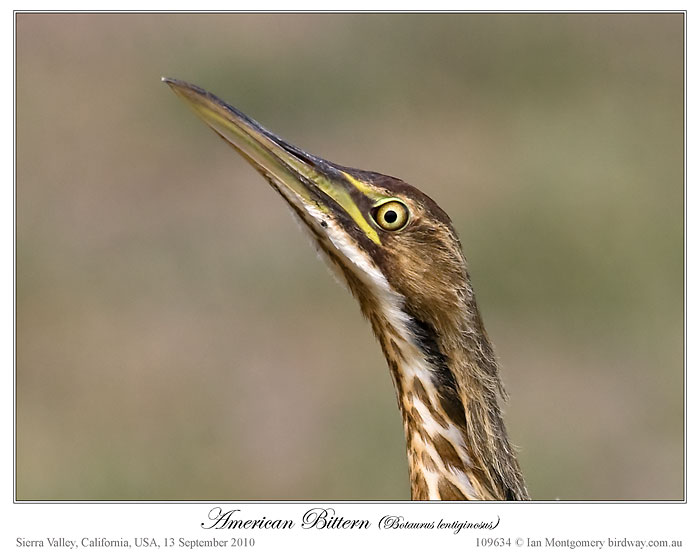
Then started a waiting game with an endlessly patient opponent that I was bound to loose. Eventually, I moved along the road away from it in the hope that it would come through the fence to regain the sanctuary of the ditch. In time, it did just that and quite stealthily, second photo. Bitterns are bizarre birds in appearance and behaviour, with extraordinarily effective camouflage and very beautiful plumage. When it had entered a small patch of reeds not much bigger than itself, it vanished, and search as I could with binoculars from a short distant, I never saw it again.

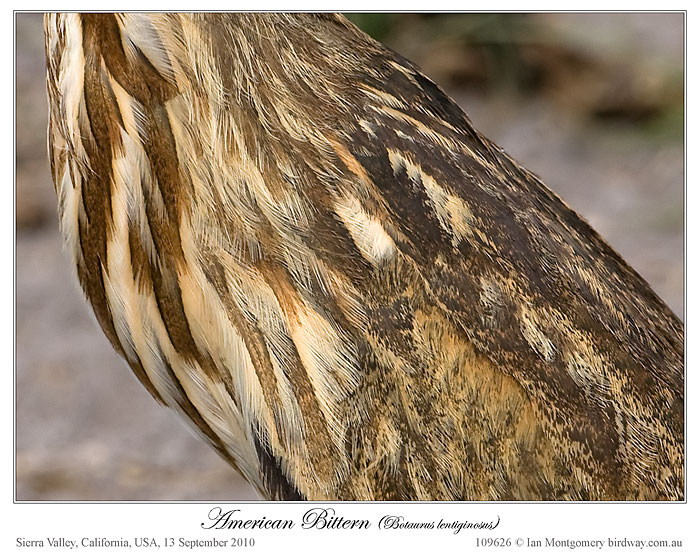
To do the plumage justice, I’ve included cropped enlargements of a couple of photos taken when the bird was behind the barbed wire. The fourth photo shows the gorgeous long neck feathers that drape over the breast and the exquisitely patterned feathers of the wing coverts.

American Bittern (Botaurus lentiginosus) by Ian Montgomery

American Bittern (Botaurus lentiginosus) by Ian Montgomery

Worldwide, there are four closely-related species of large Bitterns, one in North America, one in South America, one in Eurasia and Africa and one in Australasia. All have declined in population, but only the Australasian one is classed as endangered. All live in reed beds, all are mainly nocturnal, skulkers and easier to hear than see, particularly in the breeding season when they emit far-carrying booming sounds: presumably, they find each other easier to hear than see.

Links including recent additions:
Australiasian Bittern
Wrentit
White-breasted Nuthatch
Red-breasted Nuthatch
Red-shouldered Hawk
Sharp-shinned Hawk
Chestnut-backed Chickadee
Black-footed Albatross

On an almost totally unrelated subject, Birds Australian North Queensland has had a request from an Australian, Carolyne Hepi, living in a remote area of Papua New Guinea to support the local school by buying their 2011 Birds of Papua calendar, price 20 Australian Dollars. I think it is a great idea. Her email is carolyne_jon@hotmail.com and, if you want more information, I’ll make a copy of the pdf she sent us (size 3.8MB) available on the Birdway website.

Best wishes,
Iab

Ian Montgomery, Birdway Pty Ltd,
454 Forestry Road, Bluewater, Qld 4818
Phone: +61-7 4751 3115
Preferred Email: ian@birdway.com.au
Website: http://birdway.com.au


Lee’s Addition:

Thanks, Ian, for another great birdwatching adventure for us to read about. Saw an American Bittern in Texas in early 2000 and they are hard to capture in binoculars let alone get a decent photo of them. Great job!

Bitterns are in the Ardeidae- Herons, Bitterns Family which has 14 species world-wide. Also check out Ian’s Ardeidae family photos. The Bitterns are part of the Pelicaniformes Order and are mentioned as a Bird of the Bible.

I will also make it a possession for the bittern, and pools of water: and I will sweep it with the besom(broom) of destruction, saith the LORD of hosts. (Isa 14:23)


Family#26 – Ardeidae
*