Ian’s Bird of the Week – Scarlet Robin

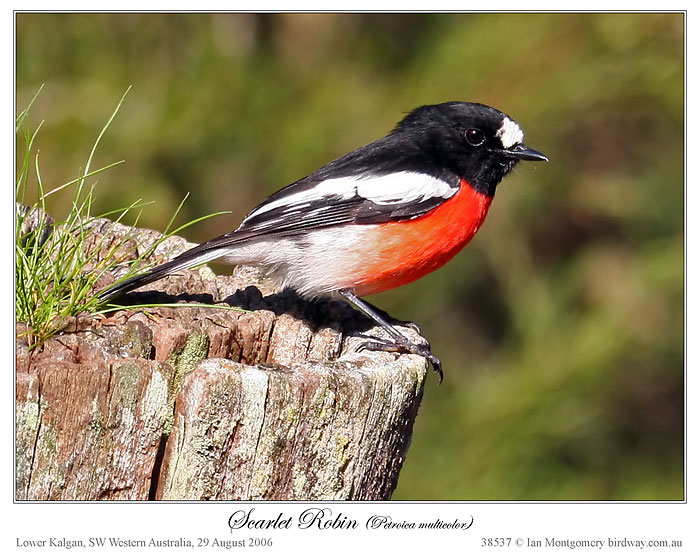
Scarlet Robin (Petroica boodang) by Ian

Scarlet Robin (Petroica boodang) by Ian

Ian’s Bird of the Week – Scarlet Robin ~ by Ian Montgomery

Newsletter and holiday wish – 12-24-10

Christmas and New Year is a time for tradition not (egregious) originality so here, without apology, is a Scarlet Robin to wish you season’s greeting. Okay, it’s not the classical European Robin – which featured as Bird of the Week on Christmas 2005 – but perhaps the closest we can get to in Australia. In fact, as a member of the Australo-Papuan Robins – the Petroicidae – rather than the Old World Flycatchers – the Muscicapidae – it’s not even closely related, but I don’t think science is very important when it comes to symbolism.

Anyway, whatever your creed or beliefs, I wish you a safe and peaceful holiday season and a fulfilling and happy 2011.

I also offer you an apology. I’ve just noticed that I sent an email, intended for the committee members of Birds Australia North Queenland, to the bird of the week list on the 14 December. I’m sorry if I mystified you but fortunately the email contained nothing controversial!

Links:
Australo-Papuan Robins
Old World Flycatchers
Eurasian Robin

Best wishes,
Ian


Ian Montgomery, Birdway Pty Ltd,
454 Forestry Road, Bluewater, Qld 4818
Phone: +61-7 4751 3115
Preferred Email: ian@birdway.com.au
Website: http://birdway.com.au


Lee’s Addition:

Merry Christmas and Happy New Year to you also, Ian. Trust you enjoy the holidays and that in 2011 you find lots of more neat birds to introduce us to in your Bird of the Week articles. Always enjoy reading about your birdwatching adventures where ever you roam. You do seem to get around quite a bit.

My son, do not forget my teaching, but let your heart keep my commandments, for length of days and years of life and peace they will add to you. (Proverbs 3:1-2 ESV)

What a neat little bird. The Scarlet Robin is in the Petroicidae Family as Ian said and that family is in the Passeriformes Order.

See all of Ian’s Birds of the Week.

*

Ian’s Bird of the Week – Spectacled Antpitta

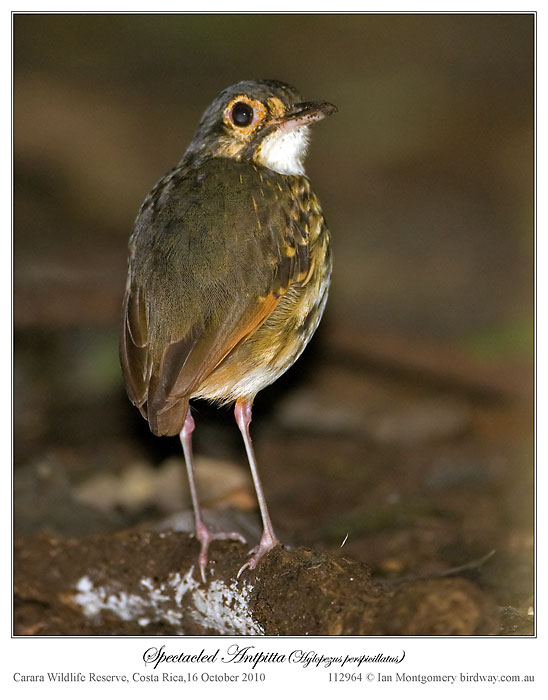
Streak-chested (Spectacled) Antpitta (Hylopezus perspicillatus) by Ian

Streak-chested (Spectacled) Antpitta (Hylopezus perspicillatus) by Ian

Ian’s Bird of the Week – Spectacled Antpitta ~ by Ian Montgomery

A friend of mine pointed out once that birds that stand upright and have short tails (long ones get in the way) look like little people and are consequently attractive. Penguins are the classic example, but there are plenty others, including the Pittas of Australia and Eurasia. Pittas don’t occur in the Americas but instead there are the unrelated but similar-looking Antpittas, members of the New World family Formicariidae, which occur from Mexico southwards.

Antpittas have similar habits to true Pittas and rummage around in leaf-litter in tropical and sub-tropical forest looking for invertebrate prey such as snails and worms. They are also easier to hear than see, so it was a pleasant surprise when we stumbled on this Spectacled Antpitta in Carara Wildlife Reserve in Costa Rica. It moved off through the undergrowth,but I struggled after it encumbered by a large lens and flash and managed to get a few photos of it peering suspiciously at me over its shoulder before disappearing. Incidentally, there are various groups of Central and South American birds, collectively called Antbirds, so named because some of them are found in association with army ants and feed on prey disturbed by the flow of ants across the landscape.

Streak-chested (Spectacled) Antpitta (Hylopezus perspicillatus) by Ian

Streak-chested (Spectacled) Antpitta (Hylopezus perspicillatus) by Ian

The Spectacled Antpitta ranges form Honduras in the north to Columbia in the south. There are about 50 species of Antpitta and there are photos of another species, the Moustached Antpitta, from Ecuador on the website. This is, I think, the last of the Costa Rican birds of the week as I’ve put most of the Costa Rican species on the website.

Recent additions to the website include the odd Yellow-thighed Finch – not a finch but a member of the Emberizidae – from Costa Rica and additional photos of a couple of terns from closer to home: the Little Tern and the Caspian Tern.

Links:
Other Antbirds:
True Pittas:

Last week, the link to the Black-necked Stilt mistakenly pointed to the American Avocet; it should have been: http://www.birdway.com.au/recurvirostridae/black_necked_stilt/source/black_necked_stilt_109873.htm . My apologies.

Best wishes,
Ian

Ian Montgomery, Birdway Pty Ltd,
454 Forestry Road, Bluewater, Qld 4818
Phone: +61-7 4751 3115
Preferred Email: ian@birdway.com.au
Website: http://birdway.com.au


Lee’s Addition:

Thanks Ian, for another great bird to find out about. Ian uses the Bird International list and we use the I.O.C.’s list of birds. The Spectacled Antpitta and the Streak-chested Antpitta are one in the same bird. That is where knowing the scientific name, “Hylopezus perspicillatus,” comes in handy. By either name, it does have a neat voice and below is a video link to one singing that I located.

The Antpittas are in the Grallariidae Family (IOC) of the Passeriformes Order.

Video of Streak-chested Antipitta singing by Dave Jackson

*

Yellow-rumped Warbler Split

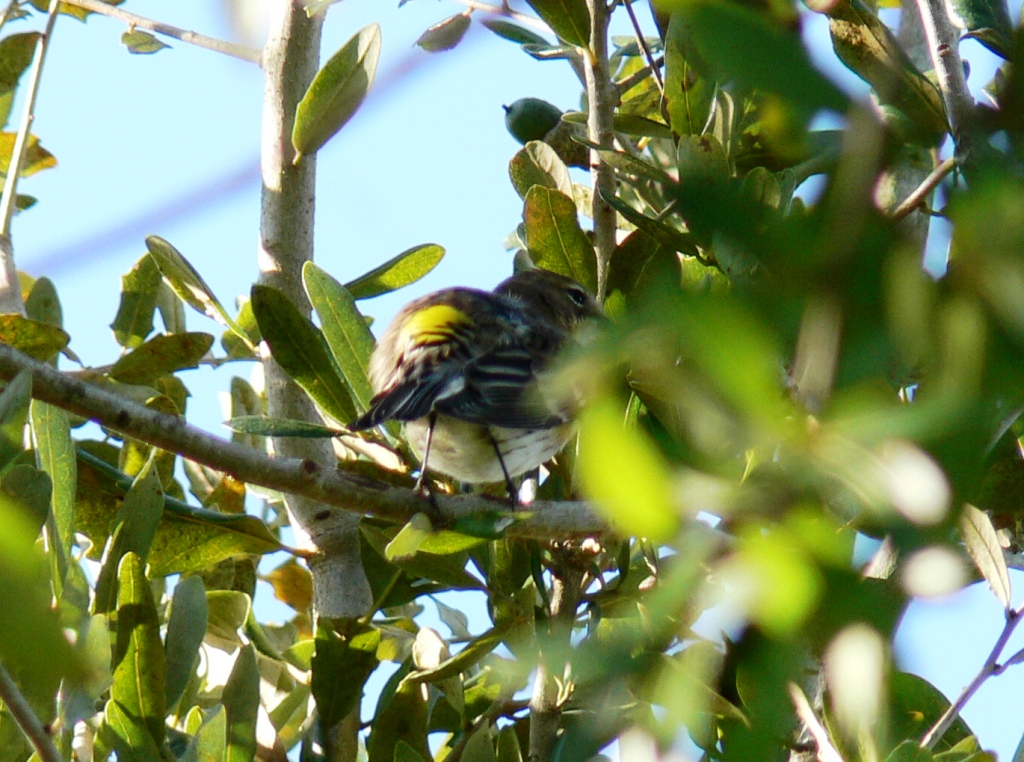
Myrtle Warbler (Dendroica coronata)

Myrtle Warbler (Dendroica coronata)

Out of the ground the LORD God formed every beast of the field and every bird of the air, and brought them to Adam to see what he would call them. And whatever Adam called each living creature, that was its name. (Genesis 2:19 NKJV)

When I wrote the article about our trip to S. Lake Howard Nature Park this week, I was not exactly sure which of the Old Yellow-rumped Warblers I had seen. Since the 2.4 Version of the I.O.C. (International Ornithologist Congress) list, they split the “Butterbutt” into four species. Hadn’t looked into it too much, but now is the time to try to figure out which one is which.

The four birds are the:
Myrtle Warbler (Dendroica coronata) – Eastern U.S. Mostly
Audubon’s Warbler (Dendroica auduboni) – Western U.S. Mostly
Black-fronted Warbler (Dendroica nigrifrons)
Goldman’s Warbler (Dendroica goldmani)

After doing quite a bit of research, I was wrong about the Audubon Warbler. Not only do I not live in the west, but after studying lots of photos, it is the Myrtle Warbler not the Audubon’s Warbler, as I first thought, that we saw.

Here are some of the traits of the Myrtle Warbler (from USGS about the Myrtle and Audubon’s Warblers):

Bright yellow rump (nicknamed “butterbutts”)

Myrtle Warbler (Dendroica coronata) Bright yellow rump

Myrtle Warbler (Dendroica coronata) Bright yellow rump

White spots in tail

Myrtle Warbler (Dendroica coronata) White spots in tail

Myrtle Warbler (Dendroica coronata) White spots in tail

White supercilium and broken eye ring

Myrtle Warbler (Dendroica coronata) White supercilium and broken eye

Myrtle Warbler (Dendroica coronata) White supercilium and broken eye

Here are some links to read to help with the split:
Myrtle Warbler by Wikipedia
Audubon’s Warbler by Wikipedia
Welcome back Myrtle Warbler? from the Drinking Bird
Goodbye Yellow-rumped Warbler, welcome back Myrtle Warbler and Audubon’s Warbler . . . by flickr discussion

At any rate, while I was sitting there, the little warbler preened and did not spook as I kept taking its photo.

These warblers belong to the Parulidae Family of the Passeriformes Order.

This is not an extensive listing of the birds, as the above articles covered much of it. These photos were taken by me (Lee).

The Slide show is of the Myrtle Warbler in the time sequence they were taken.

*

This slideshow requires JavaScript.

*

Yellow-rumped Cacique – The trusted Watchman

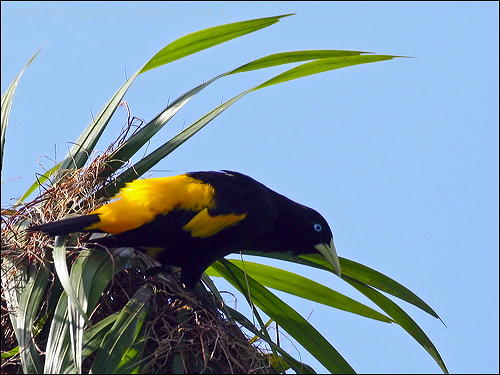
Yellow-rumped Cacique (Cacicus cela) by Ian

Yellow-rumped Cacique – The trusted Watchman ~ by a j mithra

The caciques are Passerine birds in the New World Blackbird family. Members of the family are resident breeders in tropical South America and north to Mexico. The caciques are birds associated with woodland or forest. The Yellow-rumped Cacique is found in tropical South America from Panama to central Brazil.

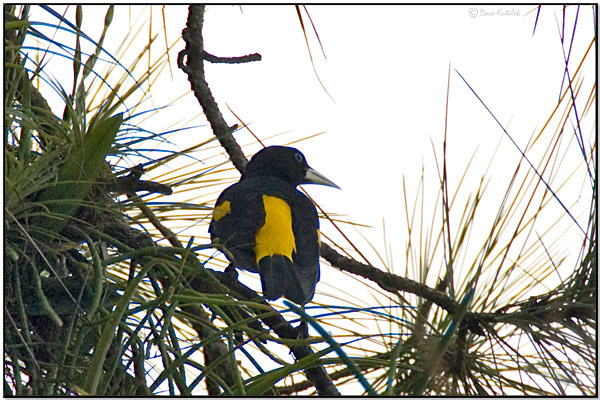
Yellow-rumped Cacique (Cacicus cela) by Daves BirdingPix

Yellow-rumped Cacique (Cacicus cela) by Daves BirdingPix

It prefers Varzea forest edges, woodland and some semi-open habitats. The areas flooded in the annual cycle are extensive lowland and forested areas bordering the main river and its tributaries and are known by the Portuguese word várzea which means flooded plains are subject to annual flooding, with consequent soil enrichment; Trees in this zone survive flooding for several weeks annually and provide the basis of a food web that includes fish adapted…

They are very gregarious and large, noisy flocks can be seen flying over Amazon Rivers particularly at dawn and dusk as the flocks move from their overnight roost to their feeding grounds and back again. These birds prefer a place which is abundant in food and water…

There is abundance in the presence of Jesus, our Good Shepherd..

King David had experienced God’s abundance and that’s why he says,

The LORD is my shepherd; I shall not want. He maketh me to lie down in green pastures: he leadeth me beside the still waters.” Psalm 23:1,2

These birds seem to know that flood brings in soil enrichment which in turn provides the basis of food web…

Are you in the midst of a flood?

Just remember this verse,

So shall they fear the name of the LORD from the west, and his glory from the rising of the sun. When the enemy shall come in like a flood, the Spirit of the LORD shall lift up a standard against him. Isaiah 59:19

Where there is flood, there the Spirit of the Lord lifts a banner..

Glory be to Jesus name!!!!!!!!!

Yellow-rumped Cacique (Cacicus cela) by Ian

Yellow-rumped Cacique (Cacicus cela) by Ian

Most are colonial breeders, with several long, hanging, bag-shaped nests in a tree, each suspended from the end of a branch and have their entrance at the upper side. The nests are occupied in the short dry season.

The birds don’t like bad weather; they leave the colony when it rains too much. Nests can be washed out of a tree by heavy rain. For more protection, a couple of males are always on watch and if a bird of prey comes in sight, they sound the alarm and the colony tree will be empty in no time.

God has set us as watchmen over His people to warm them to walk in The WAY..

If when he seeth the sword come upon the land, he blow the trumpet, and warn the people; Then whosoever heareth the sound of the trumpet, and taketh not warning; if the sword come, and take him away, his blood shall be upon his own head.

He heard the sound of the trumpet, and took not warning; his blood shall be upon him. But he that taketh warning shall deliver his soul.

But if the watchman see the sword come, and blow not the trumpet, and the people be not warned; if the sword come, and take any person from among them, he is taken away in his iniquity; but his blood will I require at the watchman’s hand.

So thou, O son of man, I have set thee a watchman unto the house of Israel; therefore thou shalt hear the word at my mouth, and warn them from me.” Ezekiel33:3-7
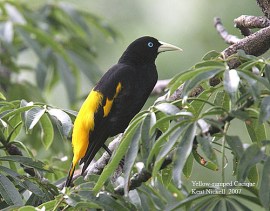
Yellow-rumped Cacique (Cacicus cela) by Kent Nickell

Yellow-rumped Cacique (Cacicus cela) by Kent Nickell

Some species choose a tree that also contains an active wasp nest as a deterrent to predators (e.g. toucans), and females compete for the best sites near the protection of the wasp nest. The wasps also repel Philornis flies which are attracted in enormous numbers by the birds’ smell. These flies are paratisized by a mite which then move on to the nestlings, many of whom die from the infestation.

The females make the nests, brood en raise the young and are more abundant than the males. These birds are not afraid of building their nests near a tree that contains wasp’s nest..

Is it because they know that,

And we know that all things work together for good to them that love God, to them who are the called according to his purpose. Romans 8:28?

If Naaman had not turned into a leper, he wouldn’t have known God…

If Lazarus didn’t die, he wouldn’t have known the power of God…

After a nasty fall, if I had not dislocated my shoulder, I would surely have dislocated my hip..

Thank You Lord for Your saving grace and I also thank You for Sister Lee and the readers of this site who had prayed for my healing…

Bless them abundantly Lord in Jesus name …Amen

These are slim birds with long tails and a predominantly black plumage The relatively long pointed bill is pale greenish, yellowish or bluish, depending on species, and most caciques have blue eyes (at least when adult).

  • The female is typically smaller than the male.
  • Caciques eat large insects and fruit.
  • Most are gregarious and typically seen in small groups.
  • They are very vocal, producing a wide range of songs, sometimes including mimicry.
  • Males try to make an indelible impression on the females by showing their yellow feathers and flapping their wings.
Yellow-rumped Cacique (Cacicus cela) by Kent Nickell

Yellow-rumped Cacique (Cacicus cela) by Kent Nickell

Gold is called the Yellow metal and Gold denotes God’s glory…

God had been showing His glory and spreading His wings time and again to show how much He cares for us and longs for us to come under His wings..

But, there are still scores of them out there who are yet to know Him…

Are we doing something to reach the unreached?

The LORD recompense thy work, and a full reward be given thee of the LORD God of Israel, under whose wings thou art come to trust. Ruth 2:12

Have a blessed day!

Your’s in YESHUA,
a j mithra

Please visit us at:  Crosstree


Lee’s Addition:

We are continuing to pray for you, a j. Praying for your speedy recovery.

There are 12 Caciques are in the Icteridae – Oropendolas, Orioles & Blackbirds Family of the Passeriformes Order.

*
Ian’s Bird of the Week – Tooth-billed Bowerbird

Tooth-billed Bowerbird (Scenopoeetes dentirostris) by Ian

Tooth-billed Bowerbird (Scenopoeetes dentirostris) by Ian

Ian’s Bird of the Week – Tooth-billed Bowerbird ~ by Ian Montgomery

Newsletter 8-20-10

I’m squeezing this bird of the week in between the Birds Australia Congress and Campout, which finished this morning, and my departure for California tomorrow. The Congress and Campout was a great success and ran like clockwork thanks to the preparation, dedication and hard work of our secretary and committee. I had a request from a participant to make the Golden Bowerbird – one of the highlights of the Campout – this week’s bird but this species starred in this role earlier this year. So, instead I’ve chosen the Tooth-billed Bowerbird and included a photo of the Golden Bowerbird, both being endemics of the Queensland wet tropics and inhabiting highland rainforest.

Tooth-billed Bowerbird (Scenopoeetes dentirostris) by Ian

Tooth-billed Bowerbird (Scenopoeetes dentirostris) by Ian

It’s not spectacular in appearance like the Golden Bowerbird, but it’s an interesting bird nevertheless. It doesn’t build a bower; instead it has a display platform consisting of an oval cleared space on the ground around a small tree trunk with a suitable branch used as a perch for singing above the platform. It decorates the platform with large, fresh leaves that the bird collects by using its serrated bill to chew through the leaf stem. The second photo shows a bird in full song and you can see the serrations on the bill, from which it gets the name. Like other bowerbirds, it is an accomplished songster and very good a mimicry. It is also fussy. Most bowerbirds are extraordinarily fussy in their choice of objects and colours to decorate the bowers. Tooth-billed Bowerbirds only use leaves, but the leaves are carefully chosen for appearance and laid upside down, with the paler surface uppermost. Apparently, if you turn them up the other way, the bird will put them back the correct way.

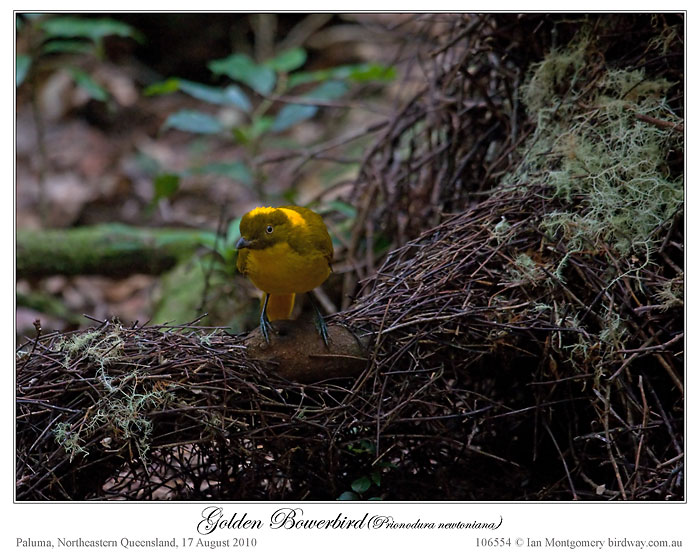
Golden Bowerbird (Prionodura newtoniana) by Ian

Golden Bowerbird (Prionodura newtoniana) by Ian

They usually start attending their display areas in September, so we were a bit early and I don’t think anyone actually saw one, though there were reports of hearing them. There was, however, some early activity and a couple of birds had several leaves in place. At the peak of the season, there may be up to 30 or so leaves, and these are replaced regularly with fresh ones. The Golden Bowerbirds had made an early start to and were decorating their bowers with pieces of lichen. The bird in the third photo, taken last Tuesday, has just added a piece to the bigger pile on the left and he is standing on the display perch between the two piles of twigs – ‘maypoles’ – that make up the typical bower of this species. The display perch is very important as it is where all the real action takes place, and you can see that this one is well worn.

You can expect an American as the next Bird of the Week. I’ve gone right off flying in recent years, so I’m getting the train to Brisbane for my flight to San Francisco. Unfortunately, there isn’t a convenient alternative to flying if you wish to cross the Pacific.

Best wishes,
Ian

Ian Montgomery, Birdway Pty Ltd,
454 Forestry Road, Bluewater, Qld 4818
Phone: +61-7 4751 3115
Preferred Email: ian@birdway.com.au
Website: http://birdway.com.au


Lee’s Addition:

The Bowerbirds are in the Ptilonorhynchidae – Bowerbirds Family. The family has 17 Bowerbirds and 3 Catbirds in it and they are part of the Passeriformes Order (Songbirds).

Previous articles on Bowerbirds:

Ian’s Bird of the Week – Spotted Bowerbird and the Golden Bowerbird

a j mithra’s – Golden Bowerbird


Family#126 – Ptilonorhynchidae
*

Ian’s Bird of the Week – Willie Wagtail

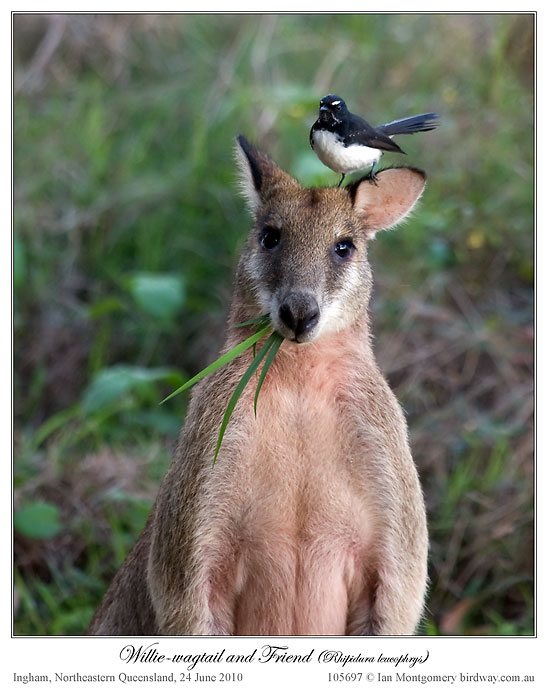
Willie Wagtail (Rhipidura leucophrys) on Wallaby by Ian Montgomery

Willie Wagtail (Rhipidura leucophrys) on Wallaby by Ian

Ian’s Bird of the Week – Willie Wagtail ~ Ian Montgomery

Newsletter – 06-30-10

Very common birds like Willie-wagtails often get overlooked in the Bird of the Week in the pursuit of the rare and exotic. It takes the unusual antics of a particular individual to get noticed, such as this Willie-wagtail, perched cheekily on the head of an Agile Wallaby at Tyto Wetlands near Ingham last week.

Perhaps ‘unusual’ isn’t strictly true, as Graham Pizzey’s Field Guide to the Birds of Australia describes the behaviour of this species as: ‘bold, perky; watches from low branches, fence-posts … backs of farm-animals’. The wallaby might be offended at being described as a mere farm-animal, though this one seems to be doing its best to imitate a country yokel by chewing grass and assuming a dopey expression.

Willie Wagtail (Rhipidura leucophrys) on Wallaby by Ian Montgomery

Willie Wagtail (Rhipidura leucophrys) on Wallaby by Ian

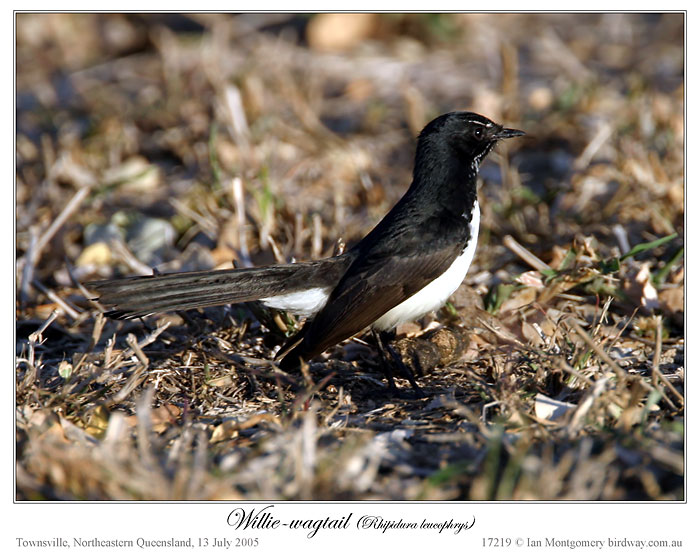
The Willie-wagtail is a popular and widespread species, occurring in a very wide range of habitats throughout Australia. It is absent from southern Tasmania and, for reasons not understood, curiously uncommon in the Townsville district, where the second photo was taken. It gets its name from its habit of fanning its tail and swinging it from side to side, (and spreading its wings) apparently to disturb the insects on which it feeds.

Back at the website, I’m continuing the task of updating all the family thumbnail pages. I’ve finished the first 100 families with only about 40 of the Passerine (perching bird) families to complete. Along the way, I’ve also added some new photos including ones of the following species:

Tawny Frogmouth
Burrowing Owl
Dollarbird
Red-backed Kingfisher
Yellow-billed Kingfisher

Best wishes,
Ian

Ian Montgomery, Birdway Pty Ltd,
454 Forestry Road, Bluewater, Qld 4818
Phone: +61-7 4751 3115
Preferred Email: ian@birdway.com.au
Website: http://birdway.com.au


Lee’s Addition:

I see Ian has a nice sense of humor. Love his description of the Wallaby. Neat little bird, thanks, Ian, for another great Bird of the Week.

Ian mentioned the birds as being “bold, perky; watches.” That brought to mind a few verses:

In the day when I cried out, You answered me, And made me bold with strength in my soul. (Psalms 138:3 NKJV)
The wicked flee when no one pursues, But the righteous are bold as a lion. (Proverbs 28:1 NKJV)
The eyes of the LORD are in every place, Keeping watch on the evil and the good. (Proverbs 15:3 NKJV)
Watch, stand fast in the faith, be brave, be strong. (1 Corinthians 16:13 NKJV)

The Wagtail is in the Rhipiduridae Family which includes all the Fantails, one Wagtail and one Silktail. The Order is the Passeriformes.

Below is a video of a Willie Wagtail on a rock, calling and waging tail, by Nick Talbot.