Ian’s Irregular Bird – Nordmann’s Greenshank

Because it’s so long since the last irregular bird, here is a special one of a very rare wader that has become something of a celebrity, perhaps the most photographed individual bird in Australian history. So you may already have superb photos of it, and I apologize in advance if you find this boring. Nordmann’s Greenshank is, sadly, one of the rarest waders in the world with a population of probably less than 2,000 individuals and a red book status of endangered as its population is declining.

Nordmann’s Greenshank (Tringa guttifer) by Ian

Its breeding range is along the coast of the Sea of Okhotsk in Siberia and is subject to disturbance from oil and gas extraction. It normally winters in southeast Asia and, very occasionally, birds end up in Australia. There are three records from wader counts along 80 Mile Beach near Broome in NW Western Australia, and this one. It first appeared in Cairns in the (northern) winter of 2021 and stayed around long enough for anyone able to navigate covid restrictions and see it. I couldn’t drive to Cairns then and resigned myself to the prospect of missing out on it. To everyone’s surprise, it reappeared this year and the scramble to see it started again.
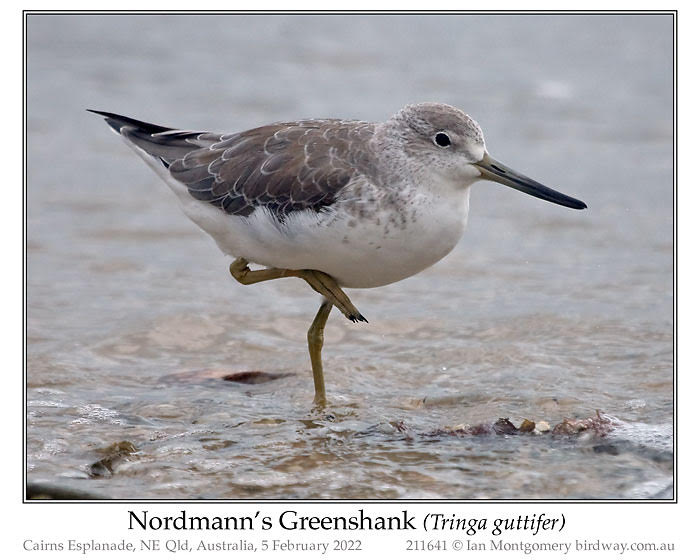
Nordmann’s Greenshank (Tringa guttifer) by Ian

I drove the 340km/210 miles to Cairns at the end of January to catch up with some good friends of long standing from Victoria. They were on the hunt for it, in airline transit from a boat trip to Torres Strait islands to Iron Range National Park on Cape York. We spent four days checking every wader along the Cairns Esplanade at suitable and sometimes unsuitable tides without success. It definitely wasn’t there, but reappeared when they had gone to Cape York and I had returned to Townsville. I rejoined them in Cairns for two days, when it did its disappearing act again, only to reappear for them after I’d returned to Townsville for a meeting that, in hindsight, I deeply regretted attending. so I dropped everything again and returned to Cairns, determined to see and photograph it.
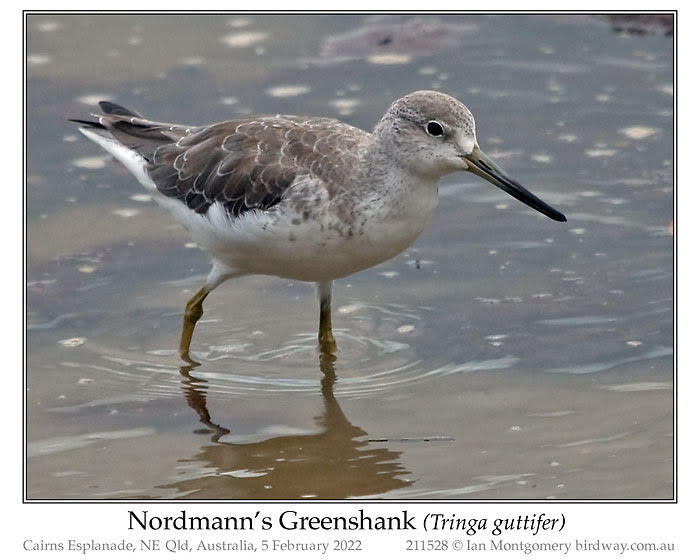
On the second morning of my third visit, the bird relented and I spent an exciting two hours as the incoming tide slowly coaxed it closer and closer. Ultimately, I ended up sitting a mere 6m/20ft from it on the sandy edge of the mudflat, second photo, having taken more than 400 photos. I’ll talk about obsession later. Then I rang Trish, the friend with whom I went to Brazil pre-Covid, who was flying from Brisbane to Townsville that afternoon and suggested she fly to Cairns instead. Which she did, changing her flight at the airport, and we got lovely views of it the following day. We also visited the wonderful Bill Cooper exhibition of tropical bird and fruit paintings at the Cairns Gallery.
Nordmann’s Greenshank (Tringa guttifer) by Ian

Trish suggested bringing our painter/birder friend Marjory and a botanist friend Chrissa to Cairns to see the bird and the exhibition before the latter finished on the 13 February. So we came up again at the weekend, this time in her larger, more comfortable car and saw both the exhibition and the bird yet again. What fun.
Nordmann’s Greenshank (Tringa guttifer) by Ian

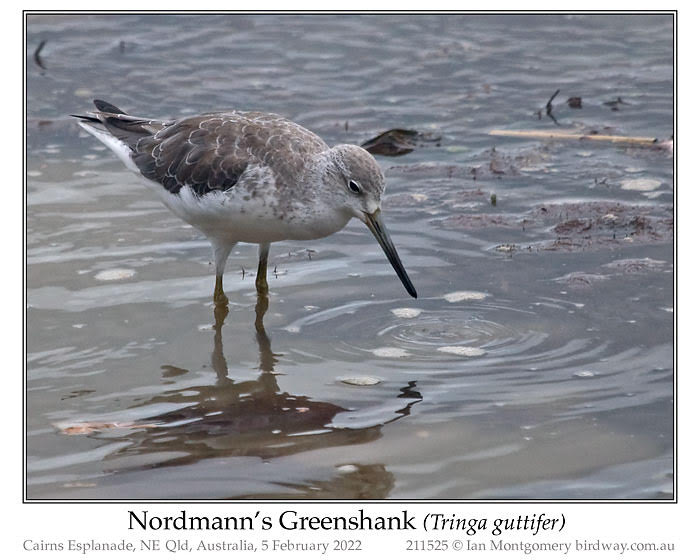
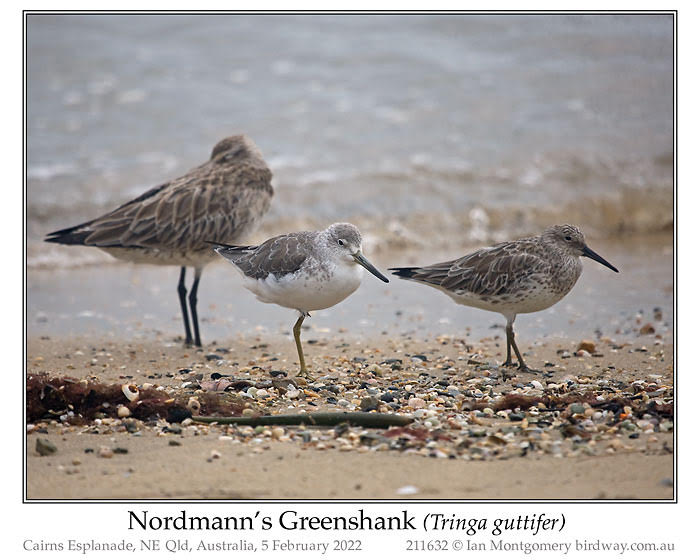
Time to mention the bird itself. It looks quite similar to the Common Greenshank and, slightly less so, to the Terek Sandpiper, both of which were present along the Esplanade. The first photo shows some of the diagnostic features: shorter, yellowish rather than greenish legs, the more robust bi-coloured bill (paler at the base) and shorter legs and bigger head (‘bull-headed’) which give it a rather stocky appearance. It’s behaviour when feeding is different too, and when one becomes accustomed to it, this is a good distinction at a distance, with poor light or muddy legs and bill. In the third and fourth photos it is feeding actively in shallow water, attempting to catch prey with a stabbing motion. It also uses its slightly upcurved bill to sieve the water surface by sweeping it back and forth, in a similar way to other waders with such bills such as the Terek Sandpiper and the Avocets. The fifth photo shows its size relative to a Bar-tailed Godwit, left, and a Great Knot, right.

Nordmann’s Greenshank (Tringa guttifer) by Ian

The second photo shows it standing on one leg, a pose it adopted often using one or the other leg, when resting or roosting (second and fifth photos) and when forced by the tide to move, it often hopped quite long distances to do so, sixth photo. In flight, last photo, the shorter legs protrude less beyond the tail than those of the Common Greenshank, it has less barring on the tail, whiter underwing coverts contrasting with dark flight feathers and it look stockier. Not much is known about its breeding habits, though it’s the only shorebird known to often build its own nest in trees. unlike its tree nesting relatives the Green and Solitary Sandpipers which use old nests of thrushes.

Nordmann’s Greenshank (Tringa guttifer) by Ian

This whole saga has revived my interest in bird photography, which rather flagged during Covid, when I took up other interests less dependent on mobility. It was also a time for personal honesty and admitting my twitching tendencies to myself rather than hiding behind the more dignified facade of a wildlife photographer. Next time, I’ll talk a bit more about the joy of twitching and explain why getting photos of this particular species was so important for me. I’m still pondering the difference between a passion and an obsession.
Greetings
Ian

Ian Montgomery,

454 Forestry Road, Bluewater, Qld 4818
Phone: 0411 602 737 +61-411 602 737
Preferred Email: ian@birdway.com.au

Recorder Society http://www.nqrs.org.au

Lee’s Addition:

Thanks, Ian. Like many of us, the Covid has slowed our birdwatching adventures. Glad you were able to finally catch up with neat Greenshank.
This Nordmann’s Greenshank is in the Scolopacidae Family of the Charadriformes Order.
More of Ian’s Articles:

Wordless Birds

Black-headed Gulls and Great Black-backed Gulls: Birdwatching in the Scottish Hebrides, Part 4

Black-headed Gulls and Great Black-backed Gulls: Birdwatching in the Scottish Hebrides, Part 4

Dr. James J. S. Johnson

For the earth shall be filled with the knowledge of the glory of the LORD, as the waters cover the sea. 

(Habakkuk 2:14)
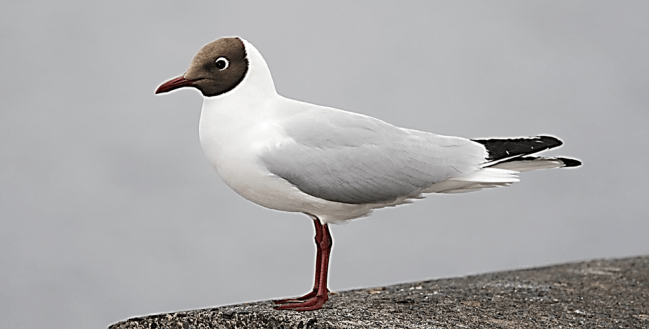
Black-headed Gull (BirdGuides.com photo credit)
Great Black-backed Gull (National Audubon Society photo credit)

The islands of Scotland’s Outer Hebrides are a familiar territory for various seagulls, including two in particular: (1) the largest seagull, the low-sounding “laughing” Great Black-backed Gull (Larus marinus); and (2) a much smaller yet loud-“laughing” Black-headed Gull (Larus ridibundus, a/k/a Chroicocephalus ridibundus).

Great Black-backed Gulls are large (more than 2’ long, with wingspan about 5’ wide; often males weigh up to 4 or 5 pounds, while females weigh slightly less), deserving their nickname “King of Gulls”. Thanks to God-given toughness these gulls can survive and thrive in coastlands of the North, breeding in parts of Russia, Scandinavia, along Baltic coasts, the British Isles, Iceland, Greenland, the Faroe Islands, plus the Atlantic seacoasts of Canada and America’s New England shorelines.  In winter many of these gulls migrate south.

In Nornian, the ancient Old Norse-derived language of the Shetland Islands, the Great Black-backed Gull was once called swaabie, from swartbak, meaning “black back”whereas in AD1758 Karl (“Linnaeus”) von Linné taxonomically designated theseseagulls as Larus marinus, denoting a marine seagull/seabird (from Greekλάῥος). In a previous study (titled “Birdwatching at Staffa, near Iona: Puffins, Shags, and Herring Gulls”), the Great Black-backed Gull was noted as a prominent predator of Atlantic puffins, yet this gull avoids puffins who nest near humans. 

BLACK-HEADED GULL perching (Nat’l Audubon Society photo credit)

However, it is not just the Atlantic puffins that must beware the apex-predatory pursuits of Black-backed Gulls, because these gulls also prey on terns and many other birds, as well as almost any other organic food smaller than themselves, living or nonliving, if they can swallow it.  Accordingly, these scavenging gulls are attracted to garbage dumps filled with human wastes, as well as to egg-filled nests of smaller birds, plus available rodents (e.g., rats) and lagomorphs (e.g., rabbits).  Likewise, these bullies practice “klepto-parasitism”, i.e., aerial bullying-based robberies of food from other birds—when accosted by Great Black-backed Gull, the smaller birds drop their food—as the Great Black-backed Gull chases the dropping food, to capture it in the air, the robbery victim flies away to safety. 

During the winter months these gulls spend less time over land, because the sea itself then offers better opportunities for food—especially lots of fish!  Any fish who are close to the ocean’s surface are at risk when these gulls scout for catchable food. In fact, quantitative studies of their stomachs show that marine fish (such as herring) are the primary diet of Great Black-backed Gulls, although they also eat other birds (like herring gulls, murres, puffins, terns, Manx shearwaters, grebes, ducks, and migrant songbirds), plus small mollusks (like young squid), crustaceans (like crabs), marine worms, coastline insects and rodents, as well as inland berries, and lots of garbage and carrion (found in places as diverse as saltmarshes, landfills, parking lots, airport runways, piers, fishing docks, surface ocean-waters, etc.). 

[See William Threlfall, “The Food of Three Species of Gull in Newfoundland”, Canadian Field-Naturalist, 82:176-180 (1968). See also, accord, Kirk Zufelt, “Seven Species of Gulls Simultaneously at the Landfill”, Larusology (http://Larusology.blogspot.com/2009/11/7-species-of-gulls-simultaneously-at.html ), posted Nov. 15, 2009.]

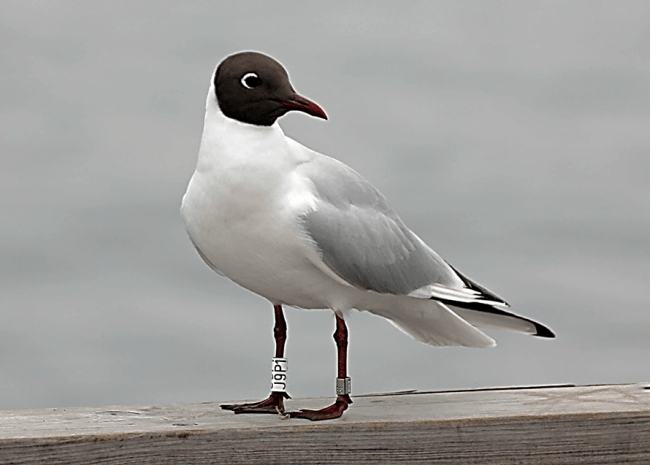
BLACK-HEADED GULL with “ankle bracelet” (Oslo Birder photo credit)

Like the above-described Great Black-backed Gull, the gregarious (i.e., colony-dwelling) Black-headed Gull is notorious for its omnivorous scavenging and often-predatory habits, opportunistically frequenting oceans, intertidal beaches and estuarial coastlands, marshlands and other inland wetlands, lakes, rivers, and even agricultural fields. These gulls, as breeding adults, sport dark-chocolate (almost black) heads.

Black-headed Gulls can soar high in the air, swim in the ocean, and walk along a sandy beach—they are equally comfortable moving to wherever they want to go to.  These noisy seagulls sometimes appear to “laugh” when they call.  Like other seagulls, they enjoy eating fish—sometimes they dip their heads under the tidewater surface, while swimming.  When scouting along a coastal beach, these gulls probe for coastline critters (which they probe for and snatch).  Also, they are fast enough to capture flying insects, which they catch “on the wing”. 

BLACK-HEADED GULL
(Shells of Florida’s Gulf Coast photo credit)

Gulls come in many varieties, plus some of these varieties are known to hybridize. For example, Great Black-backed Gulls (Larus marinus) hybridize with Herring Gulls (Larus argentatus). Black-headed Gulls (Larus ridibundus) often hybridize with Mediterranean Gulls (Larus melanocephalus), and also with Laughing Gull (Larus atricilla) and Common Gull (Larus canus).  Other hybrids exist, too, and many of these gull hybrids have been verified by genetics (i.e., DNA parentage verification).

><> JJSJ   profjjsj@aol.com

[ As a boy this author watched seagulls, both inland and at seacoasts, with wonder. God made them all! A half-century later, I still watch seagulls (and many other birds) with wonder.  “He (God) does great things beyond searching out … and wonders without number.”  (Job 9:10) — God shows how wonderful He is! ]

Black-headed gull - Norfolk Wildlife Trust
BLACK-HEADED GULLS with breeding plumage (Kevin Woolner/Norfolk Wildlife Trust photo credit)

Birds of the Bible – Out of the Ground

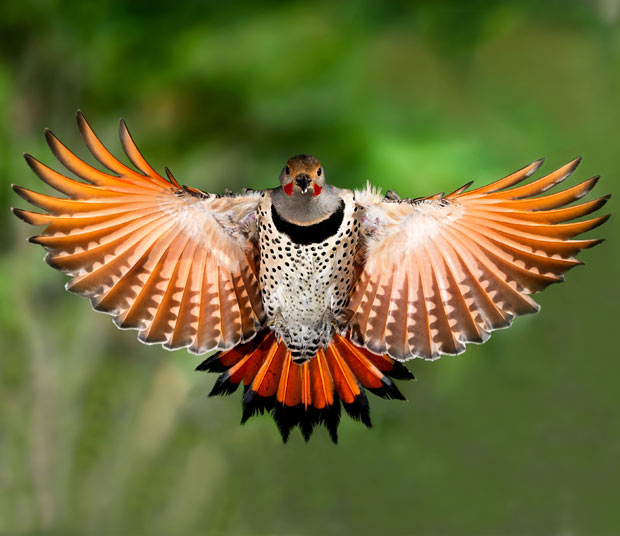
NORTHERN FLICKER (red-shafted form)
photo credit: Evergreen State College

“Out of the ground the LORD God formed every beast of the field and every bird of the air, and brought them to Adam to see what he would call them. And whatever Adam called each living creature, that was its name.” (Genesis 2:19 NKJV)

During our devotions this morning, Dan and I were reading John chapter 9. It tells about the Lord healing the blind man. Also, how the religious rulers doubted his story, and wanted to know if he had really been blind. They called the parents in, and questioned them. The temple rulers were especially upset because Jesus had healed the man on the Sabbath. Many of you know this story.

“Now as Jesus passed by, He saw a man who was blind from birth. And His disciples asked Him, saying, “Rabbi, who sinned, this man or his parents, that he was born blind?” Jesus answered, “Neither this man nor his parents sinned, but that the works of God should be revealed in him. I must work the works of Him who sent Me while it is day; the night is coming when no one can work. As long as I am in the world, I am the light of the world.” When He had said these things, He spat on the ground and made clay with the saliva; and He anointed the eyes of the blind man with the clay. And He said to him, “Go, wash in the pool of Siloam” (which is translated, Sent). So he went and washed, and came back seeing.”
(John 9:1-7 NKJV) [Bolding mine]

Here is a comment from my Chronological Life Application Study Bible (KJV, p 1350)

John 9:6 When Jesus spit on the ground and made mud in order to repair the man’s eyes, he was working with original materials. Gen2:7 states that God formed Adams body from the dust of the Ground. Jesus was demonstrating a creator’s awareness of the materials he first used to shape the human body”

I had never made that connected in that story before, but it is another view of the fact that our Creator WAS here on earth in the person of the Lord Jesus Christ. Praise the Lord for all His creation, and especially the birds, which we enjoy so much. Along with all the other parts of His Creation.

Birds of the Bible

Good News