
Common Raven at Cypress Provincial Park, British Columbia ©WikiC
In the First Bird Species Named post, you found out that it was the Raven that was sent out first from the Ark. He never came back in, but may have landed on it now and then. The Raven family has a very resourceful way of finding and collecting food and objects.
Today there are several species in the Raven family (Covidae). Of course, not all of those species were on the Ark. They spread out and reproduced after their kind. “every raven after its kind,” (Lev 11:15)
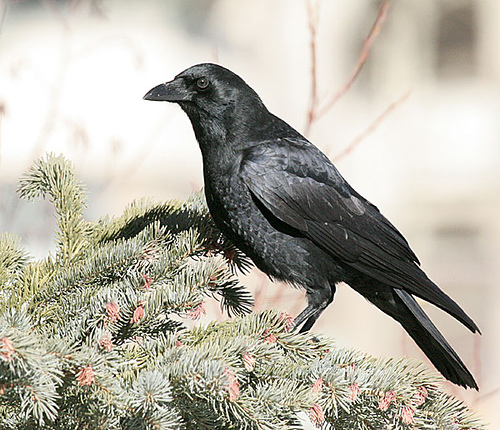
Northern Raven (Corvus corax) by Kent Nickell
Compare the Common Raven and the Chihuahuan Raven
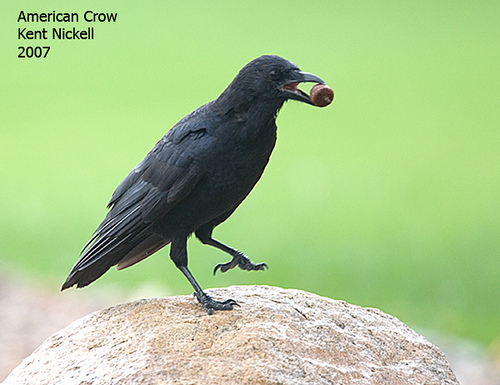
American Crow (Corvus brachyrhynchos) by Kent Nickell
and compare the Common Raven and the American Crow.
All of these birds belong to the Covid family and Dr. Johnson posted a great article that covers this family.
As was pointed out in that article, how the ravens came and fed Elijah. They brought him bread and flesh. (I Kings 17:6) But where do the Ravens get their food? (Job 38:41)
Much has been written about these interesting birds here over the years. Here are some of the links to help you find out more about the Ravens and their kind:
Other articles about the Raven:
- Birds of the Bible – Ravens, Raven I, Raven II
- What is a Raven – 10,000 Birds
- Corvidae – Crows, Jays, Ravens Family
- Common Raven – All About Birds
- Raven – Wikipedia
- Corvidae – Wikipedia
- 10 Amazing Facts about Ravens – Softpedia
Also check out articles by our various writers:
For younger readers:
- Bible Birds
- Scripture Alphabet of Animals: The Raven
- The Raven and the Old Woman’s Garden – by Emma Foster
**
 Lee's Birdwatching Adventures Plus
[REPLY TO DENZIL] Actually, the John 5:44-47 passage is directly relevant because: (1) Christ said that a major problem with folks trusting God’s Word (including what Moses said in Genesis about origins) is their preference for human approval (i.e., peer pressure) rather than prioritizing God’s approval, since it’s rare for someone to please both God and man simultaneously; and (b) the books of Moses will be used to judge us, not the other way around — and notice that the 5 books of Moses (mentioned by Christ in John 5:45-47) include GENESIS, which is the heart of the “controversy” about our origins and also about what is truly “scientific” when it comes to analyzing biodiversity and its origins. See also, re the scientific relevance of GENESIS, whenever origins (including biodiversity origins) are involved, http://www.icr.org/article/norway-redchat-defies-evolutionary-speciation , as well as http://www.icr.org/article/genesis-critics-flunk-forensic-science . (Hope this adds some clarity to the topic.) FYI, I’ve taught many science courses in colleges for years, including ecology, ornithology, limnology, biology, etc., and I routinely use the term “kind” (to denote interbreedable animals who share the same ancestry, as Genesis 1 & 9 report) when teaching biodiversity principles. Re the wonders of biodiversity, see also http://www.icr.org/article/god-fitted-habitats-for-biodiversity .
LikeLike
So true, I have been doing a lot of reading on bird intelligence lately Lee and some of the latest research findings are astounding with Corvids and Magpies. The Lord has made all his creatures with wisdom after their own kind, and it is humbling to us humans when we learn how intelligent and resilient these birds are.
LikeLiked by 1 person
Denzil, that is a great question, and we have several articles that answer that question. Type “their kind” in the search box up on the right side of this screen. There are quite a few, like:
Plus
LikeLiked by 1 person
Thanks, Lee, for getting to the corvid of the matter — now I’m ravin’ about ravens.
LikeLiked by 1 person
Just out of interest, what do you think is meant by “kind”? It’s not a scientific term like genus or species. Any ideas?
LikeLiked by 1 person
“Kind” is the English word used to translate the Hebrew noun mîn, which appears in the Hebrew Bible many times, starting in Genesis 1:11, and occurring again in Genesis 1:12, 1:21, 1:24, 1:25, 6:20, 7:14, etc. The basic idea for this classification is breedability, as is shown by the “be-fruitful-and-multiply” contexts of Genesis chapters 1 and 9. Since God knows science better than anyone else (see John 5:44-47, which directly applies to the Genesis creation account, which gives the origin of biodiversity), it is a scientific ‘best practice’ to use the category “kind” when referring to both interbreeding plants and animals, as well as humans.
LikeLiked by 1 person
Mm, not sure about all this. Kind isn’t a scientific term though. Not sure you gave me the right reference. John 5 44-47 talks about Moses, not science, I think?
LikeLike
Because the format is so condensed I’ve provided a reply (posted above) which begins with a bracketed phrase [REPLY TO DENZIL], q.v.
LikeLiked by 1 person