Yellow-rumped Warbler (Dendroica coronata) by Anthony747
For the last week, I have been working on updating the Birds of the World section to the new IOC World Bird List 2.4 version, which came out on March 7th. Not knowing that they update about every three to four months, the list was getting way behind. I had started updating to 2.3 when 2.4 came out. So, to get every thing straight, I am changing all pages to the new version without any comments of what specifically changed.
Here is an overview of the changes:
Version 2.4 (March 7, 2010) – The IOC World Bird List 2.4 contains 10,384 species classified in 39 Orders, 222 Families (+7 Incertae Sedis) and 2202 Genera.
Updates include: SPECIES:
ADDED to Master List: 25, including 4 splits of Yellow-rumped Warbler complex (Myrtle Warbler, Audubon’s Warbler, Black-fronted Warbler, Goldman’s Warbler)
DELETED from Master List: 7
English Names: 23 changes
Ranges: 28 changes
Taxonomy: 46 changes including 9 changes of Genera including 5 overdue ones for African greenbuls following Johansson et al (2007), and 1 change of Family (African stone partridges Ptilopachus to Odontophoridae).
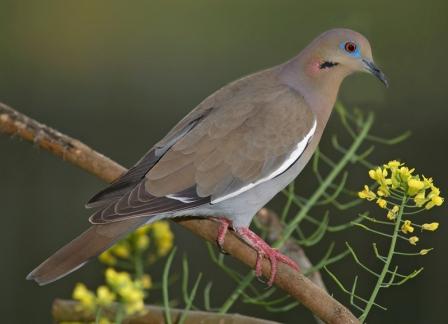
Here are some interesting thoughts about the Eyes and Voice of a Dove. We had an Eurasian Collared Dove land in our yard today. What a lovely bird, with such a soft color. I always enjoy watching them.
The Eyes of A Dove:
How beautiful you are, my darling, How beautiful you are! Your eyes are like doves.” (Song of Solomon 1:15 NASB)
Solomon is describing his love with terms that today we do not hear in that connection. How romantic to have your eyes compared to a dove’s eyes. At first it seems rather weird, but when you know what dove’s eyes actually look like, you realize that they ARE very beautiful.
Then she describes Solomon.
“His eyes are like doves Beside streams of water, Bathed in milk, And reposed in their setting. (Song of Solomon 5:12 NASB)
John Gill’s Exposition of the Whole Bible says of this verse, referring to the meekness of Christ:
“his eyes are like “doves’ eyes”; not fierce and furious, but loving and lovely; looking upon his people, under all their trials and afflictions, with sympathy and concern, to deliver them out of them: and like the eyes of doves. ”
The Voice of A Dove:
Then in chapter 2, Solomon goes on to use the dove again to describe her voice.
“Come, my shy and modest dove– leave your seclusion, come out in the open. Let me see your face, let me hear your voice. For your voice is soothing and your face is ravishing.” (Song of Solomon 2:14 MSG)
“It is fixed: She is stripped, she is carried away, And her handmaids are moaning like the sound of doves, Beating on their breasts.” (Nahum 2:7 NASB)
Audio by Andrew Spencer of Mourning Dove’s song.
John Gill’s Exposition of the Whole Bible says, “as with the voice of doves, tabering upon their breasts; mourning like doves, inwardly and secretly, not daring to express their sorrow more publicly, because of their enemies; but knocking and beating upon their breasts, as men do upon tabrets or drums, thereby expressing the inward grief of their minds; see Eze_7:16.”
Audio of Mourning Dove beating its wings by Andrew Spencer
Praise the LORD; for the LORD is good: sing praises unto his name; for it is pleasant. (Psalms 135:3 KJV)
Words: John H. Gurney, Psalms and Hymns for Public Worship (London: 1851), based on Elizabeth L. C. Follen’s lyrics in Hymns for Children (Boston, Massachusetts: 1825).
Music: Truro, from Psalmodia Evangelica, by Thomas Williams, 1789 (MIDI, score). Alternate tune:
•Williams, from Templi Carmina, before 1890 (MIDI, score)
Yes, God is good; in earth and sky,
From ocean depths and spreading wood,
Ten thousand voices seem to cry,
“God made us all, and God is good.”
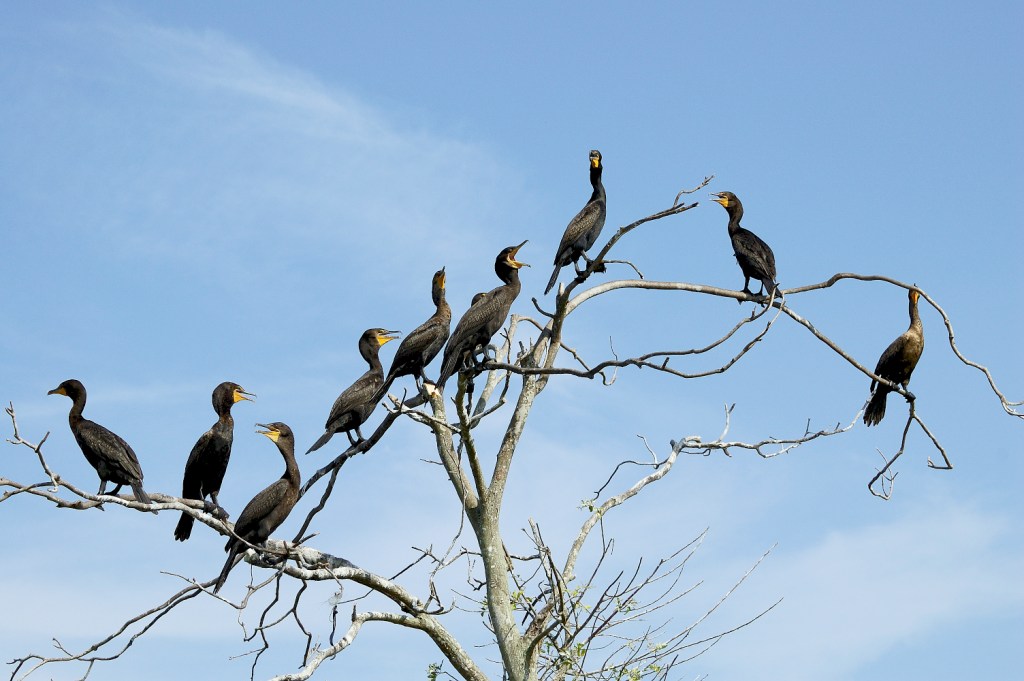
Double-crested Cormorant (Phalacrocorax auritus) at Lake John Rookery, Lakeland, FL By Dan
The sun that keeps his trackless way
And downward pours his golden flood,
Night’s sparkling hosts, all seem to say,
In accents clear, that God is good.
The merry birds prolong the strain,
Their song with every spring renewed;
And balmy air, and falling rain,
Each softly whispers, “God is good.”
I hear it in the rushing breeze;
The hills that have for ages stood,
The echoing sky and roaring seas,
All swell the chorus, God is good.
Yes, God is good, all nature says,
By God’s own hand with speech endued;
And man, in louder notes of praise,
Should sing for joy that God is good.
For all Thy gifts we bless Thee, Lord,
But chiefly for our heavenly food;
Thy pardoning grace, Thy quickening word,
These prompt our song, that God is good.
For God is the King of all the earth: sing ye praises with understanding. (Psalms 47:7 KJV)
Words: Robert Robinson, 1774.
Music: Autumn by François H. Barthélémon, 1785
Alternate tune: Wellesley by Lizzie S. Estabrook, 1878
Mighty God, While Angels Bless Thee
Mighty God, while angels bless Thee,
May a mortal sing Thy Name?
Lord of men as well as angels,
Thou art every creature’s theme.
Lord of every land and nation,
Ancient of eternal days.
Sounded through the wide creation
Be Thy just and endless praise.
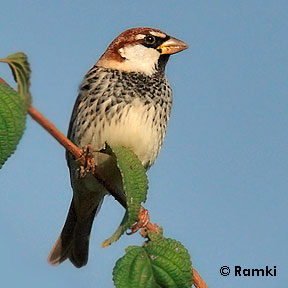
Spanish Sparrow (Passer hispaniolensis) by Nikhil Devasar
For the grandeur of Thy nature,
Grand beyond a seraph’s thought;
For the wonders of creation,
Works with skill and kindness wrought.
For Thy providence, that governs,
Through Thine empire’s wide domain,
Wings an angel, guides a sparrow,
Blessèd be Thy gentle reign.
For Thy rich, Thy free redemption,
Bright, though veiled in darkness long,
Thought is poor, and poor expression;
Who can sing that wondrous song?
Brightness of the Father’s glory,
Shall Thy praise unuttered lie?
Break, my tongue, such guilty silence!
Sing the Lord Who came to die.
From the highest throne of glory
To the cross of deepest woe,
All to ransom guilty captives;
Flow my praise, forever flow!
Reascend, immortal Savior;
Leave Thy footstool, take Thy throne;
Thence return, and reign forever,
Be the kingdom all Thine own!
“Robinson’s widowed mother sent him at age 14 to London, to learn the trade of barber and hair dresser. However, his master found he enjoyed reading more than work. Converted to Christ at age 17, Robinson became a Methodist minister. He later moved to the Baptist church and pastored in Cambridge, England. He wrote a number of hymns, as well as on the subject of theology. His later life was evidently not an easy one, judging from a well known story about his hymn Come, Thou Fount of Every Blessing. One day, he encountered a woman who was studying a hymnal, and she asked how he liked the hymn she was humming. In tears, he replied, Madam, I am the poor unhappy man who wrote that hymn many years ago, and I would give a thousand worlds, if I had them, to enjoy the feelings I had then.” (CyberHymnal)
The LORD hath appeared of old unto me, saying, Yea, I have loved thee with an everlasting love: therefore with lovingkindness have I drawn thee. (Jeremiah 31:3 KJV)
Author: George Wade Robinson, 1838-1877 – Its melody is lively and upbeat. Born in Ireland, Robinson was educated at Dublin’s Trinity College, and later at New College in London. Later he became a pastor in Dudley.
Music: Everlasting Love, James Mountain, 1843-1933 – The melody of “I am His, and He is Mine” was written under the name “Everlasting Love” by James Mountain in 1876. The melody of this hymn was written because the composer was about to publish a first edition of his hymnal, Hymns of Consecration and Faith. He took the words of Robinson’s hymn.
I Am His, and He Is Mine
Loved with everlasting love, Led by grace that love to know;
Spirit, breathing from above, Thou hast taught me it is so!
Oh, this full and perfect peace! Oh, this transport all divine!
In a love which cannot cease, I am His, and He is mine;
In a love which cannot cease, I am His, and He is mine.
Carolina Wren (Thryothorus ludovicianus) by Quy Tran
Heav’n above is softer blue, Earth around is sweeter green!
Something lives in ev’ry hue Christless eyes have never seen: Birds with gladder songs o’erflow, Flow’rs with deeper beauties shine,
Since I know, as now I know, I am His, and He is mine;
Since I know, as now I know, I am His, and He is mine.
Things that once were wild alarms Cannot now disturb my rest;
Closed in everlasting arms, Pillowed on the loving breast.
Oh, to lie forever here, Doubt, and care, and self resign,
While He whispers in my ear, I am His, and He is mine;
While He whispers in my ear, I am His, and He is mine.
His forever, only His; Who the Lord and me shall part?
Ah, with what a rest of bliss Christ can fill the loving heart!
Heav’n and earth may fade and flee, Firstborn light in gloom decline;
But while God and I shall be, I am His, and He is mine;
But while God and I shall be, I am His, and He is mine.
And out of the ground made the LORD God to grow every tree that is pleasant to the sight, and good for food; the tree of life also in the midst of the garden, and the tree of knowledge of good and evil. (Genesis 2:9 KJV)
While searching for articles about birds I came across this article. The quote below is also appropriate for birds. I believe many of them definitely qualify as “pleasant to the sight.”
“The answer that came to my mind was suggested by Genesis 2:9, where we read that God created fruit trees not only good for food but also “pleasant to the sight.” We normally expect to find aspects of beauty as well as utility in the artifacts of human creation; how much more should we expect beauty to abound in the handiwork of God! Even creationists seem to forget that God is not only the Great Engineer, but the Great Artist as well.
Unfortunately, just like the engineering marvels of God have been corrupted by mutations and other effects of the bondage to corruption occasioned by our sin (Romans 8:18-20), so its beauty has been marred. The God whose faithful care daily sustains what He has made will not leave it so. But with the creation that “groaneth in travail,” we also wait for that time when “they shall not hurt nor destroy in all my holy mountain, but the earth shall be full of the knowledge of the Lord as the waters cover the sea” (Isaiah 6:11).” (From, Nature’s Challenge to Evolutionary Theory, by Gary Parker, Ed.D., ICR)
Thought you might enjoy seeing some “Pleasant to the Sight” birds. It was hard to narrow the choices down. These are from the Non-Passerines. Used the Passerines last week.
A. J. has offered some of his articles for publishing here. He is a music teacher and an amateur birder. He and his family like to sing and worship the Lord together. They live in Chennai, India. He is a worship leader and an evangelist. One of his main burdens is to encourage people to worship not just when everything is fine, but to worship and serve the Lord even during the darkest and toughest times. He also has a passion to help youngsters and kids to know the Lord through nature. “Above all, I would like to be introduced as a worshiper of Yeshua.”
A. J. has many short sayings, poems, and articles that are going to be made available to use. He and I are both thanking the Lord for letting us work together on this. We both want to honor the Lord through what we are doing. By telling about the fantastic birds which the Lord has created, and being challenged, we trust our readers will receive not only knowledge, but a blessing.
Below are two examples of his writings:
Spiritual Catastrophe
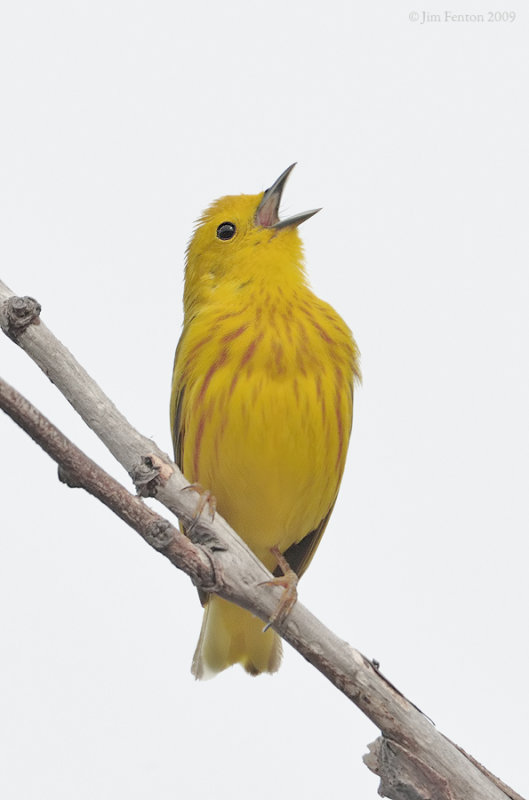
American Yellow Warbler (Dendroica aestiva) by J Fenton
If birds
don’t sing,
they wouldn’t find
a mate
and
if they don’t find a mate,
there would be
no reproduction…
If there is no reproduction,
there would a major
Ecological disaster…
If we don’t worship,
the presence of the LORD
wouldn’t be there,
If the presence of the LORD
is missing,
the church would be empty,
If the churches are empty
there would be a
Spiritual catastrophe…
DO THEY?
If they do not eat well
they would surely die
the night before…
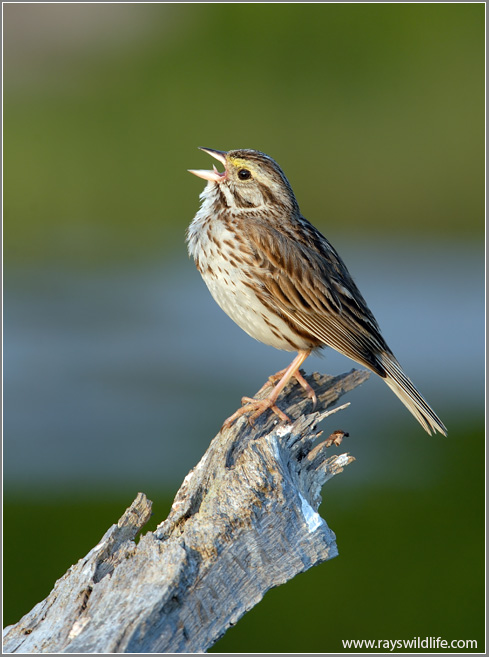
Savannah Sparrow singing by Ray
That’s why,
the birds sing at dawn,
to advertise to the world
that,
they are still alive
and that,
they are ready to face
another tough day ahead
in life…
Each new morning,
most of us grumble at the thought of
facing another hectic day..
If only we sing unto the LORD
at all times,
life would be far more beautiful
than what it is now..
After all, the joy of the LORD
Is our strength isn’t it?
Well,
Did you sing for the LORD
this morning?
Why I ask you this
is cos,
those who are dead never sing..
Do they?
For You, O LORD, have made me glad by what You have done, I will sing for joy at the works of Your hands. (Psalms 92:4 NASB)
For over 200 years paleontologists and geologists have been digging in the hills, valleys, and plains of the earth. During this time they have uncovered and cataloged over a billion fossils. Thousands of fascinating plant and animal fossils from extinct organisms have been found. Fossils, like living organisms, are found fully formed and distinctly different in structure. Evolutionists claim to have found animal bones having features intermediate between similar creatures, proving that evolution has occurred (e.g., small horses to big horses). Yet there are no examples in the fossil record of one animal slowly changing into a different kind of animal. Diagrams have been made which show variations within the same type of animal in an effort to organize them into a supposed evolutionary order. Textbooks promote this type of evidence because no transitional evidence showing one animal slowly changing into another has been found.
It is astounding that over a billion fossils have been found, yet there is no undisputed transitional form between very different types of animals or even animal features (such as reptile’s scale turning into a bird’s feather). How can we say that evolution-the idea that man is the result of slow changes over time from earlier creatures-is a reasonable theory in light of evidence?
All flesh is not the same flesh; but there is one kind of flesh of men, another flesh of beasts, another of fishes, and another of birds. (I Corinthians 15:39 KJV)
Letting God Create Your Day, Vol 3, p 213
A Closer Look At The Evidence, by Richard and Tina Kleiss, January 20
American Yellow Warbler (Dendroica aestiva) by J Fenton
This GOLD bird reminds us of Heaven. The Bible tells us Heaven has a street of gold! But the best part about Heaven is that God, who created you and me, lives there. The Bible, God’s Word, says: “God so loved the world that He gave His only begotten Son, that whosoever believeth in Him should not perish but have everlasting life.” — John 3:16 Jesus, God the Son, is in Heaven preparing a place for all who put their trust in Him. (John 14:2-3) God is holy and perfect. He cannot allow anything in Heaven that is less than perfect, so there’s one thing that can never be in Heaven. Can you think of what that might be?
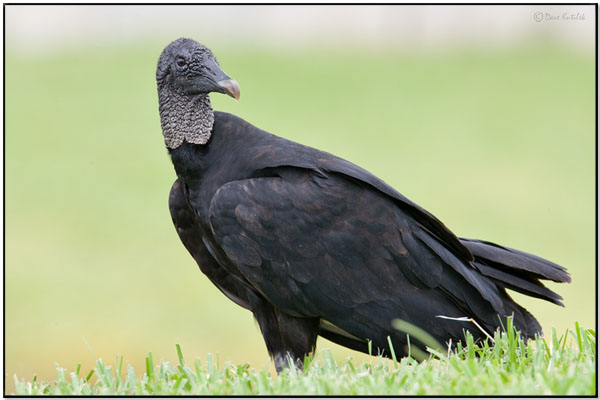
Black Vulture (Coragyps atratus) by Daves BirdingPix
It is sin! That is what this DARK bird reminds us of. Sin is anything you think, say, or do that does not please God, like lying, cheating, being selfish, or hurting others. The Bible says: “All have sinned and come short of the glory of God.” — Romans 3:23 That means everyone, big or little, young or old! No matter where you live or who you are, you have sinned. Everyone is born with a “want to” to do wrong. God says that sin must be punished (Romans 6:23), and the punishment for sin is to be separated from God forever in a place of suffering….a place called Hell. But God has a wonderful plan so that you will not have to be punished for your sin!
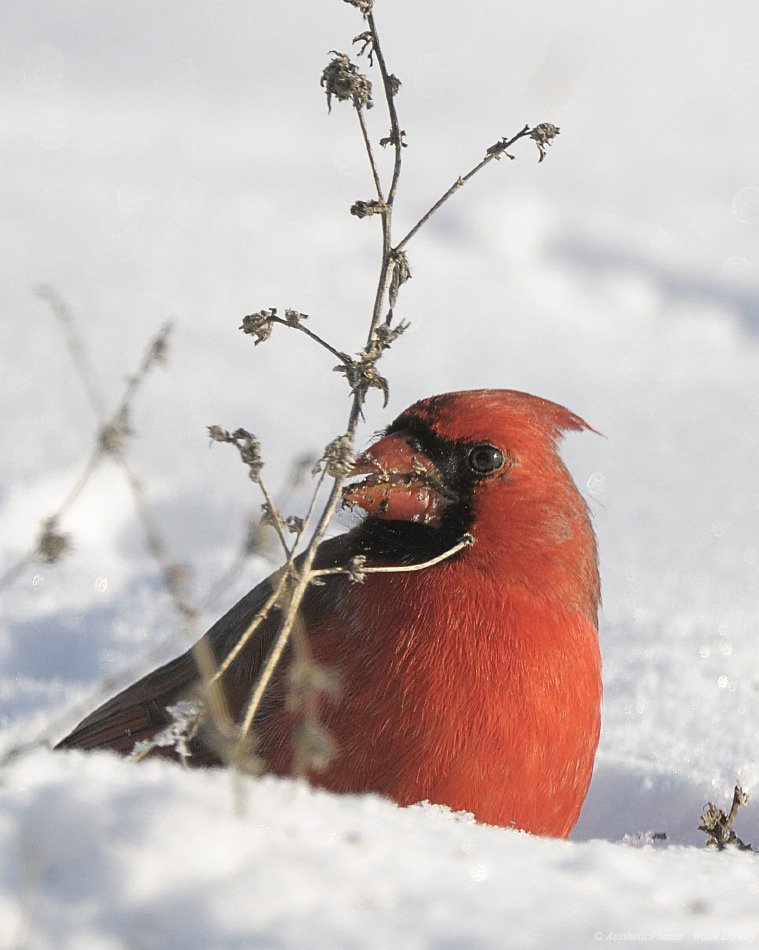
Cardinal by Aestheticphotos
God sent Jesus Christ, His perfect Son, to be born as a little baby. Jesus lived a perfect life….He never sinned. When He was grown, wicked men nailed Him to a cross. This bird is RED reminding us of Jesus’ blood. The Bible says that without the giving of blood there can be no forgiveness of sin (Hebrews 9:22). So Jesus Christ willingly died to take your sin punishment. “…Christ died for our sins according to the Scriptures; and that He was buried, and that He rose again the third day, according to the Scriptures.“— 1 Corinthians 15:3-4 Now, because of what Jesus has done for you, you can have your sins forgiven. Read on to see how!
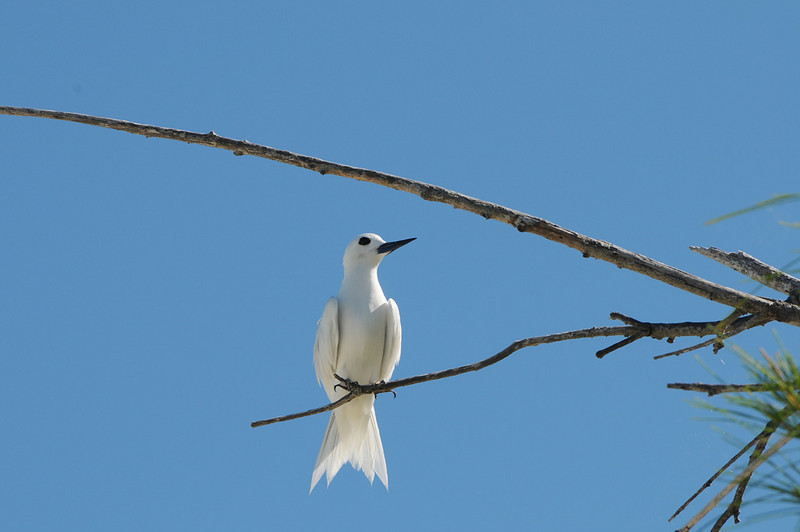
Fairy Tern (Sternula nereis) by Bob & Nan
The Bible says: “As many as received Him, to them gave He power to become the sons of God, even to them that believed on His name.” — John 1:12 The WHITE bird reminds us of a CLEAN heart. How can you have a clean heart? A = Admit to God you are a sinner and want to turn away from those sins. B = Believe in Jesus Christ, that He is God’s perfect Son who died for your sin, was buried, and rose again. C = Call on Him to save you from your sin. Would you like to do that right now? He has promised to hear, and once you are His child, He will never leave you (Hebrews 13:5). Take a moment and talk to God right now. It will change your life forever. Only one more color! What can it mean?
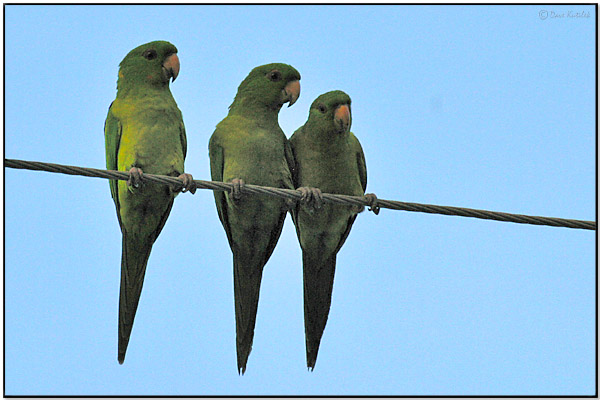
Green Parakeet (Aratinga holochlora) by Daves BirdingPix
The GREEN bird stands for things that grow. When you ask God to forgive you and save you, you become His child. God wants you to get to know Him better and to grow to become more like Him. These four things will help you grow:
1. PRAY (talk to God every day)
2. READ & OBEY THE BIBLE (to know what He says, then do it)
3. TELL OTHERS ABOUT JESUS
4. GO TO A BIBLE-BELIEVING CHURCH (where you can learn more about pleasing Him)
As a child of God, if you should sin again, stop and tell Him about it. He promises in His Word… “If we confess our sins, He is faithful and just to forgive us our sins and to cleanse us from all unrighteousness.” — 1 John 1:9 Ask God to help you live a life to please Him! Share the Good News of this story with someone else.
The Wordless Book has been used for many years by CEF (Child Evangelism Fellowship). These words are from CEF.
Once you receive Jesus as your Savior, then you have joy and peace in your heart.
Whom having not seen, ye love; in whom, though now ye see him not, yet believing, ye rejoice with joy unspeakable and full of glory: Receiving the end of your faith, even the salvation of your souls. (1 Peter 1:8-9 KJV)
This bird’s singing reminds us of the joy a Christian has in their heart after salvation and it spills out in a song and hopeful in telling others of what Christ did in their hearts.
Buried in an eroded hillside at Yellowstone National Park are petrified tree trunks protruding through multiple layers of earth. For many years a geological marker at this site (Specimen Ridge) stated that the trees were buried and petrified in place. The parallel layers were interpreted as successive forests buried by volcanic activity. It was claimed that after each volcanic eruption, the volcanic-ash layer slowly weathered into suitable topsoil and hundreds of years passed as subsequent forests grew to maturity. This pattern supposedly happened 27 times spanning 30,000 years. This interpretation seemed to present a problem to biblical accuracy, which indicates there has been less than 10,000 years of Earth history.
Polystrate lycopod in Tennessee showing VISS and crossbedding, both caused by flows from right to left in photo
However, this interpretation ignores several important observations. The roots of the tree stumps are broken off with only the root balls left. The stump size, tree ring pattern, and number of tree rings throughout all 27 layers are remarkably similar. What the evidence really supports is the rapid burial of a single massive forest by a flood of worldwide proportions. Trees are buried at different levels because they sank into the sediment at different times. Apparently the majority opinion has moved toward this better interpretation because the “multiple-forest” interpretive sign has been removed. Unfortunately, the reality of a worldwide Flood is still not mentioned. It is because the Bible can be trusted when it speaks on physical matters (such as reality of a worldwide Flood) that we can trust what the Bible has to say about spiritual matters (such as morality and eternity).
It is the glory of God to conceal a matter; to search out a matter is the glory of kings. Proverbs 25:2
A Closer Look At The Evidence, by Richard and Tina Kleiss, January 17







 Lee's Birdwatching Adventures Plus