Birds of the Bible – Dove and Turtle-Dove

The Dove is probably recognized by most people, even though they may not know which specific kind they are viewing. White doves are released at weddings and other special occasions. The symbol for the dove is displayed many times. The coo of the mourning dove is heard and most recognize a Rock Pigeon (formerly a Rock Dove). We do not have Turtle-Doves here in America; they are in the Orient, Asia, Africa and Europe.
The dove family (Columbidae) ranges from about 6.5” to 12” and seem to be gentle. Doves tend to be monogamous and both male and female produce a “crop milk” to feed their young the first few days. Most birds regurgitate food for the young from the beginning. Doves do not make the most elabroate nests, often they are on the ground and flimsy. Many were domesticated and were used for sacrifices. They are considered “clean” birds in the Bible. There are at least twenty references to doves in the Word of God.

  • The first mention of the Dove is in Genesis 8:8-13 when Noah released her from the ark. She was released three times, but came back two times because she “found no rest for the sole of her foot.” They do not eat carrion as the raven does. Most are ground feeders and she had nowhere to feed that was dry. The second time she came back with an olive leaf, and then never returned the last time.
  • (Genesis 15:9, Leviticus 5:7 and 12:6-8, Luke 2:22-24) all refer the Dove and Turtle dove being used for sacrifices.
  • David was distressed and wrote “…Oh that I had wings like a dove! for then would I fly away, and be at rest. (Psalms 55:6 KJV)
  • Isaiah 38:14 says, “I did mourn as a dove…” We have a Mourning Dove.
    The Lord used the dove when he told His Apostles, “Behold, I send you forth as sheep in the midst of wolves: be ye therefore wise as serpents, and harmless as doves.” (Matt.10:16)
  • The dove became a symbol of The Holy Spirit at Jesus’ Baptism (Mat 3:16; Luk 3:22; John 1:32).

There is more to be said, but when you find the Dove in your Scripture reading, you will have a mental picture of them. The Hymn writers have used the dove in songs like:
Sunshine in My Soul – Eliza E. Hewitt, 1851-1920
There is springtime in my soul today,
For when the Lord is near,
The dove of peace sings in my heart,
The flow’rs of grace appear. Come, Holy Spirit, Heavenly Dove – Isaac Watts, 1674-1748
Come, Holy Spirit, heav’nly Dove,
With all Thy quick’ning pow’rs;
Kindle a flame of sacred love
In these cold hearts of ours.

Pictures are (In Order-Mourning, Eurasian Collared, Ground, and White-winged Doves) Reinier Munguia at Wildstock Photography)

See our Doves and Pigeon page

Birdwatching Trip – Circle B Bar Ranch Reserve

Eastern Meadowlark

Last Saturday, they opened Circle B Bar Ranch Reserve here in Polk County up for a 1/2 day for birders, etc. to visit. The reserve has been closed for most of the winter for renovations and won’t officially open back up until November this year. So it was a delight to get to visit the wetlands part of it. They have over 1,200 acres and is a tremendous place to bird.
We arrived at 7:30 am on a clear, calm, 75 degree morning. First thing I heard and then saw were Eastern Meadowlarks. Then the normal Redwing Blackbirds, Boat-tailed Grackles, Common Moorhens, and Cattle Egret made theirselves known. When a few Glossy Ibises flew over, I stopped to watch. Don’t see them too often. Anhingas were all around with their wings streached out or diving for food. Lots of cries were heard from upset Black-neck Stilt parents when the visitors were getting too close to their eggs (which were right along the pathway).
As I continued walking along the path by the water, I saw Great Egrets, Little Blue Herons, Double-crested Cormorants, Tricolored Herons, Great Blue Herons, White Ibises, Coots, Opreys, Sandhill Cranes, and heard a Bob White. Then off in a distance with a group of Great Egrets and Snowy Egrets were several Rosetta Spoonbills (a favorite of mine).
Down another path, a man had set up a scope that was aimed at a tree. Looking through it, I saw baby Great Blue Herons and other babies unknown to me. That was the highlight of the trip for me. Retracing my steps making about a 1 1/2 mile trip altogether, I spotted Wood Ducks, a Bald Eagle, Cardinal and some Mourniing Doves.
Before going, I had asked the Lord to help me see lots of his critters and I sure wasn’t disappointed. He helped me spot the 26 different birds in about a two hour span. Watching their behavior, I now have some more articles running around in my brain for some more “Eye of the Beholder” blogs.

For other birdwatching trips to the Circle B Bar Reserve

*

Birds of the Bible – Sparrow II

White Crown and American Tree Sparrows
In Psalm 84:3 the sparrows are mentioned again, this time they are found making a home (nest) in the Tabernacle area. As mentioned in the first Sparrow article, they are known to make nest in many kinds of places. Let’s look at this verse in its context to understand a great blessing found here.

Psalms 84:1-4 KJV
(1) How amiable are thy tabernacles, O LORD of hosts!
(2) My soul longeth, yea even fainteth for the courts of the LORD: my heart and my flesh crieth out for the living God.
(3) Yea, the sparrow hath found a house, and the swallow a nest for herself, where she may lay her young, even thine altars, O LORD of hosts, my King, and my God.
(4) Blessed are they that dwell in thy house: they will be still praising thee. Selah.

Vesper Sparrow

The commentaries have different views, but many agree that the sparrow has made her nest in the Tabernacle and is close to the altars. David’s soul is longing to be in the courts of the Lord and near the Lord. The sparrow is there, has moved in and is even raising her family there. I think he is envious of the birds because they get to spend so much time there and also they sing so often, praising God.
Do we yearn and long to spend time with the Lord, our Savior? Do we seek to be as close as we can get? Do we enjoy reading His Word, praying to Him, and attending church where we can learn, sing and praise, and have fellowship with other believers? I trust you can say a mighty, Amen!

Field Sparrow Singing

Birds of the Bible – Cuckoo

Again we have a bird that is in a list of “unclean” birds. This time we will look at the Cuckoo. No. This is not the bird that pops out of your clock on the hour and sings. Let’s find out about the real Cuckoos.

And the owl, and the night hawk, and the cuckoo, and the hawk after his kind, (Deuteronomy 14:15 KJV)
And the owl, and the night hawk, and the cuckoo, and the hawk after his kind, (Leviticus 11:16 KJV)

Here in the U. S. we have a Black-billed, Common, Mangrove, Yellow-billed and Oriental, Cuckoos. The Common and Oriental Cuckoos have only been seen in Alaska. The Mangrove is seen along the mangroves of southern Florida and the other two like dense thickets, woodlands, orchards and along streams. Worldwide there are close to 100 species of Cuckoos. Our Roadrunner is the same family – cuculidae.

The cuckoos have a slender body with a downcurved bill and a long tail. Most of them have spots on the underside of their tails and the sexes are similiar. Many species of cuckoos have a habit of laying their eggs in another’s kind of bird’s nest and letting those parent raise the bird. The chick seems to hatch first and then either knock the other eggs out of the nest or harm the new chicks. Other cuckoos raise their own babies.

You-Tube of Cuckoo Sound with pictures and one showing warbler feeding baby. (from Poland)
(Updated 2/3/2009 – Video of Cuckoo laying egg in other nest and of a Cuckoo Duck
*

*

*

Back to Birds of the Bible – Cuckoos

*

Birdwatching Trip – Lake Hollingsworth 5/1/08

Mama Redwing Blackbird feeding babies

Today was a beautiful day to watch birds. We went to Lake Hollingsworth in Lakeland, FL and spent a couple of hours checking out baby birds. It’s spring and they seemed to be every where. We saw baby Common Moorhens, Mallards, Wood Ducks, Limpkin, and my favorite some Redwing Blackbirds.

I was watching a female redwing fly up in the tree that had spanish moss hanging down, when she “disappeared” from view. I knew she hadn’t flown off, so I kept watching and found her in a nest. The nest was hidden from view even though it hung over the pathway around the lake.

When we first got there, I was feeding the local gang, when the resident geese spotted me. I watched them run about a block and them swarm me. They were right in my face. Then again, I’m not very tall (under 5 feet). I wasn’t handing out goodies fast enough so they were pulling on my slacks to get my attention. Even so, the Lord gave us a great day to enjoy his critters.

We had just gone to enjoy the day and take a few pictures, but never expected so many young birds. Here is a list of the birds seen today in the order we saw them:

Ring-billed Gulls, Geese, Boat-tailed Grackles, Mallards, Eurasean Collard Dove, Redwing Blackbirds, Common Moorhens, Purple Gallinules, Anhingas, Ibises, Ospreys, Blue Jays, Pied-billed Grebes, Tern, Cormorants, Coots, and Wood Ducks. Not bad for only walking about a third mile and back.

This slideshow requires JavaScript.

*

Birds of the Bible – Lapwing

The Lapwing is only mentioned twice in scripture and both times in a list of “unclean” birds. “But these are they of which ye shall not eat,” says Deuteronomy 14:12.

And the stork, the heron after her kind, and the lapwing, and the bat. (Leviticus 11:19 KJV)
And the stork, and the heron after her kind, and the lapwing, and the bat. (Deuteronomy 14:18 KJV)

The only Lapwing in North America is the Northern Lapwing and then that has only been seen in isolated sightings. They are on the List of Birds of Florida. They are found in Europe and Asia near wetlands, coastal pastures and short-grass meadows or fields. They are in the same Order as Gulls, Terns and Plovers. In Europe there is also a Sociable Lapwing and a White-tailed Lapwing. “Most of the Lapwings seem to feed on insects and small prey from grasslands. They lay their eggs in nest on the ground and very protective of their young. They feign injury or will lead intruders away. If that doesn’t work, they are known to attack, even humans. They are medium sized about 12-13 inches with long legs. Their heads have a striking pattern with a wispy crest. Their behavior reminds me of a Killdeer.

Apparently the Lapwing was mentioned in three of Shakespeare’s plays: Comedy of Errors, Much Ado About Nothing and Measure for Measure

Return to Birds of the Bible Index

*

Birdwatching Tips – ID Body Parts

About.Com has some very good information on it about Birds. Today I received a newsletter giving help identifying the different parts of the bird. They were using the Passerines. The “passerines are mostly small land birds and include many familiar types of species such as flycatchers, thrushes, sparrows, and warblers. They are sometimes called songbirds because many passerine species display complex vocal behaviors, and they are sometimes called perching birds because their enlarged flexible hind toe (the hallux) allows for perching on top of vegetation and other structures.” (About.Com)
This article was worth passing on for you to view. Please check it out.
Passerine Identification

Birds of the Bible – Ostrich

Most people are familiar with the Ostrich, but let’s find out some details about them. The Bible verses that refer to them, caused me to want to find out about them. For instance, in Job 39:13-18 KJV
(13)Gavest thou the goodly wings unto the peacocks? or wings and feathers unto the ostrich?
Here the wings of an ostrich are mentioned, but they are very small. Huh! It seems that those little wings help with balance when running, are used for mating rituals, to scare off predators, to control their temperature, and they help shelter the young (when they stick around). “The feathers were very popular for ornamentation in fashionable clothing (such as hats during the 19th century).” “The original South African ostrich feather dusters were invented in Johannesburg, South Africa by missionary, broom factory manager, Harry S. Beckner in 1903.”, Wikipedia
(14) Which leaveth her eggs in the earth, and warmeth them in dust,

The nest is made by the male who digs an indentation 12-24 inches deep and all his females lay the eggs in the communal nest (up to 60 eggs). The females share sitting on them in the daytime and the male sits at night. Females are a light color whereas the male has a black coloring. Creation at work.

(15) And forgetteth that the foot may crush them, or that the wild beast may break them.
They seem to desert the nest alot and then when they are there their foot can cause damage to the eggs. By the way, the eggs are the largest of the living birds and weigh as much as 2 dozen eggs (3 lbs).
(16) She is hardened against her young ones, as though they were not hers: her labor is in vain without fear; (17) Because God hath deprived her of wisdom, neither hath he imparted to her understanding.
Because not all the chicks in the nest are hers, she doesn’t seem too concerned even about her own. Maybe the Lord has spared her from fret by making her not too smart.
(18 ) What time she lifteth up herself on high, she scorneth the horse and his rider.
This was interesting in that ostriches have been clocked at 55 mph. They can run that fast in a spurt, but can maintain speeds of 30 mph which out lasts a horse. They stand up to 8 feet tall.
The Ostrich can also be found in Lam_4:3; Isa_13:21; Isa_34:13; and Isa_43:20.
For further reading see:

Wikipedia
An interesting Our Daily Bread – Burying Our Heads

*

Birds of the Bible – Clean vs. Unclean

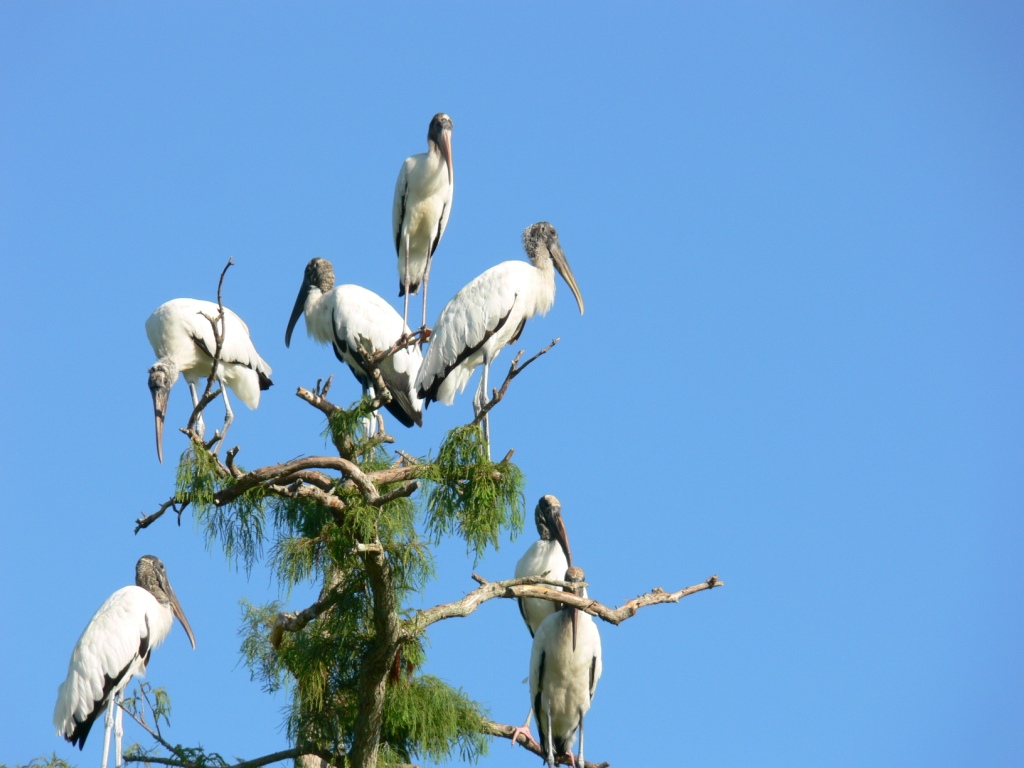
Woodstorks on top of tree at Circle B 7-22-11 by Lee

Woodstorks on top of tree at Circle B by Lee

In our study on the Birds of the Bible, it has been mentioned whether a bird is “clean” or “unclean.” As I have prepared the blogs, I have been considering why a bird is on the clean or unclean list. I had been saving this blog for later, but due to unexpected travel, I’ll do it now.

In Genesis 9:3 it is stated that “every moving thing that liveth shall be meat for you.” So, of course, the birds would be included in this as well. In Deuteronomy 14:11-20, a list of birds is given to signify which birds are unclean and not eaten; basically, all the rest can be consumed. But why are some birds unclean: Looking at the list, the eagle, ossifrage, kite, glede, vulture, and the hawk are known to eat dead animals (carrion). It would not be very healthy to eat them. The other birds on the list are all meat eaters, and maybe that has something to do with their being placed on the unclean list. Are the birds bad because of what they eat? No. Each one was created exactly for the purpose God intended. The carrion eaters help keep the land clean. Another passage mentions the list of unclean birds in Lev 11:13-20.

Some of the other birds on the list are a mystery to me. For instance the Cormorant, Swan, Pelican, Heron, and the Stork are birds I watch here in Florida, and they all seem to be fish eaters. One article mentions that the Heron used to be eaten, but they were fishy tasting and they stopped eating them. Why is it that no matter how many things we are given with only a few put off limits, that someone always has to try the few. Does that not sound like what happened in the garden of Eden when Eve just had to try the tree of knowledge of good and evil. When God puts something off-limits or says it is “unclean,” there is a good reason for it. Most times it is for our benefit because God loves us and doesn’t want us harmed. The “clean” birds mostly have a diet of grain, fruits, and vegetation. Could that be why they are okay to eat? With all the good birds available like chicken, turkey, quail, duck, etc., I’d much rather sit down to a Thanksgiving meal of turkey than vulture.
The birds used for the sacrifices were all clean birds.

Then the #1 reason to eat or not eat a bird according to the list is: AND GOD SAID

Birdwatching Trip – South Lake Howard Nature Park

Wood Ducks

We had over 5″ of rain in the last two days, so when the sun finally came back out, it was time for another trip to the park. When we got there the water way up. The center area of the pond was under water and the birds were not hanging around much. But not to despair, there is always something to behold. Drowning ants had sacrificed some to preserve the majority and had taken over a little tree standing in water. We saw a female Red-winged Blackbird with her courting male nearby.

Fishing Hole

The Bald Eagle landed on his favorite tower. We watched a Cormorant checking out the pond and saw two alligators there also. There was a male and female Wood Duck swimming around together. We also saw a Hairy Woodpecker, Blue Jays, Boat-tailed Grackles, and Common Moorhens.
We crossed the road to the raised walkways and had a pleasant surprise to see a Snowy and Little Blue egret and three Tricolored Herons vying for position in the tall grasses at the edge of Lake Howard (in Winter Haven, FL). An Osprey flew over and the White Winged Doves were calling back and forth. We were heading back to cross the road and came upon a spectacular site. There were at least 5 Great Egrets, 6 Ibises, a Snowy Egret, 2 Wood Storks, and a Great Blue Heron fishing where the overflow water was coming out of a drain. Then I heard a Cardinal singing, saw 2 Common Grackles “purple morph” and the Monk Parakeets carrying-on. So, not a bad morning at all. The Lord made sure that they were being fed and so we got the blessing of watching them.

We also met a Christian there who writes poetry and he has given permission to quote some of his poetry. I hope he will write some more and post them here on the blog.

Here is a poem from his book, POETRY at its Best, Vol 1, by Kermit R. Holt.
The Snowy Egret
The egret which is known as snowy
has feathers which are very showy
Indeed, for these, it has been shot
till near extinction this bird got.
Finally before it breathed its last
for its protection laws were passed.
Its numbers gradually increased
and its existence had not ceased.
Populations haven’t grown enough
to overcome those times so tough.

Check out the Pictures taken today at:

South Lake Howard Nature Park

Birds of the Bible – Peacocks

The Peacock is the male and the Peahen is the female in the pheasant family, Phasianidae (order Galliformes), that consists of the blue or Indian peacock and the green or Javanese peacock which is quite aggressive. More recently they discovered a Congo peacock. Peacocks and peahens are not native to North America, but are found in many zoos here.

The males have a body that is 35-50 inches with long tail feathers that are about 60 inches and “are coloured a brilliant metallic green. This train is mainly formed of the bird’s upper tail coverts, which are enormously elongated. Each feather is tipped with an iridescent eyespot that is ringed with blue and bronze. In courtship displays, the cock elevates his tail, which lies under the train, thus elevating the train and bringing it forward. At the climax of this display the tail feathers are vibrated, giving the feathers of the train a shimmering appearance and making a rustling sound. When he is courting, the male lifts his tail feathers up in a beautiful display to attract the female.” From Britannica Online, “Peacock”.

In Job 38, God started answering Job and began asking him questions about many things. By the time we get to Job 39:13, God asks:

Gavest thou the goodly wings unto the peacocks? or wings and feathers unto the ostrich? (Job 39:13 KJV)

When Solomon was the King of Israel, he was very wise and wealthy. One of the things he did was to start a navy of ships. It appears that they would go off and every three years come back with, among other things, peacocks.

For the king had at sea a navy of Tharshish with the navy of Hiram: once in three years came the navy of Tharshish, bringing gold, and silver, ivory, and apes, and peacocks. (1 Kings 10:22 KJV)
For the king’s ships went to Tarshish with the servants of Huram: every three years once came the ships of Tarshish bringing gold, and silver, ivory, and apes, and peacocks. (2 Chronicles 9:21 KJV)

The peacock has been used as an ornamental bird for many centuries. The video below gives a view of his feathers spread out.

Gavest thou the goodly wings unto the peacocks? or wings and feathers unto the ostrich?

See:

Phasianidae Family

*

Reversible Wings: Mystery or Creativity?

SmileyCentral.com

Got another interesting email today and thought I would share it. They seem to be doing a series on birds lately. Reversible Wings

Isaiah 31:5
Like birds flying about, so will the LORD of hosts defend Jerusalem. Defending, He will also deliver it; passing over, He will preserve it.

Sometimes incredible wonders pass right before our eyes but we are not equipped to see them. Take the humming bird, for an example.

Did you know that like the woodpecker, the humming bird has a tongue that wraps all the way around its head just under the skin? This feature is not really evident when you look at the humming bird. Nor is the wonderful way in which its wings move, so that it can hover, fly forwards or fly backwards.

High-speed photography has revealed some amazing secrets about the humming bird’s wings that cannot be noticed by the eye. All birds, except the humming bird, move their wings at the shoulder, elbow and wrist. Only the humming bird is capable of turning his wings upside down, so that when he hovers, both strokes of his wings beat the air in order to support him. This demonstrates that the humming bird is not a modification of the general bird design – as evolutionists tell us. Rather, the humming bird was created with unique features that enable it to make its living.

Likewise, when God tells us that He cares for those who are His through faith in Christ’s saving work, we don’t always see exactly how He is caring for us. But like the virtually invisible features of the humming bird, His care is nevertheless there.

Prayer: Dear Father in heaven, I thank You that You have made me Your own child through Jesus Christ. Help me to believe what You tell me in Your Word, even if I cannot see it all for myself. In my Savior’s Name. Amen.

References: Time-Life, Flight

Visit Web Site | Donate | Catalog | Subscribe | Unsubscribe
©2005 Creation Moments, Inc. All Rights Reserved.
Reversible Wings