The Feet – by A. J. Mithra

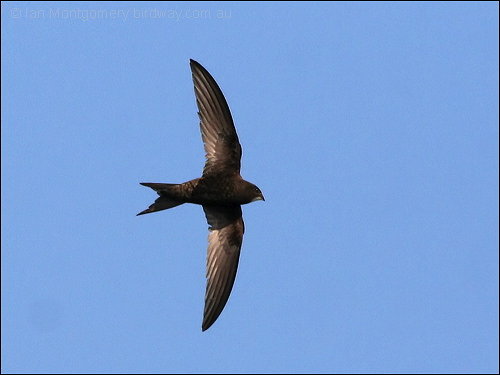
Common Swift (Apus apus) by Ian

Common Swift (Apus apus) by Ian

The foot shares the duties of locomotion with the wing.

Birds with highly developed wings have poor feet.
The swallow, an aerial bird, is an example.

The chimney swift has a tiny foot, but enormously developed wings,
and if placed on a flat surface is unable even to support itself.

All aquatic and terrestrial birds have excellently developed feet.
The loon is so thoroughly aquatic that it cannot walk on land
without the support of its breast and wings.

The sea snipe has a foot especially fitted for swimming,
and can be found a few hundred miles
off the Atlantic coast in flocks of hundreds of thousands,
perfectly at home in the water.
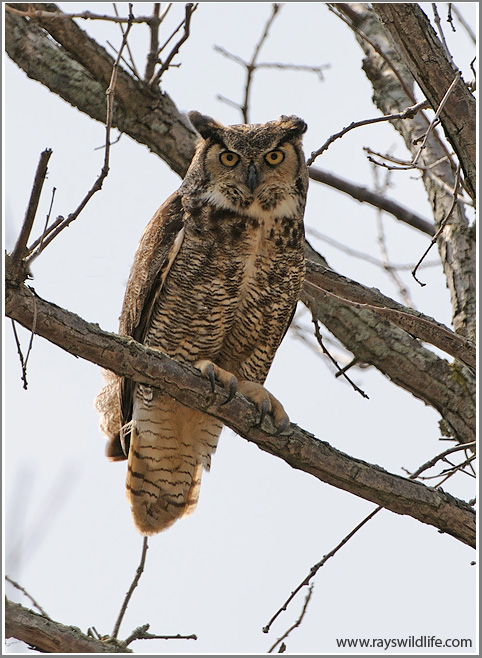
Great Horned Owl (Bubo virginianus) by Ray

Great Horned Owl (Bubo virginianus) by Ray

The foot is generally related to the length of the neck.
In securing prey the foot also plays an important part.

The great horned owl and the duck hawk
have enormous grasping power in their claws.

In grouse or partridge a horny,
fringe-like growth appears on the toes late in the fall,
serving as a sort of snowshoe during the winter,
by which the bird is enabled
to walk on the surface of the snow.
This growth is shed in the spring….

Your feet may feel weak and weary,
but, still GOD wants our feet to stand high…
That is why the Bible says,

He maketh his feet like hinds` [feet], And setteth me upon my high places. (2 Samuel 22:34 KJV)

And HE also says,

Thou shalt tread upon the lion and adder: The young lion and the serpent shalt thou trample under foot. (Psalm 91:13)
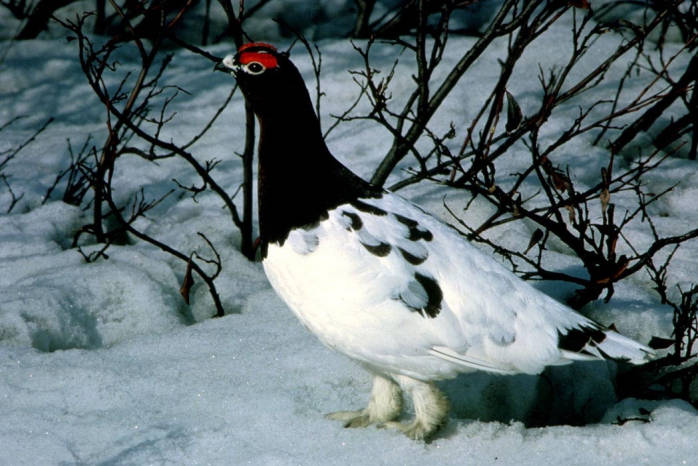
WillowPtarmigan(Lagopuslagopus)©USFWS

WillowPtarmigan(Lagopuslagopus)

God takes care of our feet even in our
going out and coming in…

They shall bear thee up in their hands, Lest thou dash thy foot against a stone. (Psalm91:12)..

No mater how big or small,
GOD says.

How beautiful are thy FEET in sandals, (Song of Solomon 7:1 KJV)

Well,
does HE means to say that, our feet look beautiful only with sandals?
What sort of sandals are we wearing?
Do we have the sandal of preparation of the gospel of peace?

and having shod your feet with the preparation of the gospel of peace; (Ephesians 6:15)

Our feet can’t be more beautiful or more purpose full
without the sandal of preparation..
GOD has given us feet for a divine purpose..

Where are our feet planted?
JESUS is returning soon and HE is in need of feet
that can take the Gospel to the ends of the earth..
Are you ready?

How beautiful upon the mountains are the feet of him that bringeth good tidings, that publisheth peace, that bringeth good tidings of good, that publisheth salvation, that saith unto Zion, Thy God reigneth! (Isaiah 52:7)

Have a blessed day!

Your’s in YESHUA,
A. J. Mithra

Please visit us at: Crosstree
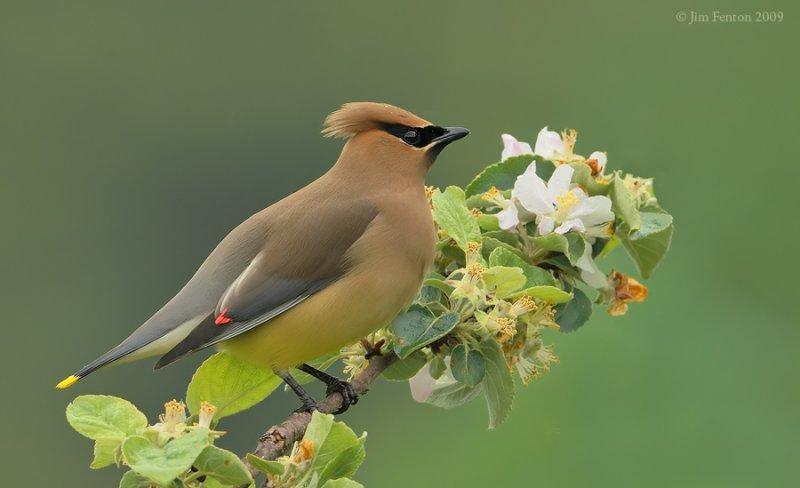
Cedar Waxwing – by A. J. Mithra

Cedar Waxwing

Cedar Waxwing (Bombycilla cedrorum) by J Fenton

Cedar Waxwing (Bombycilla cedrorum) by J Fenton

The Cedar Waxwing is one of the
few North American birds
that specializes in eating fruit.
It can survive on fruit alone
for several months…
The birds’ name derives
from their appetite
for cedar berries in winter…

Cedar is used in the temple
for purification..
Our body is the temple of GOD..
This bird seems to ask us
if we are leading a holy and pure life
isn’t it?

and he shall cleanse the house with the blood of the bird, and with the running water, and with the living bird, and with the cedar wood, and with the hyssop, and with the scarlet:  (Leviticus 14:53)

Cedar Waxwings inhabit
particularly along streams,,,
When JESUS comes into us
we will always dwell by the
Living Waters…

And he shall be like a tree planted by the rivers of water, that bringeth forth his fruit in his season; his leaf also shall not wither; and whatsoever he doeth shall prosper. ( Psalm 1:3)

Cedar Waxwing (Bombycilla cedrorum) by Daves BirdingPix

Cedar Waxwing (Bombycilla cedrorum) by Daves BirdingPix

The orange color is the result
of a red pigment picked up
from the berries of a
species of honeysuckle.
If a waxwing eats
enough of the berries
while growing its tail feathers
the tip of its feathers will be orange…

It is by HIS blood
that we are cleansed
and by HIS grace we become
more like HIM…
When “I” becomes less
and “JESUS” becomes more,
we would be like JESUS..
If these birds can pick up
the red color from the berries they eat,
don’t you think that we would
become more like JESUS
when we eat more of THE WORD,
THE LIVING BREAD?

By the way,
did you eat THE BREAD today?

Yours in YESHUA,
A. J. Mithra

Please visit us at: Crosstree

Sandhill Crane “Colt” Birdwatching

Sandhill Crane "colts"

Sandhill Crane "colts"

Our neighbor called 4 or 5 days before telling us that the Sandhill Cranes here in the community were sitting on a nest. Then Sunday afternoon (3/14/10) she called again to tell us that they were walking with the babies (born that morning). So these little Sandhill Crane “colts” are only a day old.

“Sandhill breeding habitat is marshes and bogs in central and northern Canada, Alaska, part of the midwestern and southeastern United States, Siberia and Cuba. They nest in marsh vegetation or on the ground close to water. The female lays two eggs on a mound of vegetation, but it is rare that both chicks hatch and grow to independence. Cranes mate for life; both parents feed the young, calledcolts“, who are soon able to feed themselves. The colts are taught to fly over many weeks when they run and dance with their parents. Dancing is a significant component in the education of young cranes. The Sandhill Crane does not breed until it is two to seven years old, and the average generation time is 12.5 years. It can live up to 25 years in the wild; in captivity it has been known to live more than twice that span. Mated pairs stay together year-round and migrate south as a group with their offspring.” (Wikipedia) This pair is here year-round. Been in our backyard many times.

I know all the birds of the hills, and all that moves in the field is mine. (Psalms 50:11 ESV)

Thought you might enjoy seeing them. Dan walked over and took these photos.

This slideshow requires JavaScript.

*

Updating to the IOC World Bird List 2.4 version

Yellow-rumped Warbler (Dendroica coronata) by Anthony747

Yellow-rumped Warbler (Dendroica coronata) by Anthony747

For the last week, I have been working on updating the Birds of the World section to the new IOC World Bird List 2.4 version, which came out on March 7th. Not knowing that they update about every three to four months, the list was getting way behind. I had started updating to 2.3 when 2.4 came out. So, to get every thing straight, I am changing all pages to the new version without any comments of what specifically changed.

Here is an overview of the changes:

Version 2.4 (March 7, 2010) – The IOC World Bird List 2.4 contains 10,384 species classified in 39 Orders, 222 Families (+7 Incertae Sedis) and 2202 Genera.

Updates include:
SPECIES:
ADDED to Master List: 25, including 4 splits of Yellow-rumped Warbler complex (Myrtle Warbler, Audubon’s Warbler, Black-fronted Warbler, Goldman’s Warbler)
DELETED from Master List: 7

English Names: 23 changes
Ranges: 28 changes
Taxonomy: 46 changes including 9 changes of Genera including 5 overdue ones for African greenbuls following Johansson et al (2007), and 1 change of Family (African stone partridges Ptilopachus to Odontophoridae).

So far my Indexes and the Order pages are complete, and I am working on the Family pages. “I’m on it!”

Updated 3/20/10: Just finished updating all the pages to the new 2.4 Version, I think. If you find an error, please leave a comment. Thanks.

Interesting Things – Ark, No Meat, Creator, Plus

SmileyCentral.com

While checking out Answers with Ken Ham, I found these interesting articles. Hope you find them informative.

Animals on the Ark–here Kitty, Kitty? (Jan 11, 2010)

Animals–no sin . . . no meat? (Mar 10, 2010)

Creator–where did He come from? (Jan 13, 2010)

Green-crowned Brilliant (Heliodoxa jacula) Reinier Munguia

The hummingbird-God’s Tiny Miracle! (Apr 5, 2007)

Bird brained-it could be a compliment! (Oct 9, 2009)

It’s a transition–NO, it’s a bird! (Aug 31, 2006)

Stork – The Kind Mother – by A. J. Mithra

Stork – The Kind Mother

Asian Openbill (Anastomus oscitans) on nest by Nikhil

Asian Openbill (Anastomus oscitans) on nest by Nikhil

The Hebrew word for stork
Is equivalent to “KIND MOTHER”,
and the care of storks for their young,
in their highly visible nests,
made the stork a widespread emblem
of parental care.

The image of a stork carrying an infant
wrapped in a sling held in its beak
is common in popular culture
and again a symbol of parental care…

As the chicks eat lots of food,
the parents find and eat the food.
Then they come back to the nest
and spit up the food for the chicks to eat..

We are so privileged, for,
JESUS gave HIMSELF
as THE LIVING BREAD
and as THE LIVING WATER,
so that we may have life eternal…
Father and mother may forsake,
but, JESUS will never leave us
nor forsake us..

It was widely noted in ancient natural history,
that the stork would prefer to be consumed
with the nest in a fire,
rather than fly and abandon it.
Such is its commitment towards its family..

White Stork (Ciconia ciconia) by Ian

White Stork (Ciconia ciconia) by Ian

How committed are we to JESUS?
We say that JESUS is our nest,
I mean SHELTER,
but, how many of us would still
have the courage to walk into the fire
like those three young men?
Do we have the courage to face
persecution like Stephen?
Or will run away from JESUS
and sit in the enemy’s camp like Peter?
When JESUS becomes our NEST,
HE shall give us our ETERNAL REST…

And my hand hath found as a nest the riches of the people: and as one gathereth eggs that are left, have I gathered all the earth; and there was none that moved the wing, or opened the mouth, or peeped. (Isaiah 10:14 KJV)

Have a blessed day!

Yours in YESHUA,
A. J. Mithra at Crosstree

Click to see more of A. J.’s articles


See the Stork page (a Bird of the Bible)

Storks are in the Ciconiidae Family of the Ciconiiformes Order

*

Emu – The Model Father by A. J. Mithra

Emu – The Model Father

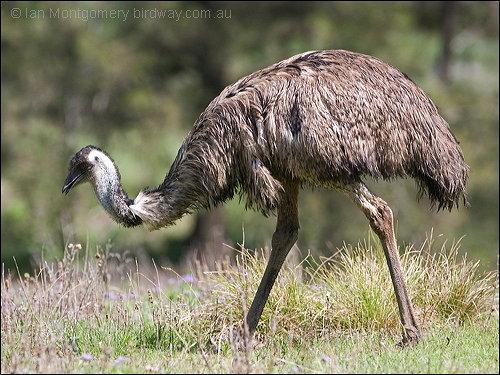
Emu (Dromaiusnovaehollandiae) by Ian

Emu (Dromaiusnovaehollandiae) by Ian

Mr. Emu is the most loving and caring
of all fathers of the bird community..
He not only builds the nest
in a semi-sheltered hollow
on the ground from bark,
grass, sticks and leaves
all by himself, but also incubates
the eggs alone and takes care of the chicks
all by himself..

JESUS neither sleeps nor slumbers
just to take care of all our needs..

During incubation,
he does not eat, drink or defecate,
but stands only to turn the eggs,
which he does about 10 times a day.
He will lose a third of his weight
during the eight week incubation period
and will survive only on stored body-fat
and on the morning dew,
that he can reach from the nest..

If these birds can survive
on morning dew,
we too are still surviving cos of
THE KING’S favor,which is like the morning dew…

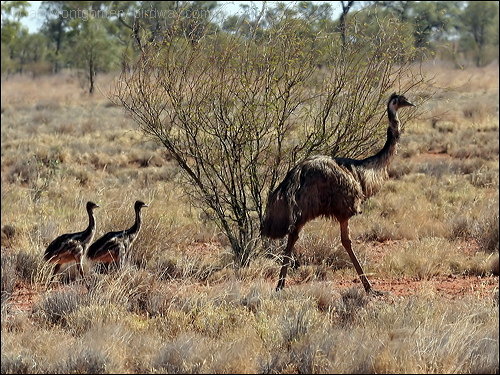
Emu (Dromaiusnovaehollandiae) with chicks by Ian

Emu (Dromaiusnovaehollandiae) with chicks by Ian

Mr. Emu stays with the growing chicks
for up to 18 months,
defending them and teaching them how to find food.

JESUS is our shield and our defense,
we are the apple of HIS eyes..
HE is with us all the days of our lives..
Once as Mr. Emu starts brooding,

Mrs. Emu mates with other males,
but that’s still okay with Mr. Emu.
He’s really very kind because
as many as half the chicks in the brood
he incubates are fathered by others.
Incubation takes 56 days….

Surely. no one would like to be an Emu,
cos, we want our mate to be faithful…
How faithful are we to JESUS, our bride-groom,
who we also call as our Eternal father?
Are we with HIM all the days of our lives?
Are we loyal to HIM?
Just think….

The king`s wrath is as the roaring of a lion; But his favor is as dew upon the grass. (Proverbs 19:12 KJV)

Have a blessed day!

Yours in YESHUA,

A. J. Mithra

To see more of A. J.’s articles – Click Here


Emus are in the Dromaiidae – Emu Family which is one of the Casuariiformes Order


Birds of the Bible – Dove’s Eyes and Voice

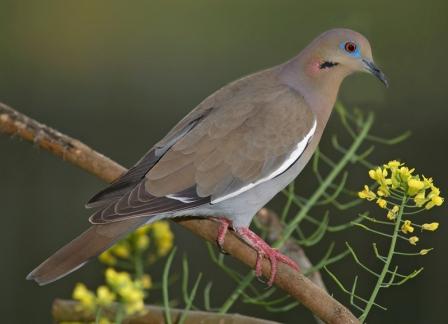
White-winged Dove by Reinier

Here are some interesting thoughts about the Eyes and Voice of a Dove. We had an Eurasian Collared Dove land in our yard today. What a lovely bird, with such a soft color. I always enjoy watching them.

White-winged Dove (Zenaida asiatica) Eye up close by Reinier

The Eyes of A Dove:

How beautiful you are, my darling, How beautiful you are! Your eyes are like doves.” (Song of Solomon 1:15 NASB)

Solomon is describing his love with terms that today we do not hear in that connection. How romantic to have your eyes compared to a dove’s eyes. At first it seems rather weird, but when you know what dove’s eyes actually look like, you realize that they ARE very beautiful.

Then she describes Solomon.

His eyes are like doves Beside streams of water, Bathed in milk, And reposed in their setting. (Song of Solomon 5:12 NASB)

John Gill’s Exposition of the Whole Bible says of this verse, referring to the meekness of Christ:
his eyes are like “doves’ eyes”; not fierce and furious, but loving and lovely; looking upon his people, under all their trials and afflictions, with sympathy and concern, to deliver them out of them: and like the eyes of doves. ”

The Voice of A Dove:
Then in chapter 2, Solomon goes on to use the dove again to describe her voice.

“Come, my shy and modest dove– leave your seclusion, come out in the open. Let me see your face, let me hear your voice. For your voice is soothing and your face is ravishing.” (Song of Solomon 2:14 MSG)

“It is fixed: She is stripped, she is carried away, And her handmaids are moaning like the sound of doves, Beating on their breasts.” (Nahum 2:7 NASB)

Audio by Andrew Spencer of Mourning Dove’s song.

John Gill’s Exposition of the Whole Bible says, “as with the voice of doves, tabering upon their breasts; mourning like doves, inwardly and secretly, not daring to express their sorrow more publicly, because of their enemies; but knocking and beating upon their breasts, as men do upon tabrets or drums, thereby expressing the inward grief of their minds; see Eze_7:16.”

Audio of Mourning Dove beating its wings by Andrew Spencer

Sounds are from Xeno-canto.org


See the Dove and Pigeons Page

Doves are in the Columbidae Family of the Columbiformes Order


Birds in Hymns – Yes, God is Good

Praise the LORD; for the LORD is good: sing praises unto his name; for it is pleasant. (Psalms 135:3 KJV)

Words: John H. Gur­ney, Psalms and Hymns for Pub­lic Wor­ship (Lon­don: 1851), based on Eliz­a­beth L. C. Fol­len’s lyr­ics in Hymns for Child­ren (Bos­ton, Mass­a­chu­setts: 1825).

Music: Tru­ro, from Psalm­o­dia Evan­gel­i­ca, by Thom­as Will­iams, 1789 (MI­DI, score). Al­ter­nate tune:
•Williams, from Tem­pli Car­mi­na, be­fore 1890 (MI­DI, score)

Yes, God is good; in earth and sky,
From ocean depths and spreading wood,
Ten thousand voices seem to cry,
“God made us all, and God is good.”

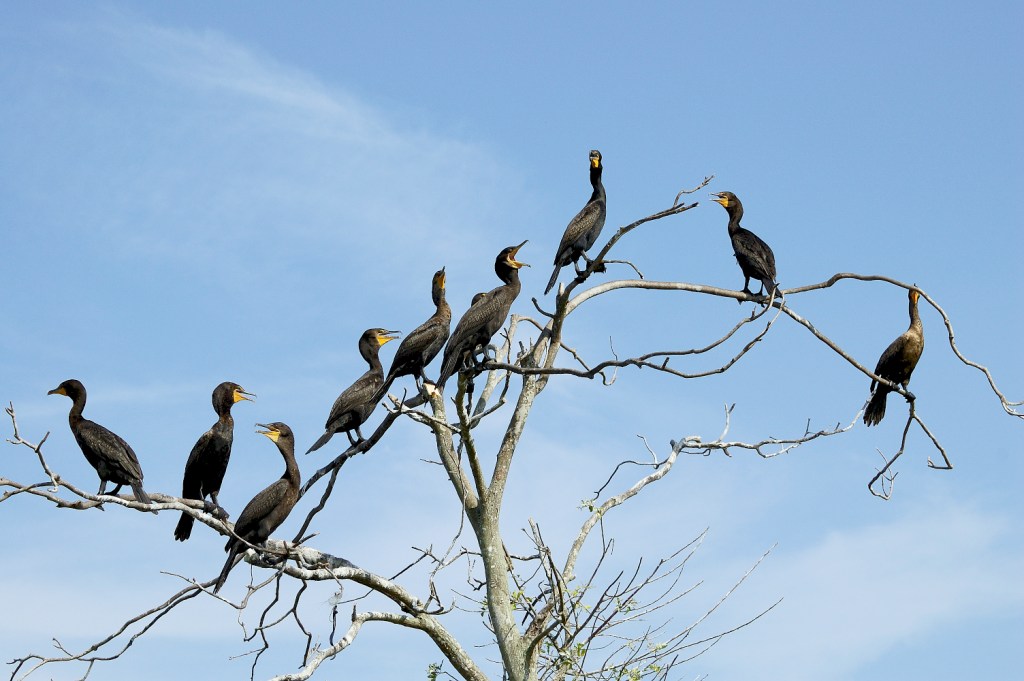
Double-crested Cormorant (Phalacrocorax auritus) at Lake John Rookery, Lakeland, FL By Dan

Double-crested Cormorant (Phalacrocorax auritus) at Lake John Rookery, Lakeland, FL By Dan

The sun that keeps his trackless way
And downward pours his golden flood,
Night’s sparkling hosts, all seem to say,
In accents clear, that God is good.

The merry birds prolong the strain,
Their song with every spring renewed;

And balmy air, and falling rain,
Each softly whispers, “God is good.”

I hear it in the rushing breeze;
The hills that have for ages stood,
The echoing sky and roaring seas,
All swell the chorus, God is good.

Yes, God is good, all nature says,
By God’s own hand with speech endued;
And man, in louder notes of praise,
Should sing for joy that God is good.

For all Thy gifts we bless Thee, Lord,
But chiefly for our heavenly food;
Thy pardoning grace, Thy quickening word,
These prompt our song, that God is good.

Most information from The Cyber Hymnal

See ~ Wordless Birds

More ~ Birds in Hymns

*

Is the Bride Ready? – A. J. Mithra

Is the Bride Ready? – A. J. Mithra

Migration the most amazing
natural phenomena on earth..
The longest migrations
of all are those of birds.

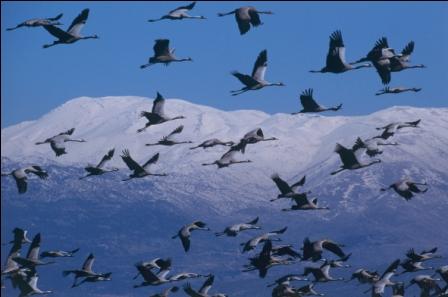
Crane Migration over Israel

Crane Migration over Israel

Israel, which is located
right at the junction
of three continents,
is crossed by migrating birds
of 300 different species,
on a scale unparalleled
anywhere in the world…

Studies over the past decade
shows that about
500 million birds cross
Israel’s narrow airspace
twice every year
in the course of their migrations…
Between one to two million raptors
migrate through Eilat,
in Israel each spring.

Is this large scale
migration and breeding in Israel,
a trial run for the feast
which GOD has planned
for these birds
when JESUS returns
as THE KING?

The Birds are
preparing themselves
for the biggest
marriage feast ever…

The BRIDE-GROOM is on HIS way,
Is the bride ready?

And thou, son of man, thus saith the Lord Jehovah: Speak unto the birds of every sort, and to every beast of the field, Assemble yourselves, and come; gather yourselves on every side to my sacrifice that I do sacrifice for you, even a great sacrifice upon the mountains of Israel, that ye may eat flesh and drink blood. (Ezekiel 39:17)

Your’s in YESHUA,
A. J. Mithra at Crosstree

Updated 5/29/10: Changed name from Migration over Israel to present. I missed aj’s updated changes – (corrected by editor).

Click to see more of A. J.’s articles


Palestine-Israel: A Crossroad for Bird Migration

Cassowary Seed Spreaders – A. J. Mithra

Cassowary Seed Spreaders

Cassowaries eat mainly
large colorful fruits,
and they are considered
as the vital “keystone” species
cos they eat,
and therefore distribute
so many large tropical rain forest fruits.

SouthernCassowary(Casuariuscasuarius) from Wikipedia

SouthernCassowary(Casuariuscasuarius) from Wikipedia

In fact, the Southern Cassowary
is probably the single most important
seed disperser of the
Australian tropical rain forest.
So far, over 200
Australian tropical rain forest plants
have been recorded
to be eaten by cassowaries

Though the bird is hard to be seen,
their scat can be quite
common and conspicuous,
and can contain up to
1 kilogram of seeds….

The survival of the rain forests
of Australia depends upon
the survival of these birds…

Have we ever realized that
the extension of God’s kingdom
depends upon how far and wide
we sow JESUS, THE SEED?

How dare we expect to reap
goodness and mercy to follow us
all the days of our lives
when we haven’t sowed
JESUS, THE SEED??

If a bird can sow
hundreds of seeds,
in how many lives
have we sown,
JESUS,THE SEED?

He that goeth forth and weepeth, bearing precious seed, shall doubtless come again with rejoicing, bringing his sheaves with him.” Psalms 126:6 (KJV)

Have a blessed day!

Yours in YESHUA,
A J Mithra

His website is CROSSTREE
More of A. J.’s articles here.


Cassowaries are in the Casuariidae Family of the Casuariiformes Order

**

Birds in Hymns – Mighty God, While Angels Bless Thee

For God is the King of all the earth: sing ye praises with understanding. (Psalms 47:7 KJV)

Words: Ro­bert Ro­bin­son, 1774.
Music: Autumn by Fran­çois H. Bar­thé­lé­mon, 1785
Al­ter­nate tune: Wellesley by Liz­zie S. Es­ta­brook, 1878

Mighty God, While Angels Bless Thee

Mighty God, while angels bless Thee,
May a mortal sing Thy Name?
Lord of men as well as angels,
Thou art every creature’s theme.
Lord of every land and nation,
Ancient of eternal days.
Sounded through the wide creation
Be Thy just and endless praise.

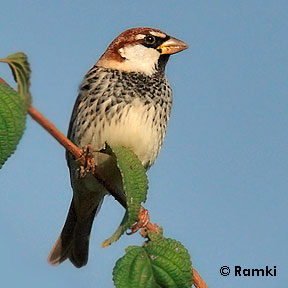
Spanish Sparrow (Passer hispaniolensis) by Nikhil Devasar

Spanish Sparrow (Passer hispaniolensis) by Nikhil Devasar

For the grandeur of Thy nature,
Grand beyond a seraph’s thought;
For the wonders of creation,
Works with skill and kindness wrought.
For Thy providence, that governs,
Through Thine empire’s wide domain,
Wings an angel, guides a sparrow,
Blessèd be Thy gentle reign.

For Thy rich, Thy free redemption,
Bright, though veiled in darkness long,
Thought is poor, and poor expression;
Who can sing that wondrous song?
Brightness of the Father’s glory,
Shall Thy praise unuttered lie?
Break, my tongue, such guilty silence!
Sing the Lord Who came to die.

From the highest throne of glory
To the cross of deepest woe,
All to ransom guilty captives;
Flow my praise, forever flow!
Reascend, immortal Savior;
Leave Thy footstool, take Thy throne;
Thence return, and reign forever,
Be the kingdom all Thine own!


See Video of Hymn by pipeorgan8

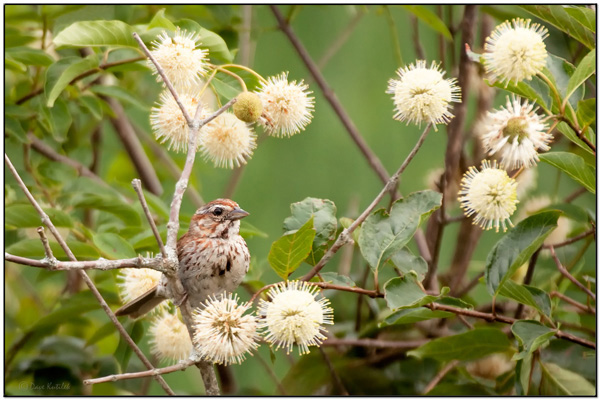
Song Sparrow in white flowers by Daves BirdingPix

Song Sparrow in white flowers by Daves BirdingPix

Ro­bert Ro­bin­son, (1735-1790)

“Robinson’s wi­dowed mo­ther sent him at age 14 to Lon­don, to learn the trade of bar­ber and hair dress­er. How­ev­er, his mas­ter found he en­joyed read­ing more than work. Con­vert­ed to Christ at age 17, Ro­bin­son be­came a Meth­od­ist min­is­ter. He lat­er moved to the Bapt­ist church and pas­tored in Cam­bridge, Eng­land. He wrote a num­ber of hymns, as well as on the sub­ject of the­ol­o­gy. His lat­er life was ev­i­dent­ly not an ea­sy one, judg­ing from a well known sto­ry about his hymn Come, Thou Fount of Ev­ery Bless­ing. One day, he en­count­ered a wo­man who was stu­dy­ing a hymn­al, and she asked how he liked the hymn she was hum­ming. In tears, he re­plied, Madam, I am the poor un­hap­py man who wrote that hymn ma­ny years ago, and I would give a thou­sand worlds, if I had them, to en­joy the feel­ings I had then.” (CyberHymnal)

*

More Birds in Hymns

See ~ Wordless Birds
Most information from The Cyber Hymnal – Mighty God, While Angels Bless Thee

*