While looking back through our visitors this winter, I remembered the one bird who would appear to be ready for today, Halloween. Not that we celebrate it much, other than giving out candy to the kiddos in the neighborhood.
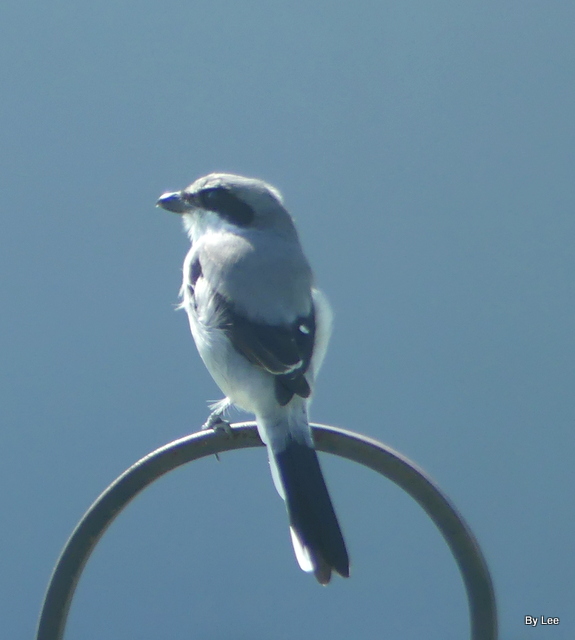
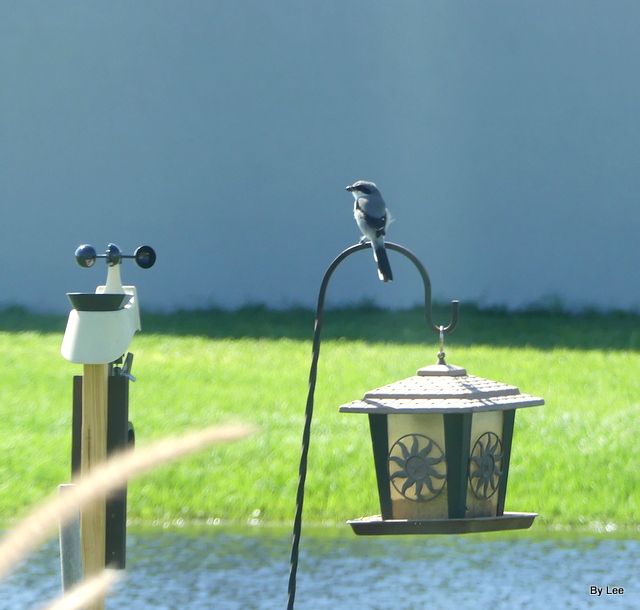
When Dan and I spotted this bird the first winter, I thought it was a Loggerhead Shrike. They, sometime two of them, usually land on a post out in the yard, but this time I caught him right outside the door on the bench arm.
Loggerhead or Northern Shrike on hook – by Lee Closeup
Today, while writing this post, and going to the All About Birds Loggerhead vs Northern Shrike page, I realized that this is a Northern and NOT my supposed Loggerhead. See what you think by clicking that link.
It’s never too late to learn something new. The part about the “mask that often does not cover the top of the bill,” is what made me take a double-take.
Close up of NORTHERN Shrike
As you can see, this was a post in progress as I put it together. Isn’t birding and learning about the Lord’s wonderfully created avian wonders great??? I’ve made my decision, and am changing the names on my photos. :0)
“Which doeth great things past finding out; yea, and wonders without number.” (Job 9:10)
Have you had to change your mind about a bird you just knew what it was, and then it wasn’t? I JUST DID!!
Since we haven’t been “birdwatching” in months, that does mean that we don’t “bird watch.” Every morning the local ducks visit to see if they can quack us out of something for their bellies. Usually they win. We buy scratch grain that they seem to enjoy.
The photo above was taken right after I came in from filling their feeders. Later the other will drop in along with the winter Grackle gang that has arrive.
This photo is looking out across to where the Eagle, and lately it’s mate have perched off and on through the day.
I remember trapsing through the woods and everywhere trying to get a photo of an Eagle. Now, this time of the year, he lands there several times a day. Come spring they, along with the Whistling ducks will scurry home up north.
Here is a photo of them a few days ago. Never know what I might find. Stay Tuned!
“This I recall to my mind, Therefore I have hope. Through the LORD’s mercies we are not consumed, Because His compassions fail not. They are new every morning; Great is Your faithfulness. “The LORD is my portion,” says my soul, “Therefore I hope in Him!” (Lamentations 3:21-24 NKJV)
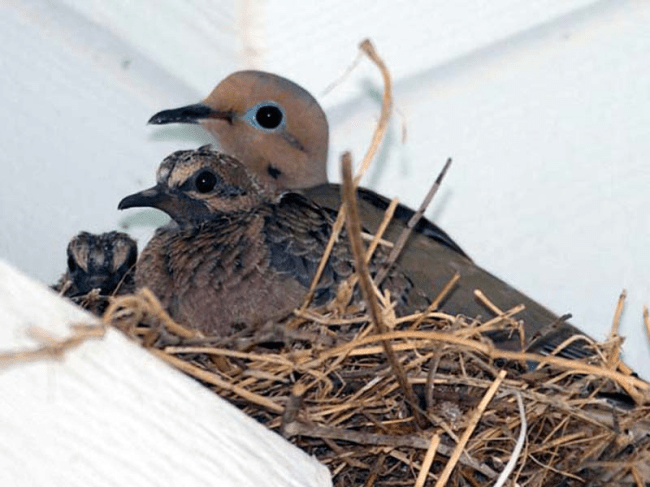
MOURNING DOVES in nest (Photo credit: DFWurbanWildlife.com)
And I said, Oh that I had wings like a dove! for then would I fly away, and be at rest.
(Psalm 55:6)
Doves are known for their fluttering flight (Psalm 55:6a), and their peaceful disposition (Matthew 10:16); yet they are also known for resting upon their nests (Psalm 55:6b & Jeremiah 48:28).
As recently noted (see my previous Leesbird.com blogpost, “Bird Nests are Important — the Bible Says So”, posted https://leesbird.com/2023/09/15/bird-nests-are-important-the-bible-says-so/ ), bird nests are very important–to nesting birds, and even to God Himself, because God chose to refer to bird nests several times in Scripture.
And, to human birdwatchers–such as Dr. Bill Boothe–nesting birds are worth watching, and nesting birds are worth photographing, too, so that other birdwatchers can appreciate these precious winged wonders that God chose to create.
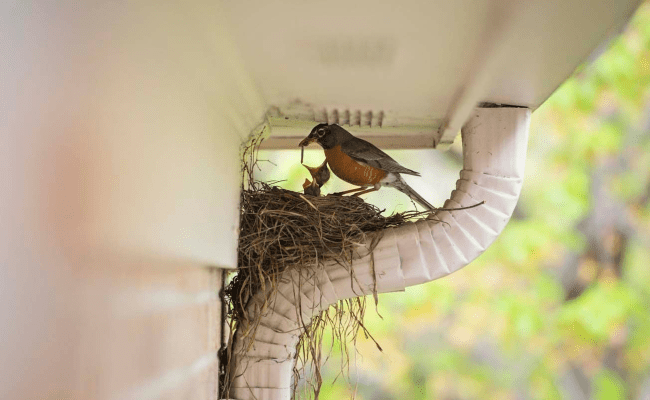
For a recent example, see the nesting Mourning Doves at the residence of Dr. William (“Bill”) Boothe. Now that’s a precious Mourning Dove family! (No “gutter-man” jokes here.)
MOURNING DOVE family in nest on gutter (photograph by Dr. Bill Boothe, used by permission)
Dr. Boothe reports that his Mourning Dove family now includes 2 babies—-how wonderful! Hidden in plain view are so many of God’s “wonders without number” (Job 9:10).
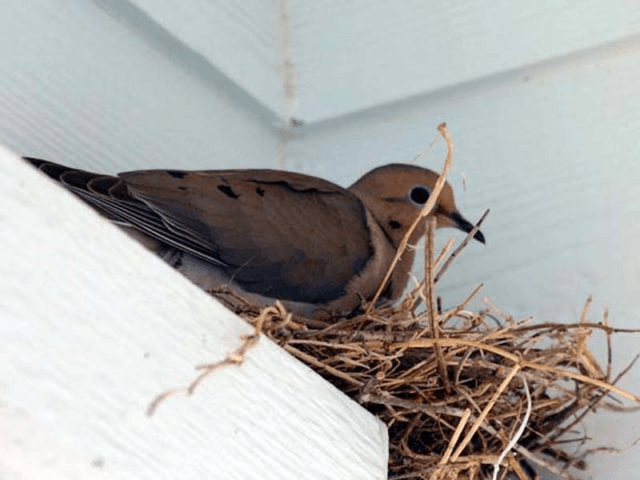
Mourning Doves have a habit of building their nests in sheltered areas, according to nest-building wisdom that God has programmed into them (see Jeremiah 48:28).
Of course, even when Mourning Doves are not seen, by humans, their mourning voices are often heard, which is how they got to be called “mourning” doves. Regarding how doves “mourn” (or “moan”), see Isaiah 38:14 & 59:11 (as well as Nahum 2:7 & Ezekiel 7:16). Providentially speaking, the doves’ mourning noises somewhat resemble the low hooting of owls, i.e., owls that prey on rodents—-rodents who are potential predators of doves—-so owl-like noises are an advantage to doves who benefit from scaring away hungry rodents. (See JJSJ, “The Ghost Army”, posted at http://www.icr.org/article/ghost-army .)
So, there you have it, hidden in plain view: Mourning Doves, in their own peaceful ways, just by being themselves, honor the Lord Jesus Christ, their Creator.
MOURNING DOVE on nest (photo credit: DFWurbanWildlife.com)
And Jesus said unto him, Foxes have holes, and birds of the air have nests; but the Son of man hath not where to lay his head. (Luke 9:58)
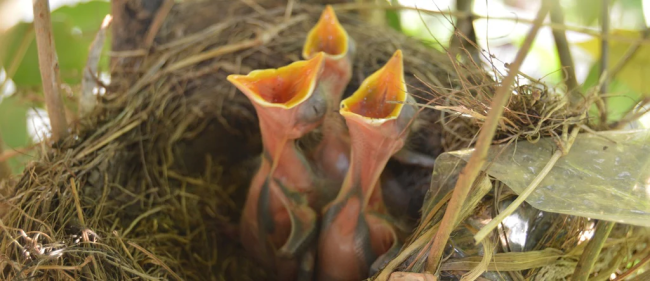
Hungry nestlings! (WhirlyBird photo credit)
NEST – this simple word “nest” represents an enormously important part of a bird’s life.
Do you recall the first times you ever saw a bird nest, close up? Did you realize, then, that the nest was “home” to the birds who resided therein?
A baby bird’s beginning is experienced inside a nest. From embryonic egg to hatchling, from hatchling to fledgling, a baby bird’s life adventures are “hatched” inside a nest of some kind. Consequently, nests are the childhood homes to young nestling birds, plus parent birds repeat their multi-generational nest life as they reproduce and nurture their own next generation of their kind.
For most birds, springtime means mating, and mating time means nesting. As soon as nesting begins in earnest, everything changes. The earth becomes quieter, the sight of a bird [displaying to attract a prospective mate] rarer. Despite the seeming tranquility, there’s much ado and excitement among the birds. The joy of expressing the springtime, of finding or reclaiming a mate, has been exchanged for the silence and secrecy of very private moments as birds begin the work of creating their homes.
And what a variety of nests there are, because God has programmed different birds to build and indwell different types of nests.
Some nests are mere scrapes upon a strategic patch of ground. Other nests are burrowed underground. Many are designed to be camouflaged or otherwise hidden. Some nests are tree-nestled demitasses. Some nests are holes on the sides fo trees or cacti. Some nests are mostly reshaped mud. Some nests are located on shorelines of freshwater, brackish water, or oceanic seashores. Some nests are in rocks, often at high altitudes.
Many bird nests go unnoticed by human eyes, yet our Heavenly Father always notices and cares about bird nests, everywhere and at all times.
Are not two sparrows sold for a farthing? And one of them shall not fall on the ground without your Father. (Matthew 10:29)
The diversity of avian nesting habits displays God’s love for variety, as one would expect, since we see countless proofs of God’s love of variety in how animals (including birds of all kinds) are fruitful, multiply, and fill niches all over the earth. [See JJSJ, “Valuing God’s Variety”, posted at www.icr.org/article/valuing-gods-variety — see also JJSJ, “God Fitted Habitats for Biodiversity”, posted at www.icr.org/article/god-fitted-habitats-for-biodiversity .]
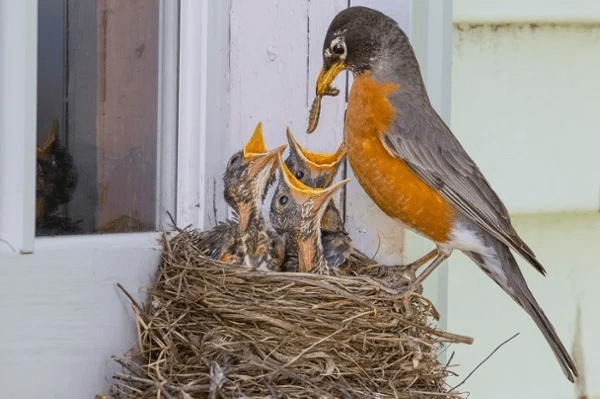
ROBIN NEST (Bird Barrier photo credit)
Accordingly, expect to find variety in bird nests.
A hummingbird hovers over a spider’s web, spending several seconds latching onto a thread of silk [to be incorporated as stabilizing material for the hummer’s coin-sized nest]. A woodpecker suspends his tree-drumming and instead works on excavating a nest hole with his mate. A shorebird slinks into a quiet area unnoticed and lays her single egg on [a strategically selected patch of] bare sand. In the privacy of their own world[s], often far beyond human ken, birds settle down to build their nests and breed young. After mating takes place, attracting attention is no longer a priority. Instead it is protecting the nest and incubating eggs that matter. All living beings are driven to reproduce, and most lay eggs. What makes birds different form other egg-laying creatures is that the embryo inside each egg is as warm-blooded as a human, and like a human, requires the warmth provided by its parent, or by an adequate substitute, to develop and to thrive. Because it is so fragile, the egg must be coddled in a secure place until its occupant is ready to leave and face the rigors of the outside world. Encased in its [calcium carbonate-structured] shell, the tiny chick’s only hope is that its parents [or foster-parents] do know what is best. The nest the adult birds provide furnishes the warmth and protection necessary for the chicks’ survival.
Nest are so important – because God made them to have value — that we should expect them to be mentioned within the HOLY BIBLE’s pages.
Sure enough, the holy Scriptures refer to bird nests, repeatedly. A few such examples follow.
Before reviewing those examples, however, it is worth noticing that the usual Hebrew noun translated “nest” is qên, which first appears in Genesis 6:14 (referring to “homes” aboard Noah’s Ark), where the King James Version of the English Bible translates it as “rooms”. Yet, even in that Ark housing context, a qên was one of many temporal “homes” (i.e., onboard chambers, like “cabins” or “staterooms” within an ocean-faring cruise ship), used for security and protection from hostile external conditions. Based upon etymologically related Hebrew words it appears that the underlying connotation is the idea of specifically claimed property (i.e., acquired and possessed as “private” property) that belongs to a specific individual, or to a specific group (such as a specific family).
Location, location, location — where you nest matters!
Where a bird nest is positioned is important. Maybe the best place for a nest—such as an Osprey nest—is high upon a relatively inaccessible rocky clifftop, or within the higher branches of a tall tree. [See Donald Stokes & Lillian Stokes, A GUIDE TO BIRD BEHAVIOR, Volume III (Little Brown & Co., 1989), page 163.]
And he looked on the Kenites, and took up his parable, and said, ‘Strong is thy dwelling-place, and thou puttest [i.e., you position] thy nest in a rock.’ (Numbers 24:21, with “nest” [qên] as noun)
And for many large birds of prey, such as eagles, nesting in high places is the way to go. (Perhaps such birds feel “high and mighty”!)
Thy terribleness hath deceived thee, and the pride of thine heart, O thou that dwellest in the clefts of the rock, that holdest the height of the hill: though thou shouldest make thy nest as high as the eagle, I will bring thee down from thence, saith the Lord. (Jeremiah 49:16, with “nest” [qên] as noun)
Though thou exalt thyself as the eagle, and though thou set thy nest among the stars, thence will I bring thee down, saith the Lord. (Obadiah 1:4)
Woe to him that covets an evil covetousness to his house, that he may set his nest on high, that he may be delivered from the power of evil! (Habakkuk 2:9, with “nest” [qên] as noun)
No need for humans to feel “high and mighty” – God resists the proud but he upholds the humble-hearted. (And pride routinely “goeth” before a fall.)
2. Multi-generational reproductive success is priority!
Birds of prey include hawks, eagles, owls, and more. Yet birds themselves are often prey to predators of many kinds, including humans who eat birds, both domesticated and wild—such as chicken, turkey, goose, and the eggs fo many kinds of birds. But if one generation of predators greedily consumes all of a prey population, the next generation of those predators would be deprived of a food source, which would be harmful to both the predator population and the prey population. Accordingly, it is good for a generation of predators to only eat a limited amount of a prey population, so that future generations of both predators and prey can benefit (form continued reproductive success of the prey population. That stewardship principle—applying restraint in lieu of greedy wastefulness—is what Moses commanded the Israelites as a conservation law for their future entry into and settlement in the Promised Land of Canaan.
If a bird’s nest chance to be before thee in the way in any tree, or on the ground, whether they be young ones, or eggs, and the mother sitting upon the young, or upon the eggs, thou shalt not take the mother with the young; but thou shalt in any wise let the mother go, and take the young to thee; that it may be well with thee, and that thou mayest prolong days. (Deuteronomy 22:6-7, with “nest” [qên] as noun)
3. Nests are where good parenting is needed!
How eagle parents treat their young has been a subject of some confusion over the years, due to a less-than-clear-and-accurate translation of Deuteronomy 32:11. That confusion has already been addressed in “Clarifying Confusion about Eagles’ Wings”, posted at https://leesbird.com/2022/09/27/clarifying-confusion-about-eagles-wings/ — so that discussion will not be repeated here. Suffice it to say, here, that eagle parents care for their young! Like many—but not all—animal parents, eagle parents go to great efforts to raise their nestling children, training them for life as fledglings.
As an eagle, he [i.e., God, in relation to His people Israel] stirs up his [i.e., God’s] nest, he {i.e., God] flutters over his [i.e., God’s] young, he [I.e., God] spreads abroad his [i.e., God’s] wings, he [i.e., God] taketh them, he [i.e., God] bears them [i.e., the Israelites as God’s people] on his [i.e., God’s] wings…. (Deuteronomy 32:11, literal translation, with editorial clarifications, with “nest” [qên] as a metaphoric noun)
This is comparable to how the Lord Jesus Christ compared His willingness to protect Jews to a mother hen’s protectiveness, as demonstrated in her welcoming and refuge-providing wingspread, noted in Matthew 23:37 and also in Luke 13:34.
4. Nests should be places of domestic security: “home sweet home”.
Then I said, I shall die in my nest, and I shall multiply my days as the sand. (Job 29:18, with “nest” [qên] as noun)
The patriarch Job, unto his “friendly” counsellors, once lamented his former life of blessing, before his torturous trials were suddenly dumped upon his head. Job related how he expected to live a long life of uninterrupted blessing, ultimately dying at peace in his own “nest” (i.e., “home sweet home”). But, God had other plans—ultimately better (albeit bumpier) plans for Job’s earthly pilgrimage.
5. The ability, of birds to make nests, is God-given, i.e., God-programmed.
Doth the eagle mount up at thy command, and make her nest on high? (Job 39:27, with “nest” [qên] as noun)
The eagle has designed (i.e., pre-programmed) abilities and inclinations to make its nest in high places, and to mount up into the air suing thermal air currents. The eagle did not invent these designed traits – God designed the eagle’s physical traits and pre-programmed abilities, including the know-how (and the how-to) needed for successfully building eyries atop high montane places or in trees. [For more on this Scripture about eagle behavior, see “JOB Chapter 39: God’s Wisdom and Providence, Exhibited in Wildlife Pair””, posted at ttps://rockdoveblog.wordpress.com/?s=Job+39%3A27 .]
6. Nests are for raising children, i.e., the next generation.
Yea, the sparrow hath found a house, and the swallow a nest for herself, where she may lay her young, even thine altars, O Lord of hosts, my King, and my God. (Psalm 84:3, with “nest” [qên] as noun)
Notice that the sparrow’s “house” is parallel in meaning to the “nest’ of the swallow. In other words, a “nest” is a “house” for dwelling in, and especially for raising young in.
7. Particular types of nests are selected according who will be living therein.
Where the birds make their nests: as for the stork, the fir trees are her house. (Psalm 104:17, with “nest” [qânan] as verb)
In the above-quoted psalm we are reminded that storks are known to make their homes within the branches of fir trees. (Storks are also known as predictable migrants—see Jeremiah 8:7, described in “A Lesson from the Stork”, posted at www.icr.org/article/lesson-from-stork .)
8. Wandering from the security of the nest can lead to many dangers.
As a bird that wanders from her nest, so is a man that wanders from his place. (Proverbs 27:8, with “nest” [qên] as noun)
For it shall be, that, as a wandering bird cast out of the nest, so the daughters of Moab shall be at the fords of Arnon. (Isaiah 16:2, with “nest” [qên] as noun)
One of the advantages of many bird nests is camouflage—being hidden form the sight of hungry predators. There is a security that comes with staying inside one’s proper home. Not that any home (or nest) is “bulletproof” from danger, but there are often many more dangers lurking about, the farther that one wanders away from home. (The same is true for young who are expelled from home.) Consequently, the high mortality rate is why birds routinely try to raise more hatchlings than themselves. In other words, two parent birds need to strive for replacing themselves with more than just two children, in order to mitigate the risks that their progeny will become prey (literally “dead meat”) before they progeny can successfully reproduce the next generation.
9. Bird eggs are a valuable source of good (i.e., nutritionally rich) food.
And my hand hath found as a nest the riches of the people: and as one gathers eggs that are left, have I gathered all the earth; and there was none that moved the wing, or opened the mouth, or peeped. (Isaiah 10:14, with “nest” [qên] as noun)
Isaiah stated the obvious—eggs are valuable; in fact, they are like a store of “riches”, nutritionally speaking. This nutrition fact concurs with the mention of eggs as a “good” food, in contrast to bad food. See Luke 11:11-13, where giving eggs to eat is recognized (by Christ Himself, the Creator of all food) as “good gifts to your children”.
10. Places are recognized as “wild places”, if dominated by many predators.
There shall the great owl make her nest, and lay, and hatch, and gather under her shadow; there shall the vultures also be gathered, everyone with her mate. (Isaiah 34:15, with “nest” [qânan] as verb)
The context of this somber prophecy, of Isaiah, is God judging (i.e., punishing) the Edomites, because of the Edomites’ wicked mistreatment of Israelites (see Isaiah 34:6-8), with the resultant desolation of the Edomites’ land—which punitive desolation to include Edomite lands becoming overtaken by birds of prey (se Isaiah 34:10-16). Thus, if Edomite lands are, in the prophesied future, dominated by the nests of predatory animals—including predatory birds—such lands are to be recognized as “wild places” (wildernesses), not fit for human habitation.
11. Flexibility increases opportunities to “fit” and “fill” different situations
O ye that dwell in Moab, leave the cities, and dwell in the rock, and be like the dove that makes her nest in the sides of the hole’s mouth. (Jeremiah 48:28, with “nest” [qânan] as verb)
Doves, which include pigeons, are famous for adjusting themselves to the most diverse of habitats. Years ago, this writer (with family) was exploring an underground “lava tube” cave at Craters of the Moon park, in Idaho. Inside this most inhospitable venue, perched within a crack in the cavernous ceiling, there was a nest with two pigeons therein! Doves can live successfully almost anywhere – they are peaceful, yet flexible and opportunistic.
12. Tree branches are often a hospitable home for nesting birds.
All the fowls of heaven made their nests in his boughs, and under his branches did all the beasts of the field bring forth their young, and under his shadow dwelt all great nations. (Ezekiel 31:6, with “nest” [qânan] as verb)
The tree that thou sawest, which grew, and was strong, whose height reached unto the heaven, and the sight thereof to all the earth, whose leaves were fair, and the fruit thereof much, and in it was meat for all; under which the beasts of the field dwelt, and upon whose branches the fowls of the heaven had their habitation. (Daniel 4:20-21)
Even in Nebuchadnezzar’s dream he recognized that tree branches (a/k/a boughs) are good sites for bird nests!
Saving the best for last: Christ prepared for bird homes via nesting habitats and nesting skills.
And Jesus saith unto him, The foxes have holes, and the birds of the air have nests; but the Son of man hath not where to lay his head. (Matthew 8:20, with “nests” [κατασκηνωσεις] as noun)
And Jesus said unto him, Foxes have holes, and birds of the air have nests; but the Son of man hath not where to lay his head. (Luke 9:58, with “nest” [κατασκηνωσεις] as noun)
Behold the kindness of our Lord Jesus Christ: He did not insist on having a “home” when He came to Earth to be our Savior. However, as our kind Creator He even prepared fitting homes fo His animal creatures, such as foxes and “birds of the air”.
Speaking of “home”, it is the very Creator-Redeemer, our Lord Jesus Christ, Who is our true home.
Accordingly, settling (domesticating) specific niches in the earth—even migratory stopover homes—and utilizing home bases for family life activities is needful to fill the multitude of Earth’s multifarious habitats. To achieve this goal, God has providentially equipped creatures with physical bodies (with helpful anatomies and physiologies) and programmed bio-informational instructions (coding and equipping for habitat-interactive behaviors) that are fitted to the dynamic challenges of physical environments (and biotic communities) all over the globe. As earthbound pilgrims, we pass through this mortal life (Hebrews 11:13; 1 Peter 2:11), interfacing with an all-too-often hostile culture (Hebrews 11:36-38). We long for a truly secure home—where we really belong.
But, as Christians, what is our true home? It is not residential real estate housing (Philippians 3:20; Hebrews 11:8-14). Our true homes are not even the earthly bodies that we temporally inhabit, although they are the “tents” we know best (2 Corinthians 5:1-4; 2 Peter 1:13). For Christians, ultimately, our real eternal home is God Himself (Psalm 90:1; 2 Corinthians 5:6; John 14:2-6). As our Creator, He started us. As our Redeemer, we finish with Him. What a homecoming we wait for!
Maybe there are more examples, of bird nests being mentioned in Scripture. But, at least, the examples listed above show that bird nests are important, so important (to God) that they merit repeated mention, in the only book that God Himself wrote.
Cormorants are Great; Great Cormorants are Really Great!
Dr. James J. S. Johnson
“But the cormorant [shalak] and the bittern shall possess it [i.e., the land of Idumea, a/k/a Edom]; the owl also and the raven shall dwell in it; and He [i.e., the LORD, in judgment] shall stretch out upon it the line of confusion, and the stones of emptiness.“
Isaiah 34:11
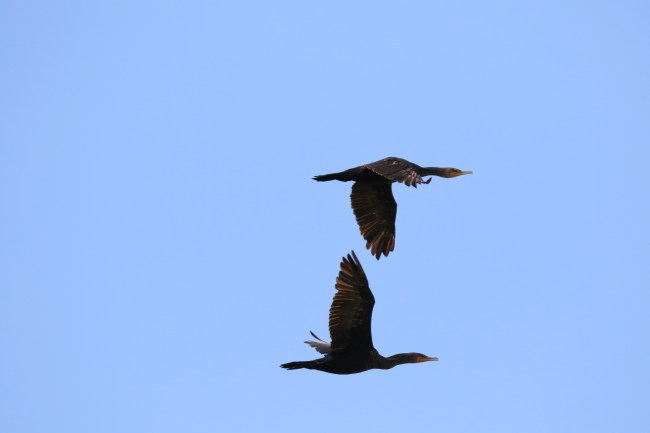
GREAT CORMORANTS in flight (Minnesota) photo credit: Bryce Gaudian
In some contexts, CORMORANTS are not deemed as indicators of blessing — as in Isaiah 34;11, where it is prophetically mentioned as an indicator that the land of Edom is catastrophically destroyed. However, in many other contexts, these magnificent birds are recognized as wonderful creatures whom God has equipped to live by bodies of water, both freshwater and seawater.
GREAT CORMORANT aloft (Minnesota) photo credit: Bryce Gaudian
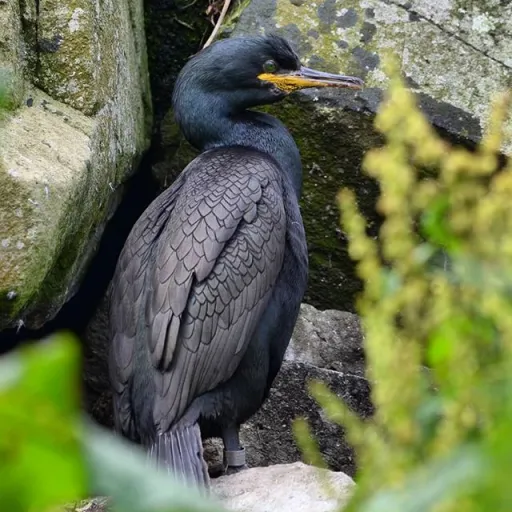
Cormorants love to live by bodies of water. Cormorants are found busy hunting — darting (befitting the Hebrew noun shalak, in Leviticus 11:17 & Deuteronomy 14:17, translated “cormorant”, which matches the darting-like targeting movements) for food over and near coastlines, including the coasts of islands, such as the Hebridean isle of Staffa, which was reported earlier (on this Christian birdwatching blog), in the report titled “Birdwatching at Staffa: Puffins, Shags, and more”, posted at https://leesbird.com/2019/07/22/birdwatching-at-staffa-puffins-shags-more/ (July 22nd A.D.2019), citing Isaiah 42:12. [Regarding “cormorants” in the Holy Bible, see George S. Cansdale, ALL THE ANIMALS OF THE BIBLE LANDS (Zondervan, 1976), at page 175.]
Cormorants constitute a large “family” of birds; the mix of “cousins” include Crowned Cormorant (Phalacrocorax coronatus), Brandt’s Cormorant (Phalacrocorax penicillatus), Galapagos Cormorant (Phalacrocorax harrisi), Bank Cormorant (Phalacrocorax neglectus), Neo-tropic Cormorant (Phalacrocorax brasilianus), Double-crested Cormorant (Phalacrocorax auritus), Indian Cormorant Phalacrocorax fuscicollis), Socotra Cormorant (Phalacrocorax nigrogularis), Cape Cormorant (Phalacrocorax capensis), Guanay Cormorant (Phalacrocorax bougainvillii, a/k/a Guanay Shag), Kerguelen Shag (Phalacrocorax verrucosus), Imperial Shag (Phalacrocorax atriceps), Antarctic Shag (Phalacrocorax bransfieldensis). South Georgia Shag (Phalacrocorax georgianus), Campbell Island Shag (Phalacrocorax campbelli), New Zealand King Shag (Phalacrocorax carunculatus), Bronze Shag (Phalacrocorax chalconous), Chatham Island Shag (Phalacrocorax onslowi), Auckland Island Shag (Phalacrocorax colensoi), Rock Shag (Phalacrocorax magellanicus), Bounty Island Shag (Phalacrocorax ranfurlyi), Red-faced Cormorant (Phalacrocorax urile, a/k/a Red-faced Shag), European Shag (Phalacrocorax aristotelis), Pelagic Cormorant (Phalacrocorax pelagicus, a/k/a Pelagic Shag), Red-legged Cormorant (Phalacrocorax gaimardi), Spotted Shag (Phalacrocorax punctatus), Pied Cormorant (Phalacrocorax varius), Great Cormorant (Phalacrocorax carbo), Japanese Cormorant (Phalacrocorax capillatus), Olivaceous Cormorant (Phalacrocoraxolivaceus, a/k/a Mexican Cormorant), and Pitt Island Shag (Phalacrocorax featherstoni).
That’s a lot of cormorant “cousins”, worldwide! [For details on each of these “cousins”, see pages 116-136 of Jim Enticott & David Tipling, SEABIRDS OF THE WORLD: THE COMPLETE REFERENCE (Stackpole Books, 1997).]
SHAG (a type of Cormorant), at Staffa, Hebrides (Scotland) photo credit: Public Insta
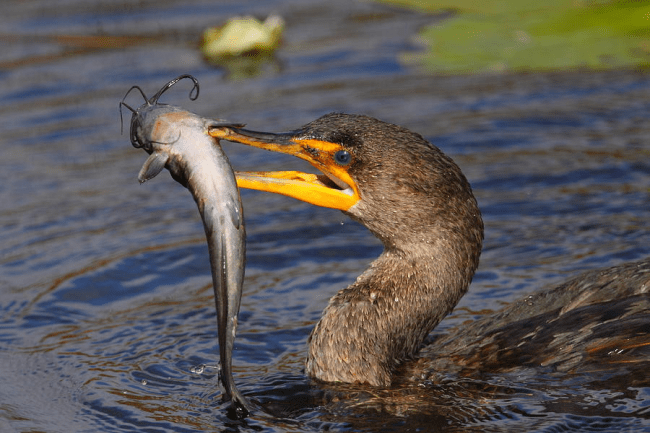
Cormorants are famous “fishermen” along ocean coastlines, yet cormorants also thrive in inland freshwater habitats, such as over and near ponds and lakes, such as the Double-crested Cormorants that frequent inland ponds in Denton County, Texas, where they catch “fish of the day”.
DOUBLE-CRESTED CORMORANT with fish photo credit: Bruce J. Robinson
Cormorants are generally described, by ornithologist Roger Tory Peterson, as follows:
Large, blackish, slender-billed water birds. Often confused with loons, but tail longer, bill hook-tipped. In flight, wing action is more rapid and axis of body and neck is tilted upward slightly (loon’s neck droops). Young birds are browner, with a pale or whitish breast. Flocks [of cormorants] fly in line or wedge formation very much like geese but they are silent. Cormorants often perch in uprightpositions on buoys or posts with neck in an S [posture]; sometimes strike a “spread eagle” pose. Swimming, they lie low like loons, but with necks more erect and snakelike, and bills tilted upward at an angle. Food: Fish (chiefly non-game). Nearly cosmopolitan [in range].
[Quoting Roger Tory Peterson, cited below]
[See Roger Tory Peterson, A FIELD GUIDE TO THE BIRDS OF TEXAS AND ADJACENT STATES (Houghton Mifflin, 1988), page 10.]
Specifically, the Double-crested Cormorant (Phalacrocorax auritis) is perhaps the most common winter migrant of the cormorants; also, the Double-crested Cormorant is often seen in the coastline areas of Texas’ Gulf of Mexico shores.
GREAT CORMORANTS descending (Minnesota) photo credit: Bryce Gaudian
Have you ever watching a silhouetted cormorant — or two — or three — winging their way across the late afternoon sky? It is a wonder to behold!
GREAT CORMORANTS silhouetted against the sky photo credit: Bryce Gaudian
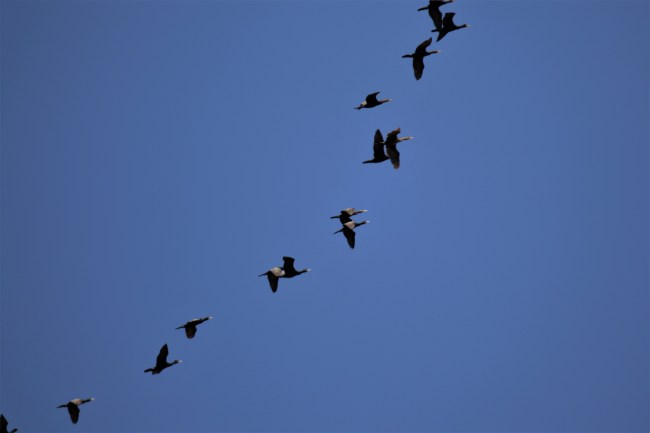
Now, try to imagine a dozen, or more, cormorants, flying in series. That’s a wondrous wonder to behold! That constitutes one of the “wonders without number” that Scripture refers to (in Job 9:10).
serial “line” of GREAT CORMORANTS in flight (Texas) photo credit: Bryce Gaudian
And now here is my closing limerick, about cormorants:
APPRECIATING HUMBLE CORMORANTS (AND SHAGS)
Cormorants are not known to brag,
If they’re so-called, or called “shag”;
They oft fly, in a line,
And on fish, they oft dine —
But cormorants aren’t known to brag.
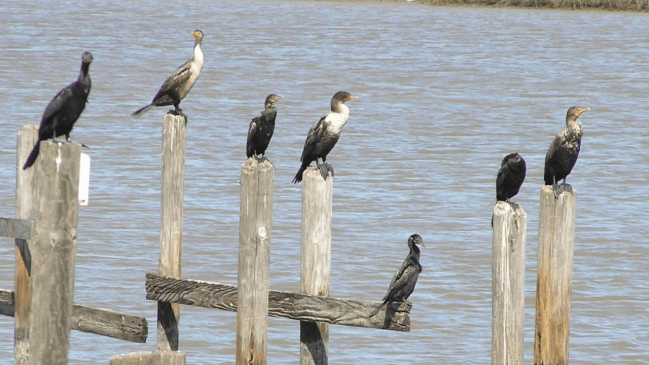
DOUBLE-CRESTED CORMORANTS perching on posts photo credit: Mark Eising Birding
(Dr. Jim Johnson formerly taught ornithology and avian conservation at Dallas Christian College, among other subjects, and he has served as a naturalist-historian guest lecturer aboard 9 international cruise ships, some of which sailed in seawaters frequented by cormorants and shags. Jim was introduced to Christian birdwatching as an 8-year-old, by his godly 2nd grade teacher, Mrs. Thelma Bumgardner.)
I would like to apologize for my lack of posting any articles since back in February of this year. (More explanation later.) What I am really thankful for is Dr. James J.S. Johnson, Dr. Jim, as Dan and I affectionately call him.
THANK YOU, DR. JIM!
Also a Hugh THANK YOU to all of you who have continued to stop by this blog. Many of you have read and commented of his articles and other previously published posts.
Black-bellied Whistling Ducks feeding in yard.
Back in February, a number of health problems began, and it seemed like about the time I improved, some other issue came up. It seems that it has just been one thing after another. Needless to say between Doctor visits, physical therapy, medical test, using cane or walker, etc. etc., birdwatching has come to a halt other than my view out the back door.
“God is faithful, by whom you were called into the fellowship of His Son, Jesus Christ our Lord.” (1 Cor. 1:9)
That top photo about describes the lack of birds lately. Like many of you around the country and parts of the world, we have had some very high heat indexes. Plus, the wintering birds have not arrived yet.
Other than Muscovy Ducks and the neighborhood Robins and Doves, there hasn’t been much going on.
Lord willing, I trust that there will be more post from me. Now that I’m improving some, I will try to at least write more about God’s amazingly Created Avian Wonders. Stay tuned!
Thanks again to all our visitors to this blog and “Dr. Jim” for keeping us blessed by his great articles.
Can the rush grow up without mire? can the flag grow without water?
(Job 8:11)
Speaking of birdwatching in Texas, ornithologist Stan Tekiela says, “It’s a sure sign of spring when [migratory] Red-winged Blackbirds return to the marshes.” [Quoting from Tekiela’s BIRDS OF TEXAS FIELD GUIDE (Cambridge, MN: Adventure Publications, Inc., 2004), page 9.]
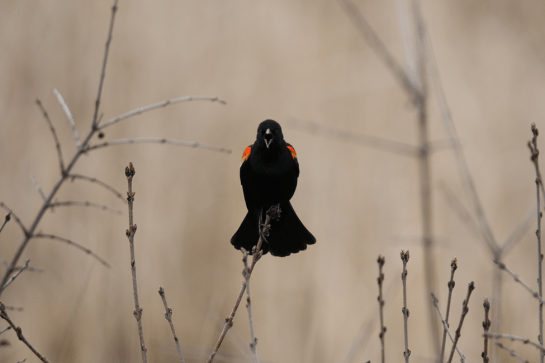
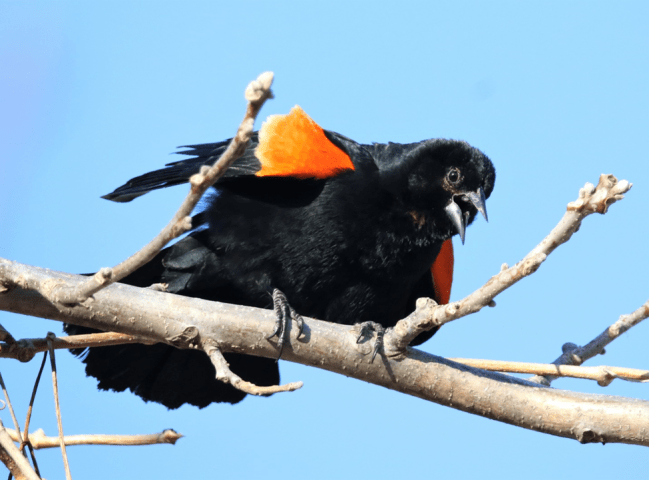
RED-WINGED BLACKBIRD MALE, front view, on budding plants (photo credit: Bryce Gaudian)
Of course, Minnesota hosts Redwinged Blackbirds in early springtime, weeks before the last snowdrifts melt away with warming spring temperatures.
“CLOUD” of RED-WINGED BLACKBIRDS, Minnesota (photo credit: Bryce Gaudian)
Of course, what could be a more iconic marshland plants than cattails, which Redwings love to perch upon, all over America’s Lower 48 states (as well as much of Mexico and Canada)?
And where you have cattails, you often have Red-winged Blackbirds, known to ornithologists as Agelaius phoeniceus, sometimes nicknamed “Redwings” (but not to be confused with the Eurasia’s thrush that is also nicknamed “redwing”), , as was noted in a previous blogpost “Redwing Pond”, posted at https://leesbird.com/2019/11/04/redwing-pond/.
The most successful way to observe the behavior of Red-winged Blackbirds is to locate a marshy area where a number of them can be regularly found, pick one or two of the more active birds, and follow their movements for about a half hour. A characteristic of Redwings is that they alternate periods of active displaying with periods of quiet and feeding, so you cannot just show up at a marsh and expect immediately to see all of their marvelous displays.
Donald Stokes, A GUIDE TO BIRD BEHAVIOR, Vol. I (Boston: Little, Brown & Company / Stokes Nature Guides, 1979), page 275.
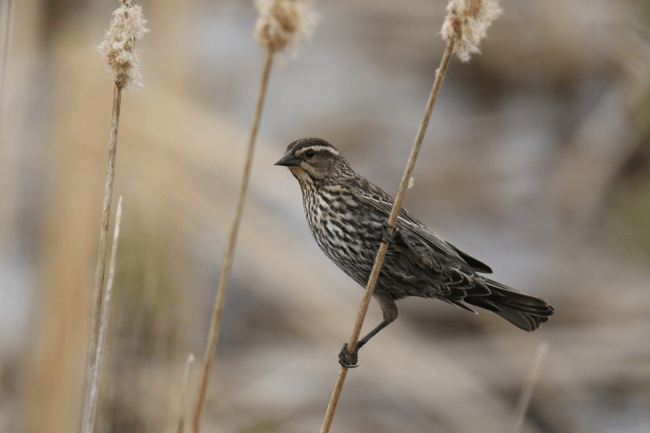
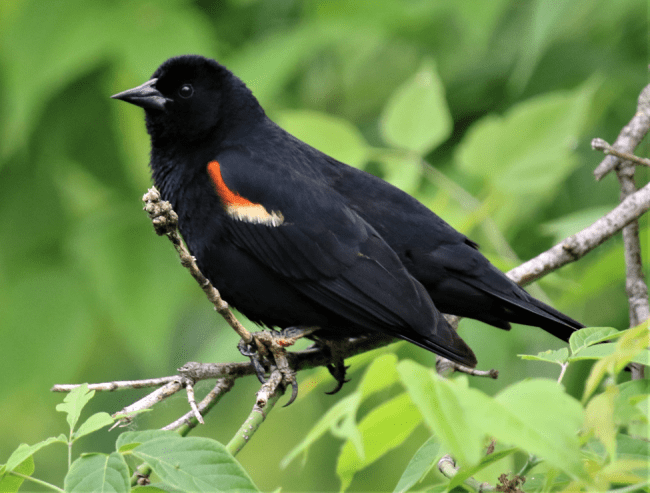
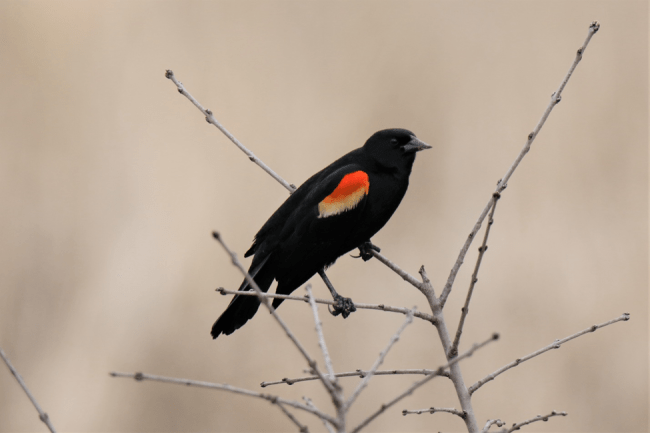
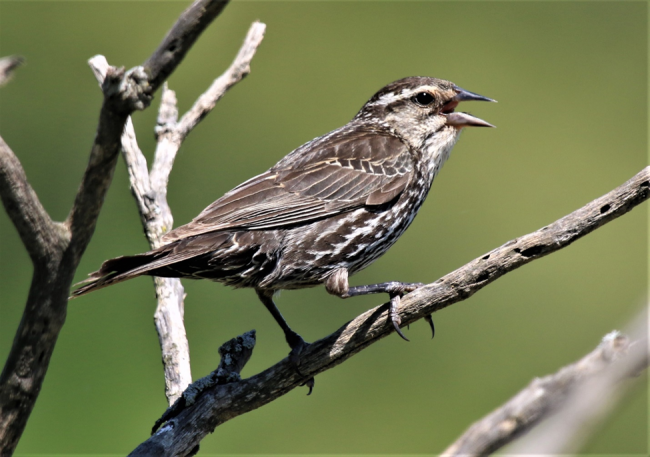
Red-winged Blackbirds are one of my favorite icterid (blackbird family) birds. The males sport colorful epaulets (i.e., shoulder-wing feather “bars”) of pale yellow and red stripes, which contrast strikingly against their otherwise glossy black plumage. The females have a more camouflage-hued brownish plumage, accenting the brown feathers with ivory-white mottling and outlining (and “eyebrows”).
Above and below are some splendid photographs taken by Christian/creationist wildlife photographer (in Minnesota), showing how beautiful (and plentiful) these Red-winged Blackbirds can be.
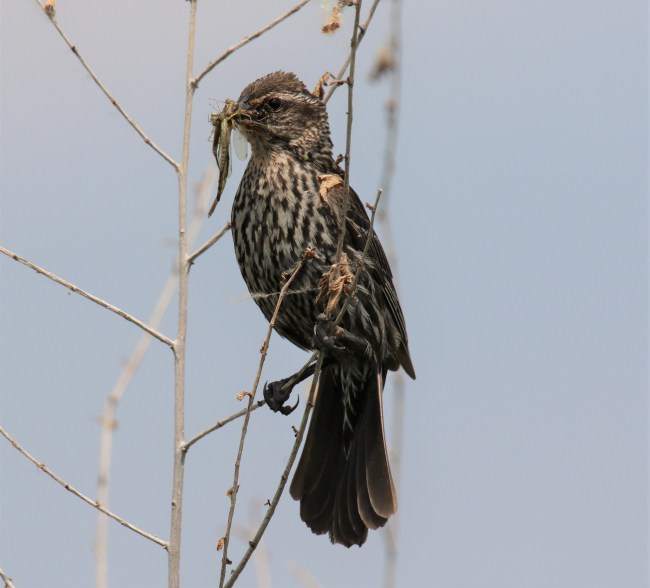
Red-winged blackbirds are not picky eaters — although they mostly eat plant material, such as seeds (including seeds from various weeds, from birdfeeders, as well as from rice or other grain seeds) and available berries (including blackberries and blueberries). Redwings also eat a mix of small animals, especially insect adults and larvae (including flies, moths, butterflies, dragonflies), spiders, earthworms, periodical cicadas, and even snails.
RED-WINGED BLACKBIRD FEMALE, perching with prey (photo credit: BRYCE GAUDIAN)
How nice it would be to see Red-winged Blackbirds perching upon cattails that constitute a fence-like edge along a pond-shore or a drainage ditch!
Thank You, Lord, for making these marsh-loving icterids.
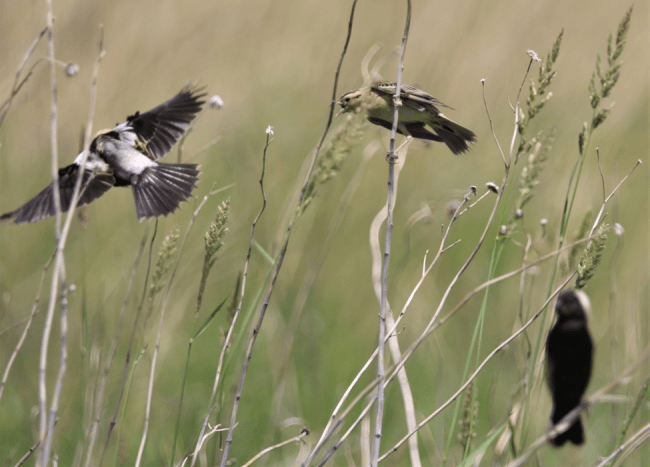
SEED-LOVING BOBOLINKS, GROUND-NESTING IN GRASSLANDS
Dr. James J. S. Johnson
BOBOLINKS in grassland habitat, Minnesota (photo credit: Bryce Gaudian)
If a bird’snest chance to be before thee in the way in any tree, or on the ground, whether they be young ones, or eggs, and the mother sitting upon the young, or upon the eggs, thou shalt not take the mother with the young.
(Deuteronomy 22:6)
Moses noted that some wild birds build their nests upon the ground; Bobolinks do just that.
Years ago, I reported on the Black-capped Chickadee, noting that I first saw one at Gilsland Farm Sanctuary, while attending a wetland ecologists’ meeting: “Decades ago, I saw Black-capped Chickadees, for the first time, in Falmouth (near Portland), Maine – at the Gilsland Farm Sanctuary (now called “Gilsland Farm Audubon Center”), on May 31st of AD1995, while attending the annual national meeting of the Society of Wetlands Scientists.” [Quoting from “Tiny Yet Tough: Chickadees Hunker Down for Winter”, posted at https://leesbird.com/2016/11/18/tiny-yet-tough-chickadees-hunker-down-for-winter/ .]
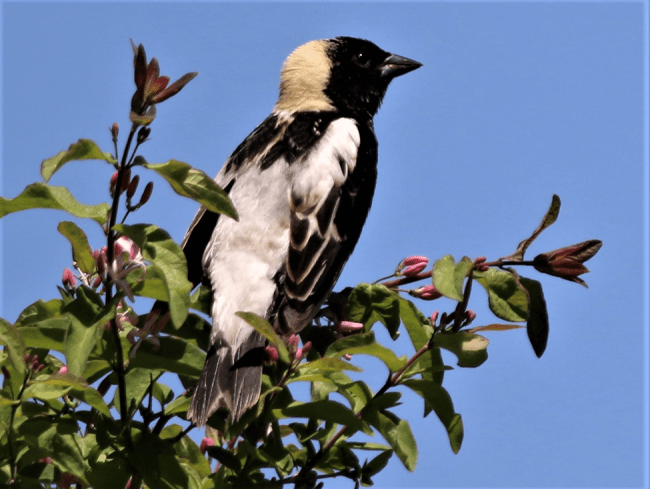
Another “lifer” that I then observed that day, at Gilsland Farm Sanctuary, was the BOBOLINK. And what a striking plumage the male Bobolink has, during breeding season!
BOBOLINK MALE in breeding plumage, Minnesota (photo credit: Bryce Gaudian)
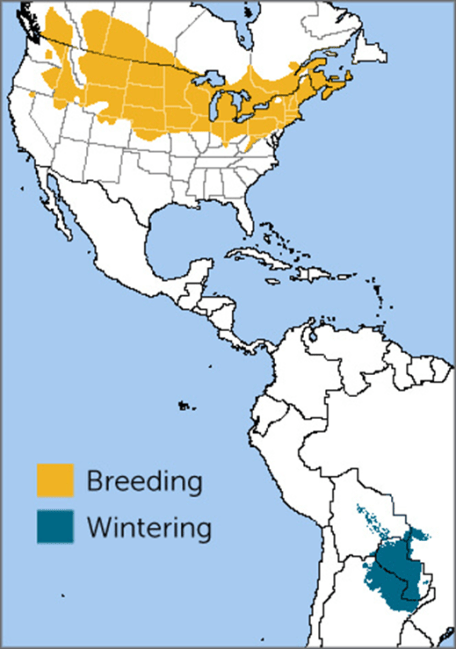
Bobolinks (Dolichonyx oryzivorus) are icterids (blackbirds of the Western Hemisphere), dwelling in America’s prairie and pasture grasslands and marshy wetlands during the warm months of the year. Bobolinks were nicknamed “rice birds” (which matches their species name, oryzivorus, meaning “rice-eating”), due to their dining habits, especially during autumn migrations.
The Bobolink genus name, Dolichonyx, means “long claw”, matching its prehensile perching “fingers”.
During such migrations Bobolinks frequently feed in farmed fields of rice and other grains (such as oats, sorghum, maize corn, and hayseed), at energy-packing refueling stopovers (e.g., in South Carolina and the Gulf states), on their aerial journeys southward, via Caribbean islands, en route to South American over-wintering range destinations.
Bobolinks feed on (or near) the ground, eating various seeds, insects, spiders, and even snails—especially during breeding seasons. Both larvae and adults of insects (especially armyworm moths) are protein-rich, much needed for growing Bobolink juveniles.
Also, during breeding seasons, Bobolinks depend upon available hay for nest-building, on the ground, in vegetated areas.
Bobolinks are quite specific in their breeding habitat needs. Open hay fields are a must, and so as farming is some regions of the country diminishes, so do populations of bobolinks. Where colonies of bobolinks have traditionally bred, it is important to preserve their habitat with regular mowing practices. Unfortunately, the right time to mow a field for hay is often just when the young are fledging[!]. Careful observation of the behavior of a [bobolink] colony and delaying of mowing until one or two weeks after fledging, a time when the young can fly fairly well, will keep a colony producing and ensure its [multi-generational] survival.
[Quoting Donald W. Stokes & Lillian Q. Stokes, A GUIDE TO BIRD BEHAVIOR, Volume III (Boston: Little, Brown & Company/Stokes Nature Guides, 1989), pages 351-352.]
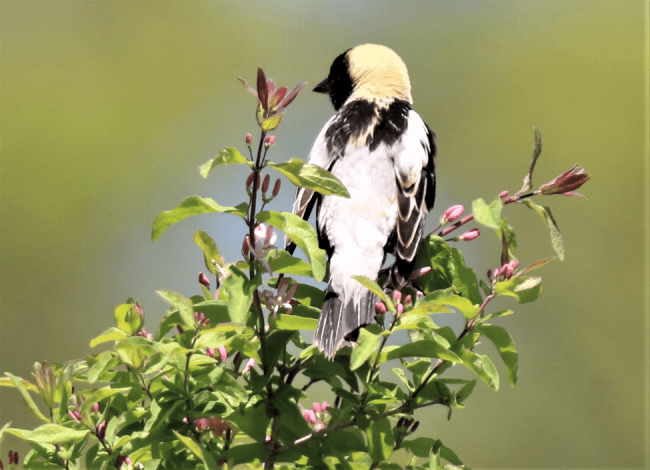
BOBOLINK MALE in grassland habitat, Minnesota (photo credit: Bryce Gaudian)
Consequently, Bobolinks are easier to find in habitats where their needs for food and nesting are plentiful.
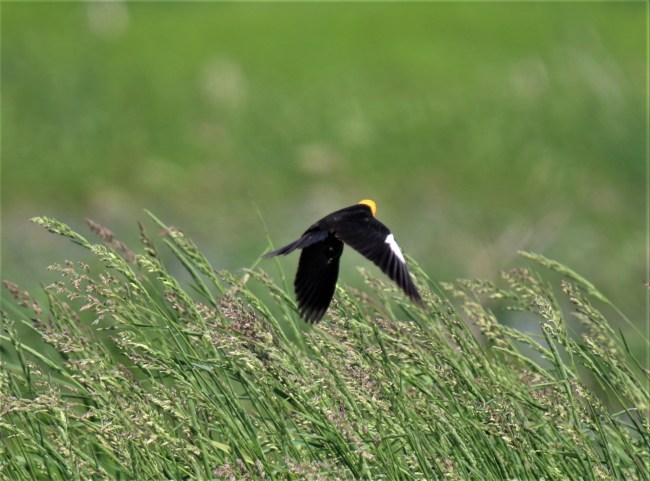
BOBOLINK male in flight, prairie habitat, Minnesota (photo credit: Bryce Gaudian)
The males have easily seen plumages—like reverse tuxedos (white upon black) in spring and summer, during breeding months.
Male and female bobolinks are easily distinguished during the breeding season. Males have a black head, belly, and wings, with a buff-gold nape and white patches on the back. The female is buff [and brown] colored all over with dark streaks on her back, wings, and sides.
[Quoting Donald W. Stokes & Lillian Q. Stokes, A GUIDE TO BIRD BEHAVIOR, Volume III (Boston: Little, Brown & Company/Stokes Nature Guides, 1989), pages 364.]
During non-breeding months, however, Bobolink males shift to duller hues of dark and light browns, similar to the year-round plumage of Bobolink females and juveniles.
Of course, these tweety-chirpy icterids breed elsewhere in spring – in most of the upper half of America’s Lower 48, from the Northeast’s coastlines almost as far wet as the coasts of Washington and Oregon. Accordingly, the Bobolink migrates about 6,000 miles southward or northward, so it accrues about 12,000 miles per year, in air miles.
American Bird Conservancy range map
It was a privilege to see Bobolinks, back in AD1995, at the Gilsland Farm Sanctuary, as part of my time attending the Society of Wetlands Scientists’ meeting.
Likewise, it’s a privilege, now, to be permitted to share some of the wonderful Bobolink photographs taken in Minnesota, by Christian/creationist photographer BRYCE GAUDIAN — thanks, Bryce!
And now, it’s time for a limerick, about Bobolinks.
This shall be written for the generation to come; and the people who shall be created shall praise the LORD.
(Psalm 102:18)
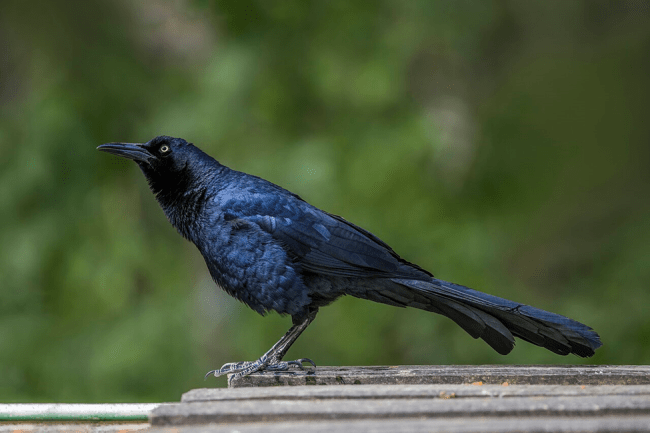
GREAT-TAILED GRACKLE (male) Charles J. Sharp / Wikipedia photo credit
Last weekend, I drove past a familiar Texas pond, where 11 years ago I saw a “common” black-feathered bird (i.e., Quiscalus mexicanus = Great-tailed Grackle, to be exact), and was then jolted by an “uncommon” (and somewhat-scary) realization – God could have made me a grackle!
Days later, during the summer of AD2012, I reported this important thought (and attitude fo gratitude) within an article [“Grackles and Gratitude”, ACTS & FACTS, 41(7):8-10 July 2012), posted at www.icr.org/article/grackles-gratitude ] about how uniquely and personally each one of us is, created by the Lord Jesus Christ, as exactly the specific individual that each one of us is.
When was the last time that you saw a bird—perhaps a grackle or a pigeon—and shuddered with the scary realization: That could have been me! Maybe you have never thought about a grackle that way. Yet it is true—God did not need to make us just as we are. He had many other options. God could have created each of us as a bird, a butterfly, or a basalt rock. God could have made you or me a uranium-bearing rock, a nudibranch, an ice worm, a quince fruit, an ultraviolet ray, or an egret.[Notice the acrostic in the previous sentence: U.N.I.Q.U.E.!]
Yet, He deliberately chose otherwise. He chose to make us one-of-a-kind humans. What a fearful and wonderful reality!…
Surely we should thank Christ for being our very personal Creator. So the next time you see a grackle, think thankfully for a moment, “That could have been me!” And be grateful to your Creator, who made you a unique, one-of-a-kind creation.
[Quoting JJSJ’s “Of Grackles and Gratitude”)
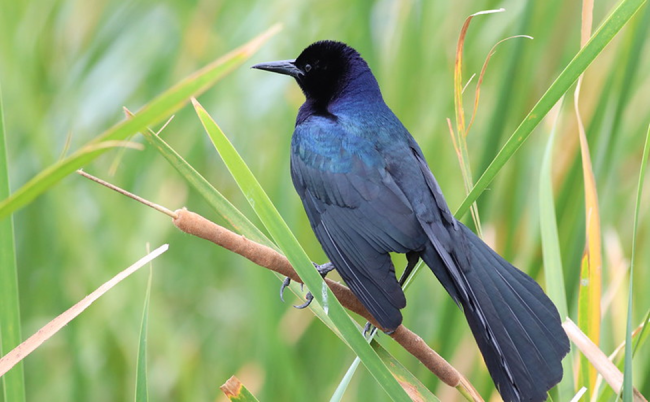
GRACKLE ON CATTAILS (BirdNote / Gary Leavens photo credit)
So, what an echo from yesteryear it was, last weekend, when I spied another “common” grackle (actually a Great-tailed Grackle, which is common in Denton County, Texas), ambling about the littoral cattails of that same pond that I drove by more than a decade ago.
Whew! What a journey the past 11 years have been, as I quickly recall and reconsider (and gratefully appreciate) God’s many personal and providential blessings unto me – including His kind and caring blessings that continue to make me the individual man I am – along with the many other blessings of His redemptive and always-sufficient grace, over those 11 years since that important icterid-aided insight.
Plus, the best is yet to come (Luke 10:20)! So, thinking of Psalm 102:18, I close this nostalgic memoir with a limerick:
AN ATTITUDE OF GRATITUDE, ON SEEING A GRACKLE IN THE CATTAILS
Some troubles, in life, we must tackle,
Threatening us, with harm, like a jackal;
Yet life, itself, we can face,
Since life, itself, is God’s grace —
Each of us, God could’ve made, a grackle!
COMMON GRACKLE on Cattail (National Park Service photo credit)
After Being Buried for 350 Years, Nottingham Sheriff’s Two Swans Reappear
Dr. James J. S. Johnson
And the swan [הַתִּנְשֶׁ֥מֶת], and the pelican, ….
(Leviticus 11:18)
Recently (today being June 26th of AD2023), an ancient (about 350 years old!) gold signet ring of interest to birdwatchers –– was found by a man in Nottingham (England), using a metal detector.
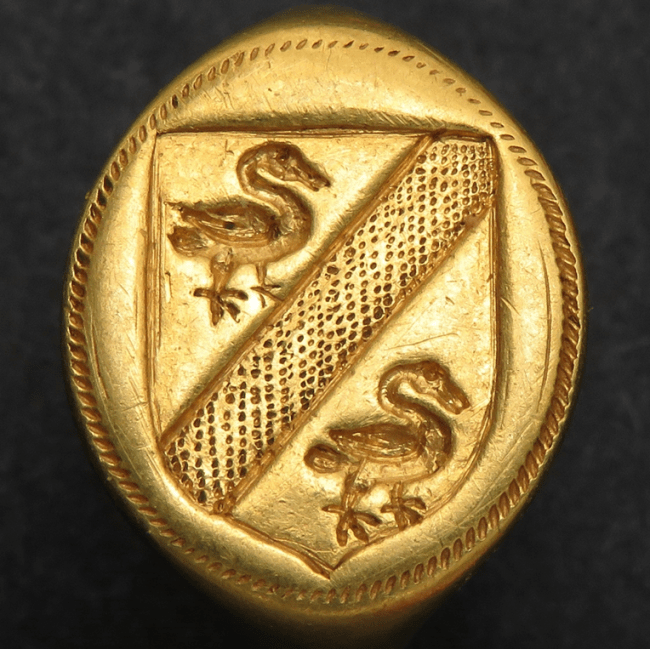
But why would this ancient ring be of interest to birdwatchers? Because the signet ring displayed an armorial coat of arms that features 2 birds that look like swans or geese. In fact, the 2 birds are swans.
Nottingham sheriff’s old signet ring (public domain image)
It was found by Graham Harrison, a retired British Merchant Navy engineer, according to a news report (that was recently brought to my attention by my good wife):
“Graham Harrison spends his time searching the hills in his town with a metal detector, in hopes of finding something special. The former merchant navy engineer struck gold, quite literally, in the form of a 350-year-old gold signet ring that was owned by Nottingham’s most famous sheriff. The ring belonged to Sir Matthew Jenison who was the Sheriff of Nottingham from 1683 and 1684, looking after the famous Sherwood Forest. Harrison found the ring on farmland about 26 miles from the forest. After finding the ring, he sent it to the British Museum’s Portable Antiquities Scheme where it was authenticated. ….
[An auctioneer’s expert] consultant valuer Adam Staples said, ‘The ring has survived in near perfect condition and the front face bears a detailed engraving of the Jenison family arms, two swans separated by a diagonal bend. This would have been pressed into melted wax in order to seal the family crest on important letters and documents’. … Jennison [who served as Nottingham’s Sheriff, guarding England’s Sherwood Forest, once home to the original Robin Hood] was born in 1654 and became a knight in 1683. As sheriff, his job was to keep watch on the trees in the Sherwood Forest. Despite starting his life defending the law, and being elected to British parliament, Jenison got himself jailed for refusing to pay legal costs from a lawsuit he was involved in … [eventually dying] in prison in 1734.”
Quoting Christina Williams, “Retiree Unearths 350-year-old Ring”, THE DAILY ACORN (May 23rd AD2023)
Whooper Swans of Great Britain (photo image credits: from The Royal Society for the Protection of Birds)
The Hebrew word translated “swan” in Leviticus 11:18 (and also in Deuteronomy 14:16) is tinšemeh, meaning breath/wind-blower, derived from the Hebrew root verb nâšam, denoting the noise of wind blowing or someone breathing. Swans are like avian woodwind instruments, famous for their vocalized nasal-sounding noises—honking, trumpeting, whooping, etc.
Since the typical swan having winter range in England is the Whooper Swan (Cygnus cygnus), it’s most likely that the signet ring displays a pair of Whooper Swans. In fact, even today there are whooper swans in England, according to Nottinghamshire Wildlife Trust ( www.nottinghamshirewildlife.org/wildlife-explorer/birds/waterfowl/whooper-swan ); these huge (and noisy) waterfowl have been protected in England since AD1981, pursuant to the Wildlife and Countryside Act.
And, thanks to conservation efforts, the United Kingdom is now seeing more swans–especially whooper swans–in places like Northern Ireland, Scotland, and England (especially East Anglia and northern England, not far from the Sherwood Forest that Nottingham’s Sheriff was famous for guarding).
Flag of Nottinghamshire, England (public domain image)
One may wonder, looking at the ring’s engraved impression, how many times those 2 swan molds were used to squish and shape melted wax into a 3-dimensional seal, leaving a wax-hardened bas-relief image of 2 swans upon the wax seal of some legal document that recorded official business of England’s Sheriff of Nottingham.
Of course, signet rings have been around–being used by government officials to solemnify and authenticate legal documents for many centuries. For example, the Persian king’s signet ring played an important role in the political drama recorded in the Old Testament’s book of ESTHER.
And the king took his ring from his hand, and he gave it unto Haman the son of Hammedatha the Agagite, the Jews’ enemy.
(Esther 3:10)
Notice that the Persian king’s ring was a signet ring that was used to seal official documents.
Then were the king’s scribes called on the thirteenth day of the first month, and there was written according to all that Haman had commanded unto the king’s lieutenants, and to the governors that were over every province, and to the rulers of every people of every province according to the writing thereof, and to every people after their language; in the name of king Ahasuerus was it written, and sealed with the king’s ring.
(Esther 3:12)
In the above-quoted verses the king’s signet ring was used by a wicked government official, Haman.
Esther 8:2 (public domain image)
However, later–thanks to God’s providence (in answer to fervent prayers of God’s people)–the king’s signet ring was used by Haman’s adversary, Mordecai, to secure a work-around solution that overcame the evils done by Haman.
And the king took off his ring, which he had taken from Haman, and gave it unto Mordecai. And Esther set Mordecai over the house of Haman. … Write ye also for the Jews, as it liketh you, in the king’s name, and seal it with the king’s ring: for the writing which is written in the king’s name, and sealed with the king’s ring, may no man reverse. … And he [i.e., Mordecai] wrote in the king Ahasuerus’ name, and sealed it with the king’s ring, and sent letters by posts on horseback, and riders on mules, camels, and young dromedaries ….
(Esther 8:2 & 8: & 8:10)
Thank God for His kind and caring providences! Without God’s providential care we have no hope!
Meanwhile, most signet rings–although important–are not used for such Earth-shaking intrigues. And, in the case of the Nottingham Sheriff’s signet ring, obscurity lasted 350 years, buried underground.
So, there you have it—a gold signet rings bearing 2 swans, within the sheriff’s armorial coat of arms. Those 2 engraved swans had to wait 350 years to see the life of day (so to speak), again, after being buried. Wow! That almost makes me want to buy a metal detector!—who knows what I might find?
WHOOPER SWAN in Great Britain (BBC photo credit)
ABOUT THE AUTHOR: Dr. James J. S. Johnson has been a birdwatcher since 2nd grade, thanks to Mrs. Thelma Bumgardner, who gave him his 1st bird-book (which he still has). Jim has taught ornithology and ecology at Dallas Christian College, for ACSI, for ICR-SOBA, and has served as a naturalist-historian guest lecturer aboard 9 different international cruise ships, for a half-century observing many birds in many places, including in Great Britain. profjjsj@aol.com ><> JJSJ
But they that wait upon the LORD shall renew their strength; they shall mount up with wings as eagles; they shall run, and not be weary; and they shall walk, and not faint.
( Isaiah 40:31)
Therefore, seeing we also are compassed about with so great a cloud of testifying-witnesses [μαρτυρων ], let us lay aside every weight, and the sin which doth so easily beset us, and let us run with patience the race that is set before us.
Seeing a Greater Roadrunner (Geococcyx californianus, a/k/a Chaparral Bird) scampering about in the grass, near the east side of my lawn, last Friday (12 May, A.D.2023), reminded me of the hidden-in-plain-view miracle of running. Roadrunners are cuckoo-like birds, capable of flight yet more famous for on-the-ground running (including chasing and catching insects and reptilian prey), easily recognizable by their skinny-chicken-looking bodies, sporting long tails, scissors-like beak, and prominent crest feathers.
GREATER ROADRUNNER in Mojave Desert, California ( photo credit: Wikipedia / Jessie Eastland )
Running is an astounding activity, although we rarely think of running that way. (And chasing is even more amazing, because it involves 2 creatures running at the same time, with one trying to catch while the other tries to escape!). However, if we only saw an animal–or a human–running once in a lifetime we might recognize the physiology of running as the God-given miracle that is. But, because we see creatures run about, frequently, we lose sight of how astonishing the action of running really is.
Running requires coordinated and energetic movement, integrating purpose, distance, and body parts and systems working together with teamwork (see 1st Corinthians chapter 12), so the bioengineering needed to enable running is an energetic and ongoing exhibit of the Lord Jesus Christ’s empowering genius and wisdom. (See, accord, Randy J. Guliuzza, “Made in His Image: Beauty in Motion”, posted at http://www.icr.org/article/beauty-motion# .)
Children assume that running is normal; grandparents watch runners with nostalgia, remembering when sprinting felt effortless. Running, if and when it is accomplished with ease, is a blessing–the ability to run is a marvelous gift from our God Who invented the ability to run. In fact, the Lord gave the gift of running to more than just human children, and athletes who are older than children–He gave the gift of running to many of the animal He created.
CHEETAH running (Answers in Genesis photo credit)
Among mammal s, notable runners include feline family (such as cheetah, jaguar, and cougar, sprinting at speeds near 70 mph!), antelope-like beasts (such as pronghorn, springbok antelope, and Indian blackbuck antelope, reaching speeds of 50 to 60 mph), wildebeest (running at 50 mph), and even bats (such as free-tailed bat, flying at 60 mph!). Other fast-footed mammals include the African lion and the hare (both climaxing at almost 50 mph, and running longer distances at lesser speeds), as well as the African wild dog and Australia’s kangaroo (both climaxing at almost 45 mph).
But, what about birds? Many birds move at speeds that are mind-boggling, such as the figure-eight wing-beating of hummingbirds, which appear as blurs to the watching eyes of human spectators–some capable of speeds above 40 mph!)..
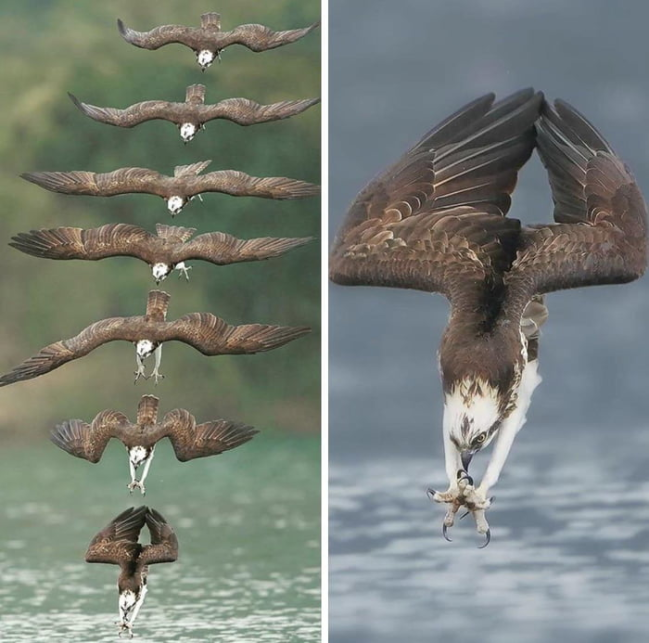
Likewise, birds can fly at high speeds, both horizontally and especially when “dive-bombing” (a/k/a stoop diving) downward—think of falcons (e.g., Peregrine Falcon, with horizontal speeds up to almost 70 mph, and diving speed above 240 mph!). Likewise, eagles are famous for their speed (e.g., Golden eagle, with horizontal speed near 30 mph, and diving speed near 200 mph).
EAGLE diving down! ( photo credit: 9gag.com )
Indeed, the Holy Bible refers to the eagle’s speedy flight more than once.
Saul and Jonathan were lovely and pleasant in their lives, and in their death they were not divided: they were swifter than eagles, they were stronger than lions.
( 2nd Samuel 1:23 )
Our persecutors are swifter than the eagles of the heaven: they pursued us upon the mountains, they laid wait for us in the wilderness.
( Lamentations 4:19 )
Yet birds can be rapid runners on ground, too–with the Roadrunner being the classic example of a bird famous for running.
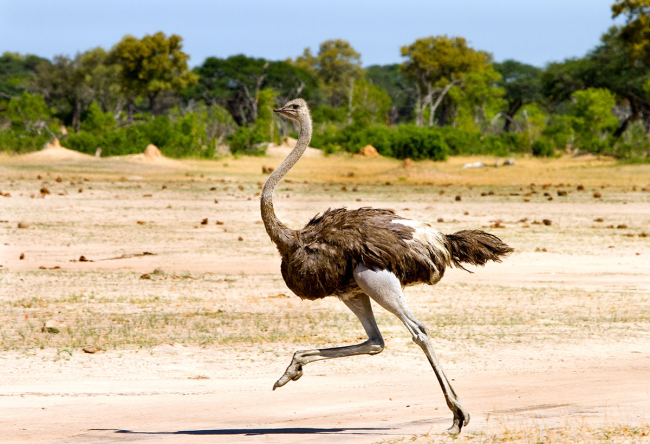
OSTRICH running ( photo credit: Thomson Safaris )
Actually, Africa’s Ostrich runs faster, achieving speeds up to 43 mph (with some reports of quick sprint-bursts up to 60 mph!), qualifying the Ostrich as the fleetest terrestrial runner among birds! Ostriches have stamina, too, so they can sustain speeds above 30 mph for a half-hour or even longer–no human can do that! Behind the Ostrich, Australia’s Emu (a smaller ratite) zooms by, racing at speeds above 30 mph.
ROADRUNNER with prey (photo credit: Nature Picture Library)
Yet the Greater Roadrunner, a much smaller bird, can dart about at speeds above 25 mph–faster than even fleet-footed children.
So, you get the picture–running is a big deal! On that note I’ll quit–i.e., rest–because I ‘got tired” just thinking about all of those creatures running to and fro. Actually, to be frank, I NEVER GET TIRED! Why? I don’t “get tired” because I stay tired.
:)
GREATER ROADRUNNER at Caprock Canyons State Park in West Texas ( photo credit: Wikipedia / drumguy8800 xvisionx.com )
Having arrived at this blogpost’s “finish line”, I’ll contribute this limerick:
STARTLED BY A ROADRUNNER ZIGZAGGING IN THE GRASS
After filling my mower with gas,
I was cutting my east lawn’s grass;
Whoa! — it gave me a start!
‘Twas a bird that did dart!
Wow! Texas roadrunners run fast!
ROADRUNNER, on the run! (photo credit: Wikipedia / El Brujo+ )
County Caithness Can Now Rave about their Raven Flag
Dr. James J. S. Johnson
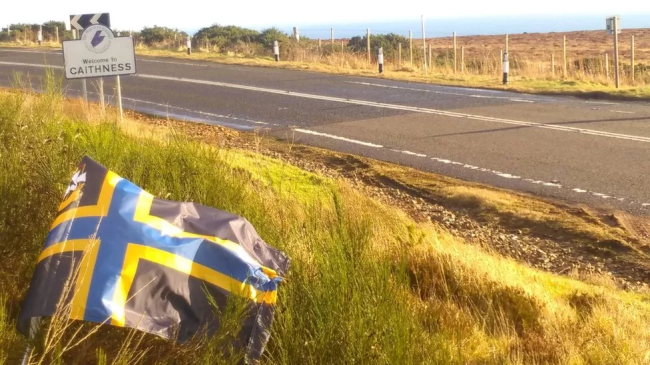
CAITHNESS flag by roadside (BBC photo credit)
Who provides for the raven his food? — when its young ones cry unto God, they wander for lack of meat.
( Job 38:41 )
Having a bird featured upon an official flag is nothing new, so the above flag of Scotland’s County Caithness, which became official (ceremonially celebrated January 26th of A.D.2016) is not a novel concept.
Flag Institute unveiling of County Caithness flag (BBC photo credit)
However, that vexillological event was and is worth noticing, especially to all of us who appreciate ravens — including Mrs. Lee Dusing, and the rest of us who appreciate her world-class bird-blog! (E.g., see one of Lee’s several blogposts, on ravens (and other corvids), at https://leesbird.com/2013/07/03/birds-of-the-bible-raven-iii/ .)
In fact, the first bird to be named (by its kind) within the Holy Bible was a raven. WOW! That’s quite an incomparable honor!
And he [i.e., Noah] sent forth the raven [‘ōrēb], which went forth to and fro, until the waters were dried up from off the earth.
( Genesis 8:7 )
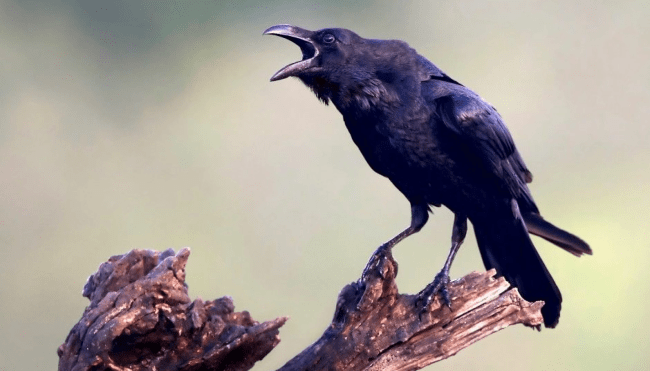
COMMON RAVEN of North America (Wikipedia photo credit)
Likewise, the godly Bible translator and leading Reformer, Dr. Martin Luther, carefully observed and appreciated flocks of ravens (and jackdaws, their corvid cousins), during the adventurous times of the Protestant Reformation’s first generation in Germany. (See “A Diet of Jackdaws and Ravens”, posted at https://leesbird.com/2015/09/16/a-diet-of-jackdaws-and-ravens/ .)
Obviously, ravens are special birds, because God providentially cares for their kind — and tells us so in the Scriptures!
For example, in the Old Testament, within God’s creation sermon to the patriarch Job, Job was questioned about how God takes spare of ravens.
Who provides for the raven his food? — when its young ones cry unto God, they wander for lack of meat.
( Job 38:41 )
Likewise, in the New Testament, the Lord Jesus Christ refers to God’s provision for the physical needs of ravens.
Consider the ravens: for they neither sow nor reap; which neither have storehouse nor barn; and God feeds them; how much more are ye better than the fowls?
( Luke 12:24 )
Ravens are something to rave about!
RAVEN in Norway ( ScienceNorway.NO Dennis Jacobsen, Colourbox photo credit )
ISLE OF MAN’s Coat of Arms, with Peregrine and Raven (public domain)
In fact, this Christian birdwatching blog has previously blended ornithology (i.e., systematic study of birds) with vexillology (i.e., systematic study of flags). Specifically, years ago (during A.D.2015), this bird-blog features a mini-series captioned “FLAG THAT BIRD!” — about flags of the world that feature a bird.
So, this blogpost, celebrating the Caithness Raven, now succinctly supplements that ornithological-vexillological series.
Official flag of Scotland’s County CAITHNESS (public domain image)
Caithness thus celebrates its Viking heritage, with a flag that contains a Nordic cross, plus the raven of antiquity, well known to Viking literature, along with a galley ship, reminiscent of ocean-faring adventures of northeastern Scotland’s Viking forebears, some who came as visitors, yet many who settled as immigrants, blending in with native Celts, providentially producing future generations of Count Caithness natives (Psalm 102:18).























 Lee's Birdwatching Adventures Plus