Birds of the Bible – Isaiah 34:11

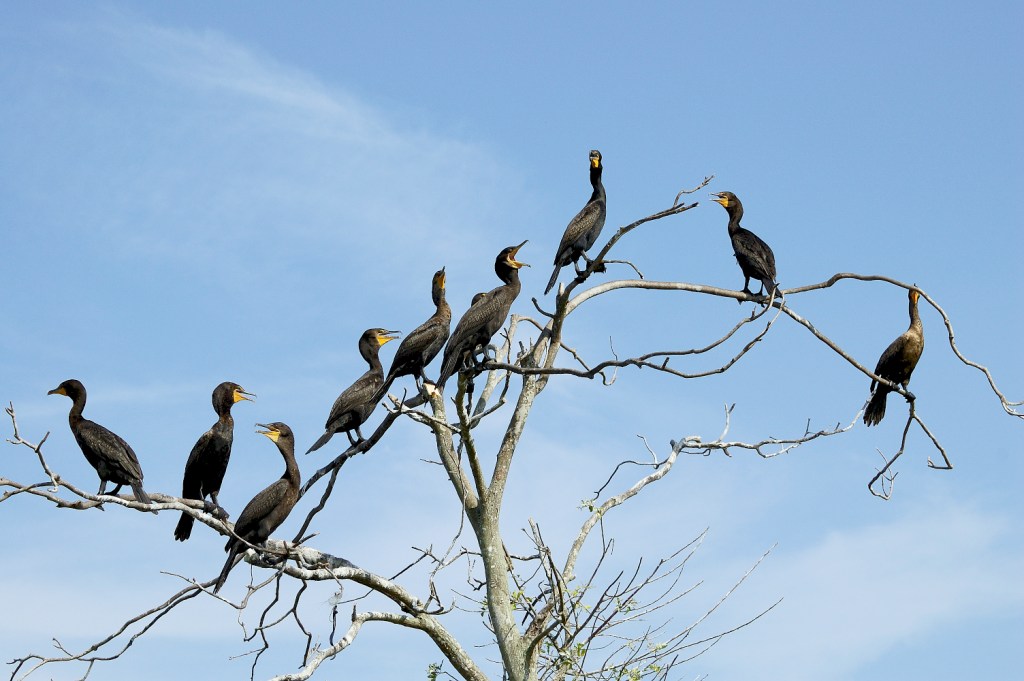
Double-crested Cormorant (Phalacrocorax auritus) at Lake John Rookery, Lakeland, FL By Dan

Double-crested Cormorant (Phalacrocorax auritus) at Lake John Rookery, Lakeland, FL By Dan

But the cormorant and the bittern shall possess it; the owl also and the raven shall dwell in it: and he shall stretch out upon it the line of confusion, and the stones of emptiness. (Isaiah 34:11 KJV)

This may seem like a simple verse in the middle of a passage telling about the day of the LORD’S vengeance in Isaiah 34:8-17.

Wesley says: “For – This is the time which God hath fixed, to avenge the cause of his persecuted people.”

John Wesley says: “Isaiah 34:11  Dwell – It shall be entirely possessed by those creatures which delight in deserts and waste places…”

Believer’s Bible Commentary: “(34:8) It is the day of the Lord’s vengeance. “The word ‘vengeance’ is of crucial importance. It does not mean getting even with someone, as we use it. It refers to God’s action in carrying out the sentence which He as Judge has justly imposed
(34:9-17) This passage describes Edom’s fate—a blazing inferno, an uninhabited waste, taken over by mysterious birds and wild beasts. God will not stop until it is without form and void. There will be no kingdom, no king, no princes worthy of the name. Its ruins will be overgrown with thorns and it will be a sanctuary for strange creatures (which cannot be identified with certainty). Every weird creature will have a mate, and thus will reproduce, and God has given them the ruins of Edom to possess . . . from generation to generation. Forever in this chapter (vv. 10, 17) means from generation to generation.”
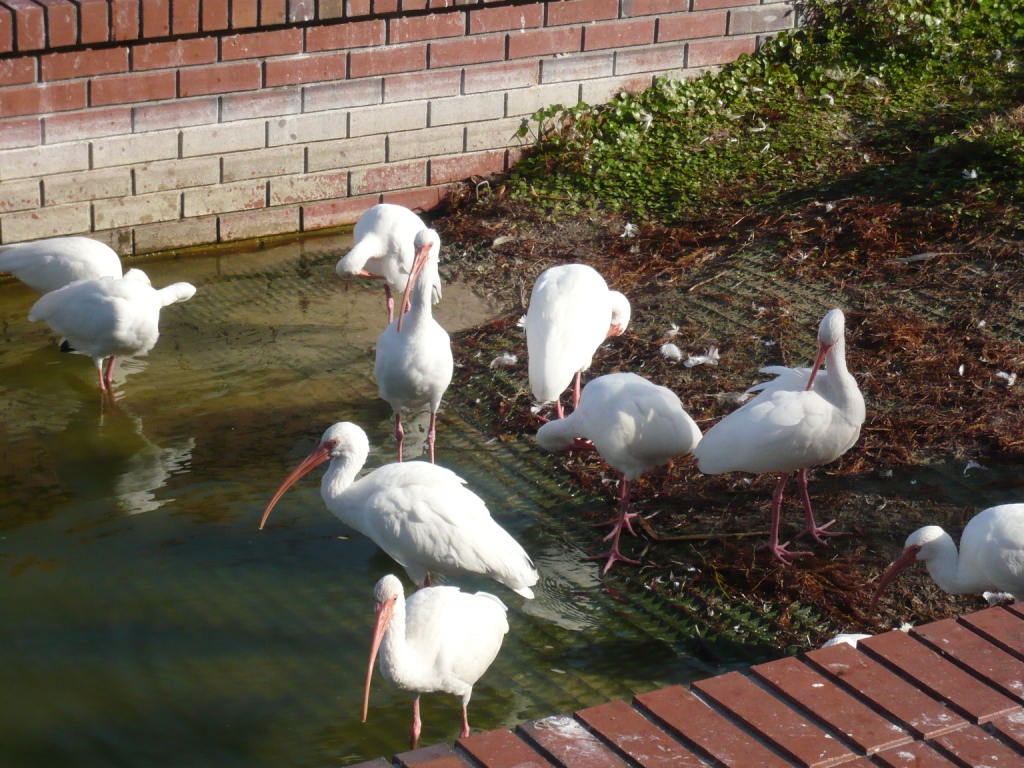
American White Ibis (Eudocimus albus) by Dan at Lake Morton

White Ibises at Lake Morton by Dan

That is the “simple” explanation of what the verses are about. It becomes interesting when you compare these verses, again using e-Sword, as to which birds are being referenced. I like the quote about the “mysterious birds” because the translators are not even for sure which birds they are that are going to be inhabiting the place. Let’s investigate the verses.

APB+ – “Birds, and hedgehogs, and ibises, and crows shall dwell in her”
ASV – “The pelican and the porcupine shall possess it; and the owl and the raven shall dwell therein”
BBE – “birds of the waste land will have their place there; it will be a heritage for the bittern and the raven”
Brenton – “and for a long time birds and hedgehogs, and ibises and ravens shall dwell in it:
CEV – “Owls, hawks, and wild animals will make it their home. God will leave it in ruins, merely a pile of rocks.”
Darby – “And the pelican and the bittern shall possess it, and the great owl and the raven shall dwell in it.”
DRB – “The bittern and ericius shall possess it: and the ibis and the raven shall dwell in it:”
ERV – “Birds and small animals will own that land. It will be a home for owls and ravens. God will leave that land in ruins. People will call it “the empty desert.”
ESV – “But the hawk and the porcupine shall possess it, the owl and the raven shall dwell in it.”
GNB – “Owls and ravens will take over the land.”
GW – “Pelicans and herons will take possession of the land. Owls and crows will live there.”
ISV – “But hawks and hedgehogs will possess it; owls and ravens will nest in it.”
JPS – “But the pelican and the bittern shall possess it, and the owl and the raven shall dwell therein;”
KJV – “But the cormorant and the bittern shall possess it; the owl also and the raven shall dwell in it:”
KJV-1611 – “The cormorant and the bitterne shall possesse it, the owle also and the rauen shall dwell in it,”
LITV – “But the owl and the hedgehog shall possess it; and the eared owl and the raven shall live in it.”
MKJV – “But the pelican and the bittern shall possess it; the owl also, and the raven, shall dwell in it.”
NASB – “But pelican and hedgehog will possess it, And owl and raven will dwell in it;”
NKJV – “But the pelican and the porcupine shall possess it, Also the owl and the raven shall dwell in it.”
RV – “But the pelican and the porcupine shall possess it; and the owl and the raven shall dwell therein:”
Webster – “But the cormorant and the bittern shall possess it; the owl also and the raven shall dwell in it”
YLT – “And possess her do pelican and hedge-hog, And owl and raven dwell in her,”
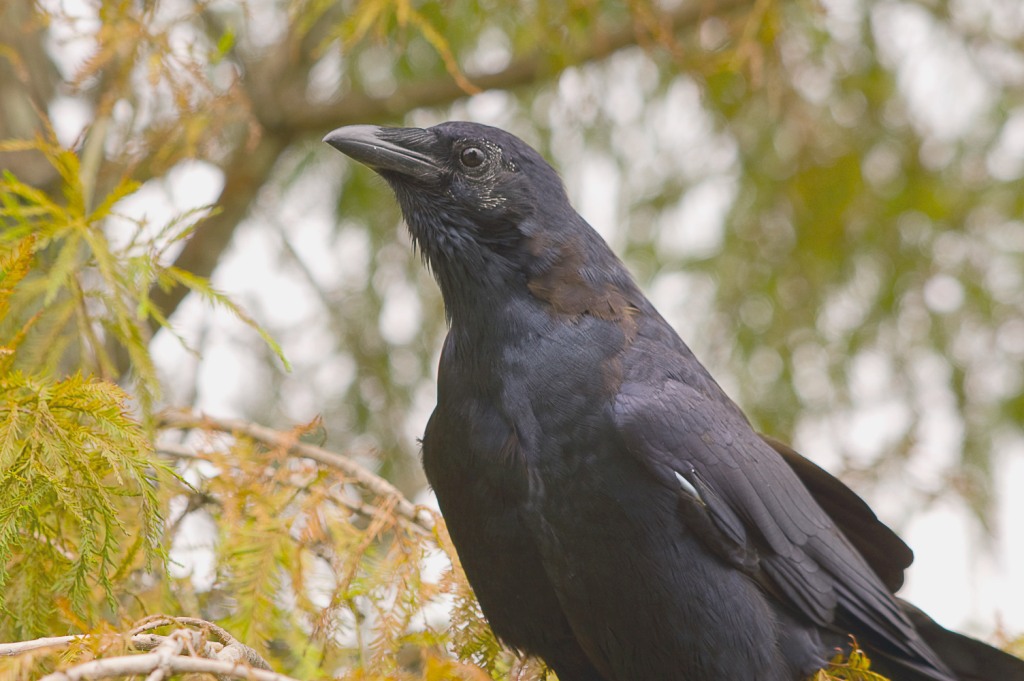
Fish Crow (Corvus ossifragus) at Lake Morton By Dan'sPix

Fish Crow (Corvus ossifragus) at Lake Morton By Dan’sPix

What caught my interest in this verse was that the Crow came up in a search for possibly some different Birds of the Bible to write about. Not only did I find the Crow, but also Ibises, which we see plenty of in this area. I always find it amazing how much they differ, but yet if you look at the birds and their families, many are related or closely related.

Most of the second half of the quotes mention the “Owl and the Raven.” The Darby uses “Great Owl”, the LITV uses “Eared Owl” and some use “owls.” No problem there. Some though use “Ibis/Ibises or Bittern” (APB, BBE, Brenton, DRB) instead of the “Owl.” The word “yanshûph or yanshôph” H3244- “an unclean (aquatic) bird; probably the heron (perhaps from its blowing cry, or because the night heron is meant (compare H5399)): – (great) owl.” Apparently the word is unclear and could go either way. Also, the Ibis is in the  Threskiornithidae – Ibises, Spoonbills Family and the Bitterns and Herons (GW) are in the Ardeidae Family, both of which are in the same Pelecaniformes Order. So they are close relatives. Also the Pelican and the Cormorant are mentioned in the first part of the verses. It is easy to figure out which Order the Pelican belongs to and it is in the Pelecanidae – Pelicans Family. The Cormorant is in the next Order which leaves it nearly related. The Suliformes Order has the Phalacrocoracidae – Cormorants, shags Family. As a note in passing, up until this year, the Cormorant was in the Pelecainformes Order. Not trying to be too detailed, but just showing that even though the translators used different birds, many are related and it doesn’t change my confidence in God’s Word. He promised to preserve it.
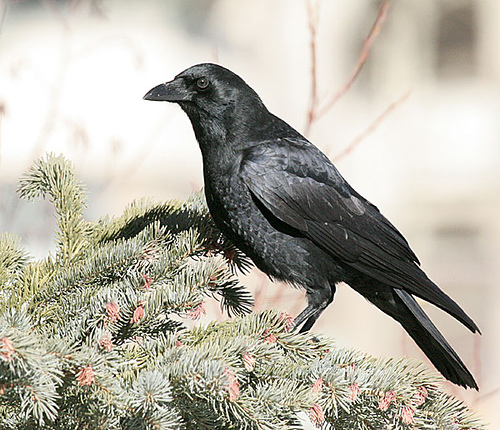
Chihuahuan Raven (Corvus cryptoleucus)Raven (Corvus corax) by Kent Nickell

Chihuahuan Raven (Corvus cryptoleucus)Raven (Corvus corax) by Kent Nickell

Another point to consider, since I am again working on the newest update to the I.O.C. list of Bird Names (Ver. 2.9), names change and the names we use today, were probably already changed once or twice and the ones we use today will probably be changed down the line. I still say, Adam had it a lot easier than what these organizations do today to keep the names figured out. They are to be commended for all the hard work they do.

Back to our verse. The Crow and the Raven are interchanged in these translations. Again, they are in the same family, the Corvidae Family. In fact, if you scroll down to the Ravens (after clicking link), you will see the Little Crow, then the Australian Raven, then the Pied Crow, the Brown-necked Raven, and the back to a Somali Crow. Again, don’t let the two translations, raven or crow, be a bother.

The only other birds mentioned are the Hawks (CEV, ESV, ISV). They are birds of prey and would “delight in the waste places.” They belong to the  Accipitridae – Family (Kites, Hawks & Eagles).

Studying the Bible and “birdwatching” through it keeps one on the alert for neat things in His Word. It works both ways; sometimes looking for a bird will turn up great truths about God’s Promises, in this case, a judgment, other times looking for a fact or promise, you find a bird. No matter which way, you are in the Bible studying His Word.

Study to shew thyself approved unto God, a workman that needeth not to be ashamed, rightly dividing the word of truth. (2 Timothy 2:15 KJV)

*
Birds of the Bible – Timid Birds

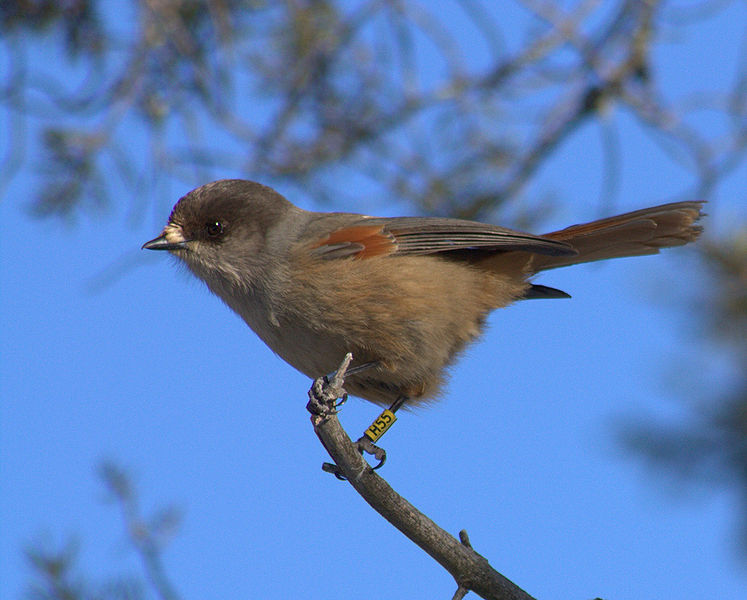
Siberian Jay (Perisoreus infaustus) ©WikiC

Siberian Jay (Perisoreus infaustus) ©WikiC

Easton’s Bible Dictionary says this about the verse: “Their (birds) timidity is alluded to in (Hosea 11:11)”

they shall come trembling like birds from Egypt, and like doves from the land of Assyria, and I will return them to their homes, declares the LORD. (Hosea 11:11 ESV)

Do birds tremble? Why? Interesting questions. Let’s see what we can find out about this passage and about “timid birds.

Instincts of: “Surely in vain the net is spread in the sight of any bird. (Proverbs 1:17 KJV)”

Nave’s Topical Bible says:

Man’s dominion over –

“Gen 1:26-28  Then God said, “Let Us make man in Our image, according to Our likeness; let them have dominion over the fish of the sea, over the birds of the air, and over the cattle, over all the earth and over every creeping thing that creeps on the earth. So God created man in His own image; in the image of God He created him; male and female He created them. Then God blessed them, and God said to them, “Be fruitful and multiply; fill the earth and subdue it; have dominion over the fish of the sea, over the birds of the air, and over every living thing that moves on the earth.”

And the fear of you and the dread of you shall be on every beast of the earth, on every bird of the air, on all that move on the earth, and on all the fish of the sea. They are given into your hand. Every moving thing that lives shall be food for you. I have given you all things, even as the green herbs. (Genesis 9:2-3 NKJV)

For You have made him a little lower than the angels, And You have crowned him with glory and honor. You have made him to have dominion over the works of Your hands; You have put all things under his feet, All sheep and oxen— Even the beasts of the field, The birds of the air, And the fish of the sea That pass through the paths of the seas. O LORD, our Lord, How excellent is Your name in all the earth! (Psalms 8:5-9 NKJV)

and wherever the children of men dwell, or the beasts of the field and the birds of the heaven, He has given them into your hand, and has made you ruler over them all—you are this head of gold. (Daniel 2:38 NKJV)

For every kind of beast and bird, of reptile and creature of the sea, is tamed and has been tamed by mankind. (James 3:7 NKJV)

Torrey’s New Topical Textbook also alludes to those verses quoted above:

Power over given to man – Genesis 1:26; Psalm 8:8;
Instinctively fear man – Genesis 9:2;
Can all be tamed – James 3:7;
Given as food to man – Genesis 9:2-3;
Taken in snares or nets – Proverbs 1:17;

Confinement of, in cages alluded to – “As a cage is full of birds, So their houses are full of deceit. Therefore they have become great and grown rich.” (Jeremiah 5:27 NKJV)

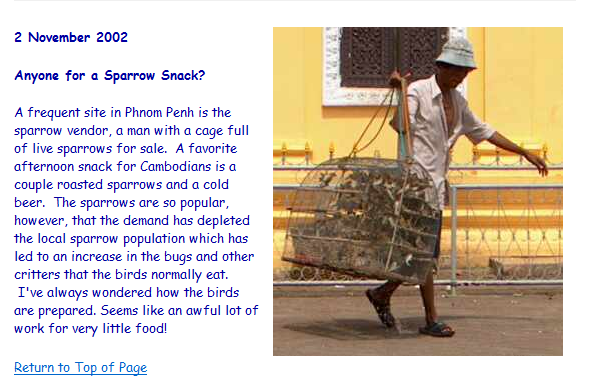
Sparrow Snack Anyone?

(From Birds of the Bible – Sparrow I)

There are many more commentary notes that could be quoted, but I think you get the idea that birds do have a reason to be timid. Just because man was given dominion over the birds doesn’t mean that he has to be cruel to them. Many birds are tamed, not by torture, but by love and patience. Forcing the birds definitely will cause them to be timid. Out in nature, many birds are shy or timid because of other birds attacking them and so they are cautious, and rightly so.

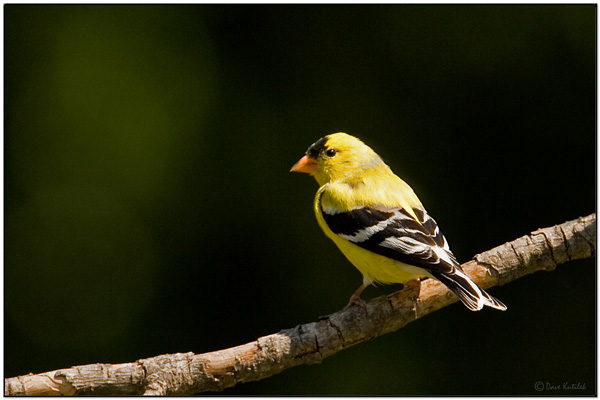
Reading some of the internet articles about timid birds, they even do research to find out about this timidity. Animal Planet produced an interesting article about research on 22 Goldfinches.

Back to our original passage of Scripture. For now we are concentrating on the timid or frightened bird, not necessarily about the dove.

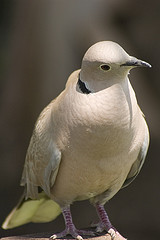
Eurasian-collared Dove in Israel

Eurasian-collared Dove in Israel

Barnes says, “Hosea 11:11
They shall tremble as a bird out of Egypt – The West denoted Europe; Egypt and Assyria stand, each for all the lands beyond them, and so for Africa and Asia; all together comprise the three quarters of the world, from where converts have chiefly come to Christ. These are likened to birds, chiefly for the swiftness with which they shall then haste to the call of God, who now turned away the more, the more they were called. The dove, especially, was a bird of Palestine, proverbial for the swiftness of its flight, easily aftrighted, and flying the more rapidly, the more it was frightened, and returning to its cot from any distance where it might be carried; from where Isaiah also says of the converts, “Who are these that fly as a cloud, and as the doves to their windows?” Isa_60:8. “The Hebrews,” says Jerome, “refer this to the coming of the Christ, who, they hope, will come; we shew that it hath taken place already. For both from Egypt and Aasyria, i. e., from East and West, from North and South, have they come, and daily do they come, who sit down with Abraham, Isaac and Jacob.”

Clarke says, “They shall tremble as a bird – Those of them that are in Egypt shall also be called thence, and shall speed hither as a bird. Those in Assyria shall also be called to return, and they shall flee as doves to their windows. All shall, in the fullness of time, return to their own land.”

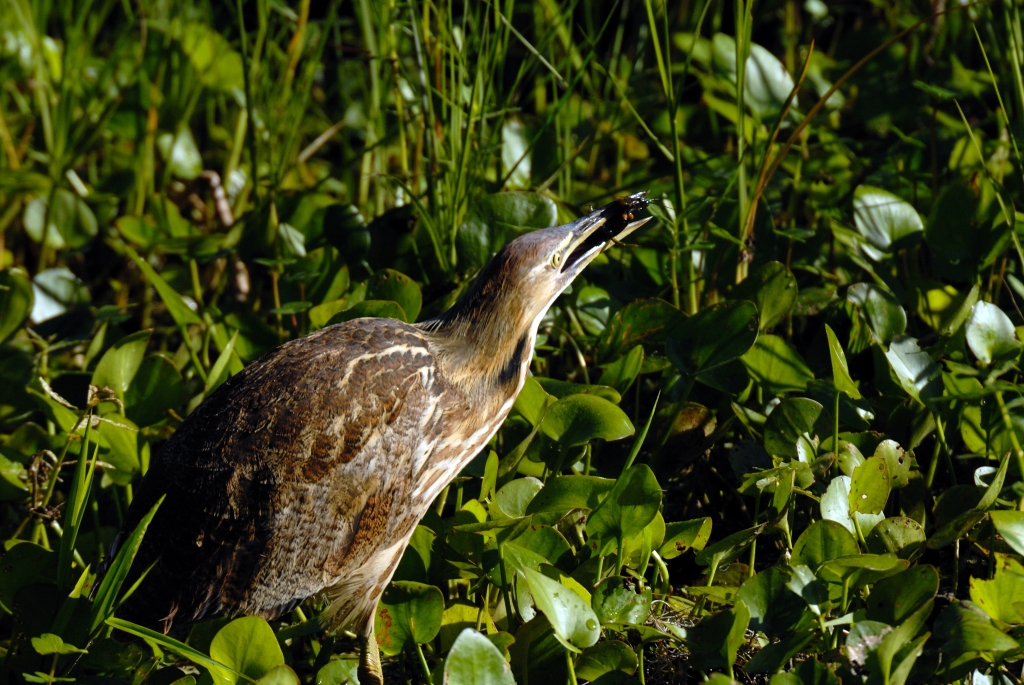
American Bittern (Botaurus lentiginosus) by Dans Pix

American Bittern (Botaurus lentiginosus) by Dans Pix

(A hard bird to capture on camera. They are very timid and evasive.)

Gill says, “Hosea 11:11  They shall tremble as a bird out of Egypt,…. They shall come from thence with fear and trembling; which may allude to the trembling of birds at the roaring of a lion, or to the trembling motion of their wings in flying; and denotes the swiftness of the motion of the Israelites and Jews to Christ, and to his church and people, and to their own land, under divine influence and direction: or “shall come with honour” (k); with all readiness and cheerfulness, in the obedience of faith: ”
“and as a dove out of the land of Assyria; which is expressive of the same things, the dove being both a timorous and swift creature. Birds in common are very timorous, and tremble at any noise, and fearful of everything that disturbs them, and therefore make all the haste and speed they can to get out of the way, and to do which they are naturally provided; and more especially the dove is always represented as very fearful and trembling, especially when pursued by the hawk, as the poet (l) observes. Though, it may be, these figures may only signify, as the weak and impotent state of the Jews, considered in themselves at this time, so the quick speed and haste they shall make to their own land.”
(So much for not concentrating on the dove.)

The next quote seems to wrap up what is being said here in Hosea 11. God is calling His trembling people home to Him because of His mercy, “Christ has purchased the pardon” for them.

Matthew Henry says, “Hosea 11:8-12
God is slow to anger, and is loth to abandon a people to utter ruin, who have been called by his name. When God was to give a sacrifice for sin, and a Saviour for sinners, he spared not his own Son, that he might spare us. This is the language of the day of his patience; but when men sin that away, then the great day of his wrath comes. Man’s compassions are nothing in comparison with the tender mercies of our God, whose thoughts and ways, in receiving returning sinners, are as much above ours as heaven is above the earth. God knows how to pardon poor sinners. He is faithful and just to forgive us our sins, and therein declares his righteousness, now Christ has purchased the pardon, and he has promised it. Holy trembling at the word of Christ will draw us to him, not drive us from him, the children tremble, and flee to him. And all that come at the gospel call, shall have a place and a name in the gospel church. The religious service of Israel were mere hypocrisy, but in Judah regard was had to God’s laws, and the people followed their pious forefathers. Let us be faithful: those who thus honour God, he will honour, but such us despise Him shall be lightly esteemed.”

Wordless Birds

More Birds of the Bible

(Commentary notes from e-Sword Bible program.)
*

American Goldfinch – The Latecomers…

American Goldfinch (Carduelis tristis) by Daves BirdingPix

American Goldfinch (Carduelis tristis) by Daves BirdingPix

Goldfinch – The Latecomers… ~ by ajmithra

Hello everyone,

This morning I happened to read an article on Goldfinch in http://www.wild.enature.com, and that inspired me to write about these amazing late nesters.. Having just entered into the month of July, I thought it would be apt to just ponder over these awe inspiring July nesters..

By July, most songbirds are in the final stages of raising their young, but not the American Goldfinches.  These appealing, colorful birds are just getting started. Notoriously late nesters, goldfinches have been waiting for the thistles to bloom.

Do we wait for God’s timing in our lives?

  • We may feel bad when everyone is moving ahead of us.

But, God’s plan for our lives is not as same as it is for the others…

  • David was anointed by Samuel when he was just a kid..
  • He did not turn into a King immediately after the anointing..
  • He had to wait for more than thirty years..
  • He did wait without grumbling, always rejoicing in the Lord and you know what?
  • David is still considered the greatest king ever lived..
  • So great that God chose to be born in his family tree..

Wait for God’s plan to bloom, like how these Goldfinches wait for the thistles to bloom..

He hath made every thing beautiful in his time: also he hath set the world in their heart, so that no man can find out the work that God maketh from the beginning to the end (Ecclesiastes 3:11)

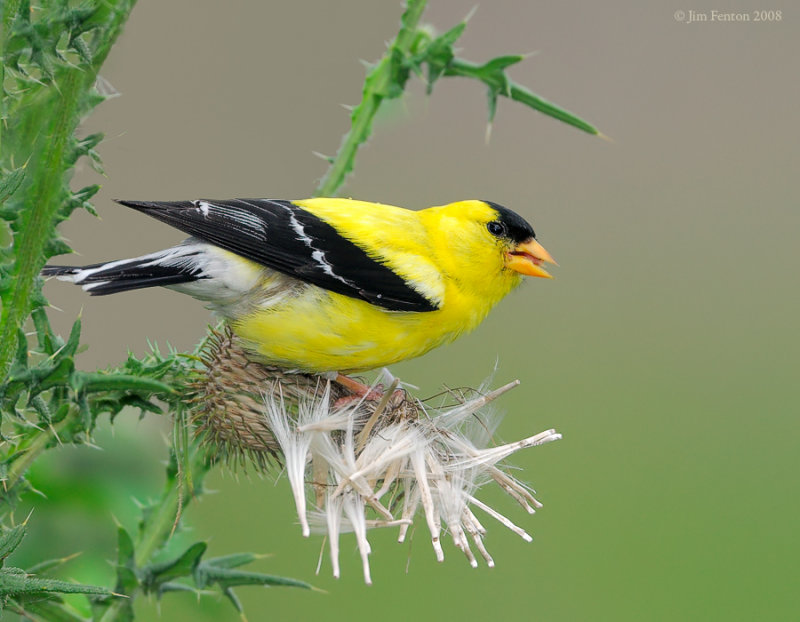
American Goldfinch (Carduelis tristis) on Thistle by Fenton

American Goldfinch (Carduelis tristis) on Thistle by Fenton

When this happens in July, it signals the goldfinches that they can start building their nests which are made primarily of the silver fibers and down of thistle blooms. Generally, the nest is built in the fork of a horizontal tree limb, 4 to 14 feet above the ground. The female builds a durable, neat cup of thistle and cattail fibers, so dense that it will hold water.Medieval writers believed that thistle can heal headaches, plague, canker, sores, vertigo, and jaundice. Do these birds know the thistles’ medicinal value?

  • God expects His bride to build a church that is durable and so dense, so that it can hold The Living Water…
  • God has promised to pour His spirit on all flesh during the last days and we do know that we are in the last days…
  • God pours so much anointing in every service in church, but we still haven’t reached the unreached yet. Why?
  • Is it because of the leak that is found in our spirit?

Are these female birds showing us how to build our nest so as to hold The Living Water?

But we have this treasure in jars of clay, to show that the surpassing power belongs to God and not to us. (2 Corinthians 4:7)

American Goldfinch (Carduelis tristis) by Lee thru window

American Goldfinch (Carduelis tristis) by Lee thru window

In it she lays 4 to 6 pale blue to white eggs and then she incubates them for 12 to 14 days, until they hatch. The attentive male often feeds his mate while she sits on the nest. By the time the eggs hatch, the thistle has gone to seed, which is perfect timing for feeding young goldfinches.

God’s timing is awesome..

See how well the birds know that the nest material will also become food for their chicks, And they don’t have to wander in search of food..

That is God’s timing..

We tend to think that God is late, but we fail to understand that He is always on time.. There are so many instances where God has asked His servants to look out for His timing..

  • Joseph had to wait for God’s time to become a Prime Minister..
  • Moses had to wait for God’s time to become a leader..
  • Sometimes God even asks us to wait for nature’s signal, like how he asks David to wait for the mulberry leaves to quiver before he falls over the enemy camp..
  • Do we wait or wilt under pressure..
  • Do not wait for a man or for an opportunity, just wait for the Lord..

Waiting to the Lord releases super power…You know?

But they that wait upon the LORD shall renew their strength; they shall mount up with wings as eagles; they shall run, and not be weary; and they shall walk, and not faint. (Isaiah 40:31)

The parents nourish this chicks by consuming the thistle seed themselves, and then regurgitating the partially digested, milk like cereal into the mouths of their nestlings. This is as close as birds come to mammals that feed their young milk from mammary glands.

Baby goldfinches are fully feathered and out of the nest 10 to 16 days later. Almost immediately, they join their parents at bird feeders across America. That’s when many people suddenly notice so many goldfinches as the summer progresses. If these birds were normal nesters like the other song birds, they would’ve faced a sever threat on their existence, which is based upon the thistle….

Masterpieces are not made overnight.. It may take weeks, months or even years to make one..

  • Do you want people to take notice of you?
  • Just wait…
  • You are destined to be the Master’s masterpiece, so just wait….

I will praise thee; for I am fearfully and wonderfully made: marvellous are thy works; and that my soul knoweth right well. (Psalm 139:14)

Have a blessed day!

Yours in YESHUA,
a j mithra

Please visit us at:
Crosstree

ajmithra21


Lee’s Addition:

See a j’s other articles – Click Here

The American Goldfinch is in the Finches – Fringillidae Family of the Passeriformes Order.

*

Birds of the Bible – Kite

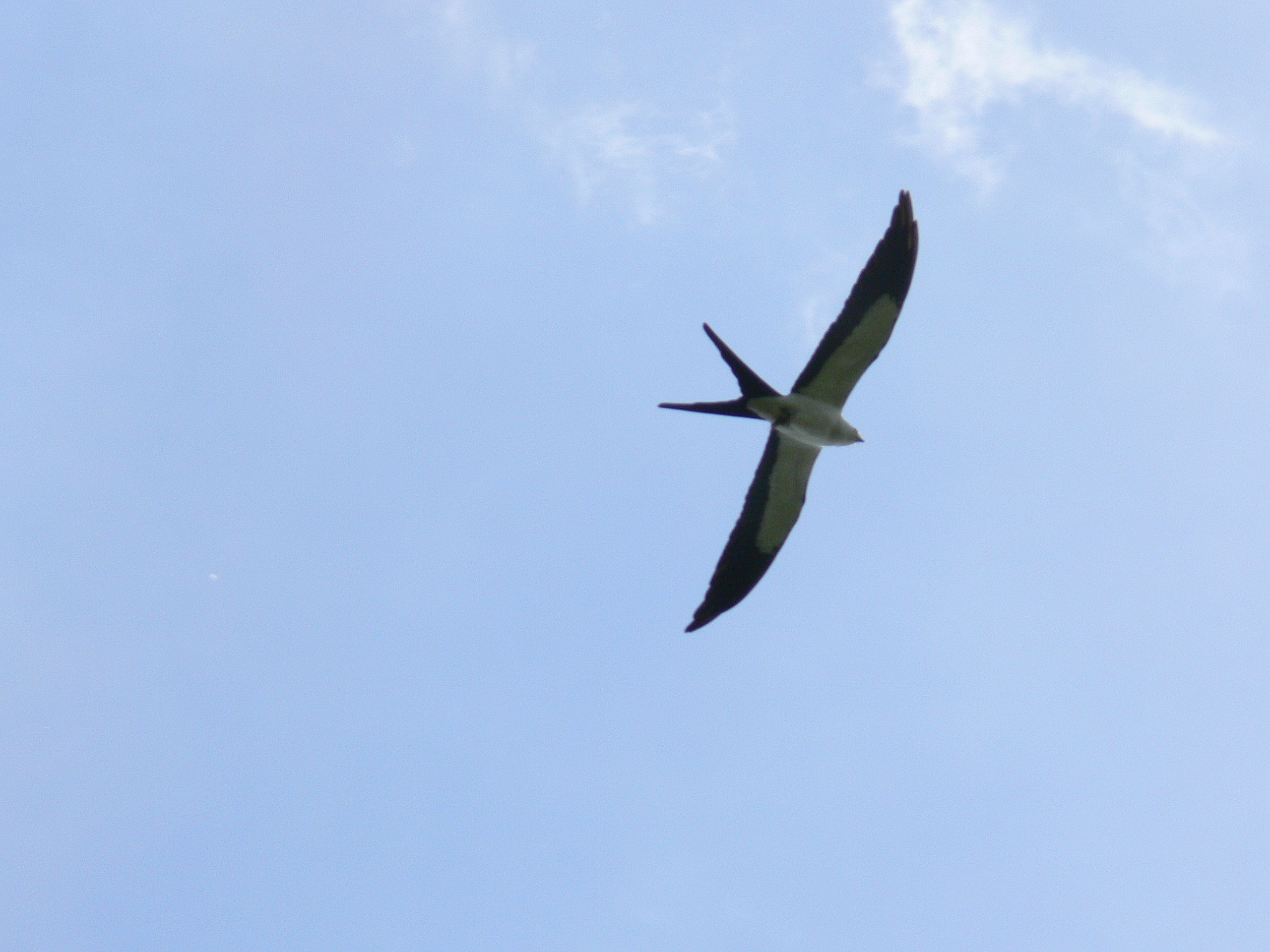
Swallow-tailed Kite - the one bird I got a photo of as it flew overhead

Swallow-tailed Kite – the one bird I got a photo of as it flew overhead

Today while Dan and I were out talking with our neighbor, a Swallow-tailed Kite flew over us several times and we all watched it disappear off in the distance. I have noticed several of them in the area lately. They are a pretty bird and I enjoy watching them fly. That tail forked out makes for a neat appearance.

Previously the Birds of the Bible – Glede and Kite article was written when this blog was first starting up. In fact, it was before we moved the blog here to WordPress and was published in the Blogspot(Blogger) format. I was exploring whether the Bible was calling it the Kite or the Glede.

Red Kite (Milvus milvus) by Ian

Red Kite (Milvus milvus) by Ian

This time, let’s look at what the versions of the Scriptures say about the Kite.

Most of the verses about the Kite are found in Leviticus 11:14 and Deuteronomy 14:13, which are in the list of the unclean birds that the Israelites were not to eat. And most of them call the bird a Kite.

Leviticus 11:14 – Here are the verses from the compare mode of e-Sword.
(ASV) and the kite, and the falcon after its kind,
(BBE) And the kite and the falcon, and birds of that sort;
(Brenton) And the vulture, and the kite, and the like to it;
(Darby) and the falcon, and the kite, after its kind;
(DRB) And the kite, and the vulture, according to their kind.
(ERV) kites, all kinds of falcons,
(ESV) the kite, the falcon of any kind,
(GW) kites, all types of buzzards,
(JPS) and the kite, and the falcon after its kinds;
(KJV) And the vulture, and the kite after his kind;
(KJV-1611) And the Uulture, and the Kite, after his kinde:
(LITV) and the kite, and the falcon, according to its kind;
(MKJV) and the kite, and the falcon, according to its kind;
(NAS77) and the kite and the falcon in its kind,
(NASB) and the kite and the falcon in its kind,
(NKJV) the kite, and the falcon after its kind;
(RV) and the kite, and the falcon after its kind;
(Webster) And the vultur, and the kite after his kind;
(YLT) and the vulture, and the kite after its kind,
Here they are called Red Kites
(ISV) red kite, falcon of any kind,

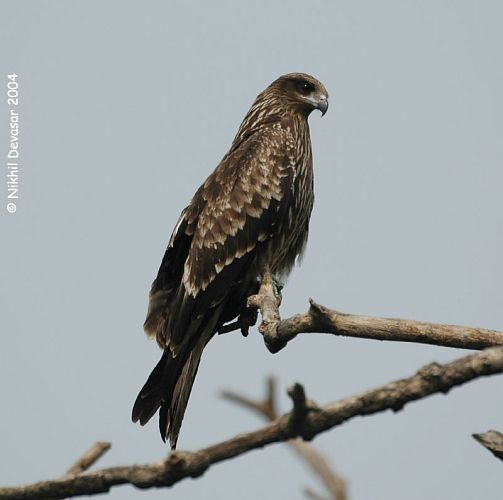
Black Kite (Milvus migrans) by Nikhil Devasar

Black Kite (Milvus migrans) by Nikhil Devasar

Deuteronomy 14:13 has some differences in the use of Kite, Glede, and Red or Black Kite.
Kite:
(ASV) and the glede, and the falcon, and the kite after its kind,
(BBE) The falcon and the kite, and birds of that sort;
(Brenton) and the vulture, and the kite and the like to it,
(Darby) and the falcon, and the kite, and the black kite after its kind;
(DRB) The ringtail, and the vulture, and the kite according to their kind:
(ERV) red kites, falcons, any kind of kite,
(ESV) the kite, the falcon of any kind;
(GW) buzzards, all types of kites,
(ISV) buzzard, any kind of kite,
(JPS) and the glede, and the falcon, and the kite after its kinds;
(KJV) And the glede, and the kite, and the vulture after his kind,
(KJV-1611) And the glede, and the kite, and the vulture after his kinde,
(KJVA) And the glede, and the kite, and the vulture after his kind,
(LITV) and the hawk, and falcons, and the kite by its kinds,
(MKJV) and the hawk, and the falcon, and the vulture after its kind,
(NAS77) and the red kite, the falcon, and the kite in their kinds,
(NASB) and the red kite, the falcon, and the kite in their kinds,
(NKJV) the red kite, the falcon, and the kite after their kinds;
(RV) and the glede, and the falcon, and the kite after its kind;
(Webster) And the glede, and the kite, and the vultur after his kind,
(YLT) and the glede, and the kite, and the vulture after its kind,

Deut 14:12  (CEV) But don’t eat the meat of any of the following birds: eagles, vultures, falcons, kites, ravens, ostriches, owls, sea gulls, hawks, pelicans, ospreys, cormorants, storks, herons, and hoopoes. You must not eat bats.

Did you notice reading down those verses that the Glede is not mentioned at all in the Leviticus 11:14 list? I even checked the verses before and after and it is not mentioned in them either. Hum!

Black-shouldered Kite (Elanus axillaris) by Nikhil

Black-shouldered Kite (Elanus axillaris) by Nikhil

There are a few other verses with “Kite” mentioned in the Bible:

Jeremiah 8:7   The kite in the air hath known her time: the turtle, and the swallow, and the stork have observed the time of their coming: but my people have not known the judgment of the Lord. (DRB-1899 Douay-Rheims)

Zechariah 5:9 And I lifted up my eyes and looked: and behold there came out two women, and wind was in their wings, and they had wings like the wings of a kite: and they lifted up the vessel between the earth and the heaven. (DRB-1899 Douay-Rheims)

Job 28:7 A path–not known it hath a ravenous fowl, Nor scorched it hath an eye of the kite, (YLT 1898 Young’s Literal Translation)

Video of American Swallow-tailed Kite by Keith Blomerley. [Broken Link] It shows a Kite in the air.

There are three versions that use “kite” in Isaiah 34:15

There shall the arrowsnake make her nest, and lay, and hatch, and gather under her shadow: yea, there shall the kites be gathered, every one with her mate. (RV Revised Version)
There shall the arrowsnake make her nest, and lay, and hatch, and brood under her shadow; yea, there shall the kites be gathered, every one with her mate. (JPS Jewish Publication Society Bible)
There shall the dart-snake make her nest, and lay, and hatch, and gather under her shade; yea, there shall the kites be gathered, every one with her mate. (ASV American Standard Version)

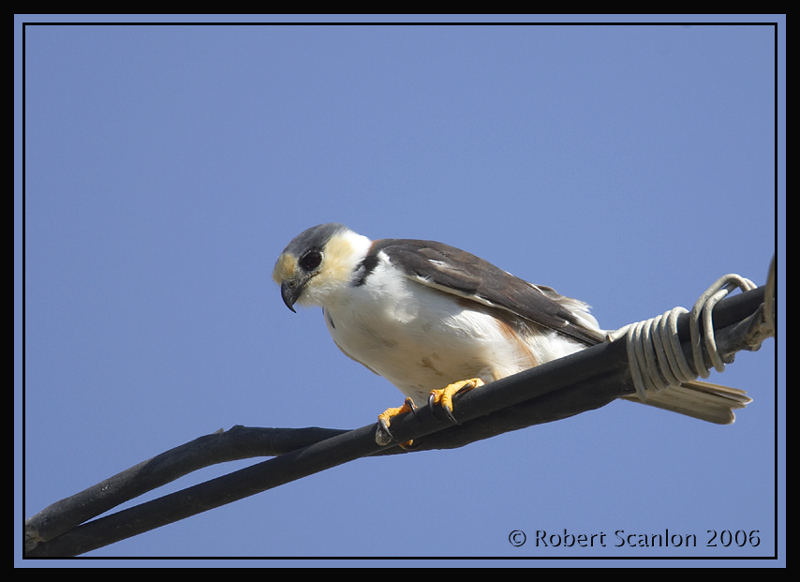
Pearl Kite (Gampsonyx swainsonii) by Robert Scanlon

Pearl Kite (Gampsonyx swainsonii) by Robert Scanlon

So what is a Kite? They are in the Accipitridae Family of the Accipitriformes Order. Being in the Accipitridae family means they are a bird of prey or raptors

Here is some of what Wikipedia has to say: “The Accipitridae, one of the two major families within the order Accipitriformes (the diurnal birds of prey), are a family of small to large birds with strongly hooked bills and variable morphology based on diet. They feed on a range of prey items from insects to medium-sized mammals, with a number feeding on carrion and a few feeding on fruit. The Accipitridae have a cosmopolitan distribution, being found on all the world’s continents (except Antarctica) and a number of oceanic island groups. Some species are migratory. Many well-known birds, such as hawks, eagles, kites, harriers and Old World vultures are included in this group.”

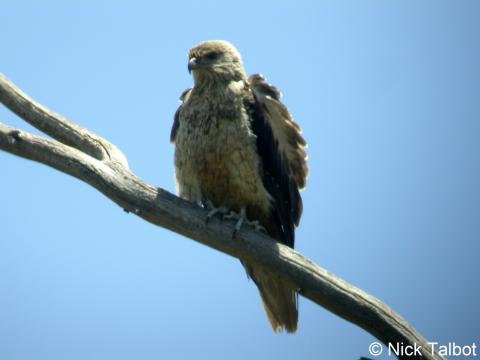
Whistling Kite (Haliastur sphenurus) by Nick Talbot

Whistling Kite (Haliastur sphenurus) by Nick Talbot

“The Black-winged Kite breeds at different times of the year across its range. Although nesting has been noted throughout the year in India, they appear not to breed in April and May. Courtship is noisy and involves chases. The nest is a loose platform of twigs in which 3 or 4 eggs are laid. The female spends more effort in the construction of the nest than the male. The eggs are pale creamy with spots of deep red. Both parents incubate but when the chicks hatch, the male spends more time on foraging for food. Females initially feed the young, sometimes hunting close to the nest but will also receive food from the male. After fledging the young birds continue to be dependent for food on the male parent for about 80 days, initially transferring food at perch and later in the air.

The prey include grasshoppers, crickets and other large insects, lizards and rodents. Injured birds, small snakes and frogs have also been recorded. The slow hunting flight is like a harrier, but it will hover like a Kestrel. It has on rare occasions been known to hunt prey in flight. Favourite perches are used for hunting and for feeding but large prey may sometimes be handled on the ground. In southern Africa, they appear to favour roadside verges for foraging and are sometimes killed by collisions with vehicles.

These birds roost communally with groups of 15 to 35 (larger numbers in Europe) converging at a large leafy tree. They are extremely silent and the calls recorded include a high-pitched squeal or a soft whistle. They call a lot mainly during the breeding season.”

(Top photo from a previous birdwatching adventure)

See others:

Glede and Kite

Birds of the Bible

Wordless Birds

*

Birds in Hymns – O Give Thanks To Him Who Made

Black-headed Heron (Ardea melanocephala) by Lee Lowry Pk Zoo

Black-headed Heron (Ardea melanocephala) by Lee Lowry Pk Zoo

Based on:

All things were made by him; and without him was not any thing made that was made. (John 1:3 KJV)

Words by ~ Jo­si­ah Con­der (1789-1855), in The Con­gre­ga­tion­al Hymn Book, 1836.
Music ~ “Dix” ~by~  Con­rad Koch­er, Stim­men aus dem Reiche Gott­es, 1838

O Give Thanks To Him Who Made

O give thanks to Him Who made
Morning light and evening shade;
Source and Giver of all good,
Nightly sleep and daily food;
Quickener of our wearied powers,
Guard of our unconscious hours.

O give thanks to nature’s King,
Who made every breathing thing;
His, our warm and sentient frame,
His, the mind’s immortal flame.
O how close the ties that bind
Spirits to the Eternal Mind!

O give thanks with heart and lip,
For we are His workmanship;
And all creatures are His care:
Not a bird that cleaves the air
Falls unnoticed
; but who can
Speak the Father’s love to man?

O give thanks to Him Who came
In a mortal, suffering frame—
Temple of the Deity—
Came for rebel man to die;
In the path Himself hath trod
Leading back His saints to God.

Most information from The Cyber Hymnal

See more Birds in Hymns

*

Birds of the Bible – Dove’s Dung

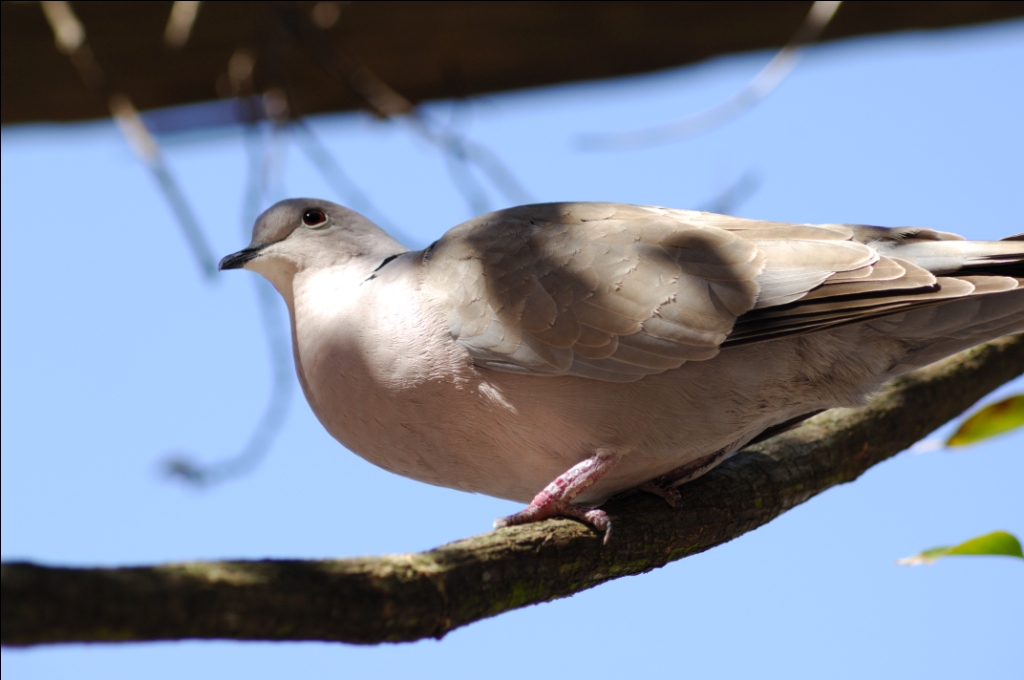
Eurasian Collared Dove (Streptopelia decaocto) by Dan

Eurasian Collared Dove (Streptopelia decaocto) by Dan

Now here is an interesting verse found in 2 Kings 6:25:

And there was a great famine in Samaria, as they besieged it, until a donkey’s head was sold for eighty shekels of silver, and the fourth part of a kab of dove’s dung for five shekels of silver. (2Ki 6:25)

First let’s find out what caused this event in the first place. Israel was being besieged and it was causing a very severe famine. Food was extremely scarce and the people were paying exorbitant prices for small amounts of anything edible.

Why were they under siege?

Afterward Ben-hadad king of Syria mustered his entire army and went up and besieged Samaria. (2Ki 6:24)

They were surrounded by the Syrian army and there was very little to eat. They may have been there for sometime or the inhabitants of Samaria were caught by surprise and didn’t have time to lay up supplies. Then again, if you read the verses just prior, 2 Kings 6:8-23, another reason for the lack of food may be given. The Samaritans had fed the Syrian raiders before sending them back home. Most commentators say that there was at least a year between that event and when this one happens.

What ever the cause, the people were so hungry that they were paying 80 shekels of silver for a donkey’s head. Several things about this:

  • Donkeys were very prized animals and well treated.
  • The head has very little meat on it.
  • “The head was the worst part of the animal.” (JFB)
  • They were on the “do not eat” list.
  • “A vast price, especially for that which had on it so little meat, and that unwholesome and unclean.” (Wesley)
Doves in Israel

Doves in Israel ©©

Now for the next food on their menu – “Dove’s dung.” Looking at the different versions of Scripture, here are some of the ways this is translated:

  • small measure of doves’ droppings was five shekels of silver – BBE
  • one-fourth of a kab of dove droppings for five shekels of silver – NKJV
  • fourth part of a (cab or kab) of dove’s dung at five pieces of silver – ASV Brenton ESV JPS KJV LITV NASB RV WEBSTER
  • small bowl of pigeon droppings cost about two ounces of silver – CEV
  • fourth part of a cab of dove’s dung five silver-pieces – Darby
  • fourth part of a cabe of pigeons’ dung, for five pieces of silver – DRB
  • forth of the cab of dovesdung at five silverlings – YLT
  • one pint of dove’s dung sold for five pieces of silver – ERV
  • one quarter of a unit of dove’s dung cost five silver coins – ISV
  • half a pound of dove’s dung cost five pieces of silver – GNB
  • two pounds of silver and a half-pint of dove manure for two ounces of silver – GW

One thing they all agree on is that it was either a Dove or a Pigeon, which are both in the same family and their names are changed back and forth even today. Most agree it was a forth of something. The cab or kab according to the commentaries is described as:

A kab – A measure containing twenty – four eggs. and a kab was the usual measure of all sorts of grains and fruits of that sort. (Wesley)
Cab – This measure is not mentioned elsewhere in Scripture. According to the rabbinical writers it was the smallest of all the dry measures in use among the Jews, being the sixth part of a seah, which was the third part of an ephah. If it was about equal to two of our quarts, the “fourth part of a cab” would be about a pint. (Barnes)

Nicobar Pigeon at Lower Park Zoo by Dan

Nicobar Pigeon at Lower Park Zoo by Dan

Up to now, we know that it was expensive for a small amount. What keeps the commentators of differing opinions is what the “Dove’s Dung” really was. Many say that it was a pulse or pease made from a pea or bean and that it had the color or texture of a dove’s droppings. Others say it was from the actual droppings and that (this is yuk) they picked through it for edible parts. (For an interesting study, load the e-Sword program – it’s free – and after loading the Bibles, dictionaries and commentaries, do a study of 2 Kings 6:25)

“dove’s dung: This probably denotes, as Bochart, Scheuchzer, and others suppose, a kind of pulse, or vetches, which the Arabs still call pigeon’s dung. “They never,” says Dr. Shaw (Travels, p. 140), “constitute a dish by themselves, but are strewed singly as a garnish over cuscasowe, pillowe, and other dishes. They are besides in the greatest repute after they are parched in pans and ovens; then assuming the name leblebby;” and he thinks they were so called from being pointed at one end, and acquiring an ash colour in parching.

Dove’s dung – Most commentators understand by this expression a sort of pulse which is called “dove’s dung,” or “sparrow’s dung” in Arabic. But it is possible that the actual excrement of pigeons is meant. The records of sieges show that both animal and human excrement have been used as food – under circumstances of extreme necessity.” (Barnes)

I am inclined to think that it could have actually been the real droppings.  The reason for that is what is mentioned after verse 25. Two ladies had agreed to eat their sons. See 2 Kings 6:26-29.

Now as the king of Israel was passing by on the wall, a woman cried out to him, saying,

“Help, my lord, O king!” And he said, “If the LORD will not help you, how shall I help you? From the threshing floor, or from the winepress?” And the king asked her, “What is your trouble?” She answered, “This woman said to me, ‘Give your son, that we may eat him today, and we will eat my son tomorrow.’ So we boiled my son and ate him. And on the next day I said to her, ‘Give your son, that we may eat him.’ But she has hidden her son.”  (2Ki 6:26-29)

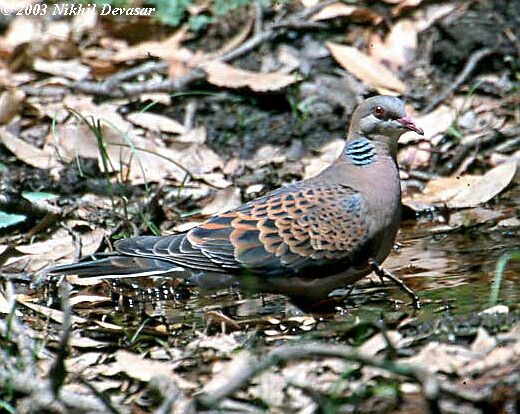
Oriental Turtle Dove (Streptopelia orientalis) by Nikhil Devasar

Oriental Turtle Dove (Streptopelia orientalis) by Nikhil Devasar

Another thought, were there any doves left that hadn’t been eaten?

I’ll end with a quote from the Wesley commentary. “Learn to value plenty, and to be thankful for it; see how contemptible money is, when, in time of famine, it is so freely parted with for anything that is eatable.”

See also:

Birds of the Bible – Doves and Pigeons
Birds of the Bible
Columbidae – Pigeons, Doves

Interesting articles from the Internet:

http://www.godfire.net/diet.html
From Heart to Heart
Dove’s Dung – Wikipedia
Plants of the Bible – Dove’s Dove

*

Birds of the Bible – Birds of Samuel and Kings

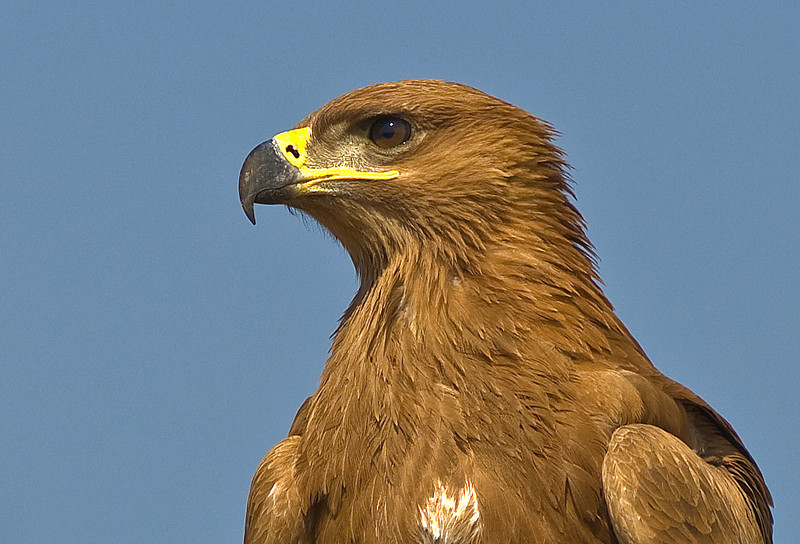
Tawny Eagle (Aquila rapax) by Africaddict

Tawny Eagle (Aquila rapax) by Africaddict

I have been reading through 1st and 2nd Samuel and 1st Kings lately in the English Standard Version (ESV). So far I have found seven references to “birds”, “birds of the air”, or “birds of the heavens.”

Five of the verses have to do with the birds coming to do something, especially to eat. I’ll save that for later. One verse is keeping the birds from eating and the other is totally unrelated to eating.

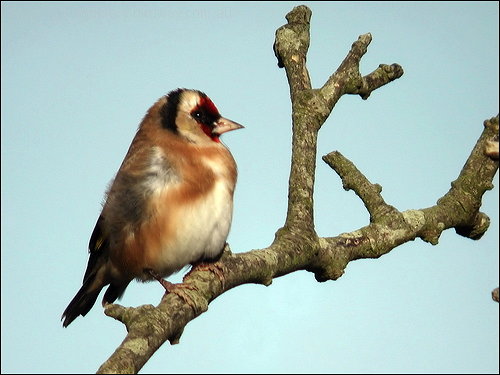
European Goldfinch (Carduelis carduelis) by Ian

European Goldfinch (Carduelis carduelis) by Ian

Let’s start with the easy one. In 1 Kings, Solomon was made king after his father, David, passed away. He asked the Lord for wisdom to know how to rule and do what was right. He was still a youngster. He was given wisdom that has surpassed any.

And God gave Solomon wisdom and understanding beyond measure, and breadth of mind like the sand on the seashore, so that Solomon’s wisdom surpassed the wisdom of all the people of the east and all the wisdom of Egypt. For he was wiser than all other men, wiser than Ethan the Ezrahite, and Heman, Calcol, and Darda, the sons of Mahol, and his fame was in all the surrounding nations. He also spoke 3,000 proverbs, and his songs were 1,005. He spoke of trees, from the cedar that is in Lebanon to the hyssop that grows out of the wall. He spoke also of beasts, and of birds, and of reptiles, and of fish. (1 Kings 4:29-33 ESV)

To save a war, seven sons were given to the Gibeonites, who hanged them. Then the mother of two of them, Rizpah, came and spread sackcloth over their remains and protected them from the birds of the air. That is told in 2 Samuel 21.

Then Rizpah the daughter of Aiah took sackcloth and spread it for herself on the rock, from the beginning of harvest until rain fell upon them from the heavens. And she did not allow the birds of the air to come upon them by day, or the beasts of the field by night. (2 Samuel 21:10 ESV)

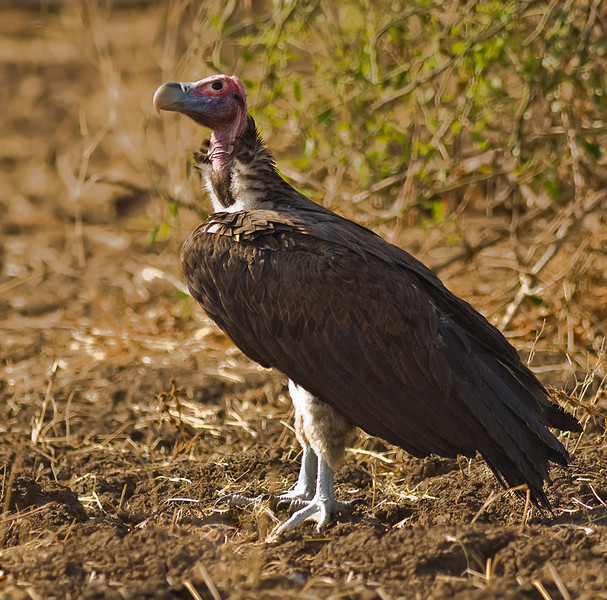
Lappet-faced Vulture (Torgos tracheliotus) by Africaddict

Lappet-faced Vulture (Torgos tracheliotus) by Africaddict

The next five incidents have to do with judgment and the birds coming to feed on the carcases of those who died.
Goliath, the giant Philistine threatened David with:

The Philistine said to David, “Come to me, and I will give your flesh to the birds of the air and to the beasts of the field.” (1 Samuel 17:44 ESV)

Then David told Goliath that the LORD would cause the Philistines to be delivered to David and the birds would be feasting on him and the other Philistines there.

This day the LORD will deliver you into my hand, and I will strike you down and cut off your head. And I will give the dead bodies of the host of the Philistines this day to the birds of the air and to the wild beasts of the earth, that all the earth may know that there is a God in Israel, (1 Samuel 17:46 ESV)

Keep reading in 2nd Samuel 17 and you will find out who the birds feasted on.

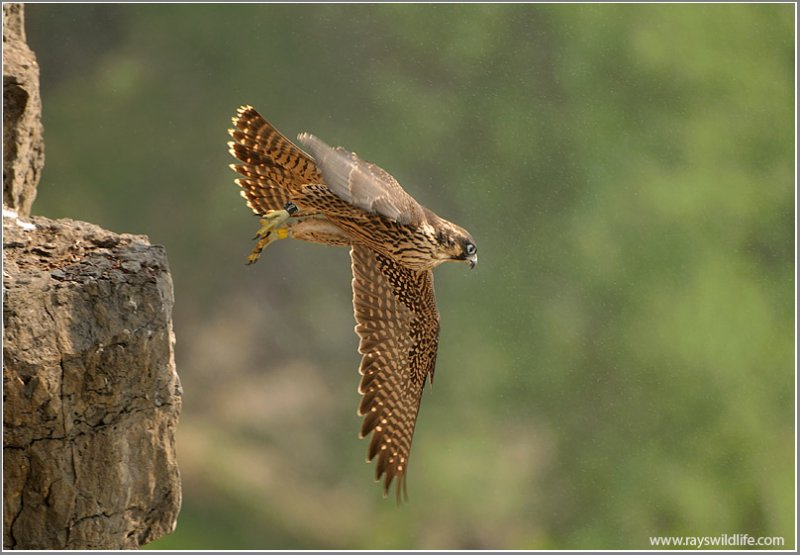
Peregrine Falcon Lift Off Into The Mist

Peregrine Falcon Lift Off Into The Mist

In 1 Kings 14:11, 1 Kings 16:4 and 1 Kings 21:24, three bad kings and their families were judged for the evil they did of not serving the LORD and causing their subjects to also fall into sin.
Jeroboam, Baasha, and Ahab all died and the birds of the heavens were invited to come and eat. Not a pretty picture, but God keeps His Word.

Anyone belonging to Jeroboam who dies in the city the dogs shall eat, and anyone who dies in the open country the birds of the heavens shall eat, for the LORD has spoken it. (1 Kings 14:11 ESV)
Anyone belonging to Baasha who dies in the city the dogs shall eat, and anyone of his who dies in the field the birds of the heavens shall eat. (1 Kings 16:4 ESV)
Anyone belonging to Ahab who dies in the city the dogs shall eat, and anyone of his who dies in the open country the birds of the heavens shall eat. (1 Kings 21:24 ESV)

Not knowing for certain which birds actually came and did the eating, my guess is that it would be those from the birds of prey families. Those birds are known to be carnivorous and would have arrived at the LORD’s will as prophesied.

Some of the birds of the large Order of Accipiitriformes – Raptors would have been involved. Those are the New World Vultures, Secretarybird, Ospreys, Kites, Hawks and Eagles. Then the Falcons and Caracaras of the Falconiformes Order possibly would have arrived. Owls from the Strigiformes Order might also have come.

But if you will not do so, behold, you have sinned against the LORD, and be sure your sin will find you out. (Numbers 32:23 ESV)

Wordless Birds

*

Birds in Hymns – The Son of God Goes Forth to War

Bald Eagle (Haliaeetus leucocephalus) by Quy Tran

Bald Eagle (Haliaeetus leucocephalus) by Quy Tran

But Jesus answered and said, Ye know not what ye ask. Are ye able to drink of the cup that I shall drink of, and to be baptized with the baptism that I am baptized with? They say unto him, We are able. (Matthew 20:22 KJV)

Words: Reginald He­ber, 1812.
(This hymn was sung in the 1975 mo­vie The Man Who Would Be King, which was nom­in­at­ed for sev­er­al Acad­e­my Awards.)

Music: All Saints, Hen­ry S. Cut­ler, in The Hymn­al with Tunes Old and New, by John Ire­land Tuck­er, 1872

Al­ter­nate tunes:

Old 81st, Day’s Psal­ter, 1562

St. Anne, Will­iam Croft, 1708

Warrior, Ar­chi­bald Mac­Don­ald, 1877

In Mrs. Ew­ing’ Sto­ry of a Short Life it is the favorite hymn in the bar­racks, where the sol­diers call it the ‘tug of war’ hymn. The of­fi­cer’s son, who had been crip­pled for life by an ac­ci­dent, begs just be­fore his death that the sol­diers will sing it again. They go un­der his win­dow, and when in the midst of the verse, ‘A no­ble ar­my, men and boys,’ a hand is seen at the win­dow pull­ing down the blind. The brave suf­fer­er is gone. The sto­ry made the hymn wide­ly pop­u­lar among child­ren as the ‘tug of war’ hymn. Telford, p. 410

The Son of God Goes Forth to War

*

The Son of God goes forth to war,
A kingly crown to gain;
His blood red banner streams afar:
Who follows in His train?
Who best can drink His cup of woe,
Triumphant over pain,
Who patient bears his cross below,
He follows in His train.

That martyr first, whose eagle eye
Could pierce beyond the grave;
Who saw his Master in the sky,
And called on Him to save.
Like Him, with pardon on His tongue,
In midst of mortal pain,
He prayed for them that did the wrong:
Who follows in his train?

A glorious band, the chosen few
On whom the Spirit came;
Twelve valiant saints, their hope they knew,
And mocked the cross and flame.
They met the tyrant’s brandished steel,
The lion’s gory mane;
They bowed their heads the death to feel:
Who follows in their train?

A noble army, men and boys,
The matron and the maid,
Around the Savior’s throne rejoice,
In robes of light arrayed.
They climbed the steep ascent of Heav’n,
Through peril, toil and pain;
O God, to us may grace be giv’n,
To follow in their train.
*

Birds of the Bible – Sea Gulls

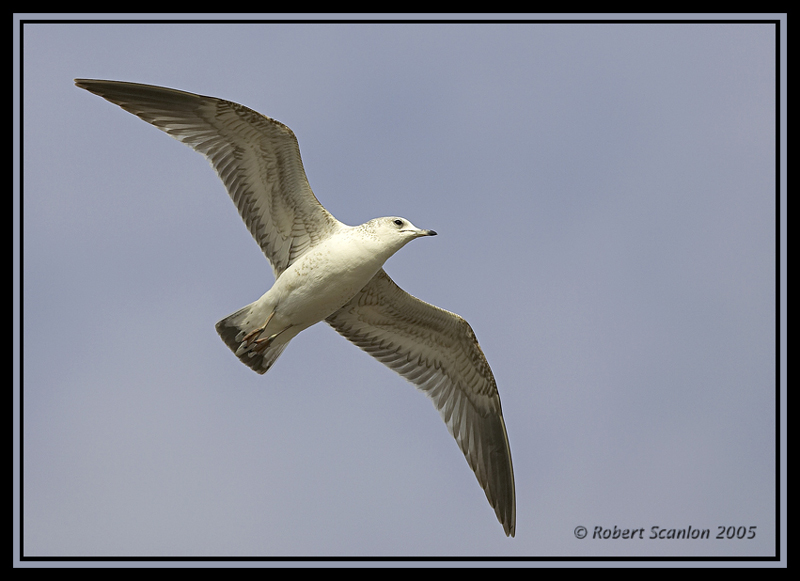
Mew Gull (Larus canus) by Robert Scanlon

Mew Gull (Larus canus) by Robert Scanlon

the ostrich, the short-eared owl, the sea gull, and the hawk after its kind; (Leviticus 11:16 NKJV)

The Sea Gull has been upgraded to an official Bird of the Bible here on this blog. The article “Birds of the Bible – A Gull?” was written when I first discovered the Gull in my reading, per article. The Gull now has it’s own Birds of the Bible – Sea Gulls page and it shows up in the sidebar along with the others birds mentioned in the Scriptures.

After updating my E-sword program and loading every English Bible Translation they have available, (for free and a few paid ones) I have been comparing the Leviticus 11:13-19 and the Deuteronomy 14:12-18 sections with a spreadsheet. That is the list of unclean birds that the Israelites were told not to eat. (Just because the different versions are being compared does not mean that this writer is in agreement with all of them or their stand.)

Iceland Gull (Larus glaucoides) chick-egg nest ©USFWS

Iceland Gull (Larus glaucoides) chick-egg nest ©USFWS

Here is an analysis of words used in those verses for the Sea Gull:
(Mouse over initials for full name of translation)

Leviticus 11:15 or 16:

gull – ABP+, MKJV
sea-gull or sea gull – DARBY, ESV, NAS77, NASB, NKJB
sea gulls – ERV, GW
seamew – ASV
sea-mew – BRENTON, JPS
sea meaw – RV
sea-hawk – BBE
larus – DRB
Different bird used –
(cuckow) – KJV & WEBSTER ,
(cuckoo) – YLT

Deuteronomy 14:15:

The word was use the same in both verses except in these translations:
LITV used – “gull” in Lev. and “sea gull” in Deut.
MKJV used – “gull” in Lev. and “cuckoo” in Deut.

Ring-billed Gull (Larus delawarensis) Lk Hollingsworth by Lee

Ring-billed Gull (Larus delawarensis) Lk Hollingsworth by Lee

Why bother in the first place to compare them, you ask? I still find it amazing how different translations vary in their description of the birds. The differences do not affect the doctrines of the Word of God, nor will they affect my faith in the Lord. So far, none of the differences have affected my appetite to eat any of the birds listed. Whether they are Sea Gulls or a Cuckoos, they still won’t end up on my dinner plate.

What it does do though is to give good reason to make the Gull a Bird of the Bible and give them their own page.

And the ostrich, and the owl, and the larus, and the hawk according to its kind: (Deuteronomy 14:15 DRB)
and the ostrich, and the night-hawk, and the sea-mew, and the hawk after its kind, (Deuteronomy 14:15 ASV)

One of the words used was “larus” which happens to be one of the Genus of Gulls and contains a Mew Gull which sounds similar to a “sea mew or seameaw”. Interesting.  Also the Laridae is the Gulls, Terns & Skimmers Family name.

The Larus Genus includes:
Pacific Gull (Larus pacificus)
Belcher’s Gull (Larus belcheri)
Olrog’s Gull (Larus atlanticus)
Black-tailed Gull (Larus crassirostris)
Heermann’s Gull (Larus heermanni)
Mew Gull (Larus canus)
Ring-billed Gull (Larus delawarensis)
California Gull (Larus californicus)
Great Black-backed Gull (Larus marinus)
Kelp Gull (Larus dominicanus)
Glaucous-winged Gull (Larus glaucescens)
Western Gull (Larus occidentalis)
Yellow-footed Gull (Larus livens)
Glaucous Gull (Larus hyperboreus)
Iceland Gull (Larus glaucoides)
European Herring Gull (Larus argentatus)
American Herring Gull (Larus smithsonianus)
Vega Gull (Larus vegae)
Caspian Gull (Larus cachinnans)
Yellow-legged Gull (Larus michahellis)
Armenian Gull (Larus armenicus)
Slaty-backed Gull (Larus schistisagus)
Lesser Black-backed Gull (Larus fuscus)

The voice of thy thunder was in the heaven: the lightnings lightened the world: the earth trembled and shook. Thy way is in the sea, and thy path in the great waters, and thy footsteps are not known. (Psalms 77:18-19 KJV)

European Herring Gull (Larus argentatus) by Keith Blomerley – An adult on the sea trying to steal food from a Common Eider

*

Birds In Hymns – When The Lord Of Love Was Here

Silver-breasted Broadbill (Serilophus lunatus) by Peter Ericsson

Silver-breasted Broadbill (Serilophus lunatus) by Peter Ericsson

We love him, because he first loved us. (1 John 4:19 KJV)

Here is another hymn from the past. This time written by Stopford A. Brooke (1832-1916) and composed by George W. Chadwick (1854-1931)

Words by Stop­ford A. Brooke, Christ­ian Hymns, 1881.

Music is called “Arm­strong” (Chad­wick) by George W. Chad­wick , 1888

When The Lord Of Love Was Here

**

When the Lord of Love was here,
Happy hearts to Him were dear,
Though His heart was sad;
Worn and lonesome for our sake,
Yet he turned aside to make
All the weary glad.

Meek and lowly were His ways,
From His loving grew His praise,
From His giving, prayer;
All the outcast thronged to hear,
All the sorrowful drew near
To enjoy His care.

When he walked the fields, He drew
From the flowers and birds and dew
Parables of God;
For within His heart of love
All the soul of man did move,
God had His abode.

Lord, be ours Thy power to keep
In the very heart of grief,
And in trial, love;
In our meekness to be wise,
And through sorrows to arise
To our God above.

Fill us with Thy deep desire
All the sinful to inspire
With the Father’s life;
Free us from the cares that press
On the heart of worldliness
From the fret and strife.

And, when in the fields and woods
Were are filled with Nature’s moods,
May the grace be given
With Thy faithful heart to say,
“All I see and feel today
Is my Father’s Heaven.”

Most information from The Cyber Hymnal

See ~ Wordless Birds

More ~ Birds in Hymns

*

Formed By Him – “Blood” Birds

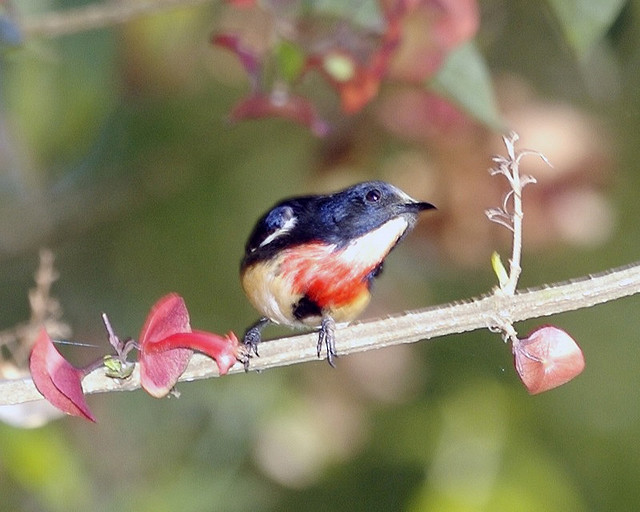
Blood-breasted Flowerpecker (Dicaeum sanguinolentum) ©©LipKee

Blood-breasted Flowerpecker (Dicaeum sanguinolentum) ©©LipKee

And almost all things are by the law purged with blood; and without shedding of blood is no remission. (Hebrews 9:22 KJV)

As we continue the mini-series of the “Easter Birds”, today we look at the blood that was shed by Jesus Christ on the cross. When we see these “Blood” Birds, may we be reminded of Christ’s sacrifice on the cross for us.

Just before being taken by the soldiers, Christ has been praying:

And being in an agony he prayed more earnestly: and his sweat was as it were great drops of blood falling down to the ground. (Luke 22:44 KJV)

John tells us:

But one of the soldiers with a spear pierced his side, and forthwith came there out blood and water. (John 19:34 KJV)

The Bible teaches all through the Old Testament about the sacrifices that were carried out for the forgiveness of sin. They had to do this time after time because, as Hebrews 9 explains:

Hebrews 9:6-15 KJV
(6) Now when these things were thus ordained, the priests went always into the first tabernacle, accomplishing the service of God.
(7) But into the second went the high priest alone once every year, not without blood, which he offered for himself, and for the errors of the people:
(8) The Holy Ghost this signifying, that the way into the holiest of all was not yet made manifest, while as the first tabernacle was yet standing:
(9) Which was a figure for the time then present, in which were offered both gifts and sacrifices, that could not make him that did the service perfect, as pertaining to the conscience;
(10) Which stood only in meats and drinks, and divers washings, and carnal ordinances, imposed on them until the time of reformation.
(11) But Christ being come an high priest of good things to come, by a greater and more perfect tabernacle, not made with hands, that is to say, not of this building;
(12) Neither by the blood of goats and calves, but by his own blood he entered in once into the holy place, having obtained eternal redemption for us.
(13) For if the blood of bulls and of goats, and the ashes of an heifer sprinkling the unclean, sanctifieth to the purifying of the flesh:
(14) How much more shall the blood of Christ, who through the eternal Spirit offered himself without spot to God, purge your conscience from dead works to serve the living God?
(15) And for this cause he is the mediator of the new testament, that by means of death, for the redemption of the transgressions that were under the first testament, they which are called might receive the promise of eternal inheritance.

There are many verses that speak about the need of Christ shedding His blood, dying, and Praise the Lord, for rising from the tomb. (Opps, that is for tomorrow.) Here are few of those verses:

Much more then, being now justified by his blood, we shall be saved from wrath through him. (Romans 5:9 KJV)

To the praise of the glory of his grace, wherein he hath made us accepted in the beloved. In whom we have redemption through his blood, the forgiveness of sins, according to the riches of his grace; (Ephesians 1:6-7 KJV)

Blood-colored Woodpecker (Veniliornis sanguineus)

But now in Christ Jesus ye who sometimes were far off are made nigh by the blood of Christ.
(Ephesians 2:13 KJV)

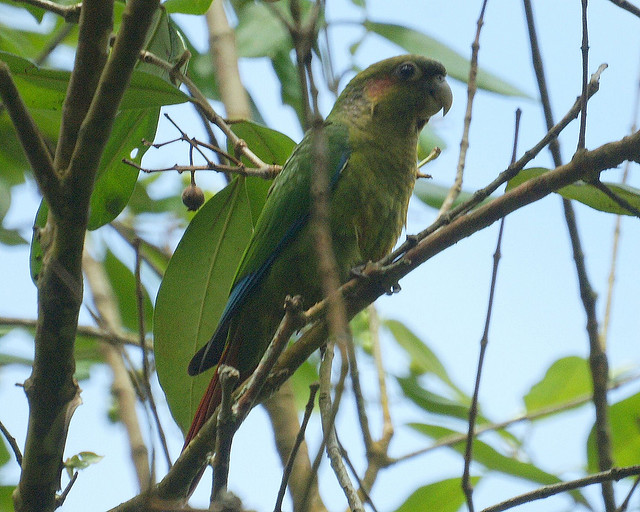
Blood-eared Parakeet (Pyrrhura hoematotis) ©©barloventomagico

Blood-eared Parakeet (Pyrrhura hoematotis) ©©barloventomagico

In whom we have redemption through his blood, even the forgiveness of sins: Who is the image of the invisible God, the firstborn of every creature: For by him were all things created, that are in heaven, and that are in earth, visible and invisible, whether they be thrones, or dominions, or principalities, or powers: all things were created by him, and for him: And he is before all things, and by him all things consist. (Colossians 1:14-17 KJV)

Forasmuch as ye know that ye were not redeemed with corruptible things, as silver and gold, from your vain conversation received by tradition from your fathers; But with the precious blood of Christ, as of a lamb without blemish and without spot: (1 Peter 1:18-19 KJV)

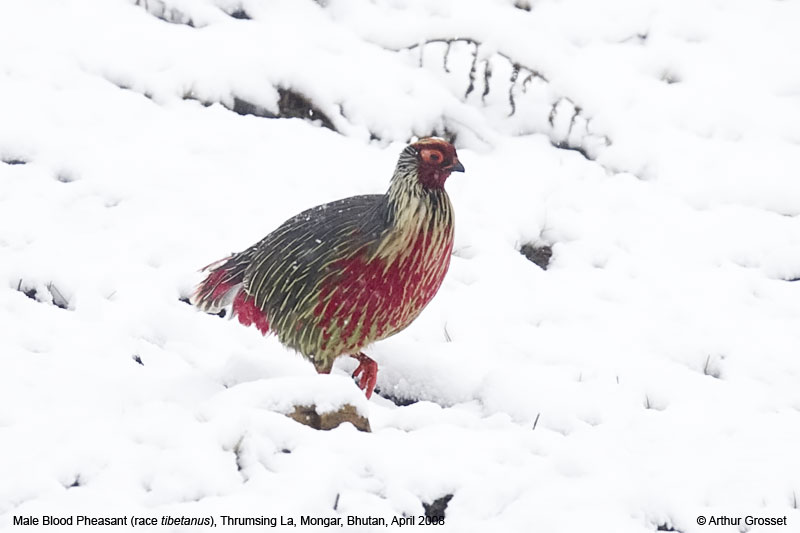
Blood Pheasant (Ithaginis cruentus) ©Arthur Grosset

Blood Pheasant (Ithaginis cruentus) ©Arthur Grosset

The “Cross” birds were considered, but the Crossbills, which are in the Finches – Fringillidae Family, were the only birds with “cross” in their name. Also, “Crown” Birds were considered, but there were too many. If you missed the mini-series, they are the “Palm”, “Whip”, “Thorn” and the “Sword and Piercer” Birds.

See:

Gospel Message

Wordless Birds
___
More Formed By Him Articles
*