Ian’s Bird of the Week – Crested Tern

Newsletter 03-20-09

Crested Tern now Swift Tern (Thalasseus bergii) by Ian
Crested Tern now Swift Tern (Thalasseus bergii) by Ian

Please accept my apologies for a late posting this week.
At the end of January I was in Cairns and we visited Palm Cove, north of the city, to search for an immature Laughing Gull
(http://www.birdway.com.au/larini/laughing_gull/index.htm), that has been spending the Northern winter there. Laughing Gulls are rare trans-Pacific vagrants in Australia and always cause some excitement when they appear.
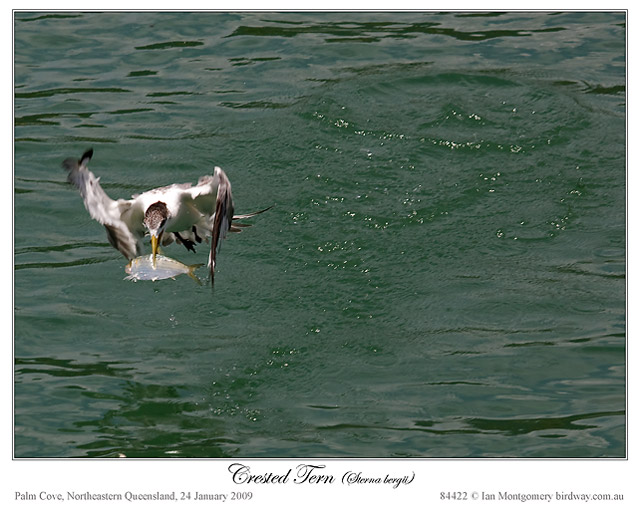
We found, and photographed, the gull okay, but while waiting for it to do its occasional forays for scraps past the fishermen on the wharf, I passed the time by photographing an immature, fishing Crested Tern – right at the other end of the Australian rarity scale and the commonest and most widespread marine tern. As luck would have it, just while I was photographing it flying towards me, it dived and caught, by tern standards anyway, a substantial fish.
Crested Tern now Swift Tern by Ian

Crested Tern now Swift Tern by Ian

In the first photo, you can see the greenish back of the fish at the surface just below the bill of the bird. The tern is braking its fall by spreading its wings and tail and has its feet splayed out in front of it ready for the impact with the water.

In the following photo, less that a second later, the tern has caught the fish expertly over its centre of gravity and is working hard to regain height. It didn’t drop the fish and the tern last disappeared into the distance with its prize.
Terns normally catch quite small fish, so it would be easy to speculate that this was an error of judgment on the part of an inexperienced bird. Or maybe it was just showing off in front of a camera-laden tourist.
One of the reason for a late posting is that I’ve been busy working on the website. The Next and Previous Family links that I mentioned last week now navigate through 30 more families beyond the New World Flycatchers as far as the Swallows. Substantially revised galleries include various Australian families such as:

Recently, I received a copy of a delightful and informative electronic document called ‘How Birds Fly’ by Stuart Cousland that he prepared and presents to schools in Victoria in his role of Education Coordinator for the (Mornington) Peninsula Bird Observers Club (part of BOCA). Some of my photos were used in it. I highly recommend it and copies are available free either on CD or as 5MB email attachment by contacting him on seastar@pac.com.au or (03) 5988 6228.

Best wishes,
Ian

Ian Montgomery, Birdway Pty Ltd,
454 Forestry Road, Bluewater, Qld 4818
Phone: +61-7 4751 3115
Preferred Email: ian@birdway.com.au
Website: http://birdway.com.au


Lee’s Addition:
23-66-1723 Swift Tern (Thalasseus bergii) Breeding by IanThe Crested Tern that Ian mentions was hard to find on the new I.O.C. list. They keep changing names and genus around and the list was update in August this year. The Sterna bergii or Crested Tern was taken out of the Sterna genus and placed in the Thalasseus genus. Then they changed it to Swift Tern. You think that didn’t take some searching to find out it’s new name.
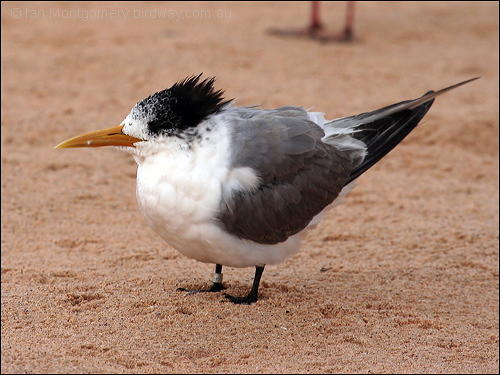
Here are some facts from Wikipedia:”The Greater Crested Tern, Crested Tern or Swift Tern, (Thalasseus bergii), is a seabird in the tern family which nests in dense colonies on coastlines and islands in the tropical and subtropical Old World. Its five subspecies breed in the area from South Africa around the Indian Ocean to the central Pacific and Australia, all populations dispersing widely from the breeding range after nesting. This large tern is closely related to the Royal and Lesser Crested Terns, but can be distinguished by its size and bill colour.”
Swift Tern (Thalasseus bergii) Non-breeding by Ian

Swift Tern (Thalasseus bergii) Non-breeding by Ian

“The Greater Crested Tern has grey upperparts, white underparts, a yellow bill, and a shaggy black crest which recedes in winter. Its young have a distinctive appearance, with strongly patterned grey, brown and white plumage, and rely on their parents for food for several months after they have fledged. Like all members of the genus Thalasseus, the Greater Crested Tern feeds by plunge diving for fish, usually in marine environments; the male offers fish to the female as part of the courtship ritual.”

This is an adaptable species which has learned to follow fishing boats for jettisoned bycatch, and to utilise unusual nest sites such as the roofs of buildings and artificial islands in salt pans and sewage works. Its eggs and young are taken by gulls and ibises, and human activities such as fishing, shooting and egg harvesting have caused local population declines. There are no global conservation concerns for this bird, which has a stable total population of more than 500,000 individuals.”

Swift Tern (Crested) (Thalasseus bergii) by Ian

Swift Tern (Crested) (Thalasseus bergii) by Ian

“The Greater Crested Tern is a large tern with a long (5.4–6.5 cm, 2.1–2.6 in) yellow bill, black legs, and a glossy black crest which is noticeably shaggy at its rear. The breeding adult of the nominate subspecies T. b. bergii is 46–49 cm (18–19 in) long, with a 125–130 cm (49–51 in) wing-span; this subspecies weighs 325–397 g (11.4–14.0 oz). The forehead and the underparts are white, the back and inner wings are dusky-grey. In winter, the upperparts plumage wears to a paler grey, and the crown of the head becomes white, merging at the rear into a peppered black crest and mask.”

The adults of both sexes are identical in appearance, but juvenile birds are distinctive, with a head pattern like the winter adult, and upperparts strongly patterned in grey, brown, and white; the closed wings appear to have dark bars.  The nests are located on low‑lying sandy, rocky, or coral islands, sometimes amongst stunted shrubs, often without any shelter at all. The nest is a shallow scrape in the sand on open, flat or occasionally sloping ground. It is often unlined, but sometimes includes stones or cuttlefish bones.

Fish are the main food of the Greater Crested Tern, found to make up nearly 90% of all prey items with the remainder including cephalopods, crustaceans and insects. Unusual vertebrate prey included agamid lizards and green turtle hatchlings.

“The Great Crested Tern feeds mostly at sea by plunge diving to a depth of up to 1 m (3 ft), or by dipping from the surface, and food is usually swallowed in mid-air. Birds may forage up to 10 km (6 mi) from land in the breeding season.”

The Greater Crested Tern occurs in tropical and warm temperate coastal parts of the Old World from South Africa around the Indian Ocean to the Pacific and Australia.”

Then He said to them, “Follow Me, and I will make you fishers of men.” (Matthew 4:19 NKJV)

Ian’s Bird of the Week – African Penguin

African Penguin by Ian

African Penguin by Ian

Newsletter – 7/16/2009

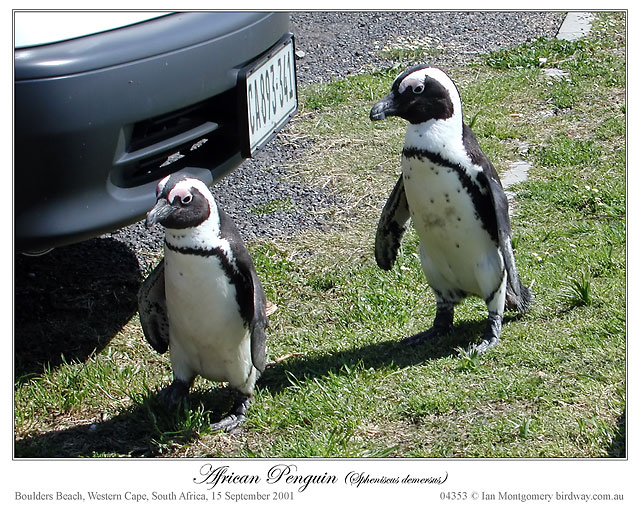
Well now, as they say, for something completely different here is the African Penguin. I was reviewing the contents of the website a few days ago, and noticed that there weren’t any penguins. Not having yet succeeded in photographing the only resident Penguin resident in mainland Australia, the Little Penguin, I rectified this by digging out some photos of what used to be called Jackass Penguins that I took in South Africa in 2001.

African Penguins strolling by Ian

African Penguins strolling by Ian

You’re right if you think that the background in the first photo isn’t snow, or even sand for that matter, and your suspicions will be confirmed by the second one – the photos were taken in the car park at Boulders Beach south of Cape Town. (The ‘CA’ of the car number plate refers to the old Cape Province.) The penguin colony is right beside the car park, and I found that the car park itself was the easiest place to photograph these very cooperative subjects.

The name Jackass Penguin refers to the braying sound that these birds make but, as their South American relatives make similar noises and this species is the only one resident in Africa, the name African Penguin is now preferred. Being a cynic, I had thought that the name change was for reasons of political correctness. With a length of 63cm/25in this is a smallish but not tiny penguin – much larger than the Little Penguin (40-45cm/16-18in).

It occurs right around southern Africa from Port Elizabeth in the east to northern Namibia in the west. The colony at Boulders Beach is a tourist attraction, and is something of a bad-news/good-news story. The bad news is that feline predators such as leopards have become less common in populated areas, but the good news is that this has allowed the Penguins to establish mainland colonies at a couple of sites near Cape Town. Two pairs first nested at Boulders Beach in 1982 and there are now over 3,000.

On the website, I recently revised the galleries for Storks, including the Jabiru or Black-necked Stork and Bustards, mainly the Australian Bustard though I’ve added a couple of ancient shots (originally on film!) of the rather similar Kori Bustard of Africa for comparison  .

Best wishes,
Ian

Ian Montgomery, Birdway Pty Ltd,
454 Forestry Road, Bluewater, Qld 4818
Phone: +61-7 4751 3115
Preferred Email: ian@birdway.com.au
Website: http://birdway.com.au


See Spheniscidae – Penguin

The Flight of Migratory Birds by Werner Gitt

Pectoral Sandpiper (Calidris melanotos) by J Fenton

Pectoral Sandpiper (Calidris melanotos) by J Fenton

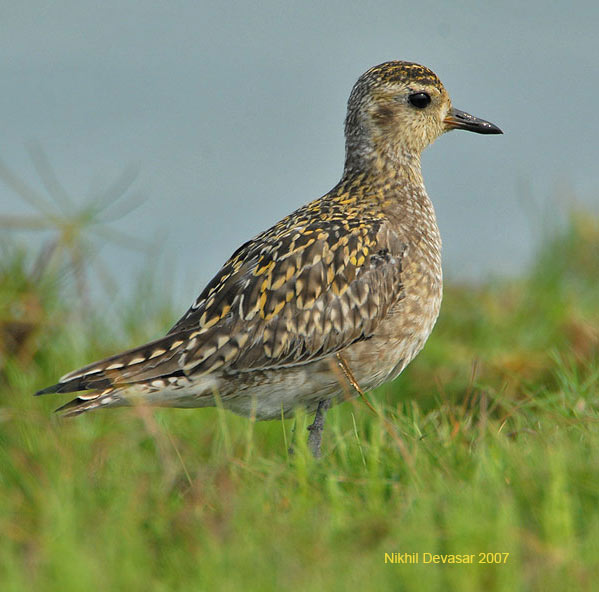
The Flight of Migratory Birds by Werner Gitt is a fairly technical, but very interesting article about the migration of birds. While thinking about yesterday’s Birds of the Bible – Migration September 2009, I came across this article. He mentions the Pacific Golden Plover in detail and some other long fliers, like:

“The following equally incredible flight performances are recorded for:

  • the Japanese snipe (Capella hardtwickii): 5,000 km flight from Japan to Tasmania
  • the needle-tailed swift of Eastern Siberia (Chaetura caudacuta): flight from Siberia to Tasmania
  • the American sandpipers (e.g. Calidris melanotos = pectoral sandpiper): 16,000 km flight from Alaska to Tierra del Fuego.”

Another excerpt from the article:

Pacific Golden Plover (Pluvialis fulva) by Nikhil Devasar

Pacific Golden Plover (Pluvialis fulva) by Nikhil Devasar

“The birds’ capabilities extend beyond the bounds of our imagination. They can determine their homeward course over long distances, even when all possible aids to orientation have been removed during the disorientation journey. They possess the extraordinary faculty of being able, wherever they are, to determine their position relative to their home territory from their immediate surroundings. And this method of determining location, itself not understood even today, is only the beginning; then comes the real problem, namely flight navigation: mere sense of direction is not enough for this.

During flight over wide, windswept stretches of ocean, a tendency to drift off course cannot be avoided. Such drift must be continually compensated for, as in a feedback system in control technology, in order to avoid losing energy by flying a longer route. The Creator equipped the birds with a precise ‘autopilot,’ which apparently is constantly measuring its geographical position and comparing the data with its individually “programmed” destination. In this way an economical, energy-saving and direct flight is guaranteed. Just where this vital system is to be found and how this operating information is coded is known by no one today except the Creator, who made it.”
To see the whole article – CLICK HERE


Ian’s Bird of the Week – Red-collared Lorikeet

Red-collared Lorikeet (Trichoglossus rubritorquis) by Ian

Red-collared Lorikeet (Trichoglossus rubritorquis) by Ian

Newsletter 9/3/2009

Here’s the catch-up bird of the week as promised yesterday.

Red-collared Lorikeet (Trichoglossus rubritorquis) by Ian

Red-collared Lorikeet (Trichoglossus rubritorquis) by Ian

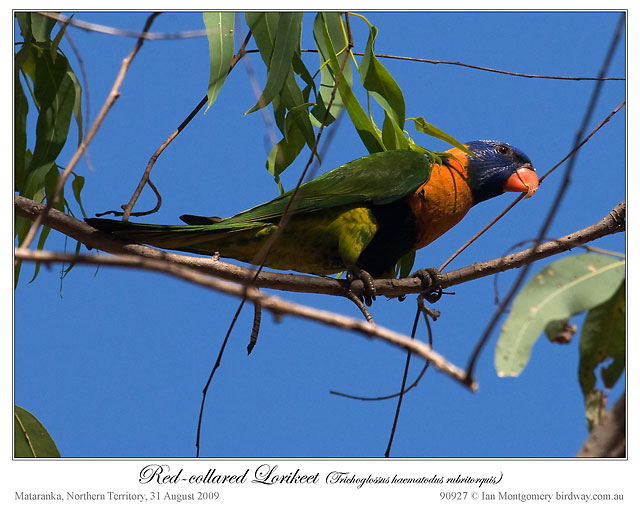
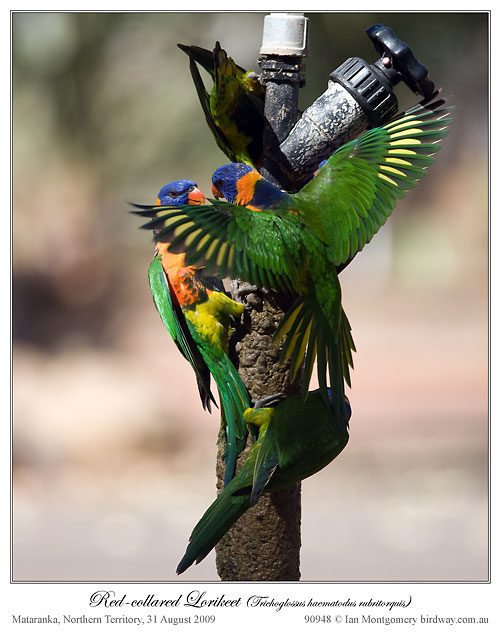
If you looked at the photos and said “that’s just a Rainbow Lorikeet!”, you’d be right, sort of, and if you said “that’s like a Rainbow Lorikeet but different” you’d be right exactly. This is the Northern race (rubritorquis) of the Rainbow Lorikeet and is sufficiently distinct to have once been considered a separate species, the Red-collared Lorikeet. The differences include the orange, rather than yellowish-green nape and the orange, rather than red, breast and black, rather than purple, belly.

It’s range is similar to that of the previous bird of the week, the Green-Backed Gerygone – including both the Kimberley district of NW Western Australia and the Top End of the Northern Territory – but it extends farther east around the Gulf of Carpentaria as far as Western Cape York Peninsula in Queensland.

Like the eastern race, this is a noisy, gregarious and common bird and very easy to take for granted. It took an English birder (thank you, Nigel!) to point out how amazingly beautiful and colourful the Rainbow Lorikeets are, a comment that stopped me in my tracks and made me regard them in a new light.

I took these photos during my stopover in Mataranka. This place is famous for its thermal springs which feed the Roper and Little Roper Rivers with permanent water. The water emerges at a temperature of 34ºC/93ºF which would be wonderful in a cold climate, but is far from refreshing when the air temperature is 37º as it was when I was there. For my second swim, I chose to swim with the (shy) Freshwater Crocodiles http://www.birdway.com.au/crocodylidae/freshwater_crocodile/index.htm farther down the Roper River where the water was cooler.

The permanent water makes Mataranka an oasis in a dry landscape with great stands of Fan Palms and Pandanus. The similarity to :Lawn Hill and Adel’s Grove in Northwestern Queensland is more than just a coincidence, as Lawn Hill Creek is fed by the same giant, subterranean, geological structure as Mataranka, perhaps 600-700 km away. The only thing missing at Mataranka is the Purple-crowned Fairywren http://www.birdway.com.au/maluridae/purple_crowned_fairywren/index.htm .

Anyway, time to pack up and leave Darwin for Kakadu. I hope that I’ll have something more special than a mere subspecies for you next week!

Best wishes,
Ian

Ian Montgomery, Birdway Pty Ltd,
454 Forestry Road, Bluewater, Qld 4818
Phone: +61-7 4751 3115
Preferred Email: ian@birdway.com.au
Website: http://birdway.com.au


Rainbow Lorikeet (Trichoglossus moluccanus) by Ian

Rainbow Lorikeet (Trichoglossus moluccanus) by Ian

Lee’s Addition:
Here is a link to the Rainbow Lorikeet that Ian mentioned. He has some fabulous shots of them.

Some interesting facts about the Lories and Lorikeets from Wikipedia:

“The Red-collared Lorikeet, Trichoglossus rubritorquis, is a species of parrot found in wooded habitats in northern Australia (north-eastern Western Australia, northern Northern Territory and far north-western Queensland). It is sometimes considered a subspecies of the Rainbow Lorikeet, but today most major authorities consider them as separate species.[2][3] No other member of the Rainbow Lorikeet group has an orange-red collar over the nape.”

“Lories and lorikeets are small to medium-sized arboreal parrots characterizedby their specialized brush-tipped tongues for feeding on nectar and soft fruits. The species form a monophyletic group within the parrot family Psittacidae. Traditionally, they were considered one of the two subfamilies in that family (Loriinae), the other being the subfamily Psittacinae, but new insights show that it is placed in the middle of various other groups. To date, this issue has not been resolved scientifically. They are widely distributed throughout the Australasian region, including south-eastern Asia, Polynesia, Papua New Guinea and Australia, and the majority have very brightly colored plumage.”

Morphology

Tongue of a Lory


“Lories and lorikeets have specialized brush-tipped tongues for feeding on nectar and soft fruits. They can feed from the flowers of about 5,000 species of plants and use their specialized tongues to take the nectar. The tip of their tongues have tufts of papillae (extremely fine hairs), which collect nectar and pollen. In the wild, lorikeets feed on nectar and pollen from plants and flowers.

Lorikeets have tapered wings and pointed tails that allow them to fly easily and display great agility. They also have strong feet and legs. They tend to be hyperactive and clownish in personality both in captivity and the wild.”

Its leaves were beautiful and its fruit abundant, and in it was food for all. The beasts of the field found shade under it, and the birds of the heavens lived in its branches, and all flesh was fed from it. (Daniel 4:12 ESV)

Birds of the Bible – Migration September 2009

Radar 9-30-09 image at 12:30 AM Eastern Daylight savings time.

Radar 9-30-09 image at 12:30 AM Eastern Daylight savings time.

I know that I have written about the migration of the birds before, but this is really interesting. They have been posting radar images of the Florida peninsula on BRDBRAIN, a bird-listing service. Here are the images for September 28th and 30th. The dark spots are the birds in migration being picked up on radar. It is amazing. I have been reading the updates for about a week and the birds are ON THE MOVE!

Even the stork in the sky Knows her seasons; And the turtledove and the swift and the thrush Observe the time of their migration; But My people do not know The ordinance of the LORD. (Jeremiah 8:7 NASB)

9-28-2009 Bird Radar

9-28-2009 Bird Radar

When the Lord created the birds, he put within them the instinct to migrate. They go for various reasons, but that desire is there and off they go. Some do not make it across the open waters, but most do. As you can see by the radar, they know to fly around the bad weather and go where it is clear. I know here in Polk county, Florida, that the Bald Eagles have been arriving back. I have seen a Bald Eagle on 7 of the last 9 days. I was in different places in the county when they were spotted. Prior to that, I had not spotted any eagles since they left on their spring northern migration other than the few resident ones.

Does the hawk fly by your wisdom, And spread its wings toward the south? (Job 39:26 NKJV)
“Stretch her wings toward the south? – Most of the falcon tribe pass their spring and summer in cold climates; and wing their way toward warmer regions on the approach of winter. This is what is here meant by stretching her wings toward the south. Is it through thy teaching that this or any other bird of passage knows the precise time for taking flight, and the direction in which she is to go in order to come to a warmer climate? There is much of the wisdom and providence of God to be seen in the migration of birds of passage. This has been remarked before. There is a beautiful passage in Jeremiah, Jer_8:7, on the same subject:” From the Adam Clarke’s Commentary.

A few links to check out are:

http://badbirdz2.wordpress.com/
http://badbirdz2.wordpress.com/2009/09/30/more-migration-over-florida-2/
http://badbirdz2.wordpress.com/2009/09/30/more-migrants-on-their-way/
http://badbirdz2.wordpress.com/2009/09/29/major-migrant-movement-last-night/

See Also:
Birds of the Bible – Migration
Bird Migration Mistakes
Interesting – Migration and Mechanics of Flight
Interesting Things – Amazing Bird Migration
Birds of the Bible – Hawk Migration
Interesting Thing – Lesson from the Stork

Meliphagidae – Honeyeaters

White-eared Honeyeater (Lichenostomus leucotis) by Ian at Birdway

White-eared Honeyeater (Lichenostomus leucotis) by Ian at Birdway

Meliphagidae – Honeyeaters Family Information

Pleasant words are as an honeycomb, sweet to the soul, and health to the bones. (Proverbs 16:24 KJV)

The honeyeaters are a large and diverse family of small to medium sized birds most common in Australia and New Guinea, but also found in New Zealand, the Pacific islands as far east as Hawaii, and the islands to the north and west of New Guinea known as Wallacea. Bali, on the other side of the Wallace Line, has a single species.

Honeyeaters and the closely related Australian chats make up the family Meliphagidae. In total there are 182 species in 42 genera, roughly half of them native to Australia, many of the remainder occupying New Guinea. Like their closest relatives, the Maluridae (Australian wrens), Pardalotidae (pardalotes and thornbills), and Petroicidae (Australian robins), they originated as part of the great corvid radiation in Australia-New Guinea (which were joined in a single landmass until quite recent geological times).

Although honeyeaters look and behave very much like other nectar-feeding passerines around the world (such as the sunbirds and flowerpeckers), they are unrelated, and the similarities are the consequence of variation.

Unlike the hummingbirds of America, honeyeaters do not have extensive adaptations for hovering flight, though smaller members of the family do hover hummingbird-style to collect nectar from time to time. In general, honeyeaters prefer to flit quickly from perch to perch in the outer foliage, stretching up or sideways or hanging upside down at need. All genera have a highly developed brush-tipped tongue, longer in some species than others, frayed and fringed with bristles which soak up liquids readily. The tongue is flicked rapidly and repeatedly into a flower, the upper mandible then compressing any liquid out when the bill is closed.

Bridled Honeyeater (Lichenostomus frenatus) by Ian at Birdway

Bridled Honeyeater (Lichenostomus frenatus) by Ian at Birdway

The extent of the partnership between honeyeaters and Australasian flowering plants is unknown, but probably substantial. A great many Australian plants are fertilised by honeyeaters, particularly the Proteacae, Myrtaceae, and Epacridacae. It is known that the honeyeaters are important in New Zealand as well, and assumed that the same applies in other areas.

In addition to nectar, all or nearly all honeyeaters take insects and other small creatures, usually by hawking, sometimes by gleaning. A few of the larger species, notably the White-eared Honeyeater, and the Strong-billed Honeyeater of Tasmania, probe under bark for insects and other morsels. Many species supplement their diets with a little fruit, and a small number eat considerable amounts of fruit, particularly in tropical rainforests and, oddly, in semi-arid scrubland. The Painted Honeyeater is a mistletoe specialist. Most, however, exist on a diet of nectar supplemented by varing quantities of insects. In general, the honeyeaters with long, fine bills are more nectarivous, the shorter-billed species less so, but even specialised nectar eaters like the spinebills take extra insects to add protein to their diet when they are breeding.

Lewin's Honeyeater (Meliphaga lewinii) by W Kwong

Lewin’s Honeyeater (Meliphaga lewinii) by W Kwong

The movements of honeyeaters are poorly understood. Most are at least partially mobile but many movements seem to be local, possibly between favorite haunts as the conditions change. Fluctuations in local abundance are common, but the small number of definitely migratory honeyeater species aside, the reasons are yet to be discovered. Many follow the flowering of favorable food plants. Arid zone species appear to travel further and less predictably than those of the more fertile areas. It seems probable that no single explanation will emerge: the general rule for honeyeater movements is that there is no general rule.

The genus Apalopteron (Bonin Honeyeater), formerly treated in the Meliphagidae, has recently been transferred to the Zosteropidae on genetic evidence.

A new taxon of honeyeater, not yet described but apparently close to the Smoky Honeyeater, has been discovered in December 2005 in the Foja Mountains of Papua, Indonesia.

From Wikipedia, the free encyclopedia with editing


See also:

Meliphagidae – Honeyeaters page

HONEYEATERS Meliphagidae by Bird Families of the World

*

Updates – 09-27-2009

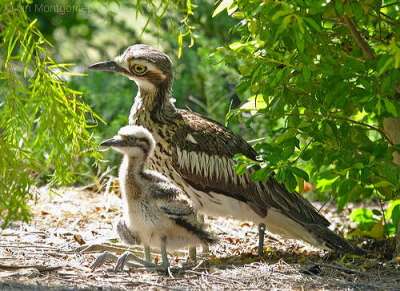
Bush Stone-curlew (Burhinus grallarius) with young by Ian

Bush Stone-curlew (Burhinus grallarius) with young by Ian

Some more bird family pages have been updated:

Burhinidae –  Stone-curlews, Thick-knees

Diomedeidae – Albatrosses

Megapodiidae – Megapodes

Anseranatidae – Magpie Goose

Anhimidae – Screamers

Birdwatching – 09-25-2009

Wood Duck (Aix sponsa) by Dan

Wood Duck (Aix sponsa) by Dan

Today we went birdwatching and ended up at three different places. Our intention was to go to Lake Hollingsworth, one of our favorite places to bird watch. I started my list as we were riding and saw about 20 Muscovy ducks (they are very prolific here), Morning Dove, Osprey, Black and Turkey Vultures, and a pair of Northern Harrier sitting on one of the light arms along the toll road.

It was clear today and about  79° when we arrived at Lake Hollingsworth at 8:35 am. We have been having some rain lately and the lake was really up. I spotted a Great Blue Heron, White Ibises, Mallards, some more vultures, and a Great Egret. What I didn’t spot were very many birds or a parking spot. So, we decided to go to Lake Morton instead. Good choice.

We were there by about 8:50 am and saw lots of birds being fed by a little girl and here father. She was the center of attention of the local clientele. I attempted to take her picture and the birds, but we had had our cameras and our eyeglasses in the car with the air conditioner running. After my glasses un-fogged, I looked through my lens and it was foggy. Needless to say, it was humid! Next time the camera will be in the trunk.

Mr and Mrs Wood Duck by Lee

Mr and Mrs Wood Duck by Lee

Anyway, it was a great day for pictures and I even took several videos (with my regular camera), fed the critters, and here is what we observed:  Wood Ducks (12+), Mallards, Wood Storks (I practically hand fed them), White Ibises, Black Swans, Mute Swans, Geese, Double-crested Cormorants, Laughing Gull, Anhinga, Muscovy Ducks, Bald Eagle (3rd one I’ve seen this week-there coming back!), Unknown terns, Limpkin, Rock Pigeons, Green Heron, Snowy Egret and a Great Blue Heron.

My highlight of being there was getting so close to the Wood Storks. I have never seen them that friendly before. Had I been brave enough to hold the bread (I know, you are not to feed wildlife, but everyone does at that lake and Hollingsworth), they would have ate right out of my hand. I tossed it to them and they were catching it and making a loud snap as that big beak closed. (The reason I didn’t hand feed. I need those fingers to snap photos with.) Also, the storks were sitting different than I had seen. Got a video of that also. The other highlight was I was videoing when a Bald Eagle flew over. I swung the camera up and caught him as he was flying off. You can hear my excitement in the video. I love eagles and had just wrote about them on yesterday’s blog.

We left there and had a small bite to eat and then on the way home decided to stop in at Circle B Bar Reserve to see what might be up near the entrance. By now it was 10:45 and most of the birds were resting somewhere, but not in sight. We heard a Blue Jay, Carolina Wren, Red-bellied Woodpecker, Tufted Titmouse and Blue-grey Gnatcatchers. Overhead we saw more Turkey Vultures and Black Vultures, and Wood Storks and then a Wood Stork flew low past us. Knowing bird sounds helps tremendously when you are in the woods and don’t always get to see the birds. I need to practice up much more myself. It counts when you are making list if they are heard.

The Lord provided a beautiful morning to watch His critters and just enjoy being out and about.

This is the LORD’S doing; it is marvellous in our eyes. This is the day which the LORD hath made; we will rejoice and be glad in it. (Psalms 118:23-24 KJV)

This first video is just looking around at the ducks and then spotting an eagle flying by.

The second video is of the stork bending its legs and sitting down.

Error
This video doesn’t exist

*

This slideshow requires JavaScript.

*

For other birdwatching trips to the Circle B Bar Reserve

*

Birds of the Bible – Eagle’s Renewal

Bless the LORD, O my soul, And forget not all His benefits: Who forgives all your iniquities, Who heals all your diseases, Who redeems your life from destruction, Who crowns you with lovingkindness and tender mercies, Who satisfies your mouth with good things, So that your youth is renewed like the eagle’s. (Psalms 103:2-5 NKJV)

Bald Eagle (Haliaeetus leucocephalus)  by AestheticPhotos

Bald Eagle (Haliaeetus leucocephalus) by AestheticPhotos

The Eagle is an interesting bird and I have written about them before. In the King James Version of the Bible, an eagle is mentioned in 34 verses. So, there will be future articles about the eagle also.

The interest of this article is the renewing of the eagle. In Psalms 103:5 (quoted above), your youth is renewed like the eagle’s. What exactly does that mean? Also, in Isaiah 40:31, strength is renewed and “shall mount up with wings as eagles.”

But they that wait upon the LORD shall renew their strength; they shall mount up with wings as eagles; they shall run, and not be weary; and they shall walk, and not faint. (Isaiah 40:31 KJV)
Many articles can be found on the internet about an eagle going off and plucking its feathers and not being able to fly for about five months. The image has even been added that the beak and claws are knocked off and then grow back during that time, giving them another 10 or so more years to their life. I have been trying to find proof of that, and am not finding it. Most Eagle authorities state that that would not happen, because the bird would die during that time with no flight feathers or beak or claws.

Bald Eagle (Haliaeetus leucocephalus)Grandfather Eagle by PastorBBC

Golden or Juvenile Bald Eagle (Haliaeetus leucocephalus) by PastorBBC in NC

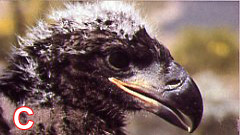
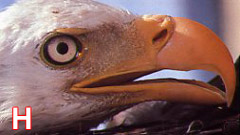
If those facts are true, then what is meant by God’s Word about the eagle? I believe God’s Word is true, so there has to be an explanation of it. From the Southwestern Bald Eagle Management I found an interesting chart that shows the different stages of plumage (feathers) as an eagle ages.  They said, “In their five year development to adulthood, bald eagles go through one of the most varied plumage changes of any North American bird. During its first four weeks of life, an eaglet’s fluffy white down changes to a gray wooly down. At about five weeks, brown and black feathers begin to grow. It becomes fully feathered at 10 weeks of age. In its first year, the mostly dark-colored juvenile can often be mistaken as a golden eagle. However, the bald eagle progressively changes until it reaches adult plumage at five years. Notice in the pictures how its dark eye lightens throughout its first four years of life until it becomes yellow. Also, see how its beak changes form gray-black to a vibrant yellow.

ald Eagle (Haliaeetus leucocephalus)  by AestheticPhotos

Bald Eagle (Haliaeetus leucocephalus) by AestheticPhotos

It is believed that the darker, more mottled plumage of a young eagle serves as camouflage, while the white head and tail announce that it is of breeding age.”

That to me sounds a lot like, “So that your youth is renewed like the eagle’s.” As the eagle goes through the different stages of its life, the new feathers are graciously provided by a Creator that sees to the needs of His creation by having designed those features to renew as it matures.

The Lord provides for renewal for His children as they mature. The following verses tell of a renewed right spirit, mind, spirit of your mind, and knowledge:

Create in me a clean heart, O God; and renew a right spirit within me. (Psalms 51:10 KJV)
And be not conformed to this world: but be ye transformed by the renewing of your mind, that ye may prove what is that good, and acceptable, and perfect, will of God. (Romans 12:2 KJV)
And be renewed in the spirit of your mind; (Ephesians 4:23 KJV)
And have put on the new man, which is renewed in knowledge after the image of him that created him: (Colossians 3:10 KJV)

(Update 11/2/11) Here is another possible explaination about this topic. It might be a vulture instead of an eagle. See: http://www.thewonderofbirds.com/griffon-vulture/bible.htm)
*

Ian’s Bird of the Week – Hooded Parrot

Hooded Parrot (Psephotus dissimilis) Male by Ian 1

Hooded Parrot (Psephotus dissimilis) Male by Ian 1

Newsletter 9-23-2009
I’m on a very shaky internet connection in Katherine, NT, so there is no guarantee that this will get through!

After Kakadu, we stayed at Pine Creek NT for a couple of days before heading off to Kununurra WA. Pine Creek’s main claim to fame is that it is the best place in the world to see Hooded Parrots.

The Hooded Parrot is one of three species of Psephotus that nest, or nested, in burrows in termite mounds. Of these, the Paradise Parrot is, alas, extinct, the Golden-shouldered of Cape York is, sadly, endangered, and only the Hooded Parrot of the Top End of the Northern Territory is tolerably secure. That said, its range is limited – South Alligator River in the east to Pine Creek in the west and Mataranka in the south – and is more restricted than formerly.

Hooded Parrot (Psephotus dissimilis) Male by Ian 2

Hooded Parrot (Psephotus dissimilis) Male by Ian 2

Pine Creek has, or at least uses, lots of water in a dry landscape and has lots of sprinklers and a Water Garden. Many birds take advantage of this, including the Hooded Parrot and the proprietor of the Lazy
Lizard caravan park told us which sprinkler to turn on at sunrise to attract the parrots. This worked both mornings, and the birds came in to drink at pools forming on the nearby road (the male in photo 1), to
drink and bathe in the wet grass (the male in photo 2) or from the sprinkler itself after it had been turned off (the female in photo 3). We saw 15 – 20 birds each morning, and the proprietor told us that the birds are more numerous than formerly.

Hooded Parrot (Psephotus dissimilis) Female by Ian 3

Hooded Parrot (Psephotus dissimilis) Female by Ian 3

I plan to head back towards Townsville tomorrow. It has been a successful trip: my companion and I are still talking, and I’ve photographed about half of the 35 species on my target list. So, I’ll have some more interesting birds to share with you in the coming weeks.

Best wishes,
Ian

Ian Montgomery, Birdway Pty Ltd,
454 Forestry Road, Bluewater, Qld 4818
Phone: +61-7 4751 3115
Preferred Email: ian@birdway.com.au
Website: http://birdway.com.au


Lee’s Addition:


Red-rumped Parrot (Psephotus haematonotus) by Ian

Red-rumped Parrot (Psephotus haematonotus) by Ian

Mulga Parrot (Psephotus varius) by Ian

Mulga Parrot (Psephotus varius) by Ian

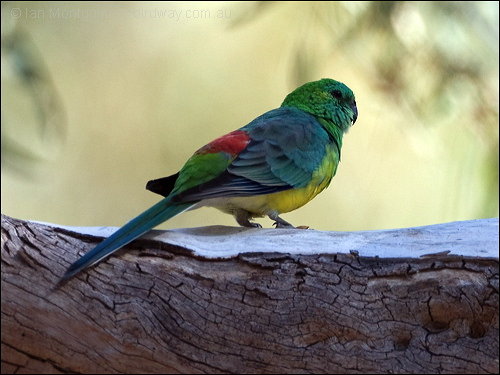
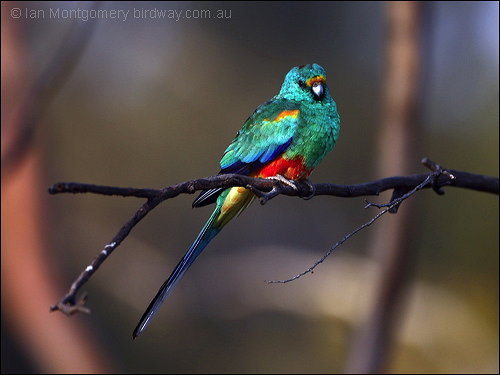
Looking at the genus Psephotus, there are only four left in the world and Ian has photos of three of them on his website. Since he is traveling and has a shaky internet connection, I checked his site and found the other two he has. The Red-rumped Parrot and the Mulga Parrot are shown here.

“The Golden-shouldered Parrot lives in open forest, where it feeds on small grass seeds, principally those of firegrass. An important habitat requirement is the provision of terrestrial termite mounds, which the bird uses for nesting in. This has led to the parrot also being known as the Antbed Parrot.and they can fly good.  The

Golden-shouldered Parrot (Psephotus chrysopterygius) Wikipedia

Golden-shouldered Parrot (Psephotus chrysopterygius) Wikipedia

Golden-shouldered Parrot will build a nest in the taller termite mounds (up to 2 m high), and will dig a burrow into them when the mound has been softened by the rains. A long tunnel is dug down into the mound, and capped off by a nesting chamber. The clutch size is between 3–6 eggs, which are incubated for 20 days. The mound regulates the temperature of the nest in the chamber, so that the eggs can be left unattended while the parents feed.” from Wikipedia

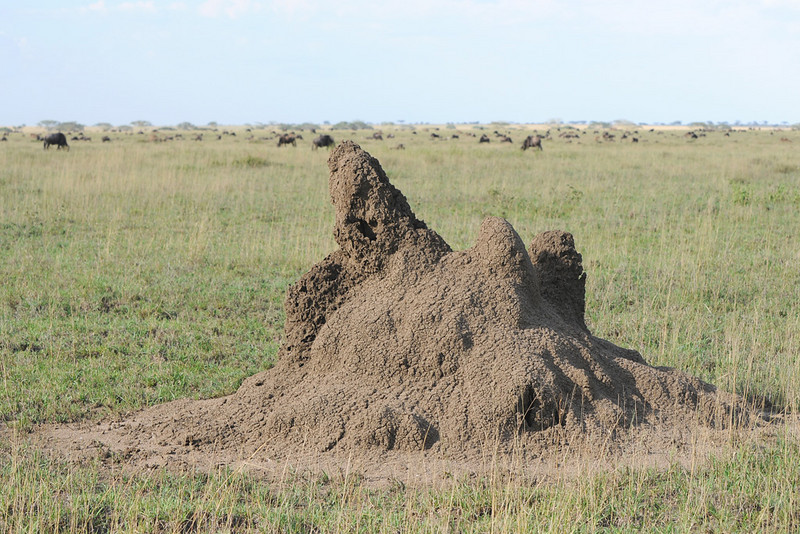
Termite Mound in Tanzania by Bob-Nan

Termite Mound in Tanzania by Bob-Nan

I remembered seeing a termite mound while looking through Bob and Nan’s gallery. This was in Tanzania, but I am sure they are similiar. (I hope)

And Jesus saith unto him, The foxes have holes, and the birds of the air have nests; but the Son of man hath not where to lay his head. (Matthew 8:20 KJV)

Interesting Things – Reshaped Wings, Forest Birds, Evolution?

I came across an interesting article in Science News, September 12, 2009, called, “Rapid evolution may be reshaping forest birds’ wings,” by Susan Millius. Subtitle – “Trend for pointier appendages in heavily logged boreal forests, with blunter, rounder ones in reforested parts of New England.”

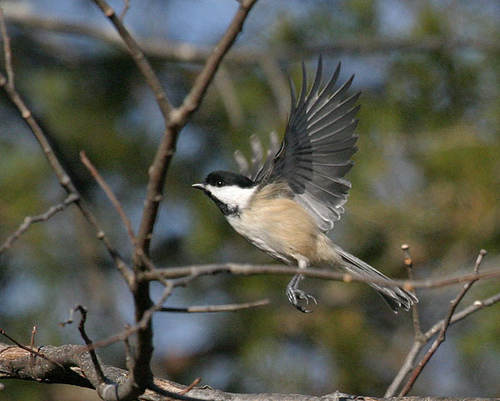
Boreal Chickadee (Poecile hudsonicus) by Daves BirdingPix

Boreal Chickadee (Poecile hudsonicus) by Daves BirdingPix

Records have been kept on birds that live in the boreal forest of Canada and parts of New England for the past centrury. These areas were heavily logged and left bare or reforested as in parts of New England.

When the records were analyzed, a trend developed. Wings of forest birds where the trees were logged and left bare were longer (approximately by 2 cm) and more pointed, whereas, the forest birds that had the trees replanted and the forest renewed, had shorter (by 2 cm) and rounder wings. They are comparing the same species of birds in both places.

“Mature-woodland species showed the clearest change in pointiness regardless of body size, Desrochers said. During the past century, their long wing feathers, or primary feathers, overall gained about 2.23 millimeters on average. That uptick roughly matches the magnitude of differences between sexes. For example, a female boreal chickadee’s wing today is about the length of a male’s in 1900, he said.

Desrochers also included more southerly species on his list, such as the scarlet tanager and hooded warbler. These birds had experienced a very different century. The landscape of New England, deforested during previous years, rebounded into green woodland again. And here, Desrochers found a trend back toward rounder wing tips. The eight mature-woodland species he studied typically had lost, on average, some 2.37 millimeters on those long primary feathers.

These species aren’t passive victims of environmental change, Desrochers said. As bird species face new challenges, they respond to the extent they can. “Birds are not like sitting ducks,” he said.”

David Winkler said, “It’s surprising that there’s so much change so fast.” He also noted, “doesn’t explicitly address whether the wings change by evolution or by some other process. Winkler said that in observing changes and invoking evolution, “we need to be careful.”

Black-capped Chickadee (Poecile atricapillus) by Kent Nickell

Black-capped Chickadee (Poecile atricapillus) by Kent Nickell

Well, of course, those statements caught my interest. I believe in a Creator who supplies his creation with tremendous capability to adapt and have their needs supplied. I believe in natural selection and variation, but not something turning into something else or “macro-evolution.” I think the bird changed “by some other process,” namely, God’s protective watch-care.

Reading through the comments left, several were of note:

“I wonder what the “evolution might be directed by the species itself” refers to. It’s obvious here that the evolutionary selection of birds with appropriately shaped wings is caused by external forces, nothing the bird is doing. Those birds in areas that are opened up which have slightly longer wings are able to raise more chicks, while those in areas that are being reforested that have more rounded wings are able to raise more chicks. The reason is that distance flying is done more efficiently with longer (and therefore pointier) wings, while maneuverability is required in heavily branched areas and is done with shorter wings.

As for whether the wings are being worn out by contact with branches, this would be evident because the wear at the tip would be obvious. Feather shafts don’t go the whole way to the end of the feather, so if the tips were worn off, it would be noticed”  by DM (very good comment)

“Could the shorter wings of birds in denser forests be due to greater feather wear from brushing against branches and foliage? Maybe all wing feathers start out pointy and simply wear into a rounded shape.” by KC

More searching on the internet turned up a remark about this article at Answers in Genesis with this very interesting statement:  “The report notes that “as bird species face new challenges, they respond to the extent they can.” This comports with the creationist view: God included a range of genetic information and adaptability in organisms to allow them to live properly in a range of habitats.

The scientists aren’t certain how significant a role genes play in the wing tip changes. Still, Cornell University ornithologist David Winkler noted, “It’s surprising that there’s so much change so fast,” and Desrochers calls “rapid evolution” the most direct explanation. The speed of the changes indicates how the created kinds could have speciated rapidly after the Flood. Centuries of accumulated changes between some populations from the same created kinds resulted in sexual incompatibility. However, in other kinds (such as canids; see above), populations retain the ability even if interbreeding is uncommon.”

Consider the ravens: they neither sow nor reap, they have neither storehouse nor barn, and yet God feeds them. Of how much more value are you than the birds! (Luke 12:24 ESV)

God is providing for the birds and we know He will provide for us, especially if we belong to Him.

Bolding is by Lee.

When I Consider! – Loon

When I Consider!

When I Consider!

“Evidence From Biology”

The loon is designed quite differently than almost all other birds. While the bodies of most birds are designed as light and aerodynamic as possible, the loon’s body is heavier, allowing it to sink until only its head is above water. It controls its ability to float by inflating or deflating tiny air sacs under its skin. When flying at high altitude, where the air is thin, the loon can conserve oxygen by limiting the flow of blood to its massive leg muscles.

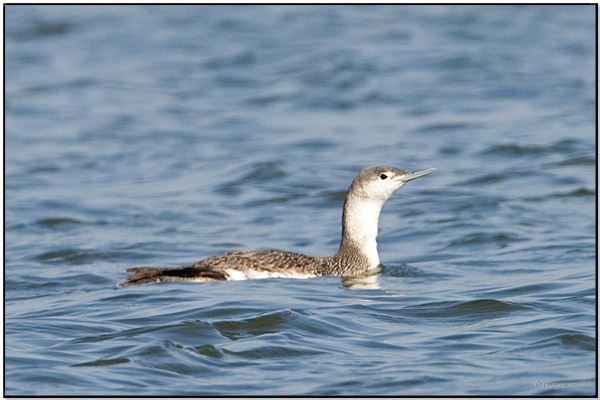
Red-throated Loon (Gavia stellata) by Daves BirdingPix

Red-throated Loon (Gavia stellata) by Daves BirdingPix

The loon also has a perfectly developed reflex which limits the flow of blood to its wings and digestive tract during underwater dives. This allows the loon to hold its breath for long periods of time. Although an average dive lasts about 40 seconds, three-minute dives that cover 300-400 yards are quite common. Astounding dives have been documented where loons have held their breath for as long as 15 minutes while swimming underwater for over 2 miles.

Both common sense and the laws of probability tell us that these many unique abilities could not have evolved by chance processes such as random mutations. The loon could not have developed its unique diving ability in some step-at-a-time manner. It would have starved to death long before it caught its first fish. The system had to work perfectly from the beginning.”

Great Northern Loon (Gavia immer) by J Fenton

Great Northern Loon (Gavia immer) by J Fenton

Character Sketches, Vol III. p.49

For thou art great, and doest wondrous things: thou art God alone. (Psalms 86:10 KJV)

From September 18, A Closer Look at the Evidence, by Richard and Tina Kleiss
More – “When I Consider!


Lee’s Additions:

“any of five species of diving birds constituting the genus Gavia, family Gaviidae. Loons were formerly included, along with the grebes, to which they bear a superficial resemblance, in the order Colymbiformes, but they are considered to constitute their own separate order. Loons range in length from 60 to 90 cm (2 to 3 feet). Characteristics include a strong tapered bill, small pointed wings, webs between the front three toes, and legs placed far back on the body, which makes walking awkward. Loons have thick plumage that is mainly black or gray above and white below. During the breeding season the dorsal plumage is patterned with white markings, except in the red-throated loon (Gavia stellata), which during the summer is distinguished by a reddish brown throat patch. In winter the red-throated loon develops white speckling on the back, while the other species lose these markings.” (Britannica Online)
“Loons are excellent swimmers, using their feet to propel themselves above and under water and their wings for assistance. Because their feet are far back on the body, loons are poorly adapted to moving on land. They usually avoid going onto land, except when nesting.

Pacific Loon (Gavia pacifica) by Ian

Pacific Loon (Gavia pacifica) by Ian

All loons are decent fliers, though the larger species have some difficulty taking off and thus must swim into the wind to pick up enough velocity to become airborne. Only the Red-throated Diver (G. stellata) can take off from land. Once airborne, their considerable stamina allows them to migrate long distances southwards in winter, where they reside in coastal waters. Loons can live as long as 30 years.”

“The loons are the size of a large duck or small goose, which they somewhat resemble in shape when swimming. Like in these but unlike in coots (which are Rallidae) and grebes (Colymbiformes), their toes are connected by webbing. They may be confused even more readily with cormorants (Phalacrocoracidae), which are not too distant relatives of divers and like them are heaviset birds whose bellies – unlike those of ducks and geese – are submerged when swimming. Flying loons resemble a plump goose with a seagull’s wings, which seem quite small in proportion to the bulky body. They hold their head slightly pointing upwards during swimming, less so than cormorants do, and in flight they let the head decidedly droop down compared to all other aquatic birds of comparable habitus.

Males and females do not differ in plumage. Males are a bit larger on average, but usually this is only conspicuous when directly comparing the two parents. Their plumage is largely patterned black-and-white in summer, with grey on the head and neck in some species, and a white belly in all of them. This resembles many sea-ducks (Merginae) a lot – notably the smaller goldeneyes (Bucephala) – but is distinct from most cormorants which rarely have white feathers, and if so usually as large rounded patches rather than delicate patterns. All species of divers have a spear-shaped bill.”(Wikipedia)

See Also:
Peterson’s Field Guide Video Series on the Common Loon (Now the Great Northern Loon)
Gaviidae – Loons
Loon from Wikipedia
An interesting article in The Wilson Bulletin dated September 1947 – “The Deep Diving of the Loon and Old-Squaw and its Mechanism