Birds in Hymns – Sweet And Clear The Birds Are Singing

Based on:

He is not here: for he is risen, as he said. Come, see the place where the Lord lay. (Matthew 28:6 KJV)

Words: Unknown, in the Hymnal for American Youth by H Augustine Smith, 1919
Music: Canticles, by Frederick F Bullard, 1902 (1864-1904)

Wood Duck

Sweet and clear the birds are singing,
At Easter dawn.
Hark, O hear, the bells are ringing,
On Easter morn!
And the song that they sing,
That good news we hear them ring,
Is “Christ the Lord is risen, is risen.”

Birds, your hearts give to your singing,
And feel no fear.
Bells, fill all the air with ringing,
Let all men hear!
For the whole world is glad,
And with beauty new is clad;
Now Christ the Lord is risen, is risen.

Northern Parula (Parula americana) by Reinier Munguia

Northern Parula (Parula americana) by Reinier Munguia

Leaf and bud, as now, were growing
In Galilee;
Lilies Jesus loved were blowing
As fair to see;
When the first Easter morn
Woke the world to joy new born,
For Christ the Lord is risen, was risen.

Easter buds will soon be flowers,
Fragrant and gay;
Winter’s snows give place to showers,
And night to day;
Hope and joy come again,
Life and light forever reign;
Yea! Christ the Lord is risen, is risen!

Most information from The Cyber Hymnal

See ~ Wordless Birds

More ~ Birds in Hymns

*

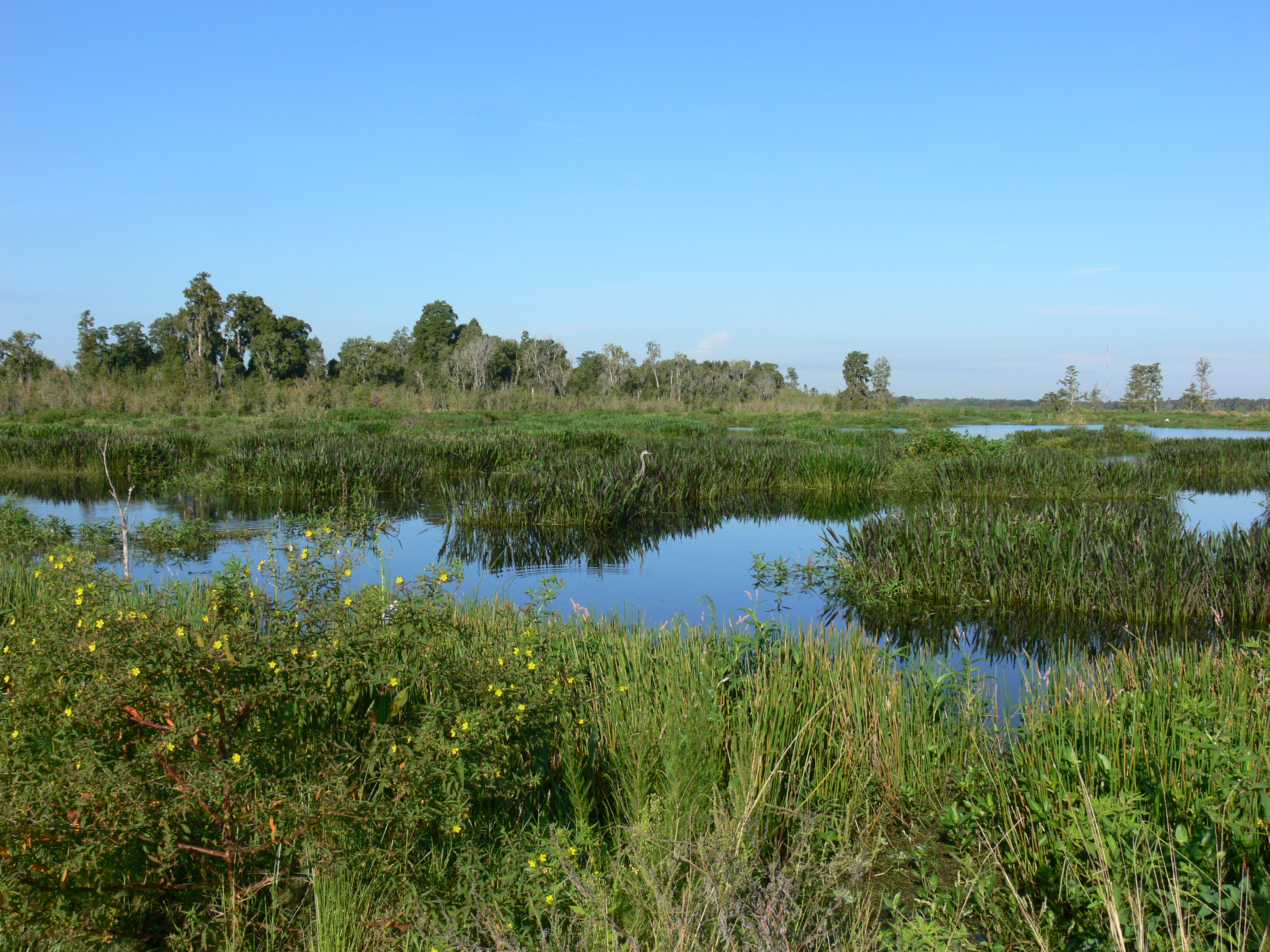
Birdwatching 09-18-09 at Circle B Bar Reserve

Looking out across part of Circle B  by Lee

Looking out across part of Circle B by Lee

Yesterday, Dan and I went out to the Circle B Bar Reserve again. As you can see it was a nice clear day. We had not been there for awhile due to the summer heat and many birds leave and head north for the summer. There were plenty of birds to see, but most have not arrived back yet. The Black-bellied Whistling-ducks were back (at least I didn’t see any last time we were there). One of the resident Bald Eagles made several low passes over the area and stirred many of the birds into the air. As they scattered, they passed right over us, whistling as they passed. There were many young Common Moorhens and at least one batch of very young ones with a parent. All in all, we saw 35 species and a few unknowns that were mostly heard.

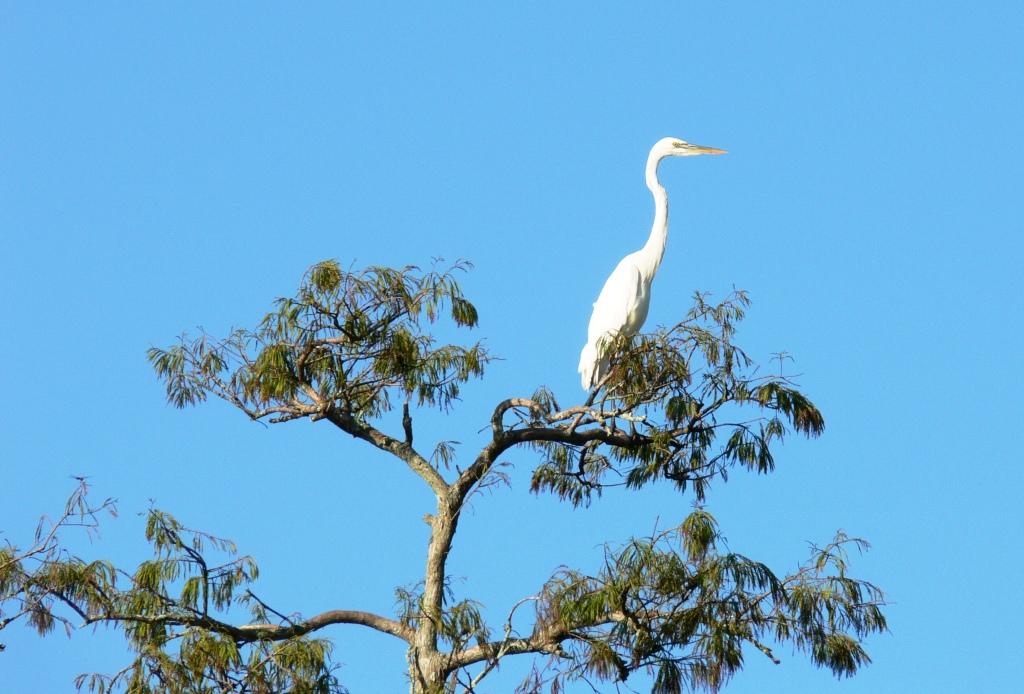
Western Great Egret (Ardea alba) Circle B by Lee

Western Great Egret (Ardea alba) Circle B by Lee

Here is a list of what we saw or heard in the order they were found:
Muscovy Ducks (just outside the park), 3 Sandhill Cranes, Mourning Doves, Black Vultures, Turkey Vultures, Ospreys, Carolina Wren, Pileated Woodpeckers, Tufted Titmouse, Great Blue Herons, Great Egrets, Red-Bellied Woodpecker, 2 Bald Eagles, Black-Bellied Whistling Ducks, Cattle Egrets, Pied-billed Grebe, Common Moorhens, Purple Gallinules, 2 Northern Harrier, 2 Red-shouldered Hawks, Little Blue Herons, Red-winged Blackbirds, Killdeer, Glossy Ibises, White Ibises, Snowy Egret, Fish Crows, Anhingas, 1 Double-crested Cormorant, Green Heron, Belted Kingfishers, Blue Jays, 2 Cardinals (M/F), Blue-grey Gnatcatcher, 5 or 6 Northern Bob-Whites. I also spotted a warbler with yellow and black, but it was too quick to get a good ID.

*

This slideshow requires JavaScript.

*

All Slide shows can be clicked on for a larger view.

For other birdwatching trips to the Circle B Bar Reserve

*

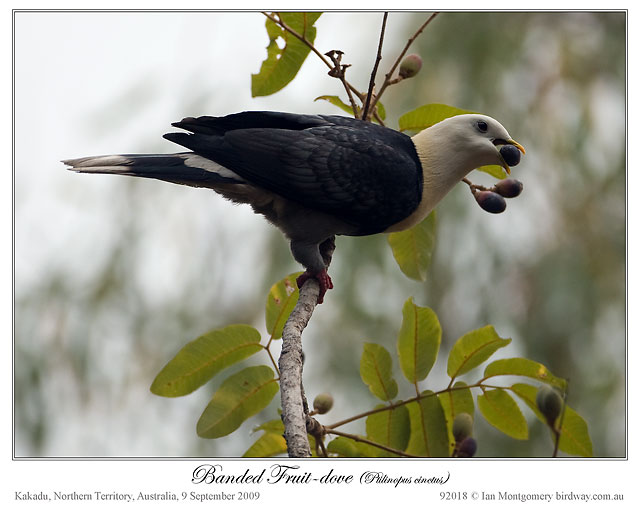
Ian’s Bird of the Week – Banded Fruit-Dove

Banded Fruit Dove (Ptilinopus cinctus) by Ian

Banded Fruit Dove (Ptilinopus cinctus) by Ian

Ian’s Newsletter – 09/18/2009

We did, in fact, find and photograph the White-quilled Rock-Pigeon on Wednesday, but rather than send another Rock-Pigeon as Bird of the Week, here is another, perhaps more photogenic, member of the pigeon family, the Banded Fruit-Dove. This was on my secondary target list (seen previously but not photographed) but high-priority none-the-less as it’s a splendid bird, uncommon and with a very restricted range in Australia, though it also occurs in Indonesia.

In Australia it occurs only in relict rain-forest patches in gullies of the sandstone escarpments of Arnhem Land and Kakadu. It’s usually shy and, like other fruit-doves, easier to hear than see as it usually keeps to to the foliage of fruiting trees. This bird, however, was gorging itself on the fruit of a tree with sparse foliage and didn’t seem to take much notice of us. It gets its name from the black band across the breast. The white head and breast makes it look rather like the Pied Imperial-Pigeon but is actually a member of the Ptilinopus genus that includes some of Australia’s most spectacular Fruit-Doves, the Wompoo, Rose-crowned and Superb (all at http://www.birdway.com.au/columbidae/index_aus.htm ).

We are still in Kununurra in Western Australia but start the return journey eastwards tomorrow. The hot weather hasn’t relented: it reached 41ºC yesterday, and it is easy to see why the local tourist season is almost finished – only mad dogs and birders etc.

Best wishes,
Ian

Ian Montgomery, Birdway Pty Ltd,
454 Forestry Road, Bluewater, Qld 4818
Phone: +61-7 4751 3115
Preferred Email: ian@birdway.com.au
Website: http://birdway.com.au


Lee’s Addition:


So I said, “Oh, that I had wings like a dove! I would fly away and be at rest. (Psalms 55:6 NKJV)

I added links to the other birds Ian mentioned above and more photos below:
Pied Imperial-Pigeon (Ducula bicolor)
Wompoo Fruit-Dove (Ptilinopus magnificus)
Rose-crowned Fruit-Dove (Ptilinopus regina)
Superb Fruit-Dove on a nest (Ptilinopus superbus)

Video of a Banded Fruit-Dove by Mark Sutton at IBC

Ptilinopus magnificus

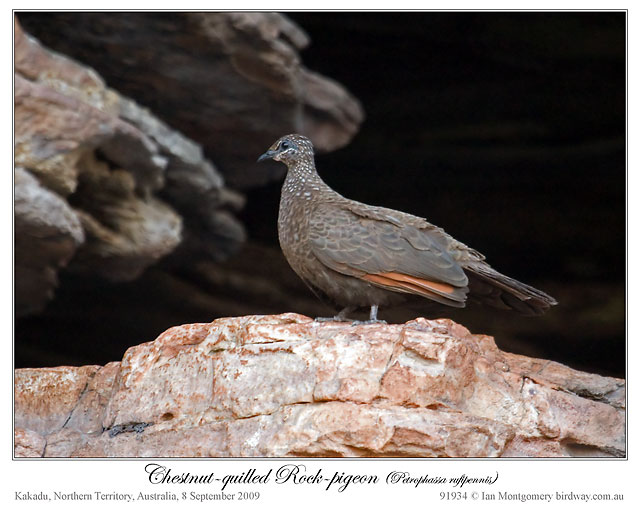
Ian’s Bird of the Week – Chestnut-quilled Rock-Pigeon

Chestnut-quilled Rock Pigeon (Petrophassa rufipennis) by Ian

Chestnut-quilled Rock Pigeon (Petrophassa rufipennis) by Ian

Ian’s Newsletter – 09/16/2009

This is really the bird of last week as this is the first opportunity I’ve had for internet access for 12 days. We are in Kununurra now in far northeastern Western Australia, having arrived here yesterday from the Northern Territory. We spent most of the time in the Kakadu area, followed by a couple of days in Pine Creek between Darwin and Katherine.

The Chestnut-quilled Rock-Pigeon was on my primary target list – birds that I hadn’t seen before – so I was pleased to find this single bird at Bardedjildidji, a sandstone escarpment in eastern Kakadu near Ubirr on the border with Arhnem Land. It obligingly flew past us before landing in this small cave not too far away and not too inaccessible. You can see the chestnut on the partially open wing.

There are two species of Rock-Pigeon – this one and the closely related White-quilled Rock-Pigeon. Both have limited distributions in northern Australia, the Chestnut-quilled in the Kakadu area and the White-quilled farther west in the Top end of the Northern Territory and across the border into Western Australia. Both are found in very rugged sandstone country where they take refuge in crevices and caves.

The White-quilled is one of the reasons for coming as far as Kununurra and we are going to look for this species later this afternoon when it cools down a bit. It has been very hot for almost our entire stay, reaching 37-38ºC almost every day. So, birding has been hard work a lot of the time.

I’ll send another catch-up bird of the week in a day or two while I have the opportunity here in Kununurra.

Best wishes,
Ian

Ian Montgomery, Birdway Pty Ltd,
454 Forestry Road, Bluewater, Qld 4818
Phone: +61-7 4751 3115
Preferred Email: ian@birdway.com.au
Website: http://birdway.com.au


Lee’s Addition: (bolding by Lee)


You who dwell in Moab, Leave the cities and dwell in the rock, And be like the dove which makes her nest In the sides of the cave’s mouth. (Jeremiah 48:28 NKJV)

One addition for us who use farenheit the 37-38° C is 98.6-100.4 F. Whew! That is hot!

“Description: (Collett 1898); Length 28 cm (12 – 12 1/2 inches). Head, neck, mantle & breast feathers dark sepia or dusky brown having a pale grey bases and buff fringes which form the scaly appearance. The throat & narrow stripe below & extending past the eye is white & is bordered above with a small black stripe extending thru the eye from the bill also bordered above with a thin white stripe. Primaries & secondaries bright chestnut with dark brown tips (chestnut color best seen when bird is in flight or stretching the wing). Belly and undertail dark brown. Eyes, bill, legs & feet dark brown. Female similar; juvenile are duller appearance.” from International Dove Society

Birds of the Bible – What Birds Can Tell – 1

Belted Kingfisher (Megaceryle alcyon) by Daves BirdingPix

Belted Kingfisher (Megaceryle alcyon) by Daves BirdingPix

But now ask the beasts, and they will teach you; And the birds of the air, and they will tell you; Or speak to the earth, and it will teach you; And the fish of the sea will explain to you. Who among all these does not know That the hand of the LORD has done this, (Job 12:7-9 NKJV)

One of my favorite birds that I enjoy watching is the Kingfisher. The ones we have here in Florida (Belted Kingfishers) are rather plain compared to others around the world, but they all have a characteristic look of a very long bill on a large head and a short neck. It is the bill that those in Japan have studied that is amazing.

Japan has electric trains that speed over 200 miles per hour or 322 kilometers per hour. They are very safe and have a great record, but a noise problem had been plaguing them until they observed the Kingfisher’s beak. When the speeding trains went through the tunnels, it caused a “tunnel boom” which goes against their strict sound pollution laws.

Blue-eared Kingfisher (Alcedo meninting) by Nik

Blue-eared Kingfisher (Alcedo meninting) by Nik

“Eiji Nakatsu, the train’s chief engineer and an avid bird-watcher, asked himself, “Is there something in Nature that travels quickly and smoothly between two very different mediums?” Modeling the front-end of the train after the beak of kingfishers, which dive from the air into bodies of water with very little splash to catch fish, resulted not only in a quieter train, but 15% less electricity use even while the train travels 10% faster.” (Learning Efficiency from Kingfishers)

Bullet Train

Bullet Train

The “tunnel boom” is caused  “when a train passes through such a tunnel at high speed, it compresses the air in front of the engine. Upon leaving the tunnel, this air rushes outward, creating a loud thunderclap, or sonic boom. Nearby windows rattle, and people are awakened by the noise.” (Don DeYoung, Answers) When the engineers did wind tunnel experiments they found that “the kingfisher’s bill is ideally shaped for a smooth, streamlined transition from air into water. This drastic change in pressure is similar to the change a bullet train experiences when emerging from a tunnel into the open air.”

By observing one of God’s created birds, the kingfisher, they were able to solve a serious problem. The Lord in His great wisdom has provided us many critters and other things to observe so that they may “tell us” things that will benefit us.

Whoso is wise, and will observe these things, even they shall understand the lovingkindness of the LORD. (Psalms 107:43 KJV)

See Also:

Speeding Bullet – Answers V4, #3
Kingfisher – Train by Discovery of Design
Learning Efficiency from Kingfishers by Biomimicry Institute

*

Early Bird by GeHof

Here’s an interesting video of tribute to birds, especially Those Early Birds Getting The Worm. From GeHof who posted it at YouTube.
What else was I to do today while we are having stormy weather here in Central Florida? I have been “Birdwatching” the internet.

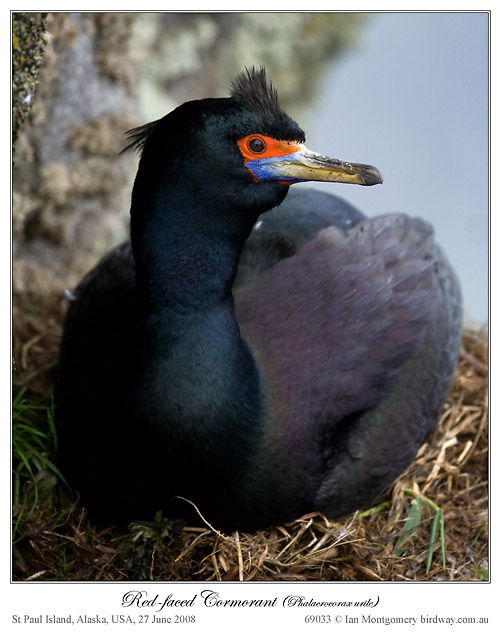
Ian’s Bird of the Week – Red-faced Cormorant

Red-faced Cormorant (Phalacrocorax urile) by Ian

Red-faced Cormorant (Phalacrocorax urile) by Ian

Newsletter 03-10-2009

Cormorants don’t often make it as Bird of the Week. People, particularly fishermen, mostly say or think “Uggh” when you say “cormorant” and even birders probably just tick them off without pausing in silent awe at their beauty. Cormorant, in general, lack style, hence the unflattering expression “like a shag on a rock”.

Well, here’s one that I think makes the grade. I particularly wanted to see Red-faced Cormorants when I was in Alaska last June. I wasn’t disappointed, particular when I got close to nesting birds on the cliffs of St Paul Island, and I give them high marks for their striking red and blue facial patterns, double crests, and startlingly iridescent plumage, worthy of some tropical wonder like a Bird of Paradise.

Red-faced Cormorant (Phalacrocorax urile) by Ian

Red-faced Cormorant (Phalacrocorax urile) by Ian

You have to go out of your way to see them, too. In North America, they occur only in southern Alaska, the Aleutians and the islands of the Bering Sea, though they are common within their restricted range, which extends across the Bering Sea to eastern Siberia and as far south as northern Japan.

On the website, I’ve been concentrating on updating galleries and indices to the latest format. One of the aims of this is to make it easier to navigate from one family to the next. I’m doing this through Previous and Next Family links on the top level (usually Global) thumbnail pages for each family (though not, at the moment, the lower Australian, Old World and New World thumbnail pages). This is progressing well. It is now possible to navigate through all the non-passerine families and I hope to fill the remaining gaps in the passerines (perching birds) soon. So, you can start at the first family, Cassowaries and Emus (http://www.birdway.com.au/casuariidae/index.htm) and follow the Next Family links all the way through 70 families as far as the New World Flycatchers (http://www.birdway.com.au/tyrannidae/index.htm) where the trail currently peters out with the New World Antbirds.

Best wishes,
Ian

Ian Montgomery, Birdway Pty Ltd,
454 Forestry Road, Bluewater, Qld 4818
Phone: +61-7 4751 3115
Preferred Email: ian@birdway.com.au
Website: http://birdway.com.au


Lee’s Addition:

The Cormorant is found in the list of unclean birds that the Israelites were not to eat.

And the pelican, and the gier eagle, and the cormorant, (Deuteronomy 14:17 KJV)

See Also:
Cormorant page
Birds of the Bible – Cormorant
Cormorant Photos
Cormorant Videos
Phalacrocoracidae – Cormorants, shags

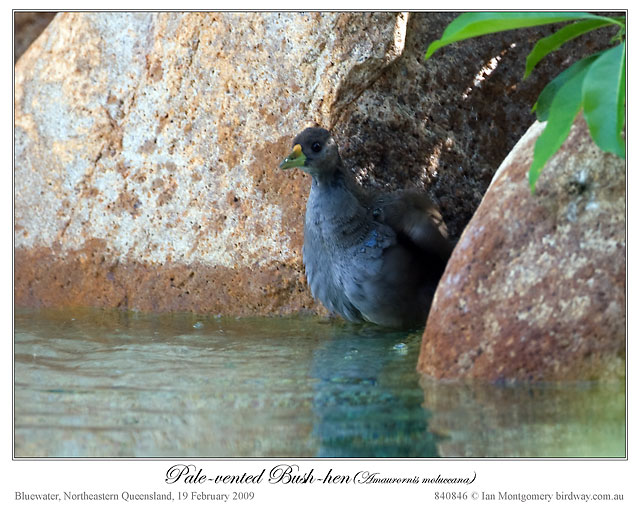
Ian’s Bird of the Week – (Pale-vented) Bush-hen

Pale-vented Bush-hen (Amaurornis moluccana) by Ian

Pale-vented Bush-hen (Amaurornis moluccana) by Ian

Ian’s Newsletter 02-24-2009

Pale-vented Bush-hen (Amaurornis moluccana) by Ian

Pale-vented Bush-hen (Amaurornis moluccana) by Ian

Last week, when discussing Kittiwakes and red legs, I referred obliquely to a common phenomenon in birding when having finally seen what I wanted (red legs) I saw lots of them. Serious birders call these bogey birds, where serious means passionate (oneself) or obsessed (someone else) and bogey means an evil spirit, or species, that leads you on a lengthy wild goose chase. The chase ends when a careless bird breaks the taboo by letting you see it and then, miraculously, the veil is lifted from your eyes and they appear everywhere.

Probably the two most challenging bogey birds in North Queensland, worse than Cassowaries, are unsurprisingly crakes: the (Pale-vented – a la Christidis & Boles, 2008) Bush-hen and the Red-necked Crake. I’d spent 6 years up here before I briefly spotted a startled Bush-hen from a speeding car (I wasn’t driving) and, after 7 years, I still haven’t had a proper view of a Red-necked Crake.

Pale-vented Bush-hen (Amaurornis moluccana) by Ian

Pale-vented Bush-hen (Amaurornis moluccana) by Ian

Typically, two weeks after seeing the Bush-hen (this time last year) a family of them appeared in my back yard, visible from the back verandah. Last Thursday, I was working on the website in the study, and went to make a cup of coffee when I spotted a Bush-hen in full view on the edge of the swimming pool. Unfortunately, the bird saw me move inside the house to get the camera and all I could manage was a shot of a nervous bird sneaking away through the vegetation. I left the camera and tripod set up in the house, just in case, and the bird reappeared a couple of hours later. It had a drink on the left hand side of the pool (photo no. 1) flew across the pool to a shallow spot for a swim (no. 2) and then spent about 10 minutes preening on a rock (no. 3). The bird came back again for another session on Saturday.
Both the days in question were sunny and very hot (33ºC/91ºF) and it was the middle of the day. The field guide says ” . . . secretive . . .emerges on overcast mornings, evenings . . .”, I like to imagine that they’re nesting again and the pool becomes irresistible during a tiresome day incubating eggs.

Back at the website, revised galleries include:
Falcons (http://www.birdway.com.au/falconidae/index.htm)
New World Vultures (http://www.birdway.com.au/cathartidae/index.htm)
Rails and Allies (http://www.birdway.com.au/rallidae/index.htm)
New World Flycatchers (http://www.birdway.com.au/tyrannidae/index.htm)
Cotingas (http://www.birdway.com.au/cotingidae/index.htm).

Best wishes,
Ian

Ian Montgomery, Birdway Pty Ltd,
454 Forestry Road, Bluewater, Qld 4818
Phone: +61-7 4751 3115
Preferred Email: ian@birdway.com.au
Website: http://birdway.com.au


Lee’s Addition:


For I satisfy the weary ones and refresh everyone who languishes. (Jeremiah 31:25 NASB)

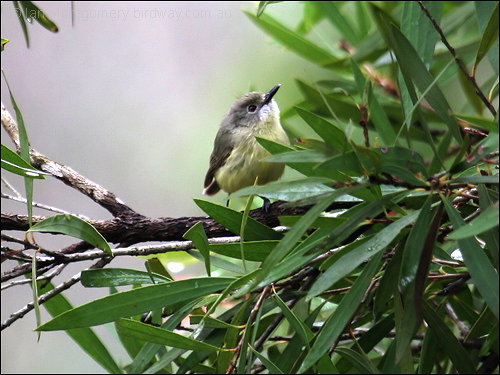
Ian’s Bird of the Week – Green-backed Gerygone

Green-backed Gerygone by Ian

Green-backed Gerygone by Ian

Ian’s 9/3/09 Newsletter – Bird of the Week: Green-backed Gerygone

Once again, my apologies for a late posting. I’ve just spent 5 days – with a 2 night stop at Mataranka – driving the 2,500km from Townsville to Darwin for the photography trip I mentioned last week. I usually prepare a trip wish-list of target species: this one has 35 on it, consisting of 9 that I haven’t seen before (the “tick” list), 9 that I have seen but haven’t photographed (the “click” list) and the remainder are candidates for better photos.

Last week’s bird was the widespread songster the White-throated Gerygone, so maybe it’s appropriate that the first target achieved – one of the 9 potential clicks – was the Green-backed Gerygone. The photo shows its diagnostic features: grey head, greenish-grey back and red eye. It may look rather nondescript but the greenish back is quite noticeable and it has a distinctive song. It feeds in typical gerygone style, foraging in the middle canopy of trees and hovering around foliage. There was a typo in last week’s email: gerugonos, not gerugogos, means something like “born of sound” in Greek but you were all too polite to point it out.

In Australia, it has a restricted distribution, occurring only in the Top End of the Northern Territory and the adjacent Kimberley region of northwest Western Australia. It is, however, quite common and we had no trouble finding it at Buffalo Creek near Darwin, where I’d seen it on a previous trip in 2002. It also occurs in New Guinea. Buffalo Creek is famous among birders as a stake-out for the elusive Chestnut Rail – http://www.birdway.com.au/rallidae/chestnut_rail/index.htm – which proved typically elusive this time even though several were to be heard in the mangroves.

We leave Darwin for Kakadu tomorrow and will probably spend a week there. So, I plan send you a catch-up bird of the week before we leave, as we’ll be camping most of the time and may not have internet access.

Best wishes,
Ian

Ian Montgomery, Birdway Pty Ltd,
454 Forestry Road, Bluewater, Qld 4818
Phone: +61-411 602 737
Preferred Email: ian@birdway.com.au
Website: Birdway


Lee’s Addition:

Fairy Gerygone (Gerygone palpebrosa) by Ian

Fairy Gerygone (Gerygone palpebrosa) by Ian

Gerygones, as one might expect, is not a bird I have enjoyed seeing, except through the lens of Ian and others. With the internet’s ability to share things, you get to learn about and “see” things you would not get the chance to do as easily. Thanks, Ian, for sharing your birding adventures.
Gerygones belong to the Australasian Warbler – Acanthizidae Family and are in the Gerygone species of which there are 19 of them. They are the Brown, Grey, Norfolk, Chatham, Fan-tailed, Treefern, Golden-bellied, Rufous-sided, Mangrove, Plain, Western, Dusky, Large-billed, Biak, Yellow-bellied, Ashy, Green-backed (this one), White-throated (last week’s), and the Fairy Gerygones. The ones with links will take you to Ian’s photos.

It was a little hard to find out much about the Gerygone, but here are some of my finds for the missing birds that Ian still needs to go find.

Grey Gerygone – video ,   Golden-bellied – video ,    Plain-Sound , all at IBC (Internet Bird Collecton)

Sounds like Ian has found a “catch.” It is always exciting when you find and photograph a rare bird. That is a part of the joy of birdwatching. When you search, scan, listen, know it’s there and then finally find that prize.

What do you think? If a man has a hundred sheep, and one of them has gone astray, does he not leave the ninety-nine on the mountains and go in search of the one that went astray? And if he finds it, truly, I say to you, he rejoices over it more than over the ninety-nine that never went astray. (Matthew 18:12-13)

Birds of the Bible – Birds of Every Sort

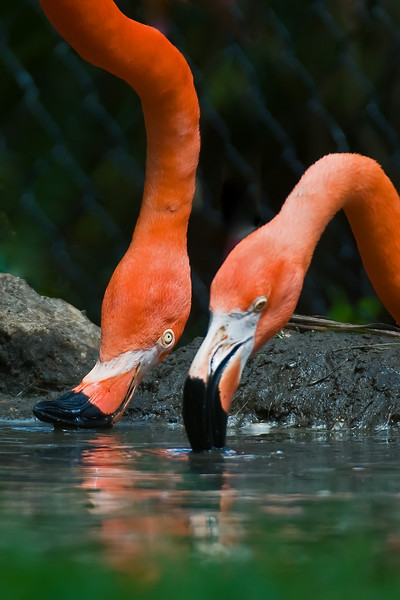
American Flamingo (Phoenicopterus ruber) by Africaddict

American Flamingo (Phoenicopterus ruber) by Africaddict

When I came across this verse about “every kind of bird” and “birds of every sort,” I decided it would be great to show some of the really fantastic birds that I have seen recently in the photos I am sorting for the Birds of the World blog. This will be done, but also the verses themselves are very interesting.

Thus says the Lord GOD: “I myself will take a sprig from the lofty top of the cedar and will set it out. I will break off from the topmost of its young twigs a tender one, and I myself will plant it on a high and lofty mountain. On the mountain height of Israel will I plant it, that it may bear branches and produce fruit and become a noble cedar. And under it will dwell every kind of bird; in the shade of its branches birds of every sort will nest. And all the trees of the field shall know that I am the LORD; I bring low the high tree, and make high the low tree, dry up the green tree, and make the dry tree flourish. I am the LORD; I have spoken, and I will do it. (Ezekiel 17:22-24 ESV)

Tufted Puffin by Dave's BirdingPix

Tufted Puffin by Dave's BirdingPix

Nebuchadnezzar had placed one of the family of David on the throne in Judah. This signified taking the seed of the land and planting it, but it did not succeed. But as these verses tell of a future time when there will be a “tender one” from the topmost twigs, referring to the Messiah, the tender one, and the tribe of Judah, main tribe. The Messiah is often referred to as a branch in prophecy.

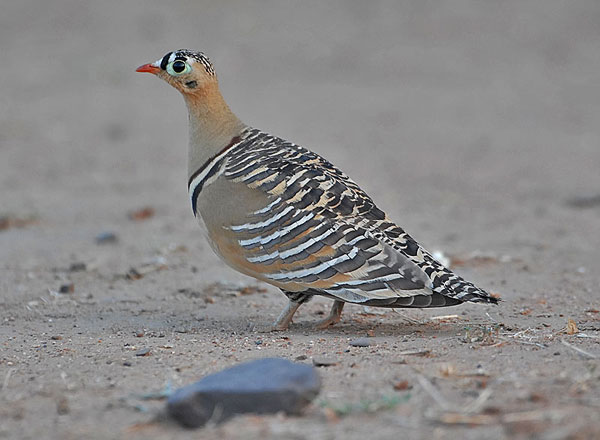
Painted Sandgrouse (Pterocles indicus) by Nikhil

Painted Sandgrouse (Pterocles indicus) by Nikhil

“Nebuchadnezzar and Zedekiah was made on this ground, and the name of Jehovah was brought in to confirm it. It was not the Gentile who broke the covenant. Zedekiah added to his other sins that of rendering impossible the existence of a people and a kingdom that belonged to God. The name of Jehovah was more despised and trampled under foot by him than by the Gentile king. He intrigues with Egypt to escape from the dominion of Nebuchadnezzar, whom God Himself, in judgment, had set up as supreme. This filled up the measure of iniquity, and brought on the final judgment. But it left room for the sovereignty of God, who would bring down the high tree and exalt the low tree, who would dry up the green tree and make the dry tree to flourish. His grace would take the little forgotten branch of the house of David and raise it up in Israel upon the mountain of His power, where He would cause it to become a goodly cedar, bearing fruit, and sheltering all that would seek the protection of its shadow. All the powers of the earth should know the word and the works of Jehovah.” From John Darby’s Synopsis.

Cedar Waxwing (Bombycilla cedrorum) by J Fenton

Cedar Waxwing (Bombycilla cedrorum) by J Fenton

“The twig planted by the Lord will grow there into a glorious cedar, under which all birds will dwell. The Messiah grows into a cedar in the kingdom founded by Him, in which all the inhabitants of the earth will find both food (from the fruits of the tree) and protection (under its shadow). For this figure, compare Daniel 4:8-9. צִפֹּור כָּל־כָּנָף, birds of every kind of plumage (cf. Ezekiel 39:4, Ezekiel 39:17), is derived from Genesis 7:14, where birds of every kind find shelter in Noah’s ark. The allusion is to men from every kind of people and tribe. By this will all the trees of the field learn that God lowers the lofty and lifts up the lowly.” From Keil & Delitzsch Commentary on Old Testament

Salvation is open to all people no matter what background, nationality, or tongue you speak. As the birds of every sort enjoy the shade and provisions of the tree, may you enjoy the Salvation of Lord and all His blessings He provides.

See: Wordless Birds

This is Birds of Every Sort – Part 1 (Non-Passerines)
*

This slideshow requires JavaScript.

*

Ian’s Bird of the Week – Red-legged Kittiwake

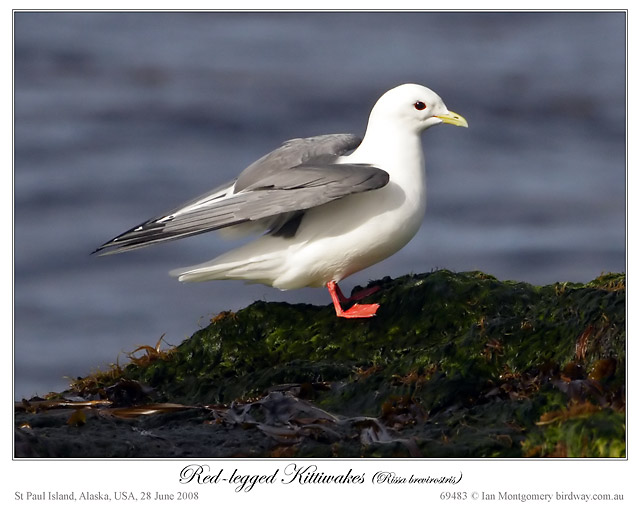
Red-legged Kittiwake (Rissa brevirostris) by Ian

Red-legged Kittiwake (Rissa brevirostris) by Ian

Ian’s Newsletter 02/17/2009

If, like me, you were a birdwatcher in the British Isles in the 1960s, you would have been been familiar with the Kittiwake, a delightful small gull usually seen at its dense nesting colonies on steep cliffs, and named after its call. You may also have wondered why, as British birdwatchers became less insular, the name was later qualified by the description “Black-legged”. This was done somewhat reluctantly, naturally, and my 1999 Collins Bird Guide still calls it (Black-legged) Kittiwake. Anyway, or as they say now, whatever, here is the reason: the Red-legged Kittiwake.

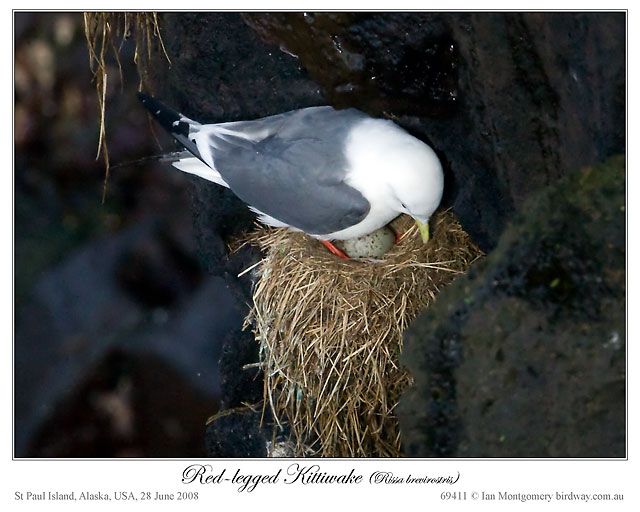
Red-legged Kittiwake (Rissa brevirostris) by Ian

Red-legged Kittiwake (Rissa brevirostris) by Ian

This was one of my must-see birds on St Paul Island in the Bering Sea on my trip to Alaska last June. Although not nearly as common as its Black-legged relative, it wasn’t hard to find. The red legs were a poor field mark, however, as the birds were either sitting on water, sitting on nests or flying past with their legs tucked snugly and sensibly into their vent feathers. With a little practice, it wasn’t hard to distinguish them by their darker wings and wing-linings, shorter, rather stubby bills and slightly smaller size, as in the photo of the Red-legged Kittiwake on the left sitting on its nest beside its similarly-occupied relative.

In fact red legs became an obsession, so that on the last morning seeing them became my only goal in life, and I set up my camera on a cliff-top with an incubating Red-legged Kittiwake in the sights and waited patiently. Eventually, I was rewarded and a rather stiff bird got up to stretch its legs and check its single egg, as in the second photo. After that, of course, the Kittiwakes came out to play and I saw red legs everywhere both on birds in flight and perched showily on rocks, third photo.

Red-legged and Black-legged Kittiwakes by Ian

Red-legged and Black-legged Kittiwakes by Ian

The Red-legged Kittiwake breeds at only 6 sites in the Bering Sea, the most important of which is St George, near St Paul, with 60% of the estimated world population of 100,000 pairs. It has more specialized feeding habits than the Black-legged, feeding mainly on squid and small fish. Its population is declining, breeding success is poor and it is classed as vulnerable. Commercial trawling is though to be responsible. It’s call is described as a high, falsetto, repeated ‘suWEEEr’, quite different from the ‘kitt-i-waake’ of the Black-legged. Maybe it should be renamed and we can go back to simple “Kittiwake”. Recent website revisions: Thrushes (http://www.birdway.com.au/turdidae/index.htm); Old World Flycatchers (http://www.birdway.com.au/muscicapidae/index.htm); Fringillid Finches (http://www.birdway.com.au/fringillidae/index.htm) and Estrildid Finches (http://www.birdway.com.au/estrildidae/index.htm). Best wishes, Ian — Ian Montgomery, Birdway Pty Ltd, 454 Forestry Road, Bluewater, Qld 4818 Phone: +61-7 4751 3115 Preferred Email: ian@birdway.com.au Website: http://birdway.com.au


Lee’s Addition:


“On the cliff he dwells and lodges, Upon the rocky crag, an inaccessible place. (Job 39:28 NASB)

This verse applied to the Eagle, but it is also applicable to the Kittiwakes.

Ian’s Bird of the Week – White-throated Gerygone

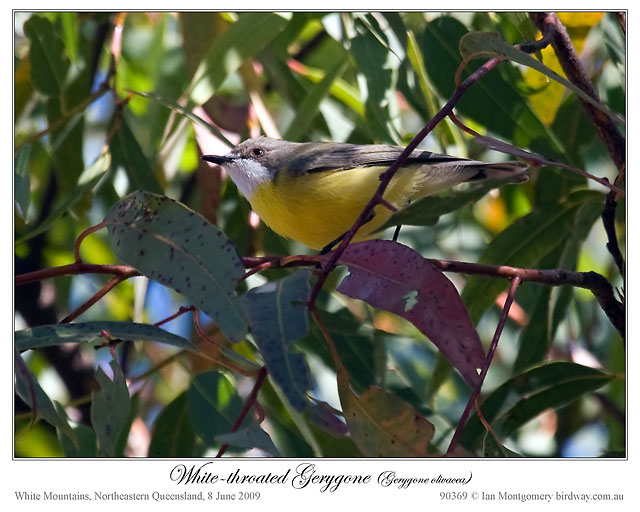
White-throated Gerygony by Ian

White-throated Gerygony by Ian

Bird of the Week: White-throated Gerygone

My apologies for a late posting this week – I’ve been trying to clear the decks in preparation for a trip to the Northern Territory in a few days. I hope this trip will fill a few gaps in Northern birds that I can share with you in the coming weeks.

Here’s a bird at the other end of the size scale from the Wedge-tailed Eagle of last week: the White-throated Gerygone. With a length of 10-11.5 cm./4-4.5 in., it’s not much bigger than Australia’s smallest bird, the Weebill (8-9 cm). Size isn’t everything, however – unless you’re an eagle – and the White-throated Gerygone has perhaps the most beautiful song of any Australian songbird. The field guides wax lyrical – let me quote Michael Morecombe: ‘Loud, clear, carrying. Usually begins with several loud, piercing, high notes immediately followed by pure, high, clearly whistled, violin-like notes that descend in an undulating, silvery, sweet cascade, at times lifting briefly, only to resume the downward, tumbling momentum. Abruptly returns to the initial louder, sharper notes to repeat the whole sequence, often with slight variations.’

This species is widespread in eastern and northern Australia from Adelaide in South Australia to the western Kimberleys in Western Australia. In addition to its distinctive song, it can be identified by its white, throat, yellow breast, red eye and white spots on the tips of the tail feathers.

There are eight species of Gerygone in mainland Australia and another twelve or so in the rest of Oceania (New Zealand to New Guinea). They used to be called Warblers, but are usually called Gerygones now (the name of the Genus) to avoid confusion with the unrelated Old World Warblers and the Wood Warblers of the New World – the Gerygones belong to the family Acanthizidae, along with other small birds including Thornbills, Scrubwrens, Heathwrens and Whitefaces. All the Gerygones are accomplished vocalists, and the word derives from the Greek – gerugogos – meaning something like ‘born of sound’. There has been much debate on how to pronounce Gerygone, but Sean Dooley had the final word in his book Anoraks to Zitting Cisticolas: ‘Not Jerry gone (or Gerry with a hard G), but more like Ja-rig-eny, rhyming with aborigine.’ It’s ironic that such beautiful singers should be be lumbered with such an ugly name.

My thanks to those who supported the petition to stop the poisoning of Golden Eagles in Ireland. Members of the list from at least Australia, Italy, Ireland and the USA added their names and Australia moved from 9th (85 signatures) to 8th (116 signatures) in the list of countries.

Best wishes,
Ian

Ian Montgomery, Birdway Pty Ltd,
454 Forestry Road, Bluewater, Qld 4818
Phone: +61-7 4751 3115
Preferred Email: ian@birdway.com.au
Website: http://birdway.com.au


Another Whtie-throated Gerygone by Ian

Another Whtie-throated Gerygone by Ian

Lee’s Additions:
He’s not the only one behind in posting. So there will be another one right soon. Since his next one is also going to be about another Gerygone, I’ll save my additions for there.

Look at the birds of the air, for they neither sow nor reap nor gather into barns; yet your heavenly Father feeds them. Are you not of more value than they? (Matthew 6:26 NKJV)

Here’s are two  interesting videos of a White-throated Gerygone at the nest. From Internet Bird Collection by Nick Talbot – CLICK HERE and CLICK HERE