Sunday Inspiration – Cuckooshrikes

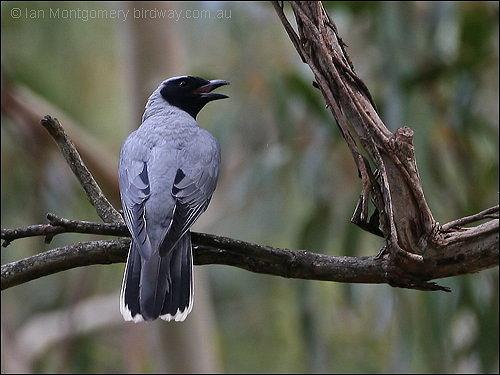
Black-faced Cuckooshrike (Coracina novaehollandiae) by Ian

Black-faced Cuckooshrike (Coracina novaehollandiae) by Ian

Out of the ground the LORD God formed every beast of the field and every bird of the air, and brought them to Adam to see what he would call them. And whatever Adam called each living creature, that was its name. (Genesis 2:19 NKJV)

The cuckooshrikes and allies in the Campephagidae family are small to medium-sized passerine bird species found in the subtropical and tropical Africa, Asia and Australasia. The roughly 92 species are found in eight (or nine) genera which comprise five distinct groups, the ‘true’ cuckooshrikes (Campephaga, Coracina, Lobotos, Pteropodocys and Campochaera) the trillers (Lalage), the minivets (Pericrocotus), the flycatcher-shrikes (Hemipus). The woodshrikes (Tephrodornis) were often considered to be in this family but are probably better placed in their own family, the Tephrodornithidae, along with the philentomas and the flycatcher-shrikes.

Pied Triller (Lalage nigra) ©WikiC

Pied Triller (Lalage nigra) ©WikiC

Overall the cuckooshrikes are medium to small arboreal birds, generally long and slender. The smallest species is the small minivet at 16 cm (6.3 in) and 6-12 grams (0.2-0.4 oz), while the largest is the south Melanesian cuckooshrike at 35 cm (14 in) and 180 grams (6 oz). They are predominantly greyish with white and black, although the minivets are brightly coloured in red, yellow and black, and the blue cuckooshrike of central Africa is all-over glossy blue. The four cuckooshrikes in the genus Campephaga exhibit sexual dimorphism, with males that have glossy black plumage and bright red or yellow wattles, the females having more subdued olive-green plumage. The genus Coracina is not monophyletic.
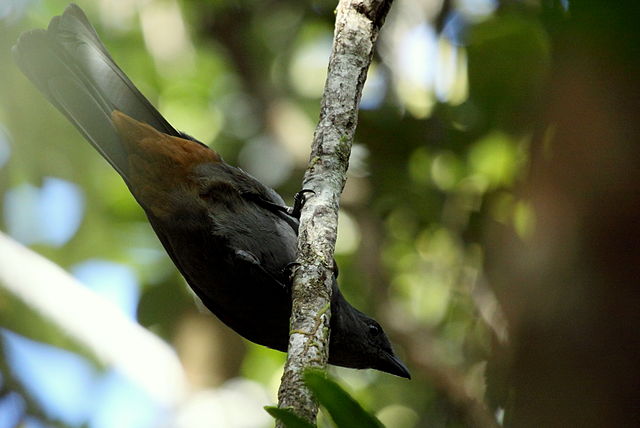
New Caledonian Cuckooshrike (Coracina analis) ©WikiC

New Caledonian Cuckooshrike (Coracina analis) ©WikiC

The majority of cuckooshrike are forest birds. Some species are restricted to primary forest, like the New Caledonian cuckooshrike, others are able to use more disturbed forest. Around eleven species use much more open habitat, one Australian species, the ground cuckooshrike being found in open plains and scrubland with few trees.

The ‘true’ cuckooshrikes are usually found singly, in pairs, and in small family groups, whereas the minivets, flycatcher-shrikes and wood-shrikes more frequently form small flocks. There is a considerable amount of variation within the family as a whole with regards to calls, some call very infrequently and some, principally the minivets, are extremely vocal.

(Info from Wikipedia with editing)

This slideshow requires JavaScript.

For the invisible things of him from the creation of the world are clearly seen, being understood by the things that are made, even his eternal power and Godhead; so that they are without excuse: (Romans 1:20 KJV)

Jesus answered them, “I told you, and you do not believe. The works that I do in My Father’s name, they bear witness of Me. (John 10:25 NKJV)

Giving thanks always for all things unto God and the Father in the name of our Lord Jesus Christ; (Ephesians 5:20 KJV)

Listen to the Hyssongs as you watch the interesting Cuckooshrike family whom the Lord created:

“There’s Something About That Name” © The Hyssongs

*

More Sunday Inspirations

Birds of the World

Cuckooshrike – Wikipedia

Cuckoo-shrike – IBC

Cuckooshrikes – Birds of the World

Falling Plates

*
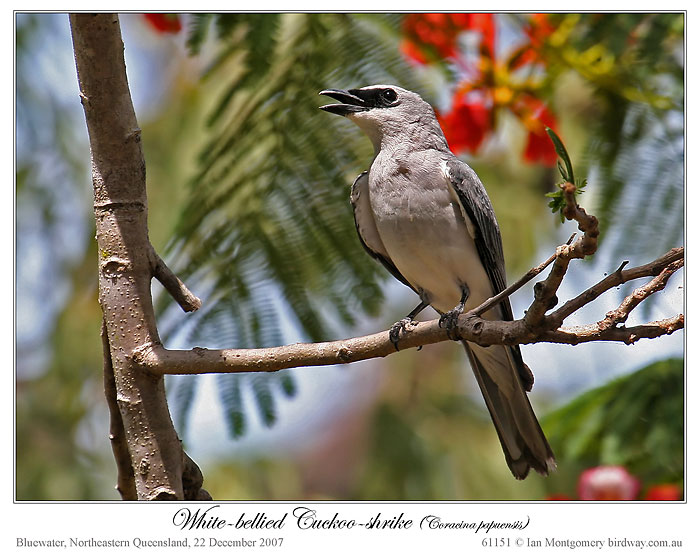
Ian’s Bird Of The Week – White-bellied Cuckooshrike

White-bellied Cuckooshrike (Coracina papuensis robusta) by Ian

White-bellied Cuckooshrike (Coracina papuensis robusta) by Ian

Ian’s Bird Of The Week – White-bellied Cuckooshrike ~ by Ian Montgomery

Newsletter – 3/27/11

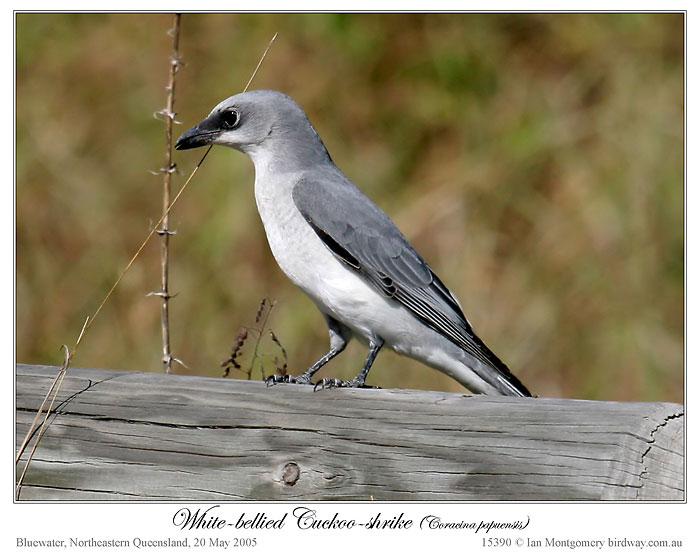
Not only colourful birds are beautiful. Take, for example, the monochrome Cuckooshrikes, such as the White-bellied. ‘Dapper’ comes to mind, though my dictionary defines it as meaning ‘up-to-date in dress and manners, and there is something timeless about the beauty of birds. I find the soft greys of Cuckooshrikes quite lovely and the contrasting white and black touches make them completely ready for the most formal occasion.

White-bellied Cuckooshrike (Coracina papuensis robusta) by Ian

White-bellied Cuckooshrike (Coracina papuensis robusta) by Ian

The best known Cuckooshrike in Australia is the very widespread Black-faced, but in North Queensland the smaller White-bellied is usually much commoner, though the migrant Black-faced can be numerous in the (winter) dry season. The first photo shows an adult of the eastern Australian race robusta perched in a red-flowering Poinsiana near my house. The second photo is of a juvenile bird, also in my garden, with the characteristic faintly barred breast and dark smudge behind the eye.

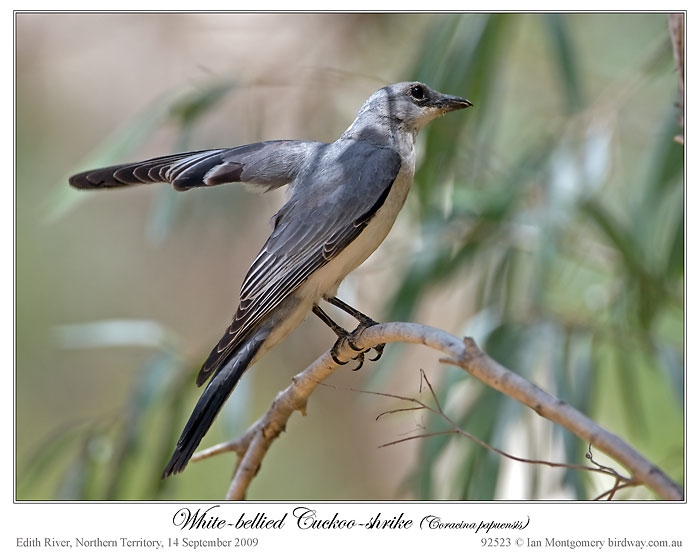
White-bellied Cuckooshrike (Coracina papuensis hypoleuca) by Ian

White-bellied Cuckooshrike (Coracina papuensis hypoleuca) by Ian

The third photo shows the paler, white-breasted, northern race hypoleuca, found in the Northern Territory and northern Western Australia. It merely looks like it’s got a broken wing: it’s actually in the middle of the wing shuffle performed both by this species and the Black-faced after landing and, apparently, during display. The shuffle is done very deliberately and the birds look as if they are having trouble folding their wings comfortably. The Black-faced is sometimes called the ‘Shufflewing’, arguably a much better name than ‘cuckooshrike’ as they are not related to either cuckoos or shrikes and shrikes are meaninglessly unknown in Australia, except as rare vagrants.

White-bellied Cuckooshrike (Coracina papuensis robusta) by Ian

White-bellied Cuckooshrike (Coracina papuensis robusta)dark morph by Ian

Interestingly, the White-bellied seems to have some black-faced genes lurking in its genome, as there is an uncommon dark morph of the race robusta, fourth photo, which could easily be confused with the larger Black-faced Cuckooshrike, though the dark morph of the White-bellied has black scallops between the breast and the belly. The species are distinguishable by call. Both are quite vocal, with the Black-faced having a musical ‘chereer’ while the White-bellied is a peevish ‘kissik’: if it sounds as if it’s complaining, it’s a White-bellied.

Links:
White-bellied Cuckooshrike
Black-faced Cuckooshrike
True Shrikes

Best wishes,
Ian


Ian Montgomery, Birdway Pty Ltd,
454 Forestry Road, Bluewater, Qld 4818
Phone: 0411 602 737 +61-411 602 737
Preferred Email: ian@birdway.com.au
Website: http://birdway.com.au


Lee’s Addition:

Thanks, Ian, for introducing us to another interesting bird. The Cuckoo is a Bird of the Bible, but I am not sure if the Cuckooshrike comes under that “kind” or not. The KJV spells it, “cuckow” and the MKJV “cuckoo.”

and the owl, and the night hawk, and the cuckoo, and the hawk after its kind, (Deuteronomy 14:15 MKJV)

The Cuckooshrikes are in the Campephagidae – Cuckooshrikes Family of the Passeriformes Order, whereas the Cuckoo is in the Cuculidae – Cuckoos Family of the Cuculiformes Order. So, I suspect that since they are two different Orders that they are totally different “kinds.”

Cuckoo is used with several other bird families:

Cuckoo-Hawks – Accipitridae Family
Cuckoo-Doves – Columbidae Family
Cuckoo Roller – Leptosomidae Family
Cuckoo Weaver – Viduidae Family

And some of you only thought the Cuckoo lived in a clock!

*