Sunday Inspiration – Grassbirds And Allies

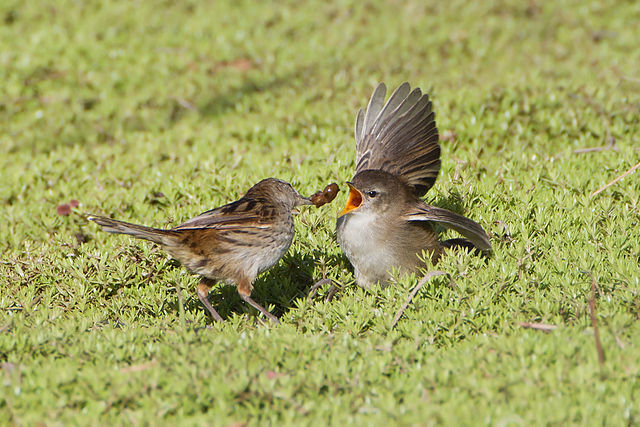
Little Grassbird (Megalurus gramineus) Adult Feeding Juvenile©WikiC

Little Grassbird (Megalurus gramineus) Adult Feeding Juvenile ©WikiC

The grass withers, the flower fades, but the word of our God will stand forever. (Isaiah 40:8 ESV)

The Lord Jesus Christ created another neat group (family) of birds that includes Grassbirds, Bush Warblers, Thicketbirds and other various warbler sized birds. There is even an Emutail.

Grey Emutail (Amphilais seebohmi) ©WikiC

Grey Emutail (Amphilais seebohmi) ©WikiC

Locustellidae is a newly recognized family of small insectivorous songbirds (“warblers”), formerly placed in the Old World warbler “wastebin” family. It contains the grass warblers, grassbirds, and the Bradypterus “bush warblers”. These birds occur mainly in Eurasia, Africa, and the Australian region. The family name is sometimes given as Megaluridae, but Locustellidae has priority.
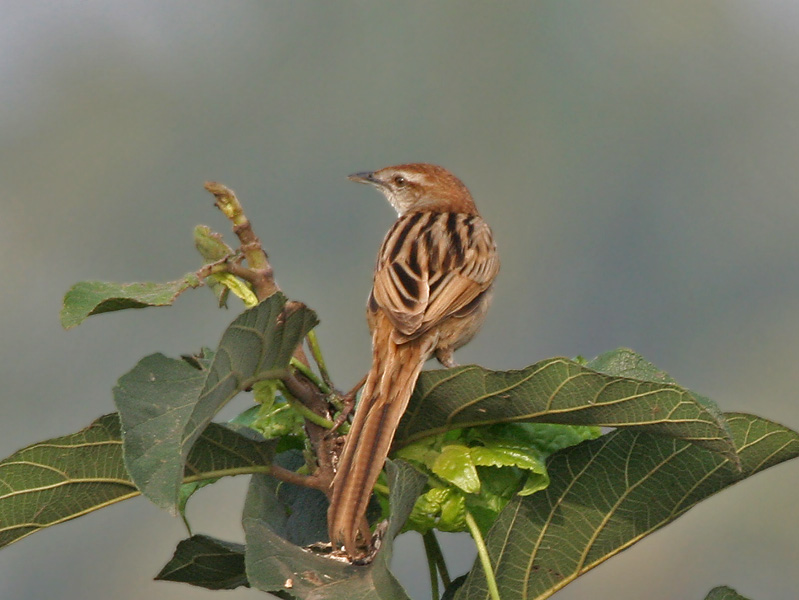
Striated Grassbird (Megalurus palustris) ©WikiC

Striated Grassbird (Megalurus palustris) ©WikiC

The species are smallish birds with tails that are usually long and pointed; the scientific name of the genus Megalurus in fact means “the large-tailed one” in plain English. They are less wren-like than the typical shrub-warblers (Cettia) but like these drab brownish or buffy all over. They tend to be larger and slimmer than Cettia though, and many have bold dark streaks on wings and/or underside. Most live in scrubland and frequently hunt food by clambering through thick tangled growth or pursuing it on the ground; they are perhaps the most terrestrial of the “warblers”. Very unusual for Passeriformes, some are becoming flightless in some taxa.

Among the “warbler and babbler” superfamily Sylvioidea, the Locustellidae are closest to the Malagasy warblers, another newly recognized (and hitherto unnamed) family; the black-capped donacobius (Donacobius atricapillus) is an American relative derived from the same ancestral stock and not a wren as was long believed. (Wikipedia with editing)

Then God said, “Let the earth bring forth grass, the herb that yields seed, and the fruit tree that yields fruit according to its kind, whose seed is in itself, on the earth”; and it was so. And the earth brought forth grass, the herb that yields seed according to its kind, and the tree that yields fruit, whose seed is in itself according to its kind. And God saw that it was good. (Genesis 1:11-12 NKJV)

You can see most of the Family as you listen to the music below the slideshow.

This slideshow requires JavaScript.

“The Church’s One Foundation” ~ Megan Fee, Cody Hancock & Dakota Hancock ~ at Faith Baptist

For we are labourers together with God: ye are God’s husbandry, ye are God’s building. According to the grace of God which is given unto me, as a wise masterbuilder, I have laid the foundation, and another buildeth thereon. But let every man take heed how he buildeth thereupon. For other foundation can no man lay than that is laid, which is Jesus Christ. (1 Corinthians 3:9-11 KJV)

*

Locustellidae – Grassbirds and Allies Family

Locustellidae – Wikipedia

Gospel Message

*

Ian’s Bird of the Week – Little Grassbird

Little Grassbird (Megalurus gramineus) by Ian

Little Grassbird (Megalurus gramineus) by Ian

Ian’s Bird of the Week – Little Grassbird ~ by Ian Montgomery

Newsletter – 7/3/2011

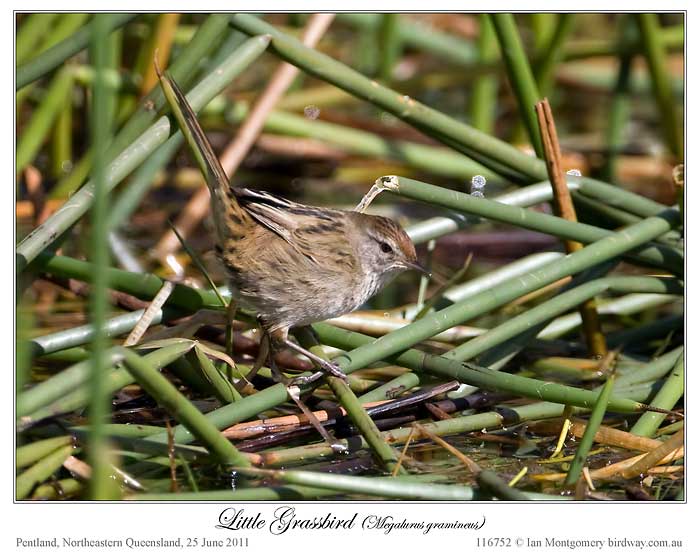
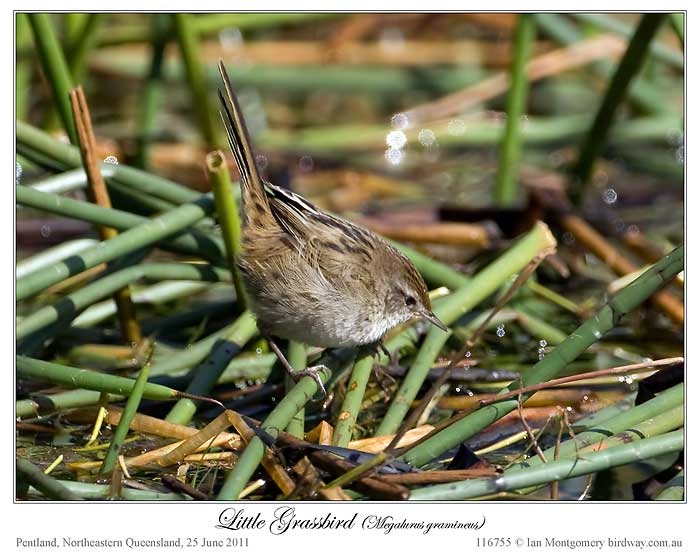
As well as the Baillon’s Crake, Pentland Dam produced another skulker, the Little Grassbird uncommon in North Queensland and usually heard rather seen – it has a distinctive, mournful three-note whistle.

I had prior warning, thank you again Len and Chris, so when a small dark bird – darker than another skulker present in the wetland, the Australian Reed-Warbler – appeared briefly, I got the camera ready in case it reappeared. It did eventually, and I got couple of quick shots before it disappeared for good.
Little Grassbird (Megalurus gramineus) by Ian

Little Grassbird (Megalurus gramineus) by Ian

The Little Grassbird is distributed quite widely in Australia, mainly in the eastern half of the mainland and Tasmania, though it does occur also in southern Western Australia and patchily through the Northern Territory as far as Kununurra across the border in northern Western Australia. Despite the name ‘Grassbird’, it occurs mainly in dense wetlands, though its only close Australian relative, the Tawny Grassbird http://www.birdway.com.au/sylviidae/tawny_grassbird/index.htm , is more flexible in its habitats.

Conventionally, the Grassbirds have been regarded as one of the Old World Warblers, family Sylviidae http://www.birdway.com.au/sylviidae/index.htm , though most bird taxonomists now accept that this family is a rather heterogeneous collection. Christidis & Boles, 2008, split it into a number of separate families and put the Grassbirds in a new one, the Megaluridae that also includes the Australian Songlarks and the Spinifexbird, while the Reed-Warblers also got their own family, the Acrocephalidae http://www.birdway.com.au/sylviidae/australian_reed_warbler/index.htm .
Best wishes
Ian


Ian Montgomery, Birdway Pty Ltd,
454 Forestry Road, Bluewater, Qld 4818
Phone: 0411 602 737 +61-411 602 737
Preferred Email: ian@birdway.com.au
Website: http://birdway.com.au


Lee’s Addition:

Ian just keeps coming up with his neat birds of the week. I am thankful that Ian lets me reproduce his newsletter on the blog. The birds he is exposing us to are fantastic and trust you enjoy them as much as I do. Many of his birds are from there in Australia and most of us will never get to travel to Australia to see those birds. So, continue to read his reports and do visit <a href=”http://birdway.com.au“>his website, Birdway, to see his many magnificent photos. Also look at the Birds of the Week here.

He causeth the grass to grow for the cattle, and herb for the service of man: that he may bring forth food out of the earth; (Psalms 104:14 KJV)

The Little Grassbird is in the Locustellidae Family.

See Ian’s other Birds of the Week

*