Ian’s Bird of the Week – Scarlet Robin

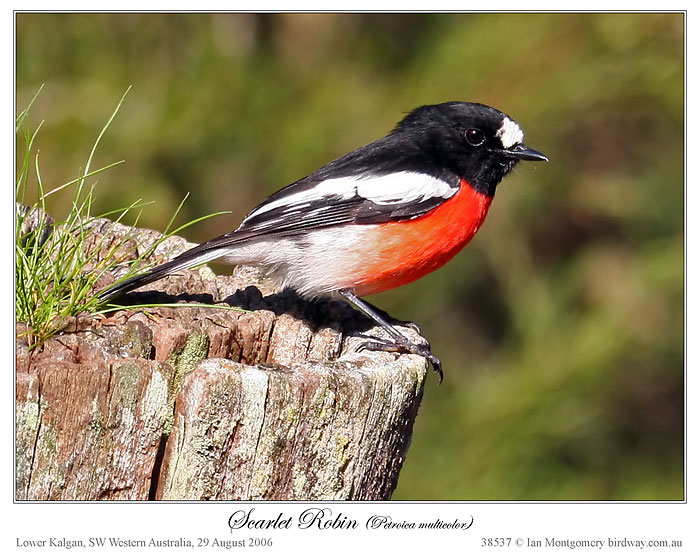
Scarlet Robin (Petroica boodang) by Ian

Scarlet Robin (Petroica boodang) by Ian

Ian’s Bird of the Week – Scarlet Robin ~ by Ian Montgomery

Newsletter and holiday wish – 12-24-10

Christmas and New Year is a time for tradition not (egregious) originality so here, without apology, is a Scarlet Robin to wish you season’s greeting. Okay, it’s not the classical European Robin – which featured as Bird of the Week on Christmas 2005 – but perhaps the closest we can get to in Australia. In fact, as a member of the Australo-Papuan Robins – the Petroicidae – rather than the Old World Flycatchers – the Muscicapidae – it’s not even closely related, but I don’t think science is very important when it comes to symbolism.

Anyway, whatever your creed or beliefs, I wish you a safe and peaceful holiday season and a fulfilling and happy 2011.

I also offer you an apology. I’ve just noticed that I sent an email, intended for the committee members of Birds Australia North Queenland, to the bird of the week list on the 14 December. I’m sorry if I mystified you but fortunately the email contained nothing controversial!

Links:
Australo-Papuan Robins
Old World Flycatchers
Eurasian Robin

Best wishes,
Ian


Ian Montgomery, Birdway Pty Ltd,
454 Forestry Road, Bluewater, Qld 4818
Phone: +61-7 4751 3115
Preferred Email: ian@birdway.com.au
Website: http://birdway.com.au


Lee’s Addition:

Merry Christmas and Happy New Year to you also, Ian. Trust you enjoy the holidays and that in 2011 you find lots of more neat birds to introduce us to in your Bird of the Week articles. Always enjoy reading about your birdwatching adventures where ever you roam. You do seem to get around quite a bit.

My son, do not forget my teaching, but let your heart keep my commandments, for length of days and years of life and peace they will add to you. (Proverbs 3:1-2 ESV)

What a neat little bird. The Scarlet Robin is in the Petroicidae Family as Ian said and that family is in the Passeriformes Order.

See all of Ian’s Birds of the Week.

*

Ian’s Bird of the Week – Spectacled Antpitta

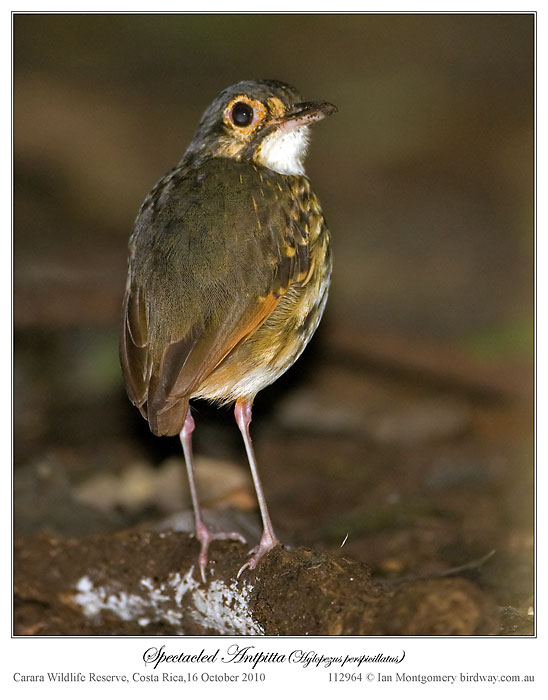
Streak-chested (Spectacled) Antpitta (Hylopezus perspicillatus) by Ian

Streak-chested (Spectacled) Antpitta (Hylopezus perspicillatus) by Ian

Ian’s Bird of the Week – Spectacled Antpitta ~ by Ian Montgomery

A friend of mine pointed out once that birds that stand upright and have short tails (long ones get in the way) look like little people and are consequently attractive. Penguins are the classic example, but there are plenty others, including the Pittas of Australia and Eurasia. Pittas don’t occur in the Americas but instead there are the unrelated but similar-looking Antpittas, members of the New World family Formicariidae, which occur from Mexico southwards.

Antpittas have similar habits to true Pittas and rummage around in leaf-litter in tropical and sub-tropical forest looking for invertebrate prey such as snails and worms. They are also easier to hear than see, so it was a pleasant surprise when we stumbled on this Spectacled Antpitta in Carara Wildlife Reserve in Costa Rica. It moved off through the undergrowth,but I struggled after it encumbered by a large lens and flash and managed to get a few photos of it peering suspiciously at me over its shoulder before disappearing. Incidentally, there are various groups of Central and South American birds, collectively called Antbirds, so named because some of them are found in association with army ants and feed on prey disturbed by the flow of ants across the landscape.

Streak-chested (Spectacled) Antpitta (Hylopezus perspicillatus) by Ian

Streak-chested (Spectacled) Antpitta (Hylopezus perspicillatus) by Ian

The Spectacled Antpitta ranges form Honduras in the north to Columbia in the south. There are about 50 species of Antpitta and there are photos of another species, the Moustached Antpitta, from Ecuador on the website. This is, I think, the last of the Costa Rican birds of the week as I’ve put most of the Costa Rican species on the website.

Recent additions to the website include the odd Yellow-thighed Finch – not a finch but a member of the Emberizidae – from Costa Rica and additional photos of a couple of terns from closer to home: the Little Tern and the Caspian Tern.

Links:
Other Antbirds:
True Pittas:

Last week, the link to the Black-necked Stilt mistakenly pointed to the American Avocet; it should have been: http://www.birdway.com.au/recurvirostridae/black_necked_stilt/source/black_necked_stilt_109873.htm . My apologies.

Best wishes,
Ian

Ian Montgomery, Birdway Pty Ltd,
454 Forestry Road, Bluewater, Qld 4818
Phone: +61-7 4751 3115
Preferred Email: ian@birdway.com.au
Website: http://birdway.com.au


Lee’s Addition:

Thanks Ian, for another great bird to find out about. Ian uses the Bird International list and we use the I.O.C.’s list of birds. The Spectacled Antpitta and the Streak-chested Antpitta are one in the same bird. That is where knowing the scientific name, “Hylopezus perspicillatus,” comes in handy. By either name, it does have a neat voice and below is a video link to one singing that I located.

The Antpittas are in the Grallariidae Family (IOC) of the Passeriformes Order.

Video of Streak-chested Antipitta singing by Dave Jackson

*

Birds in Hymns – Joy To The World

American Yellow Warbler (Dendroica aestiva) singing by J Fenton

American Yellow Warbler (Dendroica aestiva) singing by J Fenton

And the angel said unto them, Fear not: for, behold, I bring you good tidings of great joy, which shall be to all people. (Luke 2:10 KJV)

Joy To The World

Words by Isaac Watts, The Psalms of Da­vid, 1719.

Music: An­ti­och, ar­ranged by Low­ell Ma­son, 1792-1872 – The ci­ty of An­ti­och, Syr­ia, is where be­liev­ers were first called “Christ­ians” (Acts 11:26). Al­ter­nate tune:

Northern Parula (Parula americana) Reinier Munguia

Northern Parula (Parula americana) Reinier Munguia

“Joy to the World” is a popular Christmas carol.

The words are by English hymn writer Isaac Watts, based on Psalm 98 in the Bible. The song was first published in 1719 in Watts’ collection; The Psalms of David: Imitated in the language of the New Testament, and applied to the Christian state and worship. Watts wrote the words of “Joy to the World” as a hymn glorifying Christ’s triumphant return at the end of the age, rather than a Christmas song celebrating his first coming as a babe born in a stable. Only the second half of Watts’ lyrics are still used today.

The music was adapted and arranged to Watts’ lyrics by Lowell Mason in 1839 from an older melody which was then believed to have originated from Handel, not least because the theme of the refrain (And heaven and nature sing…) appears in the orchestra opening and accompaniment of the recitative Comfort Ye from Handel’s Messiah, and the first four notes match the beginning of the choruses Lift up your heads and Glory to God from the same oratorio. However, Handel did not compose the entire tune.”

As of the late 20th century, “Joy to the World” was the most-published Christmas hymn in North America.” (From Wikipedia)

Joy To The World

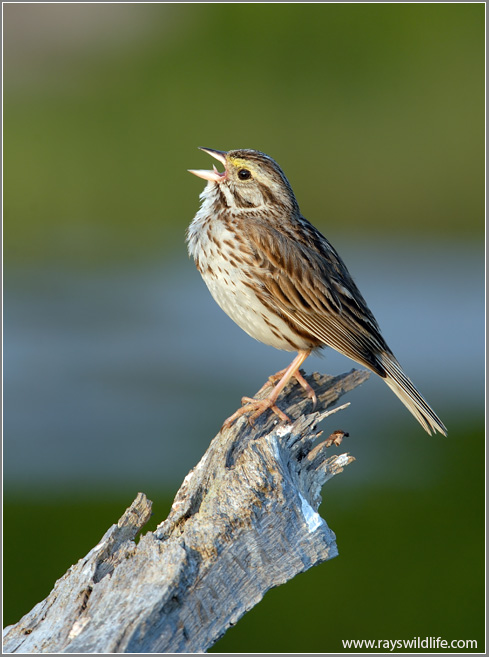
Savannah Sparrow singing by Ray

Savannah Sparrow singing by Ray

Joy to the world, the Lord is come!
Let earth receive her King;
Let every heart prepare Him room,
And Heaven and nature sing,
And Heaven, and Heaven, and nature sing.

Joy to the earth, the Savior reigns!
Let men their songs employ;
While fields and floods, rocks, hills and plains
Repeat the sounding joy,
Repeat, repeat, the sounding joy.

No more let sins and sorrows grow,
Nor thorns infest the ground;
He comes to make His blessings flow
Far as the curse is found,
Far as, far as, the curse is found.

He rules the world with truth and grace,
And makes the nations prove
The glories of His righteousness,
And wonders of His love,
And wonders, wonders, of His love.

Most information from The Cyber Hymnal

See ~ Wordless Birds

More ~ Birds in Hymns

*

Holiday Spirit from Dawn’s Bloggy Blog

My friend, Dawn, who writes the Dawn’s Bloggy Blog, posted this and thought you might enjoy it. We met a few years ago at the Birding Festival in Titusville, FL. They travel in a motorhome and she never seems to run out of interesting adventures.

These are Cedar Waxwings drinking. A sparrow and an American Robin also show up.

If thine enemy be hungry, give him bread to eat; and if he be thirsty, give him water to drink: (Pro 25:21)

Jesus answered and said unto her, Whosoever drinketh of this water shall thirst again: But whosoever drinketh of the water that I shall give him shall never thirst; but the water that I shall give him shall be in him a well of water springing up into everlasting life. (Joh 4:13-14)

To learn more about Waxwings see:

Cedar Waxwing – by A. J. Mithra
Ian’s Bird of the Week – Cedar Waxwing
Bombycillidae – Waxwings

*

Ian’s Bird Of The Week – Chestnut-mandibled Toucan

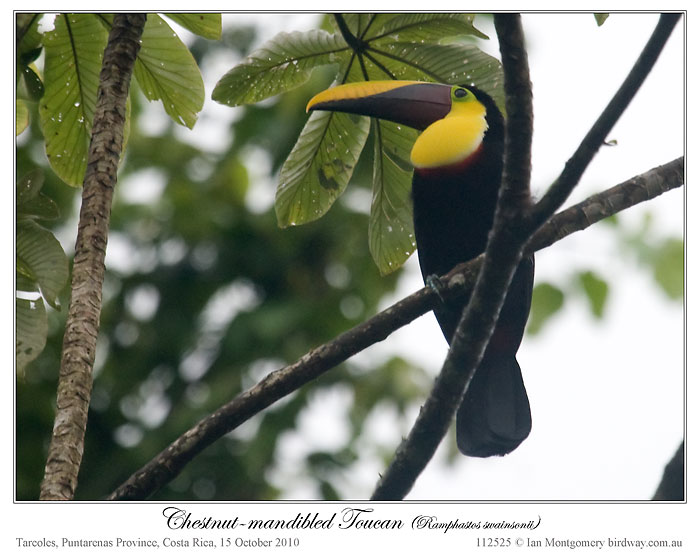
Chestnut-mandibled Toucan (Ramphastos swainsonii) by Ian

Chestnut-mandibled Toucan (Ramphastos swainsonii) by Ian

Ian’s Bird of the Week – Chestnut-mandibled Toucan ~ by Ian Montgomery

Newsletter – 12/09/10

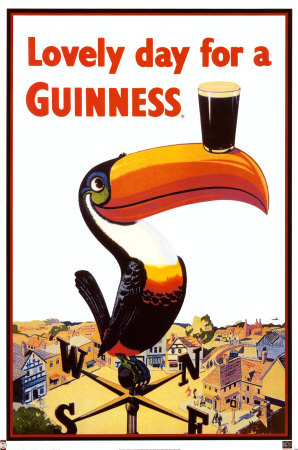
Guinness Toucan Poster from Ian

Guinness Toucan Poster from Ian

I think everybody, birders and non-birders, likes Toucans. They’re one of the iconic, almost cartoonish, animals that were introduced to as young children and I remember Toucans (and Gnus) featuring in posters for Guinness stout in Ireland in the 1950s. Their unbelievably large and colourful bills are so outlandish that it is a delightful shock to come across them in the flesh, particularly in the wild.

The Villa Lapas hotel where I stayed in the Pacific lowlands of Costa Rica had a rainforest canopy trail in its grounds and I checked it out one thundery and gloomy afternoon. The rain held off for most of the trek but, for the most part, the birds didn’t like the weather any more than I did and the light and the dense foliage made it hard to see much less photograph anything. However, repeated raucous calls led me to a pair of Chestnut-mandibled Toucans perched high in an unusually open tree. They proved to be very shy, fell silent as soon as I appeared and flew off into the forest giving me time to take only a few photos. With a length to 61cm/24in, the Chestnut-mandibled is the largest Toucan in Costa Rica. Its range includes most of Central America and Northern South America from Honduras to Ecuador.

Crimson-rumped Toucanet (Aulacorhynchus haematopygus) by Ian

Crimson-rumped Toucanet (Aulacorhynchus haematopygus) by Ian

Toucans use their large bills to collect fruit, but will also feed on nestlings. The structure of the bill is a honeycomb, so it quite light and not particularly strong. Its function has attracted a lot of speculation from reaching fruit, signalling and defence and the latest theory is that it is used as heat exchanger for cooling. The colours vary widely from species to species, supporting its use for species identification but they don’t vary either between the sexes or seasonally. There are about a dozen species of large toucan (genus Ramphastos) and the toucan family (Ramphastidae) includes smaller ones such as Mountain-Toucans (Andigena), Toucanets (Selenidera) and Araçaris (Peteroglossus). All of these are restricted to Central and South America but the related Barbets occur also in Africa and Eurasia. If you are interested in examples of these, have a look at: http://www.birdway.com.au/ramphastidae/index.htm.

Recent milestone on the website are totals of 5,600 photos and 1,300 species. Additions to the website since last week include more photos of American waders such as:

American Avocet

Black-necked Stilt

Willet

and Least Sandpiper

Best wishes,

Ian

Ian Montgomery, Birdway Pty Ltd,

454 Forestry Road, Bluewater, Qld 4818

Phone: +61-7 4751 3115

Preferred Email: ian@birdway.com.au

Website: http://birdway.com.au


Lee’s Addition:

Wow! What a milestone. Way to go Ian. Hope he doesn’t mind, but I inserted one of his photos of a toucanet. Check out Ian’s link above of the Ramphastidae Family.

Gracie the retired Chestnut-mandibled Toucan (Ramphastos swainsonii)

Gracie the retired Chestnut-mandibled Toucan (Ramphastos swainsonii)

We were able to meet and pet “Gracie” at the National Aviary in Pittsburgh, PA this summer. She is also a Chestnut-mandibled Toucan. Her beak as you can see is showing her age. She is retired now and is well cared for. Like Ian said, “I think everybody, birders and non-birders, likes Toucans.” I definitely think they are very neat.

Its leaves were beautiful and its fruit abundant, and in it was food for all. The beasts of the field found shade under it, and the birds of the heavens lived in its branches, and all flesh was fed from it. (Daniel 4:12 ESV)

The Toucans, as Ian said, are found in the Ramphastidae Family. At present, there are 47 species in the family. They are part of the Piciformes Order which contains the Woodpeckers and their allies.

(Editor’s note – not advocating or advertising Guinnes) *

Formed By Him – New Series

Thou art worthy, O Lord, to receive glory and honour and power: for thou hast created all things, and for thy pleasure they are and were created. Rev. 4:11 (Blue Jay by Dan)

Formed By Him

Now out of the ground the LORD God had formed every beast of the field and every bird of the heavens and brought them to the man to see what he would call them. And whatever the man called every living creature, that was its name. (Genesis 2:19 ESV)

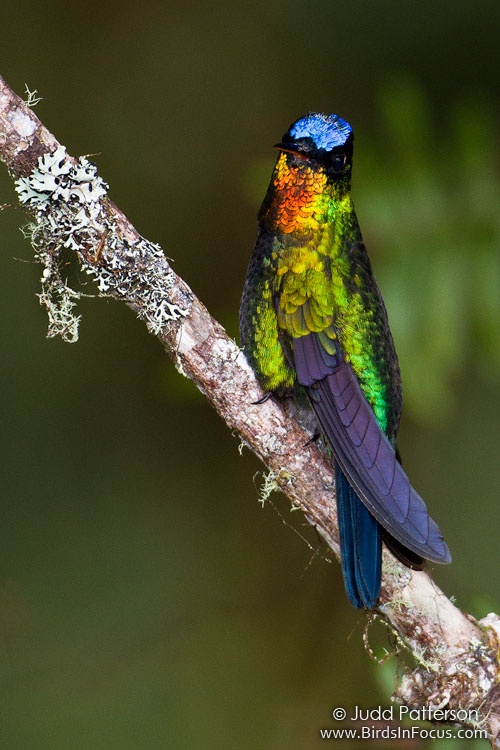
Fiery-throated Hummingbird by J Patterson

I have recently started a series of blog articles about different aspects of the Lord’s Creative Hand on the birds He has created. Some of the articles will be about a specific bird and some amazing characteristics or behavior it demonstrates. The different designs or colors of birds that have been painted with the Lord’s fantastic Paintbrush could be featured or whatever else that reveals God’s Design and His Intelligence in the creation of birds.

As I work on articles and am searching for photos of birds, other neat birds are discovered. With 10,000 plus birds flying around all over this world, the source for material should be way beyond us ever running out of things to write about. Hope you enjoy this new series, “Formed By Him.”

Thus says the LORD who made the earth, the LORD who formed it to establish it–the LORD is his name: (Jeremiah 33:2 ESV)

Red-cockaded Woodpeckers 2-day olds©USFWS

The following “Formed By Him” articles have already been published:
Sword-billed Hummingbird
Copper Birds
Bearded Barbet

Interesting Things – Butterfly Colors

White Peacock Butterfly by Herman1944

White Peacock Butterfly by Herman1944

One thing I have desired of the LORD, That will I seek; That I may dwell in the house of the LORD all the days of my life, to behold the beauty of the LORD, and to inquire in His temple. (Psalm 27:4)

More Butterfly Colors than You Can See – from Creation Moments

ThinkingThe Amazing Butterfly

The beautiful wing of the butterfly has a lesson to teach everyone who believes living things were created by chance. The design of the butterfly wing involves much more than just intricate complexity. In addition to showing a knowledge of flight, each wing design is the product of very precise specifications built around the specific wavelengths of visible light.

The iridescent colors you admire on a butterfly’s wing are created by the scales of the wings. Each square centimeter of wing has tens of thousands of these scales, each attached to the wing by tiny stems and overlapping each other like cedar shakes. Each one of these scales was a living cell until a day or two before the butterfly emerged from its pupa. Each tiny scale is made of a vertical and horizontal framing within which are found various sacks of pigment hanging from the framework.

Monarch Butterfly at the Butterfly World©©

Monarch Butterfly at the Butterfly World©©

Butterfly wings that seem to glow with iridescent blues and greens have scales with tiny lattices and ribbed walls that are designed to cause interference patterns in light waves within the 300 700 nanometer range – exactly the range humans see as color. That interference pattern is what our eyes interpret as iridescence.

It takes a good knowledge of physics as well as micro architecture to design and build an iridescent butterfly wing! Science clearly teaches us that such ability and knowledge does not come from chance. Let’s be bold to admit the truth – there is a Creator!

Prayer:

Father in heaven, a child can see the beauty of Your handiwork in the wing of the butterfly. Through my witness, help those who have been fooled by evolution to see You in Your creation and our salvation

From  More Butterfly Colors than You Can See ©Creation Moments 2010


See also:

Interesting Things

Interesting Things – The Amazing Butterfly

Butterflies – God’s Flying Flowers

The Creation of New Butterfly Species Before Our Eyes, Stephen Caesar

*

Formed By Him – Copper Birds

Copper-rumped Hummingbird (Amazilia tobaci) by Ian

Copper-rumped Hummingbird (Amazilia tobaci) by Ian

While working on my photos again, came across several pictures of these Copper-rumped Hummingbirds. What a fantastic color they show. These copper colored birds are not the only ones with that hue. Searching through the Birds of the World, I found that there are Copper Pheasants and Sunbirds. Then there is a Coppersmith Barbet, Copper-tailed Starling and a Copper-throated Sunbird. Not to be left out, there are the Coppery birds. Coppery Emerald, Coppery Metaltail, Coppery-bellied Puffleg, Coppery-chested Jacamar, Coppery-headed Emerald and a Coppery-tailed Coucal.

Many birding and ornithology groups work hard to name birds so that those of us who birdwatch can try to put a name on the bird. Since all of these have a common color, “Copper”, it makes it easier to try to figure out what we are seeing. Of course, Adam was the first to start naming the newly created birds, but it still continues today.

Out of the ground the LORD God formed every beast of the field and every bird of the air, and brought them to Adam to see what he would call them. And whatever Adam called each living creature, that was its name. (Genesis 2:19 NKJV)

Copper metal is known by most and so is it’s color. It is a valuable metal for many uses and has been used in coins for thousands of years. In Deuteronomy 8:9 they were told “out of whose hills you can dig copper.” Job 28:2 says, “copper is smelted from ore.” Christ told the disciples to, “Provide neither gold nor silver nor copper in your money belts” and also reminded them that, “Are not two sparrows sold for a copper coin? And not one of them falls to the ground apart from your Father’s will.”

Maybe the Lord wants us to see the copper color and remember that He not only made the copper, but if He cares about a little sparrow, then His concern is great toward us also.

Hope you enjoy seeing these great “Copper Birds”.

That in the ages to come he might shew the exceeding riches of his grace in his kindness toward us through Christ Jesus. (Ephesians 2:7)

*

This slideshow requires JavaScript.

*

Ian’s Bird of the Week – Slaty Flowerpiercers (and Hummingbirds)

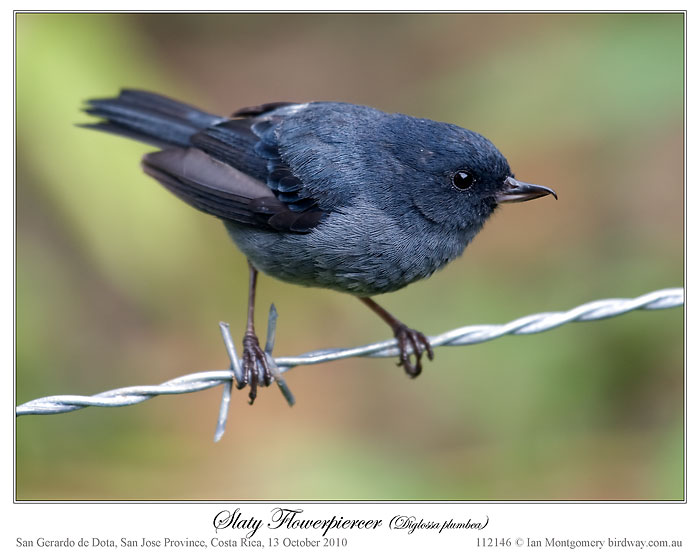
Slaty Flowerpiercer (Diglossa plumbea) by Ian

Slaty Flowerpiercer (Diglossa plumbea) by Ian

Ian’s Bird of the Week – Slaty Flowerpiercers (and Hummingbirds) ~ by Ian Montgomery

Newsletter ~ 12/02/10

Last week’s hummingbirds were popular so here, in a roundabout way, are some more. Flowers often have complex relationships with the animals (eg birds, moths) with which they interact and use them for pollination and distribution of seeds. Mutually beneficial (symbiotic) relationships may develop, such as exchange of nectar for pollination, that result in structural correspondences between species of flowers and animals, in particular the length of flower tubes and the length of the bills of hummingbirds and the probosces of months.

Slaty Flowerpiercer (Diglossa plumbea) by Ian

Slaty Flowerpiercer (Diglossa plumbea) by Ian

These relationships may exclude other species and this leads to cheating in various ways, either directly or indirectly. Flowerpiercers, such as the Slaty Flowerpiercer found in Costa Rica and named after the male of the species, first photo, cheat by using their specially adapted bills to bite through the flower tube to get at the nectar without helping with pollination. The female in the second photo shows how its done with the flower of a ginger plant.
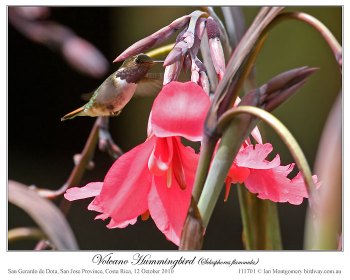
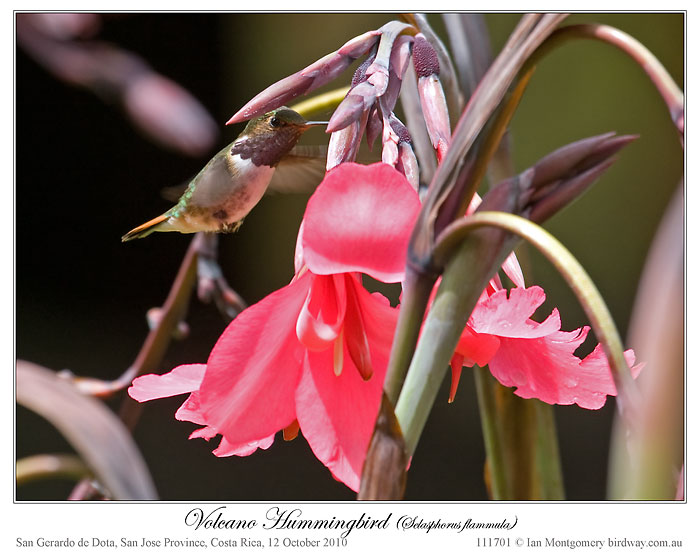
Volcano Hummingbird (Selasphorus flammula) by Ian

Volcano Hummingbird (Selasphorus flammula) by Ian

Some short-billed Hummingbirds do the same thing and stab the flower tube. Others, however, cheat indirectly and take advantage of the holes left by the flowerpiercers to sip the nectar. The tiny male Volcano Hummingbird (8cm/3.1in 2.5g) in the third photo is doing just that. Totally dwarfed by the ginger flower, it is hovering nearby and hasn’t had to land on the flower to stab it. The Volcano Hummingbird, incidentally, is a very close relative of the Scintillant Hummingbird of last week but has a violet rather than an orange gorget and is found, as its name suggests, at much higher altitudes. The vertical ranges of the two species just overlap at the 2,200m/7,200ft altitude of San Gerardo de Dota, the valley of the Quetzals.
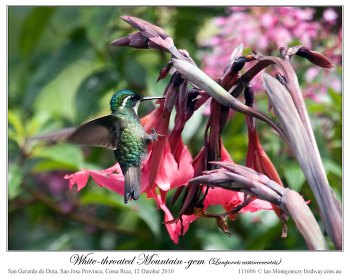
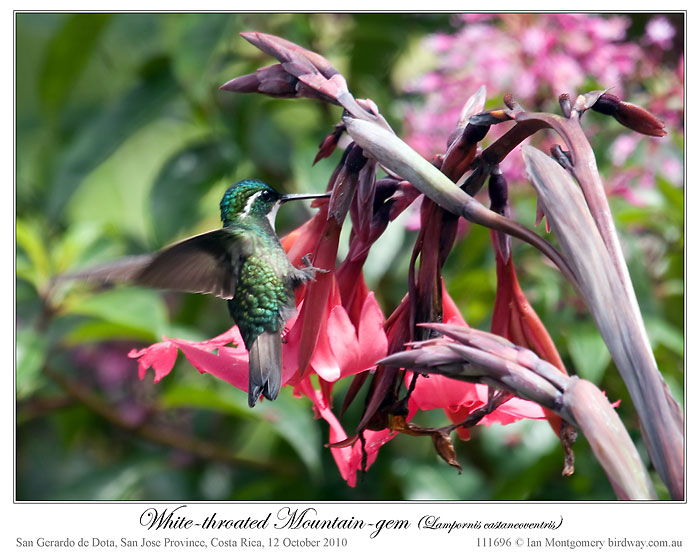
White-throated Mountaingem (Lampornis castaneoventris) by Ian

White-throated Mountaingem (Lampornis castaneoventris) by Ian

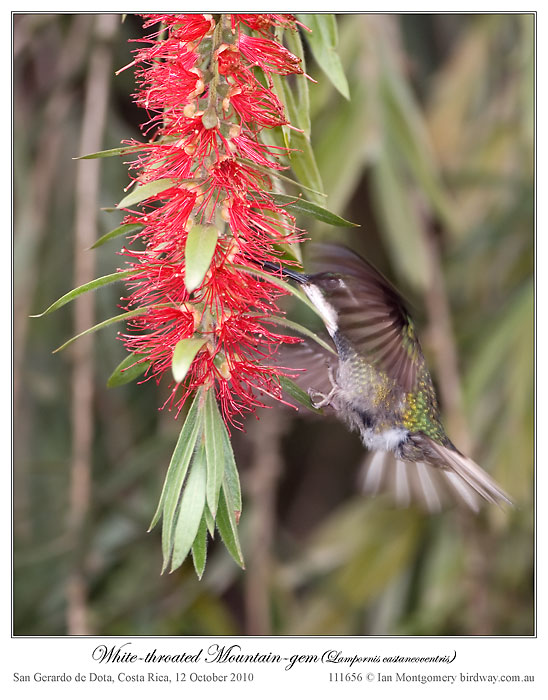
The much larger male White-throated Mountain-gem (11cm/4in 6.2g) in the fourth photo has actually landed on the ginger flower, so whether it has stabbed the flower or is also taking advantage of the Flowerpiercers isn’t obvious. They’re clearly versatile: the fifth photo shows another male feeding on an alien, almost petal-less, Bottlebrush in San Gerardo de Dota, the closest one is likely to get to an Australian Hummingbird!

White-throated Mountaingem (Lampornis castaneoventris) by Ian

White-throated Mountaingem (Lampornis castaneoventris) by Ian

Links:
Flowerpiercers (members of the Tanager family)
Volcano Hummingbird
White-throated Mountain-gem

On the website, I’m getting towards the end of adding Costa Rican birds and have added quite a variety. You might like to check out Recent Additions: http://www.birdway.com.au/index.htm#updates .

Best wishes,
Ian


Ian Montgomery, Birdway Pty Ltd,
454 Forestry Road, Bluewater, Qld 4818
Phone: +61-7 4751 3115
Preferred Email: ian@birdway.com.au
Website: http://birdway.com.au


Lee’s Addition:

Now, Ian, how did you know I was just reading about the Flowerpiercers this week? Thanks for the beautiful photos and article about these birds.

Could it be that the flowerpiercers are not cheating, but just doing as they were designed to do. By poking those holes they are not only getting a drink but allowing the little guys to have access also to a meal of nectar. Such forethought!

All things were made by him; and without him was not any thing made that was made. (John 1:3 KJV)

While working on the Hummingbird and the Tanager pages, the Flowerpiercer again caught my eye like the Sword-billed Hummingbird had from Michael Woodruff photos. If too many of the hummers had those long beaks, there would be a lot of sore necks. So by having the flowerpiercers pierce a hole nearer to the nectar, there are many hummers that get to have shorter beaks and less neck aches!

The common name refers to their habit of piercing the base of flowers to access nectar that otherwise would be out of reach. This is done with their highly modified bills, although this is greatly reduced in the Bluish Flowerpiercer, which has an almost “normal” bill. Most flowerpiercers are restricted to highlands, especially the Andes, in South America, but two species occur in Central America.

There are 18 flowerpiercers in the Diglossa genus in the Tanagers & Allies – Thraupidae Family of the Passeriformes Order.

*
Formed By Him – Sword-billed Hummingbird

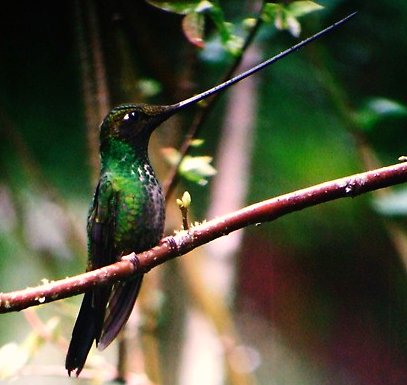
Sword-billed Hummingbird (Ensifera ensifera) by Michael Woodruff

Sword-billed Hummingbird (Ensifera ensifera) by Michael Woodruff

He loves righteousness and justice; The earth is full of the goodness of the LORD. (Psalms 33:5 NKJV)

The Lord has graciously outfitted a small, but unique hummingbird. The Sword-billed Hummingbird has an unusually long bill.

I came across this bird today while checking out photographs of our newest Photographer to give permission to use his fantastic photos. Michael Woodruff’s Photostream has some shots that have just taken my breath away today. Thanks, Michael, for the permission to use the great images that you have captured through your lenses.

When I first saw the Sword-billed Hummingbird, my first thought was why did God make it like that. There has to be a reason for that beak being so long. After investigating some, here are a few facts about this bird:

What is so unique about the Sword-billed Hummer is that it is noted as the only species of bird to have a bill longer than the rest of its body. This beak is used to feed on flowers with long corollas such as Passiflora mixta. The tongue is therefore also unusually long. God had a long flower that needed pollination and so He created a long billed hummingbird to get in that long tube. The bird gets the nectar, carries away pollen and the bird and flower both have their needs provided.

Passiflora mixta galupa - Suncrest Nurseries

Passiflora mixta galupa – Suncrest Nurseries

(From Suncrest Nurserises) “Passiflora mixta – A cool growing species with long tubed flowers that face outward and upward at a 45 degree angle. The color is a vibrant pink with white highlights. It is a large and vigorous grower and puts on an amazing show. The variety ‘Galupa’ has flowers that face outward and downward at a 45 degree angle and are a bit larger in overall aspect. A very beautiful species”

Because it’s beak is so long, it has to groom itself with it’s feet. The Sword-billed Hummingbird was created by an Omniscient Creator that knew it needed the long bill for the flowers, but also had to have a way to keep well groomed.

Keith Blomerley, one of our videographers, captured a Sword-billed Hummingbird perched on a tree and looking around. Another bird flies by.


Sword-billed Hummingbird (Ensifera ensifera)©WikiC

Sword-billed Hummingbird (Ensifera ensifera) is a species of hummingbird from South America and the sole member of the genus Ensifera. It is found in Bolivia, Colombia, Ecuador, Peru and Venezuela.

The total length can be 15 cm (6 in) and the bird can weigh 12 grams, making it one of the largest hummingbirds.

What an amazing hummingbird. The Hummingbirds are in the Apodiformes Order which includes not only the hummers (Trochilidae), but also Owlet-nightjars (Aegothelidae), Treeswifts (Hemiprocnidae) and Swifts (Apodidae).

For by Him all things were created that are in heaven and that are on earth, visible and invisible, whether thrones or dominions or principalities or powers. All things were created through Him and for Him. (Colossians 1:16 NKJV)

Updated 11/30/10:

Just received this note from Michael Woodruff about this article and thought I would attach it.

The Sword-billed Hummingbird is quite a bird. We saw two or three of them at the Yanacocha Reserve in the Andes of Ecuador. They were crazy to watch as they knew right where the end of their beak was, feeding out of the hummingbird feeders. It looked like quite a feat to balance that bill, but they were good at it!

Glad you’re enjoying the photos and it would be cool to hear which ones you end up using at some point. I think it’s great how you’re incorporating scripture verses on the pages. Awesome stuff.

Have a great week and hope you’re getting to feeling better.

Michael

*

Birds of the Bible – God’s Providence To His Creatures

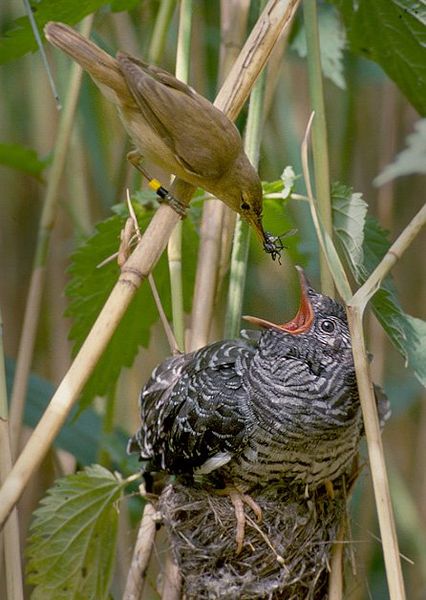
Common Cuckoo (Cuculus canorus) being raised by a Reed Warbler©WikiC

Common Cuckoo (Cuculus canorus) being raised by a Reed Warbler©WikiC

The LORD is good to all, And His tender mercies are over all His works. (Psalms 145:9 NKJV)

The following thoughts and verses are from R. A.Torrey’s Topical Textbook under the category of The Providence of God.

Preserving His creatures:

Lilian's Lovebird (Agapornis lilianae) by Africaddict

Lilian's Lovebird (Agapornis lilianae) by Africaddict

You alone are the LORD; You have made heaven, The heaven of heavens, with all their host, The earth and everything on it, The seas and all that is in them, And You preserve them all. The host of heaven worships You. (Nehemiah 9:6 NKJV)

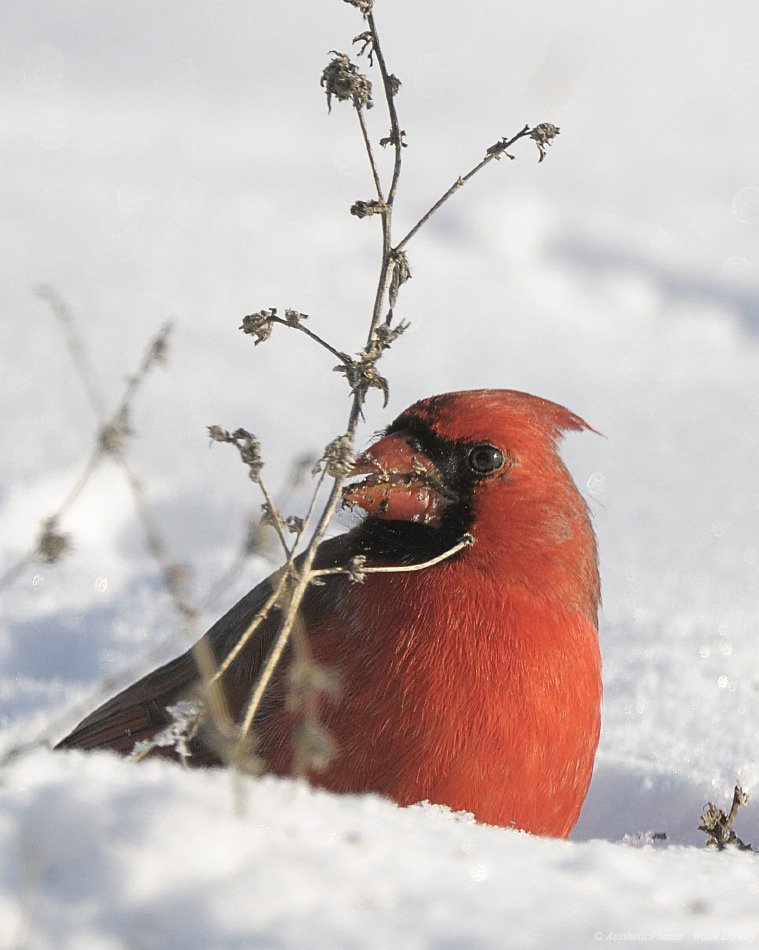
Northern Cardinal by Aestheticphotos

Northern Cardinal by Aestheticphotos

Your righteousness is like the great mountains; Your judgments are a great deep; O LORD, You preserve man and beast. (Psalms 36:6 NKJV)

House Sparrow (Passer domesticus) by Nikhil Devasar

House Sparrow (Passer domesticus) by Nikhil Devasar

Are not two sparrows sold for a copper coin? And not one of them falls to the ground apart from your Father’s will. (Matthew 10:29 NKJV)

Providing for His creatures:

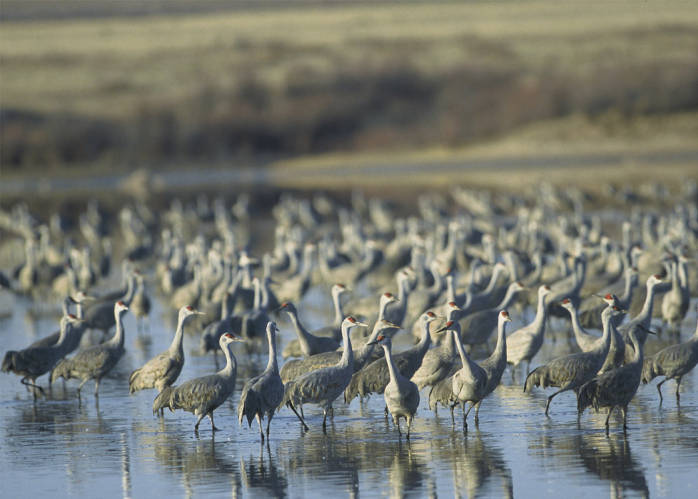
Sandhill Crane (Grus canadensis) flock ©USFWS

Sandhill Crane (Grus canadensis) flock ©USFWS

These all wait for You, That You may give them their food in due season. What You give them they gather in; You open Your hand, they are filled with good. (Psalms 104:27-28 NKJV)

Western Great Egret (Ardea alba) With Fish by AestheticPhotos

Western Great Egret (Ardea alba) With Fish by AestheticPhotos

Who giveth food to all flesh: for his mercy endureth for ever. (Psalms 136:25 KJV)

Northern Raven (Corvus corax) by Ray

Northern Raven (Corvus corax) by Ray

He giveth to the beast his food, and to the young ravens which cry. (Psalms 147:9 KJV)

Seashore at MacDill AFB by Lee

Seashore at MacDill AFB by Lee

Look at the birds of the air, for they neither sow nor reap nor gather into barns; yet your heavenly Father feeds them. Are you not of more value than they? (Matthew 6:26 NKJV)

Lee’s addition:

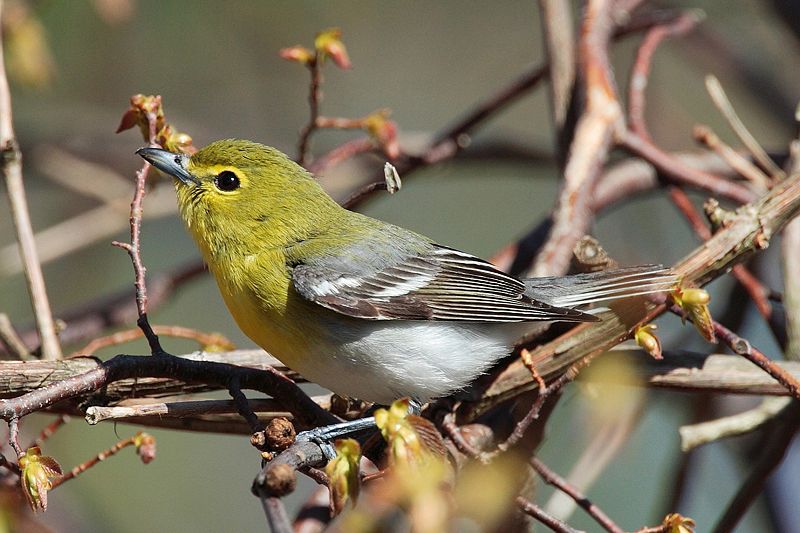
Yellow-throated Vireo (Vireo flavifrons) ©WikiC

Yellow-throated Vireo (Vireo flavifrons) ©WikiC

But seek first the kingdom of God and His righteousness, and all these things shall be added to you. Therefore do not worry about tomorrow, for tomorrow will worry about its own things. Sufficient for the day is its own trouble. (Matthew 6:33-34 NKJV)

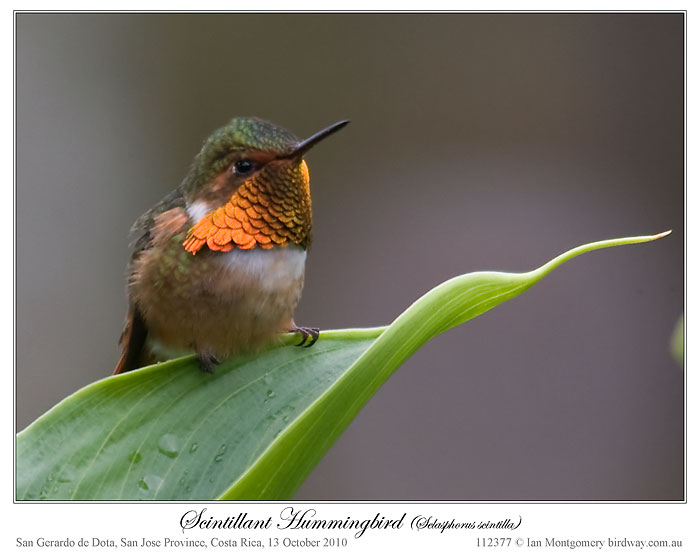
Ian’s Bird of the Week – Scintillant Hummingbird

Scintillant Hummingbird (Selasphorus scintilla) by Ian

Scintillant Hummingbird (Selasphorus scintilla) by Ian

Ian’s Bird of the Week – Scintillant Hummingbird ~ by Ian Montgomery

Newsletter – 11/25/10

At the Hotel Savegre (http://www.savegre.co.cr/) where I stayed in the highlands in Costa Rica in pursuit of the Resplendent Quetzal, a variety of Hummingbirds were regular visitors to the hummingbird feeders and the flowers in the garden. The largest of these was the Magnificent Hummingbird, up to 14cm/5.5in in length and 10g in weight – sparrow sized – as in the first photo.

Magnificent Hummingbird (Eugenes fulgens) by Ian

Magnificent Hummingbird (Eugenes fulgens) by Ian

Size, however, isn’t everything particularly in hummingbirds and big ones risk looking like, dare I say it, mere ordinary birds. Much of the fascination in hummingbirds is how insect-like they are, so the smaller the better, and my favourite was the tiny Scintillant Hummingbird. The males, second and third photo, tip the scales at 2.1g with a length of 6.5cm/2.6in (the females average 2.3g and 7cm) and perched, seemingly weightless, on the tips and edges of the leaves of Zantedeschia plants. Their over-sized orange gorgets are very striking and this species is endemic to the mountain slopes of Costa Rica and Western Panama.

Scintillant Hummingbird (Selasphorus scintilla) by Ian

Scintillant Hummingbird (Selasphorus scintilla) by Ian

Incidentally, the smallest hummingbird of all, in fact the smallest bird of all, is the Bee Hummingbird of Cuba with the males, again smaller than the females, averaging 1.6g and 5cm/2in, not that much smaller the Scintillant Hummingbird. The largest is the Giant Hummingbird of the Andes, up to 23g in weight and 22cm/8.7in long and apparently swift-like in flight. Not surprisingly, the Bee Hummingbird is on my bucket list, the Giant isn’t.

Our premature wet season continues in North Queensland, so the website has received plenty of attention. I’ve revised the Thrush galleries with the addition of 6 Central American species, added a couple of swallows and the badly-named Long-tailed Silky-flycatcher – it may be silky but it’s not a flycatcher and it mostly eats fruit:

Ruddy-capped Nightingale-Thrush

Black-faced Solitaire

Mangrove Swallow

Long-tailed Silky-flycatcher

Best wishes,

Ian

Ian Montgomery, Birdway Pty Ltd,

454 Forestry Road, Bluewater, Qld 4818

Phone: +61-7 4751 3115

Preferred Email: ian@birdway.com.au

Website: http://birdway.com.au


Lee’s Addition:

Wow! What gorgeous Hummingbirds. Love that Scintillant’s colors, but the Magnificent is also magnificent. What a creative Hand the Lord used when they were created.

Who does great things, and unsearchable, Marvelous things without number. (Job 5:9 NKJV)

The Hummingbirds belong to the Trochilidae Family of the Apodiformes Order. That Order not only has Hummingbirds, but also Owlet-nightjars, Treeswifts and Swifts.

The colors of the Scintillant fit right in with today’s day of Thanksgiving here in America.

Happy Thanksgiving from all of us on this blog!

Oh that men would praise the LORD for his goodness, and for his wonderful works to the children of men! (Psalms 107:8 KJV)

*