Ian’s Bird of the Week – Lesser Frigatebird ~ by Ian Montgomery
Newsletter – 3/2/11
This is the third of the post-cyclone Yasi birds of the week. The first dealt with survival of small birds; the second with birds like fruit-doves that move after the cyclone in search of food. Another category of birds greatly affected by cyclones are seabirds, particularly those that spend much time on the wing and these often appear in places where they are not usually seen or get blown inland, sometimes over great distances.
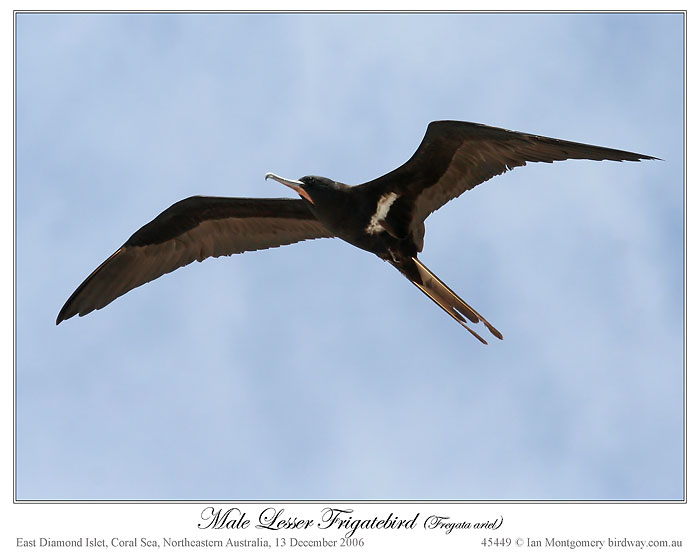
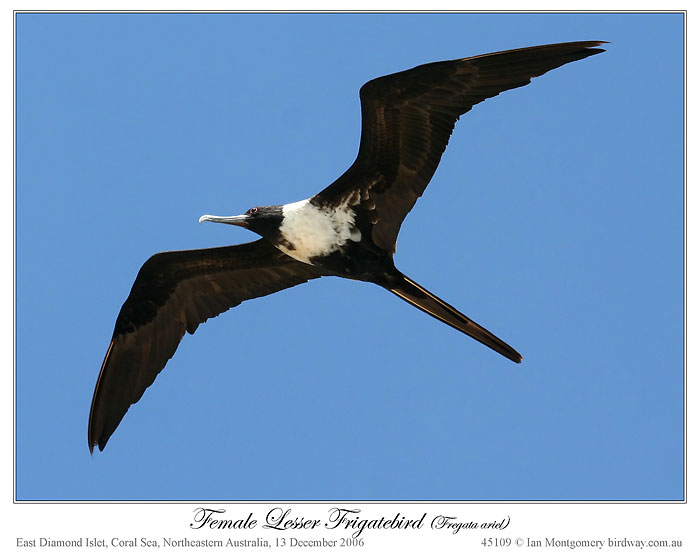
The Lesser Frigatebird is common in oceanic waters of northern Australia and breeds in colonies both on the northern mainland and on cays and islands. Adult birds are normally sedentary, remaining in the vicinity of the colonies, though immature birds may travel widely over the oceans. Frigatebirds not normally seen in places like Townsville, distant from breeding colonies, except after cyclones and cyclone Yasi was no exception with both Great and Lesser Frigatebirds being recorded along the coast. I was surprised to see a pair of Lesser Frigatebirds near my place at Bluewater, 11km from the coast and the birds looked quite out of place soaring over the hills south of the house.
Lesser Frigatebird (Fregata ariel) female by Ian
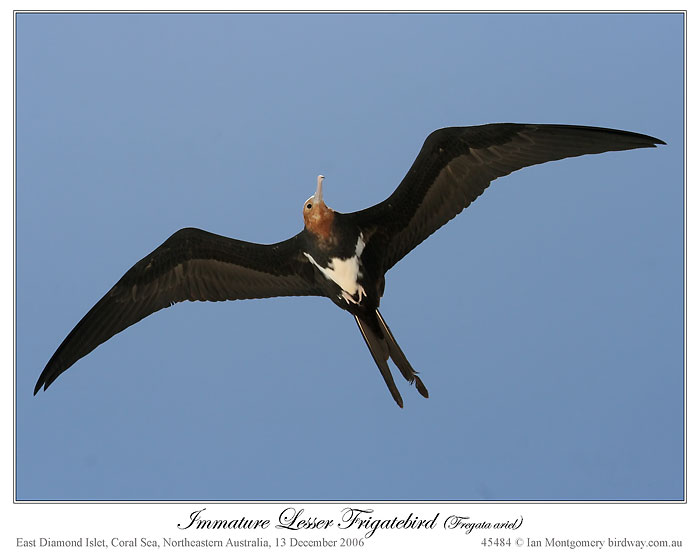
Lesser Frigatebirds are easily distinguished in all plumages from Great Frigatebirds by having white ‘armpits’ or spurs. The first photo shows a male bird, black except for these spurs and male Great Frigatebirds are entirely black. Male Frigatebirds have inflatable red throat pouches used to spectacular effect in displays (for example this male Magnificent Frigatebird in Ecuador: http://www.birdway.com.au/fregatidae/magnificent_frigatebird/source/magnif_frigatebird_27662.htm ). The second photo shows a female Lesser Frigatebird and the third an immature one.
Frigatebirds are huge. Even the Lesser, the smallest of the 5 global species, is 70-80cm/28-32in. in length with a wingspan of 1.8-1.9m/5.9-6.2 feet. They are very light for their size, having very light bones, and are adapted to soaring effortlessly in the trade winds where they are usually found. They are famous as pirates, forcing other seabirds, particularly boobies, to disgorge their prey ( http://www.birdway.com.au/fregatidae/greater_frigatebird/source/greater_frigatebird_39356.htm ), but they are also adept fishers in their own right, snatching flying fish in flight and other fish and cuttlefish from the surface of the water. They have tiny feet, useful only for perching in trees when nesting or roosting and quickly become water-logged if forced to land on water which they normally avoid. They will bathe and drink fresh water in flight ( http://www.birdway.com.au/fregatidae/greater_frigatebird/source/greater_frigatebird_40675.htm ).
Lesser Frigatebird (Fregata ariel) imm. by Ian
11km from the coast is nothing to a frigatebird and it is likely that cyclone-distributed frigatebirds can find their way home (like swifts, they often take advantage of storm fronts). Less fortunate perhaps was the Petrel recorded post-Yasi on the Atherton Tableland by Alan Gillanders, though the record for Yasi goes to a Bridled Tern rescued ‘in bad shape’ in Alice Springs by Chris Watson, probably as far away from the ocean as you can get in Australia.
The latest addition to the website is a taxonomic index of Australian birds ( http://www.birdway.com.au/aus_taxonomic.htm ), showing Orders and Families and with links to the 97 of 103 families of Australian birds represented on the website. The 6 unrepresented families are also shown but lack links. Some of these missing families are merely rare vagrants such as Northern Storm-Petrels and Leaf Warblers (the Arctic Warbler) or introductions like the Ostrich but others such as Penguins (there are only photos of African Penguins) are to be regretted and I hope to rectify this before the year is out. The other two – Scrub-birds and Sheathbills – are in the very hard baskets, and I can’t make any promises. If classification is your thing, this page is for you and you can find it under the grey navigation button ‘Indices to Australian Birds’ formerly singular. There are also instructions on the home page: http://www.birdway.com.au/index.htm#news .
The birds of the air, And the fish of the sea That pass through the paths of the seas. O LORD, our Lord, How excellent is Your name in all the earth! (Psalms 8:8-9 NKJV)
The frigatebirds are a family, Fregatidae, of seabirds. There are five species in the single genus Fregata. They are also sometimes called Man of War birds or Pirate birds. Since they are related to the pelicans, the term “frigate pelican” is also a name applied to them. They have long wings, tails and bills and the males have a red gular pouch that is inflated during the breeding season to attract a mate. They are part of the Suliformes Order.
Frigatebirds are pelagic piscivores which obtain most of their food on the wing. A small amount of their diet is obtained by robbing other seabirds, a behavior that has given the family its name, and by snatching seabird chicks. Frigatebirds are seasonally monogamous, and nest colonially. A rough nest is constructed in low trees or on the ground on remote islands. A single egg[citation needed] is laid each breeding season. The duration of parental care in frigatebirds is the longest of any bird.
Frigatebirds are found over tropical oceans and ride warm updrafts. Therefore, they can often be spotted riding weather fronts and can signal changing weather patterns.
These birds do not swim and cannot walk well, and cannot take off from a flat surface. Having the largest wingspan to body weight ratio of any bird, they are essentially aerial, able to stay aloft for more than a week, landing only to roost or breed on trees or cliffs. (Wikipedia)
Dan and I had the privilege of see a Magnificent Frigatebird flying over Ding Darling NWR.
Ian’s Bird of the Week – Superb Fruit-Dove ~ by Ian Montgomery
Newsletter ~ 02-20-11
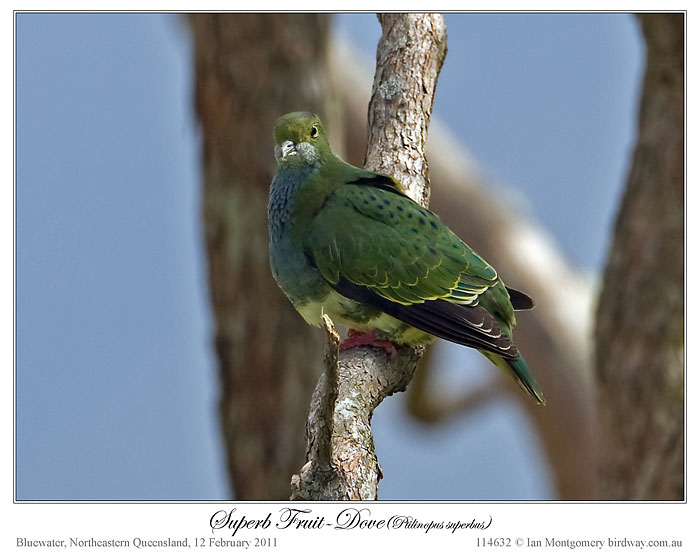
One of the tragedies of severe tropical cyclones is the damage to vegetation, particularly fruiting trees, and the resulting avian refugees, many battered and exhausted, fleeing far and wide in search of food. Since cyclone Yasi, many Superb and Wompoo Fruit-Doves and some Brown Cuckoo-doves have been moving through areas such as Bluewater and Townsville. This happened after cyclone Larry in 2006 when many of these refugees stayed around for months, but they are even more numerous this time round.
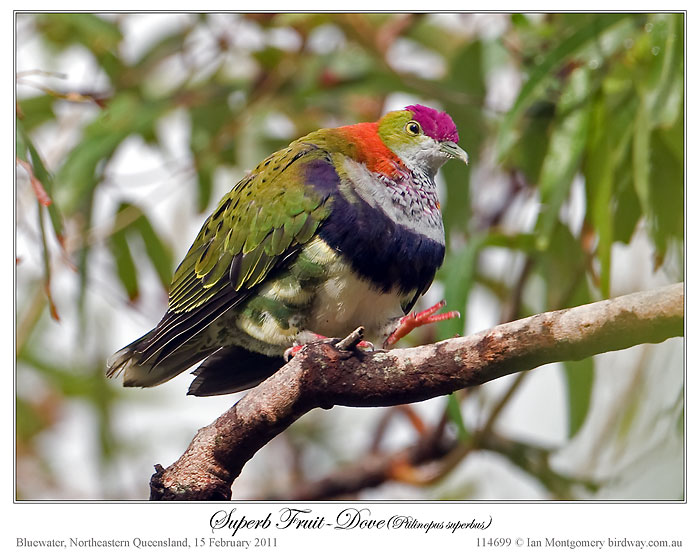
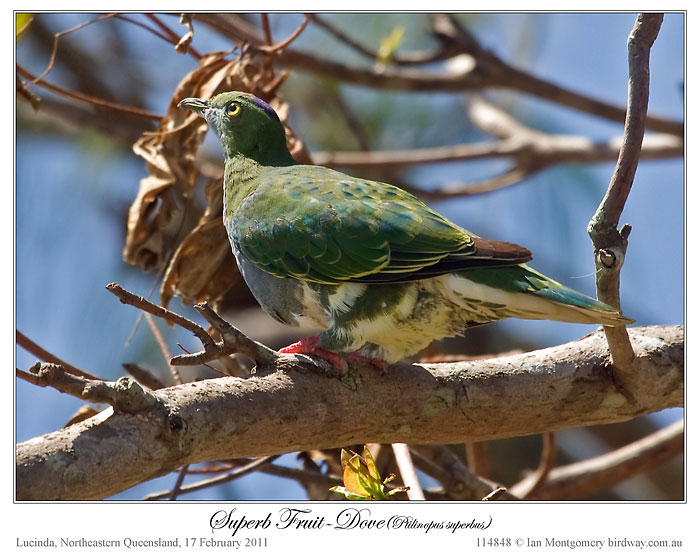
Superb Fruit-Doves are among the most spectacularly beautiful of rainforest birds in eastern Australia, but despite their bright colours are usually heard rather than seen. Their distinctive, repeated ‘whoop, whoop’ calls – with a rising inflection delivered at a regular rhythm and easily distinguished from the similar but accelerating ‘whp-whoo’ of the related and equally gorgeous Rose-crowned Fruit-Dove – are a very characteristic sound of northeastern rainforests. Hearing is no guarantee of seeing, however, and these shy birds usually remain invisible in the thick foliage of rainforest trees. So, it is strange to see these wonderful little doves (length of both species to 24cm/9.5in) sitting in full-view on trees in open tropical savanna left leafless by the cyclone, too tired to fly away when approached.
Superb Fruit Dove (Ptilinopus superbus) by Ian
The first photo shows a male, the second the less-spectacular but still beautiful female photographed from the verandah of my house a week to ten days after the cyclone when this species was most numerous around here. The females have an indigo skull cap that, being on the back of the head, is often not visible but you can see it clearly in the bird in the third photo, taken in a battered but still fruiting tree at Dungeness where we lunched last Thursday, in a normally but no longer shady park near Lucinda on the coast east of Ingham, after doing the monthly wader survey. That area took quite a battering and the sand spit along which we used to walk to do the survey has largely been flattened and the sand dumped in the mud flat to its west.
The range of the Superb Fruit-Dove in Australia is the east coast from the tip of Cape York to south of Sydney. Its main breeding range is in tropical Queensland north of Prosperine on the Whitsunday Coast and it is relatively rare in New South Wales. It also occurs in New Guinea and eastern Indonesia and many Australian birds migrate to New Guinea in winter. Fruit-eating doves normally range widely in search of food, given the seasonal nature of its availability, so it is to be hoped that this ability serves them well in times such as this.
I’ve resumed work on the website still using the borrowed mobile modem and have at last finished updating all the next/previous family pointers of the Australian bird family thumbnail pages. This means that you can now view the website in a global context or an Australian one, depending on your focus. The global context – and the New World and Old World subsets – follows the taxonomic organization and sequence of Birdlife International both between and within families while the Australian one follows the organization and sequence of Christidis and Boles, 2008, the generally accepted authorities in Australia.
There are quite a few differences in the recognized families, the sequence of families and the order within families between the 2 schema, so I suggest that you stick to one or the other (at any one time) to avoid confusion. The Australian context is distinguished by green backgrounds for both arrows (to Australian thumbnails and to previous and next families) and for the pages of family thumbnails. I’ve documented differences in family structure on the family pages; have a look at this for a simple example: http://www.birdway.com.au/cacatuinae/index_aus.htm and this for a particularly divergent example: http://www.birdway.com.au/sylviidae/index_aus.htm .
And I said, Oh that I had wings like a dove! for then would I fly away, and be at rest. (Psalms 55:6 KJV)
Superb Fruit Dove (Ptilinopus superbus) by xeno-canto-David Farrow
Rose-crowned Fruit Dove (Ptilinopus regina) by xeno-canto – Vicki Powys
Though ye have lien among the pots, yet shall ye be as the wings of a dove covered with silver, and her feathers with yellow gold. (Psalms 68:13 KJV)
This beautiful Superb Fruit-Dove or Fruit Dove, depending on whose list used, is in the Columbidae Family of the Columbiformes Order. There are 321 members of the family including the Doves, Fruit Doves, Collared Doves, Cuckoo-Doves, Wood Doves, Bronsewings, Ground and Quail Doves, Bleeding Hearts, plus all the different kinds of Pigeons.
Ian’s Bird of the Week – Olive-backed/Yellow-bellied Sunbird ~ by Ian Montgomery
Newletter: 02-17-11
Well, my apologies for a very belated bird of the week. Life in and around Townsville has largely returned to normal post-Yasi, except for for my broadband connection so I’ve borrowed a mobile modem from my neighbour.
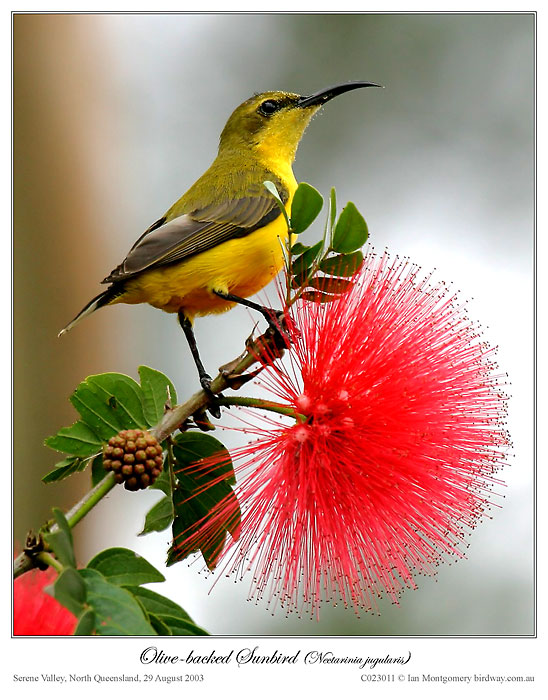
Olive-backed Sunbird (Cinnyris jugularis) by Ian
This week’s choice is the award for small bird cyclone survivor, jointly shared by around here by Red-backed Fairywren, Dusky Honeyeater and Olive-backed or Yellow-bellied Sunbird. The fairywren has been bird of the week before (July 2005), so I was going to choose the Dusky Honeyeater until I discovered that I have no record of the Sunbird being bird of the week before. That’s a potentially serious omission, so please forgive me if I’m mistaken: just nod sagely and put it down to old age and post-cyclone shock.
I suppose one shouldn’t be surprised at the Sunbird surviving cyclones as its range in Australia is restricted almost entirely to coastal tropical Queensland, extending just south of the Tropic of Capricorn to around Bundaberg. It also occurs in Torres Strait, New Guinea and southeast Asia but is regarded here as an iconic species and is immensely popular being very common around gardens, tame and often building its elegant hanging nest on verandahs. They feed mainly on the nectar of blossoms but will also take spiders.
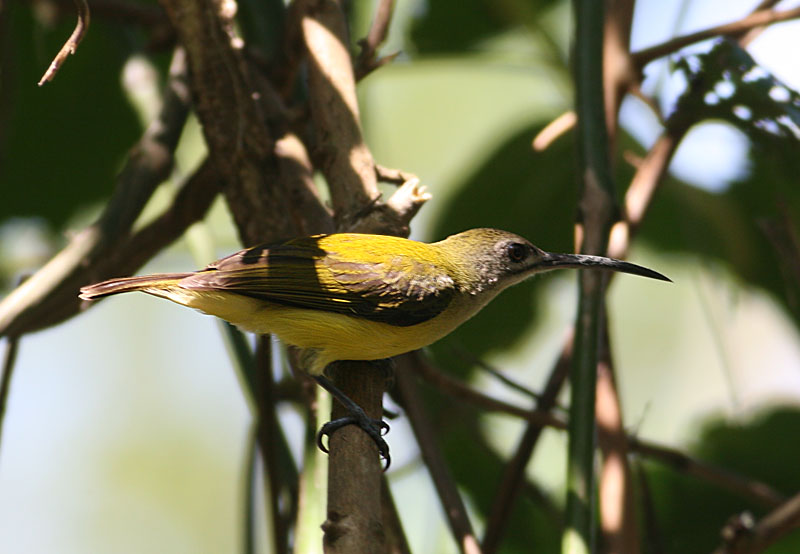
The first two photos show the blue-chested male and yellow-breasted female respectively on Calliandra (Powder Puff) and were taken at the house that I rented when I first moved to Townsville. The third photo shows one of the local males perched in a Poinsiana tree near my current house.
Olive-backed Sunbird (Cinnyris jugularis) by Ian
This species is the only Sunbird found in Australia but it belongs to a large family with more than 100 species of Sunbird in Asia and Africa and leading a lifestyle similar to that of the exclusively American and unrelated Hummingbirds. The Sunbirds are closely related to the Flowerpeckers – which include the Mistletoebird – and there is disagreement as to whether they constitute one or two families.
Other cyclone related news is that the Peaceful Dove that I rescued had an injured rather than broken wing, has recovered well in the company of the budgies next door and is ready to be returned to the wild. Food is now the main issue for survivors and many of you have naturally expressed concern for the Southern Cassowaries, just recovering from cyclone Larry. You can find out what the Queensland Government is doing . Sue and Phil Gregory tell me that the Cassowaries at Cassowary House in Kuranda near Cairns have survived well, so keep that in mind if you are visiting North Queensland and want somewhere lovely to stay: http://www.cassowary-house.com.au/ .
Like cyclone Larry, Bluewater has been visited by some unusual avian visitors post-Yasi. I’ll say more about them in the next email and some photos of a special one for bird of the week #400 which will go out shortly as a catch-up.
Best wishes and thank you again for your kindness and support.
Ian
—
Ian Montgomery, Birdway Pty Ltd,
454 Forestry Road, Bluewater, Qld 4818
Phone: +61-7 4751 3115
Preferred Email: ian@birdway.com.au
Website: http://birdway.com.au
Lee’s Addition:
What a neat looking bird and your photography skills show through as usual, Ian. Not sure about the readers, but I enjoy seeing each of your Bird of the Week offerings.
The Sunbirds reside in the Nectariniidae Family of the Passeriformes Order. There are 136 of these beautiful Sunbirds which also include Double-collared Sunbirds and Spiderhunters.
Then I saw an angel standing in the sun; and he cried with a loud voice, saying to all the birds that fly in the midst of heaven, “Come and gather together for the supper of the great God, (Revelation 19:17 NKJV)
“The sunbirds and spiderhunters are a family, Nectariniidae, of very small passerine birds. The family is distributed throughout Africa, southern Asia and just reaches northern Australia. Most sunbirds feed largely on nectar, although they will also take insects, especially when feeding young. Fruit is also part of the diet of some species. Their flight is fast and direct on their short wings.
The sunbirds have counterparts in two very distantly related groups: the hummingbirds of the Americas and the honeyeaters of Australia. The resemblances are due to the similar nectar-feeding lifestyle. Some sunbird species can take nectar by hovering like a hummingbird, but usually perch to feed.
The family ranges in size from the 5-gram Black-bellied Sunbird to the Spectacled Spiderhunter, at about 45 grams. Like the hummingbirds, sunbirds are strongly sexually dimorphic, with the males usually brilliantly plumaged in metallic colours. In addition to this the tails of many species are longer in the males, and overall the males are larger. Sunbirds have long thin down-curved bills and brush-tipped tubular tongues, both adaptations to their nectar feeding. The spiderhunters, of the genus Arachnothera, are distinct in appearance from the other members of the family. They are typically larger than the other sunbirds, with drab brown plumage that is the same for both sexes and long down-curved beaks.
Species of sunbirds that live in high altitudes will enter torpor while roosting at night, lowering their body temperature and entering a state of low activity and responsiveness.” (Wikipedia)
For the LORD God is a sun and shield; The LORD will give grace and glory; No good thing will He withhold From those who walk uprightly. (Psalms 84:11 NKJV)
Southern Carmine Bee-eater (Merops nubicoides) by Africaddict
We have written several articles about the Bee-eaters, but they are so pretty and colorful, that they are being presented again. When the Lord created them, He did not spare on the “color pallet.” Nor did He fail to provide them with the ability to know how to remove the stinger and poison of the bees and other insects before eating them.
For by him were all things created, that are in heaven, and that are in earth, visible and invisible, whether they be thrones, or dominions, or principalities, or powers: all things were created by him, and for him: And he is before all things, and by him all things consist. (Colossians 1:16-17 KJV)
This video tells about how the Bee-eater cooperate together in communities. Trust you will enjoy watching it.
“The bee-eaters are a group of near-passerine birds in the family Meropidae. Most species are found in Africa and Asia but others occur in southern Europe, Australia, and New Guinea. They are characterised by richly coloured plumage, slender bodies, and usually elongated central tail feathers. All have long downturned bills and pointed wings, which give them a swallow-like appearance when seen from afar. There are 26 different species of bee-eaters.
As the name suggests, bee-eaters predominantly eat flying insects, especially bees and wasps, which are caught in the air by sallies from an open perch.[1] While they pursue any type of flying insect, honey bees predominate in their diet. Hymenoptera (ants, bees and wasps) comprise from 20% to 96% of all insects eaten, with honey bees comprising approximately one-third of the Hymenoptera.
Carmine BeeEater (Merops nubicus or nubicoides) by Marc at Africaddict
Before eating its meal, a bee-eater removes the sting by repeatedly hitting and rubbing the insect on a hard surface. During this process, pressure is applied to the insect thereby extracting most of the venom.[1] Notably, the birds only catch prey that are on the wing and ignore flying insects once they land.
Bee-eaters are gregarious. They form colonies by nesting in burrows tunnelled into the side of sandy banks, such as those that have collapsed on the edges of rivers. Their eggs are white and they generally produce 2-9 eggs per clutch (depending on species). As they live in colonies, large numbers of these holes are often seen together, white streaks from their accumulated droppings accentuating the entrances to the nests. Most of the species in the family are monogamous, and both parents care for the young, sometimes with the assistance of other birds in the colony.” (From Wikipedia)
Some of the articles we have done that mention the Bee-eaters are:
The Bee-eaters are in the Coraciiformes Order which included the Roller, Kingfisher, Todie, Motmot Families. The Meropidae Family is the one that contains the 26 Bee-eater species.
Chestnut-headed Bee-eater (Merops leschenaulti) by Nikhil Devasar
Little Spiderhunter (Arachnothera longirostra) by Peter Ericsson
The Little Spiderhunter – The Praising Pollinator ~ by a j mithra
The Little Spiderhunter (Arachnothera longirostra) is a species of long-billed nectar feeding bird in the Nectariniidae family found in the moist forests of South and Southeast Asia.
Unlike typical Sunbirds, males and females are very similar in plumage.
They are usually seen in ones or twos and frequently make a “tzeck” call and are most often found near flowering plants where they obtain nectar. They are found close to their favorite nectar bearing trees, often species of wild Musaceae or flowers in gardens.
We too have Jesus, the Rose of Sharon and the Lilly of the valley, who is sweeter than honey..
But, where is our dwelling place? Is it near Jesus?
Though these birds are called spider eaters, a lesson can be learned from them who dwell among the flowers to obtain nectar…
Though we are sinners, the WORD, which is sweeter than honey, is able to make us holy when we prefer to dwell among The Rose of Sharon…
These birds have to go in search of their favorite flowers..
But, we have the most amazing privilege of bringing the Rose of Sharon, the Lilly of the Valley, among us through our praise…
But thou art holy, O thou that inhabitest the praises of Israel. (Psalm 22:3)
The distinctive long beak sets it apart from other Sunbirds. The sexes are alike except for a paler base to lower mandible in the female. The male has an all black beak.
They have a buzzy “zick-zick” call that is made regularly when disturbed or when foraging. The song is series of rapid chipping notes and these can go on for long periods… While dwelling near its favorite nectar bearing trees, these birds sing for long period of time particularly when they are disturbed…
King Jehoshaphat disturbed God with praise when he was disturbed by his enemies..
Peter and Silas, disturbed God with their praise when they were disturbed by the soldiers…
Jonah disturbed God with his praise when he was disturbed inside the whale’s belly..
King Nebuchadnezzar disturbed God with his praise when his pride disturbed him..
The best way to disturb God when we are disturbed is to praise Him…
Do we murmur or sing praise to the Lord when we are disturbed?
Praise ye the LORD. Sing unto the LORD a new song, and his praise in the congregation of saints.
Let Israel rejoice in him that made him: let the children of Zion be joyful in their King.
Let them praise his name in the dance: let them sing praises unto him with the timbrel and harp.
For the LORD taketh pleasure in his people: he will beautify the meek with salvation.
Let the saints be joyful in glory: let them sing aloud upon their beds.
Let the high praises of God be in their mouth, and a two edged sword in their hand;
To execute vengeance upon the heathen, and punishments upon the people;
To bind their kings with chains, and their nobles with fetters of iron;
To execute upon them the judgment written: this honour have all his saints. Praise ye the LORD. (Psalm 149)
The genus name Arachnothera means “spider hunter” and the species epithet refers to the long beak. About thirteen geographic races are recognized. The nominate race longirostra (Latham, 1790) is found in southwestern India, central and northeastern India, foothills of the Himalayas and into Thailand and Yunnan. Race sordida La Touche, 1921 is found in southern China and northeastern Thailand. Race pallida Delacour, 1932 is found in southeastern Thailand and C & S Indochina. The species is found in Bangladesh, Bhutan, Brunei, Cambodia, China, India, Indonesia, Laos, Malaysia, Myanmar, Nepal, the Philippines, Thailand, and Vietnam.
Within India, there are disjunct populations in the Eastern Ghats from Lamasinghi, Vishakapatnam and parts of Orissa and the Western Ghats apart from the main distribution in north-east India that extends into Southeast Asia. A record from the Nicobar Islands is considered doubtful.
Its natural habitats are subtropical or tropical moist lowland forests, subtropical or tropical mangrove forests, and subtropical or tropical moist montanes. It is usually found below the canopy.
They have been noted as good pollinators of wild banana species and several species of the ginger family and often visit Indian silk cotton tree and Indian coral tree for nectar.
These birds are good pollinators…
The extension of kingdom of God depends upon pollinators of His word…
Are we good pollinators of the Rose of Sharon and the Lilly of the valley?
Or are we just honey suckers?
It is time for us to think and rethink of our status in the kingdom of God…
Now then we are ambassadors for Christ … (II Corinthians 5:20)
They are often seen in plantations in forest areas. Although they are more often seen in secondary forests or in clearings and appear to be tolerant of human activities, they have become extinct in some forest fragments. In Singapore they have gone locally extinct within the botanical garden.
The breeding season in northeastern India is March to September but mainly May to August and in southern India it breeds from December to August.
The nest is a compact cup attached under a banana or similar broad leaved plant suspended by cobwebs and vegetable fibre. Two eggs are the usual clutch.
In Sarawak, the Kayan, Kenyah and Punan people consider it a bird of good omen and when they are out collecting camphor, the men would wait until they heard the “sit” call of one of these spiderhunters.
As we call His name, He sure will deliver the undelivered…
God is waiting for our call before He separates the husk from the grains…
There are millions out there who have not even head the name Jesus..
What are we going to do to reach them before the King returns?
Call unto me, and I will answer thee, and show thee great and mighty things, which thou knowest not. (Jeremiah 33:3)
Here is a video that I shot out at the Circle B Bar Reserve in Lakeland, FL on January 18th. We went out to watch some of the 4,000 American White Pelicans land at the marsh. We got there about 4:30 pm and stayed until almost 6 pm.
I left the sound on so that you can catch the amazement in my voice. My english is terrible and my words nutty, but I was thoroughly enjoying my “birdwatching adventure.” This is what it is really like to go birdwatching with me. I get so amazed at watching God’s created critters.
Thou wilt shew me the path of life: in thy presence is fulness of joy; at thy right hand there are pleasures for evermore. (Psalms 16:11 KJV)
I have more of these and pictures, but will save them for another time. Slower connections speeds will have enough problems loading just one video.
On the video I said about 100 feet over my head, it was more like 20-30 feet over our heads. The pelicans were landing right behind us.
An interesting article by Donna L. O’Daniel provided the background for this blog. You can see her complete article at: Water, Water Everywhere . . . And Not A Drop To Drink. See the article for some of the more technical aspects of this.
Birds that are at sea for months and even years must have a way to quench their thirst. How can they do that? If we drink seawater, which is loaded with salt, we would be in deep trouble. Most regular birds would also suffer harm if they were to drink the salty water all the time. Birds like the Albatrosses, Petrels, Tubenoses and Shearwaters do, in fact, drink saltwater.
Laysan Albatross (Phoebastria immutabilis) by Daves BirdingPix
You would know that the Lord God, the Creator God, would have already prepared these birds for this situation. And so He did.
For My thoughts are not your thoughts, Nor are your ways My ways,” says the LORD. “For as the heavens are higher than the earth, So are My ways higher than your ways, And My thoughts than your thoughts. (Isaiah 55:8-9 NKJV)
Have you not known? Have you not heard? The everlasting God, the LORD, The Creator of the ends of the earth, Neither faints nor is weary. His understanding is unsearchable. (Isaiah 40:28 NKJV)
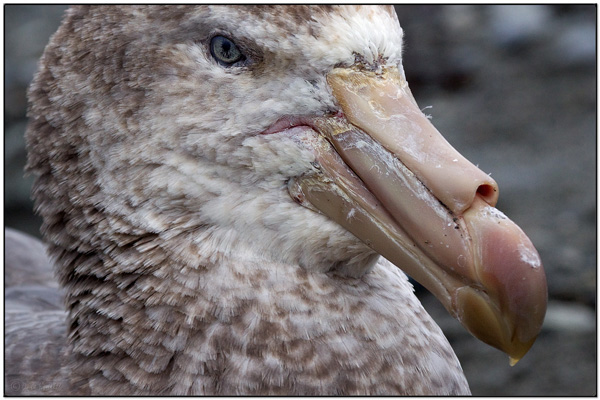
Northern Giant Petrel (Macronectes halli) by Dave’s BirdingPix
“Sea birds like the albatross drink freely from sea water but never seem to suffer any ill effects. They manage this because their physiology has become adapted to the sea environment. They have special glands just behind their eyes that actively pump salt out of their blood and into narrow tubes that lead into the bird’s nostril. The excess salt drips harmlessly out of the body, restoring the blood salt level back to normal.” “Seabirds can drink seawater and have salt glands inside the head that eliminate excess salt out of the nostrils.” (Internet)
Wikipedia has this to say about the Albatrosses: “Albatrosses, along with all Procellariiformes have a need to lower their salt content due to their drinking of ocean water. All birds have an enlarged nasal gland at the base of the bill, above their eyes. This gland is inactive in species that don’t require it; however the Procellariiformes do require its use. Scientists are uncertain as to its exact processes, but do know in general terms that it removes salt that forms a 5% saline solution that drips out of their nose or is forcibly ejected in some birds.“
Northern Giant Petrel head close-up by Daves BirdingPix
About the Tubenoses and Shearwaters: “They also have a uniquely structured bill, with seven to nine distinct horny plates.. Finally, they have a salt gland that is located above their nasal passages and helps desalinate their body, as they drink seawater. They excrete the salty waste out their nose. As members of Procellariiformes, they share certain characteristics. First they have tubular nostrils called nariorns. This feature gives them their common name, Tubenoses. The opening to the nostril is located differently in some birds. These birds have the opening on top of the upper bill.”
For since the creation of the world His invisible attributes are clearly seen, being understood by the things that are made, even His eternal power and Godhead, so that they are without excuse, because, although they knew God, they did not glorify Him as God, nor were thankful, but became futile in their thoughts, and their foolish hearts were darkened. (Romans 1:20-21 NKJV)
Wandering Albatross (Diomedea exulans) by Ian
“The creation model for the origin of avian salt glands states that an intelligent Creator created this class of vertebrates complete with all of the complex systems within their bodies to survive in and adapt to their given environments, including salt glands to rid their bodies of excess salt. Perhaps the strongest argument in favor of the creation model for the origin of avian salt glands, aside from the lack of transitional forms in the fossil record, is one consisting of purpose and interdependence of purposeful parts.
Given the complexity of the functioning of avian salt glands, their existence by design can hardly be denied. The evidence for design that is obvious in the avian salt gland suggests a Designer who not only created the gland, but the entire animal, the earth, and the entire universe.” From Donna’s Article (see above)
And He said to me, “It is done! I am the Alpha and the Omega, the Beginning and the End. I will give of the fountain of the water of life freely to him who thirsts. (Revelation 21:6 NKJV)
And the Spirit and the bride say, “Come!” And let him who hears say, “Come!” And let him who thirsts come. Whoever desires, let him take the water of life freely. (Revelation 22:17 NKJV)
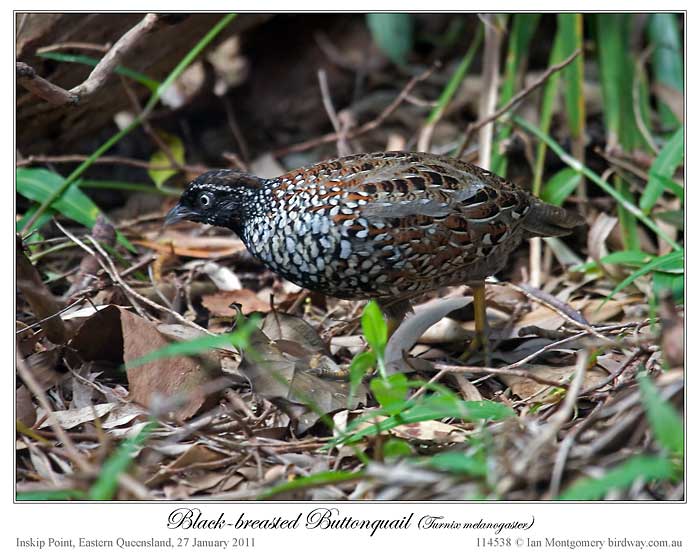
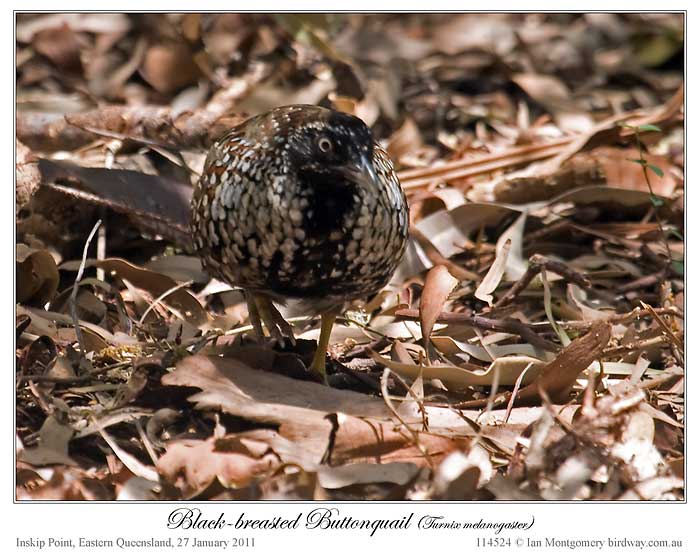
Black-breasted Buttonquail (Turnix melanogaster) by Ian
Ian’s Bird of the Week – Black-breasted Buttonquail ~ by Ian Montgomery
Newsletter – 01/30/11
I returned home from Armidale NSW by road bringing back a friend’s car that had been left at the Gold Coast south of Brisbane because of the flooding. I took the opportunity to make a detour to Inskip Point – near Rainbow Beach and Fraser Island – a known haunt of the rare Black-breasted Buttonquail, see the female in first photo.
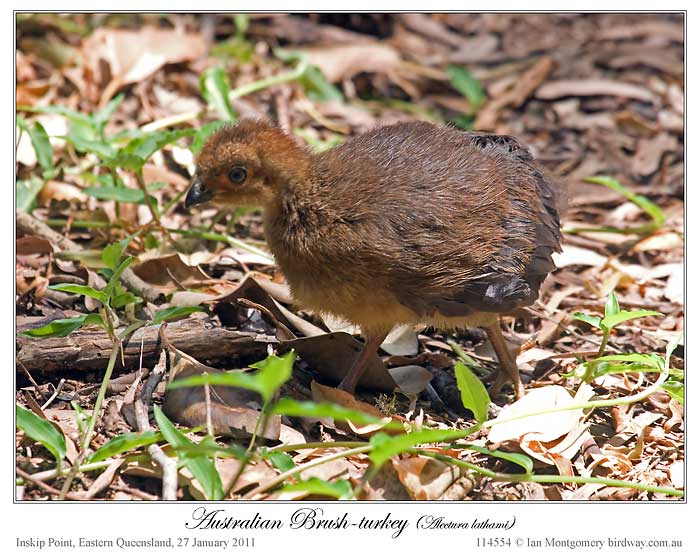
I found a pair relatively easily, though not before a few false alarms in the shape of some very young Australian Scrub-turkeys, as in the second photo, so young in fact that they were as small as the Buttonquails.
Australian Brushturkey (Alectura lathami) by Ian
Buttonquails leave characteristic circular bare patches in leaf litter called ‘platelets’ and I had stopped to examine some of these when a female Black-breasted Buttonquail ambled across the path and walked right past me. At one stage she walked towards me and I don’t think she noticed my presence. Buttonquails, like certain other eclectic groups of birds including Phalaropes and Cassowaries, have reversed sex roles with the more colourful females courting the males and the males incubating and looking after the young, so I was pleased to see the female who has a black head and black breast with moon-shaped white spots on the sides, as in the third photo.
Black-breasted Buttonquail (Turnix melanogaster) by Ian
Buttonquails are not closely related to the true quails and are placed in their own family, the Turnicidae. The most obvious structural difference is the lack of a hind toe in Buttonquails, as you can see if you look carefully in the fourth photo and they are sometimes called ‘Hemipodes’, meaning half-foots. They feed on seed and invertebrates and the Black-breasted is particularly dependent on leaf litter and eats mainly invertebrates. They make the platelets by spinning around on one foot using the other to clear away the leaves; often they then reverse direction standing on the other foot so the size of the platelet matches the size of the bird. The Black-breasted is large by Buttonquail standards with the larger females being about 19cm/7.5in in length and the males 16.5cm/6.5in. I saw her drabber partner later but he didn’t want his photo taken.
Black-breasted Buttonquail (Turnix melanogaster) by Ian
There are about 16 species in total and are found in Africa, southern Spain, southern and southeastern Asia and Australia. Seven of these occur in Australia. The range of the Black-breasted is limited to coastal southeastern Queensland and northeastern NSW from Fraser Island to just north of Lismore. Its preferred habitat is open woodland and its population has suffered from habitat clearing and it is now classed as vulnerable.
I’ve put the Southern Boobooks, photographed in Armidale, on the website: Southern Boobook
As Ian said, the Buttonquails are in the Turnicidae – Buttonquail Family of the Charadriiformes Order. There are 17 members of this family. The Charadriiformes Order does not even include the New World Quail Family. Those quails are found in the Galliformes Order which also included the Brushturkeys. The Brushturkeys are part of the Magapode – Medapodiidae Family in the Galliformes Order. It has 22 members in its family.
Quails are mentioned in the Bible in four verses; Exodus 16:13, Numbers 11:31-32 and Psalm 105:40. Which kind of quail, it is not clear, but they were complaining about not having enough to eat and the LORD sent them Quail.
The people asked, and he brought quails, and satisfied them with the bread of heaven. (Psalms 105:40 KJV)
Ian’s Bird of the Week – Laughing Kookaburra ~ by Ian Montgomery
Newsletter – 01/23/11
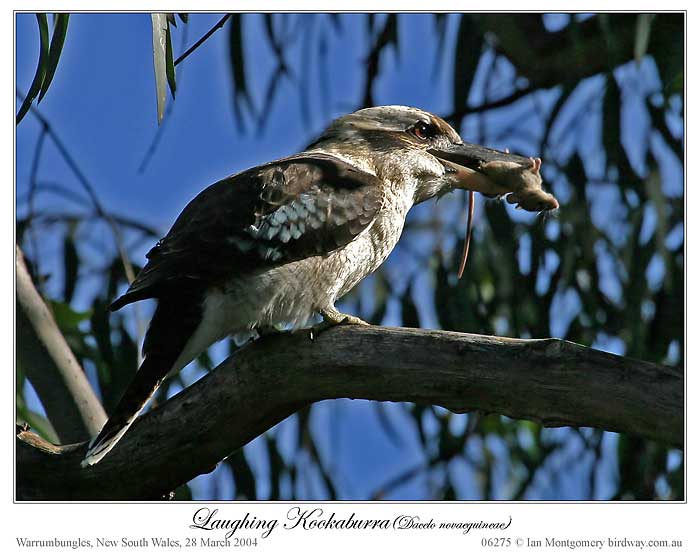
The Blue-winged Kookaburra has featured as bird of the week (twice) but, as far as I can detect, the iconic Laughing Kookaburra hasn’t, so let’s correct that using library photos. Bird photo opportunities were time-constrained during the wonderful recorder course in Armidale, NSW, though a family of roosting Southern Boobooks (which featured as bird of the week last year) gave the participants much pleasure and I’ll let you know when I’ve put the photos on the website.
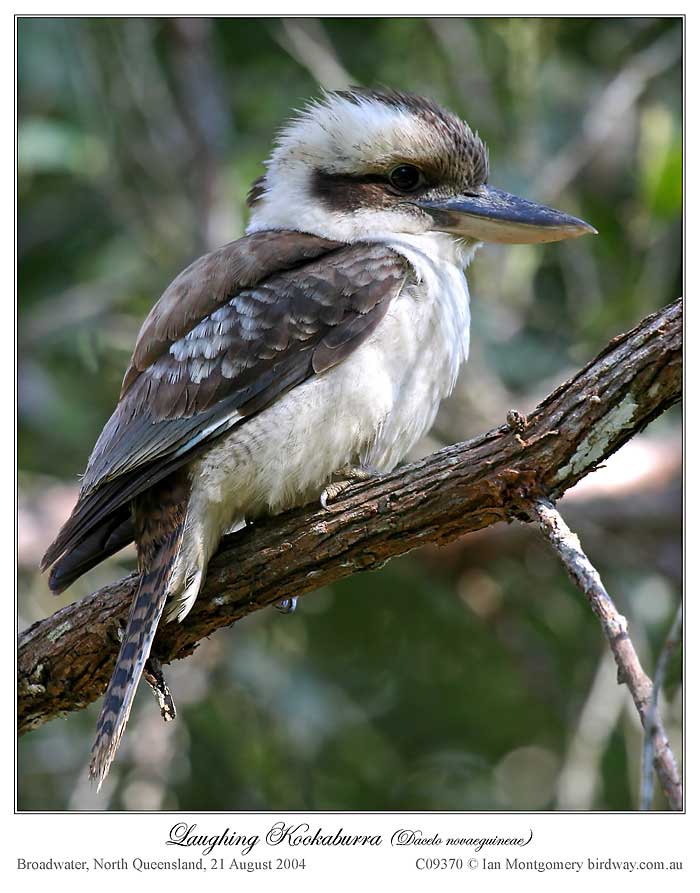
Laughing Kookaburra (Dacelo novaeguineae) by Ian
Its loud cackling call is a characteristic sound of the Australian landscape (and of the sound tracks of B-grade jungle movies not set in Australia) and it’s a familiar bird in southern and eastern Australia, first photo.
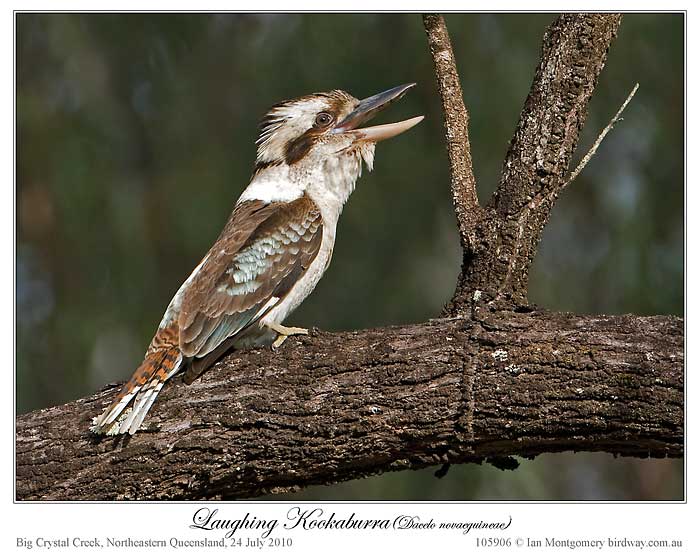
Laughing Kookaburra (Dacelo novaeguineae) by Ian
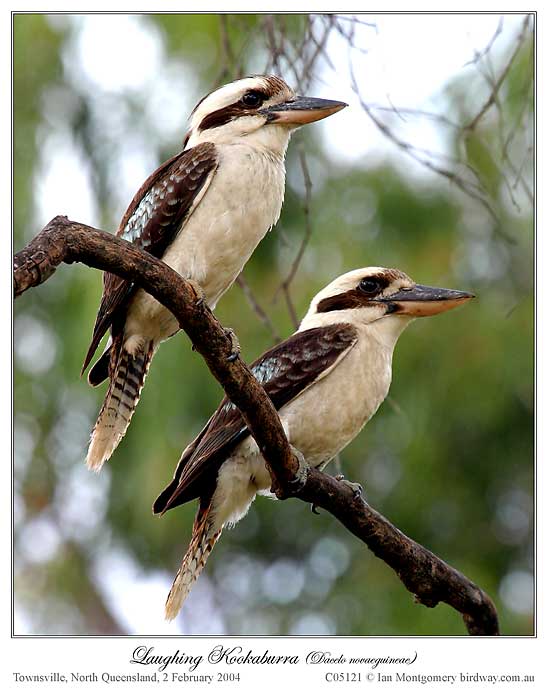
Up to 47cm/18.5in in length, it’s larger than its blue-winged cousin (length to 40cm) and by far the largest Australian Kingfisher. Unlike male blue-winged, birds of both sexes have brown tails and are not easily told apart. The third photo shows a breeding pair of Laughing Kookaburras, photographed near their nest site in a tree hollow in the botanic gardens (the Palmetum) in Townsville.
Older males can, however, be distinguished by having bluish rumps, like one making his presence very audible in the third photo. Kookaburras are very territorial and defend their territories by having calling matches and by performing circular display flights as far as the boundary of the territory. A territorial group consists of either just a breeding pair or a dominant breeding pair and several ‘helper’ birds so the calling matches can be very noisy indeed when everyone takes part.
Laughing Kookaburra (Dacelo novaeguineae) by Ian
Juvenile birds are recognisable by the pale brownish scalloped edges to the plumage, most noticeable on the back like the right hand bird in the fourth photo. This bird is barely fledged and has a very short tail.
Kookaburras are carnivorous and they hunt from perches, doing long glides down to catch terrestrial prey, typically large insects and small mammals and reptiles. The bird in the fifth photo has just caught a mouse. They will immobilise their prey by beating it on the perch, and will automatically do this even when fed dead food such as strips of meat.
Laughing Kookaburra (Dacelo novaeguineae) by Ian
The original range of the Laughing Kookaburra comprised only mainland eastern Australia from the tip of Cape York in the north south to Victoria and as far west as eastern South Australia. Since european settlement it has been successfully introduced to southwestern Western Australia, Tasmania, the islands in Bass Strait and Kangaroo Island in South Australia. Unfortunately, in these areas it competes with the native wildlife for food and with species that nest in tree hollows such as Southern Boobooks.
While we were at the National Aviary last summer, we had the privilege of seeing and hearing the Kookaburra in action. Below is the video I took up there. The Kookaburras are in the Alcedinidae – Kingfisher Family of the Coraciiformes Order.
The 5 Kookaburras are the Shovel-billed, Laughing, Blue-winged, Spangled and Rufous-bellied Kookaburra.
Blessed are you who hunger now, For you shall be filled. Blessed are you who weep now, For you shall laugh. (Luke 6:21 NKJV)
I received a request to show this short documentary about a lady, Lona Hymas-Smith, who is a great woodcarving artist. After viewing the YouTube by HappyShiver, I decided to share it on our blog. She is a fantastic artist.
Lona’s niece made this video. I am sure she is very proud of her aunt’s talent. Hope you enjoy watching her at work. What a great gift the Lord has given her. Check out her website at: http://icarvum.com/
A gift is as a precious stone in the eyes of him that hath it: whithersoever it turneth, it prospereth. (Proverbs 17:8 KJV)
Ian’s Bird of the Week – Red-necked Phalarope ~ by Ian Montgomery
Newsletter – 01-13-11
I had an inquiry from my sister, Colette, in Ireland recently about Red-necked Phalarope (some appeared in breeding plumage at a potential breeding site there last northern summer), so it was floating around in my mind yesterday when I considered what to share with you this week. It’s a dainty and interesting wader, like its cousin the Red/Grey Phalarope which featured as bird of the week after my trip to Alaska in 2008.
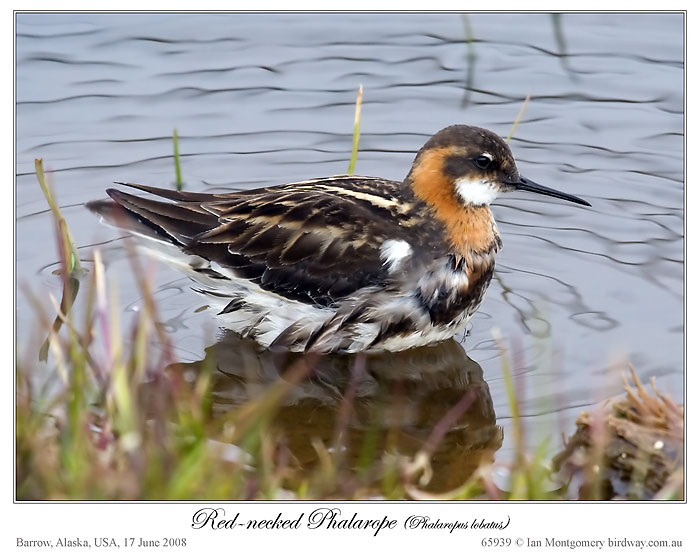
Red-necked Phalarope (Phalaropus lobatus) by Ian
The three species of Phalarope (Wilson’s is the third) breed in high latitudes in the northern hemisphere so Ireland is at the southern edge of its potential range (there was a colony of up to 50 pairs there in the early part of the 20th century). Despite their delicate appearance and toy-like behaviour when bobbing around picking up plankton from the surface of water, these are tough little birds and the Red-necked, 19cm/7.75in in length with a wing-span of 38cm/15in is the smallest of the three. Their favourite nesting sites are on small ponds in the northern tundra and outside the breeding season they are normally pelagic wandering far and wide over the oceans of the world in search of food.
Red-necked Phalarope (Phalaropus lobatus) by Ian
Like the Red/Grey (summer/winter) Phalarope, the Red-necked shows a reversal in sex roles, with the brighter females courting the males, having multiple partners and leaving the males to incubate the eggs and look after the young. There is though to be a selective advantage in the females being able to lay as many eggs as possible in the brief breeding season of high latitudes. The first photo shows the brighter female, the second the smaller and more subdued – in more ways than one – male.
Red-necked Phalarope (Phalaropus lobatus) by Ian
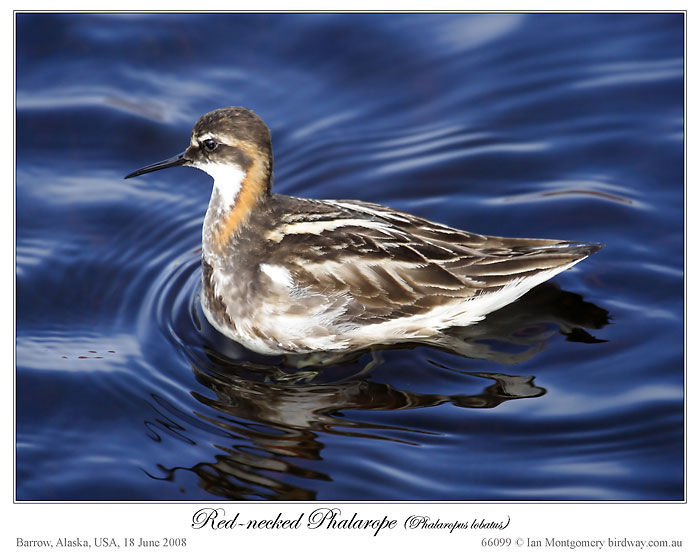
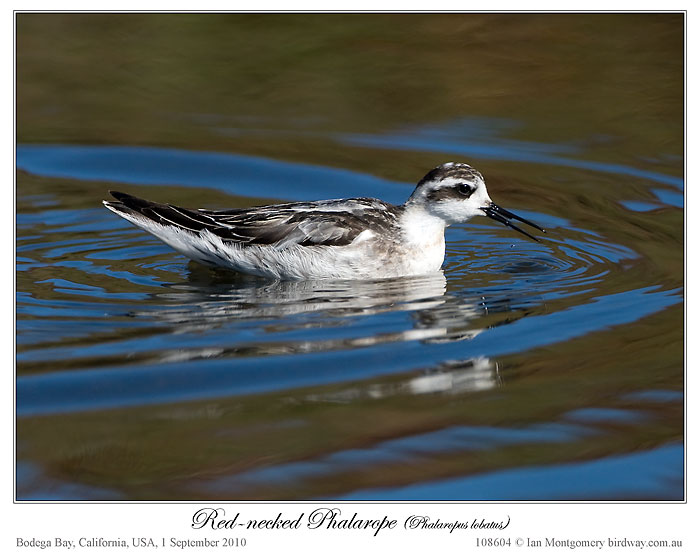
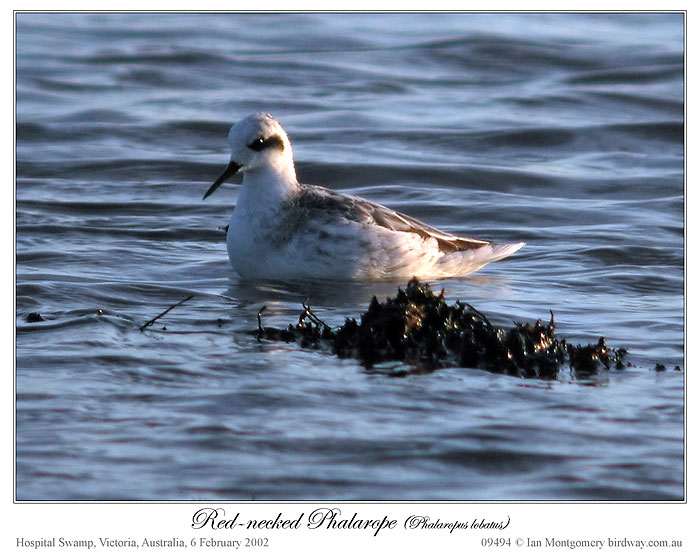
In non-breeding plumage all three species have mainly grey and white plumage. The Red-necked has a black, downturned eye-patch – see the third photos – and, visible in flight, wing bars (lacking in Wilson’s) and dark underwing marking. All three species turn up rarely in Australia in the non-breeding season, particular following storms when drive them into bays for shelter or inland. The Red-necked is the least rare of the three and the fourth photo shows one that turned up on the Bellarine Peninsula south-west of Geelong, Victoria in 2002.
On the website, I’ve started altering the sequence of the next and previous family pointers of the Australian family thumbnail pages so that they follow the sequence of Christidis and Boles (2008) – rather than that of Birdlife International – and only include families that occur in Australia. The intention is to create a ‘green’ Australian zone for visitors who are interested only in Australia birds. A green background already distinguishes the Australian thumbnails and I’m adding background colours to pointer arrows and alphbetical index pages to highlight the distinction. You might like to visit the news section of the home page http://www.birdway.com.au/#news and the Australian index http://www.birdway.com.au/australianbirds.htm to see the difference and to find links to examples.
So far I’ve changed the families from Cassowaries http://www.birdway.com.au/casuariidae/index_aus.htm (the first) as far as Plovers and Lapwings http://www.birdway.com.au/charadriidae/index_aus.htm and will progressively work through the rest. That will be delayed for a week as I’m now in northern NSW en route to Armidale, flooded roads permitting, for a recorder course. Fortunately, given the floods, I had already shelved plans to drive down and flew to the Gold Coast yesterday.
Ian has introduced another neat bird. As Ian mentioned, there are three Phalaropes and all of them are here in the United States, though I have not had the privilege of seeing them.
“A phalarope is any of three living species of slender-necked shorebirds in the genus Phalaropus of the bird family Scolopacidae. They are close relatives of the shanks and tattlers, the Actitis and Terek Sandpipers, and also of the turnstones and calidrids. They are especially notable for two things: their unusual nesting behavior, and their unique feeding technique.” (These are in the Charadriiformes Order)
Two species, the Red Phalarope (Phalaropus fulicarius, called Grey Phalarope in Europe) and Red-necked Phalarope (P. lobatus) breed around the Arctic Circle and winter on tropical oceans. Wilson’s Phalarope (P. tricolor) breeds in western North America and migrates to South America. All are 6–10 in (15–25 cm) in length, with lobed toes and a straight, slender bill. Predominantly grey and white in winter, their plumage develops reddish markings in summer.”
“Red and Red-necked Phalaropes are unusual amongst shorebirds in that they are considered pelagic, that is, they spend a great deal of their lives outside the breeding season well out to sea. Phalaropes are unusually halophilic (salt-loving) and feed in great numbers in saline lakes such as Mono Lake in California and the Great Salt Lake of Utah. (from Wikipedia)
You are the salt of the earth; but if the salt loses its flavor, how shall it be seasoned? It is then good for nothing but to be thrown out and trampled underfoot by men. (Matthew 5:13 NKJV)
Salt is good, but if the salt loses its flavor, how will you season it? Have salt in yourselves, and have peace with one another. (Mark 9:50 NKJV)
Ian’s Bird of the Week – White-tailed Kite ~ by Ian Montgomery
Newsletter ~ 1-06-11
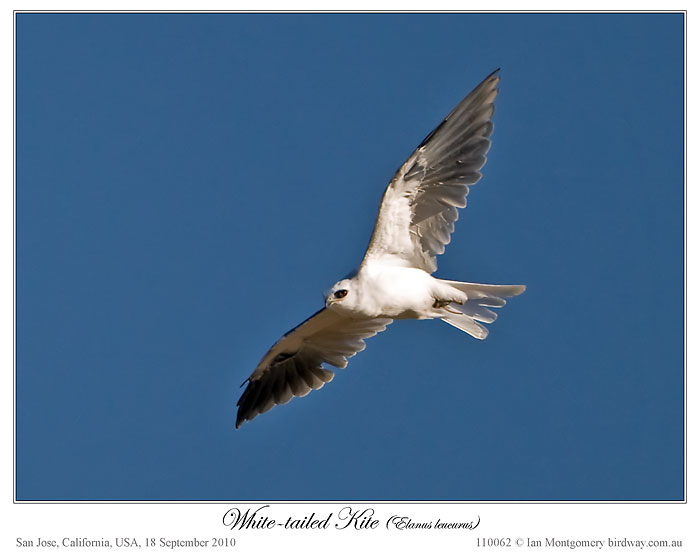
It was only when I was recently preparing this photo for the website, that I noticed that this White-tailed Kite was carrying a small mammal, probably a mouse given the location and the length of the tail, so I thought I would share it with you.
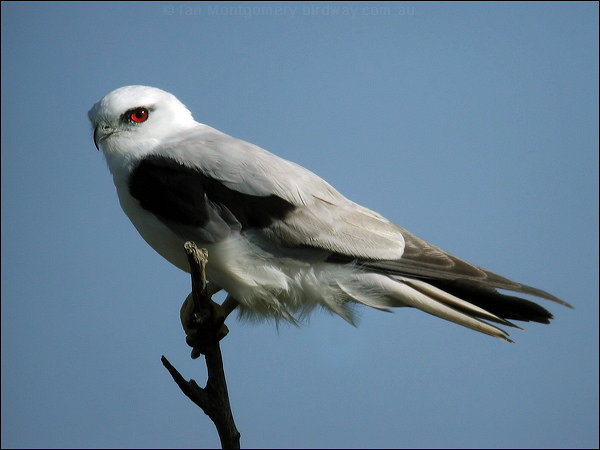
If you are an Australian birder and this bird looked very familiar – ah, a Black-shouldered Kite – you actually be very nearly right. The endemic Australian Black-shouldered (Elanus axillaris), the American White-tailed (E. leucurus) and the Old World Black-winged (E. caeruleus) Kites have been regarded as a single species in the past. Although they are now treated as separate ones, they are referred to collectively as a ‘super-species’, which, if you’re cynical, you might see as a case of taxonomists hedging their bets. The only other member of the genus Elanus worldwide is the Letterwinged Kite (E. scriptus), also an Australian endemic and a rarely seen, largely nocturnal inhabitant of the dry centre.
Black-shouldered Kite (Elanus axillaris) by Ian
The three species differ slightly in size – the White-tailed at 15in/38cm in length is by a small margin the largest – but mainly in the pattern of the underwing. If you look carefully at this bird you can see a blackish spot on a white background near the wrist joint (the primary underwing coverts). This is longer in the Australian version and missing completely in the otherwise very similar Eurasian one. The Black-winged occurs quite widely through southeastern and southern Asia, central and southern Africa and, in small numbers in Iberia and north Africa. The White-tailed occurs in the southern USA and Central and South America.
These are elegant little kites, hover like kestrels and all feed mainly on small mammals. The Letter-winged is particularly partial to the long-haired rat, despite its scientific name Rattus villosissimus, and its population cycles follow the rat’s with the birds dispersing widely when the rat population crashes. I once saw a pair at dusk in a street in inner Sydney (Surry Hills) and you can’t get much farther from the dry interior than that.
Anyway, I’m getting off the track. Back at the website, I’ve added new photos of Australian, American White and Brown Pelicans and starting adding some snakes to the Other Wildlife section.
Lee’s Addition:
Another neat bird from Ian. Glad to see him post because I wasn’t sure if he was being affected by the flooding in Australia.
The Kites are in the Accipitridae Family with the Hawks, Kites and Eagles. The Accipitridae are in the Accipitriformes Order which not only includes them but also the New World Vultures, Secretarybird and Ospreys.
But these are they of which ye shall not eat: the eagle, and the ossifrage, and the ospray, And the glede, and the kite, and the vulture after his kind, (Deuteronomy 14:12-13 KJV)