Ian’s Bird of the Week – Little Tern

Little Tern (Sternula albifrons) by Ian

Little Tern (Sternula albifrons) by Ian

Newsletter: 2-7-2010

Little Tern (Sternula albifrons) by Ian

Little Tern (Sternula albifrons) by Ian

The Little Tern is one of two tiny species of Tern found in Australia, the other being the very similar Fairy Tern. In breeding plumage, as in the first photo, the Little Tern is distinguished by having black lores forming a line through the eyes connecting the black cap to the yellow bill and it the bill usually has a black tip. Both species are of a similar size with a length of 20-28cm/8-11in. This bird was photographed in Queensland in October and would have been a member of the local breeding population.

In non-breeding plumage, as in the second photo, both species have white lores but the Little Tern has black primaries and a black bill while the Fairy Tern has grey primaries and a black-tipped bill with a yellowish base. This bird was photographed in New South Wales in January, so it is probably a member of the Asian breeding population that spends the northern winter in Australia. This bird is fishing by hovering in a characteristic posture with the tail bent sharply downwards.

Little Tern (Sternula albifrons) by Ian

Little Tern (Sternula albifrons) by Ian

The third photo was taken two seconds after the second photo, and the bird is taking flight again after an unsuccessful dive. An average Little Tern weights only about 50g./2oz. so it must have hit the water with tremendous impact. It is fishing, as is typical, in shallow water – the whitish reflection in the background is the surf breaking farther out.

The Little Tern has a widespread distribution through Eurasian, Africa and Australasia. In Australia it occurs in northern, eastern and southern coastal areas from Broome to the Yorke Peninsula and in Tasmania. In contrast, the Fairy Tern occurs mainly in western and southern areas of Australia, but the ranges do overlap in Victoria, South Australia and northern Western Australia.

Recent additions to the website include photos of:
Australasian Darter
Chestnut Teal
Rufous Night-Heron
Dusky Woodswallows
Glossy, Australian White and Straw-necked Ibises

Best wishes,
Ian

Ian Montgomery, Birdway Pty Ltd,
454 Forestry Road, Bluewater, Qld 4818
Phone: +61-7 4751 3115
Preferred Email: ian@birdway.com.au
Website: http://birdway.com.au


Lee’s Addition:

On the same day Jesus went out of the house and sat by the sea. (Matthew 13:1 NKJV)

The Little Tern is in the Laridae Family of the  Charadriiformes Order. This family, Laridae, not only has Terns, but also Noddys, Skimmers, Gulls, and Kittwakes. There are 102 birds in the family. As far a birdwatching goes, that family gives me more fits on trying to ID them. But as small as those Little Terns and the Fairy Terns, I might be able to ID them. But it is a long way to go to see if I could. Good thing Ian is down there to take their photos so we can enjoy them up here.

“This bird breeds on the coasts and inland waterways of temperate and tropical Europe and Asia. It is strongly migratory, wintering in the subtropical and tropical oceans as far south as South Africa and Australia.

The Little Tern breeds in colonies on gravel or shingle coasts and islands. It lays two to four eggs on the ground. Like all white terns, it is defensive of its nest and young and will attack intruders.

Like most other white terns, the Little Tern feeds by plunge-diving for fish, usually from saline environments. The offering of fish by the male to the female is part of the courtship display.

This is a small tern, 21-25 cm long with a 41-47 cm wingspan. It is not likely to be confused with other species, apart from Fairy Tern and Saunders’s Tern, because of its size and white forehead in breeding plumage. Its thin sharp bill is yellow with a black tip and its legs are also yellow. In winter, the forehead is more extensively white, the bill is black and the legs duller. The call is a loud and distinctive creaking noise.” (Wikipedia)

Video of a Little Tern feeding fish to its chicks at the beach by Pedro Rubio

Little Stern from World Bird Guide

Ian’s Bird of the Week – Bassian Thrush

Bassian Thrush by Ian

Bassian Thrush by Ian

Newsletter: 1/28/2010

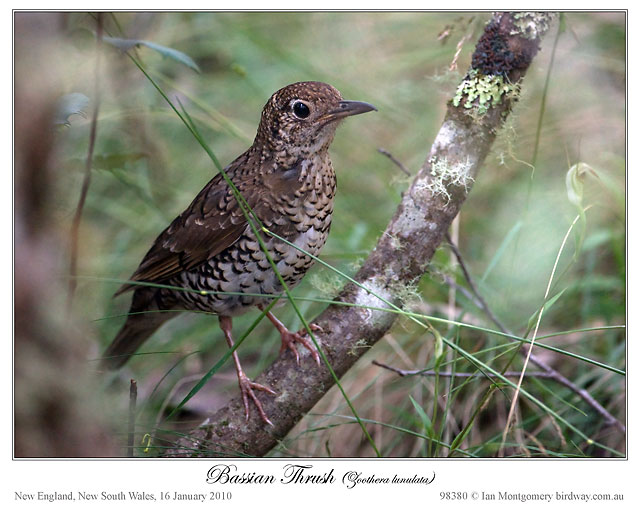
Here’s another bird from the forest of New England, NSW, the Bassian Thrush.

In the Northern Hemisphere, thrushes feature among the best known and most melodious birds of gardens and woodland, such as the Eurasian Blackbird, Song Thrush and Mistle Thrush and the (North) American Robin. They are so popular that two have been successfully introduced into southeastern Australia: the Blackbird (widespread in southeastern Australia including Tasmania) and the Song Thrush (Melbourne and Geelong).

Ask a non-birder in Australia about native Thrushes, however, and you’d probably draw a blank. In fact there are two on the mainland and a third, the Island Thrush, on Christmas Island. The two mainland ones, the Bassian and the Russet-tailed Thrushes, are very similar and are secretive inhabitants of dense forest, the Bassian in eastern and southern Australia from the Atherton Tableland in northeastern Queensland to Tasmania and the Mount Lofty Ranges in South Australia. The Russet-tailed has a more limited distribution in northeastern Queensland and southeastern Queensland and northeastern New South Wales. The ranges of the two species overlap without interbreeding, but they have been treated as separate species and distinct from the Eurasian Scaly Thrush only since 1983 (Ford, J. http://www.publish.csiro.au/paper/MU9830141.htm ).

Bassian Thrush	(Zoothera lunulata) by Ian

Bassian Thrush (Zoothera lunulata) by Ian

In the photographs, this bird can be identified as Bassian by the less rufous colour of the back, particularly the rump and tail, slight longer tail and stronger half-moon patterns on the back. Probably the best field mark are the outer tail feathers which in flight are conspicuously whiter in the Russet-tailed and, if all else fails, altitude comes to the rescue as the Russet-tailed isn’t usually found above 750 metres (this one was at 1,500m). Their songs differ too: the Bassian is rather like the Eurasian Blackbird in tone, while the Russet-tailed has a clear two-note whistle. Unfortunately, neither species is very vocal. It’s probably not surprising that it took so long to separate the species! The name Bassian, I assume, refers to the East Bassian bioregion of coastal southeastern Australia and Tasmania.

Until a couple of centuries ago, the Eurasian Blackbird was a secretive bird of forests until it discovered the delights of gardens and became accustomed to humans. Maybe the same is happening with the Bassian Thrush. This one was near a picnic area and much less shy than normal, and they do turn up in gardens sometimes.

Links:
Eurasian Blackbird
Song Thrush
Mistle Thrush
American Robin
Island Thrush

Additions to the website include:
More photos of last week’s Superb Lyrebird
Crested Tern
Papuan Frogmouth
Green Pygmy-Goose
Forest Raven

Best wishes,
Ian

Ian Montgomery, Birdway Pty Ltd,
454 Forestry Road, Bluewater, Qld 4818
Phone: +61-7 4751 3115
Preferred Email: ian@birdway.com.au
Website: http://birdway.com.au


Lee’s Addition:

(Referring to Springs in the valleys):

By them the birds of the heavens have their home; They sing among the branches.
(Psalms 104:12 NKJV)

The Bassian Thrush is in the Turdidae Family of the Passerformes Order. The family not only includes the Thrushes, but also the Rufous Thrushes, Whistling Thrushes, Ground Thrushes, Bluebirds, Solitaires, Nightingale-Thrushes, Veery, American Robin, Cochoas, Shortwings, and Alethes and others. Quite a large family (183) to say the least.

Ian’s Bird of the Week – Yellow-legged Flyrobin/Flycatcher

Yellow-legged Flyrobin (Microeca griseoceps) by Ian

Yellow-legged Flyrobin (Microeca griseoceps) by Ian

I haven’t had proper internet access for a week, so please forgive me for another late BoW. I’ve been sequestered away in a girls’ boarding school in Armidale on the tablelands of northern New South Wales attending a recorder playing workshop. It was a wonderful experience but quite exhausting and I’ve discovered that you use the same brain cells for playing music as you do for composing text. I managed find some other brain cells to prepare these two photos several days ago – taking time off from practice – but my plan to skip lunch and search for an internet cafe never had much chance of success.

Yellow-legged Flyrobin (Microeca griseoceps) by Ian

Yellow-legged Flyrobin (Microeca griseoceps) by Ian

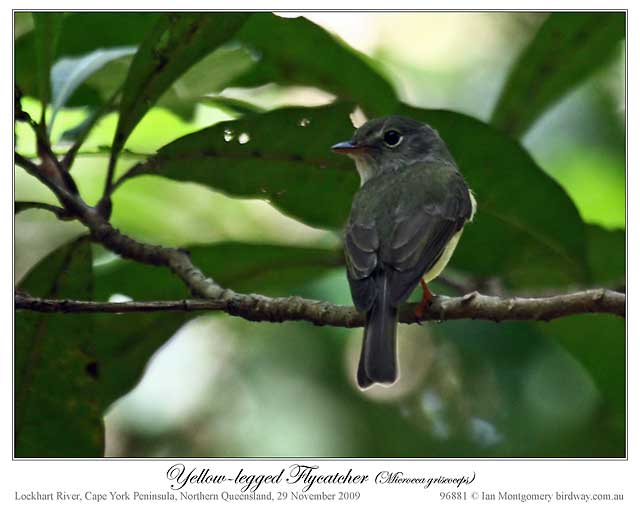
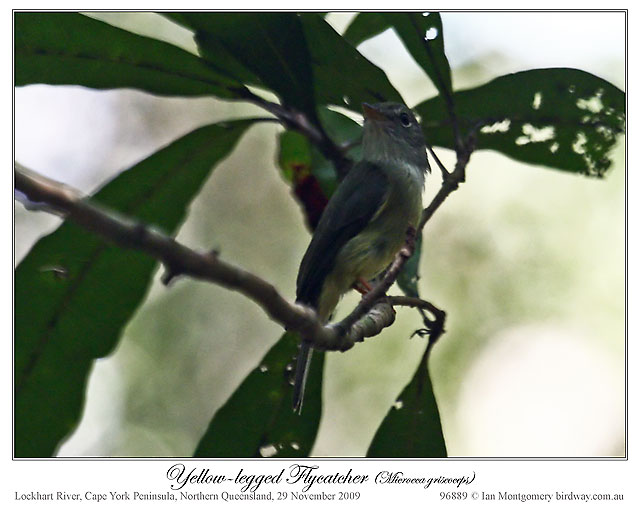
The Yellow-legged Flycatcher belongs in the obscure category. Unlike its close relative the Jacky-winter – widespread throughout Australia – it is found only in northern Cape York Peninsula and Papua New Guinea. It is a forest dweller, favouring the outer canopy and small (12cm/4in long) so it is easily overlooked. The bright chrome-yellow legs, however, contrast with its rather sombre plumage.

In recent years it has become better known as more birders visit Iron Range National Park near Lockhart River. My 1986 field guide (Slater) describes its status as ‘rare’ and its voice as ‘precise information required’, while my 2000 one (Morecombe) says it is ‘common’ and provides a detailed description of its call (variations on “wheeit”).

Like the Jacky-winter and the rather similar Lemon-bellied Flycatcher of northern Australia it is a member of the Petroicidae. the Australo-Papuan Robins and is not related to other flycatchers. To emphasize this distinction, the international name for the Yellow-legged and the Lemon-bellied is ‘Flyrobin’ (there are several species in PNG) but this name is having an uphill task in being accepted in Australia.

Now, I’m going to go Dangar Falls National Park near Armidale and have a relaxing day or two.
Best wishes,
Ian

Links:
Yellow-legged Flycatcher
Jacky-winter
Lemon-bellied Flycatcher

Ian Montgomery, Birdway Pty Ltd,
454 Forestry Road, Bluewater, Qld 4818
Phone: +61-7 4751 3115
Preferred Email: ian@birdway.com.au
Website: http://birdway.com.au


Lee’s Addition:

Petroicidae Family (Australasian Robins) are in a different Family from other Robins. The American Robin is now the only Robin in with the Thrushes & Allies which are in the (Turdidae) Family. The Clay-colored and White-throated Robins are now Thrushes.  The Muscicadpidae Family which has Robins is in with the Chats and Old World Flycatchers.

The Australasian Robins do not seem to migrate like many others from the other two families mentioned. The American Robin (thrush family) migrates because they are down here now this time of the year.

“Even the stork in the sky Knows her seasons; And the turtledove and the swift and the thrush Observe the time of their migration; But My people do not know The ordinance of the LORD. (Jeremiah 8:7 NASB)

Ian’s Bird of the Week – Bar-breasted Honeyeater

Bar-breasted Honeyeater (Ramsayornis fasciatus) ©Ian

Bar-breasted Honeyeater (Ramsayornis fasciatus) ©Ian

Newsletter 1/3/2010

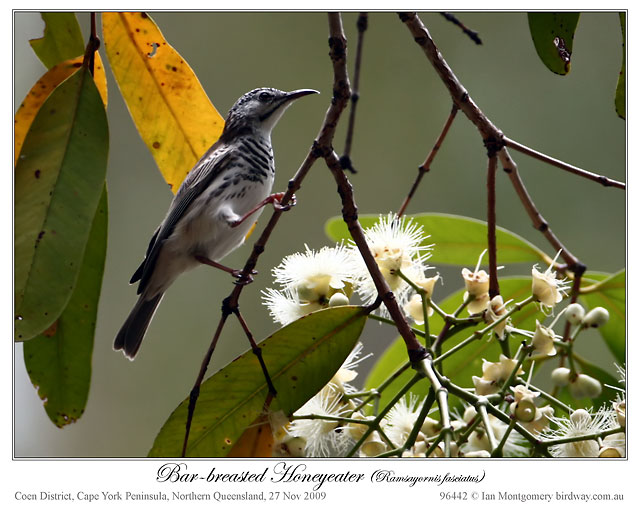
This week we have an unusual-looking honeyeater from northern Australia, the Bar-breasted Honeyeater. It is the only Australian Honeyeater with strong barring – the only other barred one is it’s close relative the faintly-barred Brown-backed Honeyeater of northeastern Queensland and PNG.

Its range extends through coastal areas from the Kimberley in Western Australia to Rockhampton in Queensland. Though scarce in eastern Queensland, it is quite common in suitable habitats in the rest of northern Australia but, being an unobtrusive feeder on the blossoms of trees, it is easy to overlook. Like the Brown-backed, it prefers woodlands near water, typically paperbarks or eucalyptus and both species build quite bulky suspended nests of paperbark strips, usually over water. See the second photo of the Brown-backed Honeyeater here for an example: http://birdway.com.au/meliphagidae/brown_backed_honeyeater/index.htm.

Bar-breasted Honeyeater (Ramsayornis fasciatus) by Ian

Bar-breasted Honeyeater (Ramsayornis fasciatus) by Ian

Birds that feed on flowering trees are usually difficult to photograph as they often remain obscured by the foliage. I photographed the one in the first photo on Cape York by sitting in comfort on a folding chair in the shade of a flowering tree – it was a very hot day – and focussing the camera on a suitably exposed blossom until a honeyeater came along. In the second photo, in northeastern Western Australia, I climbed up a tree and sat on a large limb against the trunk and waited for the birds to come and feed near me.

Well another year is on us, so Happy New Year, specifically Happy twenty-ten! (Being pedantic, I’ve joined the campaign to boycott ‘two thousand and . . .’).
Ian

Ian Montgomery, Birdway Pty Ltd,
454 Forestry Road, Bluewater, Qld 4818
Phone: +61-7 4751 3115
Preferred Email: ian@birdway.com.au
Website: http://birdway.com.au


Lee’s Addition:

It is not good to eat much honey: so for men to search their own glory is not glory. (Proverbs 25:27 KJV)

Thanks again, Ian. I also like calling it twenty ten, but I also like “Oh, ten.” Anyway, on with the bird of the week.

Ian also did a bird of the week on the Rufous-banded Honeyeater.  Also see Meliphagidae – Honeyeaters for more information about the Honeyeaters. For a list of all the Honeyeaters – Click Here.

Birds of the Bible – Mother and Her Chicks

Snow Goose (Chen caerulescens) at nest©USFWS

Snow Goose (Chen caerulescens) at nest©USFWS

If a bird’s nest happens to be before you along the way, in any tree or on the ground, with young ones or eggs, with the mother sitting on the young or on the eggs, you shall not take the mother with the young; you shall surely let the mother go, and take the young for yourself, that it may be well with you and that you may prolong your days. (Deuteronomy 22:6-7 NKJV)

Also in the with the animals, the Bible says,

Whether it is a cow or ewe, do not kill both her and her young on the same day. (Leviticus 22:28 NKJV)

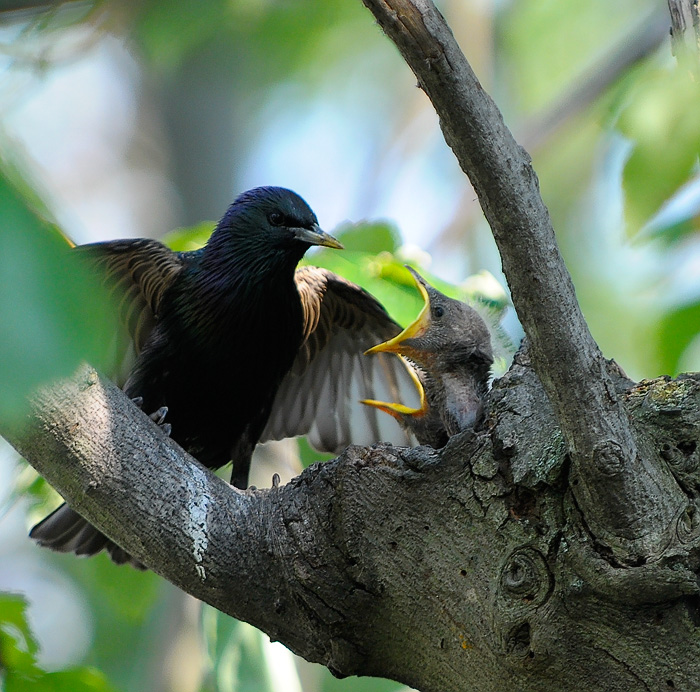
Common Starling (Sturnus vulgaris) at Nest by Anthony747

Common Starling (Sturnus vulgaris) at Nest by Anthony747

In Deuteronomy, the Israelites were being given some rules of things to do or not do. This passage about the mother bird and her chicks or eggs is among those commands. Notice that if they did this, it would be well with them and help prolong their days. There are many good characteristics for us to learn from this command. Below are some of the thoughts from the commentators.

Matthew Henry’s Commentary was the longest, but much insight. “II. In taking a bird’s-nest, the dam must be let go, Deu_22:6, Deu_22:7. The Jews say, “This is the least of all the commandments of the law of Moses,” and yet the same promise is here made to the observance of it that is made to the keeping of the fifth commandment, which is one of the greatest, that it may be well with thee, and that thou mayest prolong thy days; for, as disobedience in a small matter shows a very great contempt of the law, so obedience in a small matter shows a very great regard to it. He that let go a bird out of his hand (which was worth two in the bush) purely because God bade him, in that made it to appear that he esteemed all God’s precepts concerning all things to be right, and that he could deny himself rather than sin against God. But doth God take care for birds? 1Co_9:9. Yes, certainly; and perhaps to this law our Saviour alludes. Luk_12:6, Are not five sparrows sold for two farthings, and not one of them is forgotten before God? This law, 1. Forbids us to be cruel to the brute-creatures, or to take a pleasure in destroying them. Though God has made us wiser than the fowls of heaven, and given us dominion over them, yet we must not abuse them nor rule them with rigour. Let go the dam to breed again; destroy it not, for a blessing is in it, Isa_65:8. 2. It teaches us compassion to those of our own kind, and to abhor the thought of every thing that looks barbarous, and cruel, and ill-natured, especially towards those of the weaker and tender sex, which always ought to be treated with the utmost respect, in consideration of the sorrows wherein they bring forth children… It further intimates that we must not take advantage against any, from their natural affection and the tenderness of their disposition, to do them an injury. The dam could not have been taken if her concern for her eggs or young (unlike to the ostrich) had not detained her upon the next when otherwise she could easily have secured herself by flight. Now, since it is a thousand pities that she should fare the worse for that which is her praise, the law takes care that she shall be let go. The remembrance of this may perhaps, some time or other, keep us from doing a hard or unkind thing to those whom we have at our mercy.” (Matthew Henry’s Commentary)

Redwing Blackbird feeding young at Lake Hollingsworth

Redwing Blackbird feeding young at Lake Hollingsworth

“If a bird’s nest chance to be before thee — This is a beautiful instance of the humanizing spirit of the Mosaic law, in checking a tendency to wanton destructiveness and encouraging a spirit of kind and compassionate tenderness to the tiniest creatures. But there was wisdom as well as humanity in the precept; for, as birds are well known to serve important uses in the economy of nature, the extirpation of a species, whether of edible or ravenous birds, must in any country be productive of serious evils. But Palestine, in particular, was situated in a climate which produced poisonous snakes and scorpions; and the deserts and mountains would have been overrun with them as well as immense swarms of flies, locusts, mice, and vermin of various kinds if the birds which fed upon them were extirpated [Michaelis]. Accordingly, the counsel given in this passage was wise as well as humane, to leave the hen undisturbed for the propagation of the species, while the taking of the brood occasionally was permitted as a check to too rapid an increase.” (Jamieson, Faucett, and Brown Commentary)

If God detests cruelty done to little birds, how much more to man, made according to his image?” (Geneva Bible Translation Notes)

Redwing Blackbird young at Lake Hollingsworth

Redwing Blackbird young at Lake Hollingsworth

“..this law was made partly to preserve the species of birds, and prevent the decrease of them; for a dam let go might breed again, and to this purpose are the verses ascribed to Phocylides (y), which contain the substance of this law, and this reason of it: and partly, as Maimonides observes (z), that the dam might not be afflicted at the sight of the spoil of her young; for this law does not prohibit the taking of her in any other place but in her nest, nor after her young are taken, but not together; and, as the same writer remarks, if the law would have such care taken of beasts and birds, that they might be freed from sorrow and distress, how much more of man? Wherefore the intention of this law is to teach humanity, compassion, and pity in men to one another, and to forbid cruelty, covetousness, and such like vices; as also to instruct in the doctrine of Providence, which has a respect to birds; and our Lord may be thought to have this law in view, Luke 12:6.” (John Gill’s Exposition of the Whole Bible)

“The affectionate relation of parents to their young, which God had established even in the animal world, was also to be kept just as sacred. If any one found a bird’s nest by the road upon a tree, or upon the ground, with young ones or eggs, and the mother sitting upon them, he was not to take the mother with the young ones, but to let the mother fly, and only take the young. נִקְרָא for נִקְרָה, as in Exo_5:3. The command is related to the one in Lev_22:28 and Exo_23:19, and is placed upon a par with the commandment relating to parents, by the fact that obedience is urged upon the people by the same promise in both instances (vid., Deu_5:16; Exo_20:12).” (K & D Commentary on OT)

(Bolding is mine)

*

Ian’s Bird of the Week – Masked Finch

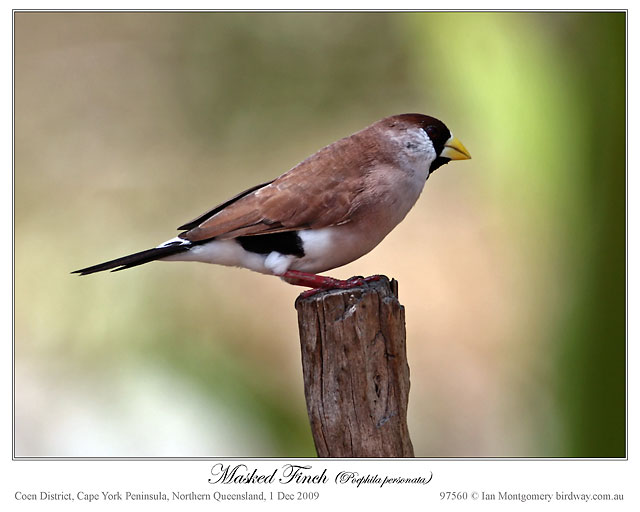
Masked Finch (Poephila personata) by Ian

Masked Finch (Poephila personata) by Ian

Newsletter: 12/26/2009

Here is yet another beautiful finch from northern Australia, the Masked Finch, which we encountered on the recent trip to Cape York Peninsula. There are two races. This one, the ‘White-eared Finch’ (Poephila personata leucotis) occurs only on Cape York, while the nominate brown cheeked race (personata) occurs from northwestern Queensland through the top end of the Northern Territory to the Kimberley district of northern Western Australia. Both races are distinguishable from the closely related Black-throated and Long-tailed Finches (P. cincta and P. acuticauda respectively) by having large yellow bills, brown, rather than grey, crowns and only a small area of black on the chin.

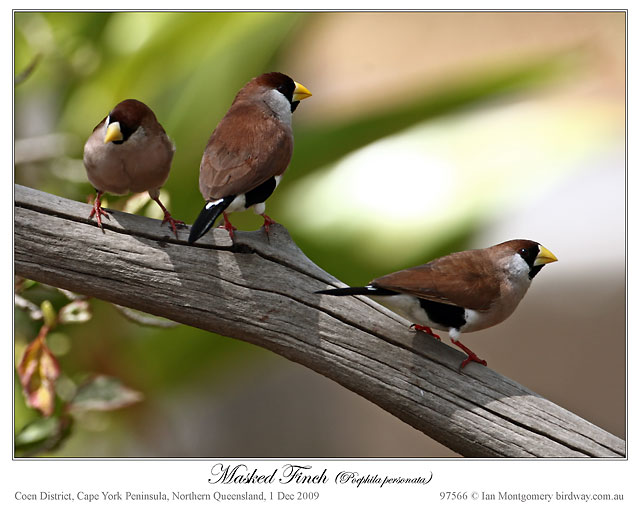
Masked Finch (Poephila personata)2 by Ian

Masked Finch (Poephila personata)2 by Ian

We encountered these individuals at the fruit quarantine station near Coen in central Cape York Peninsula. The station provides a bird bath in the small park where we finished off some fruit and the bath was popular with both Masked Finches and the northern (black-rumped) race of the Black-throated Finch.

Masked Finches feed, like their, relatives mainly on grass seeds. So they feed mainly on the ground, but will retreat into bushes and trees when disturbed. The easiest way to find them is usually at waterholes in the dry season where they come in, often in large numbers, to drink and bathe. Masked Finches build globular nests in bushes and trees and will sometimes use the old burrows of kingfishers in termite mounds.

Links:
Black-throated Finch
Long-tailed Finch
Masked Finch (including the western brown-cheeked race)
Best wishes,
Ian

Ian Montgomery, Birdway Pty Ltd,
454 Forestry Road, Bluewater, Qld 4818
Phone: +61-7 4751 3115
Preferred Email: ian@birdway.com.au
Website: http://birdway.com.au


Black-throated Finch (Poephila cincta) by Ian

Black-throated Finch (Poephila cincta) by Ian

Long-tailed Finch (Poephila acuticauda) by Ian

Long-tailed Finch (Poephila acuticauda) by Ian

Lee’s Addition:

Are not five sparrows sold for two farthings, and not one of them is forgotten before God? (Luke 12:6 KJV)

These are in the Estrildidae – Waxbills, Munias & Allies family of the Passeriformes Order.

“The Masked Finch (Poephila personata) is a small passerine bird in the estrildid finch family, Estrildidae. The estrildid finches are small passerine birds of the Old World tropics and Australasia. They can be classified as the family Estrildidae (weaver-finch), or previously as a sub-group within the family Passeridae, which also includes the true sparrows.[It is a common resident of dry savanna across northern Australia, from the Kimberley, across the Top End, the Gulf country and the southern part of Cape York Peninsula, as far east as Chillagoe, but always near water.

It is 12.5-13.5 cm (4.9-5.3 in) long. The male is larger but the sexes are otherwise similar. It is cinnamon-brown above and paler below with a white rump, black mark on the flanks and black face mask. It has a heavy yellow bill and a pointed black tail. The eastern subspecies P. p. leucotis has whitish cheeks.

Pairs or small flocks forage through the day, mostly on the ground for fallen grass seeds. In the evenings and early mornings, large numbers—sometimes thousands— can gather around waterholes to drink, bathe, and preen, flicking their tails sideways and chattering incessantly.

Pairs build a domed nest from grasses, lined with fine grass, feathers, and charcoal, in the late wet season or early dry. The nest position varies: it can be as high as 20 metres or simply hidden in long grass. Five to six white eggs are laid.” -From Wikipedia

Ian’s Bird of the Week – Frill-necked Monarch

Frill-necked Monarch (Arses lorealis) by Ian

Frill-necked Monarch (Arses lorealis) by Ian

Newsletter – 12/16/2009

Frill-necked Monarch (Arses lorealis) by Ian

Frill-necked Monarch (Arses lorealis) by Ian

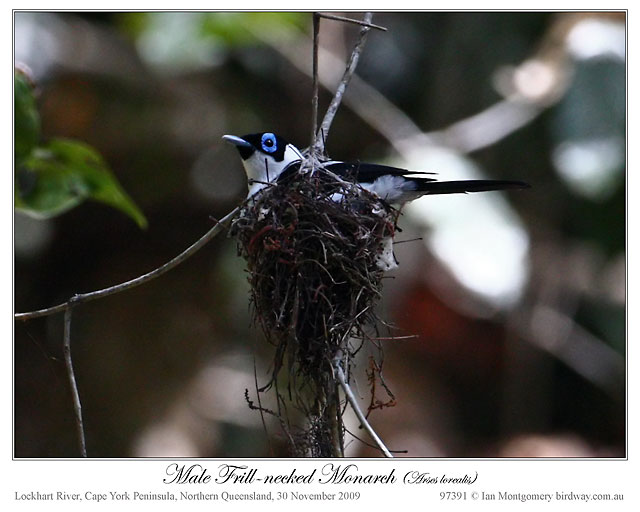
On our recent trip to Cape York Peninsula, we came across several Frill(-neck)ed Monarchs in the Lockhart River – Iron Range district. This is quite similar to the Pied Monarch of the wet tropics of northeastern Queensland, but lacks the black breast band and has a more extensive frill and broader blue eye-rings. I’ve qualified the name as the original Frilled Monarch of northern Cape York Peninsula, Torres Strait and Papua New Guinea (Arses telescopthalmus) has recently been split into the Frilled Monarch of Torres Strait and PNG and the new Frill-necked Monarch (Arses lorealis) of northern Cape York Peninsula.

The bird in the first photo is a male, distinguishable by having black lores and a black bib, or maybe goatee would be more appropriate. It’s doing something with either the white honeydew on the flower stalk or the insects (aphids or scale insects) responsible for the honeydew. More about the ‘something’ in a moment.

Earlier the same day, another Frill-necked Monarch carrying nesting material revealed the location of her nest, hanging, hammock- or swing-like, from a long vine over a creek, a typical location thought to discourage predation by animals such as arboreal snakes. This bird stayed in the nest for a few minutes, left and then, I thought, returned. It was only later, when examining the photos that it I realised that the second bird was her mate. If you look carefully, you can see the white chin (and maybe the pale lores) of the female in the second photo and the black goatee and lores of the male in the third photo.

Frill-necked Monarch

Frill-necked Monarch

The fourth photo was intended to show how precariously the nest was built at the end of at least 3 metres of vine, and, again, it was only later that I noticed that one branch of the vine was broken (in the centre of the photo). It’s still attached above the nest to the other strand of the vine and I wondered whether this attachment was serendipitous or had been done as a repair by the birds. Monarchs are supposed to use cobwebs to glue their nests together. I then wondered whether the bird in the first photograph was feeding on the aphids/scale insects, feeding on the honeydew (as some birds do such as the New Zealand Honeyeater the Tui) or collecting the honeydew as glue – it’s very sticky – for nest construction.

Back at the website, I’ve added photos of:
the Cape York race of the Masked Finch
the northern race of the Black-throated Finch
Wandering Whistling-Duck
White-bellied Sea-Eagle being fed on garfish by the Ferryman at Karumba
Golden-shouldered Parrot
White-faced Robin
Yellow-legged Flycatcher/Flyrobin
So it’s no wonder I’m late with my Christmas cards yet again!

I wish you all a safe and happy Christmas and best wishes for the New Year,
Ian

Ian Montgomery, Birdway Pty Ltd,
454 Forestry Road, Bluewater, Qld 4818
Phone: +61-7 4751 3115
Preferred Email: ian@birdway.com.au
Website: http://birdway.com.au


Lee’s Addition:

And God blessed them, saying, “Be fruitful and multiply, and fill the waters in the seas, and let birds multiply on the earth. (Genesis 1:22 NKJV)

The Frill-necked Monarch (Arses lorealis) is a species of songbird in the Monarchidae family. It is endemic to the rainforests of the northern Cape York Peninsula. It was considered a subspecies of the related Frilled Monarch (Arses telescophthalmus) for many years before being reclassified as a separate species in 1999.

The Frill-necked Monarch is a member of a group of birds termed monarch flycatchers. This group is considered either as a subfamily Monarchinae, together with the fantails as part of the drongo family Dicruridae, or as a family Monarchidae in its own right. Molecular research in the late 1980s and early 1990s revealed the monarchs belong to a large group of mainly Australasian birds known as the Corvida parvorder comprising many tropical and Australian passerines. More recently, the grouping has been refined somewhat as the monarchs have been classified in a ‘Core corvine’ group with the crows and ravens, shrikes, birds of paradise, fantails, drongos and mudnest builders.

Alternative common names include Australian Frilled Monarch, and White-lored Flycatcher.

The Frill-necked Monarch measures around 14 cm (5.5 in) in length, and the neck feathers can become erect into a small frill; the male is predominantly black and white, and can be distinguished from the similar and more common Pied Monarch by its all-white breast-the latter species having a broad black breast band. The throat, nape, shoulders, and rump are white while the wings and head are black. It has a eye-ring of bare skin, and a bright blue wattle. The bill is pale blue-grey and the eyes are dark. The female is similar but lacks the eye-ring and has white lores and a brownish tinged chest.

Breeding season is November to February with one brood raised. The nest is a shallow cup made of vines and sticks, woven together with spider webs and shredded plant material, and decorated with lichen. It is generally sited on a hanging loop of vine well away from the trunk or foliage of a sizeable tree about 2–10 metres (6.6–33 ft) above the ground. Two pink-tinged oval white eggs splotched with lavender and reddish-brown are laid measuring 19 mm x 14 mm.

Video of a Frilled Monarch (Arses telescopthalmus) by Keith.

Error
This video doesn’t exist

Ian’s Bird of the Week – Golden-shouldered Parrot

Golden-shouldered Parrot (Psephotus chrysopterygius) by Ian

Golden-shouldered Parrot (Psephotus chrysopterygius) by Ian

Newsletter: 12/8/2009

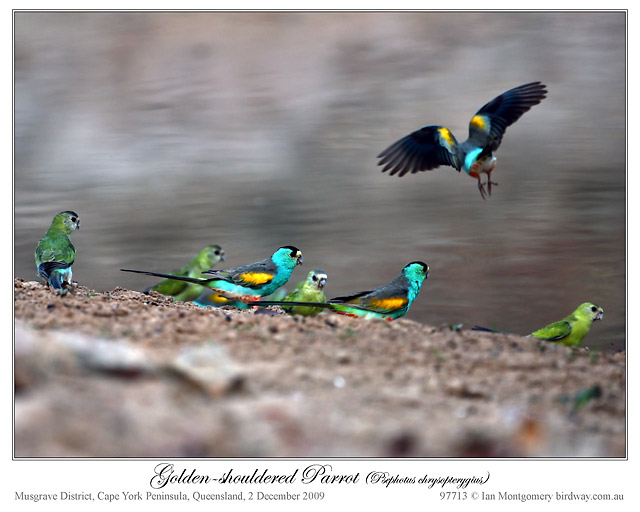
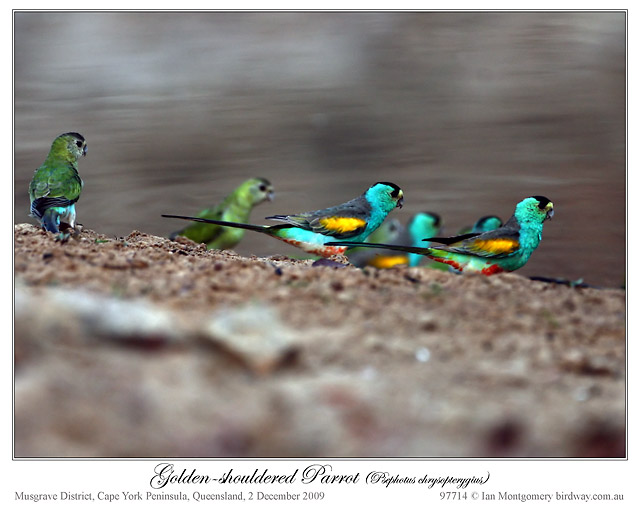
The Hooded Parrot featured as bird of the week at the end September following our encounter with some at Pine Creek in the Northern Territory. This week we have its rarer, and just as beautiful, close relative the Golden-shouldered Parrot of Cape York Peninsula, which we saw last week on our way back from Iron Range. We were shown them coming in to drink at a dam at sunrise by Sue Shephard of Artemis Station south of Musgrave.

Golden-shouldered Parrot (Psephotus chrysopterygius) by Ian

Golden-shouldered Parrot (Psephotus chrysopterygius) by Ian

The two species look very similar. Male Golden-shouldered Parrots have narrower black caps, not extending past the eye, a yellowish forehead and, despite their name, a smaller golden patch on the wing. These shoulder patches are very obvious in flight, as in the bird top right in the first photo, and presumably act, along with the turquoise rump, as signals to other members of the species. At about 26cm/10in in length, these are both quite small parrots. Like the extinct, closely related, Paradise Parrot of southeastern Queensland, all three species nest, or nested, in terrestrial termite mounds.

The Golden-shouldered Parrot used to be quite widespread on Cape York Peninsula. It is now found only in two areas: in the Morehead River catchment south of Musgrave (where we saw them) and in Staaten River National Park farther to the southwest. Population estimates range up to 1,000 pairs and the species, classified as endangered, is now the subject of a national recovery plan. The good news is that in the last decade the contraction of the range appears to have stopped and the population stabilized, owing to active conservation measures being taken by the holders of grazing properties in the Morehead River catchment, notably Tom and Sue Shephard of Artemis Station. Staaten River National Park is inaccessible by road, so monitoring and conservation there pose particular challenges.

Links:
Hooded Parrot
Golden-shouldered Parrot Recovery Plan

Best wishes,
Ian

Ian Montgomery, Birdway Pty Ltd,
454 Forestry Road, Bluewater, Qld 4818
Phone: +61-7 4751 3115
Preferred Email: ian@birdway.com.au
Website: http://birdway.com.au


Lee’s Addition:
Another neat bird that Ian has captured in photos for us to enjoy. Thanks again, Ian.

He comes from the north as golden splendor; With God is awesome majesty. (Job 37:22 NKJV)

The Golden-shouldered Parrot is in the Psittacidae Family (Parrots) of the Psittaciformes Order (New Zealand Parrots, Cockatoos, and Parrots).

The adult male is mainly blue and has a characteristic yellow over the shoulder area. It has a black cap and pale yellow frontal band. It has a pinkish lower belly, thighs and undertail-coverts. It has a Grey-brown lower back. Adult female are mainly dull greenish-yellow, and have a broad cream bar on the underside of the wings. Juveniles are similar to the adult female. (Wikipedia)

To see more about the Golden-shouldered Parrot:
Nice Video at Internet Bird Collection
By Wikipedia
By Bird Life International

Ian’s Bird of the Week – Black-winged Monarch

Black-winged Monarch (Monarcha frater) by Ian

Black-winged Monarch (Monarcha frater) by Ian

From: Ian Montgomery
Newsletter 12/7/2009

Subject: Bird of the Week: Black-winged Monarch

Black-winged Monarch (Monarcha frater) by Ian

Black-winged Monarch (Monarcha frater) by Ian

If you live on the east coast of Australia, you may be familiar with the very similar Black-faced Monarch. The Black-winged Monarch, distinguishable by paler grey upper parts and contrasting black wings, is, however, a Cape York specialty migrating from PNG in the southern summer to breed along the northeast coast of the Peninsula south to about the McIlwraith Ranges north of Coen.

It’s not a well-known species, and until fairly recently hadn’t been photographed. That, I’m sure, has all changed now with a steady stream of digitally armed birders making the pilgrimage to Lockhart River, where these photos were taken, and the nearby Iron Range National Park. Anyway, I was glad of the opportunity last week to improve on the two mediocre shots on the Birdway website taken on my first visit there almost 6 years ago.

Links:
Black-winged Monarch (the original photos)
Black-faced Monarch

Best wishes,
Ian

Ian Montgomery, Birdway Pty Ltd,
454 Forestry Road, Bluewater, Qld 4818
Phone: +61-7 4751 3115
Preferred Email: ian@birdway.com.au
Website: http://birdway.com.au


Lee’s Addition:

When I think of the Monarch, my first thoughts are of a Monarch Butterfly, but the Monarch birds are very interesting. There are 47 Monarchs in Monarchidae Family of the Passeriformes Order. Also included in the family are Paradise and Crested Flycatchers, an Elepaio, Shrikebills, a Silktail, Magpielark, Torrentlark, and the Myiagra genus of Flycatchers. (Total of 93)
Here are some more of Ian’s Photos from the Monarchidae Family:
Broad-billed Flycatcher
Leaden Flycatcher
Shining Flycatcher
Restless Flycatcher
White-eared Monarch
Spectacled Monarch
Magpielark
Frilled Monarch
Pied Monarch

Another parable He put forth to them, saying: “The kingdom of heaven is like a mustard seed, which a man took and sowed in his field, which indeed is the least of all the seeds; but when it is grown it is greater than the herbs and becomes a tree, so that the birds of the air come and nest in its branches. (Matthew 13:31-32 NKJV)

Black-faced Monarch by Nick Talbot

Also see:

Monarch Flycatchers – Wikipedia

Ian’s Bird of the Week – Spotted Whistling Duck

Spotted Whistling Duck (Dendrocygna guttata) by Ian

Spotted Whistling Duck (Dendrocygna guttata) by Ian

Newsletter – 12/3/2009

Another late bird of the week, I regret, as I’ve just returned from a ten day trip to Cape York, not famous for its internet facilities, or any facilities for that matter. I’m home now and will play catch-up with another bird of (this) week over the next few days.

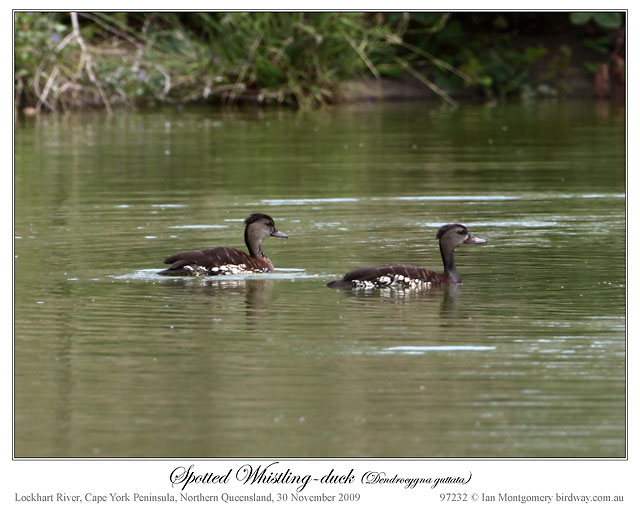
Australia is rather isolated geographically, so colonisation by a new species of bird is an unusual event. Such an event is most likely to occur on Cape York Peninsula, which is within island-hopping distance of New Guinea. The Spotted Whistling Duck, a common bird in New Guinea, was first recorded at Weipa on the western side of the peninsula in 14 years ago. It now occurs also in the Lockhart River district on the eastern side at about the same latitude as Weipa and this is where we came across a party of 4 last Monday. It will be interesting to see if it gets more widely established in Northern Australia.

Unlike the other two Australian Whistling-Ducks (Plumed and Wandering), the Spotted lacks side plumes and is easily recognisable by conspicuous white spots with black borders on the flanks. Globally, there are eight species of Whistling Ducks, all belonging to the genus Dendrocygna, with tropical and sub-tropical ranges in Australia, Asia, Africa and the Americas. The Plumed is endemic to Australia, while the Wandering also occurs in New Guinea, Indonesia, Borneo and the Philippines.

Website links:
Plumed Whistling-Duck
Wandering Whistling-Duck

Best wishes,
Ian

Ian Montgomery, Birdway Pty Ltd,
454 Forestry Road, Bluewater, Qld 4818
Phone: +61-7 4751 3115
Preferred Email: ian@birdway.com.au
Website: http://birdway.com.au


Lee’s Addition:
Thanks, Ian, those Whistling Ducks are neat. We don’t get to see those here in Florida, of course, but we do get to see lots of Black-bellied and Fulvous Whistling Ducks. The other three Whistlers are the White-faced, West Indian and the Lesser Whistling Ducks.

I will whistle for them and gather them, For I will redeem them; And they shall increase as they once increased. (Zechariah 10:8 NKJV)

The Whistling Ducks are part of the Anatidae Family within the Anseriformes Order.

Here are photos of all eight Whistling Ducks
*

This slideshow requires JavaScript.

*

Ian’s Bird of the Week – Rufous-banded Honeyeater

Rufous-banded Honeyeater (Conopophila albogularis) by Ian

Rufous-banded Honeyeater (Conopophila albogularis) by Ian

Here’s a small tropical Honeyeater that we encountered frequently in the Top End of the Northern Territory in September: the Rufous-banded. It’s appeal is subtle rather than spectacular, but I think it looks rather smart with its grey head, white-throat, rufous breast band and brown and yellow wings and tail.

Rufous-banded Honeyeater (Conopophila albogularis) by Ian

Rufous-banded Honeyeater (Conopophila albogularis) by Ian

It has a restricted range, being confined to the Top End of the Northern Territory and the northern half of Cape York in Queensland. It is rather similar to its close relative the Rufous-throated Honeyeater, which, in addition to the different throat colour of adult, lacks the rufous band and has a brownish head. The difference in head colour is diagnostic, as juveniles of the Rufous-banded and Rufous-throated lack the rufous band and throat respectively. Rufous would seem to be important in signalling sexual maturity, though the sexes are identical. The ranges of the two species overlap, with the Rufous-throated extending farther south in the tropics to include the Kimberley in Western Australia, the centre of the Northern Territory and Northern Queensland as far south as Townsville.

I’m in Mission Beach for the annual Pied Imperial Pigeon count http://www.birdsaustralianq.org/projects.htm and the BANQ Christmas get-together en route to Cape York to help in a survey in Mungkan Kandju national park between Coen and Arthur River. The survey will take several days and I plan to stay on for a few extra days to chase a few Cape York specialties.

Best wishes,
Ian

Ian Montgomery, Birdway Pty Ltd,
454 Forestry Road, Bluewater, Qld 4818
Phone: +61-7 4751 3115 Mobile +61-411 602 737
Preferred Email: ian@birdway.com.au
Website: http://birdway.com.au


Lee’s Addition:

Pleasant words are as an honeycomb, sweet to the soul, and health to the bones. (Proverbs 16:24 KJV)

The Rufous-banded Honeyeater is in the Passeriformes order and the Meliphagidae – Honeyeaters Family. Ian has great photos for 59 members of the Meliphagidae family.

“The honeyeaters are a large and diverse family of small to medium sized birds most common in Australia and New Guinea, but also found in New Zealand, the Pacific islands as far east as Hawaii, and the islands to the north and west of New Guinea known as Wallacea. Bali, on the other side of the Wallace Line, has a single species.

Honeyeaters and the closely related Australian chats make up the family Meliphagidae. In total there are 182 species in 42 genera, roughly half of them native to Australia, many of the remainder occupying New Guinea. Like their closest relatives, the Maluridae (Australian wrens), Pardalotidae (pardalotes and thornbills), and Petroicidae (Australian robins), they originated as part of the great corvid radiation in Australia-New Guinea (which were joined in a single landmass until quite recent geological times).” From “Honeyeaters” by AvianWeb

Interesting Links about this Family:
HONEYEATERS Meliphagidae by Bird Families of the World
Honeyeaters by AvianWeb.com

Ian’s Bird of the Week – White-throated Needletail

White-throated Needletail (Hirundapus caudacutus) by Ian

White-throated Needletail (Hirundapus caudacutus) by Ian

My (Ian’s) apologies for a late bird of the week – this should have gone out last week.

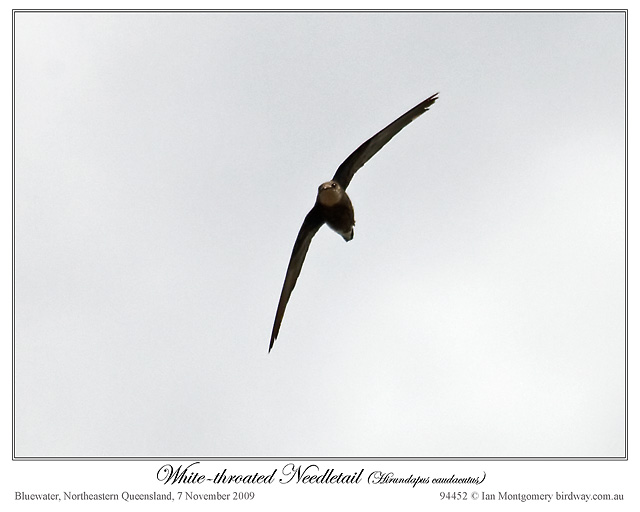
The White-throated Needletail is a large swift, length 20cm/8in, that visits eastern Australia in the southern summer. It’s main claim to fame is that, in level flight, it is one of the fastest, perhaps the fastest, bird in the world with a claimed top speed of 170km/105miles per hour. (The Peregrine Falcon can reach supposedly 300km/200miles per hour in a dive, but that’s a different event in the avian Olympics.)

Swifts are the most aerial of birds and feed, drink and maybe even sleep on the wing. It used to be thought that White-throated Needletails never landed in Australia, but recent studies with radio-tracking show that they can roost in trees, though it is uncertain how predominate this is. They follow weather systems and are often associated with stormy weather. The ones in the photographs appeared near my house last week during showery weather and the birds appeared to be feeding over trees.

White-throated Needletail (Hirundapus caudacutus) by Ian

White-throated Needletail (Hirundapus caudacutus) by Ian

The White-throated Needletail has a barrel-shaped body and a blunt tail, distinguishing it from the slimmer Fork-tailed Swift which also migrates to Australia. The name ‘needletail’ refers to short spiny ends to the tail feathers, just visible if you look carefully at the first photo.

Fast fliers are naturally a challenge to photograph. I practice keeping both eyes open so that I can track the bird until it becomes visible in the viewfinder. Camera settings that help are fast shutter speeds – 1/3000 and 1/5000 sec in these photos – obtainable by using maximum aperture with manual settings and aperture priority and/or high ISO film speed. Some telephoto lenses permit distant settings (eg > 5.6m) to aid automatic focusing and I use a single focusing point in the center of the field of view.

Recent additions to the website include photos of Black-necked Stork/Jabiru and the elusive Black Falcon .


Ian Montgomery, Birdway Pty Ltd,
454 Forestry Road, Bluewater, Qld 4818
Phone: +61-7 4751 3115
Preferred Email: ian@birdway.com.au
Website: http://birdway.com.au


Lee’s Addition:

Even the stork in the heavens Knows her appointed times; And the turtledove, the swift, and the swallow Observe the time of their coming. But My people do not know the judgment of the LORD.
(Jeremiah 8:7 NKJV)

Here’s some additional information about these birds:

“These birds have very short legs which they use only for clinging to vertical surfaces. They build their nests in rock crevices in cliffs or hollow trees. They never settle voluntarily on the ground and spend most of their lives in the air, living on the insects they catch in their beaks.

These swifts breed in rocky hills in central Asia and southern Siberia. This species is migratory, wintering south to Australia. It is a rare vagrant in western Europe, but has been recorded as far west as Norway, Sweden and Great Britain.

The White-throated Needletail is a large bird, similar in size to Alpine Swift, but a quite different build, with a heavier barrel-like body. They are black except for a white throat, white undertail, which extends on to the flanks, and a somewhat paler brown back.

The Hirundapus needletailed swifts get their name from the spiny end to the tail, which is not forked as in the Apus typical swifts. “These are all part of the Apodiformes Order, which includes the Apodidae – Swift Family.

Hirundapus – Genus
White-throated Needletail
Purple Needletail
Silver-backed Needletail
Brown-backed Needletail
Birds of the Bible – Swift
Swift Photos
Swift Videos