Many birds have built in “tools” such as the way their beaks are designed or their feet, or wings, etc. Some use things as tools as shown below in the articles and the video.
How Nature Works: White-winged Crossbill Feeding Technique from CornellLab of Ornithology. (Last statement gives credit to evolution, but we believe they were uniquely created with this ability by the Lord.)
Rooks Reveal Remarkable Tool Use It appears that Rooks (Crow related) have been given intelligence by their Creator to figure out how to use things as tools.
Also, New Caledonian Crows themselves are able to use tools.
The list goes on and on of the uniquely created ways birds use their built in or external “tools.” “The Tool-Using Bird” (Vulture) and “Animals That Make and Use Tools” by Creation Moments.
What kind of tools (gifts) has the Lord given you to use. Are you using them in the way that He intended for you to use them.
Having then gifts differing according to the grace that is given to us, let us use them: if prophecy, let us prophesy in proportion to our faith; (Romans 12:6 NKJV)
As each one has received a gift, minister it to one another, as good stewards of the manifold grace of God. (1 Peter 4:10 NKJV)
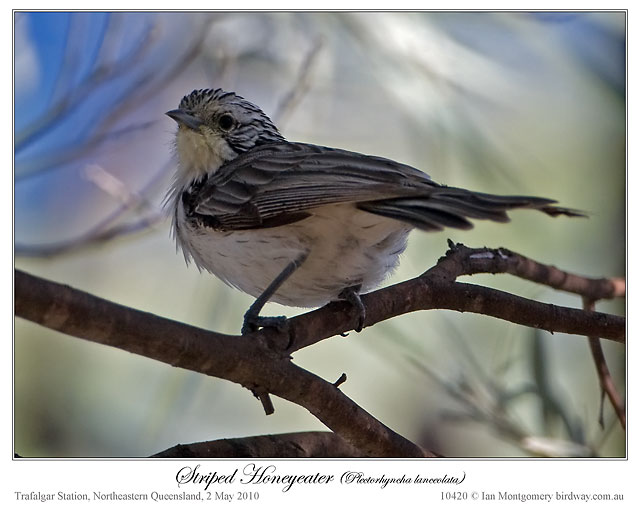
Striped Honeyeater (Plectorhyncha lanceolata) by Ian
Ian’s Bird of the Week – Striped Honeyeater – by Ian Montgomery
I’ve been slow to produce this week’s bird as I’ve been burning the midnight oil rewriting the home page of the website – more about that later.
Last week we had the Southern Bookbook from a rewarding evening of spotlighting at Trafalgar Station south of Charters Towers. Daytime birding there produced some interesting birds, notably a Pictorella Mannikin among some Plum-headed Finches and pair of Striped Honeyeaters. this is an uncommon Honeyeater with some unusual features and, being in its genus, is not closely related to other Honeyeaters.
Striped Honeyeater (Plectorhyncha lanceolata) by Ian
One such feature is a very un-honeyeater-like call that first attracted our attention. The field guides agree that it is mellow, rollicking or rolling, and rising and falling. To me it sounded like a loud gerygone, the rusty bicycle wheel of a Mangrove or Large-billed maybe, but I’m a bit deaf and you mightn’t agree. In appearance it is rather dapper, and seems formally dressed for the drier, fairly casual areas of eastern Australia in which it occurs, from the Spencer Gulf in South Australia to Cooktown in NE Queensland.
It shows its affinity with honeyeaters by having a brush tongue for nectar, but the narrow, pointed bill, shown in the second photo is in fact adapted to supplementing a sugary diet by probing for insects and orther invertebrates as illustrated by the bird in the third photo, which has just found a spider in some mistletoe. The trees are mulga, a dry country acacia, and typical habitat for Striped Honeyeaters, I included the second photo, as it isn’t often one gets to photograph birds from above, a bird’s eye view so to speak, unless they are acrobatic like these in search of food.
Striped Honeyeater (Plectorhyncha lanceolata) by Ian
I’ve redone the home page to make it easier to find photos of the more than 1,200 species in the 142 families now represented. The main change is the inclusion of a set of 142 family thumbnails – called Instant Links to Bird Families – in taxonomic sequence to take you directly to the species thumbnails for each family. The family thumbnails have been selected to show a typical member of the family, and each one has a list of the included species which will appear if you hold the cursor over the thumbnail. If you know or can guess in which family to look, you can find out, without leaving the home page, whether a particular species is present in the website.
Having clicked on a family thumbnail, the species thumbnails then allow you to go directly to view the first photo of a particular species and the thumbnails of other photos of that species. You can therefore find and view any of the now more than 5,000 photos in just three clicks. All the 5,000 photos have both family thumbnail button(s) for global and regional thumbnails and home page buttons, so you can then move back up to the family level or return directly to the home page to repeat the process for an unrelated species.
When the Lord created the birds, He gave each a unique design which includes not only their appearance, but also the sounds they make. Below is an interesting video about the sounds of the different birds. It is a little lengthy (9 min.) but well worth watching.
The Language of Birds by LabofOrnithology
The flowers appear on the earth; the time of the singing of birds is come, and the voice of the turtle is heard in our land; (Song of Solomon 2:12 KJV)
Each of the bird’s songs and sounds help them to communicate with one another, and with other species. Many times one bird, like a Blue Jay, will sound an alarm that warns all of the birds of an impending danger. Lots of birds singing is a sign that all is well in that area.
Just as the Lord uniquely gave each bird a separate song or sound, the Lord has given each of us in the church separate unique abilities and talents. One may be the preacher, one the song leader, teachers, choir or orchestra members, sound and video workers, baby sitters, ushers, etc. We all are different, but when all of those abilities are brought together, like all of those birds in the rain forest that make beautiful music together, we worship and serve the Lord jointly.
Thy hands have made me and fashioned me: give me understanding, that I may learn thy commandments. (Psalms 119:73 KJV)
Now therefore ye are no more strangers and foreigners, but fellowcitizens with the saints, and of the household of God; And are built upon the foundation of the apostles and prophets, Jesus Christ himself being the chief corner stone; In whom all the building fitly framed together groweth unto an holy temple in the Lord: In whom ye also are builded together for an habitation of God through the Spirit. (Ephesians 2:19-22 KJV)
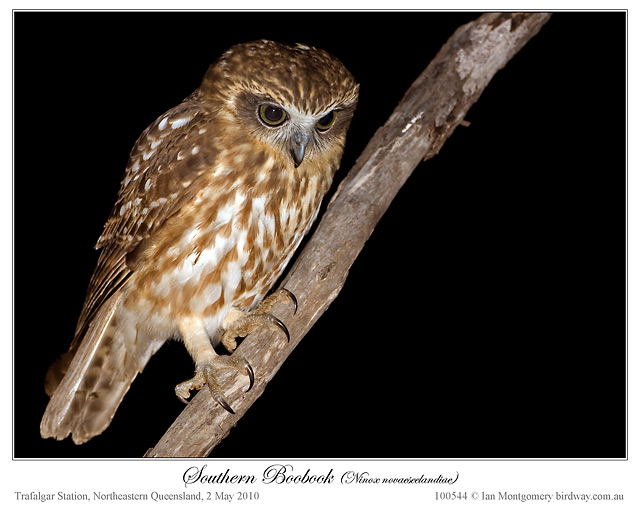
Southern Boobook ( Ninox boobook) by Ian Montgomery
Newsletter 5-4-2010
Here’s one for the lovers of owls – which, I imagine, includes almost everybody. This is the commonest and most widespread owl in Australia, and its plaintive ‘boobook’ or ‘morepork’ call is a familiar sound in a huge range of habitats from tropical rainforest, through leafy suburbs and city parks to almost treeless regions of the dry interior. Despite both its abundance and lots of effort on my part, it has eluded my camera since, as a graduate student, I took some slide photos of one through a window of the Zoology Department of Sydney University in the mid 1970s.
Southern Boobook (Ninox boobook) by Ian Montgomery
This weekend just past was the occasion of the AGM of Birds Australia North Queensland and it was held at a large cattle station (property) called Trafalgar about 50km southwest of Charters Towers outside Townsville. We went spotlighting in the station truck, ideally equipped for birding safari-style with two bench seats placed longitudinally back-to-back on the rear, on a clear Sunday night and after finding a rather flighty barn owl, we encountered a Boobook in a tree beside the road that was much more cooperative. Having photographed it from the truck, I eventually got down and set up the tripod much closer to the the owl. It stayed put, despite my flash and 3 spotlights and when we finally left, it was still there. The portrait in the first photo is in fact cropped from a photo that includes the whole bird, so you can appreciate that the conditions for photography were excellent.
Later we found a Tawny Frogmouth, also a willing subject, and on the road itself, a suicidal young Owlet-Nightjar – nearly got run over – which let me approach it so closely that I could no longer focus with my 500mm lens (minimum focusing distance 4.5m/15ft). The consensus seemed to be that it was the best night’s spotlighting ever. The clear sky with no light pollution meant that we could see both the Southern Cross and the Big Dipper/Plough simultaneously, and on the way back a just-past-full moon rose in the east.
The Boobook is a smallish owl ranging in size from 25-28cm/10-11in for males and 30-36cm/12-14in for females. This one seemed relatively large to me, so it was probably female. The current taxonomic treatment is to treat as a single species the various boobooks in Australia, New Zealand, southern New Guinea, Timor and some islands of eastern Indonesia. This leaves only the Sumba Boobook (Sumba is west of Timor) as a separate species, so there isn’t a ‘Northern’ Boobook as such.
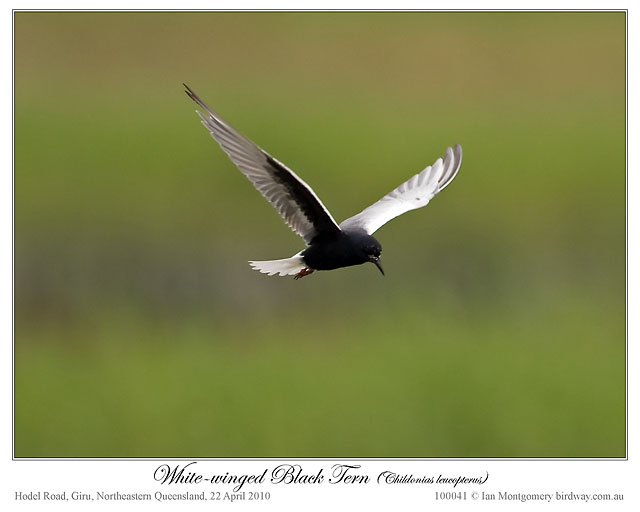
The weather is improving here, so I went birding a couple of times last week. The first time I went to Hodel Road, Giru, just south of Townsville, which goes through an area of marshy coastal grassland that can turn up interesting birds. At this time of the year, it can be good for White-winged (Black) Terns starting the migration back to the northern hemisphere and some, like the one in the first photo, may be in the unmistakable breeding plumage, with black bodies and pale wings. I’ve bracketed (Black) as this qualifier is usually added in Australia, while Birdlife International calls it just ‘White-winged Tern’.
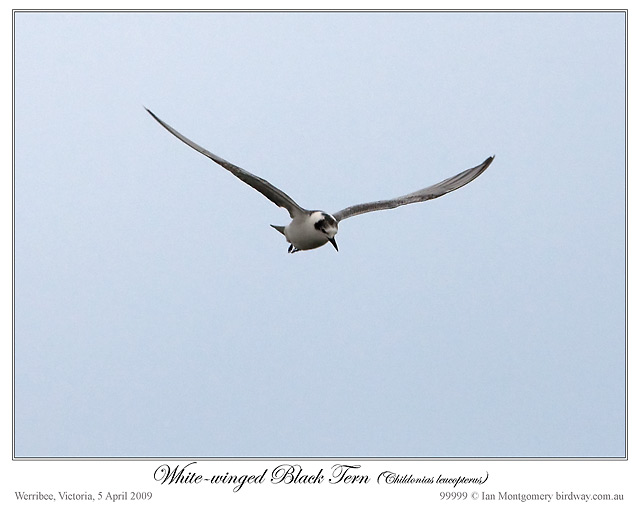
More usually in Australia, we see White-winged Black Terns in non-breeding plumage – like the one in the second photo – and care needs to be taken to distinguish them from the related, slightly larger, Whiskered Tern in the same plumage. Perhaps the best field mark is the shape of the black band on the head. In the White-winged Tern it forms a vertical hoop over the crown of the head; in the Whiskered Tern it forms a horizontal hoop around the nape and the crown is whitish. There are also differences in the patterns of the upper wing. In the White-winged the dark leading edge (visible in the second photo) and the whitish rump gives the bird a patchier appearance than that of the more homogeneous Whiskered.
White-winged Tern (Chlidonias leucopterus) by Ian
Some points that may be of interested to bird photographers relate to birds in flight coming towards the camera and to backgrounds. Telephoto lenses have very a shallow field of view, particularly at the high shutter speed/large aperture combination necessary to freeze the motion of the bird. This means that even if the auto-focus has operated correctly, the bird may have moved out of focus during the lag while the photo is taken. Some cameras have an autofocus option to compensate for constant movement, called ‘AI-Servo’ on Canon SLRs, and this is the occasion to use it.
The problem with backgrounds is that the autofocus may miss the bird and grab the background instead. Birds against the sky are easier than against the ground – unless there are clouds with high contrast. Practicing tracking birds in flight is the solution here, and I use a single focus point in the centre of the viewfinder. This gives much more control over auto-focusing and not only with birds in flight but also in spatially complex shots such as a bird in a tree with branches around it.
On the website, I’ve been experimenting with changes to the layout of bird photos. The changes involve technical aspects such as getting rid of frames, but the advantages from a user’s point of view include being able to bookmark individual photos (rather than just species), and scroll bars to prevent thumbnails extending way below the window. If you’re interested, have a look at http://www.birdway.com.au/otididae/australian_bustard/source/australian_bustard_99577.htm – I’d welcome your feedback.
The other birding outing last week was to get photos of nesting Chowchillas at Paluma (this gallery uses the new layout and has 600px-wide images instead of 500)
Best wishes,
Ian
—
Ian Montgomery, Birdway Pty Ltd,
454 Forestry Road, Bluewater, Qld 4818
Phone: +61-7 4751 3115 begin_of_the_skype_highlighting +61-7 4751 3115 end_of_the_skype_highlighting
Preferred Email: ian@birdway.com.au
Website: http://birdway.com.au
Lee’s Addition:
The White-winged (Black) Tern is in the Laridae Family of the Charadriiformes Order. There are 102 members of the family. Only 39 of those are Terns, the rest are Gulls, Noddy, Skimmers, and Kittiwakes. They are small terns generally found in or near bodies of fresh water across from Southeastern Europe east to Australia.
Their behavior like the other “marsh” terns (Chlidonias), and unlike the “white” (Sterna) terns, these birds do not dive for fish, but fly slowly over the water to surface-pick items on the surface and catch insects in flight. They mainly eat insects and small fish. In flight, the build appears thick-set. The wing-beats are shallow and leisurely.
Their breeding habitat is freshwater marshes across from southeast Europe to central Asia. They usually nest either on floating vegetation in a marsh or on the ground very close to water, laying 2-4 eggs in a nest built of small reed stems and other vegetation. In winter, they migrate to Africa, southern Asia and Australia. It is a scarce vagrant in North America, mainly on the Atlantic coast, but a few records on the Pacific coast and inland in the Great Lakes area.
The White-winged (Black) Tern is another of the neatly created birds which shows the Handiwork of God.
Then God said, “Let the waters abound with an abundance of living creatures, and let birds fly above the earth across the face of the firmament of the heavens.” (Genesis 1:20 NKJV)
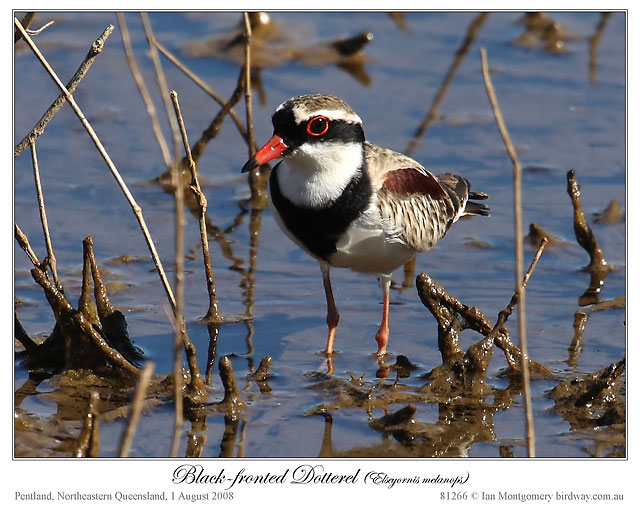
Black-fronted Dotterel (Elseyornis melanops) by Ian
Ian’s Bird of the Week – Black-fronted Dotterel ~ by Ian Montgomery
It is easy to think of waders, such as sandpipers and plovers, in terms of challenges – both the survival challenges that long distant migrants face and the identification challenges that these migrants, usually in non-breeding plumage, pose for birders. So, it’s easy to overlook the unchallenging ones – distinctive native species, easy on the eye and easy to identify that are delightful members of the Australian countryside such as the Black-fronted Dotterel.
The Black-fronted Dotterel is a small plover: at 16-18cm/6-7in in isn’t much longer than the proverbial sparrow (14-16cm). It shows a marked preference for shallow fresh water, only rarely occurring in saline environments, and can manage with quite small and transient pools. It is widespread throughout Australia and Tasmania, absent only from the most arid regions of western central Australia, and also resident in New Zealand. The first photo shows a bird – males and females are identical – on the wetland in Pentland on the Flinders Highway west of Townsville, a popular drop-in spot for passing birders. The second photo was taken at sunset at Bowra, a wonderful property near Cunnamulla in southwestern Queensland, long managed in a bird-friendly way by the McLaren family and now being purchased by the Australian Wildlife Conservancy ( http://www.australianwildlife.org/Bowra.aspx ).
Black-fronted Dotterel (Elseyornis melanops) by Ian
Unlike the migrants, residents such as the Black-fronted Dotterel, don’t have a separate breeding and (drab) non-breeding plumages. Because of irregular rainfall patterns, they can breed at any time of the year and need to be able to respond quickly and attract mates at short notice. They nest in exposed positions on the ground, so they compromise by having bold patterns with small splashes of colour on the bill and eye-ring that break up the outline of the bird, rather than blend into the background, and can be surprisingly difficult to see when crouched motionless.
On the related subject of migrant plovers, this is a good time of the year to look for birds in, or acquiring, breeding plumage. We did one of our regular wader counts at Lucinda, near Ingham north of Townsville, last week and there were still numbers of Lesser and Greater Sand Plovers around. I’ve posted photos of these – and a Grey-tailed Tattler – in breeding plumage to the website: Lesser Sand Plover Greater Sand Plover Grey-tailed Tattler
Best wishes,
Ian
—
Ian Montgomery, Birdway Pty Ltd,
454 Forestry Road, Bluewater, Qld 4818
Phone: +61-7 4751 3115
Preferred Email: ian@birdway.com.au
Website: http://birdway.com.au
Lee’s Addition:
I always enjoy finding out about Ian’s Birds of the Week. Never know what he will show us. I trust you enjoy finding out about birds in other parts of our fantastic world as well.
The Dotterels are in the Charadriidae Family of the Charadriiformes Order. There are 67 birds in the family that includes Plovers, Lapwings, Killdeer, Wrybill, and the Dotterels. There are only 6 Dotterels; Red-kneed, Eurasian, Hooded, Shore, Black-fronted, and Tawny-throated. The Inland Plover was the Inland Dotterel
I will open rivers in high places, and fountains in the midst of the valleys: I will make the wilderness a pool of water, and the dry land springs of water. (Isaiah 41:18 KJV)
Christmas Imperial Pigeon (Ducula whartoni) by Ian Montgomery
Bird of the Week: Christmas Imperial Pigeon by Ian Montgomery
Newsletter: 04/13/10
We are, we hope, near the end of a persistent wet season, during which I haven’t taken many photos. So, here is an attractive bird from the archives, photographed on a trip to Christmas Island in 2006, the Christmas Island Imperial Pigeon. It’s comparable in size (length 38-40cm/15-16in) to the Pied Imperial-Pigeon of northern Australia, but quite different in colour, much darker with strikingly iridescent plumage. In the first photo, the sunlight highlights the green iridescence of the back and wing feathers, while the second photo shows the purplish-grey and rufous-brown plumage of the underside.
Christmas Imperial Pigeon (Ducula whartoni) by Ian Montgomery
It’s endemic to Christmas Island, a mere speck – area 140 sq km – in the Indian Ocean 500 km south of Java. Because of its small range and therefore limited population, it is classified as Vulnerable on the IUCN Red List. It seemed to be quite common on the island and the population is thought to be stable, though there are concerns that it could be affected by an infestation of yellow crazy ants on Christmas Island. Control measures have reduced the ant infestation, but eliminating them has proved difficult and the baits used also affect other invertebrates such as the famous terrestrial red crabs.
It’s closest relative is the Pink-headed Imperial-Pigeon (Ducula rosacea) which is widespread but rather rare in the islands of Indonesia and East Timor. It has suffered from both habitat destruction and hunting. Some authorities consider that the Christmas Island Imperial-Pigeon may be a race of the Pink-headed.
I’ve added photos of three more Australian mammals to the website: the Euro (a blackish kangaroo), Bush Rat and Fawn-footed Melomys (also a rodent). The latter two obliged us with good view coming into feed on grain at Kingfisher Park over Easter, undeterred by the rain.
Lee’s Addition:
The Christmas Island Imperial-Pigeon has recently been changed to the Christmas Imperial Pigeon. It is in the Columbidae Family of the Columbiformes Order. There are 321 birds in the family of various Doves and Pigeons, plus Bronzewings and Bleeding Hearts.
Check out the Doves and Pigeon page. Doves and Pigeons are mentioned many times in the Bible.
So I said, “Oh, that I had wings like a dove! I would fly away and be at rest. (Psalms 55:6 NKJV)
Birds Australia North Queensland had planned to visit Cooktown for Easter, which turned out to be very wet throughout northeastern Queensland. A few intrepid souls, presumably not camping, made it there, but a friend and I spent a few days at Kingfisher Park in Julatten near Mossman before returning home. We did manage to get out birding a few times between showers and one afternoon I spent an hour or two trying to photograph birds hawking for insects over the fish ponds of a nearby Barramundi farm. As is often the case, the poor weather brought both the insects and their avian predators down to low levels – poor light but good practice.
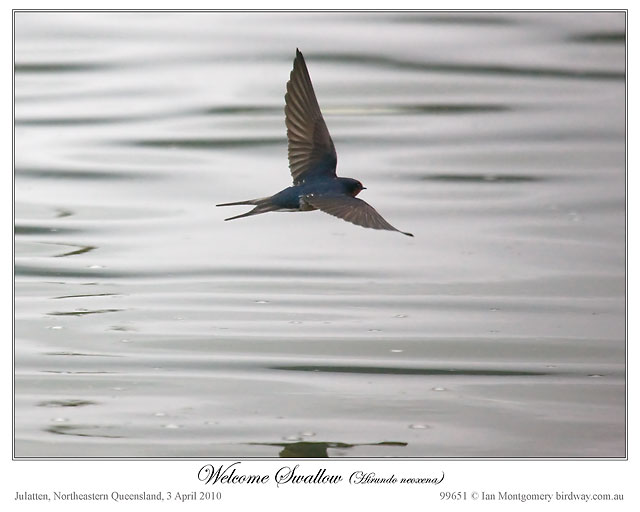
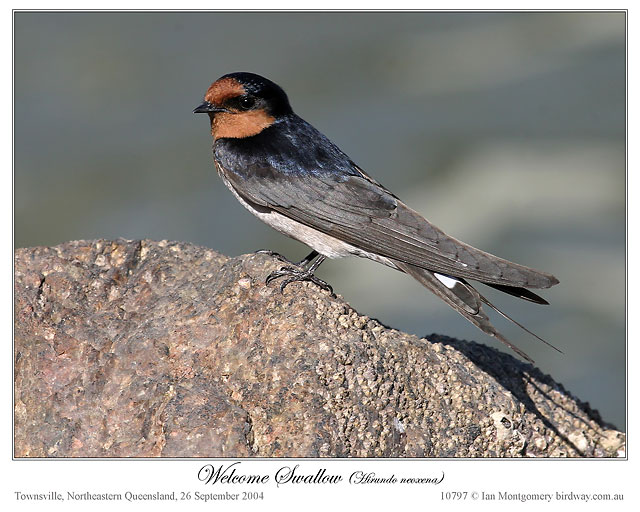
Welcome Swallow (Hirundo neoxena) by Ian
The birds consisted of a mixture of Welcome Swallows, Tree Martins and White-rumped Swiftlets, and I’ve posted images of all three to the website, though I’ve chosen the Welcome Swallow here as being the most photogenic. This is a familiar and widespread bird in Australia, though it is absent from the the arid centre and northern Western Australia and much of the Northern Territory. It is similar in appearance and habits to the Barn Swallow of the northern hemisphere, and like it builds a cup-shaped nest in sheltered sites, particularly buildings.
Welcome Swallow (Hirundo noexena) by Ian
The first photo shows a bird hawking low over grass and obligingly spreading all its tail feathers to brake or turn. The second one is flying over the fish pond and the third is a photo taken some time ago of a bird perched beside Ross River in Townsville.
The name ‘Welcome’ emphasizes its familiarity, but it also suggests to me migration and a harbinger of Spring. In fact, unlike the Barn Swallow, it is resident over much of its range and only in Tasmania and southeastern Australia does it migrate for the southern winter but only as far as Queensland and Torres Strait. The Barn Swallow is a famous migrant traveling from Europe to Africa, North to South America and Northern to Southern Asia. Some even get as far as Australia and turn up annually in small numbers in northern coastal areas.
The Welcome Swallow is in the Hirundinidae Family of the Passeriformes Order. What a shot, Ian, of that Swallow flying with wings and tail out. I hardly get to see our swallows, they fly so fast.
The Welcome Swallow is metallic blue-black above, light grey below on the breast and belly, and rusty on the forehead, throat and upper breast. It has a long forked tail, with a row of white spots on the individual feathers. These birds are about 15 cm long, including the outer tail feathers which are slightly shorter in the female. The call is a mixture of twittering and soft warbling notes, and a sharp whistle in alarm.
Young Welcome Swallows are buffy white, instead of rufous, on the forehead and throat, and have shorter tail streamers.
The winter range in northern Australia overlaps with that of wintering Barn Swallow (Hirundo rustica), but the latter is readily separable by its blue breast band.[5] Welcome Swallows readily breed close to human habitation. The nest is an open cup of mud and grass, made by both sexes, and is attached to a suitable structure, such as a vertical rock wall or building. It is lined with feathers and fur, and three to five eggs are laid. Two broods are often raised in a season.
The female alone incubates the eggs, which hatch after two to three weeks. The young are fed by both parents, and leave the nest after a further two to three weeks.
These birds are extremely agile fliers, which feed on insects while in flight. They often fly fast and low to the ground on open fields in large circles or figure 8 patterns. They will often swoop around animals or people in the open.
An immature Welcome Swallow preening by Nick Talbot
Bird of the Week: Spotted Bowerbird
Newsletter: 3/30/2010
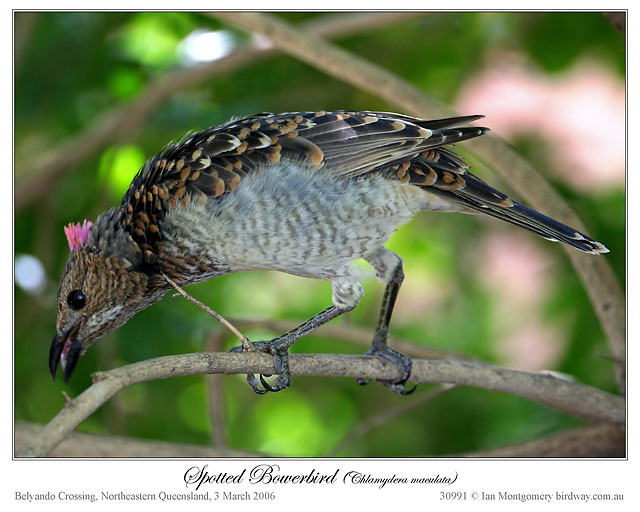
I’ve recently been updating the Bowerbird galleries on the website, including those of the Satin, Great Bowerbirds and Spotted. Both the Satin and Great have featured as bird of the week in the past, so here is the Spotted Bowerbird. It is closely related to the similar Great Bowerbird, but is smaller (to 30cm/12in in length compared with 38cm/15in) and much more richly coloured, buff and brown, rather than fawn and greyish-brown. It also has a pink erectile crest on the nape used in display, more prominent on the male but smaller or absent in females and young birds.
Spotted Bowerbird (Chlamydera maculata) by Ian
Both the photos were taken near the roadhouse at Belyando Crossing, the only place where you can get petrol and food on the 400km stretch between Charters Towers and Clermont on the inland route south of Townsville, and a reliable spot for this species. In the first photo, the bowerbird is showing interest in the mango, remains of my breakfast, currently being commandeered by a Blue-faced Honeyeater. If you look carefully, you can see the crest, but it is more obvious in the second bird which is displaying to another one, out of sight below.
Spotted Bowerbird (Chlamydera maculata) by Ian
The Spotted Bowerbird is a bird of mainly inland eastern Australia, though it reaches the coast in central Queensland. It occurs widely in Queensland, though absent from the north where it is replaced by the Great, and in New South Wales as far south as the border with Victoria and southeastern South Australia. It is common in the northern part of its range, but rarer in the south. It is replaced in central western regions of Australia (southern Northern Territory, central Western Australia and northwestern South Australia by the similar but darker Western Bowerbird. These three all belong to the genus Chlamydera, and in northern Cape York and Papua New Guinea there is a fourth species, the Fawn-breasted Bowerbird, while a fifth species, the Yellow-breasted Bowerbird, is found in New Guinea but not in Australia.
The males of all these bowerbirds build avenue bowers consisting of two parallel walls, like that of the Satin Bowerbird but unlike the maypole bower of the Golden Bowerbird that was illustrated 4 weeks ago when it featured as bird of the week. All five species collect white and green objects, and seem to show an almost fetishistic preference for shiny objects – stones and shells, historically, but nowadays glass and metal. Only the three southern species have pink crests and these three all collect red objects; the Fawn- and Yellow-breasted Bowerbirds lack the crests and I cannot find any reference to their collecting red objects. Young birds, presumably males, also collect objects in juvenile display areas that lack a proper bower. The third photo, shows one of these, playing with a blue plastic bottle ring, perhaps an indiscriminate choice of exuberant youth!
Golden Bowerbird (Prionodura newtoniana) by Ian
On the subject of bowerbirds, the attached photo of a Golden Bowerbird has been chosen as the icon for the upcoming Birds Australia Congress and Campout in Townsville in August; .
If a bird’s nest chance to be before thee in the way in any tree, or on the ground, whether they be young ones, or eggs, and the dam sitting upon the young, or upon the eggs, thou shalt not take the dam with the young: But thou shalt in any wise let the dam go, and take the young to thee; that it may be well with thee, and that thou mayest prolong thy days. (Deuteronomy 22:6-7 KJV)
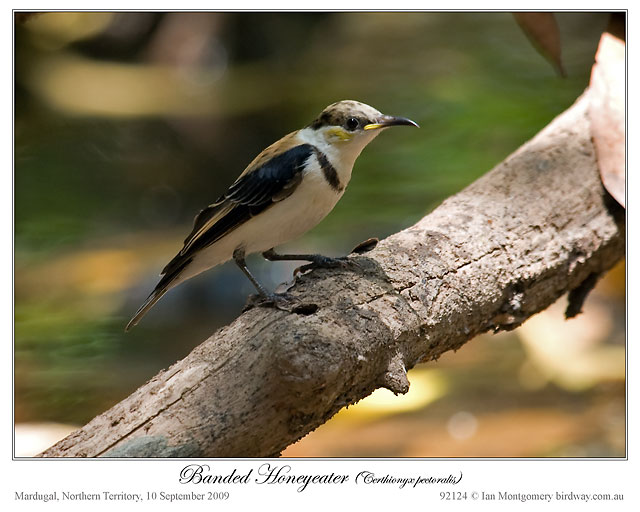
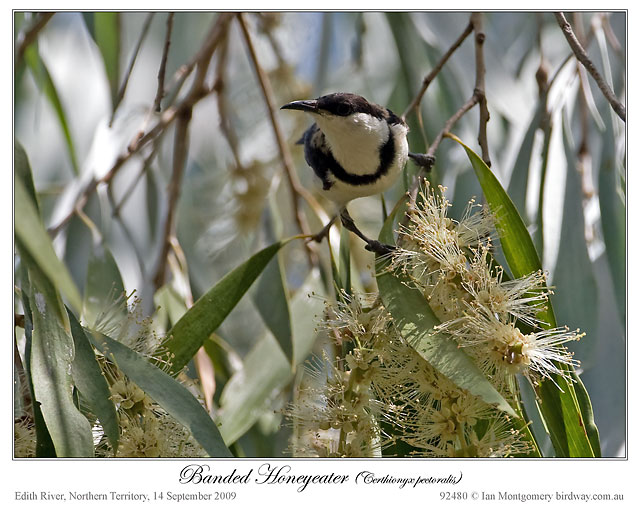
I’ve continued updating some of the Honeyeater galleries on the website. Last week, we had one of the largest, the Helmeted Friarbird, but here is one of the smaller ones, the Banded Honeyeater with a length of about 12cm/5in. Fledgling Banded Honeyeaters have fudge-coloured upper parts, wings, tail and breast-band which change to black in adult birds (of both sexes), contrasting smartly with white underparts, throat and rump.
Banded Honeyeater(Cissomela pectoralis) by Ian
At least that’s what they are supposed to do. In practice, most of the birds one sees are in transitional plumage varying between that shown in the first photo at a waterhole, which has the brownish back and head and yellow cheeks of the juvenile, but the black wings and tail of the adult. The bird in the second photo feeding on melaleuca blossom, has got almost fully black and white plumage but still has a few brownish feathers on the back. On the trip to the Top End of the Northern Territory last year where Banded Honeyeaters are fairly common, I deliberately searched for a completely black and white bird without success, and this was the best I could find. I’d be interested to hear whether others have noticed this too.
The Banded Honeyeater has a northern distribution from the Kimberley region of Western Australia to North Queensland, where it is uncommon south of Cooktown. These birds are ‘blossom nomads’ and and in recent years have been seen regularly at White Mountains National Park, between Charters Towers and Hughenden and south of Townsville, when the grevilleas are in bloom in early winter.
Taxonomically, the Banded Honeyeater has traditionally been lumped in the same genus (Certhionyx) as the superficially similar Black and Pied Honeyeaters. Recently studies have indicated that the three species are not closely related and each has been relegated to its own (monotypic) genus, Cissomela in the case of the Banded. It is apparently closer to the White-cheeked Honeyeater and allies (Phylidonyris) while the Black is closer to the Scarlet Honeyeater and relatives (Myzomela). I’ve recently updated the galleries of all these species, including some colourful photos of Scarlet and White-cheeked feeding in red and yellow blossom respectively in Paluma last Friday. (Both these have featured as Bird of the Week previously, disqualifying them from, or at least handicapping them in, selection this week).
The IOC 2.4 Version list these birds as:
Banded Honeyeater (Cissomela pectoralis) as is
Black Honeyeater (Sugomel niger)
Pied Honeyeater (Certhionyx variegatus)
White-cheeked Honeyeater (Phylidonyris)
Scarlet Honeyeater now the Scarlet Myzomela (Myzomela sanguinolenta)
You will be well pleased visiting the Ian’s links above. All of those birds are very neat looking birds. The Lord has created the honeyeaters with a remarkable tongue that is “partially tubelike and split, with a brushlike tip superbly adapted for extracting nectar. Honeyeaters also have specially adapted kidneys that allow them to process maximum nutritional benefit from this food source.” (Complete Birds of the World, National Geographic)
More to be desired are they than gold, yea, than much fine gold: sweeter also than honey and the honeycomb. (Psalms 19:10 KJV)
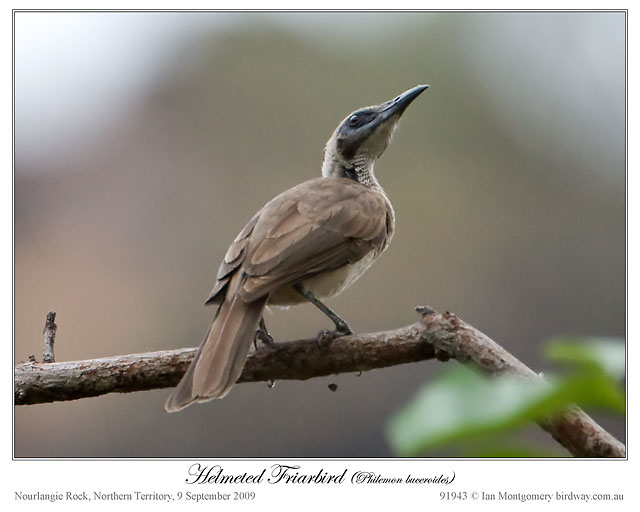
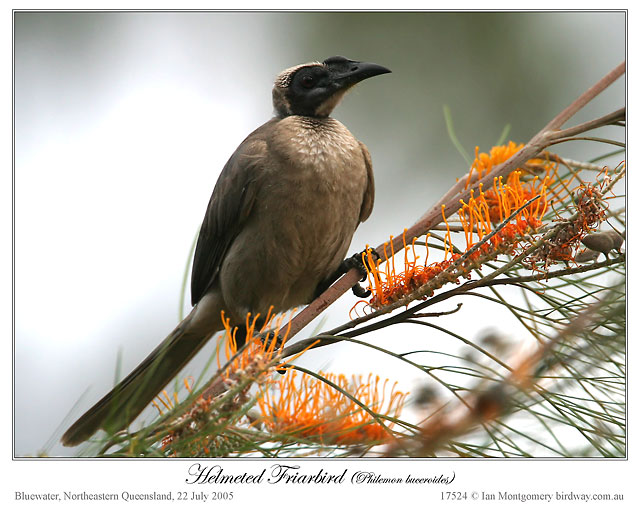
As with the Pheasant Coucal last week, I didn’t have to leave the house to photograph the Helmeted Friarbird in the first photo on the red flowers of a nearby Umbrella Tree. This tree has been flowering profusely for weeks and attracting a noisy variety of Honeyeaters and Lorikeets. The Helmeted Friarbird – length to 37cm/15in is the largest of the 4 species of Friarbirds found in Australia. Friarbirds get their name from the colour of the plumage, like the brown habits worn by friars and Helmeted refers to the feathered crown, in contrast to the naked crown of the more widespread Noisy Friarbird.
Helmeted Friarbird (Philemon buceroides) by Ian
This particular individual is sub-adult; it has pale fringes to the feathers of the back and neck which marks it as an immature bird, but it has the red eye and knobbed bill of the adult – very young birds have brown eyes and lack the knob. The second photo shows an adult bird feeding on an orange Grevillea and you can see that the plumage is more evenly coloured.
The Helmeted Friarbird is a northern species and, in Australia, it occurs only in Queensland and the Northern Territory. The Queensland race of the Helmeted Friarbird (yorki) has a silvery crown and is best distinguished from the rather similar Silver-crowned Friarbird by the shape of the rear edge of the facial skin – curved in the Helmeted, but with a backward-pointing spur in the Silver-crowned – and by its calls. In the Top End of the Northern Territory, another race of the Helmeted Friarbird (ammitophila) lacks the knob on the bill – see the third photo – and has different calls. This race is often called the Sandstone Friarbird and is a characteristic bird of the escarpments of Kakadu and Arnhem Land.
Helmeted Friarbird (Philemon buceroides) by Ian
Friarbirds are large Honeyeaters and the Helmeted Friarbird is only in exceeded in size among Australian Honeyeaters by the Yellow Wattlebird, a Tasmanian endemic. Only the Silver-crowned is an Australian endemic, the other 3 species also occur in New Guinea, where another 12 species of Friarbird occur. Noisy Friarbird Little Friarbird
“The friarbirds (also called leatherheads) are about 15 species of relatively large honeyeaters in the genus Philemon. Additionally, the single member of the genus Melitograis is called the White-streaked Friarbird. Friarbirds are found in Australia, Papua New Guinea, eastern Indonesia and New Caledonia. They eat nectar, insects and other invertebrates, flowers, fruit and seeds.
The friarbirds generally have drab plumage. In many instances their plumage is mimicked by smaller orioles, which use the aggressive nature of the friarbirds to avoid aggression themselves.
And to every beast of the earth and to every bird of the heavens and to everything that creeps on the earth, everything that has the breath of life, I have given every green plant for food.” And it was so. (Genesis 1:30 ESV)
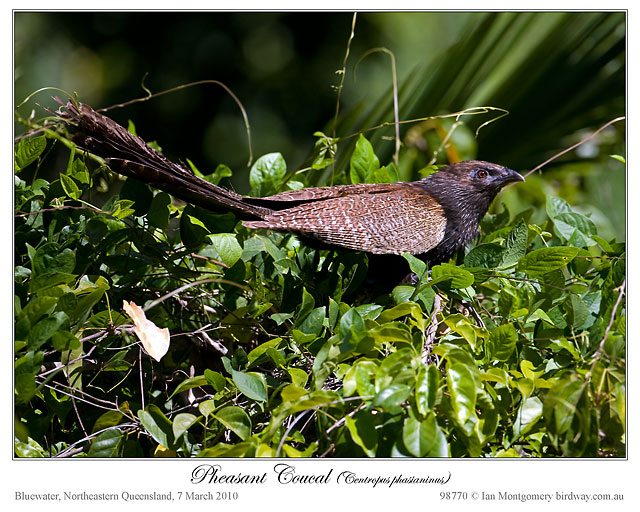
White I was making a cup of coffee this morning and pondering what to choose as Bird of the Week, this Pheasant Coucal supplied the answer by posing on a small tree, having just had a drink in the pond below. Coucals, like other cuckoos, are shy birds so I photographed it through the window – first photo – before carefully opening the French door onto the verandah to try to get a clearer view. I got the door open all right, but it spotted me raising the camera and large lens and took off before I had managed to take more than a couple of shots – second photo.
Pheasant Coucal(Centropus phasianinus) by Ian.jpg
Pheasant Coucals are splendid birds: large (to 70cm/28in in length), red-eyed with richly patterned short wings and a long tail. In breeding plumage, the head and body is blackish with shiny feather shafts and the bill is black. In non-breeding plumage the black, of both the plumage and the bill, fades to buff.
Their usual call is a wonderful “deep, hollow, descending, descending ‘coop-coop-coop-coop-coop’, like liquid glugging from bottle” to quote Pizzey and Knight. They also have a sharp alarm call that sounds coarse paper being torn suddenly. There are several territories near my place, mostly along the creek, so the sound of their ‘bottle’ call is very characteristic of summer and I realise how much I’ve missed it when they start calling in the spring.
The range of the Pheasant Coucal includes coastal north western, northern and eastern Australia from the Pilbara to the Sydney region. It is generally common, but less so at the edge of its range in central New South Wales. It also occurs in New Guinea and related species, such as the Greater Coucal, are found in the warmer parts of Asia and in Africa.
Unlike other cuckoos, Coucals build their own nest and were until recently placed in their own family (the Centropidae). Genetic studies have shown that they close affinities with other cuckoos, and it is now usual to treat them as a subfamily of the cuckoos (Centropodinae within Cuculidae).
The Pheasant Coucals fly very poorly. The usual strategy is to climb to the top of a tree and glide with a few wing-beats to the destination. Sadly, they lack traffic sense and are frequently casualties on highways. Here in North Queensland, they are called ‘pheasants’ in the same way Bush Stone-Curlews are called ‘curlews’.
Best wishes,
Ian
—
Ian Montgomery, Birdway Pty Ltd,
454 Forestry Road, Bluewater, Qld 4818
Phone: +61-7 4751 3115
Preferred Email: ian@birdway.com.au
Website: http://birdway.com.au
Lee’s Addition:
Here is the sound of a Pheasant Coucal (duet from a pair in undergrowth) by Vicki Powys from xeno-canto:
What a neat bird. From the pictures, the bird seems sort of plain, but very beautiful. Since they are closely related to the Cuckoos, they are in the Cuculidae family, which is in Cuculiformes order.
and the owl, and the night-hawk, and the cuckoo, and the hawk after its kind, (Leviticus 11:16 YLT)