Dr. James J. S. Johnson
And the same John [i.e., John the Baptist] had his raiment of camel’s hair, and a leathern girdle about his loins; and his meat was locusts and wild honey. (Matthew 3:4)
Sometimes you see a bird that “should” be somewhere else: “Hey, bird, you’re not supposed to be here!”

(3 males below; 1 female above)
John James Audubon painting
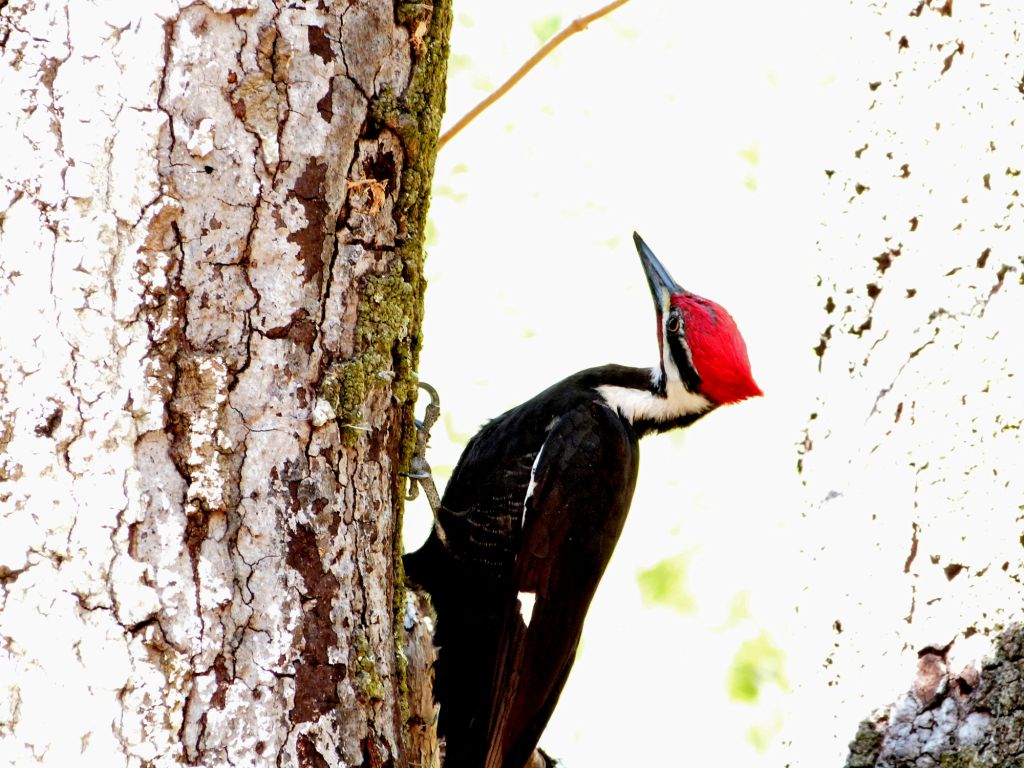
Earlier this month, to my surprise, I saw a red-crested black-and-white woodpecker in one of my trees. The woodpecker’s mostly-black-with-white plumage, plus the characteristic red crest, proved it to be a Pileated Woodpecker (Dryocopus pileatus). Unable to see if its “mustache/neck stripes were red or black, I’m not sure if it was a male or a female. Regardless of that, what is a Pileated Woodpecker doing in Denton County, Texas? Pileated woodpeckers are well-known as year-round residents within the Piney Woods of East Texas, but how did one end up in the Cross Timbers suburbs of Denton County?

Andrew Brownsword (Wikipedia/public domain)
Yet, I am not the only one claiming to have seen a Pileated Woodpecker inside Denton County, recently. Today, online, I found a report of 2 Pileated Woodpeckers observed on April 13th (A.D.2025) by “Hannah U.”, at Clear Creek Natural Heritage Center (in Denton, Texas — https://ebird.org/region/US-TX-121/bird-list?yr=cur ). Of course, wooded riparian habitats are known to attract insectivorous woodpeckers. If your trees have ants, these woodpeckers would love to feast on those ants! Other bug-plucking woodpeckers recently reported (on that same ebird.org website), inside Denton County (Texas), include Red-bellied Woodpecker, Downy Woodpecker, Hairy Woodpecker, Ladder-backed Woodpecker, and Red-headed Woodpecker. But Pileated Woodpeckers are easily recognized by their scarlet-red crests, plus they are conspicuously large — crow-sized (sometimes longer than 16″)!

In fact, Pileated Woodpeckers are known to casually frequent Texas as far west as Fort Worth, according to Keith A. Arnold, of the Department of Wildlife and Fisheries Sciences, at Texas A&M University (College Station, Texas — https://txtbba.tamu.edu/species-accounts/pileated-woodpecker/ ), saying: “DISTRIBUTION: This species is fairly common locally to uncommon in wooded portions of eastern third of Texas, west casually to Gainesville and Fort Worth [emphasis added], rarely to Bastrop and Palmetto State Park, south irregularly to Victoria (Oberholser and Kincaid 1974).” [Quoting Keith A. Arnold, “Pileated Woodpecker”, The Texas Breeding Bird Atlas, Texas A&M AgriLife Research (viewed 4-15-AD2025).]
Woodpeckers, unsurprisingly, seek to eat insects found on and in trees.
“The Pileated Woodpecker’s primary food is carpenter ants, supplemented by other ants, woodboring beetle larvae, termites, and other insects such as flies, spruce budworm, caterpillars, cockroaches, and grasshoppers [notice: “locusts” are a type of grasshopper, so these woodpeckers have part of their diet in common with that of John the Baptist!]. They also eat wild fruits and nuts, including greenbrier, hackberry, sassafras, blackberries, sumac berries, poison ivy, holly, dogwood, persimmon, and elderberry. In some diet studies, ants constituted 40 percent of the diet, and up to 97 percent in some individuals. Occasionally, Pileated Woodpeckers visit backyard bird feeders for seeds or suet.” [Quoting “Pileated Woodpecker”, ALL ABOUT BIRDS, CORNELL LAB OF ORNITHOLOGY, posted at http://www.allaboutbirds.org/guide/Pileated_Woodpecker/lifehistory .]

Mass Audubon (Massachusetts Audubon) image credit
What beautiful birds — and, considering their large size, imagine how many carpenter ants (and other insects) that a Pileated Woodpecker eats, over its lifespan of perhaps more than 10 years. That a lot of insects!
Yes, some insects are eaten by humans — such as the locusts that John the Baptist was famous for eating — but I still think that I’d rather have eggs, bacon, and some buttered rye toast, with coffee.



 Lee's Birdwatching Adventures Plus