YouTube from “Hymns – Timeless”. American Songbird Showcase
Blessed Assurance written by Fanny Crosby and sung by Ron Tolson.
Thought you might enjoy this video with all the birds showcased. No birds mentioned in the song, but it still is a “Birds in Hymn” candidate. Our Savior created all these beautiful birds.
My friend, Dawn, who writes the Dawn’s Bloggy Blog, posted this and thought you might enjoy it. We met a few years ago at the Birding Festival in Titusville, FL. They travel in a motorhome and she never seems to run out of interesting adventures.
These are Cedar Waxwings drinking. A sparrow and an American Robin also show up.
If thine enemy be hungry, give him bread to eat; and if he be thirsty, give him water to drink: (Pro 25:21)
Jesus answered and said unto her, Whosoever drinketh of this water shall thirst again: But whosoever drinketh of the water that I shall give him shall never thirst; but the water that I shall give him shall be in him a well of water springing up into everlasting life. (Joh 4:13-14)
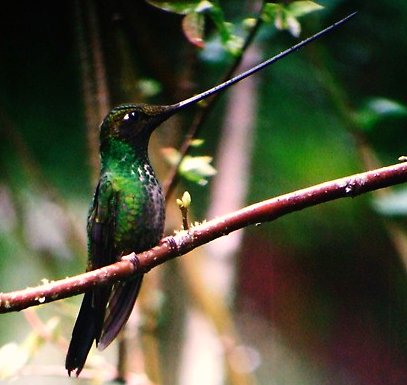
Sword-billed Hummingbird (Ensifera ensifera) by Michael Woodruff
He loves righteousness and justice; The earth is full of the goodness of the LORD. (Psalms 33:5 NKJV)
The Lord has graciously outfitted a small, but unique hummingbird. The Sword-billed Hummingbird has an unusually long bill.
I came across this bird today while checking out photographs of our newest Photographer to give permission to use his fantastic photos. Michael Woodruff’s Photostream has some shots that have just taken my breath away today. Thanks, Michael, for the permission to use the great images that you have captured through your lenses.
When I first saw the Sword-billed Hummingbird, my first thought was why did God make it like that. There has to be a reason for that beak being so long. After investigating some, here are a few facts about this bird:
What is so unique about the Sword-billed Hummer is that it is noted as the only species of bird to have a bill longer than the rest of its body. This beak is used to feed on flowers with long corollas such as Passiflora mixta. The tongue is therefore also unusually long. God had a long flower that needed pollination and so He created a long billed hummingbird to get in that long tube. The bird gets the nectar, carries away pollen and the bird and flower both have their needs provided.
Passiflora mixta galupa – Suncrest Nurseries
(From Suncrest Nurserises) “Passiflora mixta – A cool growing species with long tubed flowers that face outward and upward at a 45 degree angle. The color is a vibrant pink with white highlights. It is a large and vigorous grower and puts on an amazing show. The variety ‘Galupa’ has flowers that face outward and downward at a 45 degree angle and are a bit larger in overall aspect. A very beautiful species”
Because it’s beak is so long, it has to groom itself with it’s feet. The Sword-billed Hummingbird was created by an Omniscient Creator that knew it needed the long bill for the flowers, but also had to have a way to keep well groomed.
Keith Blomerley, one of our videographers, captured a Sword-billed Hummingbird perched on a tree and looking around. Another bird flies by.
Sword-billed Hummingbird (Ensifera ensifera) is a species of hummingbird from South America and the sole member of the genus Ensifera. It is found in Bolivia, Colombia, Ecuador, Peru and Venezuela.
The total length can be 15 cm (6 in) and the bird can weigh 12 grams, making it one of the largest hummingbirds.
For by Him all things were created that are in heaven and that are on earth, visible and invisible, whether thrones or dominions or principalities or powers. All things were created through Him and for Him. (Colossians 1:16 NKJV)
Updated 11/30/10:
Just received this note from Michael Woodruff about this article and thought I would attach it.
The Sword-billed Hummingbird is quite a bird. We saw two or three of them at the Yanacocha Reserve in the Andes of Ecuador. They were crazy to watch as they knew right where the end of their beak was, feeding out of the hummingbird feeders. It looked like quite a feat to balance that bill, but they were good at it!
Glad you’re enjoying the photos and it would be cool to hear which ones you end up using at some point. I think it’s great how you’re incorporating scripture verses on the pages. Awesome stuff.
Have a great week and hope you’re getting to feeling better.
I find the White-eyes fascinating little birds that have such a neat visible eye. The Lord has created another bird kind that has been obeying the command that it was given.
So God created great sea creatures and every living thing that moves, with which the waters abounded, according to their kind, and every winged bird according to its kind. And God saw that it was good. And God blessed them, saying, “Be fruitful and multiply, and fill the waters in the seas, and let birds multiply on the earth.” (Genesis 1:21-22 NKJV)
Cape White-eye (Zosterops pallidus) by Ian
The white-eyes are small passerine birds native to tropical, subtropical and temperate Sub-Saharan Africa, southern and eastern Asia, and Australasia. White-eyes inhabit most tropical islands in the Indian Ocean, the western Pacific Ocean, and the Gulf of Guinea. Discounting some widespread members of the genus Zosterops, most species are endemic to single islands or archipelagos. The Silvereye, Zosterops lateralis, naturally colonised New Zealand, where it is known as the “Wax-eye” or Tauhau (“stranger”), from 1855. The Silvereye has also been introduced to Hawaii as well as the Society Islands in French Polynesia.
White-eyes are mostly of undistinguished appearance, the plumage being generally greenish olive above, and pale grey below. Some species have a white or bright yellow throat, breast or lower parts, and several have buff flanks. As their common name implies, many species have a conspicuous ring of tiny white feathers around their eyes. The scientific name of the group also reflects this latter feature, being derived from the Ancient Greek for “girdle-eye”. They have rounded wings and strong legs. Like many other nectivorous birds, they have slender, pointed bills, and brush-tipped tongues. The size ranges up to 15 cm (6 in.) in length.
Matthew 6:26 says, “…yet your heavenly Father feeds them.” He has made a special tongue for them to accomplish this feat.
(YouTube by Ichiro0402Nakano)
All the species of white-eyes are sociable, forming large flocks which only separate on the approach of the breeding season. They build tree nests and lay 2-4 unspotted pale blue eggs. Though mainly insectivorous, they eat nectar and fruits of various kinds. The Silvereye can be a problem in Australian vineyards, through piercing the grape allowing infection or insect damage to follow.
The White-eyes were in the Timaliidae (Babblers) Family but now are in the Zosteropidae (White-eyes) Family. (They are constantly shuffling the families around and it is hard to maintain the web pages.) At the present time the Yuhinas and Babblers are not in with them. One thing that has kept this busy is that the White-eyes have been diversifying with rapid speciation.
“…the scientists suggest, white-eyes form new species rapidly because of their sociability, ability to survive in a variety of habitats, and a short time between generations relative to other birds. Some white-eye species may also have minimized further dispersal and gene flow by becoming sedentary over the course of evolution, similar to historically dispersive human populations that ‘settled down,’ the researchers said. “Our results indicate that high rates of diversification may have as much to do with a species’ ‘personality’ as they have to do with more classical geographic or geological drivers of ‘speciation,’ Filardi said.” (From National Geographic)
According to National Geographic’s Complete Birds of the World, the Silver-eye has migrated across 1,250 miles of open sea from between southeast Australia to Tasmania, New Zealand. That is quite a feat for birds that are only 3-6 inches long. Again, God has created much ability in these little birds.
Behold, the eye of the LORD is on those who fear Him, On those who hope in His mercy, (Psalms 33:18 NKJV)
Below is a video by Keith Blomerley of a Cape White-eye.
Thought you might enjoy this video that a friend told me about. It is loaded with great shots of hummers. They belong to the Trochilidae Family of the Apodiformes Order. There are over 330 members in the family.
O LORD, how manifold are thy works! in wisdom hast thou made them all: the earth is full of thy riches. (Psalms 104:24 KJV)
Sandhill Crane (Grus canadensis) at Lake Ashton by Lee
Last evening we were with our friends at Lake Ashton in Winter Haven, FL and they gave us a tour of the wildlife there. This time of the year there are numerous Sandhill Crane families around. We saw several young Sandhills as we were being shown around. We took some photos and also got video of two adult Sandhill Cranes giving a duet. Thought that sounded like a good topic for this weeks Birds of the Bible.
The crane is mentioned twice in the Bible and one has to do its migration.
Yea, the stork in the heaven knoweth her appointed times; and the turtle and the crane and the swallow observe the time of their coming; but my people know not the judgment of the LORD. (Jeremiah 8:7 KJV)
The second mention of the Crane has to do with its voice.
Like a crane or a swallow, so did I chatter: I did mourn as a dove: mine eyes fail with looking upward: O LORD, I am oppressed; undertake for me. (Isaiah 38:14 KJV)
As you will see and hear by the video I took of the two cranes doing their duet, you can hear a bit of “chatter.”
We are lucky here in Central Florida to see the Sandhill Cranes quite frequently and occasionally a Whooping Crane.
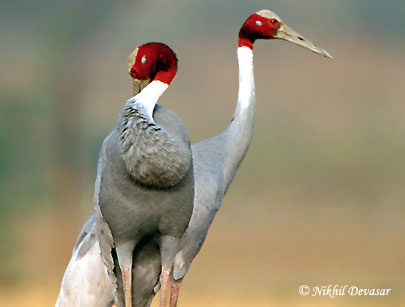
Sarus Crane (Grus antigone) by Nikhil Devasar
Around the world there are 15 crane species in the Gruidae Family of the order Gruiformes. The cranes are the Grey Crowned, Black Crowned, Demoiselle, Blue, Wattled, Siberian, Sandhill, Sarus, Brolga, White-naped, Common, Hooded, Whooping, Black-necked, and Red-crowned.
Cranes are large, long-legged and long-necked birds Unlike the similar-looking but unrelated herons, cranes fly with necks outstretched, not pulled back. Cranes live on all continents except Antarctica and South America.
They are opportunistic feeders that change their diet according to the season and their own nutrient requirements. They eat a range of items from suitably sized small rodents, fish, amphibians, and insects, to grain, berries, and plants.
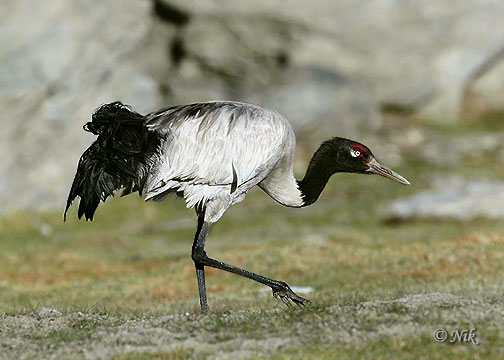
Black-necked Crane (Grus nigricollis) by Nikhil Devasar
Most have elaborate and noisy courting displays or “dances”. While folklore often states that cranes mate for life, recent scientific research indicates that these birds do change mates over the course of their lifetimes (Hayes 2005), which may last several decades. Cranes construct platform nests in shallow water, and typically lay two eggs at a time. Both parents help to rear the young, which remain with them until the next breeding season.
Some species and populations of cranes migrate over long distances; others do not migrate at all. Cranes are gregarious, forming large flocks where their numbers are sufficient.
With all the oil that is leaking into the Gulf of Mexico, at this point, Louisiana is taking a direct hit. a j mithra, who lives in India and has seen the destruction of their birds has made the following video. He told me he wept while making the video. Since he is one of our writers, I am posting it here also.
It is hard to watch not only the birds, but all of the wildlife and the people who are being harmed by this oil spill. Our hearts and prayers go out to those whose lives are being so greatly affected. Unfortunately, we are all under the curse and this is just one more example of it. One this is certain, this oil spill did not catch God by surprise.
For I reckon that the sufferings of this present time are not worthy to be compared with the glory which shall be revealed in us. For the earnest expectation of the creature waiteth for the manifestation of the sons of God. For the creature was made subject to vanity, not willingly, but by reason of him who hath subjected the same in hope, Because the creature itself also shall be delivered from the bondage of corruption into the glorious liberty of the children of God. For we know that the whole creation groaneth and travaileth in pain together until now. And not only they, but ourselves also, which have the firstfruits of the Spirit, even we ourselves groan within ourselves, waiting for the adoption, to wit, the redemption of our body. (Romans 8:18-23 KJV)
Fusion Unplugged by Boat-tailed Grackles by a j mithra
Well I see a j mithra has been busy again. He has produced another YouTube with the birds. This time he has used the Boat-tailed Grackles. Hope you enjoy watching it.
Many birds have built in “tools” such as the way their beaks are designed or their feet, or wings, etc. Some use things as tools as shown below in the articles and the video.
How Nature Works: White-winged Crossbill Feeding Technique from CornellLab of Ornithology. (Last statement gives credit to evolution, but we believe they were uniquely created with this ability by the Lord.)
Rooks Reveal Remarkable Tool Use It appears that Rooks (Crow related) have been given intelligence by their Creator to figure out how to use things as tools.
Also, New Caledonian Crows themselves are able to use tools.
The list goes on and on of the uniquely created ways birds use their built in or external “tools.” “The Tool-Using Bird” (Vulture) and “Animals That Make and Use Tools” by Creation Moments.
What kind of tools (gifts) has the Lord given you to use. Are you using them in the way that He intended for you to use them.
Having then gifts differing according to the grace that is given to us, let us use them: if prophecy, let us prophesy in proportion to our faith; (Romans 12:6 NKJV)
As each one has received a gift, minister it to one another, as good stewards of the manifold grace of God. (1 Peter 4:10 NKJV)





 Lee's Birdwatching Adventures Plus