Birds of the Bible – More Value

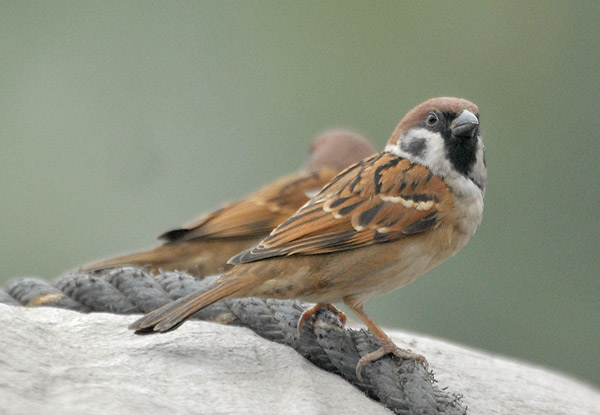
Eurasian Tree Sparrow (Passer montanus) by Nikhil

Eurasian Tree Sparrow (Passer montanus) by Nikhil

We have mentioned the sparrow many times in the blog and about how God takes care of them, as in the following articles:

Birds of the Bible – God’s Care for BirdsSparrow IISparrow I and Eye of the Beholder – House Sparrows

This time, I would like point out the part about being of “more value.” In Matthew 10:29-33, the two sparrows are mentioned as being sold for a farthing, a very small amount. According to A. Barnes’ Notes, “The argument is, that if He takes care of birds of the least value, if He regards so small a thing as the hair of the head, and numbers it, He will certainly protect and provide for you. You need not, therefore, fear what man can do to you.”

Are not two sparrows sold for a farthing? and one of them shall not fall on the ground without your Father. But the very hairs of your head are all numbered. Fear ye not therefore, ye are of more value than many sparrows. Whosoever therefore shall confess me before men, him will I confess also before my Father which is in heaven. But whosoever shall deny me before men, him will I also deny before my Father which is in heaven.(Matthew 10:29-33 KJV)

Northern Raven (Corvus corax) by Ray

Northern Raven (Corvus corax) by Ray

Also: “Indeed, the very hairs of your head are all numbered. Do not fear; you are more valuable than many sparrows.” (Luke 12:7 NASB);  “Consider the ravens, for they neither sow nor reap, which have neither storehouse nor barn; and God feeds them. Of how much more value are you than the birds?” (Luke 12:24 NKJV) and He said to them, “What man is there among you who has a sheep, and if it falls into a pit on the Sabbath, will he not take hold of it and lift it out? “How much more valuable then is a man than a sheep! So then, it is lawful to do good on the Sabbath.” (Matthew 12:11-12 NASB)

We see then that “man” has more value than sparrows, ravens, birds, and sheep just from these few verses. Yet, each of them are greatly valued by their creator. Where else are things of value mentioned in Scripture?

David had the opportunity to kill King Saul, but he valued the life of the king more.

May the LORD repay every man for his righteousness and his faithfulness; for the LORD delivered you into my hand today, but I would not stretch out my hand against the LORD’s anointed. And indeed, as your life was valued much this day in my eyes, so let my life be valued much in the eyes of the LORD, and let Him deliver me out of all tribulation.” (1 Samuel 26:23-24 NKJV)

Wisdom and understanding have great value and Job mentions it in Job 28.

But where can wisdom be found? And where is the place of understanding? “Man does not know its value, Nor is it found in the land of the living. (Job 28:12-13 NASB)

Where then does wisdom come from? And where is the place of understanding? “Thus it is hidden from the eyes of all living And concealed from the birds of the sky. (Job 28:20-21 NASB)

Zechariah in his prophecy of the future, tells about the price of Christ the Lord as 30 shekels (pieces) of silver.

Then the LORD said to me, “Throw it to the potter, that magnificent price at which I was valued by them.” So I took the thirty shekels of silver and threw them to the potter in the house of the LORD. (Zechariah 11:13 NASB)

We are of great value to the Lord, so much so, that He gave His Life for our salvation. If you know the Lord as Savior, then, that “knowing Christ Jesus,” has tremendous value.

More than that, I count all things to be loss in view of the surpassing value of knowing Christ Jesus my Lord, for whom I have suffered the loss of all things, and count them but rubbish so that I may gain Christ, (Philippians 3:8 NASB)

We trust you do know the Lord and realize how much He loves you and cares for you. Much more than the critters, whom he cares for tremendously.

See also Gospel Message

Birdwatching at Circle B Bar Reserve – October

My "Zip" (battery operated)

My "Zip" (battery operated)

Dan and I have been out to the Circle B twice in the last few weeks. We were there on the 14th and again this last Saturday, the 24th. The birds are definitely getting back down here. What an increase in Wood Storks, several hundreds, and the Roseate Spoonbill started arriving this last week, according to one of the volunteers.

The visit on the 14th, which was briefly mentioned in Stork II, was the first time I tried out my new “Zip”. As has been mentioned before, I have a slight handicap and this is a great assist. Anyway, after unloading it, off we went for a nice 73°F birdwatching adventure on a clear day. Just outside there were about 20 Black and Turkey Vultures hanging out at the brook, which is part of the reserve. Overhead a Great Egret, Osprey and some Boat-tailed Grackles flew by. The Blue Jays, Mourning Doves, Red-Bellied, Pileated Woodpecker, Eastern Phoebe,  and the elusive, but calling Carolina Wren greeted us on the way to the marsh. Once we got there I was amazed at all the Wood Storks and the others birds that had arrived.

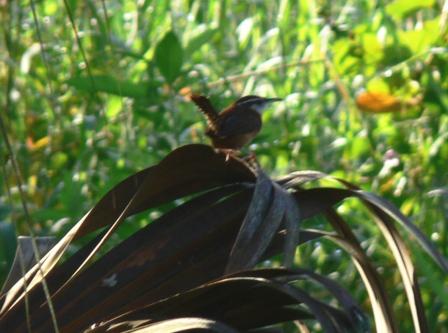
Carolina Wren - Finally

Carolina Wren - Finally

Here is what was spotted (or heard) then in order I spotted them: Turkey and Black Vultures, Blue Jay, Fish Crows, White Egrets, Carolina Wren, Mourning Doves, Red-bellied and Pileated Woodpecker, Eastern Phoebe, Wood Storks – lots, Great Blue Herons, Little Blue Herons, Tufted Titmouse, Green Heron, Downy Woodpecker, Glossy and White Ibises, Tricolored Herons, Moorhens, Mallards, Ospreys, 2 Spoonbills, Double-crested Cormorants, Anhingas, Black-bellied Whistling Ducks-lots, Great Egret, Cardinals, Red-winged Blackbird, Red-Shouldered Hawk, Cattle Egrets, Belted Kingfisher (finally got sort of a picture of it), Northern Mockingbird, Grey Catbird,  Blue-grey Gnatcatchers, Northern Harrier, Yellow-rumped Warbler, Palm Warbler, and the Common and Boat-tailed Grackles. Not a bad 2 hours of birding. A total of 40 identified.

On Saturday, we birded for about an hour before we met a group of about 10-12 AWANA boys from our church. We had been asked to join them as they went birdwatching. We figured we would get pictures before they came, as youngster can be enthusiastic and might spook a few birds. Actually, they did right well and got to see lots of birds. I got to go with them further than normal because my “Zip” was with me.

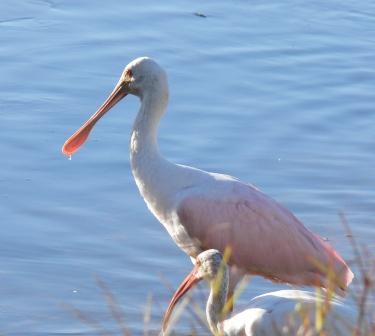
Roseate Spoonbill

Roseate Spoonbill

What we saw were about the same birds as before with the following changes. I finally got a picture of that elusive Carolina Wren. I have heard it for months, but never got a look, let alone a photo. It’s not that good, but it’s a prize for me. Up in a tree we spotted what we thought was a Hawk, but when looking at pictures, realized it was the juvenile Bald Eagle. There were a lot more Roseate Spoonbills (20-30), Tufted Titmouse, Sandhill Cranes, Blue-winged Teals have arrived, Snowy Ibises, Pied-Billed Grebes, possible Mottled Ducks, Purple Gallinules, Bald Eagles (a juvenile and adults-3 in one tree), and more unknowns. So, in the two trips the total is 48, not counting the unknowns. I almost forgot the hugh alligator. Someone said about 14 feet long.

Does the eagle mount up at your command, And make its nest on high? From there it spies out the prey; Its eyes observe from afar. (Job 39:27,29 NKJV)


I haven’t added Dan’s photos yet.

*

This slideshow requires JavaScript.

*

For other birdwatching trips to the Circle B Bar Reserve

*

When I Consider! – Skunk Cabbage

When I Consider!

When I Consider!

Evidence From Botany – August 16

The skunk cabbage is a uniquely designed plant. It generates enough heat to melt the snow around itself so that it can begin to grow and flower. Even if the air temperature drops as low as 10oF, the skunk cabbage produces the heat it needs to maintain a temperature of between 72°F and 74°F. However, if the temperature stays extremely low for more than 24 hours, the hooded blower exhausts its heating ability and the flower dies. The skunk cabbage then prepares more flowers and repeats the process.

Western Skunk Cabbage from Wikipedia

Western Skunk Cabbage from Wikipedia

This amazing plant also has a built-in thermostat. If the flower becomes too cold more heat is summoned. If the flower becomes too warm, the heat is withdrawn. Because of its amazing abilities, the skunk cabbage is one of the first plants to break through the snow in early spring. Normally, honeybees are unable to fly in temperatures below 65°F. However, when the skunk cabbages are in bloom, honeybees can fly when temperatures drop as low as 45°F. Inside the flower’s hood, the bees warm up enough to travel to the next cabbage flower. In cold weather the bees fly from one skunk cabbage to another, warming themselves as they travel back to their hive. Could this intricately designed flower be the result of random-chance mutational changes?

Character Sketches, Vol.III, P.209-212

I will ponder all your work, and meditate on your mighty deeds. Your way, O God, is holy. What god is great like our God? (Psalms 77:12-13 ESV)

(Article typed by Phyllis)

Very interesting article from The Nature Institute, Skunk Cabbage (Symplocarpus foetidus)
Skunk Cabbage by Fairfax County Public Schools

Ian’s Bird of the Week – Spotted Harrier

spotted_harrier_80355

Newsletter: 10-23-09

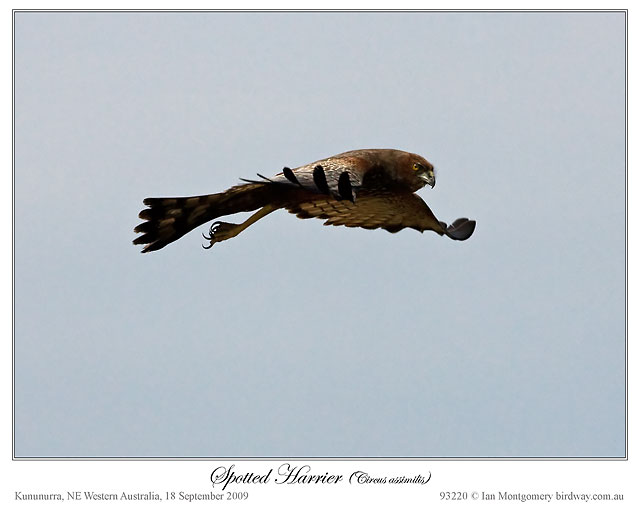
A striking raptor that is encountered regularly in small numbers when travelling through the drier parts of Australia is the Spotted Harrier, and we came across several on the trip to Northern Australia. Harriers hunt by patrolling low over open ground flying buoyantly or gliding with upswept wings, relying on stealth to capture terrestrial prey, such a birds, small mammals and reptiles.

Spotted Harrier (Circus assimilis) by Ian

Spotted Harrier (Circus assimilis) by Ian

Like Grass Owls, they have very long legs for seizing prey in grasslands and they often fly with their legs dangling as in the first two photos. This bird has the characteristic, pale-spotted chestnut underparts of the adult plumage but the upperparts are brownish rather than grey and appears sub-adult. The other bird, taken from below, is an adult and has a grey neck and the chestnut facial disc that gives it a slightly owlish appearance.

The Spotted Harrier has a wide distribution in mainland Australia, but occurs in Tasmania only as a vagrant. In wetter areas such as wetlands, it is replaced by the Swamp Harrier. There are 13 species of Harrier worldwide. All of these nest on the ground, with the exception of the Spotted Harrier which nests in small trees.

Recent additions to the website include:

a distant shot of a Sandstone Shrikethrush
and new photos of:
Golden Bowerbird
Wedge-tailed Eagle
Rainbow Bee-eater
(Far) Eastern Curlew

Spotted Harrier (Circus assimilis) by Ian

Spotted Harrier (Circus assimilis) by Ian

Best wishes,
Ian

Ian Montgomery, Birdway Pty Ltd,
454 Forestry Road, Bluewater, Qld 4818
Phone: +61-7 4751 3115
Preferred Email: ian@birdway.com.au
Website: http://birdway.com.au


Lee’s Addition:

The harrier is not specifically mentioned by name in the Bible, but it is in the same family with the hawks, kites and eagles, which are all mentioned.

Doth the hawk fly by thy wisdom, and stretch her wings toward the south? (Job 39:26)

As Ian said, there are 13 Harriers worldwide. There are also 2 Marsh Harriers and 2 Harrier-Hawks. I have shown all of them in Taxonomic order. There are links to the ones I could find. They are part of the Family Accipitridae, which includes Kites, Hawks & Eagles and all are in the ORDER ACCIPITRIFORMES.

Western Marsh Harrier (Circus aeruginosus) by Nikhil
Eastern Marsh Harrier (Circus spilonotus) ©
Papuan Harrier (Circus spilothorax) ©
Swamp Harrier (Circus approximans) by Ian
African Marsh Harrier (Circus ranivorus) by Africaddict
Reunion Harrier (Circus maillardi) ©
Malagasy Harrier (Circus macrosceles) ©
Long-winged Harrier (Circus buffoni) ©WikiC
Spotted Harrier (Circus assimilis) by Ian
Black Harrier (Circus maurus) Video by Keith
Northern Harrier (Circus cyaneus) by Jim Fenton
Cinereous Harrier (Circus cinereus) ©
Pallid Harrier (Circus macrourus) ©
Pied Harrier (Circus melanoleucos) by Nikhil
Montagu’s Harrier (Circus pygargus) by IanVideo by Keith
African Harrier-Hawk (Polyboroides typus) ©WikiC- Video by Keith
Madagascar Harrier-Hawk (Polyboroides radiatus) ©Wikipedia

Birds in Hymns – Go Out, My Heart, and Seek Delight

Words: Paul Gerhardt (1607-1676)

Sing to Him, sing psalms to Him; Talk of all His wondrous works! Glory in His holy name; Let the hearts of those rejoice who seek the LORD! (Psalms 105:2-3 NKJV)

An alternative version

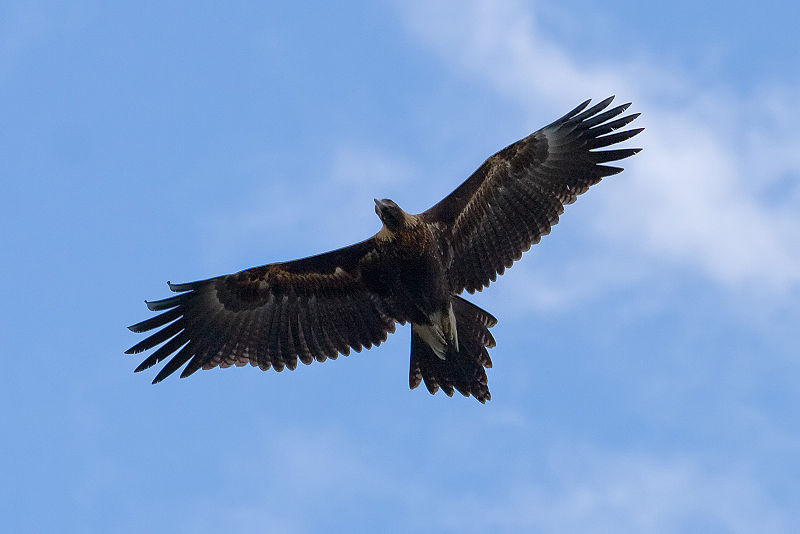
Wedge-tailed Eagle (Aquila audax) ©Wikipedia

Wedge-tailed Eagle (Aquila audax) ©Wikipedia

Go out, my heart, and seek delight
in golden sunshine, summer bright;
rejoice in God’s gifts daily.
See all of nature’s bright display;
it clothes itself in fine array
for you and me so gaily
for you and me so gaily.

The trees with foliage green are blest,
the earth her dusty face has dressed
in herbage young and tender.
The desert rose and wattle fair
are clothed in raiment far more rare
than Solomon in splendour
than Solomon in splendour.

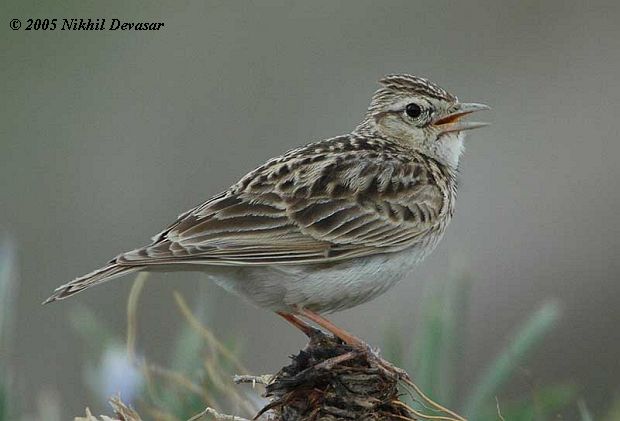
Oriental Skylark (Alauda gulgula) by Nikhil Devasar

Oriental Skylark (Alauda gulgula) by Nikhil Devasar

The wedge-tailed eagle in the sky
surveys the world with questing eye,
in lofty circles winging.
The roaring lark with trilling song
sets mountain gorge and billabong
and all the bushland ringing
and all the bushland ringing.

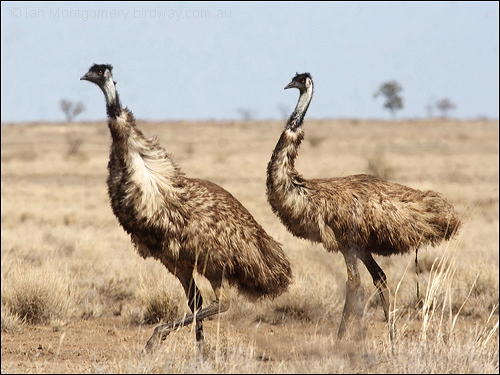
The strutting emu tends his chicks,
the bower-bird gathers twigs and sticks
to arch his glittering treasure.
The flute-call of the butcher-bird
from towering gum tree may be heard
to voice his morning pleasure
to voice his morning pleasure.

Strutting Emu (Dromaius novaehollandiae) by Ian Struting

Strutting Emu (Dromaius novaehollandiae) by Ian Struting

From rock-o’ershaded, rippling pool
the waters trickle, soft and cool,
among the ferns and creepers.
While dragon-flies dart here and there,
cicadas’ droning fills the air
and stirs all insect-sleepers
and stirs all insect-sleepers.

The swarming, busy, tireless bees
in zig-zag flight on summer breeze
seek honey-dew so tender,
as scented shrubs and sugared flowers
lift up their petalled heads for hours
their sweetness to surrender
their sweetness to surrender.

Great Bowerbird (Chlamydera nuchalis) by Ian

Great Bowerbird (Chlamydera nuchalis) by Ian

The desert quandong, orange, plum,
the passion-fruit to ripeness come;
they urge our glad thanksgiving
to him who all these gifts bestows,
and from whom such abandance flows
to gratify our living
to gratify our living.

I cannot, mighty God, be still,
for all your mighty actions fill
my being with elation.
I too must sing when all things sing,
let praises to the Highest ring
which voice my adoration
which voice my adoration.

What a delightful and fantastic hymn. Paul Gerhardt has several more that will be posted later. The last verse is how I also feel about God’s mighty creation and His Love for the critters and especially us.

I cannot, mighty God, be still,
for all your mighty actions fill
my being with elation.
I too must sing when all things sing,
let praises to the Highest ring
which voice my adoration


Most information from The Cyber Hymnal

See ~ Wordless Birds

More ~ Birds in Hymns

*


When I Consider! – Mount St. Helens

When I Consider!

When I Consider!

Evidence from Geology – October 13

“When Mount St. Helens erupted on May 18, 1980, the resulting blast cloud snapped off huge trees for 150 square miles around the mountain. At the same time an avalanche of mud sped down from the top of the mountain into Spirit Lake, causing a wave almost 900 feet high which scraped trees from the slopes adjacent to the lake. Many of these trees ended up in Spirit Lake buried at various levels on the bottom as they slowly sank in an upright position after becoming water-logged. Scuba investigations and side-scanning sonar have identified up to 100,000 upright deposited tree stumps buried a various levels of ash and peat deposits at the bottom of Spirit Lake.

Mount St. Helens Eruption by USGS

Mount St. Helens Eruption by USGS

Since Mount St. Helens continues to be active (depositing more material in the lake with time) these trees will be buried in what looks like separate geological layers, even though they all came from the same forest.

Years from now if sediment were to fill the lake and bury the trees in such a way that they became petrified in their present positions, these trees would look like multiple forest buried on top of each other over tens of thousand years. This is exactly what was assumed to be the origin of the petrified forest at Yellowstone National Park’s Specimen Ridge. Many geologists now acknowledge that the Yellowstone petrified trees were from the same standing forest, transported into their current position by a massive flood catastrophe.”

The Young Earth, p. 115-116 and Search for the Truth, II-9

So He destroyed all living things which were on the face of the ground: both man and cattle, creeping thing and bird of the air. They were destroyed from the earth. Only Noah and those who were with him in the ark remained alive. And the waters prevailed on the earth one hundred and fifty days. (Genesis 7:23-24)


Additions:
Mount St. Helens – Creation Wiki
Mt. St. Helens Evidence in Support of Biblical Catastrophe
“Is the Lava Dome at Mount St. Helens Really a Million Years Old?” by Keith Swenson
MOUNT ST. HELENS AND SPIRIT LAKE Geoscience Research Institute

More When I Consider!

Ian’s Bird of the Week – White-breasted Whistler

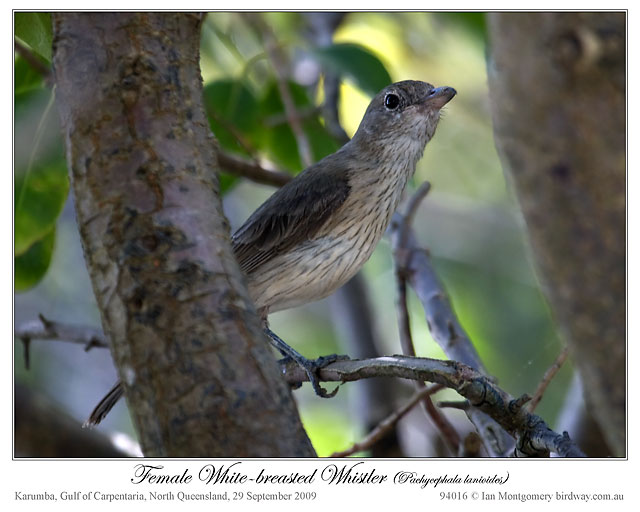
White-breasted Whistler

White-breasted Whistler

Newsletter: 10/13/2009

As I was driving south from Katherine, NT, on the first day of my return journey home and faced with the prospect of repeating in reverse the long drive through Mount Isa, Adventure whispered seductively in my ear ‘why not go home via the Gulf of Carpentaria and look for White-breasted Whistlers?’. So, I turned left at Daly Waters and drove to Karumba via Borroloola, NT (first night) and Burketown, QLD (second night). That drive involved about 700 km of gravel road and half a dozen river fords, but I was rewarded on day 2 by great views (no photos though) of a Grey Falcon on the Northern Territory side of the border with Queensland.

Female White-breasted Whistler

Female White-breasted Whistler

I found a female and young White-breasted Whistler – and insufferable numbers of little biting sandflies – in the mangroves at Karumba Point, but no males so I decided to do the sensible thing and go out with Ferryman River Cruises on the Norman River: http://www.ferryman.net.au/ (07) 4745 9155. Not only did Alison and Glen know their birds and where to find them but are also enthusiastic members of the bird of the week list. So, the three of us had a great morning on the river and they found me the White-breasted Whistlers and other good things like Red-headed Honeyeaters. They also have some friendly Black-necked Storks (Jabirus) and various raptors only too ready to put on a good display in return for garfish. So, if you’re ever in Karumba, you know what to do.

White-breasted Whistlers, particularly the females, look like Rufous Whistlers but are much more robust with large, (invariably muddy) hooked bills adapted for feeding in mangroves on invertebrates such as small crabs. The males, first photo, are more distinctive with a completely black head, a rufous collar and a white breast. The large, hooked bill is much more like that of the related Shrike-thrushes and the specific name lanoides refers directly to Lanius, the generic name for (true) Shrikes. The second photo is a young male in the middle of acquiring adult male plumage but still has the streaky buff breast of young birds and females. The third photo shows a female peering coyly through the mangroves. Rufous Whistlers were also present at Karumba Point and the first bird that I got excited about and photographed turned out to be just that. White-breasted Whistlers occur in mangroves in northwestern and northern Australia from Carnarvon in the west to western Cape York in the east.

Recent additions to the website include:
Immature Mangrove Golden Whistler
Additional photos of:
Grey Whistler
Orange-footed Scrubfowl
Hooded Parrot
Red-collared (Rainbow) Lorikeet
Barking Owl

White-breasted Whistler (Immature)

White-breasted Whistler (Immature)

The bushfires in Bluewater are now all under control thanks to the efforts of the fire service and the SES and my house still stands! My thanks to those of you who expressed their concern. I was glad, though, that I cut short my trip to Sydney as the situation was still threatening when I returned.

Best wishes,
Ian

Ian Montgomery, Birdway Pty Ltd,
454 Forestry Road, Bluewater, Qld 4818
Phone: +61-411 602 737
Preferred Email: ian@birdway.com.au
Website: http://birdway.com.au


Lee’s Addition:
Australasian Whistlers make up the bulk of whistlers (Australia with 8 and New Guinea with 15). There are 41 species in 6 genera. They also are found in Southeast Asia and some Pacific Islands. They are known for the melodious songs and I had hoped to find a recording of the bird whistling, but couldn’t find one. Maybe someone can leave a comment with a link to a recording.

I did find a video by Nick Talbot, of a Rufous Whistler singing. It is posted on my Whistlers and Allies page.

They have a head that is rounded and fairly large. “One of their earlier alternative names was ‘thick head’ (from which the Latin family name, Pachycephalidae, is derived).” (From Complete Birds of the World, National Geographic) The birds are between 12-20 cm. or 5-8 in. in length and only weigh .5-1.5 oz. or 13-44 g. Also from the book, “Obvious features are the fairly large, rounded head, short, thick neck, and short, stubby, thick bill. The wings are short and broad, with 10 primaries; in most species the wings are rounded, but in two (including the most migratory), the wing-tips are pointed. Tails vary in length, being longest in the larger species; they have 12 feathers and are squared-ended or slightly notched. The legs and feet are strong, especially in the larger species.”

The whistlers do most of their feeding among the upper foliage of trees and feed on spiders and insects they find on leaves or “hovering in flight.”

Glad he made that different trip home so we can share in his find. I am also glad the fires were in control.

Keep up the great photography and newsletters.

In that day the LORD will whistle for the fly that is in the remotest part of the rivers of Egypt and for the bee that is in the land of Assyria. (Isaiah 7:18 NASB)

See also Ian’s Whistler Pages:
Gilbert’s Whistler
Grey/Brown Whistler
Golden Whistler
Mangrove Golden Whistler
Rufous Whistler
White-Breated Whistlers

Birds of the Bible – Stork II

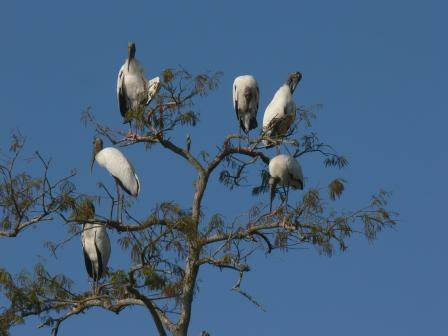
Wood Storks in Top of Tree by Lee

Wood Storks in Top of Tree by Lee

Yesterday, Dan and I went out to the Circle B Bar Reserve for some birdwatchng. I think I would have to call it, “Stork Day.” From our photos, I have counted well over 100 Wood Storks and that doesn’t count the ones we didn’t photograph. It is time to find out some more about the stork.

From the first Birds of the Bible – Stork article,we found out that the stork is on the unclean list of birds that were not to be eaten by the Israelites. (Leviticus 11:19 and Deuteronomy 14:18). Jeremiah 8:7, tells of “her appointed times” (migration) and Zechariah 5:9 mentions the “wings of a stork.”

Psalms is going to provide our thoughts for today.

The trees of the LORD are full of sap; the cedars of Lebanon, which he hath planted; Where the birds make their nests: as for the stork, the fir trees are her house. (Psalms 104:16-17)

 The Whole Tree

The Whole Tree

As you can tell from the photos, the storks like to hang out in the trees. The trees were loaded with them. We were out there recently (September 18th) and I did not see any on that visit. Jeremiah was correct, “Yea, the stork in the heaven knoweth her appointed times;” Migration has been underway and these are either resting while on their trip or they are going to be here for the winter.

“Storks (family Ciconiidae) make their nests of sticks, reeds and grass, in tall trees. When the chicks hatch, their thin, featherless skin is extremely vulnerable to the direct rays of the sun. The parent bird has two responses to the high temperature problem — if water is nearby, the stork fills its large beak, returns to the nest, and douses the tiny chicks with cooling water. If this is not sufficient, the parent then performs a most remarkable feat — it stands over the young and spreads its large wings over the entire nest, thus shading the chicks from the sun’s rays! Often it will do this for hours at a time.” from “Birdbrains?” at Answers in Genesis

Storks Shadowing Baby in Lakeland by Dan

Storks Shadowing Baby in Lakeland by Dan

When the Lord created the Stork, the knowledge to protect their babies was put in them. Our God and Savior has promised to meet our needs. If He cares about the birds, how much more does he care about us?

“Storks are large, long-legged, long-necked wading birds with long stout bills, belonging to the family Ciconiidae. They occur in most of the warmer regions of the world and tend to live in drier habitats than the related herons, spoonbills and ibises; they also lack the powder down that those groups use to clean off fish slime. Storks have no syrinx and are mute, giving no bird call; bill-clattering is an important mode of stork communication at the nest. Many species are migratory. Most storks eat frogs, fish, insects, earthworms, and small birds or mammals. There are 19 living species of storks in six genera.

Storks tend to use soaring, gliding flight, which conserves energy. Soaring requires thermal air currents. Ottomar Ansch??tz’s famous 1884 album of photographs of storks inspired the design of Otto Lilienthal’s experimental gliders of the late 19th century. Storks are heavy with wide wingspans, and the Marabou Stork, with a wingspan of 3.2 m (10.5 feet), shares the distinction of “longest wingspan of any land bird” with the Andean Condor.

Their nests are often very large and may be used for many years. Some have been known to grow to over 2 m (6 feet) in diameter and about 3 m (10 feet) in depth. Storks were once thought to be monogamous, but this is only true to a limited extent. They may change mates after migrations, and migrate without them. They tend to be attached to nests as much as partners.

Storks’ size, serial monogamy, and faithfulness to an established nesting site contribute to their prominence in mythology and culture.

This slideshow requires JavaScript.

*

Limpkin Page Updated 10-13-09

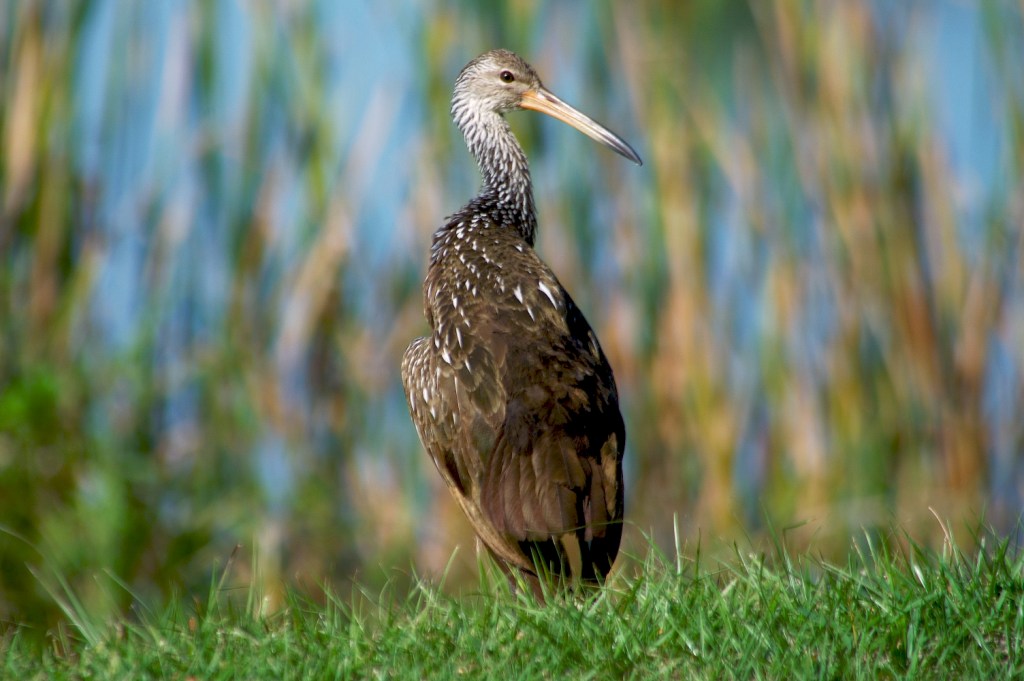
Limpkin (Aramus guarauna)II at Saddle Creek By Dan'sPix

Limpkin (Aramus guarauna)II at Saddle Creek By Dan'sPix

Let everything that has breath praise the LORD. Praise the LORD! (Psalms 150:6)

CLASS – AVES, Order – GRUIFORMES, Family – Aramidae – Limpkin


Limpkin Family Aramidae
Limpkin Aramus guarauna

Finding Photos for Limpkins was not a problem for us. That is one of the birds we see very frequently in this area.

*

This slideshow requires JavaScript.


Information from Wikipedia with editing

“The Limpkin (also called “carrao”, “courlan”, “crying bird”), Aramus guarauna, is a bird that looks like a large rail but is skeletally closer to cranes. They are in the GRUIFORMES family. It is found mostly in wetlands in warm parts of the Americas, where it feeds primarily on apple snails of the genus Pomacea. Its name derives from its seeming limp when it walks.”

Range and habitat
The Limpkin occurs from peninsular Florida (and formerly the Okefenokee Swamp in southern Georgia) and southern Mexico through the Caribbean and Central America to northern Argentina. In South America it occurs widely east of the Andes; west of them its range extends only to the Equator.

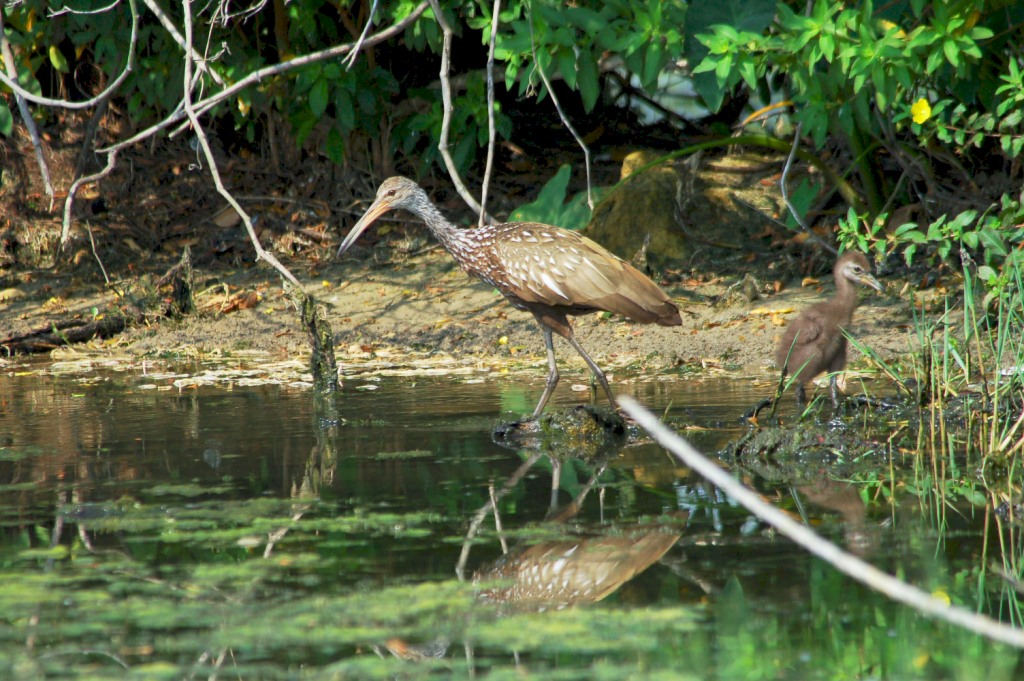
Limpkin & Baby at Saddle Creek By Dan'sPix

Limpkin & Baby at Saddle Creek By Dan'sPix

It inhabits freshwater marshes and swamps, often with tall reeds, as well as mangroves. In the Caribbean, it also inhabits dry brushland. In Mexico and northern Central America, it occurs at altitudes up to 1,500 m (4,900 ft).

Description
The Limpkin is a somewhat large bird, 66 cm (26 in) long, with a wingspan of about 102 cm (40 in) and a weight of about 1.1 kg (2.4 lb). Its plumage is drab—dark brown with an olive luster above. The feathers of the head, neck, wing coverts, and much of the back and underparts (except the rear) are marked with white, making the body look streaked and the head and neck light gray. It has long, dark-gray legs and a long neck. Its bill is long, heavy, and downcurved, yellowish bill with a darker tip. The bill is slightly open near but not at the end to give it a tweezers-like action in removing snails from their shells, and in many individuals the tip curves slightly to the right, like the apple snails’ shells. The white markings are slightly less conspicuous in first-year birds. Its wings are broad and rounded and its tail is short. It is often confused with the immature White Ibis.

This bird is easier to hear than see. Its common vocalization is a loud wild wail or scream[4][5] with some rattling quality, represented as “kwEEEeeer or klAAAar.” This call is most often given at night[4] and at dawn and dusk. It has been used for jungle sound effects in Tarzan films and for the hippogriff in the film Harry Potter and the Prisoner of Azkaban. Other calls include “wooden clicking”, clucks, and in alarm, a “piercing bihk, bihk…”.
Sound provided by xeno-canto.org
Behavior and feeding
Limpkins are largely nocturnal and crepuscular, except that in Florida refuges, where they do not fear people, they are active during the day. Even so, they are usually found near cover.

Because of their long toes, they can stand on floating water plants; they also swim well. They fly strongly, the neck projecting forward and the legs backward, the wings beating shallowly and stiffly, with a jerky upstroke, above the horizontal most of the time.

Snail remains at Lake Hollingsworth by Lee

Snail remains at Lake Hollingsworth by Lee

forage primarily in shallow water and on floating vegetation such as water hyacinth and water lettuce They walk slowly with a gait described as “slightly undulating” and “giving the impression of lameness or limping”, “high-stepping”, or “strolling”, looking for food if the water is clear or probing with the bill. They feed on small aquatic life, principally apple snails. The availability of this one mollusk has a significant effect on the local distribution of the Limpkin. When a Limpkin finds an apple snail, it carries it to land or very shallow water and places it in mud, the opening facing up. It deftly removes the operculum or “lid” and extracts the snail, seldom breaking the shell. The extraction takes 10 to 20 seconds. It often leaves piles of empty shells at favored spots.

Freshwater mussels are a secondary food source. Less important prey items are land snails, insects, frogs, and lizards.

Reproduction
Males have territories of several hectares, where they call loudly and chase other males away. Nests are built on the ground, in dense floating vegetation, in bushes, or at any height in trees. They are bulky structures of rushes, sticks or other materials. The clutch consists of 5 to 7 eggs, averaging 6, which measure 6.0 cm × 4.4 cm (2.4 in × 1.7 in). Their background color ranges from gray-white through buff to deep olive, and they are marked with light-brown and sometimes purplish-gray blotches and speckles. Both parents incubate for about 27 days. The young hatch covered with down, capable of walking, running, and swimming. They follow their parents to a platform of aquatic vegetation where they will be brooded. They are fed by both parents; they reach adult size at 7 weeks and leave their parents at about 16 weeks.

Montezuma Oropendola by Donna L. Watkins

By Donna L. Watkins (Guest Author)

© 2008 Donna L. Watkins – Montezuma Oropendola – La Selva
The Montezuma Oropendola (Psarocolius montezuma) is a New World tropical bird and I’ve been getting quite a show from the colony that is nesting here at La Selva Reserve in Costa Rica.

The unforgettable song of the male is sung during his bowing display and consists of bubbling with loud gurgles. The male, while the female is hopefully watching, will execute a complete somersault around a branch while singing his medley of tunes. (View video at bottom of article.)

Male and female both have loud calls, but the male’s display that seems like he’s pretending to be a monkey swinging on the branch, is what keeps your attention. I’ve been here 8 days now and I am still fascinated by the show. There are definitely those who outdo others. Some just don’t take the dip far enough, and others look as if they’re playing “dead man’s fall.” I just don’t know how they can get themselves back up again so gracefully.

In a rare form of non-monogamous breeding, 3-10 Montezume Oropendola males establish a colony in a tree, often isolated, and defend a group of 10-30 females that will mate and nest in the colony. (see video below)

The males engage in fighting and aggressive displays, competing among themselves to mate with the females. Usually the most dominant and heavy males mate and are fathers to most of the colony’s young.

© 2008 Donna L. Watkins – Montezuma Oropendola – Finca Luna Nueva
Male and female differ greatly in size. The male is 20″ in length (50 cm) and weighs over 18 ounces (520 gm), while the female is 15″ (38 cm) and weighs about 8 ounces.

Adult males are mostly chestnut-colored with a blackish head and rump with a show-off tail that is bright yellow. There is a bare blue cheek patch and a pink wattle that gives the bird an odd appearance, but who could resist it? Females are similar with a smaller wattle.

Its range is listed as Gulf-Caribbean slope of Southern Mexico and southern Pacific slope of Nicaragua and Costa Rica to Central Panama. It’s quite a common bird in parts of its range often seen in flocks foraging in trees for small vertebrates, large insects, nectar, and fruit. Outside the breeding season, this species moves around, so it’s fortunate for me that I am getting to enjoy them during breeding season.

The Montezuma Oropendola inhabits forest canopy, edges and old plantations. They have chosen a tree in an open area here at La Selva. They’re easily bothered while foraging, but are very confident when on their breeding tree.

Oropendolas weave a large bag-like nest 2-6 ft. long that hangs from the ends of tree branches with many on the same tree. It’s woven of fibers and vines high in a tree.

Almost always built by females who also incubate the 2 dark-spotted white or buff eggs at the bottom of the pouch for 11-14 days. The male guards the nest. The nestlings are fed by the female with the young fledging in 30 days. There are generally about 30 nests in a colony, but up to 172 have been recorded.

To imagine the size of the pouch nests that can be from 2-6 feet long, keep in mind that the male is 20 in. long and the female 15 in. I’m not sure whether it’s a male or female at the top of one of these nests, but it shows how long the pouches are regardless.

References:
Costa Rica: The Ecotravellers’ Wildlife Guide by Les Beletsky
http://www.Wikipedia.com
View La Selva photo ablum.

Provided by and with Donna’s permission.

She has a nice video at the bottom of her post – Costa Rica: Montezuma Oropendola at The Nature in Us

Creation Moments – Columbus Day article

B. C. – Before Columbus

King Solomon also built a fleet of ships at Ezion Geber, which is near Elath on the shore of the Red Sea, in the land of Edom. (1 Kings 9:26)

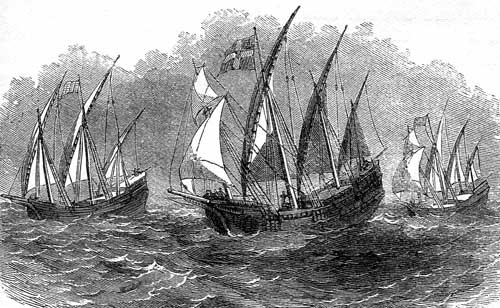
Columbus' ships

Columbus’ ships

Normally, it would not be unusual to find a stone with engraving on it in South America. But a stone found in 1872 in Brazil is unusual, since Aztec, Mayan and Incan civilizations never lived in that region. Besides, the engraving on the stone was in Phoenician. Its discoverer, who did not know Phoenician, sent it to authorities who gave it to the head of the national museum. He recognized the ancient language and translated it. It reads, “We are the Sons of Canaan from Sidon, the city of the King. Commerce has cast us on this distant shore, a land of mountains.”

Could 7th century B.C. Phoenicians have sailed as far as South America in search of commerce? In the ancient world, Phoenicians were known as the greatest commercial sailors of their day. But there is a modern bias against seeing ancient peoples as being as smart and resourceful as we are today, so the inscription has generally been considered a hoax. Then, in the 1960s, the original rubbing made of the inscription turned up at a scholarly auction in the United States. A modern expert on ancient languages studied the rubbing and concluded that the inscription must be authentic. It contains quirks of the Phoenician language that were unknown even to scholars in the 19th century.

While we today may know more facts, the ancients were no less intelligent and resourceful than we are today. That’s consistent with the Bible’s picture of man as God’s highest visible creation, rather than evolution’s gradually improving creature.

Prayer: I glorify Your Name, O Lord, for making us the way You have. Amen.

References: Archeology, “Before Columbus or the Vikings,” Science, May 1968.

©2009 Creation Moments

See Also:
Phoenicians in Brazil
Archeology: Before Columbus or the Vikings,” Time, Friday, May. 24, 1968

Eye of the Beholder – Ibises and Crane

Sandhill Crane at Cirle B by Tommy Tompkins

Sandhill Crane at Cirle B by Tommy Tompkins

Last week while reading by the window that overlooks our small backyard, my eye caught movement. When I looked out, under the tree in the shade stood a Sandhill Crane surrounded by 8 or 9 White Ibises. The Ibises walked toward my way and were digging and checking out our lawn. The group kept moving and digging around as Ibises will do. They exited left of my view and the Sandhill was still standing in the same spot. Soon, from the left of view the Ibises came back and this time there were 11 of them. They walked back toward the crane and exited right. Crane still standing. Then a few minutes later, back they came right to left and this time there were 13 of them. The Crane was still standing there. Off they went to the left of my view. You got it, the crane was still standing there. Then, here they came the last time, left to right, and there were 14 of them this time. My stately Sandhill Crane was still standing there. All of this took place in about a 30 minute time span.

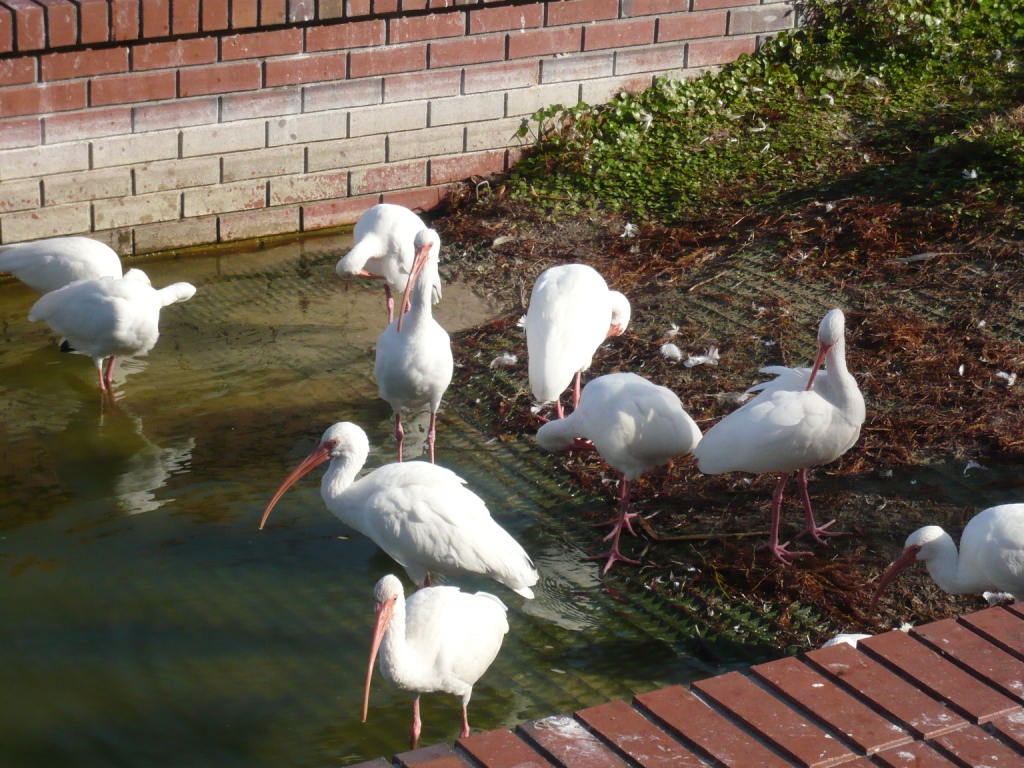
White Ibises at Lake Morton by Dan

White Ibises at Lake Morton by Dan

Needless to say, my reading was slowed down by all this activity. The ibises were digging around and yet they kept on the move. They put their beaks in the ground and pound up and down about 5 or 6 times and then move on and repeat the process over again. One or two of them will find something good to eat and will stay in the same spot to continue to dig. When they look up and see that the group has moved on, they immediately scurry off to catch up with the others. They have a funny little way of walking. This was repeated many times as they looked up and then followed the crowd.

I can come up with several applications for what was going on, but I will only choose one of them, for now.

God has given us His Word, the Bible, and in it we learn the truths about God the Father, Jesus Christ the Son, and the Holy Spirit who are one and are the great I AM.  The Word reveals truths about creation, salvation, sin, God’s attributes such as love, mercy, grace, judgment, justice, long-suffering, etc. As the Sandhill Crane stood, so should we stand firm in the truths taught in the Bible. We should not waver or try to change what has been written. Jesus has provided salvation, through His death on the cross, and invites us to accept His gift of salvation.

Jesus said to him, “I am the way, the truth, and the life. No one comes to the Father except through Me. (John 14:6)

Many people know the truth about Jesus, the Cross, God, creation, heaven, hell, etc., but do not apply it to their heart or soul. They either think, there is some other way and are always searching for some new “angle” of belief. Be it different religions, non-religion, atheism, or what ever.

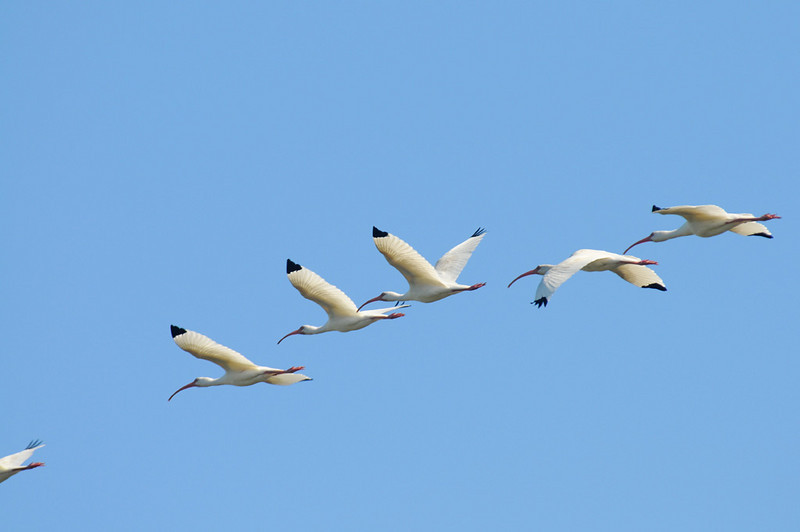
Off on another search - American White Ibis by Bob-Nan

Off on another search - American White Ibis by Bob-Nan

Others who do accept the Lord Jesus Christ as their Savior, want to find some new “angle” to what the Bible teaches, by perverting it, or trying to twist it to where their “sin” is justified. Maybe are just not really “walking with the Lord” and want to live in sin or they become false teachers.

Both groups, unbelievers or believers, are like the Ibises who go away from the truth (crane), and try new things, then almost come back, sort of, and then scurry off to find something different. Even those who settle down, look up and see the crowd going a certain way, and run after that new thing.

Enter by the narrow gate; for wide is the gate and broad is the way that leads to destruction, and there are many who go in by it. Because narrow is the gate and difficult is the way which leads to life, and there are few who find it. (Matthew 7:13-14)

May we all seek the truth of God, accept the Lord’s salvation, and then live our lives according to God’s Word.

See:
The Gospel Message
Wordless Birds