Ian’s Bird of the Week – Yellow-rumped Munia/Mannikin

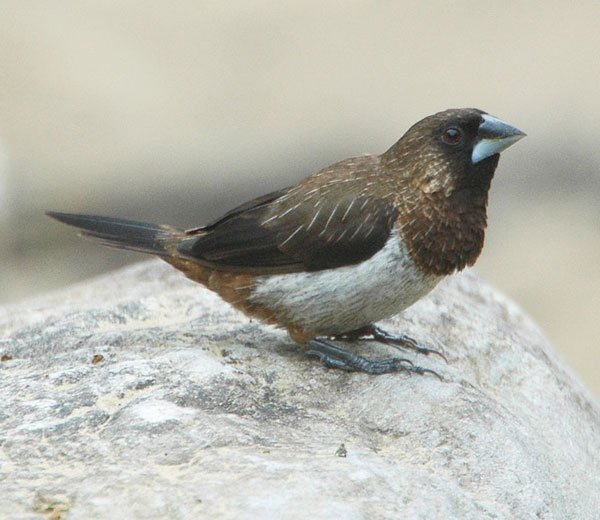
Yellow-rumped Munia by Ian Montgomery

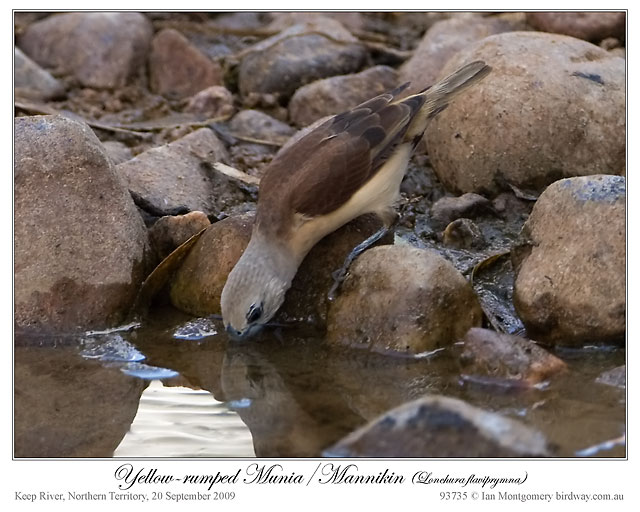
Yellow-rumped Munia by Ian Montgomery

Newsletter – 10/6/2009

Although last week’s bird, the Gouldian Finch, was a welcome encounter in Wyndham my main target in the Kununurra district of NE Western Australia was another finch, the Yellow-rumped Munia or Mannikin (members of the genus Lonchura are usually called Mannikins in Australia and Munias overseas).

This species has a very restricted distribution, occurring only in the eastern Kimberley and in northwestern Northern Territory. It is supposed to be quite abundant in the Ord River irrigation area near Kununurra. We searched quite diligently in many of its favourite locations without finding any and it wasn’t until, on the return journey, I saw this single bird in the company of Chestnut-breasted Munias/Mannikins at a water hole in the Keep River district on the Northern Territory side of the border.
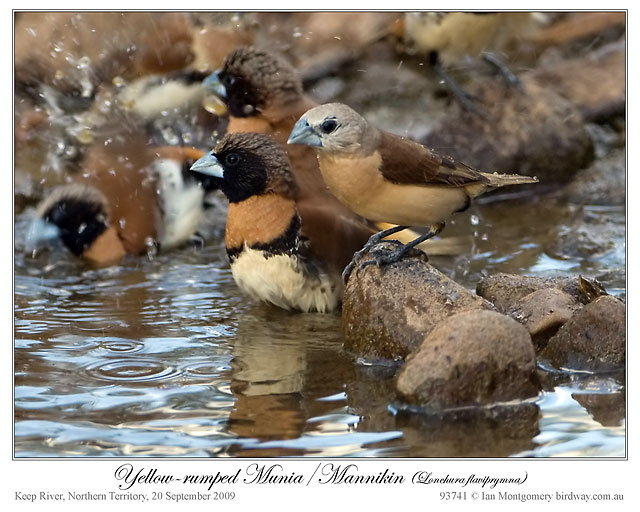
Yellow-rumped Munia by Ian Montgomery

Yellow-rumped Munia with Chestnut-breasted Munias by Ian Montgomery

Compared with the almost meretricious plumage of the Gouldians and the exuberance of the bathing Chestnut-breasteds, ‘restrained elegance’ comes to mind in both the appearance and behaviour of the Yellow-rumped: tasteful but subtle colours and decidedly demure beside its frolicking companions. Even when drinking, as in the second photo, it sipped delicately from a high perch as if not wanting to spoil its costume. The Yellow-rumped is closely related to the more widespread Chestnut-breasted and, in addition to consorting together, they sometimes interbreed.

I’m in Sydney briefly for last night’s presentation to Birding NSW. It was an enjoyable evening with a delightful group of people but I am returning home prematurely this afternoon. There were several bushfires burning near my house in unseasonably hot and dry weather and I don’t feel comfortable being away longer than necessary.

I’ve posted a dozen photos of the Gouldian Finches at Wyndham to the website to join several that I took at Mornington Station in the Kimberley five years ago: http://www.birdway.com.au/estrildidae/gouldian_finch/index.htm .

Best wishes,
Ian

Ian Montgomery, Birdway Pty Ltd,
454 Forestry Road, Bluewater, Qld 4818
Phone: +61-7 4751 3115
Preferred Email: ian@birdway.com.au
Website: http://birdway.com.au


Lee’s Addition:


Checked out Ian’s Gouldian Finch photos and they are really neat.

The Munia/Mannikins are in the Waxbill Family of Estrilidae. Their genus, Lonchura, consists of the following birds of which I have included links to photos and videos:

Bronze Mannikin –  Video Lonchura cucullata
Black-and-white MannikinVideo Lonchura bicolor
Red-backed Mannikin Lonchura nigriceps
Magpie Mannikin Lonchura fringilloides
White-rumped Munia Nik – Video Lonchura striata
Javan Munia  –  Video Lonchura leucogastroides
Dusky Munia –  Video Lonchura fuscans
Black-faced MuniaVideo Lonchura molucca
Scaly-breasted Munia Ian’s  – Video Lonchura punctulata
Black-throated Munia  –  Video Lonchura kelaarti
White-bellied Munia Lonchura leucogastra
Streak-headed Munia  –  Video Lonchura tristissima
White-spotted Munia Lonchura leucosticta
Five-colored Munia –  Video Lonchura quinticolor
Tricolored Munia Lonchura malacca
Chestnut MuniaVideo Lonchura atricapilla
White-headed Munia –  Video Lonchura maja
Pale-headed Munia  –  Video Lonchura pallida
Great-billed Munia Lonchura grandis
Grey-banded Munia Lonchura vana
Grey-headed Munia Lonchura caniceps
Grey-crowned Munia Lonchura nevermanni
Hooded Munia Lonchura spectabilis
New Ireland Munia Lonchura forbesi
Mottled Munia Lonchura hunsteini
Yellow-rumped Munia Ian’s Lonchura flaviprymna
Chestnut-breasted Munia Ian’s  –  Video Lonchura castaneothorax
Black Munia Lonchura stygia
Black-breasted Munia  –  Video Lonchura teerinki
Eastern Alpine Munia Lonchura monticola
Western Alpine Munia –  Video Lonchura montana
Sooty Munia Lonchura melaena
Timor Sparrow Lonchura fuscata
Java Sparrow Ian’s Lonchura oryzivora
Pictorella Munia Ian’s Heteromunia pectoralis

Two verses come to mind about these birds. While I was looking for extra photos of the birds, I found many of these birds have been kept as pets and also the diet of most of these is grain and seeds.


For every kind of beast and bird, of reptile and creature of the sea, is tamed and has been tamed by mankind. (James 3:7)
And as he sowed, some seed fell by the wayside; and the birds came and devoured them. (Matthew 13:4)

Birds in Hymns – How Great Thou Art

Great is the LORD, and greatly to be praised; And His greatness is unsearchable. (Psalms 145:3)

Author: Carl Boberg, 1859-1940
Tr. By Stuart K. Hine, 1899-
Musician: Swedish Melody
Arr. By Stuart K. Hine, 1899-

(by Sean Fielder)

How Great Thou Art

American Yellow Warbler (Dendroica aestiva) by J Fenton

American Yellow Warbler (Dendroica aestiva) by J Fenton

O Lord my God! When I in awesome wonder
Consider all the worlds Thy hands have made,
I see the stars, I hear the rolling thunder,
Thy power throughout the universe displayed,

Refrain:
Then sings my soul, my Saviour God to Thee;
How great Thou art, how great Thou art!
Then sings my soul, my Saviour God to Thee;
How great Thou art, how great Thou art!

When through the woods and forest glades I wander
And hear the birds sing sweetly in the trees;
When I look down from lofty mountain grandeur
And hear the brook and feel the gentle breeze;

And when I think that God, His Son not sparing
Sent Him to die, I scarce can take it in;
That on the cross, my burden gladly bearing,
He bled and died to take away my sin;

When Christ shall come with shout of acclamation
And take me home, what joy shall fill my heart!
Then I shall bow in humble adoration
And there proclaim, my God, how great Thou art!

——————————————————————————–

HYMN HISTORY:

Northern Parula (Parula americana) by Reinier Munguia

Northern Parula (Parula americana) by Reinier Munguia

Boberg wrote the poem “O Store Gud” (O Great God) in 1885 with nine verses.

The inspiration for the poem came when Boberg was walking home from church near Kronobäck, Sweden, and listening to church bells. A sudden awe-inspiring storm gripped Boberg’s attention, and then just as suddenly as it had made its violent entrance, it subsided to a peaceful calm which Boberg observed over Mönsterås Bay. According to J. Irving Erickson:

Carl Boberg and some friends were returning home to Mönsterås from Kronobäck, where they had participated in an afternoon service. Nature was at its peak that radiant afternoon. Presently a thundercloud appeared on the horizon, and soon sharp lightning flashed across the sky. Strong winds swept over the meadows and billowing fields of grain. The thunder pealed in loud claps. Then rain came in cool fresh showers. In a little while the storm was over, and a rainbow appeared.

When Boberg arrived home, he opened the window and saw the bay of Mönsterås like a mirror before him… From the woods on the other side of the bay, he heard the song of a thrush…the church bells were tolling in the quiet evening. It was this series of sights, sounds, and experiences that inspired the writing of the song.[7]

According to Boberg’s great-nephew, Bud Boberg, “My dad’s story of its origin was that it was a paraphrase of Psalm 8 and was used in the ‘underground church’ in Sweden in the late 1800s when the Baptists and Mission Friends were persecuted.”  The author, Carl Boberg himself gave the following information about the inspiration behind his poem:

“It was that time of year when everything seemed to be in its richest colouring; the birds were singing in trees and everywhere. It was very warm; a thunderstorm appeared on the horizon and soon thunder and lightning. We had to hurry to shelter. But the storm was soon over and the clear sky appeared.

“When I came home I opened my window toward the sea. There evidently had been a funeral and the bells were playing the tune of ‘When eternity’s clock calling my saved soul to its Sabbath rest.’ That evening, I wrote the song, ‘O Store Gud.'”

[edit] Publication

Boberg first published “O Store Gud” in the Mönsterås Tidningen (Mönsterås News) on 1886 March 13.

The poem became matched to an old Swedish folk tune. and sung in public for the first known occasion in a church in the Swedish province of Värmland in 1888. Eight verses appeared with the music in the 1890 Sions Harpan.

In 1890 Boberg became the editor of Sanningsvittnet (The Witness for the Truth). The words and music were published for the first time in the 16 April 1891 edition of Sanningsvittnet. Instrumentation for both piano and guitar was provided by Adolph Edgren (born 1858; died 1921 in Washington D.C.), a music teacher and organist, who later migrated to the United States.

Boberg later sold the rights to the Svenska Missionsförbundet (Mission Covenant Church of Sweden). In 1891 all nine verses were published in the 1891 Covenant songbook, Sanningsvittnet.  These versions were all in 3/4 time. In 1894 the Svenska Missionsförbundet sångbok  published “O Store Gud” in 4/4 time as it has been sung ever since (cf. Time signature).
——————————————————————————–
Wikipedia – How Great Thou Art – History
SermonAudio – How Great Thou Art – Audio

See ~ Wordless Birds

More ~ Birds in Hymns

*

The Gospel Message

The Gospel Message is that Jesus Christ, the Creator, came to earth and died for us. It is up to us to accept, by faith, what He has done for us. He loves us, and wants to be our Savior, Lord, and King.

Please read the basic message of the whole gospel below and seriously consider that your eternal soul is very important to God, the Lord Jesus Christ, the Holy Spirit.

A.  God

  • He exists  (Hebrews 11:6)
  • He is holy  (1 Peter 1:15)
  • Man must be perfect to reach God  ( Matthew 5:48)
  • The measure of God’s holiness is the law  ( Romans 2:12, 13, 14, 15, 16)
  • He has judged sin  (Romans 6:23)

B.  Man

  • He is a sinner  (Romans 3:23)
  • He cannot save himself  (Ephesians 2:8,9)

C.  Jesus Christ

  • He died because of our sins  (1 Corinthians 15:3)
  • He rose again  (1 Corinthians 15:14)
  • He is the only Messiah (Savior)  (John 14:6), (1 Timothy 2:5)
  • He paid the price for our sins  (1 Corinthians 6:1920), (Hebrews 7:27)
  • That He is Lord, that is the right ruler of all, including us  (Romans 10:9, 10)

D.  Grace

  • Salvation is a free gift.  (Ephesians 2:8,9)
  • We can’t earn it  (Ephesians 2:8,9)

E.  Faith

  • We must totally yield ourselves to Christ  (Acts 16:31)
  • We accept what God has done  (John 13:20)
  • We trust in Christ alone for salvation  (John 14:6), (Ephesians 2:8,9, 10)
  • Repentance is inherent in Biblical Faith  (Acts 2:36)

F.  Commitment

  • We must be willing to turn from our sins and follow Christ  (2 Corinthians 5:15)

(The verses will pop up when mouse is placed over them)

If you have any further questions or would like assistance accepting Christ as your personal Savior, please contact me at Lee@Leesbird.com or contact my pastor, Rev. Nathan Osborne III.

wsbirdsbirdhouse(Pastor Osborne provided the above outline)

As much as we enjoy bird watching and enjoy seeing how many we can see or how many we can count on a list, remember the following verses:

For what will it profit a man if he gains the whole world, and loses his own soul? Or what will a man give in exchange for his soul? (Mark 8:36-37)

When I Consider! – Turkey Vulture

Turkey Vulture Tree at Saddle Creek by Lee

Turkey Vulture Tree at Saddle Creek by Lee

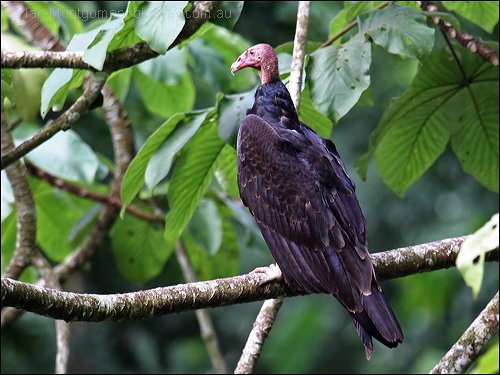
We get to see lots of Turkey Vultures in this area. I have seen trees just loaded with them. They are ugly to look at, but are very useful.

The following is the October 6th’s “Evidence from Biology” article from A Closer Look at the Evidence, by Richard and Tina Kleis:

“The Turkey Vulture has incredible farsighted vision capable of seeing dead or dying objects several miles beyond what the human eye can detect. Yet it is designed with dull, weak, talons and a thin beak, forcing it to eek out an existence eating rotting flesh or decaying vegetables. Since the vulture eats the remains of animals that have died of disease, it has a digestive tract designed to destroy deadly bacteria (including anthrax!). The Turkey Vulture also has the ability to sanitize itself and its surroundings using a special disinfectant found in its own excrement. The same chemicals which kill the deadly bacteria in its stomach continue to kill the germs outside its body!

Turkey Vulture by Ian Montgomery

Turkey Vulture by Ian Montgomery

Because the vulture’s head is usually covered in blood, pieces of rotten flesh, and bacteria, it is especially vulnerable to disease. Therefore, this particular bird was created without feathers from the neck up. As the turkey vulture stands in the sun, the ultraviolet radiation kills any remaining bacteria.

By removing the carcasses of decaying animals, the turkey vulture serves an important purpose of limiting the spread of disease and preventing potential epidemics among both man and beast. One wonders how the turkey vulture could have evolved all of the specialized characteristics. The creation solution is that they were created with the original vulture-type bird. The survival characteristics needed for our fallen world were either given after the Fall or developed from originally created abilities.”

Character Sketches, Vol. III, p. 121-124

The LORD is righteous in all his ways, and holy in all his works. (Psalms 145:17 KJV)


Lee’s Extras:
We have mentioned the Vulture many times on the blog and especially in the places below. After all, they are one of the unclean birds that the Jewish people were not allowed to eat. After reading the above article, you can understand why they were off the “menu.”

There is a path which no fowl knoweth, and which the vulture’s eye hath not seen: (Job 28:7 KJV)

Birds of the Bible – Vulture
Vulture
Vulture Photos
Vulture Videos
Accipitridae – Kites, Hawks & Eagles

More When I Consider! articles

Ian Juby’s Newsletter – Oct 2009

Ian Juby just sent out his latest newsletter and it is also available at his blog. The article features the new “Ardi” that is suppose to prove our ancestors were related to this fossil. Personally, I believe it will become another hoax like “Luci,” but time will tell.

So God created man in his own image, in the image of God created he him; male and female created he them. (Genesis 1:27 KJV)

1) Ardi ar arrr…


Artist’s best guess as to what Ardipithecus ramidus may have looked like.
Okay, so maybe it didn’t stand upright like that, and maybe it didn’t have human eyes like that, and maybe it was a male and not a female, and maybe it….well, it’s close at least!
Drawing by J.H. Matternes

The propaganda machine goes into overdrive:
Got a barrage of emails this week from my honourable news watch team regarding a supposed “Missing link” found this week which “proves” our ancestral relationship to the apes.
In fact, Science magazine even ran a special issue just on this fossil, CBC’s “Quirks and Quarks” devoted a segment of their program to it (downloadable as a 22 meg MP3), National Geographic had a spread on it as well.
Seeing as how there’s been so much fuss over this fossil, I thought I’d devote a newsletter in response.

As is typical, this “missing link” is presented with impressive pomp and circumstance before the emporer comes out wearing no clothes. We’ve seen this before time and again with Ida, Puijila, and even Archaeoraptor – the fraudulent fossil that was brazenly heralded with many bold claims as “proof of evolution” before it was quietly sidelined after it was discovered to be a fake.  I still, to this day, occasionally have people bring up Archaeoraptor as proof of evolution.  This is the power of propaganda.

Same old, same old.
Before proceeding, it’s probably a good idea to point you to my previous response to the SciAm write up on our supposed “hominid” fossil lineage.  In this article, I dealt with dozens of these supposed “half-ape/half-human” fossils that evolutionists often hurl at us:  “The Human Pedigree”

As you can see, the whole “science” behind these “hominid” fossils is so speculative and subjective it isn’t funny!
1) Start with the assumption that evolution is true.
2) Interpret the fossil within an evolutionary paradigm
3) Use the interpretation as proof that evolution is true.
4) Return to step #1.

The New Old Find
The “new” find (actually found back in ‘92) is attributed to Ardipithecus ramidus.  The famous ‘flintstone fossil’ “Ardipithecus ramidus kadaba-daba-doooooo!” (thanks Teno Groppi), Ardipithecus has now been divided into two fossils, Ardipithecus ramidus, and Ardipithecus kadaba.  Good grief – there was barely enough fossil fragments for one fossil reconstruction, let alone two!  See my response to SciAm for more details.

So with the unveiling of  more of the fossils this week, once again … To see the rest of the article –  CLICK HERE

To see more here by Ian Juby – CLICK HERE

Blog Updates – 10-05-09

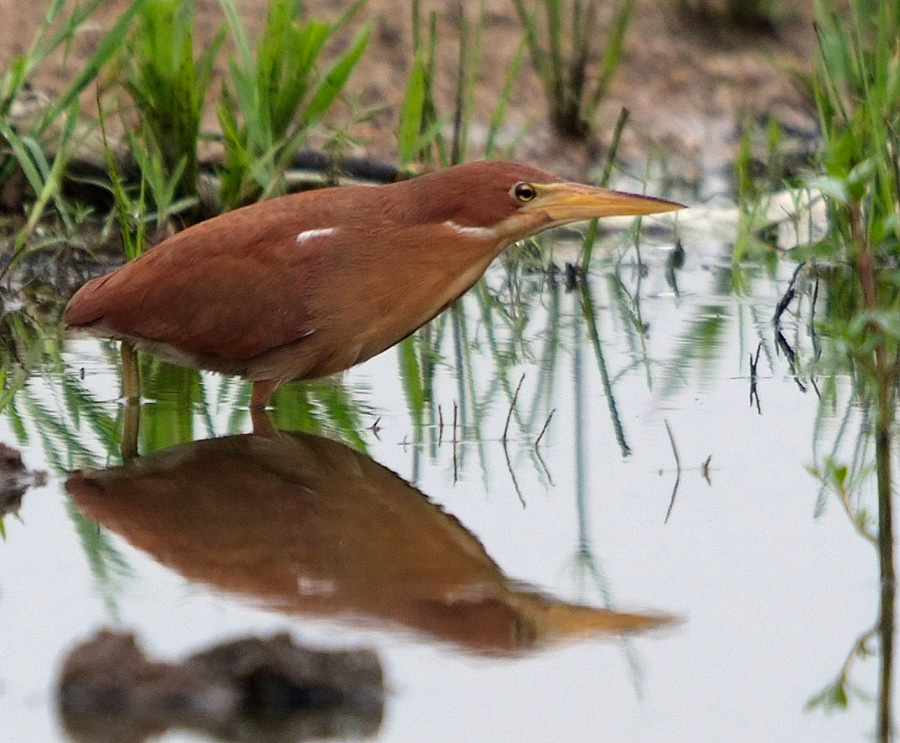
Cinnamon Bittern by Phil Kwong

Cinnamon Bittern by Phil Kwong

I have been working behind the scenes to make some changes and additions:

Some Updates today on the blogs:

Bittern

Bittern Photos

Sunbittern

Torrey’s Topical Textbook – Birds

Ian’s Bird of the Week – Gouldian Finches

#1 Red-headed Gouldian Finch by Ian

#1 Red-headed Gouldian Finch by Ian

Newsletter 10-03-09

I’m now back home in North Queensland, so it’s perhaps appropriate to select as bird of the week one photographed at the farthest point reached during the trip: Wyndham on the Cambridge Gulf in NE Western Australia. I wanted to go to Wyndham, 100 Km from Kununurra, only because it is on the coast and the journey didn’t seem complete without reaching it. When there, we discovered from the locals that 600 Gouldian Finches were coming in at sunrise to drink at sprinklers in the town.

#2 Black-headed Gouldian Finch by Ian

#2 Black-headed Gouldian Finch by Ian

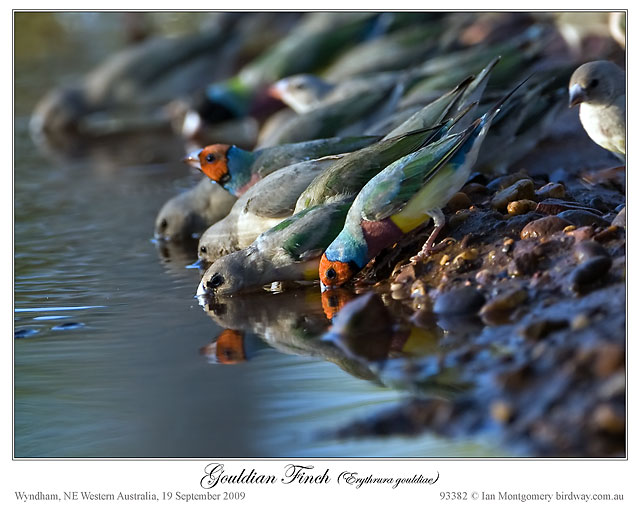
600 of any endangered species is an awful lot and too good to miss, so a couple of days later I got up at 3:45 am and drove the 100 Km to get there just before sunrise. The usual spot for the finches was very quiet – the Gouldian Finch Recovery Team had been banding them there on previous mornings and had probably put them off it – but I found them at another watering hole nearby. It was possible to drive right up to it, so I stayed in the car and photographed them out of the car window to disturb them less. Naturally, I was too busy to count, but 600 was probably a fair estimate and at one point I had two flocks totally maybe 200 birds in attendance. Most of the birds were juveniles, so they would appear to have had a good breeding season. This was also the case at another water hole near Mary River in Kakadu where we saw maybe 50 Gouldians.

#3 Red-headed with Juveniles

#3 Red-headed with Juveniles

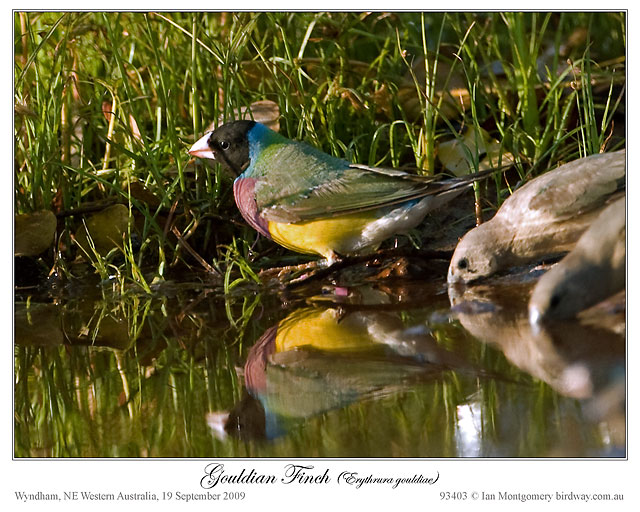
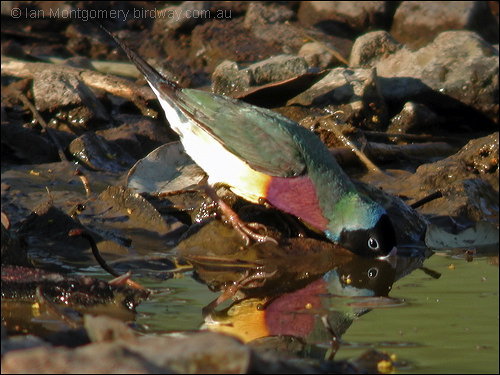
Gouldians come in three forms, depending on the colour of the facial mask. The first photo shows a Red-headed (with, out of focus, a Black-headed in the background and a juvenile in the foreground). The second shows a Black-headed about to drink, beside two juveniles. The third shows two Red-headed birds drinking with juveniles in various degrees of acquiring the adult plumage. The Black-headed is the commonest form (about 75%), then the Red-headed (about 24%) with 1% or less Golden-faced. The females are like the males but less strongly coloured.

I’ve started adding photos from the trip to the website. So far I’ve added:

White-quilled Rock-Pigeon
Chestnut-quilled Rock-Pigeon
Banded Fruit-Dove
Ground Cuckooshrike
Green-backed Gerygone

I’m making a brief visit to Sydney next week to give a talk, with lots of photos, on my 2008 trip to Alaska to Birding NSW on Tuesday 6th Oct. The meeting is open to anyone who would like to attend and is in the Mitchell Theatre, Level 1, Sydney Mechanical School of Arts, 280 Pitt Street, Sydney (between Park and Bathurst): http://www.birdingnsw.org.au/ . The meeting starts at 7:00 pm and my presentation is being preceded by a book launch by author Peter Roberts.

Best wishes,
Ian

Ian Montgomery, Birdway Pty Ltd,
454 Forestry Road, Bluewater, Qld 4818
Phone: +61-7 4751 3115
Preferred Email: ian@birdway.com.au
Website: http://birdway.com.au


Lee’s Addition:
What neat looking finches and what an adventure Ian has been on. I am not sure which was the “earlier bird.” 3:45am is my sleeping time! Thanks, Ian, for getting there so early so we can enjoy your great photos.


Here are some quotes from Wikipedia about the Gouldian Finch:
The Gouldian Finch, Erythrura gouldiae (or Chloebia gouldiae), also known as the Lady Gouldian Finch, Gould’s Finch or Rainbow Finch , is a colourful passerine bird endemic to Australia.”

Gouldian Finch (Erythrura gouldiae) by Ian

Gouldian Finch (Erythrura gouldiae) by Ian

“The Gouldian Finch was described by British ornithological artist John Gould in 1844 and named after his wife Elizabeth. It is also known in America as the Rainbow, Gould, or Lady Gouldian Finch (although Mrs Gould did not hold the title Lady). In Australia it is always called Gouldian Finch. It is a member of the weaver-finch family Estrildidae, which is sometimes considered a subfamily of Passeridae.”
“Gouldian Finches are about 130–140 mm long. Both sexes are brightly coloured with black, green, yellow, red and other colours. The females tend to be less brightly coloured. One major difference between the sexes is that the male’s chest is purple, while the female’s is a lighter mauve colour.

Gouldian Finches’ heads may be red, black, or yellow. People used to think they were three different kinds of finches, but now it is known that they are colour variants that exist in the wild.[1] Selective breeding has also developed mutations (blue, yellow and silver instead of green back) in body colour and breast colour.”

Now Israel loved Joseph more than any other of his sons, because he was the son of his old age. And he made him a robe of many colors. (Genesis 37:3 ESV)

“Juveniles have distinctive colours. Their heads, sides and necks are grey, and their backs, wings and tail feathers are olive green. Their undersides are pale brown. Beaks are blackish with a reddish tip. Their legs and feet are light brown. Newly hatched Gouldian finches are pink and naked until about 12 days old when the beginnings of feathers start to appear. Very young birds also have blue, phosphorescent beads on the sides of their beaks to help their parents see them in the dark.”

“Like other finches, the Gouldian Finch is a seed eater. During the breeding season, Gouldian Finches feed mostly on ripe or half-ripe grass seeds of Sorghum Spc. During the dry season they forage on the ground for fallen seed. During the wet season, Spinifex grass seed [Triodia Spc] is an important component of their diet. So far Gouldians have been recorded as consuming 6 different species of grass seed but during crop analysis researchers have never so far found insects.”

“Gouldian finches generally make their nests in holes in trees, generally within a kilometre or so of water. They usually breed in the early part of the dry season, when there is plenty of food around. The male courtship dance is a fascinating spectacle. When a male is courting a female, he bobs about ruffling his feathers to show off his colours. He expands his chest and fluffs out his forehead feathers. After mating, a female lays a clutch of about 4–8 eggs. Both parents help brood the eggs during the daytime, and the female stays on the eggs at night. When the eggs hatch, both parents help care for the young. Gouldian Finches leave the nest at between 19 and 23 days and are independent at 40 days old.

Young Gouldians are very fragile until their final moult. Some breeders believe parent-raised Gouldians have greater success rearing young than those fostered by other species, such as society or spice finches.

It has been shown scientifically that female finches from Northern Australia are controlling the sex of their offspring, according to the head colour of their male counterpart. Gouldian Finches should not be mated with Gouldian Finches of a different head colour (black-head with red-head etc.) as such a mating will result in an inbalance in the sex ratio of the young, with a greater proportion of male offspring being produced.”

Bird Song Quiz from Birds and Bloom

Beside them the birds of the heavens dwell; they sing among the branches. (Psalms 104:12 ESV)

Play the Video from Birds and Bloom Magazine and see how many you get right. I did not get 100% because I do not see some of them in this area.

Visit their videos page at http://www.youtube.com/user/birdsandblooms

Ian’s Bird of the Week – Grey-crowned Rosy Finch

Grey-crowned Rosy Finch (Leucosticte tephrocotis) by Ian

Grey-crowned Rosy Finch (Leucosticte tephrocotis) by Ian

Newsletter 03-25-09

I have at last finished major changes to the website and can now look forward to turning my attention back to Australian birds. I’m planning trips soon to chase up a few Australian species that haven’t made it to the website yet.

Grey-crowned Rosy Finch (Leucosticte tephrocotis) by Ian

Grey-crowned Rosy Finch (Leucosticte tephrocotis) by Ian

In the meantime, here is yet another bird from St Paul Island in the Bering Sea. Most of the birds there are seabirds or waders and only 4 species of passerine nest there. One is a summer visitor – the Lapland Longspur – while 3 are residents – the Snow Bunting and the Bering Sea races of the Winter Wren and the Gray-crowned Rosy-Finch, both larger than the mainland races. The Rosy-Finch is a startlingly beautiful bird which stands out in the harsh tundra: pink doesn’t mean delicate!

The bird on the rock, in the first photo, is a male, while the second, perched on a garbage container beside the wall of the airport/hotel is a female. This unfortunate bird had just lost its newly fledged offspring to an Arctic Fox which we saw running sneakily away with something in its mouth as we arrived back at the hotel. The mother searched everywhere frantically, calling repeatedly and it was sad to watch.

Artic Fox by Ian

Artic Fox by Ian

Life is tough in the Bering Sea and the foxes have to make do like everyone else. There are no other terrestrial mammals, so their usual diet of Lemmings is missing. Instead they feed all year round on marine invertebrates, particularly sea urchins, and whatever else they can scavenge along the coast including seaweed. In the nesting season, they raid the nests of seabirds and we saw another fox on a cliff top making off with the egg of a Murre (Guillemot). The good news, from an avian point of view, is that there are no resident raptors and the only other scavenger is the resident Glaucous-winged Gull.

The visible changes to the website include a consistent structure for bird families and their index (thumbnail) pages, conforming, as far as possible, to both the Birdlife International taxonomy (definition of families and order of species) for non-Australian birds and to Christidis & Boles (2008) for Australian Birds.

I’ve finished linking all the top-level family indices with Previous and Next buttons so you can now navigate through the more than 130 families represented on the site following the Birdlife International sequence.

Behind the scenes, the changes will make the website easier to maintain and update so I can spend more time taking photographs!

Best wishes,
Ian

Ian Montgomery, Birdway Pty Ltd,
454 Forestry Road, Bluewater, Qld 4818
Phone: +61-7 4751 3115
Preferred Email: ian@birdway.com.au
Website: http://birdway.com.au


Lee’s Additions:


I added links to photos of the birds he mentioned in his newsletter. I always enjoy looking the bird when I see its name.

But we see him who for a little while was made lower than the angels, namely Jesus, crowned with glory and honor because of the suffering of death, so that by the grace of God he might taste death for everyone. (Hebrews 2:9 ESV)

“The Gray-crowned Rosy Finch, Leucosticte tephrocotis, is a medium-sized finch.

Adults are brown on the back and breast and mainly pink on the rest of the underparts and the wings. The forehead and throat are black; the back of the head is grey. They have short black legs and a long forked tail. There is some variability in the amount of grey on the head.

Their breeding habitat is rocky islands and barren areas on mountains from Alaska to the northwestern United States. They build a cup nest in a sheltered location on the ground or on a cliff.

These birds are permanent residents on some islands and in the Canadian Rockies. Other birds migrate south to the western United States.

These birds forage on the ground, many fly to catch insects in flight. They mainly eat seeds from weeds and grasses, and insects. They often feed in small flocks.

At one time, this bird, the Black Rosy Finch and the Brown-capped Rosy Finch were considered to be the same species as the Asian Rosy Finch.”
(From Wikipedia – Gray-crowned Rosy-finch) Gray change to Grey in August 2009

See:  http://rosyfinch.com

Ian’s Bird of the Week – Crested Tern

Newsletter 03-20-09

Crested Tern now Swift Tern (Thalasseus bergii) by Ian

Crested Tern now Swift Tern (Thalasseus bergii) by Ian

Please accept my apologies for a late posting this week.
At the end of January I was in Cairns and we visited Palm Cove, north of the city, to search for an immature Laughing Gull
(http://www.birdway.com.au/larini/laughing_gull/index.htm), that has been spending the Northern winter there. Laughing Gulls are rare trans-Pacific vagrants in Australia and always cause some excitement when they appear.
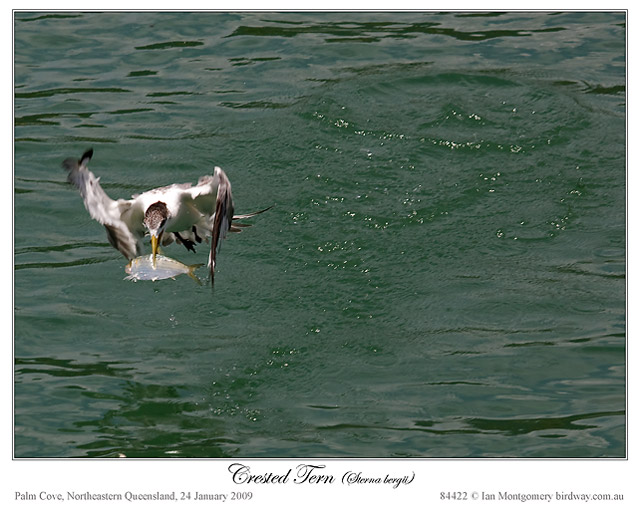
We found, and photographed, the gull okay, but while waiting for it to do its occasional forays for scraps past the fishermen on the wharf, I passed the time by photographing an immature, fishing Crested Tern – right at the other end of the Australian rarity scale and the commonest and most widespread marine tern. As luck would have it, just while I was photographing it flying towards me, it dived and caught, by tern standards anyway, a substantial fish.
Crested Tern now Swift Tern by Ian

Crested Tern now Swift Tern by Ian

In the first photo, you can see the greenish back of the fish at the surface just below the bill of the bird. The tern is braking its fall by spreading its wings and tail and has its feet splayed out in front of it ready for the impact with the water.

In the following photo, less that a second later, the tern has caught the fish expertly over its centre of gravity and is working hard to regain height. It didn’t drop the fish and the tern last disappeared into the distance with its prize.
Terns normally catch quite small fish, so it would be easy to speculate that this was an error of judgment on the part of an inexperienced bird. Or maybe it was just showing off in front of a camera-laden tourist.
One of the reason for a late posting is that I’ve been busy working on the website. The Next and Previous Family links that I mentioned last week now navigate through 30 more families beyond the New World Flycatchers as far as the Swallows. Substantially revised galleries include various Australian families such as:

Recently, I received a copy of a delightful and informative electronic document called ‘How Birds Fly’ by Stuart Cousland that he prepared and presents to schools in Victoria in his role of Education Coordinator for the (Mornington) Peninsula Bird Observers Club (part of BOCA). Some of my photos were used in it. I highly recommend it and copies are available free either on CD or as 5MB email attachment by contacting him on seastar@pac.com.au or (03) 5988 6228.

Best wishes,
Ian

Ian Montgomery, Birdway Pty Ltd,
454 Forestry Road, Bluewater, Qld 4818
Phone: +61-7 4751 3115
Preferred Email: ian@birdway.com.au
Website: http://birdway.com.au


Lee’s Addition:
23-66-1723 Swift Tern (Thalasseus bergii) Breeding by IanThe Crested Tern that Ian mentions was hard to find on the new I.O.C. list. They keep changing names and genus around and the list was update in August this year. The Sterna bergii or Crested Tern was taken out of the Sterna genus and placed in the Thalasseus genus. Then they changed it to Swift Tern. You think that didn’t take some searching to find out it’s new name.
Here are some facts from Wikipedia:”The Greater Crested Tern, Crested Tern or Swift Tern, (Thalasseus bergii), is a seabird in the tern family which nests in dense colonies on coastlines and islands in the tropical and subtropical Old World. Its five subspecies breed in the area from South Africa around the Indian Ocean to the central Pacific and Australia, all populations dispersing widely from the breeding range after nesting. This large tern is closely related to the Royal and Lesser Crested Terns, but can be distinguished by its size and bill colour.”
Swift Tern (Thalasseus bergii) Non-breeding by Ian

Swift Tern (Thalasseus bergii) Non-breeding by Ian

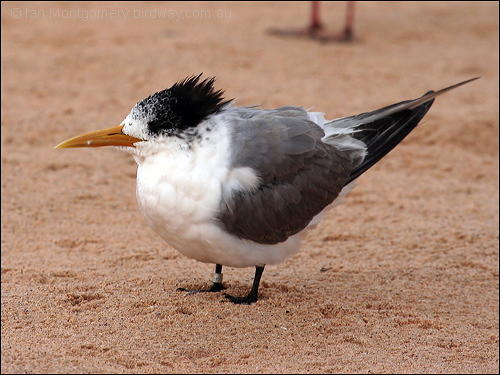
“The Greater Crested Tern has grey upperparts, white underparts, a yellow bill, and a shaggy black crest which recedes in winter. Its young have a distinctive appearance, with strongly patterned grey, brown and white plumage, and rely on their parents for food for several months after they have fledged. Like all members of the genus Thalasseus, the Greater Crested Tern feeds by plunge diving for fish, usually in marine environments; the male offers fish to the female as part of the courtship ritual.”

This is an adaptable species which has learned to follow fishing boats for jettisoned bycatch, and to utilise unusual nest sites such as the roofs of buildings and artificial islands in salt pans and sewage works. Its eggs and young are taken by gulls and ibises, and human activities such as fishing, shooting and egg harvesting have caused local population declines. There are no global conservation concerns for this bird, which has a stable total population of more than 500,000 individuals.”

Swift Tern (Crested) (Thalasseus bergii) by Ian

Swift Tern (Crested) (Thalasseus bergii) by Ian

“The Greater Crested Tern is a large tern with a long (5.4–6.5 cm, 2.1–2.6 in) yellow bill, black legs, and a glossy black crest which is noticeably shaggy at its rear. The breeding adult of the nominate subspecies T. b. bergii is 46–49 cm (18–19 in) long, with a 125–130 cm (49–51 in) wing-span; this subspecies weighs 325–397 g (11.4–14.0 oz). The forehead and the underparts are white, the back and inner wings are dusky-grey. In winter, the upperparts plumage wears to a paler grey, and the crown of the head becomes white, merging at the rear into a peppered black crest and mask.”

The adults of both sexes are identical in appearance, but juvenile birds are distinctive, with a head pattern like the winter adult, and upperparts strongly patterned in grey, brown, and white; the closed wings appear to have dark bars.  The nests are located on low‑lying sandy, rocky, or coral islands, sometimes amongst stunted shrubs, often without any shelter at all. The nest is a shallow scrape in the sand on open, flat or occasionally sloping ground. It is often unlined, but sometimes includes stones or cuttlefish bones.

Fish are the main food of the Greater Crested Tern, found to make up nearly 90% of all prey items with the remainder including cephalopods, crustaceans and insects. Unusual vertebrate prey included agamid lizards and green turtle hatchlings.

“The Great Crested Tern feeds mostly at sea by plunge diving to a depth of up to 1 m (3 ft), or by dipping from the surface, and food is usually swallowed in mid-air. Birds may forage up to 10 km (6 mi) from land in the breeding season.”

The Greater Crested Tern occurs in tropical and warm temperate coastal parts of the Old World from South Africa around the Indian Ocean to the Pacific and Australia.”

Then He said to them, “Follow Me, and I will make you fishers of men.” (Matthew 4:19 NKJV)

Dinosaur Protein Sequences & Dino-to-Bird Model – Tomkins

Dinosaur Protein Sequences and the Dino-to-Bird Model by Jeffrey Tomkins, Ph.D. is in this months Acts and Fact.

Here is an excerpt from it:

“Evolutionists have maintained that the fossil record supports a long-ages history for earth, but material extracted from dinosaur bones is providing an interesting challenge to that theory. The recent discoveries of soft dinosaur tissues, defined cell matrices, elastic blood vessels, and clearly observable cell microstructures such as cell nuclei have been a source of both shock and excitement to the paleontology community.

Dinosaurs

Dinosaurs

The shock comes from the fact that degradative processes somehow did not completely destroy all evidence of tissue from the supposedly millions-of-years-old fossils. The excitement comes from the fact that, given the pristine state of these tissues, scientists should be able to extract macromolecules. These would then be used in studies of molecular evolution to bolster the evolutionary ideas that are competing for supremacy in the scientific community, such as the currently touted “dinosaur to bird” transition model.

In fact, soft tissues from the bones of a Tyrannosaurus rex and a Brachylophosaurus canadensis (duck-billed hadrosaur) did yield protein fragments that were subjected to amino acid sequence analysis and then used in theoretical computational analyses.1, 2 But did the data demonstrate a dinosaur to bird transition, or was it possibly manipulated in the spirit of academic politics?”
Click here to read the rest of a very interesting article.

More from the Institute of Creation Research

Ian’s Bird of the Week – African Penguin

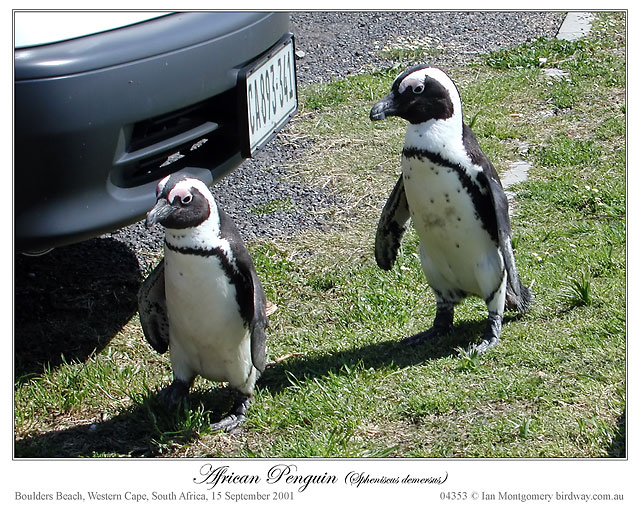
African Penguin by Ian

African Penguin by Ian

Newsletter – 7/16/2009

Well now, as they say, for something completely different here is the African Penguin. I was reviewing the contents of the website a few days ago, and noticed that there weren’t any penguins. Not having yet succeeded in photographing the only resident Penguin resident in mainland Australia, the Little Penguin, I rectified this by digging out some photos of what used to be called Jackass Penguins that I took in South Africa in 2001.

African Penguins strolling by Ian

African Penguins strolling by Ian

You’re right if you think that the background in the first photo isn’t snow, or even sand for that matter, and your suspicions will be confirmed by the second one – the photos were taken in the car park at Boulders Beach south of Cape Town. (The ‘CA’ of the car number plate refers to the old Cape Province.) The penguin colony is right beside the car park, and I found that the car park itself was the easiest place to photograph these very cooperative subjects.

The name Jackass Penguin refers to the braying sound that these birds make but, as their South American relatives make similar noises and this species is the only one resident in Africa, the name African Penguin is now preferred. Being a cynic, I had thought that the name change was for reasons of political correctness. With a length of 63cm/25in this is a smallish but not tiny penguin – much larger than the Little Penguin (40-45cm/16-18in).

It occurs right around southern Africa from Port Elizabeth in the east to northern Namibia in the west. The colony at Boulders Beach is a tourist attraction, and is something of a bad-news/good-news story. The bad news is that feline predators such as leopards have become less common in populated areas, but the good news is that this has allowed the Penguins to establish mainland colonies at a couple of sites near Cape Town. Two pairs first nested at Boulders Beach in 1982 and there are now over 3,000.

On the website, I recently revised the galleries for Storks, including the Jabiru or Black-necked Stork and Bustards, mainly the Australian Bustard though I’ve added a couple of ancient shots (originally on film!) of the rather similar Kori Bustard of Africa for comparison  .

Best wishes,
Ian

Ian Montgomery, Birdway Pty Ltd,
454 Forestry Road, Bluewater, Qld 4818
Phone: +61-7 4751 3115
Preferred Email: ian@birdway.com.au
Website: http://birdway.com.au


See Spheniscidae – Penguin