Kagu – The High Profile Endemic Emblem

The Kagu – The High Profile Endemic Emblem – by a j mithra
Kagu (Rhynochetos jubatus) Wikipedia

Kagu (Rhynochetos jubatus) Wikipedia

Kagus (Rhynochetos jubatus) are rather oddballs among birds because they are a mixed bag of physical characteristics, some of which are unique to Rhynochetidae, but most of which are shared with other bird families.

The name “Rhynochetos” refers to the unique rolled corns or nasal flaps that cover its nostrils.

Kagus look like rails (Rallidae) and occupy a niche similar to Rallidae; however, Kagus also exhibit light coloration and abundant, widely distributed powder-downs, much like herons (Ardeidae).

Kagus have a unique blood composition compared to other bird species, consisting of one-third the number of red blood cells and three times the hemoglobin content…

Our life is unique compared to the others, for we are not only brought by the blood of Jesus, but also protected by His precious blood..

Take heed therefore unto yourselves, and to all the flock, over the which the Holy Ghost hath made you overseers, to feed the church of God, which he hath purchased with his own blood. (Acts 20:28)

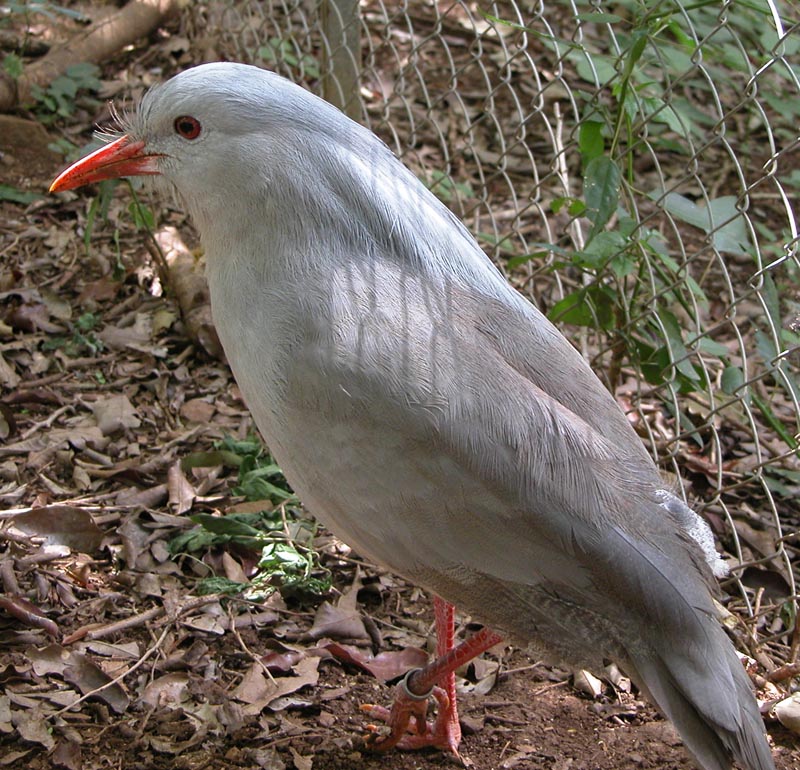
Although flightless, Kagus have large wings. They are medium-sized quite compact and agile birds that move surprisingly fast. Their dark-red eyes and orange-red, long legs and large bill contrast with their ash-gray and white plumage. A striking feature of the Kagu’s appearance, and usually concealed, is the patterning on the wings, which somewhat resembles that on the Sunbittern‘s wings. The patterning consists of a dominant design of black-and-white cross-bands with a smaller area of brown “overlay” also running across the primaries. Their long crest feathers extend to the lower back and are difficult to spot unless raised. The pattern on the wings of these birds resembles that of the Sunbittern’s wings…

Do we have the life pattern of The Sun of Righteousness in our lives? God has created us in His image; do we carry His image wherever we go?

So God created man in his own image, in the image of God created he him; (Genesis 1:27)

The Kagu is exclusively carnivorous, feeding on a variety of animals with annelid worms, snails and lizards being amongst the most important prey items…

Also taken are larvae, spiders, centipedes and insects such as grasshoppers, bugs, and beetles. The majority of the diet is obtained from the leaf litter or soil, with other prey items found in vegetation, old logs and rocks.

It possesses bright red legs and a similarly coloured bill, and has large eyes, positioned so that they give good binocular which is helpful in finding prey in the leaf litter and seeing in the gloom of the forest.

Their hunting technique is to stand still on the ground or from an elevated perch, and silently watch for moving prey. they must also use other means, like vibration and/or sound, to pinpoint out-of-sight prey in soil that they capture.

Sometimes Kagus will hunt small animals in shallow water. They may stand on one foot and move the leaf litter with the other foot in order to flush prey. Victory is not a guarantee, no matter how technically qualified we are.

Like the Kagu, our battle technique ought to stand still and watch God win the battle for us…

And all this assembly shall know that the LORD saveth not with sword and spear: for the battle is the Lord’s, and he will give you into our hands. (1 Samuel 17:47)

In addition to their song, Kagus are best known for their distinctive displays. For defense, the wings are opened to reveal their patterning and positioned forward-facing in an attention-grabbing display that might have acted to confuse past predators. This display is remarkably similar in form and function to the “frontal display” of the Sunbittern..

Kagus use a “strutting” display in courtship and in disputes with other birds. They take an upright pose with the crest raised and fanned and the wings held down and forward in the form of a cape. They then slowly circle around each other in a ballet-like dance.

A captured bird held by the feet will also instinctively open its wings to reveal the patterning and bring them together as “shields” to cover its head….

The Kagu played a part in some indigenous Kanak cultures; for example, Kagu feathers were worn by the chiefs and their song was used in war dances.

Kagus are considered very important in New Caledonia, it is a high profile endemic emblem for the Territory.

Its distinctive song used to be played to the nation every night as the island’s TV station signed off the air.

Kagus make a range of different sounds, most commonly duetting in the morning, each duet lasting about 15 minutes. Its survival is considered important for the nation’s economy and image…

Kagus seem to know the importance of corporate worship, is that why they sing duets every morning?

We may not be able to have corporate worship every morning, but, how many of us realize the importance of corporate worship at least on a Sunday morning?

Jesus said,

For where two or three are gathered together in my name, there am I in the midst of them. (Mathew 18:20)

This is what the Bible says about corporate worship…

Not forsaking the assembling of ourselves together, as the manner of some is; but exhorting one another: and so much the more, as ye see the day approaching. (Hebrew 10:25)

Our survival is important for the extension of God’s kingdom,so, let us live like JESUS and for JESUS…

Have a blessed day!

Your’s in YESHUA,
a j mithra

Please visit us at: Crosstree

Ian’s Bird of the Week – Southern Boobook

Southern Boobook (Ninox boobook) by Ian Montgomery

Southern Boobook ( Ninox boobook) by Ian Montgomery

Newsletter  5-4-2010

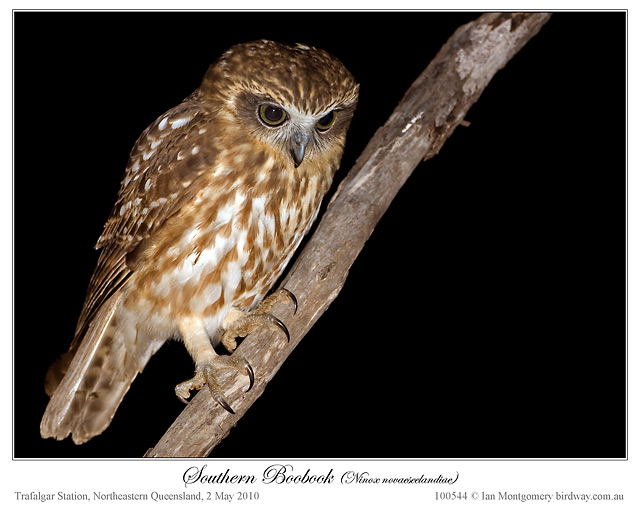
Here’s one for the lovers of owls – which, I imagine, includes almost everybody. This is the commonest and most widespread owl in Australia, and its plaintive ‘boobook’ or ‘morepork’ call is a familiar sound in a huge range of habitats from tropical rainforest, through leafy suburbs and city parks to almost treeless regions of the dry interior. Despite both its abundance and lots of effort on my part, it has eluded my camera since, as a graduate student, I took some slide photos of one through a window of the Zoology Department of Sydney University in the mid 1970s.

Southern Boobook (Ninox boobook) by Ian Montgomery

Southern Boobook (Ninox boobook) by Ian Montgomery

This weekend just past was the occasion of the AGM of Birds Australia North Queensland and it was held at a large cattle station (property) called Trafalgar about 50km southwest of Charters Towers outside Townsville. We went spotlighting in the station truck, ideally equipped for birding safari-style with two bench seats placed longitudinally back-to-back on the rear, on a clear Sunday night and after finding a rather flighty barn owl, we encountered a Boobook in a tree beside the road that was much more cooperative. Having photographed it from the truck, I eventually got down and set up the tripod much closer to the the owl. It stayed put, despite my flash and 3 spotlights and when we finally left, it was still there. The portrait in the first photo is in fact cropped from a photo that includes the whole bird, so you can appreciate that the conditions for photography were excellent.

Later we found a Tawny Frogmouth, also a willing subject, and on the road itself, a suicidal young Owlet-Nightjar – nearly got run over – which let me approach it so closely that I could no longer focus with my 500mm lens (minimum focusing distance 4.5m/15ft). The consensus seemed to be that it was the best night’s spotlighting ever. The clear sky with no light pollution meant that we could see both the Southern Cross and the Big Dipper/Plough simultaneously, and on the way back a just-past-full moon rose in the east.
The Boobook is a smallish owl ranging in size from 25-28cm/10-11in for males and 30-36cm/12-14in for females. This one seemed relatively large to me, so it was probably female. The current taxonomic treatment is to treat as a single species the various boobooks in Australia, New Zealand, southern New Guinea, Timor and some islands of eastern Indonesia. This leaves only the Sumba Boobook (Sumba is west of Timor) as a separate species, so there isn’t a ‘Northern’ Boobook as such.
Best wishes,
Ian
Links:

Barn Owl
Tawny Frogmouth
Australian Owlet-nightjar

Ian Montgomery, Birdway Pty Ltd,
454 Forestry Road, Bluewater, Qld 4818
Phone: +61-7 4751 3115
Preferred Email: ian@birdway.com.au
Website: http://birdway.com.au


Lee’s Addition:

Boobooks are in the Strigidae Family of the Strigiformes Order. I love that name. Not sure how it got it other than it’s sound.

Southern Boobook Audio from xeno-canto.org by Pakihi Okarito

But the cormorant and the bittern shall possess it; the owl also and the raven shall dwell in it: (Isa 34:11a)

Thousands of Eyes, But No Brain?

This is a copy of a neat article by April Lorier – “Thousands of Eyes, But No Brain?

April Lorier Perspective

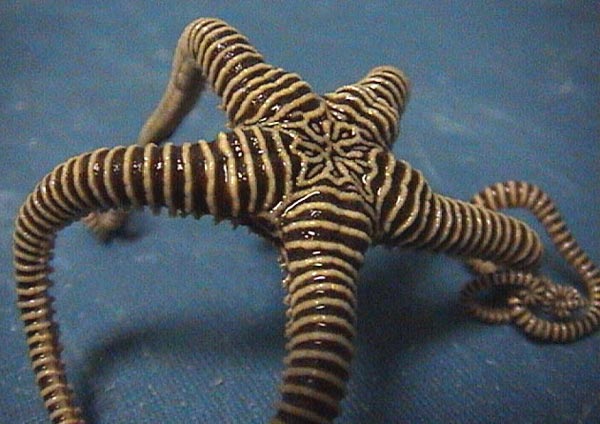
Brittlestar from Wikipedia

Brittlestar from Wikipedia

We generally associate eyes with our brain because they are two closely working parts of our nervous system. Our brain is necessary to interpret what our eyes see. However, the brittlestar, a relative of the starfish, has thousands of eyes and no brain.

The brittlestar’s body is covered with a pliable crystalline material. Inserted in this material are literally thousands of perfectly shaped lenses that collect light. Each of these lenses is about half the diameter of a human hair.

Researchers commented that these lenses are much finer than anything we can engineer. Studies show that all of these lenses work together to act as one giant eye. They seem to work rather like the compound eye of the fly. The lenses focus incoming light on photoreceptors.

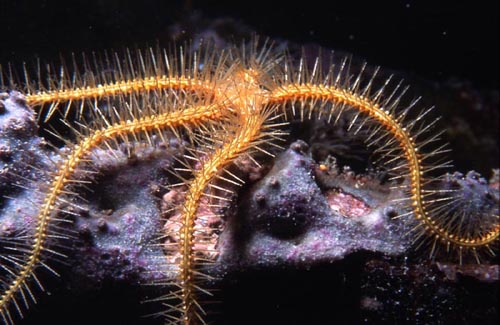
Brittlestar ©Rachel Graham

Brittlestar ©Rachel Graham

Researchers believe that this arrangement allows the brittlestar to form a rough image of its surroundings and tell what time of day it is. If the light becomes too bright, the brittlestar can darken its skin, in effect, putting on sunglasses. Even more amazing is that the brittlestar does all of this, despite the fact that it doesn’t have a brain! As one researcher put it, “This is very clever engineering.”

The wonders that have come from God’s creative hand can lead even evolutionists to use the language of creation. Yet, God’s greatest wonder is His plan for our salvation.

2010 Christian Nature

“Better is the sight of the eyes than the wandering of the desire…” Ecclesiastes 6:9a —

References: Discover, 11/01, p. 16.

Used with permission of April Lorier.

See more of April’s articles.

*

Three-wattled Bellbird – The Noise Maker

Three-wattled Bellbird – The Noise Maker  by a j mithra

Three-wattled Bellbird (Procnias tricarunculata) Immature male by Kent Nickell

Three-wattled Bellbird (Procnias tricarunculata) Immature male by Kent Nickell

The Three-wattled Bellbird lives between eastern Honduras and western Panama. In Costa Rica it lives on both slopes of the country..

It breeds in the cloud forests and in the foothill and highland moist forest at 1,200-2,100 m, and occasionally down to 750 m. In the non-breeding season, birds undertake complex migrations ranging up to 3,000 m (in Costa Rica), and then descending to the foothills and lowlands on both the Pacific and Caribbean slopes…

There is protection, anointing and guidance under the Pillar of the Cloud…
These birds seem to know the secret of living a protected life under the clouds..

The Bible says that we are the temple of the Living God, but, can we say that, we dwell under the Pillar of the Cloud?

During the days of Moses, the Pillar of the Cloud hovered above the tabernacle, from where Moses took orders from the Lord…
From where do we take orders? Man or God?

And it came to pass, as Moses entered into the tabernacle, the cloudy pillar descended, and stood at the door of the tabernacle, and the LORD talked with Moses. (Exodus 33:9)

Maybe that is the reason that, we are not able to hear the voice of the Lord…

Three-wattled Bellbird © Pete Morris

Three-wattled Bellbird © Pete Morris

The Three-Wattled Bellbird swallows the fruits of trees, particularly those in the Lauraceae family, of which the avocado is a member. Avocados, known as Butter-fruit in India, have the highest protein content of any fruit. Avocados contain more potassium than bananas. One avocado contains 81 mcg of lutein, an important nutrient for healthy eyes. Leaf and seed extracts have been used for a variety of medical application, including treatment of diarrhea and dysentery and as an antibiotic.

What kind of food do we eat?
These birds not only eat healthy food, but they eat medicinal food too..
People spend more money on medicine rather than on food..

Why?

Is it because, now a days, people don’t eat to live, but they live to eat..

And put a knife to thy throat, if thou be a man given to appetite. (Proverbs 23:2)

At close range, the vocalization of many in Costa Rica is heard as a complex three-part song, is thought to be among the loudest bird calls on Earth, audible to humans from over 0.5 mi (0.80 km) away. The song is different in Nicaragua and in also Panama, and these songs also include an extremely loud, but less bell-like, note.

Based on limited spectral analysis, researchers believe that the Bell-bird makes its unusual anvil-like sound by singing up to three notes simultaneously. This is a trick which takes the young birds a while to perfect. This one seems to be producing pitches of roughly 1280, 1365, and 1450 Hz, approximately E6, F6, and F-sharp6 in the musical scale. These three notes, each a semi-tone apart, produce a very rough, dissonant “bonk” giving the bird its name.

A link to the Three-wattled Bellbird. A male is displaying and you can hear his call, by Max Roth.

http://ibc.lynxeds.com/video/three-wattled-bellbird-procnias-tricarunculatus/male-displaying-treetop-perch

The three-wattled bellbird, which inhabits the cloud forests, is rarely seen in the mist-shrouded treetops, though the male’s eerie call, described as a “ventriloqual bonk!’ haunts the rainforest… as long as the sun is shining.

The purpose for which God created us is to worship and worship alone…
But, are we worshipping the Lord at all times or just in a Sunday morning service?

These Birds may not have a song but still their BONK saves them from predators…

You may not have a good voice but still your noise can frighten the devil..
You know? God loves your NOISE and not your VOICE…

These birds sing as long as the sun is shining..

We, the church too can sing only as long as the Sun of Righteousness shines on us..
Darkness is fast descending, let us keep singing , for the hour of the Lord has come..
If we don’t sing here, how can we sing in heaven?
After all, only practice makes us perfect…

The dead praise not the LORD, neither any that go down into silence. (Psalm 115:17)

Have a blessed day!

Your’s in YESHUA,
a j mithra

Please visit us at:  Crosstree

Lee’s Addition:

The four Bellbirds are in the Cotingidae Family of the Passerifromes Order. The Cotinga family has Bellbirds (4), Cotingas (25), Plantcutter (3), Berryeater (2), Fruiteater (12), Cock-of-the-rock (2), Phia (9), Fruitcrow (4), Capuchinbird (1), and Umbrellabird (3). They all seem to have interesting names.