Canary (yellow) White-eye (Zosterops luteus) by Ian
Ian’s Bird of the Week – Yellow White-eye ~ by Ian Montgomery
Newsletter – 4/15/11
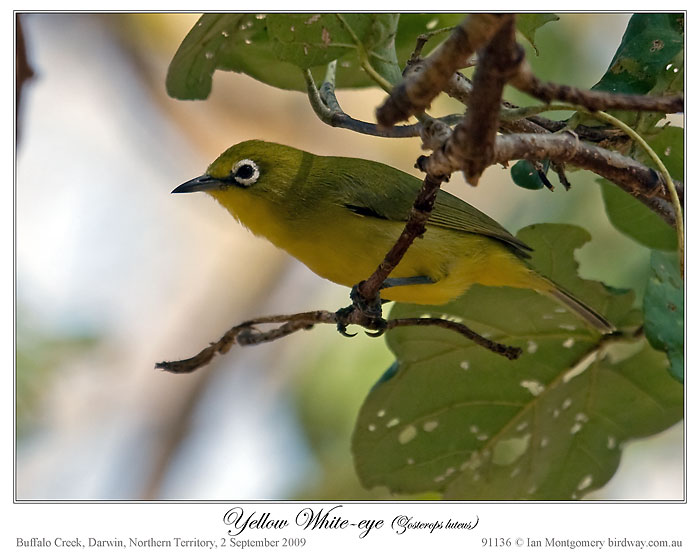
This week’s bird, the Yellow White-eye is a mangrove-dwelling relative of the widespread and familiar Silvereye. While the Silvereye is well-known in gardens and orchards of all the more densely populated areas of mainland Australia and Tasmania, the Yellow White-eye is confined to coastal areas of northern Western Australia, the Northern Territory and northwestern Queensland with one very isolated population near Ayr south of Townsville. So you have to go out of your way to find it, but it is quite common in suitable habitat within its range.
Canary (yellow) White-eye (Zosterops luteus luteus) by Ian
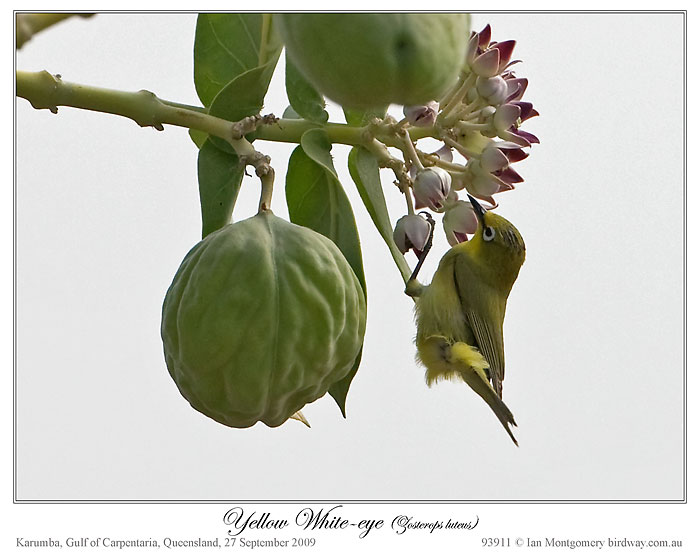
The first photo was taken at Buffalo Creek near Darwin and the second near Karumba on the southern end of the Gulf of Carpentaria. Incidentally, I’d be interested to hear from anyone who can identify the pink-flowered shrub with the White-eye-sized fruit (Yellow White-eyes are 11-12cm/4.3-4.7in). Birds from these regions are yellower than the Western Australian birds and some taxonomists split the species into two sub-species. These yellower northern and eastern birds belong to the nominate race luteus while the greener birds in Western Australia belong to the race balstoni.
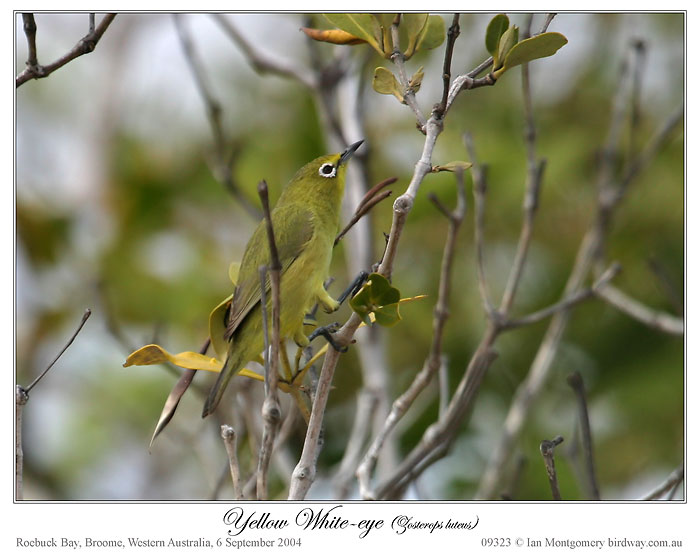
The third photo was taken at Roebuck Bay near the Broome Bird Observatory and belongs to this greener race. The difference is subtle and I imagine you would need to compare birds directly to see the distinction. More striking is how well the plumage matches the colour of the leaves of the mangroves. Like Silvereyes, Yellow White-eyes are very lively and vocal so if they are around, they are not hard to find.
Canary (yellow) White-eye (Zosterops luteus balstoni) by Ian
The apparently endless wet season has finally ended in North Queensland and this week we have all been enjoying lovely sunny days and moonlit nights. I’m making preparations to travel with friends to the Easter campout being organised by the Northern NSW group of Birds Australia in Baradine in the Pilliga Scrub/Forest between Coonabarabran and Narrabri. There are some interesting birds there (I have my sights set on Turquoise Parrot) and I hope I’ll be able to share some of them with you.
Best wishes,
Ian
—
Ian Montgomery, Birdway Pty Ltd,
454 Forestry Road, Bluewater, Qld 4818
Phone: 0411 602 737 +61-411 602 737
Preferred Email: ian@birdway.com.au
Website: http://birdway.com.au
Thanks for introducing us to another interesting bird. The I.O.C. World Bird List has this bird as the Canary White-eye. This is another example of why the Scientific names are important. No matter what the bird is called, the scientific name assures that the same bird is being described.
I am trusting Ian will be able to capture through his lens that Turquoise Parrot. That sounds like another neat bird.
Keep me as the apple of the eye, hide me under the shadow of thy wings, (Psalms 17:8 KJV)
Beside them the birds of the heavens dwell; they sing among the branches…. O LORD, how manifold are your works! In wisdom have you made them all; the earth is full of your creatures. (Psalms 104:12, 24 ESV)
It has been hard to find the time lately to go out on a birdwatching trip, but we have been seeing quite a few birds. Do you ever have times like that? Unfortunately, those are the times when you see some interesting bird, but you are not prepared to take a photo or have a notepad at hand. That has been the case with us recently. Though a true bird watcher is always on the lookout for avian friends to view.
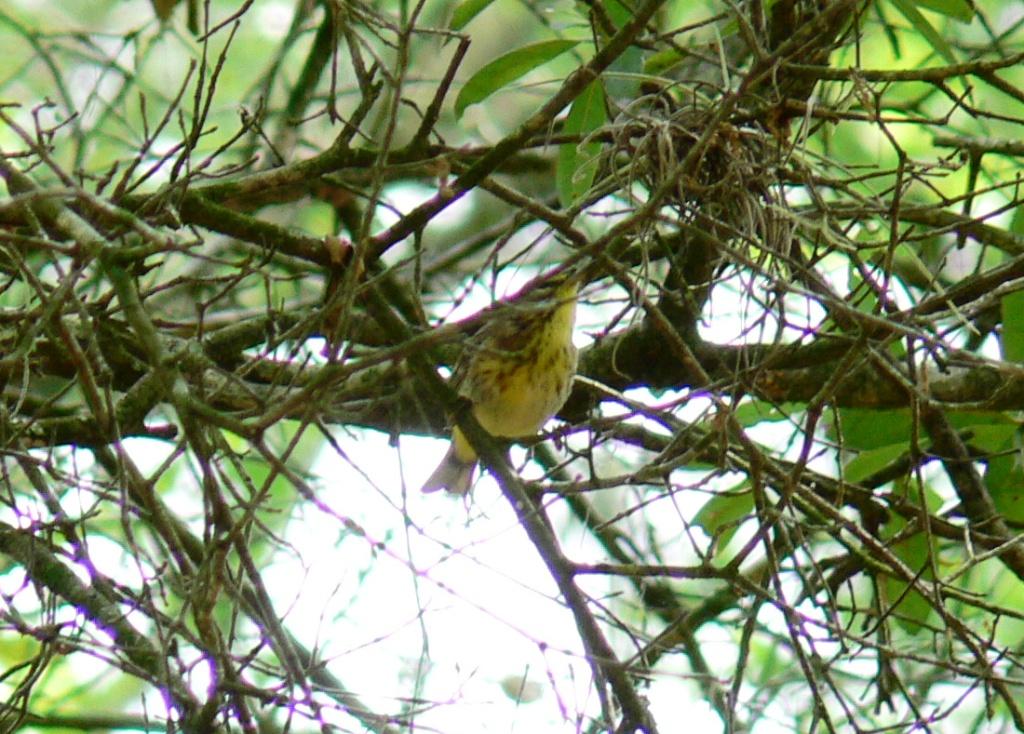
Unknown Warbler by Lee
We’ve had company, my sister and her husband, a short family reunion out of town, and a trip to South Carolina, and on and on. By the time we get a chance to go out with cameras in hand, all of our birds will have flown back north for the summer. Oh, well! Those of you who live north of us will be glad to see their feathered friends arrive and start their nesting season. Take good care of them and send them back to us in the fall.
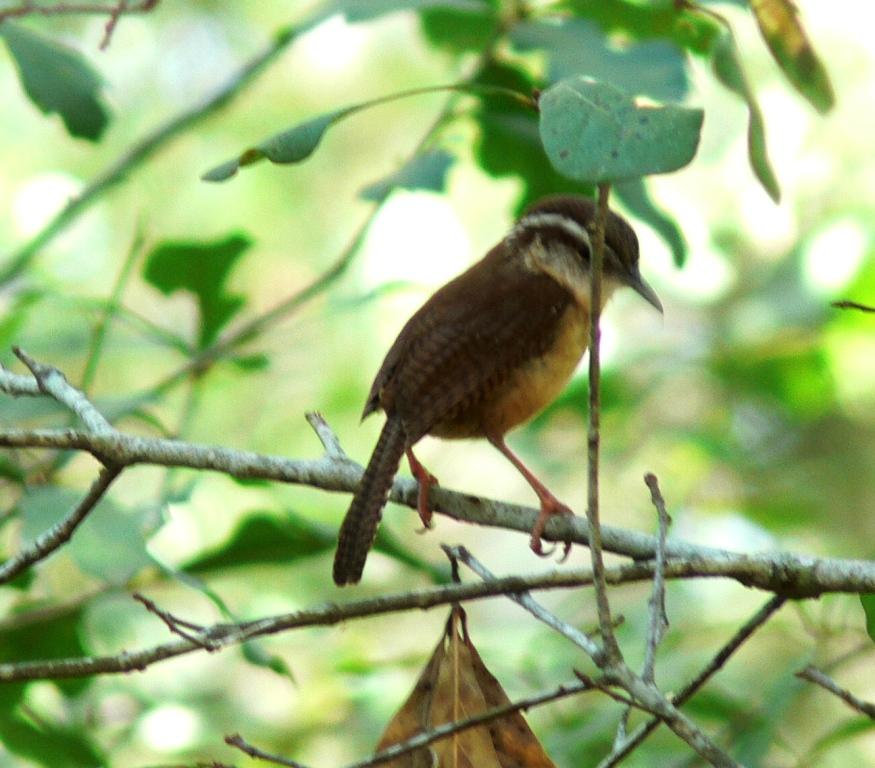
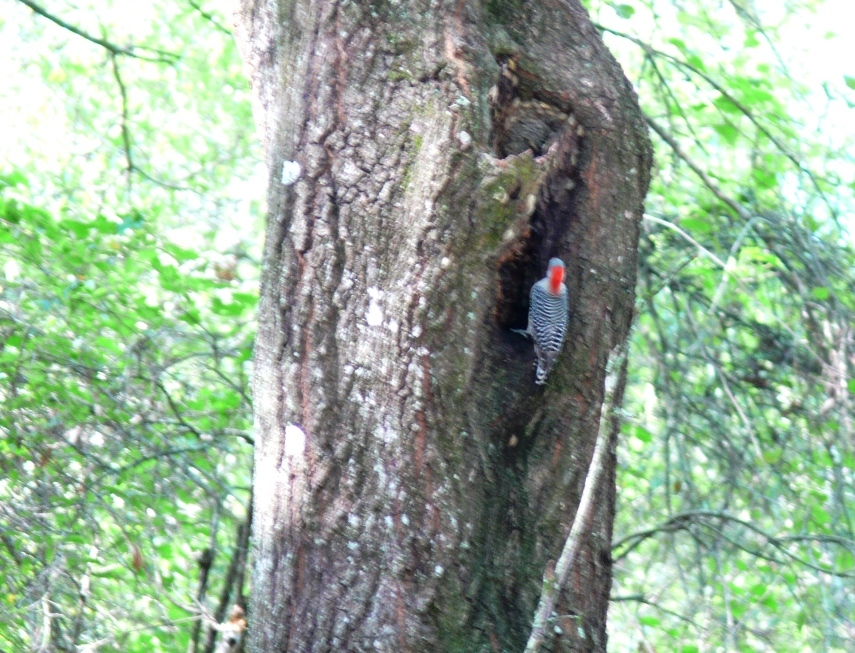
We have seen some birds we don’t normally see here near the house. At my brothers, near Webster, FL, we either heard or saw Pileated Woodpeckers and Red-bellied Woodpeckers, Blue Jays, Carolina Wren, Tufted Titmice, Mourning Dove, American Crow, and an unknown to me warbler. We watched the Red-bellied coming in an out of a nest. Did have a camera, but not the normal one. Not the best photo. At my feeder, I spotted a House Finch that was an orange variant. In our neighborhood recently I spotted a Pileated Woodpecker, Lesser Yellowlegs, and a baby Sandhill Crane with its parents.
Red-bellied Woodpecker (Melanerpes carolinus) by Lee
Being at my brother’s house, which is in a very wooded area, helped me realize that I need more practice hearing and identifying birds by their sounds. It was hard to spot most of them, but they were there singing and calling, but my lack of practice, made it hard to put names on them. There are many good programs and websites that can help teach the sounds.
All of this was said to encourage you to stay alert to what is around you. Planned or unplanned, birdwatching is always interesting and many times surprises comes in to view or a sound comes into your ear.
The I.O.C Version 2.8 of the World Bird List is out and the Birds of the World is being updated.
P.S. If you know what that bird is, please leave a comment.
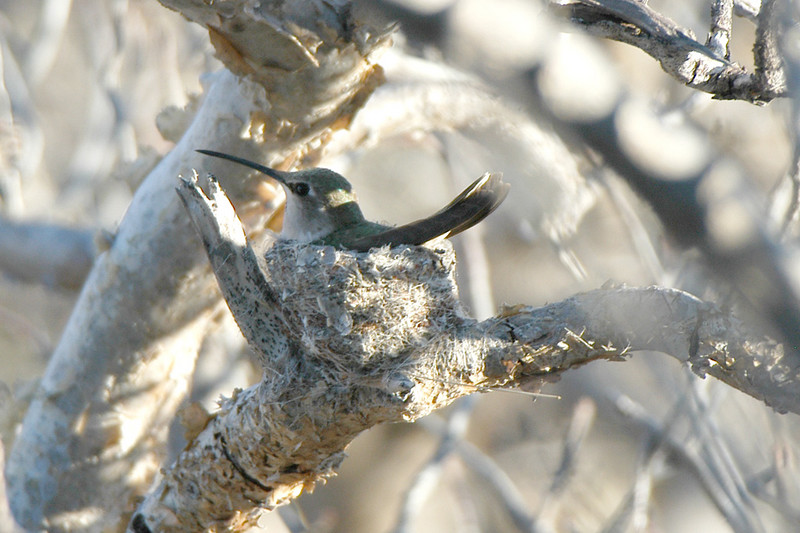
Costa's Hummingbird on Nest (Calypte costae) by Bob-Nan
Based on:
Let us be glad and rejoice, and give honour to him: for the marriage of the Lamb is come, and his wife hath made herself ready. (Revelation 19:7 KJV)
Words by – Anne R. Cousin, in The Christian Treasury, 1857.
From this hymn came the title of Cousin’s 1876 work, Immanuel’s Land and Other Pieces by A. R. C.
Music: Rutherford, Chrétien d’Urhan, 1834; arranged by Edward F. Rimbault, 1867
The Sands of Time Are Sinking
The sands of time are sinking, the dawn of Heaven breaks;
The summer morn I’ve sighed for—the fair, sweet morn awakes:
Dark, dark hath been the midnight, but dayspring is at hand,
And glory, glory dwelleth in Immanuel’s land.
O Christ, He is the fountain, the deep, sweet well of love!
The streams on earth I’ve tasted more deep I’ll drink above:
There to an ocean fullness His mercy doth expand,
And glory, glory dwelleth in Immanuel’s land.
Oh! Well it is forever, Oh! well forevermore,
My nest hung in no forest of all this death doomed shore:
Yea, let the vain world vanish, as from the ship the strand,
While glory—glory dwelleth in Immanuel’s land.
There the red rose of Sharon unfolds its heartsome bloom
And fills the air of Heaven with ravishing perfume:
Oh! To behold it blossom, while by its fragrance fanned
Where glory—glory dwelleth in Immanuel’s land.
The King there in His beauty, without a veil is seen:
It were a well spent journey, though seven deaths lay between:
The Lamb with His fair army, doth on Mount Zion stand,
And glory—glory dwelleth in Immanuel’s land.
Oft in yon sea beat prison My Lord and I held tryst,
For Anwoth was not Heaven, and preaching was not Christ:
And aye, my murkiest storm cloud was by a rainbow spanned,
Caught from the glory dwelling in Immanuel’s land.
But that He built a Heaven of His surpassing love,
A little new Jerusalem, like to the one above,
“Lord take me over the water” hath been my loud demand,
Take me to my love’s own country, unto Immanuel’s land.
But flowers need night’s cool darkness, the moonlight and the dew;
So Christ, from one who loved it, His shining oft withdrew:
And then, for cause of absence my troubled soul I scanned
But glory shadeless shineth in Immanuel’s land.
The little birds of Anwoth, I used to count them blessed,
Now, beside happier altars I go to build my nest:
Over these there broods no silence, no graves around them stand,
For glory, deathless, dwelleth in Immanuel’s land.
Fair Anwoth by the Solway, to me thou still art dear,
Even from the verge of Heaven, I drop for thee a tear.
Oh! If one soul from Anwoth meet me at God’s right hand,
My heaven will be two heavens, In Immanuel’s land.
I’ve wrestled on towards Heaven, against storm and wind and tide,
Now, like a weary traveler that leaneth on his guide,
Amid the shades of evening, while sinks life’s lingering sand,
I hail the glory dawning from Immanuel’s land.
Deep waters crossed life’s pathway, the hedge of thorns was sharp;
Now, these lie all behind me Oh! for a well tuned harp!
Oh! To join hallelujah with yon triumphant band,
Who sing where glory dwelleth in Immanuel’s land.
With mercy and with judgment my web of time He wove,
And aye, the dews of sorrow were lustered with His love;
I’ll bless the hand that guided, I’ll bless the heart that planned
When throned where glory dwelleth in Immanuel’s land.
Soon shall the cup of glory wash down earth’s bitterest woes,
Soon shall the desert briar break into Eden’s rose;
The curse shall change to blessing the name on earth that’s banned
Be graven on the white stone in Immanuel’s land.
O I am my Beloved’s and my Beloved’s mine!
He brings a poor vile sinner into His “house of wine.”
I stand upon His merit—I know no other stand,
Not even where glory dwelleth in Immanuel’s land.
I shall sleep sound in Jesus, filled with His likeness rise,
To love and to adore Him, to see Him with these eyes:
’Tween me and resurrection but paradise doth stand;
Then—then for glory dwelling in Immanuel’s land.
The bride eyes not her garment, but her dear bridegroom’s face;
I will not gaze at glory but on my king of grace.
Not at the crown He giveth but on His piercèd hand;
The Lamb is all the glory of Immanuel’s land.
I have borne scorn and hatred, I have borne wrong and shame,
Earth’s proud ones have reproached me for Christ’s thrice blessed name:
Where God His seal set fairest they’ve stamped the foulest brand,
But judgment shines like noonday in Immanuel’s land.
They’ve summoned me before them, but there I may not come,
My Lord says “Come up hither,” My Lord says “Welcome home!”
My king, at His white throne, my presence doth command
Where glory—glory dwelleth in Immanuel’s land.
Old School House in Anwoth, Scotland
Anwoth is a settlement near the Solway Firth in the Stewarty of Kirkcudbright, in South West Scotland, within a parish of the same name in the Vale of Fleet, Dumfries and Galloway. Anwoth lies a mile (1.5 km) to the west of Gatehouse of Fleet.
Anwoth’s most famous inhabitant was the Rev. Samuel Rutherford (1600? – 1661), who was the minister at Anwoth Old Kirk from 1627 until 1636 when he was banished to Aberdeen. On a nearby hill, there is Rutherford’s Monument, a 55 foot high granite obelisk erected in 1842. A millennium cairn opposite the monument lists the names of all the ministers of Anwoth and Girthon until the year 2000 when it was erected. The Old Kirk was in use until 1825, but is now just a ruin.
West Anwoth Parish Church was built in 1826–1827. It is a Walter Newall Gothic box style church with tower and hood-moulded windows. It closed in 2002.
The Church of Scotland sold the Church to a neighbouring family who now keep it as a hall fo ceremonies and parties. The church was re-roofed in 2007 and is being kept in the best of condition.
An ancient fort on nearby Trusty’s Hill was occupied by Iron Age people and may have been attacked and burned by a Pictish raiding party, who carved a series of symbol stones in a rock beside the entrance passage.
Anne Ross Cousin’s hymn, The Sands of Time are Sinking, mentions Anwoth, because of its historic spiritual connection with Samuel Rutherford. Verses 9 & 10 of her original nineteen stanza poem are:
The little birds of Anwoth, I used to count them blessed,
Now, beside happier altars I go to build my nest:
Over these there broods no silence, no graves around them stand,
For glory, deathless, dwelleth in Immanuel’s land.
Fair Anwoth by the Solway, to me thou still art dear,
Even from the verge of heaven, I drop for thee a tear.
Oh! If one soul from Anwoth meet me at God’s right hand,
My heaven will be two heavens, In Immanuel’s land.
Sources – CyberHymnal and Wikipedia
*
Another great hymn by Anne R. Cousin is worth listening to an meditating on the words. She sums up what we desire for all who visit this blog.
Is Jesus Able To Redeem?
Based on:
Come unto me, all ye that labour and are heavy laden, and I will give you rest. (Matthew 11:28 KJV)
Words: Anne R. Cousin (1824-1906).
Music: Esrom, Ira D. Sankey (1840-1908)
Is Jesus able to redeem
A sinner lost, like me?
My sins so great, so many seem!
O sinner, “come and see.”
The blood that Jesus shed of old
Was shed for you and me:
And there is room within the fold—
O “come to Him and see.”
Is Jesus willing to forgive
A rebel child, like me?
Who would not in His favor live?
O rebel, “come and see.”
The blood that Jesus shed of old
Was shed for you and me:
And there is room within the fold—
O “come to Him and see.”
Is Jesus waiting to relieve
A wanderer, like me,
Who chose the Father’s house to leave?
O wanderer, “come and see.”
The blood that Jesus shed of old
Was shed for you and me:
And there is room within the fold—
O “come to Him and see.”
Is Jesus ready now to save
A guilty one, like me,
Who brought Him to the cross and grave?
Come, guilty one, and see.
The blood that Jesus shed of old
Was shed for you and me:
And there is room within the fold—
O “come to Him and see.”
*
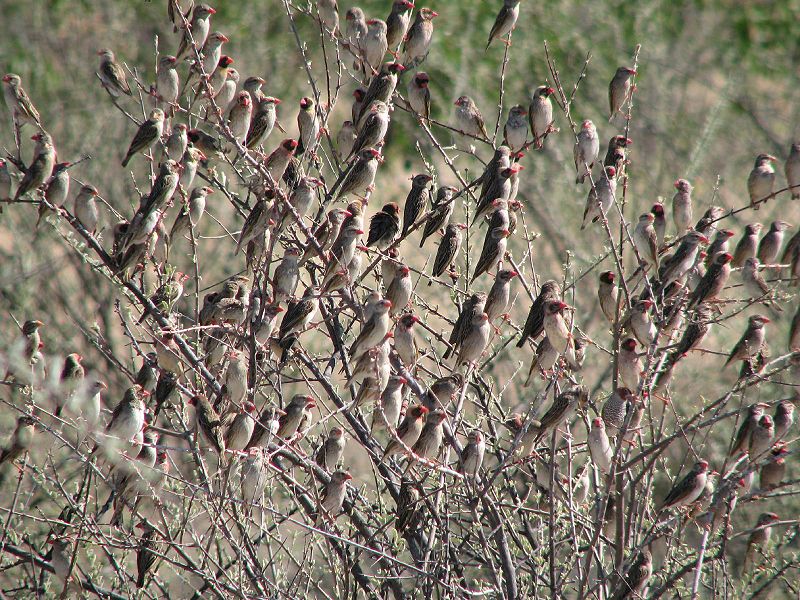
Red-billed Quelea – Unity Unplugged ~ by a j mithra
The term quelea bird usually refers to the species Quelea quelea, the Red-billed Quelea, native to bush, grasslands, and savannahs of sub-Saharan Africa. Red-billed Quelea is one of the weavers, birds that build elaborate enclosed nests by weaving together strands of grass and other plant materials. There are more than one hundred species of weavers—most of them live in Africa, but others are found in the Arabian Peninsula, India, Southeast Asia, China, and Indonesia.
Most weavers don’t clash with humans, but a flock of Red-billed Quelea, sometimes called locust birds, is a flock of pest birds that African farmers fear. Red-billed Quelea live and breed in huge flocks which can take up to 5 hours to fly past.
They live mostly in steppe and savanna regions, but do not avoid human settlements. While foraging for food they may fly large distances each day without tiring. Their life expectancy is two to three years.
The unity found in these birds is amazing…
Sometimes it takes about five hours for a single flock to fly past..
How many seats are filled in our churches every Sunday?
Though we say that we live as a family, unity is found wanting in most Christian families..
If only each family is bound together by the chord of His love, there would be a great revival in our churches…
After all ministry starts at home isn’t it?
I appeal to you, brothers, in the name of our Lord Jesus Christ, that all of you agree with one another so that there may be no divisions among you and that you may be perfectly united in mind and thought. (1 Corinthians 1:10)
They never tire to fly long distances each day in search of food…
How far do we seek as a family in search of spiritual food?
This is the thing which the LORD hath commanded, Gather of it every man according to his eating, an omer for every man, according to the number of your persons; take ye every man for them which are in his tents. And the children of Israel did so, and gathered, some more, some less. And when they did mete it with an omer, he that gathered much had nothing over, and he that gathered little had no lack; they gathered every man according to his eating. (Exodus 16:16-18)
Each person’s daily quota of manna is about 2 litres..
How much of spiritual manna do we have each day?
If our spiritual strength depends upon the intake of spiritual manna, we need to check how strong we’re in spirit…
Found in bush, grassland, cultivation and savannah this is one of Kenya’s most studied birds. It is, to put it bluntly, the greatest avian agricultural pest in the whole of the Afrotropical region. Being highly gregarious as well as nomadic, flocks containing hundreds of thousands and sometimes even millions of individuals can devastate cereal crops. They roost in such massive numbers that they can break thick tree branches.
These small 20 gram birds can break thick tree branches, but, God doesn’t need a big army to bring Deliverance to His people…
The unity of Jonathan and his arm bearer brought deliverance to Israel..
The unity of just 300 of Gideon’s men was enough to bring deliverance to his people..
We as a church are not able to break satan’s plans, why?
It is not because of the dwindling number in our churches or the lack of unity?
If unity is lost, how is it possible to overcome the enemy and how is it possible to extend the kingdom of God?
For where two or three are gathered together in my name, there am I in the midst of them. (Mathew 18:20)
When God comes amongst us, we can surely say,
And those he predestined, he also called; those he called, he also justified; those he justified, he also glorified. What, then, shall we say in response to these things? If God is for us, who can be against us? (Romans 8:30-31)
At first light the flocks leave their roost to go for water and from a distance it looks as though a grass fire has started. The Queleas form into dense, highly synchronised flocks which look like clouds of smoke, and then, as the flock approaches you, the numbers are so vast their wing-beats sound like a high wind.
These birds go in search of water at the first light of the day..
We say that Jesus is the living water, but do we drink Him at the first light of the day?
Doctors say that drinking water the first thing in the morning, heals a lot of ailments from diabetes to ulcer..
If water can bring healing to our body, how much healing can the Living water bring to our body, mind and soul?
Jesus answered and said unto her, Whosoever drinketh of this water shall thirst again: But whosoever drinketh of the water that I shall give him shall never thirst; but the water that I shall give him shall be in him a well of water springing up into everlasting life. (John 4:13-14)
The flock breeds at times of abundant rainfall and young are ready to move with the nomadic flock within six weeks—often coinciding with the ripening of grain crops. A nesting colony of Red-billed Quelea can extend over hundreds of acres, and a single flock may number millions of birds, moving together in a synchronized fashion.
A flock of Red-billed Quelea has been described as looking like a rolling cloud passing over a grain field or a grass fire sweeping over the grassland. It might as well be a grass fire, for when a huge flock of these bird pests leaves a field of millet, sorghum, or other cereal crop, scarcely a grain will be left behind. Grasses and cultivated wheat crops are highly attractive to them, and wherever there is grain and a source of water in Africa, there is a risk of a quelea bird outbreak.
The food of the Red-billed Quelea consists of annual grasses, seeds and grain. As soon as the sun comes up, they come together in their huge flocks and co-operate in finding a suitable feeding place.
Every day the Sun of Righteousness comes up in our lives, but, the question is, do we come together and most importantly co-operate in finding a suitable feeding place..
It has become a fashion for the members of a family to go to different churches on Sundays..
Where is the co-operation?
It has become a thing of the past for a family to sit together during taking part in the breaking of bread…
Should we not learn from these birds about finding a suitable feeding place together?
The Bible encourages corporate feeding..
Well, Jesus Himself set an example of corporate feeding when He fed the multitudes and also during the last supper…
And he commanded them to make all sit down by companies upon the green grass. And they sat down in ranks, by hundreds, and by fifties. And when he had taken the five loaves and the two fishes, he looked up to heaven, and blessed, and brake the loaves, and gave them to his disciples to set before them; and the two fishes divided he among them all. And they did all eat, and were filled. (Mark 6:39-42)
After a successful search, they settle rapidly and can cause serious damage to crops. In the middle part of the day they rest in shady areas near water and preen. Birds seem to prefer drinking at least twice a day. In the evening they once again fly in search of food.
How much we can learn from these birds…
They search for food together, seek water together twice every day, they preen together, and even fly again in the evening in search of food..
They are so sure about the power of staying together…
The Bible tells us so much about the power of staying together, but do we live like these bird? Let us live together like Psalm 133.
Breeding is localized and erratic but often colonies include tens of thousands to millions of pairs. The breeding season begins with the seasonal rains, which come at different times in different parts of their range – starting at the north-western edge around the beginning of November. The breeding males first weave half-complete ovoid nests from grass and straw. After the female has examined the construction and the mating has occurred, This mating style of these birds remind us of what Jesus said before ascending to heaven..
And if I go and prepare a place for you, I will come again, and receive you unto myself; that where I am, [there] ye may be also. (John 14:3)
The female lays two to four light blue eggs, and incubates them for twelve days. After the chicks hatch, they are nourished for some days with caterpillars and protein-rich insects. After this time parents change to mainly feeding seeds.
The young birds fledge and become independent enough to leave their parents after approximately two weeks in the nest. They are sexually mature after just one year, but many birds die before reaching this stage and males may weave nests that go unused if the female dies.
These males weave the nest that go unused if the female dies..
Is the church dead or alive?
Let us not be complacent for Jesus may use the unused if His bride, the church is dead…
Let us examine if we still have life or if we live like white washed graves…
The dead praise not the LORD, neither any that go down into silence. (Psalm 115:17
And to every beast of the earth, and to every fowl of the air, and to every thing that creepeth upon the earth, wherein there is life, I have given every green herb for meat: and it was so. (Genesis 1:30 KJV)
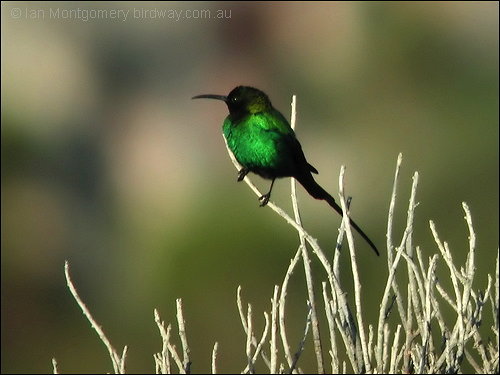
God has created an amazing bird, the Malachite Sunbird, and a beautiful flower, Babiana Ringens or “Rat’s Tail,” that both need one another to help meet their needs. The bird wants the nectar the flower produces and the flower needs to pollinate and is helped by the birds feathers. To help the two, the flower was created with a perch for the “long-tailed” bird to perch on while drinking nectar.
“Babiana ringens has a bright red floral display situated close to ground level . Its red colour , long corolla tubes and copious nectar supply make it attractive to sunbirds, which seem to be the primary pollinators of this plant. A strange, fleshy, twig-like structure projects above the plant giving it the common name of “rotstert ” or “rat’s tail.” The sole function of this twig-structure is that it provides a perching platform for sunbirds, which presumably “feel more comfortable” pollinating the plant from this vantage point than from the ground (Anderson et al. 2005). Having this perch increases outcrossing rates and positions birds correctly for efficient pollen transfer (Anderson et al. 2005). Anderson et al. (2005) also showed that male sunbirds were more particular about the presence or absence of a perch which they ascribed to territoriality or perhaps because using a perch is less likely to damage the long tail sported only by males than if they used the ground. This is arguably the most specialized bird perch in the world.” (To see whole article – Click Here)
Praise the LORD from the earth, ye dragons, and all deeps … Beasts, and all cattle; creeping things, and flying fowl… (Psalm 148:7, 10)
Could a plant devise a special growth for itself so that it becomes inviting to its only pollinator? If evolution was true, how could such a plant survive until it could learn enough about its pollinator, and about genetics, to evolve a special growth just for that pollinator.
Those sound like silly questions, but if evolution is true, they must be answered, and answered scientifically. A South African plant called the “Rat’s Tail” grows a seemingly purposeless spear that extends near its flowers. Theorizing that the spear might be a bird-perch for a pollinator, scientists closely watched some of the plants in the wild. They learned that the only bird that seems interested in pollinating the plant is a bird called the “Malachite Sunbird.” The scientists then removed the spikes from some of the plants. The result was that male sunbirds were far less likely to visit and pollinate those plants. As a result, perchless-plants only produced half as many seeds as plants with perches. Researchers pointed out that this arrangement makes sense because male sunbirds have long tails that can be damaged by ground landings.
However, if we conclude that the Rat’s Tails were created for the sunbirds, and the sunbirds for the Rat’s Tails, we don’t have to find natural explanations for such silly questions. This is simply another of God’s clever designs.
Prayer:
Lord, Your caring hand is all around us. I thank You especially for caring for me by forgiving my sins. Amen.
Notes:
Science News, 6/4/05, p. 365, “Built-in bird perch spreads the pollen.”
___
The breeding male Malachite Sunbird, which has very long central tail feathers, is 25cm long, and the shorter-tailed female 15 cm. The adult male is metallic green when breeding, with blackish-green wings with small yellow pectoral patches. In non-breeding (eclipse) plumage, the male’s upperparts are brown apart from the green wings and tail, the latter retaining the elongated feathers. The underparts in eclipse plumage are yellow, flecked with green.
The female has brown upperparts and dull yellow underparts with some indistinct streaking on the breast. Her tail is square-ended. The juvenile resembles the female.
This species, like most sunbirds, feed mainly on nectar, although they will also take insects, especially when feeding young. This sunbird may hunt in a similar manner to a flycatcher, hawking for insect prey from a perch. Most sunbird species can take nectar by hovering like a hummingbird, but usually perch to feed most of the time. As a fairly large sunbird, the Malachite Sunbird is no exception. They have long thin down-curved bills and brush-tipped tubular tongues, both adaptations to nectar feeding.
Ian’s Bird of the Week – Little Egret ~ by Ian Montgomery
Newsletter ~ 4/6/11
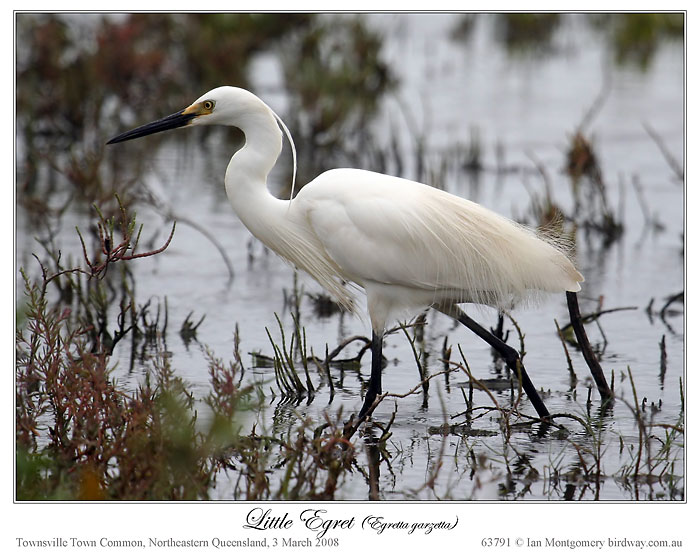
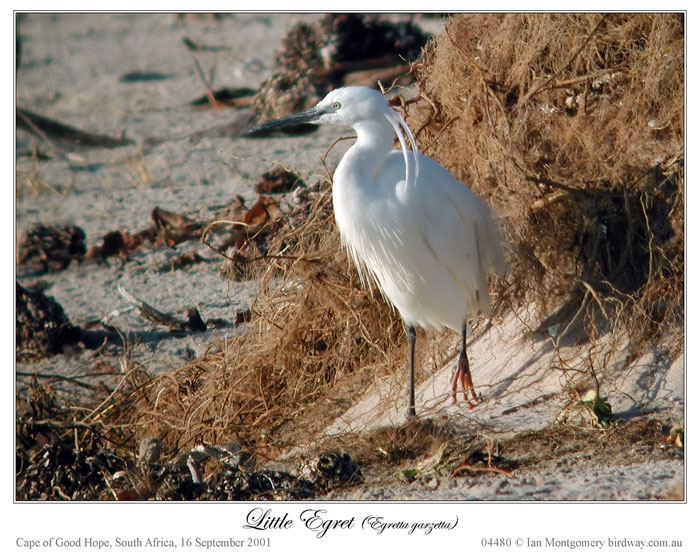
I’ve recently been updating the Heron and Egret galleries (Ardeidae) on the website and I noticed that the elegant Little Egret hadn’t yet featured as bird of the week. Its one of five species of egret resident in Australia and in breeding plumage it is easily distinguished by the only one to have a pair of head plumes – as in the first photo – in addition to breast and back plumes. The only other egrets globally with these head plumes are the closely related Snowy Egret of the Americas and the possibly conspecific Western Reef Egret, neither of which has been recorded in mainland Australia (there are records of the Western Reef Egret in the Cocos Islands).
Little Egret (Egretta garzetta) by Ian
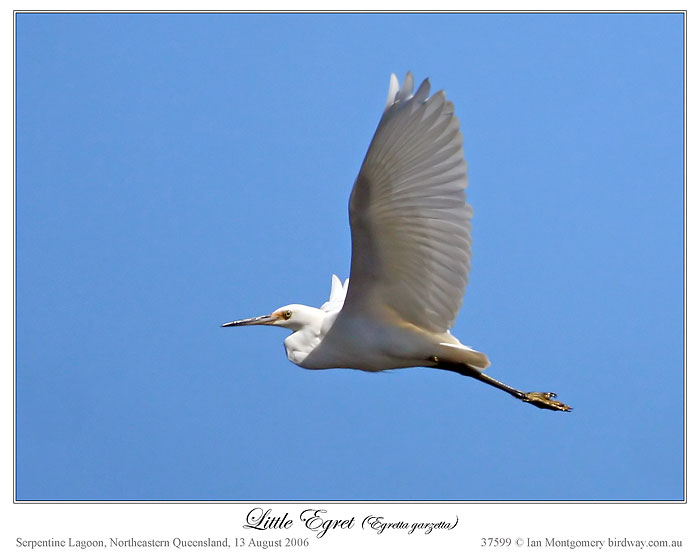
In non-breeding plumage, it lacks plumes and is most easily separated from the similarly-sized Intermediate Egret by having a dark bill rather than a yellow or orange one. It’s best and worst field mark is the yellowish feet – best because this feature is shared only with Snowy and Western Reef Egrets and worst because you usually can’t see the colour of the feet in their normal habitat – wetlands – though visible in flight as in the second photo.
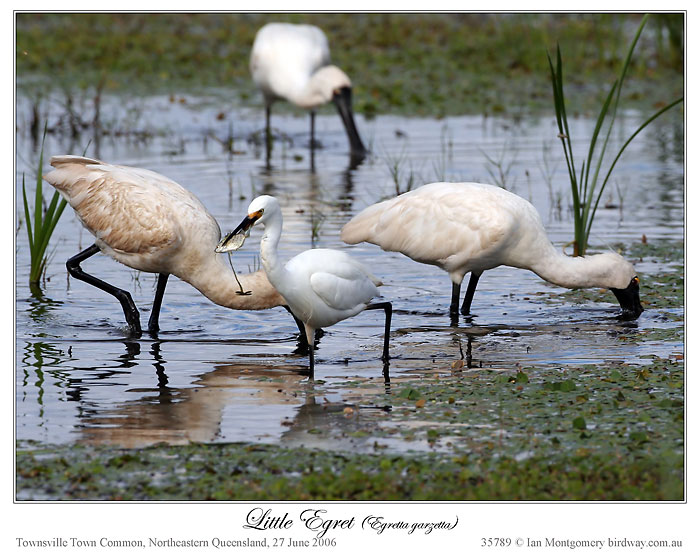
In Australia, the Little Egret is commonest in northern Australia, but also occurs in smaller numbers in eastern and southeastern Australia, in Tasmania in winter and in central and western Australia when conditions are suitable. It also extends widely through Eurasia and Africa. The Australian race has yellow lores between the bill and the eye, but that of the nominate Eurasian race normally has blue-grey lores as in the fourth photo of one on a beach at the Cape of Good Hope. Globally, Little Egrets are quite variable and their taxonomy is still poorly understood.
Like other egrets, the global population of Little Egrets suffered severely in the late 19th century because of the fashion trade in plumes. It was this trade in plumes that lead to the establishment of the RSPB in 1889, a silver lining if there was one, and populations have recovered since.
the stork, the heron after its kind, and the hoopoe and the bat. (Deuteronomy 14:18 NKJV)
The Egrets keep company with Heron and Bitterns in the Ardeidea Family of the large Pelecaniformes Order which includes the Pelicans, Ibises, Spoonbills, Hamerkop and Shoebill.
The Heron is one of the birds mentioned in the Bible, so is found in our Birds of the Bible – Heron page.
Oh, the depth of the riches both of the wisdom and knowledge of God! How unsearchable are His judgments and unfathomable His ways! (Romans 11:33 NASB)
Hornbills that Understand Monkey
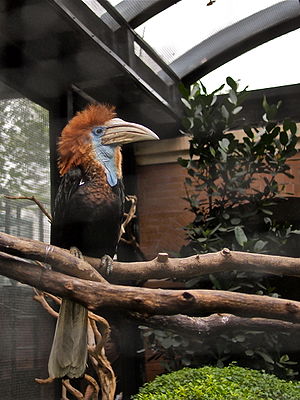
The Yellow-casqued Hornbill (Ceratogymna elata) is found in the primeval rain forest of coastal regions of West Africa, for example in Côte d’Ivoire.
Yellow-casqued Hornbills are one of the largest birds of the forest, with adults weighing up to 2 kg. They live mainly in the forest canopy, feeding on the ground only rarely. They live in small family groups containing at least one adult male and female, with one or two immature birds, though they sometimes gather in larger flocks to exploit a major food supply such as an ant or termite nest.
“The birds are occasionally preyed upon by Crowned Eagles, and they respond to the presence of an eagle (sometimes indicated by its characteristic shriek) by mobbing, i.e. approaching it and emitting calls. Since the eagles depend on surprise to make a catch, this frequently causes them to leave the area.” (Wikipedia edited)
“With the exception of basic messages such as aggression, communication between two entirely different species has seldom been observed among animals in the wild. We know that many animals among the same species give each other specific warnings about an impending danger.” One example is “researchers have found that a downy woodpecker responds to alarm calls from chickadees.” “However, scientists have never noted one species recognizing the specific warning given by a second species.
Diana monkeys on the Ivory Coast of Africa face two primary threats, leopards and crowned eagles. When one of these threats appears, the spotter gives a very specific bark-like call depending on the type of threat. Of course, the monkeys need to respond differently to each threat whether it comes from the leopard below or the eagle above. So it helps them to know what they are facing. On the other hand, a bird named the yellow hornbill is threatened only by the crowned eagles. Researchers noted that these birds ignored the monkeys’ warning about the leopards. But when the monkeys signaled danger from the eagle, the bird took defensive measures. Researchers confirmed their observations using tape recorded monkey calls. The researchers were amazed that these birds understood the monkey warnings in an intelligent manner.”
Such intelligence comes from the Creator, Who has given the gift of such intelligence to His creatures in a way that provides for their survival. This shows His loving care for His creation.
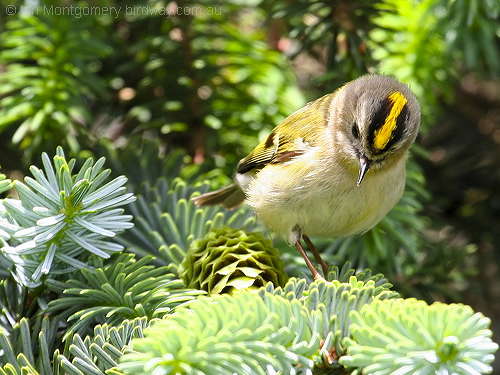
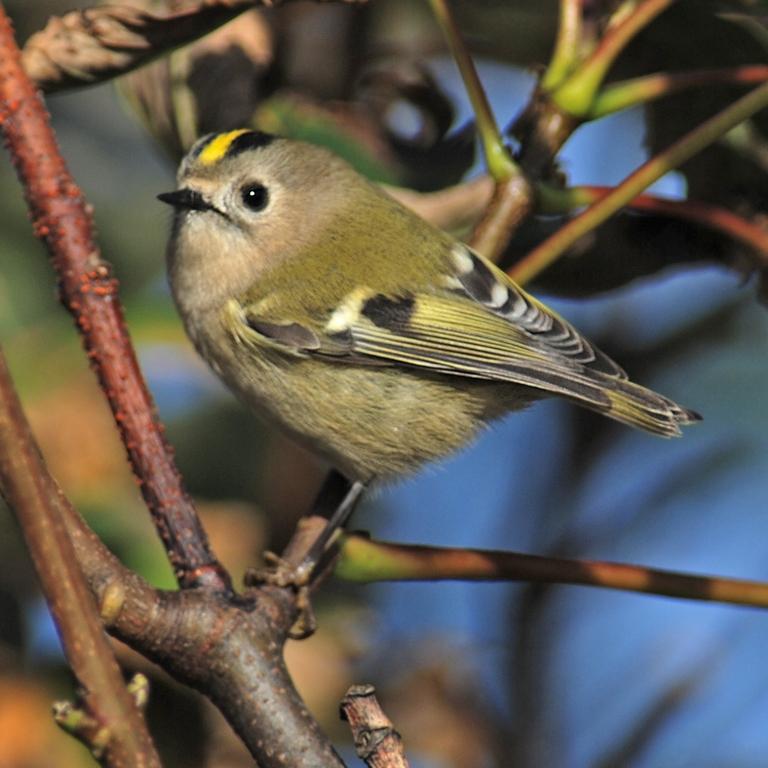
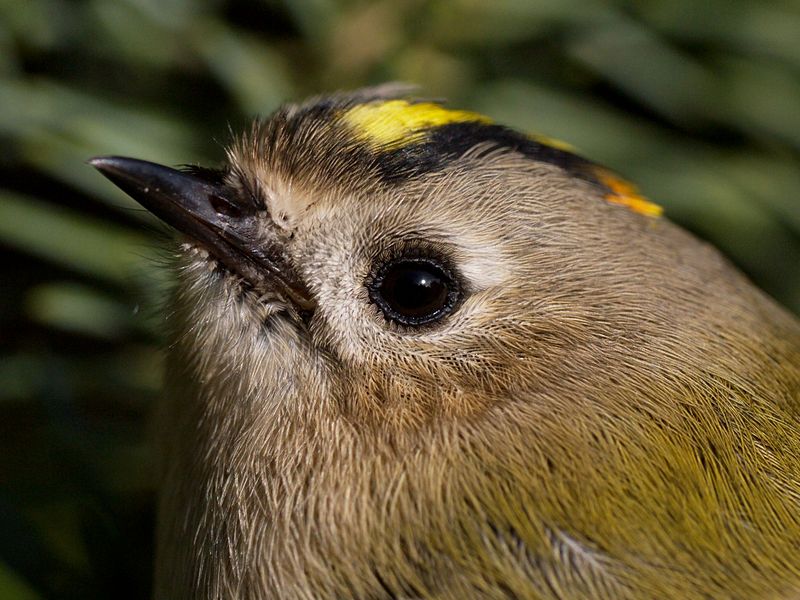
The Goldcrest, Regulus regulus, is a very small passerine bird in the kinglet family. Its colourful golden crest feathers gives rise to its English and scientific names, and possibly to it being called the “king of the birds” in European folklore. It has a plain face contrasting black irises and a bright head crest, orange and yellow in the male and yellow in the female, which is displayed during breeding.
God has created us in His own image and that is why He loves to call us as the Royal Priest..
The yellow crest is displayed during breeding season..
But, God calls us as His crown and we shall be a crown to our Jesus, our bridegroom, face to face…
“Thou shalt also be a crown of glory in the hand of the LORD, and a royal diadem in the hand of thy God.” Isaiah 62:3
The typical contact call of the Goldcrest is a thin, high-pitched zee given at intervals of 1–4 seconds, with all the notes at the same pitch. It sometimes has a more clipped ending, or is delivered more rapidly. The call is higher and less rough than that of the Firecrest. The song of the male Goldcrest is a very high, thin double note cedar, repeated 5–7 times and ending in a flourish, cedarcedar-cedar-cedar-cedar-stichi-see-pee. The entire song lasts 3–4 seconds and is repeated 5–7 times a minute. This song, often uttered while the male is foraging, can be heard in most months of the year. The song is a repetition of high thin notes, slightly higher-pitched than those of its relative. The songs of mainland Goldcrests vary only slightly across their range and consist of a single song type, but much more divergence has occurred the isolated Macaronesian populations.
Not only are there variations between islands and within an island, but individual males on the Azores can have up to three song types. The dialects on the Azores fall into two main groups, neither of which elicited a response from male European Goldcrests in playback experiments. There are also two main dialect groups on the Canary islands, a widespread group similar to the European version, and another which is restricted to the mountains of Tenerife. The song variations have been used to investigate the colonisation pattern of the Macaronesian islands by Goldcrests, and identified a previously unknown subspecies.
Though these birds have a thin high two note song, they still have different song dialects for different places and can be heard most of the year..
We may be from different places but still we have one song which we all are singing and would be singing over and over again..
That songs is , “ALLELUIA”
1) And after these things I heard a great voice of much people in heaven, saying, Alleluia; Salvation, and glory, and honour, and power, unto the Lord our God:
2) For true and righteous are his judgments: for he hath judged the great whore, which did corrupt the earth with her fornication, and hath avenged the blood of his servants at her hand.
3)And again they said, Alleluia. And her smoke rose up for ever and ever.
4) And the four and twenty elders and the four beasts fell down and worshipped God that sat on the throne, saying, Amen; Alleluia.
5) And a voice came out of the throne, saying, Praise our God, all ye his servants, and ye that fear him, both small and great.
6) And I heard as it were the voice of a great multitude, and as the voice of many waters, and as the voice of mighty thunderings, saying, Alleluia: for the Lord God omnipotent reigneth.” Revelations 19:1 – 6
The Goldcrest breeds in mature lowland and mountain coniferous woodlands, mainly up to 3,000 m (9,800 ft), and occasionally to 4,800 m (15,800 ft). It uses spruce, Larch, Scots Pine, Silver Fir and Mountain Pine. Though this bird is just about 4.5 to 7.0 grams in weight, it breeds so high…
If these small 8.5 to 9.5 cm long birds can fly that high, how far should we be able to fly?
We all want to fly like an Eagle, but are we willing to pay the price of waiting upon the Lord?
But they that wait upon the LORD shall renew their strength; they shall mount up with wings as eagles; they shall run, and not be weary; and they shall walk, and not faint. (Isaiah 40:31)
A study in the Baltic region showed that northern Goldcrests were more likely to migrate, and increased their body mass beforehand; non-migratory
southern birds did not increase their fat reserves. The travel speed of migrating Goldcrests increased for those leaving later in the autumn, and was greater for the northernmost populations. Migration was faster on routes that crossed the Baltic Sea than on coastal routes, the birds with the largest fat reserves travelled at the highest speeds. The ability to lay down fat is adversely affected in this tiny bird by poor health Goldcrests can fly 250–800 km (150–500 mi) in one day, although they keep at a lower level in heavy headwinds.
These birds seem to know how to tackle the heavy wind, by flying at a lower level..
Here is a secret these birds seem to teach us..
They seem to tell us that we need to fly at a lower level, to fly long and fast…
Believers find it so difficult to fly low, everyone wants to be seen high..
But, God’s expects us to be different…
And whosoever shall exalt himself shall be abased; and he that shall humble himself shall be exalted. (Mathew 23:12)
The Goldcrest is monogamous. The male sings during the breeding season, usually while foraging rather than from a perch. It has a display which involves bowing its head towards another bird and raising the coloured crest. A male Goldcrest will defend his territory against either species, sometimes including some Firecrest phrases in his song.
Goldcrest’s songs, helps in defending its territory from other species…
Our songs too has the power to defend us from all evil..
It is in our praises that our Lord loves to dwell…
Remember, our God is in spirit, so, where there is spirit there is liberty and our praise has the power to bring THE SPIRIT in our midst to liberate us..
So let’s sing and not let GOD dwell in heaven but amongst our praises..
But thou art holy, O thou that inhabitest the praises of Israel. (Psalm 22:3)
The Goldcrest’s nest is a well-insulated cup-shaped structure built in three layers. The nest’s outer layer is made from moss, small twigs, cobwebs and lichen, the cobwebs also being used to attach the nest to the thin branches that support it. The middle layer is moss, which is lined by an inner layer of feathers and hair. The nest is larger, shallower and less compact than that of the Firecrest, with an internal diameter of about 9.0 cm (3.5 in), and is constructed by both sexes, although the female does most of the work. Laying starts at the end of April into early May. The eggs are whitish with very indistinct buff, grey or brown markings at the broad end. The eggs are 14 × 10 mm (0.55 × 0.34 in) and weigh 0.8 g (0.028 oz), of which 5% is shell.
The clutch size in Europe is typically 9–11 eggs, but ranges from 6–13. The eggs are piled up in the nest and the female keeps the eggs warm with her brood patch and also by putting her warm legs into the middle of the pile between the eggs. Within a clutch the size of eggs increases gradually and the last laid egg may be 20% larger than the first egg. Second clutches, which are common, are laid usually while the first nest still has young. The male builds the second nest, then feeds the young in the first nest while the female is incubating in the second; when the first brood has fledged, he joins the female in feeding the second brood.
The female Goldcrest is not normally fed by her mate while incubating. She is a tight sitter, reluctant to leave the nest when disturbed, and has been recorded as continuing to attend the nest when it has been moved, or even when it is being held. The eggs are maintained at 36.5 °C (97.7 °F), the female regulating the temperature of the eggs by varying the time spent sitting. She leaves the nest more with increasing air temperature, and incubates more tightly when the light intensity is lower early and late in the day.
The female bird sits tight when the light intensity is lower…
When darkness surrounds, we need to be still and wait until THE LIGHT shines on us..
It also regulates the temperature of the eggs at 36.5 °C (97.7 °F)…
Is the intensity of the spiritual fire in us constant?
Or is God upset over us for having left our first love?
Nevertheless I have somewhat against thee, because thou hast left thy first love.: (Revelation 2: 4)
Let us walk as children of light before eternal darkness fall over…
Then spake Jesus again unto them, saying, I am the light of the world: he that followeth me shall not walk in darkness, but shall have the light of life. (John 8:12)
The female incubates the eggs for 16 to 19 days to hatching, and broods the chicks, which fledge in a further 17 to 22 days later. Both parents feed the chicks and fledged young, and in very hot weather, the female has been noted as taking drops of water to her chicks in her bill.
To carry water in its tiny bill to its tiny chick is incredible…
What a thoughtful mother this bird could be!
If this bird could be so incredible, how incredible its creator would be?
These birds carry water only to its chicks but, listen to what our God says…
For I will pour water upon him that is thirsty, and floods upon the dry ground: I will pour my spirit upon thy seed, and my blessing upon thine offspring: (Isaiah 44:3)
He also says,
And it shall come to pass afterward, that I will pour out my spirit upon all flesh; and your sons and your daughters shall prophesy, your old men shall dream dreams, your young men shall see visions. And also upon the servants and upon the handmaids in those days will I pour out my spirit (Joel 2:28)
The Goldcrest takes a wide variety of prey, especially spiders, caterpillars, bugs, springtails and flies. Larger prey such as oak bush crickets and tortrix moths may sometimes be taken. Goldcrests will occasionally feed on the ground amongst leaf-litter with tits. Non-animal food is rare, although Goldcrests have been seen drinking sap from broken birch twigs together with tits and nuthatches. Flying insects are taken in hovering flight but not nomally pursued; there is a record of a Goldcrest attacking a large dragonfly in flight, only to be dragged along by the insect before releasing it unharmed.
The devil may try to drag you, but it can never ever harm you, for you are carved in His palm ..
God doesn’t want to go blind for you are the apple of His eye…
No weapon that is formed against thee shall prosper; and every tongue that shall rise against thee in judgment thou shalt condemn. This is the heritage of the servants of the LORD, and their righteousness is of me, saith the LORD. (Isaiah 54:17)
But we need to pay a price to inherit this the promise..
Serve the Lord and He shall save you from every weapon and every tongue..
Several small passerine species survive freezing winter nights by inducing a lower metabolic rate and hypothermia, of a maximum of 10 °C (18 °F) below normal body temperature,in order to reduce energy consumption overnight. However, in freezing conditions, it may be that for very small birds, including the tiny Goldcrest, the energy economies of induced hypothermia may be insufficient to counterbalance the negative effects of hypothermia including the energy required to raise body temperature back to normal at dawn.
Observations of five well-fed birds suggest that they maintain normal body temperatures during cold nights by metabolising fat laid down during the day, and that they actually use behavioural thermoregulation strategies, such as collective roosting in dense foliage or snow holes to survive winter nights. Two birds roosting together reduce their heat loss by a quarter, and three birds by a third. During an 18 hour winter night, with temperatures as low as −25 °C (−13 °F) in the north of its range,
Goldcrests huddled together can each burn off fat equivalent to 20% of body weight to keep warm…
Did someone preach the word of God or give them a Bible to read?
How come they know that they can keep themselves warm by staying together?
Who taught them?
Does the church stay together to keep themselves on fire?
Again, if two lie together, then they have heat: but how can one be warm alone? And if one prevail against him, two shall withstand him; and a threefold cord is not quickly broken.” Ecclesiastes (4:11-12)
Aristotle (384 BC – 322 BC) and Pliny (23 AD – 79) both wrote about the legend of a contest amongst the birds to see who should be their king, the title to be awardedto the one that could fly highest. Initially, it looked as though the eagle would win easily, but as he began to tire, a small bird which had hidden under the eagle’s tail feathers, emerged to fly even higher and claimed the title.
This may sound like a folklore but there is point for us to remember..
God carries us like an Eagle in His wings….
Jesus said. “Verily, verily, I say unto you, He that believeth on me, the works that I do shall he do also; and greater works than these shall he do; because I go unto my Father.” (John 14:12)
God has called us to do greater things, come, let us hide under His wings…
Yesterday we had very heavy rain and wind. We were under Tornado Warnings most of the day. In the afternoon, it turned very bad as a tornado was being tracked just south of our house. Our flagpole went down as well as the concrete sign at the entrance to our community. There were plenty of trees and branches strewn around and planes tossed around at the Fun n Sun festival in Lakeland, Florida.
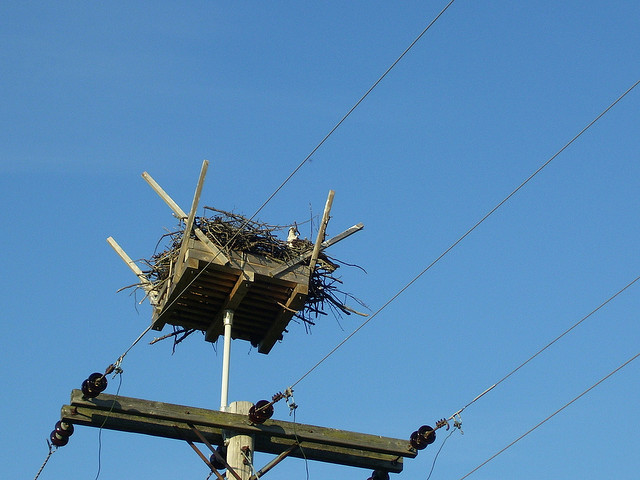
We went down to Bartow this afternoon and took the Old Bartow road, that I have renamed, the “Osprey Road.” There are many Osprey nest in the power lines down through there and also the electric companies have placed platforms for the Osprey to raise their babies.
One of the main food source for the Osprey is fish. We have had several very cold snaps these last two winters and many of the fish were killed off. Without a good source of food to raise their young, the numbers of Osprey have decreased in this area.
Osprey Road by Dan – (Old Bartow Road) 2007
This year we had already seen fewer Osprey’s raising their young. Now many of those nests were destroyed or left bedraggled by the storm yesterday. What a shame. Then again, had there been lots of active nest, there would have been more killed or injured birds.
We are reminded through Scripture that:
Are not two sparrows sold for a farthing? and one of them shall not fall on the ground without your Father. (Matthew 10:29 KJV)
They were not Sparrows, but I know that promise applied to them also. God, the Father, knows all about what happened to them. He is not so busy that He doesn’t take notice of such things. That is why that passage is so special, because, it goes on to say:
Fear ye not therefore, ye are of more value than many sparrows. Whosoever therefore shall confess me before men, him will I confess also before my Father which is in heaven. (Matthew 10:31-32 KJV)
Osprey with Fish by Jim Fenton
Another thing about Ospreys as well as the other birds is that they were commanded to “multiply and fill the earth.” What I haven’t mentioned is that on the way down and back we saw four different sets of birds mating. I imagine that they lost their young and are busy planning the next clutch of birds to raise. Birds have emotions, and I am sure they feel the loss, but they have picked themselves back up and have begun repairing nests and starting new families.
May we be reminded that the Lord knows all about the things that happen to us. Sometimes the events aren’t so much “fun.” How do we handle situations when this happens. Do we keep our eyes on the Lord and trust Him to see us through it, or do we blame Him and become angry and miserable?
___
Ospreys are in the Pandionidae Family of the Accipitriformes Order. There is an Eastern Osprey (Pandion cristatus) and a Western Osprey (Pandion haliaetus).












 Lee's Birdwatching Adventures Plus