“B” is for Bobwhite and Buteo: “B” Birds, Part 2
James J. S. Johnson
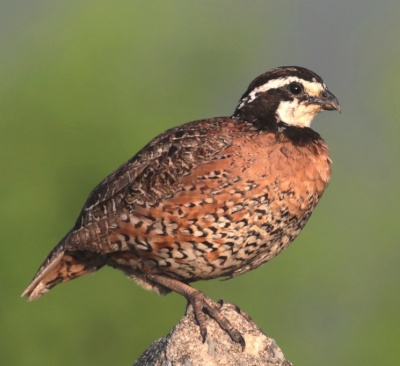
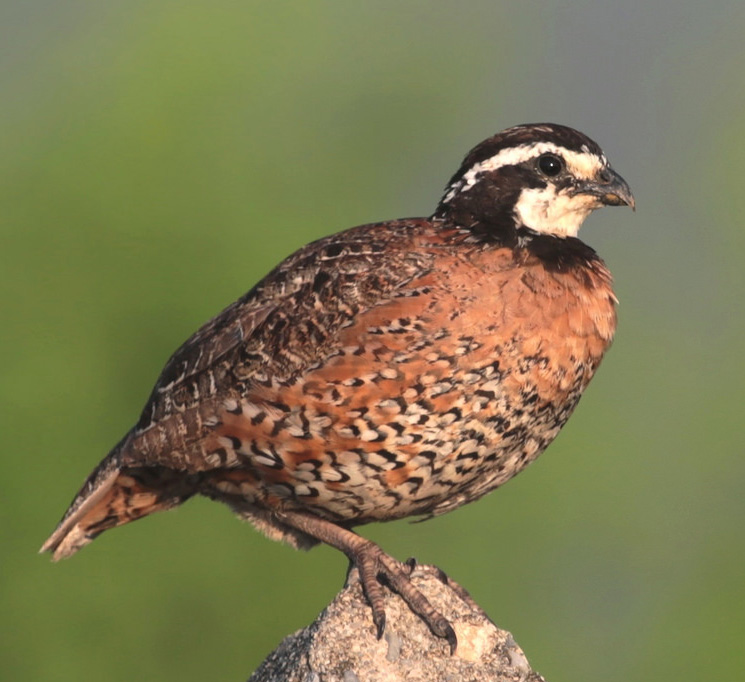
Northern Bobwhite (Colinus virginianus) ©StateSymbols
BOBWHITE QUAIL (Colinus virginianus)
In this series the “B” birds began (in Part 1) with Bluebird and Bittern.
In this Part 2 the “B” birds will continue with Bobwhite Quail and Buteo Hawks.
Now for Bobwhite, i.e., the Bobwhite Quail — and the relevance of 1st Samuel 26:20 will be noted below.
Bobwhite is the name of a bird belonging to the New World quail family. Other members of that quail family include the Yucatan (Black-throated) Bobwhite, the Crested Bobwhite, and the Spot-bellied Bobwhite.

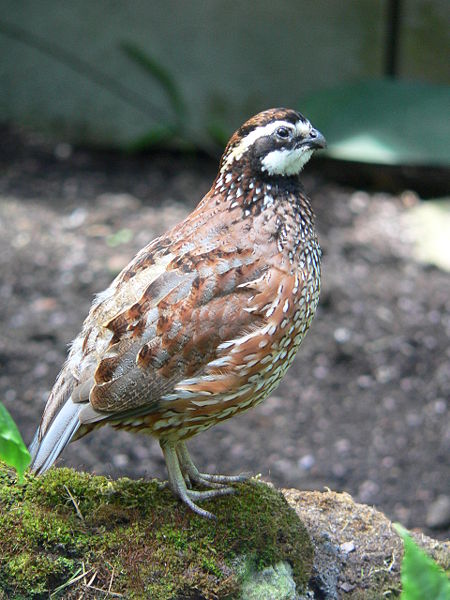
The Bobwhite Quail (Colinus virginianus), a/k/a Northern Bobwhite and Virginia Quail, is a “New World quail”, meaning that it belongs to the group of pheasant/grouse/partridge/quail-like ground-fowl that habituate parts of North America. In particular, the Northern Bobwhite is the only small native galliform (i.e., chicken-like ground-fowl) in the eastern region of North America.
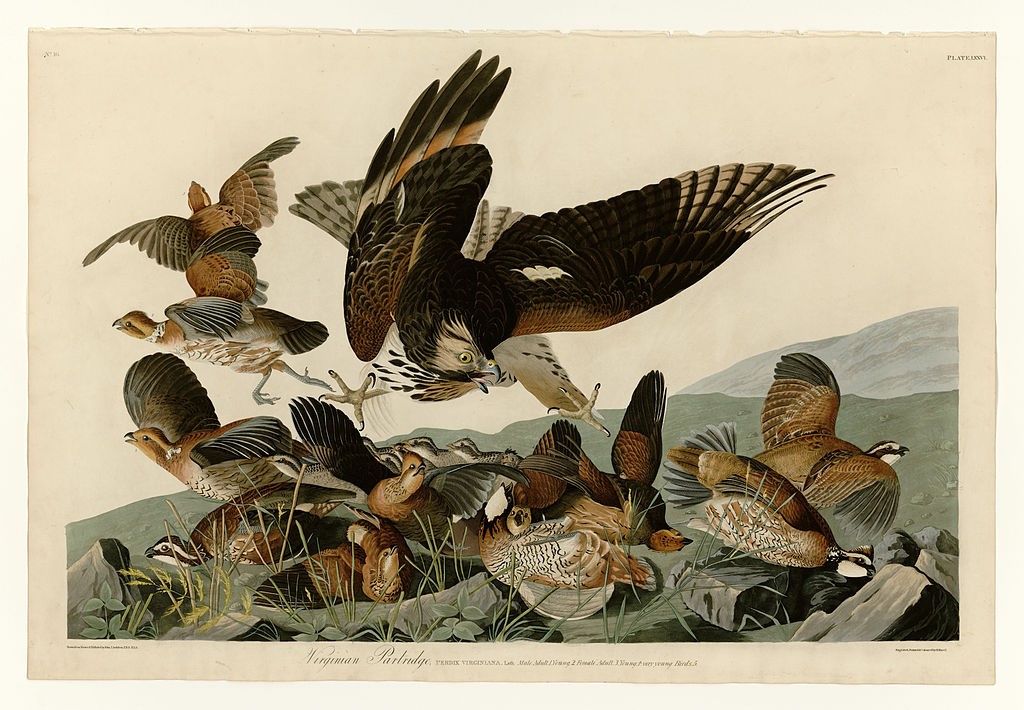
The name “bobwhite” is supposed to represent this quail’s terse two-syllable whistle-call. The Bobwhite’s call has a lower (and slower) first syllable, followed by a sharply projected (and quicker) “whhht”. One variety of the Northern Bobwhite, known for habituating Virginia, was formerly called the “Virginia Partridge” (e.g., by ornithologist John James Audubon) – that local variety now being called Colinus virginianus virginianus (identified by Linnaeus in AD1758).
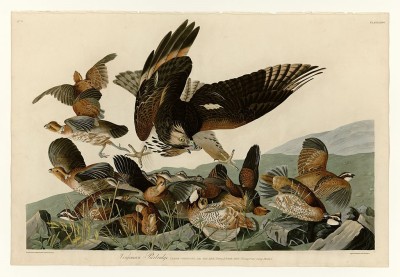
Virginia Partridge (under attack by diving hawk) depicted by John James Audubon (Public Domain)
Bobwhite Quail, a/k/a Virginia Quail (and a/k/a Northern Bobwhite), are quail. Accordingly, it is unsurprising to learn that they hybridize with other quail – reports indicate successful hybridizations with Blue Quail (Coturnix adansonii), Gambel’s Quail (Callipepla gambelii), California Quail (Callipepla californica), and Mountain Quail (Oreortyx pictus).
The ground-fowl lifestyle of this grouse-like ground-fowl is comparable to the Rock Partridge (Alectoris graeca) of which Israel’s king David once wrote:
Now therefore, let not my blood fall to the earth before the face of the Lord: for the king of Israel is come out to seek a flea, as when one doth hunt a partridge in the mountains. (1st Samuel 26:20).
(See “Rock Partridges: Lessons about Hunting and Hatching”, citing 1st Samuel 26:20).
Now for the last category of “B” birds, the Buteo hawks.
So what are the most prominent characteristics of buteo hawks? Describing the birds of prey we call Buteo Hawks (a/k/a “buzzard hawks”), Roger Tory Peterson says: “Large, thick-set hawks, with broad wings and wide, rounded tails. Buteos habitually soar high in wide circles”, taking advantage of thermal air currents to lift their heavy bodies. [See Roger Tory Peterson, A FIELD GUIDE TO WESTERN BIRDS (Houghton Mifflin, 3rd ed., 1990), page 174.] The different sexes often look similar, yet the female buteo is typically larger than her male counterpart.
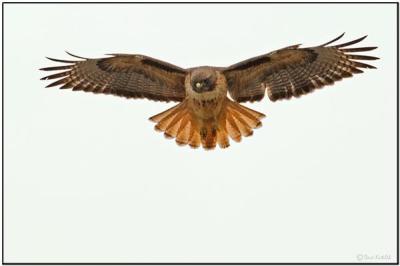
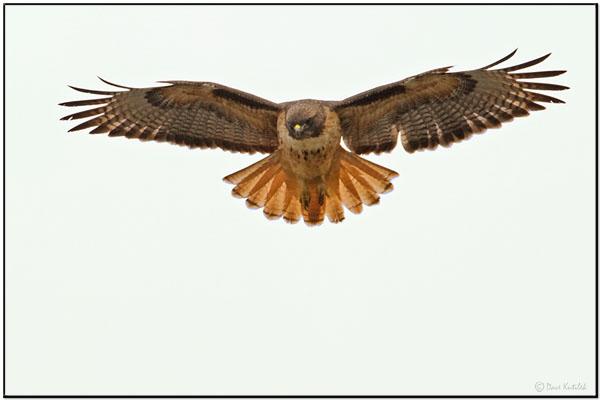
Red-tailed Hawk (Buteo jamaicensis) by Daves BirdingPix
Buteo hawks, as a category or raptors, are routinely contrasted with the Accipiter hawks (a/k/a “bird hawks”) that were described in the previous article on “A” birds (see “A” for Accipiter and Alcid: “A” Birds, Part 2, featuring Cooper’s hawk as the representative accipiter). Hawk-like raptor birds include kites, falcons (including kestrels), harriers, eagles, Old World buzzards, vultures, osprey, and the exotic Secretary Bird.

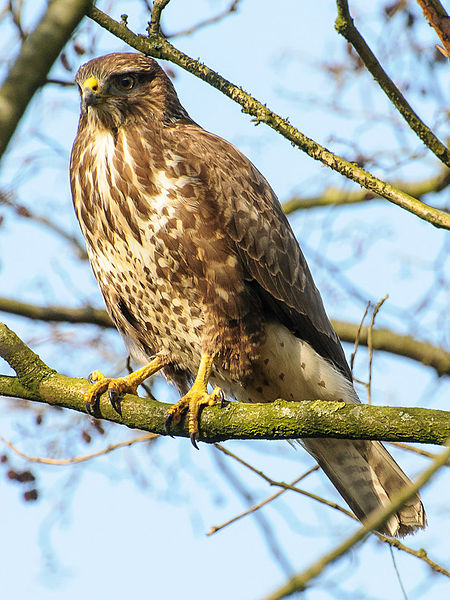
Common Buzzard (Buteo buteo) ©WikiC
Common Buzzard (Buteo buteo, of Eurasia)
The paradigmatic buteo, in Europe, would be the Common Buzzard (Buteo buteo). However, that hawk has non-artificial range in the Western Hemisphere, so the Common Buzzard is not “common” to American birders. Besides the Common Buzzard, there are many buteo hawks around the world, such as the Ferruginous Hawk (Buteo regalis), Grey Hawk (Buteo plagiatus), Swainson’s Hawk (Buteo swainsoni), Eastern Buzzard (Buteo japonicas), Himalayan Buzzard (Buteo burmanicus), Cape Verde Buzzard (Buteo bannermani), Short-tailed Hawk (Buteo brachyurus), and many more. For this article, however, to represent the entire group of buteos, one buteo will be reviewed, the Red-tailed Hawk (Buteo jamaicensis) of North America.
RED-TAILED HAWK (Buteo jamaicensis).
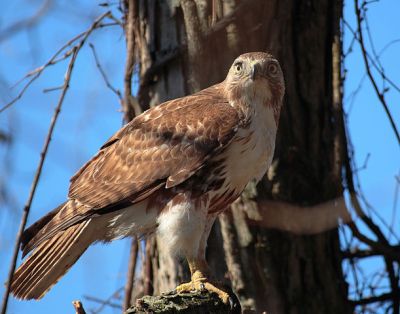
Red-tailed Hawk (Buteo jamaicensis) ©WikiC
The Red-Tailed Hawk (Buteo jamaicensis) is described by ornithologist Mary Taylor Gray as follows: “The most abundant, widespread, and familiar hawk of he West, the Red-tailed Hawk resides year-round in Colorado [and elsewhere]. Adult birds are readily identified by their rusty-red tail[s]. Dark bars along the undersides of the leading edge of the outstretched wings, near the shoulder, are also characteristic. We often see redtails perched on power [utility] poles or soaring in the air on broad wings, carving slow, wide arcs. The redtail’s dramatic call fits its image as a western icon. The down-slurred scream—Keeeer!—is often heard as a background sound in movies and television shows.” [Quoting Mary Taylor Gray, THE GUIDE TO COLORADO BIRDS (Englewood, Colorado: Westcliffe Publishers, 1998), page 66.]
Gray’s observation – that the Red-tailed Hawk is the common buteo of America’s Great West – is illustrated by my own birding experience, even 20 years ago! – having seen redtails during AD1996 in places as divergent as Montana (eastern side of Glacier National Park, July 2nd AD1996) and South Texas (Rockport-Fulton shoreline, Aransas Bay region, March 10th AD1996).
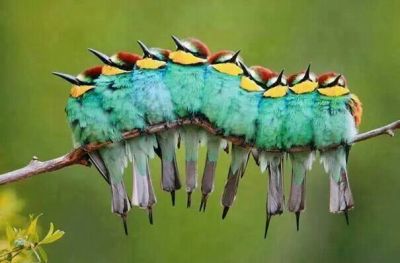
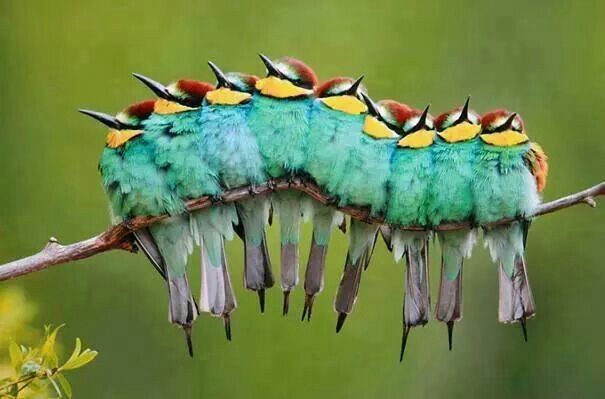
Bee-eaters From Pinterest
Of course, other “B” birds (such as the colorful and gregarious bee-eaters, shown above – photograph taken from Lee Dusing’s “Fellowship”, exhibit our alphabet’s second letter – but this article is already long enough. God willing, the next contribution to this alphabetic series will be some “C“ birds – such as Cardinal, Chicken, Coot, Cormorant, Chickadee, Caracara, Crane, Cuckoo, Curlew, and Corvid (including Crow)! So stay tuned! > JJSJ
*
“B” is for Bluebird and Bittern: “B” Birds, Part 1
“A” is for Avocet, Albatross: “A” Birds, Part 1
“A” is for Accipiter and Alcid: “A” Birds, Part 2
*



 Lee's Birdwatching Adventures Plus