How Can a Mechanical ‘Cardinal’ Make ‘Selections’?

How Can a Mechanical ‘Cardinal’ Make ‘Selections’?

For we are made a spectacle unto the world, and to angels, and to men. (1st Corinthians 4:9b)

But what about birds: can they be spectators?

What about fake birds:  can they “select” when to sing?

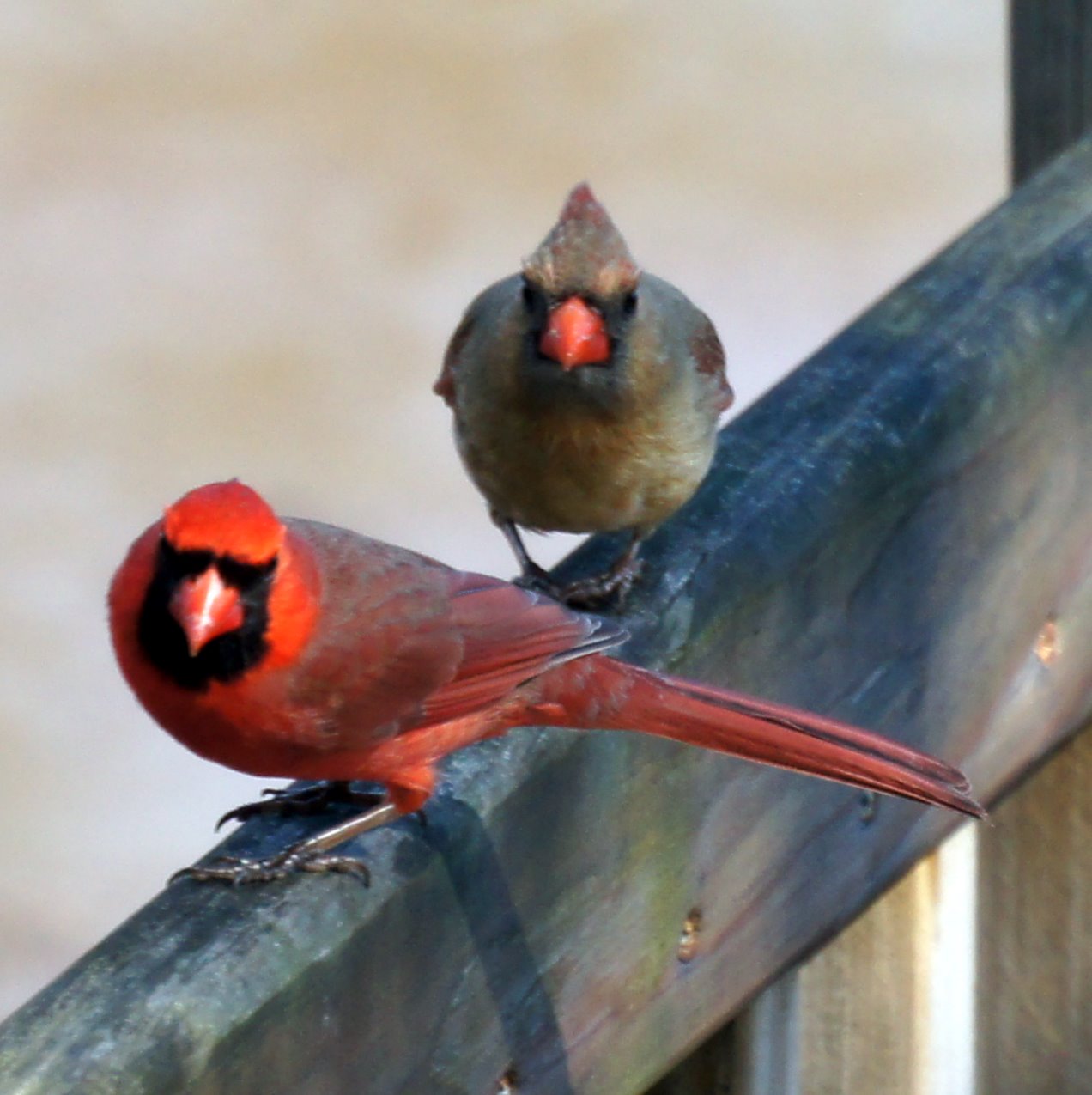
Northern Cardinal (Cardinalis cardinalis) Male and Female ©WikiC

Northern Cardinal (Cardinalis cardinalis) Male and Female ©WikiC

This unusual bird-watching report begins with a “no-brainer” observation that most birders already know well:  we humans like to watch birds!

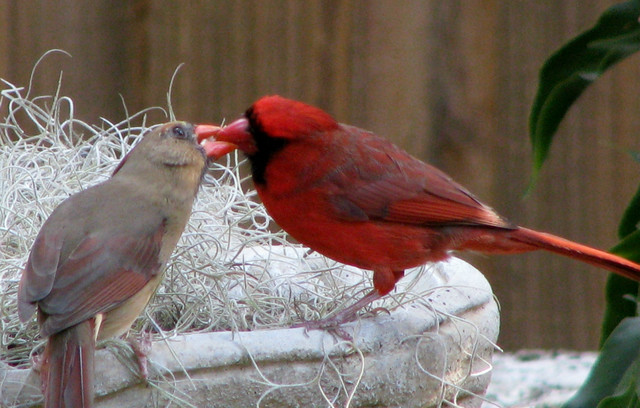
Northern Cardinal (Cardinalis cardinalis) Male and Female ©WikiC

Northern Cardinal (Cardinalis cardinalis) Male and Female ©WikiC

Luzon Bleeding-heart by Dan

Orni-Theology

In fact, it seems (based on a survey done by wildlife ecologists in Maryland) that we humans like to watch birds — moreso than any other kind of wildlife.  People love birds, and well they should!  Specifically, according to a U.S. Fish & Wildlife Service officer, birds are the main attraction when it comes to people viewing wildlife.  “The 2011 National Survey of Fishing, Hunting and Wildlife-Associated Recreation noted that 71.8 million American participated in some kind of wildlife-watching recreation, including observing, feeding or photographing [wildlife].  Birds attract the biggest following of all U.S. wildlife.  Approximately 46.7 million people observed birds around the house and on trips in 2001.  A large majority, 88 percent (41.3 million), observed wild birds around the home, while 38 percent (17.8 million) took trips away from home to observe wild birds.  Home birders averaged 119 days, while away-from-home birders averaged 13 days.”  (Quoting from Kathy Reshetiloff, “Services Provided by Migratory Birds Don’t Come Cheaply”, Chesapeake Bay Journal, 24(3):1 (May 2014).  As noted previously, birds often don’t notice when we are watching them – and that is when we see them acting true to character. [See https://leesbird.com/2014/10/06/busy-hummingbirds-oblivious-to-spectators/  ]

A plastic “toy” cardinal can make you wonder about motion sensitivity.  (More on that below.)

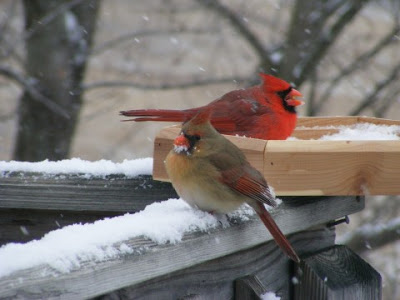
Northern Cardinal (Cardinalis cardinalis) Male and Female ©WikiC

Northern Cardinal (Cardinalis cardinalis) Male and Female ©WikiC

The Northern Cardinal (Cardinalis cardinalis), a/k/a “redbird” is a beauty to behold – and to hear.  Cardinals are so highly appreciated that seven states claim it as their official state bird:  Illinois, Indiana, Kentucky, North Carolina, Ohio, Virginia, and West Virginia!

Cardinals are songbirds that are easily seen (especially the males), due to their colored plumage contrasting with the green foliage of spring and summer, — or with the bright white of winter snow.

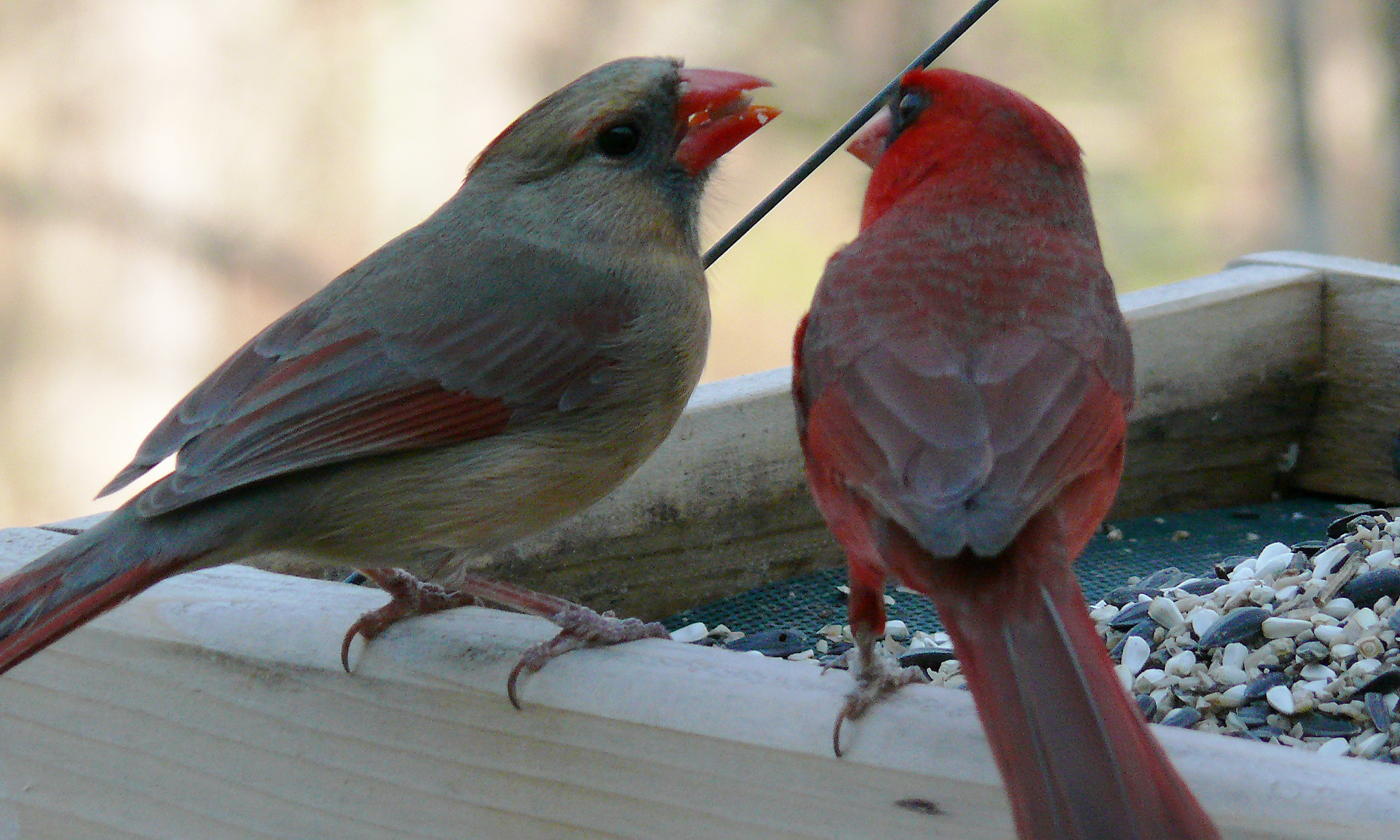
Northern Cardinal (Cardinalis cardinalis) Male and Female ©Zanawer

Northern Cardinal (Cardinalis cardinalis) Male and Female ©Zanawer

Surely a view of cardinals, eating safflower and sunflower seeds (or other cracked corn, peanuts, or even raisins!), will make you wonder at God’s creative genius and love of beauty, when He chose to make (see Genesis 1:21) the male and female of that beautiful songbird species!

Northern Cardinal (Cardinalis cardinalis) Male and Female ©WikiC

Northern Cardinal (Cardinalis cardinalis) Male and Female ©WikiC

“The cardinal is a favorite bird of many people and it’s easy to see why.  The brilliant scarlet plumage of the male and the subtle shades of the female, combined with their clear melodic song, make them enjoyable to watch (and to listen to] in any season.”  [Quoting from Donald Stokes & Lillian Stokes, A Guide to Bird Behavior, Volume II (Little, Brown & Co., 1983), page 247.]

But, could it be that birds also like to watch humans?  And could it even be that mechanical “birds” appreciate humans who move around in front of them?

http://www.ebay.com/itm/like/251378388026?lpid=82&chn=ps

Plastic Cardinal from ebay.com

[ plastic cardinal image  from  http://www.ebay.com/itm/like/251378388026?lpid=82&chn=ps ]

Lately my wife have been having fun at my expenses, using a “toy” cardinal.  The cardinal was given to her by Marcia Webel (of Florida, wife of Chaplain Bob Webel).  It is a smaller than life-sized bird shaped and colored like a male cardinal, and it can make “vocal” noises like one, too.  But it is a “motion-activated” machine.  In other words, it is “selective” in when it “chooses” to sound off its recorded chirping sounds (which do sound like a real cardinal).  But it’s not really making decisions about when to chirp; it’s just a programmed machine that is designed with receptor features that sense motion nearby, and the inventor designed the machine to “trigger” its recorded sounds whenever its receptors “recognize” such motions.

So far, so good.

But here is the puzzle:  my wife moves in front of the “cardinal” and he chirps for her, just like the toy’s inventor designed him to do.  Then I dance (not in public, of course, — just in the privacy of our kitchen) in front of the “cardinal” and he is silent.  Silent!  So I dance again.  Silent, silent!  So I try a few Tae Kwon Do maneuvers (kicking, punching, whirling, bowing) – and he is still silent. If proving my body’s mobility was dependent upon the “cardinal” chirping I would be diagnosed as paralyzed or unconscious.

It seems like the “cardinal” is “selective” regarding which human he is “willing” to chirp for.  But that can’t be, you say, and you are right.

A lifeless machine – even one that looks like and sounds like a male cardinal – cannot really “select” anything.

The very idea that anything lifeless can “select” anyone or anything is silly, because the English word “select” necessarily includes the actions of thinking and choosing.  (Of course, the preprogrammed actions of the machine do reveal the thought and choices of the machine’s inventor.)

By now I’m sure you see the parallel to God our Creator, Who programmed all of creation to perform according to how He invented His creatures and the world that He put them in.  (He made the planning and programming choices needed to invent all the birds, and ourselves, and everything else  —   God did it, not “nature”.)

It is both silly and deceptive to use the phrase “natural selection” to imply that nonliving substances (like sunlight, wind, rain, snow, lightning bolts, etc.) are a kind of “natural selection” that orders “nature”.   In fact, the phrase “natural selection” is a science-fiction example of “bait-and-switch” [See “Bait and Switch”, at http://www.icr.org/article/bait-switch-trick-used-by-both-anglerfish ]

Yet that very misleading phrase (“natural selection”) is spun as a secular God-substitute, to explain the origin of species that inhabit our fine-tuned planet.  [See “DNA and RNA:  Providential Coding to ‘Revere’ God”, at http://www.icr.org/article/dna-rna-providential-coding-revere ]  Obviously, the mechanical “cardinal”, with its puzzling actions that “react” to some (but not all) motions, was invented by a clever inventor.  How much moreso is our Creator-God a clever inventor!  It is God Who selected how to make our bodies, to eat food (Acts 14:17) and to grow (Psalm 139) and to do so many other amazing things during our earthly lives.  And He also invented the real cardinals!  (And sometimes real cardinals watch me, so there!)

Maybe I don’t have the kind of “walk” that causes a mechanical cardinal to “sing”.  As we all know, you need to have the “walk”, not just the “talk”.

So who do you watch?  If you only sang a song if and when someone walked in front of you, but not if he (or she) merely talked, who would you sing for?

The best sermons are role-modeled – those who “walk” their “talk” are truly the best communicators!  When we consider the “talk” and “walk” of other Christians, as we do without consciously trying, we are evaluating which Christians we think are moving in step with God’s Word.  Some are.   Others aren’t.  (And some we can’t be too sure about – see 1st Timothy 5:24.)

Meanwhile, as we move through this world, from day to day, are our own lives worth watching?

Let your light so shine before men, that they may see your good works, and glorify your Father which is in heaven.  (Matthew 5:16)

*

Orni-Theology

James J. S. Johnson

Cardinalidae – Cardinals, Grosbeaks and allies

*

Pond-side Birdwatching in Florida III

PondsideBirdwatching-WebelBackyard.2

Pond-side Birdwatching-Webel Backyard

Pond-side Birdwatching in Florida,

from Chaplain Bob’s Backyard: Part 3

 by James J. S. Johnson

Like a crane or a swallow, so did I chatter: I did mourn as a dove: mine eyes fail with looking upward: O Lord, I am oppressed; undertake for me. (Isaiah 38:14)

But they that escape of them shall escape, and shall be on the mountains like doves of the valleys, all of them mourning, every one for his iniquity. (Ezekiel 7:16)

O ye that dwell in Moab, leave the cities, and dwell in the rock, and be like the dove that maketh her nest in the sides of the hole’s mouth.  (Jeremiah 48:28)

Mourning Dove (Zenaida macroura) by Daves BirdingPix

Mourning Dove (Zenaida macroura) by Daves BirdingPix

Doves (a kind of birds that include pigeons) are among the most commonly observed birds in the world.  Doves display great variety (mourning dove, turtle dove, zebra dove, Inca dove, white-winged dove, etc.), the most popular variety being the pigeon (whose more formal name is “rock dove”).   Doves illustrate 2 different nesting habits (both being mentioned in Deuteronomy 22:6-7):  some nest in trees or other high places; others nest on the ground. Pigeons are often seen, due to their conspicuous habit of domesticating urban habitats (such as city buildings and bridges), nesting in high places (as indicated by , feeding, and flying in plain view of human spectators – often learning to accept food from humans, or to scavenge human garbage.  However, other doves (such as mourning doves) nest on the ground, a more vulnerable lifestyle.  Doves that nest on the ground, however, tend to be more reclusive (hiding in bushes and other thick vegetation), so they are more often heard than seen.  For example, in this birding report, brief mention will be made of a cooing mourning dove – that was heard, but not seen.

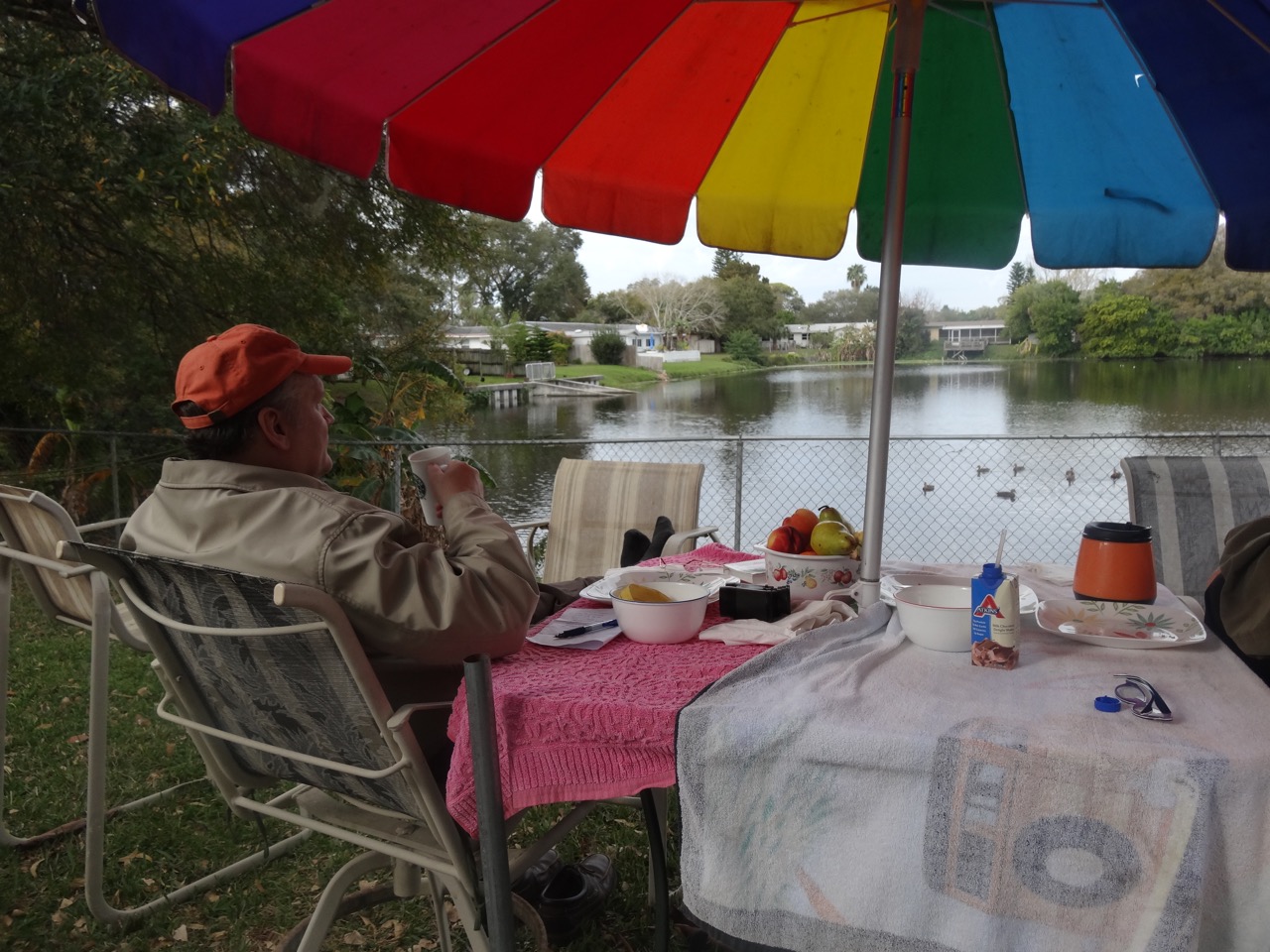
As reported previously, at Lee’s Birdwatching Adventures, it was a wonderful morning in St. Petersburg, where 3 of us  (my dear friends in Christ, Chaplain Bob and Marcia Webel, and I)  were watching the duck-populated pond and its bird-visited shores, with coffee and feet propped up, in the Webels’ backyard —  under a huge beach umbrella, shielded from occasional droppings (!) from ibises and ospreys (who were perched in branches hanging over where we were) sitting with binoculars, coffee mugs, healthy breakfast foods, and a bird-book.  Mostly we were bird-watching, that morning, but also we were bird-listening!

Muscovy Duck

Muscovy Duck

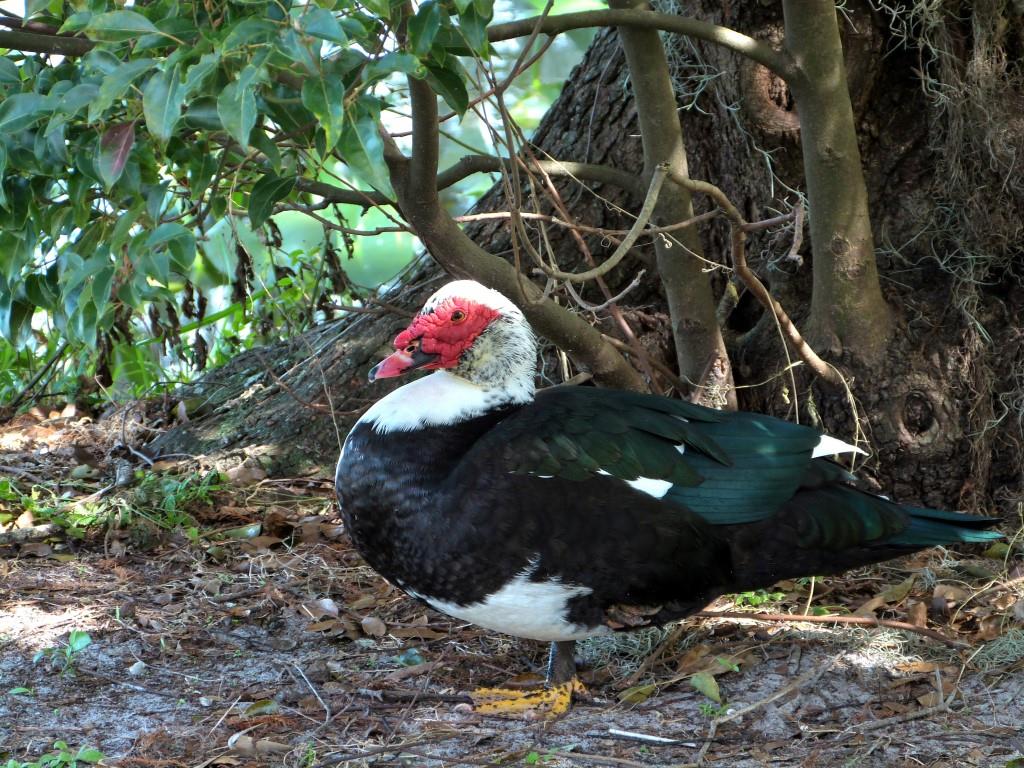
MUSCOVY   (a/k/a “MUSCOVY DUCK” or “BARBARY DUCK”:  Cairina moschata).

RTP @ 52-53 & 302-303

The Muscovy Duck is a strange looking fowl.  (And its name refers to “musk”, so it must have a characteristic smell, too!)  It is a duck, yet it is large – the size of a goose.  Yet even stranger are the colorful growths of red flesh upon its face:  the Muscovy looks like someone spilled some red bumpy-lumpy oatmeal on the sides of its bill, and on some of them the “red oatmeal” stuck to the face even around the eyes.  This fleshy growth is wattle-like “caruncle”, something like what turkey faces display.  Some people dislike the Muscovy Duck simply because its knobby (i.e., carunculated) face looks grotesque or diseased or “corrupted”!  But Mallards don’t seem to disdain these beauty contest flunkies; often a Muscovy (or two) is seen amidst a group of Mallards, and it seems that maybe they sometimes hybridize.  The coloring of a Muscovy Duck might be mostly white, or mostly black (with iridescent green tinting), or a quilt-patched mixture of black and white, with large white “patches” or “bars” on the wings.   (See Roger Tory Peterson, A Field Guide to the Birds Eastern Birds:  A Completely New Guide to All the Birds of Eastern and Central North America, abbreviated as “Eastern Birds” [Peterson Field Guides, Houghton Mifflin, 1980], at pages 52-53 & 302-303.)   The Muscovy’s awkward gait, when waddling about, sometimes looks a clumsy-looking, but these strange ducks are hearty survivors.  Regardless of where they came from (some say Latin America), these ducks are here to stay.   A domesticated form of the Muscovy is bred as the Pato Criollo (i.e., Creole Duck), though it seems that many of these have figured out how to escape their intended culinary destinies, becoming semi-wild as escapees. Muscovy Ducks have been observed and studied for centuries.  The Muscovy Duck was noted by two of the earliest (and most godly) eco-science geniuses, Konrad Gessner and John Ray, both being Bible-believing creationists.  To appreciate just an introductory sample of their trail-blazing creation research, analysis, and scholarship, see:  http://www.icr.org/article/christianity-cause-modern-science/  (mentioning John Ray),   http://www.icr.org/article/graffiti-judgment/  (mentioning, in Footnote #3, both Konrad Gessner and John Ray),  and  http://www.icr.org/article/fossil-political-correctness-sixteenth-century (mentioning Konrad Gessner as a Bible-believing Christian ecologist).

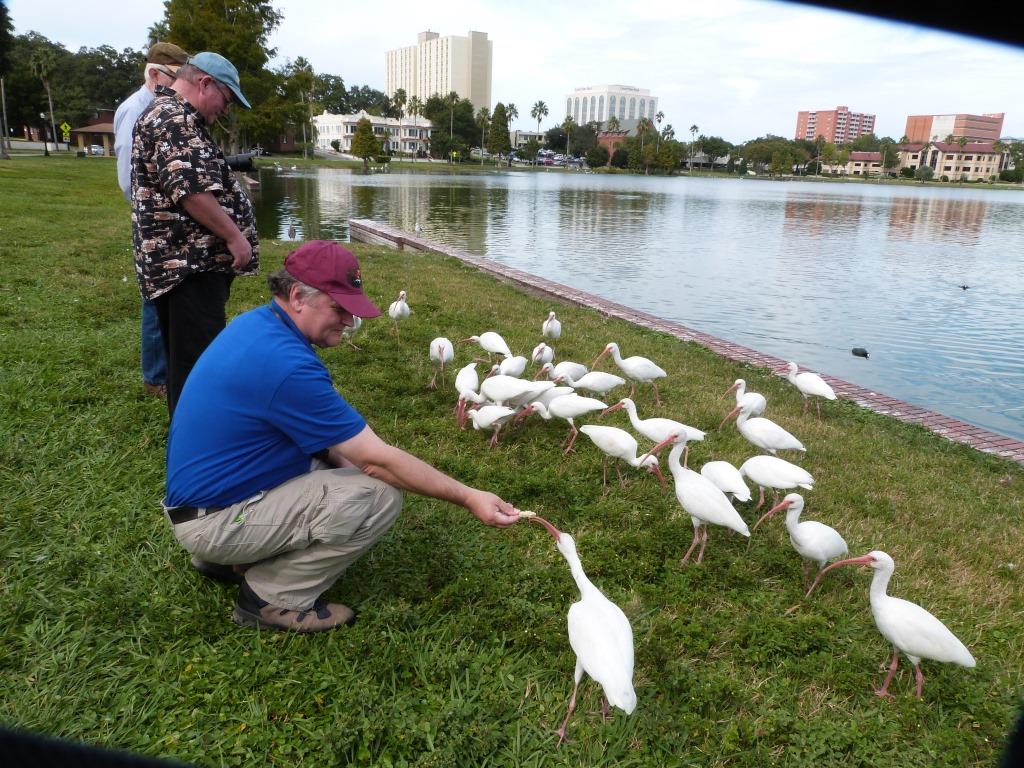
Feeding White Ibises at Lake Morton

Feeding White Ibises at Lake Morton

WHITE  IBIS   (Eudocimus albus).

The White Ibis is a white-plumed wading bird, with a reddish/orange-scarlet/pinkish/salmon-colored “decurved” (i.e., downward-curved) bill — shown here (with Dan Dusing, Baron Brown, and me  —  in a lakeshore photograph taken by ornithologist Lee Dusing) being fed bread crumbs.  The White Ibis is a gregarious bird, nesting in colonies and often seen foraging as a group.  Its homes are found in coastal mudflats, lakes and lakeshores, ponds and pondshores, and marshy areas.  (Obviously this group of ibises have been fed bread crumbs before – they are quite ready for a tasty snack!)  During the breeding season the White Ibis also has skinny pink legs (about the same color as its prominent bill, but at non-breeding times these legs are duller in color),  —  and this bird knows how to scurry about on those legs! The decurved bill, of course, is an excellent tool for probing around in shoreline mud or sand, for little things to eat, such as small crustaceans (like mudcrabs), frogs, or bugs.  (Obviously God gets the credit, for designing the ibis bill to accomplish what it does for the ibis, as well as for supplying ibis populations with the food sources they need to carry on the business of life.)  If the White Ibis bill snaps your fingers, as you feed him (or her) a bread-crumb, don’t worry!  –  the ibis’s bill is so light and gentle that its peck doesn’t hurt at all.  The White Ibis is found all over Florida, year-round, as well as on the Gulf Coast and America’s East Coast as far north as North Carolina.   (See Peterson’s Eastern Birds” [noted above, in entry for Muscovy Duck], at page M105.)  Why do fishermen especially appreciate the White Ibis?   The ibises eat a lot of shoreline crustaceans (like crabs and crayfish), which in turn eat fish eggs.  So if the crustacean populations grow too much, eating lots of fish eggs, the fish populations decline – bad news for fishermen.  Without consciously realizing it, therefore, the White Ibis is protecting the reproductive success of coastal fish populations — on which human fishermen (and their customers) rely.   (See the National Audubon Society’s Field Guide to North American Birds – Eastern Region [Alfred A, Knopf, 1994 revised edition], co-authored by John Bull & John Farrand, Jr., at page 376.)

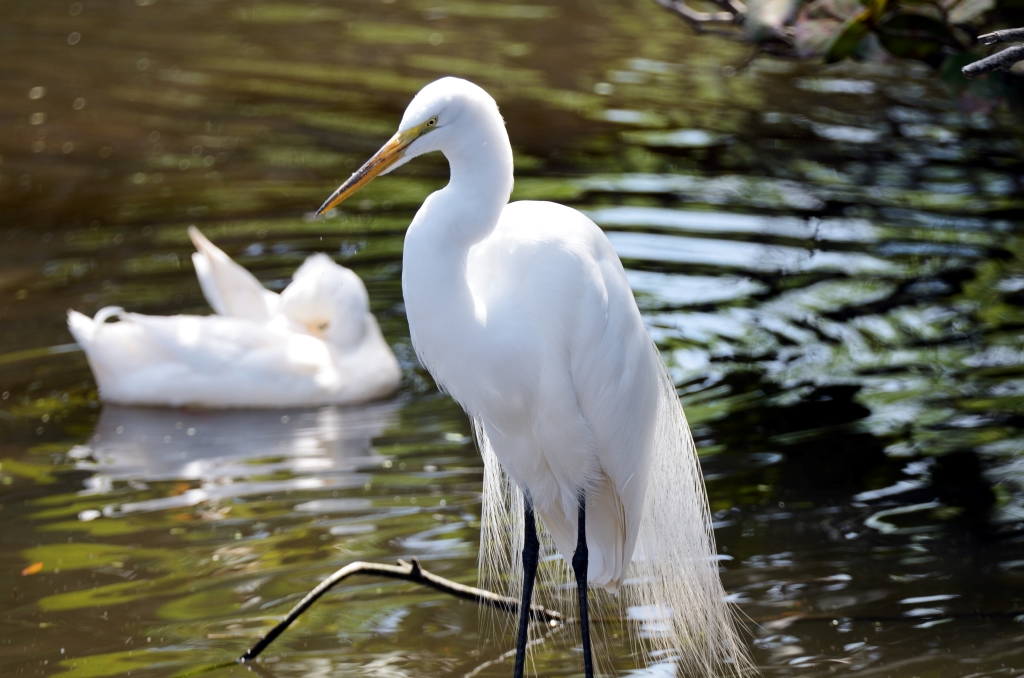
Great Egret at Gatorland by Dan

GREAT  WHITE  EGRET   (Ardea alba  or  Casmerodius albus).

The Great White Egret (a/k/a “Great Egret”) is a large long-legged heron-like wading bird, white in plumage, with a yellow bill and black legs.  (See Bull & Farrand’s Eastern Region [noted above, in entry for White Ibis], at page 368.)  This truly “great” egret is often seen standing, like a statute, on the shoreline of a pond, waiting for movement that would betray the availability, in the shallow water or the shoreline weeds, of a quick meal  –  perhaps a fish, a frog, or even a snake.   Donald and Lillian Stokes describe its eating habits as follows:  “Primarily feeds by walking slowly, head erect, then striking prey.  Forages in shallow water for small fish and amphibians [like frogs], but also on land for insects, reptiles [like snakes], and small mammals.  May feed solitarily and defend feeding areas by displaying aggressively and supplanting intruders.  Also feeds in large groups when food is concentrated.  Has been known to steal fish from other birds.” (Quoting Donald W. Stokes & Lillian Q. Stokes, Stokes Field Guide to Birds – Eastern Region [Little, Brown & Co., 1996], page 34.)  During summer this egret also frequents marshy grasslands, tidal mudflats, salt marsh beaches, and other wet habitats – all over America’s lower 48 states.  During winter this fair-weather fowl routinely migrates to America’s East (northward to Delaware), Gulf Coast, and West Coast.  It makes guttural-hoarse croaking noises, as well as loud squawking noises, but it is usually seen before it is heard – due to its large size and strikingly white color.  Its flight is majestic and gracious  —  a marvel to watch, with or without binoculars.

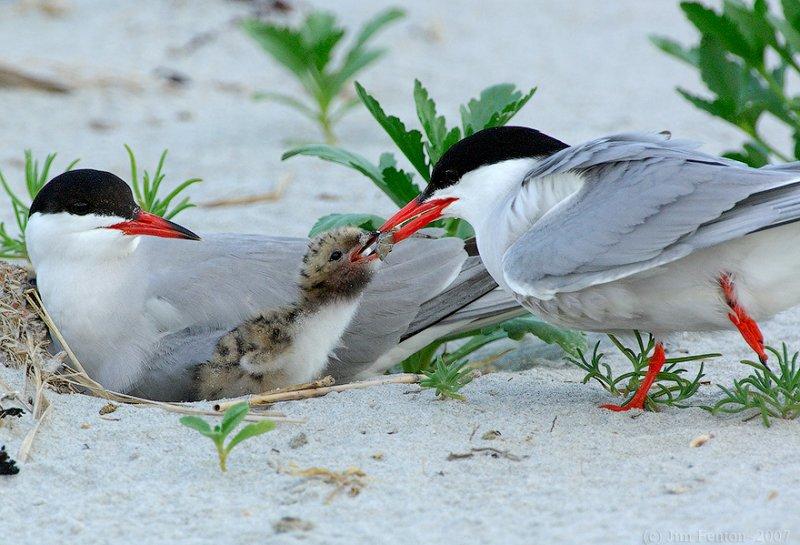
Common Tern (Sterna hirundo) by J Fenton

Common Tern (Sterna hirundo) by J Fenton

COMMON  TERN   (Sterna hirundo).

The Common Tern is one of the many coastline-dwelling birds that get lumped into the term “seagull”.  The Common Tern has been described as “White with black cap and pale gray back and wings.  Bill red with black tip; tail deeply forked.  Similar to Forster’s Tern, but lacks frosty wing tip.  Also similar to Arctic and Roseate Terns.”  (Quoting Bull & Farrand’s Eastern Region [noted above, in entry for White Ibis], at page 519.)  This seagull likes to nest in colonies, often on sandy beaches or on small islands, near lakes, bays, or ocean tidewaters.  Unsurprisingly, the males are the more aggressive sex, although a male intruder may be rebuffed by a male-and-female pair  —  so don’t mess with a Common Tern couple!  (See “Common Tern”, by Donald W. Stokes & Lillian Q. Stokes, in Bird Behavior, Volume III [Little, Brown & Co., 1989], page 71.)

Mourning Dove by Reinier Munguia

Mourning Dove by Reinier Munguia

MOURNING  DOVE   (heard cooing  —   Zenaida macroura).

Many books could be written about the Mourning Dove, and about its many cousins – such as the “pigeon” (Rock Dove) – that inhabit so many rural, suburban, and urban places around the world (as noted above, at the beginning of this birding report).  But a better description and appreciation for this bird must wait another day, because this report is already too long!  So, for now, this report closes with a passing mention that “mourning” was heard that morning – the plaintive cooing of the (well-named) Mourning Dove.  But no need for sadness  –  because it will soon be (God willing) another day for pondside birdwatching in Florida!


On the morning of February 9th, AD2015, from the pond-side backyard of Bob & Marcia Webel (while enjoying breakfast and Christian fellowship with the Webels), I saw 14 birds:  Great Blue Heron, Brown Pelican, Mallard, Double-Crested Cormorant, Black Vulture, Wood Stork, Lesser Scaup, Osprey, Snowy Egret, and Florida Gallinule,  as reported previously,  —  and, as reported hereinabove, Muscovy Duck, Great Egret, White Ibis, and Common Tern, plus the cooing of a nearby Mourning Dove was clearly recognizable.  What a morning!


James J. S. Johnson loves duck ponds, having formerly taught Environmental Limnology and Water Quality Monitoring for Dallas Christian College, as well as other courses on ecology and ornithology.  Limnology terms are not universal:  what some call a “pond” others call a “lake”.  [NOTE:  Some use the temperature of the bottom water as the lentic nomenclature determinant:  if the bottom water is the same temperature, year-round (i.e., regardless of whether it is winter or summer), it’s deep enough to be a “lake” – otherwise limnologists call it a “pond”.]   Regardless of this semantic custom, the “pond” viewed in the foregoing bird-watching report is called “Lake Coronado” in Florida’s Pinellas County.  J


*
Pond-side Birdwatching in Florida I

Pond-side Birdwatching in Florida II

Other Articles by James J. S. Johnson

*

Pond-side Birdwatching in Florida II

Pond-side Birdwatching in Florida,

from Chaplain Bob’s Backyard: Part 2

 by James J. S. Johnson

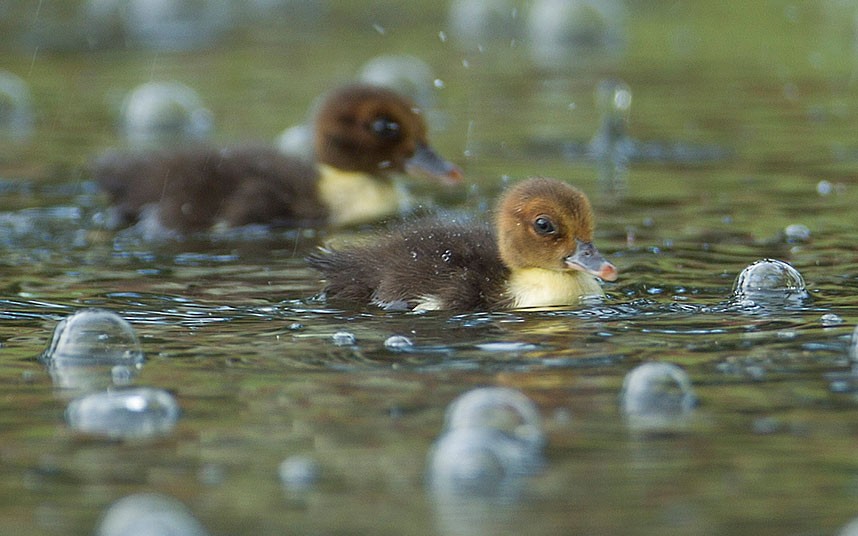
Moscovy Duck

Muscovy ducklings in the rain   (photo credit: J Pat Carter / AP)

For He [i.e., God] maketh small the drops of water: they pour down rain according to the vapor thereof, which the clouds do drop and distil [literally, pour down and drop down] upon man abundantly.  (Job 36:27-28)

For as the rain comes down, and the snow from heaven, and returns not there, but waters the earth, and makes it bring forth and bud, that it may give seed to the sower, and bread to the eater, so shall My word be that goes forth out of My mouth: it shall not return unto Me void, but it shall accomplish that which I please, and it shall prosper in the thing whereto I sent it.  (Isaiah 55:10-11)

[photo above: http://i.telegraph.co.uk/multimedia/archive/02298/ducklings_2298053k.jpg ]

A pond is not a pond unless it has standing [“lentic”] water, — yet a pond will eventually dry up (and thus cease to be a “pond”) if cloud-dumped rains fail to refill its standing waters!  (The same is true of running [“lotic”] waters – see 1st Kings 17:7.)  Why?  Because rain-provided water is always escaping ponds by evaporation.  (That’s why swimming pool owners must continually add more water to their pools.)

Accordingly, every pond needs rain (or snow that melts into rain-like liquid water), sooner or later, to be a pond!  Obviously, steady rainfall impedes birdwatching, so ideal birdwatching is done when it is not raining.  Even so, all bird-watchers should appreciate the rains that God sends, from time to time!  In fact, rain is a major part of God’s program for how our world and its diverse lifeforms function:  birds need rain, other animals need rain, people need rain, plants need rain, even microörganisms needs rain, — and all of that water is continually recycled throughout the earth!  In fact, Earth itself is mostly water!

As the prophet Isaiah noted [above]—and as every Gideon knows — God’s providentially sustained hydrologic cycle is comparable to how, all over the world, God carefully manages and orchestrates the specific influence and productivity of His written Word.  For more Scriptures relevant to Earth’s water cycle, see also Deuteronomy 8:7 & 32:2; Job 26:8; Ecclesiastes 1:7 & 11:3; Amos 5:8 & 9:6; Psalm 19:1-2 (noting that solar heat affects the sky) & 65:9-10 & 72:6 & 104:10-18 & 135:7; Isaiah 30:23; Jeremiah 10:13 & 14:22 & 51:16; Zechariah 10:1; — and especially Luke 12:54.

This birding report follows “Part 1” of this mini-series.   As noted in Part 1, I happily observed the busy birds at the pond that borders the backyard of Chaplain Bob and Marcia Webel (of St. Petersburg, Florida) on the morning of February 9th (AD2015), a Monday, when we saw 14 birds and heard (but did not see) a mourning dove.  As noted before, those birds were busy  —  quacking, splashing, swimming, perching on shoreline tree branches, dabbling, diving, and with several of them sporadically flying here and there.

Already, 5 of those lacustrine birds were described in Part 1 (Great Blue Heron, Brown Pelican, Mallard, Double-Crested Cormorant, and Black Vulture).  This Part 2 will feature 5 more:  Wood Stork, Lesser Scaup, Osprey, Snowy Egret, and Common Moorhen.  (Hopefully, the remaining 5 birds will be mentioned in an anticipated “Part 3” of this series.)

Wood Stork (Mycteria americana) By Dan'sPix

Wood Stork (Mycteria americana) By Dan’sPix

WOOD STORK   (Mycteria americana).

The Wood Stork (in some places nicknamed “Flinthead”, and f/k/a “wood ibis”) is a huge, long-legged wading bird, built somewhat like a large egret, heron, ibis, or spoonbill.  This bird is tall!  — with adults growing from 3 to almost 4 feet high!  The Wood Stork sports a long, flexible, blackish-grey, featherless neck.  Its ibis-like head is likewise featherless and not likely to be called beautiful (except by its mother).  Its powerful and prodigious bill is stout and slightly curved, well-fitted for probing in mud or muddy water, and for gobbling up fish, frogs, snakes, bugs, and worms located in wetland mud.  Storks sometimes eat small birds, small mammals, and even baby alligators!  The feathers of the Wood Stork are mostly white, except for the tail-feathers and black edge of its wings, which trail behind when the stork is flying.  Its feet are noticeably reddish in color.

Wood Stork (Mycteria americana) sitting by Dan

Wood Stork (Mycteria americana) sitting by Dan

The Wood Stork is typically mute (i.e., no vocal calls), communicating in other ways, such as by “bill-clattering”.  Being very large – and therefore heavy — birds, Wood Storks try to conserve their food-provided energy when flying.  Like other heavy birds (e.g., eagles, vultures, hawks), storks locate and “ride” thermal air currents, soaring and gliding when they can.  A true wetland bird, the Wood Stork is comfortable in a variety of wet habitats (such as ponds, marshy pastures, and swampy woodlands).  Storks construct huge nests for their families, typically as part of a stork colony (which may include literally thousands of stork pairs), often adding size to them year after year – some being built to about 6 feet in diameter and about 10 feet in depth!  Usually storks are monogamous (i.e., a male and female stay paired till one dies) although, for reasons not understood, sometimes pairs can get separated during a migration.  The dependability of the stork, in its migratory movements, is reflected in its Hebrew name (chasidah) which means “faithful” — see Jeremiah 8:7, explained in “A Lesson from the Stork” (posted at  http://www.icr.org/article/lesson-from-stork ).  Although they often migrate – spending summer in the southeastern states, these storks are known to reside in Florida (and parts of Georgia) year-round.  (See range map in Donald W. Stokes & Lillian Q. Stokes, Stokes Field Guide to Birds – Eastern Region [Little, Brown & Co., 1996], page 47, — as well as National Audubon Society’s Field Guide to North American Birds – Eastern Region [Alfred A, Knopf, 1994 revised edition], co-authored by John Bull & John Farrand, Jr., at page 379-380.)

Lesser Scaup (Aythya affinis) by Ray

Lesser Scaup (Aythya affinis) by Ray

LESSER  SCAUP   (a/k/a “LITTLE BLUEBILL”:  Aythya affinis).

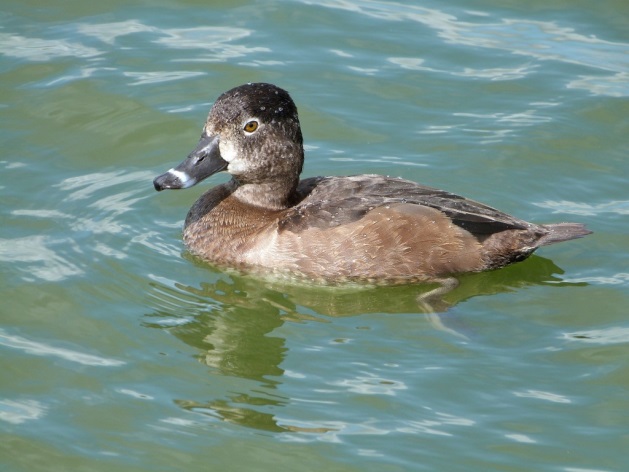
The Lesser Scaup looks a lot like the Greater Scaup, but there are two ways to distinguish these look-almost-alike ducks:  (1) different shapes of their respective heads and bills; and (2) different winter ranges of territory where they live.  Donald and Lillian Stokes note the following traits:  “Head and bill shapes are most useful characteristics distinguishing [the Lesser Scaup] from the Greater Scaup … [on the] Lesser Scaup the head comes to a peak at the top or near the back [of the head]; [the Lesser Scaup] bill is slightly shorter and narrower [than that of the Greater Scaup].”  (Quoting Stokes & Stokes, Stokes Field Guide to Birds – Eastern Region [noted above, in entry on the Wood Stork], page 75.)  Regarding the respective ranges of scaups, the typical winter range territories of the Lesser Scaup includes the East Coast, Gulf Coast, West Coast, and non-mountainous regions of states (including most of Texas) that include the greater Mississippi River Valley’s tributary drainage basin.

Greater Scaup (Aythya marila) by Ray

Greater Scaup (Aythya marila) by Ray

The Greater Scaup, however, has a winter range that usually includes only the northern portions of the West Coast and East Coast, plus regions near the Great Lakes.  (Compare the sparser ranges indicated in Stokes & Stokes, Eastern Region, at page 75, with the range maps in Roger Tory Peterson, A Field Guide to the Birds Eastern Birds:  A Completely New Guide to All the Birds of Eastern and Central North America, abbreviated as “Eastern Birds” [Peterson Field Guides, Houghton Mifflin, 1980], at maps M43 & M44, with field notes at pages 58 & 72.)   In other words, if it’s a scaup on a Florida pond, it’s probably a Lesser Scaup!  The male of this duck has an easy-to recognize color pattern:  its bill is pale blue, its head, breast, and tail are dark-blackish; its flanks are white, and its back is mottled grey. In bright sunlight the male’s head has a purplish iridescence.   The female is mostly dark grey-brownish and black, with a noticeable white patch-like spots on both sides of her dark bill. (As with ducks generally, the easiest way to spot a female Lesser Scaup is to watch for a dark duck that pairs with a male Lesser Scaup!)   These ducks are divers – they dive into pond-water to catch and consume submergent plant seeds, insects, snails, and small crustaceans.  These duck are seen on ponds, lakes, rivers, and marshlands (including “prairie potholes” and estuarial saltmarshes).  Lesser Scaups, like ducks generally, are social creatures – sometimes they aggregate in hundreds or even thousands!  In many places, due to the availability of needed resources – which may be indicted by the size of a lake or pond, less than a hundred (maybe only a dozen) will group together.   Bird-books sometimes allege irresponsible and irrational opinions about how scaups supposedly “evolved” (e.g., Bull & Farrand, Eastern Region [noted above, in entry on the Wood Stork], at page 403), without any forensic evidence for such science fiction. The real truth is that all Lesser Scaups (like all other ducks) ultimately descend from ducks that disembarked Noah’s Ark, about 4500 years ago, which Flood survivors were themselves s directly descended form ducks that God made on Day #5 of Creation Week (see Genesis 1:21).

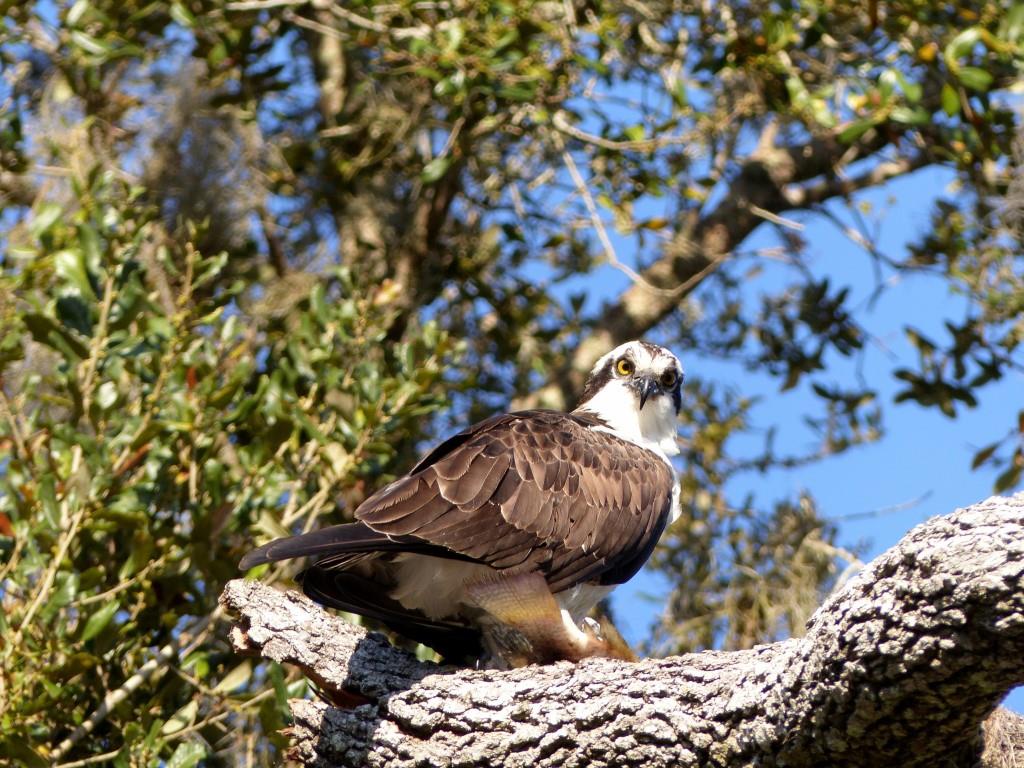
Osprey at Circle B by Lee

Osprey at Circle B by Lee

OSPREY    (a/k/a “FISH HAWK”:  Pandion haiaetus).

The Osprey is rightly nicknamed the “fish hawk” – they love to catch and eat fish! And, to the delight of bird-watchers, ospreys are not afraid to display their fish-eating lifestyle to nearby humans. Donald and Lillian Stokes make this interesting observation about osprey behavior:  “Among our birds of prey the osprey is one of the most amenable to living near humans.  Its main requirements are open water [such as a Florida pond!] where it can hunt for fish and a platform or strong tree where it can build its nest.  Ospreys have occasionally built nests [or use habitual perching sites] right next to homes [such as a large tree in the Webels’ backyard, bordering the pond], in parking lots, and in public parks.  Although they do not prefer being near humans [especially busy humans who move around a lot, causing distraction], they do seem to tolerate human presence, an ability that is a big asset for the survival of any species.” (Quoting “Osprey”, by Donald W. Stokes & Lillian Q. Stokes, in Bird Behavior, Volume III (Little, Brown & Co., 1989), page 159.]  The Osprey has a range that includes river systems in America’s Great West (e.g., Wyoming’s Snake River), a well as coastlines on the West Coast, Gulf Coast, and East Coast.  (See Stokes & Stokes, Eastern Region [noted above, in entry on the Wood Stork], at page 94.)  This “fish hawk” is relatively slender, for a hawk, but obviously stouter than a falcon.

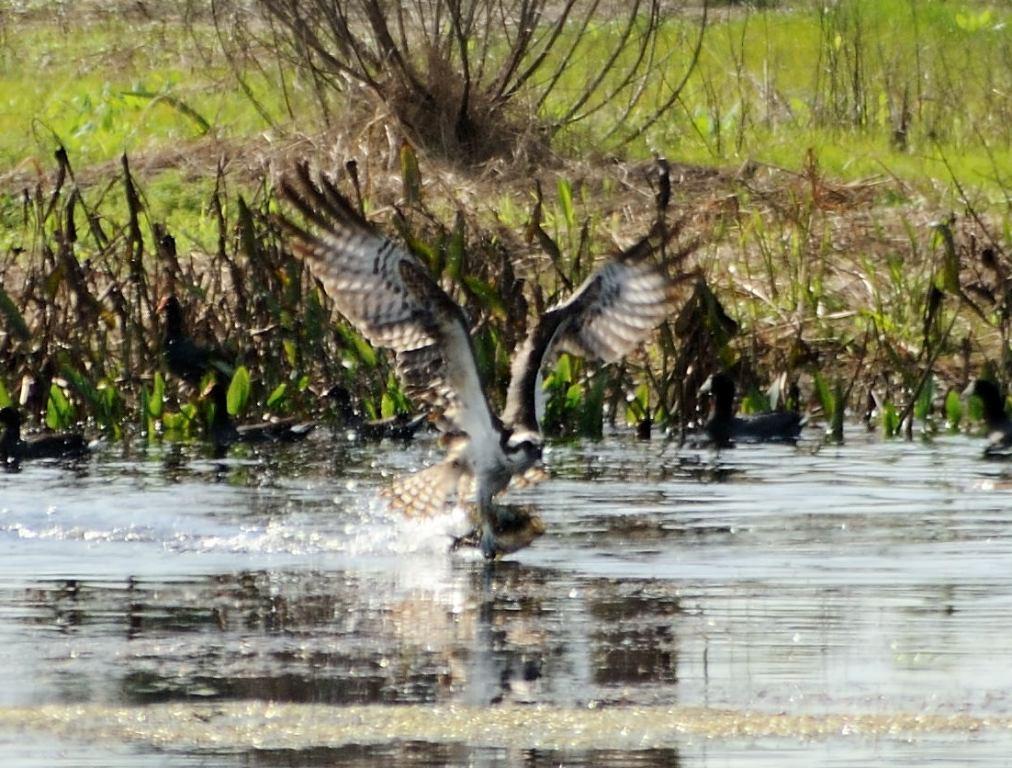
Osprey Catching Fish - Viera Wetlands

Osprey Catching Fish – Viera Wetlands by Dan

The Osprey is long-winged, white underneath (except the outer feathers of its wings, and its tail, which are brown), with a mottled brown pattern above; its head is mostly white, with a dark side-streak that passes “through” each eye and on the side of the hawk’s face.  The talons of this fish-grabber are opened for prey, when the Osprey dives into water, tightly clutching any fish it succeeds in seizing after it splashes into the water.  Sometimes a dead Osprey is seen hanging onto a riverine fish.  How did that happen?  Occasionally a strong fish flees when attacked by an Osprey, diving deeper with the Osprey still attached, as the desperate fish tries to avoid its avian pursuer.  If the Osprey’s talons are embedded in the diving fish’s flesh, the fish may cause the Osprey to die by drowning, if the Osprey cannot shake loose its talons in time to escape.   (Fishing always has its hazards, as any fisherman knows!) If the Osprey is successful, it quickly re-surfaces and flies off with its fish, adjusting its hold on the fish so that the fish’s face is pointed forward – for safe eating.  Ospreys are sloppy eaters.  If Ospreys eat chunks of their catch while perched in tree branches that spread over where you are sitting, watch out!  Fish scraps may fall on your head – or something worse (!) might drop onto your head.  Therefore, a wide beach umbrella (like one that Bob and Marcia Webel have, and use in their backyard, while bird-watching) is a good “shield” to have when Ospreys are eating above you.

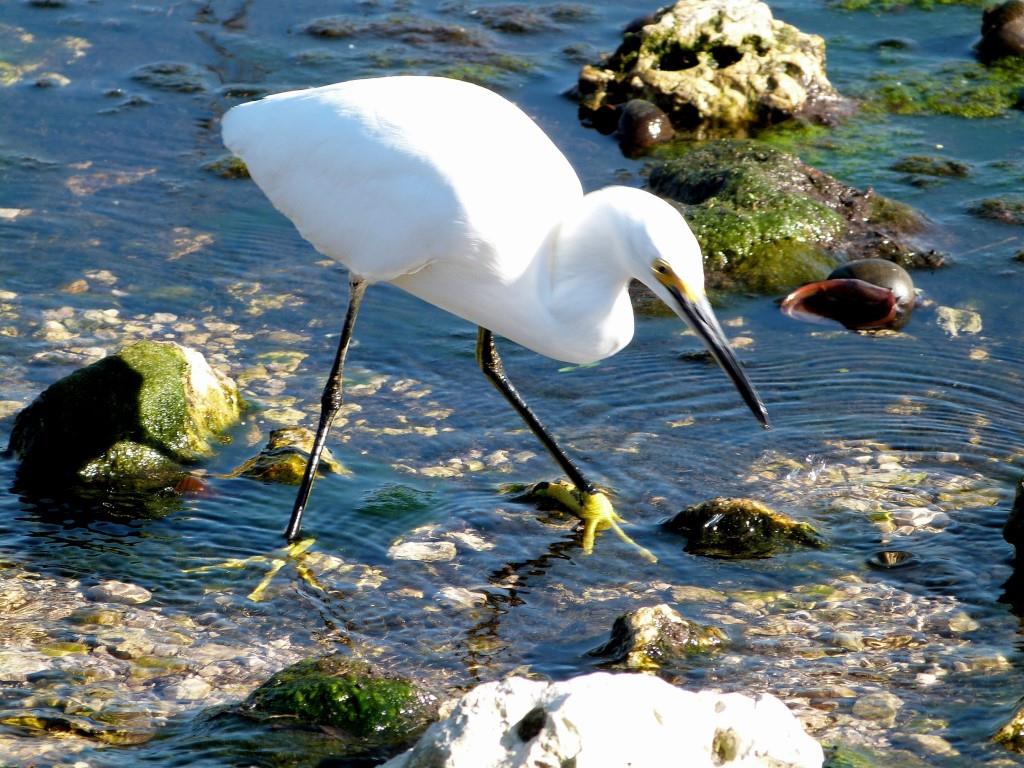
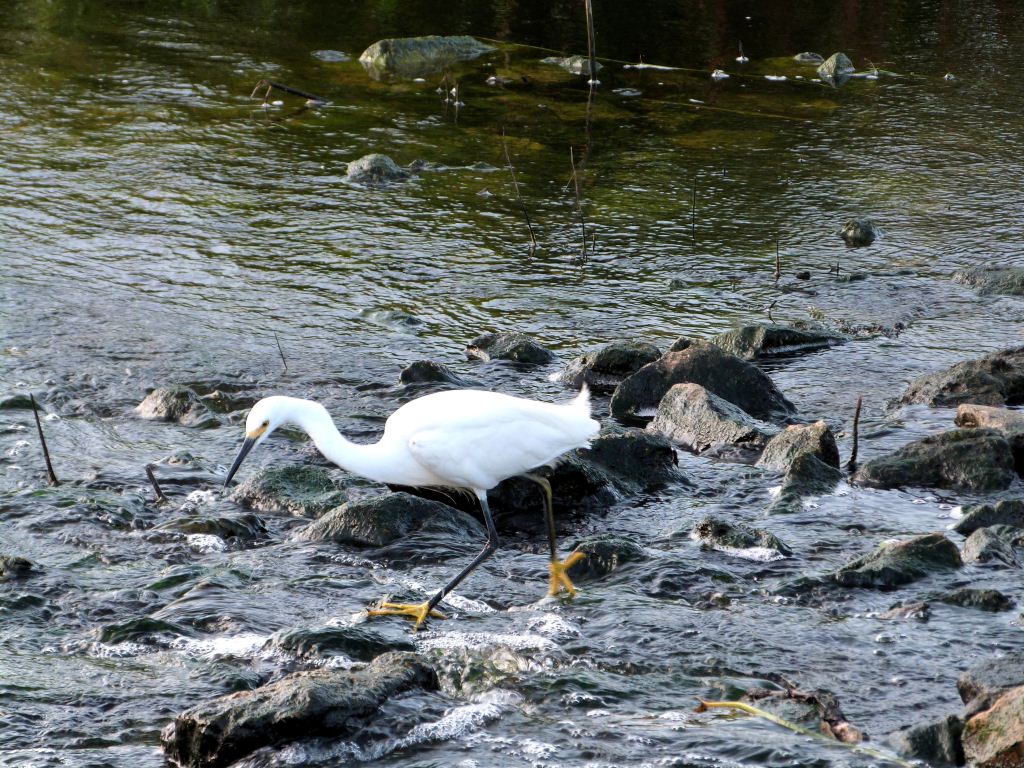
Snowy Egret (Egretta thula) Notice Yellow Feet by Lee at Circle B

Snowy Egret (Egretta thula) Notice Yellow Feet by Lee at Circle B

SNOWY  EGRET   (Egretta thula).

This beautiful white-feathered egret looks like a small version of the Great Egret (a/k/a Great White Egret), except it has its trademark “golden slippers” – i.e., its long skinny black legs end with feet that are conspicuously bright-yellow (unlike the black feet of a Great White Egret).  Also, the slender Snowy Egret has a thin black bill, in contrast to the thicker golden-yellow bill of the stouter  Great White Egret.   (See Roger Tory Peterson, Eastern Birds [noted above, in entry on the Lesser Scaup], pages 102-103 & map M93 & M444.)   Sometimes the Snowy Egret’s feathers, at the back of its head, “hang loose” (i.e., these feathers won’t lay down close to the bird’s head/neck), looking somewhat like a comb-over that won’t “sit down”).   Its feet stir up opportunities to find food:  “When feeding [it] rushes about, shuffling [its] feet to stir up food.”  (Quoting Peterson, Eastern Birds, at page 102.)

Snowy Egret Circle B 8-3-12 by Lee

Snowy Egret Circle B by Lee

Like other egrets, the Snowy Egret habituates the marshy edges of lakes and ponds, as well as other marshy areas, eating fish and almost anything else it can grab with its bill. The summer range of this elegant egret is broad – it can be found at and near many lakes, ponds, estuarial marshlands, and even wet pasturelands throughout America’s lower 48 states.  During winter it can be found all over Florida , as well as all along the Gulf Coast, along the East Coast as far north as North Carolina, plus parts of California (See Stokes & Stokes, Stokes Field Guide to Birds –  Eastern Region [noted above, in entry on the Wood Stork], at page 35.)  notwithstanding taxonomic “splitting”, this is basically the same bird that Europeans call the “Little Egret” (Egretta garzetta), which winters in northern Africa.  (See, accord, Chris Kightley, Steve Madge, & Dave Nurney, Pocket Guide to Birds of Britain and North-West Europe [British Trust for Ornithology/Yale University Press, 1998], page 19.)

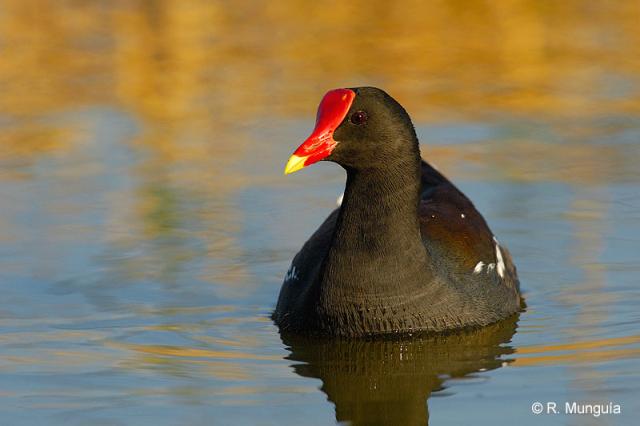
CommonMoorhen (Gallinula chloropus) by Reinier Munguia

CommonMoorhen (Gallinula chloropus) by Reinier Munguia

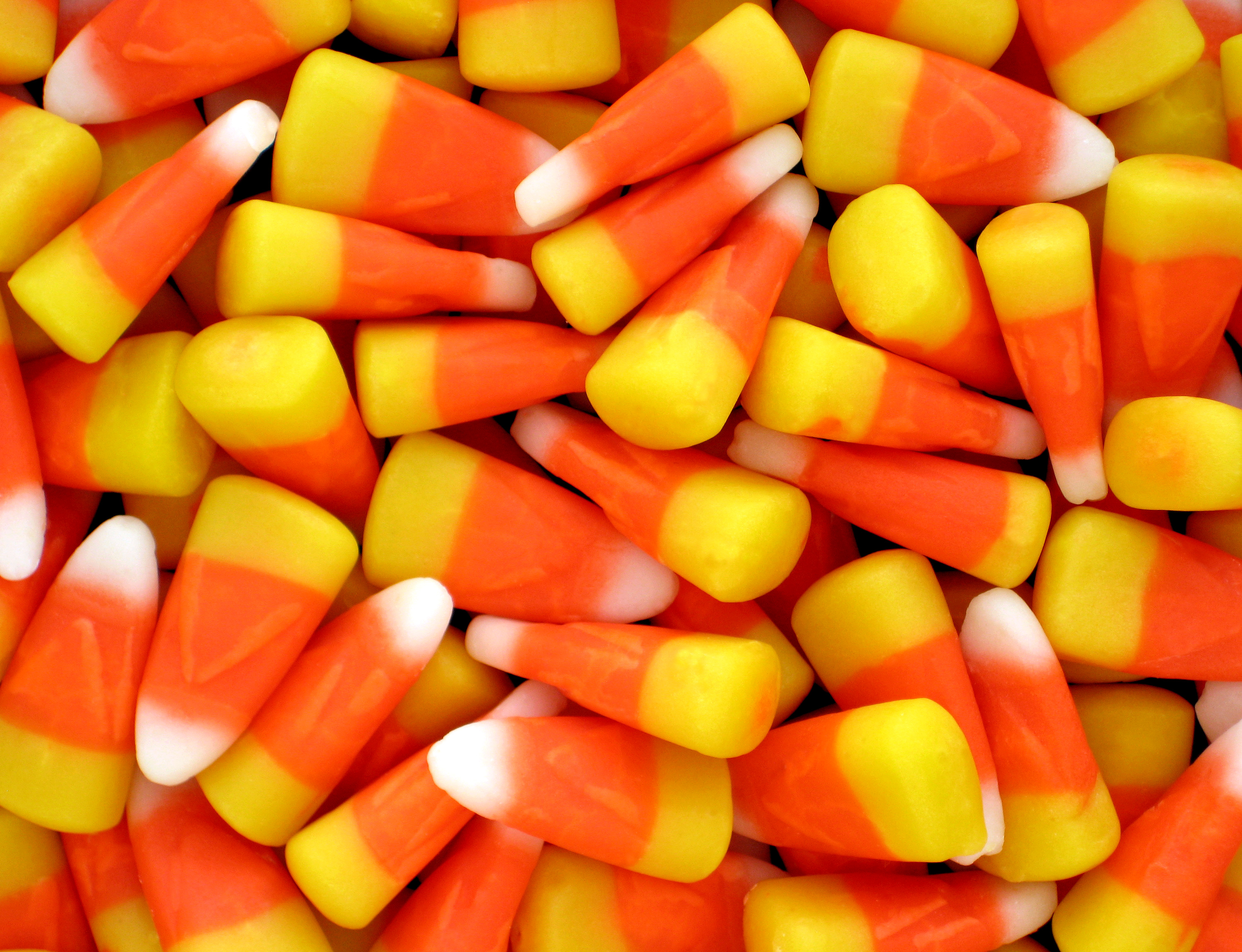
Candy-Corn

Candy-Corn

FLORIDA  GALLINULE   (a/k/a “COMMON MOORHEN” & “COMMON GALLINULE”:   Gallinula chloropus).

This gallinule (i.e., chicken-sized marsh-fowl) is almost all black, with a characteristic and conspicuous yellow-tipped scarlet-red bill.  (Actually the scarlet part of the bill can fade to a less vibrant reddish hue during winter.)  Due to the specific color pattern and shape of this gallinule’s bill, ornithologist Lee Dusing aptly calls this the “candy corn” bird.  (Some of us remember “candy corn” as a trick-or-treat candy.)  This waterfowl makes a variety of noises, including chicken-like clucking noises (befitting its nickname “moorhen”).  The Florida Gallinule is quite similar to the American Coot (which, though a similarly shaped black gallinule, is distinguishable by its all-white bill) and the Purple Gallinule (which is distinguishable due to its male’s iridescent peacock-blue, indigo, and slightly purplish breast and neck feathers, and its glossy green back feathers).  The long “fingers” (i.e., toes) on their feet enable this gallinule to spread out their modest body weight so that they can “walk” on lily pads and similar vegetation that floats in marshy lentic waters.  This gallinule (or “moorhen”) habituates lakes, ponds, and marshy wet places, often near cattails, summering in states east of and within the Mississippi River Valley, plus a few coastal place on the West Coast.  (See Stokes & Stokes, Stokes Field Guide to Birds – Eastern Region [noted above, in entry on the Wood Stork], page 139; Bull & Farrand, Eastern Region [noted above, in entry on the Wood Stork], at page 459.)  Its diet includes marshy vegetation (especially seeds), snails, land bugs, and water bugs.  This rail-like bird is entertaining to watch, routinely bobs its head while swimming across a pond.  Like coots they confidently swim in open-water contexts where they are easily observable to appreciative bird-watchers (like me).

Wow!  That’s another 5 of the 15 birds that the Webels and I observed, that morning, from the Webels’ pond-side backyard.   Stay tuned!  God willing, the remaining 5 birds will be given their proper recognition, at this excellent bird-site!

**

On the morning of February 9th, AD2015, from the pond-side backyard of Bob & Marcia Webel (while enjoying breakfast and Christian fellowship with the Webels), I saw 14 birds:  Great Blue Heron, Brown Pelican, Mallard, Double-Crested Cormorant, and Black Vulture  –  as reported previously – plus Wood Stork, Lesser Scaup, Osprey, Snowy Egret, White Ibis, Common Tern, and Florida Gallinule,   — as reported above  —  as well as Muscovy Duck, Great Egret, White Ibis, and Common Tern, plus the cooing of a nearby Mourning Dove was clearly recognizable.  It is hoped (God willing) that one more report will supplement this one, so the remaining 5 birds will be properly recognized for their lacustrine appearances on that Monday morning.

James J. S. Johnson loves duck ponds, having formerly taught Environmental Limnology and Water Quality Monitoring for Dallas Christian College, as well as other courses on ecology and ornithology.  The hydrologic cycle Scriptures (quoted at the beginning of this bird-watching report) are especially appreciated by Jim, as a Certified Water Quality Monitor, certified by and serving the Texas Natural Resource Conservation Commission, providing reports on Furneaux Creek to the Trinity River Authority of Texas.  Like us all, birds need clean water!  Accordingly, backyard pond habitats are for bird-watching!

*

Pond-side Birdwatching in Florida I

Other Articles by James J. S. Johnson

*

European Dipper, Norway’s National Bird

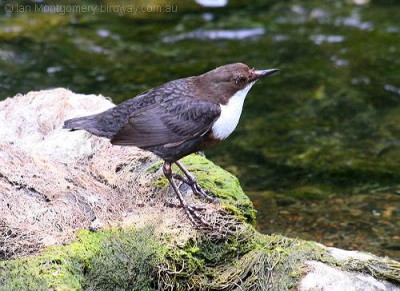
White-throated Dipper (Cinclus cinclus) by Ian

White-throated Dipper (Cinclus cinclus) by Ian

European Dipper, Norway’s National Bird

by Dr. James J. S. Johnson

Take therefore no thought for the morrow: for the morrow shall take thought for the things of itself. Sufficient unto the day is the evil thereof. (Matthew 6:34)

EUROPEAN DIPPER

Luzon Bleeding-heart by Dan

Orni-Theology

The official bird of Norway is the White-throated Dipper (a/k/a European Dipper: Cinclus cinclus). Unlike the American Dipper (which is dark-black all over), it has a mix of colors: brown head, white throat/bib, chestnut belly, and blackish back and tail.

As the range map shows, this little bird is known to range over all of Norway, as a year-round resident. This bird needs running freshwater, because that is where its primary source of food resides. And Norway has lots of fast-running freshwater, especially as mountain snow melts and flows downhill, in crevices, waterfalls, streams, and other drainage pathways that lead westward to the sea.

White-throated Dipper aka European Dipper

White-throated Dipper aka European Dipper

This passerine (i.e., perching songbird) bird is thus deemed an “aquatic” bird, due to its familiar habit of dipping into freshwater for food – and “walking” across the streambed as it fishes (underwater) for insect larvae and other edible morsels found in streambeds.

Specifically, this dipper has too behavioral movements that fit its name: (1) as it perches near quick-flowing stream-waters, it often (and suddenly – some say “spasmodically”) bobs, with its tail propped up (somewhat like a wren), near the splashing water; and (2) it dives into such lotic waters, sometimes after wading into the water’s edge: then submerges itself by quickly plunging in (or diving in), with a small splash. While underwater it seems to swim, though its wings actually “fly” underwater, or (at times when the current is stronger) the submerged bird vigorously “rows” its sturdy wings, like oars, to resist the under-current, in order to steady its underwater position.

Dipper under water by Getty Images

Dipper under water by Getty Images

The Dipper can also use its strong prehensile toes (i.e., it can grip with its feet, almost like a human hand) to grab onto projecting substrates on the bottom of a stream, while simultaneously straining its muscles (and keeping its head bent down so that it can see what is on the streambed) to prevent it from rising to the water’s surface – thus giving the appearance that it is “walking on the bottom” of the stream!

While underwater the dipper collects its food (which is often “epibenthic”, i.e., located on top of the stream-bottom sediments), such as caddisfly larvae (and other insect larvae), as well as small freshwater mollusks, fish, and amphibians – and a favorite freshwater crustacean, the thin amphipod shrimp (of the genus Gammarus, a genus containing marine “scud”, estuarial, and freshwater shrimps known for their detritivorous / scavenging habits).

What a strange bird! Yet it is determined to use its anatomy and strength to get food for the day, even appearing to defy gravity while it does. It may not be a huge buffet banquet table, by our standards, but it is enough – so the bird eats what it needs, one day at a time.

Just face one day of challenges at a time – what a concept!

Take therefore no thought for the morrow: for the morrow shall take thought for the things of itself. Sufficient unto the day is the evil thereof. (Matthew 6:34)

*

Orni-theology

James J S Johnson

Dippers – Cinclidae

Good News

*

Pond-side Birdwatching in Florida I

PondsideBirdwatching.photo1

Pond-side Birdwatching in Florida,

from Chaplain Bob’s Backyard: Part 1

  by James J. S. Johnson

He turneth the wilderness into a standing water [’agam = “pond”], and dry ground into water-springs.  (Psalm 107:35)

Another wonderful morning in St. Petersburg (Florida), gazing at the duck pond and its marshy shores, with mocha coffee, buttered rye toast, and my feet propped up, birdwatching from the pond-side backyard of Chaplain Bob and Marcia Webel   —   under a huge beach umbrella, shielded from the occasional post-digestion droppings (!) from several ibises and ospreys perched in branches that hung over where were sat, birdwatching, properly outfitted with binoculars, coffee mugs, breakfast foods, and a bird-book. That is what I was doing, by God’s grace, on Monday morning (2-9-AD2015) during February (which, by the way,  is officially “National Bird-Feeding Month” – see 103rd Congress, Volume 140, Congressional Record, for 2-23-1994, U.S. House of Representatives, Rep. John Porter speaking on “National Wild Bird Feeding Month”).

The lacustrine birds (in this backyard-and-pond setting) were busy, busy, busy,  —  and noisy!  — with their morning activities.  Most of them were ducks (mallards and lesser scaups).  These lentic water-loving birds were busy:  some were paddling across the pond, quacking, splashing, dabbling or diving, others were perching on shoreline tree branches, or loitering in the pond-edge marshy plants.  Most of them were sporadically flying here and there, sometimes alone, sometimes as a group.  (And they noticed the presence of turtles in the water, as well as a dog on the shoreline.)   Sometimes tall wading birds (e.g., egrets and herons) perched atop the roofs of houses near the pond-shore. In that one morning, in just an hour or two, I saw at least 14 different birds, plus we heard the distinctive cooing of a mourning dove!

To memorialize the happy experience (which was all the more enjoyable because it was shared with my good friends Bob and Marcia Webel), please appreciate this quick report on those pond-side birds, blended with a few thoughts about those fair fowl —  all of which birds were so carefully made and maintained by our Lord Jesus Christ. Of course, it would take too long to report, now, on all 15 birds that we then observed.  So this report  (God willing)  will be just the first installment – reporting on the Great Blue Heron, Brown Pelican, Mallard, Double-Crested Cormorant, and Black Vulture,  —  within what should be a mini-series, eventually covering  all 15 of those beautiful-to-behold  backyard-pond-birds.

Great Blue Heron by Dan

Great Blue Heron

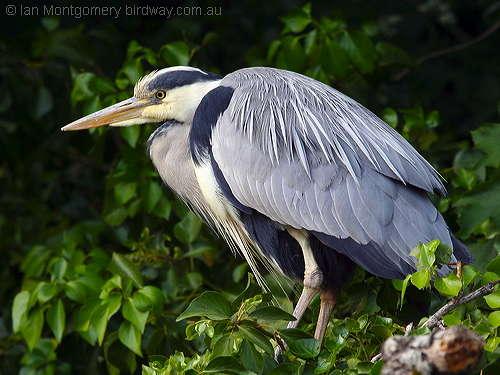
GREAT  BLUE  HERON   (Ardea herodias). The Great Blue Heron is a tall, majestic egret-like bird, poised and dignified.  It can stand still as a statue for a long time, waiting for its food to become snatchable.  When the heron spies its prey (likely a fish or frog – but maybe a small mammal, bird, lizard, or even a snake!), at the side of a pond, it stabs with sudden speed – the prey never saw that powerful, sharp, dagger-like beak coming – till it was too late! When in flight, the Great Blue Heron is graceful, purposeful, and dignified.  The National Audubon Society’s Field Guide to North American Birds – Eastern Region (Alfred A, Knopf, 1994 revised edition), co-authored by John Bull & John Farrand, Jr., reports (at its page 367) this description of the Great Blue Heron:  “A common, large, mainly [Confederate] grayish heron with pale or yellowish bill.” Its most habitat – which changes with seasonal migrations — is a pond’s edge, or that of a lake, stream, river, or marshland.  What a regal bird!  “For most of us, sightings of great blue herons are confined to a glimpse of the bird as it flies slowly and steadily overhead, wings arching gracefully down with each beat, neck bent back, and feet trailing behind.  At other times we see it on its feeding grounds, standing motionless and staring intently into shallow water, or wading with measured steps as it searches for prey.” [Quoting from “Great Blue Heron”, by Donald W. Stokes & Lillian Q. Stokes, in Bird Behavior, Volume III (Little, Brown & Co., 1989), page 25.]

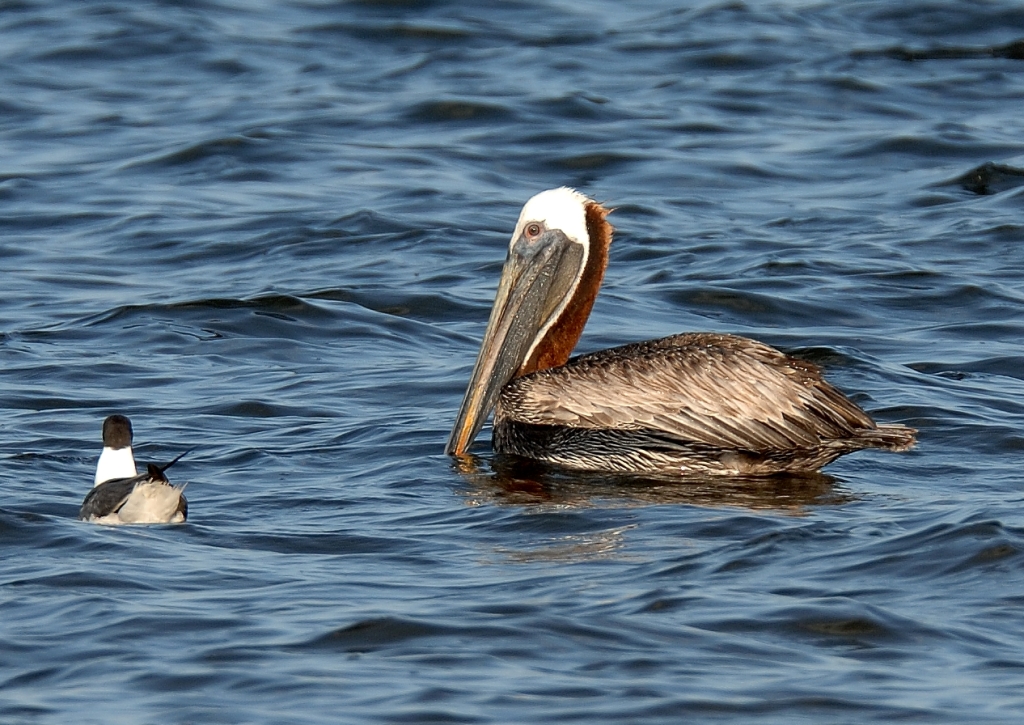
Brown Pelican and Laughing Gull by Dan MacDill Shore 2014

Brown Pelican and Laughing Gull by Dan MacDill Shore 2014

BROWN  PELICAN   (Pelecanus occidentalis). In their Field Guide to North American Birds – Eastern Region (noted above, in the Great Blue Heron entry), Bull & Farrand describe (at page 359) the Brown Pelican as a “very large, stocky bird with a dark brown body and a long flat bill”.  The adult storks have an ivory-white head, dark throat pouch, with dark brown hindneck coloring during the mating season.  The immature storks have dark brown heads and ivory-white breasts. These pelicans are year-round residents of Florida’s coastlands.  Bull & Farrand (on page 359) also report that the Brown Pelican is the “only nonwhite pelican in the world”, describing its eating habit as follows:  “…this marine bird obtains its food by diving from the air, its wings half folded as it plunges into the surf.  During one of these dives, the pouched bill takes in both fish and water; the bird drains out the water before throwing its head back and swallowing the fish.”  Donald and Lillian Stokes contrast this eating habit with that of the American White Pelican, which “feeds while floating on the water”.  (See Donald W. Stokes & Lillian Q. Stokes, Stokes Field Guide to Birds – Eastern Region [Little, Brown & Co., 1996], page 25.) One characteristic behavior of pelicans – the world over (including the Holy Land) – is the practice of adult pelicans regurgitating partially digested food into the mouths of their young.  “Pelicans” (Hebrew noun: qa’ath) are mentioned in Leviticus 11:18, Deuteronomy 14:17, and Psalm 102:6 [v. 7 in the Hebrew Bible’s verse numbering] – and apparently also in Isaiah 34:11 and Zephaniah 2:14.  George Cansdale says: “All pelicans feed their young by partly digested food, taken by the chick as it puts its head down the parent’s throat.  This regurgitation was the basis of the LXX and [Vulgate translation for] pelican, for [the Hebrew noun] qa’ath is said to mean ‘vomiter’.” (Quoting George S. Cansdale, All the Animals of the Bible [Zondervan, 1976], page 157.)  Cansdale rightly notices this, because the Hebrew noun for “vomitus” is qa’ (an etymologically related noun, which appears in Proverbs 26:11).

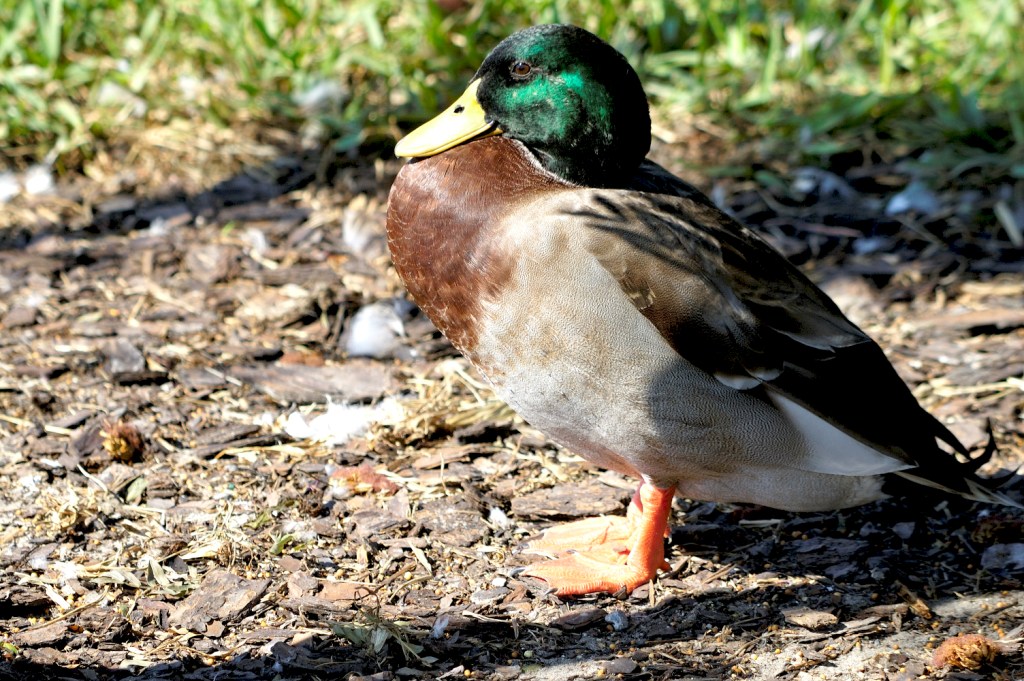
Mallard (Anas platyrhynchos) at Lake Parker By Dan'sPix

Mallard (Anas platyrhynchos) at Lake Parker By Dan’sPix

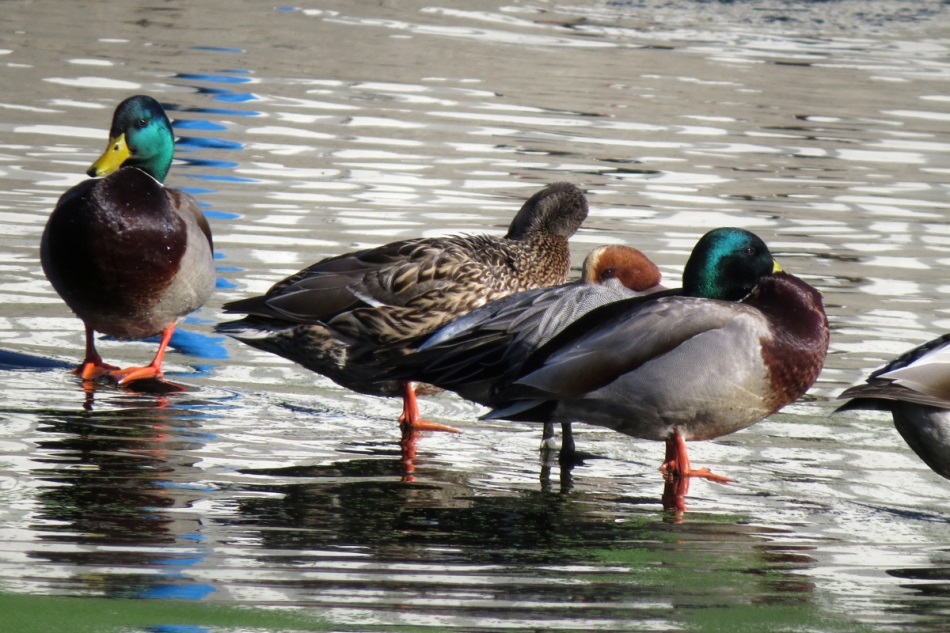
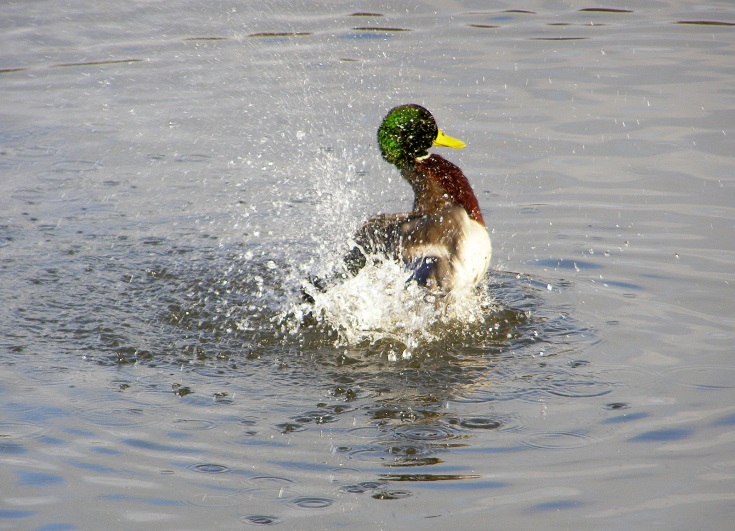
MALLARD   (a/k/a “GREEN-HEAD”:  Anas platyrhynchos). Mallards are nicknamed “green-heads”, due to the males’ iridescent green heads (which are bordered by a white neck ring).  The mallard male’s breast is chestnut-hued. Mallards live both on the coasts and inland (at ponds, lakes, prairie potholes, marshlands, including saltmarshes), including the entirety of America’s lower 48 states, so they are common (and well-known to American birdwatchers), so commonly known facts about them will not be repeated here.  Bull & Farrand [noted above, in the entry on Great Blue Heron] reports that the Mallard “is undoubtedly the most abundant duck in the world” (quoting page 392). Mallards are not only relatively ubiquitous, in their migratory or residential ranges (living or visiting in America, wherever migratory or residential ducks might be found), they are not shy around the habitat “edges” of human settlements.  Mallards frequent parks and backyards near ponds or other water bodies (including manmade reservoirs), often learning (and anticipating) that humans might provide bread crumbs or popcorn.  (But if you throw a piece of rotten banana into pond-water the mallards will not eat it.)  Donald Stokes reports that males and females make different noises:  “The quacking sound, which I had assumed that all Ducks made, can be made only by the female.  The male has two other calls of his own – a nasal rhaeb sound and a short Whistle-call, the latter accompanying all of the group courtship displays.”  (Donald W. Stokes, A Guide to Bird Behavior, Volume I (Stokes Nature Guides, Little, Brown & Co., 1979, page 31) Stokes goes on to say (pages 31-32) that this pattern of vocal behavior is not limited to Mallards – it also is observed in similar ducks including Gadwalls, Widgeons, Teals, Black Ducks, and Pintails.  Remember, therefore, if you see a large group of Mallards on a pond, and you hear a lot of quacking, it’s the females who are making all that noise.  (They might be trying to frighten of a turtle or other animal that is getting too close to their ducklings!)

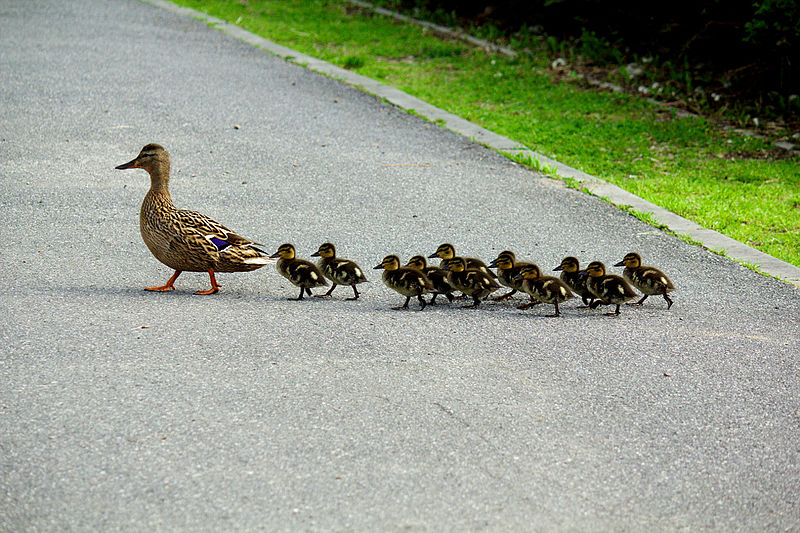
Mallard Duck army marching (I know it's not a King, but it's cute) ©WikiC

Mallard Duck army marching ©WikiC

Mallards have good memories (as do all birds, I assume), and I have personal knowledge of that fact.  More than 15 years ago, my son and I would regularly feed the ducks (mostly mallards, plus lesser scaups during the winter months) at a pond near Furneaux Creek (in Denton County, Texas), in the evening. But one day we were in a hurry — I don’t recall why — so we drove straight home, bypassing the pond, then driving about a block, taking a right turn, then after another block taking another right turn, then driving down the hilly street to near the end of the cul-de-sac in our neighborhood, parking the car by our mailbox. However, as we got out of the car (and I approached our mailbox at the edge of our small front yard), and as we stepped onto the sidewalk toward our home’s front yard, we were greeted by a host of energetically quacking ducks! — apparently they wanted to know why we didn’t make our usual stop to feed them at the pond. Embarrassed, we quickly found something to feed them, and we quickly scattered food scraps on our front yard, to satisfy our avian guests (and they gobbled up all the bread scraps)! Yes, I felt a bit ashamed of myself, that day, for disappointing the mallards that day — but I’m pretty sure that they “forgave” us. Life gets busy — but that should not become an excuse for ignoring those whom we have an opportunity to be kind to (Galatians 6:10), even if they are mallards who live at a nearby pond.

Double-crested Cormorant (Phalacrocorax auritus) by Lee at Honeymoon Is SP

Double-crested Cormorant (Phalacrocorax auritus) by Lee at Honeymoon Is SP

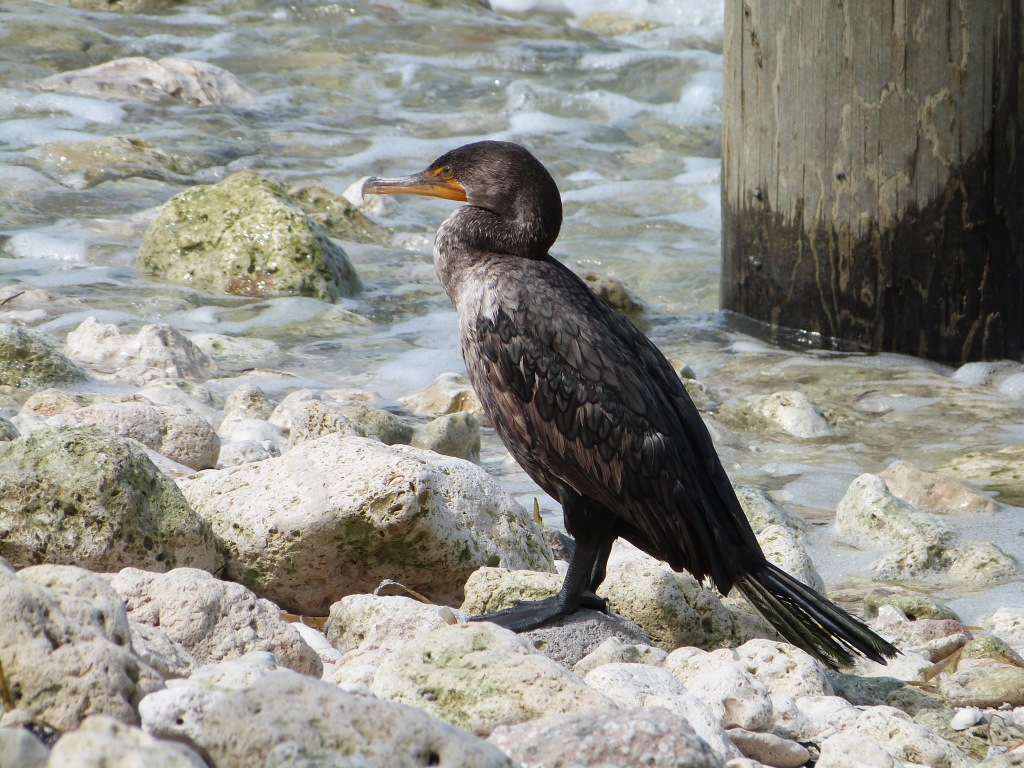
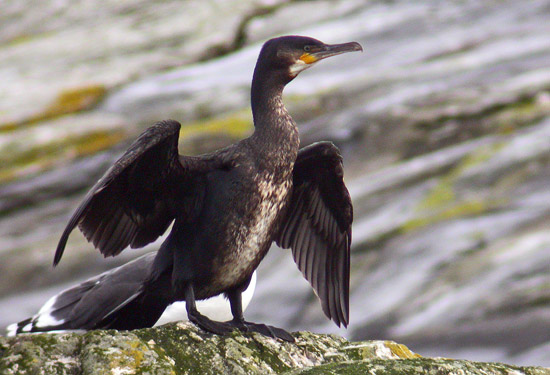
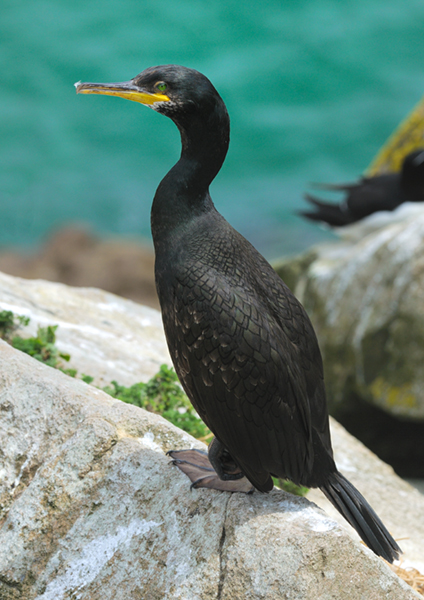
DOUBLE-CRESTED  CORMORANT   (Phalacrocorax auritus). The male of this bird is basically black, like a super-sized crow, with a goldish-orange bill and throat pouch, featuring a long neck that is usually posed in an S curve if perching.  (The female’s coloring is lighter – somewhat brownish-grey.)   But why is this bird called “double-crested”?   Don’t expect to observe any “crests” on its head (like a cardinal or a Steller’s jay), much less two of them!   Donald and Lillian Stokes inform us that the description “refers to crests that grow during breeding” that, even then, are “hard to see”.  (Stokes & Stokes, Stokes Field Guide to Birds – Eastern Region [noted above, in entry on Brown Pelican], page 27.)  Stokes & Stokes also note (on page 27) that this cormorant is the most common cormorant seen in the Eastern region of  America, on Atlantic (and Gulf of Mexico) coasts and farther inland, often wintering throughout the eastern half of Texas, and residing year-round in Florida.  (For example, the Heard Natural Science Museum and Wildlife Sanctuary — located in McKinney, Texas — is a good place to view these cormorants.) Cormorants are known to live in the coastal areas of the Holy Land.  The darting-to-its-prey habit, of diving cormorants, fits the Hebrew noun, shalak, often translated as “cormorant” (see Leviticus 11:17 & Deuteronomy 14:17). Like anhingas, these dark birds perch with outstretched wings, to dry out their wings after diving into and swimming in water for food (usually fish).  Like vultures, eagles, and hawks, these large birds have a bit of difficulty launching their heavy bodies from the ground, so after they do ascend high enough, to reach rising thermal air currents, they position themselves to “ride” those air currents (sometimes ascending as if riding an elevator), soaring and gliding whenever those air currents are conveniently available.   The double-crested cormorant’s neck is crooked in flight, unlike other cormorants.   These are gregarious birds – they nest in colonies and they often fly in groups, either in a straight line of in V formation.  (See Stokes & Stokes, page 27; see also page 361 of Bull & Farrand [noted above, in entry for Great Blue Heron].)

Black Vulture by Lee Myakka SP

Black Vulture by Lee Myakka SP

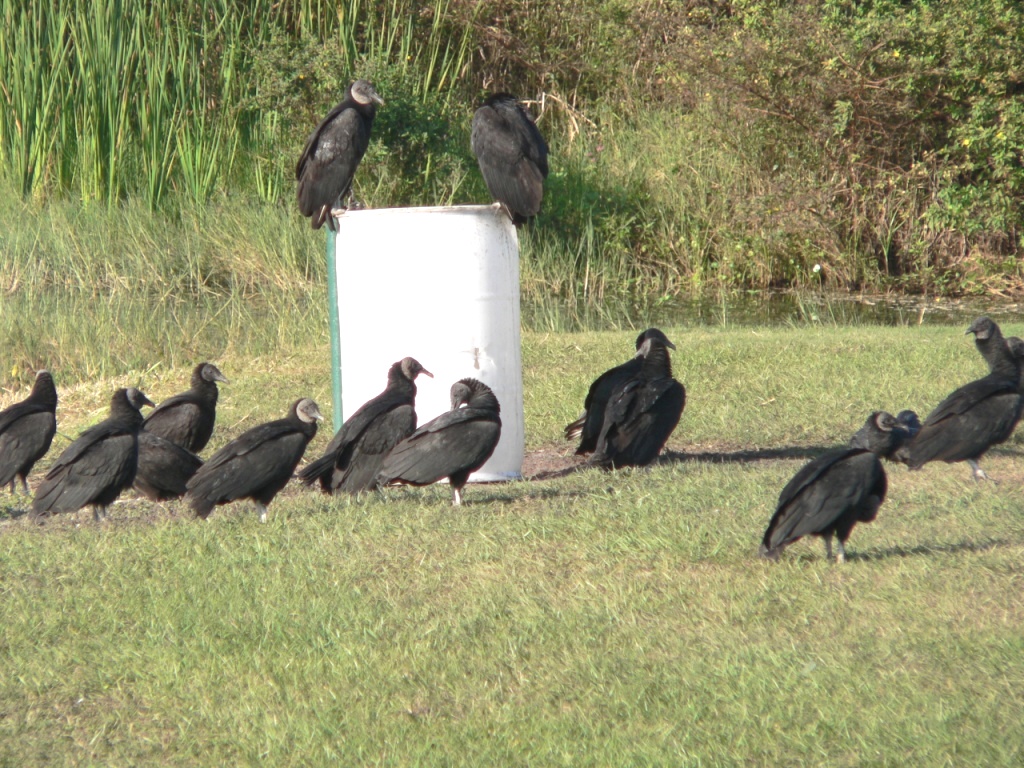
BLACK  VULTURE (Coragyps atratus). This eagle-like scavenger’s grey face distinguishes it from its cousin, the Turkey Vulture, which has a reddish-pink face Both of those faces are wrinkled, somber-looking, and – to put it bluntly – ugly.  The Black Vulture is distinguished by its conspicuously “short square tail that barely projects from the rear edge of the wings and by a whitish patch toward the wing tip”.  (Quoting Roger Tory Peterson, A Field Guide to the Birds Eastern Birds:  A Completely New Guide to All the Birds of Eastern and Central North America, abbreviated as “Eastern Birds” [Peterson Field Guides, Houghton Mifflin, 1980] page 160, with illustration on page 161.)  Black Vultures are somewhat feistier than their slightly larger cousins; they are known to scare off Turkey Vultures when there is competition for carrion.  (See Bull & Farrand [noted above, in entry for Great Blue Heron] at pages 416-417.   On the average, a Turkey Vulture grows about 4 inches larger than a Black Vulture, — yet both are about 2 feet long, from bill tip to tail tip.  Anyway, a vulture (sometimes colloquially called a “buzzard”) is a vulture is a vulture, and this is a vulture!   Vultures eat dead stuff – and sometimes even defenseless live animals.   Scavengers by God’s design (serving as garbage collectors/processors for this fallen world), vultures love to pick over and eat dead stuff!  God gave it a “naked” (featherless) head, which may be an advantage for keeping rotten food from besmirching its head with contagion, which might be more likely if its head was covered in feathers.  But Black Vultures   —   like other vultures  —   routinely consume flies-infested, rotting, bacteria-breeding dead animal carcasses  — why do they not get sick and die themselves of botulism or some other kind of food poisoning?  Dan “the Animal-man” Breeding has the answer:

“What is a vulture’s job? They find and eat what I call “road pizza.” They basically help keep the environment livable by limiting the build-up of dead animals and the spread of disease. God carefully designed vultures, giving them the needed tools to find, digest, and keep clean after eating dead animals.  Most meat-eating animals can find their dinner because it is mobile. Movement makes finding things easier. Have you noticed that when someone walks through your peripheral vision, you are acutely aware of it? But if you’ve misplaced your keys, it can take hours before you find them. God gave Buzz and vultures like him two special designs to help them find their motionless dinner—keen eyesight and an extraordinary sense of smell.

Black Vultures at Saddle Creek by Lee

Black Vultures at Saddle Creek by Lee

Vultures have very sharp eyesight. Even when they are soaring high above the ground, they can still see everything below them. God even provided them with sunglasses to protect their eyes against the sun’s harsh light. Vultures have dark lines around their eyes, which work the same way as the dark lines underneath a football player’s eyes. The dark color absorbs sunlight, reducing glare.  This way, vultures don’t have to worry about missing a single detail.  The lesser yellow-headed vultures have another advantage over most birds: a keen sense of smell. Their nares, or nose openings, look like holes in their beak. Wind from any direction funnels through the nares, which leads to the largest amount of sniffing possible. Each breeze is loaded with information, so God equipped these vultures with a very large olfactory lobe, able to handle all that information. Once the vultures find their dinner, how can they possibly eat it? Most other animals would get sick from eating dead animals. Why don’t vultures get sick all the time?  God gave them a very special digestive system. The acid in their crop (which functions like our stomach) is one of the strongest in the natural world. Strong enough to kill the harmful bacteria found in their dinner, it keeps them from getting sick from pretty much anything! In fact, vultures can use their digestive juices to defend themselves. If you were to startle a vulture while it was eating, you’d better back up quickly—vultures will vomit on you if you’re not careful. This not only makes them lighter (so they can more easily escape), but with the addition of the digestive acid, their lunch now smells much worse.”

(Quoting from  Dan Breeding, “Lesser Yellow-headed Vulture” [Answers in Genesis, 3-14-AD2012], posted at https://answersingenesis.org/birds/lesser-yellow-headed-vulture/ .)

Egyptian Vulture (Neophron percnopterus) by Nikhil

Egyptian Vulture (Neophron percnopterus) by Nikhil

In the Holy Land proper (i.e., Israel), as well as in southwestern Europe and northern Africa to India, there is a vulture – the Egyptian Vulture (Neophron percnopterus – a/k/a White Scavenger Vulture) – that appears to match the Hebrew nouns rachma in Leviticus 11:18 (q.v.) and rachamah in Deuteronomy 14:17 (q.v.), and that same bird is nowadays known in Arabic as rachmah, essentially the same word.  (See, accord, George S. Cansdale, All the Animals of the Bible [Zondervan, 1976], pages 145-146.) The Black Vulture soars high in the sky, with a wingspan of about 5 feet (!), often in wide circles, scanning the ground for carrion – something dead yet nutritious to eat.   Scouting for rotting animal carcasses, vultures monitor the land below them:   marshy coastlands, tree-spotted hillsides, grasslands and other open fields, not-so-dense forests, riparian shore-banks, bushy thickets, — and but I’m not sure about the famous Hinckley under-brush of Minnesota (that we have heard so much about from Dr. Stan Toussaint — although he has confirmed that at Hinckley “the men are men, pansies are flowers, and the women are slightly above average”).  The Black Vulture’s body is heavy – like an eagle – so its wing-flappings are few, if possible, to conserve energy.  “Note the quick labored flapping — alternating with short glides”, notices Roger Tory Peterson (Eastern Birds, at page 160).  Its black-to-grey wings are two-tone-colored, with the flight feathers that trail behind the wings being paler (Peterson, Eastern Birds, page 160;  —  see also page 91 of Stokes & Stokes, Eastern Region, noted above in entry on Brown Pelican).  These scavengers are both residents and migrants:  they reside in most of the southern half of America’s lower 48 states, year-round, and summer in the northern half of those states.  Vultures are not picky eaters!  Roadkill, or even a partially picked-over animal carcass, is a wonderful “fast food” for a vulture.  If the roadkill (or other available animal carcass) is large enough it might provide a quick picnic for a family of vultures.

Wow!  That’s just 5 of the 15 birds we observed that morning, in the Webels’ pond-side backyard.   Stay tuned!  God willing, the other 10 birds will be given their proper recognition, at this excellent bird-site!

(On the morning of February 9th, AD2015, from the pond-side backyard of Bob & Marcia Webel (while enjoying breakfast and Christian fellowship with the Webels), I saw 14 birds:  Great Blue Heron, Brown Pelican, Mallard, Double-Crested Cormorant, and Black Vulture  –  as reported above – plus Wood Stork, Lesser Scaup, Osprey, Muscovy Duck, Great Egret, Snowy Egret, White Ibis, Common Tern, and Florida Gallinule, — plus the cooing of a nearby Mourning Dove was clearly recognizable.  It is hoped (D.v.) that later reports can supplement this one, so the latter-listed 10 birds will be properly recognized for their lacustrine appearances that morning.)

====================================================================================

James J. S. Johnson loves duck ponds, having formerly taught Environmental Limnology and Water Quality Monitoring for Dallas Christian College, as well as other courses on ecology and ornithology.  As noted in a recent comment to Emma Foster’s fascinating bird tale “The Old Man and the Ibises” (posted 2-11-AD2015), Jim enjoyed the habit of feeding ducks at a neighborhood pond during years when he lived near Furneaux Creek (in Carrollton, Texas).  Nowadays, from time to time, Jim feeds ducks (mostly mallards) and geese (mostly Canada geese) that visit the pond at the edge of his present home’s backyard.  Backyards and ponds are for bird-watching!

* Other Articles by James J. S. Johnson *

Of Robins, Wrens, and Monuments in AD2015

But lay up for yourselves treasures in heaven, where neither moth nor rust doth corrupt, and where thieves do not break through nor steal.  (Matthew 6:20)

As the year of our Lord 2014 closed, all too quickly it seemed, I thought about what was done in those dozen months of busy-ness.  What do we have to show for our journey through those pages of the AD2014 calendar?   Was that year worth our time on Earth?  Was that year one of fruitful service to our Lord?  What good achievements, what valuable accomplishments, what worthwhile “monuments” are left in our wake, as we sail ahead into the year of our Lord 2015?

Thinking about these questions reminded me of robins and wrens, for reasons that follow.

But before exploring why earthly achievements (and “monuments”) remind me of wrens and robins, some attention to those birds is appropriate.

European Robin (Erithacus rubecula) by Robert Scanlon

European Robin (Erithacus rubecula) by Robert Scanlon

ROBINS

The European Robin (Erithacus rubecula) is the unofficial bird of the United Kingdom.  English settlers, seeing what we call the American Robin (Turdus migratorius), were reminded (perhaps nostalgically) of the European Robin, which is also a thrush-like brown-and-grey-backed bird with orange breast coloring. The American Robin is larger, and its coloring is less intense, but it is not hard to understand why the English settlers were reminded of the European Robin they knew from their native land.

The American Robin, as its scientific name denotes, is known for seasonal migration  — its range covers most of America, plus parts of Canada and Mexico, with moderate climate regions hosting robins year-round.  [See Donald Stokes, A Guide to Bird Behavior, Volume 1 (Little Brown & Co., 1979), page 221; see also Roger Tory Peterson, Eastern Birds (Peterson Field Guides, Houghton Mifflin, 1980), pages 220-221 & range map M267.]

Robin Eating by Jim Fenton

Robin Eating by Jim Fenton

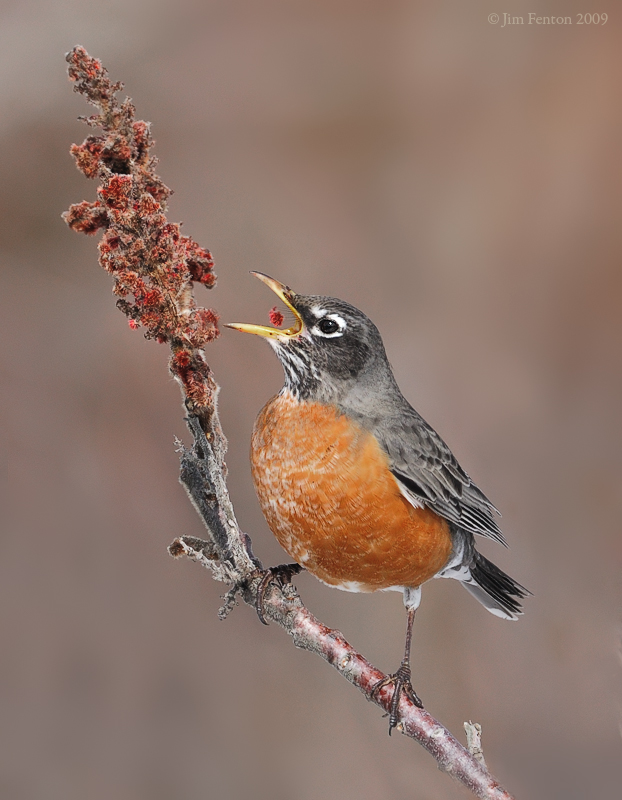
American Robins walk about with erect heads, sporting large dark eyes (with white eye-rings, if you look closely).  Like other thrushes, American Robin juveniles have spotted breast coloring.   The American Robin adult females have dull orange breast coloring, and dull brown backs, in contrast to the brighter almost brick-red breast coloring and darker brown backs of the adult males.  Robins love to eat berries in winter.

European Robin juveniles, like their American counterparts, have spotted buff-colored bellies.  Males and females look alike, unlike their Yankee cousins. These birds are known for hopping along the ground, with drooped wings, often pausing upright and alerted.  Common year-round residents in the British Isles, these robins have a year-round range that includes most of Western Europe, except most of Norway and Sweden host them only during the mild months of summer.  [See Chris Kightley, Steve Madge, & Dave Nurney, Birds of Britian and North-West Europe (Yale University Press, 1998), page 207.]  Imagine how honored some European Robins must be, to visit and entertain Laird Bill Cooper (a noble birdwatcher in England, renowned for his godly scholarship as a Biblical creationist) and his family!  Even birds can be granted great privileges during their little avian lifespans!

Carolina Wren (Thryothorus ludovicianus) by Quy Tran

Carolina Wren (Thryothorus ludovicianus) by Quy Tran

WRENS

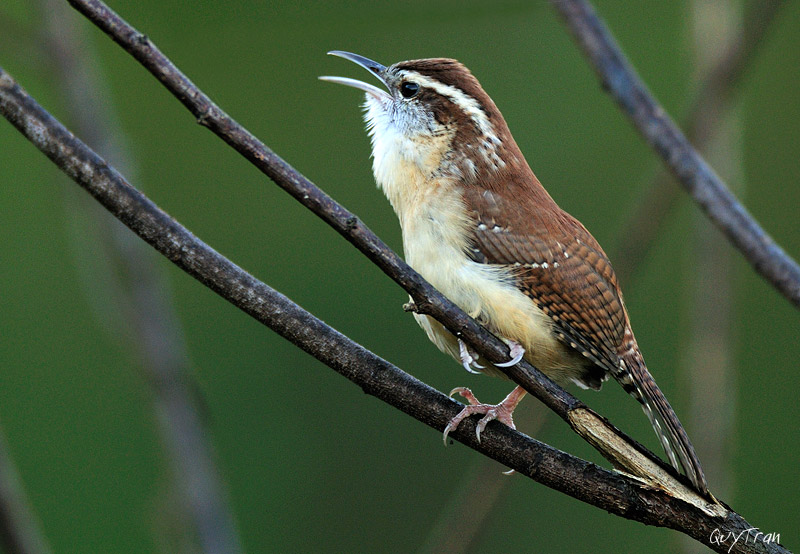
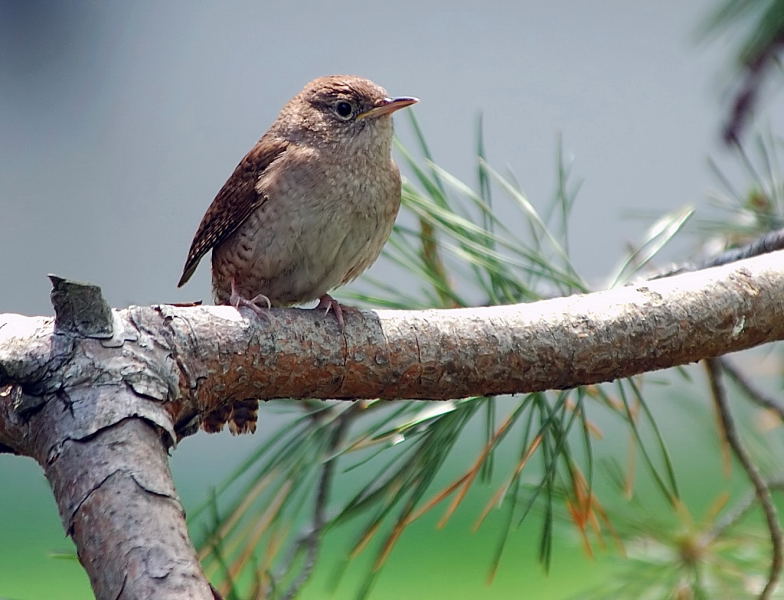
Wrens are famous as small, short, energetic birds with slightly decurved bills and tilted-up tails.  The tail is routinely cocked almost upright, as if flying a flag.  Wren tails often are brown with black parallel stripes, with brown backs and wings, and white or ivory bellies.  When not flying, here or there, wrens hop, creep, climb, and scurry.  Examples of familiar wrens,  often sighted by birders, include Bewick’s Wren (Thryomanes bewickii), Carolina Wren (Thryothorus ludovicianus), House Wren (Troglodytes aedon), Marsh Wren (Cistothorus palustris), Rock Wren (Salpinctes obsoletus), Sedge Wren (Cistothorus platensis), Winter Wren (Troglodytes troglodytes – common also in the British Isles and Western Europe), etc.  [See Roger Tory Peterson, Eastern Birds (Peterson Field Guides, Houghton Mifflin, 1980), pages 214-215 & range maps M254 through M259.]

House Wren (Troglodytes aedon) by Ray

House Wren (Troglodytes aedon) by Ray

One popular wren, known for its warbling song, is the House Wren (Troglodytes aedon).  Males try to attract females, vibrating their wings and singing with a squeaky high-pitched voice when a prospective mate approaches the male’s nest site. If she adds a lining of soft grass to a male’s nest, that means “yes”.  Soon the female will be incubating eggs as her mate brings food to her.  Often two broods will be hatched and fledged during the spring-to-autumn months.  [See Donald Stokes, A Guide to Bird Behavior, Volume 1 (Little Brown & Co. 1979), pages 175-176.]

Bewick's Wren (Thryomanes bewickii) by Daves BirdingPix

Bewick’s Wren (Thryomanes bewickii) by Daves BirdingPix

Years ago a Bewick’s Wren (Thryomanes bewickii) built a nest inside a decorative wreath, a wreath that my wife hung on our Texas home’s front door.  When we walked out our front door the nervous mother wren would flutter and fly away, as we tried to gently shut the door so that the nest was not unnecessarily jostled.  The mother wren would quickly return, satisfied that we were not bothering her nest’s nestlings.  Baby wrens were hatched and fledged from the wreath on our front door!  This arrangement worked nicely, for us and for the wren family, for weeks if not months.  But one day Mama Wren got confused, as someone opened the door – she flew into the house – and then panicked as she tried to discern how to undo what she had done!  Eventually we coached her out – she never tried that again!

Obviously robins and wrens are delightful birds.  But now, robins remind me of “Christopher Robin”.

Christopher Robin ©WikiC

Christopher Robin ©WikiC

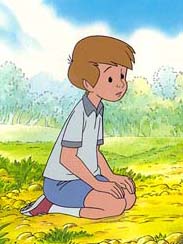
CHRISTOPHER ROBIN

Many children know about Winnie the Pooh (originally written Winnie-the-Pooh), a fictional bear cub who acts a lot like a human child.  (The original “Winnie” was a real bear that A. A. Milne saw at the London Zoo.)  Pooh’s imaginary adventures have amused children of many generations  —  what fun it is to romp about on a “blustery day”!  Winnie the Pooh’s adventures (“Winnie-the-Pooh”, “The House at Pooh Corner”, etc.) began in newspaper serials, and later books, authored by Alan Alexander Milne (and illustrated by Ernest  Howard Shepard).  Later, the adventures of Pooh and his friends (Eeyore, Christopher Robin, Tigger, Piglet, Kanga, Roo, Owl, etc.), and later were dramatized by animated cartoon movies.  Pooh’s literary creator, A. A. Milne, had a son named Christopher Robin Milne, obviously the source of Mr. Milne’s concept for the Christopher Robin” who appears as Pooh’s friend and co-adventurer in the Pooh book series.  The Milne family life was an ongoing tragedy, apparently, and the available evidence points to a pessimistic eternal destiny for Christopher Robin (Milne), “and probably also for his father, author A. A. Milne (who despised the Old Testament  –  see John 5:45-47).

Harry Colebourne and Winnie 1914 ©WikiC

Harry Colebourne and Winnie 1914 ©WikiC

Winnie the Pooh has made millions of dollars for several individuals and businesses, but what lasting value is that, by itself?  It is inferior to treasures laid up in Heaven, which neither corrupt nor disappear to human thievery.  Childhood memories – and gentle stories for toddlers — are valuable, of course, but how much more precious are experiences and deeds that honor the Lord, which become “gold, silver, and precious stones” in eternity.

CHRISTOPHER WREN

The name “Christopher Robin” reminds me of a similar name, featuring a different bird:  Christopher Wren.  Sir Christopher Wren was an expert in engineering science, a science professor and (better known as) the leading architect of his generation.  Wren was the architect responsible for building dozens of English churches after London’s Great Fire (of AD1666), including St. Paul’s Cathedral, as well as England’s Royal Observatory, the Wren Library at Cambridge’s Trinity College, Chelsea Hospital, Windsor Castle’s reconstructed state room, works at Kensington Palace and Hampton Court, Oxford’s Sheldonian Theatre, Cambridge’s Pembroke College’s chapel, etc.

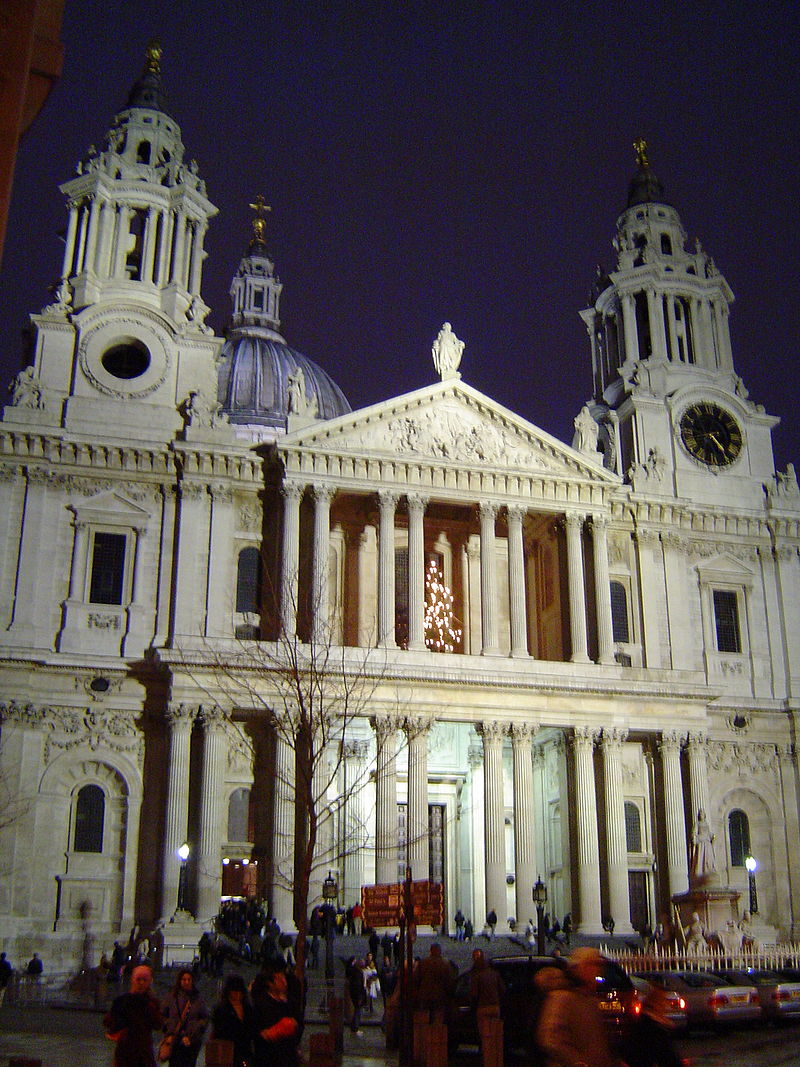
But the crowning architectural achievement of Christopher Wren, from 300+ years ago, is the Anglican church titled St. Paul’s Cathedral, which rests atop Ludgate Hill, the highest part of London – at a site said to have hosted an earlier church building (named for the apostle Paul) founded around AD604, — ironically, by an invader/activist named Augustine of Canterbury (who is infamous for persecuting the British Celtic Church to the point of orchestrating slaughter of their presbyters at Bangor).

St. Paul's Cathedral At Night ©WikiC

St. Paul’s Cathedral At Night ©WikiC

Christopher Wren’s greatest earthly memorial, of course, is St. Paul’s Cathedral itself, which includes a Latin inscription upon the black marble beneath its central dome, that translates to English as:

Here in its foundations lies the architect of this church and city, Christopher Wren, who lived beyond ninety years, not for his own profit but for the public good. Reader, if you seek his monument – look around you.  Died 25 Feb. 1723, age 90.

St Paul's Cathedral Dome Interior ©WikiC

St Paul’s Cathedral Dome Interior ©WikiC

The Latin inscription was composed by Christopher Wren, Jr., his son.  Thus his greatest professional accomplishment, the grandiose design and successful construction of St. Paul’s Cathedral, became Christopher Wren’s gargantuan “monument”, more dignified than any cemetery gravestone.

But what kind of achievements will constitute the “monuments” of our earthly lives?  Will our deeds, done last year, stand the test of time and eternity, as deeds of faith like those reported in Hebrews chapter 11, the “Hall of Faith”?

But lay up for yourselves treasures in heaven, where neither moth nor rust doth corrupt, and where thieves do not break through nor steal.  (Matthew 6:20)

Last year, good or bad, is behind us  –  so it is this new year that we must try (under God’s good grace) to be worthy stewards of, so that each day becomes another “monument” of gratitude and testimony to our great God and Savior.  How we use this new year will be a “monument” to what we really value.

For where your treasure is, there will your heart be also.  (Matthew 6:21)

By James J. S. Johnson

*

Orni-Theology

James J. S. Johnson

*

A Bohemian Goose and a Saxon Swan

A Bohemian Goose and a Saxon Swan

by James J. S. Johnson

Of whom the world was not worthy: they wandered in deserts, and in mountains, and in dens and caves of the earth. (Hebrews 11:38)

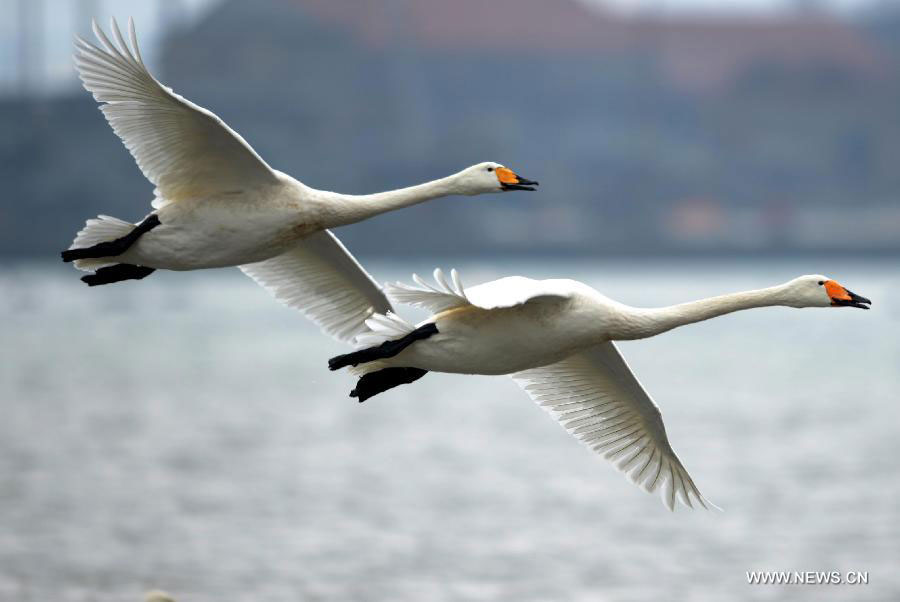
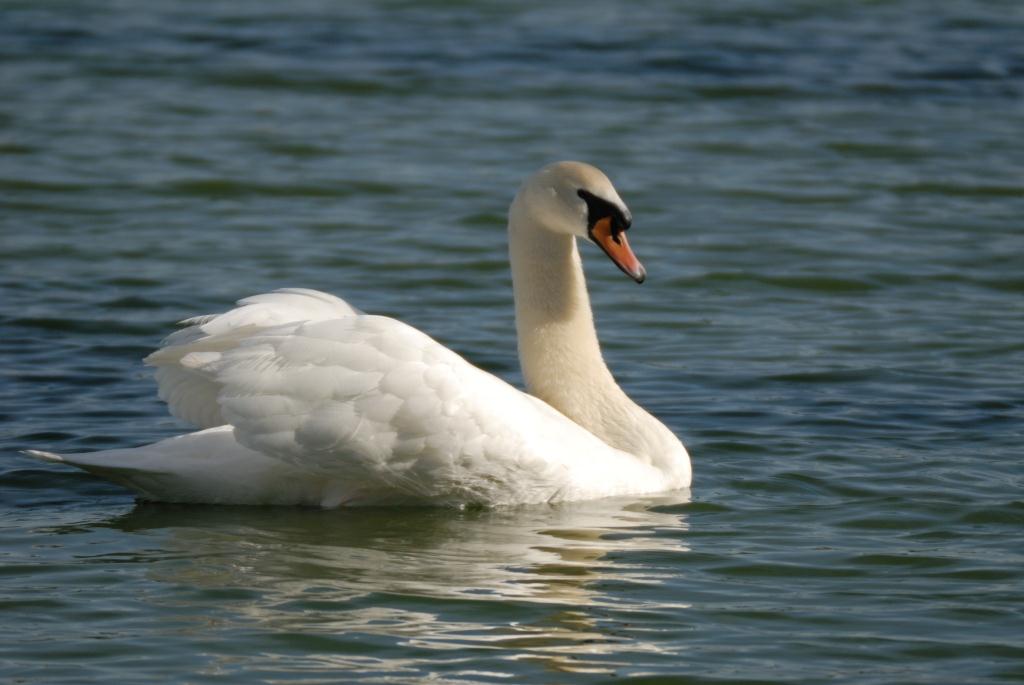
The ministry of God’s messengers sometimes reminds me of geese and swans, but why?

To explain why those two birds (the Goose and the Swan) remind me of God’s messengers, some background information on waterbirds, combined with some European history, is necessary. (See the earlier posting titledBirdwatching in Iceland”, and notice especially the coverage of geese and swans.)

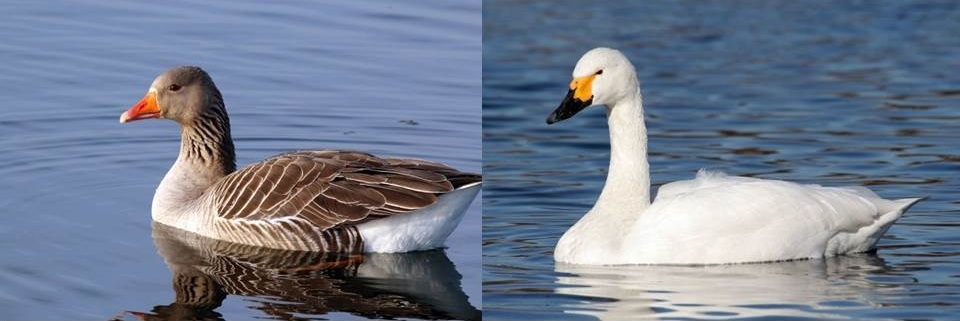
A Bohemian Goose (Jan Hus).

Many of this website’s readers are already familiar with the Christian Reformer and martyr, Jan Hus (a/k/a John Huss), for who the Hussites were named. Jan Hus was a Christian Bible scholar and teacher, in Bohemia (e.g., Prague), a land that today is called the Czech Republic. Jan Hus was a Roman Catholic priest whose studies of the Holy Bible led to him to protest against various unbiblical doctrines and practices that dominated the ecclesiastical politics of his generation. Until he was stopped, Jan Hus taught the Holy Bible’s doctrines (like John Wycliffe, whose writings Hus had studied) to the Bethlehem Chapel congregation (of about 3000 worshippers), in Prague. Hus also taught as a Bible professor at Univerzita Karlova (i.e., Charles University) in Prague.

But how is it fair to call Jan Hus a “Bohemian goose”?

Hus 1

The persecution and trial (for “heresy”) of Jan Hus, a “kangaroo court” by today’s Due Process standards, ended in his execution as an enemy of the Roman Catholic Church – Hus was burned to death on July 6th of AD1415. Since his family name was “Hus”, which means “goose” in the Czech (Bohemian) language, it was said that the Church of Rome had “cooked a goose”. [See church historian Ken Curtis, “John Hus: Faithful unto Death”, posted at http://www.christianity.com/church/church-history/timeline/1201-1500/john-hus-faithful-unto-death-11629878.html.]

Hus 2

Yet an interesting detail of Jan Hus’s last day on Earth is reported by an eye-witness, and corroborated by historical sources close in time to the historic event. (The reports contain slight differences in details, as authentic history accounts do.) Although Jan Hus’s accusers used “foul mouth” curses, Jan Hus could be said to have had a “fowl mouth” when he warned of the future:

With such Christian prayers, Hus arrived at the stake, looking at it without fear. He climbed upon it, after two assistants of the hangman had torn his clothes from him and had clad him into a shirt drenched with pitch. At that moment, one of the electors, Prince Ludwig of the Palatinate, rode up and pleaded with Hus to recant, so that he might be spared a death in the flames. But Hus replied: “Today you will roast a lean goose [i.e., Hus], but hundred years from now you will hear a swan sing, whom you will leave unroasted and no trap or net will catch him for you.”

[Quoting from hostile witness Poggius Florentini, Hus the Heretic, Letter 2 (an eye-witness account written to Leonhard Nikolai), page 60, quoted in Pastor Tom Browning’s “The Goose that Became a Swan” (Arlington Presbyterian Church), pages 6 & 19, at http://www.monergism.com/thethreshold/articles/onsite/browning/Lesson2.pdf.

The gist of this historic account is substantially corroborated by the research provided in Foxe’s Book of Martyrs, which recounts:
When the chain was put about him at the stake, he said, with a smiling countenance, “My Lord Jesus Christ was bound with a harder chain than this for my sake, and why then should I be ashamed of this rusty one?” When the fagots [i.e., pieces of wood] were piled up to his very neck, the duke of Bavaria was so officious as to desire him to abjure. “No, (said Huss;) I never preached any doctrine of an evil tendency; and what I taught with my lips I now seal with my blood.” He then said to the executioner, “You are now going to burn a goose, (Huss signifying goose in the Bohemian language:) but in a century you will have a swan which you can neither roast nor boil.” If he were prophetic, he must have meant Martin Luther, who shone about a hundred years after…

[Quoting from martyrologist/historian John Foxe, Foxe’s Book of Martyrs, Chapter 8, (first translated into English during AD1563), as quoted in Pastor Tom Browning’s “The Goose that Became a Swan” (Arlington Presbyterian Church), pages 6 & 19, posted at http://www.monergism.com/thethreshold/articles/onsite/browning/Lesson2.pdf] *The slight differences in reported detail may result from translation/paraphrase limitations, and/or may be due to Hus making his prediction more than once, during his last hours, using slightly different words. Soon after a coin was minted, paraphrasing Hus’ strange prediction.

What could this mean?

Did a “swan” arise in place of the cooked “goose”, a hundred years later?

A Saxon Swan (Dr. Martin Luther).

From the region of Germany once called Saxony (or “Saxland”), came Dr. Martin Luther, the colorful leader of Germany’s Protestant Reformation and translator of Germany’s “Luther Bible”. After studying law (without completing law school), Martin Luther became a Roman Catholic priest. After earning four university degrees, that last being a doctorate in Bible, Dr. Luther became troubled by the clash between what the Bible itself taught versus what most of the religious officials taught. Like Hus, his personal studies of the Holy Bible led him to protest various unbiblical doctrines and practices (e.g., the ecclesiastical sale of “indulgences”) that dominated the ecclesiastical politics of his generation.

But how is it fair to call Martin Luther a “Saxon swan”?

On October 31st of AD1517 – 103 years after Hus was burned at Constance — Dr. Martin Luther nailed his 95 Theses onto the door of the Wittenberg church, effectively firing a theological “shot heard ‘round the world” (to borrow a phrase from the American Revolution).

Luther 1

Although Luther’s friends warned him that Luther might be burned at the stake, like Hus (i.e., “cooked like a goose”), Dr. Luther continued to preach and teach what he believed to be the Bible’s teaching about God, truth, authority, salvation, faith, marriage, and many other important topics. And Luther’s own commentary includes his opinion that he fulfilled Jan Hus’s dying declaration:

However, I, Dr. Martin, have been called to this work and was compelled to become a doctor, without any initiative of my own, but out of pure obedience. Then I had to accept the office of doctor and swear a vow to my most beloved Holy Scriptures that I would preach and teach them faithfully and purely. While engaged in this kind of teaching, the papacy crossed my path and wanted to hinder me in it. How it has fared is obvious to all, and it will fare still worse. It shall not hinder me. In God’s name and call I shall walk on the lion and the adder, and tread on the young lion and dragon with my feet. And this which has been begun during my lifetime will be completed after my death. St. John Huss prophesied of me when he wrote from his prison in Bohemia, “They will roast a goose now (for ‘Huss’ means ‘a goose’), but after a hundred years they will hear a swan sing, and him they will have to endure.” And that is the way it will be, if God wills.

[Quoting from Martin Luther, in Lutherʹs Works (Vol. 34, Page 103-104). Philadelphia: Fortress Press, 1999 (from Dr. Martin Luther’s Commentary on the Alleged Imperial Edict Promulgated in the Year 1531, After the Imperial Diet of the Year 1530), as quoted in Tom Browning’s “The Goose that Became a Swan” (supra), page 19, posted at http://www.monergism.com/thethreshold/articles/onsite/browning/Lesson2.pdf ] Ironically, the word “swan” etymologically connotes one who makes a sound, and the strong voice of Martin Luther would be heard, magnified by the newly invented movable-type printing press.

What an exciting time (and place) it was, during the Protestant Reformation (in Europe)!

What about today?

Jan Hus and Martin Luther were both spiritual pioneers who fearlessly championed God’s truth to a world dominated by hostile opponents.

Jan Hus was “excommunicated” and executed, being burned at the stake – as a “cooked goose”.

Martin Luther too was “excommunicated”; however, he was neither boiled nor burned. In fact, Dr. Luther married a good wife, raised many children with her, taught his family and others in his home and in various churches, pioneered new traditions in sacred music and Christian education, translated the Bible into German, wrote books and booklets (often demonstrating a merry and satirical wit), etc., — and eventually he died of natural causes.

Both Hus and Luther are appreciated by those who value the “sola Scriptura” principle (i.e., Scripture alone is the final authority) of the Protestant Reformation. Unsurprisingly, those who reject the Bible as the ultimate truth authority are often severe critics of both Jan Hus and Martin Luther (illustrating the saying that a man is known not only by his friends, but also by his enemies!).

Pioneers for God’s truth receive opposition nowadays as well, albeit on a less grand scale and in less dramatic confrontations than the “goose cooking” of AD1415 or Wittenberg’s 95 Theses of AD1517. Many who pioneer God’s truth in uncharted (worldview arena) territories will never be as famous as Jan Hus or Martin Luther, yet their brave efforts – swimming against the tides of popular idolatries — are well-known to the God they serve. The ongoing persecution that they suffer is expected, of course, because Paul forewarned us that “all who will live godly in Christ Jesus shall suffer persecution” (2nd Timothy 3:12).

Mark Armitage.

One modern example of a godly truth pioneer, persecuted for promoting God’s truth, is electron microscope scientist Mark Armitage. Mark researched, photographed using SEM (scanning electron microscope), forensically analyzed, and published his observations of soft tissue located within the horn of a Triceratops dinosaur. Mark’s published micrographs and paleontological analysis of the Triceratops bone cells (within the dinosaur’s stretchy soft tissue) proves that the Triceratops was not so old – because such soft tissue cannot last intact and stretchy for the “millions” of years that evolutionists imagine.

In May 2012, Mark Armitage … uncovered one of the largest triceratops horns ever found in the Hell Creek Formation [in Montana], a legendary stack of fossil-bearing rocks that date to the last days of the dinosaurs. Armitage drove the horn back home to Los Angeles, California, where his microscopic examination revealed that it contained not only fossilized bone but also preserved layers of soft tissue. “They were brown, stretchy sheets. I was shocked to see anything that was that pliable,” he says. In February 2013, he published his findings in Acta Histochemica, a journal of cell and tissue research (M. H. Armitage and K. L. Anderson Acta Histochem. 115, 603-608; 2013). Two weeks later, he was fired from his job at California State University, Northridge (CSUN), where he had managed the biology department’s electron and confocal microscopy suite. Now he is embroiled in a long-shot legal fight to get his job back. In July [2014], his lawyers filed a wrongful-termination suit claiming that religious intolerance motivated the dismissal: as a young-Earth creationist, Armitage says that finding soft tissue in the fossil supports his [Bible-based] belief that such specimens date to the time of the biblical flood, which he puts at about 4,000 years ago.

Quoting Christopher Kemp, “University Sued by Creationist”, Nature, 515:20 (Nov. 6, 2014).

Mark Armitage by Johnson

[Regarding the news reports about Mark Armitage’s lawsuit, see http://www.afajournal.org/archives/2010-present/2014/october/issues/evolutionists-get-thin-skinned-over-dinosaur-tissue-discovery.aspx and http://www.worldmag.com/2014/07/trumpeting_a_dinosaur_horn. For Mark Armitage’s Christian testimony, see https://answersingenesis.org/ministry-news/ministry/the-things-that-are-not/ .]

On a more personal note, Mark Armitage told me, once, when he visited Dallas, that dug-up dinosaur bone finds are overpoweringly stinky — smelling detestably foul, apparently, due to the rotting organic material that was not fossilized. (The forensic implications of that are obvious to any honest forensic scientist – such dinosaurs lived centuries or millennia ago, but not millions of years ago.)
Like those who opposed Hus and Luther, Mark Armitage’s dinosaur tissue research and analysis conflicts with and contradicts the dogma of his detractors.

Dr. Randy J. Guliuzza.

A similar report – of truth-promoting resilience under censorial persecution — could be given for another Biblical creation pioneer, Dr. Randy Guliuzza (M.D., M.P.H., P.E.), a scientist who is both a medical doctor (having done surgery in Iraq, while serving the U.S. Air Force) and professional engineer (having served the U.S. Navy as an engineer), with a Bible college foundation (Moody Bible Institute).

Dr Guliuzza

Dr. Guliuzza has been persecuted and disparaged by theistic evolutionists (and even by compromised creationists) because he has debunked “natural selection” as a bogus phrase invoked to accredit geophysical “magic” for selectively “favoring” or “disfavoring” life-forms in competition. [For more about this creation science controversy, see Dr. Guliuzza’s science articles posted at

Analytically and comprehensively, again and again, Dr. Guliuzza has consistently shown that the definitional reality of Darwin’s sophistic phrase “natural selection” is mere “magic words” shibboleths – see http://www.icr.org/article/unmasking-evolutions-magic-words.

In response to a careless bashing of Dr. Guliuzza’s critique of “natural selection” sophisms (by a mystical “genes-in-magic” advocate), Dr. Guliuzza published a 3-part rebuttal, with  point-by-point refutations of his detractors. [See Randy J. Guliuzza, “A Response to ‘Does Natural Selection Exist?’:  Creatures’ Adaptation Explained by Design-based, Organism-driven Approach, Parts 1, 2, & 3”, serially posted at:  https://answersingenesis.org/natural-selection/response-does-natural-selection-exist-part1/  —  followed by  https://answersingenesis.org/natural-selection/response-does-natural-selection-exist-part2/   —  followed by  https://answersingenesis.org/natural-selection/response-does-natural-selection-exist-part3/  .]   In short, Dr. Guliuzza’s refutations (cited above) illustrate how to apply the Biblical mandate of Proverbs 26:4-5  (see “How Do We Answer Fools?”  — posted at  http://www.icr.org/article/8354  ).

All of this may sounds fairly technical (and some of it is), but the bottom line is that inanimate “nature” cannot “select” anything or anyone. Only a being with an intelligent mind, decision-making powers, and some kind of preferential values (which provide a basis of choosing, from available options, one outcome as more valuable than another) can “select” anything or anyone. [See my article on “Bait and Switch”, posted at https://www.icr.org/article/6538/.]

In other words, only God can – and only God did — create creation (including you and me), and He told us (in Genesis) how and when He did it.

And, despite what 1st Timothy 6:20 calls “science falsely so-called” (such as popular myths that accredit Earth’s biodiversity to an imaginary god-substitute called “natural selection”), God intelligently, volitionally, and judgmentally did all of the “selecting” needed to pre-program all biological lives (including our own) to “be fruitful, and multiply, and fill the Earth”. Since God did all the creative “selecting” He should be given credit for doing so.

But until the time comes when all knees bow to God and His truth, and all tongues confess that the Lord Jesus is the Creator-Lord of all, we can expect to see persecutions of God’s messengers – some of them famous (like Hus and Luther) and some of them not-so-famous (like Mark Armitage and Randy Guliuzza).

Like the prophets of old, the obligation is the same – tell God’s truth to those who have “ears to hear”, and don’t let unpopularity or persecution censor God’s message. Don’t expect applause from worldly-minded people, whether they be theists (like the Pharisees) or atheists (like many evolutionists). The world is not worthy of God’s message, so it gives no welcome to God’s messengers.

Of whom the world was not worthy: they wandered in deserts, and in mountains, and in dens and caves of the earth. (Hebrews 11:38)

The goal, of course, is the live as witnesses for God’s truth, with the courage and commitment of the Bohemian Goose and the Saxon Swan.

Dr. James J. S. Johnson (shown here with Chaplain Bob Webel, a bird-watcher in St. Petersburg) believes in the God of the Bible (not in Darwin’s god-substitute labeled “natural selection”) as biodiversity’s omni-intelligent “selector”. No stranger to forensic science, Jim frequently teaches forensic evidence analysis to Texas lawyers, and is a member of the American Academy of Forensic Sciences. Also no stranger to birds, Jim previously taught ornithology and ecology-related courses at Dallas Christian College.

Dr. James J. S. Johnson

*

*

Birdwatching in Iceland

Birdwatching  in  Iceland

by James J. S. Johnson

The Lord reigneth; let the earth rejoice; let the multitude of isles be glad thereof.   (Psalm 97:1)

Islanders, like others, should rejoice in appreciation for the historic incarnation of our Lord Jesus Christ – which incarnation we celebrate annually as Christmas.  It is that same Christ (John 1:1-3; Hebrews 1:1-3) Who made all the seabirds that visit and live on the world’s islands, and Iceland is no exception.
Luzon Bleeding-heart by Dan

Orni-Theology

A recent email from Iceland reminded me of some birdwatching, years ago, that my wife and I did, while visiting Iceland.  Some might think that a place called “Iceland” would be so cold that birds, there, would be few and far between.  Thankfully, that is not the case, especially due to the moderating influence of the warm Gulf Stream current, which washes the southwestern shores of Iceland.  The birds of Iceland, like those of many other islands, are (unsurprisingly), are predominantly waterbirds, since islands are surrounded by water, typically ocean water.
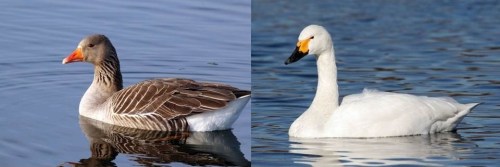
What were some of the birds that my wife and I saw, then (September 17th of AD2002), in Iceland?  A few examples are mentioned below, with special attention to Icelandic geese and swans (which is especially relevant to the sequel to this birdwatching report, which will report on a Bohemian goose and a Saxon swan).

Waterbirds live around (and sometimes in) bodies of water, sometimes saltwater and sometimes freshwater.  Waterbirds might habituate seacoasts, riverbanks, estuarial mudflats, lakes, ponds, swamps, and water-logged marshlands.  (Some are attracted to manmade water bodies, such as dam reservoirs, concrete canals, swimming pools, fountains, or birdbaths.)  Birds need water.

Think of the various waterbird categories, some wading shorebirds, some seabirds:  goose, gull, grebe, gallinule, gannet, guillemot, limpkin, loon, duck, dipper, brant, booby, bittern, coot, crane, crake, curlew, cormorant, kittiwake, kingfisher, plover, pelican, puffin, penguin, petrel, phalarope, flamingo, fulmar, frigatebird, albatross, anhinga, auklet, ibis, eider, egret, oystercatcher, osprey, mallard, merganser, murre, shag, shearwater, shoveler, smew, spoonbill, stint, stork, scoter, scaup, skua, skimmer, swan, sandpiper, sora, snipe, wigeon, tern, teal, tropicbird, turnstone,  jabiru, jaeger, jacana, heron, knot, noddy, rail, redshank,    —  the list could go on and on!
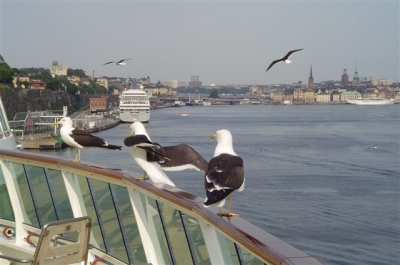
SeaGulls on Rail by James Johnson

SeaGulls on Railing, by James J. S. Johnson

Seagulls.

Seagulls   —  such as gulls, terns, and fulmars  —  are one of the most typical kinds of seabirds.  For example, see the Great Black-backed Gull (Larus marinus), perching on the railing of the Royal Caribbean cruise ship (Jewel of the Seas), which I photographed as the ship approached the harbor of Helsinki, Sweden, during the summer of AD2006.

Ironically, many “seagulls”, such as herring gulls and ring-billed gulls, are observed far from the “sea”, living inland as residents or migrants, at huge distances many miles away from the closest saltwater shoreline. For example, during winter the Ring-billed gull (Larus delawarensis) is known to congregate in the parking lots of shopping centers near Dallas, hardly a “range” fit for a “seagull”!  However, visiting a saltwater beach, like the Gulf of Mexico or an ocean, provides opportunities for seeing many kinds of seagulls, at any time of the year.

While serving as a speaker on a cruise ship, during September of AD2002, the ship headed from Ireland’s Dublin to Iceland’s Reykjavik.  Along the way I saw a variety of seagulls, including:  Herring Gull (Larus argentatus), on a boat-dock in Dublin;  Fulmar (Fulmarus glacialis), in a Dublin estuary;  Storm Petrel (Hydrobates pelagicus), over the Irish Sea just north of Dublin;  Common Tern (Sterna hirundo), at sea somewhere between Scotland and Iceland;  Kittiwake (Rissa tridactyla), also at sea somewhere between Scotland and Iceland; Black-headed Gull (Larus ridibundus) and  Lesser Black-headed Gull (Larus fuscus), both of which I saw in the open sea somewhere between Scotland and Iceland.   In time our boat docked at Reykjavik (Iceland), where I would happily see some “lifers” (and other birds I’d seen before).

Manx Shearwater (Puffinus puffinus).  Near the Reykjavik dock there was a rocky shoreline where a colony of busy Manx Shearwaters could be seen, apparently not far from their summer nests in rocky crevices.  These are seabirds are sooty black on top and white underneath, except for a white bar on the upper side of their underwings. These low-flying birds are pelagic (staying at sea most of the time), often accustomed to following boats, coming to shore at sunset to breed.  Their diet includes fish, aquatic crustaceans, carrion, and whatever seafaring humans dump or throw overboard (i.e., human garbage or donated food-scraps).
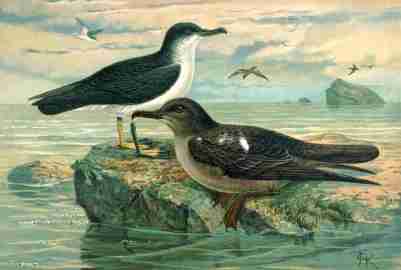
Manx Shearwater

Manx Shearwater

Arctic Skua (Stercorarius parasiticus).  One of the tourist stops in Iceland is the world-famous geyser named Geysir – this is the namesake of all geysers, translating literally as “gusher”.  (Iceland has been volcanically active for more than 1000 years, so geysers, fumaroles, and volcanic lava-flows are always foreseeable there.)  Like Yellowstone’s “Old Faithful”, this famous geyser has lost power over the centuries, but it is still an impressive hydrothermal spring that intermittently expels boiling hot mineral waters from its surface vent.  Near the gushing geyser Geysir, I saw Arctic Skua, a seabird that often frequents boggy tundra fields, especially damps heathland areas alogn island coastlands.  [See Jürgen Nicolai, Detlef Singer, & Konrad Wothe, Birds of Britain and Europe (Collin Nature Guides, 2000; trans. By Ian Dawson) at page 122.]  The Arctic Skua is rather aggressive, robbing other birds of their fish, and sometimes taking their nest eggs; skuas are also know to eats small rodents, such as mice.  This skua is brown-winged, brown-legged, and brown-capped, but is otherwise mostly white, resembling a Common Gull in size and body shape, except its dark brown tail feather assembly has two pointed projections. If seen closely some yellowish tint accents its neck and cheeks. It is usually at sea except during the breeding season (May to July).

Arctic Skua

Arctic Skua

Iceland Gull (Larus glaucoides).  Near Reykjavik, at the edge of a pond, a group of Iceland Gulls were loitering about.  The Iceland Gull is not bashful about human settlements.  This gull often “winters” at fishing boat harbors, manmade reservoirs, or coastal waste dumps.  Like other gulls (including the Glaucous Gull mentioned below), the Iceland Gull is a resourceful scavenger of fish waste and other human food-scraps.  This gull has plumage similar to that of the Glaucous Gull (described below) except smaller and less robust in shape, thinner, with narrower wings.

Glaucous Gull

Glaucous Gull

Glaucous Gull (Larus hyperboreus). “Flying busily about the bay-waters of  Reykjavik were a group of Glaucous Gulls, whose habitats and dietary habits resemble those of the Iceland Gull (noted above). This gull is larger than most, dominated by pale white except for grey wings and back, plus freckle-like buff-hued blotches on its neck.  Its legs are salmon-pink.  Its bill is salmon-peach-colored except for a black tip.”
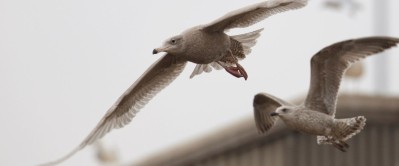
Glaucous Gulls

Glaucous Gulls

Ducks.

Ducks are certainly a favorite waterfowl for many.  Ducks don’t limit their ranges to oceans and seacoasts; they are found (as residents or as migrants) in wetlands of all kinds, including prairie potholes, swamps, wet woods, lake, ponds, and fields watered by streams and agricultural irrigation systems.
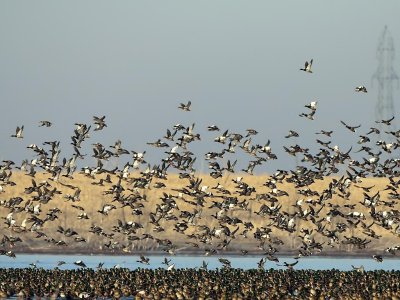
American Wigeon flocks

American Wigeon flocks

In Texas’s Denton County, for years (since the early AD1990s), I have (sometimes with family,  college students, and/ or other birdwatchers)  enjoyed watching the behaviors of ducks that winter in our part of the Lone Star State, including (but certainly not limited to):  American Wigeon (Anas americana, a/k/a “Baldpate”), a gregarious and gentle duck that frequently winter in northern Texas pond habitats;  Lesser Scaup (Aythya affinis, a/k/a “Bluebill”), which has a conspicuous light-blue bill;  and  Northern Shoveler (Anas clypeata), which is known for its extra-large shovel-shaped bill, many of which over-winter in wetlands of northern Texas.  [And, as Lee Dusing recently mentioned in “Fantastic Weekend” (her birdwatching report posted at https://leesbird.com/2014/11/10/fantastic-week-end/ ), four of us Christian birdwatchers enjoyed watching a variety of palustrine and lacustrine birds, including Ring-necked Duck (Aythya collaris), a “lifer” for me, at Lakeland’s Morton Pond, on 11-8-AD2014.]
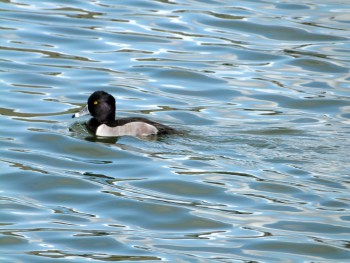
Ring-necked Duck male
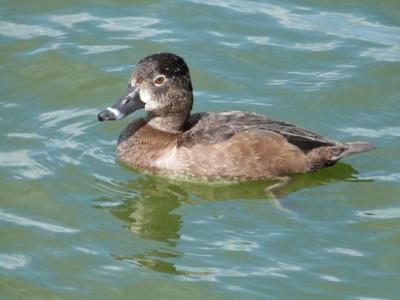
Ring-necked Duck male

Ring-necked Duck female

Ring-necked Duck female

Mallard (Anas platyrhynchos).  Near Reykjavik, at the edge of a pond, not far from a group of loitering Iceland Gulls, this famous (and far-ranged) duck was present, looking just like their cousins who inhabit northern Texas  —  it was like a piece of “home away from home”, to see the iridescent green heads of the mallard drakes.  Mallards are not particularly shy around the habitat “edges” of human settlements, so they frequent parks and ponds, often learning that humans might provide bread crumbs or popcorn.  [More on that in another posting, hopefully.]
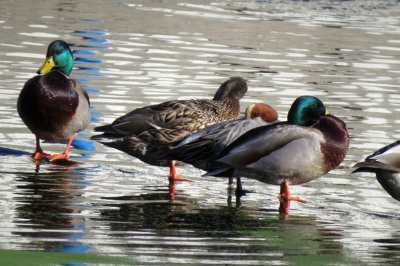
Mallard
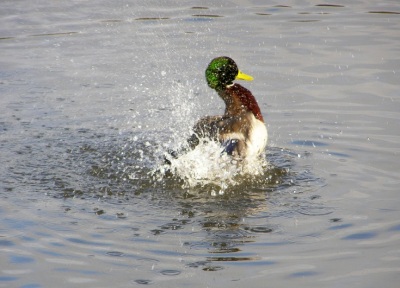
Mallard

Mallard

Mallard

Cormorants.

Earlier in this (summer AD2002) trip I had observed two kinds of cormorants.  In an estuarial waterway of Dublin, 4 days before visiting Iceland, I saw Great Cormorant (Palacrocorax carbo, a/k/a “European Cormorant”) as well as Shag (Palacrocorax aristotelis, ), a smaller cormorant known for its dark-to-greenish-black hue).
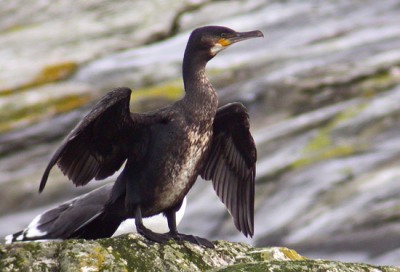
Great Cormorant

Great Cormorant

Since I was concentrating of finding “lifers” I did not try to find any cormorants in Iceland.  However, both of these cormorant types include Iceland in their ranges.  Like me, cormorants love to eat fish.  (American cormorants are often seen in manmade reservoirs, thriving on their catch of fish; of course, ocean-caught fish are more typical of cormorants, globally speaking.)
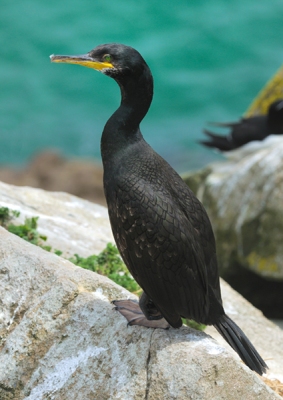
Shag

Shag

Herons, Egrets, and the like.

Because my backyard includes a pond, and that pond connects to a spill-over drainage ditch flanked by hydrophilic plants, it is not uncommon for the pond-shore to host herons and egrets.

The most frequent of these tall waders are the magnificent Great Blue Heron (Ardea herodias) and the majestic Great White Egret (Casmerodius albus), plus sometimes the pond is visited by the “golden-slippered” Snowy Egret (Egretta thula) or the “mustard-dabbed” Cattle Egret (Bubulcus ibis), plus, albeit rarely, by the clandestine Green Heron (Butorides virescens, a/k/a Butorides striatus).
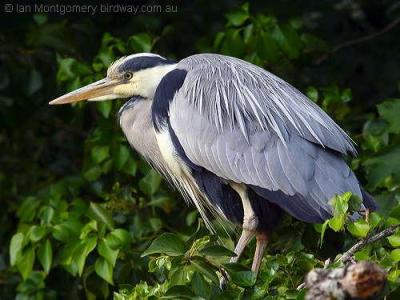
Grey Heron by Ian

Grey Heron by Ian

But the Grey Heron (Ardea cinerea) that I saw outside the city of Glasgow (Scotland), on a beach of the River Clyde (9-14-AD2002), was a “lifer” for me, so I took special notice of that particular heron.  Apparently the Grey Heron is occasionally sighted in Iceland, as an “accidental” stray (i.e., rare migrant), but I did not see it or any other kind of heron.

Sandpipers, Plover, and the like.

Ringed Plover (Charadrius hiaticula) was a “lifer” for me, when I saw such on a beach of the River Clyde, outside of Glasgow (Scotland), 9-14-AD2002.

But that was Scotland, and this report of mostly about Iceland waterbirds, so without further ado I’ll report the sandpiper I saw 3 days later.

Curlew Sandpiper (Calidris ferrugines).  The Curlew Sandpiper is a small and quite gregarious wading bird, mottled grey-brown on top and white underneath, with a conspicuously pointy bill.  (During breeding the underparts change to a reddish-brown/chestnut-colored tint.)

Notice the long, thin beak.  These sandpipers eat a lot of bugs and other small invertebrates (worms, leeches, snails, and mussels), often picking and probing for them on water-drained mudflats located close to arctic tundra.
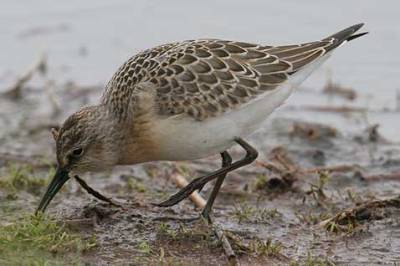
Curlew Sandpiper

Curlew Sandpiper

These migratory sandpipers are known to hybridize with other sandpipers, proving that they trace back to common ancestors who disembarked Noah’s Ark about 4½ thousand years ago.  (Avian “taxonomy” is a fairly arbitrary classification scheme, so hybridizations are the real key to discovering created kinds among bird groupings.)

The Curlew Sandpiper was seen on the open (and slightly marshy-grassed) tundra, near the so-called “summer home” area just outside of Thingvellir [Þingvellir], historic site of the ancient Althing [Alþingi], the assembly-valley of Iceland’s parliamentary politics since AD930.  [See info posted at http://en.wikipedia.org/wiki/Althing ].  A photo of me, taken that day at Thingvellir, appears below.
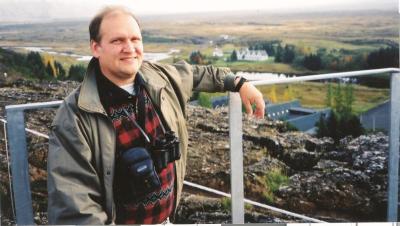
Dr Jim in Iceland

Dr Jim in Iceland

Geese.

The goose that I see most frequently – sometimes a dozen congregate on the east side of my home – is the Canada Goose (Branta Canadensis).  Since my neighborhood (in the “cross timbers” region of northern Texas) has several ponds, most of which are ringed by hydrophilic emergent plants, it is not surprising that these huge honking migrants winter in such places.  However, in Iceland I was privileged to see some “lifers”, including four geese.
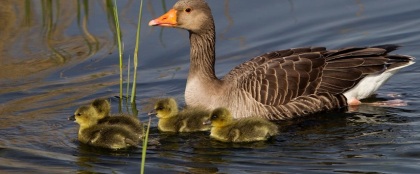
Greylag Goose with chicks

Greylag Goose with chicks

Greylag Goose (Anser anser).  This “classic” wild goose has dark brown-grey feathers topside and silver-grey feathers beneath, with an orange-salmon-hued bill and pink-salmon-hued feet.  Many of these geese emigrate from Iceland by or during October, not to return till late spring, so visiting Iceland during mid-September was good timing.  [Lars Jonsson, Birds of Europe (Princeton University Press, 1992; translated from Swedish by David Christie), page 80.]  Domesticated geese are said to derive from wild ancestors of this variety.  Greylag geese habituate lakes and ponds, especially those with goose-friendly fringing wetland plants, such thick rushes and reeds. Nearby marshy meadows and pastures also attract these geese. The Greylag Geese that I saw were seen wandering about near Geysir geyser.
Greylag Goose

Greylag Goose

Pink-footed Goose (Anser brachyrhynchus).  This goose was seen in mossy lava-fields by a pond outside of Reykjavik.  The Pink-footed Goose prefers arctic tundra, as well as estuarial wetlands.  This goose is more beige-brown than most geese, with a pink-salmon bar on its bill, pinkish feet, and a dark brown head that could be called dark chocolate (but it’s not as dark as “UPS brown”).
Pink-footed Goose (Anser brachyrhynchus)

Pink-footed Goose (Anser brachyrhynchus)

Lesser White-fronted Goose (Anser erythropus).  This goose, with a noticeable white front to its face (above its orange bill on its otherwise dark brown face), has red-gold eyes (depending upon how light shines off it), is known for eating dwarf willow grass (that grows where taiga transitions into tundra).  Most of the bird’s body is covered in brown plumage, except the rump is white.  This goose was spotted ambling about near a bank of the Elliðaá River just east of Reykjavik, one of Iceland’s many “salmon rivers”.  [Note: this “Salmon River” is not to be confused with the more famous Lax River that runs through the Lax-dale (“salmon valley”) region of Iceland, the early pioneer history of which is chronicled in the Laxdæla Saga.]
Lesser White-fronted Goose (Anser erythropus)

Lesser White-fronted Goose (Anser erythropus)

Brent Goose (Branta bernicia). This relatively small-sized arctic tundra goose resembles the coloring of a White-fronted Goose (see above), except the Brent Goose has a completely brown face, plus it sports a white bar-like marking on the side of its otherwise brown neck.  During winter this goose prefers mudflats providing eelgrass and algae.  It was in the marshy tundra just south of Thingvellir where I saw this goose.
Brent Goose (Branta bernicia)

Brent Goose (Branta bernicia)

Swans

The first swan I remember seeing close-up was the huge Trumpeter Swan (Cygnus buccinators, yet a/k/a Cygynus cygnus buccinator), which can exceed 22 pounds in weight, the heaviest “native” bird of North America, considered to be a close cousin of the Eurasian Whooper Swan (Cygnus cygnus, noted below).  These huge birds breed in southeast Alaska; when present, they are easy to see with binoculars.  Another white swan, that I have seen on prior occasions, is the Tundra Swan (Cygnus columbianus), the national bird of Russia.  When this swan is found in North America it is called the Whistling Swan, but many call it the Bewick’s Swan (as if it were a subspecies Cygnus columbianus bewickii, commemorating the famous bird illustrator-engraver Thomas Bewick), whenever it appears in Eurasia or Iceland. Unsurprisingly, this swan is known to habituate arctic tundra habitats.
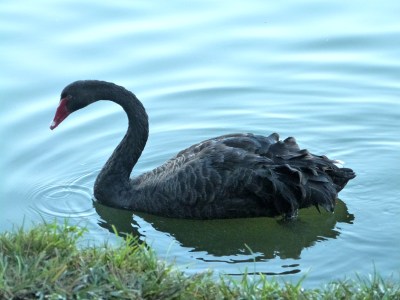
Black Swan at Lake Morton

The Black Swan (Cygnus atratus), originally from Australia and New Zealand, has been introduced to other parts of the world (arriving sometimes in captivity as “ornamental” transplants, followed by some of the later generations escaping or being released to the wild (such as the Black Swan colony in Dawlish, Devon, in County Exeter, England), or as being “semi-released” as quasi-domesticated swans, i.e., permitted freedom to fly yet being attracted to stay by repetitive feedings (such as the Black Swan family at The Broadmoor [hotel] in Colorado Springs, Colorado  — which I saw during the summer of AD2000, while I was there to present a Biblical history paper on the Moabite Stone, to the Evangelical Theological Society).  As its name suggests, the Black Swan is black all over, except for a large band of white flight feathers on its wings.

Whooper Swan (Cygnus cygnus, pronounced “hooper”) is the “classic” white swan of Eurasia, famous for its V (“wedge”) formation when a “bevy” of these migrants are in flight, although sometimes they are seen flying in an oblique line.  [Lars Jonsson, Birds of Europe (Princeton University Press, 1992; translated from Swedish by David Christie), page 76.]  Besides its large white body, the Whooper Swan has a golden-yellow beak accent-tipped with black.  The summer range for Whooper Swans includes Iceland, Scandinavia, Northern Russia (including Siberia), as well as tundra or taiga regions of northeastern Asia (such as Japan, northern China). The Whooper Swan is the national bird of Finland.  Like other large swans, the Whooper Swan’s diet is mostly plant material (such as grasses and immature cereal grains), sometimes supplemented by some very small aquatic animals.  This majestic swan was seen on a pond near the edge of Reykjavik (and was confirmed by a local Icelandic guide).
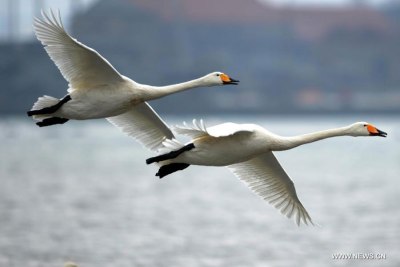
Whooper Swan (Cygnus cygnus)

Whooper Swan (Cygnus cygnus)

Mute Swan (Cygnus olor).  The white Mute Swan resembles the Whooper Swan (see above) in its appearance, except the Mute Swan has a conspicuous black basal “bulb” on its bill, and its bill is an orange-red hue noticeably darker than the golden-yellow bill of the Whooper Swan.  Also, the Mute Swan has a black “mask” bordering its eyes and bill.  Its primary food is submerged plant material.  As its name suggests, it is unusually quiet for a swan, though it is known for a “hoarse hissing” when pressured into a self-defense situation.  The Mute Swan is the national bird of Denmark. It was at a tundra pond near Gullfoss (“Golden Falls”) where my wife and I saw the dignified Mute Swan.
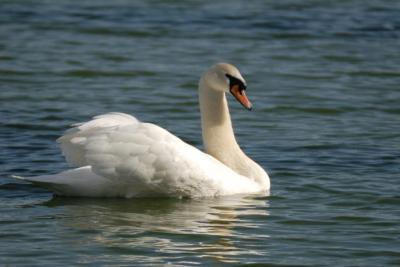
Mute Swan (Cygnus olor) by Dan

Mute Swan (Cygnus olor) by Dan

Iceland is a cool place to watch birds! 

Coming soon, God willing: a sequel regarding a Bohemian goose and a Saxon swan!

Dr. James J. S. Johnson (seen here visiting Chaplain Bob Webel, a birdwatcher in St. Petersburg) believes in the God of the Bible (not in Darwin’s god-substitute labeled “natural selection”) as biodiversity’s omni-intelligent “selector”.  No stranger to forensic science, Jim frequently teaches forensic evidence analysis to Texas lawyers, and is a member of the American Academy of Forensic Sciences. No stranger to birds, Jim previously taught ornithology and ecology-related courses at Dallas Christian College.

Dr. James J. S. Johnson

*

A Bohemian Goose and a Saxon Swan (Part 2)

Orni-Theology

James J S Johnson’s Articles

*
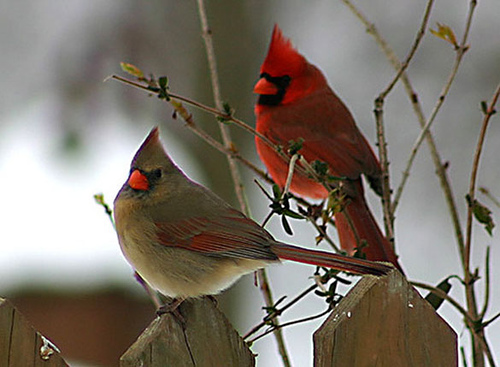
Strangers and Pilgrims (and the American Turkey)

Strangers and Pilgrims ©WikiC

Strangers and Pilgrims ©WikiC

Strangers and Pilgrims

by James J. S. Johnson

These all died in faith, not having received the promises, but having seen them afar off, and were persuaded of them, and embraced them, and confessed that they were strangers and pilgrims on the earth.  (Hebrews 11:3)

Dearly beloved, I beseech you as strangers and pilgrims, abstain from fleshly lusts, which war against the soul.  (1st Peter 2:11)

The phrase “strangers and pilgrims” occurs twice in the New Testament (KJV), in Hebrews 11:3 and in 1st Peter 2:11, as quoted above.

The English word “pilgrim” is a translation of the New Testament Greek noun parepidêmos, which refers to a foreigner who immigrates as a settler, taking up residence in a new land, beside the original inhabitants of that place.  A similar thought appears in 1st Peter 1:1, which refers to believers who are “strangers”, dispersed (“scattered”) like seeds in foreign lands belonging to other peoples.

Even today Christians live in and among lands dominated by nonbelievers (Psalm 73:12).  Because we are “in” the world, yet not “of” the world (see John 17:14-17), we live “near” our non-Christians neighbors, yet our Christ-focused lives are noticeably separate from “the world” (e.g., in our beliefs, priorities, moral values, etc.).

A similar word appears in the Old Testament, translated as “pilgrimage” (Hebrew: magûr, derived from the Hebrew verb gûr, meaning to “sojourn” or “migrate”). The noun “pilgrimage” appears in Genesis 47:9 (twice); Exodus 6:4; and Psalm 119:54.  [See Young’s Analytical Concordance, page 752, column 3.]

Like the English Pilgrims of old, our “pilgrimage” is a holy journey, through this earthly lifetime, adventurously walking with our great God, in spiritual fellowship with brothers and sisters in Christ.  That “pilgrimage” is an ongoing  witness to the watching world (1st Corinthians 4:9)  – because we each live our lives in the presence of observing nonbelievers “near” us, whose lives are spiritually separate from us (Daniel 5:22-23).

During Thanksgiving season, in America, we remember God’s historic providence at Plymouth Plantation, which was celebrated by a thanksgiving feast, a sacred occasion where the Pilgrims (a/k/a “Separatists”) shared their harvest bounty with many local Indian tribesmen, who themselves contributed quite a bit of wild game to the festive event.

Strangers and Pilgrims ©WikiC

The American Turkey (Meleagris gallopavo).

But is there any historical record of the Pilgrims’ first Thanksgiving feast (AD1621) really featuring wild turkey?

Strangers and Pilgrims ©WikiC

Yes.  One of the original Pilgrims, William Bradford, kept a careful chronicle of the important events at Plymouth, and he reported the context of the Pilgrim’s harvest-time during the fall of AD1621:

[During the autumn of AD1621 the Plymouth Pilgrims, with the help of Squanto] found the Lord to be with them in all their ways, and to bless their outgoings and incomings, for which let His holy name have the praise forever, to all posterity.

They began now to gather in the small harvest they had, and to fit up their houses and dwellings against winter, being all well recovered in health and strength and had all things in good plenty.  For as some were thus employed in affairs abroad, others were exercised in fishing, about cod and bass and other fish, of which they took good store, of which every family had their portion.  All the summer there was no want; and now began to come in store of fowl, as winter approached, of which this place did abound when they came first (but afterward decreased by degrees).  And besides waterfowl there was a great store of wild turkeys, of which they took many, besides venison, etc.  Besides they had about a peck a meal a week to a person, or now since harvest, Indian corn to that proportion.  Which made many afterwards write so largely of their plenty here to their friends in England, which were not feigned but true reports.

Quoting  William Bradford,  Of Plimouth Plantation  1620-1647  (Alfred A. Knopf, 1989; edited by Samuel Eliot Morison), page 90.

Strangers and Pilgrims ©WikiC

But it was another Pilgrim, Edward Winslow, who reported (within a letter dated December 11th of AD1621) on the specific activities at the Pilgrim’s historic Thanksgiving feast that season:

Our harvest being gotten in, our Governor sent four men on fowling (i.e., hunting wild birds, such as turkeys, quail, etc.), so that we might after a more special manner rejoice together, after we had gathered the fruit of our labors.  They four in one day killed as much fowl as, with a little help beside, served the Company almost a week.  At which time, amongst other recreations, we exercised our arms [i.e., used their firearms for target practice], many of the Indians coming amongst us, and amongst the rest their [i.e., the Wampanoag tribe’s] greatest king, Massasoit with some 90 men, whom for three days we entertained and feasted.  And they went out and killed five deer which they brought to the plantation and bestowed on our Governor and upon the Captain [Miles Standish] and others.

Quoting Edward Winslow, in Mourt’s Relation, pages 60 et seq., as quoted by Samuel Eliot Morison in Footnote 8 on page 90 of Bradford’s Of Plymouth Plantation 1620-1647 (noted above).

The first Thanksgiving was spontaneous.  Years later the Pilgrims celebrated other days of thanksgiving, sometimes at the direction of the colonial governor. [See above, William Bradford, Of Plymouth Plantation, at page 132.]

By combining William Bradford’s report of the “wild turkeys” (as the most notable wild-fowl hunted by the Pilgrims) with Edward Winslow’s report of the wild fowl hunting for the first Thanksgiving feast, we can fairly conclude that America’s wild turkey (Meleagris gallopavo) rightly belongs as part of the American Thanksgiving feast tradition.

But Thanksgiving is not just about being thankful for harvested food  –  we should also be thankful as “pilgrims and strangers” who are now living “in” the world, yet not “of” the world, because our true citizenship is actually in Heaven (Philippians 3:20), where our Lord Jesus Christ, Who Himself is our greatest Blessing, is seated at the right hand of God our Heavenly Father  –  until the day He returns, as King, to the world that He created.   Maranatha!

*

More Thanksgiving post coming.

More James J. S. Johnson’s Articles

*

Barn Swallows, a Nostalgic Reminder of Home

Barn Swallow (same)

Barn Swallow (same)

Barn Swallows, a Nostalgic Reminder of Home

by James J. S. Johnson

Whereas ye know not what shall be on the morrow. For what is your life? It is even a vapour, that appeareth for a little time, and then vanisheth away.  For that ye ought to say, If the Lord will, we shall live, and do this, or that.  (James 4:14-15).

Luzon Bleeding-heart by Dan

Orni-Theology

As daylight slid slowly into nighttime darkness, one warm summer evening in Sweden, I thought I recognized the sleek silhouettes of swallows, flitting and zooming here and there, like aerial fighter pilots, catching hapless insects in the air.  It was too dark, and they were too fast, to positively confirm them as Barn Swallows, but surely that’s what they were.  Little hatchlings, waiting hungrily in mud-nests nearby, likewise appreciated the aerial insect-grabbing of their caring parents.  The day would come, in time, when the hungry nestlings would do the same for their progeny.

Barn Swallow (Hirundo rustica) baby by Neal Addy Gallery

Barn Swallow (Hirundo rustica) baby by Neal Addy Gallery

In Europe one of the common summer migrants is the Swallow (Hirunda rustica), known in America as the Barn Swallow, due to their habit of nesting colonies near the roofs of barns, stables, and other wooden buildings.  Barn swallows are easily recognized by their long tail streamers, narrow and pointed wings, iridescent blue-black upper feather coat, contrasting with a white underside sporting a rusty orange forehead and chin-throat bib.  (The sexes are similar except that the female has shorter tail streamers.)   Like other swallows, the barn swallow is mostly insectivorous, catching bugs on the fly, as it darts and arcs with graceful flight patterns, powered by deep wing-beats.  [See Jürgen Nicolai, Detlef  Singer, & Konrad Wothe, Birds of Britain and Europe (Harper Collins, AD1994; translated by Ian Dawson), page 170.]

One of the most nostalgic folk songs of Scandinavia (especially Sweden) is Hälsa dem därhemma  (“Greet those at Home” – audio and bilingual lyrics at http://treasures2.weebly.com/haumllsa-dem-daumlrhemma.html ), a song about a young sailor aboard a ship, as night falls, homesick for his family and homeland, who sees a flight of migratory swallows.  In song the homesick sailor asks the little swallows (“lilla svala”) to give greetings to “those at home”, including his father, mother, and little brother – and even the green fields that the sailor left behind.  To those of us who have heard it sung, many times and in many places, the emotional recall of days (and homes) gone by pull at our hearts and memories, as we too can think of loved ones we have left behind, one way or another, as we have traveled our life journeys in this busy world.

If swallows could transmit greetings, from us to loved ones now out of reach, what greetings would that be?  The New Testament epistle of James reminds us that we have no control on the day that unfolds us, much less on the many tomorrows that approach our horizons.  But the future is not “up for grabs” – it belongs to God.  It is good to know that our great God sovereignly rules the world — and us therein.

Whereas ye know not what shall be on the morrow. For what is your life? It is even a vapour, that appeareth for a little time, and then vanisheth away.  For that ye ought to say, If the Lord will, we shall live, and do this, or that.  (James 4:14-15).

Barn Swallow (Hirundo rustica) baby by Neal Addy Gallery

Barn Swallow (Hirundo rustica) baby by Neal Addy Gallery

Life has many changes.  Homes come and go.  People come and go  —  even loved ones.

But God is always there and He changes not (Malachi 3:6).  And He prepares a place for us, as a permanent and perfect Home, for that day appointed for our Earth-leaving, which is the day of our true Home-going/Home-coming.  And yet, we are already Home, now, if we belong to the Lord Jesus Christ, because God Himself is our permanent home.  What a wonderful privilege it is to be created by Him, redeemed by Him, and to belong to Him (and to His loved ones) now and forever.

It’s okay to be homesick,  —  and to appreciate the migratory swallows that go “home” each year,  — but our true home awaits us, in Christ, and there are many mansions there (John 14:2-3).  Heaven is a prepared place for a prepared people.  ><> JJSJ

*
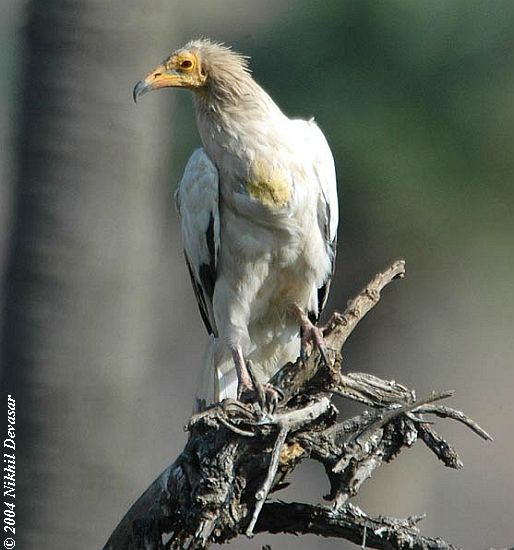
Orni-Theology

Hirundinidae – Swallows, Martins

Birds of the Bible – Swallows

Gospel Message

*

Busy Hummingbirds, Oblivious to Spectators

Violet-headed Hummingbird (Klais guimeti) by Michael Woodruff

Violet-headed Hummingbird (Klais guimeti) by Michael Woodruff

Busy Hummingbirds, Oblivious to Spectators

“Let your light so shine before men, that they may see your good works, and glorify your Father Who is in heaven.” (Matthew 5:16)

Luzon Bleeding-heart by Dan

Orni-Theology

As the cooling days of September fall from the calendar, like the abscission of colorful autumn leaves, the shelf-life of flower nectar nears its expiry date.  For just a few more days, the nectar pantries of bright-hued flowers are “open for business”, ready to feed the voracious appetites of neighborhood hummingbirds  —  those petite, iridescence-sparkled, blurry-winged wonders with super-sized metabolic fuel needs.  Floral nectar is a sweet resource!  Yet, as winter approaches, such fly-by “fast-food” opportunities cannot be taken for granted, especially if one is an energy-craving hummingbird.

Steely-vented Hummingbird by Wildstock Photos

Steely-vented Hummingbird by Wildstock Photos

Hummingbirds are famous for their (males’) jewel-like throats, their hovering and multi-directional flying, and their ability to change directions   —  stop, go, up, down, left, right, backward, forward, — using high-speed wings that whip figure-eight patterns faster than human eyes can follow, producing a humming sound (that explains their name) that almost sounds like a contented cat purring.   Hummingbirds, due to their speedy, darting movements, and their iridescent green colors, attract the eye.  So you see them  –  zip!  –  then you don’t.  Zip!  –  then you see them again.   The summer range of hummingbirds (such as the Ruby-throated Hummingbird, Archilochus colubris) is broad enough that most of us have seen hummingbirds, though it is unlikely that we ever see one relaxing!  No time to relax  —  their needle-like bills must sip up nectar where and when it is available!

Volcano Hummingbird (Selasphorus flammula) by Ian

Volcano Hummingbird (Selasphorus flammula) by Ian

The business of a hummingbird’s life is so intense, so metabolically demanding, that slurping up available nectar is a lifestyle priority, requiring dietary focus and persistence:  “Get nectar, get more nectar, get even more nectar!  Hurry, hurry, hurry!”  Sugar substitutes are unacceptable for hummingbirds – they must have real sugar to thrive.  See Elizabeth Mitchell, Our Creator’s Sweet Design for Hummingbird Taste, with a link (in its Footnote #1) to video footage of hummingbird sugar consumption.  (Obviously hummingbirds are a living exhibit that refutes “natural selection” mythology  —  see Frank Sherwin, Hummingbirds at ICR”, Acts & Facts, 35(9), September 2006 issue.

What an enormous appetite for such a miniature bird!  The calories consumed and burned by hummingbirds, on a boy weight ratio, are comparable to a human eating more than a 1000 hamburgers every day, as body fuel needed for a day’s normal activities!  (See Denis Dreves, The Hummingbird:  God’s Tiny Miracle, subtitled “If you operated at this bird’s energy level, you would burst into flames!”.

It is no surprise, therefore, that a hungry hummingbird hovered by brilliant vermillion flowers, in a garden spot I casually visited, as he (or she) slurped up nectar from one flower, then another flower, then another, — without any (apparent) concern for my physical presence or proximity, only a few steps from him (or her).  Why was the buzzing hummer oblivious of me, the birdwatcher so close by?

The hungry hummer was too preoccupied with the pressing business of life, to notice me, a quiet spectator.  What a privilege it was, to watch – for a long time, actually – this sparkling-in-the-sunlight hummingbird, darting among the bright flowers.

Fiery-throated Hummingbird (Panterpe insignis) by Raymond Barlow

Fiery-throated Hummingbird (Panterpe insignis) by Raymond Barlow

Yet are not our own lives, at least somewhat, like that busy hummingbird?  Are we not – day by day, hour by hour, minute by minute, moment by moment – preoccupied with the ever-pressing business of life, darting here-and-there, from this task to the next one, such that we often ignore the spectators, those watching eyes who observe and appreciate our lives – those who (hopefully) see God’s beauty and wisdom imaged in our own attitudes and actions?

Yes, we have audiences we should not be oblivious of.  As we live the moments of our fast-paced lives we should not forget three audiences, who watch us much more than we consciously realize.

First, there are many curious humans who watch our busy lives, especially those who are younger than us.  What kind of role-models are we?  Hopefully our Christian lives are like the Thessalonian believers whom Paul commended as examples to all of the believers in Macedonia and Greece (1st Thessalonians 1:7).  Who is watching us? Who is listening?  Who is evaluating the message(s) of our lives, comparing our “walk” to our “talk”?  Do our lives “shine” as God’s testifying “lights” (Matthew 5:16), such that our good deeds prompt spectators to glorify God our Heavenly Father?

Black-chinnedHummingbird (Archilochus alexandri) by S Slayton

Black-chinnedHummingbird (Archilochus alexandri) by S Slayton

Second, there are non-human spectators watching our lives:  angels!   Angels learn from watching the “spectacle” of human lives (1st Corinthians 4:9 & 11:10).  Indeed, the effect of God’s gospel of grace, in the earthly lives of redeemed humans, is something that angels can only learn about as spectators (1st Peter 1:12, since redemption is never experienced by angels.

Yet the most important audience we have, always, is the Lord Himself  (Jehovah-jireh, the God Who is and sees).  Our primary audience, always, is our omniscient and omnipresent Creator-God.  It is our wonderful Maker Who watches every sparrow’s avian lifespan, and we are of much greater value to God than the lives of many sparrows (Matthew 10:29-31; Luke 12:7).  As the Lord Jesus Christ’s vicarious death and resurrection has peremptorily proved, for all time and eternity, we are God’s favorite creatures.  God is caringly concerned with every detail of our busy lives (from creation to ultimate redemption), so let us not be oblivious to our most important Audience.  Do we live our earthly lives as ingrates, ignoring Him and His Word?  Or do we live life appreciative of Him and His Word, grateful that He created us and provided us with redemption in Christ?

Accordingly, with these three audiences in mind, as spectators of our busy lives, let us consider the prophet Ezekiel’s serious question (Ezekiel 33:10):  “how should we then live?”

By James J. S. Johnson

*

More Orni-Theology

Changed From the Inside Out

*


Yellow-headed and Red-winged Blackbirds: Living on the Inside or the Outside?

Yellow-headed Blackbird (Xanthocephalus xanthocephalus) ©WikiC Alan Vernon

Yellow-headed Blackbird (Xanthocephalus xanthocephalus) ©WikiC Alan Vernon

Draw nigh to God and He will draw nigh to you. (James 4:8)

Luzon Bleeding-heart by Dan

Orni-Theology

The Visitor Center at Jackson Hole, Wyoming (“Jackson Hole & Greater Yellowstone Visitor Center”), is a good place to go to for information on Grand Teton National Park, which borders the more-famous Yellowstone National Park.  Yet for bird-lovers, the visitor’s center itself is an attraction, in summer, because the marshy ponded area next to the building hosts a congregation of blackbirds, both Red-winged Blackbirds (Agelaius phoeniceus) and Yellow-headed Blackbirds (Xanthocephalus xanthocephalus).

If you are helping city kids to see these passerine icterids, tell them to “look for the tall corny-dogs growing in the wild” (cattails – Typha species, tall-stemmed wetland plants topped by a sausage-shaped flowering “spike”), around the pond.

As in many other lacustrine marshlands, red-winged blackbirds are often found perched among the cattails that grow as emergents among the wavy shoreline of pond.  For a redwing this is “prime real estate”, until the yellow-heads move in. How so?  In cattail dominated marsh-ponds, if both yellow-heads and red-wings are both present, the innermost places of the cattail “ring” are routinely occupied by the yellow-headed blackbirds, leaving the “outer” cattail positions (i.e., slightly farther away from the pond-water) for the redwings.

Why?  I have no idea why, but others have notice this. [E.g., see W. Braun’s observations in Blackbirds In Cattail Marshes , saying “The YHBs [yellow-headed blackbirds] clearly are the rulers of the cattails. They often, but not always, nest in the same marsh as the Red-winged Blackbird and the Common Grackles. The larger Yellow-headed Blackbird is dominant to the Red-winged Blackbird and displaces the smaller blackbird from the prime nesting spots.”]

Red-winged and Yellow-headed Blackbirds on Cattails ©Orcawatcher.com

Red-winged and Yellow-headed Blackbirds on Cattails ©Orcawatcher.com

Photo credit Orcawatcher.Com

But it reminds me of the dramatic difference between the apostle Peter and the Pharisee Nicodemus.  Peter was (almost) always close to Christ, and often so, but Nicodemus mostly kept his distance from Christ, at least publicly.

Far from being infallible, Peter is infamous for his cowardice that was indicted by a rooster crowing thrice (Luke 22:54-61).  Peter is also remembered for getting distracted, and becoming fearful, and sinking into the Sea of Galilee, after having miraculously walked on water for only a few steps (Matthew 14:24-33).  But Peter was wise enough to immediately cry out “Lord, save me!”  (And Jesus did.)  At least Peter did some walking on water (at Christ’s command, of course), which is a lot better than the other disciples who just stayed in the boat, as mere spectators, wonderfully how Jesus was enabling Peter to walk on water.

Red-winged Blackbird (Agelaius phoeniceus) by Ray

Red-winged Blackbird (Agelaius phoeniceus) by Ray

Likewise, Peter had the courage to step up and speak up – to call Jesus “the Christ, the Son of the living God” – a deed that the Lord Jesus commended Peter  — and God the Father —  for doing (Matthew 16:15-17).  And Peter did what he could to defend Jesus, in the Garden of Gethsemane, as Jesus was being arrested – Peter used a sword to chop off one man’s ear (Luke 22:49-51; John 18:10-11)!  (But unlike the Orcadian Viking known to history as Thorfinn Skull-splitter, Peter missed most of his victim’s head.)  It’s the thought that counts, right?

Yellow-hooded Blackbird (Chrysomus icterocephalus) ©Flickr Bob

Yellow-hooded Blackbird (Chrysomus icterocephalus) ©Flickr Bob

So you really have to love Peter.  (Jesus certainly did!)  Peter was one of the “inner” circle of three  –  just James, John, and Peter  — who were invited to witness the Lord Jesus Christ being glorified upon the Mount of Transfiguration (Matthew 17:1-8).  What an unforgettable privilege that was (2nd Peter 1:16-18)!  Jesus later invited the same “inner circle” of three to pray for Him in the Garden of Gethsemane (Matthew 26:37-38).  With all his faults, Peter was a truly privileged member of Christ’s “inner circle”.

But Peter’s privileges are not so high that we should feel sorry for Nicodemus.  Not at all!

Red-winged Blackbird (Agelaius phoeniceus) by Ray

What a privilege it was for Nicodemus to be the first listener to hear, what we now read in, John’s third chapter (John 3:1-9), including the everlastingly famous promise of John 3:16, spoken by Jesus Himself!  Later Nicodemus took a modest stand for Jesus (John 7:50-52), and in time Nicodemus had an official role in Christ’s burial (John 19:39-40) three days before Jesus rose triumphantly from the grave!

Even so, if one had the choice, why visit Christ, in secret, keeping a distance from Him in public, when the opportunity to belong to His “inner circle” is available?

Am I more like Peter or Nicodemus?  Maybe that question will come to mind next time you see a group of “inner circle” yellow-headed blackbirds, perching on cattails, as the “outer circle” of cattails hosts the red-winged blackbirds. And, if you like the idea of being in the Lord’s “inner circle”, you might sing this as a prayer:  “Just a closer walk with Thee…”

James J. S. Johnson, with his family, has repeatedly visited Wyoming’s Jackson Hole Visitor Center, in summer, to admire the yellow-headed and red-winged blackbirds that congregate on and among the pond-ringed cattails there. (And a very special thank-you to Lee for teaching me how to edit the typos in this blog.)

*